Corruption exposed: US meddled in Ecuador’s election, using Julian Assange as bargaining chip
A former minister of Ecuador testified that the US government conspired with a right-wing political party to run a disinformation campaign against the leftist Correísta movement, backing a millionaire banker for president in exchange for giving up journalist Julian Assange, who had asylum in the Ecuadorian embassy.
MP, Ben Norton, 13 Nov 22,
Ecuador’s former energy minister testified that the US government conspired with a right-wing political party to run a disinformation campaign against the leftist Correísta movement of ex President Rafael Correa.
He said that US “federal agents” pledged to help “influence” the 2017 presidential elections and support the candidacy of conservative millionaire banker Guillermo Lasso in exchange for the promise to turn over journalist Julian Assange, who had been given asylum by Correa and was stuck living for years in Ecuador’s embassy in London.
The former energy minister, Carlos Pareja Yannuzzelli, had fled a corruption investigation in Ecuador and was living as a fugitive from justice in the United States in late 2016 when he was offered large sums of money and US government protection in return for reading a carefully prepared “script” that made false accusations of corruption against Correa and his Vice President Jorge Glas, who was later imprisoned on highly dubious charges.
Pareja testified that the federal agents also coerced him into making false accusations against a US citizen, so they could justify their involvement in the Ecuadorian case. This led to the US citizen being arrested and imprisoned for three-and-a-half years.
Lasso ended up losing the 2017 election (before going on to win the 2021 election), but his victorious opponent, Lenín Moreno, later betrayed Assange anyway, letting British authorities raid the embassy, imprison the WikiLeaks journalist, and prepare to extradite him to the United States.
The revelation of this extraordinary example of Washington meddling in another country’s election came from one of the top officials in Ecuador’s oil industry……………………………………………………………
US intelligence-linked right-wing Ecuadorian politician uses corrupt US asset to accuse Correa of corruption……………………………………………..
Ecuador’s ex energy minister details US-backed campaign to help the right wing in the 2017 elections………………………………………………………..
it was widely assumed, even by Correa himself, that Correa’s former Vice President Lenín Moreno would continue his socialist political program.
Moreno did run on a left-wing presidential campaign, but after entering office, he did a political 180. Moreno turned hard to the right, repressing, imprisoning, and exiling Correísta politicians.
He also stabbed Julian Assange in the back, reversing Correa’s pledge to protect the WikiLeaks publisher and renouncing the Ecuadorian citizenship that had been given to the journalist. In order to arrest Assange, Moreno even let British authorities violate his own country’s sovereignty by storming the embassy, which constitutes Ecuadorian territory under the Vienna Convention in international law.
Correísta politicians have alleged that Moreno was bribed and/or blackmailed by the US government, as he obediently fulfilled all of Washington’s foreign-policy goals, collaborating closely with the Donald Trump administration, removing Ecuador from the Bolivarian Alliance (ALBA) and Union of South American Nations (UNASUR), and even recognizing US-appointed coup leader Juan Guaidó in Venezuela.
…………………………………………………………….. Corrupt Ecuadorian official conspired with Miami-based oligarchs who stole millions from their people……………………………………………. more https://multipolarista.com/2022/11/11/capaya-us-meddled-ecuador-election-assange/
Why is Bill Gates investing in nuclear power?

Such forms of corruption are also widespread in the nuclear industry, with groups like the Nuclear Energy Institute (NEI), devising marketing campaigns that benefit nuclear power plant owning companies, including influencing the appointment of officials to oversight bodies such as the Nuclear Regulatory Commission (NRC).
In this pursuit, the public also gets to foot the bill; in the case of TerraPower, taxpayers have put up tens of millions of dollars into this venture without ever being given an opportunity to provide or deny their informed consent for this technology.
Beyond Nuclear By M.V. Ramana and Cassandra Jeffery 14 Nov 22
………………………………………………………………………….Systemic Problems
Why is Bill Gates investing in nuclear power? This question comes up a lot, although frequently as a rhetorical excuse to wax eloquently about the virtues of nuclear technology. The answer is by no means straightforward.
Nuclear energy is only one lottery ticket among many for Bill Gates. He’s invested into dozens of companies, especially through Breakthrough Energy Ventures. Breakthrough’s investments range from companies that focus on energy storage — examples are Form Energy and Malta — to ones making new kinds of concrete, developing geothermal energy, and producing steel.
Gates has also secured a stake in the future of agriculture; in 2021, he was dubbed America’s largest private farmland owner.
Clearly, Gates’ strategy is to diversify his investments. If the Natrium reactor — TerraPower’s leading offering at this point — turns out to be a nuclear lemon, which is quite likely for the reasons discussed above, Gates will have a suite of investments to fall back on.
This tactic — diversifying assets and investments to increase the probability that at least one stake will pay off big time — is standard practice among venture capitalists. Other fellow billionaires investing in nuclear power have similarly diversified strategies.
Gates and fellow oligarchs have other strategies to maintain their wealth. They devote enormous financial resources and time to nurture their economic positions by political campaign financing and lobbying for favorable policies and regulations.
Such tactics are legal but amount to a form of corruption and facilitate the extraction of what economists call rents (for example, through the imposition of intellectual property protections), which are going to come in the way of climate mitigation as well.
Such forms of corruption are also widespread in the nuclear industry, with groups like the Nuclear Energy Institute (NEI), devising marketing campaigns that benefit nuclear power plant owning companies, including influencing the appointment of officials to oversight bodies such as the Nuclear Regulatory Commission (NRC).
Among the recent pieces of legislation that NEI lobbied for was the Nuclear Energy Innovation and Modernisation Act. Publicly endorsed by Gates, the law makes it easier for “next-generation advanced reactors,” the kind that TerraPower is developing, to be licensed for construction by the NRC.
Such behaviors, unfortunately, are standard for the large organizations that dominate today’s economy.
People like Bill Gates are billionaires because they hit the jackpot on a lottery ticket and then lobbied rule-makers to extract as much money as possible from that lottery ticket. These gains allow them to reinvest into a diversified portfolio to increase the odds of another windfall prize.
In this pursuit, the public also gets to foot the bill; in the case of TerraPower, taxpayers have put up tens of millions of dollars into this venture without ever being given an opportunity to provide or deny their informed consent for this technology.
The public — especially those who live near one of the sites targeted for new reactor deployment, the areas where uranium will be mined and processed, and wherever the long-lived nuclear waste will go — will be subject to environmental contamination, paying far more than just a financial cost.
Given the experimental technologies involved in these new nuclear reactor designs, the risks to such communities are considerable. Many of these risks will only become greater with climate change as extreme weather events become more frequent and challenge operations at nuclear plants.
The risks and wasted investments are mounting. Further, this obsession with nuclear power and other untested technologies diverts the public’s attention from the larger systemic drivers of the climate crisis: unabated capitalism and its need for never-ending economic growth.
Pushing the nuclear agenda furthers the falsehood that growth can continue indefinitely with no limits, and the pretense that climate change can be solved using one more technology from the same toolbox that caused the problem in the first place.
“Those most responsible for creating the problem [of climate change] will see to it that they profit from the solution that they propose,” observed Indian writer Arundhati Roy in 2019. People like Gates exemplify that observation. Not only do they create the conditions for accelerating global warming but they also see to it that they are amply rewarded when they claim to know how to solve climate change.
Bill Gates might well be interested in finding a solution to climate change but he seems far more devoted to maintaining the current system for as long as it is feasible. Protecting this system requires, among other things, selling people the idea that the system is capable of solving climate change. Selling nuclear power is part of that larger sales job.
M.V. Ramana is the Simons Chair in Disarmament, Global and Human Security and Professor at the School of Public Policy and Global Affairs, University of British Columbia, Vancouver, Canada, and the author of The Power Of Promise: Examining Nuclear Energy In India. Cassandra Jeffery holds a Master’s degree in Public Policy and Global Affairs from the University of British Columbia and is the recipient of a Simons Award in Nuclear Disarmament and Global Security for research into the political economy of nuclear energy. https://beyondnuclearinternational.org/2022/11/13/bill-gates-and-techno-fix-delusions/
A Father Fights for His Son & What’s Left of Democracy
The film Ithaka, about the quest of Julian Assange’s father to save his son, makes its U.S. premiere on Sunday in New York City. It is reviewed by Joe Lauria.
By Joe Lauria
Special to Consortium News
To the extent that the media has covered the tragedy of Julian Assange at all, the focus has been on politics and the law.
Consortium News, which has provided perhaps the most comprehensive coverage of the prosecution under the Espionage Act of the WikiLeaks publisher, has also focused more on the case and less on the man.
The great issues involved transcend the individual: war, diplomacy, official deception, high crimes, an assault on press freedom and on the core of what little democracy is left in a militarized and money-corrupted system.
Assange supporters sometimes also overlook the person and concentrate instead on the larger issues at stake. Ironically, it has been Assange’s enemies and detractors who’ve long focused on the person in the worst tradition of ad hominem assaults.
He has been attacked to deflect public attention from what WikiLeaks has revealed, from what the state is doing to him and to hide the impact on freedom in the media and standards in the courtroom.
There has been a steady and organized stream of smears against Assange, from ridiculous stories about him smearing feces on Ecuadoran Embassy walls to the widely reported falsehood that he was charged with rape. That case was dropped three times before any charges were filed, but the “rape” smear persists.
These personal attacks were planned as far back as March 8, 2008 when a secret, 32-page document from the Cyber Counterintelligence Assessment branch of the Pentagon described in detail the importance of destroying the “feeling of trust that is WikiLeaks’ center of gravity.” The leaked document, which was published by WikiLeaks itself, said: “This would be achieved with threats of exposure and criminal prosecution and an unrelenting assault on reputation.”
An answer to these slurs and the missing focus on Assange as a man is Ithaka. The film, which makes its U.S. premiere Sunday night in New York, focuses on the struggle of Assange’s father, John Shipton, and his wife, Stella Assange, to free him.
f you are looking for a film more fully explaining the legal and political complexities of the case and its background, this is not the movie to see. The Spanish film, Hacking Justice, will give you that, as well as the more concise exposition in the brilliant documentary, The War on Journalism, by Juan Passarelli.
Ithaka, directed by Ben Lawrence and produced by Assange’s brother, Gabriel Shipton, humanizes Assange and reveals the impact his ordeal has had on the people closest to him.
The title comes from the poem of that name by C.P. Cavafy (read here by Sean Connery) about the pathos of an uncertain journey. It reflects Shipton’s travels throughout Europe and the U.S. in defense of his son, arguably the most consequential journalist of his generation.
The story begins with Shipton arriving in London to see his son for the first time behind bars after the publisher’s rights of asylum were lifted by a new Ecuadoran government leading to him being carried out of the embassy by London police in April 2019.
“The story is that I am attempting in my own … modest way to get Julian out of the shit,” Shipton says. “What does it involve? Traipsing around Europe, building up coalitions of friendship.” He meets with parliamentarians, the media and supporters across the continent. Shipton describes the journey as the “difficulty of destiny over the ease of narrative.”……………………………
We learn that Julian Assange’s frustration with the inability to stop the 2003 Iraq invasion, despite the largest, worldwide anti-war protests in history, motivated him to start WikiLeaks.
The releases he published about the Iraq and Afghanistan wars, leaked by Army intelligence analyst Chelsea Manning, were published not only by WikiLeaks but by its partners at The New York Times, Die Spiegel and The Guardian, yet only Assange has been prosecuted.
The main focus of the film is the extradition hearing in Westminster Magistrate’s Court that began in February 2020 and ended in September of that year…………………………
One of several scenes that drives home the personal side of the story is audio of Assange speaking from Belmarsh Prison to Stella about what children’s books to read to their two sons. The toll it is taking on her is seen as she breaks down emotionally during the recording of a BBC interview that has to be paused.
“Extraditions are 99 percent politics and one percent law,” Stella says. “It is entirely the political climate around the case that decides the outcome. And that is shaped by the media. For many years there was a climate that was deliberately created through false stories, smears; through a kind of relentless character attack on Julian to reduce that support and make it more likely to successfully extradite him to the United States.”
“This is the public narrative that has been spread in the media for ten years,’ Nils Melzer, the now former U.N. Special rapporteur on torture, says in the film.
“No one has been able to see how much deception there is. Why is this being done? For ten years all of us were focused only on Julian Assange, when he never wanted it to be about him. It never was about him. It was about the States and their war crimes and their corruption. That’s what he wanted to put a spotlight on – and he did. And that’s what made them angry. So they put the spotlight on him.”
“He just needs to be treated like a human being,” says Stella, “and be allowed to be a human being and not denied his dignity and his humanity, which is what has been done to him.”
Ithaka makes its first theatrical showing in the U.S. at the SVA Cinema, 333 W. 23rd St, New York, N.Y., on Sunday, Nov. 13, at 7:45 pm. There will be a Q&A following the first screening with Ben Lawrence, Gabriel Shipton, Adrian Devant, cinematographer Niels Ladefoged, and John Shipton.
For ticket information: https://docnyc.net/film/ithaka/ https://consortiumnews.com/2022/11/11/a-father-fights-for-his-son-whats-left-of-democracy/
U.S. House Intelligence Committee questioned about alleged surveillance of WikiLeaks founder
A Spanish judge has asked the US House Intelligence Committee to provide information regarding the alleged surveillance of Julian Assange and his visitors during his seven-year-long stay in the Ecuadorian embassy in London
El Pais, JOSÉ MARÍA IRUJO, Madrid – NOV 05, 2022 Judge Santiago Pedraz of Spain’s National High Court has filed a request for judicial assistance with the United States House Intelligence Committee. He is asking the committee – charged with overseeing the US intelligence community – to provide his office with information pertaining to a Spanish firm that may have surveilled WikiLeaks founder Julian Assange.
While Assange was protected by the Ecuadorian embassy in London – in an attempt to avoid extradition to the United States to face charges over leaking thousands of classified documents – he was allegedly subjected to espionage by the Spanish security firm Undercover Global SL. Pedraz has pointed out that the CIA may have been a possible recipient of the material that was collected on Assange.
In October of 2021, Adam Schiff – a Democratic congressman and Chairman of the House Intelligence Committee – demanded that all American security agencies inform him about espionage activity that took place concerning Assange during his seven-year-long stay (2012-19) in the Ecuadorian embassy, before he was turned over to British police. Schiff’s initiative came after Yahoo News published a report, in which unnamed former US officials acknowledged the existence of a plan to kidnap Assange from the embassy in 2017. They also claimed that US spies had been monitoring the communications and movements of numerous WikiLeaks personnel.
Undercover Global SL is a Cádiz-based security firm, owned by retired Spanish military officer David Morales. It was hired by the Ecuadorian embassy to the United Kingdom to provide security.
An investigation by EL PAÍS revealed that, in 2019, Morales and his employees may have recorded several months worth of private conversations between Assange and his lawyers, while spying on dozens of his visitors, including medical personnel, politicians and journalists.
The publication in this newspaper of the audios and videos of the alleged espionage led to the arrest of Morales. Since 2019, Spain’s National High Court has been investigating him for crimes against privacy and for violating the confidentiality of attorney-client privilege. Morales is currently out on bail……………………….
In his formal legal request for information, Pedraz describes, in detail, the espionage to which he believes Assange was subjected to at the Ecuadorian embassy. He notes that some of the alleged victims of espionage include former US congressman Dana Rohrabacher and former-president Correa.
Pedraz has also previously requested the testimony of Mike Pompeo. A Trump appointee, Pompeo was the Director of the CIA from 2017 until 2018, before being appointed Secretary of State. William Evanina’s testimony has also been requested: he was the Director of the National Counterintelligence and Security Center from 2014 until 2021, serving under a portion of the Obama administration and the entirety of the Trump administration.
This is not the first time that the National High Court of Spain has requested judicial assistance from the US government to investigate this case. Retired judge José de la Mata – Pedraz’s predecessor – previously asked American authorities to provide him with the IP addresses from which the UC Global SL server had been accessed. But the US Justice Department demanded that De la Mata first reveal the identities of the whistleblowers within UC Global SL, who gave him the details about the alleged espionage……………….
Pedraz continues to ask US authorities for the same data and testimonies that De la Mata requested. He has explained to the House Intelligence Committee that, after three years of investigations, all signs point to US intelligence agencies having been the recipients of whatever UC Global SL gathered while surveilling Assange.
This past August, a group of US citizens who visited Assange in the Ecuadorian embassy sued former CIA director Mike Pompeo for alleged espionage. The lawsuit was filed by lawyers Margaret Ratner Kunstler and Deborah Hrbek, as well as journalists John Goetz and Charles Glass, both specialists in national security issues.
The suit claims that all four plaintiffs – along with dozens of other individuals – were spied on while visiting Assange during Pompeo’s tenure at the CIA. It cites statements made by Pompeo, in which he said that the WikiLeaks founder was a “target.”
The lawyers and journalists suing Pompeo believe that the CIA hired David Morales and his company to spy on Assange, his communications and his visitors, in order to learn his defense strategy in the face of the US extradition request. https://english.elpais.com/international/2022-11-05/house-intelligence-committee-questioned-about-alleged-surveillance-of-wikileaks-founder.html
At COP27 Climate Summit the International Atomic Energy Agency joins all those paid nuclear lobbyists in pushing the lie that “nuclear solves the climate problem”
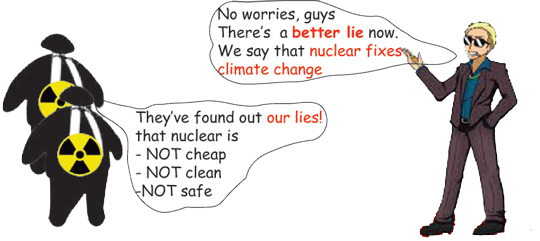
At COP27, nuclear power industry vies for bigger role in decarbonizing planet
https://www.reuters.com/business/cop/cop27-nuclear-power-industry-vies-role-decarbonizing-planet-2022-11-09/ By Richard Valdmanis, Sarah Mcfarlane and Valerie Volcovici
HARM EL-SHEIKH, Egypt, Nov 9 (Reuters) – Nuclear energy supporters including politicians and activists sought to polish the industry’s spotty image on Wednesday, using the COP27 climate summit in Egypt to argue that atomic power offers a safe and cost-efficient way to decarbonize the world.
Rising concerns about the swift pace of climate change and tight power supplies around the globe have softened some policy makers view of nuclear energy, an industry that has struggled for years to draw investment because of worries about safety, radioactive waste, and huge costs for building a reactor.
The International Atomic Energy Agency, an intergovernmental organization that seeks to promote nuclear power, opened an exhibit at the U.N. climate gathering of global leaders in Egypt – its first time doing so in 27 years of the annual international climate negotiations. The showcase expounded the technology’s potential in the fight against climate change.
When you talk about nuclear, you’re talking about a confirmed energy producer which is not part of the problem, but rather part of the solution,” IAEA Director General Rafael Mariano Grossi told Reuters in an interview.
“You will see that that nuclear energy has a really solid, very consistent safety record,” he added.
U.S. Special Climate Envoy John Kerry, meanwhile, pumped up the industry on Tuesday at a news conference at the summit announcing the U.S. Export-Import Bank (EXIM)’s formal interest in providing $3 billion in financial support for a nuclear plant in Romania.
“We have a viable alternative in nuclear … This is one of the ways in which we can achieve net-zero,” he told reporters, referring to an international target of cutting net greenhouse gas emissions to zero by 2050. “We don’t get to net zero by 2050 without nuclear power in the mix.”
The United States has already earmarked billions of dollars toward keeping existing nuclear power plants open as part of a broader strategy to decarbonize the economy and is hoping to encourage new projects.
The nuclear power industry has had trouble raising money in recent years, having taken a huge public relations hit following the 2011 reactor meltdown at the Fukushima power plant in Japan. Russia’s invasion of Ukraine has further raised concerns about nuclear safety with sporadic fighting and power cuts at the site of the Zaporizhzhia plant.
Oleksii Riabchyn, advisor to the Ukraine government on green energy, told Reuters at the summit that he thought the country’s reactors required a missile shield to protect them.
AEA’s Grossi said the security concerns in Ukraine should not dissuade countries from building nuclear plants: “The big problem is war, is not nuclear energy or any other industrial activity.”
He added he was in the midst of “very complex” negotiations with Russia and Ukraine over a proposed no-combat zone around the plant and hoped for an agreement soon.
Hannah Fenwick, the co-lead of Nuclear for Climate which represents a network of 150 associations advocating for governments to embrace nuclear power, said her organization was lobbying policy-makers at COP27 to consider nuclear energy investments and was getting decent feedback.
“We have been saying that nuclear is a solution for climate for many years and the geopolitical climate has changed and people are now listening,” she said.
Reporting by Richard Valdmanis, Sarah McFarlane and Valerie Volcovici; Editing by Katy Daigle, Frank Jack Daniel and Deepa Babington
How the CIA Front group National Endowment for Democracy Laid Foundations for Ukraine War

In the hours following Russia’s invasion of Ukraine, NED hurried to remove any and all trace of its funding for organizations in Ukraine from its website.
A search of the NED grants database today for Ukraine returns “no results,” but a snapshot of the page captured February 25th reveals that since 2014, a total of 334 projects in the country have been awarded a staggering $22.4 million. By NED President Duane Wilson’s reckoning, Kiev is the organization’s fourth-largest funding recipient worldwide.
NED’s expurgation of records exposing its role in fomenting and precipitating the horror now unfolding in southeast Ukraine not only protects de facto CIA agents on the ground. It also reinforces and legitimizes the Biden administration’s fraudulent narrative, endlessly and uncritically reiterated in Western media, that Russia’s invasion was entirely unprovoked and groundless.
Substack, Kit Klarenberg, Jul 2, 22
Obvious examples of Central Intelligence Agency covert action abroad are difficult to identify today, save for occasional acknowledged calamities, such as the long-running $1 billion effort to overthrow the government of Syria, via funding, training and arming barbarous jihadist groups.
In part, this stems from many of the CIA’s traditional responsibilities and activities being farmed out to “overt” organizations, most significantly the National Endowment for Democracy (NED).
Founded in November 1983, then-CIA director William Casey was at the heart of NED’s creation. He sought to construct a public mechanism to support opposition groups, activist movements and media outlets overseas that would engage in propaganda and political activism to disrupt, destabilize, and ultimately displace ‘enemy’ regimes. Subterfuge with a human face, to coin a phrase.
Underlining the Endowment’s insidious true nature, in a 1991 Washington Post article boasting of its prowess in overthrowing Communism in Eastern Europe, senior NED official Allen Weinstein acknowledged, “a lot of what we do today was done covertly 25 years ago by the CIA.”
It Begins…
Fast forward to September 2013, and Carl Gershman, NED chief from its launch until summer 2021, authored an op-ed for The Washington Post, outlining how his organization was hard at work wresting countries in Russia’s near abroad – the constellation of former Soviet republics and Warsaw Pact states – away from Moscow’s orbit.
Along the way, he described Ukraine as “the biggest prize” in the region, suggesting Kiev joining Europe would “accelerate the demise” of Russian leader Vladimir Putin. Six months later, Ukraine’s elected President Viktor Yanukovych was ousted in a violent coup.
Writing in Consortium News not long before that fateful day, investigative legend Robert Parry recorded how, over the previous year, NED had funded 65 projects in Ukraine totaling over $20 million. This amounted to what the late journalist dubbed “a shadow political structure of media and activist groups that could be deployed to stir up unrest when the Ukrainian government didn’t act as desired.”
NED’s pivotal role in unseating Yanukovych can thus be considered beyond dispute, an unambiguous matter of record – yet not only is this never acknowledged in the mainstream press, but Western journalists aggressively rubbish the idea, viciously attacking those few who dare challenge the established orthodoxy of US innocence.
As if to assist in this deceit, NED has removed many entries from its website in the years since the coup, which amply underline its role in Yanukovych’s overthrow.
Read more: How the CIA Front group National Endowment for Democracy Laid Foundations for Ukraine WarFor example, on February 3rd 2014, less than three weeks before police withdrew from Kiev, effectively handing the city to armed protesters and prompting Yanukovych to flee the country, NED convened an event, Ukraine’s lessons learned: from the Orange Revolution to the Euromaidan.
It was led by Ukrainian journalist Sergii Leshchenko, who at the time was finishing up an NED-sponsored Reagan–Fascell Democracy Fellowship in Washington DC.
Alongside him was Nadia Diuk, NED’s then-senior adviser for Europe and Eurasia, and graduate of St. Antony’s College Oxford, a renowned recruiting pool for British intelligence founded by former spies. Just before her death in January 2019, she was bestowed the Order of Princess Olga, one of Kiev’s highest honors, a particularly palpable example of the intimate, enduring ties between NED and the Ukrainian government.
While the event’s online listing remains extant today, linked supporting documents – including Powerpoint slides that accompanied Leshchenko’s talk, and a summary of “event highlights” – have been deleted.
What prompted the purge isn’t clear, although it could well be significant that Leshchenko’s oratory offered a very clear blueprint for guaranteeing the failure of 2004’s Orange Revolution – another NED-orchestrated putsch – wasn’t repeated, and the country remained captured by Western financial, political and ideological interests post-Maidan. It was a roadmap NED subsequently followed to the letter.
Along the way, Leshchenko highlighted the importance of funding NGOs, exploiting the internet and social media as “alternative [sources] of information,” and the danger of “unreformed state television.”
So it was that on March 19th, representatives of the far-right Svoboda party – which has been linked to a false flag massacre of protesters on February 20th, an event that made the downfall of Yanukovych’s government a fait accompli – broke into the office of Oleksandr Panteleymonov, chief of Ukraine’s state broadcaster, and beat him over the head until he signed a resignation letter.
That shocking incident, motivated by the station broadcasting a Kremlin ceremony at which Vladimir Putin signed a bill formalizing Crimea as part of Russia, was one of many livestreamed by protesters that traveled far and wide online.
Panteleymonov’s savage defenestration notwithstanding, much of this livestreamed output served to present foreign audiences with a highly romantic narrative of the demonstrations, and their participants, which bore no relation to reality.
The Revolution Will Be Televised
Writing in NED’s quarterly academic publication Journal of Democracy in July that year, Leshchenko discussed in detail the media’s fundamental role in the Maidan coup’s success, drawing particular attention to the work of “online journalist” Mustafa Nayyem.
Nayyem personally kickstarted the protests the previous November, rallying hundreds of his Facebook followers to protest in Kiev’s Independence – now Maidan – Square, after Yanukovych scrapped the Ukrainian-European Association Agreement in favor of a more agreeable deal with Moscow.
Nayyem was no ordinary “online journalist”. He had by that point worked alongside Leshchenko for many years at Ukrainska Pravda, an opposition media outlet funded by NED, and also USAID, another CIA front, which likewise played a key role in the Maidan coup.
This may account for why, in October 2012, Nayyem was one of six Ukrainians whisked to Washington DC by Meridian International, a State Department-connected organization that identifies and grooms future overseas leaders, to “observe and experience” that year’s Presidential election………………………………………….
only 40 – 45 percent of Ukrainians were in favor of European integration, Yanukovych remained “the most popular political figure in the country,” and no poll conducted to date had ever indicated mass support for the uprising.
In fact, “quite large majorities” opposed “takeover of regional governments by the opposition,” and the population remained bitterly divided on the future of Ukraine, Darden and Way wrote. Such hostility stemmed from “anti-Russian rhetoric and the iconography of western Ukrainian nationalism,” rife among demonstrators, “not [playing] well among the Ukrainian majority.”
…….. “Anti-Russian forms of Ukrainian nationalism expressed on the Maidan are certainly not representative of the general view of Ukrainians. Electoral support for these views and for the political parties who espouse them has always been limited,” Darden and Way concluded. “Their presence and influence in the protest movement far outstrip their role in Ukrainian politics and their support barely extends geographically beyond a few Western provinces.”
‘Pro-Ukrainian Agenda’……………………………. an objective analysis of what actually happened and why, in which NED is completely central. Still, the organization didn’t need to rely purely on Leshchenko to keep the Minsk Accords moribund. Its extensive network of assets in the country, and Washington’s dark alliance with Ukraine’s far-right, was more than sufficient to ensure that Zelensky’s overwhelmingly popular mission of restoring relations with Russia would and could never be fulfilled.
‘In Solidarity’
In the hours following Russia’s invasion of Ukraine, NED hurried to remove any and all trace of its funding for organizations in Ukraine from its website.
A search of the NED grants database today for Ukraine returns “no results,” but a snapshot of the page captured February 25th reveals that since 2014, a total of 334 projects in the country have been awarded a staggering $22.4 million. By NED President Duane Wilson’s reckoning, Kiev is the organization’s fourth-largest funding recipient worldwide.
An archive of NED funding in Ukraine over 2021 – which has now been replaced with a statement “in solidarity” with Kiev – offers extensive detail on the precise projects backed by the CIA front over that fateful 12-month period.
It points to a preponderant focus on purported Russian misdeeds in eastern Ukraine. One grant, of $58,000, was provided to the NGO Truth Hounds to “monitor, document, and spotlight human rights violations” and “war crimes” in the Donetsk and Luhansk regions.
Another, of $48,000, was provided to Ukraine’s War Childhood Museum to “educate the Ukrainian public about the consequences of the war through a series of public events.” Yet another received by charity East-SOS aimed to “raise public awareness” of “Russia’s policies of persecution and colonization in the region, and document illustrative cases,” its findings circulated to the UN Human Rights Council, European Courts of Human Rights, and International Court of Justice.
There was no suggestion this wellspring would be used to document any abuses by Ukrainian government forces. UN research indicates 2018 – 2021, over 80 percent of civilian casualties were recorded on the Donbas side. Meanwhile, Organization for Security and Cooperation in Europe reports show that shelling of civilian areas in the breakaway regions intensified dramatically in the weeks leading up to February 24th, potentially the precursor of a full-blown military offensive.
As such, NED’s expurgation of records exposing its role in fomenting and precipitating the horror now unfolding in southeast Ukraine not only protects de facto CIA agents on the ground. It also reinforces and legitimizes the Biden administration’s fraudulent narrative, endlessly and uncritically reiterated in Western media, that Russia’s invasion was entirely unprovoked and groundless.
Ukrainians now live with the mephitic legacy of that reckless, unadmitted meddling in the most brutal manner imaginable. They may well do for many years to come. Meanwhile, the men and women who orchestrated it rest comfortably in Washington DC, insulated from any scrutiny or consequence whatsoever, every day cooking up fresh schemes to undermine and topple troublesome foreign leaders, hailed as champions of liberty by the mainstream press every step of the way. https://kitklarenberg.substack.com/p/anatomy-of-a-coup-how-cia-front-laid
Azov Nazi speaks to school kids across America
http://space4peace.blogspot.com/2022/11/azov-nazi-speaks-to-school-kids-across.html Bruce Gagnon, 7 Nov 22, I know this is hard to imagine – to believe. An Azov death squad member – a Nazi being paraded across the US to speak to school students. As we like to say – this takes the cake!
And to top it off he gets interviewed on MSNBC TV. The so-called ‘liberal’ channel.
This is how the minds of American youth are being contaminated with trash – filth – pure evil.
This is how fascism is being introduced to young people across our land.
This is a total disgrace.
This is being supported/organized by the neo-con run Democratic Party that a high percentage of American ‘peaceniks’ will be voting for on November 8.
Can we say that most Americans are blind and confused? Yes for sure.
This makes me sick.
Remember WW II Italian leader Benito Mussolini’s definition of fascism – the ‘wedding of corporations and government’.
This is what we have in the USA today.
Ukrainian First Lady Zelenska ordered The Grayzone’s Web Summit cancellation
The Grayzone, MAX BLUMENTHAL·NOVEMBER 3, 2022
Irish media and sources close to Web Summit’s CEO confirm The Grayzone was banned from the gathering as the result of a personal campaign waged by Olena Zelenska, the wife of Ukrainian President Volodymyr Zelensky.
The Grayzone was disinvited from Web Summit, a tech industry mega-event in Lisbon, Portugal this November, following a personal lobbying campaign spearheaded by Ukrainian First Lady Olena Zelenska. Zelenska was the surprise keynote speaker at Web Summit, addressing conference attendees on November 1.
This outlet learned of Zelenska’s role in our cancellation from several sources close to Web Summit CEO Paddy Cosgrave. Their accounts were confirmed in a November 3 report by the Irish Examiner, which noted that The Grayzone’s Max Blumenthal and Aaron Mate “had been cancelled from the event at the insistence of the first lady of Ukraine Olena Zelenska…”
According to a source privy to internal communications among Web Summit organizers, Zelenska “and the highest levels of the Ukrainian government” threatened to “apply significant influence on sponsors” if the summit did not cancel The Grayzone and academic Noam Chomsky, who had also been invited to speak.
She basically said she was gonna yank the whole tablecloth off of the table and break everything,” the source said.
The source explained that in order to prevent the possible sabotage of his event, Web Summit chief executive Paddy Cosgrave decided to “give up” Blumenthal and Mate in exchange for “keeping” Chomsky.
Additionally, The Grayzone’s Anya Parampil was unable to access her Web Summit ticket upon arriving in Lisbon despite having been granted a press credential for the event.
A second source close to Web Summit organizing discussions emphasized the Ukrainian First Lady’s influence over the event, explaining Zelenska “would have been able to get quite a number of people to pull out, big companies or whatever, I would say that was a strong possibility.”
“The bottom line is you were dropped because that’s what she [Zelenska] wanted,” the source stated.
Yet Zelenska demands did not end with her call to cancel The Grayzone.
Zelenska cancels nuclear button memes………..
The Ukrainian first lady is due to remain in Lisbon throughout the week to lobby government officials and tech bigwigs to support the Ukrainian war effort.
A Web Summit source said their colleagues were well aware that “a small group of Atlantic Council people and Bellingcat people” helped coordinate the social media campaign to disinvite The Grayzone.
The Atlantic Council and Bellingcat are NATO-related lobbying groups which rely on funding from the US and British governments, as well as assorted pro-NATO oligarchs. The former organization, a DC-based think tank which has hosted Bellingcat founder Elliot Higgins as a resident fellow, has also received funding from the corruption-stained Ukrainian gas company, Burisma.
The Ukrainian Ministry of Digital Transformation and Ukrainian embassy in Portugal also participated in the censorship blitzkreig, delivering a letter to Web Summit organizers which demanded The Grayzone’s staff be banished from the conference.
Since the US-backed Maidan coup in 2014, Kiev has maintained an iron grip on the flow of information. All opposition media has been effectively banned under the watch of Zelensky, and of the 400-some journalists listed on the Ukrainian government’s semi-official “hit list,” known as Myrotvorets, at least a dozen have been murdered. Now, Zelensky and his wife have brought their government’s war on the press and free exchange of ideas well into the heart of Western Europe.
The Grayzone attends private dinner with Web Summit organizers
On the evening of November 2, The Grayzone’s Max Blumenthal, Aaron Mate, and Anya Parampil attended a private dinner in Lisbon organized by Web Summit chief executive Paddy Cosgrave. There, they and other guests discussed the proxy war in Ukraine, the dangers of NATO expansion, and the upcoming US midterm elections.
The Grayzone’s presence at the private dinner generated headlines the following day in the Irish Examiner and the Business Post, the latter of which tasked two reporters with covering the story.
more https://thegrayzone.com/2022/11/03/ukrainian-zelenska-grayzones-web-summit/
Australia’s ongoing nuclear submarine debacle – ‘A tangle of overlapping interests’

https://undueinfluence.substack.com/p/a-tangle-of-overlapping-interests?utm_source=post-email-title&publication_id=297295&post_id=82059669&isFreemail=true&utm_medium=email Michelle Fahy 5 Nov 22
The federal government’s secret hiring from 2015 of numerous former US Navy officials to advise on Australia’s submarine procurement was exposed by The Washington Post a fortnight ago. “Some of the retired admirals have worked for the Australian government while simultaneously consulting for US shipbuilders and the US Navy, including on classified programs,” the Post said. The US officials benefited financially from “a tangle of overlapping interests”. The Post revealed that one former US admiral had been consulting to Australia while also occupying a full time position as chairman of the board of Huntington Ingalls Industries, a US company that builds US nuclear-powered submarines. That arrangement was abandoned in April this year due to conflict of interest concerns.
Australian defence experts Mike Scrafton and Richard Tanter have outlined the implications of these revelations in John Menadue’s public policy journal, Pearls and Irritations.
Mike Scrafton said, “What remains unclear now is the extent to which the abandonment of the French submarine and the decision to pursue a nuclear powered version was influenced by the Americans. The dramatic shift to the AUKUS project casts the role of the ex-US officials in a different light.”
Red flags have been a feature of Australia’s submarine procurement process since the original deal with France’s Naval Group in 2016. Concerns there included the government’s selection of Naval Group despite it being under investigation for corruption in three earlier shipbuilding contracts, with a fourth investigation added after Australia handed Naval Group the deal. Neither this alarming fact, nor other questionable aspects of the deal, triggered a rethink to find a more suitable contractor. The Washington Post revelations now raise even more questions about the backroom dealings in this disastrous extended procurement process.
Israeli finance minister added to Kiev’s ‘kill list’
Rt.com 31 Oct 22,
The Mirotvorets website labeled Avigdor Lieberman a “Russian agent of influence,” who took part in acts of “humanitarian aggression” against Ukraine
Israeli finance minister, Avigdor Lieberman has been added to the controversial Mirotvorets website “enemies of Ukraine” database on Sunday.
The authors of the site, which is believed to have links to the Ukrainian security services, described Lieberman as an “agent of influence” for Russia, who had been manipulating publicly significant information in favor of Moscow. They also blamed him for taking part in acts of “humanitarian aggression” against Ukraine.
Among the actions that led to Lieberman being placed on the list, were his refusal to finance an Israeli field hospital in Ukraine in March and his neutral stance on who is to blame for the massacre in the Kiev suburb of Bucha in April. The website also shared a link to an article, claiming that he had ties with Russian gas giant Gazprom.
Ukrainian authorities have frequently expressed their disappointment with the level of support they’ve been getting from Israel during the conflict with Russia. The country has only provided Kiev with humanitarian aid and life-saving defense equipment, but not weapons and munitions. Israel also refrained from joining international sanctions on Moscow. Last week, Liberman said that Israeli assistance to Ukraine since the outbreak of the fighting between Russia and Ukraine in late February amounted to some $40 million……………………………..
The Mirotvorets website, translated as ‘peacemaker’, was launched in 2014, positioning itself as an independent database run by anonymous moderators to help Ukrainian authorities and “special services” apprehend pro-Russian terrorists, separatists, and war criminals, among others.
However, some have branded the database a ‘kill list,’ which is backed by the government, after several individuals, including writer Oles Buzina, politician Oleg Kalashnikov, and Russian journalist Darya Dugina were assassinated shortly after their profiles appeared on the website.
The most recent high-profile additions to Mirotvorets included Kazakhstan’s president, Kassym-Jomart Tokayev, Pink Floyd co-founder Roger Waters. There were claims that the world’s richest man, Elon Musk, was put on the database in mid-October, but swiftly removed from it. The alleged addition happened after Musk offered a peace plan, which envisaged Kiev giving up territories to Moscow. https://www.rt.com/russia/565651-lieberman-israel-ukraine-mirotvorets/
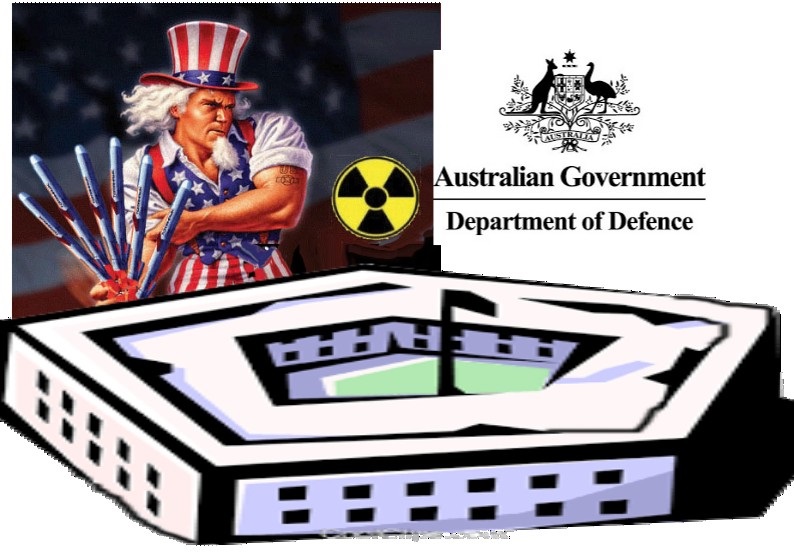
The Pentagon builds a network in our Australian Department of Defence amidst media silence
https://johnmenadue.com/pentagon-takes-over-australias-defence-policies-amidst-media-silence/ By John MenadueOct 29, 2022,
It is more than inter-operability and inter-changeability with the US military. Anthony Albanese and Richard Marles need to break up the American network in our Department of Defence that the Washington Post has exposed.
The Washington Post has found that a retired US Admiral is ‘now a Deputy Secretary of Defense for Australia’.
I wonder how the Admiral handles ASTEO documents- for Australian eyes only?
In the last few days in Pearls and Irritations, Mike Scrafton and Richard Tanter have exposed how retired US Admirals have been employed as highly paid consultants to shape our policies on submarines.
At the same time our media has shown no interest or concern. This is more than ‘foreign influence’. It looks more like foreign control.
As Paul Keating recently put it,‘our strategic sovereignty is being outsourced to another country, the US’.
It was the Washington Post, not our Corporate Media that has given us an insight into the abdication of responsibility of our politicians, public officials and journalists who have been on a Washington drip feed for so long. They have been captured by American interests, particularly the US military and industrial complex that former President Eisenhower warned us about.
Following the first Washington Post exposures, the authors then ran a webinar from which the Post has printed a Q and A.
The webinar includes the following:
“In court papers, the Justice Department and Pentagon officials were very clear about this: They argued that disclosing the documents might subject retired generals, admirals and others to embarrassment and/or harassment, and would be an invasion of their privacy.”
“We have more stories we’re working on – stay tuned. Congress has taken some half-steps in recent years to require the Pentagon to disclose more details about retired generals and admirals working for foreign governments. But the Pentagon hasn’t been very forthcoming. Maybe that will change now.”
Q: “What was something which personally shocked you during your investigation?
From Nate Jones:
“I was surprised to learn Admiral Stephen Johnson is now a deputy Secretary of Defense for Australia.”
From Craig Whitlock:
“I was surprised by how many retired U.S. generals went to work as advisors and consultants to the Saudi Crown Prince AFTER he approved the assassination of Saudi journalist Jamal Khashoggi in 2018. I mean, hello?”
Q: “Do they have to disclose anything about what they do?
From Nate Jones:
“Here is a sample of former national security advisor James Jones’s application. You can see he discloses some things in a page or two.”
From Craig Whitlock:
“The war in Yemen is a good example of a terrible, unintended consequence. The Pentagon and State Dept have authorized more than 300 retired US military personnel to work as contractors or consultants for Saudi Arabia and UAE since 2015. During that time, KSA and UAE have bombed the heck out of Yemen, turning their civil war into a far worse humanitarian disaster. US has enabled that to a significant degree by allowing so many veterans to build up the KSA and UAE armed forces.”
From Craig Whitlock:
“With one exception, there were no instances of retired US personnel seeking to work for nations that the US govt categories as “foreign adversaries” eg., China, North Korea, Iran, Cuba or Venezuela. The lone exception was a retired US Air Force officer who sought – and received – approval to work for a satellite launch company owned by the government of Russia.”
The Washington Post revealed that one of the American consultants was (probably still is) being paid $6000 a day for his consultancy to Prime Minister Morrison, plus whatever he might have been receiving from Peter Dutton, plus presumably a fee for participating in a longer running US Defence project. No doubt he was also on some sort of “compensation” from the US Defence Industry. Presumably he was the mystery source when Dutton persisted in claims that he could get a couple of US submarines much earlier.
The inclusion of the UK in AUKUS was only a cover for the US/Australia deal.
But all the $10m of funding to US Admirals is of lesser concern than the peddling of US interference in our national security debate. We have known all along that the need for the submarines stemmed from concerns in the US defence community years ago about the so-called “submarine gap” in the containment ring around China – which they intended Australia to fill. And we would pay for it!
And all of that has been borne out by the relentless pressure applied recently by US service chiefs and Pentagon officials to promote so shamelessly major new Australian defence procurement in advance of the Smith/Houston review.
While Morrison and Dutton created the astonishing network, it appears that Albanese and Marles have not moved to break it up. They should do so quickly.
This has all the makings of a major can of worms which both major parties will be keen to keep the lid on.
This is not just a national disgrace. It is positively dangerous.
Malcolm Fraser called the US a dangerous ally.
I have written many times about how we are joined at the hip to an ally that is almost always at war. And we keep tagging along in one US defeat after another. The US is now goading China.
Our future is not to be a spear carrier for the US in our region. Our future is learning to live securely in our own region.
China is not going away but the US ultimately will.
Our captured corporate media will not examine the offence to our national dignity that the Washington Post has exposed. Our media has abandoned all pretence of independence and professionalism.
Can our Parliament rouse itself and help restore some trust in our institutions and expose what is going on?
John Menadue is the Founder and Editor in Chief of Pearls and Irritations. He was formerly Secretary of the Department of Prime Minister and Cabinet under Gough Whitlam and Malcolm Fraser, Ambassador to Japan, Secretary of the Department of Immigration and CEO of Qantas.
Meet the spooks, mercenaries s and chickenhawk politicos enlisting as “North Atlantic Fellas Organization” (NAFO) trolls
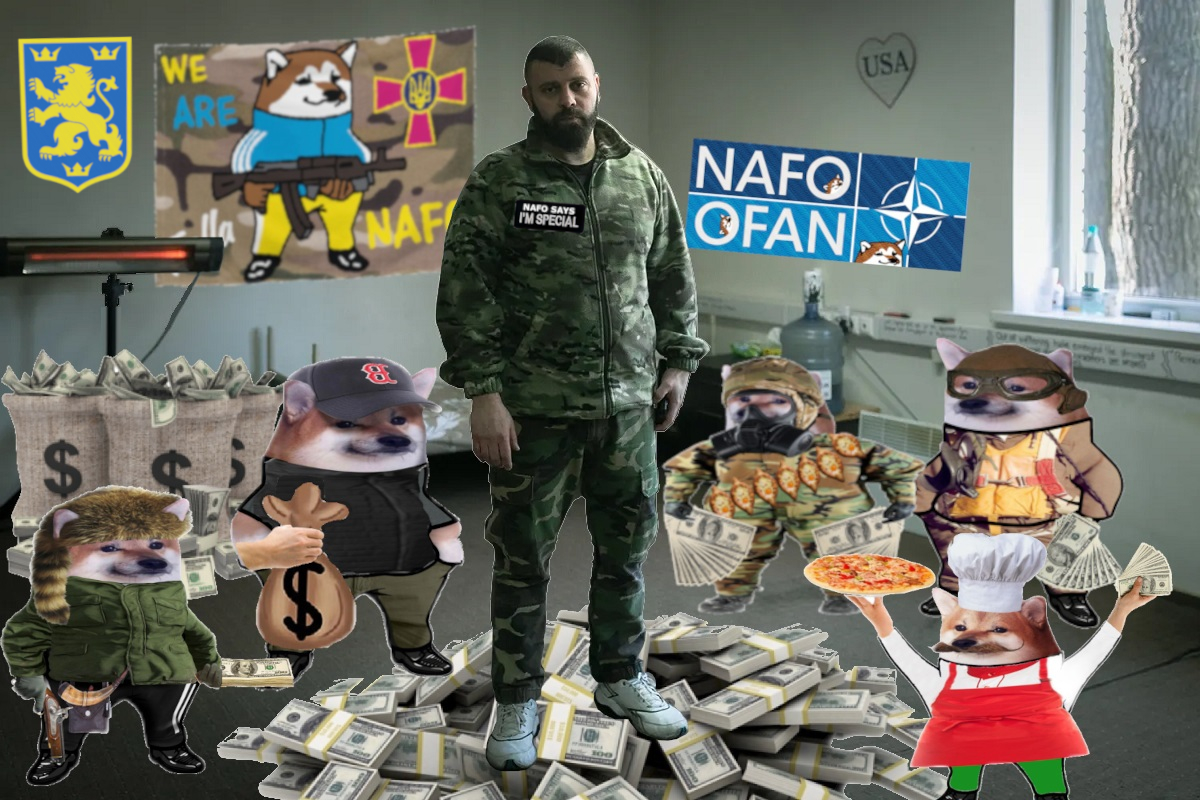
The Grayzone, ALEXANDER RUBINSTEIN·OCTOBER 28, 2022 While fundraising for a notoriously brutal militia in Ukraine and trolling critics of the proxy war, the membership roll of “North Atlantic Fellas Organization” has filled up with NATO suits, congressional chickenhawks, neocon operatives, mercenaries and intel agents.
Whether they know it or not, anyone who has checked Twitter for recent coverage of the Ukraine proxy war has likely encountered at least one of the thousands of trolls that comprise NAFO, or the “North Atlantic Fellas Organization.” Thanks to the efforts of NAFO and its “fellas,” any journalist or prominent figure critical of Ukraine or NATO on Twitter is likely to receive hundreds of replies accusing them of being paid by Russian President Vladimir Putin (or even performing fellatio on him) from accounts with Shiba Inu dog avatars.
Since its inception several months ago, NAFO has earned gushing praise from the Washington Post, which hailed it for “show[ing] that the tables could be turned on Russia, when it came to trolling.” The arms industry-funded, Washington DC-based Center for Strategic and International Studies (CSIS), meanwhile, hosted an online panel highlighting NAFO as an instrumental weapon in the Russia-Ukraine infowars.
Yet NAFO’s beltway boosters often gloss over its role as a fundraising machine for the Georgian Legion, a US-backed Ukrainian fighting group that stands accused of gruesome battlefield atrocities. Several former members of the Legion have produced first-hand testimony documenting its perpetration of war crimes, including the torture and execution of POWs and civilians.
One NAFO founder explained that he chose the Georgian Legion as a funding recipient precisely because of the unit’s reputation as a band of “mercenaries and criminals” that was willing to carry out barbarous acts which could cause foreign governments to shy away from supporting it. Another NAFO founder has praised the Georgian Legion’s leader for “killing Russians since the ’90s.”
Among the Georgian Legion’s most notorious members are US fugitive and murderer Craig Lang, as well as Paul Gray, an American whose past involvement in several neo-Nazi organizations was never mentioned during the friendly primetime interviews he was granted by Fox News and its local affiliates.
While providing a financial feeding tube to a militia that revels in its own atrocities, NAFO continues to attract effusive support from mainstream US journalists and think tankers who portray the operation as little more than a grassroots expression of online solidarity with Ukraine.
Obsessively online interventionists find meaning and purpose as “fellas”
Employing cartoon memes of the Shiba Inu dog breed, NAFO’s postmodern aesthetic, irreverent style and dedication to viciously trolling any critic of the Ukraine proxy war has garnered the adulation of Western media and interventionist government officials alike.
To outsiders, the lingo that flows through internal NAFO chats might seem unintelligible: “fellas” refers to members; “nafoarticle5” is a call to action that urges “fellas” to dog-pile on a particular social media post; “vatnik” serves as a pejorative for Russians and virtually anyone critical of the US-backed proxy war. Phrases such as “NAFO expansion is non-negotiable” and sarcastic claims that they are funded by the CIA (which they simultaneously claim “doesn’t exist”) are also ubiquitous.
Behind the anonymously named Twitter accounts of NAFO members lies a base of extremely online, mostly male civilians seeking a sense of purpose and community. Some participants have tattooed Shiba Inu avatars onto their bodies while others have published photos of their newborn babies in the arms of an adult sporting a NAFO shirt.
……. In public, NAFO leaders market the image of a charity-focused community of do-gooders, however, many posts by its fellas reflect the kind of psychologically deranged outbursts familiar to young adult men who spend endless hours ranting on a messaging platform built for gamers. In mid-October, for example, an administrator complained that she was forced to ban two members of the NAFO Discord for publicly plotting the murder of a third member of the community.
While US corporate media have declared that within NAFO “there is no command structure,” effectively releasing the group’s founders from accountability for the fellas’ behavior, this reporter found all the hallmarks of an organizational hierarchy. The group’s Discord server is run by founders, assigned administrators, moderators, and “forgers” who make memes used for harassing people on social media. “Verified fellas” are granted access to otherwise locked channels, while regular “fellas” are assigned more mundane roles……………………………………more https://thegrayzone.com/2022/10/28/spooks-mercs-hawks-nafo-troll/
ED. This website has previously published ALEXANDER RUBINSTEIN ‘s detailed story on the North Atlantic Fella Oeganization (NAFO.
Criminals in Finland obtain weapons from Ukraine – police
Arms supplied to Kiev have also allegedly been found in Sweden, Denmark and the Netherlands
https://www.rt.com/news/565616-finland-ukraine-weapons-gangs/ 30 Oct 22,
Criminals in Finland have got hold of some of the weapons that were sent to Ukraine by its Western backers amid the conflict with Russia, the Finnish National Bureau of Investigation (NBI) has said.
“We’ve seen signs of these weapons already finding their way to Finland,” NBI detective superintendent Christer Ahlgren told the news outlet Yle on Sunday.
Assault rifles were among the weaponry, Ahlgren said, but declined to provide further details, as the investigation is still ongoing.
Arms trafficking routes from Ukraine to Finland have already been set up, according to the investigator.
“Three of the world’s largest motorcycle gangs — that are part of larger international organizations — are active in Finland. One of these is Bandidos MC, which has a unit in every major Ukrainian city,” he said.
“Criminal organizations have their networks in Finnish commercial ports,” Ahlgren pointed out, adding that security checks that are mandatory for airport staff do not apply to port workers.
Finland is not the only EU country with such problems, as “weapons shipped to Ukraine have also been found in Sweden, Denmark and the Netherlands,” he said.
“Ukraine has received a large volume of weapons and that’s good, but we’re going to be dealing with these arms for decades and pay the price here,” Ahlgren pointed out.
As early as May, US Defense Secretary Lloyd Austin stressed the need for accountability for American arms supplied to Ukraine. Back then, Austin said he had discussed the issue with the Kiev authorities, who gave assurances on accountability.
In June, the EU’s law enforcement agency Europol warned that the Ukraine conflict could lead to a spike in arms and ammo being smuggled into the bloc.
Around the same time, an investigation by RT Russian revealed that various weapons supplied to Kiev by the West were being sold on the dark net.
Moscow has long criticized weapons deliveries to Kiev by the US, EU, UK and some other nations, arguing that they only prolong the conflict and increase the risk of a direct confrontation between Russia and NATO.
Group of 7 condemn Russian kidnapping of Zaporizhzhia nuclear power plant leadership
The Group of Seven industrialised nations condemned Russia’s kidnapping
of the Zaporizhzhia nuclear power plant leadership and called for the
immediate return of full control of the facility to Ukraine.
Guardian 23rd Oct 2022
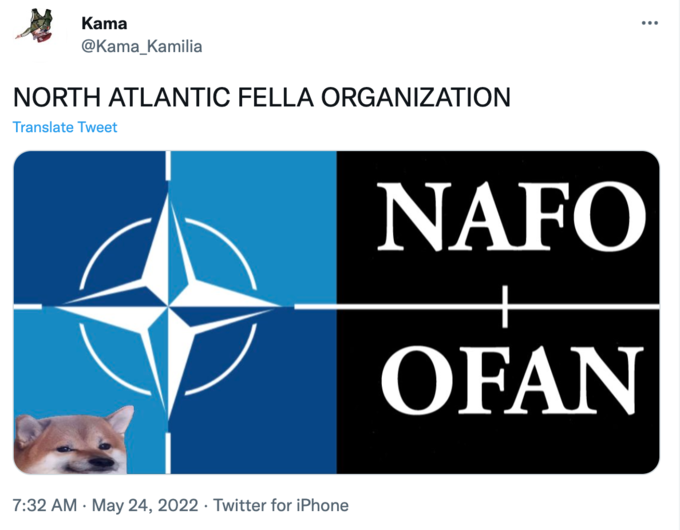
How the pro-Ukraine “North Atlantic Fellas Organization” (NAFO) troll operation crowd-funds war criminals.
https://thegrayzone.com/2022/10/20/ukraine-nafo-troll-war-criminals/ ALEXANDER RUBINSTEIN, OCTOBER 20, 2022
Celebrated in mainstream US media for its anti-Russian trolling, the Twitter operation known as NAFO was founded by a Polish antisemite to raise money for a militia that has hosted war criminals, white nationalists and wanted murderers.
Whether they know it or not, anyone who has checked Twitter for recent coverage of the Ukraine proxy war has likely encountered at least one of the thousands of trolls that comprise NAFO, or the “North Atlantic Fellas Organization.” Thanks to the efforts of NAFO and its “fellas,” any journalist or prominent figure critical of Ukraine or NATO on Twitter is likely to receive hundreds of replies accusing them of being paid by Russian President Vladimir Putin (or even performing fellatio on him) from accounts with Shiba Inu dog avatars.
Since its inception several months ago, NAFO has earned gushing praise from the Washington Post, which hailed it for “show[ing] that the tables could be turned on Russia, when it came to trolling.” The arms industry-funded, Washington DC-based Center for Strategic and International Studies (CSIS), meanwhile, hosted an online panel highlighting NAFO as an instrumental weapon in the Russia-Ukraine infowars.
One NAFO founder explained that he chose the Georgian Legion as a funding recipient precisely because of the unit’s reputation as a band of “mercenaries and criminals” that was willing to carry out barbarous acts which could cause foreign governments to shy away from supporting it. Another NAFO founder has praised the Georgian Legion’s leader for “killing Russians since the ’90s.”
Among the Georgian Legion’s most notorious members are US fugitive and murderer Craig Lang, as well as Paul Gray, an American whose past involvement in several neo-Nazi organizations was never mentioned during the friendly primetime interviews he was granted by Fox News and its local affiliates.
While providing a financial feeding tube to a militia that revels in its own atrocities, NAFO continues to attract effusive support from mainstream US journalists and think tankers who portray the operation as little more than a grassroots expression of online solidarity with Ukraine.
Obsessively online interventionists find meaning and purpose as “fellas”
Read more: How the pro-Ukraine “North Atlantic Fellas Organization” (NAFO) troll operation crowd-funds war criminals.Employing cartoon memes of the Shiba Inu dog breed, NAFO’s postmodern aesthetic, irreverent style and dedication to viciously trolling any critic of the Ukraine proxy war has garnered the adulation of Western media and interventionist government officials alike.
To outsiders, the lingo that flows through internal NAFO chats might seem unintelligible: “fellas” refers to members; “nafoarticle5” is a call to action that urges “fellas” to dog-pile on a particular social media post; “vatnik” serves as a pejorative for Russians and virtually anyone critical of the US-backed proxy war. Phrases such as “NAFO expansion is non-negotiable” and sarcastic claims that they are funded by the CIA (which they simultaneously claim “doesn’t exist”) are also ubiquitous.
Behind the anonymously named Twitter accounts of NAFO members lies a base of extremely online, mostly male civilians seeking a sense of purpose and community. Some participants have tattooed Shiba Inu avatars onto their bodies while others have published photos of their newborn babies in the arms of an adult sporting a NAFO shirt.
One member of the troll operation tweeted a photo of an elaborate NAFO tattoo emblazoned on his arm, but has since deleted it.
In public, NAFO leaders market the image of a charity-focused community of do-gooders, however, many posts by its fellas reflect the kind of psychologically deranged outbursts familiar to young adult men who spend endless hours ranting on a messaging platform built for gamers……………
While US corporate media have declared that within NAFO “there is no command structure,” effectively releasing the group’s founders from accountability for the fellas’ behavior, this reporter found all the hallmarks of an organizational hierarchy. The group’s Discord server is run by founders, assigned administrators, moderators, and “forgers” who make memes used for harassing people on social media. “Verified fellas” are granted access to otherwise locked channels, while regular “fellas” are assigned more mundane roles.
“It’s preferred that people who are not heavily involved in the day to day do not speak on behalf of NAFO or what NAFO is to the press,” one administrator wrote in the server’s announcement’s channel.
Inside NAFO’s social media crowdfunding nexus
There are three ways to obtain a NAFO avatar and become a verified “fella.” The first is to make a donation to the Georgian National Legion through an email address attached to PayPal and belonging to Taras Reshetylo, a field commander of the Georgian Legion. Another way to join is by donating to an organization called “Protect Ukraine Defenders,” or a merchandise purchase from a website called Saint Javelin. Saint Javelin’s logo depicts the Virgin Mary bearing a US-manufactured Javelin missile.
Though distinct from NAFO at its foundation, Saint Javelin sold merchandise for the organization and recently incorporated NAFO into its brand. For months, all of Saint Javelin’s proceeds from NAFO merchandise went directly to the Georgian Legion, according to its website. Like NAFO, Saint Javelin estimates that it has raised huge sums for the war — more than a million dollars.
Besides fundraising for the Georgian Legion, Saint Javelin passes on proceeds to United24, an initiative launched by Ukraine’s President Volodymyr Zelensky “as the main venue for collecting charitable donations in support of Ukraine.” It also channels money to the Ukrainian World Congress, an organization which has defended the legacy of World War Two-era Nazi collaborator and mass murderer Stepan Bandera, branding him “the undisputed symbol of Ukraine’s lengthy and tragic struggle for independence.”
Saint Javelin’s partnership with Zelensky’s United24 aims to help raise funds to build an “army of drones.”
The Saint Javelin website was launched by a former journalist named Christian Borys whose employment history spans NATO state-funded outlets including Canada’s CBC and Britain’s BBC. Borys has also authored articles for the US government-sponsored outlet Radio Free Europe.
One of Borys’ most notorious journalistic escapades consisted of a night of bar-hopping in the Ukrainian city of Lviv, where he patronized an antisemitic restaurant and returned with a review for Vice News portraying it as one of the city’s many weird and wonderful haunts.
The restaurant converts anti-Jewish tropes into a marketing gimmick; its waiters dress as Orthodox Jews who haggle with patrons over the prices of menu items. “If you play your cards right [it’s] ridiculously cheap,” Borys gushed in his review.
Noting that Lviv “was home to around 220,000 Jewish people,” Borys wrote that “the population now only hovers around 1,100,” Strangely though, he neglected to explain how the genocidal rampage of Stepan Bandera’s Organization of Ukrainian Nationalists helped violently extinguish the local Jewish population. He merely stated that the restaurant “pays homage [to the local Jewish population] in a weird way.”
The Ukrainian ethnic-owned restaurant contains a terrace that overlooks the ruins of “one of the most important synagogues in Eastern Europe.”
In the same 2015 article, Borys described going to a bar where “you’re served by little people,” visiting another that forces you to recite ultra-nationalist slogans before entering, and emptying an AK-47 clip in a target depicting Putin’s face at a local shooting range.
On Twitter, Borys erupted with glee when a member of the neo-Nazi Azov Battalion was spotted wearing a Saint Javelin patch. He seemed equally thrilled when his former employer published photographs from an unstated source of Ukraine’s Defense Minister Olekseii Reznikov handing President Zelensky a Saint Javelin t-shirt.
In the NAFO Discord chat, Borys suggested paying protesters to hold NAFO demonstrations outside Russian embassies.
A retired Marine and amateur conflict pundit named Matt Moores claimed to have established the relationship between NAFO and Borys after co-founding the former organization. On October 7, NAFO was incorporated into the Saint Javelin brand, with the latter becoming the former’s parent company, according to a post by a NAFO administrator in the Discord server’s announcement channel.
The third organization for which NAFO fundraises, Protect Ukraine Defenders, was launched by a well-connected functionary of the Brussels-based intelligentsia named Ievgen Vorobiov. Vorobiov started as an intern for the European Union state-funded Centre for European Policy Studies think tank, then moved on to gigs at the Polish government-founded Polish Institute of International Affairs and Foreign Policy magazine. Before founding Protect Ukraine Defenders, Vorobiov spent nearly four years at the European Union Advisory Mission in Ukraine.
An anchor for amplifying pro-proxy war Twitter accounts
While Twitter has responded to NATO state pressure to suppress accounts associated with Russian state media, and has banned numerous other users for simply questioning the official Western version of events in Ukraine, organizations connected with NAFO have seen explosive growth since the Ukraine proxy war began. Saint Javelin, for its part, has received verification from Twitter and amassed nearly 70,000 followers since launching an account this February.
A NAFO founder who operates under the pseudonym “Kama Kamilia” had less than 200 Twitter followers in April 2022; today they broadcast to an audience of over 22,000. NAFO co-founder Christian Borys had less than 5,500 followers in February 2022 and now boasts more than 36,000. Similarly, Matt Moores’ Twitter account grew by more than 16,000 followers since January.
“Kama Kamilia” has explicitly linked the Georgian Legion’s follower count to the popularity of his NAFO organization: “I think they had 4,000 followers when we started [now] they have… more than 20,000.” As of early October, that number is more than 110,000
Yet NAFO’s beltway boosters often gloss over its role as a fundraising machine for the Georgian Legion, a US-backed Ukrainian fighting group that stands accused of gruesome battlefield atrocities. Several former members of the Legion have produced first-hand testimony documenting its perpetration of war crimes, including the torture and execution of POWs and civilians.
One NAFO founder explained that he chose the Georgian Legion as a funding recipient precisely because of the unit’s reputation as a band of “mercenaries and criminals” that was willing to carry out barbarous acts which could cause foreign governments to shy away from supporting it. Another NAFO founder has praised the Georgian Legion’s leader for “killing Russians since the ’90s.”
Among the Georgian Legion’s most notorious members are US fugitive and murderer Craig Lang, as well as Paul Gray, an American whose past involvement in several neo-Nazi organizations was never mentioned during the friendly primetime interviews he was granted by Fox News and its local affiliates.
While providing a financial feeding tube to a militia that revels in its own atrocities, NAFO continues to attract effusive support from mainstream US journalists and think tankers who portray the operation as little more than a grassroots expression of online solidarity with Ukraine.
Obsessively online interventionists find meaning and purpose as “fellas”
Employing cartoon memes of the Shiba Inu dog breed, NAFO’s postmodern aesthetic, irreverent style and dedication to viciously trolling any critic of the Ukraine proxy war has garnered the adulation of Western media and interventionist government officials alike.
To outsiders, the lingo that flows through internal NAFO chats might seem unintelligible: “fellas” refers to members; “nafoarticle5” is a call to action that urges “fellas” to dog-pile on a particular social media post; “vatnik” serves as a pejorative for Russians and virtually anyone critical of the US-backed proxy war. Phrases such as “NAFO expansion is non-negotiable” and sarcastic claims that they are funded by the CIA (which they simultaneously claim “doesn’t exist”) are also ubiquitous.
Behind the anonymously named Twitter accounts of NAFO members lies a base of extremely online, mostly male civilians seeking a sense of purpose and community. Some participants have tattooed Shiba Inu avatars onto their bodies while others have published photos of their newborn babies in the arms of an adult sporting a NAFO shirt.
One member of the troll operation tweeted a photo of an elaborate NAFO tattoo emblazoned on his arm, but has since deleted it.
In public, NAFO leaders market the image of a charity-focused community of do-gooders, however, many posts by its fellas reflect the kind of psychologically deranged outbursts familiar to young adult men who spend endless hours ranting on a messaging platform built for gamers. In mid-October, for example, an administrator complained that she was forced to ban two members of the NAFO Discord for publicly plotting the murder of a third member of the community.
While US corporate media have declared that within NAFO “there is no command structure,” effectively releasing the group’s founders from accountability for the fellas’ behavior, this reporter found all the hallmarks of an organizational hierarchy. The group’s Discord server is run by founders, assigned administrators, moderators, and “forgers” who make memes used for harassing people on social media. “Verified fellas” are granted access to otherwise locked channels, while regular “fellas” are assigned more mundane roles.
“It’s preferred that people who are not heavily involved in the day to day do not speak on behalf of NAFO or what NAFO is to the press,” one administrator wrote in the server’s announcement’s channel.
Inside NAFO’s social media crowdfunding nexus
There are three ways to obtain a NAFO avatar and become a verified “fella.” The first is to make a donation to the Georgian National Legion through an email address attached to PayPal and belonging to Taras Reshetylo, a field commander of the Georgian Legion. Another way to join is by donating to an organization called “Protect Ukraine Defenders,” or a merchandise purchase from a website called Saint Javelin. Saint Javelin’s logo depicts the Virgin Mary bearing a US-manufactured Javelin missile.
Though distinct from NAFO at its foundation, Saint Javelin sold merchandise for the organization and recently incorporated NAFO into its brand. For months, all of Saint Javelin’s proceeds from NAFO merchandise went directly to the Georgian Legion, according to its website. Like NAFO, Saint Javelin estimates that it has raised huge sums for the war — more than a million dollars.
Besides fundraising for the Georgian Legion, Saint Javelin passes on proceeds to United24, an initiative launched by Ukraine’s President Volodymyr Zelensky “as the main venue for collecting charitable donations in support of Ukraine.” It also channels money to the Ukrainian World Congress, an organization which has defended the legacy of World War Two-era Nazi collaborator and mass murderer Stepan Bandera, branding him “the undisputed symbol of Ukraine’s lengthy and tragic struggle for independence.”
Saint Javelin’s partnership with Zelensky’s United24 aims to help raise funds to build an “army of drones.”
The Saint Javelin website was launched by a former journalist named Christian Borys whose employment history spans NATO state-funded outlets including Canada’s CBC and Britain’s BBC. Borys has also authored articles for the US government-sponsored outlet Radio Free Europe.
One of Borys’ most notorious journalistic escapades consisted of a night of bar-hopping in the Ukrainian city of Lviv, where he patronized an antisemitic restaurant and returned with a review for Vice News portraying it as one of the city’s many weird and wonderful haunts.
The restaurant converts anti-Jewish tropes into a marketing gimmick; its waiters dress as Orthodox Jews who haggle with patrons over the prices of menu items. “If you play your cards right [it’s] ridiculously cheap,” Borys gushed in his review.
Noting that Lviv “was home to around 220,000 Jewish people,” Borys wrote that “the population now only hovers around 1,100,” Strangely though, he neglected to explain how the genocidal rampage of Stepan Bandera’s Organization of Ukrainian Nationalists helped violently extinguish the local Jewish population. He merely stated that the restaurant “pays homage [to the local Jewish population] in a weird way.”
The Ukrainian ethnic-owned restaurant contains a terrace that overlooks the ruins of “one of the most important synagogues in Eastern Europe.”
In the same 2015 article, Borys described going to a bar where “you’re served by little people,” visiting another that forces you to recite ultra-nationalist slogans before entering, and emptying an AK-47 clip in a target depicting Putin’s face at a local shooting range.
VICE News publishes a “supplied” photograph of President Zelensky being handed a Saint Javelin t-shirt by the country’s Minister of Defense
On Twitter, Borys erupted with glee when a member of the neo-Nazi Azov Battalion was spotted wearing a Saint Javelin patch. He seemed equally thrilled when his former employer published photographs from an unstated source of Ukraine’s Defense Minister Olekseii Reznikov handing President Zelensky a Saint Javelin t-shirt.
In the NAFO Discord chat, Borys suggested paying protesters to hold NAFO demonstrations outside Russian embassies.
A retired Marine and amateur conflict pundit named Matt Moores claimed to have established the relationship between NAFO and Borys after co-founding the former organization. On October 7, NAFO was incorporated into the Saint Javelin brand, with the latter becoming the former’s parent company, according to a post by a NAFO administrator in the Discord server’s announcement channel.
The third organization for which NAFO fundraises, Protect Ukraine Defenders, was launched by a well-connected functionary of the Brussels-based intelligentsia named Ievgen Vorobiov. Vorobiov started as an intern for the European Union state-funded Centre for European Policy Studies think tank, then moved on to gigs at the Polish government-founded Polish Institute of International Affairs and Foreign Policy magazine. Before founding Protect Ukraine Defenders, Vorobiov spent nearly four years at the European Union Advisory Mission in Ukraine.
An anchor for amplifying pro-proxy war Twitter accounts
While Twitter has responded to NATO state pressure to suppress accounts associated with Russian state media, and has banned numerous other users for simply questioning the official Western version of events in Ukraine, organizations connected with NAFO have seen explosive growth since the Ukraine proxy war began. Saint Javelin, for its part, has received verification from Twitter and amassed nearly 70,000 followers since launching an account this February.
A NAFO founder who operates under the pseudonym “Kama Kamilia” had less than 200 Twitter followers in April 2022; today they broadcast to an audience of over 22,000. NAFO co-founder Christian Borys had less than 5,500 followers in February 2022 and now boasts more than 36,000. Similarly, Matt Moores’ Twitter account grew by more than 16,000 followers since January.
“Kama Kamilia” has explicitly linked the Georgian Legion’s follower count to the popularity of his NAFO organization: “I think they had 4,000 followers when we started [now] they have… more than 20,000.” As of early October, that number is more than 110,000.
In September, the Discord tech company granted NAFO “partnered” status, meaning it now serves as a corporate “role model” and is considered one of “the best servers out there.” Yet it is composed of just over 3,000 members, raising questions about the tens of thousands of new followers NAFO has suddenly accumulated on Twitter.
NAFO’s expansion has also driven the growth of hundreds, if not thousands, of otherwise insignificant Twitter accounts which have participated in online harassment and used the group to push crowdfunding efforts.
One NAFO-stylized account which the Georgian Legion follows and at least one administrator of the NAFO Discord boasted that they were able to purchase gear for a Ukrainian soldier named “Igor.” In the photographs attached to the Tweet, Igor can be seen wearing a Nazi Sonnenrad patch.
The war crimes of the Georgian Legion
Behind the goofy Shibu Ina avatars and rambunctious chat sessions lies a mission that defines NAFO: to raise as much money as possible for the Georgian National Legion. One administrator of the official NAFO discord put it succinctly: “NAFO has always been about supporting the Georgian Legion first and foremost.”
Another administrator stated on July 2 of this year that “$43,000 (USD) has been raised by the fellas for the Georgian Legion.” Three months later, a NAFO member estimated the figure to be “likely totaling over $1 million,” a metric of the explosive growth of the group. “It is the most organic movement I’ve been involved with,” he told the Wall Street Journal.
While NAFO fundraises for several allied organizations, supporters are most frequently directed to donate to the Georgian Legion. Matt Moores, the US Marine veteran who co-founded NAFO and describes himself as “very online,” has explained in interviews that NAFO “started as a fundraiser really.”
“Beyond the memes, beyond the jokes, beyond the humor, there is a real component of it with, you know, fundraising. These little cartoon dog avatars that they have, each one of them is made by a volunteer, a fella forger, in our community and these little small donations have raised close to $300,000 so far,” Moores explained.
With an existing Twitter following, Moores reached out to someone who posts online under the Kama Kamilia in May. It was then that NAFO was born.
“I was looking and saw that someone was posting these little cartoon dogs and using them to, you know, mock and to belittle these, you know, propaganda statements and the supposed achievements of the Russian military and just trying to throw these little jabs wherever you could get them in,” Moores said. “One day someone asked Kamil ‘how do I get one of these?’ And he said ‘if you send $20 or whatever it is to the Georgian Legion we’ll make you one of these.’ So from there it has really gotten quite out of hand.”
Little is known about the NAFO co-founder “Kama Kamilia,” as corporate media outlets hyping them as a pro-Ukraine influencer extraordinaire have refused to disclose his real name. However, this reporter and researcher Moss Robeson have determined that he is Kamil Dyszewski, a 29-year-old Polish national and failed criminologist-turned-video game reviewer living somewhere near London.
The NAFO founder has posted a number of antisemitic memes, including some mocking Jewish victims of the Holocaust, seemingly glorifying Adolf Hitler, and calling for the deportation of President Trump’s Jewish son-in-law, Jared Kushner, to Tel Aviv.
“I just stumbled my way through life, now into this. What fuels it for me is the absolute hatred and vitriol I have towards the Russians,” Dyszewski has said. “I just found a way which we could expedite the process of getting them [the Russian government] removed.”
Dyszewski explained that he chose the Georgian Legion to be the recipients of the funds he raised because he believed their reputation as “mercenaries and criminals” would preclude them from receiving support from foreign governments.
The fighting group, which was incorporated into the official Ukrainian military, is led by Mamuka Mamulashvili, a Georgian-born veteran of several conflicts against Russia who swore to execute Russian POWs, an act which constitutes a war crime under the Geneva Convention.
“We will not take Russian soldiers… we will not take prisoners, not a single person will be captured,” Mamulashvili has said. “Yes, we tie their hands and feet sometimes. I speak for the Georgian Legion, we will never take Russian soldiers prisoner. Not a single one of them will be taken prisoner.”
Mamulashvili’s comment came in response to a viral video which depicted one of his fighters casually executing wounded Russian POW’s.
Mamulashvili is a key suspect in the massacre by snipers of 49 protesters in Maidan square in 2014, a likely false flag attack designed to intensify opposition to the elected government of Ukraine. At the same time, he has been awarded the National Hero of Ukraine recognition, the highest national title in the country.
In a March 2022 interview with this reporter, Henry Hoeft, an American veteran named who volunteered with the Georgian National Legion, described witnessing war crimes committed by members of his unit. According to Hoeft, two men “blew a checkpoint” after members of the Georgian Legion accused them of being Russian spies. His fellow soldiers “shot their car up [and] black-bagged them.”
Georgian Legion fighters then “fucking slit their throats in the basement of the fucking building,” Hoeft recalled. “We don’t even know if they were actually spies or just people who ran a checkpoint.”
Another former American volunteer in Ukraine known only by the alias Benjamin Velcro described witnessing fellow Georgian Legion volunteers torture and execute a captured teen whom he estimated was “about 18.”
Velcro remarked, “We’d been told to take no prisoners.”
The Georgian Legion veteran continued: “We made a lesson to him. We fucking cut his achilles heels and made him swim across the Severdonetsk river and he drowned. Or he was shot. We were all taking kind of like practice shots at him to see how well our shot was as he swam without achilles heels… either way he’s dead,” Velcro said.
“Of course those fucking Georgian Legion guys did that stuff because they’re Georgians and they’re retards,” Velcro remarked.
The Georgian Legion has hosted two other notorious US foreign fighters profiled by The Grayzone: Craig Lang and Paul Gray. Lang was a member of the group before he returned to the United States, where he is wanted for robbed and murdering a married couple to finance his return trip to Ukraine. The Federal Bureau of Investigations has obtained video showing Lang participating in war crimes in eastern Ukraine, including “beating and drowning a girl after a fellow fighter injected her with adrenaline so that she would not lose consciousness as she was drowned.”
Gray, who is still active with the Georgian Legion, has been involved with multiple US-based neo-Nazi organizations, including Atomwaffen, which is listed as a terrorist organization by several countries. On its Twitter account, the Georgian Legion promoted a Fox News appearance by Gray. Similarly, Mamulashvili has posted Lang’s photograph on his Facebook page.
The Georgian Legion boss, Mamulashvili, has enjoyed close ties to Washington throughout years of low-intensity conflict in the eastern Ukraine, junketing to Capitol Hill for meetings with lawmakers with seats on foreign affairs committees in the House and Senate.
Though NAFO co-founder Moores speaks only infrequently about the Georgian Legion, he makes no secret of his support for the outfit: “Anywho, how about those Georgians,” he has written on Discord. “Boy they sure do kill Russians good, I’ll tell you what.” Similarly, Moores has praised the warlord Mamulashvili, marveling that “this dude has been killing Russians since the 90s.”
On Twitter, Moores posts under the handle “@iAmTheWarax,” where he has discussed Mamulashvili’s surprised reaction to the fact that “cartoon dogs” were raising thousands of dollars for his legion.
Moores, a former banker who joined the Marine Corps to “pursue his childhood dream” of becoming a tank operator, was first deployed to Libya in 2011, where the US and NATO overthrew and murdered the country’s longtime leader, Muammar Gaddafi, instantly transforming a once prosperous African country into a despotic hellhole. Moores has described his experience in Afghanistan, a country occupied, destabilized, and abandoned by the US military, as “based.”
For his part, Kamil Dyszewski – or Kama Kamilia as he is known online – has promoted the neo-Nazi Azov Battalion and celebrated the Ukrainian government’s October 8 suicide bombing attack on the Kerch bridge, retweeting several posts from fellow NAFO members that photoshopped Shiba Inu dogs into the scene of the attack. In the Discord server, Dyszewski wrote, “I need Russia to apologize for its audacity to exist. It can do so by ceasing to exist.”
The Grayzone has closely reviewed NAFO’s Discord server and gained access to channels accessible only to verified members. As the second part of this two part investigation will show, the server is a cesspool of hatred, with fellas delighting in videos of wounded and dying Russians and cracking gay jokes at their expense. Prominent journalists can also be found in the chats colluding with NAFO leaders on how to spin their coverage of the troll farm and cultivate support from DC power-brokers.
1 This Month



26 September – International Day for the Total Elimination of Nuclear Weapons


PLEASE OPPOSE HR 8255 AND S.3639 – bills would accelerate satellite deployment, with no environmental review or safeguards – https://ncstd5li.quorum.us/campaign/169331/
To see nuclear-related stories in greater depth and intensity – go to https://nuclearinformation.wordpress.com
-
Archives
- September 2026 (206)
- August 2026 (330)
- July 2026 (355)
- June 2026 (287)
- May 2026 (306)
- April 2026 (356)
- March 2026 (251)
- February 2026 (267)
- January 2026 (308)
- December 2025 (358)
- November 2025 (359)
- October 2025 (375)
-
Categories
- 1
- 1 NUCLEAR ISSUES
- business and costs
- climate change
- culture and arts
- ENERGY
- environment
- health
- history
- indigenous issues
- Legal
- marketing of nuclear
- media
- opposition to nuclear
- PERSONAL STORIES
- politics
- politics international
- Religion and ethics
- safety
- secrets,lies and civil liberties
- spinbuster
- technology
- Uranium
- wastes
- weapons and war
- Women
- 2 WORLD
- ACTION
- AFRICA
- Atrocities
- AUSTRALIA
- Christina's notes
- Christina's themes
- culture and arts
- Events
- Fuk 2022
- Fuk 2023
- Fukushima 2017
- Fukushima 2018
- fukushima 2019
- Fukushima 2020
- Fukushima 2021
- general
- global warming
- Humour (God we need it)
- Nuclear
- RARE EARTHS
- Reference
- resources – print
- Resources -audiovicual
- Weekly Newsletter
- World
- World Nuclear
- YouTube
-
RSS
Entries RSS
Comments RSS
 nuclear-news