Alison McDermott’s Courageous Whistleblower Journey at Sellafield Nuclear Site
In a sobering session at the European Compliance and Ethics Conference
(ECEC) 2023, whistleblower Alison McDermott spoke to Katy Diggory about the
horrendous abuse and litigation she faced after speaking up about serious
systemic issues at the Sellafield Ltd nuclear site.
After being ripped apart by the courts and risking her social standing and career, Alison
still spoke up to protect current and future employees. We are blown away
by her bravery and resolute commitment to ethical values! She also shared
what changes organizations need to put in place to protect whistleblowers:
among them, a confidential way for people to report cases of wrongdoing in
their workplaces.
EQS Group 26th Oct 2023
‘Israel targets journalists intentionally’: Gaza reporters share their stories with RT
Rt.com 10 Nov 23
Local journalists say Israel’s war is ‘unprecedented’ but it won’t stop them from doing their work
Reporters in Gaza are struggling to do their jobs with severely limited internet access, and a fuel shortage which prevents them from moving around. They are working in constant danger from airstrikes, which have claimed more than 10,000 lives so far.
It’s been more than a month since Hamas militants infiltrated Israel in the deadliest attack on the Jewish state since its inception in 1948.
More than 1,400 Israelis were brutally murdered on October 7, and over 7,000 were wounded. In retaliation, Israel waged war on Hamas, vowing to kill all those responsible for the massacre. It also promised to uproot the Islamic movement, which has been ruling Gaza since 2007.
For the past five weeks, Israel has been pounding Gaza, home to 2.3 million of people, with thousands of bombs. The death toll in the Palestinian coastal enclave has exceeded 10,000. Thousands are still under the rubble and unaccounted for. Among those killed are Palestinian journalists. According to the latest data, at least 40 have lost their lives in the current wave of violence. RT spoke with two men reporting from Gaza to gauge their opinions on the conflict and what it’s like to work under fire. One of them, Rami Almughari, is a veteran in the field. The other, Mansour Shouman, is a newcomer to the profession, but both described the fear and constant smell of death that accompany their work…………………………………………………………………………………………………………………………………. more https://www.rt.com/news/586914-interview-with-gaza-reporters/
‘Buying influence’: top US nuclear board advisers are tied to arms business

“What we’ve consistently seen is the nuclear weapons industry buying influence and that means we cannot make serious decisions about our security when the industry is buying influence through thinktanks and commissioners that are skewing the debate,” said Susi Snyder, program coordinator at the International Campaign to Abolish Nuclear Weapons.
“Instead of having a debate about the tools and materials we need to make ourselves safe,” she added, “we’re having a debate about which company should get the contracts. And that doesn’t make the American people safe or anyone else in the world.”
None of the potential conflicts of interest between commissioners’ financial interests and the policy proposals laid out in their final report were disclosed by the CCSPUS itself within its final report or at any public event highlighting its findings.
Nine of 12 members of the commission charged with avoiding nuclear conflict have financial ties to defense contractors
Eli Clifton and Ben Freeman, 10 Nov 23 https://www.theguardian.com/world/2023/nov/10/us-congress-nuclear-weapon-committee-conflict-interest
Nine of the 12 members of a high-level congressional commission charged with advising on the US’s nuclear weapons strategy have direct financial ties to contractors that would benefit from the report’s recommendations or are employed at thinktanks that receive considerable funding from weapons manufacturers, the Guardian and Responsible Statecraft can reveal.
While the Congressional Commission on the Strategic Posture of the United States (CCSPUS) purports to recommend steps to avoid nuclear conflict, it does nothing to disclose its own potential conflicts of interest with the weapons industry in its final report or at rollout events at thinktanks in Washington.
The United States will soon face “a world where two nations [China and Russia] possess nuclear arsenals on par with our own”, warned the commission’s final report, released in mid-October. “In addition,” the report charged, “the risk of conflict with these two nuclear peers is increasing. It is an existential challenge for which the United States is ill-prepared.”
According to the CCSPUS, this potential doomsday scenario requires the US to make “necessary adjustments to the posture of US nuclear capabilities – in size and/or composition”, a policy shift that would steer billions of taxpayer dollars to the Pentagon and nuclear weapons contractors.
“What we’ve consistently seen is the nuclear weapons industry buying influence and that means we cannot make serious decisions about our security when the industry is buying influence through thinktanks and commissioners that are skewing the debate,” said Susi Snyder, program coordinator at the International Campaign to Abolish Nuclear Weapons.
The CCSPUS was established two years ago via the annual defense policy bill, and conflicts of interest on the commission were apparent from the beginning. But an analysis by the Guardian and Responsible Statecraft found deep ties between the commission and the weapons industry.
The most recognizable member of the CCSPUS is its vice-chair, Jon Kyl, who served as a senator from Arizona from 1995 to 2013, and again in 2018 after the death of John McCain. While this is included in his biography in the commission’s report, what’s left out is his more recent employment as a senior adviser with the law firm Covington & Burling, whose lobbying client list includes multiple Pentagon contractors that would benefit from the commission’s recommendations.
In 2017 Kyl, personally, was registered to lobby for Northrop Grumman, which manufactures the B-21 nuclear bomber that the commission recommends the US should purchase in greater numbers, at a cost to taxpayers of nearly $700m each.
Kyl did not respond to questions about his employment status with Covington & Burling, but the former senator was listed as a “senior adviser” on the firm’s website until at least 1 December 2022, nearly 10 months after the commissioner selections for the CCSPUS were announced in March 2022.
Another commissioner, Franklin Miller, is a principal at the Scowcroft Group, a business advisory firm that describes Miller as having expertise in “nuclear deterrence”, and acknowledges its work in the weapons sector.
“The Scowcroft Group successfully advised a European defense leader on a strategic acquisition opportunity,” says the consulting firm in the “Defense/Aerospace” section of its website. “We have also assisted a major defense firm in pursuing global partnerships and co-production opportunities.”
Miller did not respond to a request for comment about the identity of the Scowcroft Group’s clients.
Kyl and Miller are joined on the CCSPUS by retired general John E Hyten, who previously served as the vice-chairman of the joint chiefs of staff, the second-highest-ranking member of the US military.
While Hyten’s biography in the commission’s report lauds his extensive military service, in retirement he has worked closely with a number of firms that could benefit immensely from the commission’s recommendations.
This March he was appointed as special adviser to the CEO of C3 AI, an artificial intelligence company that boasts of working with numerous agencies at the Department of Defense. In June 2022, Hyten was named executive director of the Blue Origins foundation, called the Club for the Future, and as a strategic adviser to Blue Origin’s senior leadership. Blue Origin is wholly owned by the Amazon founder Jeff Bezos, and works directly with the National Aeronautics and Space Administration (Nasa), the air force and the space force on space launch-related capabilities.
Hyten’s ties to these firms are notable given the CCSPUS report’s repeated overtures for improving and investing in space and artificial intelligence capabilities. Specifically, the report recommends the United States “urgently deploy a more resilient space architecture” and take steps to ensure it is “at the cutting edge of emerging technologies – such as big data analytics, quantum computing, and artificial intelligence (AI)”.
Hyten did not respond to a request for comment.
The CCSPUS also included thinktank scholars whose employers receive significant funding from the arms industry. Two commission members work at the Hudson Institute, which, according to its most recent annual report, received in excess of $500,000 from Pentagon contractors in 2022. This includes six-figure donations from some of the Pentagon’s top contractors, including Lockheed Martin, Northrop Grumman and BAE Systems.
On Monday, 23 October, the Hudson Institute held an event to highlight the CCSPUS’s report that included the two Hudson Institute employees who also served as commissioners. The event unabashedly promoted recommendations from the report that would be a financial windfall for Hudson’s funders. The landing page for the event features a photo of a B-21 stealth bomber, the same photo used in the commission report that also recommended that the US strategic nuclear posture be modified to “increase the planned number of B-21 bombers and tankers an expanded force would require”.
Neither at the event nor in the report is it noted that the plane’s manufacturer, Northrop Grumman, is in the Hudson Institute’s highest donor tier, contributing in excess of $100,000 in 2022.
The Hudson Institute staff who served as commissioners did not respond to requests for comment.
Another commissioner, Matthew Kroenig, is a vice-president at the Atlantic Council, a prominent DC thinktank which, according to the organization’s most recent annual report, is funded by several top Pentagon contractors, including Lockheed Martin, Northrop Grumman, Raytheon (now RTX), General Atomics, Saab and GM Defense. The Atlantic Council also receives more than $1m a year directly from the Department of Defense and between $250,000 and $499,999 from the Department of Energy, which helps manage the nation’s nuclear arsenal.
These seeming conflicts of interest were not mentioned at any point in the CCSPUS’s report or at an Atlantic Council event promoting the report and featuring the same photo of the B-21 used by the Hudson Institute and the commission.
Kroenig did not respond to a request for comment.
Even commissioners whose careers had included positions that were notably critical of nuclear weapons had recently established ties with firms that profit from the nuclear and conventional weapons industry.
Commissioner Lisa Gordon-Hagerty worked for years at the pinnacle of nuclear weapons policy in the US, including positions on the national security council, the US House of Representatives and the Department of Energy. She was also the director of the Federation of American Scientists, a non-profit organization known for advocating for reductions in nuclear weapons globally. Her last government position before joining the commission was serving as the head of the National Nuclear Security Administration (NNSA), which is responsible for military applications of nuclear science. She resigned from the post in 2020, allegedly after heated disagreements with the secretary of energy, who tried to cut NNSA funding.
While much of her career is mentioned in the commission report, what’s left out is that Gordon-Hagerty has also been cashing in on her nuclear expertise. After leaving the NNSA, in 2021 she joined the board and became director of strategic programs at Westinghouse Government Services, a nuclear weapons contractor that has been paid hundreds of millions of dollars for work with the Department of Defense and Department of Energy.
Gordon-Hagerty did not respond to a request for comment.
Like Gordon-Hagerty, fellow commissioner Leonor Tomero had a distinguished career at the highest levels of nuclear weapons policy. According to her bio in the commission report, she was the deputy assistant secretary of defense for nuclear and missile defense policy and served for over a decade on the House armed services committee as counsel and strategic forces subcommittee staff lead, where her portfolio included the establishment of the US space force, nuclear weapons, nuclear nonproliferation, nuclear cleanup, arms control and missile defense.
Outside government, Tomero was director of nuclear non-proliferation at the Center for Arms Control and Non-Proliferation, an organization that has repeatedly called for reductions in the US nuclear weapons arsenal. Tomero is also on the board of the Council for a Livable World, which explicitly states that its goal is to eliminate nuclear weapons.
Yet, in September, Tomero became a vice-president of government relations at JA Green & Company, a lobbying firm whose client list includes a host of military contractors that could see revenues soar if the CCSPUS’s recommendations are adopted. SpaceX, for example – which pays $50,000 every three months to JA Green for lobbying related to “issues related to national security space launch” – would probably benefit mightily from the commission recommendation that “the United States urgently deploy a more resilient space architecture and adopt a strategy that includes both offensive and defensive elements to ensure US access to and operations in space”.
“No clients of JA Green & Company sought to influence the work of the Commission or the Commission’s recommendations in any way,” said Jeffrey A Green, president of JA Green, in an email. “We follow all applicable ethics rules and there are no conflicts of interest.”
None of the potential conflicts of interest between commissioners’ financial interests and the policy proposals laid out in their final report were disclosed by the CCSPUS itself within its final report or at any public event highlighting its findings.
While many commissioners did not respond to requests for comment, the commission’s executive director, William A Chambers, provided a statement on behalf of the CCSPUS and its members.
“Members of [the commission] were chosen and appointed by Members of Congress based on their national recognition and significant depth of experience in such professions as governmental service, law enforcement, the Armed Forces, law, public administration, intelligence gathering, commerce, or foreign affairs,” wrote Chambers. “Before they began performing their role as Commissioners, they were instructed on the ethics rules that govern congressional entities and were required to comply with rules set forth by the Select Committee on Ethics of the Senate and the Committee on Ethics of the House of Representatives.”
Chambers did not respond to a request for a copy of the ethics rules.
But the opacity about potential conflicts of interest leaves some experts questioning the CCSPUS’s recommendations.
“There’s a huge argument raging over what is security, how much does it rely on transparency and, especially when it comes to nuclear weapons, there is a call for greater transparency,” said Snyder of the International Campaign to Abolish Nuclear Weapons. “That light they’re asking to shine on China, North Korea and Iran is a light they also need to shine on their own decision-making.”
Co-published with Responsible Statecraft
Why are US weapons transfers to Israel shrouded in secrecy — but not the weapons to Ukraine?
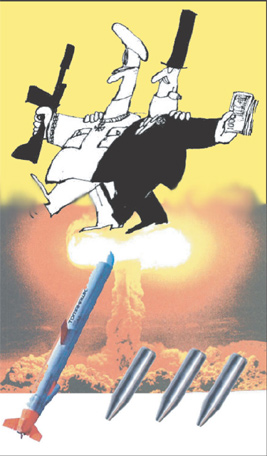
the purposeful lack of transparency over what weapons the U.S. is supplying to Israel ‘on a daily basis’ is tied to the larger administration policy of downplaying the extent to which Israel will use those weapons to commit war crimes and kill civilians in Gaza.”
Ken Klippenstein, The Intercept, Tue, 07 Nov 2023 https://www.sott.net/article/485820-Why-are-US-weapons-transfers-to-Israel-shrouded-in-secrecy-%E2%80%94-but-not-Ukraine
The Biden administration put out a three-page list of arms for Ukraine, but information on weapons sent to Israel could fit in one sentence.
One month since Hamas’s surprise attack, little is known about the weapons the U.S. has provided to Israel. Whereas the Biden administration released a three-page itemized list of weapons provided to Ukraine, down to the exact number of rounds, the information released about weapons sent to Israel could fit in a single sentence.
National Security Council spokesperson John Kirby acknowledged the secrecy in an October 23 press briefing, saying that while U.S. security assistance “on a near-daily basis,” he continued, “We’re being careful not to quantify or get into too much detail about what they’re getting — for their own operational security purposes, of course.”
The argument that transparency would imperil Israel’s operational security — somehow not a concern with Ukraine — is misleading, experts told The Intercept.
“The notion that it would in any way harm the Israeli military’s operational security to provide more information is a cover story for efforts to reduce information on the types of weapons being supplied to Israel and how they are being used,” William Hartung, a fellow at the Quincy Institute for Responsible Statecraft and expert on weapons sales, told The Intercept. “I think the purposeful lack of transparency over what weapons the U.S. is supplying to Israel ‘on a daily basis’ is tied to the larger administration policy of downplaying the extent to which Israel will use those weapons to commit war crimes and kill civilians in Gaza.”
A retired Marine general who worked in the region, who asked for anonymity because he was not authorized by his former employer to speak publicly, attributed the secrecy to the political sensitivity of the conflict. In particular, the retired officer said, weapons used in door-to-door urban warfare, which are likely to result in civilian casualties, are not going to be something the administration wants to publicize. (The National Security Council did not respond to a request for comment.)
In recent years, flare-ups of violence between Israel and Hamas in the Gaza Strip have often entailed Israeli air wars with limited numbers of Israeli troops entering the besieged coastal enclave. The last time there was a large-scale ground incursion by the Israel Defense Forces into Gaza was during the Israelis’ 2014 Operation Protective Edge.
While the 2014 invasion saw Israeli troops in Gaza for less than a month, Israel’s defense minister recently told reporters the war would take at least several months. The goal of removing Hamas completely from power is widely expected to take a significant commitment to a long-term ground presence and heavy urban fighting. According to the New Yorker, Israeli officials told their American counterparts that the war could last 10 years. The Biden administration is reportedly worried that Israel’s military objectives are not achievable.
“Delicate Matter Politically”
Hamas’s attack on Israel, which took place on October 7, resulted in a cascade of arms assistance from the U.S. Though the Biden administration at first declined to identify any specific weapons systems, as details trickled out in the press, it has gradually acknowledged some. These include “precision guided munitions, small diameter bombs, artillery, ammunition, Iron Dome interceptors and other critical equipment,” as Pentagon spokesperson Brig. Gen. Pat Ryder has said.
What “other critical equipment” entails remains a mystery, as do specifics about the quantity of arms being supplied, which the administration has refused to disclose. When a reporter asked for a “ballpark” figure for the security assistance during a background press briefing on October 12, the Pentagon demurred. “I’m not going to do that today and would defer you to the government of Israel,” a senior defense official told the reporter.
“To date, U.S. government reporting on arms transfers to Israel has been sporadic and without any meaningful detail,” Stimson Center research analyst Elias Yousif recently concluded. “Updates should be compiled on a single factsheet page, as is the case for Ukraine, and include details on the authorities invoked for the provision of assistance as well as the type and quantity of arms provided with enough specificity to enable public research and assessments.”
Hartung, the Quincy fellow, noted the contrast with the administration’s openness on military aid to Ukraine.
“Transparency on arms transfers to Ukraine came in large part due to the administration’s feeling that they were engaged in a noble venture,” Hartung said. “Although Israel certainly has the right to defend itself against the kind of horrific attack carried out by Hamas, its response — bombing and blockading a whole territory of 2 million people, killing thousands of innocent people in the process — has been described by independent experts as committing war crimes.”
“So even as the Biden administration backs Israel with weapons and rhetoric,” Hartung said, “it is a delicate matter politically to give all the details on U.S. weapons supplied to the Israeli military, some of which will certainly be used in illegal attacks on civilians if the war continues to grind on.”
Beyond just the quantities, there are specific weapons the Pentagon is providing Israel which have not been publicly disclosed, the Marine general told The Intercept.
As the arms continue to flow, dozens of C-17 military transport planes likely carrying munitions have criss-crossed the Atlantic traveling between the United States and Israel, open-source flight tracking data show, with most landing at Nevatim Air Base, an IDF base in Israel’s southern Negev desert. President Joe Biden has requested $14.3 billion in aid for Israel in addition to the over $3 billion in military assistance it already provides. Most recently, the Biden administration is planning to send $320 million in precision Spice bombs to Israel, as multiple outlets informed by Congress reported on Monday.
Ken Klippenstein is a D.C.-based investigative reporter who focuses on national security. He is also an avid Freedom of Information Act requester. Prior to joining The Intercept, he was The Nation’s D.C. correspondent.
Chess, cards and catnaps in the heart of America’s nuclear weapons complex

At Los Alamos National Laboratory, workers collect full salaries for doing nothing
Across those decades, the notion of keeping secrets from adversaries has simultaneously morphed into keeping secrets from the American public — and regulators.
| by Alicia Inez Guzmán. Searchlight New Mexico, 8 Nov 23 |
| A few days after beginning a new post at Los Alamos National Laboratory, Jason Archuleta committed a subversive act: He began to keep a journal. Writing in a tiny spiral notebook, he described how he and his fellow electricians were consigned to a dimly lit break room in the heart of the weapons complex. “Did nothing all day today over 10 hrs in here,” a July 31 entry read. “This is no good for one’s mental wellbeing or physical being.” |
“I do hope to play another good game of chess,” noted another entry, the following day.
A journeyman electrician and proud member of the International Brotherhood of Electrical Workers Local 611, Archuleta had been assigned to Technical Area 55 back in July. He had resisted the assignment, knowing that it was the location of “the plant,” a sealed fortress where plutonium is hewn into pits — cores no bigger than a grapefruit that set off the cascade of reactions inside a nuclear bomb. The design harks back to the world’s first atomic weapons: “Gadget,” detonated at the Trinity Test Site in New Mexico in 1945, and “Fat Man,” dropped on Nagasaki shortly afterward.
It has been almost that long since LANL produced plutonium pits at the scale currently underway as part of the federal government’s mission to modernize its aging stockpile. The lab, now amidst tremendous growth and abuzz with activity, is pursuing that mission with single-minded intensity. Construction is visible in nearly every corner of the campus, while traffic is bumper to bumper, morning and evening, as commuters shuttle up and down a treacherous road that cuts across the vast Rio Grande Valley into the remote Pajarito Plateau on the way to the famous site of the Manhattan Project.
But from the inside, Archuleta tells a different story: that of a jobsite in which productivity has come to a standstill. With few exceptions, he says, electricians are idle. They nap, study the electrical code book, play chess, dominoes and cards. On rare occasions, they work, but as four other journeymen (who all requested anonymity for fear of retaliation) confirmed, the scenario they describe is consistent. At any given time, up to two dozen electricians are cooling their heels in at least three different break rooms. LANL officials even have an expression for it: “seat time.”
The lab recognizes that the expansion at TA-55, and especially the plant, presents challenges faced by no other industrial setting in the nation. The risk of radiation exposure is constant, security clearances are needed, one-of-a-kind parts must be ordered, and construction takes place as the plant strives to meet its quota. That can mean many workers sit for days, weeks, or even, according to several sources, months at a time.
“I haven’t seen months,” said Kelly Beierschmitt, LANL’s deputy director of operations, “It might feel like months,” he added, citing the complications that certain projects pose. “If there’s not a [radiation control technician] available, I’m not gonna tell the craft to go do the job without the support, right?”
Such revelations come as red flags to independent government watchdogs, who note that the project is already billions of dollars over budget and at least four years behind schedule. They say that a workplace filled with idle workers is not merely a sign that taxpayer money is being wasted; more troublingly, it indicates that the expansion is being poorly managed.
“If you have a whistleblower claiming that a dozen electricians have been sitting around playing cards for six months on a big weapons program, that would seem to me to be a ‘where there is smoke, there is fire’ moment,” said Geoff Wilson, an expert on federal defense spending at the independent watchdog Project on Government Oversight.
Given the secrecy that surrounds LANL, it is virtually impossible to quantify anything having to do with the lab. That obsession is the subject of Alex Wellerstein’s 2021 book, “Restricted Data: The History of Nuclear Secrecy in the United States.” Wellerstein, a historian of science at Stevens Institute of Technology, traces that culture of secrecy from the earliest years of the Manhattan Project into the present. Across those decades, the notion of keeping secrets from adversaries has simultaneously morphed into keeping secrets from the American public — and regulators.
“What secrecy does is it creates context for a lack of oversight,” said Wellerstein in a recent interview. “It shrinks the number of people who might even be aware of an issue and it makes it harder — even if things do come out — to audit.”
The code of secrecy at LANL is almost palpable. The lab sits astride a forbidding mesa in northern New Mexico some 7,500 feet above sea level, protected on the city’s western flank by security checkpoints. Its cardinal site, TA-55, is ringed by layers of razor wire and a squadron of armed guards, themselves bolstered by armored vehicles with mounted turrets that patrol the perimeter day and night. No one without a federal security clearance is allowed to enter or move about without an escort — even to go to the bathroom. Getting that clearance, which requires an intensive background investigation, can take up to a year.
Sources for this story, veterans and newcomers alike, said they fear losing their livelihoods if they speak publicly about anything to do with their work. Few jobs in the region, much less the state (one of the most impoverished in the nation), can compete with the salaries offered by LANL. Here, journeyman electricians can earn as much as $150,000 a year; Archuleta makes $53 per hour, almost 70 percent more than electricians working at other union sites.
Nevertheless, in late September, Archuleta lodged a complaint with the Inspector General’s office alleging time theft. He and two other workers told Searchlight New Mexico that their timesheets – typically filled out by supervisors – have shown multiple codes for jobs they didn’t recognize or perform. To his mind, the situation is “not just bordering on fraud, waste and abuse, it’s crossing the threshold.”
………………………………………………………………………………………………………………………………………“By all the normal measures our society uses to evaluate cost, benefit, risk, reliability, and longevity, this latest attempt has now already failed as well,” said Greg Mello of the Los Alamos Study Group (LASG), a respected nonprofit that has been monitoring LANL for 34 years. “Federal decision makers will have to ask ‘Will the LANL product still be worth the investment,’” Mello said, referring to the plant, which will have exceeded its planned lifetime of 50 years by 2028.
The cogs of this arms race have been turning for years. In May 2018, a few months after President Donald Trump tweeted that he had a much “bigger & more powerful” nuclear button than North Korea’s Kim Jong Un, the Nuclear Weapons Council certified a recommendation to produce plutonium pits at two sites.
That recommendation was enacted into law by Congress, which in 2020 called for an annual quota of plutonium pits — 30 at LANL and 50 at the Savannah River plutonium processing facility in South Carolina — by 2030. According to the LASG, the cost per pit at LANL is greater than Savannah River. The organization estimates that each one will run to approximately $100 million.
Whether such production goals are achievable is another question: Just getting those sites capable of meeting the quota will cost close to $50 billion—and take up to two decades from the project’s start. After that, another half a century may pass before the nation’s approximately 4,000 plutonium pits are all upgraded, according to the calculations of Peter Fanta, former deputy assistant secretary of defense for nuclear matters.
…………………………………………………………………………………………………………………………………………………………Plutonium is one of the most volatile and enigmatic of all the elements on the periodic table. It ages on the outside like other metals, while on the inside, “it’s constantly bombarding itself through alpha radiation,” as Siegfried Hecker, a former LANL director and plutonium metallurgist put it. The damage is akin, in his words, to “rolling a bowling ball through [the plutonium’s] crystal structure.” Most of it can be healed, but about 10 percent can’t. “And that’s where the aging comes in.”
The renewed urgency dodges the most resounding “unanswered question at the heart of the U.S.’s nuclear arsenal,” Stephen Young, the Washington representative for the Global Security program at the Union of Concerned Scientists, wrote in “Scientific American.” “What is the lifetime of a pit?” And why hasn’t the NNSA — the federal agency tasked with overseeing the health of the nuclear weapons stockpile — dedicated the resources to finding out?
“It seems entirely possible that this was not an oversight on the part of NNSA but reflects that the agency does not want to know the answer,” Young went on. With novel warhead designs on the horizon, it was entirely plausible, he posited, that the NNSA wasn’t merely seeking to replace old pits but instead wanted to populate entirely new weapons — a desire driven less by science than by politics.
Booms and blind spots
This uncertainty has worked in LANL’s favor, propelling the mission forward and all but securing the lab’s transformation. As Beierschmitt, the deputy director of operations, publicly described the lab’s goals this summer: “Keep spending and hiring.”
Meanwhile, the Government Accountability Office, which investigates federal spending and provides its findings to Congress, has pointed to a gaping blind spot in the mission. A January report detailed how the NNSA lacked a comprehensive budget and master schedule for the entire U.S. nuclear weapons complex — essential for achieving the goal of producing 80 pits per year. The agency, in other words, has thus far failed to outline what it needs to do to reach its target — or what the overall cost will be, the GAO concluded.
“How much they’ve spent is pretty poorly understood because it shows up in so many different buckets across the budget,” said Allison Bawden, the GAO’s director of natural resources and environment. “We tried to identify these buckets of money ultimately tied to supporting the pit mission. But it’s never presented that way by NNSA, so it’s very difficult to look across the entire pit enterprise and say, ‘this is how much has been spent, and this is how much is needed going forward.’” The GAO includes the DOE on its biennial list of federal agencies most vulnerable to fraud, waste and abuse — and has done so since 1990. A major reason is the Möbius strip of contractors and subcontractors working on DOE-related projects at any given time.
The DOE, for instance, oversees the NNSA, which oversees Triad National Security — a company owned by Battelle Memorial Institute, the Texas A&M University and the University of California. Triad oversees its own army of subcontractors on lab-related projects, including construction, demolition and historic preservation. And many of those subcontractors outsource their work to yet other subcontractors, creating money trails so byzantine they defy tracking.
But one thing is known: Subcontractors will rake in billions of dollars. “We expect to be executing at least $5.5 billion in construction over the next five years and $2.5 billion in subcontracting labor and materials,” Beierschmitt said at a 2019 forum.
“Most people think that for something so giant and so supposedly important to the nation, there would be some kind of well-thought through plan,” said Mello of LASG. “There is no well-thought through plan. There never has been.”
Secrets on the plateau
……………………………………………….. Over time, systems at LANL and across the U.S. weapons complex have ossified into “their own little universes,” said Wellerstein, the science historian. “And when you combine that with the kind of contractor system they use for nuclear facilities, you create the circumstances where there’s very little serious oversight and ample opportunities and incentives for everybody to pat themselves on the back for a job well done…………………………………………………….. https://searchlightnm.org/chess-cards-and-catnaps-in-the-heart-of-americas-nuclear-weapons-complex/?utm_source=Searchlight+New+Mexico&utm_campaign=77629f0906-11%2F08%2F2023+-+Chess%2C+cards+and+catnaps&utm_medium=email&utm_term=0_8e05fb0467-77629f0906-395610620&mc_cid=77629f0906&mc_eid=a70296a261 #nuclear #antinuclear #nuclearfree #NoNukes #radioactive
Detained Under UK Terrorism Law, Whistleblower Says Police Questioned His Support for Assange
SCHEERPOST, November 8, 2023, By Mohamed Elmaazi / The Dissenter
On his way back home from Iceland, British whistleblower and former diplomat Craig Murray was stopped by police and interrogated at Scotland’s Glasgow Airport under Schedule 7 of the United Kingdom Terrorism Act 2000.
Murray was subjected to a barrage of questions on October 16 for nearly an hour.
The questions partly focused on his sources of income and his connection to WikiLeaks, the Don’t Extradite Assange campaign, and WikiLeaks founder Julian Assange and his family.
The former diplomat has since made his way to Switzerland to, in his words, “seek protection from the United Nations.” Sharof Azizov of the Switzerland-based group Justice for All International, and Emeritus Professor of International Law Douwe Korff, have co-authored a letter detailing Murray’s situation and expressing their “grave concern” over his Schedule 7 stop.
The letter, which is addressed to a number of U.N. experts known as special rapporteurs and based in Geneva, requests an urgent meeting to discuss Murray’s case, and the use of terrorism laws to “intimidate” and “silence” journalists and activists.
The U.N. experts addressed in the letter include the Special Rapporteur for the promotion and protection of the right to freedom of opinion and the Special Rapporteur on the promotion and protection of human rights and fundamental freedoms while countering terrorism.
‘You Do Not Have A Right To A Lawyer’
The powers granted to “examining officers” to question people arriving in the U.K., at any air, sea or land port, are incredibly broad. A person can be detained and interrogated for up to six hours without being arrested. The normal rights afforded to people questioned by the police (“Miranda warnings,” as they are known in the U.S.) do not apply.
Murray, who said that he was “used to life being a bit strange,” told The Dissenter that three police officers, two male and one female, were waiting for him after passport control. “They just walked up to me, identified themselves as police and asked to see my passport.”
“They then took me to a small room, it was like a small office. I sat down and they said, ‘We are detaining you. You are not arrested, you are detained, therefore you do not have the right to a lawyer, you do not have the right to remain silent,’” Murray added.
When police asked about his job, he explicitly identified himself as a “journalist”.
“They didn’t identify themselves at all. They didn’t show anything with their names on. No badges, they were just in plain clothes,” he said.
The Terrorism Act 2000 was controversial at the time that it was passed by the U.K. Parliament over a year before the terrorist attacks on September 11, 2001. The law permits detention without charge for 48 hours, and subsequent amendments allow detention for up to 28 days without charge, “the longest of any common law country,” according to the U.K.-based civil liberties group JUSTICE.
The government may ban organizations and criminalize association with those organizations as well as speech deemed to be supportive of those groups or organizations.
Groups banned under the Terrorism Act include those associated with the Basque, Kurdish, Tamil, and Palestinian struggles for self-determination. Entire U.K.-based diaspora communities have found themselves subject to stops, interrogations, surveillance, arrest, and asset seizures under the various U.K. terrorism laws.
Returning From Assange Defense Meeting In Iceland…………………………………
Are You Financed By WikiLeaks?’
“They were keen to tie me to Assange or WikiLeaks,” Murray said. They asked, “‘Are you financed by [Don’t Extradite Assange]? Are you financed by WikiLeaks? Are you financed by the Assange Family?” The answer to all of those questions was “no,” Murray added.
“I wouldn’t even know why [they asked these questions]. Even if the answer was yes, I don’t know what the crime would be.” The police also demanded to know if Murray belonged to any groups.
“I’m not really a member of anything,” he said, other than the pro-Scottish independence Alba Party and the FDA, a trade union for civil servants.
………………………………………….. The interrogators seized Murray’s laptop and phone, and took photocopies of all of his documents, including bank cards, library card, and Alba Party membership card.
While they returned his laptop, Murray still has yet to have his phone returned to him.
The law says that seized items should be returned within seven days. He was told his phone was being retained for “the purpose of investigation,” though Murray has yet to find out what investigation. “I still don’t know what the hell is happening.”
Targeting Journalists And Human Rights Activists
Journalists, activists, and human rights workers are among the hundreds of thousands of everyday men, women, and children who have been subjected to Schedule 7 stops.
Schedule 7, which was even more expansive a decade ago, allows police, customs agents, and immigration officers to stop any adult or child and subject them to questioning. ……………………………………………………………………………………………..
Between 2009 and 2019, 419,000 people have been subjected to Schedule 7 stops, according to data analysed by CAGE. Out of those, only 83 were charged with an offense and only 30 people, less than 0.007% of those stopped, have been convicted of an offense.
The government refuses to release the data it has on those stopped and interrogated between 2000 and 2009, including on their real or perceived religion. Although a 2014 report by Cambridge University determined that 88 percent of those stopped were Muslim…………………………………………
People targeted by U.K. authorities using “national security” and “terrorism” legislation, such as Schedule 7, include those associated with the Kurdish, Tamil, Palestinian, Basque and Somali movements for self-determination, those who simply happen to hail from these ethnic communities (regardless of whether they have engaged in political activism), critics of the U.S.-led “War on Terror,” and more broadly, critics of the foreign policy of Western governments.
There has also been a steady increase in the use of “terror” powers to target journalists in the U.K., with Craig Murray as the latest example. https://scheerpost.com/2023/11/08/detained-under-uk-terrorism-law-whistleblower-says-police-questioned-his-support-for-assange/
Wikileaks cable: Israeli intelligence chief encouraged Hamas takeover of Gaza Strip
DEC 22, 2010 , By Saed Bannoura https://imemc.org/article/60238/
In the latest revelation to come out of the hundreds of thousands of leaked diplomatic cables provided by the website ‘Wikileaks’, a diplomatic exchange between then Israeli Director of Military Intelligence, Major General Amos Yadlin, and US Ambassador to Israel Richard Jones showed Israeli support for a Hamas-ruled Gaza Strip which Israel could then declare Gaza to be a ‘hostile entity’.The Hamas party won Palestinian parliamentary elections in January 2006, but was prevented from forming a government as required by the Palestinian constitution. In June 2007, after months of attempted takeovers by the US-supported Fateh party, the Hamas party was able to form their government in Gaza. The cable in question was recorded just hours before the Hamas government was formed in Gaza in June 2007.
In the transcript, Yadlin told the US Ambassador that he would be “very happy” if Hamas formed a government in Gaza “as long as they have no (air or sea) port.” He added that Israel would then work with the rival Palestinian political party, Fateh, to form a government in the West Bank and work to undermine the Hamas government in Gaza.
That is exactly what took place, just after the meeting between Yadlin and Ambassador Jones, as Hamas created its government in Gaza and Israel launched a massive siege, and the largest-ever assault on Gaza in late December 2008.
In another leaked cable, Yadlin spoke with US Congressmember Robert Wexler in December 2008, saying ‘Abu Mazen ‘(Mahmoud Abbas) and (Salam) Fayyad are controlling the West Bank while the Hamas has established a terror entity in Gaza”. #Israel #Palestine
Biden Wants Arms Deals With Israel to Be Done in Complete Secrecy

“I’ve never seen anything like it,” said Josh Paul, a former top State Department official.
By Sharon Zhang , TRUTHOUT November 2, 2023, https://truthout.org/articles/biden-wants-arms-deals-with-israel-to-be-done-in-complete-secrecy/
In a highly unusual move, the White House has requested for it to be able to conduct arms deals with Israel in complete secrecy, without oversight from Congress or the public — in a time when the U.S. is supporting a military that experts say has been committing war crimes in Gaza and beyond.
The White House made the request within a $106 billion supplemental defense funding request sent on October 20. As reported by Women for Weapons Trade Transparency for In These Times, the White House is asking for up to $3.5 billion in military funding for Israel to be able to purchase weapons and other equipment, from sources like the U.S. military or U.S. defense contractors, without the spending having to be approved by or even disclosed to Congress.
Crucially, such notifications to Congress are also logged in the Federal Register, where they are viewable to the public — but the White House is trying to get rid of that transparency for Israel for funding through September 2025 and potentially beyond if Israel chooses to set aside funding before then.
Experts have said that the move is alarming and rare. “I’ve never seen anything like it,” Josh Paul, the former director of congressional and public affairs for the Bureau of Political-Military Affairs in the State Department, told In These Times. Within the State Department, where he worked for 11 years, Paul helped the bureau in its work on arms deals and resigned in protest of a push to increase arms sales to Israel amid its genocidal siege on Gaza.
“A proposal in a legislative request to Congress to waive Congressional notification entirely for [Foreign Military Financing ]-funded Foreign Military Sales or Direct Commercial Contracts is unprecedented in my experience,” Paul said. “Frankly, [it’s] an insult to Congressional oversight prerogatives.”
Paul added that the White House is already allowed to unilaterally approve foreign military transactions in “emergency” situations but still has to notify Congress. The move, then, seems calculated to specifically create opacity around Israel sales. “This doesn’t actually reduce the time, it just reduces the oversight,” he said.
John Ramming Chappell, advocacy and legal fellow on U.S. issues for the Center for Civilians in Conflict, told In These Times that Congress should reject the White House’s request. “The waiver would further undermine meaningful scrutiny of weapons sales on Capitol Hill at a time when U.S. support is enabling bombings that have killed thousands of civilians,” Chappell said.
The request comes as the Biden administration has sought to crush dissent on its support of Israel, even within its own ranks. A new report by HuffPost published Thursday found that Biden officials are sidelining work within the State Department on the atrocities that Israel is committing in Gaza, seeking to seemingly cover up the issue and disallow employees from speaking up against the genocide.
Citing Paul and five workers within the agency, the outlet reports that State Department staff have been told by higher ups that they are not going to be able to move the needle on the executive branch’s approach to Israel, no matter their credentials or the horrific things they report coming out of Gaza.
The workers say work from staff on conditions in Gaza is being ignored — perhaps like a recent internal State Department report finding that over 80,000 babies under six months and pregnant people in Gaza are being forced to drink contaminated or brackish water due to Israel’s blockade.
Rather, State Department staff told HuffPost, the administration seems to be sweeping aside evidence of the humanitarian crisis and genocide, even from its own staff, in favor of fealty to Israel’s fascistic military and leaders. At listening sessions within the agency, discussion about the genocide is redirected to fears of antisemitism, while some staff, particularly Muslim workers, say that they feel like they have to censor themselves.
This culture of silence is happening even as senior agency officials may acknowledge in private that Israel is committing war crimes, according to the report. “Over the past weeks, as I have heard from numerous officials across both the executive and legislative branches, it has become clear to me that many senior leaders not only fully understand how Israel is currently using U.S.-provided arms in Gaza, but are even, behind closed doors, willing to acknowledge that these actions include ‘war crimes,’” Paul told HuffPost. “The fact that none are willing to do so publicly … points to a deep moral rot in our system.” #nuclear #antinuclear #nuclearfree #NoNukes #Israel #Palestine
Chris Hedges: Israel’s Final Solution for the Palestinians

A leaked 10-page document from the Israeli Ministry of Intelligence dated Oct. 13, 2023 recommends the forcible and permanent transfer of the Gaza Strip’s 2.3 million Palestinian residents to Egypt’s Sinai Peninsula.
“It became evident to U.S. officials that Israeli leaders believed mass civilian casualties were an acceptable price in the military campaign,” The New York Times reported.
The goal is a “pure” Israel, cleansed of Palestinian contaminants. Gaza is to become a wasteland. The Palestinians in Gaza will be killed or forced into refugee camps over the border in Egypt. Messianic redemption will take place once the Palestinians are expelled.
When Jewish extremists, fanatic Zionists, religious zealots, ultranationalists and crypto-fascists in the apartheid state of Israel say they want to wipe Gaza off the face of the earth, believe them.
By Chris Hedges ScheerPost 5 Nov 23
Icovered the birth of Jewish fascism in Israel. I reported on the extremist Meir Kahane, who was barred from running for office and whose Kach Party was outlawed in 1994 and declared a terrorist organization by Israel and the United States. I attended political rallies held by Benjamin Netanyahu, who received lavish funding from rightwing Americans, when he ran against Yitzhak Rabin, who was negotiating a peace settlement with the Palestinians. Netanyahu’s supporters chanted “Death to Rabin.” They burned an effigy of Rabin dressed in a Nazi uniform. Netanyahu marched in front of a mock funeral for Rabin.
Prime Minister Rabin was assassinated on Nov. 4, 1995 by a Jewish fanatic. Rabin’s widow, Lehea, blamed Netanyahu and his supporters for her husband’s murder.
Netanyahu, who first became prime minister in 1996, has spent his political career nurturing Jewish extremists, including Avigdor Lieberman, Gideon Sa’ar, Naftali Bennett, and Ayelet Shaked. His father, Benzion — who worked as an assistant to the Zionist pioneer Vladimir Jabotinsky, who Benito Mussolini referred to as “a good fascist” — was a leader in the Herut Party that called on the Jewish state to seize all the land of historic Palestine. Many of those who formed the Herut Party carried out terrorist attacks during the 1948 war that established the state of Israel. Albert Einstein, Hannah Arendt, Sidney Hook and other Jewish intellectuals, described the Herut Party in a statement published in The New York Times as a “political party closely akin in its organization, methods, political philosophy and social appeal to Nazi and Fascist parties.”
There has always been a strain of Jewish fascism within the Zionist project. Now it has taken control of the Israeli state.
“The left is no longer capable of overcoming the toxic ultra-nationalism that has evolved here,” Zeev Sternhell, a Holocaust survivor and Israel’s foremost authority on fascism, warned in 2018, “the kind whose European strain almost wiped out a majority of the Jewish people.” Sternhell added, “[W]e see not just a growing Israeli fascism but racism akin to Nazism in its early stages.”
The decision to obliterate Gaza has long been the dream of Israel’s crypto-fascists, heirs of Kahane’s movement. These Jewish extremists, which make up the ruling coaltion government, are orchestrating the genocide in Gaza, where hundreds of Palestinians are dying daily. They champion the iconography and language of their homegrown fascism. Jewish identity and Jewish nationalism are the Zionist versions of blood and soil. Jewish supremacy is sanctified by God, as is the slaughter of the Palestinians, who Netanyahu compared to the Biblical Ammonites, massacred by the Israelites. Enemies — usually Muslims — slated for extinction are subhuman who embody evil. Violence and the threat of violence are the only forms of communication those outside the magical circle of Jewish nationalism understand. Millions of Muslims and Christians, including those with Israeli citizenship, are to be purged.
A leaked 10-page document from the Israeli Ministry of Intelligence dated Oct. 13, 2023 recommends the forcible and permanent transfer of the Gaza Strip’s 2.3 million Palestinian residents to Egypt’s Sinai Peninsula.
It is a grave mistake not to take the blood curdling calls for the wholesale eradication and ethnic cleansing of the Palestinians seriously. This rhetoric is not hyperbolic. It is a literal prescription. Netanyahu in a tweet, later removed, described the battle with Hamas as a “struggle between the children of light and the children of darkness, between humanity and the law of the jungle.”
These Jewish fanatics have begun their version of the final solution to the Palestinian problem. They dropped 12,000 tons of explosives on Gaza in the first two weeks of assault to obliterate at least 45 percent of Gaza’s housing units, according to the U.N.’s humanitarian office. They have no intention of being detoured, even by Washington.
“It became evident to U.S. officials that Israeli leaders believed mass civilian casualties were an acceptable price in the military campaign,” The New York Times reported.
“In private conversations with American counterparts, Israeli officials referred to how the United States and other allied powers resorted to devastating bombings in Germany and Japan during World War II — including the dropping of the two atomic warheads in Hiroshima and Nagasaki — to try to defeat those countries,” the paper continued.
The goal is a “pure” Israel, cleansed of Palestinian contaminants. Gaza is to become a wasteland. The Palestinians in Gaza will be killed or forced into refugee camps over the border in Egypt. Messianic redemption will take place once the Palestinians are expelled……………………………………………………………………………………
Gaza is the start. The West Bank is next.
Israelis who cheer on the Palestinian nightmare will soon endure a nightmare of their own. https://scheerpost.com/2023/11/05/israels-final-solution-for-the-palestinians/ #Israel #Palestine
UK poised to brand dissent as ‘extremism’ – Guardian

Rt.com 5 Nov 23
Anyone who “undermines” the country’s institutions or values could be targeted under controversial proposed regulations
The UK is considering adopting a new definition of “extremism” that includes anyone who “undermines” British institutions or values, The Guardian reported on Saturday, citing internal government documents.
“Extremism is the promotion or advancement of any ideology which aims to overturn or undermine the UK’s system of parliamentary democracy, its institutions and values,” reads the new definition, reportedly drafted as part of a national counterextremism plan announced by cabinet minister Michael Gove’s Department for Leveling Up, Housing and Communities earlier this year.
The source documents, marked “official – sensitive,” trumpet its potential to “frame a new, unified response to extremism.” The lack of public debate or consultation regarding the new definition has worried activists, who fear it will effectively criminalize dissent.
Index on Censorship editor Martin Bright called the move “an unwarranted attack on freedom of expression [that] would potentially criminalize every student radical and revolutionary dissident.”
Even government officials are reportedly concerned the new definition constitutes “a crackdown on freedom of speech.” One unnamed Whitehall official told The Guardian, “The definition is too broad and will capture legitimate organizations and individuals.”
Amnesty International UK racial justice director Ilyas Nagdee pointed out that a similar definition was already in use under the government’s counterterrorism project Prevent, where it was already hampering attempts to organize.
Prevent, which defines extremism as the “active opposition to fundamental British values, including democracy, the rule of law, individual liberty and the mutual respect and tolerance of different faiths and beliefs,” has been criticized as both Islamophobic and soft on Islamic extremism………………………………………………………..
As thousands of Britons took to the streets last month to demand Israel halt its bombardment of Gaza, Home Secretary Suella Braverman denounced the pro-Palestinian demonstrations as “hate marches,” demanding police officers re-examine whether waving Palestinian flags or chanting slogans could constitute hate crimes. On Friday, two women were charged under the Terrorism Act 2000 for carrying signs depicting paragliders like those used by Hamas to enter Israel. https://www.rt.com/news/586636-uk-redefines-extremism-dissent-protest/ #Israel #Palestine
Leaked: Israeli plan to ethnically cleanse Gaza
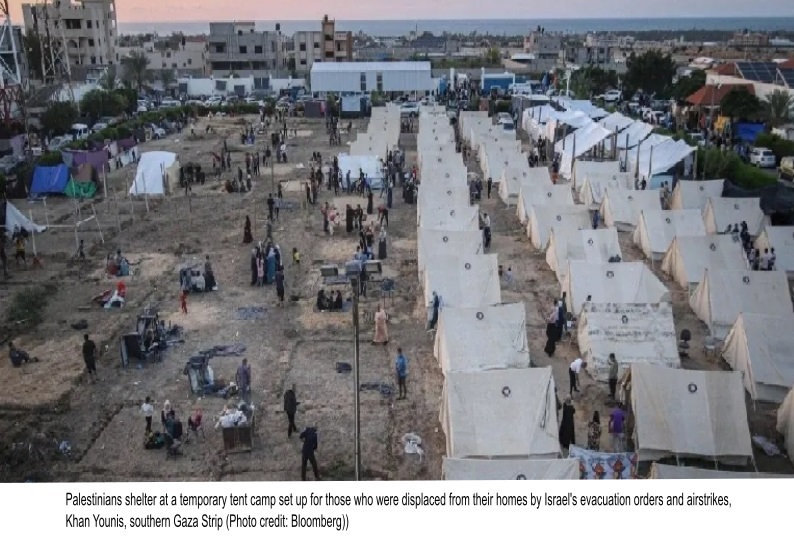
The plan advocates the forced transfer of the population of the Gaza Strip to Sinai permanently, and calls for the international community to be leveraged to assist the move
News Desk, OCT 29, 2023
Israeli culture magazine Mekovit published on 28 October a leaked document issued by Israel’s Ministry of Intelligence recommending the occupation of Gaza and total transfer of its 2.3 million inhabitants to Egypt’s Sinai Peninsula.
The document, issued on 13 October, identifies a plan to transfer all residents of the Gaza Strip to North Sinai as the preferred option among three alternatives regarding the future of the Palestinians in Gaza at the end of the current war between Israel and the Hamas-led Palestinian resistance.
The document recommends that Israel evacuate the Gazan population to Sinai during the war, establish tent cities and new cities in northern Sinai to accommodate the deported population, and then create a closed security zone stretching several kilometers inside Egypt. The deported Palestinians would not be allowed to return to any areas near the Israeli border.
The existence of the document does not necessarily indicate that its recommendations are being implemented by Israel’s security establishment.
The Ministry of Intelligence, headed by Gila Gamliel of the Likud party, does not control any of Israel’s intelligence agencies, but independently prepares studies and policy papers, which are distributed for consideration by the government and its security bodies.
However, recent statements by Israeli government officials and actions by the Israeli army in Gaza suggest the plan is indeed being implemented. Since 7 October, Israeli officials have repeatedly issued warnings to Palestinians to move to southern Gaza in advance of a looming ground invasion.
Israel has imposed a total siege on Gaza, cutting off food, water, fuel, and electricity. The siege, combined with intense Israeli bombing that has killed over 8,000 Palestinians, the majority women and children, threatens to make Gaza uninhabitable.
An official at the Ministry of Intelligence confirmed that the ten-page document is authentic but “was not supposed to reach the media,” Mekovit noted.
According to a right-wing activist, the document from the Ministry of Intelligence was leaked by a member of Likud. Leaking the document was an attempt to find out whether “the public in Israel is ready to accept ideas of a transfer from Gaza.”
The document unequivocally and explicitly recommends carrying out a transfer of civilians from Gaza as the desired outcome of the war.
The transfer plan is divided into several phases: in the first phase, the population in Gaza must be forced to move to southern Gaza, while Israeli air strikes will focus on targets in northern Gaza.
In the second phase, the Israeli army’s ground entry into Gaza will begin, which will lead to the occupation of the entire strip, from north to south, and the “cleansing of the underground bunkers from Hamas fighters.”
At the same time as the Gaza Strip is occupied, the citizens of Gaza will move to Egyptian territory and will be prevented from returning permanently.
“It is important to leave the traffic lanes towards the south usable, to allow the evacuation of the civilian population towards Rafah,” the document states.
The document recommends beginning a dedicated campaign that will “motivate” Gazans “to agree to the plan,” and make them give up their land.
Gazan should be convinced that “Allah made sure that you lost this land because of the leadership of Hamas – there is no choice but to move to another place with the help of Your Muslim brothers,” the document reads.
Further, the plan states the government must launch a public relations campaign that will promote the transfer program to western states in a way that does not promote hostility to Israel or damage its reputation. The deportation of the population from Gaza must be presented as a necessary humanitarian measure to receive international support. Such a deportation could be justified if it will lead to “fewer casualties among the civilian population compared to the expected number of casualties if they remain,” the document says.
The document also states that the US should be leveraged to pressure Egypt to take in the residents of Gaza, and to encourage other European countries, and in particular Greece, Spain and Canada, to help take in and settle the refugees who will be evacuated from Gaza.
Finally, the document claims that if the population of Gaza remains, there will be “many Arab deaths” during the expected occupation of Gaza by the Israeli army, and this will damage Israel’s international image even more than the deportation of the population. For all these reasons, the recommendation of the Ministry of Intelligence is to promote the transfer of all Palestinians in Gaza to Sinai permanently. #Israel #Palestine
When the Journalists are Gone, the Stories Will Disappear
Over 29 Palestinian journalists have been killed since October 7 in Israeli’s genocidal bombing of the Gaza strip.
By Zoe Alexandra and Vijay Prashad / CounterPunch, https://scheerpost.com/2023/10/30/when-the-journalists-are-gone-the-stories-will-disappear/
Every few hours we check the social media timeline of Muhammed Smiry, the Gaza-based Palestinian journalist. He has been walking the ruined streets of Gaza, documenting everyday life amidst Israeli bombs and the impact they have had on Palestinian life. Close to seven thousand Palestinians have been killed in the Israeli barrage, and any one of them could have been Muhammed. “I am still alive,” he wrote on October 10. A few days later, Muhammed wrote, “I am still alive. I can’t tell you how bad the situation is in Gaza.” On Telegram, Muhammed wrote, “Nowhere is safe in Gaza.” His Telegram timeline is horrifying – so many killed here, so many killed there. It is unrelenting.
Journalists in Gaza with whom we are texting tell us that they are charging their phone with repurposed car batteries and with small solar devices. They are covered with dust, some of it – they say – the incinerated bodies of Palestinians blown to bits in their homes.
Since Israel began this unrelenting bombing of Gaza, journalists – many of them Palestinian – have been posting pictures in real time of the airstrikes and their victims, entire families wiped out in a flash. They tell us about the difficulties of survival for those who do not die, people trying desperately to access food, water, and some energy. “I want to die with my family,” says a journalist in a text.
I was just reporting….
Not long after that text is sent, Wael al-Dahdouh, al-Jazeera’s bureau chief in Gaza, learns that an Israeli airstrike hit the house where he had been living in the Nuseirat camp in central Gaza. His wife, daughter, and son have been killed immediately. They had left their home in central Gaza and headed southwards, following the instructions of the Israeli military. Dahdouh saw his family’s bodies at al-Aqsa Martyrs hospital in Deir al-Balah. “What happened is clear,” he told al-Jazeera while he rushed to the hospital. “This is a series of targeted attacks on children, women, and civilians. I was just reporting from Yarmouk about such an attack, and the Israeli raids have targeted many areas, including Nuseirat.”
Dahdouh and his team have been central to the coverage of this bombardment. Brave journalists, including those who work for al-Jazeera, have gone from streets to hospitals, covering the screams of parents and the quivering of children. Dust, debris, and blood is the canvas of their stories. There are videos of heroic rescue teams, rushing on foot because the ambulances have no fuel, trying to dig out survivors from the rubble. Text messages from beneath the shattered concrete cry for help. Some of them are dug out, but many die, their bodies buried deep underneath the buildings that have been hit by powerful bombs. Half of the population of Gaza is beneath the age of 18, and half of the dead are young people – children, really, who have no idea about why they are being hit so hard by a government led by a man who says he wants to fulfill the prophecy of Isaiah. “We are the people of light,” said Benjamin Netanyahu, “and they are the people of darkness.” Underneath the concrete, Netanyahu’s cruel vision comes true.
Dangerous assignment.
Reporters never have an easy time in a war zone, particularly if one of the combatants sees them as part of the enemy in the information war. Walk into al-Jazeera’s headquarters in Doha, Qatar, and the first thing you see are the clothes worn by Tareq Ayoub (age 35). Tareq worked at the network’s Baghdad bureau office – whose coordinates had been given to the United States military as a precaution. On April 8, 2003, Tareq – a Jordanian national – was reporting on the violence in Iraq when the United States bombed the office and killed him, leaving his wife Dima and his one-year-old child Fatima. Tareq was the twelfth journalist killed in Iraq, and he would be followed by many more (one report counts 283 journalists killed in Iraq since the US began its illegal war in 2003).
We remember names of journalists killed in the wars because their deaths were spectacular or we knew them personally, but otherwise they are forgotten, part of the anonymity of the war dead.
The database at the Committee to Protect Journalists (CPJ) counts twenty-two journalists killed in the Occupied Territory of Palestine – most of them due to “dangerous assignment.” This is a strange designation. Salam Mema (age 32) was the head of the Women Journalists Committee at the Palestinian Media Assembly. She was at her home in the Jabalia camp in the northern Gaza Strip on October 13, 2023, when an Israeli airstrike levelled it. Her “dangerous assignment” was to be Palestinian and to live in Palestine.
The CPJ database now has the name of Duaa Sharaf, a presenter for Al-Aqsa Radio and a facebook friend of one of us. Duaa, like Salam Mema, was at home early in the morning of October 26 with her young daughter in the al-Zawaida area in central Gaza. Israeli fighter jets fired not one missile but many into her home. Duaa was, it seems, on a “dangerous assignment,” waking up with her daughter to make some food and rush off to be on the radio.
Murder.
Al-Jazeera has lost many reporters in the conflicts from Iraq to Libya (Ali Hassan al-Jaber, a cameraman, was killed in Suluq, Libya, on March 13, 2011; one of us knew him in Doha, where he worked for Qatar TV). The most dramatic of the killings of al-Jazeera journalists appears in the CPJ database under “Murder” not “Dramatic Assignment,” and that is the murder of Shireen Abu Akleh on May 11, 2022, in Jenin, Palestine by the Israeli military. The Israelis argued that Abu Akleh was shot by Palestinian gunmen, in the same way as they argued that the airstrike on the Al-Ahli Arab Hospital in Gaza, City on October 17, 2023, was actually a rocket strike by Islamic Jihad.
Despite the numbers of these deaths and the danger of the war zone, more and more reporters go out there – bravely – to tell the stories that need to be told. Thanks to the reporters in Gaza who are uploading pictures and videos on their ordinary phones, and who are writing posts on telegram and facebook, we are able to pierce the ugly multi-billion-dollar hasbara or propaganda machine of the Israeli government. The atrocities depicted and evidenced in their work have in a significant way been responsible for the mass outpouring of support for the Palestinian struggle and the overwhelming condemnation of Israel’s actions.
Say their names.
Each tweet we read, each picture we see, reminds us of the journalists who are putting their lives on the line, some of them being targeted by the Israeli war machine. Say their names, these journalists murdered in a vicious war. Say their names. Say their names:
- Mohammed Imad Labad
- Roshdi Sarraj
- Mohammed Ali
- Khalil Abu Aathra
- Sameeh Al-Nady
- Mohammad Balousha
- Issam Bhar
- Abdulhadi Habib
- Yousef Maher Dawas
- Salam Mema
- Husam Mubarak
- Issam Abdallah
- Ahmed Shehab
- Mohamed Fayez Abu Matar
- Saeed al-Taweel
- Mohammed Sobh
- Hisham Alnwajha
- Assaad Shamlakh
- Mohammad Al-Salhi
- Mohammad Jarghoun
- Ibrahim Mohammad Lafi
- Duaa Sharaf
Since this piece was written, the number of journalists killed in the bombing of Gaza has risen. The Committee to Protect Journalists reported on October 29, 2023 that this number was at 29. #Israel #Palestine
Media Manufactures Consent for Gaza Genocide

“As long as Hamas does not release the hostages in its hands, the only thing that needs to enter Gaza are hundreds of tons of explosives from the Air Force, not an ounce of humanitarian aid.”
KIT KLARENBERG, OCT 31, 2023, https://kitklarenberg.substack.com/p/media-manufactures-consent-for-gaza?utm_source=post-email-title&publication_id=552010&post_id=138432771&utm_campaign=email-post-title&isFreemail=true&r=ln98x&utm_medium=email
Ever since Operation Al-Aqsa Flood was initiated on October 7th, the Western media has been monomaniacally focused on events in Israel and Gaza. Remarkably, none of this relentless coverage has provided Western audiences with any information relevant to even vaguely understanding what has been happening, and why. Even more egregiously, the deluge distorts, obfuscates, and even justifies Zionist atrocities against innocent civilians. Sometimes, preemptively.
Given the pace at which events are moving, it is all but impossible to keep up with the sheer volume of misleading or outright false propaganda and whitewashing that has spewed from the mouths and social media accounts of Zionist officials, pundits, and think tank “experts”, duly regurgitated unquestioningly and uncritically by major news outlets and the alleged “journalists” they employ.
Nonetheless, at the core of all this misreporting and malfeasance is a total lack of any context whatsoever. Readers, viewers and social media users are provided no understanding of the causes of the current crisis, or the paths to its resolution. Countless reporters, pundits and editorials in prominent agenda-setting newspapers have claimed that Operation Al-Aqsa Flood was completely without provocation, some even implying it was motivated purely by the virulent anti-Semitic hatred of Hamas.
On October 9th, the New York Times boldly declared Hamas had “burst through border fences without warning or any immediate provocation.” In reality, that “border” is a weaponized, lethal fence of an open-air concentration camp, equipped with motion-sensor-activated automatic guns, barbed wire, and cameras usually meaning death for any Palestinian who dares tread nearby. This dishonest sleight of hand is nonetheless not quite as shocking as the obfuscatory insertion of “immediate” before “provocation”.
In August, the UN issued an updated analysis on the plight of Gaza. It ruled that Palestinians “have been living under collective punishment” as a result of Israel’s blockade, which results in 95% of the population lacking access to clean drinking water, among other horrors. UN secretary general António Guterres concludes the measures “contravene international humanitarian law, as they target and impose hardship on the civilian population, effectively penalizing them for acts they have not committed.”
In late September, Israel bombed Gaza for several days, then on October 4th, Zionist settlers attacked Al-Aqsa Mosque, one of Islam’s holiest sites. From January 1st this year until that date, Israeli Occupation Forces (IOF) murdered 234 Palestinians, and made 821 homeless by demolishing their houses.
‘Kill and Kill and Kill’
The closest a mainstream outlet has come to acknowledging a rationale for Hamas’ attack on Israel was the Washington Post in its first editorial on the strike, October 7th. The article parenthetically referenced “legitimate Palestinian grievances,” albeit in the context of Hamas “exploiting” them for its own cynical purposes. Even more egregiously, there was no detail provided on what those “grievances” might be.
No mention of the Nakba. No mention of Palestinians being illegally prevented from returning to their stolen homes and lands stolen, in contravention of UN resolutions. No mention of the peaceful Great March of Return March 2018 – December 2019, during which over 200 unarmed civilians were killed, and 9,200 injured. Many were shot by IOF snipers in their knees, crippling them for life – horrific, wanton mutilation about which the perpetrators openly boasted to Zionist media.
All of these facts are urgently relevant to consider in the context of any modern day Palestinian violence directed towards their Zionist occupiers. So too that systematic, industrial scale slaughter of Palestinians was hardwired into Israel’s plan to blockade Gaza and the West Bank from the outside world, from the very beginning. In 2004, Arnon Sofer of Haifa University laid out detailed proposals for how this genocidal strategy would work directly to Ariel Sharon’s government.
Israeli forces would be withdrawn from the area entirely, and a stringent surveillance and security system constructed to ensure nothing and no one entered or exited without Zionist proviso. Anyone attempting to flee would be murdered. Sofer forecast – and eagerly welcomed – absolutely dire results:
“When 2.5 million people live in a closed-off Gaza, it’s going to be a human catastrophe. Those people will become even bigger animals than they are today…The pressure at the border will be awful. It’s going to be a terrible war. So, if we want to remain alive, we will have to kill and kill and kill. All day, every day…the only thing that concerns me is how to ensure the boys and men who are going to have to do the killing will be able to return home to their families and be normal human beings.”
‘Evade Detection’
As this journalist revealed on September 21st, declassified files show as far back as the 1960s, British intelligence was well-versed in surreptitiously packaging weaponized information serving specific psychological warfare objectives as innocuous, “unemphasised news items” for broadcast via the BBC, and other “organs of publicity” London’s spies “control or influence.” This way, British spooks recorded, their brazen propaganda campaigns were “far more likely to be believed” by unsuspecting target audiences.
(excerpt here on original)
Such revealing excerpts resonate ominously today, given the British state broadcaster has repeatedly laid justificatory foundations for genocidal Zionist attacks before they happen. In the most egregious example to date, on October 16th the BBC investigated whether Hamas constructs tunnels “under hospitals in schools,” reportedly in response to a question from an “anonymous reader.”
The British state broadcaster declared that Hamas did, contending based on uncorroborated “reports” and a graphic map supplied by the IOF, that “some passages have entrances located on the bottom floors of houses, mosques, schools and other public buildings to allow militants to evade detection,” therefore “effectively using them as human shields.”
On cue, the very next day, Gaza’s al-Ahli Arab Hospital, brimming with hundreds of injured patients, and thousands of Palestinians seeking refuge from the inexorable onslaught of Zionist airstrikes, was struck from the sky. The damage was absolutely cataclysmic, and fatality estimates range from 300 – 800.
Even at the lower end of the scale, this represents the largest single loss of life in Gaza since Israel sealed the area off from the outside world almost two decades ago. Before the dust had settled at the hospital, Hananya Naftali, an IOF operative “recently called up from the frontline to another front – the digital war,” took to Twitter to boast about the carnage:
“Israeli Air Force struck a Hamas terrorist base inside a hospital in Gaza. A multiple number [sic] of terrorists are dead. It’s heartbreaking that Hamas is launching rockets from hospitals, mosques, schools, and using civilians as human shields.”
‘Nakba 2.0’
The echo in these words of the BBC’s “unemphasised news item” from 24 hours earlier is palpable. Conspicuously though, Naftali deleted this within hours. A post on Netanyahu’s official Twitter account, which perversely branded the IOF assault on Gaza “a struggle between the children of light and the children of darkness, between humanity and the law of the jungle” was almost promptly purged. Hurriedly, the Israeli Ministry of Foreign Affairs published a video purporting to show a Palestinian rocket striking the hospital.
Almost instantly though, online sleuths determined the clip to be fraudulent, and it was retracted. Despite such suspicious retractions and falsification being unambiguous signifiers of guilt, mainstream journalists not only persist in refusing to attribute the hospital strike to either “side”, but urge their audiences to avoid jumping to conclusions, and/or blaming Zionist forces. Veteran Sky News editor Adam Boulton went to the extent of declaring, “Israel had nothing to gain from this.”
Yet, the Zionists absolutely did have much to gain from destroying the hospital, just as they do from it wholesale destruction of the Occupied Territories, and all who live there. The current blitz on Gaza is concerned with completing their founding objective of purging Palestine of its entire indigenous population, and leaving what remains a monoethnic state forever. In the wake of Operation Al-Aqsa Flood’s launch, multiple Israeli lawmakers and officials openly called for a “Nakba 2.0”.
Translated from the Hebrew by Google
“As long as Hamas does not release the hostages in its hands – the only thing that needs to enter Gaza are hundreds of tons of explosives from the Air Force, not an ounce of humanitarian aid“
Those horrific proposals remain extant today. So too does a heinous statement from Israeli National Security minister Itamar Ben-Givr, issued not long after the destruction of al-Ahli Arab Hospital:
Those horrific proposals remain extant today. So too does a heinous statement from Israeli National Security minister Itamar Ben-Givr, issued not long after the destruction of al-Ahli Arab Hospital:
“As long as Hamas does not release the hostages in its hands, the only thing that needs to enter Gaza are hundreds of tons of explosives from the Air Force, not an ounce of humanitarian aid.”
Zionists over many, many years have made their genocidal intentions towards the Palestinian people abundantly clear. It is therefore urgently incumbent upon us all to do what Western journalists refuse to do. Namely, take them at their word, and act accordingly. #Israel #Palestine
Israel Cut Off Gaza’s Communications Because Murderers Don’t Like Witnesses

CAITLIN JOHNSTONE, OCT 28, 2023 https://www.caitlinjohnst.one/p/israel-cut-off-gazas-communications?utm_source=post-email-title&publication_id=82124&post_id=138354929&utm_campaign=email-post-title&isFreemail=true&r=1ise1&utm_medium=email
Israeli ground forces have ramped up activities in Gaza in what anonymous US officials are reportedly telling the press is a “rolling start” to the long-anticipated ground invasion.
Israel has also concurrently crippled Gaza’s largest telecommunications service, which had been the enclave’s last remaining contact with the outside world after Israel knocked out all the others. Humanitarian organizations and mainstream press outlets now say they have lost communication with their contacts in Gaza in a level of information blackout we’re unaccustomed to seeing in modern times.
“This information blackout risks providing cover for mass atrocities and contributing to impunity for human rights violations,” Human Rights Watch correctly notes.
And I’m going to go ahead and say that’s probably not just a convenient coincidence for Israel. A genocidal massacre in total darkness works very much to the advantage of those doing the massacring.
As Israeli siege warfare cuts Gazans off from both electricity and communications, we’re seeing the lights go out in Gaza in more ways than one.
The light has been further dimmed by the rampant killing of journalists by the Israeli military. Wikipedia, whose notoriously rigged editing system tends to skew information in the favor of US information interests, still currently lists 17 journalists killed by the IDF in Gaza and another one in southern Lebanon in this current onslaught. NPR lists the numbers a bit higher, while conveniently declining to say who did the killing.
An Al Jazeera reporter named Wael Dahdouh lost his wife, son, daughter and baby grandson to a single Israeli airstrike in Gaza, saying “They’re taking their revenge by killing our children!” on the air while kneeling over the body of his dead son. He had reportedly moved them south of Gaza City following an Israeli evacuation order, believing it would keep them safe.
According to Reuters, the IDF is now telling both the Reuters and AFP news agencies that it cannot guarantee the safety of their reporters if they continue operating in the Gaza Strip. After Israel’s historically unparallelled assault on journalists these past three weeks, this can only be interpreted as a threat.
As we have discussed previously, Israel has been suffering for years from an increasingly worsening PR crisis as the ability to share and circulate raw video footage of its abuses emerged with the arrival of smartphones and widespread social media access.
During a 2021 video appearance for the International Festival of Whistleblowing, Dissent and Accountability, Israel-based journalist Jonathan Cook made some remarks that I find myself contemplating frequently as Israel scrambles to shut all the lights off in Gaza. Cook described the changes he’s seen as smartphones and internet access made Palestinians less dependent on the work of sympathetic western activists and gave them the ability to directly share footage of their own abuse.
Here’s a quote:
“Sadly most corporate journalists paid little attention to the work of these activists. In any case, their role was quickly snuffed out. That was partly because Israel learnt that shooting a few of them served as a very effective deterrent, warning others to keep away.
“But it was also because as technology became cheaper and more accessible — eventually ending up in mobile phones that everyone was expected to have — Palestinians could record their own suffering more immediately and without mediation.
“Israel’s dismissal of the early, grainy images of the abuse of Palestinians by soldiers and settlers — as ‘Pallywood’ (Palestinian Hollywood) — became ever less plausible, even to its own supporters. Soon Palestinians were recording their mistreatment in high definition and posting it directly to YouTube.”
Israel is perhaps more acutely aware than any other government on earth of how disadvantageous it is to have your crimes recorded in the light of day and shared with the world. That’s why it shut the lights off in Gaza: because murderers don’t like witnesses. #Israel #Palestine
Australians Call to End Long Persecution of WikiLeaks’ Julian Assange

ROBIN ANDERSEN, 25 Oct 23 https://fair.org/home/australians-call-to-end-long-persecution-of-wikileaks-julian-assange/
As WikiLeaks founder and Australian citizen Julian Assange has nearly exhausted his appeals to British courts against a US extradition order, Australia has ramped up its advocacy on his behalf. Six Australian MPs held a press conference outside the US Department of Justice on September 20 to urge the Biden administration to halt its pursuit of Assange (Consortium News, 9/20/23).
They came representing an impressive national consensus: Almost 80% of Australian citizens, and a cross-party coalition in Australia’s Parliament, support the campaign to free Assange (Sydney Morning Herald, 5/12/23). Opposition leader Peter Dutton joined Prime Minister Anthony Albanese in urging Assange’s release.
The day before, an open letter to the Biden administration signed by 64 Australian parliamentarians appeared as a full-page ad in the Washington Post. It called the prosecution of Assange “a political decision” and warned that, if Assange is extradited, “there will be a sharp and sustained outcry” from Australians.
Given what is at stake for freedom of the press in the Assange case, and the intensified pressure from Australia—a country being wooed to actively enlist in the US campaign against China by spending $368 billion on nuclear submarines and supersonic missiles (Sydney Morning Herald, 8/10/23)—we ought to expect coverage from the Washington Post, New York Times and major broadcast networks. But coverage of the press conference was virtually absent from US corporate media.
Prosecuting publishing
The US has been seeking to extradite Assange from Britain on charges relating to the leaking of hundreds of thousands of documents to international media in 2010 and 2011, many of which detailed US atrocities carried out in the Afghanistan and Iraq wars and other human rights violations, such as the torture of detainees at Guantánamo Bay (Abby Martin, 3/10/23).
In 2019, President Donald Trump’s administration brought Espionage Act charges against Assange for obtaining and publishing leaked documents, a dramatic new attack on press freedom (FAIR.org, 8/13/22). Assange could face 175 years in a supermax prison if convicted under the Espionage Act, “a relic of the First World War” meant for spies (American Constitution Society, 9/10/21), and not intended to criminalize leaks to or publications by the press. The Biden administration has rolled back much of the legal mechanism used by Trump to attack journalists, but President Joe Biden has reaffirmed the call to extradite Assange.
Assange also coordinated with international news outlets to publish other material known as Cablegate about the “inner-workings of bargaining, diplomacy and threat-making around the world” (Intercept, 8/14/23). Indeed, the New York Times (e.g., 11/28/10) published many articles based on the WikiLeaks documents, which had been sent to Assange by US army whistleblower Chelsea Manning.
US officials have repeatedly justified their case by charging that Assange put lives at risk; to date, no evidence has surfaced that any individuals were harmed by the leaks (BBC, 12/1/10; Chelsea Manning, Readme.txt, 2022). As the Columbia Journalism Review (12/23/20) admonished, don’t let the Justice Department’s
misdirection around “blown informants” fool you—this case is nothing less than the first time in American history that the US government has sought to prosecute the act of publishing state secrets, something that national security reporters do with some regularity.
US officials have repeatedly justified their case by charging that Assange put lives at risk; to date, no evidence has surfaced that any individuals were harmed by the leaks (BBC, 12/1/10; Chelsea Manning, Readme.txt, 2022). As the Columbia Journalism Review (12/23/20) admonished, don’t let the Justice Department’s
misdirection around “blown informants” fool you—this case is nothing less than the first time in American history that the US government has sought to prosecute the act of publishing state secrets, something that national security reporters do with some regularity.
In failing health after suffering a stroke, Assange has been held in London’s high-security Belmarsh Prison since he was removed from the Ecuadorian Embassy in April 2019. He had sought asylum at the embassy in London in 2012 to avoid being sent to Sweden for questioning over sexual assault allegations, because Sweden would not provide assurances it would protect him from extradition to the US. Sweden dropped charges against Assange in November 2019 (BBC, 11/19/19), after he was in British custody.
International condemnation
The Australian diplomatic mission coincided with the convening of the UN General Assembly in New York City, where President Lula da Silva of Brazil condemned the prosecution of Assange, offering yet another opportunity for US corporate media to cover the strong international opposition to Assange’s treatment.
A video (9/19/23) of Lula speaking at the opening of the UN General Assembly was widely circulated on social media. “Preserving press freedom is essential,” Lula declared. “A journalist like Julian Assange cannot be punished for informing society in a transparent and legitimate way.”
Former British ambassador Craig Murray commented about Lula’s reception at the UN (Twitter, 9/17/23):
It is really not normal for the hall at the UN General Assembly to break into this kind of spontaneous applause. The US has been losing the room internationally for a decade. The appalling treatment of Julian is a focus for that.
US media absence
Yet, with a few exceptions (Fox News, 9/20/23; The Hill, 9/21/23; Yahoo News, 9/21/23), none of this made the major US news outlets.
Over a week later, Business Insider (10/1/23) ran a long piece that featured an interview with Gabriel Shipton, Assange’s half-brother. It pointed out that Assange had become an obstacle to US plans to involve Australia in its aggression toward China, quoting the PM. But the piece also hashed through a number of long-debunked claims, including one that reminded readers that Mike Pompeo once called Assange “a fugitive Russian asset” (FAIR.org, 12/03/18; Sheerpost 2/25/23), and another that repeated US assertions that WikiLeaks releases would put the US at risk.
The New York Times has been conspicuously absent from the coverage of Assange. Though the Times signed a joint open letter (11/28/22) with four other international newspapers that had worked with Assange and WikiLeaks, appealing to the DoJ to drop its charges, the paper has remained almost entirely silent on both Assange and the issues raised by his continued prosecution since then.
As FAIR pointed out, during the Assange extradition hearing in London, the Times
published only two bland news articles (9/7/20, 9/16/20)—one of them purely about the technical difficulties in the courtroom—along with a short rehosted AP video (9/7/20).
There were no editorials on what the case meant for journalism. FAIR contributor Alan MacLeod noted that the Times seemed to distance itself from Assange and WikiLeaks, and its own reporting on the Cablegate scandal, coverage that boosted the papers’ international reputation.
Other opportunities for coverage have been missed by the Times. For instance, Rep. Rashida Tlaib wrote a letter (4/11/23), signed by six other members of the Progressive Caucus, calling for the DoJ to drop the charges against Assange. Tlaib cited support from the ACLU, Amnesty International, Reporters Without Borders, the Committee to Protect Journalists, Defending Rights & Dissent and Human Rights Watch, and many others, stating that his prosecution “could effectively criminalize” many “common journalistic practices.” The letter was covered by The Nation (4/14/23), the Intercept (3/30/23), Fox News (4/1/23), The Hill (4/11/23) and Politico (4/11/23), but the Times and other major newspapers were conspicuously silent.
When Assange lost his most recent appeal against extradition in June, a few outlets reported the news online (e.g., AP, 6/9/23; CNN, 6/9/23), but not a single US newspaper report could be found in the Nexis news database. (Newsweek‘s headline framed the news as a “headache for Biden”—6/8/23—rather than a blow for press freedom.) The Times only vaguely referred to the news (Assange “keeps losing appeals”) two weeks later in a feature (6/18/23) on the late whistleblower Daniel Ellsberg, who had criticized Biden’s decision not to drop the case against Assange.
The world is watching
A huge collective breath is being held as the world watches to see what will happen to Assange, the most famous publisher on the globe. Will he be returned to his country and his family by Christmas, as the Australian MPs have requested? Or will Britain and the US continue to slowly execute him?
Assange’s case is expected to be discussed during Prime Minister Albanese’s current visit to the US, which includes a state dinner hosted by Biden on October 25. MP Monique Ryan, part of the pro-Assange delegation, told news outlets: “Our prime minister needs to see this as a test case for standing up to the US government. There are concerns among Australians about the AUKUS agreement, and whether we have any agency” (Business Insider, 10/1/23).
As Common Dreams (9/19/23) quoted from the delegation’s letter:
We believe the right and best course of action would be for the United States’ Department of Justice to cease its pursuit and prosecution of Julian Assange…. It is well and truly time for this matter to end, and for Julian Assange to return home.
1 This Month


PLEASE OPPOSE HR 8255 AND S.3639 – bills would accelerate satellite deployment, with no environmental review or safeguards – https://ncstd5li.quorum.us/campaign/169331/
To see nuclear-related stories in greater depth and intensity – go to https://nuclearinformation.wordpress.com
-
Archives
- September 2026 (194)
- August 2026 (330)
- July 2026 (355)
- June 2026 (287)
- May 2026 (306)
- April 2026 (356)
- March 2026 (251)
- February 2026 (267)
- January 2026 (308)
- December 2025 (358)
- November 2025 (359)
- October 2025 (375)
-
Categories
- 1
- 1 NUCLEAR ISSUES
- business and costs
- climate change
- culture and arts
- ENERGY
- environment
- health
- history
- indigenous issues
- Legal
- marketing of nuclear
- media
- opposition to nuclear
- PERSONAL STORIES
- politics
- politics international
- Religion and ethics
- safety
- secrets,lies and civil liberties
- spinbuster
- technology
- Uranium
- wastes
- weapons and war
- Women
- 2 WORLD
- ACTION
- AFRICA
- Atrocities
- AUSTRALIA
- Christina's notes
- Christina's themes
- culture and arts
- Events
- Fuk 2022
- Fuk 2023
- Fukushima 2017
- Fukushima 2018
- fukushima 2019
- Fukushima 2020
- Fukushima 2021
- general
- global warming
- Humour (God we need it)
- Nuclear
- RARE EARTHS
- Reference
- resources – print
- Resources -audiovicual
- Weekly Newsletter
- World
- World Nuclear
- YouTube
-
RSS
Entries RSS
Comments RSS
 nuclear-news