Was the massacre in a Ukrainian village in fact a false-flag provocation by the Kiev regime?
More proof of a false-flag massacre at village funeral by Kiev regime
Strategic Culture Foundation, Tue, 10 Oct 2023 https://www.sott.net/article/485035-More-proof-of-a-false-flag-massacre-at-village-funeral-by-Kiev-regime
A massacre in a Ukrainian village last week that was roundly blamed on the Russian military in Western media reports has taken a new twist that further shows the incident was actually a false-flag provocation by the Kiev regime.
Western media last week reported that 52 people were killed when a cafe was allegedly hit by a Russian precision missile on Thursday, October 5. All Western media reports cited Ukrainian officials as their source for attributing blame on the Russian military firing an Iskander missile.
The cafe was crowded with families who had attended a funeral for a Ukrainian soldier.
Ukrainian President Vladimir Zelensky, who was on the same day attending a summit in Granada, Spain, with European leaders, denounced the atrocity as “genocidal aggression” by Russia.
After widely reporting the slaughter in the village of Hroza in eastern Ukraine amid a torrent of condemnations of Russia, as usual, Western media have quickly shifted their focus onto other world events, primarily the eruption in violence between Israelis and Palestinians over the weekend.
However, a follow-up report by AP on the horror at Hroza inadvertently sheds more light on who actually fired the missile. There is good reason to suspect that the Kiev regime orchestrated the air strike as a false-flag propaganda stunt. In other words, the regime deliberately killed civilians in its own territory in a cynical effort to smear Russia.
The new twist is that the families of the victims are reportedly at a loss as to how Russian forces knew of the gathering of people for the dead soldier’s funeral. The village has no military bases or tactical value. It is situated nearly 30 kilometers from the frontline between Ukrainian and Russian troops in eastern Ukraine.
The follow-up AP report claims that local people suspect that an informer in the village might have given the coordinates of the funeral to the Russian military. But rather than making that deduction, a more plausible explanation for the deadly attack can be found in the acutely felt political needs of the Kiev regime.
The timing of the massacre on the same day that Zelensky was making a big pitch for more military aid from European NATO members strongly suggests that Kiev regime forces carried out the strike on Hroza village to give its president more emotive power in his set-piece appeal to European leaders.
There is precedent for such a vile act. As noted earlier, when U.S. Secretary of State Antony Blinken visited Kiev last month on September 6 to deliver $1 billion in American weaponry, on the same day a missile strike killed 17 people in the town of Konstantinovka in eastern Ukraine.The town is under the control of the Ukrainian military. That atrocity was immediately blamed on Russia which Zelensky and Blinken vociferously condemned at the time. It turned out later, though, that the Armed Forces of Ukraine carried out the air strike in a seeming error, according to the New York Times.
It is argued by this author that the strike on Konstantinovka was not an error, but rather a deliberate act of killing Ukrainian civilians to smear Russia and to garner support for more American military aid.
The same modus operandi is believed to explain the massacre at the village of Hroza last week.
Bear in mind that the summit in Granada addressed by Zelensky where he cited the carnage at Hroza and suitably accused Russia of depraved terrorism was held at a crucial political moment concerning American and European financial support for the Kiev regime. The U.S. Congress has temporarily suspended billions of dollars for Ukraine and the pressure is on Europe to maintain the flow of money.
The highly emotive appeal by Zelensky in Granada appeared to bolster European military support with reports that same day of Spain pledging to supply more air-defense systems to Ukraine.
Returning to the latest AP report, it was said:
“Locals say it [Hroza village] is strictly a civilian area. There has never been any military base, whether Russian or Ukrainian. They said only civilians or family came to the funeral and wake, and residents were the only people who would have known where and when it was taking place.
“Dmytro Chubenko, spokesman for the regional prosecutor, said investigators are looking into whether someone from the area transmitted the cafe’s coordinates to the Russians — a betrayal to everyone now grieving in Hroza… Many share that suspicion, describing a strike timed to kill the maximum number of people. The date of the funeral was set a few weeks ago, and the time was shared throughout the village late last week.”
This version of events stretches credulity. Would a local village inhabitant go out of their way to tell the Russian military about a family funeral gathering? Would the Russian military go to the trouble of firing an Iskander precision missile at a civilian gathering 30 kms from its front line and also knowing that Western media would predictably vilify Russia for “barbarity”?
That explanation of an alleged informer and Russian depravity does not add up.
What does add up, rather, is the Kiev regime authorities knew that a funeral for one of their own soldiers was taking place on the same day that their president was making a big appeal for more weapons at a summit in Spain.
Zelensky needed a propaganda punch for his appeal and Western media obliged as usual to paint Russia as evil barbarians. #Ukraine
Journalism Itself Is Locked Up In Belmarsh
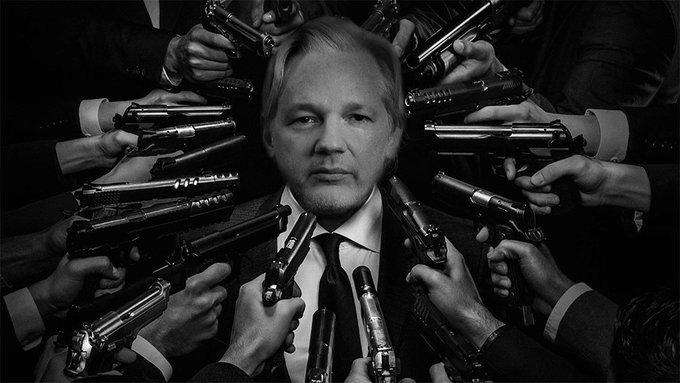
they are showing the world that they can lock up anyone.
That’s what this case has always been about.
It’s about setting a legal precedent that will allow the US empire to extradite anyone anywhere in the world who reveals inconvenient facts about it.
CAITLIN JOHNSTONE, OCT 5, 2023 https://www.caitlinjohnst.one/p/journalism-itself-is-locked-up-in?utm_source=post-email-title&publication_id=82124&post_id=137688774&utm_campaign=email-post-title&isFreemail=true&r=1ise1&utm_medium=email #JulianAssange
As the 17th anniversary of the creation of WikiLeaks passes us by, it’s probably worth taking a moment to reflect on Julian Assange and what his persecution means for us and our society.
Because in a very real sense, it’s not just a man locked up in Belmarsh Prison for the crime of good journalism — it’s journalism itself. It’s the idea that anyone should be permitted to expose the criminality of the world’s most powerful and tyrannical people. It’s the idea that the public should be allowed to know what abuses the US empire is committing around the world.
Julian Assange is the world’s greatest journalist. By revolutionizing source protection for the digital age with the creation of WikiLeaks 17 years ago and then going on to break some of the biggest stories of the 21st century, Assange set himself head and shoulders above any other living reporter anywhere on earth. And by showing the world that they can lock up the world’s greatest journalist for revealing inconvenient truths, they are showing the world that they can lock up anyone.
That’s what this case has always been about. It’s not about whether Assange crossed some arbitrary procedural line when working with Chelsea Manning to expose US war crimes. It’s not about the US protecting its national security. It’s not about any of the other justifications people have put forward to excuse their sycophantic support for the persecution of a journalist for doing journalism. It’s about setting a legal precedent that will allow the US empire to extradite anyone anywhere in the world who reveals inconvenient facts about it. It’s about showing all journalists everywhere that if they can do it to the greatest among them, they can do it to any of them. And, like so much else in the world today, it’s about narrative control.
To accept the persecution of Julian Assange is to accept the idea that all media everywhere must function as propaganda organs of the US government. It’s to take it as a given that any journalist anywhere in the world who decides to do real journalism and expose inconvenient facts about the powerful in the public interest should be jailed until they can be extradited to the United States for a show trial, and then left to rot in one of the most draconian prison systems on the planet. It’s to accept that we will never live in a truth-based society guided by facts and information, and must forever resign ourselves to living in a society dominated by the whims of the powerful.
Your position on the Assange case is therefore your position on what kind of society we should hope to live in, and what kind of future we should hope to have. In a very real way, it’s your position on humanity itself.
Should humanity try to create a better world, or should we keep plunging into dystopia until we are driven into nuclear war or environmental catastrophe by rulers we are forbidden to question? Do we want to move into the light, or into the darkness? Your position on Assange shows your answer to these questions, and shows which course you want us to take.
Australian Defence Minister slammed for exorbitant secret travel costs for nuclear submarine deal

Jacqui Lambie’s nuclear response to secret flights for submarine project. Independent Senator Jacqui Lambie has slammed the decision to slug taxpayers $630,000 a month in “secret” travel costs.
Samantha Maiden, news.com.au 7 Oct 23 #nuclear #antinuclear #nuclear-free #NoNukes
Independent Senator Jacqui Lambie has slammed the decision to slug taxpayers $630,000 a month in “secret” travel costs for bureaucrats working on Australia’s nuclear submarine project.
Despite the fact that the first submarine won’t be delivered to Australia under the deal until 2040, new documents reveal scheme has already blown up $15 million in travel costs alone in two years.
But bizarrely, the Defence Department has redacted the commercial airline departure times “for security reasons” suggesting it might reveal patterns of travel and put bureaucrats lives and safety at risk…………………………………………………………
It’s the same reason the defence department is refusing to reveal details of Defence Minister Richard Marles’ VIP flights suggesting it could put his safety in danger.
Australia plans to acquire a total of eight nuclear powered submarines (SSNs) under the $368bn deal.
But at least three of the subs and up to five of the eight will be Virginia-class submarines it will buy from the United States.
New data revealed under freedom of information laws reveal that Vice Admiral Jonathan Dallas Mead, the navy’s nuclear-powered submarine taskforce chief, has spent $197,000 on 8 overseas trips alone.
That’s contributing to the $15 million in global travel costs, a figure that adds up to $633,000 per month.
Defence representatives travelled to the United States and United Kingdom, and our AUKUS partners travelled to Australia, as part of the 18-month consultation period.
“Fifteen million bucks is a shocking amount to spend on travel, that‘s a bill of $633,000 a month for the Australian tax payer,” Senator Lambie said.
Defence personnel don’t get frequent flyer points – but do get status points.
“Admiral Mead alone has spent $197,000 on eight overseas trips, I bet his status points are looking good,” she said.
“It‘s not a submarine – it’s a gravy boat! And why all this secrecy?
“The government says the flights have been redacted because it‘s a national security matter, what a load of rubbish, these flights are in the past, there’s no national security issue.”
“Australia seems to be footing most of the bill for the AUKUS submarines, what is the UK and the US paying?.”
“This government campaigned on transparency and yet they are failing Australians when it comes to public scrutiny.“
Senator Lambie asked the Department of Defence how much had actually been spent out of the $300 million that was allocated to the task force in the financial year of 2022-23.
In response, the department confirmed that Defence representatives travelled to the United States and United Kingdom, and AUKUS partners travelled to Australia, as part of the 18-month consultation period.
The total expenditure for the Nuclear Powered Submarine Taskforce over the 18-month consultation period (16 September 2021 to 31 March 2023) was $139.2m.
A breakdown of class of travel is not held…….. https://www.news.com.au/national/politics/jacqui-lambies-nuclear-response-to-secret-flights-for-submarine-project/news-story/0bb81fa011f5c3128e9caa7361a7ef2d
The CIA’s “Information War” is Now Globalized?
Global Research, 6 Oct 23
In 1967, the CIA’s covert use of the National Student Association to spread countermessages to communism was revealed by a college dropout named Michael Wood.2 The revelation sent shockwaves through the U.S., and as journalists started to pull at the strings, the the CIA’s covert propaganda operations unraveled.
Journalists discovered that the CIA had set up nonprofit foundations to funnel taxpayer money into philanthropic foundations that then sent the CIA’s “donations” to organizations that had joined the CIA’s payroll to promote government-sponsored propaganda
These included youth organizations and student groups, church groups, public radio and news organizations. Sen. Wayne Morse, D-Ore., slammed the CIA’s covert propaganda activities, arguing the agency had created a “credibility chasm” within public opinion — a gap that could not and would not be bridged unless the government made clear that it would “fill the chasm with the truth”
The CIA was never reined in and is more involved in propaganda activities today than ever before
While many still have not realized it, we are at war, and the aggressors are government intelligence and security agencies that have turned their weapon of choice — information — against their own citizens
The video above [on original https://www.youtube.com/watch?v=op0HMkcQhew&t=297s%5D features a 1967 CBS special report titled “In the Pay of the CIA: An American Dilemma,”1 hosted by Mike Wallace. It examines how the Central Intelligence Agency (CIA) was secretly paying students, labour organizations, broadcasting networks and other organizations to do their bidding…….
A Condensed History
The National Security Act of 1947, signed by President Truman, created the CIA, the National Security Council, the Office of Secretary of Defense and the U.S. Air Force.3 As explained by the Office of the Historian,4 the Act “was a major reorganization of the foreign policy and military establishments of the U.S. government.”
The CIA was an outgrowth of the World War II era Office of Strategic Services and several small post-war intelligence organizations, and as noted by Wallace:
“Since the beginning, the CIA has suffered a personality split, because in addition to intelligence, the Security Act of 1947 orders the CIA to ‘perform other functions and duties as directed by the President and his National Security Council.’ That phrase has become a sort of blank check, authorizing CIA excursions into everything from simple propaganda to the overthrow of unfriendly governments.”
Wallace goes on to explain how the CIA ended up with fingers in so many pies. First, it set up several nondescript nonprofit foundations, the function of which were to funnel taxpayer money from the CIA to other, real foundations involved in real-world philanthropy.
However, in return for CIA funds, these foundations “agreed to become conduits for central intelligence,” and funneled the exact dollar amounts received on to other organizations that, in the 1940s, ’50s and ’60s, joined the CIA’s payroll to promote government-sponsored propaganda………………………………………………………..
Operation Mockingbird Is Alive and Well
Unfortunately, the CIA was never reined in, and its propaganda activities have only expanded and become more sophisticated over time. The 1976 Church Committee investigation (chaired by Senator Frank Church) exposed how the CIA had corrupted the media by paying journalists to promote the agency’s narratives.
The program, called Operation Mockingbird, was officially dismantled, but while the operational name may have been retired, there’s plenty of evidence to suggest the CIA never discontinued its media influence.5
In fact, we have evidence the CIA is controlling mainstream media to this day, and it is doing so with unprecedented efficiency, as it can now push its narratives out through the three global news agencies, which are responsible for crafting and curating most of the news disseminated worldwide…………………………………………………
The FBI is also in on the action, as are most of the world’s intelligence agencies. They are all pushing the same Great Reset and Fourth Industrial Revolution narratives, the aim of which is the technocratic control of the global population. That is why we are seeing the same narratives playing all over the world including the Orwellian argument that we must censor to protect democracy.
A New Type of War
While many still have not realized it, we are at war. The aggressors are government intelligence and security agencies that have turned their weapon of choice — information — against their own citizens.
And, while the organizations doing the CIA’s dirty work may have changed, the basic organizational structure is the same as it was in 1967. Taxpayer money gets funneled through various federal departments and agencies into the hands of non-governmental agencies that carry out censorship activities as directed.
Trump blabbed nuclear sub secrets to Australian billionaire member of Mar-a-Lago club, report claims
Andrew Feinberg, Fri, October 6, 2023 https://www.yahoo.com/news/trump-blabbed-nuclear-sub-secrets-211203147.html?guccounter=1
Former president Donald Trump allegedly revealed highly classified information about American nuclear-powered submarines to a wealthy Australian who regularly paid large sums to one of his companies, according to a report from ABC News.
Mr Trump reportedly disclosed the extremely sensitive information to a billionaire member of his Mar-a-Lago social club, which is housed at the location where he allegedly hoarded hundreds of classified documents for more than a year after his term as president — and his authorisation to possess such documents — had come to an end.
Citing sources familiar with the matter, ABC reported that the Aussie high-roller in question allegedly shared the information about US nuclear-powered submarines with “scores” of other people not authorised to have it, including “more than a dozen foreign officials” and journalists of unknown nationality.
Department of Justice investigators working under the supervision of Special Counsel Jack Smith learned of the potential breach as they were investigating Mr Trump’s alleged unlawful retention of national defence information.
Both prosecutors and special agents with the Federal Bureau of Investigation have reportedly spoken to the Mar-a-Lago member, packaging magnate Anthony Pratt, on at least two occasions this year.
Mr Pratt reportedly told investigators that the ex-president told him two pieces of information about the submarines: How many nuclear warheads are carried by American Ohio class ballistic missile submarines, and how close to such vessels a Russian submarine must get to detect them.
Both of those figures are among the US Navy’s most closely guarded secrets. But sources reportedly told ABC that Mr Pratt described what Mr Trump had said to at least 45 other people, including 10 Australian officials and a trio of former prime ministers.
Who Is Anthony Pratt, the Australian Billionaire Trump Allegedly Shared Nuclear Secrets With?
Bloomberg, By Andrew Heathcote, October 6, 2023 #nuclear #antinuclear #nuclear-free #NoNukes
Australian billionaire Anthony Pratt has been hurled into the spotlight after US press reports alleged that former President Donald Trump spilled secrets about US nuclear subs to the businessman.
ABC News first reported that Trump discussed the potentially sensitive information with Pratt — who’s a member of his Mar-a-Lago Club — shortly after leaving office. The report alleges that the businessman then went on to share that information with several others, following the revelations at Trump’s private club.
Here’s a quick rundown of what you need to know about Australia’s ‘cardboard king’…………………………………………..
He’s worth $9.2 billion, according to the Bloomberg Billionaires Index. That makes him the world’s 213th richest person, the data show……………………………
Former Australian prime minister Scott Morrison joined Trump and Pratt on their paper plant tour in 2020. Pratt also has a relationship with President Joe Biden having invited the then vice president to dinner during his Australian visit in 2016. Back in 2013, during the Obama administration he appointed a former US ambassador to his advisory board…………………..
What did Pratt do after Trump’s alleged revelations?
After Trump allegedly shared details on the submarines — reported to be the number of nuclear warheads they carry and how close they can get to Russian subs — Pratt went on to disclose the potentially-sensitive information to “scores of others,” including foreign officials, journalists and employees, according to ABC. He has since been interviewed by US law enforcement agencies, the network reported…………… more https://www.bloomberg.com/news/articles/2023-10-06/who-is-anthony-pratt-the-billionaire-trump-is-accused-of-revealing-secrets-to?leadSource=uverify%20wall
Ukrainians who helped elderly neighbours in Russian occupation are being convicted of collaboration.
In Occupation, They Cared for the Vulnerable. Now They’re in Jail for It
Ukrainians who ensured elderly neighbours survived when Russia took their town are being convicted of collaboration.
SCHEERPOST, By Oleksiy Arunyan / openDemocracy October 6, 2023 #Ukraine
When the eastern Ukrainian city of Lyman was occupied for five months last year, Valentyna Tkach and Tetiana Potapenko stayed behind. They volunteered to help their vulnerable neighbours. They cared for elderly residents, contacted the Russian occupation administration to ask for food and coal for them, and even buried dead bodies.
Now, both women are in detention, having been accused by Ukraine’s Secret Service of collaboration with Russia – a crime punishable by up to 10 years in prison.
Tkach and Potapenko were volunteers long before the occupation. Since Soviet times, Lyman’s population has self-organised to better coordinate with local authorities. Residents of each of the city’s ‘microdistricts’ nominate individuals, who are usually women and are known as street attendants (vulychni), to maintain order and liaise with the mayor’s office on their behalf.
This work is coordinated by a head of the neighbourhood, who is elected by residents. When Russia captured Lyman, the local leaders in Tkach and Potapenko’s microdistricts fled, and the women stepped up to take on their roles.
Today, they believe they are being punished for helping others. As part of a series of stories on collaboration trials in the Donetsk region, Ukrainian news outlet Graty met both women in April, while they were in pre-trial detention. Below, [on original] openDemocracy publishes an abridged translation of Graty’s feature…………………………………………………………………………………………………………….. more https://scheerpost.com/2023/10/06/in-occupation-they-cared-for-the-vulnerable-now-theyre-in-jail-for-it/
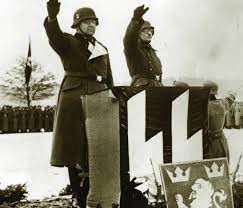
New Canadian Nazi scandal forces Viceroy to apologize – media
https://www.rt.com/news/584009-order-canada-nazi-veteran/ 44 oct 23 #Ukraine
The country’s second-highest order was bestowed in 1987 on a former member of a Ukrainian Waffen-SS unit
Canadian Governor General Mary Simon has reportedly apologized and expressed “regret” that her office awarded the second-highest merit in the country in 1987 to a Ukrainian-Canadian who formerly served in a Nazi unit.
The statement was reported on Tuesday by Forward, a Jewish news outlet that previously helped expose the dark past of Yaroslav Hunka. The Ukrainian-Canadian Waffen-SS veteran received a standing ovation at the Canadian parliament last month, sparking international outrage. Peter Savaryn, whose decoration more than three decades ago has now been deemed inappropriate, served in the same 14th Waffen Grenadier Division of the SS as Hunka.
Savaryn was already mentioned in connection in the Hunka scandal due to his tenure as the 12th chancellor of the University of Alberta from 1982 to 1986. Last month, the university announced it was shutting down an endowment named after Hunka. The Friends of Simon Wiesenthal Center (FSWC), a Jewish advocacy group, urged the university to acknowledge Savaryn’s past as well.
The unit in which the two Ukrainian-Canadians served, which was also known as the Galicia Division, was formed from volunteers in 1943 to assist Nazi Germany’s campaign on the eastern front. It stands accused of committing war crimes against Polish civilians.
Only living individuals can be members of the Order of Canada. Savaryn, who passed away in 2017, no longer has the honor, and it cannot be revoked retroactively under the order’s constitution, the statement quoted by Forward said.
“The Chancellery is committed to working with Canadians to ensure our honors system is reflective of Canadian values,” it added.
The Canadian governor general is the British monarch’s personal representative in the country, although the Canadian prime minister provides advice on who should serve in the largely ceremonial role. Simon was given the job in 2021, becoming the first Canadian indigenous person to hold the position.
The Hunka scandal prompted Canadian parliament speaker Anthony Rota to resign, after he took full responsibility for inviting the 98-year-old to the chamber. Amid the international outcry Prime Minister Justin Trudeau claimed that Russia was “politicizing” the controversy to undermine Ukraine’s reputation.
Ukrainian President Vladimir Zelensky, who joined Canadian officials in applauding Hunka, has not publicly commented on the situation. Ukrainian Nazi collaborators are often treated as national heroes in modern Ukraine on the grounds that they fought against the Soviet Union for an independent Ukrainian state.
CANADA WELCOMES HITLER’S TOP UKRAINIAN PROPAGANDISTS
SCHEERPOST, By Max Blumenthal / The Grayzone 1 Oct 23 “…………………………………………………………………………………………………………………………………………………….Throughout the Nazi German occupation of Poland, the Ukrainian journalist Michael Chomiak served as one of Hitler’s top propagandists. Based in Krakow, Chomiak edited an antisemitic publication called Krakivs’ki visti (Krakow News), which cheerled the Nazi invasion of the Soviet Union – “The German Army is bringing us our cherished freedom,” the paper proclaimed in 1941 – and glorified Hitler while rallying Ukrainian support for the Waffen-SS Galicia volunteers.
Chomiak spent much of the war living in two spacious Krakow apartments that had been seized from their Jewish owners by the Nazi occupiers. He wrote that he moved numerous pieces of furniture belonging to a certain “Dr. Finkelstein” to another aryanized apartment placed under his control.
In Canada, Chomiak participated in the Ukrainian Canadian Committee (UCC), which incubated hardcore nationalist sentiment among diaspora members while lobbying Ottawa for hardline anti-Soviet policies. On its website, the UCC boasted of receiving direct Canadian government assistance during World War Two: “The final and conclusive impetus for [establishing the UCC] came from the National War Services of Canada which was anxious that young Ukrainians enlist in military services.”
The UCC’s first president Volodymyr Kubijovych, had served as Chomiak’s boss back in Krakow. He also played a part in the establishment of the 14th Grenadier Division of the Waffen-SS Galicia, announcing upon its formation, “This historic day was made possible by the conditions to create a worthy opportunity for the Ukrainians of Galicia, to fight arm in arm with the heroic German soldiers of the army and the Waffen-SS against Bolshevism, your and our deadly enemy.”
FREELAND NURTURES MEDIA CAREER AS UNDERCOVER REGIME CHANGE AGENT IN SOVIET-ERA UKRAINE
Following his death in 1984, Chomiak’s granddaughter, Chrystia Freeland, followed in his footsteps as a reporter for various Ukrainian nationalist publications. She was an early contributor to Kubijovych’s Encyclopedia of Ukraine, which whitewashed the record of Nazi collaborators like Stepan Bandera, referring to him as a “revolutionary.” Next, she took a staff position at the Edmonton-based Ukrainian News, where her grandfather had served as editor.
A 1988 edition of Ukrainian News (below on original) featured an article co-authored by Freeland, followed by an ad for a book called “Fighting for Freedom” which glorified the Ukrainian Waffen-SS Galician division.
During Freeland’s time as an exchange student in Lviv, Ukraine, she laid the foundations for her meteoric rise to journalistic success. From behind cover as a Russian literature major at Harvard University, Freeland collaborated with local regime change activists while feeding anti-Soviet narratives to international media bigwigs.
“Countless ‘tendentious’ news stories about life in the Soviet Union, especially for its non-Russian citizens, had her fingerprints as Ms. Freeland set about making a name for herself in journalistic circles with an eye to her future career prospects,” the Canadian Broadcasting Corporation (CBC) reported.
Citing KGB files, the CBC described Freeland as a de facto intelligence agent: “The student causing so many headaches clearly loathed the Soviet Union, but she knew its laws inside and out – and how to use them to her advantage. She skillfully hid her actions, avoided surveillance (and shared that knowledge with her Ukrainian contacts) and expertly trafficked in ‘misinformation.’”
In 1989, Soviet security agents rescinded Freeland’s visa when they caught her smuggling “a veritable how-to guide for running an election” into the country for Ukrainain nationalist candidates.
She quickly transitioned back to journalism, landing gigs in post-Soviet Moscow for the Financial Times and Economist, and eventually rising to global editor-at-large of Reuters – the UK-based media giant which today functions as a cutout for British intelligence operations against Russia.
CANADA TRAINS, PROTECTS NAZIS IN POST-MAIDAN UKRAINE
When Freeland won a seat as a Liberal member of Canada’s parliament in 2013, she established her most powerful platform yet to agitate for regime change in Russia. Milking her journalistic connections, she published op-eds in top legacy papers like the New York Times urging militant support from Western capitals for Ukraine’s so-called “Revolution of Dignity,” which saw the violent removal of a democratically elected president and his replacement with a nationalist, pro-NATO government in 2014.
In the midst of the coup attempt, a group of neo-Nazi thugs belonging to the C14 organization occupied Kiev’s city council and vandalized the building with Ukrainian nationalist insignia and white supremacist symbols, including a Confederate flag. When riot police chased the fascist hooligans away on February 18, 2014, they took shelter in the Canadian embassy with the apparent consent of the Conservative administration in Ottawa. “Canada was sympathizing with the protesters, at the time, more than the [Ukrainian] government,” a Ukrainian interior ministry official recalled to the Canadian Broadcasting Corporation.
Official Canadian support for neo-Nazi militants in Ukraine intensified after the 2015 election of the Liberal Party’s Justin Trudeau. In November 2017, the Canadian military and US Department of Defense dispatched several officers to Kiev for a multinational training session with Ukraine’s Azov Battalion. (Azov has since deleted the record of the session from its website).
Azov was controlled at the time by Adriy Biletsky, the self-proclaimed “White Leader” who declared, “the historic mission of our nation in this critical moment is to lead the White Races of the world in a final crusade for their survival… A crusade against the Semite-led Untermenschen.”
AS NAZI FAMILY HISTORY SURFACES, FREELAND LIES TO THE PUBLIC
Back in Canada, Freeland’s troubling family history was surfacing for the first time in the media. Weeks after she was appointed in January 2017 as Foreign Minister – a post she predictably exploited to thunder for sanctions on Russia and arms shipments to Ukraine – her grandfather’s role as a Nazi propagandist in occupied Poland became the subject of a raft of reports in the alternative press.
The Trudeau government responded to the factual reports by accusing Russia of waging a campaign of cyber-warfare. “The situation is obviously one where we need to be alert. And that is why the Prime Minister has, among other things, encouraged a complete re-examination of our cyber security systems,” Public Safety Minister Ralph Goodale declared.
Yet few, if any, of the outlets responsible for excavating Chomiak’s history had any connection to Russia’s government. Among the first to expose his collaborationism was Consortium News, an independent, US-based media organization.
For her part, Freeland deployed a spokesperson to lie to the public, flatly denying that “the minister’s grandfather was a Nazi collaborator.”
When Canadian media quoted several Russian diplomats about the allegations, Freeland promptly ordered their deportation, accusing them of exploiting their diplomatic status “to interfere in our democracy.”
By this time, however, her family secrets had tumbled out of the attic and onto the pages of mainstream Canadian media. On March 7, 2017, the Globe and Mail reported on a 1996 article in the Journal of Ukrainian Studies confirming that Freeland’s grandfather had indeed been a Nazi propagandist, and that his writing helped fuel the Jewish genocide. The article was authored by Freeland’s uncle, John-Paul Himka, who thanked his niece in its preface for helping him with “problems and clarifications.”
“Freeland knew for more than two decades that her maternal Ukrainian grandfather was the chief editor of a Nazi newspaper in occupied Poland that vilified Jews during the Second World War,” the Globe and Mail noted.
After being caught on camera this September clapping with unrestrained zeal alongside hundreds of peers for a Ukrainian veteran of Hitler’s SS death squads, Freeland once again invoked her authority to scrub the incident from the record.
Three days after the embarrassing scene, Freeland was back on the floor of parliament, nodding in approval as Liberal House leader Karina Gould introduced a resolution to strike “from the appendix of the House of Commons debates” and from “any House multimedia recording” the recognition made by Speaker Anthony Rota of Yaroslav Hunka.
Thanks to decades of officially supported Holocaust education, the mantra that demands citizens “never forget” has become a guiding light of liberal democracy. In present day Ottawa, however, this simple piece of moral guidance is now treated as a menace which threatens to unravel careers and undermine the war effort in Ukraine.
The Zelensky lie is coming to an end

Voltaire Network, by Thierry Meyssan, Translation by Roger Lagassé 1 Oct 23
President Volodymyr Zelensky’s trip to the United States cleared up any remaining ambiguities. Everyone wondered about his strategy. He doesn’t seem to be trying to defend his own people, as he mobilizes all his men and sends them to die on the front line with no hope of victory. From now on, he appears to have no qualms about lying and cheating, and uses every means at his disposal to expel certain states from intergovernmental organizations.
How can we not draw a parallel with Stepan Bandera, who massacred thousands of his own compatriots in the final days of the Second World War, when the defeat of the Reich was in no doubt?

Ukrainian President Volodymyr Zelensky attended the 78th General Assembly of the United Nations to deliver his customary speech on Russian terrorism. It was his first speech from this rostrum.
This year, four of the five permanent members of the Security Council did not send their heads of state or government: China, France, the UK and Russia. Clearly, despite the rhetoric, something has gone wrong in this institution.
Let’s summarize President Zelensky’s speech:
“Russia uses food as a weapon against the rest of the world and the “game”, in its favor, of certain European countries. It also uses civilian nuclear reactors as weapons, as it is doing at Zaporijha. It has abducted “hundreds of thousands” of Ukrainian children, who are being re-educated at home in hatred of Ukraine, which constitutes “genocide”. Russia provokes a war every decade. Today, it threatens Kazakhstan and the Baltic states. Many seats in this hemicycle would be empty if Russia were to achieve its objectives through its acts of treachery. Thank God nobody has yet imagined how to use the climate as a weapon. Natural disasters kill. They happen while Moscow has decided to kill tens of thousands of people. We must unite against these challenges. We can breathe new life into the “Rules-Based World Order” by building on the Ukrainian peace formula that I will be presenting to the Security Council shortly. I invite you all to the Peace Summit we are organizing. We can’t rely on Russia’s word: ask Prigozhin if he keeps his promises! Slava Ukraini!”
All the delegations allied with the United States applauded the speech loud and clear, while the others kept a low profile.
This speech calls for several comments:
– The argument of using food as a weapon refers to sieges to starve populations, as in North Korea yesterday or Yemen today. This is not at all what the Russians are doing in Ukraine, where they are attacking the profits of the major US corporations (Cargill, Dupont and Monsanto) which own a third of Ukrainian crops. The use of civilian nuclear power plants as a weapon of war must be understood as having an effect only at close range. The Russians occupy the Zaporijha plant and would lose their soldiers in the event of radiation. On the contrary, it is the Ukrainian forces who are threatening them with radiation in order to expel them. Finally, Russia has never abducted Ukrainian children, but has protected them from the combat zones by moving them within its territory. The International Criminal Court’s condemnation is based exclusively on the refusal to consider the accession of Crimea, Donbass and part of Novorossia to the Russian Federation as legal.
– The argument of Russian expansionism may frighten the Kazakhs and Balts, but it’s nothing more than a trial of intent. Returning to the possible use of climate as a weapon shows an ignorance of history. The USA already used it in their war against Viet Nam, making rain for months on the Ho Chi Min trail, the Vietcong’s supply route through the Laotian jungle (Operation “Popeye”). Eventually, they signed the Convention on the Prohibition of Military or Any Other Hostile Use of Environmental Modification Techniques
– To claim, without naming them, that Poland, Hungary and Slovakia are playing into the Russians’ hands by banning the import of Ukrainian grain at knock-down prices is an insult to these countries. Poland, which, forgetting the massacre of over 100,000 Poles by Ukrainian integral nationalists during the Second World War, has nevertheless welcomed 1.5 million Ukrainian refugees since the start of the current war, will appreciate this.
– The call to defend the “rules-based World Order” can only be taken as a challenge to the majority of UN members who are fighting, on the contrary, for a return to International Law. The Ukrainian peace plan therefore concerns only the Western camp and aims to extend the war.
– President Zelenski’s conclusion refers to a poem by Taras Shevchenko (1814-1861). The expression “Slava Ukraini!” had become the cry of recognition of the Ukrainian integral nationalists of Dmitry Dontsov and Simon Petlioura during the war against the Soviet revolution, when they massacred the Jews and anarchists of Novorussia. Then it became the victory cry of the Ukrainian integral nationalists of Dmitry Dontsov and Stepan Bandera when they massacred Jews, Gypsies and Resistance fighters. Finally, in 1941, it became the equivalent of “Heil Hitler! Its use today, especially at the United Nations, refers back to the post-war resolutions against Nazi propaganda, which Ukraine now opposes……………………………………………………………………………………………………………………………………………………..
The debate continued with a speech by Secretary General António Guterres. He began by pointing out that some multilateral meetings, such as the one on the plan to safeguard the Sustainable Development Goals, are held efficiently. He then described Russia’s invasion of Ukraine as a flagrant violation of the UN Charter and international law. On the judicial front, he reported that investigative teams were continuing to gather evidence of shocking and widespread human rights violations “mainly perpetrated by the Russian Federation”, including the forced transfer of children. Finally, he welcomed the agreement on cereals and regretted that Russia had not renewed it.
The Secretary General’s position expresses only his personal opinion. In this case, it is not based on any judicial decision and does not take into account the Russian position. The trial currently underway before the International Court of Justice, i.e. the UN’s internal tribunal, will hear both sides. It will be for the Court alone to judge whether there has been a violation of the Charter, as Russia claims to have launched a special military operation to comply with Security Council Resolution 2202 (“Minsk agreements”). In any case, the Court will only rule on one question: whether or not Ukraine was massacring its own citizens before the Russian special military operation. We are talking about 20,000 citizens.
Ukrainian President Volodymyr Zelensky then intervened. He began his speech by asking how a state that violates the UN Charter can sit on the Security Council? He noted that the General Assembly had recognized that Russia, not Ukraine, was responsible for the war. He then presented his 10-point peace plan. This plan, which had already been presented to the G20 in Bali, does not take Russia’s demands into account. So, strictly speaking, it’s not a peace plan, but rather Ukraine’s demands. In passing, he asked the General Assembly to adopt, by a two-thirds majority, a modification of its statutes and deprive Russia of its right of veto. Finally, he called on all States present to participate in the “peace” conference that his country was organizing.
The session chairman, Edi Rama, wondered about the current situation: a member of the Security Council is violating the UN Charter! Fortunately, despite the abusive use of its veto power, the majority of Council members ensure that its values are respected. He then gave the floor to Council members in the order of their registration.
Their speeches added nothing new. None of them dared to take up Ukraine’s call for Russia to be stripped of its veto power.
A little backtracking is in order here: when the United Nations was created, Franklin D. Roosevelt of the United States and Winston Churchill of Great Britain were at odds with Joseph Stalin of the Soviet Union. The USA and the UK wanted to create an organization that would govern the world according to their own conceptions, while the USSR wanted it to uphold international law and prevent war. It was the Soviet conception that triumphed. The right of veto takes into account the military reality of the time. There is no such thing as a legitimate or abusive veto. Quite simply, international law cannot be respected by all if it runs counter to the interests of one of its most powerful members.
The idea of depriving Russia of its veto power had never been expressed in public. Last year, however, the US State Department tested the matter with all UN member states, and it proved impossible to achieve a two-thirds majority.
After his speech, President Zelensky left the room, having no time to waste listening to the other delegations. He rushed off to Washington to address Congress, as he had already done in December 2022. However, when he arrived on Capitol Hill, House Speaker Kevin McCarthy told him straight out that it was out of the question. Parliamentarians have too busy an agenda,” he said. Dejected, the Ukrainian president had to content himself with a meeting with the presidents of the two chambers and a few Democratic senators.
The time for unconditional support is over. Like all their Western counterparts, US parliamentarians have realized that: – ammunition is in short supply, and the Western arms industry cannot compete with Russia’s in either the short or medium term; – the rebellion of Wagner Group owner Yevgeny Prigozhin against the Kremlin has failed; – the Ukrainian counter-offensive has been extremely deadly, with over a thousand people killed every day for the past two weeks, without achieving any significant successes.
Many would therefore like to negotiate a way out of the crisis or, at the very least, stop spending astronomical sums of money for nothing. Some Republicans have written to the Biden administration asking for a precise account of how the funds already disbursed have been used. Pending a response, they will not vote for another dollar. The Pentagon is therefore devising ways to divert equipment and continue the US commitment to Ukraine. It is hiding behind the possibility of blocking the federal budget in the event of a substantive disagreement between Capitol Hill and the White House.
To make up for the parliamentary affront, both the Secretary of Defense and President Joe Biden granted the Ukrainian president an interview. He also visited a university, the Clinton Foundation and the Atlantic Council, and chatted with the heads of financial companies. But the fact remains: everyone has observed President Zelensky’s outrages and his inability to win this war. Everyone has now been able to verify that Volodomyr Zelensky is not trying to defend his country. On the contrary, he is sending his men to die for nothing in front of the Russian defense line. He’s acting just as hard-line nationalists and Nazis always did: he doesn’t hesitate to lie to his own people, to cheat, and to use every means at his disposal to provoke a general confrontation at the cost of sacrificing his own people. https://www.voltairenet.org/article219739.html?fbclid=IwAR1_Hi_V0hQJPPSffJRKWhlqmnLKJYYprcKu1qeNRoRlUfGpX4-IVSD3nsQ
Monuments to Ukrainian Nazis in Canada

W.O. Munce, https://www.thepostil.com/monuments-to-ukrainian-nazis-in-canada/
Given the fact that Ukraine and Nazis are again making news, it is important to point out that there are indeed commemorative monuments to Ukrainian Nazis in Canada, located where the Ukrainian populations are the greatest. The reasons for such monuments are known to the Ukrainian community alone, but so it is essential to make a record of them here, along with a hint at what those being commemorated did back in the days of World War Two.
“Ukrainian partisans and their allies burned homes, shot or forced back inside those who tried to flee, and used sickles and pitchforks to kill those they captured outside. Churches full of worshipers were burned to the ground. Partisans displayed beheaded, crucified, dismembered, or disemboweled bodies, to encourage remaining Poles to flee… It was this maimed OUN-Bandera, led by Mykola Lebed’ and then Roman Shukhevych, that cleansed the Polish population from Volhynia in 1943” (The Reconstruction of Nations).
The 14th Division of the Ukrainian SS surrounded the village Huta Pieniacka from three sides… The people were gathered in the church or shot in the houses. Those gathered in the church—men, women and children—were taken outside in groups, children killed in front of their parents. Some men and women were shot in the cemetery, others were gathered in barns where they were shot” (British archives).
“One of their major tasks as UPA partisans was the cleansing of the Polish presence from Volhynia. Poles tend to credit the UPA’s success in this operation to natural Ukrainian brutality; it was rather a result of recent experience. People learn to do what they are trained to do, and are good at doing what they have done many times. Ukrainian partisans who mass-murdered Poles in 1943 followed the tactics they learned as collaborators in the Holocaust in 1942: detailed advance planning and site selection; persuasive assurances to local populations prior to actions; sudden encirclements of settlements; and then physical elimination of human beings. Ukrainians learned the techniques of mass murder from Germans. This is why UPA ethnic cleansing was striking in its efficiency, and why Volhynian Poles in 1943 were nearly as helpless as Volhynian Jews in 1942. It is one reason why the campaign against Poles began in Volhynia rather than Galicia, since in Volhynia the Ukrainian police played a greater role in the Final Solution” (The Reconstruction of Nations).
“On that day, early in the morning, soldiers of this division, dressed in white, masking outfits, surrounded the village. The village was cross-fired by artillery. SS-men of the 14th Division of the SS ‘Galizien’ entered the village, shooting the civilians rounded up at a church. The civilians, mostly women and children, were divided and locked in barns that were set on fire. Those who tried to run away were killed. Witnesses interrogated by the prosecutors of the Head Commission described the morbid details of the act. The crime was committed against women, children, and newborn babies” (The Institute of National Remembrance. Commission for the Prosecution of Crimes against the Polish Nation).
Related Articles:
Nazigate: Canada’s top general won’t apologize for applauding Ukrainian Waffen-SS vet
WYATT REED, ·SEPTEMBER 28, 2023, https://thegrayzone.com/2023/09/28/nazigate-canadas-general-ukrainian-waffen-ss/—
As Canada’s top officials express embarrassment for honoring a WWII Nazi collaborator in parliament, the leader of the country’s military, Gen. Wayne Eyre, refuses to apologize for his standing ovation. The Canadian military has trained Ukraine’s notorious neo-Nazi Azov Battalion for years.
Canadian politicians have been in frantic damage control mode since feting a former member of the Waffen-SS during a parliamentary reception for Ukrainian President Volodymyr Zelensky on September 22. The Speaker of Canada’s House of Commons, Anthony Rota, resigned following the incident, while Prime Minister Justin Trudeau lamented it as “extremely upsetting,” and opposition leader Pierre Poilievre branded the affair the “biggest single diplomatic embarrassment” in Canada’s history.
But amid the gratuitous public rites of contrition, one influential official has been conspicuously absent: Canada’s highest-ranking general. According to the Ottawa Citizen, Chief of the Defence Staff Gen. Wayne Eyre has “declined to apologize for his standing ovation” for Yaroslav Hunka, the now-notorious 98-year-old former member of the 14th Waffen Grenadier Division of the SS, whose members gained international infamy for hunting down anti-Nazi partisans, massacring thousands of civilians, and burning hundreds of Polish villagers alive.
The notion that the Nazi proclivities of figures like Hunka could have escaped Eyre’s notice now appears increasingly remote. In 2017, Ukraine’s Azov Battalion published photos on their website publicizing their meeting with high-level Canadian military officials, who had arrived in Ukraine to help train the notoriously neo-Nazi infested unit, which was officially incorporated into the Ukrainian National Guard.
A year later, Azov posted photos on its official social media channels showing Canadian military attaché Col. Brian Irwin meeting with its personnel. Responding to a query from journalist Asa Winstanley, a Canadian military spokesman justified training the fascist military on the grounds that the session “includes ongoing dialogue on the development of a diverse, and inclusive Ukraine.”
Just four months before Russia’s invasion of Ukraine, The Friends of Simon Wiesenthal Center for Holocaust Studies sent a letter to then-Acting Chief of the Defense Staff Gen. Wayne Eyre and Defense Minister Harjit Sajjan demanding an investigation into the decision to train Ukrainian neo-Nazis. The Jewish group urged them to ensure that such instruction did not continue.
“If Canada is going to be providing military training to foreign forces, then it is our responsibility to know we are not training neo-Nazis,” said Jaime Kirzner-Roberts, policy director of the Friends of Simon Wiesenthal Center. “It is our obligation to our Canadian veterans who sacrificed so much defeating fascism in Europe.”
But such warnings apparently went unheeded. The Canadian military not only declined to discontinue its Nazi-training policies, it escalated its program of coaching avowed fascists. Since Russian military operations in Ukraine kicked off in Feb. 2022, Canada has invested a further $1.6 billion USD in the arming and instructing of Kiev’s military.
On the sidelines of Zelensky’s now-infamous address to the Canadian Parliament, Ottawa authorized the further disbursement of another $483 million USD in aid and training on F-16 fighter jets.
Canada’s scheme of funneling weapons to Kiev and coaching Ukrainian forces officially began in 2014, just months after anti-Russian forces toppled the democratically-elected government of Viktor Yanukovych in a brutal US government-backed coup d’etat. Under the auspices of “Operation UNIFIER,” more than 33,000 Ukrainian troops received “advanced combat instruction by Canadian soldiers,” Canada’s state-affiliated CBC reported in 2022.
Ukraine’s ambassador in Ottawa, Yulia Kovaliv, heralded the training initiative as a “very important initiative.”
“It is also important to further provide Ukraine with heavy weapons,” she added.
In the UK, where Canadian forces frequently travel in order to school Zelensky’s army in the art of killing Russians, the program received a similarly warm welcome. An ebullient British Defense Secretary Ben Wallace said in a statement at the time that he was “delighted” that “the Canadian Armed Forces will be joining the growing international effort to support the training of Ukrainian soldiers in the UK.”
“Canada’s expertise will provide a further boost to the programme and ensure that the Ukrainian men and women, coming to the UK to train to defend their country, will get a wide pool of experience and skills from both UK forces and our international partners,” Wallace crowed.
Just what exactly the nationalist-leaning members of Ukrainian armed forces did with the training and tacit blessing of Canada has yet to be ascertained. But Azov members have been implicated in a number of war crimes. Despite the unit’s recent push to whitewash its Nazi tendencies, Azov — which has since expanded to a full-fledged brigade under Kiev’s official command — retains as its leader Andrey Biletsky, who once described Ukraine’s role on the global stage as helping to “lead the white races of the world in a final crusade … against Semite-led Untermenschen.”
Biletsky has taken pains to distance himself from the comment, but the unit has not undertaken similar efforts to distance itself from Biletsky. In September 2023, Biletsky was photographed proudly shaking hands with Zelensky during an intimate meeting with the Ukrainian President on the outskirts of Bakhmut. And Zelensky himself appears to have few problems with publicly associating with the group.
In a post commemorating the encounter with Ukraine’s most celebrated Nazi formation, Zelensky declared: “I am grateful to everyone who defends our country and people, who brings our victory closer.”
German ambassador applauded Ukrainian Waffen SS Nazi – Berlin
Members of the Canadian parliament stood and gave long ovations for the 98-year-old Hunka when he was introduced during a visit by Ukrainian President Vladimir Zelensky on Friday. Zelensky and Canadian Prime Minister Justin Trudeau were among the enthusiastic participants in the cheers.
Ukrainian Nazi collaborators slaughtered thousands of Poles during World War II. Hunka was among thousands of Ukrainian fighters who were allowed to emigrate to the UK and Canada after World War II, despite their possible participation in war crimes.
https://www.rt.com/news/583676-germany-ambassador-nazi-ovations/ 29 Sept 23
The foreign ministry has claimed that its diplomat was not aware that Yaroslav Hunka fought with a notorious WWII Ukrainian-based battalion
Germany’s Foreign Office has shrugged off the participation of its ambassador to Canada in last week’s embarrassing standing ovations for a Ukrainian veteran of the Waffen SS, saying she was unaware that he was a Nazi when she joined with Ottawa lawmakers in applauding him.
Foreign Office spokesman Sebastian Fischer acknowledged the gaffe for the first time on Wednesday, when asked at a press briefing about Ambassador Sabine Sparwasser’s honoring of World War II Nazi collaborator Yaroslav Hunka.
Members of the Canadian parliament stood and gave long ovations for the 98-year-old Hunka when he was introduced during a visit by Ukrainian President Vladimir Zelensky on Friday. Zelensky and Canadian Prime Minister Justin Trudeau were among the enthusiastic participants in the cheers.
Sparwasser simply didn’t know about Hunka’s Nazi affiliation when she joined with others in applauding him, Fischer claimed. The spokesman conceded that the incident was unacceptable, but Hunka’s true identity was not known to the German diplomat or other members of the crowd because his attendance at the event was not announced beforehand.
However, when House Speaker Anthony Rota introduced his guest to the crowd, he noted that Hunka “fought for Ukrainian independence against the Russians,” which by definition suggested that he served on the side of the fascist Axis powers. “He’s a Ukrainian hero, a Canadian hero, and we thank him for all his service,” the speaker said.
Rota resigned from his position on Tuesday and apologized for his mistake in honoring Hunka. The war veteran was a volunteer in the 14th Waffen Grenadier Division of the SS, a Ukrainian unit, which committed atrocities against Jews and Poles on the Eastern Front.
Asked about how Sparwasser could fail to understand Hunka’s Nazi affiliation – despite being told that he fought against the Red Army – Fischer said there were other possible explanations for his role in the war. For instance, he theorized, Hunka could have been a fighter for the Polish Home Army, which fought against both German and Russian forces.
Ukrainian Nazi collaborators slaughtered thousands of Poles during World War II. Hunka was among thousands of Ukrainian fighters who were allowed to emigrate to the UK and Canada after World War II, despite their possible participation in war crimes.
Moscow called the incident a cynical abuse of the memory of the victims of Nazism and an example of blatant Russophobia, and said it may launch a probe into potential war crimes and request the extradition of Hunka. Poland, which has been among the top backers of modern-day Ukraine in its fight against Russia, has also urged a probe into potential war crimes committed by Hunka.
Chinese Balloon Was Not Spying, US Government Admits Months Later
by EDITORS, September 29, 2023 https://scheerpost.com/2023/09/29/chinese-balloon-was-not-spying-us-government-admits-months-later/
The Pentagon admitted that a Chinese balloon that crossed into US territory in February was not spying; it was likely blown off course by wind. But Washington and the media milked this manufactured scandal for new cold war propaganda.
By Ben Norton / Geopolitical Economy
The US government has admitted that severe accusations it made against China were just a lot of hot air.
The highest-ranking official in the US military has clarified that a Chinese balloon that crossed into US territory in February 2023 was not spying; it was likely blown off course by wind.
CBS News published an interview this September with the chairman of the Joint Chiefs of Staff, General Mark Milley, who stated, “The intelligence community, their assessment – and it’s a high-confidence assessment – [is] that there was no intelligence collection by that balloon”.
Milley conceded that the large rubber object was probably pushed off track by powerful wind.
This report, released seven months after the incident, has confirmed exactly what the Chinese government stated at the time: its balloon was not spying on the United States, and only accidentally entered its airspace.
The US government has still insisted that the Chinese balloon had technology that could have potentially been used to gather information – although it has not clarified if that technology was focused specifically on collecting data on weather patterns, which is what Beijing said it was doing.
Regardless, in another massive blow to Washington’s narrative, CBS News acknowledged in its report that, “After the Navy raised the wreckage from the bottom of the Atlantic, technical experts discovered the balloon’s sensors had never been activated while over the Continental United States“.
So even if the Chinese balloon had the technological capacity to spy on the United States, as Washington claims, the sensor was never turned on.
This is not the first time a senior US official has admitted that the Chinese balloon was not spying.
In June, Pentagon press secretary Brigadier General Pat Ryder made very similar comments.
“We’re aware that [the balloon] had intelligence collection capabilities, but it was our — and it has been our — assessment now that it did not collect while it was transiting the United States”, the Defense Department spokesman said, in remarks quoted by ABC News.
These statements confirm that Geopolitical Economy Report was accurate in its analysis in February, which synthesized existing evidence at the time and concluded that the Chinese balloon had likely been blown off course by unexpected weather.
Despite these bombshells proving the entire scandal to be manufactured, Washington and the US media turned this weather accident into a diplomatic crisis, milking the incident to demonize China and depict it as a grave “threat”.
The nationwide freakout was reminiscent of crude propaganda from the first cold war, when the US government produced “Duck and Cover” films instructing students to hide under their desks in the case of a sudden Soviet nuclear strike, or when Hollywood churned out blockbuster movies imploring North Americans to suspect their neighbors of being dastardly Russian communist spies.
Today, the United States is waging a new, second cold war. Moscow is still a target, but this time Washington’s main adversary is Beijing.
As CNN put it bluntly in February, “the Chinese balloon crisis could be a defining moment in the new Cold War”.
During the manufactured scandal, the US State Department claimed the “high altitude balloon’s equipment was clearly for intelligence surveillance”, and was “capable of conducting signals intelligence collection operations”.
The Pentagon referred to the rubber object as a “maneuverable Chinese surveillance balloon” that “violated U.S. airspace and international law, which is unacceptable”.
The White House accused Beijing of operating a “global” espionage program, stating, “We know that these [Chinese] surveillance balloons have crossed over dozens of countries on multiple continents around the world, including some of our closest allies and partners”.
Hawkish US politicians, like Republican Congressman Mike Gallagher, the chair of the House of Representatives’ Select Committee on the Chinese Communist Party, declared that the large rubber object “is a threat right here at home. It is a threat to American sovereignty, and it is a threat to the Midwest”.
Fox News brought on air neoconservative activists from think tanks funded by the weapons industry, who argued that Beijing was using the balloon to spy on the US to “prepare the battlefield” for war.
NATO Secretary General Jens Stoltenberg even claimed the rubber object was a threat to other Western governments.
While standing next to US Secretary of State Antony Blinken, Stoltenberg insisted, “The balloon over the United States confirms a pattern of Chinese behavior where we see that China has invested heavily in new capabilities, including different types of surveillance and intelligence platforms… We need to be aware of the constant risk of Chinese intelligence and step up what we do to protect ourselves and react in a prudent and responsible way”.
Canadian Parliament Gives Standing Ovation to Man Who Served in Waffen SS
Daily Sceptic, BY NOAH CARL, 24 SEPTEMBER 2023
“…………………………………………….. On September 22nd, Justin Trudeau invited a 98-year-old Ukrainian-Canadian man named Yaroslav Hunka to the parliament in Ottawa. Hunka was introduced as a “veteran from the Second World War who fought for Ukrainian independence against the Russians”. Greeted with a standing ovation, he was described as a “Ukrainian hero” and a “Canadian hero”.
Left out was the fact that Hunka fought with the Nazis as a volunteer in the Waffen SS ‘Galicia Division’.
There seems to some dispute about whether or to what extent this particular unit was involved in atrocities. Wikipedia notes that although it “has not specifically been found guilty of any war crimes by any war tribunal or commission”, the unit faces “numerous accusations”, and goes on to list several atrocities in which it was allegedly involved.
What is true is that by the time the ‘Galicia Division’ was formed in 1943, the Nazis and their collaborators had already murdered hundreds of thousands of Hunka’s fellow citizens (mostly Jews and ethnic Poles). So regardless of exactly what his unit did during the war, fighting with the Nazis against the Soviets is hardly something a Western parliament should be honouring as “heroic”.
Indeed, “heroic” would have been to resist both the Nazis and the Soviets, as some Eastern European partisans did.
My point here is not that ‘Ukrainians are Nazis’. My point is that the Canadian parliament are taking us for fools. They honoured a man with ‘associations’ (to put it mildly) that in any other context they would have viciously denounced. Either that or they didn’t do basic due diligence…………………………………..
Stop Press: The speaker of the Canadian parliament has apologized and accepted responsibility for honouring Hunka. So it seems that neither Trudeau nor the Canadian parliament was aware of Hunka’s role in the Waffen SS. Was not a single parliamentarian just a little bit suspicious? https://dailysceptic.org/2023/09/24/canadian-parliament-gives-standing-ovation-to-man-who-served-in-waffen-ss/
1 This Month

of the week – Shut Down Drone Warfare!


Tell the Ukrainian Government to Drop Prosecution of Peace Activist Yurii Sheliazhenko

Petition to revoke the licensing of the Near Surface Nuclear Disposal Facility (NSDF) at Chalk River. https://www.ourcommons.ca/petitions/en/Petition/Details?Petition=e-7247
To see nuclear-related stories in greater depth and intensity – go to https://nuclearinformation.wordpress.com
-
Archives
- April 2026 (7)
- March 2026 (251)
- February 2026 (268)
- January 2026 (308)
- December 2025 (358)
- November 2025 (359)
- October 2025 (376)
- September 2025 (257)
- August 2025 (319)
- July 2025 (230)
- June 2025 (348)
- May 2025 (261)
-
Categories
- 1
- 1 NUCLEAR ISSUES
- business and costs
- climate change
- culture and arts
- ENERGY
- environment
- health
- history
- indigenous issues
- Legal
- marketing of nuclear
- media
- opposition to nuclear
- PERSONAL STORIES
- politics
- politics international
- Religion and ethics
- safety
- secrets,lies and civil liberties
- spinbuster
- technology
- Uranium
- wastes
- weapons and war
- Women
- 2 WORLD
- ACTION
- AFRICA
- Atrocities
- AUSTRALIA
- Christina's notes
- Christina's themes
- culture and arts
- Events
- Fuk 2022
- Fuk 2023
- Fukushima 2017
- Fukushima 2018
- fukushima 2019
- Fukushima 2020
- Fukushima 2021
- general
- global warming
- Humour (God we need it)
- Nuclear
- RARE EARTHS
- Reference
- resources – print
- Resources -audiovicual
- Weekly Newsletter
- World
- World Nuclear
- YouTube
-
RSS
Entries RSS
Comments RSS
 nuclear-news