Canadian Nazi Yaroslav Hunka given a military award by Ukrainian provincial government
The announcement didn’t specify if Hunka’s contribution was his recent political fiasco in Ottawa or his work with the Nazi SS during the 1940s.
By Ezra Levant, March 23, 2024 https://www.rebelnews.com/breaking_canadian_nazi_yaroslav_hunka_given_a_military_award_by_ukrainian_provincial_government
Yaroslav Hunka, the former Nazi SS officer whose invitation to Canada’s Parliament by Justin Trudeau sparked an international scandal six months ago, has been awarded a state honour by the regional council of Ternopil, a province in Western Ukraine.
The award, named after Ukrainian Nazi collaborator Yaroslav Stetsko, was given to Hunka last week for “significant personal contribution to providing assistance to the Armed Forces of Ukraine, active charitable and public activities”, according to the Ukrainian news service Suspilne. The announcement didn’t specify if Hunka’s contribution was his recent political fiasco in Ottawa or his work with the Nazi SS during the 1940s. Ternopil had a significant Jewish population until 1943 when the Nazis and their collaborators murdered thousands of Jews, and sent thousands more to death camps in Poland.
While Hunka himself did not attend the awards ceremony in person, Ternopil politician Oleg Syrotyuk presented the award to Hunka’s grand-niece Olga Vitkovksa, suggesting that the family still takes pride in their Nazi past.
Russian president Vladimir Putin has said that one of his reasons for invading Ukraine was to root out Nazis, a claim disputed by Ukraine.
1
“Anonymous” claims it has infiltrated Israel’s nuclear plant in Dimona
Hacker group discloses 7GB of documents it claims to have stolen, though Israeli sources view this primarily as psychological warfare rather than an act of substantive harm
AUDIO FILE here https://www.ynetnews.com/business/article/byblpvdaa
Israel Wullman, 20 Mar 24
Visa & Mastercard: The Real Threat To The Digital ID Control System
March 11, 2024 By Corey Lynn and The Sharp Edge
The question isn’t whether Visa and Mastercard are at the forefront of the Digital ID control system, the question is whether Visa, Mastercard and central banks will be able to pull it off without the implementation of central bank digital currencies (CBDCs). A “Digital ID” may sound convenient and harmless, but the intention behind it is far reaching – compiling and connecting data and biometrics while removing every form of privacy in order to control how one spends their money, achieves access to services, and ultimately takes control over all assets. This will have an impact on all areas of life, including education, healthcare, food, agriculture, transportation, real estate, and technology, which of course will all be controlled through the Digital ID connected to banks, and a person’s social credit score. This isn’t an imaginary scheme. These intentions are well documented by the Bank for International Settlements (BIS), central banks, the World Bank, financial institutions, credit card companies, and government.
In simple terms, the Bank For International Settlements’ (BIS) blueprint proposes that all private property in the real world, such as money, houses, cars, etc., would be “tokenized” into digital assets within an “everything in one place” global unified ledger. Of course, smart contracts on a “programmable” platform with rules on how each asset can and cannot be used are the key ingredient.
By using fear of cyber attacks on any single institution, big Gov and financial institutions want everyone to believe that consolidating all data and assets of a person’s life into tokens under a Digital ID will somehow protect them from attacks by having everything in one location.
Though many are under the impression that the battle is against the ushering in of CBDCs, it would seem that all of the appropriate financial rails and interoperability are already in place, or darn close to it, to expand on the mountain of identity verification processes already dialed in, to initiate the all-in-one Digital Identity and lock those dominoes into place.
This digital world they intend to manifest is being fashioned to look like a convenient and necessary way everyone must live, and as they build these “rails” of prison cells, consumers are sinking further into debt and relying more and more on credit cards. The Federal Reserve Bank of New York issued a report noting that credit card balances in Q4 of 2023 increased by $50 billion to a record high of $1.13 trillion, while also reporting a rise in delinquencies. The report states that credit card delinquencies increased over 50% in 2023. Total household debt also rose by $212 billion reaching $17.5 trillion in the fourth quarter of 2023, according to the report.
Visa and Mastercard are at the forefront of this takeover and if they succeed, the monitoring, tracking, and control will be immeasurable and there will be no going back. Consumers need to think twice before using credit cards and use cash as often as possible, while state legislators need to get on board with implementing creative legislation with independent systems that not only provide protection for the citizens of their state, but build strong financial freedom with the ability to operate utilizing cash, precious metals, and unique structures as pointed out in this article.
“I get why China would be interested. Why would the American people be for that?” – Neel Kashkari, President of the Minneapolis Federal Reserve, ‘The Threat of Financial Transaction Control,’ the Solari Report, February 24, 2024.
The International Atomic Energy Agency recruiting spies?

I have recently received three offers via LinkedIn to apply for different job openings at the International Atomic Energy Agency.
Needless to say I won’t be pursuing a tax-free life in Vienna, or at least not with the IAEA. I’ll actually be in Brussels with something to say about their ridiculous summit, along with a network of activists from different organizations across Europe.
And at Beyond Nuclear — as well as on my LinkedIn page — we will continue to call out the hypocrisies and conflicts of interest of the IAEA.
The official mission of the IAEA, an agency of the United Nations, is that it quote “seeks to promote the safe, secure and peaceful use of nuclear technologies.”
What it is actually seeking to promote, with unprecedented aggression, is a massive expansion of nuclear energy. This is the exact opposite of “peaceful” and presents some real proliferation problems the agency seems entirely willing to ignore.

A spy in Vienna
By Linda Pentz Gunter beyondnuclearinternational, https://beyondnuclearinternational.org/2024/03/17/a-spy-in-vienna/
The IAEA is recruiting, but it’s barking up all the wrong trees
Note: On March 21st the International Atomic Energy Agency will be hosting what it bills as the “First Nuclear Energy Summit” in Brussels, Belgium, co-hosted with the Belgian government. We will have something to “show” and “tell” about that next week.
I have recently received three offers via LinkedIn to apply for different job openings at the International Atomic Energy Agency. Each time, the representative from the IAEA who pitched me wrote that: “I just came across your profile, and it caught my attention”, then described the job itself and why my skill set was ideally suited. Really?
Caught their attention, yes, although evidently they didn’t actually read what is on my LinkedIn page. Unless the IAEA is looking to “turn” me, because I presume what they don’t want is a dissenting mole in their midst. That would mean the IAEA had suddenly developed a conscience.
It was tempting, though, given the goodies thrown in.
“As this position is based in Vienna, Austria, we would support you with multiple benefits, including relocation, rental subsidy, visa support, education grant for your children, tax-free salary, health insurance, and many more,” read each invitation.
Wow, I am in the wrong job! But for all the right reasons.
The official mission of the IAEA, an agency of the United Nations, is that it quote “seeks to promote the safe, secure and peaceful use of nuclear technologies.”
What it is actually seeking to promote, with unprecedented aggression, is a massive expansion of nuclear energy. This is the exact opposite of “peaceful” and presents some real proliferation problems the agency seems entirely willing to ignore.

The IAEA’s Director General, Rafael Grossi, has insisted, as the war in Ukraine drags on, imperiling its 15 nuclear reactors — most dangerously the six at Zaporizhzhia — that nuclear power is not the problem; the war is. “It’s very simple, the problem in Ukraine and in Russia is they are at war. The problem is not nuclear energy,” Grossi told the BBC.
And yet, even as Grossi sounds ever more urgent alarms about the potential for nuclear catastrophe in Ukraine (despite his agency’s mission statement that nuclear energy is intrinsically safe, secure and peaceful), he is busy promoting the expansion of nuclear power around the world with evangelical zeal.
Currently, the IAEA’s proudest headline amongst its 2023 highlights and achievements is that nuclear power “made history at COP28.”
It’s referring, of course to the ludicrous and widely panned announcement, by 22 countries at the time, during last winter’s COP28 climate summit in Dubai, that the world should triple its nuclear capacity by 2050, something that has absolutely zero chance of happening. Nor should it.

This followed an October 2023 IAEA press release, that trumpeted, “First-Ever Nuclear Energy Summit to be Held in Brussels in March 2024.” It will mark a gathering of the cabal that supports the IAEA’s misleadingly titled campaign, Atoms4NetZero, which of course is impossible. Nuclear power involves uranium mining, fuel manufacture, transportation, construction and waste production, none of which is now — or ever will be — net zero.
The Brussels summit, says the IAEA, will see “leaders from around the world” gathering “to highlight the role of nuclear energy in addressing the global challenges to reduce the use of fossil fuels, enhance energy security and boost economic development”.
Again, none of this is achievable. Nuclear power, given its extreme costs and long timelines (never mind the dangers and human rights violations) can only impede and slow reductions in fossil fuel use by getting in the way of cleaner, safer, cheaper and faster renewable energy implementation whose technology, unlike the fantasy fission and fusion reactors of the future, is here now.
The IAEA has a long history as a nuclear apologist, promoter and defender. After the 1986 Chornobyl nuclear explosion, the agency was notorious in downplaying and even concealing the true health impacts of the disaster. It effectively has a gag order on the World Health Organization, which must be subordinate* to the IAEA on matters of radiation and health — something the IAEA is not qualified to assess. And yet, the IAEA effectively censors the WHO in its own area of expertise!
The IAEA was lurking around the halls of the Second Meeting of States Parties to the Treaty on the Prohibition of Nuclear Weapons in New York last November. On November 30, a declaration was published wrapping up the meeting that was abruptly revised and re-issued the next day. The new version contained a clause (27) missing from the previous day’s statement that read:
“We once again emphasize that nothing in the TPNW shall be interpreted as affecting the inalienable right of its States Parties to develop research, production and use of nuclear energy for peaceful purposes without discrimination.”
The burning need to re-emphasize what is effectively the IAEA’s mission apparently came on the initiative of Vietnam, although there was no dissent. How ironic that it was Vietnam, a country that has considered building massive nuclear power plants in the coastal province Ninh Thuan through contracts with Russia and Japan. For now, both schemes have been canceled. Vietnam will be one of the first countries to be inundated by climate crisis-induced sea-level rise and yet, despite its eighteen hundred miles of vulnerable coastline, the country is once again toying with the idea of new nuclear power plants, this time both small modular and floating off-shore reactors.
Needless to say I won’t be pursuing a tax-free life in Vienna, or at least not with the IAEA. I’ll actually be in Brussels with something to say about their ridiculous summit, along with a network of activists from different organizations across Europe.
And at Beyond Nuclear — as well as on my LinkedIn page — we will continue to call out the hypocrisies and conflicts of interest of the IAEA.
*The Independent WHO vigils are no longer active.
Linda Pentz Gunter is the international specialist at Beyond Nuclear and writes for and curates Beyond Nuclear International.
Israel government continues to block aid response despite ICJ genocide court ruling, says Oxfam
March 18, 2024, by: The AIM Network
Oxfam Australia Media Release
International community resorts to sea routes and air drops rather than challenge Israel for systemically undermining unfettered access of relief
Israeli authorities have rejected a warehouse full of international aid including oxygen, incubators and Oxfam water and sanitation gear all of which is now stockpiled at Al Arish just 40 km away from the border of 2.3 million desperate Palestinians in Gaza.
The aid originates from many humanitarian organisations around the world and has been rejected over weeks and months as result of an unpredictable and chaotic regime of approval, scanning and inspection, ultimately controlled by Israeli authorities. The reasons for rejection are not clear, says Oxfam.
In a new report today, Oxfam said this rejected aid was just one example of an overall humanitarian response that Israel has made so dangerous and dysfunctional as to be impossible for aid agencies to work at the speed and scale necessary to save lives, despite best efforts.
Oxfam says that Israel’s government ultimately bears accountability for the breakdown of the international response to the crisis in Gaza. It is failing in its legal responsibilities to the people whose land it occupies and breaking one of the key provisions demanded by the International Court of Justice (ICJ) – to boost humanitarian aid in light of the risk of genocide in Gaza.
Oxfam believes that people living in Gaza will suffer mass death from disease and starvation far beyond the current 31,000 Palestinian war casualties unless Israel takes immediate steps to end its violations………………………………………………………………………………………………………………………… more https://theaimn.com/israel-government-continues-to-block-aid-response-despite-icj-genocide-court-ruling-says-oxfam/
Musk’s SpaceX is building spy satellite network for US intelligence agency, sources say
By Joey Roulette and Marisa Taylor, March 17, 2024
WASHINGTON, March 16 (Reuters) – SpaceX is building a network of hundreds of spy satellites under a classified contract with a U.S. intelligence agency, five sources familiar with the program said, demonstrating deepening ties between billionaire entrepreneur Elon Musk’s space company and national security agencies.
The network is being built by SpaceX’s Starshield business unit under a $1.8 billion contract signed in 2021 with the National Reconnaissance Office (NRO), an intelligence agency that manages spy satellites, the sources said.
The contract signals growing trust by the intelligence establishment of a company whose owner has clashed with the Biden administration and sparked controversy, opens new tab over the use of Starlink satellite connectivity in the Ukraine war, the sources said.
The Wall Street Journal reported, opens new tab in February the existence of a $1.8 billion classified Starshield contract with an unknown intelligence agency without detailing the purposes of the program.
Reuters reporting discloses for the first time that the SpaceX contract is for a powerful new spy system with hundreds of satellites bearing Earth-imaging capabilities that can operate as a swarm in low orbits, and that the spy agency that Musk’s company is working with is the NRO.
Reuters was unable to determine when the new network of satellites would come online and could not establish what other companies are part of the program with their own contracts.
SpaceX, the world’s largest satellite operator, did not respond to several requests for comment about the contract, its role in it and details on satellite launches. The Pentagon referred a request for comment to the NRO and SpaceX.
In a statement the NRO acknowledged its mission to develop a sophisticated satellite system and its partnerships with other government agencies, companies, research institutions and nations, but declined to comment on Reuters’ findings about the extent of SpaceX’s involvement in the effort…………………………………………..
New York Time’s Morning Newsletter Blames Everyone but Israel for Israeli Crimes

HARRY ZEHNER, FAIR, 13 Mar 24
With over 17 million subscribers, the Morning, the New York Times’ flagship newsletter, is by far the most popular newsletter in the English-speaking world. (It has almost three times as many subscribers as the next most popular newsletter.)
Since October 7, as Israel has waged an unprecedented war on Palestinian children, journalists, hospitals and schools, the New York Times’ highly influential newsletter has bent over backwards to blame everyone but Israel for the carnage.
Waging a legitimate war
According to the Morning—led by head writer David Leonhardt—Israel’s war on Gaza is a targeted operation designed to eliminate Hamas. The Morning propagates this narrative despite well-documented declarations of collective punishment and even genocidal intent by high-ranking Israeli officials—a tendency that South Africa has forcefully documented in their case before the ICJ (UN, 12/29/23). Israeli President Isaac Herzog’s comments on October 12, 2023, are typical: “It’s an entire nation out there that is responsible. It’s not true, this rhetoric about civilians not aware, not involved.”
This sentiment has been echoed by Prime Minister Benjamin Netanyahu, multiple cabinet-level ministers and senior military officials. Speaking from a devastated northern Gaza, one top Israeli army official said (UN, 12/29/23): “Whoever returns here, if they return here after, will find scorched earth. No houses, no agriculture, no nothing. They have no future.”
Despite these statements and the body of supporting evidence, the Morning has consistently portrayed the war on Gaza as a focused campaign targeting the military infrastructure of Hamas.
For instance, in one October edition (10/13/23), Leonhardt and co-writer Lauren Jackson explained, “Israel’s goals are to prevent Hamas from being able to conduct more attacks and to reestablish the country’s military credibility.”
Despite these statements and the body of supporting evidence, the Morning has consistently portrayed the war on Gaza as a focused campaign targeting the military infrastructure of Hamas.
For instance, in one October edition (10/13/23), Leonhardt and co-writer Lauren Jackson explained, “Israel’s goals are to prevent Hamas from being able to conduct more attacks and to reestablish the country’s military credibility.”
The Morning did, in the same edition (1/28/24), quote Israeli Defense Minister Yoav Gallant’s comments in the immediate aftermath of October 7:
After the Hamas-led October 7 terrorist attacks, Israel ordered what its defense minister called a “complete siege” of Gaza. The goal was both to weaken Hamas fighters and to ensure that no military supplies could enter.
This is, however, a downright fictional interpretation of Gallant’s quote (Al Jazeera, 10/9/23), given that the Morning failed to quote the next words out of his mouth:
There will be no electricity, no food, no water, no fuel, everything will be closed. We are fighting against human animals, and we are acting accordingly.
Blame the terrorists
The Morning consistently has argued that Hamas makes densely populated civilian areas legitimate targets for Israeli attacks by conducting military operations nearby. This deflects blame from Israel and frames civilian casualties as a necessary evil, as in the October 30 edition of the newsletter:
Hamas has hidden many weapons under hospitals, schools and mosques so that Israel risks killing civilians, and facing an international backlash, when it fights. Hamas fighters also slip above and below ground, blending with civilians.
These practices mean that Hamas is responsible for many of the civilian deaths, according to international law.
Similar rhetoric was deployed in this December edition (12/20/23):
Hamas has long hidden its fighters and weapons in and under populated civilian areas, such as hospitals and mosques. It does so partly to force Israel to make a gruesome calculation: To fight Hamas, Israel often must also harm civilians.
The Morning has not yet found it pertinent to report on, for instance, the Israeli soldiers who dressed as doctors to gain access to the Ibn Sina Hospital in the West Bank, and proceeded to assassinate three Palestinian militants in their hospital beds.
To the Morning (11/14/23), Israel’s mass slaughter of civilians is unavoidable:
The battle over Al-Shifa Hospital in Gaza highlights a tension that often goes unmentioned in the debate over the war between Israel and Hamas: There may be no way for Israel both to minimize civilian casualties and to eliminate Hamas.
It repeats this line again in a late January edition (1/22/24), once again framing the mass murder of civilians as a “difficult decision”:
The Israeli military faces a difficult decision about how to proceed in southern Gaza…. Israel will not easily be able to eliminate the fighters without killing innocent civilians.
And again in the October 17 edition:
Longer term, there will be more difficult choices. Many steps that Israel could take to reduce civilian casualties in Gaza, such as advance warnings of attacks, would also weaken its attempts to destroy Hamas’s control.
These themes are repeated across all editions of the Morning, and echo throughout the New York Times’ reporting on Israel. Israel’s motivations in the war (beyond eliminating Hamas) go unquestioned, while the openly genocidal statements made by high-ranking politicians and military leaders go unacknowledged.
And when Israeli mass murder of Palestinian civilians is mentioned, it is constantly qualified by the line that Hamas is fully or partially to blame.
Let’s break down one emblematic newsletter (12/7/23) written by Leonhardt in December, in which he “puts the [civilian death] toll in context and explains the reason for it.”……………………………………………………………………………………………………………………………………..
It is notable that—unlike with Israel—Leonhardt did not attempt to contextualize Hamas’ actions by noting the horrifying conditions that Israel has imposed on Gaza for years, or the over 900 Palestinian children killed by Israel in the decade preceding October 7. To Leonhardt, history is only relevant when it justifies Israeli aggression.
While Leonhardt states unequivocally that Hamas is violating international law, he does not find it worthwhile to investigate Israel’s flagrant and abundantly documented violations of international law. He also does not mention the Palestinian right to resist occupation, a right enshrined under international law.
This unequal treatment leads straight to the jarringly contrasting conclusions, in which he essentially excuses Israel’s genocidal war as unavoidable, while he condemns Hamas for “simply not prioritizing Palestinian lives.”
Leonhardt’s December 7 piece is not an aberration: It is emblematic of the language, selective contextualization and framing that the Times‘ Morning newsletter wields to provide ideological cover for Israel’s crimes. https://fair.org/home/nyts-morning-newsletter-blames-everyone-but-israel-for-israeli-crimes/
Why the US is trying to imprison Assange: Report from inside the Court
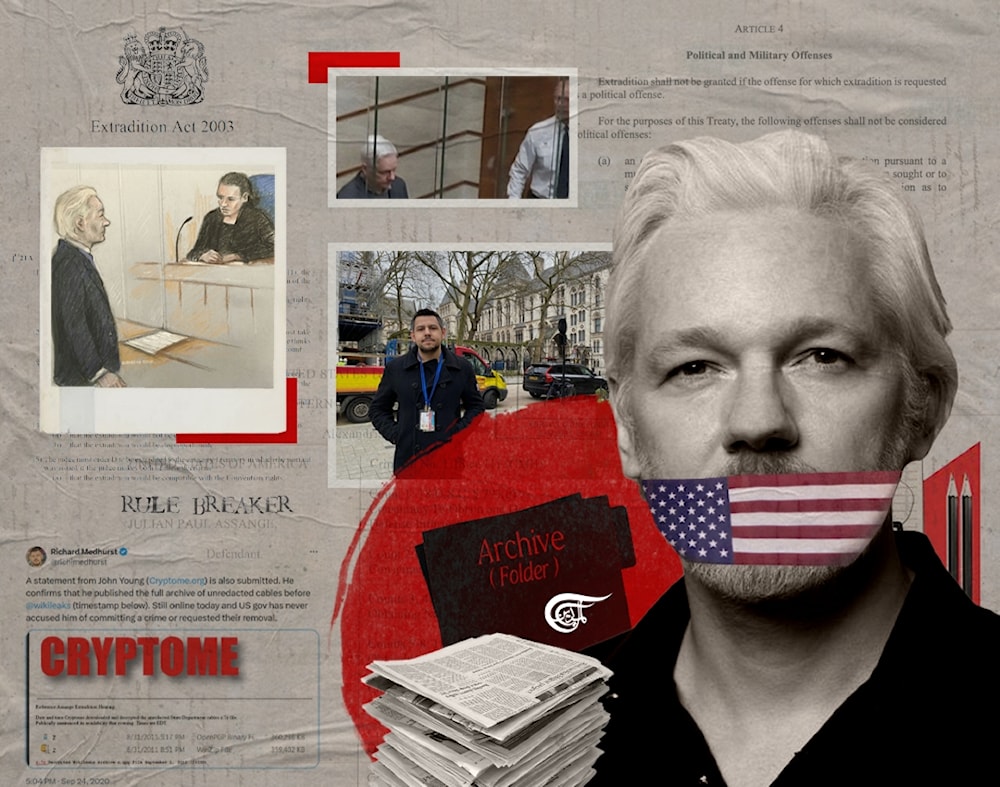
But even if what the United States is saying were true, these documents were not published first by Assange. John Young, the owner of a website called cryptome.org testified to the court that he was the one who published the documents first, and the United States never prosecuted him or asked him to take them down.
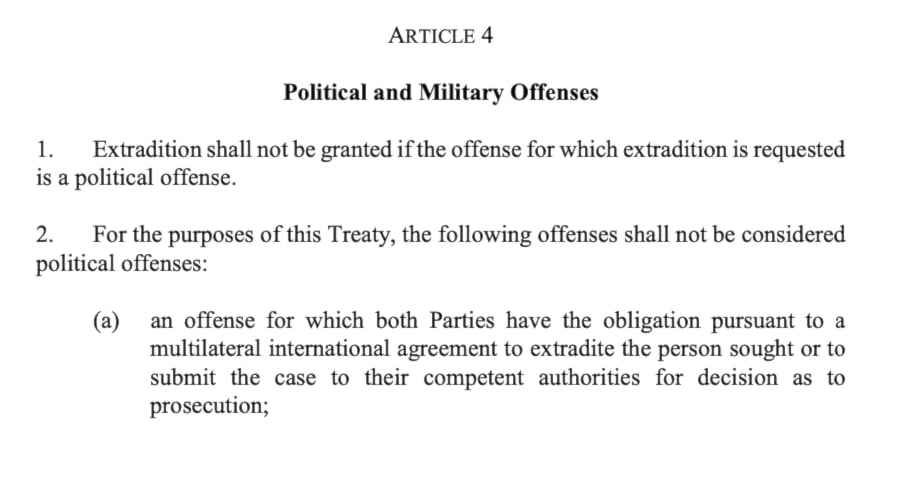
Extraditions for political offenses are forbidden under Article 4 of the US-UK Extradition Treaty 2003
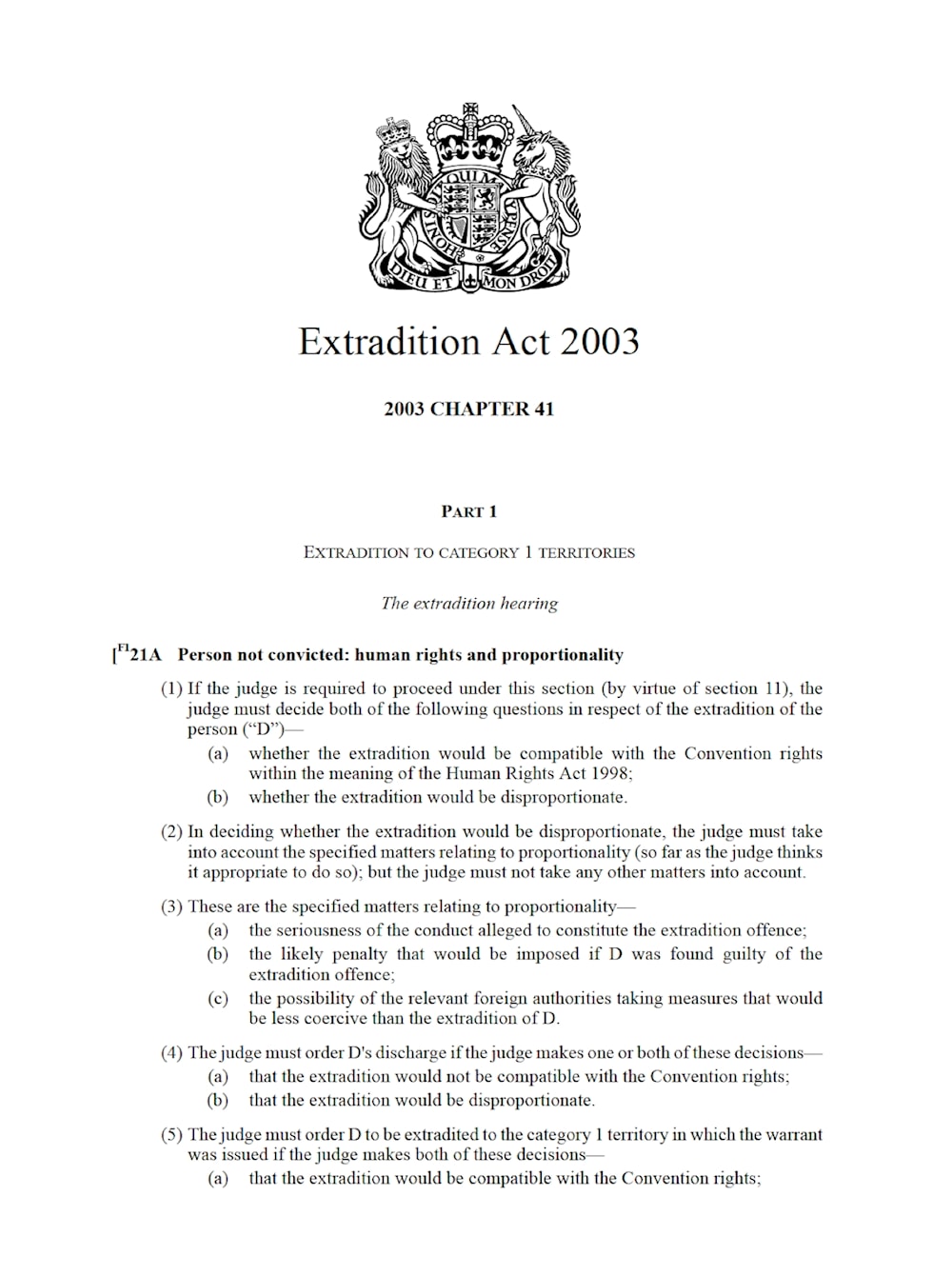
The Extradition Act, which is the implementation of the US-UK treaty inside British law, is missing this section. This is likely due to the fact it was passed at the height of the “War on Terror” in 2003, giving the Americans carte blanche to snatch people, drag them to the US and throw them in dungeons
Richard Medhurst Al Mayadeen English, 7 Mar 2024, https://english.almayadeen.net/articles/analysis/why-the-us-is-trying-to-imprison-assange–report-from-inside
Richard Medhurst is a British journalist who has covered Julian Assange’s extradition case from inside the court since 2020. In this article, he explains what took place in the latest hearings, why the United States is trying to extradite the WikiLeaks founder, and why everyone should care.
Julian Assange is an Australian journalist in the United Kingdom, and the founder of WikiLeaks. He published documents that were given to him by a US soldier called Chelsea Manning, which showed US war crimes in Iraq, Afghanistan, and much more.
The United States want to extradite Assange from the UK to America, and put him on trial for publishing these classified documents. They are threatening him with 175 years in prison.
The reason this case is so serious is because it essentially makes journalism illegal.
The United States claims Assange asked Manning for classified documents and that this is a crime. It’s not.
The US alleges that Assange having classified documents in his possession and publishing them is a crime. It’s not.
Asking for classified documents; protecting sources, these are things journalists do every single day around the world.
But because these files were so embarrassing to the United States and exposed the brutality of their war crimes, they are threatening Assange with almost two centuries in prison; and to do it, they are accusing him of being a “spy” and a “hacker”, charging him with 17 counts under the “Espionage Act”, and with one count of “Conspiracy to Commit Computer Intrusion”.
The goal of this indictment is to make an example out of Assange, and make other journalists afraid to publish things that the public has a right to know.
If extradited, Assange would be placed in the worst prison conditions imaginable, “Special Administrative Measures” (or SAMs): A strict regime of solitary confinement, no contact with other prisoners allowed, and barely any contact with your family. SAMs are internationally recognized as torture. Julian would be sent to the worst prison in America, ADX Florence, a super-maximum security facility in Colorado.
On January 4, 2021, British judge Vanessa Baraitser blocked Assange’s extradition because US prison conditions would be so oppressive in his current state as to drive him to suicide.
Nevertheless, despite blocking the extradition on health grounds, she agreed with all the political and trumped-up charges.
I have attended all of Assange’s court hearings and saw the smears against him debunked by dozens of expert witnesses. But the judge still chose to side with the United States. She chose to essentially criminalize journalism, even drawing dangerous equivalences between the US Espionage Act and Britain’s Official Secrets Act (OSA).
After this, the United States went to the English High Court to appeal her ruling and won by providing empty promises that they would supposedly treat Assange well– even though the United States has a history of violating extradition assurances. I exposed this when I published classified documents from David Mendoza’s extradition from Spain to the US, a case previously cited in court by Julian’s lawyers.
After the US succeeded in overturning the lower court’s ruling in Dec 2021, there was only one thing left: A signature from the Home Secretary, who allowed the extradition to go ahead.
The above is everything that took place between 2020 and 2024, which brings us to the latest hearings at the Royal Courts of Justice in February 2024.
Point 1: To appeal the ruling of the lower court from Jan 4, 2021.
Assange’s lawyers argued that the judge was correct to block Assange’s extradition on health grounds, but she was wrong to agree with all the political charges (equating him with a “hacker” and a “spy”).
They’re saying very plainly: This case is undemocratic, it criminalizes journalism, and doesn’t take into account the fact that the documents Assange published expose enormous US war crimes that the public had the right to know about.
(See for example the “Collateral Murder” video published by Julian Assange’s WikiLeaks: Footage from a US gunship crew laughing as they slaughter Iraqi civilians, among them children and reporters).
Another claim made by the United States is that Assange “harmed informants” by publishing unredacted cables. Ironically, this was proven false by the United States’ own military when they court-martialed Chelsea Manning (the soldier that gave the files to Assange). The US military couldn’t find a single example of anyone having been harmed by the disclosures.
The assertion by the United States that Julian Assange simply published all these documents without censoring or redacting names simply isn’t true: I listened to many journalists tell the court how they spent countless hours meticulously redacting names with Assange.
Assange’s lawyers are also arguing that the judge in the lower court failed to undertake a balancing act. She blindly accepted the United States’ premise that the lives of informants– who weren’t even harmed– are more important than the people killed and tortured by the United States. This is tantamount to saying: The United States should be allowed to continue committing these war crimes in secret; that it’s somehow okay for them to butcher people in Iraq and Afghanistan, and the public have no right to know.
But even if what the United States is saying were true, these documents were not published first by Assange. John Young, the owner of a website called cryptome.org testified to the court that he was the one who published the documents first, and the United States never prosecuted him or asked him to take them down.
This demonstrates that the whole case against Assange is selective, political, and has nothing to do with the law.
Assange’s lawyers are also arguing that the judge in the lower court failed to undertake a balancing act. She blindly accepted the United States’ premise that the lives of informants– who weren’t even harmed– are more important than the people killed and tortured by the United States. This is tantamount to saying: The United States should be allowed to continue committing these war crimes in secret; that it’s somehow okay for them to butcher people in Iraq and Afghanistan, and the public have no right to know.
But even if what the United States is saying were true, these documents were not published first by Assange. John Young, the owner of a website called cryptome.org testified to the court that he was the one who published the documents first, and the United States never prosecuted him or asked him to take them down.
This demonstrates that the whole case against Assange is selective, political, and has nothing to do with the law.
The Espionage Act that Assange is being charged under was created during World War I, in 1917. It has always been used as a political tool against dissidents such as Eugene Debs, or whistleblowers like Daniel Ellsberg and Edward Snowden, who exposed the true extent of the US war in Vietnam, and NSA mass surveillance.
If you’re charged under the Espionage Act, you’re also forbidden from arguing a public interest defense. This means that even if you expose colossal government crimes, you still go to prison.
Point 2: The Home Secretary was wrong to allow the extradition
This constitutes the second part of Assange’s appeal: It is illegal in Britain to extradite someone to another country, knowing they could face the death penalty.
If the Home Secretary, who has the final say on extraditions, is aware of such a risk, they are compelled to bar the extradition.
It is inconceivable that Priti Patel was unaware of who Julian Assange is, and the likelihood he would be killed in the United States. Once in US jurisdiction, the US could pile on additional charges, or simply execute him, as espionage is a capital offense.
Even without a specific death sentence, at 52 years old, even a 30-year bid is akin to a death sentence.
The hollow assurances given by the United States do not preclude the death penalty. And on top of that, the Home Secretary didn’t even bother asking for assurances that would.
So how could the Home Secretary agree to send Assange to a foreign country that so clearly wants to see him dead?
Mike Pompeo, who back then was head of the CIA, and then-president Donald Trump, launched this legal case against Julian Assange. In the past, Donald Trump had called for Assange to be given the death penalty, while Mike Pompeo proclaimed Assange “has no First Amendment rights”. After WikiLeaks published a trove of CIA documents, dubbed the Vault 7 files, Mike Pompeo declared war on WikiLeaks by publicly labeling it a “non-state hostile intelligence service”
All these political denunciations of WikiLeaks and Assange were then followed up with threats against him and his family. As we heard in court in 2020 from protected witnesses, the CIA had drawn up plans to potentially kidnap or assassinate Julian.
The United States is accusing Julian Assange of “espionage”. Normally, this is where the case should be thrown out, because espionage is considered a textbook political offense. And it is forbidden to extradite someone for a political offense under the US-UK Extradition Treaty, Art 4.
Customary extradition treaties have always forbidden extradition for political offenses such as “espionage” and “treason”. And this line of defense has been used before in court to successfully block extraditions.
- Extraditions for political offenses are forbidden under Article 4 of the US-UK Extradition Treaty 2003
Here is where the problem arises:
The Extradition Act, which is the implementation of the US-UK treaty inside British law, is missing this section. This is likely due to the fact it was passed at the height of the “War on Terror” in 2003, giving the Americans carte blanche to snatch people, drag them to the US and throw them in dungeons.
At the time of its passage, many criticized the Extradition Treaty as being extremely one-sided in favor of the United States.
No matter how you look at Assange’s case, it is unfair and illegal.
The United States wants to prosecute Julian Assange under US law, but at the same time deny him any protections under US law, such as free speech. If Assange has no First Amendment rights as a foreign national, then how can he be punished as a foreign national – who is not even in the US? This is such a flagrant double standard, and selective application of the law.
The European Convention on Human Rights (ECHR) is incorporated into British law through the Human Rights Act. Upon examination, it is clear that Julian’s rights are being flagrantly violated
Article 5 protects one from arbitrary detention.
Because this is a political case, it would be a violation of the Extradition Treaty to send Julian to America. Therefore, he has no reason to be in prison right now, and is therefore being arbitrarily detained in violation of his Article 5 rights.
Article 6 guarantees the right to a fair trial.
We know the United States spied on Assange’s conversations with his lawyers when he was inside the Ecuadorian embassy; stole his electronic devices; and collected medical and legal records.
In 2020, I sat in court with Fidel Narvaez, the former Consul to the Ecuadorian embassy in London. We listened to the submissions of two protected witnesses who confirmed they had spied on Assange because the security company they worked for, UC Global, had been contracted by the CIA to do so. They also discussed plans to potentially kidnap and poison Julian Assange and harvest DNA from his baby.
To spy on someone’s privileged conversations with their lawyers, and to use tainted evidence in court is scandalous beyond words, and violates the fundamentals of due process in any jurisdiction. Any judge would have thrown this case out from day one.
We also know Assange will not get a fair trial in America because the jury will be selected from a pool of people who work for the CIA, NSA, or have friends and family working in the intelligence community. These are the very same people whose crimes Julian Assange exposed.
The court in Virginia that issued the charges and would hold this trial is used specifically for this reason; because the jury is biased and the government knows it can’t lose. It is already 100% guaranteed that he will get convicted and go to prison.
Additionally, the United States could use secret evidence against Julian Assange, that he wouldn’t even be allowed to view due to it being “classified”.
Article 7 protects one from being punished retroactively. The case against Julian Assange is unprecedented: No publisher in America has ever been prosecuted, let alone convicted for publishing classified documents.
This case criminalizes journalism, and therefore violates Article 10, which guarantees freedom of expression.
Assange’s lawyers went over the ECHR repeatedly because it is incorporated into British law, meaning the court is obliged to follow it. Not only that, but this was their way of hinting to the judges: If you don’t give us permission to appeal, we will go to the European Court of Human Rights (ECtHR) in Strasbourg, and that court will look upon your decision unfavorably.
(The United Kingdom is a founding and current member of the European Council, which is separate from the European Union).
Assange’s lawyer, Mark Summers, argued very clearly: The Strasbourg court will see that a) these US war crimes were real; b) they were happening on the ground at the time, and; c) by publishing these documents Assange altered the United States’ behavior: The helicopter massacres like in the “Collateral Murder” video stopped, and the Iraq war came to an end.
Assange’s team put together a very compelling defense during this week’s hearing.
Continue readingNewsGuard AI Censorship Targets People Who Read Primary Sources To Fact-Check The News

Artificial intelligence censorship tools are making sure you never read this article or share it with anyone it might persuade.

This article seems to me to be pretty pro Trumpist.
My problem is:
much as I dislike Donald Trump – purveyor of chaos , this article is probably true
JOY PULLMAN @JOYPULLMANN MARCH 07, 2024
NewsGuard announced last week it’s using AI to automatically prevent American citizens from seeing information online that challenges government and corporate media claims about elections ahead of the 2024 voting season.
“[P]latforms and search engines” including Microsoft’s Bing use NewsGuard’s “ratings” to stop people from seeing disfavored information sources, information, and topics in their social media feeds and online searches. Now censorship is being deployed not only by humans but also by automated computer code, rapidly raising an Iron Curtain around internet speech.
Newsguard rates The Federalist as a “maximum” risk for publishing Democrat-disapproved information, even though The Federalist accurately reports major stories about which NewsGuard-approved outlets continually spread disinformation and misinformation……………….
Newsguard rates The Federalist as a “maximum” risk for publishing Democrat-disapproved information, even though The Federalist accurately reports major stories about which NewsGuard-approved outlets continually spread disinformation and misinformation.
“The purpose of these taxpayer-funded projects is to develop artificial intelligence (AI)-powered censorship and propaganda tools that can be used by governments and Big Tech to shape public opinion by restricting certain viewpoints or promoting others,” says a recent congressional report about AI censorship. These “…projects threaten to help create a censorship regime that could significantly impede the fundamental First Amendment rights of millions of Americans, and potentially do so in a manner that is instantaneous and largely invisible to its victims.”
Numerous federal agencies are funding AI censorship tools, including the U.S. Department of State, the subject of a December lawsuit from The Federalist, The Daily Wire, and the state of Texas. The report last month from the House Subcommittee on the Weaponization of the Federal Government reveals shocking details about censorship tools funded by the National Science Foundation, one of hundreds of federal agencies.
It says NSF has tried to hide its activities from the elected lawmakers who technically control NSF’s budget, including planning to take five years to return open-records requests legally required to be returned within 20 to 60 days under normal circumstances. NSF and the projects it funded also targeted for censorship media organizations that reported critically on their use of taxpayer funds.
“In my dream world,” censorship technician Scott Hale told NSF grantmakers, people like him would use aggregate data of the speech censored on social media to develop “automated detection” algorithms that immediately censor banned speech online, without any further human involvement.
“Misinformation” that NSF-funded AI scrubs from the internet includes “undermining trust in mainstream media,” the House report says. It also works to censor election and vaccine information the government doesn’t like. One censorship tool taxpayers funded through the NSF “sought to help train the children of military families to help influence the beliefs of military families,” a demographic traditionally more skeptical of Democrat rule.
Federal agencies use nonprofits they fund as cutouts to avoid constitutional restraints that prohibit governments from censoring even false speech. As Foundation for Freedom Online’s Director Mike Benz told Tucker Carlson and journalist Jan Jekielek in recent interviews, U.S. intelligence agencies are highly involved in censorship, using it essentially to control the U.S. government by controlling public opinion. A lawsuit at the Supreme Court, Murthy v. Missouri, could restrict federal involvement in some of these censorship efforts……………………………………… https://thefederalist.com/2024/03/07/ai-censorship-targets-people-who-read-primary-sources-to-fact-check-the-news/—
Israel Accused Of Torturing UN Workers To Obtain False Testimony About UNRWA
CAITLIN JOHNSTONE, MAR 9, 2024, https://www.caitlinjohnst.one/p/israel-accused-of-torturing-un-workers
A recent UNRWA document says its staff report having been tortured while detained by Israeli forces, who pressed them to provide false statements about ties between the agency and Hamas.
“The document said several UNRWA Palestinian staffers had been detained by the Israeli army, and added that the ill-treatment and abuse they said they had experienced included severe physical beatings, waterboarding, and threats of harm to family members,” Reuters reports, saying UNRWA workers “reported having been pressured by Israeli authorities into falsely stating that the agency has Hamas links and that staff took part in the Oct. 7 attacks.”
This is another one of those stories about Israeli offenses that are so stunning that at first you can mistakenly believe you must not be reading it correctly — especially since the western political-media class haven’t been treating it like the jarring news that it is. If we had anything remotely like an objective news media in the western world, reports that Israel tortured United Nations staff to get them to make false statements against a UN aid agency would be the top story everywhere for days.
Many, including myself, speculated that torture was involved in obtaining the Israeli “intelligence” behind initial claims of UNRWA staff involvement in the October 7 attack when this narrative first surfaced back in January. A senior Israeli official told Axios at the time that Israeli intelligence agencies came upon the information about the UNRWA staffers largely through “interrogations of militants who were arrested during the Oct. 7 attack.” Israel has an extensive history of using torture in its interrogations, and there’s no reason to believe such methods haven’t been used on captured Hamas fighters in recent months — but reports that it was actual UN staff being tortured are something new.
We may be certain that if it was Hamas being accused of torturing workers for international aid agencies in order to extract false confessions, we’d never hear the end of it. To this day unsubstantiated rumors of mass systemic sexual violence on October 7 continue to dominate the headlines resulting in scandalous instances of journalistic malpractice, despite the Israeli spinmeisters behind those reports having a much worse track record than UNRWA in the truth-telling department and UNRWA standing much less to gain than Israel by lying.
But that’s what the information ecosystem looks like in the shadow of the empire. The flimsiest allegations against enemies of the US-centralized power alliance are spun as gospel truth and kept in the headlines for months, while even the most damning evidence against the empire never gets anything better than a cursory nod from the mass media and is then promptly memory-holed as the daily news churn moves on.
US Media and Factcheckers Fail to Note Israel’s Refutation of ‘Beheaded Babies’ Stories
DAVID KNOX, FAIR, 8 Mar 24
In late November, the Washington Post (11/22/23) factchecked President Joe Biden’s repeated claims that babies had been beheaded during Hamas’s October 7 attack in Israel.
Biden’s remarks during a November 15 news conference triggered the factcheck:
Hamas has already said publicly that they plan on attacking Israel again, like they did before, to where they were cutting babies’ heads off to burning women and children alive.
Despite acknowledging a lack of confirmation of such atrocities, the Post stopped short of branding Biden’s statements false, and declined to dole out any of its iconic Pinocchios.
“It’s too soon in the Israel/Gaza war to make a definitive assessment,” Post Factchecker Glenn Kessler wrote, noting that even the most basic facts weren’t yet known.
“The Israeli prime minister’s office has said about 1,200 people were killed on October 7, down from an initial estimate of 1,400,” he said, “but it’s unclear how many were civilians or soldiers.”
An authoritative count
That statement isn’t true. While the exact number killed amid the extreme violence and chaos of October 7 may never be finalized, an authoritative count of civilian deaths—as well as data that definitively refutes claims babies were beheaded—was available to anyone with access to the internet little more than a month after the attack.
That’s when Bituah Leumi, or National Insurance Institute, Israel’s social security agency, posted a Hebrew-language website (11/9/23) with the name, gender and age of every identified civilian victim and where each had been attacked.
Two days later Bituah Leumi (also transliterated as Bituach Leumi) posted an English-language news release (11/11/23) publicizing the website as a memorial to the civilian victims of the “Iron Swords” war—Israel’s name for Hamas’s attack and Israel Defense Forces’ response. (The news release refers to “695 identified war casualties,” but there are no wounded; all the victims are listed as “killed.”)
The journalistic importance of the memorial website was shown less than a month later, when Haaretz (12/4/23), Israel’s oldest newspaper, used the social security agency’s data to debunk some of the most sensational atrocities blamed on Hamas.
‘Proved untrue’
Haaretz’s 2,000-word, English-language article was cautious, with allowances for mistaken and exaggerated reports from traumatized observers describing horrific scenes of carnage. But unlike the Washington Post’s factcheck, the Israeli newspaper didn’t pull its punches, flatly concluding that some of the claims of atrocities “have been proved untrue.”
Chief among the claims disproved was that Hamas fighters deliberately slaughtered dozens of babies—beheading some, burning and hanging others.
“According to sources including Israel’s National Insurance Institute, kibbutz leaders and the police, on October 7 one baby was murdered, 10-month-old Mila Cohen,” the Haaretz article stated. “She was killed with her father, Ohad, on Kibbutz Be’eri.” The child’s mother survived.
In addition to a single infant, the social security agency’s list of victims includes only a few other young children. Haaretz’s reporters were able to determine the circumstances of each of their deaths:
According to the National Insurance Institute, five other children aged 6 or under were murdered, including Omer Kedem Siman Tov, 2, and his 6-year-old twin sisters Arbel and Shachar, who were killed on Kibbutz Nir Oz. There was also 5-year-old Yazan Zakaria Abu Jama from Arara in the southern Negev, who was killed in a Hamas rocket strike, and 5-year-old Eitan Kapshetar, who was murdered with his parents and his 8-year-old sister, Aline, near Sderot.
Haaretz also used the social security data to refute allegations made by Israeli Prime Minister Benjamin Netanyahu to Biden that Hamas targeted and tortured children:
There is no evidence that children from several families were murdered together, rendering inaccurate Netanyahu’s remark to US President Joe Biden that Hamas terrorists “took dozens of children, tied them up, burned them and executed them.”
‘Details still sparse’
The Washington Post (12/4/23) acknowledged the Haaretz story the same day it was published, with a one-paragraph “update” inserted into its November 22 factcheck. While crediting Haaretz with doing a “detailed examination of unverified accounts of alleged atrocities disseminated by Israeli first-responders and army officers,” the Post downgraded the Israeli newspaper’s conclusion, saying only that “no accounts of beheaded or burned babies could be verified.”
While the Post noted that Haaretz “could document only one case of a baby being killed in the Hamas attacks,” the update did not explain that the source of that critical fact was an agency of the Israeli government. Nor did the Post alter the factcheck’s inconclusive, mishmashed “Bottom Line”:……………………………………………………………………………………………………………………………
‘War on truth’
The first major news outlet outside of Israel to use data from the social security agency’s website was the French wire service Agence France-Presse.
The AFP’s 1,000-word, English-language dispatch, headlined “Israel Social Security Data Reveals True Picture of October 7 Deaths,” was picked up by France24 (12/15/23), the Times of India (12/15/23), the financial weekly Barron’s (12/15/23) and a scattering of small newspapers, including the Caledonian (Vermont) Record (12/15/23).
The AFP story covered much the same ground as Haaretz’s analysis, listing the same slain infant—Mila Cohen—and five other young victims under 7 years old in refuting claims of wholesale slaughter of babies.
While Google searches found no US mainstream media reporting on the Israeli social security agency’s data, several independent journalists did.
Gareth Porter, an American historian and journalist whose credentials go back to the Vietnam War, cited the social security data in an article in Consortium News (1/6/24) that argued that the Netanyahu government sought to build support for the invasion of Gaza by “inventing stories about nonexistent atrocities and planting them with credulous US news outlets.”
In February, Jeremy Scahill used that data to make the same case in a 8,000-word article, headlined “Netanyahu’s War on Truth,” in the Intercept (2/7/24), the investigative website he helped found.
Both journalists credit the December 15 AFP dispatch as the source of the Israeli social security data. (Porter’s story provides a link to the Times of India; Scahill links to France24.)
Earlier this week a third independent journalist, Glenn Greenwald (3/3/24), quoted the December 4 Haaretz report, which used the Israeli social security data, in a YouTube video, titled “October 7 Reports Implode: Beheaded Babies, NY Times Scandal & More.”
Emotion-inflaming stories
In the months since the Haaretz and AFP reports were published, Bituah Leumi has updated its civilian death count to 779, including 76 foreign workers, as more victims are identified (Jewish News Syndicate, 1/15/24.).
But a detailed examination this week of the 16-page list of victims on the memorial website found no additional infants or young children—only those already accounted for by Haaretz and AFP—and a total of 36 children under 18 years old.
Mila Cohen remains the only infant reported killed in the October 7 attack.
US corporate media’s failure to cite the social security agency’s data to forcefully refute claims of butchered babies and other outrages comes at a high cost. Such emotion-inflaming stories continue to foul the public debate over whether Israel’s invasion of Gaza, which has resulted in the deaths of more than 30,000 Palestinians (AP, 2/29/24)—two-thirds of those women and children (PBS, 2/19/24)—is a criminally disproportionate response to the Hamas attack………………………………………………………………………………………………………………………………..
Unfounded horror stories about Hamas’s infant victims that should have been debunked were still being repeated by Biden (12/12/23) at a campaign fundraiser more than two months after Israel was attacked:
I saw some of the photographs when I was there—tying a mother and her daughter together on a rope and then pouring kerosene on them and then burning them, beheading infants, doing things that are just inhuman—totally, completely inhuman.
This time the Washington Post didn’t factcheck Biden—even though the White House stated months earlier that the president had never seen such photos (CNN, 10/12/23).
Still no Pinocchios. https://fair.org/home/us-media-and-factcheckers-fail-to-note-israels-refutation-of-beheaded-babies-stories/
US Refuses to Assure UK Judges That Assange Won’t Be Executed If He’s Extradited

UK law prohibits extradition to a country that may impose capital punishment.
By Marjorie Cohn , TRUTHOUT, February 27, 2024
n February 20 and 21, as nearly 1,000 supporters of Julian Assange gathered outside the London courthouse, a two-judge panel of the High Court of Justice presided over a “permission hearing.” Assange’s lawyers asked the judges to allow them to appeal the home secretary’s extradition order and raise issues that the district court judge had rejected without full consideration.
The High Court panel, Dame Victoria Sharp and Justice Jeremy Johnson, were concerned that the U.S. government could execute Assange if he is extradited to the United States, a penalty outlawed in the U.K. Although Assange faces 175 years in prison for the charges alleged in the indictment, there is nothing to prevent the U.S. from adding additional offenses which would carry the death penalty.
The Trump Administration Indicted Assange for Exposing U.S. War Crimes
Assange is charged with 17 counts of alleged violations of the Espionage Act, based on obtaining, receiving, possessing and publishing national defense information. He is accused of “recruit[ing] sources” and “soliciting” confidential documents just by maintaining the WikiLeaks website that stated it accepted such materials. Assange is also charged with one count of “conspiracy to commit computer intrusion” with intent to “facilitate [whistleblower Chelsea] Manning’s acquisition and transmission of classified information related to the national defence of the United States.”
The basis for the indictment, Assange’s lawyers told the panel, is WikiLeaks’s “exposure of criminality on the part of the U.S. government on an unprecedented scale.” Assange is charged for revealing war crimes committed by the United States in Iraq, Afghanistan and Guantánamo Bay. The indictment has nothing to do with Hillary Clinton and the 2016 election or Swedish allegations of sexual misconduct, which have been dropped.
WikiLeaks revealed the “Iraq War Logs” — 400,000 field reports including 15,000 unreported deaths of Iraqi civilians, as well the as systematic rape, torture and murder after U.S. forces handed over detainees to a notorious Iraqi torture squad. The revelations also included the “Afghan War Diary” — 90,000 reports of more civilian casualties by coalition forces than the U.S. military had reported.
In addition, WikiLeaks revealed the “Guantánamo Files,” 779 secret reports with evidence that 150 innocent people had been held at Guantánamo Bay for years, and 800 men and boys had been tortured and abused, in violation of the Geneva Conventions and the Convention Against Torture and Other Cruel, Inhuman or Degrading Treatment or Punishment.
WikiLeaks also revealed the notorious 2007 “Collateral Murder Video,” in which a U.S. Army Apache attack helicopter targeted and killed 11 unarmed civilians in Baghdad, including two Reuters journalists and a man who came to rescue the wounded. Two children were injured. The video contains evidence of war crimes prohibited by the Geneva Conventions.
And WikiLeaks exposed “Cablegate” — 251,000 confidential U.S. State Department cables that “disclosed corruption, diplomatic scandals and spy affairs on an international scale.” According to The New York Times, they told “the unvarnished story of how the government makes its biggest decisions, the decisions that cost the country most heavily in lives and money.”
“These were the most important revelations of criminal U.S. state behavior in history,” Assange attorney Mark Summers argued to the High Court panel.
Assange’s Appellate Issues
Assange is asking the U.K. High Court to review issues of treaty obligations, human rights violations and political persecution.
The U.S.-U.K. Extradition Treaty would allow the U.S. to amend or add charges which could expose Assange to the death penalty, a punishment prohibited in the U.K. In response to questioning by one of the judges, the prosecutor admitted that the U.S. had not provided assurances that Assange would not be subject to the death penalty if extradited.
Article 4(1) of the extradition treaty does not allow extradition for political offenses. Espionage is the “quintessential” political offense, Assange attorney Edward Fitzgerald told the panel. “The gravamen (and defining legal characteristic) of each of the charges is thus an alleged intention to obtain or disclose US state secrets in a manner that was damaging to the security of the US state,” which makes them political offenses, Assange’s lawyers wrote. The defense claimed it was an abuse of process for the United States to pursue extradition of Assange for a political offense……………………………………………………………………………….
“The Most Important Revelation Since Abu Ghraib”
The Collateral Murder video is “the most important revelation since Abu Ghraib,” Summers told the panel. “The cables Assange published disclosed extrajudicial assassinations, rendition, torture, dark prisons and drone killings.” Summers said the Guantánamo Files revealed a “colossal criminal act.” The defense pointed out that WikiLeaks’s revelations actually saved lives. After WikiLeaks published evidence of Iraqi torture centers established by the U.S., the Iraqi government refused President Barack Obama’s request to grant immunity to U.S. troops who committed criminal and civil offenses there. As a result, Obama had to withdraw U.S. forces from Iraq.
The Obama administration, which prosecuted more whistleblowers under the Espionage Act than all prior U.S. administrations combined, considered prosecuting Assange, but feared it would violate the First Amendment. The administration was unable to distinguish what WikiLeaks did from what The New York Times and The Guardian did since they also published documents that Chelsea Manning had leaked.
But the Trump administration did indict Julian Assange. The U.K. arrested Assange and has held him in Belmarsh Prison for nearly five years pending a decision on whether he should be extradited to the U.S. to stand trial.
In January 2021, following a three-week hearing, Baraitser denied extradition after finding that Assange’s mental health was so frail there was a “substantial risk” of suicide if he was extradited to the U.S. because of the harsh conditions of confinement in which he would be held. But she rejected all other legal objections to extradition that Assange had raised.
U.S. “Assurances” That Assange Will Be Treated Humanely
After Baraitser had already ruled, the U.S. came forward with diplomatic “assurances” that Assange would be treated humanely if extradited to the United States. The Biden administration assured the court that Assange: (1) would not be subject to onerous Special Administrative Measures (SAMs) that would keep him in extreme isolation and monitor his confidential communications with his attorneys; (2) would not be housed at the notorious ADX Florence maximum security prison in Colorado; (3) would receive psychological and clinical treatment in custody; and (4) could serve any custodial sentence in Australia.
But the U.S. said the assurances wouldn’t apply if Assange committed a “future act” that “met the test” for the SAMs. That unspecified contingency would be based on a subjective determination of prison authorities with no judicial review.
Although the United States has reneged on nearly identical assurances in the past, the High Court accepted them at face value, saying it was satisfied that the U.S. was acting in good faith, and in December 2021, the High Court reversed Baraitser’s denial of extradition.
However, in a 2023 decision, the U.K. Supreme Court unanimously held that the court has an independent duty to determine the validity of assurances,
writing, “The government’s assessment of whether there is such a risk is an important element of that evidence, but the court is bound to consider the question in the light of the evidence as a whole and to reach its own conclusion.”
In June 2023, a single High Court judge, Jonathan Swift, refused Assange permission to appeal in a cursory three-page ruling. The hearing on February 20 and 21 was an effort by Assange’s legal team to reverse that decision so that the High Court will entertain his appeal.
Assange Redacted Names of Informants to Protect Them
…………………… Several witnesses testified at the 2020 extradition hearing that Assange took great care to ensure that the names were redacted. Other outlets published the unredacted cables before WikiLeaks with no adverse consequences.
………………….Moreover, Brig. Gen. Robert Carr testified at Manning’s court martial that no one was harmed by the WikiLeaks releases. Summers told the panel that Baraitser never balanced the public interest in the disclosures against the fact that no harm came from them.
Conviction of Assange Would Chill Investigate Journalists From Exposing Government Secrets
In November 2022, The New York Times, The Guardian, Le Monde, DER SPIEGEL and El País signed a joint open letter calling on the Biden administration to drop the Espionage Act charges against Assange. They wrote, “Publishing is not a crime,” noting that Assange is the first publisher to be charged under the Espionage Act for revealing government secrets.
The indictment would punish conduct that national security journalists routinely engage in, including cultivating and communicating confidentially with sources and soliciting information from them, shielding their identities from disclosure, and publishing classified information. If Assange is prosecuted and convicted, it will discourage journalists both in the U.S. and abroad from publishing evidence of government wrongdoing.
No publisher has ever been prosecuted under the Espionage Act for disclosing government secrets. The U.S. government has never prosecuted a publisher for publishing classified information, which constitutes an essential tool of investigative journalism.
But rather than dropping Trump’s prosecution of Assange consistent with the position of the Obama-Biden administration, Joe Biden has zealously pursued extradition and prosecution.
Pending House Resolution Would Call for Dismissal of All Charges Against Assange.
On December 13, 2023, House Resolution 934 was introduced in the U.S. House of Representatives by Rep. Paul A. Gosar (R-Arizona), with cosponsors from both political parties. It would express “the sense of the House of Representatives that regular journalistic activities are protected under the First Amendment, and that the United States ought to drop all charges against and attempts to extradite Julian Assange.” The resolution states that the WikiLeaks disclosures “promoted public transparency through the exposure of the hiring of child prostitutes by Defence Department contractors, friendly fire incidents, human rights abuses, civilian killings, and United States use of psychological warfare.”
…………… The conviction of Assange under the Espionage Act, the resolution continues, “would set a precedent allowing the United States to prosecute and imprison journalists for First Amendment protected activities, including the obtainment and publication of information, something that occurs on a regular basis.”
…………..
At the conclusion of the two-day hearing, the High Court panel set a due date of March 4 for further written submissions from the parties. If the court agrees to review at least one of Assange’s appellate issues, there will be a full hearing. Meanwhile, Assange, who is in poor physical and emotional health, remains in prison.
If the High Court denies his right to appeal, Assange can ask the European Court of Human Rights to hear his case. If that court finds “exceptional circumstances” and an “imminent risk of irreparable harm,” it can order provisional measures, including a stay of execution while the case is pending in the European court. But there is a danger that the U.K. could immediately extradite Assange to the United States before the European Court of Human Rights has a chance to consider Assange’s petition.
Patrick Lawrence: The CIA in Ukraine — The NY Times Gets a Guided Tour
SCHEERPOST, By Patrick Lawrence February 29, 2024
The New York Times recently ran a story called “The Spy War: How the C.I.A. Secretly Helps Ukraine Fight Putin.” Patrick Lawrence writes that these “secrets” only contained what the CIA “wanted and did not want disclosed,” and were “effectively authorized” by the agency.
f you have paid attention to what various polls and officials in the U.S. and elsewhere in the West have been doing and saying about Ukraine lately, you know the look and sound of desperation. You would be desperate, too, if you were making a case for a war Ukrainians are on the brink of losing and will never, brink or back-from-the-brink, have any chance of winning. Atop this, you want people who know better, including 70 percent of Americans according to a recent poll, to keep investing extravagant sums in this ruinous folly.
And here is what seems to me the true source of angst among these desperados: Having painted this war as a cosmic confrontation between the world’s democrats and the world’s authoritarians, the people who started it and want to prolong it have painted themselves into a corner. They cannot lose it. They cannot afford to lose a war they cannot win: This is what you see and hear from all those good-money-after-bad people still trying to persuade you that a bad war is a good war and that it is right that more lives and money should be pointlessly lost to it.
Everyone must act for the cause in these dire times…………………………………………………
you have Jens Stoltenberg, NATO’s war-mongering sec-gen, telling Radio Free Europe/Radio Liberty last week that it will be fine if Kyiv uses F–16s to attack Russian cities once they are operational this summer. The U.S.–made fighter jets, the munitions, the money—all of it is essential “to ensure Russia doesn’t make further gains.” Stephen Bryen, formerly a deputy undersecretary at the Defense Department, offered an excellent response to this over the weekend in his Weapons and Strategy newsletter: “Fire Jens Stoltenberg before it is too late.”
Good thought, but Stoltenberg, Washington’s longtime water-carrier in Brussels, is merely doing his job as assigned: Keep up the illusions as to Kyiv’s potency and along with it the Russophobia, the more primitive the better. You do not get fired for irresponsible rhetoric that risks something that might look a lot like World War III.
What would a propaganda blitz of this breadth and stupidity be without an entry from The New York Times? Given the extent to which The Times has abandoned all professional principle in the service of the power it is supposed to report upon, you just knew it would have to get in on this one.
The Times has published very numerous pieces in recent weeks on the necessity of keeping the war going and the urgency of a House vote authorizing that $61 billion Biden’s national security people want to send Ukraine. But never mind all those daily stories. Last Sunday it came out with its big banana. “The Spy War: How the C.I.A. Secretly Helps Ukraine Fight Putin” sprawls—lengthy text, numerous photographs. The latter show the usual wreckage—cars, apartment buildings, farmhouses, a snowy dirt road lined with landmines. But the story that goes with it is other than usual.
Somewhere in Washington, someone appears to have decided it was time to let the Central Intelligence Agency’s presence and programs in Ukraine be known. And someone in Langley, the CIA’s headquarters, seems to have decided this will be O.K., a useful thing to do. When I say the agency’s presence and programs, I mean some: We get a very partial picture of the CIA’s doings in Ukraine, as the lies of omission—not to mention the lies of commission—are numerous in this piece. But what The Times published last weekend, all 5,500 words of it, tells us more than had been previously made public.
Let us consider this unusually long takeout carefully for what it is and how it came to make page one of last Sunday’s editions…………………………………………………………..
Adam Entous and Michael Schwirtz tell the story of—this the subhead—“a secret intelligence partnership with Ukraine that is now critical for both countries in countering Russia.” They set the scene in a below-ground monitoring and communications center the CIA showed Ukrainian intel how to build beneath the wreckage of an army outpost destroyed in a Russian missile attack. They report on the archipelago of such places the agency paid for, designed, equipped, and now helps operate. Twelve of these, please note, are along Ukraine’s border with Russia.
………………………..The CIA handed these two material according to what it wanted and did not want disclosed, and various officials associated with it made themselves available as “sources”—none of the American sources named, per usual.
……………………………..The narrative thread woven through the piece is interesting. It is all about the two-way, can’t-do-without-it cooperation between the CIA and Ukraine’s main intel services—the SBU (the domestic spy agency) and military intelligence, which goes by HUR
……………………… Sloppy, tiresome. But to a purpose. Why, then? What is The Times’s purpose in publishing this piece?
………………………………..The Times piece appears amid flagging enthusiasm for the Ukraine project. And it is in this circumstance that Entous and Schwirtz went long on the benefits accruing to the CIA in consequence of its presence on the ground in Ukraine. But read these two reporters carefully: They, or whoever put their piece in its final shape, make it clear that the agency’s operations on Ukrainian soil count first and most as a contribution to Washington’s long campaign to undermine the Russian Federation. This is not about Ukrainian democracy, that figment of neoliberal propagandists. It is about Cold War II, plain and simple. It is time to reinvigorate the old Russophobia, thus—and hence all the baloney about Russians corrupting elections and so on. It is all there for a reason. ………………………………………………..
more https://scheerpost.com/2024/02/29/patrick-lawrence-the-cia-in-ukraine-the-ny-times-gets-a-guided-tour/
More indictments for Ohio nuclear crimes

The mainstream national press has scarcely reported any of this. Maybe they view it as a local story. But this kind of nuclear corruption has also occurred in South Carolina and Illinois, culminating in multiple indictments and prison sentence
Why does the nuclear industry find itself mired in these kinds of criminal conspiracies? Because it has no chance of standing on its own financial feet.
Former executives face a judge — in their ankle monitors
By Linda Pentz Gunter, , beyondnuclearinternational
It was called “likely the largest bribery money-laundering scheme ever perpetrated against the people of the state of Ohio.” And the shoes are still dropping. Or should that be ankle monitors? Because these latter belong to the three latest criminals indicted for their roles in a scheme that saw FirstEnergy hand over $61 million in bribes to Ohio politicians and their co-conspirators to secure favorable legislation.
That bill, known as HB6, guaranteed a $1.3 billion bailout to FirstEnergy in order to keep open its two failing Ohio nuclear power plants, Davis-Besse and Perry, as well as struggling coal plants. The nuclear portion of the bill has since been rescinded, but Ohio consumers are still paying to prop up two aging coal plants, to the tune of half a million dollars a day, amounting to an extra $1.50 a month on every ratepayer’s electric bill.
The $61 million bribery plot was the mastermind of then speaker of the Ohio House, Larry Householder, who is now a household name in Ohio for all the wrong reasons. He was sentenced last June to 20 years in prison for his part in the conspiracy. GOP Chairman Matt Borges, was also found guilty of racketeering conspiracy and sentenced to five years in federal prison. Both men say they will appeal.
Householder may have been the instigator, but in those earlier trials, FirstEnergy was described as a company that went “looking for someone to bribe them”. They found willing accomplices among politicians but also in the person of then Ohio Public Utilities Commission chairman, Samuel Randazzo.
So on February 12, yet more indictments were handed down, this time to Randazzo and the two FirstEnergy executives who corrupted him — former CEO Charles Jones, and former senior vice president of external affairs, Michael Dowling.
Their list of crimes, including a collective 27 felonies, was announced at a press conference by Ohio Attorney General Dave Yost. But although the presence of their company had been requested, the accused were not there. ……………………………………………………………
The mainstream national press has scarcely reported any of this. Maybe they view it as a local story. But this kind of nuclear corruption has also occurred in South Carolina and Illinois, culminating in multiple indictments and prison sentences. It’s possible we could yet see something similar go down in Georgia as electricity rates there soar to pay for the two late-arriving and over-budget Vogtle reactors, the second of which just started fissioning earlier this month.
Why does the nuclear industry find itself mired in these kinds of criminal conspiracies? Because it has no chance of standing on its own financial feet. Meanwhile, cheaper, faster, more job-friendly renewable energy industry options are leaving nuclear power behind in a cloud of radioactive dust.
This economic collapse has, in turn, put pressure on politicians to make things right for their corporate nuclear friends, something Senator Joe Manchin and others are currently working hard to do on Capitol Hill.
So there may yet be more shoes (and ankle monitors) to drop and it’s going to be very interesting to see who’s wearing them.
Linda Pentz Gunter is the international specialist at Beyond Nuclear and writes for and edits Beyond Nuclear International. https://beyondnuclearinternational.org/2024/02/25/more-indictments-for-ohio-nuclear-crimes/
1 This Month



4 August – WEBINAR – Hiroshima & Nagasaki: Nuclear Bombs Never Again
Tuesday, Aug. 4 at 5 pm PT / 8 pm ET.
Aug 5, 2026 10:00 AM in Australia/Melbourne
Join the Nuclear Bombs Never Again webinar on August 4th at 5pm Pacific Time / 8pm Eastern Time / 9am Japan Standard Time.
Cross generational voices at the intersection of Japan-Korea-US policy and militarization will share their lived experiences, nuclear impacts in these contexts, anti-war strategies, and actions you can take to advocate for a world with Nuclear Bombs Never Again. This 75-minute event is co-hosted by WILPF US and Korea Peace Now.

22,000+ miles voyaging for nuclear disarmament
and a radiation-free environment https://vfpgoldenruleproject.org/
To see nuclear-related stories in greater depth and intensity – go to https://nuclearinformation.wordpress.com
-
Archives
- July 2026 (277)
- June 2026 (287)
- May 2026 (306)
- April 2026 (356)
- March 2026 (251)
- February 2026 (267)
- January 2026 (308)
- December 2025 (358)
- November 2025 (359)
- October 2025 (375)
- September 2025 (257)
- August 2025 (319)
-
Categories
- 1
- 1 NUCLEAR ISSUES
- business and costs
- climate change
- culture and arts
- ENERGY
- environment
- health
- history
- indigenous issues
- Legal
- marketing of nuclear
- media
- opposition to nuclear
- PERSONAL STORIES
- politics
- politics international
- Religion and ethics
- safety
- secrets,lies and civil liberties
- spinbuster
- technology
- Uranium
- wastes
- weapons and war
- Women
- 2 WORLD
- ACTION
- AFRICA
- Atrocities
- AUSTRALIA
- Christina's notes
- Christina's themes
- culture and arts
- Events
- Fuk 2022
- Fuk 2023
- Fukushima 2017
- Fukushima 2018
- fukushima 2019
- Fukushima 2020
- Fukushima 2021
- general
- global warming
- Humour (God we need it)
- Nuclear
- RARE EARTHS
- Reference
- resources – print
- Resources -audiovicual
- Weekly Newsletter
- World
- World Nuclear
- YouTube
-
RSS
Entries RSS
Comments RSS
 nuclear-news