India removing freedom of information about nuclear industry
 the bill provides for penal action against persons who disclose the information regarding nuclear energy establishments.
“This clause will be used as a shield to prevent disclosure of information relating to even allegations of human rights violation and corruption in such bodies,”

 Civil society and govt divided over nuclear safety, Chetan Chauhan, Hindustan Times, New Delhi, March 29, 2012 The Nuclear Safety Regulatory Authority Bill is becoming a new flashpoint between the government and the civil society. The bone of contention is two clauses in the bill which aims to restrict application of transparency law — the Right To Information (RTI) — in nuclear energy establishments. These provisions will prevent the citizens from seeking sensitive information regarding nuclear and radiation safety even though section 8 of the RTI Act provides adequate protection of legitimate needs of information which should not be disclosed. Continue reading
In Japan, radiation being tactfully left out of school textbooks
without the appropriate study materials, how well … Japan’s school children will understand how their lives have been and will continue to be impacted by the nuclear disaster is unknown.

 Japanese textbooks whitewashing nuclear disaster Asian Correspondent By Anna Watanabe Mar 29, 2012 There are many of things Japan has done in the past that it tries to erase from public memory by downplaying their events in school textbooks: the Nanking Massacre, medical testing on POWs during WWII, comfort women and territorial disputes.
But all these are atrocities that have happened outside of Japan, to other nationalities and they occurred generations ago. As inexcusable as it is to claim their non-existence, the logic is somehow more understandable.
But now Japan is trying to rewrite its own, modern-history. Continue reading
A deeply corrupt nuclear industry
The corrupt Government and nuclear industry alliance, Independent Australia, 20 March 12, Nuclear power is inherently unsafe, and only continues because of an insidious alliance between Governments and a deeply corrupt nuclear industry. Joe Giambrone comments. “….. Japan’s devastation is our wake-up call. This was a General Electric manufactured reactor, of which there are more than 20 similar units operating in the US, right now.

Local communities in America reject these ticking time bombs, reactors designed for several decades’ use, which are then re-licensed to operate for several more decades beyond their specifications. The motivation for this re-licensing is clearly monetary and not safety related. The plants are literally crumbling and critical cooling pipes are worn so thin as to be the width of a sheet of paper. Numerous plant failures are expected by many observers in the coming few years.
But as local entities and state governments vote to stop these hazards and shut them down, the federal government claims authority over “safety” (sic) and simply ignores the demands of the people living at the grounds zero. Continue reading
Japan’s secretive nuclear culture will prevent investigation of Fukushima radiation cover-up
“It sounds, it looks…like a major cover up,”
However, Escobar says, it is unlikely Japanese authorities will ever investigate the case – “everyone will bow and nothing will be solved.” And the reason is in what Escobar calls the “cultural element”. “Japan is really ritualistic and secretive society.”
 VIDEO Mystery of lost Fukushima radiation emails ‘a major cover-up’ http://www.rt.com/news/japan-fukushima-email-deleted-285/ 23 March, 2012 The Fukushima Prefecture government apparently deleted emails with reports on data vital to safely evacuate people from that area, according to fresh appeared revelations. But as Pepe Escobar told RT, it is unlikely Japan will investigate. Continue reading
Disappearance of Fukushima radiation data in March 2011
Fukushima Pref. deleted 5 days of radiation dispersion data just after meltdowns Mainichi Daily News, 23 March 12 The Fukushima Prefectural Government revealed on March 21 that it deleted five days of early radiation dispersion data almost entirely unread in the wake of the meltdowns at the Fukushima No. 1 nuclear plant.
The data from the System for Prediction of Environmental Emergency Dose Information (SPEEDI) — intended to predict the spread of radioactive contamination, information vital for issuing evacuation advisories — was emailed to the prefectural government by the
Ministry of Education, Culture, Sports, Science and Technology.
According to the prefecture’s disaster countermeasure office, just after the March 2011 quake and tsunami, its dedicated SPEEDI terminal was unable to receive data due to effects of the disasters. Therefore, prefectural officials asked the Nuclear Safety Technology Center, which operates SPEEDI, to send data via email on March 12, 2011 — one
day into the nuclear crisis. The Nuclear Safety Technology Center thensent the data hourly starting at 11:54 p.m. that day.
The Fukushima Prefectural Government, however, deleted all the data it received from March 12 to about 9 a.m. March 16….. http://mdn.mainichi.jp/mdnnews/news/20120322p2a00m0na012000c.html
Hundreds arrested in protest against Kudankulam Nuclear Power Plant
 Kudankulam nuclear plant protests: Vaiko among 500 held Times of India, Mar 23, 2012, TIRUNELVELI, TN: Leaders of various parties and outfits, including MDMK leader Vaiko, were on Friday arrested here when they attempted to proceed to Idinthakarai, the epicentre of protests against Kudankulam Nuclear Power Plant, to express their solidarity with the locals demanding the scrapping of the Indo-Russian project.
Leaders and volunteers of MDMK, PMK, Viduthalai Chiruthaigal Katchi, Nam Tamizhar Iyakkam and Popular Front of India and Anti-Kudankulam Nuclear Power Plant People’s Movement co-ordinator ‘Kolathur’ Mani were arrested at Palayamkottai here, police said.
They were arrested in view of the ban orders in force in the entire Radhapuram taluk under which Kudunakulam and Idinthakarai falls. Earlier, they participated in a rally organised here to condemn the central and state governments for their ‘atrocious’ attitude in going ahead with the project and the crackdown on People’s Movement Against Nuclear Engery (PMANE), spearheading the protest…… http://timesofindia.indiatimes.com/india/Kudankulam-nuclear-plant-protests-Vaiko-among-500-held/articleshow/12380791.cms
Another complaint, by whistleblower at Hanford nuclear waste site
“This is an aggressive, retaliatory stance,” …”It is demonstrative of the systemic issues here, so significant that even the Department of Energy found it offensive.”
New complaint filed about Wash. nuclear waste site SF Gate, By  SHANNON DININNY, Associated Press, March 23, 2012 The Energy Department is investigating another complaint claiming a contractor at the nation’s most contaminated nuclear site interfered with an investigation into the design and safety of a massive plant under construction to treat nuclear waste.
The complaint is the latest in a string of whistleblower and other claims related to the design and safety of the $12.3 billion waste treatment plant at the Hanford nuclear reservation in south-central Washington……. Continue reading
Sedition charges for anti nuclear hunger striker?
 Locals Resume Anti-Nuclear Protest, WSJ, March 21, 2012, “…….. protesters, mostly fishermen and villagers who live in coastal areas, are still worried that nuclear waste from the planned seaside nuclear power plant may damage the ecosystem and ruin their livelihoods.
S.P. Udaykumar of the People’s Movement Against Nuclear Energy, a Tamil Nadu-based anti-nuclear power group that is spearheading the protest, is concerned the nuclear site could endanger those who live in close proximity to it. “People have not been given any disaster training…Both central and state government will be held responsible if
any untoward incident happens in the area,” Mr. Udaykumar told India Real Time Wednesday.
Mr. Udaykumar, who started an indefinite hunger strike on Monday in protest, is under investigation on charges that include sedition for his role in the agitation.
Local police officer Vijendra Bidari on Wednesday told India Real Time that more than 150 people have been arrested since Monday in Idinthakarai, the epicenter of protests against the proposed Kudankulam nuclear power plant…
Mr. Bidari said that, to maintain law and order in the state, further protests in the area have been banned.
The news was welcomed by the Nuclear Power Corporation of India Ltd.,
which is building the plant in Kudankulam with Russian support….
Is the world aware of India’s repression of its peaceful anti nuclear protestors?
 “There is no need for such massive deployment of police here. This is nothing short of state terrorism against a peaceful group of women, children and men fighting for the last seven months in a non-violent manner”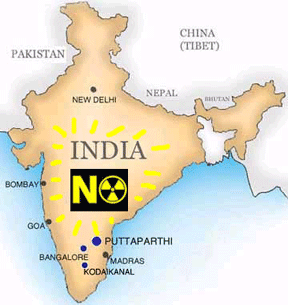
 Tension simmers in Koodankulam http://www.asianage.com/chennai/tension-simmers-koodankulam-750 The Asian Age, Mar 21, 2012 – Pradeep Damodaran & Arul Oli | DC | Idinthakarai Even as engineers and other workers drove in to resume work following the government’s green signal for the Koodankulam nuclear power project, the situation at Idinthakarai, which is less than 10 minutes drive from the nuke plant, is getting more tense by the minute as the ‘fast-to-death’ by the protesters’ leader S.P. Udayakumar and 14 others entered the second day on Tuesday. Continue reading
Civil liberties gone, as Tamil Nadu government moves to crush anti nuclear protest
Civil society members warn of “nuclear Nandigram” THE HINDU, CHENNAI, March 21, 2012 Civil society members, including former judges, writers, scientists, academicians, filmmakers and lawyers, have condemned the Tamil Nadu government’s decision “to give the green signal to commissioning of the Kudankulam Nuclear Power Project (KKNPP) and the massive deployment of police force to crush the peaceful agitation.” Continue reading
India: the crackdown on protestors, the pro nuclear media ‘spin’
And Koodankulam is Being Hunted Down ! http://www.dianuke.org/and-koodankulam-is-being-hunted-down/ 6000 armed policemen, led by Tamil Nadu’s Additional Director General of Police (ADGP), 3 DIGs (Deputy Inspector Generals) and 20 SPs (Superintendents of Police) who are present themselves and are presiding over this operation that can turn up into a state-sanctioned carnage of its own civilians.
As drumbeats approached Idinthakarai, Tamil Nadu Chamber of Commerce and Industry hails the decision to start the Koodankulam reactor as it is necessary for the State’s “progress”.
A 5-page press statement from the Chief Minister of Tamil Nadu ended the rituals of “engaging people”, “dialogue with the locals” and “allaying their fears” in the world’s largest democracy. Not surprisingly, the government crackdown on people’s movement waited for another mega-ritual to end: the elections in the neighbouring assembly constituency of Sankarankoil on March 18.
Since yesterday afternoon, the police squads have blocked every road leading to Koodankulam and Idinthikarai to prevent people from gathering there. Yet, more than 20,000 people have gathered at the gate of Koodankulam nuclear power project, with several hundreds getting detained on their way.
Learning from the democracies in the West, the corporate media here has also embedded itself to this ‘shock and awe’. Newspapers and TV channels are abuzz with the ‘green signal’ given to the nuclear project and the country’s progress. The titles say it all: …. http://www.dianuke.org/and-koodankulam-is-being-hunted-down/
Taipower poisons island with nuclear wastes, and islanders’ minds with money
“Taipower contaminates our island with nuclear waste and it also contaminates our minds with money,” “They are trying to make us think that we cannot live without nuclear waste.”…
a lot of Taos depend on Taipower for jobs and are afraid of losing their jobs if they tell people what they really think.

 Lanyu’s residents grudgingly accept nuclear storage Taipei Times, By Loa Iok-sin 19 March 12, The Tao Aborigines of Lanyu (蘭嶼) — also known as Orchid Island — are once again taking to the streets to voice their opposition to a nuclear storage facility on their island, calling for its immediate removal.
While it may appear that the removal of nuclear waste is the only thing the Taos want, the
real situation is much more complicated, as Taiwan Power Co (Taipower) is exerting considerable effort on the resource-scarce island to minimize opposition. Continue reading
New evidence raises questions about the murder of anti nuclear campaigner
A high-profile campaigner against nuclear weapons, she had been due to present evidence to the public inquiry into the proposed Sizewell B nuclear reactor in East Anglia.
“The victim was consumed with anxiety that something was going to happen to her. A look at why that might be involves the evidence she was about to give to the Sizewell inquiry.”

 Hilda Murrell murder: call to examine ‘MI5 link’ to murder of nuclear activist Michael Mansfield QC wants to know what intelligence services knew about killing of anti-nuclear activist Hilda Murrell in 1984 Mark Townsend, Guardian UK, The Observer , 18 March 2012 Campaigner Hilda Murrell, 78, who was murdered in March 1984, had been due to give evidence at the public inquiry into the Sizewell B nuclear reactor.
One of Britain’s leading human rights lawyers has demanded a fresh police inquiry to establish what the British intelligence services knew about the murder of a prominent anti-nuclear campaigner. Continue reading
Thousands of police surround India’s anti nuclear protestors
Indian Police Arrest 10 at Nuclear Power Plant Protest IDINTHAKARAI, Tamil Nadu, India, March 19, 2012 (ENS) – Thousands of police today surrounded thousands of anti-nuclear protestors demonstrating against the Kudankulam Nuclear Power Plant in Idinthakarai.
Ten people have been arrested, including three protest leaders, Continue reading
China’s secretive nuclear industry – more dangerous than Japan’s?
 China’s nuclear power plant review: ‘problems in 14 areas’ found Christina Science Monitor, Should we be concerned? 18 March 12, A nuclear official said in passing this weekend that problems in 14 areas need to be resolved. In the wake of Fukushima, a shade more transparency would be welcome. By Peter Ford, “…. a press conference held on Saturday on the sidelines of the annual National People’s Congress meeting, at which a top nuclear-industry insider spoke:
Referring to a safety review of China’s nuclear power plants conducted in the wake of the Fukushima nuclear power plant meltdown in Japan last year, he mentioned, in passing, that “problems in 14 areas have been found and need to be resolved.” Some of them will take up to three years to fix, he added.
 That was all that Wang Binghua, chairman of the State Nuclear Power Technology Corp., said on the subject, and none of the journalists present pressed him further, according to an official transcript of his remarks. So all we, and the Chinese public, know is that among China’s 14 working nuclear reactors there are 14 “problems.” What they might be, where, how serious they are, and what can be done to rectify them remains secret…..
Mr. Wang said he expected that the current freeze on the examination and approval of new nuclear plants – in effect since Fukushima – would end this year. He promised that “the Chinese government will not approve any new nuclear project that does not contain necessary emergency measures before the problems identified in the review have been solved.”
But since nobody outside China’s nuclear industry knows what the problems are, nobody can know whether they have been solved or not. Suddenly, even Japan’s dangerously shadowy nuclear industry begins to look almost transparent…. http://www.csmonitor.com/World/Global-News/2012/0312/China-s-nuclear-power-plant-review-problems-in-14-areas-found
1 This Month
26 September – International Day for the Total Elimination of Nuclear Weapons





PLEASE OPPOSE HR 8255 AND S.3639 – bills would accelerate satellite deployment, with no environmental review or safeguards – https://ncstd5li.quorum.us/campaign/169331/
To see nuclear-related stories in greater depth and intensity – go to https://nuclearinformation.wordpress.com
-
Archives
- September 2026 (313)
- August 2026 (330)
- July 2026 (355)
- June 2026 (287)
- May 2026 (306)
- April 2026 (356)
- March 2026 (251)
- February 2026 (267)
- January 2026 (308)
- December 2025 (358)
- November 2025 (359)
- October 2025 (375)
-
Categories
- 1
- 1 NUCLEAR ISSUES
- business and costs
- climate change
- culture and arts
- ENERGY
- environment
- health
- history
- indigenous issues
- Legal
- marketing of nuclear
- media
- opposition to nuclear
- PERSONAL STORIES
- politics
- politics international
- Religion and ethics
- safety
- secrets,lies and civil liberties
- spinbuster
- technology
- Uranium
- wastes
- weapons and war
- Women
- 2 WORLD
- ACTION
- AFRICA
- Atrocities
- AUSTRALIA
- Christina's notes
- Christina's themes
- culture and arts
- Events
- Fuk 2022
- Fuk 2023
- Fukushima 2017
- Fukushima 2018
- fukushima 2019
- Fukushima 2020
- Fukushima 2021
- general
- global warming
- Humour (God we need it)
- Nuclear
- RARE EARTHS
- Reference
- resources – print
- Resources -audiovicual
- Weekly Newsletter
- World
- World Nuclear
- YouTube
-
RSS
Entries RSS
Comments RSS

