Secret terror blueprints for US NSC to ‘help Ukraine resist’ exposed.
The Grayzone, By Kit Klarenberg – February 15, 2025
Newly-leaked documents reveal a crew of military academics pitching the US National Security Council a series of extreme strategies for Ukraine, from IED’s inspired by Iraqi insurgents to sabotaging Russia’s infrastructure to propaganda “from ISIS’ playbook.”
Conceived under the auspices of the UK’s University of St. Andrews, the plans were outsourced through third parties to ensure “plausible deniability.”
Explosive leaked documents reviewed by The Grayzone show how a shady transatlantic collective of academics and military-intelligence operatives conceived schemes which would lead to the US “helping Ukraine resist,” to “prolong” the proxy war “by virtually any means short of American and NATO forces deploying to Ukraine or attacking Russia.”
The operatives assembled their war plans immediately in the wake of Russia’s invasion of Ukraine in February 2022, and delivered them directly to the highest-ranking relevant US National Security Council official in the Biden administration.
Proposed operations ranged from covert military options to jihadist-style psychological operations against Russian civilians, with the authors insisting, “we need to take a page from ISIS’ playbook.”
ISIS was not the only militant outfit upheld as a model for Ukraine’s military. The intelligence cabal also proposed modernizing IEDs, like those staged by Iraqi insurgents against occupying US troops, for a potential stay-behind guerrilla army in Russia, which would attack rail lines, power plants and other civilian targets.
Many of the cabal’s recommendations were subsequently enacted by the Biden administration, dangerously escalating the conflict and repeatedly crossing Russia’s clearly-stated red lines.
Included among the proposals were providing extensive training to “Ukrainian expatriates” in using Javelin and Stinger missiles, enabling “cyberattacks on Russia by ‘patriotic hackers’ with deniability,” and flooding Kiev with “unmanned combat air vehicles.” It was also foreseen that “replacement fighter aircraft” would be provided by “many sources,” and that “non-Ukrainian volunteer pilots and ground crews” would be recruited to fight air battles in the manner of the Flying Tigers, a World War II-era force composed of American Air Force pilots, which was formed in April 1941 to help the Chinese oppose Japan’s invasion before Washington’s formal entry into the conflict.
The document was written and cosigned by a quartet of academic armchair warriors with colorful pasts. They included historian Andrew Orr, the director of the University of Kansas Institute for Military History. His recent academic contributions include a chapter in an obscure academic volume entitled, “Who is a Soldier? Using Trans Theory to Rethink French Women’s Military Identity in World War II.”
Joining him was Ash Rossiter, assistant professor of international security at the United Arab Emirates’ Khalifa University, and described as “ex-British Army Intelligence Corps.” Also participating was Marcel Plichta, then a doctoral candidate at St. Andrews. He’s described as a veteran of the US Defense Intelligence Agency, and his LinkedIn profile indicates he interned at NATO before working in roles with Pentagon contractors, then joined the DIA as an intelligence analyst. Along the way, Plichta claims to have “[nominated] known or suspected terrorists to the national watchlisting and screening community.”
Also involved in the academic cabal was Zachary Kallenborn, a self-styled US Army “mad scientist” currently pursuing his PhD in War Studies at King’s College London, with a focus on drones, WMD, and other edgy forms of modern warfare. Kallenborn, who has moonlighted at the DC-based Center for Strategic and International Studies, contributed to the Ukraine war planning by offering proposals for Iraqi insurgent-style “smart” IED attacks on Russian targets, and planting bombs on Russian trains and railways.
The cabal appears to have been led by Marc R. DeVore, a senior lecturer at Britain’s St. Andrews University. Little about his personal or professional background can be ascertained online, although his most recent academic publications discuss military strategy. Around the time the secret proposal document was being drafted, he published an article with Orr for the Pentagon’s in-house Military Review journal entitled “Winning by Outlasting: The United States and Ukrainian Resistance to Russia.” Moreover, he is a fellow at the elite Royal Navy Strategic Studies Centre, a Ministry of Defence-run “think tank.”
Emails show DeVore passed the group’s handiwork directly to Col. Tim Wright, who was the Director for Russia in the Biden administration’s National Security Council (NSC) at the time the emails were sent, according to his LinkedIn profile. Since July 2022, Wright has been the Assistant Head for Research and Experimentation in the Futures Directorate of the British Army.
The Grayzone attempted to contact Orr, Rossiter, and Devore by phone and email in order to solicit comment about their role in proxy war scheme, and about whether St. Andrews University was aware it was being used as a base for planning terror attacks against Russia. None have responded to our requests.
Surging the Ukrainian diaspora to the front
…………………………………………………………………….. This diaspora, it was believed, could easily be identified and recruited due to their registration with Ukrainian “consulates or embassies” in the West, then given “intensive classes” in using “shoulder-launched missiles” before being dispatched to Kiev………..
“Volunteer cyber warriors” conceal state hacking
The quartet’s plans extended into the realm of cyberware, calling for “Western intelligence agencies” to “provide cyber tools and suggestions” to “volunteer hackers who want to strike their blow for Ukrainian independence, while also warning them what targets we do not want attacked.”
A “major task for these volunteer cyber warriors,” the four wrote, “could be to make certain that videos of Russian indiscriminate attacks, the use of objectionable weapons such as thermobarics, Ukrainian civilian casualties, Russian casualties and poor befuddled captured Russian conscripts” were made available to Russian audiences. Simultaneously, “patriotic hackers” could seek to bombard Russians with propaganda “about domestic opposition to the war.”
The intelligence cabal made clear they aimed to achieve the same psychological impact as the world’s most notorious terrorist organization, declaring, “we need to take a page from ISIS’ playbook in agilely communicating our message to Russians.”………………………………………………………………………………… more https://thegrayzone.substack.com/p/secret-terror-blueprints-for-us-nsc?utm_source=post-email-title&publication_id=474765&post_id=157234988&utm_campaign=email-post-title&isFreemail=true&r=4ds0bd&triedRedirect=true&utm_medium=email
The Coventry experiment: why were Indian women in Britain given radioactive food without their consent?
When details about a scientific study in the 1960s became public, there was shock, outrage and anxiety. But exactly what happened?
By Samira Shackle, Guardian, 11 Feb 25
In 2019, Shahnaz Akhter, a postdoctoral researcher at Warwick University, was chatting to her sister, who mentioned a documentary that had aired on Channel 4 in the mid-1990s. It was about human radiation experiments, including one that had taken place in 1969 in Coventry. As part of an experiment on iron absorption, 21 Indian women had been fed chapatis baked with radioactive isotopes, apparently without their consent.
Having grown up in Coventry’s tight-knit South Asian community, Akhter was shocked that she had never heard of the experiment. When she looked into it, she found an inquiry by the Coventry Health Authority in 1995 conducted soon after the documentary aired. The inquiry examined whether the experiment put the subjects’ health at risk and whether informed consent was obtained. But the only mention of the women’s perspectives was a single sentence: “At the public meeting, it was stated that two of the participants who had come forward had no recollection of giving informed consent.”
…………………………………… rather than putting out a public call for information, Akhter quietly asked around within her community for people who might know families that had been affected.
By chance, at about the same time, a historian and broadcaster, Dr Louise Raw, came across some old reporting about the radioactive chapatis – specifically, a 1995 story in India Today following up on the documentary, which jogged her memory of watching the film when it aired. Raw is interested in hidden histories and was immediately intrigued.
……………………………………………………….The story provoked major anxiety in Coventry. Though the study only involved 21 women, Owatemi was contacted by scores of people terrified that their mothers or grandmothers had been affected.
………………………………………Desperate for information, Kalbir – an articulate, assertive woman who sees herself as a fighter – tried to get access to her mother’s medical records, only to hit dead ends: the doctor’s surgery no longer existed and medical confidentiality still applied after death. Meanwhile, Akhter and Owatemi’s efforts were stalling too. The Medical Research Council (MRC), the public body that funds and coordinates research into human health in the UK, says it does not have any documentation relating to the study, not even a list of who was experimented on………………………………
The study took place more than 50 years ago, yet it still stirs up strong emotions, tapping into a host of broader anxieties about racial health inequalities and abuses by the medical establishment. After so many years have elapsed, sorting truth from panic is a complex task. What really happened in Coventry in 1969?
……………………………………………………..In the postwar period, doctors used radiation to treat everything from arthritis to ringworm. By the mid-1950s, it had become clear that exposure increases the chance of developing certain cancers and can cause infertility. The use of radiation was pared back, but medical researchers remained excited about the quick, precise experimentation it offered.
……………………………………..a new set of principles for ethical research on humans, known as the Nuremberg Code, had been introduced. The first of its 10 points is: “The voluntary consent of the human subject is absolutely essential.” The code also sets out other principles: experiments should be for the good of society and carried out by qualified researchers, and the risk should never exceed the potential benefit. But at first the code didn’t have much effect on researchers in the UK and the US, who saw it as something that applied to evil war criminals, not high-minded doctors who wanted to further scientific knowledge. In 1964, the medical researcher Paul Beeson, who had been a professor of medicine at both Yale and Oxford, wrote that the Nuremberg Code was “a wonderful document to say why the war crimes were atrocities, but it’s not a very good guide to clinical investigation which is done with high motives”.
……………………………..There are countless other examples from the US, UK and Canada. A number of these involved radiation exposure: in the 1950s, pregnant women in London and Aberdeen were injected with radioactive iodine to test their thyroid function despite the fact that radiation exposure of any sort poses a risk to a foetus. In Massachusetts in the 1940s and 1950s, boys with learning difficulties at a residential school were fed radioactive oatmeal as part of an experiment to see how Quaker Oats were digested.
………………………………………………………………………………………………………. in Cardiff Elwood hired an Indian housewife to teach a group of Welsh women to make traditional chapatis. Using flour fortified with radioactive iron, they made 200 chapatis to freeze until needed. Meanwhile, Elwood looked for participants. He needed South Asian women who still ate a traditional diet. Eventually he settled on Coventry, where there was a community of migrants from the Punjab region of India. Elwood’s team enlisted a doctor’s surgery in Foleshill, the centre of Coventry’s South Asian community, to identify women who could take part.
………………………………………………………….Despite translation difficulties, and the possibility that the women did not understand what was happening, the study got under way. Every morning for four days, the women were asked to eat one of the irradiated chapatis, which were delivered on dry ice each morning. A few hours later, Tom Benjamin, a field worker on Elwood’s team, would return, visiting all 21 houses to check the women had eaten it and record what foods they’d had with it. Seventeen days later, the women were picked up and driven an hour and a half to Harwell Laboratory for testing,
…………………………………Kalbir finds it upsetting to imagine her mother there. “The terror these women must have gone through,” she said. “They were already struggling in England. Our homes were being attacked by racists, we would get abused on the street, and then the system does this to them.”
The study, published in 1970, found that iron was not absorbed any more effectively from chapatis and the fermented flour they use than from bread. No one informed the women about the results, and no one followed up to check whether the radiation exposure had impacted their health.
………………………………………………In the 1990s, MRC officials insisted that it would be a poor use of public money to do a follow-up study on the women since the level of radiation exposure was so low. But to people who already feel misled, such reassurances can feel like a repetition of the “doctor knows best” mentality. “I feel anger, frustration and massive anxiety,” Kalbir told me. “I’m desperate to get answers and justice.” As it has surfaced and resurfaced, the story of the radioactive chapatis has come to represent something more than itself. “These women had a hard time in England,” said Kalbir. “They didn’t understand the way research and the medical professions worked. They had a great deal of trust. This shouldn’t have happened.” https://www.theguardian.com/news/2025/feb/11/the-coventry-experiment-why-were-indian-women-in-britain-given-radioactive-food-without-consent
Engineer who worked on Hinkley Point C nuclear project quizzed on suspicion of being a Russian spy
By LETTICE BROMOVSKY, 4 February 2025 , https://www.dailymail.co.uk/news/article-14355483/Nuclear-power-worker-suspicion-Russian-spy.html?openWebLoggedIn=true&login
An engineer who worked on a UK nuclear project was quizzed on suspicion of being a spy after he returned to the UK from Russia.
Mario Zadra, a 67-year-old Italian national, who worked as an engineer on the Hinkley Point C project from 2020 to 2023 from their headquarters in Bristol, was questioned by counter-terrorism police after he flew into Heathrow airport on April 12, 2023.
It was reported that potentially sensitive documents were found in his possession and were seized by the authorities to prevent them being ‘used to carry out a hostile attack’.
Zadra was arrested under Schedule Three, which gives police the power to search, question, and detain a person to determine whether they are engaged in hostile activity, Burnham & Highbridge Weekly News first reported.
Hinkley Point C is currently constructing two new nuclear reactors, which will provide zero-carbon electricity for around six million homes, and is expected to cost a massive £46billion.
Zadra was later dismissed by his employer, Alten Ltd, a supplier for EDF’s Hinkley Point C – settling for more than £37,000 in an employment tribunal, local media reported.
Counter terrorism police retained Mr Zadra’s hard drives for national security reasons. He was not charged with any offence.
A spokesperson for Hinkley Point C said: ‘Hinkley Point C takes information security very seriously and there are rigorous measures in place to protect sensitive data.
‘This individual did not have access to sensitive nuclear information. The information he removed was outdated.
‘Allegations made by this person were thoroughly investigated and independently reviewed. His contract with Alten Ltd ended as a result of increasingly inappropriate and disruptive behaviour.’
The Met police and the Home Office have been approached for comment.
Hinkley Point plays down reports of suspected ‘spy’ at nuclear power plant
A spokesperson for Hinkley Point C has played down press reports about a
man suspected of being a spy at the nuclear power plant. A 67-year-old
Italian national who worked at Hinkley Point C from 2020 to 2023 was
questioned by counter-terrorism police after he flew into Heathrow airport
on April 12th, 2023.
It was reported that several documents were found in
his possession and were seized by the authorities. Counter terrorism police
retained the man’s hard drives for national security reasons. He was not
charged with any offence.
A spokesperson for EDF’s Hinkley Point C adds:
“Hinkley Point C takes information security very seriously and there are
rigorous measures in place to protect sensitive data.” “This individual
did not have access to sensitive nuclear information. The information he
removed was outdated.” The spokesperson adds that the man’s contract
with his employer, a supplier to EDF’s Hinkley Point C, has since ended.
Burnham-on-Sea.com 4th Feb 2025, https://www.burnham-on-sea.com/news/hinkley-point-plays-down-press-reports-of-suspected-spy-operating-at-nuclear-power-plant/
Engineer who worked on Hinkley Point C nuclear project quizzed on suspicion of being a Russian spy
A nuclear power station worker was quizzed on suspicion of being a spy
after he returned to the UK from Russia. Mario Zadra, a 67-year-old Italian
national, worked at Hinkley Point C in Somerset from 2020 to 2023, and was
questioned by counter-terrorism police after he flew into Heathrow airport
on April 12, 2023. It was reported that potentially sensitive documents
were found in his possession and were seized by the authorities to prevent
them being ‘used to carry out a hostile attack’.
Daily Mail 3rd Feb 2025,
https://www.dailymail.co.uk/news/article-14355483/Nuclear-power-worker-suspicion-Russian-spy.html
They won’t tell you these truths about nuclear energy
by Cindy Folkers and Amanda M. Nichols, opinion contributors – 02/02/25 , https://thehill.com/opinion/energy-environment/5118792-nuclear-power-industry-radiation-debunk/?fbclid=IwY2xjawIOldhleHRuA2FlbQIxMQABHfrKakROFL169LYfifqZe6YoIrO_jAtv23bm6hkyL0zF7neIUesv9XURpw_aem_ocJM3kdP_FV_AlGdyUVxdg
Scientists have been arguing about the health risks from radiation since the end of the 19th century, when radioactivity was first discovered. Today, with electricity demand soaring and AI companies clamoring for their own nuclear power plants, from small modular reactor projects to giant new nuclear builds, that century-old argument is ongoing.
But now it’s mostly a battle between scientists on the one hand and the nuclear industry, the politicians it lobbies and gullible media on the other.
Currently, scientists are being drowned out. The Biden administration proposed to triple U.S. nuclear capacity by 2050, and President Trump is perceived as favoring nuclear expansion as well. Despite reams of peer-reviewed studies and books showing radiation’s harmful effects, there is persistent denialism that seems impervious to fact-checking.
It took until this century for the U.S. government to finally admit that radiation had killed workers at nuclear weapons plants. For Congress, compensating them remains politically radioactive: lawmakers failed to reauthorize the Radiation Exposure Compensation Act that expired in 2024. Media coverage increasingly and uncritically repeats the talking points of nuclear industry spokespeople, who preposterously claim you would have to stand next to nuclear waste for a year to get as much radiation as having an X-ray, or that eating a banana gives you as much radiation exposure as living next to a nuclear plant.
This is dangerous disinformation in a long line of dangerous disinformation.
After the U.S. dropped atomic bombs on Japan, the director of the Manhattan Project, Gen. Leslie R. Groves, debunked reports of radiation sickness as Japanese “propaganda.” Later, when he had to admit its existence, Groves misled Congress and the public by saying it was “a very pleasant way to die.”
Spreading such lies is bad enough. What is even worse is that the truth of the matter has been actively and deliberately suppressed.
Scientists who first dared to expose radiation’s harms — cancer, birth defects, disproportionate impacts on females — had their funding and data seized and suffered professional ostracism and vilification.
Spreading such lies is bad enough. What is even worse is that the truth of the matter has been actively and deliberately suppressed.
Scientists who first dared to expose radiation’s harms — cancer, birth defects, disproportionate impacts on females — had their funding and data seized and suffered professional ostracism and vilification. Yet their early scientific findings were largely vindicated. It’s now well established that exposure to ionizing radiation has adverse health impacts, affecting the heart, lungs, thyroid, brain and immune system, causing blood disorders, cataracts, malignant tumors, keloids and other chronic conditions. It wreaks genetic havoc that can result in cancer, organ dysfunction and immune and metabolic disorders. Children and pregnant women are particularly vulnerable.
It’s also proven that ionizing radiation disproportionately impacts women and girls, with the youngest worst affected. Ethnicity and other factors beyond biological sex and age may be contributing or compounding factors. There is also a growing body of evidence that radiation has transgenerational impacts.
Meanwhile, regulators set dose limits for radiation exposure that fly in the face of the evidence. These limits purport to set a “safe” level of radiation exposure, ignoring radiation researchers who have long stressed there is no such thing as a safe level, since any exposure can contribute to adverse health impacts.
In fact, nuclear technologies, including civilian power reactors, have poisoned large swaths of land — and not only the areas around Chernobyl and Fukushima, whose radioactive cesium contaminated Tokyo. The U.S. nuclear industry has left a lasting legacy of radiation in our environment, including in our water and food, which U.S. regulators are hardly able to effectively track, let alone remediate.
Uranium mining and nuclear weapons testing particularly and disproportionately affect Indigenous land and Native Americans, compounding the harms of colonization, exploitation and marginalization on already overburdened communities. Nuclear technologies have done and will continue to do long, slow violence, especially to the poor and marginalized, leaving long-lasting ecological, human-health and genetic impacts.
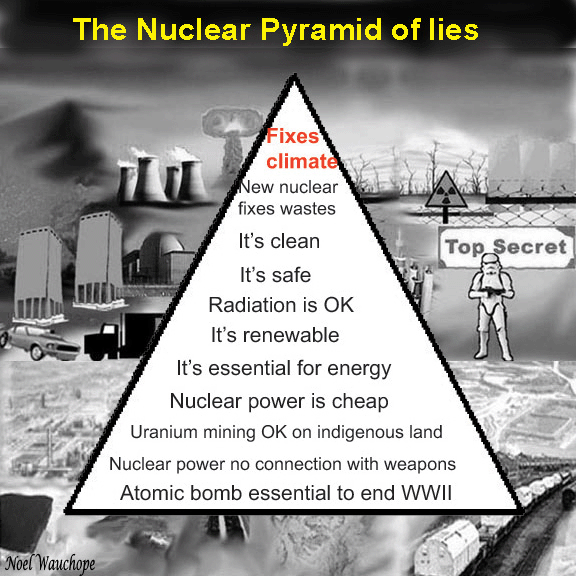
We seem unable to keep these inconvenient truths in our heads, the more so since well-financed nuclear lobbyists and their government targets have misdirected our attention by reframing nuclear power as key to fighting climate change.
This is a fallacy. There’s actually plenty of evidence showing the opposite — that relying on nuclear power actually makes climate change worse, and undercuts the true climate solution of renewables and efficiency. Even the Government Accountability Office called out the Nuclear Regulatory Commission for its nonsensical refusal to consider the growing dangers of operating nuclear plants amid climate change. But none of that has prevented countenancing the myth of nuclear as a climate strategy and other big lies about it
Perhaps the biggest lies about nuclear stem from Eisenhower’s 1953 “Atoms for Peace” speech, a carefully crafted bid to recast nuclear technology as peaceful after the atrocious 1945 Hiroshima and Nagasaki bombings. Atoms for Peace promised to make electricity “too cheap to meter” and “make the deserts bloom,” while deliberately concealing the truth that nuclear was utterly uncompetitive and not remotely economically viable as a power source. Civilian nuclear power was misdirection away from the real agenda of building nuclear power plants, which was to help supply the nuclear weapons complex, producing enriched plutonium as feedstocks for nuclear bombs in the burgeoning arms race.
Today, nuclear weapons are still the hidden agenda and secret rationale behind the otherwise nonsensical nuclear power industry. The resurgent nuclear arms race is the real reason why many tens of billions in federal subsidies ($53.5 billion in the Inflation Reduction Act alone, plus billions more in state subsidies) are propping up the utterly uncompetitive nuclear power industry, and why many billions more of taxpayers’ money is now getting thrown at corporations pushing chimerical “advanced” nuclear and uneconomical, dirty, failing small modular reactors (SMRs).
But some are pushing back, like Indigenous nations and public interest advocates in southwest Washington, where Amazon is pushing to build SMRs to power its AI business, heedless of their negative impacts and prohibitive costs.
Of all the dangers of reckless nuclear boosterism, the most insidious is disinformation concealing and denying nuclear’s past, present and future harms while wildly exaggerating its benefits. These are the perennial tactics of the nuclear industry. They litter its history, and they’re again getting traction today.
But they can be countered with sunshine — both the kind that powers real renewables with which nuclear can’t compete, and the kind that exposes its prevarications and lies with scientific evidence and public scrutiny.
Cindy Folkers is the radiation and health hazard specialist at the NGO Beyond Nuclear, and co-author with Ian Fairlie of the new book “The Scientists who Alerted us to the Dangers of Radiation.” Amanda M. Nichols, Ph.D. is a postdoctoral research fellow at University of California Santa Barbara’s Environmental Studies Program, and managing editor of the peer-reviewed Journal of Religion, Nature and Culture.
The Atlas Network talking about itself

The MPS and its Atlas Network have conscientiously worked to change university campuses from places of free inquiry and critical thinking. Those beachheads in universities are matched by opportunities to find and promote “conservative” students. The idea is to shape them and potentially promote their careers in politics, the law, media, policy, academia and business.
January 26, 2025, Lucy Hamilton , https://theaimn.net/the-atlas-network-talking-about-itself/
There is much to learn about the Atlas Network from one of Ron Manners’ Mannkal Economic Education Foundation newsletters. This Mannkal newsletter was issued in April 2015. The project continues unabated.
The Atlas Network is a global interconnection of over 500 faux “thinktanks” (or junktanks), dedicated to reinforcing and propagandising the “free market” message. The Mont Pelerin Society (MPS) is considered its steering committee. The Atlas Network was designed from 1981 to metastasise similar bodies to sell “business” ideas. It finds local enthusiasts and donors around the world to eliminate obstructions to profit for American corporations and local fellow-travellers. The MPS is secretive: its membership is only rarely leaked.Ron Manners, with mining money, founded Mannkal in 1997. He is currently a life member and on the board of the MPS. He was appointed to the Advisory Council for the Atlas Economic Research Foundation in 2010. In 2020, he was awarded Atlas’s Sir Antony Fisher Achievement award. The newsletter explains that the name Mannkal originated in the cable/telex address of the company he inherited.
The Mannkal newsletter illustrates the connection to the MPS which first met in 1947. It brought together Austrian School economists such as Friedrich von Hayek and Ludwig von Mises together with the Chicago School’s Milton Friedman. The MPS, through Hayek, began the process of creating plutocrat-serving law and economics institutes in universities around America.
It also took the model provided by bodies such as the Foundation for Economic Education (FEE), founded in 1946, to create the mirage that a chorus of genuine policy experts supported the political economy that the donors desired. Friedman did much of the public relations for the project before the junktanks became more organised.
In the 1950s, Brit Antony Fisher, inspired by The Road to Serfdom, visited Hayek for advice. One of the UK junktanks in the Network explains that Hayek “told him bluntly to forget politics. Politicians just follow prevailing opinions. If you want to change events, change ideas.” He instructed Fisher to found thinktanks to help shift the prevailing mood away from the consensus that government, labour and capital all had a say in how society should operate towards a world where capital could dictate all including directing the government for its own ends.
When the co-founder of the Atlas Network Heritage Foundation, Ed Feulner, visited Australia in 1985 to conduct a workshop, he contrasted Friedman’s role marketing supply side economics, privatisation and the flat tax with the need for bodies to “set the terms and agenda of public policy.” The intent was to propagandise or “market an idea.” There must be “permanent saturation campaigns with multi-pronged, longterm strategies.” Proctor and Gamble, he explained, sell Crest toothpaste by “keeping the product fresh in the consumers’ minds.” That was to be the junktanks’ role. (These are a combination of Dr Jeremy Walker’s summaries and Feulner’s own words. The essay is well worth your time to see the history and people of Atlas in Australia.)
That Adam Smith Institute essay continues to boast that the Atlas Network had grown at the time of writing to 450 bodies. Now, the essay boasts, “They are changing events all over the world – from land reform in Peru, through privatization in Britain, public debt control in Pakistan, to low-cost education in India. And spreading the ideas of liberty in even the most unlikely places, in the Muslim world from Morocco through Turkey to Yemen and Kazakhstan; in Africa from Mali and Ivory Coast to Ethiopia; in Europe and the Far East.”
The MPS and its Atlas Network have conscientiously worked to change university campuses from places of free inquiry and critical thinking. Those beachheads in universities are matched by opportunities to find and promote “conservative” students. The idea is to shape them and potentially promote their careers in politics, the law, media, policy, academia and business.
One of Mannkal’s primary roles is the selecting of libertarian students in Western Australia for scholarships to Atlas Network junktanks around the world. In this edition of the newsletter, two report back on attending an MPS conference. One celebrated attending “networking events with prominent intellectuals and businesspeople from around the world.” Another was dazzled by, “Having dinner alongside a mining magnate, the chairman of a prominent think-tank, a famous TV presenter and an ex-CIA agent”. He continued, “I was exposed to a network rich in knowledge and influence, including a plethora of world-class academics, Nobel laureates and senior political figures.” (Nafeez Ahmed’s Alt Reich shows the significance of the CIA – and their former Nazis – in the shaping of the Atlas Network.)
Melbourne’s Institute of Public Affairs (IPA), a 1943 creation, was absorbed into the Atlas Network in the era of the Liberal Party’s battle between the Wets and the Dries. It was reportedly “hijacked” by “radicals” after people senior in the body attended an MPS conference.

The newsletter report of a third scholarship holder illustrates the Cold War dread of communism that continues to motivate the MPS and its Atlas junktanks. Former Czech president Vaklav Klaus, then a member of the MPS for 25 years, spoke at a lunch. People who have suffered under communist and socialist governments are often rolled out to warn audiences of the continuing threat of authoritarianism. The offspring of refugees who have had awful experiences in such countries provide some of the enthusiastic recruits for Mannkal.
Neoliberalism was always a bunk economics that trumpeted itself as superior because it was driven by theory and rejected evidence. In fact it was an ideology – and a network of activists – that functioned to serve the rich donors. As the project became our new normal, it created ever more dramatic inequalities, resulting in the fury and pain that drives sadopopulism. Youthful interest in social democracies has been a more productive response. In 2024, the IPA was sharing American Atlas junktank Cold War 2.0 propaganda to address the risk that youth might turn away from the “freedom” they sell.
Those of us watching the Atlas Network’s Heritage Foundation plans come to fruition in the first week of Trump’s second term see where authoritarianism lurks right now. Heritage’s Mandate for Leadershiphas come a long way since its first iteration set out the Ronald Reagan economic revolution’s steps. Now it combines its ultra-libertarian positions with authoritarian social policy and autocratic governance.
In this newsletter, Mannkal boasts of 154 scholarships available. Many are to conferences. Fifteen are “midyear internships abroad.” Another 45 are “3-month internships abroad.” The students are sent to Atlas junktanks around the world with 12 partners in particular listed. They include the inspiration for Mannkal, the FEE in Atlanta mentioned above. The Institute of Economic Affairs in London is another. That’s the body that helped create Maggie Thatcher’s economics after she was inspired by The Road to Serfdom. She co-founded another Atlas junktank, the Centre for Policy Studies.
One of the interns celebrates Maggie Thatcher’s certainty of the importance of Atlas: “It started with Sir Keith and me, with the Centre for Policy Studies, and Lord Harris at the Institute of Economic Affairs. Yes, it started with ideas, with beliefs. That’s it. You must start with beliefs. Yes, always beliefs.” Thatcher and Reagan make repeat appearances as Atlas heroes in the newsletter.
Another intern went to the New Zealand Institute, where the Chief Economist is Eric Crampton, MPS director.
The intern who was sent to Atlas headquarters in Washington was delighted to attend events at several of the Atlas junktanks including the Cato Institute (where Rupert Murdoch was a board member in the 1990s) and the Leadership Institute (party to Project 2025 and, like Heritage, to the Christian Nationalist Council for National Policy). She was impressed by Tom Palmer: Atlas’s Executive Director for International Programs. His patronising speeches at the Friedman Conference over the years can be found online.
Another of the interns was deeply grateful to spend time in Melbourne at the IPA with John Roskam. Two went to the Menzies Research Centre (MRC). One was thrilled to sit in on “meetings with high-level politicians and policy-advisors.” Mathias Corman, then Finance Minister, spoke at an MRC event about “shrinking government” in New Zealand and Australia. The Atlas Network’s Project 2025 shows how brutal the cuts to government are ultimately intended to be.
The Executive Director of the Liberal Party-affiliated MRC Nick Cater has just spent the European summer with Viktor Orbán’s junktanks in Budapest.
Scholarship donors are listed in the newsletter as Manners, Gina Rinehart, Willy Packer and Toby Nichols.
One public figure who shows the path and now models the Atlas policy influence is David Seymour, Deputy Prime Minister of New Zealand/Aotearoa. He was recruited on his university campus by the Atlas Association of Consumers and Taxpayers (ACT). The ACT is the now the political party that he leads. Seymour was awarded an Atlas “MBA” after a fortnight’s training at Atlas headquarters. He went on to work in the Canadian Atlas Frontier Center before returning to Atlas work in NZ. He is far from the only political leader with deep Atlas Network ties.
Austrian School economics is largely dead these days, although Atlas partners continue to try to resuscitate them. One of the intern reports in the newsletter says the “highlight of my experience was learning about Austrian economics, a stream of economics that is not taught in Australian high schools or universities.” There is a cogent reason why she was freshly discovering the contribution from “economists such as Ludwig von Mises, Friedrich Hayek, Joseph Schumpeter and Frederic Bastiat – important economists whose ideas or names have never once been mentioned in my four years of studying economics.” Several interns mention this inculcation of Austrian School truthiness as part of their experience.
One of the most ebullient floggers of Austrian thought in America has been Rand Paul. The intern sent to Canada’s Fraser Institute was excited to report that he met the man.
The newsletter discusses its links to the then highlight of the Atlas Network calendar in Australasian region, the Friedman Conference. In 2024, the conference was reduced to a rabble-rousing event called the Triple Conference that gave a day to libertarianism, a day to Christian Nationalism and a day to conspiracy theory nonsense.
The Mannkal newsletter also links to the History of Economic Thought Society Australia (HETSA), which hosts a Young Scholars Initiative (YSI) conference. HETSA is, anecdotally, a host to MPS figures. In 2024, this event took place at the Alphacrucis University College in NSW. Alphacrucis is the official training college of the Pentecostal Assemblies of God network, Australian Christian Churches reshaped under Hillsong’s Brian Houston. Notre Dame University, also a Catholic force in reactionary politicking and culture wars, provided the YSI organiser.
A third conference series mentioned is the “Freedom to Choose” conference, hosted by Notre Dame University and “supported” by Mannkal. The 2024 conference focused as its theme on the “enduring relevance” of Hayek’s Road to Serfdom, the book that inspired so many of the big money donors in the early history of neoliberalism.
Ron Manners pontificates on Public Choice Theory in the newsletter. This is a core aspect of Atlas’s history.
One of the key details to be gleaned from the newsletter is that this project is lifelong and often intergenerational for the donors. One of the interns at the IEA considered herself lucky to meet Hayek’s daughter who allowed the interns to “gain insight into the workings of her father first-hand!” Antony Fisher’s daughter, Linda Whetstone, was president of the MPS, chair of the Atlas Network and on the board at the IEA. Rupert Murdoch’s father Keith co-founded the IPA with Charles Kemp. Rupert was an official board member at Cato, and an unofficial conduit of the IPA, Centre of Independent Studies and MRC, whose people are regularly found on his platforms. The Kemp sons, Rod and David, were key figures in the thinktanks and the Atlas Americanisation of Australian politics.
Charles Koch has been a prime force financially and strategically at Atlas for decades.
It is hard to know how much of the change from Keynesian balanced economy to neoliberal brutality is attributable to the MPS and the Atlas Network, compared to how much might be due to the general impact of the donors and ideologues. Industry lobbies and the direct power of the plutocrats intermix with the marketing of the Atlas Network and its soft power impact for American corporations around the world.
The plutocrats ventriloquised through Atlas operations, but do not seem to feel the same compulsion to separate their goals from their faces any longer. Whether it’s Elon Musk or Gina Rinehart, they seem to feel comfortable now dictating oligarch policy for themselves.
Regardless, it’s worth watching Atlas talking about itself: the freedom it declares it fights for was always anti-democratic.
North Korea beats sanctions to acquire key tool for nuclear weapons.
North Korea obtained a key tool used in the production of nuclear warheads
by shipping it through three separate countries in an elaborate ploy to
dodge international sanctions on the country’s weapons programme.
According to a US think tank, authorities in Mexico, South Africa and China
failed to spot false documentation for a vacuum furnace, which can be used
in creating uranium fuel for nuclear warheads.
The case demonstrates the
increasing difficulties of enforcing international sanctions against North
Korea. The report by the Institute for Science and International Security
cites unnamed government sources to describe an incident in 2022, when the
vacuum furnace was shipped from Spain with an accurate declaration of its
function.
Times 20th Jan 2025,
https://www.thetimes.com/world/asia/article/north-korea-sanctions-key-nuclear-tool-z6qwg79jj
‘I was exposed to evil in British nuclear tests’

Kirsteen O’Sullivan & Marcus White, 15 Jan 25, https://www.bbc.com/news/articles/cvgpp5ze28ro?fbclid=IwY2xjawH5E-JleHRuA2FlbQIxMQABHegxfVRLO66gQNKipt3Y5f9BWzRPbu0h6QWkys9CWH2yBTjZhE1YRCwhmA_aem_E7q8FCNDKoWD6DMMToVaoQ
A nuclear test veteran who witnessed the detonation of several British atomic bombs in the 1950s has said he was “exposed to evil”.
Robert James, 87, was an RAF firefighter stationed in Maralinga in Australia, where seven major UK tests took place.
Mr James, from Fordingbridge, Hampshire, said many service personnel had suffered fatal illnesses as a result and he was angry that the UK government had still not offered compensation.
The Ministry of Defence (MoD) said ministers were continuing to discuss issues with families.
Veterans’ campaign groups have said British service personnel were lined up and deliberately exposed to bomb tests to see what effect they would have.
Mr James said many of his comrades had died as a result of cancers and diseases associated with radiation exposure.
He said: “A lot of the guys suffered a lot. There’s lads dying every day… and after having long illness.
“We were exposed to evil, we were exposed to radiation. That’s pretty serious and I think that warrants compensation.
“Not only for people that are surviving like myself but the families that have suffered where their husbands or fathers died.”
In 2019, the Labour Party, then led by Jeremy Corbyn, pledged £50,000 for each surviving British nuclear test veteran.
Sir Keir Starmer met veterans in 2021, before becoming Prime Minister, but made no promises – and the 2019 offer was not in the 2024 manifesto.
However, the current Defence Secretary John Healey posted on his website in 2021: “UK remains the only nuclear power that refuses them recognition or compensation, unlike the US, France, Canada and Australia.”
Mr James said: “Don’t go back on your word, Mr Starmer… You promised us full compensation and recognition. Keep to your word.”
Destroyed Assange Files: Why Judge’s Rebuke Against Crown Prosecution Service Was So Significant.

“This is a significant victory in a long battle to get the truth out on the involvement of CPS in keeping Julian in arbitrary detention that later turned into political imprisonment, according to UN bodies and the Parliamentary Assembly of the Council of Europe.”
An unknown number of emails were apparently deleted after one of the U.K.’s lead prosecutor in the case, Paul Close, retired from the CPS. The deletions occurred despite the fact that the case against the award-winning journalist and publisher of the news and transparency website WikiLeaks was still active.
the dissenter, Mohamed Elmaazi, 14 Jan 2025,
A British judge issued an unusually critical rebuke against the Crown Prosecution Service of England and Wales.
A British judge issued an unusually critical rebuke against the Crown Prosecution Service of England and Wales (CPS) for its handling of freedom of information requests related to Sweden’s failed attempt to extradite WikiLeaks founder Julian Assange.
The decision by the United Kingdom’s information rights tribunal was made public on January 10. It followed an appeal by Italian investigative journalist Stefania Maurizi, who argued that the CPS failed in its duty to properly explain why a senior prosecutor’s emails were allegedly deleted or destroyed.
In writing the decision for the three-member tribunal, First-Tier Tribunal (FTT) Judge Penrose Foss pierced the veil of deference that is often shown to governmental bodies in England and Wales by the U.K.’s data protection regulator, the Information Commissioner’s Office (ICO). Foss was quite blunt in her criticism of the CPS’s handling of multiple Freedom of Information Act (FOIA) requests that Maurizi had submitted as early as 2015.
It is uncommon for the CPS to be a respondent in FOIA appeals. A review of FTT decisions regarding information rights cases since 2009 shows the CPS as a respondent in 16 out of 3,167 cases (0.5 percent). This includes two appeals filed by Maurizi.
The decision establishes a precedent that may make it easier for future FOIA requests to be successful in the long run, according to Estelle Dehon KC of London’s Cornerstone Barristers, who represented Maurizi.
When the information rights tribunal comes across instances of a public authority’s failure to comply with FOIA obligations it “has been known to be quite trenchant in its criticism,” Dehon, told The Dissenter. But it is “unusual in the run of cases that are specific to Stefania’s FOIA requests” for the tribunal to be as critical as it was last week, she added.
“What we can do now is say to the ICO, look at the quality of the search process [conducted by a public body when a FOIA request is made]. If the search process was poor, then that is an indication that the information is being, or might be, held despite the public authority’s claims to the contrary,” Dehon said.
Kristinn Hrafnsson, WikiLeaks’ editor-in-chief, told The Dissenter, “This is a significant victory in a long battle to get the truth out on the involvement of CPS in keeping Julian in arbitrary detention that later turned into political imprisonment, according to UN bodies and the Parliamentary Assembly of the Council of Europe.”
The tribunal ordered the CPS to confirm whether it holds information as to “when, how and why” it destroyed or deleted any “hard or electronic copies of emails” with the Swedish Prosecution Authority by February 21 at 4 p.m. If they have any such information they must provide it to Maurizi or otherwise explain why they are exempt from doing so.
‘Unfounded’ Assumptions Prevented Adequate Search For Records
“Overall, based on the evidence before us, our concern is that over a number of years the CPS has not properly addressed itself at least to recording, if not undertaking, adequate searches in relation to the CPS lawyer’s emails, with the result that, in 2023, when it has purported to answer [Maurizi’s] 2019 [FOIA] Request, it has not been able to give a clear and complete account,” the Tribunal stated in its decision.
The tribunal noted that the CPS’s approach “appears to have been informed by a combination of unfounded and incorrect assumptions or speculation, flawed corporate memory, and unreliable anecdotal instruction, much, but not all, of that resting inevitably in the natural succession of employees through the organisation over time.”
“The cumulative effect of those things, taken together with what we find to be (1) imprecisely worded questions and a failure to drill down into answers, and (2) the absence of any clear and complete audit trail of enquiries and responses at each stage, has very likely prevented adequate searches and has certainly prevented a full and satisfactory account of matters.”
An unknown number of emails were apparently deleted after one of the U.K.’s lead prosecutor in the case, Paul Close, retired from the CPS. The deletions occurred despite the fact that the case against the award-winning journalist and publisher of the news and transparency website WikiLeaks was still active.
…………………………………………………………………….. Taking Aim At the UK’s Data Protection Regulator
The tribunal was quite critical of the ICO for its willingness to accept that every reasonable step had been taken by the prosecution to search for the information Maurizi requested.
…………………………………………………………………. The tribunal found that claims made by the government were contradictory and lacking in evidence to support them and even found “no evidence as to what searches were undertaken” in relation to Maurizi’s earlier FOIA requests.
……………………………………….The tribunal’s decision represents the latest victory for Maurizi who has filed multiple FOIA requests and appeals over the U.K. and Swedish governments’ handling of Assange’s extradition case. Dehon summarized the decision succinctly, “The tribunal concluded the CPS likely still holds some information explaining what took place. Hopefully that will finally be disclosed.”
“So far we have learned that the CPS overstepped and dictated how the Swedish prosecutor’s office handled the case with the obvious intent to keep Julian in limbo and maintain for years his unlawful detention,” Hrafnsson said. “The world needs to know who dictated CPS staff to handle the case in this manner both inside the U.K. establishment at its initiative and with input from other governments. It is unacceptable that government files in the U.K. are disappeared in an effort to hide the truth from the public.”
Hrafnsson believes that the missing files, or “at least their fate,” will ultimately “shed light on the real story behind the political persecution of Julian Assange.”
………………………………………………………………………………………. more https://thedissenter.org/destroyed-assange-files-why-judges-rebuke-against-crown-prosecution-service-was-so-significant/
CBS’ 60 Minutes Exposes the Biden Administration’s Complicity in Gaza Genocide, Interviews the Whistleblowers
Here is the segment on YouTube:
Biden policy on Israel-Gaza sparks warnings, dissent, resignations | 60 Minutes
Juan Cole, 01/13/2025 Ann Arbor (Informed Comment) https://www.juancole.com/2025/01/administrations-complicity-whistleblowers.html
– The amazingly brave Cecilia Vega at CBS’ 60 Minutes did a groundbreaking segment on Sunday in which she interviewed US government officials involved with the Israeli war on Gaza, who resigned in protest either explicitly or implicitly. She also screened the sort of horrific footage of the aftermath of Israeli attacks in Gaza, with the gory parts left in. Here is the transcript.
American television news has almost completely ignored Israeli (and US) war crimes in Gaza, which have been taking place daily, but are not apparently deemed “news” at CNN, MSNBC, Fox, CBS, ABC, etc.
Here let me just excerpt some statements by the former US government officials:
Hala Rharrit was an American diplomat working on human rights: “What is happening in Gaza would not be able to happen without U.S. arms. That’s without a doubt.”
“I would show the complicity that was indisputable. Fragments of U.S. bombs next to massacres of– of ch– mostly children. And that’s the devastation. It’s been overwhelmingly children.” (Emphasis added.)
“I would show images of children that were starved to death. In one incident, I was basically berated, “Don’t put that image in there. We don’t wanna see it. We don’t wanna see that the children are starving to death.”
Hala Rharrit: The level of anger throughout the Arab world, and I– I’ll say beyond the Arab world– is palpable. Protests began erupting in the Arab world, which I was also documenting, with people burning American flags. This is very significant because we worked so hard after the war on terror to strengthen ties with the Arab world.
[Cecilia Vega: You believe that this has put a target on America’s back, you’ve said.]
Hala Rharrit: 100%.
Hala Rharrit: Yes. I don’t say them lightly. And I say it as someone that myself has survived two terrorist attacks. My first assignment was in the U.S. Embassy in Yemen. I survived a mortar attack. I say it as someone who has worked intensely on these issues and has intensely monitored the region for two decades.
After three months of the Gaza War in 2023, she was told her reports were no longer needed.
Josh Paul spent 11 years as a director in the State Department’s Bureau of Political – Military Affairs.
Josh Paul: Most of the bombs come from America. Most of the technology comes from America. And all of the fighter jets, all of Israel’s fixed-wing fleet– comes from America.
Josh Paul: There is a linkage between every single bomb that is dropped in Gaza and the U.S. because every single bomb that is dropped is dropped from an American-made plane.
Josh Paul: After October 7th, there was no space for debate or discussion. I was part of email chains where there were very clear directions saying, “Here are the latest requests from Israel. These need to be approved by 3:00 p.m.”
Josh Paul: “This came from the president, from the secretary and from those around them.”
Josh Paul: I would argue exactly the opposite. I think the moment of October 7th was a moment of incredible worldwide solidarity with Israel. And had Israel leveraged that moment to press for a real, just and lasting peace, I think we would be in a very different place now in which Israel would not be facing this increasing isolation around the world and in which its hostages would be free.
Andrew Miller was the deputy assistant secretary of state for Israeli-Palestinian affairs.
Andrew Miller: The Israelis were using those bombs in some instances to target one or two individuals in densely packed areas. And in enough instances, we saw that was in question, how Israel was using it. And those weapons were suspended.
Andrew Miller: There were conversations from the earliest days about U.S. desires and expectations for what Israel would do. But they weren’t defined as a red line.
Andrew Miller: I’m unaware of any red lines being imposed beyond the normal language about complying with international law, international humanitarian law, the law of armed conflict.
Andrew Miller: I believe the message that Prime Minister Netanyahu received is that he was the one in the driver’s seat, and he was controlling this, and U.S. support was going to be there, and he could take it for granted.
Andrew Miller: There is a danger– that if the U.S. was not providing support to Israel, Hezbollah, Hamas, Iran would see that as an opportunity to go after Israel. However, we could have said, we are taking this step because we believe this class of weapons– is being used inappropriately. But if you use this moment to accelerate your attacks against Israel, then we are going to immediately lift our prohibition.
Andrew Miller: Yes. I think it’s fair to say Israel does get the benefit of the doubt. There is a deference to Israeli accounts of what’s taken place.
Here is the segment on YouTube:
Biden policy on Israel-Gaza sparks warnings, dissent, resignations | 60 Minutes
How Fukushima’s radioactive fallout in Tokyo was concealed from the public

Because of the controversy surrounding Satoshi’s paper and the lack of research on the health impacts of these particles, it remains unclear to what extent Tokyo residents have been exposed to dangerous radiation levels as a result of the Fukushima accident.
Because CsMPs are so small, typically two microns or less in diameter, if humans breathe them, they could potentially reach the bottom of the lung, and be lodged into sacs known as alveoli, where the lung generally cannot expel them.
By unit of mass, CsMPs are much more radioactive than even spent reactor fuel
Japanese radiochemist Satoshi Utsunomiya found that air samples from March 15, 2011, in Tokyo contained a very high concentration of insoluble cesium microparticles. He immediately realized the implications of the findings for public safety, but his study was kept from publication for years.
Bulletin, By François Diaz-Maurin, January 13, 2025 [excellent illustrations]
On March 14 and 15, 2011—three days after the Great East Japan Earthquake and its resulting tsunami hit the Fukushima nuclear power plant—explosions at two of the plant’s reactor buildings released a huge amount of invisible radioactivity. These radioactive plumes were blown away by the wind, descending over the surrounding area and into the ocean. Eventually, the radiation emitted from the Fukushima plants spread over the entire Northern Hemisphere. It also spread to Japan’s capital, Tokyo.
Following the explosions, Japanese researchers rushed to collect and study radioactive materials from the soil and the air to find out what had happened inside the reactors, believed now to have melted down because their cooling systems failed. On March 13, the Tokyo Metropolitan Industrial Technology Research Institute, the agency responsible for measuring the air quality of particulate matter in the Tokyo area, started to collect air samples more frequently. This effort was part of the Tokyo metropolitan government’s emergency monitoring program for environmental radiation, which aimed to detect gamma-emitting nuclides in airborne dust. The filters revealed that at around 10 a.m. on March 15, 2011, a large plume of radioactivity reached Tokyo, some 240 kilometers (149 miles) south of Fukushima. All samples taken on March 14 and March 15 showed spikes in radioactivity.
The institute’s researchers published their first results in the journal of the Japan Radioisotope Association in June 2011 (Nagakawa et al. 2011); they estimated the total exposure dose to humans from radioactive substances, including iodine 131 and cesium 137 found in airborne dust, foodstuffs, and drinking water from the Setagaya ward in the old Tokyo City. Extrapolating from their measurements from March 13 to May 31, they calculated the corresponding annual cumulative dose of radiation in that part of Tokyo as being 425.1 microsieverts, which is less than half the annual dose limit to the public recommended by the International Commission on Radiological Protection. In a second conference publication in English (Nagakawa et al. 2012), the researchers extended their monitoring period to October and estimated that the total annual effective dose due to inhalation for adults in the Tokyo metropolitan area from the Fukushima radioactive plumes was far lower, at 25 microsieverts.
But two years after the accident, Japanese scientists discovered a new type of highly radioactive microparticle in the exclusion zone around the Fukushima plant. The microparticles, which had been ejected from the Fukushima reactors, contained extremely high concentrations of cesium 137—a radioactive element that can cause burns, acute radiation sickness, and even death. Satoshi Utsunomiya, an environmental radiochemist from Kyushu University in southwestern Japan, soon found that these particles were also present in air filter samples collected in Tokyo in the aftermath of the Fukushima accident.
The controversy surrounding his attempts to publish his findings nearly cost him his career and prevented his results from being widely known by the Japanese public ahead of the 2020 Summer Olympics in Tokyo.[1] Scientists still don’t know if these highly radioactive microparticles present significant danger to people, and Satoshi is one of the very few scientists who is focused on trying to find out. “We have the measurements now that tell that the particles did pass over population centers and were being deposited in places,” Gareth Law, a radiochemist from the University of Helsinki, told me. “We should answer the question.”
The discovery
In May 2012, Toshihiko Ohnuki, an accomplished environmental radiochemist then at the Japan Atomic Energy Agency (JAEA), visited Yoshiyasu Nagakawa at the Tokyo Metropolitan Industrial Technology Research Institute, also known as TIRI. Nagakawa was the first author of two TIRI studies on radiation exposure in Tokyo, and Ohnuki asked Nagakawa if he could obtain some air samples for further analysis. Ohnuki had already studied how radioactive cesium fallout from Fukushima reacted with components of contaminated soil. Now, he wanted to do the same with the airborne dust samples from Tokyo.
Nagakawa gave Ohnuki five small filters that had been collected from the Setagaya ward in old Tokyo City at different times on March 15, 2011—the day the radioactive plume reached Tokyo. Ohnuki received the samples without restriction on their use, and no written agreement was made.[2]
Back in his laboratory at JAEA, Ohnuki performed autoradiography of the five samples, revealing many radioactive spots on all of them. The bulk radioactivity on each sample was measured to be between 300 counts per minute for the filter that covered the midnight to 7 a.m. period and 10,500 counts per minute between 10 a.m. and 11 a.m. on March 15.[3] The radiation rate was so high that Ohnuki had to cut some of the filters into small pieces, less than one square centimeter, to keep from saturating the scanning electron microscope. Ohnuki stored the unexamined filters for future analysis.
Months later, in August 2013, four researchers from the Meteorological Research Institute in Japan reported for the first time about a new type of spherical radioactive cesium-bearing particle that had been ejected in the early days of the Fukushima accident (Adachi et al. 2013). The researchers had collected air samples on quartz fiber filters at their institute in Tsukuba, located 170 kilometers southwest of the Fukushima plant. Their findings, published in Scientific Reports, were about to revolutionize the way environmental radiochemists understood the radioactive fallout from Fukushima.
Back in the lab, the researchers placed the filters on an imaging plate and inserted them into a portable radiography scanner. The images revealed many black dots, which indicated the presence of radioactive materials on the filters, with a maximum radioactivity level measured on the sample at 9:10 a.m. on March 15, 2011, four days after the Fukushima accident began. The researchers placed this sample under a scanning electron microscope and then into an energy-dispersive X-ray spectrometer to directly observe the shape and composition of the radioactive materials on the filters. What they saw stunned them………………………………………………………………
Shocking results
The newly discovered entities were initially called spherical cesium-bearing particles, but Satoshi and his co-workers coined the term cesium-rich microparticles, or CsMPs, in 2017, which is now what researchers call them generally (Furuki et al. 2017). CsMPs had not been noted in earlier major reactor accidents.
Scientists knew the microparticles came from the Fukushima reactors because their isotopic ratio between cesium 134 and cesium 137 matched the average ratio for the three damaged reactors calculated by the Oak Ridge National Laboratory.[5] Because these particles emanated from the Fukushima reactors, Satoshi and the other scientists studying them thought that they may contain evidence about reactions that occurred during the accident. But the environmental radiochemist’s curiosity was also triggered by the unique features of these microparticles: Their size is very small, typically two to three microns, even smaller than one micron in some cases.[6] And the cesium concentration in each of the particles is very high relative to their size.
After Satoshi obtained four small pieces of the Tokyo air filters, he designed what he calls “a very simple procedure” to find out whether the filters contained cesium-rich microparticles. In April 2015, he took autoradiograph images of the four pieces, confirming what Ohnuki had already seen with a digital microscope at JAEA. Then Satoshi moved to characterize the structural and chemical properties of the particles using scanning electron microscopy (SEM) and atomic-resolution transmission electron microscopy (TEM). Although the procedure’s design was simple, executing these steps would prove to be extremely difficult.
In July 2015, as Satoshi was busy working on the Tokyo air filters in his lab at Kyushu University, Ohnuki received a note from Nagakawa, the TIRI researcher who had provided the samples, asking him to return them so they could be reanalyzed. In his e-mail, Nagakawa did not specify the motive for his request, which appeared innocuous: “Please return at least some of the materials we gave you for reanalysis … if the location is unknown, it can’t be helped.”
Ohnuki immediately sent Nagakawa two filters from March 15, including the filter from 10 a.m. to 11 a.m. that had the highest level of radioactivity and contained the largest number of radioactive spots. Ohnuki added that he had discarded the other three filters after he analyzed them in 2013.
Nagakawa also asked Ohnuki whether he was planning to publish papers based on the samples. Ohnuki explained that he stopped analyzing them after his inconclusive attempts in 2013, but did not mention he had given Satoshi part of the filters for study.[9]
Satoshi was now ready to publish his results in a scientific journal. These were important findings that the scientific community needed to know. But Satoshi also understood that they could create a public relations crisis in Japan because his findings contradicted previous statements that played down the implications for public health of Fukushima fallout in Tokyo.
The Goldschmidt Conference—the foremost such international meeting on geochemistry—that year was held in the Japanese city of Yokohama. Satoshi was invited to give a plenary talk and present his research on environmental contamination from the Fukushima disaster (Utsunomiya 2016). During the talk, he presented his new findings on the Tokyo air filters. His talk received a lot of attention and was even reported by several Japanese and international newspapers. After his presentation, the scientific chair of the conference, Hisayoshi Yurimoto, said: “Very interesting results. And also very shocking results.”[1
In April and June 2016, Satoshi conducted dissolution experiments and quickly confirmed that the CsMPs were insoluble in water. The experiments also showed that most of the cesium activity on these filters came from CsMPs. In fact, up to 90 percent of the cesium radioactivity came from these microparticles, not from soluble forms of cesium—meaning that most of the cesium radioactivity detected during the March 15 plume in Tokyo was from CsMPs.
Between 2016 and 2019, a Kafkaesque sequence of events circled about Ohnuki, the former JAEA researcher who gave Satoshi the Tokyo air filter samples, and Satoshi. During that sequence of events, Satoshi’s research paper was accepted for publication by a prestigious scientific journal after peer review—but the journal delayed publication of the paper for years, eventually deciding not to publish it based on mysterious accusations of misconduct that, it turned out, were unwarranted. As a result, Satoshi’s findings were not made widely known, saving the Japanese authorities a possible public relations crisis as the summer Olympics in Tokyo neared. Because of the controversy surrounding Satoshi’s paper and the lack of research on the health impacts of these particles, it remains unclear to what extent Tokyo residents have been exposed to dangerous radiation levels as a result of the Fukushima accident.
I worked to reconstruct the sequence of events related to Satoshi’s research paper to find out whether the controversy over its publication was the result of some unethical practice on his part; competition between research laboratories; or attempted suppression of scientific results. The account that follows is based on the review of dozens of e-mails, letters, reports, and transcripts of phone conversations the Bulletin has obtained, as well as on multiple interviews with people directly involved in the events.
In August 2016, the leader of Nagakawa’s research group at TIRI, Noboru Sakurai, sent an e-mail to Ohnuki urging him to return filter samples he had earlier obtained from TIRI to the Tokyo Institute of Technology, where Ohnuki was now employed. Ohnuki responded that the filters had already been sent, but Sakurai maintained they had not received them. Ohnuki had asked a staff member of the research group he used to work in at the Japan Atomic Energy Agency to send the samples he had left there, but the samples were not sent. Because the samples were studied in a controlled area, theymay have been disposed of together with other Fukushima-related samples that had been stored at JAEA.
In October, as Ohnuki dealt with insistent requests that he return the filter samples, Satoshi submitted two research manuscripts to the journal Scientific Reports, one on the first successful isotopic analysis of individual cesium-rich microparticles based on soil samples collected from the exclusion zone at Fukushima, and one on the first characterization of the CsMPs from the Tokyo air filter samples that he had presented during his talk in Yokohama. Both articles were accepted in early January 2017 after peer review.[11]
The Tokyo paper, titled “Caesium fallout in Tokyo on 15th March, 2011 is dominated by highly radioactive, caesium-rich microparticles,” was co-authored by three graduate students from Satoshi’s lab—Jumpei Imoto, Genki Furuki, and Asumi Ochiai, who conducted the experiments—and three Japanese collaborators: Shinya Yamasaki from the University of Tsukuba who contributed to the measurement of samples; Kenji Nanba of Fukushima University, who contributed to the collection of samples; and Toshihiko Ohnuki, who had obtained the samples. The paper included two international collaborators who were world experts in the study of radioactive materials, Bernd Grambow of the French National Center for Scientific Research at the University of Nantes in France and Rodney C. Ewing of Stanford University, who contributed to the research ideas and participated in the analysis of the data. Satoshi was the lead author of the study.
……………………………………………..On the day of the visit, Moriguchi sent an e-mail to Ohnuki, pressing him to inform TIRI about the planned publication. “This type of information makes government agencies very sensitive,” Moriguchi wrote. “If the results obtained from these valuable sample collections conducted at a research institute under the administration were to incur the displeasure of government agencies and it becomes difficult to obtain cooperation from research institutions, we are concerned that this could hinder future research using these types of samples.”
…………………………………………………..Almost immediately, Sakurai moved to block the publication, according to e-mails obtained by the Bulletin.
………………………………………………………………………………………In July 2017, TIRI increased the pressure by sending a formal complaint to the Tokyo Institute of Technology, where Ohnuki was now employed. In a letter that the researchers were not able to see until a year after it was sent, TIRI accused Ohnuki of “suspected acts violating internal regulations, researcher’s ethics and code of conduct” in providing Satoshi with samples from TIRI without the institute’s consent.
As the issue became more political and involved more institutions, Satoshi continued his research on CsMPs and presented two other papers about Fukushima at the next Goldschmidt Conference in Paris in August 2017. Later that month, under pressure from the Tokyo Metropolitan Institute of Industrial Technology, the Tokyo Institute of Technology opened a formal investigation of Ohnuki on suspicion of improper research activities with Satoshi. “It was like a court,” Satoshi said of being called before the compliance committee. Except that, unlike in a trial, he did not know the exact terms of what they were accused of. “The team at TIRI didn’t even allow Kyushu University to show me this letter,” Satoshi said. “So at that point, I didn’t understand what the problem was.”
………………………………………………………………………………………………………………………………………………. Cleared but still harassed
During the investigation, Satoshi almost gave up on publishing the paper based on examination of the filters in Tokyo. He told the committee members that he would probably withdraw the paper, then “in press,” from Scientific Reports. Both the committee members and TIRI were pleased. “But then I talked to Rod [Ewing], and we did something clever,” Satoshi explained. They would not withdraw the paper; instead, they would keep it “in press” until the investigation was over.
…………………………………………………………………………….Tokyo Tech initiated a pressure campaign against Ohnuki and Satoshi to get the samples back…………………………………..
Satoshi did not want to give the samples away. “These are the only evidence to prove our article,” he said.
………………………………………………………“I sent all the samples to Stanford,” Satoshi said. Satoshi sent the air filter samples through regular postal services “in a UPS package.”[15] On September 13, Kyushu University’s executive vice president, Koji Inoue, called Satoshi to his office and yelled at him, urging him to give back the samples. Satoshi told Inoue that it was too late; he had already sent the samples to Stanford “for further investigation.”
Now the samples were secured, but Satoshi still needed his paper to be published.
……………………………………………………………………….. Thompson’s article in Scientific American was published on March 11, 2019, mentioning the fact that the paper had been rejected (Thompson 2019).
In June 2019, Satoshi and his co-authors posted their paper on arXiv (Utsunomiya et al. 2019), thereby making the findings public—two-and-a-half years after its acceptance by Scientific Reports. Ohnuki’s name does not appear in the list of co-authors on the arXiv paper, and Satoshi did not acknowledge TIRI for providing the samples.
……………………………………………………………………………………. After the paper was made public, the researchers received some attention, but not the visibility commensurate with the implications that the study had for public health in Japan.[16] The three institutions—TIRI, Tokyo Tech, and Kyushu University—were all “very happy,” Satoshi said. “People may think that we lost, but for me, we actually protected science.“
New risks
In the early days after the Fukushima accident, radiochemists thought that the situation was very different from Chernobyl. The three reactor-core damage events at Fukushima were considered to be of low energy, meaning that no actual explosion of the reactors had occurred, as was the case for Chernobyl. This led radiochemists to assume that radioactive particles probably had not come out of the reactors or, at least, not in large volume. A lot of the early post-accident research, therefore, focused on the traditional environmental radiochemist approach of collecting soils and sediments, doing bulk analysis, and learning from that.
It was only after scientists discovered the existence of cesium-rich microparticles that researchers, including Satoshi, realized that particles had actually been ejected from the reactors.
…………………………………………………………………………Because they were unknown until recently, CsMPs pose new risks that are still underappreciated by the research community and public authorities.
Once formed, radioactive cesium 137 has a half-life of about 30 years, after which half of the nuclides will have decayed into stable barium 137, whereas the other half will remain radioactive. CsMPs tend to accumulate, forming hotspots that contain many of the particles.[17] Hotspots of the microparticles have been found inside and outside abandoned buildings in the Fukushima exclusion zone and in other places (Fueda et al. 2023; Ikenoue et al. 2021; Utsunomiya 2024a). “They’re actually there in great numbers in many places, and then that’s when the health questions start to come in,” Law said. Despite their great numbers and potential risks, hotspots of CsMPs have not been systematically mapped around Fukushima. “When we visited the exclusion zone, we could still see some hot spot occurrences on the roadside without any protection,” Satoshi said. “We shouldn’t be able to access freely that kind of hot spots.”
Because CsMPs are so small, typically two microns or less in diameter, if humans breathe them, they could potentially reach the bottom of the lung, and be lodged into sacs known as alveoli, where the lung generally cannot expel them.[18] Scientists don’t know what would happen then. For instance, a typical immune system response would consist of some kind of clearance mechanism that seeks out foreign bodies and tries to either envelop or dissolve them. But it is still unknown how exactly CsMPs would dissolve in lung fluids.
Most knowledge about breathing and radioactive particulates is based on the assumption that particles dissolve, and researchers have calculated the rates for their dissolution in the human body. But because CsMPs don’t dissolve easily, once inhaled, they will likely stay longer in the human body. Researchers believe that, because CsMPs are so slow to dissolve, they may stay much longer—certainly for several months, maybe longer—in the body, compared to hours or days for suspended cesium.[19]
By unit of mass, CsMPs are much more radioactive than even spent reactor fuel. Some researchers from the Japan Atomic Energy Agency have shown that cultured cells exposed to the radiation from suspended CsMPs display a stronger local impact compared to what is known from previous radiological simulation studies using soluble radionuclides (Matsuya et al. 2022). Scientists are only now seeing some emerging evidence that the point-source nature of the radioactivity from CsMPs could lead to damage to cell systems. This is qualitatively different from the conventional estimate of internal radiation dose at the organ level based on uniform exposure to soluble cesium.
Despite the new risks that CsMPs might pose, the study of their impacts has received little interest.
…………………………………………………………………………………………………….Satoshi continues to study CsMPs actively and regularly presents his results to the Goldschmidt Conference and publishes his results in scientific journals. He and his collaborators work relentlessly to understand better the fate of CsMPs in the environment and their impacts on human health. In 2024, Satoshi received the Geochemical Society’s Clair C. Patterson Award in recognition of his innovative contributions to the understanding of CsMPs.[21]……………… more https://thebulletin.org/premium/2025-01/how-fukushimas-radioactive-fallout-in-tokyo-was-concealed-from-the-public/?utm_source=SocialShare&utm_medium=Facebook&utm_campaign=Facebook&utm_term&fbclid=IwY2xjawHyUndleHRuA2FlbQIxMQABHb1H3gK2UVzfBC5I7-s75EVtx4t5Q9uUi2MspvTqpluEOqbarYJJnhIwUA_aem_ok6x3HQOxccGg2I-7KnZjA
Japanese yakuza leader pleads guilty to trafficking nuclear materials from Myanmar
US authorities charged Takeshi Ebisawa with conspiring to traffic nuclear materials from Myanmar for expected use by Iran in nuclear weapons, handling nuclear material sourced from Myanmar and seeking to sell it to fund an illicit arms deal, US authorities have said.
Yakuza leader Takeshi Ebisawa and a co-defendant had previously been charged in April 2022 with drug trafficking and firearms offences, and both were remanded.
He was then additionally charged in February 2024 with conspiring to sell weapons-grade nuclear material and lethal narcotics from Myanmar, and to purchase military weaponry on behalf of an armed insurgent group, prosecutors said.
The military weaponry to be part of the arms deal included surface-to-air missiles, the indictment alleged.
“As he admitted in federal court today, Takeshi Ebisawa brazenly trafficked nuclear material, including weapons-grade plutonium, out of Burma,” acting US attorney Edward Kim said on Wednesday, using another name for Myanmar.
“At the same time, he worked to send massive quantities of heroin and methamphetamine to the United States in exchange for heavy-duty weaponry such as surface-to-air missiles to be used on battlefields in Burma.”
Prosecutors alleged that Ebisawa, 60, “brazenly” moved material containing uranium and weapons-grade plutonium, alongside drugs, from Myanmar.
From 2020, Ebisawa boasted to an undercover officer he had access to large quantities of nuclear materials that he sought to sell, providing photographs of materials alongside Geiger counters registering radiation.
During a sting operation including undercover agents, Thai authorities assisted US investigators in seizing two powdery yellow substances that the defendant described as “yellowcake.”
“The (US) laboratory determined that the isotope composition of the plutonium found in the Nuclear Samples is weapons-grade, meaning that the plutonium, if produced in sufficient quantities, would be suitable for use in a nuclear weapon,” the Justice Department said in its statement at the time.
One of Ebisawa’s co-conspirators claimed they “had available more than 2,000 kilograms (4,400 pounds) of Thorium-232 and more than 100 kilograms of uranium in the compound U3O8 – referring to a compound of uranium commonly found in the uranium concentrate powder known as ’yellowcake’.”
The indictment claimed Ebisawa had suggested using the proceeds of the sale of nuclear material to fund weapons purchases on behalf of an unnamed ethnic insurgent group in Myanmar.
Ebisawa faces up to 20 years’ imprisonment for the trafficking of nuclear materials internationally.
Prosecutors describe Ebisawa as a “leader of the Yakuza organised crime syndicate, a highly organised, transnational Japanese criminal network that operates around the world (and whose) criminal activities have included large-scale narcotics and weapons trafficking.”
Sentencing will be determined by the judge in the case at a later date, prosecutors said.
The Atlas Network has eugenicist roots

January 8, 2025 Lucy Hamilton, https://theaimn.net/the-atlas-network-has-eugenicist-roots/
We don’t expect the free market’s ad men to understand their movement’s deep integration with eugenicist ideas. It is worth knowing that fact, however much they will deny the relevance of their origin stories.

Peter Kurti, of the Atlas Network’s Centre for Independent Studies, wrote an opinion piece for The Australian recently called “Citizenship based on rights can’t replace the glue of civil society.” There he posits “social cohesion” as more important than rights. He blames “multiculturalism” for the reluctance of Australians to volunteer. These are baseless tropes common to the Atlas Network, and also to Viktor Orbán’s junktank space where Kurti is a feature.
British investigative journalist Nafeez Ahmed has just published a book tracking the tight integration of the same American eugenics movement that fed the Nazi death camps into the “science” of free market economics. The integration of “former” Nazis and fellow travellers into the movement around libertarianism is made quite clear in his account. The same donors that fund the Atlas Network also funded the “science” of class and racial difference.
It is not surprising that a movement designed to serve the rich should emerge out of racist beliefs. The upper classes of the early 20th century tended to be eugenicist and many supported the Nazis. The 19th century Social Darwinist idea that success, in society or business, reflected genetic fitness never went away.
The Mont Pelerin Society (that later birthed the Atlas Network to act as the self-replicating advertising agency for its oligarch donors’ policy goals) was established in 1947 to fight the threat of communism. Property had to be protected from the masses. Keynesian government involvement in the market and society was just another form of theft for these economist-servants of the upper echelons.
At the same time, Ahmed explains, the proto-CIA was integrating former Nazi spies into the Western intelligence gathering circuit where they fostered anti-Soviet hysteria for their own purposes. William Casey was one of the key OSS figures in that era and later director of the CIA under Reagan.
Casey also worked with the creator of the Atlas Network Sir Antony Fisher, co-founding together Fisher’s first American junktank, the Manhattan Institute.(1)
Race, empire and capitalism have deeply intertwined roots. Part of the monumental global violence of the Cold War involved empires and capitalist forces rejecting the colonised people’s demand for freedom. One of the Atlas Network’s roles has been to deploy disgruntled local elites to foster a more convenient definition of “freedom” that protects the local (lighter skinned) aristocracy’s property, alongside the (foreign) corporations’ investments and profits.
The Cold War struggle against redistribution came to demarcate the “communist” enemy in any group that wanted equal rights. Old racisms were recast as factual detection of communist subversion. The Civil Rights movement was depicted by the propagandists entrenching privilege as a communist threat.
Many amongst the moneyed class in America belonged to the notorious John Birch Society through the 1950s into the 70s. Charles Koch, one of the key Atlas Network donors and strategists later in the century bought a lifetime membership. His father had been a founding member. Birch was an hysterical conspiracist organisation that fought communism but was also explicitly racist.
So the fact that key Atlas donors like the Mellon-Scaifes, Bradleys and Olins were also funding research to establish that “science” could shore up the Evolutionary Ladder is not surprising. They wanted the proof that Black people were genetically inferior.
It had the adjunct benefit of establishing that the White working class was inferior also.
Atlas junktanks and Rupert Murdoch, who was a junktank director at Atlas’s Cato Institute in the 90s, fostered the career and disseminated the writing of figures like Charles Murray who gave them the (discredited) science to fight “welfare.” There was no value in helping the poor, of any skin colour, if they were genetically trapped in their suffering.
Many of the same donors funded the transition of the race biology industry into the Islamophobia industry after 9/11. They needed a new enemy, now that Russia was White and Christian again. Creating a sense that there was an integral “clash of civilisations” with the Islamic “world” was as useful as the certainty that the Soviets were an existential threat and that Black people were genetically inferior.
Many of same figures and families continue to work now in this movement that gradually flipped Western society from a Keynesian understanding of political economy to a neoliberal one.
In the wake of the shooting of a CEO in New York, there have been many musings on the “ruthless arithmetic” of neoliberal capitalism, the implicit knowledge that some lives have no value for the shareholder.
The same old idea of the fungibility of the lower orders underpins the Atlas Network’s Institute of Public Affairs (IPA) hosting Jay Bhattacharya in Australia during the pandemic to promote his easily debunked research fighting public health measures. The massive death toll amongst (darker skinned) “essential workers” in the USA was a small price to pay for quarterly profit protection.
One of the reasons such tools argued that schools must remain open (despite the unwillingness to allow investment in the improvements that would make schools safer during a pandemic) is because the CEOs needed them as childminding.
Atlas Network junktanks fight any regulation that translates into making workplaces and products safer. Their workers, neighbours and customers can die if the shareholder is happy.
The demonisation of “welfare” by Atlas Network junktanks over the decades created the space for Alan Tudge’s threats towards the battlers in the rhetoric around Robodebt. It provides the context for the individual cases that Tudge had extracted and provided to “friendly” media to ruin the reputation of people complaining about the illegal program.
The rich are on tax strike, one of the Atlas Network’s key goals. Much of the common wealth that is collected is funnelled up to the investors in industries such as the weapons sector, or just gifted as Jobkeeper overpayments were. This limits the money available for social goods.
That means that Kurti’s emphasis on volunteering becomes even more important. If the oligarchs have ensured that there is very little money available for the community, we need volunteers to compensate. The neoliberal project also partly works to fan up “family values” because they need women to provide the care for the family unit that they have prevented society making available.
And the enemy must be depicted as the Other. Whether it is the Black rights activist who must be portrayed as “communist” or the multicultural society that Kurti singles out as undermining “social cohesion,” the enemy cannot be the oligarch whose propaganda has enabled making our lives more precarious. Viktor Orbán is the guiding light of those who want ethnostates, the only way they can imagine cohesion.
The alleged socialism of anyone who wants their rights protected continues in random allegations of “socialism” by Atlas Network operatives. They rant against the trope of “woke” which they claim is the product of “cultural marxism,” a fevered furphy that is both an allegation of socialism and an antisemitic slur.(2)
The roots of the racism and desired inequality that underpinned the creation of the Atlas Network continue in its talking points now. We need to help those around us see those ghostly echoes for the dangerous entrenchment of privilege that they are.
- Atlas’s Manhattan Institute now has Christopher Rufo as a Senior Fellow. This is the man who took the academic legal study of residual racist laws from past eras – Critical Race Theory – and turned it into a frenzied effort by the MAGA base to prevent the teaching of accurate history in schools. His work to return American education to a White mythologised version of the nation’s history has been very effective at mobilising – and distracting – the radicalised base. Rufo followed up that work with a second toxic campaign to erase the existence of LGBTQIA+ people from education. Rufo is one of the connections between the acknowledged Atlas junktanks and Viktor Orbán’s junktank sphere.
Jack Posobiec was a 2019 Fellow at Atlas’s Claremont Institute. Claremont was a more reputable right-wing junktank but has become radicalised. It has many personnel connections with an “extremist fraternal order” with Christofascist goals. It hosted senior personnel connected to the plot behind Donald Trump’s insurrection attempt in 2021. It appeared to be promoting a new civil war. Jack Posobiec has written a book that labels anyone not belonging to the radicalised Right a “socialist” threat and an Unhuman. The violence likely to follow that label has clear historical precedents.
EU officials will claim ignorance of Israel’s war crimes. A leaked document shows what they knew.
Arthur Neslen, The Intercept, Mon, 23 Dec 2024
The internal EU document may strip European foreign ministers of “plausible deniability” in Israeli war crimes in Gaza, experts said.
European Union foreign ministers rebuffed a call to end arms sales to Israel last month, despite mounting evidence of war crimes — and, potentially, genocide — presented to them in an internal assessment obtained by The Intercept.
The contents of the previously unknown 35-page assessment could sway future war crimes trials of EU politicians for complicity in Israel’s assault against Gaza, according to lawyers, experts, and political leaders.
The appraisal was written by the EU’s special representative for human rights Olof Skoog and sent to EU ministers ahead of acouncil meetingonNovember 18, as part of a proposal by the head of the EU’s foreign policy to suspend political dialogue with Israel. The proposal was rejected by the council of foreign ministers from EU member states.
Skoog’s analysis laid out evidence from United Nations sources of war crimes by Israel, Hamas, and Hezbollah since October 7, 2023, when around 1,200 people were killed during a Hamas-led attack that prompted Israel’s assault on the Gaza Strip. The U.N. estimates some 45,000 people have died in Gaza since, with more than half estimated to be women and children.
Though the assessment did not spare Hamas and Hezbollah, much of its strongest language was reserved for the Israel Defense Forces.
“War has rules,” the paper says. “
Given the high level of civilian casualties and human suffering, allegations focus mainly on how duty bearers, including the Israeli Defence Forces (IDF), have seemingly failed to distinguish between civilians and combatants and to take all feasible precautions to protect civilians and civilian objects against the effects of the attacks, in violation of the fundamental principles of IHL” — international humanitarian law……………………………………………………………………………………………………………………………
In the wake of the assessment, some EU politicians will be at risk of complicity if Israel is found to have committed war crimes, said Tayab Ali, a partner in the U.K. law firm Bindmans, which recently took the British government to court over its arms exports to Israel.
“Lawyers across Europe are watching this closely and likely to initiate domestic and international accountability mechanisms. Economic interests are not a defence to complicity in war crimes,” Ali told The Intercept. “It is astounding that, following the contents of this report, countries like France and Germany might even remotely consider raising issues of immunity to protect wanted war criminals like Netahyahu and Gallant” — referring to Israeli Prime Minister Benjamin Netanyahu and former Defense Minister Yoav Gallant.
Diana Buttu, a former legal adviser and negotiator for the Palestinian Authority suggested that the rejection of the EU’s own analysis by its member states was political.
“Legally, we know where the dominoes should be falling,” Buttu said. “It was a question of whether the politics would match with the law, and unfortunately, they did not.”…………………………………………………………………………………………….
Skoog’s assessment says international law allows Israel “the right and indeed the duty to protect its population,” but that this can only be exercised in response to an armed attack or imminent attack and must be proportional. Because it is an occupying power, the assessment says, Israel also had an obligation to ensure safety and the health of those living under occupation.
Agnès Bertrand-Sanz, an Oxfam humanitarian expert, said the assessment “reinforces the case that EU governments have been acting in complicity with Israel’s crimes in Gaza.”
“Even when their own services presented them with the facts, they refused to act,” she said. “Those that continued exporting arms to Israel in defiance of the report’s clear advice, are involved in a blatant case of criminal collusion.” m https://www.sott.net/article/496948-EU-officials-will-claim-ignorance-of-Israels-war-crimes-A-leaked-document-shows-what-they-knew
1 This Month

of the week – Shut Down Drone Warfare!


Tell the Ukrainian Government to Drop Prosecution of Peace Activist Yurii Sheliazhenko

Petition to revoke the licensing of the Near Surface Nuclear Disposal Facility (NSDF) at Chalk River. https://www.ourcommons.ca/petitions/en/Petition/Details?Petition=e-7247
To see nuclear-related stories in greater depth and intensity – go to https://nuclearinformation.wordpress.com
-
Archives
- March 2026 (244)
- February 2026 (268)
- January 2026 (308)
- December 2025 (358)
- November 2025 (359)
- October 2025 (376)
- September 2025 (257)
- August 2025 (319)
- July 2025 (230)
- June 2025 (348)
- May 2025 (261)
- April 2025 (305)
-
Categories
- 1
- 1 NUCLEAR ISSUES
- business and costs
- climate change
- culture and arts
- ENERGY
- environment
- health
- history
- indigenous issues
- Legal
- marketing of nuclear
- media
- opposition to nuclear
- PERSONAL STORIES
- politics
- politics international
- Religion and ethics
- safety
- secrets,lies and civil liberties
- spinbuster
- technology
- Uranium
- wastes
- weapons and war
- Women
- 2 WORLD
- ACTION
- AFRICA
- Atrocities
- AUSTRALIA
- Christina's notes
- Christina's themes
- culture and arts
- Events
- Fuk 2022
- Fuk 2023
- Fukushima 2017
- Fukushima 2018
- fukushima 2019
- Fukushima 2020
- Fukushima 2021
- general
- global warming
- Humour (God we need it)
- Nuclear
- RARE EARTHS
- Reference
- resources – print
- Resources -audiovicual
- Weekly Newsletter
- World
- World Nuclear
- YouTube
-
RSS
Entries RSS
Comments RSS
 nuclear-news