Why Limit Iranian Enrichment Peacefully When You Can Bomb Them Instead?
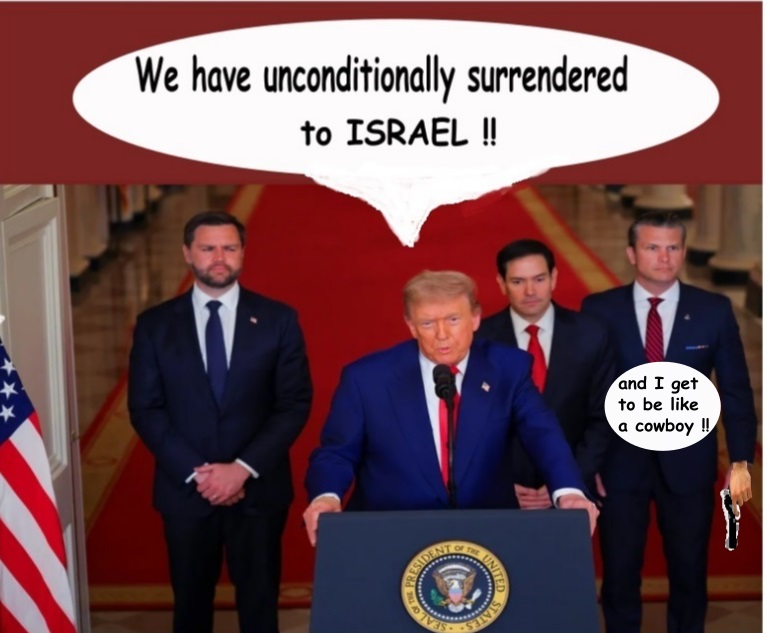
A deal was limiting Iran’s enrichment of uranium until Donald Trump pulled the U.S. out of it. Instead the Dealmaker bombed Iran, threatening to set the region on fire, writes Joe Lauria. With a ceasefire what does he do now?
By Joe Lauria, Consortium News. June 24, 2025, https://consortiumnews.com/2025/06/24/why-limit-iranian-enrichment-peacefully-when-you-can-bomb-them-instead/
In the last great achievement of international diplomacy, the United States and its allies Britain, France and Germany, concluded a deal in 2015 with Russia, China and Iran — something that today would be unthinkable — to limit Iran’s nuclear enrichment to purely civilian uses at 3.67 percent.
Negotiations on the deal began in November 2013, just three months before the U.S.-backed unconstitutional change of government in Kiev that started the long slide in U.S.-Russian relations. That did not prevent the nuclear deal from being concluded in July 2015 and endorsed by the Security Council in October of that year.
Seven years later, Washington and its European allies began fighting a hot war against Moscow through its proxy Ukraine. Relations with China have also sharply deteriorated. The idea of such cooperation on Iran now is unthinkable.
But in 2013 such wise diplomacy was still possible and the result was a peaceful resolution of the Iranian enrichment issue.
Iran agreed to stringent monitoring by the International Atomic Energy Agency and in exchange, the United States, Europe and the United Nations lifted economic sanctions against Tehran.
The IAEA certified that the deal was working. Iran was sticking to 3.67 percent enrichment. Diplomacy worked. Iran’s nuclear program was in check.
But the Israelis had opposed it all along because Israel’s aim has long been to overthrow the government in Iran in Israel’s quest for regional dominance.
Netanyahu could not stop Barack Obama from working with the Chinese and the Russians to conclude the deal that solved the nuclear issue and left the Iranian government in a more secure position.
Then Donald Trump became president. He did what Netanyahu wanted. He pulled the U.S. out of the deal, saying it was a lousy agreement and he could do better. But there was no new deal. Iran continued to cooperate with the existing agreement for a year before increasing enrichment, eventually to 60 percent for leverage in the negotiation. (90 percent is needed for a bomb, but U.S. intelligence and the IAEA said in recents months that Iran is not pursuing a bomb).
Obama’s vice president, Joe Biden, did nothing to return the U.S. to the deal to save it when he got into the White House, dishonoring probably Obama’s greatest achievement.
Trump 2.0’s idea of a better deal to limit Tehran’s enrichment was to demand zero percent after Iran agreed to return to 3.67 percent. Trump would look like a fool if he accepted 3.67 percent, as that would mean agreeing to the very deal that was working well before he tore it up.
So it was bombs away instead.
Clearing Smoke Reveals Trump’s Lies
More than 24 hours after the smoke cleared above Fordow, Natanz and Isfahan nuclear facilities Trump’s lies during his address Saturday night came clearly into view.
The strikes were not “a spectacular military success.” Iran’s “key nuclear enrichment facilities” were not “completely and totally obliterated.” There is no evidence that a single centrifuge was damaged and Iran’s 60 percent enriched fuel had already been removed and is in a location unknown to Israel, the U.S. and the IAEA.
Trump called Iran the “bully of the Middle East” when any neutral person knows that bully is Israel backed by the U.S., the bully of the world.
In just the past few months, with U.S. backing, Israel has invaded Lebanon and Syria, launched an unprovoked attack on Iran and is committing genocide in Gaza. The last time Iran invaded anyone was Iraq in 1982 but only after Iraq had invaded it first in 1980.
Israel gets away with this by portraying itself as the perpetual victim of an imminent new Holocaust 80 years after the fact and thus needs to invade and bomb its neighbors in “self defense” to pre-empt this from happening.
Regional hostility toward Israel does not stem from a reaction to its decades of aggression against Palestinians and its neighbors but purely from anti-semitic hatred. These countries must constantly be attacked to wipe out this hatred, not to reconstitute an ancient Hebrew empire from (beyond) the River to the Sea.
One power that empire never conquered was Persia
With their overlapping empires — Israel’s regional and the U.S.’s global — Iran, the land of Darius and Cyrus, is the prime target. The U.S. has sought to control it since at least its 1953 coup restored the shah to power for its oil and because of its Cold War rivalry with Russia.
Trump mimicked Israel, calling Iran “the world’s number one state sponsor of terror,” when an objective analysis would correctly award that title to the Gulf Sunni monarchies, principally Saudi Arabia, all allied with the United States.
They have sponsored al-Qaeda and ISIS and all their offshoots and rebrandings, while Iran has mostly supported militia resisting occupations in Lebanon, Iraq, Syria and Gaza.
Though formed in 1982 in response to Israel’s invasion and occupation of Lebanon, Hezbollah was only designated a terrorist organization by the European Union in 2013, for instance. Though founded in 1987, the EU did not view Hamas as a terrorist group until 2001.
Then Trump said of Iran:
“They have been killing our people, blowing off their arms, blowing off their legs with roadside bombs. That was their specialty. We lost over 1,000 people, and hundreds of thousands throughout the Middle East and around the world have died as a direct result of their hate.”
This is a bizarre statement that can only be related to attacks by militia against U.S. occupation forces in Iraq after the U.S. 2003 invasion. But only some of these groups were Iranian-backed and they killed not a thousand, but 169 U.S. soldiers, whom Trump referred to as “our people,” as if they were tourists and not an occupying army.
Trump’s thousand U.S. victims appears to come from propaganda put out by the Jerusalem Center for Public Affairs, which calls itself “a leading independent research institute, serving as Israel’s global embassy for national security and applied diplomacy.”
It combats what it calls “apartheid antisemitism.” It falsely called the 2015 nuclear agreement that Trump withdrew from “a deal that would allow Iran to become a nuclear-armed state.” In 2015, Haaretz named Sheldon Adelson, Trump’s principal donor, “one of the main financers of JCFA in recent years.”
Israel had to cut short its ambitions to conquer Iran (at least overtly) and agree to a ceasefire because it was running out of interceptor missiles; it’s economy, already weakened by Gaza, was threatened at $200 million a day; and it sustained far more damage than it will admit.
Now that there is a ceasefire, Trump is back to square one. The New York Times reported:
“Rafael Mariano Grossi, the director of the U.N.’s nuclear watchdog, welcomed news of a cease-fire. In a social-media post, he said he has invited Iran’s foreign minister Abbas Araghchi to meet to discuss a diplomatic solution on Iran’s nuclear program.”
That solution would be a return to 3.67 percent enrichment and Iran giving up its 60 percent stockpile, in other words, returning exactly to the deal Trump tore up to plunge the region into extreme danger with his bombing stunt.
Where will he turn now?
Joe Lauria is editor-in-chief of Consortium News and a former U.N. correspondent for The Wall Street Journal, Boston Globe, and other newspapers, including The Montreal Gazette, the London Daily Mail and The Star of Johannesburg. He was an investigative reporter for the Sunday Times of London, a financial reporter for Bloomberg News and began his professional work as a 19-year old stringer for The New York Times. He is the author of two books, A Political Odyssey, with Sen. Mike Gravel, foreword by Daniel Ellsberg; and How I Lost By Hillary Clinton, foreword by Julian Assange.
Trump rejects leaked intelligence that says strikes did not destroy Iran nuclear programme.
Donald Trump insists nuclear sites in Iran were
“completely destroyed” by US military strikes, despite an intelligence
report casting doubt on their success The leaked damage assessment from the
Pentagon’s Defense Intelligence Agency estimates the attack only set Iran’s
nuclear programme back “a few months”
BBC 25th June 2025,
https://www.bbc.co.uk/news/live/c20xel1e97gt
How the US and Israel Used Rafael Grossi to Hijack the IAEA and Start a War on Iran
Rafael Grossi, director General of the International Atomic Energy Agency (IAEA), allowed the IAEA to be used by the United States and Israel—an undeclared nuclear weapons state in long-term violation of IAEA rules—to manufacture a pretext for war on Iran, despite his agency’s own conclusion that Iran had no nuclear weapons program.
Israel began working on a nuclear weapon in the 1950s, with substantial help from Western countries, including France, Britain and Argentina, and made its first weapons in 1966 or 1967. By 2015, when Iran signed the JCPOA nuclear agreement, former Secretary of State Colin Powell wrote in a leaked email that a nuclear weapon would be useless to Iran because “Israel has 200, all targeted on Tehran.”
The agency’s chief has not only continued its subservience to U.S. and Western interests, but also its practice of turning a blind eye to Israel’s nuclear weapons.
Medea BenjaminNicolas J.S. Davies, Jun 23, 2025, https://www.commondreams.org/opinion/how-the-us-and-israel-used-rafael-grossi-to-hijack-the-iaea-and-start-a-war-on-iran
Rafael Grossi, director General of the International Atomic Energy Agency (IAEA), allowed the IAEA to be used by the United States and Israel—an undeclared nuclear weapons state in long-term violation of IAEA rules—to manufacture a pretext for war on Iran, despite his agency’s own conclusion that Iran had no nuclear weapons program.
On June 12th, based on a damning report by Grossi, a slim majority of the IAEA Board of Governors voted to find Iran in non-compliance with its obligations as an IAEA member. Of the 35 countries represented on the Board, only 19 voted for the resolution, while 3 voted against it, 11 abstained and 2 did not vote.
Rafael Grossi, director General of the International Atomic Energy Agency (IAEA), allowed the IAEA to be used by the United States and Israel—an undeclared nuclear weapons state in long-term violation of IAEA rules—to manufacture a pretext for war on Iran, despite his agency’s own conclusion that Iran had no nuclear weapons program.
On June 12th, based on a damning report by Grossi, a slim majority of the IAEA Board of Governors voted to find Iran in non-compliance with its obligations as an IAEA member. Of the 35 countries represented on the Board, only 19 voted for the resolution, while 3 voted against it, 11 abstained and 2 did not vote.
Without you, Common Dreams simply wouldn’t exist.
In a moment that demands fearless reporting, Common Dreams needs your support to keep our independent journalism alive.
about:blank
The United States contacted eight board member governments on June 10th to persuade them to either vote for the resolution or not to vote. Israeli officials said they saw the U.S. arm-twisting for the IAEA resolution as a significant signal of U.S. support for Israel’s war plans, revealing how much Israel valued the IAEA resolution as diplomatic cover for the war.
The IAEA board meeting was timed for the final day of President Trump’s 60-day ultimatum to Iran to negotiate a new nuclear agreement. Even as the IAEA board voted, Israel was loading weapons, fuel and drop-tanks on its warplanes for the long flight to Iran and briefing its aircrews on their targets. The first Israeli air strikes hit Iran at 3 a.m. that night.
On June 20th, Iran filed a formal complaint against Director General Grossi with the UN Secretary General and the UN Security Council for undermining his agency’s impartiality, both by his failure to mention the illegality of Israel’s threats and uses of force against Iran in his public statements and by his singular focus on Iran’s alleged violations.
The source of the IAEA investigation that led to this resolution was a 2018 Israeli intelligence report that its agents had identified three previously undisclosed sites in Iran where Iran had conducted uranium enrichment prior to 2003. In 2019, Grossi opened an investigation, and the IAEA eventually gained access to the sites and detected traces of enriched uranium..
Despite the fateful consequences of his actions, Grossi has never explained publicly how the IAEA can be sure that Israel’s Mossad intelligence agency or its Iranian collaborators, such as the Mojahedin-e-Khalq (or MEK), did not put the enriched uranium in those sites themselves, as Iranian officials have suggested.
While the IAEA resolution that triggered this war dealt only with Iran’s enrichment activities prior to 2003, U.S. and Israeli politicians quickly pivoted to unsubstantiated claims that Iran was on the verge of making a nuclear weapon. U.S. intelligence agencies had previously reported that such a complex process would take up to three years, even before Israel and the United States began bombing and degrading Iran’s existing civilian nuclear facilities.
The IAEA’s previous investigations into unreported nuclear activities in Iran were officially completed in December 2015, when IAEA Director General Yukiya Amano published its “Final Assessment on Past and Present Outstanding Issues regarding Iran’s Nuclear Program.”
The IAEA assessed that, while some of Iran’s past activities might have been relevant to nuclear weapons, they “did not advance beyond feasibility and scientific studies, and the acquisition of certain relevant technical competences and capabilities.” The IAEA “found no credible indications of the diversion of nuclear material in connection with the possible military dimensions to Iran’s nuclear program.”
When Yukiya Amano died before the end of his term in 2019, Argentinian diplomat Rafael Grossi was appointed IAEA Director General. Grossi had served as Deputy Director General under Amano and, before that, as Chief of Staff under Director General Mohamed ElBaradei.
The Israelis have a long record of fabricating false evidence about Iran’s nuclear activities, like the notorious “laptop documents” given to the CIA by the MEK in 2004 and believed to have been created by the Mossad. Douglas Frantz, who wrote a report on Iran’s nuclear program for the Senate Foreign Relations Committee in 2009, revealed that the Mossad created a special unit in 2003 to provide secret briefings on Iran’s nuclear program, using “documents from inside Iran and elsewhere.”
And yet Grossi collaborated with Israel to pursue its latest allegations. After several years of meetings in Israel and negotiations and inspections in Iran, he wrote his report to the IAEA Board of Governors and scheduled a board meeting to coincide with the planned start date for Israel’s war.
Israel made its final war preparations in full view of the satellites and intelligence agencies of the western countries that drafted and voted for the resolution. It is no wonder that 13 countries abstained or did not vote, but it is tragic that more neutral countries could not find the wisdom and courage to vote against this insidious resolution.
The official purpose of the International Atomic Energy Agency, or IAEA, is “to promote the safe, secure and peaceful use of nuclear technologies.” Since 1965, all of its 180 member countries have been subject to IAEA safeguards to ensure that their nuclear programs are “not used in such a way as to further any military purpose.”
The IAEA’s work is obviously compromised in dealing with countries that already have nuclear weapons. North Korea withdrew from the IAEA in 1994, and from all safeguards in 2009. The United States, Russia, the United Kingdom, France and China have IAEA safeguard agreements that are based only on “voluntary offers” for “selected” non-military sites. India has a 2009 safeguard agreement that requires it to keep its military and civilian nuclear programs separate, and Pakistan has 10 separate safeguard agreements, but only for civilian nuclear projects, the latest being from 2017 to cover two Chinese-built power stations.
Israel, however, has only a limited 1975 safeguards agreement for a 1955 civilian nuclear cooperation agreement with the United States. An addendum in 1977 extended the IAEA safeguards agreement indefinitely, even though the cooperation agreement with the U.S. that it covered expired four days later. So, by a parody of compliance that the United States and the IAEA have played along with for half a century, Israel has escaped the scrutiny of IAEA safeguards just as effectively as North Korea.
Israel began working on a nuclear weapon in the 1950s, with substantial help from Western countries, including France, Britain and Argentina, and made its first weapons in 1966 or 1967. By 2015, when Iran signed the JCPOA nuclear agreement, former Secretary of State Colin Powell wrote in a leaked email that a nuclear weapon would be useless to Iran because “Israel has 200, all targeted on Tehran.” Powell quoted former Iranian President Mahmoud Ahmadinejad asking, “What would we do with a nuclear weapon? Polish it?”
In 2003, while Powell tried but failed to make a case for war on Iraq to the UN Security Council, President Bush smeared Iran, Iraq and North Korea as an “axis of evil,” based on their alleged pursuit of “weapons of mass destruction.” The Egyptian IAEA Director, Mohamed ElBaradei, repeatedly assured the Security Council that the IAEA could find no evidence that Iraq was developing a nuclear weapon.
When the CIA produced a document that showed Iraq importing yellowcake uranium from Niger, just as Israel had secretly imported it from Argentina in the 1960s, the IAEA only took a few hours to recognize the document as a forgery, which ElBaradei immediately reported to the Security Council.
Rafael Grossi, director General of the International Atomic Energy Agency (IAEA), allowed the IAEA to be used by the United States and Israel—an undeclared nuclear weapons state in long-term violation of IAEA rules—to manufacture a pretext for war on Iran, despite his agency’s own conclusion that Iran had no nuclear weapons program.
On June 12th, based on a damning report by Grossi, a slim majority of the IAEA Board of Governors voted to find Iran in non-compliance with its obligations as an IAEA member. Of the 35 countries represented on the Board, only 19 voted for the resolution, while 3 voted against it, 11 abstained and 2 did not vote.
Without you, Common Dreams simply wouldn’t exist.
In a moment that demands fearless reporting, Common Dreams needs your support to keep our independent journalism alive.
about:blank
The United States contacted eight board member governments on June 10th to persuade them to either vote for the resolution or not to vote. Israeli officials said they saw the U.S. arm-twisting for the IAEA resolution as a significant signal of U.S. support for Israel’s war plans, revealing how much Israel valued the IAEA resolution as diplomatic cover for the war.
The IAEA board meeting was timed for the final day of President Trump’s 60-day ultimatum to Iran to negotiate a new nuclear agreement. Even as the IAEA board voted, Israel was loading weapons, fuel and drop-tanks on its warplanes for the long flight to Iran and briefing its aircrews on their targets. The first Israeli air strikes hit Iran at 3 a.m. that night.
On June 20th, Iran filed a formal complaint against Director General Grossi with the UN Secretary General and the UN Security Council for undermining his agency’s impartiality, both by his failure to mention the illegality of Israel’s threats and uses of force against Iran in his public statements and by his singular focus on Iran’s alleged violations.
The source of the IAEA investigation that led to this resolution was a 2018 Israeli intelligence report that its agents had identified three previously undisclosed sites in Iran where Iran had conducted uranium enrichment prior to 2003. In 2019, Grossi opened an investigation, and the IAEA eventually gained access to the sites and detected traces of enriched uranium.
Despite the fateful consequences of his actions, Grossi has never explained publicly how the IAEA can be sure that Israel’s Mossad intelligence agency or its Iranian collaborators, such as the Mojahedin-e-Khalq (or MEK), did not put the enriched uranium in those sites themselves, as Iranian officials have suggested.
While the IAEA resolution that triggered this war dealt only with Iran’s enrichment activities prior to 2003, U.S. and Israeli politicians quickly pivoted to unsubstantiated claims that Iran was on the verge of making a nuclear weapon. U.S. intelligence agencies had previously reported that such a complex process would take up to three years, even before Israel and the United States began bombing and degrading Iran’s existing civilian nuclear facilities.
The IAEA’s previous investigations into unreported nuclear activities in Iran were officially completed in December 2015, when IAEA Director General Yukiya Amano published its “Final Assessment on Past and Present Outstanding Issues regarding Iran’s Nuclear Program.”
The IAEA assessed that, while some of Iran’s past activities might have been relevant to nuclear weapons, they “did not advance beyond feasibility and scientific studies, and the acquisition of certain relevant technical competences and capabilities.” The IAEA “found no credible indications of the diversion of nuclear material in connection with the possible military dimensions to Iran’s nuclear program.”
When Yukiya Amano died before the end of his term in 2019, Argentinian diplomat Rafael Grossi was appointed IAEA Director General. Grossi had served as Deputy Director General under Amano and, before that, as Chief of Staff under Director General Mohamed ElBaradei.
The Israelis have a long record of fabricating false evidence about Iran’s nuclear activities, like the notorious “laptop documents” given to the CIA by the MEK in 2004 and believed to have been created by the Mossad. Douglas Frantz, who wrote a report on Iran’s nuclear program for the Senate Foreign Relations Committee in 2009, revealed that the Mossad created a special unit in 2003 to provide secret briefings on Iran’s nuclear program, using “documents from inside Iran and elsewhere.”
And yet Grossi collaborated with Israel to pursue its latest allegations. After several years of meetings in Israel and negotiations and inspections in Iran, he wrote his report to the IAEA Board of Governors and scheduled a board meeting to coincide with the planned start date for Israel’s war.
Israel made its final war preparations in full view of the satellites and intelligence agencies of the western countries that drafted and voted for the resolution. It is no wonder that 13 countries abstained or did not vote, but it is tragic that more neutral countries could not find the wisdom and courage to vote against this insidious resolution.
The official purpose of the International Atomic Energy Agency, or IAEA, is “to promote the safe, secure and peaceful use of nuclear technologies.” Since 1965, all of its 180 member countries have been subject to IAEA safeguards to ensure that their nuclear programs are “not used in such a way as to further any military purpose.”
The IAEA’s work is obviously compromised in dealing with countries that already have nuclear weapons. North Korea withdrew from the IAEA in 1994, and from all safeguards in 2009. The United States, Russia, the United Kingdom, France and China have IAEA safeguard agreements that are based only on “voluntary offers” for “selected” non-military sites. India has a 2009 safeguard agreement that requires it to keep its military and civilian nuclear programs separate, and Pakistan has 10 separate safeguard agreements, but only for civilian nuclear projects, the latest being from 2017 to cover two Chinese-built power stations.
Israel, however, has only a limited 1975 safeguards agreement for a 1955 civilian nuclear cooperation agreement with the United States. An addendum in 1977 extended the IAEA safeguards agreement indefinitely, even though the cooperation agreement with the U.S. that it covered expired four days later. So, by a parody of compliance that the United States and the IAEA have played along with for half a century, Israel has escaped the scrutiny of IAEA safeguards just as effectively as North Korea.
Israel began working on a nuclear weapon in the 1950s, with substantial help from Western countries, including France, Britain and Argentina, and made its first weapons in 1966 or 1967. By 2015, when Iran signed the JCPOA nuclear agreement, former Secretary of State Colin Powell wrote in a leaked email that a nuclear weapon would be useless to Iran because “Israel has 200, all targeted on Tehran.” Powell quoted former Iranian President Mahmoud Ahmadinejad asking, “What would we do with a nuclear weapon? Polish it?”
In 2003, while Powell tried but failed to make a case for war on Iraq to the UN Security Council, President Bush smeared Iran, Iraq and North Korea as an “axis of evil,” based on their alleged pursuit of “weapons of mass destruction.” The Egyptian IAEA Director, Mohamed ElBaradei, repeatedly assured the Security Council that the IAEA could find no evidence that Iraq was developing a nuclear weapon.
When the CIA produced a document that showed Iraq importing yellowcake uranium from Niger, just as Israel had secretly imported it from Argentina in the 1960s, the IAEA only took a few hours to recognize the document as a forgery, which ElBaradei immediately reported to the Security Council.
Bush kept repeating the lie about yellowcake from Niger, and other flagrant lies about Iraq, and the United States invaded and destroyed Iraq based on his lies, a war crime of historic proportions. Most of the world knew that ElBaradei and the IAEA were right all along, and, in 2005, they were awarded the Nobel Peace Prize, for exposing Bush’s lies, speaking truth to power and strengthening nuclear non-proliferation.
In 2007, a U.S. National Intelligence Estimate (NIE) by all 16 U.S. intelligence agencies agreed with the IAEA’s finding that Iran, like Iraq, had no nuclear weapons program. As Bush wrote in his memoirs, “…after the NIE, how could I possibly explain using the military to destroy the nuclear facilities of a country the intelligence community said had no active nuclear weapons program?” Even Bush couldn’t believe he would get away with recycling the same lies to destroy Iran as well as Iraq, and Trump is playing with fire by doing so now.
ElBaradei wrote in his own memoir, The Age of Deception: Nuclear Diplomacy in Treacherous Times, that if Iran did do some preliminary research on nuclear weapons, it probably began during the Iran-Iraq War in the 1980s, after the US and its allies helped Iraq to manufacture chemical weapons that killed up to 100,000 Iranians.
The neocons who dominate U.S. post-Cold War foreign policy viewed the Nobel Prize winner ElBaradei as an obstacle to their regime change ambitions around the world, and conducted a covert campaign to find a more compliant new IAEA Director General when his term expired in 2009.
After Japanese diplomat Yukiya Amano was appointed as the new Director General, U.S. diplomatic cables published by Wikileaks revealed details of his extensive vetting by U.S. diplomats, who reported back to Washington that Amano “was solidly in the U.S. court on every key strategic decision, from high-level personnel appointments to the handling of Iran’s alleged nuclear weapons program.”
After becoming IAEA Director General in 2019, Rafael Grossi not only continued the IAEA’s subservience to U.S. and Western interests and its practice of turning a blind eye to Israel’s nuclear weapons, but also ensured that the IAEA played a critical role in Israel’s march to war on Iran.
Even as he publicly acknowledged that Iran had no nuclear weapons program and that diplomacy was the only way to resolve the West’s concerns about Iran, Grossi helped Israel to set the stage for war by reopening the IAEA’s investigation into Iran’s past activities. Then, on the very day that Israeli warplanes were being loaded with weapons to bomb Iran, he made sure that the IAEA Board of Governors passed a resolution to give Israel and the U.S. the pretext for war that they wanted.
In his last year as IAEA Director, Mohamed ElBaradei faced a similar dilemma to the one that Grossi has faced since 2019. In 2008, U.S. and Israeli intelligence agencies gave the IAEA copies of documents that appeared to show Iran conducting four distinct types of nuclear weapons research.
Whereas, in 2003, Bush’s yellowcake document from Niger was clearly a forgery, the IAEA could not establish whether the Israeli documents were authentic or not. So ElBaradei refused to act on them or to make them public, despite considerable political pressure, because, as he wrote in The Age of Deception, he knew the U.S. and Israel “wanted to create the impression that Iran presented an imminent threat, perhaps preparing the grounds for the use of force.” ElBaradei retired in 2009, and those allegations were among the “outstanding issues” that he left to be resolved by Yukiya Amano in 2015.
If Rafael Grossi had exercised the same caution, impartiality and wisdom as Mohamed ElBaradei did in 2009, it is very possible that the United States and Israel would not be at war with Iran today.
Mohamed ElBaradei wrote in a tweet on June 17th 2025, “To rely on force and not negotiations is a sure way to destroy the NPT and the nuclear non-proliferation regime (imperfect as it is), and sends a clear message to many countries “that their ‘ultimate security’ is to develop nuclear weapons!!!”
Despite Grossi’s role in U.S.-Israeli war plans as IAEA Director General, or maybe because of it, he has been touted as a Western-backed candidate to succeed Antonio Guterres as UN Secretary General in 2026. That would be a disaster for the world. Fortunately, there are many more qualified candidates to lead the world out of the crisis that Rafael Grossi has helped the U.S. and Israel to plunge it into.
Rafael Grossi should resign as IAEA Director before he further undermines nuclear non-proliferation and drags the world any closer to nuclear war. And he should also withdraw his name from consideration as a candidate for UN Secretary General.
Holtec: Criminality, Corruption, Incompetence, and Inexperience.

Below, brief introduction to the 2-page explanation at https://beyondnuclear.org/wp-content/uploads/2024/03/2-29-24-Holtec-two-pager.pdf
On June 16, an environmental coalition, including Beyond Nuclear, submitted an intervention petition against Holtec’s BAND-AID fixes on Michigan’s Palisades atomic reactor’s severe steam generator tube degradation, a pathway to catastrophic core meltdown. The generators have needed to be replaced for two decades, but Holtec’s two-year neglect of basic safety maintenance — a rookie error, by a company that has never operated a reactor — has made it dangerously worse. On June 18, the U.S. Supreme Court ruled against our side, regarding highly radioactive waste dumps in Texas (ISP’s) and New Mexico (Holtec’s). But now, we can pursue our Holtec dump appeal in the D.C. Circuit. TX and NM state laws also stand in the way of the dumps.
After Iraq There’s No Excuse For Buying The War Lies About Iran
Caitlin Johnstone, Jun 17, 2025, https://www.caitlinjohnst.one/p/after-iraq-theres-no-excuse-for-buying?utm_source=post-email-title&publication_id=82124&post_id=166146740&utm_campaign=email-post-title&isFreemail=true&r=1ise1&triedRedirect=true&utm_medium=email
There is absolutely no excuse for buying into the war propaganda about Iran after what we all saw with Iraq.
“OMG nuclear weapons!” Shut up, idiot. If you’re a grown adult with internet access still swallowing this load of bull spunk in the year 2025 you’re either stupid or evil.
President Donald Trump is now saying he has no intention of seeking or facilitating a ceasefire with Iran, telling reporters that he’s after a “complete give-up” from Iran instead.
“I’m not too much in a mood to negotiate,” Trump said.
Asked by the press if he’s worried about US troops being targeted by Iran in the coming days, the president said “We’ll come down so hard if they do anything to our people. We’ll come down so hard. The gloves are off. I think they know not to touch our troops.”
This is a stupid, crazy lie. Iran has explicitly said it will strike US bases in the region if the US attacks Iranian territory. If you punch someone, you expect to be punched back.
If Trump orders US forces to bomb Iran, it will be because he wants to start a war and knowingly chose to do so.
One of the dumbest narratives we’re currently being fed about Iran is the claim that Israel is precision-striking high-level targets in Iran while Iran is just bombing civilians all over the place in Israel.
A casual glance at the death tolls shows this is clearly false. As of this writing the current official death count sits at 24 Israelis killed by Iran and 224 Iranians killed by Israel — most of whom are reportedly civilians. On Friday they bombed a residential building and killed 60 people, including 20 kids.
Israeli Defense Minister Israel Katz thumped his chest on Twitter about an IDF strike on an Iranian television station on Monday, saying “The Iranian regime’s propaganda and incitement broadcasting authority was attacked by the IDF after a widespread evacuation of residents in the area.”
I wonder how the western press who are currently deceiving the public to promote Israel’s information interests feel about this new rule that it’s okay to bomb media outlets if someone decides they’re propaganda?
People shouldn’t be so hard on Trump about all this. You’d probably start a war with Iran too if someone was threatening to leak your child molestation video.
The war on Iran isn’t really about nuclear weapons — if it was they would’ve kept the nuclear deal in place, which was working as intended. The Gaza holocaust isn’t really about Hamas or hostages — if it was they would’ve just targeted Hamas or negotiated a hostage deal.
It’s all lies. The war on Iran is about regional hegemony and the genocide in Gaza is about Israel’s longstanding desire to remove all Palestinians from a Palestinian territory. It’s not about self-defense, it’s about land and power, and it always has been.
This is one of the reasons antiwar people have been focusing so hard on Gaza, by the way. It wasn’t just because it’s a horrific genocide happening right in front of us, it was because it always risked blowing up into a regional war involving Israel’s western allies. We’ve been watching it expand into the West Bank, Lebanon, Yemen, Syria, and into Iran for a bit last year, and now it’s blown up into all-out war between Israel and Iran with the US poised to join in.
For 20 months I’ve been getting people asking me why I’ve been so laser-focused on Gaza while paying less attention to this or that conflict or foreign policy issue. This is why. It’s a waking nightmare in and of itself, but it’s also always been a powderkeg that could explode into something much, much worse.
We Are, Of Course, Being Lied To About Iran
The western political/media class have been dutifully promoting this line and uncritically parroting Israel’s claim that its unprovoked attack on Iran was “preemptive”, but there is absolutely no evidence that any of this is true.
Caitlin Johnstone, Jun 15, 2025, https://www.caitlinjohnst.one/p/we-are-of-course-being-lied-to-about?utm_source=post-email-title&publication_id=82124&post_id=165951075&utm_campaign=email-post-title&isFreemail=true&r=1ise1&triedRedirect=true&utm_medium=email
Iran and Israel are at war, with the US already intimately involved and likely to become more so. Which of course means we’ll be spending the foreseeable future getting bashed in the face with lies from the most powerful people in the world.
The most immediately obvious of these is the Netanyahu-promoted narrative that Israel initiated this conflict because Iran was on the brink of developing a nuclear weapon. With absolutely no self-consciousness or sense of irony, the Israeli prime minister followed the attacks with a statement accusing Iran of “genocidal rhetoric” which it has backed up “with a program to develop nuclear weapons.” Israel, as we all know, has an unacknowledged nuclear arsenal, and its leaders are presently committing genocide in Gaza while spouting genocidal rhetoric.
“And if not stopped, Iran could produce a nuclear weapon in a very short time,” Netanyahu claimed. “It could be a year. It could be within a few months — less than a year. This is a clear and present danger to Israel’s very survival.”
The western political/media class have been dutifully promoting this line and uncritically parroting Israel’s claim that its unprovoked attack on Iran was “preemptive”, but there is absolutely no evidence that any of this is true.
Benjamin Netanyahu has spent literally decades falsely claiming that Iran was a year or two away from developing a nuke, only to have the calendar prove him wrong with the passage of time over and over again.
US intelligence chief Tulsi Gabbard testified just weeks ago that “The IC [Intelligence Community] continues to assess that Iran is not building a nuclear weapon and Supreme Leader Khamenei has not authorized the nuclear weapons program he suspended in 2003.”
As journalist Séamus Malekafzali recently noted on Twitter, one of the strongest arguments that Iran had not reversed its decision to refrain from obtaining nuclear weapons is that Iranian nuclear scientists have been publicly expressing frustration about the fact that their government won’t allow them to construct a nuke. They want to do it, but Tehran won’t let them.
US Secretary of Defense Pete Hegseth helped pave the way for Netanyahu’s claims this past Wednesday when he told the Senate that “there have been plenty of indications” Iran has been “moving their way toward something that would look a lot like a nuclear weapon.”
This claim by Hegseth was swiftly scooped up and promoted by warmongers like Tom Cotton who said that Hegseth had “confirmed that Iran’s terrorist regime is actively working towards a nuclear weapon.”
Cotton’s claim was then picked up by war pundit Mark Levin, who has been personally lobbying Trump to green light an attack on Iran, sarcastically quipping on Twitter, “So, SecDef Hegseth must by lying, too. Everyone’s lying except the isolationists, Koch-heads, Islamists, Chatsworth Qatarlson and their media propagandists.”
But let’s back up and look at what Hegseth actually said. He did not say “Iran is building a nuclear weapon.” He said “there have been plenty of indications” Iran has been “moving their way toward something that would look a lot like a nuclear weapon.”
If the US had intelligence that Iran was building a nuke, Hegseth would have just said so. But instead he performed this freakish verbal gymnastics stunt muttering about indications of something that might kinda sorta look like a nuclear weapon, which his fellow Iran hawks then falsely took and ran with as a positive assertion that Iran was building a nuke.
There are other lies being circulated to help market this war as well. As Moon of Alabama notes, the Washington Post’s odious war propagandist David Ignatius is pushing the narrative that Iran has been cultivating a relationship with de-facto al-Qaeda leader Saif al-Adel. The lie that Saddam Hussein was in league with al-Qaeda was used two decades ago to sell the invasion of Iraq.
At the same time, Trumpian pundits are currently circulating the narrative that the United States is full of Iranian “sleeper cells” who could activate at any moment and begin attacking Americans. The most egregious of these is Laura Loomer’s repeated claims that there are “millions” of such cells awaiting Iran’s orders to strike — possibly the single most bat shit insane claim I have ever seen anyone with any major platform make, since it would mean a very sizable percentage of the US population is actually a secret Iranian proxy army.
The fountain of lies is just getting started. There will be more. Believe nothing unless it is substantiated by mountains of evidence. These freaks have been caught lying to sell wars to the public far too many times for any of their claims to be taken on faith.
Iran says it will release Israeli nuclear secrets as pressure grows to reimpose sanctions
Tehran threat comes as European powers press for vote that could lead to reimposition of UN sanctions
Guardian Patrick Wintour, 9 June 25
Iran has said it will soon start releasing information from a hoard of Israeli nuclear secrets it claims to have obtained, as European countries push for a vote this week on reimposing UN sanctions on Tehran over its nuclear programme.
The unverified claims by Iranian intelligence of a massive leak of Israeli secrets may be designed to turn the focus away from what Iran argues is its own excessively monitored civil nuclear programme.
On Sunday, Iran’s intelligence minister, Esmail Khatib, claimed Tehran had obtained “a vast collection of strategic and sensitive [Israeli] documents, including plans and data on the nuclear facilities”. He added evidence would be released shortly, and implied some of the documentation was linked to Israel’s arrest of two Israeli nationals, Roi Mizrahi and Almog Attias, over alleged spying for Iran………………………………………………………………………………………………………………………………………………… https://www.theguardian.com/world/2025/jun/09/iran-says-it-will-release-israeli-nuclear-secrets-as-pressure-grows-to-reimpose-sanctions
Defence review dodges Britain’s nuclear blind spot.

THE UK’s nuclear enterprise is in crisis. Not just because of cost
overruns or ageing submarines, but because of the deepening secrecy and
silence that surrounds it. That silence should have been broken by the
Labour Government’s new Strategic Defence Review 2025.
Instead, it was quietly reinforced. Presented as a roadmap to “Make Britain Safer”, the
review promised clarity and accountability, but it fails to confront the
most pressing truths: that the UK’s nuclear programme is financially
unsustainable, strategically unbalanced, increasingly unaccountable and a
real and present danger to us all.
These concerns are not hypothetical. In
the final months of the last Parliament, I raised them on the floor of the
House of Commons, not out of party dogma, but in response to serious and
public allegations from Dominic Cummings, former chief adviser to the then
prime minister, remember him? He described Britain’s nuclear
infrastructure as a “dangerous disaster”, responsible for the secret
“cannibalisation” of other national security budgets and shielded from
meaningful scrutiny. Instead of confronting the truth, the review restates
familiar platitudes and leaves the public and Parliament no wiser about the
scale cost, or consequences of the UK’s nuclear commitment. The Defence
Secretary, who heard these warnings first-hand from the opposition bench,
is now in a position to act – he has chosen not to.
The National 8th June 2025,
https://www.thenational.scot/politics/25222635.defence-review-dodges-britains-nuclear-blind-spot/
Epstein, Israel, ISIS, Palantir
Caitlin Johnstone, Jun 06, 2025, https://www.caitlinjohnst.one/p/epstein-israel-isis-palantir?utm_source=post-email-title&publication_id=82124&post_id=165336332&utm_campaign=email-post-title&isFreemail=true&r=1ise1&triedRedirect=true&utm_medium=email
Amid the inevitable giant ego clash between Elon Musk and Donald Trump, Musk tweeted that the president “is in the Epstein files,” saying “That is the real reason they have not been made public.”
As we have discussed previously, it is a known fact that Trump is on the Epstein flight logs and has been obstructing the release of the Epstein files. It is also a known fact that Jeffrey Epstein worked with Israeli intelligence and was running a sexual blackmail operation, and that Trump has been bending over backwards to give Israel everything it wants while stomping out American free speech that is critical of Israel’s actions in Gaza.
“I’ve known Jeff [Epstein] for fifteen years. Terrific guy,” Trump said in 2002. “He’s a lot of fun to be with. It is even said that he likes beautiful women as much as I do, and many of them are on the younger side.”
There’s no reason to take seriously anything Elon Musk says during a textbook case of narcissistic collapse, but for the record if anyone in Washington is likely to have been blackmailed by Epstein it’s Donald John Trump.
Israel has admitted to arming ISIS-linked gangs as proxy forces in Gaza, throwing some cold water on the fuzzbrained narrative that the west is backing Israel to help defeat Islamic extremism. Israel is backing these forces in order to sow chaos and strife with the goal of advancing its ethnic cleansing objectives in the Palestinian territory.
❖
Lately whenever I talk about Israel’s ethnic cleansing agenda I get Israel supporters telling me “They’re not doing ethnic cleansing! They’re just making the Palestinians leave Gaza because they don’t want them there!” Which is yet another reminder of how stupid Israel apologists are, because the forced mass expulsion of an undesired ethnic group is precisely the definition of ethnic cleansing.
I have this conversation every single day:
Me: Here’s evidence of Israel doing something evil.
Israel supporter: All Hamas has to do is surrender and release the hostages and this ends immediately.
Me: No that’s false, Israel is openly saying the slaughter will continue until all Palestinians have been ethnically cleansed from Gaza regardless of whether Hamas surrenders or the hostages are released. Here’s a pile of evidence showing that this is the case.
Israel supporter: Yeah well that’s what happens when you start a war you can’t win. Next time don’t do terrorism.
Me: You were just claiming Hamas can end this at any time by making different decisions. Now that you know Hamas is powerless to stop Israel’s ethnic cleansing atrocities you have pivoted to saying all Palestinians deserve mass murder and ethnic cleansing. Sounds like you’ll just support Israel no matter what it does regardless of facts or morality.
Israel supporter: ANTISEMITE ANTISEMITE ANTISEMITE ANTISEMITE
❖
I keep meaning to talk about how the Trump administration is reportedly granting oligarch Peter Thiel’s odious company Palantir a central role in a massive authoritarian expansion in government surveillance powers which would see American data compiled and tracked across multiple government agencies.
For those who don’t know, Palantir is a CIA-backed surveillance and data mining tech company with longstanding ties to both the US intelligence cartel and to Israel, and has already been playing a crucial role in both the US empire’s sprawling surveillance network and Israeli atrocities against Palestinians.
This is being framed by the political/media class as a Trump policy, but it’s obviously a US empire policy. These sweeping surveillance powers are intended to remain in place long after Trump is gone, regardless of who happens to be in office.
We are being asked to believe that individuals becoming violently radicalized by the ongoing genocide in Gaza is of greater concern than the ongoing genocide in Gaza.
No. That isn’t going to happen.
Perhaps the best way to stop people from committing acts of violence in response to the genocide in Gaza would be to cease actively fucking facilitating the fucking genocide in Gaza.
Palestine supporters: Here’s a video that just came out showing Israel massacring Palestinian civilians again.
Israel supporters: Okay, so, two thousand years ago…
❖
The world waking up to Israel’s depravity reminds me of the moment I first saw how nasty and abusive my ex was. That first glimpse when I finally let myself see the sadism and ill will he had for me was the beginning of the end.
Maybe the world is beginning its own moment of clarity.
Watchdog probes Springbank baron over nuclear firm meeting
Herald Scotland, 29th May, Andrew Bowie, House of Lords,Politics
The House of Lords watchdog has launched an investigation into a Scottish Conservative peer over his role in arranging a meeting between a government minister and a Canadian nuclear technology firm he advises.
The probe into Ian Duncan by the House of Lords Commissioners for Standards’ Office, a former Scotland Office minister, follows a report published last month by the Guardian.
The paper stated that Lord Duncan of Springbank helped Terrestrial Energy secure a meeting in 2023 with Andrew Bowie, then the UK nuclear minister.
Lord Duncan, who has also served as a junior climate minister, has been an adviser to Terrestrial Energy since 2020.
The company is developing a new type of nuclear reactor it claims can be built more quickly and cheaply than traditional power stations.
Although Lord Duncan has not received a salary for the role, he has been granted share options—allowing him to buy company shares at a preferential rate if the business becomes profitable.
Documents released under freedom of information legislation show that, in 2023, Lord Duncan forwarded a letter from Terrestrial Energy’s chief executive, Simon Irish, to Mr Bowie.
In the letter, Mr Irish requested a meeting with the minister to introduce himself and brief him on the firm’s products. He noted that, alongside a partner, the company had “applied for a grant from [the] UK’s nuclear fuel fund programme”………………………………..
The House of Lords Commissioners for Standards’ website confirms that Lord Duncan is under investigation for a “potential breach” of paragraph 9(d) of the 12th edition of the House of Lords Code of Conduct, which states that “Members must not seek to profit from membership of the House by accepting or agreeing to accept payment or other incentive or reward in return for providing parliamentary advice or services.”………………………https://www.heraldscotland.com/politics/westminster/25198535.watchdog-probes-springbank-baron-nuclear-firm-meeting/
France spent €90,000 countering research into impact of Pacific nuclear tests
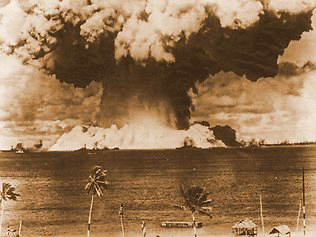
Radiation-related thyroid, breast and lung cancers, as well as leukaemia and lymphoma, are prevalent across the islands.
Documents suggest campaign to discredit revelation that tests contaminated many more people than acknowledged
Jon Henley Guardian, 27 May 25
France’s Atomic Energy Commission (CEA) has spent tens of thousands of euros in an effort to counter research revealing that Paris has consistently underestimated the devastating impact of its nuclear tests in French Polynesia in the 1960s and 1970s.
Days before a parliamentary inquiry presents its report on the tests, documents obtained by the investigative outlet Disclose, and seen by Le Monde and the Guardian, suggest the CEA ran a concerted campaign to discredit the revelations.
A 2021 book, Toxique, which focused on just six of the 193 nuclear tests that France carried out from 1966 to 1996 at Moruroa and Fangataufa atolls, drawing on 2,000 pages of declassified material and dozens of interviews, concluded that they contaminated many more people than France has ever acknowledged.
The latest documents show that a year after the book’s publication, the CEA published 5,000 copies of its own booklet – titled “Nuclear tests in French Polynesia: why, how and with what consequences?” – and distributed them across the islands.
As part of an operation costing more than €90,000, the commission also flew a four-man team by business class to French Polynesia, where they stayed at the Hilton hotel, to meet local dignitaries and give interviews to the media.
The CEA’s booklet, printed on glossy paper, claimed to provide “scientific responses” to the “allegations” contained in Toxique, whose authors it said did not have “the same level of expertise”. It claimed contamination had been limited and that France always behaved transparently and with respect for local inhabitants’ health.
The publication of Toxique – based on the investigation by Disclose, Princeton University’s science and global security programme and Interprt, an environmental justice research collective – caused a furore in France, prompting visits to French Polynesia by a minister and the president, Emmanuel Macron, who acknowledged France’s “debt” to the region.
In one 1974 test alone, the scientific research found, 110,000 people – the population of Tahiti and its nearby islands – could have received a radiation dose high enough to qualify them for compensation if they later developed one of 23 different cancers.
Toxique alleged the CEA has long underestimated the radiation levels involved, significantly limiting the numbers eligible for compensation: by 2023, fewer than half the 2,846 compensation claims submitted had even been judged admissible.
The parliamentary inquiry, which has so far called more than 40 politicians, military personnel, scientists and victims, is due to report before the end of May on the social, economic and environmental impact of the tests – and whether France knowingly concealed the extent of contamination.
The CEA’s military division, CEA/DAM, the inventor of France’s atomic bomb, has repeatedly called this a “false assertion”. But France’s nuclear safety body, the ASNR, has since acknowledged “uncertainties associated with [the CEA’s] calculations” and confirmed to the parliamentary inquiry that it was impossible to prove people received radiation doses lower than the compensation threshold.
The CEA said in a statement that the aim of its booklet “was to provide Polynesians in particular with the elements to understand” the tests and their impact. It said the booklet applied “the necessary scientific rigour” to explain “the health and environmental consequences of the tests” in a “factual and transparent manner”……………………..
The inquiry has heard that the CEA/DAM has so far declassified only 380 documents in the four years since Macron demanded “greater transparency” around the tests and their consequences – compared with 173,000 declassified by the army.
Jérôme Demoment, the director of CEA/DAM, told the parliamentary inquiry earlier this year that it was “highly likely, if we were to have to manage [nuclear tests] today, that the system put in place would respond to a different logic”.
Forty-six of France’s nuclear tests were atmospheric, exposing the local population, site workers and French soldiers who were stationed in Polynesia at the time to high levels of radiation before the testing programme was moved underground in 1974.
Radiation-related thyroid, breast and lung cancers, as well as leukaemia and lymphoma, are prevalent across the islands. For its part, the French army has said up to 2,000 military personnel could have been exposed to enough radiation to cause cancer.
“The notion of a ‘clean bomb’ has generated controversy, which I fully understand,” Demoment told the parliamentary inquiry. “No nuclear test generating radioactive fallout can be considered clean.” https://www.theguardian.com/world/2025/may/27/france-spent-90000-countering-research-into-impact-of-pacific-nuclear-tests
How does the nuclear industry get away with its persistent, repetitive lies?
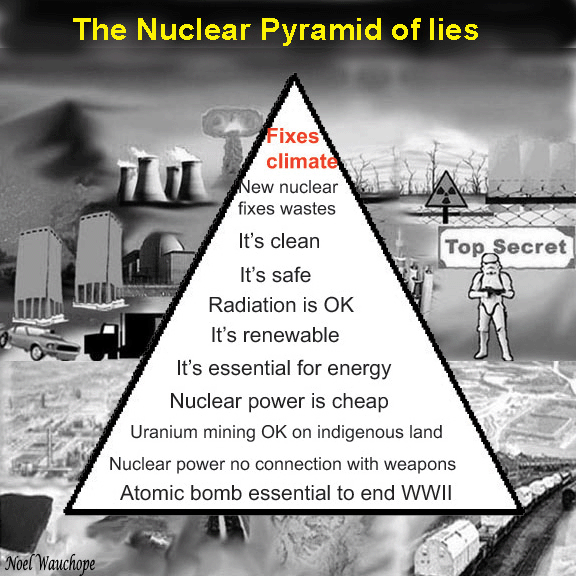
Radiation Free Lakeland * nuclear landfill/geological dump * NO TA!
Steve Wallis , 25 May 25.
Thoughts on the nuclear industry and how it is “run” and perceived by the people who work in the industry and how it is “sold” to the public. An earlier thread details Trump’s executive orders re “new” nuclear and the lies spouting forth about new this, new safety that, and not like the other nukes nonsense.
There are a few things that are very puzzling when it comes to the nuclear industry, perhaps the main one is why tell lies and why these lies are believed. Before talking about this I am interested in the “new” nuclear and the growing criticism concerning lack/lapse of regulation, mainly to build them quicker, cheaper and more of them. For example the SMR’s in the US will not fall under the current impact surveys for standard nuclear plants, re environmental/public safety.
Trump mentions SMR’s as if they already exist. This is not true, the modular means these reactors are built on a production line and then assembled on site. No factory production line exists at the moment.
Then the question is how does the nuclear industry get away with telling the same lies over and over, which it always does? Maybe this is because of regulatory capture, when a regulatory agency becomes dominated by the industry it is meant to regulate, and therefore does not protect public interest. Sellafield is an example of this over and over.
So why does the public believe Trump and the nuclear industry who are liars? This brings me to The Nietzsche Thesis, in his words we will accept and look for “truth” only when it has “pleasant, life-preserving consequences.” Conversely, we are hostile “to potentially harmful and destructive truths.” So, I will accept what is said if it preserves my view of the world, conversely I present a hostile reaction to harmful truths. Surveys asking Trump supporters how they feel about the lies are unconcerned because the lies fulfil their goals, and do not threaten their status. Likewise, despite loads of nuclear accidents people still believe the industries lies about providing safe, clean and cheap energy.
The nuclear industry always tells the public it is safe, and how it prides itself on providing the safest form of energy. It is as if all the nuclear accidents simply never happened and the public tend to believe this lie rather than the truth.
UK’s Geological Disposal Facility Community Partnership operates under restrictive government guidance and the management of Nuclear Waste Services
An interesting article recently sent to the NFLAs prompted a reply by our
Secretary identifying the limitations placed upon members of the Geological
Disposal Facility Community Partnerships wishing to source independent
information or commission bespoke research.
Such Community Partnerships operate under restrictive government guidance and the management of Nuclear Waste Services.
The Author and Article: A Quiet Resistance is run by a
writer, author, and marketing copywriter, living with her small family near
Millom. Understanding how language is used to persuade, convince, and
influence the decisions of mass populations, she set out to unpack the
messaging around the unfolding climate catastrophe, to help others decode
truth from fiction for themselves, and to open up critical thinking
pathways through the consumerism.
A Quiet Resistance documents this journey of discovery. AQuietResistance.co.uk –
https://aquietresistance.co.uk/the-media-scientific-consensus-toxic-nuclear-waste
23 April 2025. The media, scientific consensus, and toxic nuclear waste
When government agencies are hard to trust, who do we look to? Scientists. But
what job is the concept of scientific consensus doing in the marketing of
the GDF? ‘Scientific consensus’ carries a lot of weight in news media
discussing the proposed Geological Disposal Facilities (GDFs) (nuclear
waste dumps) in West Cumbria.
This consensus is also being used as a
persuasion tool in the official literature handed out to communities by
Nuclear Waste Services (NWS). Since most of us aren’t scientists in either
the nuclear industry or geodisposal, we have to turn to those who are if
we’re to understand what’s going to happen to our community. Alongside the
regular newsletters and other marketing from NWS, we usually access those
people through articles in the news and on the internet. But it’s important
to keep asking questions about what we’re reading. ‘Scientific consensus’
doesn’t mean the science is settled; articles can contain facts and still
be biased.
NFLA 16th May 2025, https://www.nuclearpolicy.info/wp/wp-content/uploads/2025/05/A431-NB317-The-media-scientific-consensus-and-toxic-nuclear-waste-May-2025.pdf
How Donald Trump’s Crypto Dealings Push the Bounds of Corruption.

With the meme coin $TRUMP and the company World Liberty Financial, the President is using an underregulated industry to enrich himself and court foreign influence.
By Kyle Chayka, May 14, 2025, https://www.newyorker.com/culture/infinite-scroll/how-donald-trumps-crypto-dealings-push-the-bounds-of-corruption?cndid=30183386&bxid=5be9d23d24c17c6adf3bf435&esrc=subscribe-page&hashc=ac5a1f5526e7292c73f49dfa8fb6d5d0cb87d8773cec3b9b03d38a4ce482d7c8&hashb=e1c24f6a6459c7d1d625eb2ea55d9dfbbb4633bf&hasha=432fc0d0ad6543e820e2dfcd39f76c35&mbid=CRMNYR012019&utm_campaign=aud-dev&utm_term=TNY_Science_Tech&utm_source=nl&utm_medium=email&utm_brand=tny&utm_mailing=TNY_Science_051725
Imagine that someone in a position of great political power created a hundred billion raffle tickets and made them available for public purchase. If you buy the tickets, eventually you will receive a reward: a proportional quantity of magic beans—and eventually each magic bean will be exchangeable for one United States dollar. What’s more, if you buy the raffle tickets early, you can get them for less than a dollar, perhaps for as little as five cents apiece. Not only will the raffle tickets eventually gain you more traditional currency; you can also vote on company matters with your raffle tickets and help manage the magic-bean supply, and the more tickets you purchase, the more say you have. Oh, and the creator of the raffle will keep a bunch of the tickets for himself, and much of the revenue generated by the magic-bean economy will also go back to him.
This effectively describes the workings of a new cryptocurrency created by World Liberty Financial, a company affiliated with the Trump family, with President Donald Trump serving as its “Chief Crypto Advocate.” The cryptocurrency, a so-called governance token called WLFI, is the raffle ticket, and another cryptocurrency, a “stablecoin” called USD1, is the magic bean. World Liberty deals in the nascent industry of “decentralized finance,” in which cryptocurrency instruments allow users to circumvent the traditional, regulated banking ecosystem for moving, storing, and lending money. Stablecoins are cryptocurrencies that are pegged to a single currency value, such as one U.S. dollar, though they are not always so stable: Terra, a once successful stablecoin, lost its peg and suffered a collapse in 2022. Stablecoins fall nebulously within the bounds of the law, so long as they don’t appear to function as securities (as, for instance, stock in a publicly traded company does). A banner on the World Liberty website serves as a legal disclaimer: “World Liberty Financial does not consider the tokens to be securities.” Donald Trump et fils quietly assumed a controlling stake of World Liberty, in January, through a company called DT Marks Defi. Though fine print specifies that no member of the Trump family is an “officer, director or employee” of World Liberty, DT Marks Defi receives seventy-five per cent of its subsidiary company’s net revenue. (The remaining twenty-five per cent goes to Axiom Management Group, which is connected with two of World Liberty’s official leaders, Chase Herro and Zachary Folkman, a pair of self-described “crypto-punks,” whose other ventures include, in Folkman’s case, a company called Date Hotter Girls.)
Trump is a onetime crypto skeptic who announced, in a tweet in 2019, “I am not a fan of Bitcoin.” Yet in recent years, he has touted several varieties of magic beans, bringing a P.R. boost to an industry in which new ventures are often dead on arrival. In 2022, he released Trump Digital Trading Cards, a series of non-fungible tokens that has continued to produce new batches, including a January, 2024, “Mugshot” edition, featuring his glaring police photo. (Bulk buyers of the mug-shot N.F.T. received invitations to Mar-a-Lago.) Three days before his Inauguration, he launched a so-called meme coin, cryptocurrencies based on online notoriety that become de-facto pyramid schemes as early buyers sell off to later ones at higher prices. $TRUMP consists of a billion coins, eighty per cent of which were kept by Trump-related companies, and the remainder sold to the public. It reportedly made around three hundred and fifty million dollars in revenue in its sale and has a market capitalization of nearly three billion dollars; Trump’s business earns a fee for every $TRUMP transaction.
The price of the meme coin is now down to less than a fifth of its all-time high, and the majority of its buyers have seen their purchases lose value. An official Melania Trump meme coin released soon after Trump’s has fared even worse. But $TRUMP was given a recent bump when Fight Fight Fight, a business associated with the Trump Organization and its crypto projects, ran a contest in which the two hundred and twenty largest holders of the meme coin won invitations to a gala dinner with Donald Trump, to be hosted at the Trump National Golf Club near Washington, D.C. (Black tie is optional.) The top twenty-five will get access to a more private reception with the President. The contest offers an explicit way to buy Trump’s attention, lending magic beans a new appeal as a lobbying tool. Many of the meme-coin investors are based abroad, and some have been unequivocal about their goal of influencing Trump’s agenda. (One Australian entrepreneur told the Times that he hopes to talk to the President about crypto policy; a Mexican buyer said that he would like Trump’s ear on tariffs.) On Tuesday, a small Chinese company that operates an e-commerce business on TikTok announced plans for a three-hundred-million-dollar purchase of $TRUMP and Bitcoin—at a time when the Trump Administration is considering whether to follow through on a TikTok ban.
The World Liberty operation has far vaster implications than the meme coin, however, because its stablecoin, which can be easily and reliably exchanged for U.S. dollars, creates something like an entire Trump-sponsored underground economy. It’s as if a new bank had opened under the sitting President’s name, and it was being sent large quantities of funds by various foreign businesses and political élites. Major buyers of WLFI have included Justin Sun, a Chinese crypto entrepreneur, who bought seventy-five million dollars’ worth, and DWF Labs, an Abu Dhabi-based cryptocurrency trading firm, which bought twenty-five million dollars’ worth. In March, World Liberty announced that it had sold more than half a billion dollars’ worth of its token. Earlier this month, another Abu Dhabi-based investment firm announced that it would use USD1, the stablecoin controlled by World Liberty, for a two-billion-dollar investment in Binance, the largest cryptocurrency exchange in the world.
Buying the Trumpian magic beans provides a way of purchasing influence, not unlike how foreign dignitaries could rent rooms at the Trump International Hotel in D.C. during Trump’s first Administration. But World Liberty makes renting hotel rooms look quaint by comparison. The more money that flows into WLFI and USD1, the more legitimate and valuable these currencies appear, and the higher their market capitalizations creep. Tether, the world’s largest stablecoin, has a market capitalization nearing a hundred and fifty billion dollars, with more than thirty billion dollars in daily trading volume. World Liberty aspires to create something similar.
The American public has been inundated with news of the Trump family’s self-enrichment for so long that many of their dealings now barely create a stir. Just this week, it was revealed that the Administration is preparing to accept the gift of a luxury Boeing 747-8 jet offered by the royal family of Qatar, to be used as a new Air Force One, at least until a new Air Force One is completed by Boeing. The Department of Defense will receive the jet, but when Trump leaves office it will reportedly be donated to his Presidential library, effectively turning the plane, worth four hundred million dollars, into a private possession—never mind that this arrangement would seem to blatantly contradict the foreign-emoluments clause, which prevents U.S. officials from accepting gifts from foreign leaders and governments. (Trump has dismissed ethical concerns by saying that declining a gift would be “stupid.”) In the realm of crypto, though, a backlash against Trump’s ventures may be mounting in Congress. Last week, some Senate Democrats balked at passing a popular crypto-friendly bill in light of the President’s naked profiteering. In a bit of almost farcical understatement, Senator Cynthia Lummis, Republican of Wyoming, recently told the Times, “The optics are challenging.” But the Trump family has so far wagered correctly that no one will stop them. ♦
Kyle Chayka is a staff writer at The New Yorker. His column, Infinite Scroll, examines the people and platforms shaping the Internet. His books include “Filterworld: How Algorithms Flattened Culture.
Conflicts of interest in the Trump group’s push to sell nuclear reactors to Saudi Arabia.

|
The Trump administration is eager to sell nuclear reactors to Saudi Arabia. But why? Bulletin of the Atomic Scientists, By Aileen Murphy, M. V. Ramana, April 16, 2019 US government officials appear to be advancing a potential sale of nuclear power plants to Saudi Arabia. Late last month, Reuters reported that Energy Secretary Rick Perry approved six secret authorizations for companies to do preliminary work on a Saudi nuclear deal without congressional oversight. The Reuters article followed an interim staff report that US Rep. Elijah Cummings, chairman of the House Oversight Committee, released in February; the report cited whistleblowers who had warned that the White House was trying to rush the transfer of nuclear technology to the Kingdom.
Many experts have expressed concern about the terms of a US-Saudi nuclear cooperation agreement now apparently under negotiation. Some despair at the very idea of transferring such sensitive technology to a regime known to have been involved in the gruesome murder of a prominent US-based journalist and to have led a bloody war in Yemen. Saudi Arabia has attempted to justify its nuclear power program as a way to shift its electrical system away from fossil fuels, in part because of climate change concerns and in part because it is economically useful for the Kingdom to sell its oil and gas on the international market, rather than use them to generate electricity. But for sun-baked Saudi Arabia, the economical and obvious switch is to solar energy, which also doesn’t result in carbon emissions and can be used to reduce domestic consumption of oil and gas. The limited efforts in installing solar power capacity on the part of the Saudi government suggest that climate action and economics may not be the driving motivations for its extensive nuclear energy plan. Indeed, members of the Saudi regime have, on other occasions, made it clear that their interests in nuclear energy derive from the idea that it would help them acquire the capability to make nuclear weapons and match Iran, whose regional status is seen to have risen as a result of its uranium enrichment program, even though it is now apparently limited by the Iran nuclear deal. The contrast between Saudi Arabia’s solar potential and its focus on nuclear power raises a question: Why is the Trump administration so eager to provide nuclear technology to such a questionable partner? We offer some tentative answers to this question and argue that it would be best for the United States to stop trying to sell nuclear reactors to Saudi Arabia, and to use its considerable diplomatic capacity to encourage other countries to do the same. Outside inducement, inside interest. Despite President Trump’s outspoken interest in maintaining a close relationship with the Saudi leadership, the White House is not seeking a Saudi nuclear agreement entirely on its own volition. It is also responding to a major lobbying effort. In February, representatives from several nuclear energy firms, including NuScale, TerraPower, Westinghouse, and General Electric, met with President Trump reportedly with the aim of having the president “highlight the role US nuclear developers can play in providing power to other countries.” The motivation for nuclear reactor suppliers is understandable. Thanks in part to the multibillion-dollar cost of reactors, the nuclear energy market is slim. One can literally count the number of new reactor construction projects starting each year since 2010 on the fingers of one hand. Westinghouse, the leading company among those that lobbied Trump, has not signed a new reactor contact in more than a decade. The Middle East has been an especially competitive market for companies interested in building reactors in the Kingdom. If any reactors are sold, it will only be with the help of high-level support, probably involving national governments or even heads of state. But the effort to sell US nuclear power plants has also garnered some new players: companies involving ex-members of the armed forces. For about two years now, there have been reports of former national security advisor Michael Flynn playing an important role in trying to start nuclear exports to the Middle East, especially Saudi Arabia. More recently, a host of articles have uncovered the role of the newly established IP3 Corporation (derived from International Peace, Power, and Prosperity), a company dominated by a number of retired military officials. The extent of IP3’s lobbying became apparent only after the House Oversight Committee report was published. The influence trail is murky, and the various conflicts of interest within the Trump administration render the picture even murkier. One example is the case of Westinghouse and Jared Kushner, son in law of and senior advisor to President Donald Trump and a close friend of Saudi Crown Prince Mohammad bin Salman. Westinghouse is the largest nuclear reactor supplier in the United States, but, thanks to cost escalations in multiple projects involving its AP1000 nuclear reactor design, the company filed for bankruptcy protection in 2017. It was then purchased by the Canadian company Brookfield Business Partners. Brookfield Business Partners is a subsidiary of Brookfield Asset Management Inc., which reached a deal in August 2018 with the Kushner family’s real estate company to lease a highly unprofitable building in New York. The Kushner company had purchased 666 Fifth Avenue in New York for $1.8 billion in 2007, just before the property markets collapsed. The company had been trying for years to offload this debt. Brookfield’s deal might be just a coincidence, but the timing and the earlier foray into the nuclear business raise obvious conflict of interest questions………. Three reasons to question. Three aspects of the proposed sale of nuclear reactors to Saudi Arabia demand attention. The first, which has received much media attention, involves the opaque tangle of shady talks and negotiations between the Trump administration and the Kingdom, in the realm of nuclear energy and in other areas. Second, it is clear that nuclear energy makes little economic sense for Saudi Arabia, suggesting that there are other motives for its nuclear power program. Third, one of these motives need no longer be the subject of speculation: Saudi Arabia’s leaders have clearly stated their interest in potentially developing nuclear weapons. The acquisition of nuclear power and associated technology could well aid that process. Given these questions, neither the United States nor any other country should be exporting nuclear power plants to Saudi Arabia. This will not just be in the interest of the United States, but also in the economic interest of the Saudis. To the extent that there is concern that other countries like Russia and China might step in and sell nuclear reactors to Saudi Arabia, the obvious corollary is that the United States should use its considerable diplomatic capacity to discourage such efforts. Success is, of course, not guaranteed, but not trying is the surest way to fail. https://thebulletin.org/2019/04/the-trump-administration-is-eager-to-sell-nuclear-reactors-to-saudi-arabia-but-why/ |
|
1 This Month

of the week – Shut Down Drone Warfare!


Tell the Ukrainian Government to Drop Prosecution of Peace Activist Yurii Sheliazhenko

Petition to revoke the licensing of the Near Surface Nuclear Disposal Facility (NSDF) at Chalk River. https://www.ourcommons.ca/petitions/en/Petition/Details?Petition=e-7247
To see nuclear-related stories in greater depth and intensity – go to https://nuclearinformation.wordpress.com
-
Archives
- March 2026 (244)
- February 2026 (268)
- January 2026 (308)
- December 2025 (358)
- November 2025 (359)
- October 2025 (376)
- September 2025 (257)
- August 2025 (319)
- July 2025 (230)
- June 2025 (348)
- May 2025 (261)
- April 2025 (305)
-
Categories
- 1
- 1 NUCLEAR ISSUES
- business and costs
- climate change
- culture and arts
- ENERGY
- environment
- health
- history
- indigenous issues
- Legal
- marketing of nuclear
- media
- opposition to nuclear
- PERSONAL STORIES
- politics
- politics international
- Religion and ethics
- safety
- secrets,lies and civil liberties
- spinbuster
- technology
- Uranium
- wastes
- weapons and war
- Women
- 2 WORLD
- ACTION
- AFRICA
- Atrocities
- AUSTRALIA
- Christina's notes
- Christina's themes
- culture and arts
- Events
- Fuk 2022
- Fuk 2023
- Fukushima 2017
- Fukushima 2018
- fukushima 2019
- Fukushima 2020
- Fukushima 2021
- general
- global warming
- Humour (God we need it)
- Nuclear
- RARE EARTHS
- Reference
- resources – print
- Resources -audiovicual
- Weekly Newsletter
- World
- World Nuclear
- YouTube
-
RSS
Entries RSS
Comments RSS
 nuclear-news