Covering up Ukrainian Nazis is nothing new – the Canadians have been doing it for almost eighty years

Ian Proud, April 29, 2025. https://strategic-culture.su/news/2025/04/29/covering-up-ukrainian-nazis-nothing-new-canadians-have-been-doing-it-for-almost-eighty-years/
A number of topics remain taboo in discussing the war in Ukraine. Busification, Zelensky’s democratic mandate, Ukraine’s casualty numbers and anything suggesting that Ukraine cannot win are all off limits. Likewise the problem of alleged neo-Nazis in Ukraine.
One of the most embarrassing episodes since the Ukraine war started in 2022, was when Yaroslav Hunka, was given two standing ovations in the Canadian House of Commons public gallery by MPs during the visit of President Zelensky in 2023. Hunka has been accused by Russia of genocide, because of his alleged involvement in the Huta Pieniacka massacre of February 28 1944 in which more than 500 ethnic Poles were murdered in a village, in what is now western Ukraine. Hunka was a member of the SS Galicia Division, a mostly Ukrainian unit of the Waffen SS, which Commissions in Germany and Poland later found guilty of war crimes.
This was shocking because it opened the lid on a topic of conversation that has been largely silenced by the western mainstream media since the beginning of the war: Ukraine’s contemporary challenge of far-right ultranationalism. But the Hunka case also illustrates how western authorities airbrushed discussion of nazis in Ukraine after World War II too.
On 13 July 1948 the British Commonwealth Relations Office, what is now part of the Foreign Commonwealth and Development Office, sent a telegram to Commonwealth governments, proposing an end to Nazi war crimes trials in the British zone of Germany. “Punishment of war crimes is more a matter of discouraging future generations than of meting out retribution to every guilty individual… it is now necessary to dispose of the past as soon as possible.”
After the conclusion of the Nuremberg War Trials in 1946 the western world faced a new enemy in the Soviet Union. Limited security resources in cash-strapped Albion and its colonies were re-deployed to uncover suspected Soviet agents and Communists, rather than to identify and track down lower-order Nazi war criminals.
Around this time, many Ukrainians fled the Soviet Union to settle in Canada. In the thirty-year period after the start of Operation Barbarossa, the Ukrainian population in Canada almost doubled, from 300,000 to almost 600,000 people. While most of them, I am sure, would not have been Nazi collaborators, some, undoubtedly, were. They were joined by lesser numbers of Latvians, Hungarians, Slovaks and others.
Within that exodus would have been so-called “lesser” war criminals; persons who had organised the transportation of Jews, Slavs, gypsies and homosexuals to death camps, acted as informers, committed murders, or become involved in war crimes as other ranks and non-commissioned officers in death squads. They were the lower echelon collaborators, acting as the instruments of the genocide initiated by the Nazis.
Yet, following the British instruction, Canada progressively relaxed its immigration policy between 1950 and 1962, steadily removing restrictions against the entry of German nazis and non-German members of German military units like the SS Galicia Division.
However, in 1984 the Simon Wiesenthal Center wrote a letter to the Canadian government claiming to have obtained evidence that the ‘Angel of Death’ Josef Mengele had applied for a landed immigrant visa to Canada in 1962. Though this proved to be incorrect, it caused such outrage among Canada’s Jewish community that a Commission of Inquiry on War Criminals in Canada was established in 1985.
Known as the Deschênes Commission, it uncovered a list of 774 persons who had allegedly entered Canada and who required further investigation. Of that list, only 28 underwent serious investigation and trial.
Michael Pawlowski, accused of murdering 410 Jews and 80 non-Jewish Poles in Belarus in 1942, was acquitted as judges blocked the prosecution from gathering evidence in the Soviet Union.
Stephen Reistetter of Slovakia was not tried for allegations that he kidnapped 3000 Jews to have them sent to Nazi death camps while serving in the Hlinka party, a far right clerical-fascist movement with Nazi leanings. His case fell apart because a witness died.
Erich Tobias, was accused of involvement in the execution of Latvian Jews but died before his case went to court.
By 1995, with no convictions for war crimes having been secured, the Canadian Justice Department cut the size of its war crimes unit from 24 to 11 people. In the absence of criminal prosecutions, the Canadian Government tried civil proceedings to revoke citizenship from alleged war criminals.
Wasily Bogutin collaborated with the Nazi occupation forces in the town of Selidovo, in Donetsk, and was personally and directly involved in effecting the roundup of young persons for forced labour in Germany. In February 1998, Judge McKeown, of the Trial Division of the Federal Court, found that Bogutin had concealed his role in war crimes, but he died before he could be extradited.
Joseph Nemsila, who commanded a Slovak unit that sent civilians to Auschwitz died in 1997 after a decision not to revoke citizenship was overturned, but death prevented exportation.
In only 7 cases was order made for the suspect to be extradited or exported. This included Ladislaus Csizsik-Csatary, accused of involvement in the confinement of thousands of Hungarian Jews and their subsequent deportation to death camps. In July 1997, just before his trial was to begin, he decided not to oppose the loss of his citizenship and voluntarily left the country.
Vladimir Katriuk was accused of having taken part in the Khatyn Massacre in Belarus and Wasyl Odnynsky, a guard at SS labour camps at Trawniki and Poniaka. Moves were made to revoke their citizenship, but they were allowed to remain in Canada until all court proceedings were lifted in 2007.
Progress in prosecuting alleged war criminals in Canada was always slow, often held up by foot-dragging by often reluctant judges, and a refusal to allow for the gathering of evidence in the Soviet Union.
Today, the media and Jewish groups still pressure the Canadian government to reveal the names of all of the 774 persons considered by the 1985 Deschênes Commission with so far little success.
An American academic recently discovered what is believed to be a similar list of 700 suspects which included Volodymyr Kubiovych, a Ukrainian Nazi collaborator who helped organize the SS Galicia division and who was editor in chief of the Encyclopedia of Ukraine compiled at the University of Alberta. A photograph of a parade in Lviv, Ukraine, in July, 1943, shows Mr. Kubiovych making a Nazi salute alongside Otto Wächter, a senior member of the SS who also served as governor of Galicia and Krakow.
Yaroslav Hunka was not on that list, raising questions about how many Nazi collaborators in Canada were never discovered.
I don’t think that Ukraine today is a Nazi society and, even at its high watermark, the Svoboda party only garnered 10% of the national vote. But ultranationalism is a major problem, particularly in the west of Ukraine, in that area known as Galicia during World War II. And the refusal of western governments to acknowledge the issue of ultranationalism in Ukraine or speak out means that we are turning a blind eye once more to activity that we would never tolerate in our own countries.
Chernobyl’s Hidden Impact: Disinformation and Nuclear Politics

And yes it is oxymoronic to have the same agency being responsible for safety and promotion of nuclear power
Chernobyl is not the past.
every nuclear power plant ever built assumes there will never be a war on the site.
Chernobyl explosion was “perhaps the real cause of the collapse of the Soviet Union.” According to Mikhail Gorbachev who was the last leader of the Soviet Union and was in power during the meltdown. But perhaps the more important lesson from the Chernobyl catastophe is that disinformation can kill you. It is important to remember that the largest and most deadly nuclear accident in the world was not even reported initially by the secretive and corrupt Soviet Union. It was not until 2 days after the meltdown that the Forsmark Nuclear Power Plant in Sweden detected the radiation and forced the Soviets to admit there had been an accident. Forsmark is 1100 km from Chernobyl.
Disinformation about Chernobyl is not confined to the Soviet Union, western nations and especially the UN played a critical role in down playing and distorting information about the effects of the disaster. This is most obvious in the fatality estimates associated with the catastrophe.
In 1959, the powerful UN agency responsible for both promoting and monitoring nuclear power, the IAEA, signed an agreement with the UN’s health monitoring agency, WHO, that restricted them from reporting on nuclear accidents. And as part of the western public relations cover up, 4 months after the meltdown the then general director of the IAEA, Hans Blix, would affirm: “The world could tolerate a nuclear accident as serious as Chernobyl every year.” WHO was blocked from releasing any independent Chernobyl studies and ultimately the IAEA (with WHO) would officially report that there were only between 4000 to 9000 deaths. [And yes it is oxymoronic to have the same agency being responsible for safety and promotion of nuclear power.]
Consensus is not your friend. There have been many scientific studies of the affects of Chernobyl. Greenpeace did an anthology of these studies at the 25th anniversary and estimated that at least 93,000 people will have died and the actual total is likely well be over 200,000 premature deaths. Why the big difference between the UN’s official tally and independent scientists? The answer is consensus. The IAEA has representatives from pro-nuclear states on it’s Chernobyl Forum, they release their reports operating by consensus and those invested in nuclear energy have a strong interest in down playing the effects of accidents. Independent scientists have also found radiation levels in the exclusion zone to be over three times higher than the IAEA reports.
How effective is this western mis/disinformation campaign? Check out Wikipedia or ask any AI. You will quickly find the IAEAs 4000 person fatality rate. Depending on the source more accurate information is either buried or not revealed in your first responses. Lots of people on the nuclear payrolls have put a bunch of effort into minimizing the impact of all nuclear accidents. This is not a (known) conspiracy, per se, but rather contemporary industrial capitalism functioning as designed. But perhaps more revealing is that almost no mainstream news sources are covering this years 39th anniversary. Far more important in our attention economy is that Trump is going to the Pope’s funeral and we are arresting judges in the US.
Chernobyl is not the past. In February of this year a relatively low cost attack drone blew a hole in the second $1.7 billion Chernobyl sarcophagus. The fire from this attack burned for 3 weeks, requiring technicians to make further holes in the exterior shell in a high stakes game of “nuclear whack a mole”
“We did a lot of safety analysis, considering a lot of bad things that could happen,” said a senior technical adviser on the project. “We considered earthquakes, tornadoes, heavy winds, 100-year snowfalls, all kinds of things. We didn’t consider acts of war.”
It is worth pointing out that every nuclear power plant ever built assumes there will never be a war on the site. Assuming otherwise would be yet another in the long list of reasons why nuclear power should not be considered or continued. Other major problems with civil nuclear power include: subsidized insurance, proliferation risks, uneconomic construction and operation, perverse effects on avoiding climate disruption and the threat to democracy. The total cost of the Cheronbyl accident has been estimated at $700 billion which is about 5 times the Ukraines average GDP for the last 10 years.
The only good nuclear news on this anniversary is the complexity of nuclear power plants combined with the previous globalization of the nuclear construction and fuel supply chain mean that Trump’s tariffs may put the breaks on any new nuclear construction in the US. Or perhaps more sadly, these Trump taxes will just increase the already ridiculous price of nuclear power to both taxpayers and ratepayers.
On Neo-Nazi Influence in Ukraine

The Azov Battalion, which arose during the coup, became a significant force in the war against the Russian-speaking people of the Donbass, who resisted the coup. Its commander, Andriy Biletsky, infamously said Ukraine’s mission is to “lead the White Races of the world in a final crusade for their survival … against the Semite-led Untermenschen.”
the Azov backer’s television channel had by this time aired the hit TV show Servant of the People (2015-2019), which catapulted Volodymyr Zelensky to fame and ultimately into the presidency under the new Servant of the People Party. The former actor and comedian’s presidential campaign was bankrolled by Kolomoisky, according to multiple reports.
Zelensky was elected president on the promise of ending the Donbass war. About seven months into his term he traveled to the front line in Donbass to tell Ukrainian troops, where Azov is well-represented, to lay down their arms. Instead he was sent packing. The Kyiv Post
A short history of neo-Nazism in Ukraine in response to some who say, “There is no evidence that Nazism has substantial influence in Ukraine.” Joe Lauria reports.
By Joe Lauria, Consortium News, 20 Apr 25
The U.S. relationship with Ukrainian fascists began after the Second World War. During the war, units of the Organization of Ukrainian Nationalists (OUN-B) took part in the Holocaust, killing at least 100,000 Jews and Poles.
Mykola Lebed, a top aide to Stepan Bandera, the leader of the fascist OUN-B, was recruited by the C.I.A. after the war, according to a 2010 study by the U.S. National Archives.
The government study said, “Bandera’s wing (OUN/B) was a militant fascist organization.” Bandera’s closest deputy, Yaroslav Stetsko, said: ““I…fully appreciate the undeniably harmful and hostile role of the Jews, who are helping Moscow to enslave Ukraine…. I therefore support the destruction of the Jews and the expedience of bringing German methods of exterminating Jewry to Ukraine….”
The study says: “At a July 6, 1941, meeting in Lwów, Bandera loyalists determined that Jews ‘have to be treated harshly…. We must finish them off…. Regarding the Jews, we will adopt any methods that lead to their destruction.’”
Lebed himself proposed to “’cleanse the entire revolutionary territory of the Polish population,’ so that a resurgent Polish state would not claim the region as in 1918.” Lebed was the “foreign minister” of a Banderite government in exile, but he later broke with Bandera for acting as a dictator. The U.S. Army Counterintelligence Corps termed Bandera “extremely dangerous” yet said he was “looked upon as the spiritual and national hero of all Ukrainians….”
The C.I.A. was not interested in working with Bandera, pages 81-82 of the report say, but the British MI6 was. “MI6 argued, Bandera’s group was ‘the strongest Ukrainian organization abroad, is deemed competent to train party cadres, [and] build a morally and politically healthy organization….’” An early 1954 MI6 summary noted that, “the operational aspect of this [British] collaboration [with Bandera] was developing satisfactorily. Gradually a more complete control was obtained over infiltration operations …
Britain ended its collaboration with Bandera in 1954. West German intelligence, under former Nazi intelligence chief Reinhard Gehlen, then worked with Bandera, who was eventually assassinated with cyanide dust by the KGB in Munich in 1959.
Instead of Bandera, the C.I.A. was interested in Lebed, despite his fascist background. They set him up in an office in New York City from which he directed sabotage and propaganda operations on the agency’s behalf inside Ukraine against the Soviet Union. The U.S. government study says:
“CIA operations with these Ukrainians began in 1948 under the cryptonym CARTEL, soon changed to AERODYNAMIC. … Lebed relocated to New York and acquired permanent resident status, then U.S. citizenship. It kept him safe from assassination, allowed him to speak to Ukrainian émigré groups, and permitted him to return to the United States after operational trips to Europe. Once in the United States, Lebed was the CIA’s chief contact for AERODYNAMIC. CIA handlers pointed to his ‘cunning character,’ his ‘relations with the Gestapo and … Gestapo training,’ [and] the fact that he was ‘a very ruthless operator.’”
The C.I.A. worked with Lebed on sabotage and pro-Ukrainian nationalist propaganda operations inside Ukraine until Ukraine’s independence in 1991. “Mykola Lebed’s relationship with the CIA lasted the entire length of the Cold War,” the study says. “While most CIA operations involving wartime perpetrators backfired, Lebed’s operations augmented the fundamental instability of the Soviet Union.”
Bandera Revival

The U.S. thus covertly kept Ukrainian fascist ideas alive inside Ukraine until at least Ukrainian independence was achieved. “Mykola Lebed, Bandera’s wartime chief in Ukraine, died in 1998. He is buried in New Jersey, and his papers are located at the Ukrainian Research Institute at Harvard University,” the U.S. National Archives study says.
The successor organization to the OUN-B in the United States did not die with him, however. It had been renamed the Ukrainian Congress Committee of America (UCCA), according to the International Business Times (IBT).
“By the mid-1980s, the Reagan administration was honeycombed with UCCA members. Reagan personally welcomed [Yaroslav] Stetsko, the Banderist leader who oversaw the massacre of 7,000 Jews in Lviv, in the White House in 1983,” IBT reported. “Following the demise of [Viktor] Yanukovich’s regime [in 2014], the UCCA helped organise rallies in cities across the US in support of the EuroMaidan protests,” it reported.
That is a direct link between Maidan and WWII-era Ukrainian fascism.
Despite the U.S. favoring the less extreme Lebed over Bandera, the latter has remained the more inspiring figure in Ukraine.
In 1991, the first year of Ukraine’s independence, the neo-fascist Social National Party, later Svoboda Party, was formed, tracing its provenance directly to Bandera. It had a street named after Bandera in Liviv, and tried to name the city’s airport after him. (Svoboda won 10 percent of the Rada’s seats in 2012 before the coup and before Sen. John McCain and U.S. Assistant Secretary of State Victoria Nuland appeared with Svoboda’s leader the following year.)
In 2010, pro-Western Ukrainian President Viktor Yushchenko declared Bandera a Hero of Ukraine, a status reversed by President Viktor Yanukovych, who was overthrown with the help of Ukrainian neo-Nazis in 2014.
More than 50 monuments, busts and museums commemorating Bandera have been erected in Ukraine, two-thirds of which have been built since 2005, the year the pro-American Yuschenko was elected. A Swiss academic study says:
“On January 13, 2011, the L’vivs’ka Oblast’ Council, meeting at an extraordinary session next to the Bandera monument in L’viv, reacted to the abrogation [skasuvannya] of Viktor Yushchenko’s order about naming Stepan Bandera a ‘Hero of Ukraine’ by affirming that ‘for millions of Ukrainians Bandera was and remains a Ukrainian Hero notwithstanding pitiable and worthless decisions of the courts’ and declaring its intention to rename ‘Stepan Bandera Street’ as ‘Hero of Ukraine Stepan Bandera Street.’”
Torchlit parades behind Bandera’s portrait are common in Ukrainian cities, particularly on Jan. 1, his birthday, including this year.
Mainstream on Neo-Nazis
From the start of the 2013-2014 events in Ukraine, Consortium News founder Robert Parry and other writers began providing the evidence NewsGuard, which bills itself as a news-rating agency, says doesn’t exist. Parry began reporting extensively on the coup and the influential role of Ukraine’s neo-Nazis. At the time, corporate media also reported on the essential part neo-Nazis played in the coup. [See: ROBERT PARRY: Ukraine’s Inconvenient Neo-Nazis]
As The New York Times reported, the neo-Nazi group, Right Sector, had the key role in the violent ouster of Yanukovych. The role of neo-fascist groups in the uprising and its influence on Ukrainian society was well reported by mainstream media outlets at the time.
The BBC, the NYT, the Daily Telegraph and CNN all reported on Right Sector, C14 and other extremists’ role in the overthrow of Yanukovych. The BBC ran this report a week after his ouster:
After the coup a number of ministers in the new government came from neo-fascist parties. NBC News (100 percent NewsGuard rating) reported in March 2014: “Svoboda, which means ‘Freedom,’ was given almost a quarter of the Cabinet positions in the interim government formed after the ouster of President Viktor Yanukovych in February.”
Svoboda’s leader, Tyahnybok, whom McCain and Nuland stood on stage with, once called for the liberation of Ukraine from the “Muscovite-Jewish mafia.” The International Business Times (82.5 percent) reported:
“In 2005 Tyahnybok signed an open letter to then Ukrainian president Viktor Yushchenko urging him to ban all Jewish organisations, including the Anti-Defamation League, which he claimed carried out ‘criminal activities [of] organised Jewry’, ultimately aimed at the genocide of the Ukrainian people.”
Before McCain and Nuland embraced Tyahnybok and his social national party, it was condemned by the European Parliament, which said in 2012:
Continue readingBribery at Hinkley Point
A claim for unfair dismissal by project director Garrick Nisbet against Notus Heavy Lift Solutions – one of the heavy lift subcontractors working for EDF on the construction the Hinkley Point C nuclear power station in the UK – has highlighted cases of bribery and corruption at the site, relating to the supply of heavy lift and rigging services.
An employment tribunal held last year was told that Ashley Daniels – at the time EDF’s head of lifting and temporary works at Hinkley Point C – accepted gifts from Nisbet on the basis that it would help ensure more business for him and his employer Notus. The ‘gifts’ included an £11,000 quad bike, £2,000 worth of tickets for a boxing match and of all things a refill for a Montblanc pen. Daniels’ activities are reportedly the subject of an ongoing investigation by EDF.
Notus Heavy Lift dismissed Nisbet without notice in April 2023 when evidence came to light, indicating that he had given the quad bike to Daniels in exchange for more work or to retain existing work levels. Daniels had apparently told Nisbet that the quad bike would give “Notus a bit of breathing space”.
In evidence given by the former managing director of Notus Heavy Lift, the tribunal heard that Daniels had “the full authority to decide who came on site and that without Ashley’s approval, Notus would not have any work on the site”.
Nisbet claimed that the ‘favours’ he had offered Daniels were limited to lunches, coffee and biscuits, and argued that he had nothing to do with the boxing tickets, adding that the Montblanc refill was simply a spare he had bought, which Daniels had asked for.
Employment judge Colm O’Rourke found that Nisbet’s use of the word “favours” was “disingenuous”, adding that the items given were “clearly bribes”………………………
………………………….More information on the ruling and evidence
This case was concluded in October last year but updated earlier this month.
To see the full list of reasons and evidence in this case go to: https://assets.publishing.service.gov.uk/media/673c76869a48a5ab14acc394/Mr_G_Nisbet_-vs-_Notus_Heavy_Lift_Solutions_Limited_-_6001564.2023_-_Written_Reasons.pdf
Vertikal 24th April 2025
https://vertikal.net/en/news/story/46007/bribery-at-hinkley-point
CIA: Undermining and Nazifying Ukraine Since 1953
In 1969, AERODYNAMIC began advancing the cause of the Crimean Tatars. In 1959, owing to Canada’s large Ukrainian population, Canada’s intelligence service began a program similar to AERODYNAMIC codenamed «REDSKIN».
AERODYNAMIC continued into the 1980s as operation QRDYNAMIC, which was assigned to the CIA’s Political and Psychological Staff’s Soviet East Europe Covert Action Program. Prolog saw its operations expanded from New York and Munich to London, Paris, and Tokyo.
Assistant Secretary of State for European/Eurasian Affairs Victoria Nuland, the baked goods-bearing «Maiden of Maidan,» told the US Congress that the United States spent $5 billion to wrest control of Ukraine from the Russian sphere since the collapse of the Soviet Union. With the recent disclosures from the CIA it appears that the price tag to the American tax payers of such foreign shenanigans was much higher.
by Wayne Madsen, Voltaire Network | 14 January 2016
The CIA programs spanned some four decades. Starting as a paramilitary operation that provided funding and equipment for such anti-Soviet Ukrainian resistance groups as the Ukrainian Supreme Liberation Council (UHVR); its affiliates, the Organization of Ukrainian Nationalists (OUN) and Ukrainian Insurgent Army (UPA), all Nazi Banderists. The CIA also provided support to a relatively anti-Bandera faction of the UHVR, the ZP-UHVR, a foreign-based virtual branch of the CIA and British MI-6 intelligence services. The early CIA operation to destabilize Ukraine, using exile Ukrainian agents in the West who were infiltrated into Soviet Ukraine, was codenamed Project AERODYNAMIC.
The recent declassification of over 3800 documents by the Central Intelligence Agency provides detailed proof that since 1953 the CIA operated two major programs intent on not only destabilizing Ukraine but Nazifying it with followers of the World War II Ukrainian Nazi leader Stepan Bandera.
A formerly TOP SECRET CIA document dated July 13, 1953, provides a description of AERODYNAMIC: «The purpose of Project AERODYNAMIC is to provide for the exploitation and expansion of the anti-Soviet Ukrainian resistance for cold war and hot war purposes. Such groups as the Ukrainian Supreme Council of Liberation (UHVR) and its Ukrainian Insurgent Army (OUN), the Foreign Representation of the Ukrainian Supreme Council of Liberation (ZPUHVR) in Western Europe and the United States, and other organizations such as the OUN/B will be utilized». The CIA admitted in a 1970 formerly SECRET document that it had been in contact with the ZPUHVR since 1950.
The OUN-B was the Bandera faction of the OUN and its neo-Nazi sympathizers are today found embedded in the Ukrainian national government in Kiev and in regional and municipal governments throughout the country.
AERODYNAMIC placed field agents inside Soviet Ukraine who, in turn, established contact with Ukrainian Resistance Movement, particularly SB (intelligence service) agents of the OUN who were already operating inside Ukraine. The CIA arranged for airdrops of communications equipment and other supplies, presumably including arms and ammunition, to the «secret» CIA army in Ukraine. Most of the CIA’s Ukrainian agents received training in West Germany from the US Army’s Foreign Intelligence Political and Psychological (FI-PP) branch. Communications between the CIA agents in Ukraine and their Western handlers were conducted by two-way walkie-talkie (WT), shortwave via international postal channels, and clandestine airborne and overland couriers.
Agents airdropped into Ukraine carried a kit that contained, among other items, a pen gun with tear gas, an arctic sleeping bag, a camp axe, a trenching tool, a pocket knife, a chocolate wafer, a Minox camera and a 35 mm Leica camera, film, a Soviet toiletry kit, a Soviet cap and jacket, a .22 caliber pistol and bullets, and rubber «contraceptives» for ‘waterproofing film’. Other agents were issued radio sets, hand generators, nickel-cadmium batteries, and homing beacons.
An affiliated project under AERODYNAMIC was codenamed CAPACHO.
CIA documents show that AERODYNAMIC continued in operation through the Richard Nixon administration into 1970.
The program took on more of a psychological warfare operation veneer than a real-life facsimile of a John Le Carré «behind the Iron Curtain» spy novel. The CIA set up a propaganda company in Manhattan that catered to printing and publishing anti-Soviet ZPUHVR literature that would be smuggled into Ukraine. The new battleground would not be swampy retreats near Odessa and cold deserted warehouses in Kiev but at the center of the world of publishing and the broadcast media.
Read more: CIA: Undermining and Nazifying Ukraine Since 1953The CIA front company was Prolog Research and Publishing Associates, Inc., which later became known simply as Prolog. The CIA codename for Prolog was AETENURE. The group published the Ukrainian language «Prolog» magazine. The CIA referred to Prolog as a «non-profit, tax exempt cover company for the ZP/UHVR’s activities». The «legal entity» used by the CIA to fund Prolog remains classified information. However, the SECRET CIA document does state that the funds for Prolog were passed to the New York office «via Denver and Los Angeles and receipts are furnished Prolog showing fund origin to backstop questioning by New York fiscal authorities».
As for the Munich office of Prolog, the CIA document states that funding for it comes from an account separate from that of Prolog in New York from a cooperating bank, which also remains classified. In 1967, the CIA merged the activities of Prolog Munich and the Munich office of the Ukrainian exiled nationalist «Suchasnist» journal. The Munich office also supported the «Ukrainische Gesellschaft fur Auslandstudien». The CIA documents also indicate that US Federal Bureau of Investigation (FBI) agents may have interfered with AERODYNAMIC agents in New York. A 1967 CIA directive advised all ZPUHVR agents in the United States to either report their contacts with United Nations mission diplomats and UN employees from the USSR and the Ukrainian SSR to the FBI or their own CIA project case officer. CIA agents in charge of AERODYNAMIC in New York and Munich were codenamed AECASSOWARY agents. Apparently not all that taken with the brevity of MI-6’s famed agent «007», one CIA agent in Munich was codenamed AECASSOWARY/6 and the senior agent in New York was AECASSOWARY/2.
AECASSOWARY agents took part in and ran other AERODYNAMIC teams that infiltrated the Vienna World Youth Conference in 1959. The Vienna infiltration operation, where contact with made with young Ukrainians, was codenamed LCOUTBOUND by the CIA.
In 1968, the CIA ordered Prolog Research and Publishing Associates, Inc. terminated and replaced by Prolog Research Corporation, «a profit-making, commercial enterprise ostensibly serving contracts for unspecified users as private individuals and institutions».
The shakeup of Prolog was reported by the CIA to have arisen from operation MHDOWEL. There is not much known about MHDOWEL other than it involved the blowing of the CIA cover of a non-profit foundation. The following is from a memo to file, dated January 31, 1969, from CIA assistant general counsel John Greany, «Concerns a meeting of Greaney, counsel Lawrence Houston and Rocca about a ‘confrontation’ with NY FBI office on January 17, 1969. They discussed two individuals whose names were redacted. One was said to be a staff agent of the CIA since 8/28/61 who had been assigned in 1964 to write a monograph, which had been funded by a grant from a foundation whose cover was blown in MHDOWEL (I suspect that is code for US Press). One of the individuals [name redacted] had been requested for use with Project DTPILLAR in November 1953 to Feb. 1955 and later in March 1964 for WUBRINY. When the Domestic Operations Division advised Security that this person would not be used in WUBRINY, Rocca commented that ‘there are some rather ominous allegations against members of the firm of [redacted],’ indicating one member of that firm was a ‘card-carrying member of the Communist Party.’ The memo went on to say that Rocca was investigating the use of the individual in Project DTPILLAR concerning whether that person had mentioned activities in Geneva in March 1966 in connection with Herbert Itkin». Raymond Rocca was the deputy chief of the CIA’s Counterintelligence Division. Itkin was an undercover agent for the FBI and CIA who allegedly infiltrated the Mafia and was given a new identity in California as «Herbert Atkin» in 1972.
In 1969, AERODYNAMIC began advancing the cause of the Crimean Tatars. In 1959, owing to Canada’s large Ukrainian population, Canada’s intelligence service began a program similar to AERODYNAMIC codenamed «REDSKIN».
As international air travel increased, so did the number of visitors to the West from Soviet Ukraine. These travelers were of primary interest to AERODYNAMIC. Travelers were asked by CIA agents to clandestinely carry Prolog materials, all censored by the Soviet government, back to Ukraine for distribution. Later, AERODYNAMIC agents began approaching Ukrainian visitors to eastern European countries, particularly Soviet Ukrainian visitors to Czechoslovakia during the «Prague Spring» of 1968. The Ukrainian CIA agents had the same request to carry back subversive literature to Ukraine.
AERODYNAMIC continued into the 1980s as operation QRDYNAMIC, which was assigned to the CIA’s Political and Psychological Staff’s Soviet East Europe Covert Action Program. Prolog saw its operations expanded from New York and Munich to London, Paris, and Tokyo.
QRDYNAMIC began linking up with operations financed by hedge fund tycoon George Soros, particularly the Helsinki Watch Group’s operatives in Kiev and Moscow. Distribution of underground material expanded from journals and pamphlets to audio cassette tapes, self-inking stamps with anti-Soviet messages, stickers, and T-shirts.
QRDYNAMIC expanded its operations into China, obviously from the Tokyo office, and Czechoslovakia, Poland, Estonia, Lithuania, Latvia, Yugoslavia, Afghanistan, Soviet Central Asia, the Soviet Pacific Maritime region, and among Ukrainian-Canadians. QRDYNAMIC also paid journalist agents-of-influence for their articles. These journalists were located in Sweden, Switzerland, Australia, Israel, and Austria.
But at the outset of glasnost and perestroika in the mid-1980s, things began to look bleak for QRDYNAMIC. The high cost of rent in Manhattan had it looking for cheaper quarters in New Jersey.
Assistant Secretary of State for European/Eurasian Affairs Victoria Nuland, the baked goods-bearing «Maiden of Maidan,» told the US Congress that the United States spent $5 billion to wrest control of Ukraine from the Russian sphere since the collapse of the Soviet Union. With the recent disclosures from the CIA it appears that the price tag to the American tax payers of such foreign shenanigans was much higher.
Ambassador does not deny Russian attempts to track UK subs
Alys Davies BBC 12th April 2025
Russia’s ambassador to the UK has not denied allegations that Russian sensors have been hidden in seas around Great Britain in an attempt to track UK nuclear submarines.
Andrei Kelin said that while he did not deny Russia was attempting to track British submarines, he rejected the idea that such activities presented a threat to the UK.
Asked on BBC One’s Sunday with Laura Kuenssberg whether he objected to the claims, Kelin said: “No”.
“I am not going to deny it, but I wonder whether we really have an interest in following all the British submarine with very old outdated nuclear warheads… all these threats are extremely exaggerated,” he said.
Pressed further by Kuenssberg, the ambassador added: “I’m denying existence of threats for the United Kingdom. This threat has been invented, absolutely, there is no threat at all from Russia to the UK.”
Kelin’s admission follows an investigation published by the Sunday Times earlier this month, detailing the discovery of alleged Russian sensors in seas around Britain.
In its investigation, the Sunday Times said the devices are believed to have been planted by Moscow to try to gather intelligence on the UK’s four Vanguard submarines, which carry nuclear missiles……………………………………………………………………………………..
https://www.bbc.co.uk/news/articles/c5yl2729nmjo
Tory peer helped secure meeting with minister for Canadian nuclear firm he advises

Ian Duncan ‘facilitated an introduction’ for Terrestrial Energy, which was seeking government funding
Rob Evans and Henry Dyer, Guardian 10th April 2025,
A Conservative peer helped to secure a meeting with a minister for a
Canadian company he was advising while it was seeking government funding
worth millions of pounds. Ian Duncan was on an advisory board of
Terrestrial Energy, a nuclear technology company, when he “facilitated an
introduction” between its chief executive and a new energy minister while
the company was applying for a government grant. The revelation raises
questions for Duncan about whether his actions broke House of Lords rules.
The meeting with Andrew Bowie, the nuclear minister at the time, enabled
the chief executive of Terrestrial Energy to lobby for easier access to UK
government funding. Lord Duncan of Springbank has been an adviser to the
company since 2020, after he was recruited by another peer, Lady
Bloomfield. He took the position months after a stint as a junior climate
minister. He does not receive a salary for the role, but was given share
options at the outset of his appointment.
These give him the right to buy shares in the company at a preferential rate if they become profitable. In March, the company announced a deal that would result in its shares being listed on a US stock market at the end of the year, with the company valued at about $1bn. The move could allow Duncan to make a significant profit……………………………………………………………………
Peers are banned under House of Lords rules from seeking to “profit from membership of the house”. They are barred from making use of their position to “help others to lobby” members of either house, ministers or officials, “by whatever means”.
Dr Jonathan Rose, a political integrity expert at De Montfort University, said Duncan’s conduct appeared to be “extremely problematic”. “I think there needs to be an investigation specifically into Lord Duncan to understand whether he actually did break the rules. It seems to me that he is providing parliamentary advice and services, which he’s not allowed to do.”
Details of Duncan’s conduct are being published by the Guardian as part of the Lords debate, a series examining the role of the House of Lords and the conduct of its members, at a time when the government is proposing to reform the upper chamber.
Guardian 10th April 2025, https://www.theguardian.com/politics/2025/apr/10/tory-peer-helped-canadian-firm-advising-secure-meeting-minister
Ex-Hinkley boss called ‘greedy toad’ over bribes
A senior manager at a nuclear power plant has been described to a tribunal as a “greedy little toad” over claims he accepted bribes.
Ashley Daniels, who worked at Hinkley Point C in Somerset under the French energy company EDF, accepted an £11,000 quad bike from a subcontractor looking to secure more work, the employment tribunal in Bristol heard.
Mr Daniels, who the BBC understands no longer works for the company, was not the subject of the tribunal, which was brought by a former employee of the subcontractor.
The tribunal heard Mr Daniels also received gifts including £2,000 hospitality tickets for a boxing match and a refill for his Montblanc fountain pen.
The hearing, for a claim of unfair dismissal, was brought by engineer Garrick Nisbet against the subcontractor, Notus Heavy Lift Solutions.
Mr Nisbet was dismissed without notice in April 2023 in the belief he had gifted the quad bike to Mr Daniels – at the time the head of lifting and temporary works at Hinkley – to “ensure that work was directed” to Notus, the hearing was told.
Speaking about messages he had sent regarding the alleged bribes, Mr Nisbet told the tribunal Mr Daniels was “cheeky and a greedy little toad”.
In other messages, the tribunal heard, he said the purchase of the quad bike would give Notus “a bit of breathing space”, later saying Mr Daniels was “hard to say no to”.
‘Clearly bribes’
Hinkley Point B halted operations in August 2022 having come to the end of its life, with Hinkley Point C under construction since late 2018………….
BBC 8th April 2025 https://www.bbc.co.uk/news/articles/cn7xv8vyzp3o
‘Better that Ukrainians don’t know the truth’ – Kiev’s spy chief

7 Apr 25, https://www.rt.com/russia/615336-budanov-harsh-reality-opinions/
General Kirill Budanov has said people should remain unaware of the “harsh reality” of the conflict with Russia
Many Ukrainians cannot handle the “harsh reality” of the conflict with Russia and should be kept in the dark about the details, Kiev’s military intelligence chief has said.
Three-star general Kirill Budanov expressed his views on information censorship during wartime in a conversation with journalist Anna Maksimchuk on Saturday, suggesting that much of the truth of the conflict should only become public knowledge to Ukrainians in the future.
During wartime, knowing the whole truth is not necessary. Otherwise, people may develop opinions,” Budanov said. “Some minds are not prepared to grasp the harsh reality. Let’s not put them to the test. Everything should be dosed.”
Since 2020, Budanov has led the Main Directorate of Intelligence of the Ukrainian Defense Ministry (HUR) – an agency reportedly rebuilt from scratch by the CIA following the 2014 armed coup in Kiev to serve as a tool against Russia.
Prior to the escalation of hostilities with Russia in 2022, Ukraine’s Vladimir Zelensky cracked down on critical media, claiming to do so in order to fight against local oligarchs under Moscow’s influence.
During the conflict, Kiev launched a news marathon with programming said to be directly controlled by the president’s office – which critics have called state propaganda. Additionally, under martial law, Zelensky banned several opposition parties, claiming they posed a national security threat.
Earlier this year, turmoil swept through Ukraine’s media landscape following US President Donald Trump’s decision to dismantle the US Agency for International Development (USAID), an organization used by Washington to promote its political agenda through foreign grants.
Researcher Oksana Romanyuk estimated in January that nearly 90% of Ukrainian outlets relied on foreign aid, with 80% specifically receiving funding from USAID.
Nuclear missile ‘cover-up’ fears as secret pact allowing US to bring deadly weapons to UK revealed
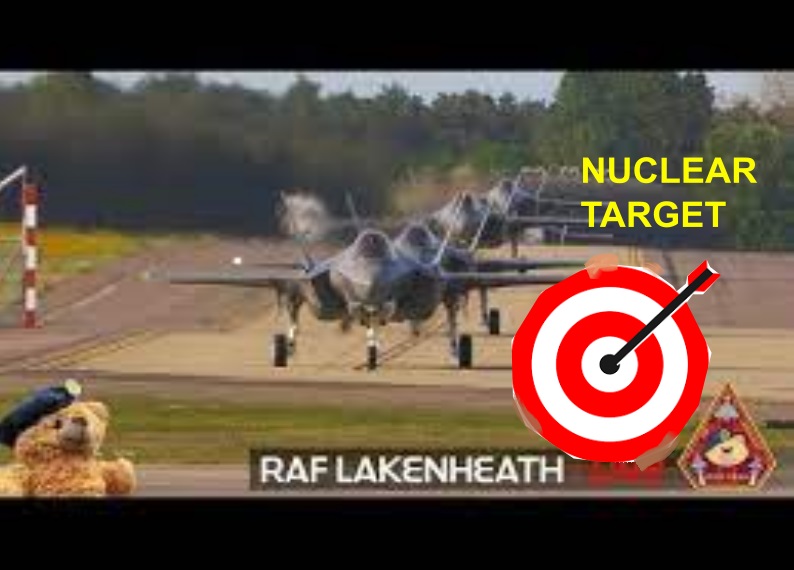
US nuclear missiles could be delivered to the UK as the Mirror reveals Ministry of Defence chiefs signed off on a secret pact allowing American forces to bring deadly bombs to UK
Chris Hughes Defence and Security Editor and Ashley Cowburn Political Correspondent, 06 Apr 2025
https://www.mirror.co.uk/news/world-news/nuclear-missile-cover-up-fears-34997771
British defence chiefs are at the centre of a ‘cover-up’ row over secretly exempting US troops from telling local authorities they are storing nuclear weapons. A declassified document proves former defence secretary Ben Wallace signed the ‘sensitive’ waiver which means local authorities are being left in the dark over the missiles.
The nuclear bust-up centres upon US air base RAF Lakenheath, home of F-35A Lightning II fighters, although the March 2021 waiver exempts all US bases in the UK. Not only are locals being kept in the dark over the possible nuclear missile storage but troops are also exempt from sticking to regulations applied to radiation risks. That means local authorities cannot draft disaster emergency plans.
The MoD was forced to declassify the Ben Wallace document down from ‘sensitive’ to prove to the Campaign for Nuclear Disarmament that legally they do not have to tell locals. It clearly says it was signed for ‘national security’ and that they are exempt from Ionisation Regulations 2017 and Radiation Regulations 2019.
Although it is not known publicly if RAF Lakenheath has US nuclear weapons on site, the exemption means nobody outside security-cleared personnel will ever know. CND General Secretary Sophie Bolt said: “The government’s exemption order smacks of a cover-up for a new generation of deadly US nuclear bombs that could be deployed in Britain.
“Nuclear weapons are the most destructive in the world. They put us all at risk every day. Yet the government is more concerned about its special relationship with the US than people’s safety.
“This declassified document shows that not only are US forces exempt from British nuclear safety laws at RAF Lakenheath, they are exempt at US bases right across Britain. This means that local authorities will never be told about any nuclear weapons present in their area. And will be under no legal obligation to produce emergency radiation plans.”
“The government doesn’t want people to know what’s going on. The government has to put a stop to these deadly nuclear risks. That means PM Keir Starmer should announce publicly that US nuclear weapons will not be stationed here.”
The exclusion of US troops from having to tell local authorities about the presence of nuclear weapons has infuriated politician critics in relation to blanket secrecy on nuclear weapons. Senior MP and former shadow chancellor John McDonnell stormed: “This is extremely concerning. “People need to know what risks their government is imposing on them. The ability to hold governments and the military to account is totally undermined by this level of secrecy. “
RAF Lakenheath first hit the nuclear spotlight again in 2022 when American plans to deploy nuclear weapons to the Suffolk airbase were revealed. It emerged again in department of defence documents showing plans to build accommodation for more US troops. The document stated the work was in preparation for the base’s “upcoming nuclear mission,” sparking controversy.
The US Office of the Under Secretary of Defence document sparked further fear as it stated the work was in preparation for the base’s potential ‘surety mission.’ The word ‘surety’ is understood to mean ‘nuclear weapons storage.’
But the UK Ministry of Defence said at the time it had a long-standing agreement within the department and its allies not to discuss nuclear weaponry. The following September a US government contracts award notice showed how £728,379.96 was to be spent on constructing guard facilities known as “hardened ballistic security shelters”.
Twenty-two blast resistant manoeuvrable cabins were being built with bulletproof metal flat sheets welded onto the frame to “to protect our high value assets”of RAF Lakenheath’s defence force, the 48th Security Forces Squadron (48 SFS). The specification for the windows included glass which could withstand an impact from a .30 calibre rifle.
In 2008 it was revealed nuclear bombs had been removed from RAF Lakenheath, which houses 4,000 service personnel and more than 1,500 British and US civilians. It is home to the US Air Force’s 48th Fighter Wing, which operates both the F-15E Eagle and the F-35A Lighting II fighter aircraft.
As well as normal combat duties it is believed the newer F-35A has been flight tested to use the latest variant of the B61-12 thermonuclear bomb. Defence specialising Janes Magazine said the B61-12 was capable of an explosive power of up to 340 kilotons, twenty times the power of the Hiroshima bomb.
On Friday an MoD spokesman, asked about the exemption, replied in a statement: “The UK and NATO have a long-standing policy to neither confirm nor deny the presence of nuclear weapons at any given location.
Manager at Hinkley Point C accepted a quad bike as a bribe, tribunal hears
Ashley Daniels accused of giving more work to engineering firm after gifts that also included £2,000 boxing tickets
Jamie Grierson, 8 Apr 25, Guardian
A senior manager at the Hinkley nuclear power plant accepted bribes such as an £11,000 quad bike to funnel extra work to a British engineering firm, an employment tribunal has heard.
Ashley Daniels was investigated by Hinkley’s owner, EDF, after he was given gifts such as £2,000 hospitality tickets for a boxing match and a refill for his Montblanc fountain pen, the tribunal in Bristol heard.
The hearing was told Daniels ensured more work was “directed” to a firm specialising in heavy lifting so that it could continue operating at the Somerset site.
The Guardian understands Daniels was dismissed by EDF.
The details have emerged in the judgment of a tribunal claim brought by an engineer called Garrick Nisbet, who sued his employer, Notus Heavy Lift Solutions – a subcontractor at Hinkley Point C – for unfair dismissal.
Hinkley Point C will be the first nuclear power station to be built in the UK for more than 30 years and is reported to have a price tag of up to £46bn…………………………………………………………..
https://www.theguardian.com/uk-news/2025/apr/07/manager-at-hinkley-point-c-accepted-a-quad-bike-as-a-bribe-tribunal-hears
Russian sensors suspected of attempting to spy on the UK’s nuclear submarines have been found hidden in the seas around Britain.
The discovery by the British military was deemed a potential threat to national security
and has never been made public.
Several were found after they washedashore, while others are understood to have been located by the Royal Navy.
The devices are believed to have been planted by Moscow to try and gather
intelligence on Britain’s four Vanguard submarines, which carry nuclear
missiles. One of these submarines is always at sea under what is known as
the UK’s continuous at-sea deterrent.
The Sunday Times has chosen to withhold certain details, including the locations of the sensors. During a three-month investigation we spoke to more than a dozen former defence
ministers, senior armed forces personnel and military experts to expose how
Russia is using its unrivalled underwater warfare capabilities to map, hack
and potentially sabotage critical British infrastructure.
Times 5th April 2025 https://www.thetimes.com/uk/defence/article/russia-secret-war-uk-waters-submarines-dpbzphfx5
Meltdown: the toxic culture that helped destroy the Nuclear Advanced Manufacturing Research Centre (AMRC)
Dan Hayes•28.03.2025, Sheffield Tribune
Complaints about bullying were made as far back as 2018. Why did the University of Sheffield turn a blind eye?
“This is a diary of events in note form and to be clear I have never felt the need, in 30 years of employment, to create such a record.”
That opening line was penned by Carl Hitchens in 2018. Hitchens, the former head of machining at the Nuclear AMRC, sent me the diary in place of a conversation. He told me he just couldn’t face reliving such a painful period.
The Nuclear AMRC was set up in 2009 with a simple mission: to help UK manufacturers win work in the civil nuclear sector. As well as research and development into nuclear technologies, the centre also worked with British firms to help them design and build components that could be used in nuclear power plants. Ostensibly part of the University of Sheffield, the Nuclear AMRC enjoyed a large degree of autonomy from its parent organisation.
As we found in our piece last year, the Nuclear AMRC never found its task easy. Continuing concerns about the safety of nuclear energy, the government’s refusal to commit to its future, and newer technologies like small modular reactors (SMRs) all created a challenging environment to navigate. Despite this, all indications are that, in its early days, the Nuclear AMRC was a fairly happy ship.
So how did something that was meant to put South Yorkshire at the centre of a generational transformation of the UK energy sector fall apart in a few short years? How did the Nuclear AMRC go from being touted as a huge growth success story, to being all but shut down? Carl Hitchens’ diary — and the recollections of his colleagues — are now allowing us to answer that question……………………………………..(subscribers only) https://www.sheffieldtribune.co.uk/meltdown-the-toxic-culture-that-helped-destroy-the-nuclear-amrc/
What really happened in Bucha? The questions Western media won’t ask
By Petr Lavrenin, an Odessa-born political journalist and expert on Ukraine and the former Soviet Union – https://www.rt.com/russia/614967-what-really-happened-in-bucha/ 2 Apr 25 [illustrations]
The narrative on an event from three years ago is under scrutiny. Here’s a closer look at the evidence
On the first day of April in 2022, shocking videos began circulating on Ukrainian social media, showing the streets of Bucha, a town in Kiev region, strewn with dead bodies. The “Bucha massacre” quickly became one of the most widely discussed and controversial chapters of the ongoing Russia-Ukraine conflict. Western media immediately accused the Russian army of mass killings, while Vladimir Zelensky declared that these acts were not only war crimes but a genocide against his country’s people.
However, a closer look at the situation raises numerous questions. An analysis of video footage, satellite images, and eyewitness accounts reveals significant inconsistencies that cast doubt on the official narrative adopted by Kiev and its Western allies. This article explores why it appears the so-called “Bucha massacre” has been fabricated.
What do we know
Bucha, with a population of 40,000 people, found itself on the front lines from the first days of the Ukraine conflict. To the north of Bucha lies the village of Gostomel, home to the strategically important Antonov Airport, where Russian paratroopers landed on the morning of February 24, 2022. This group soon joined the main Russian units advancing from Belarus.
In the days that followed, fierce battles broke out around Bucha as Russian troops attempted to establish a foothold in the town and push toward Irpin, a large suburb of Kiev. Nevertheless, the area remained under the control of the Armed Forces of Ukraine (AFU) and territorial defense units.
Between March 3 and 5, Russian forces entered Bucha from the side of the village of Vorzel, setting up a base at a glass factory and along the southern outskirts of the city. From then on, Bucha became a transit point and rear base for Russian troops engaged in combat near Kiev.
On March 29, following a round of negotiations between Russia and Ukraine, Russian Deputy Defense Minister Alexander Fomin announced a significant reduction in military activity around Kiev and Chernigov.
By March 30, Russian forces began withdrawing from Kiev Region due to the shifting priorities of the military operation.
However, just days after their retreat, shocking footage emerged that stunned the whole world.
When Ukrainian soldiers entered Bucha, international media outlets began publishing photo and video evidence of murdered civilians. Vladimir Zelensky and his team quickly accused Russian troops of committing mass murder, labeling it an act of genocide.
“This is genocide. The annihilation of an entire nation and people,” Zelensky declared on CBS’s Face the Nation. Ukrainian Foreign Minister Dmitri Kuleba called on the G7 countries to impose immediate “new devastating sanctions” against Russia, including imposing a complete embargo on Russian oil, gas, and coal, closing ports to Russian vessels, and disconnecting Russian banks from the SWIFT system.
The Russian Foreign Ministry denied any involvement in civilian deaths. Press Secretary of the President of the Russian Federation Dmitry Peskov said that the images showed “signs of forgery” and manipulation.
From the beginning, the narrative surrounding the “Bucha massacre” was full of inconsistencies and peculiarities, many of which remain unclear to this day.
Timing discrepancies
Among the key arguments that cast doubt on the Ukrainian narrative of mass killings in Bucha are the timing discrepancies.
The Russian Ministry of Defense has consistently stated that all Russian units had left Bucha by March 30, 2022. This claim is supported by local authorities. On March 31, Bucha Mayor Anatoliy Fedoruk recorded a video message confirming the withdrawal of Russian forces but did not mention any mass killings or bodies. In the background of the video, the streets appear clear, and there are no signs of corpses or destruction. At the same time, Ukrainian MPs and military personnel were in Bucha, yet none of them reported seeing dead bodies. Local residents did not mention any mass shootings either.
The first images of the bodies emerged only on April 1-2, a couple of days after Ukrainian military personnel and activists entered the city. This raises questions about the timing and circumstances surrounding their deaths: if Russian troops left Bucha on March 30, how could evidence of the killings have come to light only several days later?
Analysis of video footage from the scene further shows that many bodies appear too “fresh” to have been lying there for over a week. Forensic experts point out that signs of decomposition should have manifested much earlier if the deaths truly occurred in mid-March. Photos and videos provided by Ukrainian and Western media show signs (such as drying skin in certain areas) that suggest death likely took place just hours or a day before the images were captured.
Controversial satellite images and social media data
On April 1, 2022, Maxar Technologies released satellite images dated March 19, allegedly showing bodies on Yablonskaya Street in Bucha. These images were cited by Ukrainian and Western media as key evidence of mass killings supposedly carried out by Russian forces.
However, these images are highly questionable. Independent researchers have noted that the images may have been manipulated or backdated.
Firstly, the March images from Maxar, published by The New York Times, are of very low quality compared to the February photos. This complicates analysis and raises suspicions of manipulation. The objects depicted in the images cannot be unequivocally identified as bodies, so claims about corpses that have been there for a long time rely solely on Western media reports and have not been independently verified. The images could have been altered or backdated to suggest that the bodies had been on the streets since March.
Secondly, the weather conditions captured in the videos do not match the meteorological data for the dates specified in Western media reports. This discrepancy indicates a possible mismatch in the timing of the recordings.
Thirdly, Maxar Technologies has close ties to US government structures, raising concerns about a potential bias and the use of its data for propaganda purposes.
Alexey Tokarev, who has a PhD in political science, and his team from the Moscow State Institute of International Relations conducted an analysis of media coverage, social media, and Telegram channels related to Bucha, and uncovered an intriguing pattern: there were no mentions of bodies on Yablonskaya Street prior to April 1. While there were reports of destruction, prisoners, and fighting, there was no information regarding mass killings.
“If we are to believe the Western media, the town has been full of corpses since April 1, and according to a leading American newspaper, even earlier – since March 11. So why is it that in a video captured by the Ukrainian police on April 2, which features 14 civilians, no one mentions any bodies or mass executions? The nearly eight-minute-long video shows nine different locations in the small town, but we don’t see a single corpse,” Tokarev says.
Discrepancies in visual evidence
The videos and photographs released by the Ukrainian side reveal numerous inconsistencies that suggest a possible staging. For instance, in one case, we see Ukrainian soldiers moving bodies between takes, while in another video, a “corpse’s” hand noticeably twitches. These signs indicate that the individuals depicted were not actually dead.
The Investigative Committee of Russia reported that the bodies did not display signs of having been outside for an extended period – there were no corpse marks and uncoagulated blood in wounds – casting doubt on the official Ukrainian narrative. Experts also noted the absence of shrapnel or explosive damage near the bodies, further contradicting claims of mass shootings.
Additionally, many victims, judging by photos, wore white armbands – a symbol typically associated with pro-Russian civilians. This suggests that Ukrainian forces might have targeted individuals suspected of “collaboration”, i.e., cooperating with Russian troops, and then accused the other side of the murders.
Moreover, in the initial days following the withdrawal of Russian troops from Bucha, a curfew was imposed, restricting locals from venturing into the streets. This created suitable conditions for the potential fabrication of events.
Eyewitness accounts and questionable sources
Adrien Bocquet, a French volunteer and journalist who was in Kiev Region during intense fighting, claimed that he personally witnessed Ukrainian forces staging mass killings in Bucha.
He recounted seeing bodies being brought into the city and arranged on the streets to create the impression of “mass deaths”. “When we drove into Bucha, I was in the passenger seat. As we passed through the city, I saw bodies lying on the roadside, and right before my eyes, people were unloading corpses from trucks and placing them next to those already on the ground to amplify the effect of mass casualties,” he said.
“One of the volunteers who had been there the day before – let me emphasize that this is not something I observed myself, but what I heard from another volunteer – told me he saw refrigerated trucks arriving in Bucha from other cities in Ukraine, unloading bodies and lining them up. From this, I realized that these were staged incidents,” he stated.
According to Bocquet, volunteers were prohibited from taking photos or videos.
Interestingly, in June 2022, the Office of the Prosecutor General of Ukraine stated that many claims made by former Ombudsman for Human Rights in Ukraine Lyudmila Denisova, including those related to the events in Bucha, were not accurate. “Law enforcement officials tried to carry out their own investigation. They went through all medical reports, police statements, and data on the deceased, attempting to find cases (…). However, all this work proved futile,” reported the news outlet Ukrainskaya Pravda.
Russian military correspondents, including Aleksandr Kots, have also referred to the so-called Bucha massacre as fake. Kots, who visited Bucha in February and March 2022, said “It’s not hard to verify what I’m saying. A forensic examination would determine the time of death of those poor people and align it with NATO’s objective monitoring data, which clearly indicates when Russian troops withdrew. But that’s if you’re looking for the truth. And who in the West wants that?”
Motives and geopolitical context
The story of the Bucha massacre emerged at a time when both the Ukrainian and Russian sides, albeit with varying degrees of optimism, were reporting progress in ceasefire negotiations.
“The Ukrainian side has become more realistic regarding issues related to Ukraine’s neutral and non-nuclear status, but the draft agreement is not ready for top-level discussions,” said Vladimir Medinsky, head of the Russian delegation and an aide to the President of Russia. Meanwhile, Ukrainian negotiator David Arahamiya noted that the document was ready, and the two presidents could meet and discuss it.
However, following reports of the “Bucha massacre,” Zelensky withdrew from the peace talks.
The incident in Bucha became a pivotal moment that not only derailed peace negotiations in Istanbul but also intensified Russia’s diplomatic isolation in the West, led to the mass expulsion of Russian diplomats and tighter sanctions, and resulted in Ukraine receiving additional military aid from NATO states.
Without presenting sufficient evidence, Western media spread the narrative of the “atrocities” committed by Russian forces. This suggests that the events in Bucha may have been used as a propaganda tool.
To date, no independent investigation has confirmed the accuracy of Ukraine’s accounts. Additionally, a complete list of casualties and the circumstances surrounding their deaths has yet to be made public.
Analyzing timing discrepancies, satellite images, video footage, eyewitness accounts, and Ukraine’s motives suggests that the events in Bucha may have been fabricated or politically exploited.
Despite the extensive media coverage of the “Bucha massacre,” Ukraine’s official narrative raises many questions and demands an independent inquiry. Ukraine has failed to conduct a thorough investigation or provide any coherent explanation as to why Russian soldiers would kill innocent civilians. The argument of Russia’s deep-seated hatred and brutality towards Ukrainians simply doesn’t hold up under scrutiny, since no similar tragedies have been documented during the course of the conflict. Instead, the “massacre” has become part of a media campaign aimed at dehumanizing Russian soldiers and portraying them as occupiers.
Bucha stands as one of the key propaganda symbols in the anti-Russia campaign. However, a closer examination of the evidence reveals numerous unanswered questions that officials prefer to avoid. An independent investigation could shed light on the true circumstances, but given the ongoing information war, it is unlikely to happen soon.
By Petr Lavrenin, an Odessa-born political journalist and expert on Ukraine and the former Soviet Union
Event to mark 40th anniversary of mysterious death of Willie McRae
The National 31st March 2025, By James Walker, https://www.thenational.scot/news/25052033.event-mark-40th-anniversary-mysterious-death-willie-mcrae/
AN EVENT is to be held in the Highlands to mark the anniversary of the mysterious death of Willie McRae.
In 1980, McRae – a top lawyer and senior SNP member – made headlines after representing a group opposed to dumping nuclear waste in the Ayrshire hills at a public inquiry.
He won, and the victory proved a major setback in plans for having nuclear waste buried across the UK.
But on the evening of Good Friday, April 5, 1985, McRae set off from his flat in Glasgow’s southside for his holiday cottage close to Dornie in Wester Ross. He never arrived.
Instead, on April 6, his car was found by the side of the road. He was in the front seat with a bullet through his right temple.
On Sunday, April 7, McRae died without ever regaining consciousness.
A post-mortem concluded suicide, but questions have persisted for decades. A gun was not found when the scene was first visited by the police, but was when the scene was searched the following week.
Now, a group of Yessers is looking to hold an event to draw new attention to McRae’s case.
“Forty years has passed since a man was found dying on a Highland road in mysterious circumstances. Not just any man, but a seeker of justice and a thorn in the side of the establishment,” Pete Smith, an event organiser and a member of Yes Highlands and Islands, told The National.
He added: “Willie McRae took a massive secret to his grave and we intend to seek justice for McRae by demanding a public enquiry into the case.”
There are six speakers lined up, including Ron Culley whose book Firebrand examines the McRae case in detail and is also mentioned on the flyer which has been created for the event (above).
A piper and – reportedly – a film crew will also be in attendance.
The organisers also wished to stress that this is not an independence event, although added that the “quest for Scotland’s self governance is of course linked to this killing”.
The event will be held at the Willie McRae Memorial Cairn, on the A87 at the side of Loch Lorne, at 12 noon on April 5.
Attendees will then head to the nearby Invergarry Hotel for speeches – with those wishing to attend asked to register via Eventbrite due to limited space.
Organisers were also keen to highlight that parking is limited near the cairn.
1 This Month

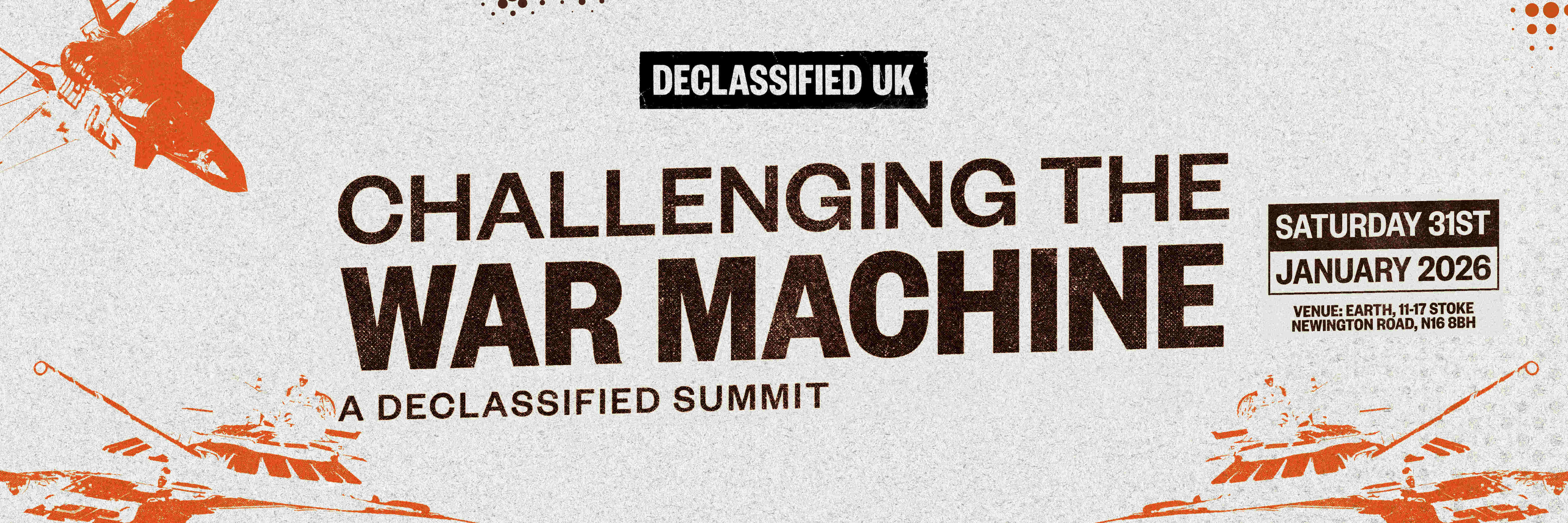
31st January – Challenging the War Machine – a DECLASSIFIED UK SUMMIT

Website of the Week
Now until to February 10, 2026 Radioactive waste storage in France: the debate is finally open! How to participate?
-
Archives
- January 2026 (227)
- December 2025 (358)
- November 2025 (359)
- October 2025 (377)
- September 2025 (258)
- August 2025 (319)
- July 2025 (230)
- June 2025 (348)
- May 2025 (261)
- April 2025 (305)
- March 2025 (319)
- February 2025 (234)
-
Categories
- 1
- 1 NUCLEAR ISSUES
- business and costs
- climate change
- culture and arts
- ENERGY
- environment
- health
- history
- indigenous issues
- Legal
- marketing of nuclear
- media
- opposition to nuclear
- PERSONAL STORIES
- politics
- politics international
- Religion and ethics
- safety
- secrets,lies and civil liberties
- spinbuster
- technology
- Uranium
- wastes
- weapons and war
- Women
- 2 WORLD
- ACTION
- AFRICA
- Atrocities
- AUSTRALIA
- Christina's notes
- Christina's themes
- culture and arts
- Events
- Fuk 2022
- Fuk 2023
- Fukushima 2017
- Fukushima 2018
- fukushima 2019
- Fukushima 2020
- Fukushima 2021
- general
- global warming
- Humour (God we need it)
- Nuclear
- RARE EARTHS
- Reference
- resources – print
- Resources -audiovicual
- Weekly Newsletter
- World
- World Nuclear
- YouTube
-
RSS
Entries RSS
Comments RSS
 nuclear-news