Israel-Hamas “war” – another excuse to shut down free speech

Kit Knightly 11 Oct 23 https://off-guardian.org/2023/10/11/israel-hamas-war-another-excuse-to-shut-down-free-speech/
As a brand new war-narrative unfolds, there’s already efforts underway to parlay the conflict into tighter controls on free speech and freedom of expression, both in person and on the internet.
The headlines have been filled with nothing but Israel and Hamas since the “surprise attack” on Saturday, with the predictable back and forth of historical grievances and accusations of racism, punctuated by unsubstantiated claims of atrocities.
“Atrocity Propaganda” is nothing new. It is the opening salvo of every war as state combatants try to win the public to their side.
For example, the totally unsubstantiated claim that Hamas “threw forty Jewish babies out of their cribs and beheaded them”, which was doing the rounds yesterday. As far as atrocity propaganda goes the claim is startling in its unoriginality (Nayirah anyone?)
There’s a lot of that right now, lurid claims of graphic and pointless violence directed against the innocent, most of which survives just long enough to cause some outrage before being “debunked” or walked-back.
Part of that is the general “fog of war”, heightened by the advent of social media. When a lot of people can talk a lot more is said (good and bad).
But there’s another interpretation: That fake war stories are being intentionally seeded onto social media and then “debunked” to discredit platforms and appear to justify digital censorship.
Within the past twenty-four hours Reuters, NBC, YahooNews, The Guardian and the AP have run stories criticising the proliferation of “fake war news” on social media. Al Jazeera joined in too.
Almost all of those accusations have been directed solely at Twitter/X – increasingly the media’s anti-free speech strawman.
Governments have not been quiet on the issue either, with the European Union reportedly “warning” Elon Musk there would be “penalties” for the spread of war-related “misinformation” on his platform.
It’s not just “misinformation” either, but also “hate”. In an unusually subtle headline, NBCNews warns of the “increasingly fraught nature of online speech”. USA Today is more on the nose, claiming “online hate” is “surging”.
Oh, and there are the “unregulated” sites to worry about, where terrorists allegedly upload violent videos, at least so the New York Times says:
Hamas Seeds Violent Videos on Sites With Little Moderation”
It’s not hard to see where this leads.
And while “misinformation” is used to justify social media censorship, “safety” is used to justify shutting down freedom of assembly.
In the UK and US pro-Palestinian rallies were met with calls for the police to get involved, citing laws that outlaw the public support of “listed terrorist organizations”.
UK Home Secretary Suella Braverman has told the police that waving a Palestinian flag could be considered a crime. Metropolitan police are engaging in “reassurance patrols”.
In France the police are already more directly involved, shutting down a pro-Palestine demonstration.
…and people applauded.
Many of them the same voices who railed against tyranny in defending the Canadian truckers or anti-lockdown protests. It is disheartening to see.
In short, the “war” is four days old and is already being used to suppress dissent on the streets and argue against free-speech on the internet.
However the war narrative evolves over there, over here it’s just more of the same.
Journalism Itself Is Locked Up In Belmarsh
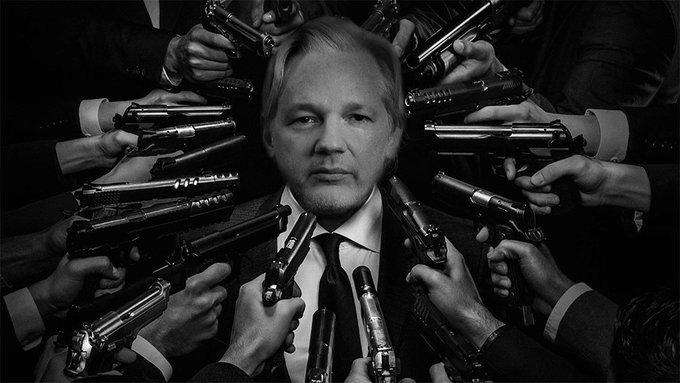
they are showing the world that they can lock up anyone.
That’s what this case has always been about.
It’s about setting a legal precedent that will allow the US empire to extradite anyone anywhere in the world who reveals inconvenient facts about it.
CAITLIN JOHNSTONE, OCT 5, 2023 https://www.caitlinjohnst.one/p/journalism-itself-is-locked-up-in?utm_source=post-email-title&publication_id=82124&post_id=137688774&utm_campaign=email-post-title&isFreemail=true&r=1ise1&utm_medium=email #JulianAssange
As the 17th anniversary of the creation of WikiLeaks passes us by, it’s probably worth taking a moment to reflect on Julian Assange and what his persecution means for us and our society.
Because in a very real sense, it’s not just a man locked up in Belmarsh Prison for the crime of good journalism — it’s journalism itself. It’s the idea that anyone should be permitted to expose the criminality of the world’s most powerful and tyrannical people. It’s the idea that the public should be allowed to know what abuses the US empire is committing around the world.
Julian Assange is the world’s greatest journalist. By revolutionizing source protection for the digital age with the creation of WikiLeaks 17 years ago and then going on to break some of the biggest stories of the 21st century, Assange set himself head and shoulders above any other living reporter anywhere on earth. And by showing the world that they can lock up the world’s greatest journalist for revealing inconvenient truths, they are showing the world that they can lock up anyone.
That’s what this case has always been about. It’s not about whether Assange crossed some arbitrary procedural line when working with Chelsea Manning to expose US war crimes. It’s not about the US protecting its national security. It’s not about any of the other justifications people have put forward to excuse their sycophantic support for the persecution of a journalist for doing journalism. It’s about setting a legal precedent that will allow the US empire to extradite anyone anywhere in the world who reveals inconvenient facts about it. It’s about showing all journalists everywhere that if they can do it to the greatest among them, they can do it to any of them. And, like so much else in the world today, it’s about narrative control.
To accept the persecution of Julian Assange is to accept the idea that all media everywhere must function as propaganda organs of the US government. It’s to take it as a given that any journalist anywhere in the world who decides to do real journalism and expose inconvenient facts about the powerful in the public interest should be jailed until they can be extradited to the United States for a show trial, and then left to rot in one of the most draconian prison systems on the planet. It’s to accept that we will never live in a truth-based society guided by facts and information, and must forever resign ourselves to living in a society dominated by the whims of the powerful.
Your position on the Assange case is therefore your position on what kind of society we should hope to live in, and what kind of future we should hope to have. In a very real way, it’s your position on humanity itself.
Should humanity try to create a better world, or should we keep plunging into dystopia until we are driven into nuclear war or environmental catastrophe by rulers we are forbidden to question? Do we want to move into the light, or into the darkness? Your position on Assange shows your answer to these questions, and shows which course you want us to take.
Chris Hedges: Craig Murray on the ‘Slow Motion Execution’ of Assange
And I saw, 100% for certain, that the judge came into court with her ruling already typed out before she heard the arguments, and she sat there almost pretending to listen to what the defense was saying for now and what the prosecution was saying for now. Then she simply read out the ruling.
Chris Hedges: She’s like the Queen of Hearts in Alice in Wonderland giving the verdict before she hears the sentence.
SCHEERPOST, September 17, 2023
Julian Assange continues to fight extradition to the United States to face prosecution under the Espionage Act, a growing chorus of voices is rising to demand an end to his persecution. Hounded by US law enforcement and its allies for more than a decade, Assange has been stripped of all personal and civil liberties for the crime of exposing the extent of US atrocities during the War on Terror. In the intervening years, it’s become nakedly apparent that the intent of the US government is not only to silence Assange in particular, but to send a message to whistleblowers and journalists everywhere on the consequences of speaking truth to power. Former British ambassador to Uzbekistan, Craig Murray, who was fired for exposing the CIA’s use of torture in the country, joins The Chris Hedges Report to discuss what Julian Assange’s fight means for all of us.
TRANSCRIPT
Chris Hedges: Craig Murray, the former British ambassador to Uzbekistan, was removed from his post after he made public the widespread use of torture by the Uzbek government and the CIA. He has since become one of Britain’s most important human rights campaigners and a fierce advocate for Julian Assange as well as a supporter of Scottish independence. His coverage of the trial of former Scottish first minister Alex Salman, who was acquitted of sexual assault charges, saw him charged with contempt of court and sentenced to eight months in prison. The very dubious sentence, half of which Craig served, upended most legal norms. He was sentenced, supporters argued, to prevent him from testifying as a witness in the Spanish criminal case against UC global director, David Morales, being prosecuted for installing a surveillance system in the Ecuador embassy when Julian Assange found refuge that was used to record the privileged communications between Julian and his lawyers.
Morales is alleged to have carried out this surveillance on behalf of the CIA. Murray has published some of the most prescient and eloquent reports from Julian’s extradition hearings and was one of a half dozen guests, including myself, invited to Julian and Stella’s wedding in Belmarsh Prison in March 2022. Prison authorities denied entry to Craig, based on what the UK Ministry of Justice said were security concerns, as well as myself from attending the ceremony.
Joining me to discuss what is happening to Julian Assange and the rapid erosion of our most basic democratic rights is Craig Murray.
And to begin, Craig, I read all of your reports from the trial which are at once eloquent and brilliant. It’s the best coverage that we’ve had of the hearings. But I want you to bring us up to date with where we are with the case at this moment.
Craig Murray: Yeah. The legal procedures have been extraordinarily convoluted after the first hearings for the magistrate ruled that Julian couldn’t be extradited, on essentially, health grounds. Due to the conditions in American prisons, the US then appealed against that verdict. The high court accepted the US appeal on extraordinarily dubious grounds based on a diplomatic note giving certain assurances which were conditional and based on Julian’s future behavior. And of course, the US government has a record of breaking such assurances, and also, those assurances could have been given at the time of the initial hearing and weren’t.
Chris Hedges: I don’t think those assurances have any… It was a diplomatic note. It has no legal validity.
Craig Murray: It has no legal validity. It’s not binding in any sense. And as I say, it is in itself conditional. It states that they may change this in the future. It actually says that –
Chris Hedges: Well, based on his behavior.
Craig Murray: – Based on his behavior, which they will be the sole judges of.
Chris Hedges: Of course.
Craig Murray: And which won’t involve any further legal process. They will decide he’s going into a supermax because they don’t like the way he looks at guards or something. It’s utterly meaningless. And so the US, having won that appeal so Julian could be extradited, it was then Julian’s turn to appeal on all the points he had lost at the original extradition. Those include the First Amendment, they include freedom of speech, obviously, and they include the fact that the very extradition treaty under which he’s being extradited states that there shall be no political extradition and this is plainly a very political case and several other important grounds. That appeal was lodged. Nothing then happened for a year. And that appeal is an extraordinary document. You can actually find it on my website, CraigMurray.org.uk.
I’ve published the entire appeal document and it is an amazing document. It’s an incredible piece of legal argument. And some of the things it sets out like the fact that the US key witness for the charges was an Icelandic guy who they paid for his evidence. They paid him for his evidence and he is a convicted pedophile and convicted fraudster. And since he has said he lied in his evidence and he just did it for the money. That’s one example of the things you find. The documentation is not dry legal documentation at all. It’s well worth going and looking through Julian’s appeal. That appeal ran to 150 pages plus supporting documents.
For a year, nothing happened. Then two or three months ago it was dismissed in three pages of double-spaced A4, in which the judge, Judge Swift, said that there were no legal arguments, no coherent legal arguments in this 150 pages and it followed no known form of pleading and it was dismissed completely. And the thing is that the appeal was written by some of the greatest lawyers in the world. It’s supervised and written by Gareth Pierce, who I would say is the greatest living human rights lawyer. Those people have seen the film In the Name of the Father, starring Daniel Day-Lewis…………………………………….
She’s won numerous high-profile cases. She has enormous respect all around the world and this judge, who is nobody, is saying that there’s no validity to her pleadings which follow no known form of pleading. This is quite extraordinary.
Chris Hedges: Am I correct in that he was a barrister, essentially, for the defense ministry? He was served the interests of the UK government and that’s essentially got him his position. Is that correct?
Craig Murray: Exactly. He was the lead barrister for the security services. Well, he was a banister who specialized in working for the security services.
……………………………………………………And I saw, 100% for certain, that the judge came into court with her ruling already typed out before she heard the arguments, and she sat there almost pretending to listen to what the defense was saying for now and what the prosecution was saying for now. Then she simply read out the ruling.
Chris Hedges: She’s like the Queen of Hearts in Alice in Wonderland giving the verdict before she hears the sentence.
……………………………..On the most basic level, the evisceration of attorney-client privilege because UC Global recorded the meetings between Julian and his lawyers, that in a UK court, as in a US court alone, should get the trial invalidated
Craig Murray: In any democracy in the world, if your intelligence services have been recording the client’s attorney consultations, that would get the case thrown out. ………………………….
……………………………………………………………………………………………………………….at times it seemed as though they were deliberately doing things as slowly as possible.
Chris Hedges: Well, this is what Neils Melzer, the special repertoire on torture for the UN, said that he called it, a slow motion execution, were his words.
………………………………..Craig Murray: It was because of my advocacy for and friendship with Julian. That’s why they put me in jail. I was in the cell, my cell was 12 feet by eight feet which is slightly larger than Julian’s cell, and I was kept in solitary confinement for 23 hours a day, sometimes 23.5 hours a day for four months. And that’s extremely difficult. It’s extremely difficult. But I knew when I was leaving, I had an end date. To be in those conditions as Julian has been for years and years and no idea if it will ever stop, no idea if you’ll ever be let out alive, let alone not having an end date, I can’t imagine how psychologically crushing that would be……………………………………………………………………………….
Craig Murray: The immediate thing that will happen is that Julian’s lawyers will try to go to the European Court in Strasbourg –
Chris Hedges: To the European Court of Human Rights.
Craig Murray: – The European Court of Human Rights to submit an appeal and get the extradition stopped, pending an appeal. The worry is that Julian would instantly be extradited and that the government wouldn’t wait to hear from a European Court.
Chris Hedges: Explain to Americans what it is and what jurisdiction it has in the UK, the European Court.
Craig Murray: Yeah, the European Court of Human Rights is not a European Union body. It’s a body of the Council of Europe. It has jurisdiction over the European Convention on Human Rights which guarantees basic human rights and therefore it has legally binding jurisdiction over human rights violations in any member state of the treaty. So it does have a legally binding jurisdiction and is acknowledged as such, normally, by the UK government. They’re very powerful voices within the current conservative government in the UK which wants to exit the convention on human rights. But at present, that’s not the case. The UK is still part of this system. And so the European Court of Human Rights has legally binding authority over the government of the United Kingdom purely on matters that contravene human rights.
Chris Hedges: And if they do extradite him, they’ve essentially nullified that process, the fear is that, of course, the security services would know about the ruling in advance. He’d be on the tarmac and shuttled in, sedated, and put in a diaper and hooded or something and put on a CIA flight to Washington. I want to talk about if that happens. It’s certainly very possible. What we need to do here, and I know part of the reason you’re in the US, is to prepare for that should it take place. You will try and cover the hearings and trial here as you did in the UK but let’s talk about where we go if that event occurs.
Craig Murray: Yeah. The first thing to say is that if that happens, on the day it happens, it will be the biggest news story in the world; It would be a massive news story. So we have to be prepared. We have to know who, from the Assange movement or who from his defense team, who’s going to be the spokesman, who are going to be the spokespeople, who are going to be offered up to all the major news agencies? We have to affect the story on day one. Because if you get behind the story – And we know what their line will be. They’ll put out all these lies about people being killed because of WikiLeaks, about the American insecurity being endangered, we know all the propaganda that they will try to flood the airwaves with – So we need to be ready and ahead of the game to know who our people are, who are going to be offered up to interview, who are going to proactively get onto the media, and not just the alternative media like this media, but onto the so-called mainstream as well, and get out the story…………………………………………………………………………………………………………………………………………………………………
Chris Hedges. ………………….my reading of it is that they don’t care how they look. And part of it is to send a message. It doesn’t matter what nationality you are, it doesn’t matter where you are. WikiLeaks is not a US-based publication, it doesn’t matter where you are. If you expose the information that Julian and WikiLeaks exposed, we’re going to come for you. Isn’t that the message?
Craig Murray: That’s absolutely right. And this, again, it’s amazing they don’t see the dangers in this claim of universal jurisdiction. …………………….
This claim of universal jurisdiction is extraordinary. And what’s even more extraordinary is they’re claiming universal jurisdiction but Julian is under their jurisdiction because he published American Secrets even though he’s not an American and he wasn’t in America. And at the same time, while they claim jurisdiction over him, they’re claiming he has no First Amendment rights because he’s an Australian.
The combination of we have jurisdiction over you, you have all the liabilities that come with that but you have none of the rights that come with that because you’re not one of our citizens, that’s pernicious. It’s so illogical and so vicious. …………………………………………
Chris Hedges: I want to close because there’s been noise out of Australia. The ambassador, Carolyn Kennedy, said that they might consider a plea deal. I have put no credence in it. It’s all smoke but I wondered what you thought.
Craig Murray: Yeah. It’s an attempt to placate Australian public opinion. Public opinion in Australia is extremely strong. Over 80% of Australians want Julian released and allowed to go home to Australia. Blinken came there and made some very hostile and un-diplomatic remarks at a time when Australia was allowing the US to base nuclear weapons on its side. Caroline Kennedy came out… It’s a lie, frankly. There has been no approach from a justice department or from the State Department to doing any plea deal. It’s purely smoke and mirrors to try to distract the Australian public. Caroline Kennedy was lying to the Australian public. That’s pure and simple.…………..
JULIAN ASSANGE AND THE END OF AMERICAN DEMOCRACY
The revival of the Espionage Act in the persecution of Assange is destroying the very foundation of democracy
The US government has hounded Julian Assange since WikiLeaks first revealed the extent of US war crimes in 2010. In the process of persecuting Assange, the federal government has used every tool at its disposal and even pushed beyond the boundaries that supposedly restrict state power in defense of civil liberties. One of the most insidious tactics is the use of the Espionage Act, which had not been used for against whistleblowers and journalists for almost a century before Assange’s case. In the first part of a two-part conversation, lawyer and human rights defender Stella Assange, spouse of Julian Assange, joins Chris Hedges for a look at the vast and vicious campaign by the US to silence Julian Assange, and what it all portends for our democracy.
…..one of the things that’s disturbed me from the start is how all of the international bodies and the legal entities that have gone after Julian, have broken their own rules and it’s so blatant. That’s what I find kind of incomprehensible because it’s public. It’s not a secret. I mean, there is many secret stuff they’ve done, too, of course. But, you know, revoking political asylum, allowing British police to go in on sovereign territory, charging him under the Espionage Act when he’s not an American citizen, recording his meeting with his attorneys. I mean, any one of these things in a normal legal procedure, would have seen the case dismissed and yet they keep doing it and doing it.
…………. if they eviscerate the rule of law, it’s not just going to be for Julian. They set those kinds of precedents and if they’re allowed to get away with it with anyone, it’s dangerous. That’s what, for me, is just so frustrating.
STELLA
But don’t you think they’re deliberately dismantling the system? They want to show that they are dismantling it.
CHRIS
Yes, of course, they are. But they’re dismantling it right in front of us and we’re just watching. I’m talking about the broader public and not reacting.
Yes, of course, that is the goal.
And so in a way, that passivity makes us complicit in what is ultimately our own enslavement. I mean, this is all, of course, even beyond Julian as a person and as a journalist. And that’s what, you know, having followed this case for several years and as you know, I was very close friends with Michael Ratner, which is how I met Julian, because I would come to London with Michael. I’m just kind of mystified at how people can’t see where this is going to lead………………………………………………………….
CHRIS
……… I think reading the CIA, which is a state within a state, it’s not even accountable within the Congress. And there was a few years ago, Feinstein, after the torture was exposed, tried to do a congressional report and there was this really revealing moment. I’m no fan of Feinstein, but she was, at that moment, trying to do the right thing.And she came out and she was just ashen. And I can’t remember the exact words, but it’s something like, “we can’t take on these people…”, because they had bugged all the computers in the congressional office, they destroyed information.
And I think it was that moment where she personally realised that we can’t control, there’s no regulation, there’s no oversight, there’s no control. And unlike the Church and the Pike committees that in the middle 70s, had exposed the crimes. That was it. That moment is gone. And I think that Vault 7, because of this kind of imperial attitude on the part of the CIA where they can do anything, because the CIA, we have 17 intelligence communities in the United States. I mean, the CIA as an intelligence organization is kind of redundant.
And what it has done is transformed itself into a paramilitary, especially after 9/11. And it’s completely in the dark. It has its own drones and special forces units. Having had friends who served in Afghanistan and Iraq, these people create more problems than they solve because they’ll go on extraction and night raids and anger an entire village and then the next day the Rangers will go through the village and they open fire on…I mean, they’re counterproductive. And I think that what happened with Vault 7 is that you now have an incredibly powerful organisation that is, in essence, a paramilitary organisation with huge resources and that exposure of Vault 7, they’re not used to being monitored, exposed in any way. I think the anger, I think it was more visceral. I think the anger within the CIA was ran really deep. And, you know, again, I haven’t spoken to anyone in the CIA, but my guess is that at that point, they laid down the law. We’re getting Julian. That’s my my guess.
I think it’s all being, because Biden, no matter who’s in the office, Obama, you can’t, at this point they talk about the Dark State. I mean, these are the, you know, figures like Biden are the puppets. In the military, you know, the US military has not been audited for a decade. I read somewhere we spend more on military bands than we do on the State Department. I mean, again, it’s like ancient Rome. I mean, it’s its own entity, almost severed from the government.
But that’s how I read what happened after Vault 7.
…………………………………………………………………………………………………………………………………….. there is no investigative journalism now within the government, with the inner workings of government, because everyone’s too frightened to talk, because they they’re they can immediately be traced.
So the last readout of any kind of exposure of the the the crimes, the criminal activity of power comes through people who are like Chelsea manning or Snowden, who have access to documents and will leak them,……………………………………………………………….
It means there is no power is in no way accountable. There’s no transparency, and we know history has taught us that when that kind of secrecy is imposed on autocratic power, it just in abuse grows upon abuse grows upon abuse. And that is why they’re just determined to crucify Julian.
That’s the crisis that we’re in.
We’ve lost the ability to know what power is doing.
STELLA
I have this feeling that in order to establish the baseline, you would have to give a history lesson.
Because, for example, the use of the Espionage Act, you have to understand that it wasn’t used for almost 100 years against whistleblowers and journalists. There was a shift with Obama that opened the doors to maybe one day the Espionage Act being used against publishers in the same way now being used against whistleblowers. And the way it was being used against whistleblowers was as if they were spies to begin with. So, there was a progressive shift. And that’s why Julian was surprised when Michael Ratner told him that he tought the US would try him under the Espionage Act after he had published. Because it was unprecedented, because the First Amendment is clear. And the First Amendment is really a revolutionary instrument, and it is the gold standard in the world…………………………………………………………..
And then, with what’s been done to Julian, because it’s been so protracted, we’re in a completely different information and security environment, as in the powers of the security state are far greater and have eroded all these other rights that came.
…………………………………since the surveillance state has become so powerful, there’s been an ability to control communication in such an aggressive and invisible manner.
In the 12 or 13 years since WikiLeaks published this, we’re in a completely different environment……………………………………………………………………………………………………………………. more https://therealnews.com/julian-assange-and-the-end-of-american-democracy
Chris Hedges: Stella Assange Speaks Out on the Conditions of Julian Assange’s Imprisonment
SCHEERPOST, September 14, 2023
Julian Assange has languished in Belmarsh Prison in the UK since 2019 as he fights extradition to the US to face prosecution under the Espionage Act.
Prison is always a political tool, and in the case of whistleblowers like Julian Assange, the use of incarceration to suppress, discourage, and silence dissent is self-evident. Since being imprisoned, Assange has married and even started a family—but has been kept apart from his wife and children. In the second part of a two-part conversation, Stella Assange and Chris Hedges discuss the conditions of Julian’s incarceration, and how it offers a glimpse into the overall brutality of the prison system……………………………………………………
Educating the US Imperium: Australia’s Mission for Assange

Then there is the issue of whether the delegation’s urgings will have any purchase beyond being a performing flea act. US State Department officials remain glacial in their dismissal of Canberra’s “enough is enough” concerns and defer matters to the US Department of Justice. The unimpressive ambassador Kennedy has been the perfect barometer of this sentiment: host Australian MPs for lunch, keep up appearances, listen politely and ignore their views. Such is the relationship between lord and vassal.
September 6, 2023 Dr Binoy Kampmark https://theaimn.com/educating-the-us-imperium-australias-mission-for-assange/
An odder political bunch you could not find, at least when it comes to pursuing a single goal. Given that the goal is the release of WikiLeaks publisher Julian Assange makes it all the more striking. Six Australian parliamentarians of various stripes will be heading to Washington ahead of Prime Minister Anthony Albanese’s October visit to test the ground of empire, maybe even plant a few seeds of doubt, about why the indictment against their countryman should be dropped.
That indictment, an outrageous, piffling shambles of a document comprising 18 charges, 17 based on that nasty, brutish statute, the Espionage Act of 1917, risks earning Assange a prison sentence in the order of 175 years. But in any instrumental sense, his incarceration remains ongoing, with the United Kingdom currently acting as prison warden and custodian.
In the politics of his homeland, the icy polarisation that came with Assange’s initial publishing exploits (former Australian Prime Minister Julia Gillard was convinced Cablegate was a crime) has shifted to something almost amounting to a consensus. The cynic will say that votes are in the offing, if not at risk if nothing is done; the principled will argue that enlightenment has finally dawned.
The Australian Prime Minister Anthony Albanese and the Opposition leader, Peter Dutton, agree on almost nothing else but the fact that Assange has suffered enough. In Parliament, the tireless work of the independent MP from Tasmania, Andrew Wilkie, has bloomed into the garrulous Bring Julian Assange Home Parliamentary Group.
The Washington mission, which will arrive in the US on September 20, comprises former deputy prime minister Barnaby Joyce, the scattergun former Nationals leader, Labor MP Tony Zappia, Greens Senators David Shoebridge and Peter Whish-Wilson, Liberal Senator Alex Antic and the competent independent member for Kooyong, Dr. Monique Ryan.
What will be said will hardly be pleasing to the ears of the Washington establishment. Senator Shoebridge, for instance, promises to make the case that Assange was merely telling the truth about US war crimes, hardly music for guardians from Freedom’s Land. Sounding like an impassioned pastor, he will tell his unsuspecting flock “the truth about this prosecution.”
Joyce, however, tried to pour some oil over troubled waters by insisting on ABC News that the delegates were not there “to pick a fight”. He did not necessarily want to give the impression that his views aligned with WikiLeaks. The principles, soundly, were that Assange had not committed any of the alleged offences as a US national, let alone in the United States itself. The material Assange had published had not been appropriated by himself. He had received it from Chelsea Manning, a US military source, “who is now walking the streets as a free person.”
To pursue the indictment to its logical conclusion would mean that Assange, or any journalist for that matter, could be extradited to the US from, say, Australia, for the activities in question. This extraterritorial eccentricity set a “very, very bad precedent”, and it was a “duty” to defend his status as an Australian citizen.
The Nationals MP also noted, rather saliently, that Beijing was currently interested in pursuing four Chinese nationals on Australian soil for a number of alleged offences that did not, necessarily, have a nexus to Chinese territory. Should Australia now extradite them as a matter of course? (The same observation has been made by an adviser to the Assange campaign, Greg Barns SC: “You’ve got China using the Assange case as a sort of moral equivalence argument.”)
Broadly speaking, the delegation is hoping to draw attention to the nature of publishing itself and the risks posed to free speech and the journalistic craft by the indictment. But there is another catch. In Shoebridge’s words, the delegates will also remind US lawmakers “that one of their closest allies sees the treatment of Julian Assange as a key indicator on the health of the bilateral relationship.”
Ryan expressed much the same view. “Australia is an excellent friend of the US and it’s not unreasonable to request to ask the US to cease this extradition attempt on Mr Assange.” The WikiLeaks founder was “a “journalist; he should not be prosecuted for crimes against journalism.”
While these efforts are laudable, they are also revealing. The first is that the clout of the Albanese government in Washington, on this point, has been minimal. Meekly, the government awaits the legal process in the UK to exhaust itself, possibly leading to a plea deal with all its attendant dangers to Assange. (The recent floating of that idea, based on remarks made by US ambassador to Australia Caroline Kennedy, was scotched by former British diplomat and Assange confidante Craig Murray in an interview with WBAI radio last week.) Best, then, to leave it to a diverse set of politicians representative of the “Australian voice” to convey the message across the pond.
Then there is the issue of whether the delegation’s urgings will have any purchase beyond being a performing flea act. US State Department officials remain glacial in their dismissal of Canberra’s “enough is enough” concerns and defer matters to the US Department of Justice. The unimpressive ambassador Kennedy has been the perfect barometer of this sentiment: host Australian MPs for lunch, keep up appearances, listen politely and ignore their views. Such is the relationship between lord and vassal.
In Washington, the perspective remains ossified, retributive and wrongheaded. Assange is myth and monster, the hacker who pilfered state secrets and compromised US national security; the man who revealed confidential sources and endangered informants; a propagandist who harmed the sweet sombre warriors of freedom by encouraging a new army of whistleblowers and transparency advocates.
Whatever the outcome from this trip, some stirring of hope is at least possible. The recent political movement down under shows that Assange is increasingly being seen less in the narrow context of personality than high principle. Forget whether you know the man, his habits, his inclinations. Remember him as the principle, or even a set of principles: the publisher who, with audacity, exposed the crimes and misdeeds of power; that, in doing so, he is now being hounded and persecuted in a way that will chill global efforts to do something similar.
What’s Behind Talk of a Possible Plea Deal for Assange?

Were Assange to give up his legal battle and voluntarily go to the U.S. it would achieve two things for Washington:
1). remove the chance of a European Court of Human Rights injunction stopping his extradition should the High Court in London reject his last appeal; and
2). it would give the U.S. an opportunity to “change its mind” once Assange was in its clutches inside the Virginia federal courthouse.
Top U.S. officials are speaking at cross purposes when it comes to Julian Assange. What is really going on? asks Joe Lauria.
By Joe Lauria, Consortium News https://consortiumnews.com/2023/09/03/whats-behind-talk-of-a-possible-plea-deal-for-assange/
It was a little more than perplexing. U.S. Secretary of State Antony Blinken, on Australian soil, left no doubt about how his government feels about one of Australia’s most prominent citizens.
“I understand the concerns and views of Australians,” Blinken said in Brisbane on July 31 with the Australian foreign minister at his side. “I think it’s very important that our friends here understand our concerns about this matter.” He went on:

“What our Department of Justice has already said repeatedly, publicly, is this: Mr. Assange was charged with very serious criminal conduct in the United States in connection with his alleged role in one of the largest compromises of classified information in the history of our country. So I say that only because just as we understand sensitivities here, it’s important that our friends understand sensitivities in the United States.”
In other words, when it comes to Julian Assange, the U.S. elite cares little for what Australians have to say. There are more impolite ways to describe Blinken’s response. Upwards of 88 percent of Australians and both parties in the Australian government have told Washington to free the man. And Blinken essentially told them to stuff it. The U.S. won’t drop the case.
A few days before Blinken spoke, Caroline Kennedy, the U.S. ambassador to Australia and daughter of slain President John F. Kennedy, was also dismissive of Australians’ concerns, telling Australian Broadcasting Corporation Radio:
“I met with Parliamentary supporters of Julian Assange and I’ve listened to their concerns and I understand that this has been raised at the highest levels of our government, but it is an ongoing legal case, so the Department of Justice is really in charge but I’m sure that for Julian Assange it means a lot that he has this kind of support but we’re just going to have to wait to see what happens.”
Asked why she met with the parliamentarians at all, she said: “Well, it’s an important issue, it has, as I’ve said, been raised at the highest levels and I wanted to hear directly from them about their concerns to make sure that we all understood where each other was coming from and I thought it was a very useful conversation.”
Asked whether her meeting with the MPs had shifted her thinking on the Assange case, Kennedy said bluntly: “Not really.” She added that her “personal thinking isn’t really relevant here.”
Blowback
Australia has too often behaved as a doormat to the United States, to the point where Australia is threatening its own security by going along with an aggressive U.S. policy towards China, which poses no threat to Australia.
But this time, Blinken got an earful. Prime Minister Anthony Albanese reiterated that he wanted the Assange case to be dropped. Certain members of Parliament brusquely gave it back to Blinken.
Assange was “not the villain … and if the US wasn’t obsessed with revenge it would drop the extradition charge as soon as possible,” Independent MP Andrew Wilkie told The Guardian‘s Australian edition.
“Antony Blinken’s allegation that Julian Assange risked very serious harm to US national security is patent nonsense,” said Wilkie said.
“Mr Blinken would be well aware of the inquiries in both the US and Australia which found that the relevant WikiLeaks disclosures did not result in harm to anyone,” the MP said. “The only deadly behaviour was by US forces … exposed by WikiLeaks, like the Apache crew who gunned down Iraqi civilians and Reuters journalists” in the infamous Collateral Murder video.
As was shown conclusively by defense witnesses in his September 2020 extradition hearing in London, Assange worked assiduously to redact names of U.S. informants before WikiLeaks publications on Iraq and Afghanistan in 2010. U.S. Gen. Robert Carr testified at the court martial of WikiLeaks‘ source, Chelsea Manning, that no one was harmed by the material’s publication.
Instead, Assange faces 175 years in a U.S. dungeon on charges of violating the Espionage Act, not for stealing U.S. classified material, but for the First Amendment-protected publication of it.
Labor MP Julian Hill, also part of the Bring Julian Assange Home Parliamentary Group, told The Guardian he had “a fundamentally different view of the substance of the matter than secretary Blinken expressed. But I appreciate that at least his remarks are candid and direct.”
“In the same vein, I would say back to the United States: at the very least, take Julian Assange’s health issues seriously and go into court in the United Kingdom and get him the hell out of a maximum security prison where he’s at risk of dying without medical care if he has another stroke,” Hill said.
Damage Control
The fierce Australian reaction to both Blinken and Kennedy’s remarks appears to have taken Washington by surprise, given how accustomed to Canberra’s supine behavior the U.S. has become. Just two weeks after Blinken’s remarks, Kennedy tried to soften the blow by muddying Blinken’s clear waters.
She told The Sydney Morning Herald in a front-page interview published on Aug. 14 that the United States was now, despite Blinken’s unequivocal words, suddenly open to a plea agreement that could free Assange, allowing him to serve a shortened sentence for a lesser crime in his home country.
The newspaper said there could be a “David Hicks-style plea bargain,” a so-called Alford Plea, in which Assange would continue to state his innocence while accepting a lesser charge that would allow him to serve additional time in Australia. The four years Assange has already served on remand at London’s maximum security Belmarsh Prison could perhaps be taken into account.
Kennedy said a decision on such a plea deal was up to the U.S. Justice Department. “So it’s not really a diplomatic issue, but I think that there absolutely could be a resolution,” she told the newspaper.
Kennedy acknowledged Blinken’s harsh comments. “But there is a way to resolve it,” she said. “You can read the [newspapers] just like I can.” It is not quite clear what in the newspapers she was reading.
Blinken is Kennedy’s boss. There is little chance she had spoken out of turn. Blinken allowed her to put out the story that the U.S. is interested in a plea bargain with Assange. But why?
First, the harsh reaction in Australia to Blinken’s words probably had something to do with it. If it was up to the U.S. Justice Department alone to handle the prosecution of Assange, as Kennedy says, why was the Secretary of State saying anything about it at all? Blinken appears to have spoken out of turn himself and sent Kennedy out to reel it back in.
Given the growing opposition to the AUKUS alliance in Australia, including within the ruling Labor Party, perhaps Blinken and the rest of the U.S. security establishment is not taking Australia’s support for granted anymore. Blinken stepped in it and had Kennedy try to clean up the mess.
Second, as suspected by many Assange supporters on social media, Kennedy’s words may have been intended as a kind of ploy, perhaps to lure Assange to the United States to give up his fight against extradition in exchange for leniency.
In its article based on Kennedy’s interview, The Sydney Morning Herald spoke to only one international law expert, a Don Rothwell, of Australian National University in Canberra, who said Assange would have to go to the United States to negotiate a plea. In a second interview on Australian television, Rothwell said Assange would also have to drop his extradition fight.
Of course, neither is true. “Usually American courts don’t act unless a defendant is inside that district and shows up to the court,” U.S. constitutional lawyer Bruce Afran told Consortium News. “However, there’s nothing strictly prohibiting it either. And in a given instance, a plea could be taken internationally. I don’t think there’s anything wrong with that. It’s not barred by any laws. If all parties consent to it, then the court has jurisdiction.” But would the U.S. consent to it?
Were Assange to give up his legal battle and voluntarily go to the U.S. it would achieve two things for Washington: 1). remove the chance of a European Court of Human Rights injunction stopping his extradition should the High Court in London reject his last appeal; and 2). it would give the U.S. an opportunity to “change its mind” once Assange was in its clutches inside the Virginia federal courthouse.
“The U.S. sometimes finds ways to get around these agreements,” Afran said. “The better approach would be that he pleads while in the U.K., we resolve the sentence by either an additional sentence of seven months, such as David Hicks had or a year to be served in the U.K. or in Australia or time served.”
Assange’s brother, Gabriel Shipton, told the Herald his brother going to the U.S. was a “non-starter.” He said: “Julian cannot go to the US under any circumstances.” Assange’s father, John Shipton, told the same to Glenn Greenwald last week.
So the U.S. won’t be getting Assange on its soil voluntarily, and perhaps not very soon either. And maybe it wants it that way. Gabriel Shipton added: “Caroline Kennedy wouldn’t be saying these things if they didn’t want a way out. The Americans want this off their plate.”
Third, the U.S. may be trying to prolong Assange’s ordeal for at least another 14 months past the November 2024 U.S. presidential election. As Greenwald told John Shipton, the last thing President Joe Biden would want in the thick of his reelection campaign next year would be a high-profile criminal trial in which he was seen trying to put a publisher away for life for printing embarrassing U.S. state secrets.
But rather than a way out, as Gabriel Shipton called it, the U.S. may have in mind something more like a Great Postponement.
The postponement could come with the High Court of England and Wales continuing to take its time to give Assange his last hearing — for all of 30 minutes — before it rendered its final judgement, months after that, on his extradition. This could be stretched over 14 months. As Assange is a U.S. campaign issue, the High Court could justify its inaction by saying it wanted to avoid interference in the election.
According to Craig Murray, a former British diplomat and close Assange associate, the United States has not, despite Kennedy’s words last month, so far offered any sort of plea deal to Assange’s legal team. Murray told WBAI radio in New York:
“There have been noises made by the U.S. ambassador to Australia saying that a plea deal is possible. And that’s what the Australian Government have been pushing for as a way to solve it. What I can tell you is that there have been no official approaches from the American government indicating any willingness to soften or ameliorate their posihttps://www.youtube.com/watch?v=fnNjwQNV4Gction. The position of the Biden administration still seems to be that they wish to persecute and destroy Julian and lock him up for life for publishing the truth about war crimes …
So there’s no evidence of any sincerity on behalf of the U.S. government in these noises we’ve been hearing. It seems to be to placate public opinion in Australia, which is over 80% in favor of dropping the charges and allowing Julian to go home to his native country…
The American ambassador has made comments about, oh well, a plea deal might be possible, but this is just rubbish. This is just talk in the air. There’s been no kind of approach or indication from the Justice Department or anything like that at all. It’s just not true. It’s a false statement, in order to placate public opinion in Australia.”
Afran said a plea deal can be initiated by the Assange side as well. Assange lawyer Jennifer Robinson said in May for the first time on behalf of his legal team that they were open to discussion of a plea deal, though she said she knew of no crime Assange had committed to plead guilty to.
The U.S. would have many ways to keep prolonging talks on an Assange initiative, if one came, beyond the U.S. election. After the vote, the Justice Department could then receive Assange in Virginia courtesy of the British courts, if this the strategy the U.S. is pursuing.
Australian MPs Blast Blinken Over Assange

The MPs called the U.S. secretary of state’s remarks that Julian Assange threatened U.S. national security “nonsense” and said the U.S. is only bent on revenge, reports Joe Lauria.
SCHEERPOST, By Joe Lauria / Consortium News August 2, 2023
Three Australian members of Parliament have dismissed U.S. Secretary of State Antony Blinken’s strong statement in support of prosecuting imprisoned WikiLeaks publisher Julian Assange as “nonsense.”
Independent MP Andrew Wilkie told The Guardian‘s Australian edition that Assange was “not the villain … and if the US wasn’t obsessed with revenge it would drop the extradition charge as soon as possible.”
“Antony Blinken’s allegation that Julian Assange risked very serious harm to US national security is patent nonsense,” Wilkie said.
“Mr Blinken would be well aware of the inquiries in both the US and Australia which found that the relevant WikiLeaks disclosures did not result in harm to anyone,” said Wilkie. “The only deadly behaviour was by US forces … exposed by WikiLeaks, like the Apache crew who gunned down Iraqi civilians and Reuters journalists” in the infamous Collateral Murder video.
Speaking at a press conference with Australian Foreign Minister Penny Wong in Brisbane on Saturday, Blinken said he understood Australians’ concerns about their imprisoned citizen, but took a hard line against any move to end his persecution. Blinken said:
“…………………………………………………….Mr Assange was charged with very serious criminal conduct in the United States in connection with his alleged role in one of the largest compromises of classified information in the history of our country.
The actions that he is alleged to have committed risked very serious harm to our national security, to the benefit of our adversaries, and put named human sources at grave risk of physical harm, grave risk of detention…………”
As was shown conclusively by defense witnesses in his September 2020 extradition hearing in London, Assange worked assiduously to redact names of U.S. informants before WikiLeaks publications on Iraq and Afghanistan in 2010. U.S. Gen. Robert Carr testified at the court martial of WikiLeaks‘ source, Chelsea Manning, that no one was harmed by the material’s publication.
Instead, Assange faces 175 years in a U.S. dungeon on charges of violating the Espionage Act, not for stealing U.S. classified material, but for the First Amendment-protected publication of it.
The Meaning of ‘National Security’
WikiLeaks has indeed threatened “national security” if the “nation” is defined as merely its rulers. If “national security” however is meant to be the security of the entire nation, then Blinken’s obsession with continuing the war in Ukraine with the risk of nuclear conflict is truly a threat to the nation’s security.
Liberal MP Bridget Archer, another co-chair of the pro-Assange parliamentary group, said: “He continues to suffer mentally and physically, as does his family, and the government should redouble their efforts to secure his release and return to Australia.”
………………………..Labor MP Julian Hill, also part of the Bring Julian Assange Home Parliamentary Group last week called on Assange to take a plea deal, which should not reflect badly on him. In the meantime, Hill said improving prison conditions “should not be difficult to do even while argument continues about resolution of this matter.”
A recent opinion poll shows that 79 percent of Australians want Assange released and bought home. https://scheerpost.com/2023/08/02/australian-mps-blast-blinken-over-assange/—
US rejects Australian plea to drop Assange case

29 July 23, https://www.rt.com/news/580512-blinken-rejects-assange-australia/
Secretary of State Antony Blinken insisted that the WikiLeaks founder caused “serious harm” to US national security
US Secretary of State Antony Blinken has confirmed that Australia has raised the case of Julian Assange’s continued prosecution, but declared that Washington will not cease seeking the extradition of the former WikiLeaks boss and intends to try him for espionage.
Speaking alongside Australian Foreign Minister Penny Wong in Brisbane on Saturday, Blinken said that while he understands “the concerns and views of Australians,” Assange’s alleged actions “risked very serious harm to our national security, to the benefit of our adversaries, and put named human sources at grave risk – grave risk – of physical harm, and grave risk of detention.”
Assange, he said, was “charged with very serious criminal conduct” and had allegedly taken part in “one of the largest compromises of classified information in the history of our country.”
An Australian citizen, Julian Assange is currently being held in London’s Belmarsh Prison. He is fighting extradition to the US, where he faces 17 charges under the Espionage Act and potentially a 175-year prison sentence. Human-rights and press-freedom activists have demanded his release, citing his deteriorating mental and physical health, while Australian Prime Minister Anthony Albanese said in May that he was “working through diplomatic channels” to press the US into dropping the case.
The charges against Assange stem from his publication of classified material obtained by whistleblowers, including Pentagon documents detailing alleged US war crimes in Iraq and Afghanistan, and more than 250,000 diplomatic cables exposing US efforts to – among other things – spy on its allies and influence foreign elections.
While Assange did not personally steal these documents, he is nevertheless being prosecuted for espionage. He and his supporters argue that WikiLeaks’ publication of this material is protected by the First Amendment of the US Constitution.
“We have made clear our view that Mr Assange’s case has dragged on for too long,” Foreign Minister Wong said on Saturday. “We’ve said that publicly and you would anticipate that that reflects also the position we articulate in private.”
The extradition of Assange from Britain to the US was approved in 2020 by then-UK Home Secretary Priti Patel. The publisher lodged his final appeal against the decision in June, after all eight grounds of a previous appeal were rejected by a British High Court judge.
Responding to Blinken’s comments on Saturday, Assange’s brother, Gabriel Shipton, said that it is now up to Prime Minister Albanese to make a public appeal for Assange’s freedom, during his upcoming visit to the US.
If Albanese’s such a buddy of Biden’s, why is Assange still in jail?
An initial refusal from Biden is only an invitation to ask a second time, in a firmer voice
Bob Carr Bob Carr was NSW’s longest-serving premier and is a former Australian foreign affairs minister. 27 jul 23, https://www.theage.com.au/politics/federal/if-albanese-s-such-a-buddy-of-biden-s-why-is-assange-still-in-jail-20230721-p5dqci.html
Julian Assange is in his fourth year in Britain’s Belmarsh prison. If the current appeal fails, he will be shackled and driven off in a prison van and flown across the Atlantic on a CIA aircraft for a long trial. He faces likely life imprisonment in a federal jail, perhaps in Oklahoma.
In 2021, then opposition leader Anthony Albanese said, “Enough is enough. I don’t have sympathy for many of his actions, but essentially, I can’t see what is served by keeping him incarcerated.”
As prime minister, Albanese said he had already made his position clear to the Biden administration. “We are working through diplomatic channels,” he said, “but we’re making very clear what our position is on Mr Assange’s case.”
So we can assume that at one of his seven meetings with US President Joe Biden he has raised Assange, even on the fringes of the Quad or at one of two NATO summits. Or perhaps in San Diego when they launched AUKUS, under which Australia will make the largest transfer of wealth ever made outside this country. This $368 billion is a whopping subsidy to American naval shipyards and to the troubled, chronically tardy British naval builder BAE Systems.
But it clinches Australia’s reputation as a deliriously loyal, entirely gullible US ally. It gives President Biden the justification for telling Republicans or Clinton loyalists in his own party that he had no alternative but to end the pursuit of Assange. “Those Aussies insisted on it. They’re doing us all these favours … we can’t say no.”
In addition to the grandiose AUKUS deal, Biden could list other decisions by the Albanese government that render Australia a military stronghold to help US regional dominance while materially weakening our own security.

Candid words, but they aren’t mine. They belong to Sam Roggeveen of the Lowy Institute in this month’s edition of Australian Foreign Affairs. In a seminally important piece of analysis, Roggeveen nominated Australia’s decision to fully service six American B52 bombers at RAAF Tindal, in the Northern Territory, as belonging on that list. It is assumed these are aimed at China’s nuclear infrastructure such as missile silos. “It is hard to overstate the sensitivity involved in threatening another nation’s nuclear forces,” Roggeveen writes.
In his article, he reminds us we’ve also agreed to host four US nuclear subs on our west coast at something to be called “Submarine Rotational Force-West”. Their mission would be destroying Chinese warships or enforcing a blockade of Chinese ports.
The east coast submarine base, planned most likely for Port Kembla, will also directly support US military operations. It’s another nuclear target. As Roggeveen says, all these locations raise Australia’s profile in the eyes of the Chinese military planners designing their response in the event of war with the US.
In this context, I can’t believe the US president is not on the point of agreeing to the prime minister’s request to drop charges against Assange.
Apart from the titanic strategic favours, two killer facts help our case. One, former US president Barack Obama commuted the sentence of Chelsea Manning, who had supplied Assange with the information he published. The Yank is free, the Aussie still pursued.
Two, the crimes Manning and Assange exposed involved US troops on a helicopter gunning down unarmed civilians in Baghdad. They are directly comparable to the alleged Australian battlefield murders in Afghanistan we are currently prosecuting.
An initial refusal from Biden is only an invitation to ask a second time, in a firmer voice.
It’s possible to imagine an Australian PM – Fraser, Hawke, Keating, Howard or Rudd – being appropriately forceful with a US president. There would be an inflection point in their exchange – prime minister to president – when the glint-eyed Australian says, “Mr President, it’s gone on too long. Both sides of our politics are united. Your old boss commuted Chelsea Manning, an American, in the same case.”
A pause. A beat. Then the killer summation. “Mr President, I speak for Australia.”
Surely this counts.
I don’t believe the president can shake his head and say, “nope”, given all we have gifted – the potent symbolism of B52s, nuclear subs and bases on the east and west coast. It would look like we have sunk into the role of US territory, as much a dependency as Guam or Puerto Rico.
US counter-intelligence conceded during court proceedings there is no evidence of a life being lost because of Assange’s revelations. Our Defence Department reached the same view.
If Assange walks out the gates of Belmarsh into the arms of his wife and children it will show we are worth a crumb or two off the table of the imperium. If it’s a van to the airport, then making ourselves a more likely target has conferred no standing at all. We are a client state, almost officially.
Julian Assange Is “Dangerously Close” to Extradition for Revealing US War Crimes

This is the first time a publisher has been charged under the Espionage Act for disclosing government secrets.
By Marjorie Cohn , TRUTHOUT, July 15, 2023 https://truthout.org/articles/julian-assange-is-dangerously-close-to-extradition-for-revealing-us-war-crimes/?utm_source=Truthout&utm_campaign=75553d1810-EMAIL_CAMPAIGN_3_20_2023_13_41_COPY_01&utm_medium=email&utm_term=0_bbb541a1db-75553d1810-650192793&mc_cid=75553d1810&mc_eid=73e1cd43d0
or nearly five years, publisher and journalist Julian Assange has fought extradition to the United States where he faces 175 years in prison for revealing evidence of U.S. war crimes.
Instead of protecting freedom of the press, to which he pledged allegiance at the White House Correspondents’ Dinner in April, Joe Biden is continuing Donald Trump’s prosecution of Assange under the infamous Espionage Act. Journalist James Ball is one of at least four journalists that the Department of Justice (DOJ) and FBI are pressuring to cooperate with the prosecution of Assange, Ball wrote in Rolling Stone.
Biden’s DOJ is apparently attempting to bolster its prosecution of Assange in the event he is extradited to the United States. Ball said that all three of the other journalists being pressured to provide a statement told him they have no intention of helping the prosecution.
Assange, who is in frail physical and mental health after years of confinement, is contesting the U.K. High Court’s rejection of his appeal. If he loses in the U.K., Assange’s last resort is to the European Court of Human Rights to litigate several violations of the European Convention on Human Rights (ECHR).
But even if the European court issues an injunction against extradition, the U.K. courts may not honor that ruling. Assange is “dangerously close” to extradition, according to his family and observers.
“Julian Assange and Wikileaks were responsible for the exposure of criminality on the part of the U.S. Government on a massive and unprecedented scale,” including “torture, war crimes and atrocities on civilians,” Assange’s Perfected Grounds of Appeal states.
“Assange’s work, dedicated to ensuring public accountability by exposing global human rights abuses, and facilitating the investigation of and prosecution for state criminality, has contributed to the saving of countless lives, stopped human rights abuses in their tracks, and brought down despotic and autocratic regimes,” his appeal papers say. Human rights defenders who expose state crimes suffer “political retaliation and persecution from the regimes whose criminality they expose. Julian Assange is no exception.”
The War Crimes That Assange and WikiLeaks Exposed
In 2010, U.S. Army intelligence analyst Chelsea Manning provided WikiLeaks with documents containing evidence of U.S. war crimes. They included the “Iraq War Logs,” which were 400,000 field reports describing 15,000 unreported deaths of Iraqi civilians, as well as systematic rape, torture and murder after U.S. forces “handed over detainees to a notorious Iraqi torture squad.” They contained the “Afghan War Diary,” 90,000 reports of more civilian casualties by coalition forces than the U.S. military had reported. And they also included the “Guantánamo Files” — 779 secret reports with evidence that 150 innocent people had been held at Guantánamo Bay for years, and 800 men and boys had been tortured and abused, which violated the Geneva Conventions and the Convention Against Torture and Other Cruel, Inhuman or Degrading Treatment or Punishment.
Manning also furnished WikiLeaks with the notorious 2007 “Collateral Murder Video,” which shows a U.S. Army Apache attack helicopter targeting and killing 11 unarmed civilians, including two Reuters journalists, as well as a man who came to rescue the wounded. Two children were injured. The video reveals evidence of three violations of the Geneva Conventions and the U.S. Army Field Manual.
This is the first time a publisher has been prosecuted under the Espionage Act for disclosing government secrets. In December 2022, The New York Times, The Guardian, Le Monde, El País and Der Spiegel signed a joint open letter calling on the U.S. government to dismiss the Espionage Act charges against Assange for publishing classified military and diplomatic secrets. “Publishing is not a crime,” the letter says. “This indictment sets a dangerous precedent, and threatens to undermine America’s First Amendment and the freedom of the press.”
Extradition Initially Denied on Mental Health Grounds
On January 4, 2021, U.K. District Judge Vanessa Baraitser ruled that Assange could not be extradited to the United States because of the repressive prison conditions in the U.S. and the threat that imprisonment would pose to his mental health, including the likely risk of suicide. The Biden administration’s DOJ appealed.
The U.K. High Court reversed Baraitser’s ruling after the DOJ presented questionable “assurances ” that Assange would be held in humane conditions if extradited.
Assange asked the High Court to consider his other grounds of appeal which Baraitser had rejected when she denied extradition for mental health reasons.
On June 8, 2023, British Judge Sir Jonathan Swift rejected Assange’s appeal in a cursory three-page denial with almost no analysis of the issues raised in Assange’s 150-page submission.
Assange appealed Swift’s ruling to the U.K. High Court and his appeal is pending.
The U.K.-U.S. Extradition Treaty Prohibits Extradition for Political Offences
The Espionage Act charges in the indictment include the following:
- Conspiracy to obtain, receive and disclose national defense information (Count 1);
- Unauthorized obtaining and receiving of national defense information (Counts 3 to 9); and
- Unauthorized disclosure of national defense information (Counts 10 to 18).
In addition, Assange is charged with “conspiracy to commit computer intrusion” with intent to “facilitate Manning’s acquisition and transmission of classified information related to the national defence of the United States.”
Article 4(1) of the U.K.-U.S. Extradition Treaty provides that “extradition shall not be granted if the offence for which extradition is requested is a political offence.” In their appeal, Assange’s lawyers note that espionage is a “pure political offence” as it is an offence against the state.
As Assange’s legal team wrote, “The gravamen (and defining legal characteristic) of each of the charges is thus an alleged intention to obtain or disclose US state secrets in a manner that was damaging to the security of the US state,” which makes them political offences.
In his denial, Swift wrote that the 2003 Extradition Act trumps the binding treaty between the U.S. and the U.K. The act doesn’t include the “political offences” bar to extradition.
The Extradition Request Was Made for Ulterior Political Motives and Not in Good Faith
Article 4(3) of the Extradition Treaty forbids extradition if the request was “politically motivated.”
The legally unprecedented and selective nature of the prosecution in focusing on leaked national security information speaks to the political character of the prosecution and request for extradition, the appeal says.
Assange’s lawyers wrote that “this prosecution is motivated by matters other than the proper and usual pursuit of criminal justice. It is motivated instead by a concerted intent to destroy or inhibit the publishers of evidence of state criminal ability, and thereby put a stop to the process of investigating, prosecuting and preventing such international crimes in the future.”
The appeal papers point out that Assange is being prosecuted for exposing “wholescale abuse and war crimes” committed by the United States. If instead he had “exposed war crimes or crimes against humanity committed by a state such as the Russian Federation,” the defense lawyers write, “there can be no doubt that his prosecution for such revelations would be regarded as both a political offence (within the Treaty) and an impermissible prosecution motivated by a desire to punish him for his political opinions/acts.”
“While the leakers of such materials have been prosecuted albeit selectively, no prosecution for the act of obtaining or publishing state secrets has ever occurred,” the appeal says.
That is “[b]ecause the First Amendment protects the free press and it is vital that the press expose rather than ignore … not because journalists are somehow privileged but because the citizenry has a right to know what is going on,” Mark Feldstein, journalism professor at University of Maryland, testified at Assange’s extradition hearing.
Extradition Would Violate Freedom of Expression Guaranteed by the ECHR
Article 10 of the ECHR protects freedom of expression.
Columbia Law Professor Jameel Jaffer testified that the indictment is focused “almost entirely” on things that national security journalists do “routinely and as a necessary part of their work,” including “cultivating sources, communicating with them confidentially, soliciting information from them, protecting their identities from disclosure, and publishing classified information.”
The conviction of Assange would chill journalists from fulfilling their function as watchdog for the public. The appeal quotes the 1996 case of Goodwin v. the United Kingdom:
Press freedom assumes even greater importance in circumstances in which State activities and decisions escape democratic or judicial scrutiny on account of their confidential or secret nature. The conviction of a journalist for disclosing information considered to be confidential or secret may discourage those working in the media from informing the public on matters of public interest. As a result, the press may no longer be able to play its vital role as “public watchdog” and the ability of the press to provide accurate and reliable information may be adversely affected.
There Is New Evidence Not Considered by the District Judge
The ECHR protects the right to life (Article 2) and forbids torture and cruel, inhuman or degrading treatment (Article 3). The appeal argues that there is a real risk of violation of Article 2 and/or Article 3 if Assange is extradited.
In September 2021, a Yahoo! News report revealed that while Assange was living in the Ecuadorian embassy in London under a grant of asylum, senior CIA and Trump administration officials asked for “sketches” and “options” for assassinating him. Trump himself “asked whether the CIA could assassinate Assange and provide him ‘options’ for how to do so.”
“If these state agencies were prepared to go to these lengths whilst he was under the protection of an embassy and located in the UK, there must be a real risk of similar extra-judicial measures or reprisals if he is extradited to the US,” the appeal says.
The High Court’s ruling on Assange’s appeal could be issued any day.
Journalists Abandoned Julian Assange and Slit Their Own Throats
The failure by journalists to mount a campaign to free Julian Assange, or expose the viscous smear campaign against him, is one more catastrophic and self-defeating blunder by the news media.
CHRIS HEDGES, JUL 10, 2023
LONDON: The persecution of Julian Assange, along with the climate of fear, wholesale government surveillance and use of the Espionage Act to prosecute whistleblowers, has emasculated investigative journalism. The press has not only failed to mount a sustained campaign to support Julian, whose extradition appears imminent, but no longer attempts to shine a light into the inner workings of power. This failure is not only inexcusable, but ominous.
The U.S. government, especially the military and agencies such as the CIA, the FBI, the NSA and Homeland Security, have no intention of stopping with Julian, who faces 170 years in prison if found guilty of violating 17 counts of the Espionage Act. They are cementing into place mechanisms of draconian state censorship, some features of which were exposed by Matt Taibbi in the Twitter Files, to construct a dystopian corporate totalitarianism.
The U.S. and the U.K. brazenly violated a series of judicial norms and diplomatic protocols to keep Julian trapped for seven years in the Ecuadorian Embassy after he had been granted political asylum by Ecuador. The CIA, through the Spanish security firm UC Global, made recordings of Julian’s meetings with his attorneys, which alone should invalidate the extradition case. Julian has been held for more than four years in the notorious Belmarsh high-security prison since the British Metropolitan Police dragged him out of the embassy on April 11, 2019. The embassy is supposed to be the sovereign territory of Ecuador. Julian has not been sentenced in this case for a crime. He is charged under the Espionage Act, although he is not a U.S. citizen and WikiLeaks is not a U.S.-based publication. The U.K. courts, which have engaged in what can only be described as a show trial, appear ready to turn him over to the U.S. once his final appeal, as we expect, is rejected. This could happen in a matter of days or weeks.
On Wednesday night at the School of Oriental and African Studies, University of London, Stella Assange, an attorney who is married to Julian; Matt Kennard, co-founder and chief investigator of Declassified UK, and I examined the collapse of the press, especially with regard to Julian’s case. You can watch our discussion here.
“I feel like I’m living in 1984,” Matt said. “This is a journalist who revealed more crimes of the world’s superpower than anyone in history. He’s sitting in a maximum-security prison in London. The state that wants to bring him over to that country to put him in prison for the rest of his life is on record as spying on his privileged conversations with his lawyers. They’re on record plotting to assassinate him. Any of those things, if you told someone from a different time ‘Yeah this is what happened and he was sent anyway and not only that, but the media didn’t cover it at all.’ It’s really scary. If they can do that to Assange, if civil society can drop the ball and the media can drop the ball, they can do that to any of us.”
When Julian and WikiLeaks released the secret diplomatic cables and Iraq War logs, which exposed numerous U.S. war crimes, including torture and the murder of civilians, corruption, diplomatic scandals, lies and spying by the U.S. government, the commercial media had no choice but to report the information. Julian and WikiLeaks shamed them into doing their job. But, even as they worked with Julian, organizations such as The New York Times and The Guardian were determined to destroy him. He threatened their journalistic model and exposed their accommodation with the centers of power.
“They hated him,” Matt said of the mainstream media reporters and editors. “They went to war with him immediately after those releases. I was working for The Financial Times in Washington in late 2010 when those releases happened. The reaction of the office at The Financial Times was one of the major reasons I got disillusioned with the mainstream media.”
Julian went from being a journalistic colleague to a pariah as soon as the information he provided to these news organizations was published. He endured, in the words of Nils Melzer, at the time the U.N. Special Rapporteur on Torture, “a relentless and unrestrained campaign of public mobbing, intimidation and defamation.” These attacks included “collective ridicule, insults and humiliation, to open instigation of violence and even repeated calls for his assassination.”
Julian was branded a hacker, although all the information he published was leaked to him by others. He was smeared as a sexual predator and a Russian spy, called a narcissist and accused of being unhygienic and slovenly. The ceaseless character assassination, amplified by a hostile media, saw him abandoned by many who had regarded him a hero.
“Once he had been dehumanized through isolation, ridicule and shame, just like the witches we used to burn at the stake, it was easy to deprive him of his most fundamental rights without provoking public outrage worldwide,” Melzer concluded.
The New York Times, The Guardian, Le Monde, El Pais and Der Spiegel, all of which published WikiLeaks documents provided by Julian, published a joint open letter on Nov. 28, 2022 calling on the U.S. government “to end its prosecution of Julian Assange for publishing secrets.”
But the demonization of Julian, which these publications helped to foster, had already been accomplished……………………………………………………………………………
“This is not just about Assange,” Matt continued. “This is about all of our futures, the future for our kids and our grandkids. The things we hold dear, democracy, freedom of speech, free press, they’re very, very fragile, much more fragile than we realize. That’s been exposed by Assange. If they get Assange, the levies will break. It’s not like they’re going to stop. That’s not how power works. They don’t pick off one person and say we’re going to hold off now. They’ll use those tools to go after anyone who wants to expose them.”
“If you’re working in an environment in London where there’s a journalist imprisoned for exposing war crimes, maybe not consciously but somewhere you [know you] shouldn’t do that,” Matt said. “You shouldn’t question power. You shouldn’t question people who are committing crimes secretly because you don’t know what’s going to happen…The U.K. government is trying to introduce laws which make it explicit that you can’t publish [their crimes]. They want to formalize what they’ve done to Assange and make it a crime to reveal war crimes and other things. When you have laws and a societal-wide psyche that you cannot question power, when they tell you what is in your interest, that’s fascism.” https://chrishedges.substack.com/p/journalists-abandoned-julian-assange?utm_source=post-email-title&publication_id=778851&post_id=134153872&isFreemail=true&utm_medium=email
Zelensky bans Russian books
The Ukrainian president has signed a controversial bill outlawing the import of Russian and Belarusian publications
Ukrainian President Vladimir Zelensky announced on Thursday that he had signed a law making it illegal to import and distribute Russian and Belarusian language products in Ukraine. However, some Ukrainian officials have pointed out that the step could hinder Kiev’s plans to join the EU.
The move comes after Ukrainian citizens registered an online petition on the official presidential website asking for the ban, back in May. The petition reached the 25,000-vote threshold required for it to be formally considered by the head of state.
The author of the petition noted that the Ukrainian parliament had already approved the law on June 19, 2022, but that Zelensky had never signed the bill. As a result, Russian books continued to be sold in Ukraine, which undermines “the information security of the state and the economic foundations of Ukrainian book publishing,” according to the petition.
“I consider the law to be correct,” Zelensky stated in a Telegram post announcing that he had finally signed the legislation.
He noted, however, that the text of the legislation had been sent to EU institutions for an “additional assessment” of whether it could breach Kiev’s obligations to protect minority rights, particularly linguistic ones, in the context of Ukraine’s application for EU membership.
In a written response to the petition last month, Zelensky explained that there had been a “number of reservations” that prevented the law from being adopted.
The president stated that Ukraine’s Ministry of Justice had proposed applying the right of veto to the bill, arguing that completely banning the import and distribution of Russian publications would contradict several articles of Ukraine’s constitution.
Additionally, Zelensky said that despite agreeing with the nature of the law, the Ukrainian Foreign Ministry had also advised vetoing the bill. The ministry had warned that its current version “does not meet the norms and standards of the EU in the field of human rights, including freedom of opinion, protection of the rights of national minorities, prohibition of discrimination on the basis of language, and therefore may complicate the process of negotiations on Ukraine’s accession to the European Union.”
Why Biden Wants Assange in Jail: Case at the Tipping Point
15 Jun 2023 A London High Court judge rejected Wikileaks editor Julian Assange’s appeal against his extradition to the United States. He now faces up to 175 years in prison — despite public opinion around the world and in his home country, Australia. The UN has declared his detention “arbitrary,” which usually results in the release of the detainee, but not so far. The fate of the man who revealed so many of the hidden crimes of the US empire hangs in the balance. Brian Becker is joined by Joe Lauria, editor in chief of Consortium News
Democracy out the window in USA – as teachers and others punished for making pro-Russian comments
Tammy, 17 June 23
Three St. Louis residents indicted on charges of illegally pushing pro-Russian propaganda
First of all Russia is not a socialist country and being a socialist in the usa is not a crime. Bernie sanders is a democratic socialist. The biden administration, is behind these prosecutions.
https://news.yahoo.com/substitute-teacher-suspended-remarks-supporting-004938324.html
Substitute teacher suspended for remarks supporting Putin’s invasion of Ukraine
Other teachers in Florida, Utah, and Idaho have been suspended or fired for similar views.
Not democratic. Semi totalitarian.
People from across the usa, have complained about FBI interrogations about, their views on Russia and the Ukraine. Some taken from social media. This is totalitarian at many levels.
1 This Month
Chernobyl: The Lost Tapes – A good documentary on Chernobyl on SBS available On Demand for the next 3 weeks– https://www.sbs.com.au/ondemand/tv-program/chernobyl-the-lost-tapes/2352741955560

of the week–London Campaign for Nuclear Disarmament

Tell the Ukrainian Government to Drop Prosecution of Peace Activist Yurii Sheliazhenko
To see nuclear-related stories in greater depth and intensity – go to https://nuclearinformation.wordpress.com
-
Archives
- April 2026 (139)
- March 2026 (251)
- February 2026 (268)
- January 2026 (308)
- December 2025 (358)
- November 2025 (359)
- October 2025 (376)
- September 2025 (257)
- August 2025 (319)
- July 2025 (230)
- June 2025 (348)
- May 2025 (261)
-
Categories
- 1
- 1 NUCLEAR ISSUES
- business and costs
- climate change
- culture and arts
- ENERGY
- environment
- health
- history
- indigenous issues
- Legal
- marketing of nuclear
- media
- opposition to nuclear
- PERSONAL STORIES
- politics
- politics international
- Religion and ethics
- safety
- secrets,lies and civil liberties
- spinbuster
- technology
- Uranium
- wastes
- weapons and war
- Women
- 2 WORLD
- ACTION
- AFRICA
- Atrocities
- AUSTRALIA
- Christina's notes
- Christina's themes
- culture and arts
- Events
- Fuk 2022
- Fuk 2023
- Fukushima 2017
- Fukushima 2018
- fukushima 2019
- Fukushima 2020
- Fukushima 2021
- general
- global warming
- Humour (God we need it)
- Nuclear
- RARE EARTHS
- Reference
- resources – print
- Resources -audiovicual
- Weekly Newsletter
- World
- World Nuclear
- YouTube
-
RSS
Entries RSS
Comments RSS
 nuclear-news