Julian Assange’s Christmas speech
 The WikiLeaks boss also mentioned his plans to run for a seat in the Australian Senate, indicating confidence that he would win in next year’s federal election. “In Australia, an unelected senator will be replaced by one that is elected,” he stated.
‘We continue to stand up to bullies’ ’ every day ordinary people teach us that democracy is free speech.’
 (includes video )Assange: WikiLeaks to release over a million new docs in 2013
http://rt.com/news/assange-wikileaks-christmas-speech-511/ 20 December, 2012, Despite all the difficulties the WikiLeaks faced in 2012, Julian Assange vowed to publish some 1,000,000 new documents in the coming year. In his Christmas speech he called for people to continue fighting for democracy “from Tahrir to London.” Continue reading
Japan imprisons professor who opposes radiation management
Radioactive contamination has not been properly dealt with at all, and the contamination is being spread through the circulation of food and other goods. In the midst of this situation, the government lies about “insufficient electricity” to try to continue using nuclear power plants. This is nothing but insanity.
Every day I look at my students and wonder what sort of world they will live in when these 20-year-olds turn forty like me
 Unjust Arrest of a Professor Opposing Debris Incineration in Osaka http://fukushimavoice-eng.blogspot.com.au/2012/12/unjust-arrest-of-professor-opposing.html Below this background information is a letter from Masaki Shimoji, a university associate professor who has been unfairly detained since his sudden arrest on December 9, 2012. The arrest occurred
  because he walked through the Japan Railways Osaka station on October 17, 2012.
Professor Shimoji and others are opposing the “areawide management of the disaster debris” measure, which intended to spread, incinerate and bury harmful substances in the disaster debris all over Japan that should not be incinerated, such as radioactive material and asbestos. Osaka-city is trying to begin regular incineration and burial beginning in February 2013.
The following is the timeline for the arrest: Continue reading
“Green Run” – deliberate radiation experiments on USA citizens
 COMMENTARY: 1949 nuclear experiment is an ugly legacy of Hanford
http://www.registerguard.com/web/opinion/29097307-57/green-hanford-run-nuclear-iodine.html.csp
BY SUSAN CUNDIFF AND PATRICIA HOOVER The Register-Guard December 2, 2012
Many of us in the timber-rich Northwest are familiar with such terms
as “pulling the green chain” and fresh-cut “green” wood. But how many
know the term “Green Run?” Never heard of it? That’s because it was a
secret.
 On Dec. 2, 1949, officials at the Hanford Nuclear Reservation in
southeastern Washington deliberately experimented on residents in the
area by releasing raw, irradiated uranium fuel. It was the largest
known single incident of intentional radioactive contamination ever.
It’s come to be known as the Green Run; in this case “green” meant
“uncured.”
Normally, radiated fuel would be cooled for 83 to 101 days to allow
some of the short-lived radioactive materials to decay before
releasing those materials into the environment. For this test,
officials waited a mere 16 days and did not filter the exhaust.
Over a seven-hour period, 7,780 curies of iodine-131 and 20,000 curies
of xenon-133 were released. To put these numbers in perspective, the
Three Mile Island accident released between 15 and 24 curies of
radioactive iodine. Women and children were evacuated, and milk was
impounded.
During the Green Run, Air Force planes measured the deposits of
iodine-131 on ground vegetation within a 200- by 40-mile plume that
stretched from The Dalles to Spokane. Vegetation samples taken in
Kennewick, Wash., revealed nearly 1,000 times the acceptable daily
limit of iodine-131.
Citizens in the area routinely accepted unusual practices devised by
Hanford officials as natural and patriotic: urine samples were left on
porches for pick-up, schoolchildren went through whole-body counter
scans, and men in white coats palpated students’ throats around the
thyroid gland.
As thyroid disease and cancer rates rose among the populations of
Richland, Wash., The Dalles, Hermiston and the surrounding
countryside, the public began to question the safety of Hanford’s
practices. They were assured that “not one atom” had ever escaped from
Hanford and that it was as “safe as mother’s milk.” Of course, if
mother is contaminated, her breast milk is, too — as is the milk from
dairy cattle in the area, the salmon in the river, and vegetables and
fruit from the farms and ranches nearby.
With all their collected data, officials had to know the health
consequences. And still the deception continued. Press releases
recommended iodized salt and trucked-in pasteurized milk, but only as
mere suggestions. In fact, all public health records from Hanford were
sent only to Walla Walla, Wash., and never recorded at the state
Capitol, thus ensuring that health research would not contain damning
statistics.
The Green Run was only part of a much larger pattern of contamination.
From 1944 to 1957 a total of 724,779 curies of iodine-131 were
released into the atmosphere.
Why conduct an experiment such as the Green Run? Were the military and
the Atomic Energy Commission trying to develop a method for
determining production rates in the Soviet Union? Were Hanford
officials attempting to speed up their own production? Or was
something more sinister going on?
We may never know, because specific reasons for the experimentation
remain classified. It took 37 years for the public to learn anything
at all about the Green Run, and only then because grass-roots groups
forced the release of documents through the Freedom of Information
Act.
According to Michele Gerber, author of “On the Home Front,” “…the
question of whether the Green Run was a radiological warfare
experiment, designed to test harm to foodstuffs and living creatures,
is still open.”
Hanford continues to pose risks. Radioactive contaminants leak into
the water table and the river. Cleanup efforts stall.
Vitrification, the process of turning waste into glass, was supposed
to be the answer to the problem. In 2010, a whistle-blower warned that
the $12.2 billion plant under construction might be seriously flawed.
He was pushed aside for his ethical stand. Recent announceinclude the hiring of a new manager to take over the “problem-plagued
construction at the Hanford vitrification plant” (Register Guard, Nov.
25).
As a member of the U.S. House of Representatives, Oregon’s Ron Wyden
spoke of nuclear weapons production as “the largest, most
ultra-hazardous industry of its kind in the world.” Wyden’s concerns
about Hanford continue now that he is in the Senate, and he has
traveled to Japan to learn more about the disastrous nuclear plant
site at Fukushima.
Today, Dec. 2, is a time to remember the atrocities of the Green Run
and renew our call for transparency in the secretive nuclear industry.
As we search for viable solutions to our energy needs, we must insist
on openness, truth and safety, striving together for real green
solutions.
American justice in question, as USA cracks down on hacker Jeremy Hammond
 The bigger story is what they’ve done in this country to Jeremy Hammond, Bradley Manning, and what they have proposed to do to Julian Assange, and that’s really say that they’re going to come down as heavily as they can on people who expose government secrets, whistleblowers,”
 Anonymous hacker behind Stratfor attack faces life in prison, Rt : 23 November, 2012, A pretrial hearing in the case against accused LulzSec hacker Jeremy Hammond this week ended with the 27-year-old Chicago man being told he could be sentenced to life in prison for compromising the computers of Stratfor.
Judge Loretta Preska told Hammond in a Manhattan courtroom on Tuesday that he could be sentenced to serve anywhere from 360 months-to-life if convicted on all charges relating to last year’s hack of Strategic Forecasting, or Stratfor, a global intelligence company whose servers were infiltrated by an offshoot of the hacktivist collective Anonymous.
Hammond is not likely to take the stand until next year, but so far has been imprisoned for eight months without trial. Continue reading
Exploiting Japan’s university students as Fukushima cleanup workers
 [Exploiting the youth] Fukushima university to give students credit
for decontamination work http://fukushima-diary.com/2012/11/exploiting-the-youth-fukushima-university-to-give-students-credit-for-decontamination-work/ by Mochizuki November 24th, 2012
 On 11/19/2012, Fukushima Diary wrote, “It’s likely that they make it a credit necessary to graduate from schools to go to Fukushima (plant).” in the column [Japan may seek solution of Fukushima in drifting to the right]. Fukushima university is going to do exactly what was written in the column.
Fukushima university is going to give students credit for decontamination work, which is supposed to be volunteer. 45 hours of decontamination is one credit, 90 hours of decontamination is two credits.
16 years in prison, perhaps, for anti nuclear nun?
 Rice, an 82-year old vowed sister of the Society of the Holy Child of Jesus, was much calmer than the average person facing up to 16 years in federal prison for pulling off what has been dubbed by some legal experts as the biggest security breach in the history of the nation’s atomic complex.
A decision on both the dismissal and the admission of evidence will be made by Judge Shirley within the next 30 days. A trial in the U.S. District Court is scheduled for late February 2013.
82 year old nun ready to go to prison for nuclear breach (uncludes video) By Jo Piazza / current.com , 22 Nov 12, With her fingers pointed in a steeple supporting her chin, Sister Megan Rice made a small but formidable presence in the East Tennessee District Court this week.
Clad in a lavender hoodie and navy sweatpants, her steel-colored hair cut into a sturdy pixie, the diminutive Catholic nun was nearly dwarfed by the large wooden defendant’s table. Rice, an 82-year old vowed sister of the Society of the Holy Child of Jesus, was much calmer than the average person facing up to 16 years in federal prison for pulling off what has been dubbed by some legal experts as the biggest security breach in the history of the nation’s atomic complex. Continue reading
Democracy eroding in India
ID please, keep it ready for all reserved rail trips after Dec 1 Hindu Business Line, MAMUNI DAS NEW DELHI, NOV 1: From December1, you require an original identity proof to travel in any reserved services of the Indian Railways. Those without identity proof will be treated as travelling without ticket and attract a penalty equivalent to the ticket fare….
http://www.thehindubusinessline.com/industry-and-economy/logistics/id-please-keep-it-ready-for-all-reserved-rail-trips-after-dec-1/article4054531.ece?homepage=true
India: more arrests of peaceful protestors in Tamil nadu
We have information that 25 members of Tamizhaga Vazurimai Iyyakam from Salem (including the district secretary), 2 members of Dalit Viduthalai Katchi from Avinashi, and 1 member each from MDMK and Nam Tamilar Iyyakam from Tirupur are presently under preventive detention. The Police have maintained that they are only being detained and will not be arrested but the status remains unclear at the time of sending out this report.
Another 42 members of Pengal Munnani have been detained by the police at Kulithalai Railway Station and taken to Kulithalai police station. The police have said that they will get the signatures of the people and let them leave after 11 pm.
Tepco will make all 100,000 employees work at Fukushima annually
 Report: 100,000 Tepco employees being sent to Fukushima in 2013 http://enenews.com/100000-tepco-employees-expected-to-go-to-fukushima-in-2013-all-of-companys-workers-to-be-sent
Report: 100,000 Tepco employees being sent to Fukushima in 2013
October 27th, 2012
Oct. 27 ,2012 report in Nikkei with summary translation by Fukushima Diary:
In the mid-term administration plan, Tepco decided to send all of their employees to Fukushima for decontamination from 2013.
They are sent to Fukushima for 2~3 times a year, about 100,000 people in total will go to Fukushima annually.
This is not volunteer, this is obligation.
Google translation of an excerpt from the Nikkei report:
USA doesn’t like Imran Khan’s anti drone opinions
This Former Cricket Star Turned US Drone Critic Was Pulled From His Plane On The Way To The States http://www.businessinsider.com/this-former-cricket-star-turned-us-drone-critic-imran-khan-got-hauled-off-a-plane-for-questioning-on-his-way-to-the-states-2012-10 AP | Oct. 28, 2012, Imran Khan, the cricketer turned politician, claimed he was taken off an international flight by US immigration officials and questioned about his views on drones and jihad before being allowed into the country, it emerged on Saturday
Mr Khan has emerged as a leading critic of US policy in Pakistan and Afghanistan, and his party is poised to make a breakthrough in elections due next year. Continue reading
India stops Australian film maker entering Kudankulam anti nuclear protest area
 Australian filmmaker prevented from entering Kudankulam 25 Oct
  12http://www.dnaindia.com/india/report_australian-filmmaker-prevented-from-entering-kudankulam_1756187 , Oct 25, 2012, Three persons from Australia were today prevented from entering Idinthakarai, the epicentre of protests by People’s Movement Against Nuclear Energy leading the stir against Kudankulam Nuclear Power Plant in Tirunelveli district, police said.
Filmmaker David Bradbury along with his wife and son arrived in India on tourist visas and were about to enter Idinthankarai from Kanyakumari district this morning when police stopped them near Radhapuram police station, they said.
“After interrogations, the three were made to go back, since prohibitory orders were in place,” an officer said.
The PMANE has been leading protests against the plant for over a year citing safety concerns.
Commissioning of the first unit of the Indo-Russian project was originally scheduled for December last year, but has been delayed due to the protest.
South Korea – civil liberties disappearing, in the interests of nuclear industry

 South Korea can’t deny the risks of nuclear power forever http://www.greenpeace.org/international/en/news/Blogs/nuclear-reaction/nuclear-south-korea-risks/blog/42486/
by Jan Beranek – October 8, 2012 I am at a detention centre at South Korea’s airport, quickly writing these few words as best I can on a mobile phone. Together with my colleague, Dr. Rianne Teule, I have been denied entry to South Korea.
We have done nothing wrong. That is, unless you agree with the government in Seoul that exposing the risks of nuclear power and calling for better protection of people from radiation is wrong. Continue reading
East Kazakhstan’s horror nuclear legacy from Soviet times till now
 Josef Stalin’s nuclear legacy remains in East Kazakhstan Scotsman.com, 9 October 2012 Stalin used the area as a nuclear test site and the local population have been paying a terrible price ever since. The plight of these people in East Kazakhstan has touched the heart of Scottish MEP Struan Stevenson, who has campaigned to bring their situation to wider
recognition for 13 years. Now, in an exclusive article for
The Scotsman, he argues Stalin’s actions could have devastating consequences in the future, too Continue reading
Josef Stalin’s nuclear legacy remains in East Kazakhstan Scotsman.com, 9 October 2012 Stalin used the area as a nuclear test site and the local population have been paying a terrible price ever since. The plight of these people in East Kazakhstan has touched the heart of Scottish MEP Struan Stevenson, who has campaigned to bring their situation to wider
recognition for 13 years. Now, in an exclusive article for
The Scotsman, he argues Stalin’s actions could have devastating consequences in the future, too Continue reading
Death of democracy in India: anti nuclear heroes – “Enemies of the State”
 A non-governmental fact finding team that visited area found that police personnel had seriously injured many protestors, inflicted physical and verbal sexual abuse on several women, and at least two children had been stripped and tortured
serious criminal charges have been slapped against more than 150,000, mostly unnamed villagers…. at least 10,000 people are charged with sedition and waging war against the state..
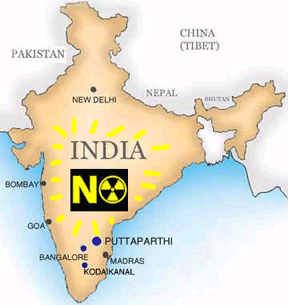 India Clamps Down on Villagers’ Anti-Nuclear Protests, Earth Island Journal, BY NITYANANDJAYARAMAN – OCTOBER 4, 2012 In their eagerness to power the country’s growing economy, ndian authorities are treating opponents of nuclear energy as enemies of the state
If the chief minister of Tamil Nadu has her way, democracy would be dispensed with in the southern Indian state. On two separate occasions this year, chief minister J. Jayalalithaa let loose battalions of armed police on thousands of fisherfolk and farmers to crush their months-long non-violent protest against the unfinished nuclear power plants in Koodankulam and Idinthakrai, two coastal villages in the state.
In March, when she sent out security personnel to quell the protests, police squads blocked roads leading to villages and stopped essential supplies like milk and drinking water from reaching the area. (Read our earlier report on the conflict here.) Continue reading
India: opponents of nuclear power treated as ‘pathological’
The way the Indian government has dealt with the opponents of the Koodankulam nuclear reactors being built in Tamil Nadu violates all three red lines.
The Department of Atomic Energy and its subsidiary Nuclear Power Corporation of India Ltd. see the opposition as a pathology to be cured by psychiatrists from the National Institute of Mental Health and Neurosciences.
Don’t impose K’kulam reactorshttp://www.thedailystar.net/newDesign/news-details.php?nid=252289, 3 Oct 12, Praful Bidwai Even zealous supporters of nuclear power should logically concede three things to their opponents. First, after Fukushima, it’s natural for people everywhere to be deeply sceptical of the claimed safety of nuclear power, and for governments to phase out atomic programmes, as is happening in Germany, Switzerland, Italy, and now Japan.
Second, nuclear power, like all projects, should only be promoted with the consent of local people, and with scrupulous regard for civil liberties. And third, safety must be paramount in reactor construction and operation, with strict compliance with rules laid down by an
independent safety authority. Continue reading
1 This Month



26 September – International Day for the Total Elimination of Nuclear Weapons


PLEASE OPPOSE HR 8255 AND S.3639 – bills would accelerate satellite deployment, with no environmental review or safeguards – https://ncstd5li.quorum.us/campaign/169331/
To see nuclear-related stories in greater depth and intensity – go to https://nuclearinformation.wordpress.com
-
Archives
- September 2026 (233)
- August 2026 (330)
- July 2026 (355)
- June 2026 (287)
- May 2026 (306)
- April 2026 (356)
- March 2026 (251)
- February 2026 (267)
- January 2026 (308)
- December 2025 (358)
- November 2025 (359)
- October 2025 (375)
-
Categories
- 1
- 1 NUCLEAR ISSUES
- business and costs
- climate change
- culture and arts
- ENERGY
- environment
- health
- history
- indigenous issues
- Legal
- marketing of nuclear
- media
- opposition to nuclear
- PERSONAL STORIES
- politics
- politics international
- Religion and ethics
- safety
- secrets,lies and civil liberties
- spinbuster
- technology
- Uranium
- wastes
- weapons and war
- Women
- 2 WORLD
- ACTION
- AFRICA
- Atrocities
- AUSTRALIA
- Christina's notes
- Christina's themes
- culture and arts
- Events
- Fuk 2022
- Fuk 2023
- Fukushima 2017
- Fukushima 2018
- fukushima 2019
- Fukushima 2020
- Fukushima 2021
- general
- global warming
- Humour (God we need it)
- Nuclear
- RARE EARTHS
- Reference
- resources – print
- Resources -audiovicual
- Weekly Newsletter
- World
- World Nuclear
- YouTube
-
RSS
Entries RSS
Comments RSS
 nuclear-news