Fukushima nuclear waste decision also a human rights issue
Fukushima nuclear waste decision also a human rights issue https://english.kyodonews.net/news/2020/07/1145e5b3970f-opinion-fukushima-nuclear-waste-decision-also-a-human-rights-issue.html
By Baskut Tuncak, KYODO NEWS – In a matter of weeks, the government of Japan will have the opportunity to demonstrate to the world how much it values protecting human rights and the environment and to meet its international obligations.
In the aftermath of the Fukushima Daiichi nuclear disaster, myself and other U.N. special rapporteurs consistently raised concerns about the approaches taken by the government of Japan. We have been concerned that raising of “acceptable limits” of radiation exposure to urge resettlement violated the government’s human rights obligations to children.
We have been concerned of the possible exploitation of migrants and the poor for radioactive decontamination work. Our most recent concern is how the government used the COVID-19 crisis to dramatically accelerate its timeline for deciding whether to dump radioactive wastewater accumulating at Fukushima Daiichi in the ocean.
Setting aside the duties incumbent on Japan to consult and protect under international law, it saddens me to think that a country that has suffered the horrors of being the only country on which not one but two nuclear bombs were dropped during war, would continue on a such a path in dealing with the radioactive aftermath of the Fukushima Daiichi disaster.
Releasing the toxic wastewater collected from the Fukushima nuclear plant would be, without question, a terrible blow to the livelihood of local fishermen. Regardless of the health and environmental risks, the reputational damage would be irreparable, an invisible and permanent scar upon local seafood. No amount of money can replace the loss of culture and dignity that accompany this traditional way of life for these communities.
The communities of Fukushima, so devastated by the tragic events of March 11, 2011, have in recent weeks expressed their concerns and opposition to the discharge of the contaminated water into their environment. It is their human right to an environment that allows for living a life in dignity, to enjoy their culture, and to not be exposed deliberately to additional radioactive contamination. Those rights should be fully respected and not be disregarded by the government in Tokyo.
The discharge of nuclear waste to the ocean could damage Japan’s international relations. Neighboring countries are already concerned about the release of large volumes of radioactive tritium and other contaminants in the wastewater.
Japan has a duty under international law to prevent transboundary environmental harm. More specifically, under the London Convention, Japan has an obligation to take precaution with the respect to the dumping of waste in the ocean. Given the scientific uncertainty of the health and environmental impacts of exposure to low-level radiation, the disposal of this wastewater would be completely inconsistent with the spirit, if not the letter, of this law.
ndigenous peoples have an internationally recognized right to free, prior and informed consent. This includes the disposal of waste in their waters and actions that may contaminate their food. No matter how small the Japanese government believes this contamination will be of their water and food, there is an unquestionable obligation to consult with potentially affected indigenous peoples that it has not met.
The Japanese government has not, and cannot, assure itself of meaningful consultations as required under international human rights law during the current pandemic. There is no justification for such a dramatically accelerated timeline for decision making during the covid-19 crisis. Japan has the physical space to store wastewater for many years.
I have reported annually to the U.N. Human Rights Council for the past six years. Whether the topic was on child rights or worker’s rights, in nearly each and every one of those discussion at the United Nations, the situation of Fukushima Daiichi is raised by concerned observers for the world to hear. Intervening organizations have pleaded year-after-year for the Japanese government to extend an invitation to visit so I can offer recommendations to improve the situation. I regret that my mandate is coming to an end without such an opportunity despite my repeated requests to visit and assess the situation.
The disaster of 2011 cannot be undone. However, Japan still has an opportunity to minimize the damage. In my view, there are grave risks to the livelihoods of fishermen in Japan and also to its international reputation. Again, I urge the Japanese government to think twice about its legacy: as a true champion of human rights and the environment, or not.
(Baskut Tuncak has served as U.N. special rapporteur on the implications for human rights of the environmentally sound management and disposal of hazardous substances and wastes since 2014.)
Julian Assange’s father calls on Australia’s Prime Minister Scott Morrison to help this Australian citizen
 Assange’s father calls extradition process ‘disgrace’ https://telanganatoday.com/assanges-father-calls-extradition-process-disgrace?fbclid=IwAR1a7bQ0W_Xcgc9EIeGaAHVP7Zmm2cM6nNV65ZXtkhCwNUlarqIYTJVw6xo1 July 20, The 80-year-old is organizing public events in Australia despite the ongoing coronavirus pandemic and hopes to travel to London in August to support Assange during his extradition trial.
Sydney: WikiLeaks founder Julian Assange’s father, John Shipton, is fighting tirelessly for the release and return of his son, who is facing an extradition trial in London for publishing classified information, a process he described as abuse.
“We maintain that the extradition request is a fraud in the English court… It’s a fraud in the English legal system, it’s a case of abuse of process, it is a disgrace,” Shipton, who travelled from Melbourne to Sydney to campaign for his son’s release, told Efe news in an interview.
The 80-year-old is organizing public events in Australia despite the ongoing coronavirus pandemic and hopes to travel to London in August to support Assange during his extradition trial which, he says, is being carried out under “dire” circumstances.
In May 2019, the UN Special Rapporteur on Torture, Nils Melzer, said, after visiting Assange in the Belmarsh prison along with two medical experts, that he showed “all symptoms typical for prolonged exposure to psychological torture, including extreme stress, chronic anxiety and intense psychological trauma”.
Assange has spent almost a decade in confinement, first under house arrest in a British town and then at the Ecuadorian embassy in London between 2012 until 2019, when Ecuador withdrew his political asylum status.
Shipton has urged the Australian government to mediate with the UK administration for the release of his son, who is wanted in the US on 18 charges of espionage and computer intrusion, for which he could be sentenced to prison for up to 175 years.
“I believe the government can, if it wishes to, assist us in bringing Julian home. I believe that (it) is very simple for the Prime Minister (Scott Morrison) to pick up the phone and ring (his UK counterpart) Boris Johnson and say Julian Assange is an Australian citizen in dire circumstances.
“This will resolve this immediately and that’s easily possible,” he told Efe news during the interview.
The Anthropocene, begun in 16th Century colonialism, slavery -? for repair in 21st Century post-Covid-19 recovery

Why the Anthropocene began with European colonisation, mass slavery and the ‘great dying’ of the 16th century, The Conversation, Mark Maslin, Professor of Earth System Science, UCL, Simon Lewis, Professor of Global Change Science at University of Leeds and, UCL June 25, 2020 The toppling of statues at Black Lives Matter protests has powerfully articulated that the roots of modern racism lie in European colonisation and slavery. Racism will be more forcefully opposed once we acknowledge this history and learn from it. Geographers and geologists can help contribute to this new understanding of our past, by defining the new human-dominated period of Earth’s history as beginning with European colonialism.Today our impacts on the environment are immense: humans move more soil, rock and sediment each year than is transported by all other natural processes combined. We may have kicked off the sixth “mass extinction” in Earth’s history, and the global climate is warming so fast we have delayed the next ice age.
We’ve made enough concrete to cover the entire surface of the Earth in a layer two millimetres thick. Enough plastic has been manufactured to clingfilm it as well. We annually produce 4.8 billion tonnes of our top five crops and 4.8 billion livestock animals. There are 1.4 billion motor vehicles, 2 billion personal computers, and more mobile phones than the 7.8 billion people on Earth.
All this suggests humans have become a geological superpower and evidence of our impact will be visible in rocks millions of years from now. This is a new geological epoch that scientists are calling the Anthropocene, combining the words for “human” and “recent-time”. But debate still continues as to when we should define the beginning of this period. When exactly did we leave behind the Holocene – the 10,000 years of stability that allowed farming and complex civilisations to develop – and move into the new epoch?
Five years ago we published evidence that the start of capitalism and European colonisation meet the formal scientific criteria for the start of the Anthropocene.
Our planetary impacts have increased since our earliest ancestors stepped down from the trees, at first by hunting some animal species to extinction. Much later, following the development of farming and agricultural societies, we started to change the climate. Yet Earth only truly became a “human planet” with the emergence of something quite different. This was capitalism, which itself grew out of European expansion in the 15th and 16th century and the era of colonisation and subjugation of indigenous peoples all around the world.
In the Americas, just 100 years after Christopher Columbus first set foot on the Bahamas in 1492, 56 million indigenous Americans were dead, mainly in South and Central America. This was 90% of the population. Most were killed by diseases brought across the Atlantic by Europeans, which had never been seen before in the Americas: measles, smallpox, influenza, the bubonic plague. War, slavery and wave after wave of disease combined to cause this “great dying”, something the world had never seen before, or since.
In North America the population decline was slower but no less dramatic due to slower colonisation by Europeans. US census data suggest the Native American population may have been as low as 250,000 people by 1900 from a pre-Columbus level of 5 million, a 95% decline.
This depopulation left the continents dominated by Europeans, who set up plantations and filled a labour shortage with enslaved workers. In total, more than 12 million people were forced to leave Africa and work for Europeans as slaves. ……….
In addition to the critical task of highlighting and tackling the racism within science, perhaps geologists and geographers can also make a small contribution to the Black Lives Matter movement by unflinchingly compiling the evidence showing that when humans started to exert a huge influence on the Earth’s environment was also the start of the brutal European colonisation of the world.
In her insightful book, A Billion Black Anthropocenes or None, the geography professor Kathryn Yusoff makes it very clear that predominantly white geologists and geographers need to acknowledge that Europeans decimated indigenous and minority populations whenever so-called progress occurred.
Defining the start of the human planet as the period of colonisation, the spread of deadly diseases and transatlantic slavery, means we can face the past and ensure we deal with its toxic legacy. If 1610 marks both a turning point in human relations with the Earth and our treatment of each other, then maybe, just maybe, 2020 could mark the start of a new chapter of equality, environmental justice and stewardship of the only planet in the universe known to harbour any life. It’s a struggle nobody can afford to lose. https://theconversation.com/why-the-anthropocene-began-with-european-colonisation-mass-slavery-and-the-great-dying-of-the-16th-century-140661
Huge police squadron paid by nuclear industry to monitor residents of Bure
the tens of millions of euros per year disbursed by Andra to pay for the presence of the gendarme squadron represents a significant sum. In 2018, the agency’s net profit amounted to only 11.5 million euros,
Cigeo related expenses are directly funded by the three major nuclear players: EDF and Orano, two private companies, and CEA, a public research establishment. In 2018, they poured 212 million euros into the landfill project.

Large Man Looking At Co-Worker With A Magnifying Glass — Image by © Images.com/Corbis
In Bure, the nuclear waste agency pays the police,  À Bure, l’agence des déchets nucléaires se paie des gendarmes, Reporterre, 5 juin 2020 / Marie Barbier (Reporterre) et Jade Lindgaard According to information obtained by Mediapart and Reporterre, an agreement was signed in 2018 between the national gendarmerie and Andra, the agency responsible for the burial of nuclear waste, in this village of the Meuse. Since then, the agency has paid tens of millions of euros to monitor residents through gendarmes. This partnership poses ethical and legal problems.
Around Bure, in the Meuse, where the most dangerous nuclear waste from French power plants must be buried in a gigantic mine 500 meters underground, the villages are only inhabited by a handful of people. And yet, 75 gendarmes patrol there 24 hours a day. For almost a year and a half, according to information collected by Mediapart and Reporterre, these soldiers are paid by Andra, the National Agency for Radioactive Waste Management, which has set up a laboratory at the future landfill.
In October 2018, an agreement was signed between Andra and the General Directorate of the National Gendarmerie (DGGN) “in order to guarantee the safety of personnel and facilities in the long term” the agency confirmed to us, in response to our questions. According to figures given by the agency itself, “ten million euros” are spent each year by Andra, a public industrial and commercial establishment (EPIC), to pay the soldiers engaged and cover related costs, including catering. To date, therefore, at least twenty million euros have been spent – or are in the process of being spent – in this context
The mobile gendarmes are hosted directly on Andra’s site, in a block built for this purpose. They sleep there, store their equipment and their vehicles and take their recovery days there before leaving to patrol. These soldiers, often very young, stay there for three to six weeks before leaving on another assignment. They are immediately replaced by new arrivals. The DGGN refused to communicate the exact content to us The government decision to assign a squadron of mobile gendarmes to this territory dates from the summer of 2017. In June, Le Bindeuil, a hotel-restaurant known to accommodate Andra staff and gendarmes, suffered damage during the anti-nuclear days. And in August, a demonstration ended in confrontations with the police. These facts are today the subject of judicial information, in which ten people are under investigation, and which gives rise to massive and particularly intrusive surveillance, as we detailed in our four-part investigation……..
Is it legal to pay a squadron of gendarmes to protect themselves?….
Long dormant, this system was revived by a decree, signed by Alain Juppé in 1997…..
….. In 2009, an agreement was signed with EDF for the protection of nuclear power plants. “At the national level, the overall workforce is around a thousand gendarmes,” confirms EDF, who specifies that “this specialized platoon is financed by EDF” but that the latter “does not communicate on the cost of this protection” .
This is to prevent a new Zad, like that of Notre-Dame-des-Landes, from forming But Andra’s laboratory cannot, unlike nuclear power plants, be considered a sensitive site. No radioactive waste is present there. Cigeo’s excavation work.
So what is the purpose of the gendarmerie platoon paid by Andra at the Bure site? According to many residents that we were able to contact, these gendarmes are mainly assigned to the surveillance of the territory and its inhabitants. For the police, it is a question of preventing the militants evicted from Lejuc wood – a communal forest once occupied by opponents of Cigeo – from returning. And to prevent a new Zad from forming, he example of Notre-Dame-des-Landes, in Loire-Atlantique
According to residents interviewed for this article, the patrol vehicles are reformed vehicles, old Range Rovers, or newer models from Kangoo and Transit. A villager saw them move at night with torches bearing the acronym of Andra. What exactly are their prerogatives? The Directorate General of the National Gendarmerie refused to answer our questions.
“Permanent and repeated identity checks infringe on individual freedoms” and can “only lead to incidents”.
Me Matteo Bonaglia, one of the lawyers indicted in the framework of the criminal investigation for association of criminals, says he is “surprised by such means allocated to Andra. This explains, however, the over-militarization that we observe in this territory where the fight against the project to bury nuclear waste is playing out, Andra being able to allocate the assistance of the police force in a proportion three times greater than everywhere elsewhere.
It is already difficult to oppose the Cigeo project and assert its anti-nuclear opinions. Here, the multiplication of controls and the over-representation of gendarmes constitutes a de facto obstacle to freedom of opinion and the free expression of ideas. It also explains the large number of trials that have taken place in recent years for offenses such as contempt and rebellion, not everyone is so willing to be subject to constant scrutiny. ”
This agreement with the gendarmerie is all the more problematic since Andra appears several times in the file currently being examined after the start of the fire at the Hôtel-restaurant du Bindeuil, in which ten anti-nuclear activists are put under review and to which Mediapart and Reporterre had access.
The agency did not bring a civil action, but complained three times. Thus, on February 17, 2017, its director, David Mazoyer, filed a complaint “on behalf of Andra” after “degradations” committed on the site of the eco-library, belonging to the agency. “During the night of February 16 to 17, 2017,” explains the director of gendarmes in Ligny-en-Barrois the opponents damaged, bent or tore down the fence around the site, mainly on the west facade and on a line of about 150 meters. These degradations were the subject of an additional indictment and joined the long list of crimes covered in this sprawling instruction.
A few months later, on June 21, 2017, the day of the fire at the Le Bindeuil hotel and restaurant, David Mazoyer filed a second complaint: “Other members of their movement attacked the code on the pedestrian portal giving access to the Ecothèque site. This device is damaged and out of use. I am filing a complaint on behalf of Andra for the destruction of this device. ”
Finally, on April 24, 2018, it was the head of Andra’s risk protection and prevention service who complained about receiving documents after discovering photos belonging to the Ecoteca during a search.
According to our information, the platoon of gendarmes paid by Andra is not assigned to the “Bure cell”, a cell of gendarmes with their own badge in charge of the current investigation. But what about a complainant who pays gendarmes to go and monitor the people against whom he has complained? By order of the prefecture, Andra gendarmes can also in theory be assigned to the maintenance of order at demonstrations or at the courthouse. The mix of genres would then be total: a complainant who pays the police in a demonstration against him or worse, during trials of opponents of his project …
In addition to this potential conflict of interest, the apparently legal agreement between Andra and the national gendarmerie raises legal questions. In 2018, a circular from the Minister of the Interior Gérard Colomb paved the way for a much wider billing than what had been initially planned. “The circular no longer takes the precaution of limiting it to” organizers of sporting, recreational or cultural events for profit “. We can invoice everyone, regardless of the object and the lucrative purpose or not, “said Mickaël Lavaine.
In 2018, the publication of his article in the review of legal current events in administrative law gave rise to an action brought by the Collectif des Festivals before the Council of State, the organizers denouncing the considerable sums of security which they owed. ” discharge to the State.
This mixture of genres questions the impartiality of police work
In this legal debate, the two paragraphs of article L211-11 of the code of internal security, organized by the Columbus circular, are opposed. The first specifies that these conventions concern only “organizers of sporting, recreational or cultural events for profit”, the second target much more broadly all “natural or legal persons”. “The Council of State will have to rule on this debate: is paragraph 2 linked to paragraph 1? If he decides in this sense, which I defend, that means that Andra cannot be invoiced, nor of the associations which organize the potato festival. This would return to the spirit of the text of the Tour de France, “said Mickaël Lavaine. The Council of State is expected to decide by summer.
For the researcher, this legal debate poses a much broader question: “The internal security code specifies that the police or gendarmerie forces may be charged for law enforcement services which cannot be attached to the normal obligations incumbent on the public authorities’. But what is the obligation normal state? This notion is vague enough to be able to put what you want into it. If we push the logic of the Columbus circular to its end, there is nothing to prohibit charging the organizer of an FO demonstration or the CGT for the police devices of a demonstration. However, the Declaration of Human Rights provides that the public force must be financed by taxes. ”
For Alexandre Faro, lawyer for one of the activist witnesses assisted in the investigation opened after the fire at Bindeuil, “this amounts to privatizing the police in favor of Andra. From a strict legal point of view this is very questionable because in France the police are a monopoly of the state and the Constitution provides that sovereignty is exercised by the people and for the people. ”
These debates also animated Andra employees when the agreement with the DGGN was signed. An internal source tells us that “that posed questions”: “Why is Andra paying when it is a public establishment?
Far from being anecdotal, the tens of millions of euros per year disbursed by Andra to pay for the presence of the gendarme squadron represents a significant sum. In 2018, the agency’s net profit amounted to only 11.5 million euros, mainly made up of research tax credit, as indicated in the establishment’s annual financial report. Cigeo related expenses are directly funded by the three major nuclear players: EDF and Orano, two private companies, and CEA, a public research establishment. In 2018, they poured 212 million euros into the landfill project.
The gendarmes paid by Andra who crisscross the territory are not the same as those who are investigating for justice as part of the judicial information and have listened for months to opponents of Andra. But they belong to the same institution. This mix of genres questions the impartiality of police work. Then does not public power find itself in a situation of insincerity towards the citizens whom it controls with such relentlessness? The gendarmes, Andra, justice, political leaders on one side; opponents of the other. Two tight-knit camps, one facing the other, like in a war situation.
https://reporterre.net/A-Bure-l-agence-des-dechets-nucleaires-se-paie-des-gendarmes
Assange too sick to attend the very unjust process of the UK extradition hearings
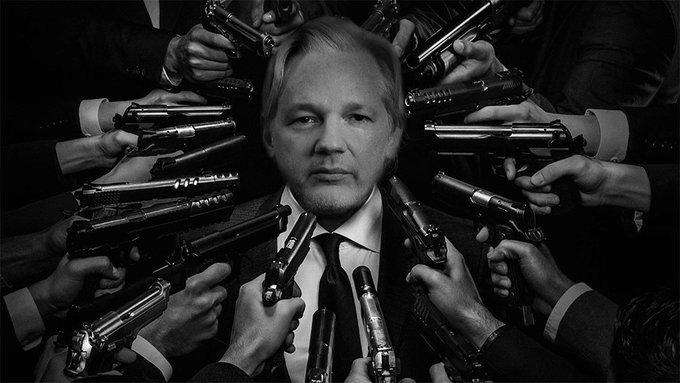 Monica Del Mestre 3 June 20
2. In addition to other ongoing health concerns, Assange faces the serious risk of exposure to Covid in Belmarsh prison, and has been advised that even going to the video room to take part in hearings is unsafe. This is another reason he should be immediately released.
3. Assange’s lawyers have long complained they have had insufficient access to him in prison. Under lockdown conditions, they have had no access to him at all. They have repeatedly flagged that this lack of access seriously impacts their ability to prepare his defence.
4. One of the next steps agreed today is that psychiatric reports on Assange from the prosecution and defence will be due to the court on 31 July. Remember that UN Special Rapporteur @NilsMelzer has expressed alarm many times that Assange shows symptoms of psychological torture.
5. It is a welcome step that the continuation of the full extradition hearing was adjourned, as lockdown conditions present clear barriers to open justice – but 7 September may not be late enough to make a meaningful difference. Also the court is still struggling to find a venue.
6. It remains extremely frustrating that the court does not adequately accommodate NGO observers. I have never experienced so much difficulty accessing a trial in any country as at Woolwich Crown Court in February, and the teleconference option we now have is far from sufficient.
7. The press are also facing severe restrictions. Only 6 journalists have been allowed to attend in person the past 2 hearings, with others limited to the awful phone line. This case is of high public interest and a better solution must be found before the full hearing resumes.
8. Assange’s next callover hearing has been scheduled for 29 June at 10 am. We urge the court to find workable solutions to enable his safe attendance and ensure the press and observers are able to properly monitor proceedings. /END
Torture would await Assange in the US prison system
From the frying pan into the fire. The torture that awaits Julian Assange in the US.https://www.thecanary.co/uk/analysis/2020/05/10/from-the-frying-pan-into-the-fire-the-torture-that-awaits-julian-assange-in-the-us/
Tom Coburg 10th May 2020 WikiLeaks founder Julian Assange is currently held in Belmarsh prison awaiting hearings that could see him extradited to the US to face prosecution for alleged espionage-related offences.
Award-winning US journalist Chris Hedges described the torture that would await Assange in the US prison system, adding “they will attempt to psychologically destroy him”. If extradited, Assange would likely be detained in accordance with ‘Special Administrative Measures’ (SAMs). One report equates this to a regime of sensory deprivation and social isolation that may amount to torture.
Journalists speak out
US journalist Chris Hedges spoke about the treatment Assange is likely to receive in the US. He argues that the US authorities will “psychologically destroy him” and that conditions imposed could see him turned into a ‘zombie’ to face life without parole:
Australian journalist John Pilger agrees:
If Julian is extradited to the US, a darkness awaits him. He’ll be subjected to a prison regime called special administrative measures… He will be placed in a cage in the bowels of a supermax prison, a hellhole. He will be cut off from all contact with the rest of humanity.
From the frying pan…
Assange is already in a precarious position, alongside all other UK prisoners. Belmarsh is a high-security Category A facility and, as with all other prisons in the UK, inmates there are at risk to infection from coronavirus (Covid-19).
On 28 April, the BBC reported that there were “1,783 “possible/probable” cases of coronavirus – on top of 304 confirmed infections across jails in England and Wales”. Also that there were “75 different “custodial institutions”, with 35 inmates treated in hospital and 15 deaths”.
Vaughan Smith, who stood bail for Assange, reported that the virus was “ripping through” Belmarsh:
We know of two Covid-19 deaths in Belmarsh so far, though the Department of Justice have admitted to only one death. Julian told me that there have been more and that the virus is ripping through the prison.
Assange has a known chronic lung condition, which could lead to death should he become infected with coronavirus. Assange’s lawyers requested he is released on bail to avoid succumbing to the virus, but that request was rejected.
As for the psychological effects of segregation, a European Committee for the Prevention of Torture and Inhuman or Degrading Treatment or Punishment report argued that it can “can have an extremely damaging effect on the mental, somatic and social health of those concerned”.
…and into the fire
It’s likely that Assange will be placed under SAMs if he is extradited to the US. The Darkest Corner, a report authored by the Allard K. Lowenstein International Human Rights Clinic and The Center for Constitutional Rights, describes how SAMs work.
In its summary, the report explains that:
SAMs are the darkest corner of the U.S. federal prison system, combining the brutality and isolation of maximum security units with additional restrictions that deny individuals almost any connection to the human world. Those restrictions include gag orders on prisoners, their family members, and their attorneys, effectively shielding this extreme use of government power from public view.
It continues:
SAMs deny prisoners the narrow avenues of indirect communication – through sink drains or air vents – available to prisoners in solitary confinement. They prohibit social contact with anyone except for a few immediate family members, and heavily regulate even those contacts. And they further prohibit prisoners from connecting to the social world via current media and news, limiting prisoners’ access to information to outdated, government-approved materials. Even a prisoner’s communications with his lawyer – which are supposed to be protected by attorney-client privilege – can be subject to monitoring by the FBI.
It ominously adds that: “Many prisoners remain under these conditions indefinitely, for years or in some cases even decades”. Moreover, these conditions can be used as a weapon to force a prisoner to plead guilty:
In numerous cases, the Attorney General recommends lifting SAMs after the defendant pleads guilty. This practice erodes defendants’ presumption of innocence and serves as a tool to coerce them into cooperating with the government and pleading guilty.
The report provides further details on how SAMs incorporate sensory deprivation and social isolation measures that “may amount to torture”. Also, it argues that the SAMs regime contravenes both US and international laws.
ECHR article 3
Should the UK courts agree to extradite Assange, he could face months, if not decades, of psychological torture. However, Article 3 of the European Court of Human Rights states clearly: “No one shall be subjected to torture or to inhuman or degrading treatment or punishment”. Under that article, the US extradition request should be rejected by the UK courts.
For a publisher to be subjected to such a nightmare scenario would be intolerable.
Alabama joins Kentucky, South Dakota and West Virginia to criminalize fossil fuel protests
In March, Kentucky, South Dakota and West Virginia passed laws restricting pipeline protests. Alabama is poised to become the fourth.
By Alexander C. Kaufman 10 May 20 Alabama lawmakers this week advanced legislation to add new criminal penalties to nonviolent protests against pipelines and other fossil fuel projects, setting a course to become the fourth state to enact such measures amid the chaos of the coronavirus pandemic.
Kentucky, South Dakota and West Virginia enacted similar measures in March, just as states started implementing lockdowns to contain the outbreak of COVID-19, the respiratory illness caused by the virus.
The Alabama Senate passed the bill on March 12, just befohe Alabama Senate passed the bill on March 12, just before state officials, alarmed at the spread of the virus, postponed legislative hearings for a month. When the capitol reopened in Montgomery on May 4, state Democrats remained in their home districts, but enough Republican lawmakers returned to restart work on the legislation. On Monday, the House version of the bill was introduced and referred to the committee that oversees utilities and infrastructure. Continue reading
France’s unfairly heavy monitoring of anti-nuclear activists, treating them as violent criminals
 Justice has massively monitored Bure’s anti-nuclear activists Reporterre, April 27, 2020 / Marie Barbier (Reporterre) and Jade Lindgaard. Dozens of people tapped, a thousand retranscribed discussions, more than 85,000 conversations and intercepted messages, more than 16 years of cumulative telephone surveillance time: the judicial information opened in July 2017 is a disproportionate machine of intelligence on the movement antinuclear from this village of the Meuse, according to the documents consulted by Reporterre and Mediapart.
Faces caught in a web of arrows and diagrams. Under each photo: date and place of birth, nickname, organization. The individuals are grouped into “clans”, linked to places and ratings of the investigation file. Some faces are magnified, others reduced to the size of a pinhead. Some people are entitled to a photo, others appear in the form of a pictogram – blue for men, fuchsia pink for women.
This diagram [on original] was produced by the Anacrim criminal analysis cell of the national gendarmerie. Its software, Analyst’s notebook, makes it possible to visualize the links between people via their telephone numbers, places, events. This technique is usually used to solve particularly serious crimes: it recently emerged from the Gregory of legal darkness case, and is currently used in the investigation of the multi-repeat killer Nordahl Lelandais.
Examining magistrate Kévin le Fur used it to dissect the organization of the opposition movement at Cigeo, the radioactive waste landfill center planned next to the village of Bure, in the Meuse. Scheduled to come into operation in 2035, it is one of the largest industrial facilities in project today in France, and a very sensitive site for the nuclear industry.
The Anacrim diagram appears in the file of the judicial information for association of criminals, where ten antinuclear militants are under investigation for various reasons in connection with degradations committed in a hotel and the organization of an undeclared demonstration in August 2017. Subject to strict judicial control, those under investigation are prohibited from seeing each other, talking to each other and even being in the same room.
In the Bure case, Anacrim produced a total of fourteen diagrams on “the role and involvement” of the accused and the interactions between collectives and associations. This method leaves its mark on education. Seven people, among the ten indicted, are for criminal association, but 118 individuals are listed in the organization chart of the gendarmes placed in the investigation file.
Dozens of people tapped, more than a thousand transcribed discussions, tens of thousands of conversations and intercepted messages, more than fifteen years of cumulative telephone interception time: the judicial information opened in July 2017 looks like a real intelligence machine on the anti-nuclear movement of Bure, according to the investigation file consulted by Reporterre and Mediapart, and of which Liberation had unveiled part of the content in November 2018. An extraordinary investigation, extremely intrusive and focused on the surveillance of political activists whom the justice system seems to consider as enemies of democracy.
Molotov cocktails and stones fly. Gendarmes were injured and a protester mutilated by a grenade on the foot. Those charged are for different reasons from each other: participation in a gathering after summons, participation in a criminal association for the preparation of an offense punishable by five or ten years’ imprisonment, detention (or complicity) in an organized gang of incendiary product, damage to the property of others by dangerous means, concealment of property from an aggravated theft, voluntary violence in meetings.
From the first days of the investigation, the gendarmes were worried about “criminal designs” unrelated to the “legitimate challenge in a democratic state” of the militants implicated. “These actions can no longer be considered as a legitimate social and societal protest” or “as a form of democratic opposition”, they write in a report, July 27, 2017. According to them, “some of the opponents deliberately choose a violent path. They attack the property associated with the contested projects, but sometimes also the people working for the development of these industrial installations and at the same time against the police. ” In the eyes of the investigators, “opponents criminalize themselves”.
Part of the seals is sent to the Anti-Terrorism Office, a unit of the gendarmerie responsible for the prevention and suppression of acts of terrorism. To take the measure of the surveillance of the militants of Bure and their entourage, Reporterre and Mediapart evaluated the means deployed by the gendarmerie and the justice in their mission. Almost 765 telephone numbers have been the subject of identity verification requests from telephone operators. At least 200 other requests were made to find out the call histories, their places of emission, the bank details of the holders subscription, PUK codes to unlock a phone when you don’t know your PIN.
According to Me Raphaël Kempf, one of the lawyers for the indictments: Listening for so long is proof that we are not in a classic criminal judicial procedure intended to collect evidence of the commission of crimes, but that we are using the means of law and criminal procedure for the purpose of intelligence, which is political in nature. ”
If we add up all these sequences, we get a cumulative time spent listening to activists equivalent to more than sixteen years! According to the minutes, most of these people were listened to permanently by a team of gendarmes taking turns behind their screens. In total, more than 85,000 conversations and messages were intercepted, according to our estimates. And no less than 337 conversations were transcribed on trial- verbal, to which are added some 800 messages reproduced by the Technical Assistance Center (CTA). Are these means proportionate to the crimes being prosecuted? Joined by Reporterre and Mediapart, Olivier Glady, public prosecutor of Bar-le-Duc answers: “I cannot answer that. This is a dossier that makes fifteen volumes. You have files of other kinds (traffic in vehicles or narcotics) which are roughly equivalent, I am not sure that the proportionality of the investigations is simply to relate to a number as you give it to me. ”
During these innumerable hours spent listening to the militants, the gendarmes tracked the indications, sometimes tiny, of each other’s responsibilities in organizing the protest. These are two cultures which, behind closed doors of a judicial investigation, seem to confront each other from a distance. On the one hand, the gendarmes. On the other, anti-nuclear, libertarian culture, who refuse hierarchy and formal assignments to roles. Inevitably, the vision of gendarmes stumbles on the spontaneous and horizontal practices of regulars at the Maison de la Résistance. This old farm in Bure was bought in 2004 by anti-nuclear activists to create a place of struggle. It has become a place of collective life where people come to sleep during a gathering, get together, work, cook, party……. https://reporterre.net/1-3-La-justice-a-massivement-surveille-les-militants-antinucleaires-de-Bure
Sailors on nuclear aircraft carrier cheer their captain who put their health above his career
 any information about their nuclear-powered ships to get out. And even when such news does get out, the word “NUCLEAR” is dropped from the media coverage.
The Navy Fired the Captain of the Theodore Roosevelt. See How the Crew Responded. The rousing show of support provided another gripping scene to emerge from the coronavirus pandemic: the rank and file cheering a boss they viewed as putting their safety ahead of his career. By Helene Cooper, Thomas Gibbons-Neff and Eric Schmitt
- April 3, 2020 WASHINGTON — It was a send-off for the ages, with hundreds of sailors aboard the aircraft carrier Theodore Roosevelt cheering Capt. Brett E. Crozier, the commander who sacrificed his naval career by writing a letter to his superiors demanding more help as the novel coronavirus spread through the ship.
- The rousing show of support provided the latest gripping scene to emerge from the coronavirus pandemic: the rank and file shouting their admiration for a boss they viewed as putting their safety ahead of his career.
…….. in removing Captain Crozier from command, senior Navy officials said they were protecting the historic practice that complaints and requests have to go up a formal chain of command. They argued that by sending his concerns to 20 or 30 people in a message that eventually leaked to news organizations, Captain Crozier showed he was no longer fit to lead the fast-moving effort to treat the crew and clean the ship.
Sailors on nuclear aircraft carrier Theodore Roosevelt applaud their fired captain
Videos have emerged on social media showing sailors on the aircraft carrier USS Theodore Roosevelt giving their fired captain a rousing sendoff as he left the ship.
Capt. Brett Crozier was relieved of duty for a “loss of confidence” following the leak of a letter in which he advocated for stronger measures to protect his crew from an outbreak of coronavirus aboard the ship.
The videos show hundreds of sailors gathered in the ship’s hangar clapping and cheering loudly for Crozier as he walked down a ramp towards the pier in Guam where the ship is docked. ……
In one of the videos capturing that moment, voices can be heard saying “We love you, too!” and “Thank you skipper!”
Later, the ship’s crew is heard rhythmically clapping and chanting, “CAPTAIN! CROZIER!”
Earlier on Thursday, Crozier was relieved of duty by acting Secretary of the Navy Thomas Modly who said he had lost confidence in his leadership abilities following the leak of a letter where Crozier advocated for stronger measures to protect his ship’s crew from further infection by the coronavirus.
Modly said Crozier had expressed valid concerns for the safety of his ship but had exercised “poor judgment” in distributing the letter to senior commanders to a broad group of people when he could have expressed his concerns to the admiral aboard the carrier.
In the letter Crozier advocated Navy leaders to speed up the removal of the nearly 5,000 sailors aboard the carrier to appropriate accommodations on Guam that met social distancing guidelines set by the Centers for Disease Control and Prevention.
The day after the letter appeared in the San Francisco Examiner the Navy announced that 2,700 of the ship’s crew were being brought ashore and that suitable housing would be found in hotel rooms on the island. …..https://abcnews.go.com/Politics/sailors-aircraft-carrier-give-fired-captain-rousing-sendoff/story?id=69957655
US Navy fires captain who sought help for coronavirus-stricken nuclear aircraft carrier
 US Navy fires captain who sought help for coronavirus-stricken ship, ABC News, 3 Apr 20 The US Navy has fired the captain of an aircraft carrier who faced a growing outbreak of the new coronavirus on his ship, saying he created a panic by sending his memo pleading for help to too many people. US Navy fires captain who sought help for coronavirus-stricken ship, ABC News, 3 Apr 20 The US Navy has fired the captain of an aircraft carrier who faced a growing outbreak of the new coronavirus on his ship, saying he created a panic by sending his memo pleading for help to too many people.
Key points:
In a four-page memo to Navy leaders, the captain of the nuclear-powered warship said the spread of the disease was ongoing and accelerating, and said that removing all but 10 per cent of the crew was a “necessary risk” in order to stop the spread of the virus. Navy Secretary Thomas Modly said the ship’s commander Brett Crozier “demonstrated extremely poor judgment” in the middle of a crisis……. That decision was immediately condemned by members of the House Armed Services Committee, who called it a “destabilising move” that would “likely put our service members at greater risk and jeopardise our fleet’s readiness”. ….. Captain Crozier graduated from the US Naval Academy in 1992 and later attended the Nuclear Power School, a prerequisite to command a nuclear-powered aircraft carrier. The USS Theodore Roosevelt, with a crew of nearly 5,000, is docked in Guam, and the Navy has said as many as 3,000 people will be taken off the ship and quarantined by Friday. More than 100 sailors on the ship have tested positive for the virus, but none have been hospitalised. ….. Democrats in support of Captain CrozierDemocrats on the House committee issued a joint statement in support of Captain Crozier. They said that while the captain went outside his chain of command, the pandemic presented a new set of challenges. “Captain Crozier was justifiably concerned about the health and safety of his crew, but he did not handle the immense pressure appropriately,” the statement said. Captain Crozier, in his memo, raised warnings the ship was facing a growing outbreak of the coronavirus and asked permission to isolate the bulk of his crew members on shore, an extraordinary move to take a carrier out of duty in an effort to save lives. He said that removing all but 10 per cent of the crew would be a “necessary risk” in order to stop the spread of the virus. “We are not at war. Sailors do not need to die. If we do not act now, we are failing to properly take care of our most trusted asset: our sailors,” Captain Crozier wrote. https://www.abc.net.au/news/2020-04-03/navy-fires-captain-who-sought-help-for-coronavirus-stricken-ship/12117534 |
|
|
Doctors warn on coronavirus danger for Julian Assange, imprisoned without conviction, in a coronavirus incubator
ASSANGE EXTRADITION: Doctors Warning on Assange in a Covid-19 Breeding Ground, Consortium News,April 1, 2020 • In a prison cited for failing to curb infections, Doctors4Assange warn that Julian Assange is at high risk of contracting the deadly coronavirus. According to a report Wednesday in The Daily Maverick, imprisoned WikiLeaks publisher Julian Assange is one of only two prisoners of 797 inmates in Belmarsh Prison who are being held for skipping bail. The majority are violent criminals, including 20 percent for murder and 16 inmates on terrorism offenses. The facility was also repeatedly criticized by prison inspectors for a lapse in preventing infections to inmates. Following Judge Vanessa Baraitser’s decision to deny Assange bail last week, Doctors4 Assange released the following statement:
Doctors4Assange Statement on Assange
Bail Hearing over Coronavirus Risk, March 27, 2020 Doctors4Assange strongly condemns last Wednesday’s decision by UK District Judge Vanessa Baraitser to deny bail to Julian Assange. Despite our prior unequivocal statement[1] that Mr Assange is at increased risk of serious illness and death were he to contract coronavirus, and the evidence of medical experts, Baraitser dismissed the risk, citing UK guidelines for prisons in responding to the global pandemic: “I have no reason not to trust this advice as both evidence-based and reliable and appropriate.”[2]
Notably, however, Baraitser did not address the increased risk to Mr Assange relative to the general UK prison population, let alone prisoners at HMP Belmarsh where Assange is incarcerated. Nor did she address the rapidly emerging medical and legal consensus that vulnerable and low-risk prisoners should be released, immediately.
As the court heard, Mr Assange is at increased risk of contracting and dying from the novel disease coronavirus (COVID-19), a development which has led the World Health Organization to declare a public health emergency of international concern[3] and a global pandemic.[4] The reasons for Mr Assange’s increased risk include his ongoing psychological torture, his history of medical neglect and fragile health, and chronic lung disease.
Edward Fitzgerald, QC, representing Mr Assange, said, “These [medical] experts consider that he is particularly at risk of developing coronavirus and, if he does, that it develops into very severe complications for him… If he does develop critical symptoms it would be very doubtful that Belmarsh would be able to cope with his condition.”[5]
Baraitser’s casual dismissal of Mr Assange’s dire situation in the face of the COVID-19 emergency stood in stark contrast not only to the expert medical evidence, but the proceedings themselves. The hearing took place on the third day of the UK’s coronavirus lock-down. Of the two counsels representing Mr Assange, Edward Fitzgerald QC wore a facemask and Mark Summers QC participated via audiolink. US attorneys joined the proceedings by phone.
Mr Assange himself appeared by videolink, which was terminated after around an hour, rendering him unable to follow the remainder of his own hearing, including the defence summation and the District Judge’s ruling. Mr Assange’s supporters attending in person observed social distancing measures. Overall only 15 people were in attendance, including judge, counsel, and observers……..
Adding their legal voices to these medical and human rights authorities, the day after Mr Assange’s bail hearing, three professors in law and criminology recommended “granting bail to unsentenced prisoners to stop the spread of coronavirus”.[12]
Julian Assange is just such an unsentenced prisoner with significant health vulnerability. He is being held on remand, with no custodial sentence or UK charge in place, let alone conviction.
Doctors4Assange are additionally concerned that keeping Assange in Belmarsh not only increases his risk of contracting coronavirus, it will increase his isolation and his inability to prepare his defence for his upcoming extradition hearing, in violation of his human right to prepare a defence…… https://consortiumnews.com/2020/04/01/assange-extradition-doctors-warning-on-assange-in-a-covid-19-breeding-ground/
Doctors again call on Australian govt about Julian Assange’s precarious health, risk of coronavirus
Almost 200 medical doctors say Julian Assange’s health is at increased risk from coronavirus, https://www.thecanary.co/global/world-news/2020/03/18/almost-200-medical-doctors-say-julian-assanges-health-is-at-increased-risk-from-coronavirus/ John McEvoy 18th March 2020 On 18 March, almost 200 medical doctors wrote to Australian foreign minister Marise Payne to warn that Julian Assange’s health is at increased risk from the new coronavirus.
“Mr Assange could die in prison”
This is the latest in a number of letters sent by Doctors for Assange to express concern over the WikiLeaks publisher’s deteriorating health.
On 22 November, the group signed an open letter addressed to UK home secretary Priti Patel, saying: “we have real concerns, on the evidence currently available, that Mr Assange could die in prison”.
In a follow-up letter published on 4 December, the doctors wrote:
When the UK, as a Permanent Member of the United Nations Security Council, repeatedly ignores not only the serious warnings of the United Nations Special Rapporteur on Torture, but also its unequivocal investigative and remedial obligations under international and human rights law, the credibility of the UK’s commitment to human rights and the rule of law is fatally undermined.
Fertile breeding grounds”
The latest letter, signed by medical doctors from countries including the UK, Australia, Sweden, and the US, was written in light of the recent coronavirus pandemic.
The letter reads:
We wrote to you on December 15 2019 that Julian Assange’s life is at risk due to nearly a decade of human rights abuse including arbitrary detention, psychological torture and medical neglect. Now, with the president of the Prison Governor’s Association warning that prisons provide “fertile breeding grounds” for coronavirus, Julian Assange’s life and health are at heightened risk due to his arbitrary detention during this global pandemic. That threat will only grow as the coronavirus spreads. …
We therefore stand by our previous calls for the Australian Government to urgently intervene to protect the life, health and human rights of its citizen Julian Assange, before it is too late, whether due to coronavirus or any number of catastrophic health outcomes.
Coronavirus is the latest threat to Assange’s life, adding onto years of arbitrary punishment and psychological torture.
1 This Month
Chernobyl: The Lost Tapes – A good documentary on Chernobyl on SBS available On Demand for the next 3 weeks– https://www.sbs.com.au/ondemand/tv-program/chernobyl-the-lost-tapes/2352741955560

of the week–London Campaign for Nuclear Disarmament

Tell the Ukrainian Government to Drop Prosecution of Peace Activist Yurii Sheliazhenko
To see nuclear-related stories in greater depth and intensity – go to https://nuclearinformation.wordpress.com
-
Archives
- April 2026 (152)
- March 2026 (251)
- February 2026 (268)
- January 2026 (308)
- December 2025 (358)
- November 2025 (359)
- October 2025 (376)
- September 2025 (257)
- August 2025 (319)
- July 2025 (230)
- June 2025 (348)
- May 2025 (261)
-
Categories
- 1
- 1 NUCLEAR ISSUES
- business and costs
- climate change
- culture and arts
- ENERGY
- environment
- health
- history
- indigenous issues
- Legal
- marketing of nuclear
- media
- opposition to nuclear
- PERSONAL STORIES
- politics
- politics international
- Religion and ethics
- safety
- secrets,lies and civil liberties
- spinbuster
- technology
- Uranium
- wastes
- weapons and war
- Women
- 2 WORLD
- ACTION
- AFRICA
- Atrocities
- AUSTRALIA
- Christina's notes
- Christina's themes
- culture and arts
- Events
- Fuk 2022
- Fuk 2023
- Fukushima 2017
- Fukushima 2018
- fukushima 2019
- Fukushima 2020
- Fukushima 2021
- general
- global warming
- Humour (God we need it)
- Nuclear
- RARE EARTHS
- Reference
- resources – print
- Resources -audiovicual
- Weekly Newsletter
- World
- World Nuclear
- YouTube
-
RSS
Entries RSS
Comments RSS
 nuclear-news