Trump White House plagiarized Iran war manifesto from Israel-aligned think tank
Wyatt Reed and Max Blumenthal.The Grayzone, March 20, 2026
The Trump White House plagiarized its justification for attacking Iran from the Foundation for the Defense of Democracies, the main DC outfit promoting war with Tehran. The think tank was originally founded to “enhance Israel’s image,” and partners closely with the Israeli government.
The Trump Administration appeared to plagiarize its official justification for its war on Iran, copying almost word-for-word a document originally produced by the Foundation for the Defense of Democracies (FDD), a pro-war think tank with close ties to Israeli intelligence which was originally founded to “enhance Israel’s image.”
The FDD document was authored by Tzvi Kahn, the former assistant director for policy and government affairs at the American Israel Public Affairs Committee (AIPAC).
A March 2, 2026 statement issued by the White House accusing Tehran of 44 instances of terrorism against American citizens is “virtually identical” to the list published by FDD in June 2025, analyst Stephen McIntyre noted Thursday.
While the White House did make superficial alterations to the text, they largely consisted of appending the label “Iran-backed” to every mention of groups like Hezbollah and Hamas. In the few instances where Trump administration officials bothered to make significant changes to the original FDD list, the edits were almost always made in service of “ratcheting up the underlying allegation,” McIntyre concluded.
Among the most egregious examples was a 1996 attack on the Khobar Towers in Saudi Arabia, which FDD originally said merely that Hezbollah al-Hejaz was “deemed responsible” for. In the White House version, however, the group’s responsibility was “asserted as factual,” explained McIntyre, noting that serious questions about the incident remain unanswered to this day. “Clinton’s Defense Secretary William Perry subsequently wondered (along with many others) whether Khobar Towers should have been attributed to Al Qaeda,” he wrote.
A 2009 investigation by journalist Gareth Porter based on interviews with over a dozen former CIA, FBI and Clinton administration officials demonstrated that the FBI’s inquiry into the Khobar Towers attack was precooked to blame Iran, when Al Qaeda was most likely the culprit. Porter found that Shia citizens of Saudi Arabia had been tortured into confessing to the crime by Saudi secret police.
While the White House declined to join FDD in blaming Iran for the Sept. 11, 2001 terror attacks, it echoed the Israel-oriented organization in blaming Tehran for 603 military deaths in Iraq, which both documents attributed to “Iran-backed militias.” But there are major discrepancies with the figure, which amounts to 60% of the total US combatant deaths attributed to Iran. As McIntyre noted, such a claim is “not made in the State Department annual reports on Global Terrorism.”
At least four of the Americans the Trump administration claims were killed by Iran had served in Israel’s military. These included a US citizen who died while invading Lebanon in 2006 and two Americans in the IDF’s Golani brigade who were killed while invading Gaza in 2014. The fourth American, who was born in Israel and had also served in the Golani brigade, was killed amid violent reprisals against settlers in the West Bank in 2015.
A number of the claims are undermined by the very sources they cite, including a December 2019 incident in which the Trump administration insisted “Iran-backed Kataib Hezbollah terrorists killed an American civilian contractor and wounded several U.S. service members in a rocket attack at K1 Air Base in Kirkuk, Iraq.” But the Reuters article cited by the White House as proof that Iran was responsible made no such claim, explicitly cautioning that “no group has claimed responsibility for the attack.” In reality, Reuters suggested the attack was the work of “Islamic State militants operating in the area [who] have turned to insurgency-style tactics.”…………………………………………………………………………………………………………………….https://thegrayzone.com/2026/03/20/trump-plagiarized-iran-israel-think-tank/
Dramatic high-risk US Delta Force plan to snatch Iran’s nuclear stocks revealed
Chris Hughes Defence and Security Editor, 25 Mar 2026, https://www.mirror.co.uk/news/world-news/dramatic-high-risk-delta-force-36921080
American special forces could be used to smash Iran’s nuclear ambitions as war-chiefs weigh up high-risk mission amid fears of casualties and a repeat of 1980 ‘Op’ Eagle Claw’ disaster
American military chiefs are considering one of the biggest special forces raids ever-launched in a bid to cripple Iran’s nuclear programme.
The massive helicopter-borne insertion of thousands of assault troops supporting a large number of Delta Force specialists could take at least 24 hours to conduct.
It would try to seize 450kg of 60% enriched uranium believed still to be hidden deep beneath one of Tehran’s nuclear facilities and is an immensely high-risk operation.
Although below the ‘weapons grade’ 90% of enriched uranium needed to make a nuclear weapon some US intelligence experts fear Iran could use it in the future.
Two British military sources have told the Mirror the operation plan has been drawn up, although both said it has been assessed as “very high-risk, with high probability of casualties and low probability of absolute mission success since the exact location of the uranium is uncertain.”
After fighting their way into the complex, the elite Delta Force soldiers would secure the site for specialist engineers to drill and blast their way into the underground complex.
The immensely complex operation would involve scores of spy planes and fighter jets helping to secure the approach to the mission targets.
Ground troops would form a vast perimeter around the site to fight off attacks from the IRGC. Plans were drawn up by Joint Special Operations Command which has a poignant link to Iran as it was set up in 1980 following the disastrous Operation Eagle Claw whose aim was to rescue US hostages from Tehran.
Then eight US Navy Sea Stallion helicopters took off from the deck of an American aircraft carrier for a 600-mile trip to rendezvous in the Iranian desert with six C-130 transport aircrafts.
They were hit by a violent wind-driven sand storm common in the desert which damaged the aircrafts and President Carter abandoned the mission.
As the force prepared to depart, a RH-53D helicopter crashed into a C-130 plane carrying extra fuel for refueling, igniting a fire that killed five Airmen and three Marines.
America vowed it would never happen again and sought to bring its special forces and intelligence elites together for better mission planning and execution.
In 1980 JSOC was launched forming combined units from the Army Delta Force, Navy SEAL Team Six, and the Air Force’s 24th Special Tactics Squadron to ensure they could operate seamlessly together, a key failing during the Iran hostage crisis.
One source, from the intelligence community, told the Mirror: “The plan does exist but the risks of failure are very high and it may have been discounted as too difficult.
“However it is known that President Trump is extremely belligerent and not exactly risk-cognisant so there is always the possibility he could still give the go-ahead for it to happen.
“Certainly the US military has given the President options, along with their risk assessment and the uranium seizure is top of his list. Troops movements we are seeing towards the Gulf indicate something bigger than, or as well as, a Strait of Hormuz -specific operation.”
The operational planning includes crack paratroopers entering Iranian airspace in fast-moving Chinook troop carrier helicopters and uniquely-adapted special forces planes for an unusually large number of elite Delta Force special forces soldiers.
A second, military source, told the Mirror: “If it goes ahead this could be the biggest Special Forces operations ever launched, with diversions elsewhere in Iran and major air-raids to cast confusion into the ranks of the Islamic Revolutionary Guard Corps. It has been looked into for some time but it is exceptionally high risk.
“The final word will go to Commander-in-Chief Donald Trump with input from Pete Hegseth, his so-called Secretary of War, who has been extremely enthusiastic about this war. It is a major decision as a lot can go wrong in an operation of this size but US administration may see it as the only way to secure the enriched uranium. The question is whether Trump is prepared to give it the go-ahead.”
Earlier this month the Mirror revealed exclusively how US forces had sent a number of uniquely adapted MC-130J Commando II special forces planes from RAF Mildenhall in Suffolk to the Middle East, indicating a major covert operation was being planned.
The Lockheed Martin US Air Force Special Operations Command planes are for clandestine, low-visibility infiltration, exfiltration, and resupply of special operations forces.
They perform high-speed, low-level air refueling, cargo airdrops, and air to land missions in hostile or sensitive areas. It comes amid reports President Trump has now ordered thousands of elite US paratroopers to the Middle East, perhaps to invade Kharg Island, the oil-exporting hub on which the Iranian economy relies.
Based at Fort Bragg in North Carolina, the Immediate Response Force is a brigade of about 3,000 troops from the 82nd Airborne Division that can deploy anywhere in the world within 18 hours.
But at least 5,000 marines are also en route for the Gulf, supposedly also to support an operation to secure Kharg Island, despite Trump’s claims peace negotiations are underway.
These claims have been vehemently denied by Iran’s foreign ministry. The first of two marine expeditionary units is due to arrive in the Middle East on Friday, comprising the USS Tripoli, an amphibious assault ship carrying 2,200 troops, the USS New Orleans, an amphibious docking ship, F-35B Lightning II stealth fighters and MV-22B Osprey tilt-rotor aircraft.
Our sources told the Mirror the two operations against Kharg Island and the site of the hidden nuclear facility, which we have chosen not to identify, may yet happen simultaneously.
Your money, their rules. Super funds support Israel war machine

by Andrew Gardiner | Mar 24, 2026, https://michaelwest.com.au/your-money-their-rules-super-funds-support-israel-war-machine/
Australian industry super funds are investing in companies involved in the Gaza genocide, and unions are not demanding they stop. Andrew Gardiner reports.
Protected by rules putting a member’s “best financial interests” over ethical, environmental or social considerations, the vast majority of Australia’s industry superfunds are all-systems-go on pouring money into projects connected to the decimation of Gaza, dispossession in the West Bank, and bombing Israel’s neighbours.
An MWM investigation has confirmed that just two of Australia’s 20 industry super funds are making modest changes to their investment portfolios. The other 18 remain invested in Israel’s war machine, with Australian Super alone funding corporations like Elbit Systems (drones), ICL Group (white phosphorus) and Palantir (AI/software for weapons systems).
This, even as the IDF is again using the banned white phosphorus in Lebanon, in which Australian super is invested.
The two funds which did divest – Vision Super and HESTA – still have some money tied up in Israeli projects in Gaza and the West Bank. “HESTA and Vision divested from Israeli banks (but) they still have money in companies listed on a UN database as operating from Israel’s illegal settlements”, Molly Coburn from the Australia Palestine Advocacy Network (APAN) told MWM.
Activist Jill Sparrow says even those modest changes could be quietly reversed “as soon as we look away”. “Divestment isn’t set and forget (and)
“there’s a lot of money to be made in dropping bombs,”
“so super funds could be sorely tempted”, she said.
If you’re in a union-partner industry super fund and have a problem with genocide, chances are you’re out of luck on the socially-conscious investments front. Unions routinely route members’ super into partner funds with little regard to the social or environmental impact when it’s invested.
Ethics ignored
Under 2005 rule changes, union members can transfer their super to retail super funds, Australian Ethical and Future Group, which shun companies whose work enables the carnage in Gaza. These funds show it can be done, so why have industry super funds not done it?
Instead, unions aligned with the Labor Party, under pressure from Zionist lobbyists, are content to send members’ money to super funds that aid the Israeli war effort, funding what the UN calls “a moral stain on us all”.
Like so many other ACTU affiliates, the United Workers Union (UWU), with 151,000 members, talks a good game on Israel’s actions in Gaza, but hasn’t put its members’ super where its mouth is. MWM’s efforts to ascertain how much the union had done to lobby its super funds – HostPlus, Australian Super and HESTA – yielded nothing.
What we learned from UWU members is that in early 2024, a rank-and-file motion including divestment was passed at the council level in various states before being “soft-blocked” by union officials, who reportedly sat on it. Later that year, a more formal “Boycott, Divestment and Sanctions” (BDS) motion, requiring real action compelling divestment by the super funds, was defeated.
“Social issues are bread and butter issues, and funding war is a dead end. Our leadership – who are on the boards of HESTA and Australian Super – (need) to stop hiding behind ‘fiduciary duties’ to fund death and destruction”, UWU delegate (early childhood education) Nicki Toupin told MWM.
Fidiciary duties
Fiduciary duty doesn’t just provide cover for unions putting the bottom line first. “In the interests of members”, it’s cited time and again by super funds whenever there’s pressure to divest.
Buttressing their argument is case law precedent, which will raise the hackles of Australian republicans: Cowan v Scargill, a UK decision dating back to the Thatcher years (1985), helped redefine a member’s “best interests” as “best financial interests” (emphasis added). 2021 changes to fiduciary duty here in Australia reflect that new emphasis.
How do you define “best financial interests”? Wouldn’t a stable Middle East be good for the world’s economy, providing investment opportunities for our super funds that don’t involve genocide?
“Egregious war crimes, crimes against humanity and devastating environmental impacts mean you can argue that the financial interests of super fund members are undermined by investments that support the Israeli military”, Claire Parfitt, Senior Lecturer in Political Economy at Sydney University, told MWM.
It seems our super funds, and their investment managers, are ignoring these arguments in the quest for a quick return, their investment in the Israeli war machine rendering Middle East instability something of a self-fulfilling prophecy.
There are, of course, equal and opposite rules against super funds investing in projects “maintaining the situation created by Israel’s illegal presence in the occupied Palestinian territory”. But some rules, it seems, are more equal than others; successive Australian governments barely lift a finger to enforce international court rulings, human rights obligations and social considerations (ESG), which might trouble the bottom line.
To quote a famous movie line, “a foul is not a foul unless the ref blows his whistle”. The failure to enforce international and ethical obligations means super funds can go on hiding behind “fiduciary duty”; at least 18 of our 20 industry funds are doing just that.
The “fiduciary duty” chestnut, and “soft blocking” tactics by union officials aligned with an ALP which quietly supports the Gaza carnage, have rendered meaningful “change from within” on divestment all but impossible. So groups like ASU for Palestine and UWU 4 Palestine are taking matters into their own hands.
Following a 1000-strong “community picket” of the Israeli-owned ZIM Ganges cargo ship at Port Melbourne, ASU for Palestine started looking at divestment as a way to hit Israel where it hurts. After ASU secretary (now Senator) Lisa Darmanin, then a board member at Vision Super, inevitably advised ASU for Palestine of its “fiduciary and statutory obligations” (adding it wasn’t legal for her to “act as (a) representative” of ASU members on divestment) it became clear something more compelling was called for.
What did ASU for Palestine do? It began a campaign to raise awareness on divestment, suggesting ASU members “switch their super fund” elsewhere, while lobbying to change the default super fund in enterprise agreements to none other than Australian Ethical.
It’s amazing how the threat of losing thousands of ASU members (and untold millions) can motivate a super fund to abandon “fiduciary” rhetoric and do the right thing. A couple of months later, amid much fanfare at the ASU conference, Vision Super announced its limited divestment, full details of which are expected by the end of this month.
These kinds of ‘direct action’ appear to actually work, although (per APAN) the extent of Vision’s divestment was limited. “If it’s not good enough, we’ll just have to go again”, Sparrow told MWM.
For their part, UWU 4 Palestine sees divestment as a major social cause that it and Members First, a grassroots change ticket at upcoming union elections, can get their teeth into. “Building a rank and file, fighting union that isn’t remote from members gives us the power to push for the kind of world we want, not just on workplace issues but in investing our money in something other than genocide”, Toupin told MWM, adding
That’s right. Direct Action works.
Tremors in MAGA: Joe Kent, the Iran War and the Antisemitism Smear
21 March 2026 Dr Binoy Kampmark, https://theaimn.net/tremors-in-maga-joe-kent-the-iran-war-and-the-antisemitism-smear/
Joe Kent, the now former US Director of the National Counterterrorism Center, always seemed a bit off, especially to liberals. As a combat veteran of MAGA pedigree, he found favour with President Donald J. Trump, who rewarded him for his conspiracy blustering in a manner befitting other nominees baptised in the truth repelling River of Fox News. But the mindless adventurism in attacking Iran in league with Israel was a step too far.
In his resignation letter, Kent asserted that he could not “in good conscience support the ongoing war in Iran. Iran posed no imminent threat to our nation, and it is clear that we started this war due to pressure from Israel and its powerful American lobby.” Till June 2025, the President had “understood that the wars in the Middle East were a trap that robbed America of the precious lives of our patriots and depleted the wealth and prosperity of our nation.”
Then came the machinations of “high-ranking Israeli officials and influential members of the American media” with their “misinformation campaign that wholly undermined your America First platform and sowed pro-war sentiments to encourage a war with Iran.” From there came the “echo chamber” that deceived Trump “into believing Iran posed an imminent threat to the United States, and that should you strike now, there was a clear path to a swift victory.” The same tactics had been used by Israel in drawing the US “into the disastrous Iraq War that cost our nation the lives of thousands of our best men and women.”
Israel comes in for a further lashing for having left its personal mark on Kent’s life. “As a veteran who deployed to combat 11 times and as a Gold Star husband who lost my beloved wife Shannon in a war manufactured by Israel, I cannot support sending the next generation off to die in a war that serves no benefit to the American people nor justifies the cost of American lives.”
The portrait of Kent is an unremittingly spiky and jarring one. Even before the resignation, he was already under investigation by the FBI’s criminal division for alleged leaks of classified information, which should commend him to the fifth estate. (Such leaks in any administration, and most certainly one like the Trump administration, should be treasured, not abominated.) Former deputy White House chief of staff Taylor Budowich was of the view that Kent was “often at the centre of national security leaks” and “spent all his time working to subvert the chain of command and undermine the President of the United States.”
The language of the resignation note was also bound to stir the blood of those willing to see antisemitism rearing its vast, deformed head. This was made easier given Kent’s checkered history, a point made by the Anti-Defamation League (ADL) and the Southern Poverty Law Center (SPLC) during last year’s confirmation hearings on Capitol Hill. In a February 2025 statement, the ADL noted his tendency to promote “multiple conspiracy theories” and forge links “with individuals who have extremist ties, including to groups such as the Proud Boys, Groypers and Three Percenters, some of which have a history of violence.”
In a June 2025 joint letter authored with the Western States Center, the SPLC similarly noted a past heavily salted with conspiracy theorising and links to right wing extremism and white supremacists. Kent had not only “embraced discredited anti-government conspiracy theories – including that the FBI and the intelligence community were involved in the January 6, 2021 deadly attacks at the US Capitol” but had “connections with bigoted individuals, far right violent extremists, and anti-democratic movements.” He had, for instance, discussed social media strategy with the white nationalist and antisemite Nick Fuentes and conducted an interview with Greyson Arnold, a live streamer who thought Hitler “a complicated historical figure which many people misunderstand.”
The ADL and the American Israel Public Affairs Committee (AIPAC) who nakedly operate as open fronts of Israeli opinion, were bound to play the ad hominem game in attacking the man over opinion. According to the ADL, Kent’s letter trafficked “in old-age antisemitic tropes.” It was hardly a “surprise that he would blame Israel and the media for pushing the President into war against the Iranian regime.” Refusing to consider the pathological lunacy underlying the pre-emptive war on Iran, Ilan Goldenberg of the liberal pro-Israel advocacy group J Street could only see “ugly stuff that plays on the worst antisemitic tropes.”
These inane airings are unsurprising. The ADL refuses to acknowledge the sheer depth of Israeli involvement and support in the US
political and religious establishment, much of it unhealthy and a good deal of it undemocratic. Suggestions that Israel might be distorting the perspective of US strategists and policy makers are shouted down in frothing fury. The organisation can barely stomach the term “Israel lobby,” something evidenced in the organisation’s travesty of a review of a work bearing that name by John J. Mearsheimer and Stephen M. Walt. Here was, in the words of the ADL’s unlettered hatchet job, “a classical conspiratorial anti-Semitic analysis invoking the canards of Jewish power and Jewish control.” Unmissable here is that Mearsheimer and Walt had, like Kent, also noted the poisonous hold Israel had exerted over the Washington establishment in encouraging the pre-emptive, illegal war waged against Iraq in 2003. The lie of the imminent threat has some form.
Kent also had another handicap from the past that was bound to be exploited by the administration. On that platform of handy bile and venom called Truth Social, Trump posted a tweet from January 2020 in which Kent encouraged attacking Iran. “We should not sit and wait for the next attack, wipe Iran’s ballistic capability out and get our troops out of Iraq – they are only targets now.” The post on what was then Twitter was made in the aftermath of Trump’s order to assassinate the Iranian commander of the Quds force, General Qassem Soleimani. “No US WIA/KIA is a tribute to the professionalism of our military and intel professionals not Iranian restraint.”
As the letter itself indicates, Kent may have changed his mind. He even acknowledged that Soleimani’s assassination was a decisive application “of military power without getting us drawn into never ending wars.” (MAGA is for slaying foreign officials, as long as the operation is scrupulously limited.) For the dogmatist followers of the Trump MAGA brand, something deeper is underfoot. The prospects for conscientious objections to the war by service members reluctant to serve in the conflict have also improved. Prolonging the absurd, illegal, and increasingly catastrophic war against Iran will prove telling in that regard. And just because it is deemed such by a person as sketchy as Kent is hardly a reason to ignore the premise.
A MAN and woman have been arrested after attempting to enter Faslane naval base.
20th March, https://www.thenational.scot/news/25954299.man-woman-arrested-attempting-enter-faslane-naval-base/
The incident, which took place at around 5pm on Thursday, saw the pair reportedly ask if they could enter.
They were refused permission and were then arrested shortly after. It is understood the pair did not try to force their way into the base.
According to the PA news agency, the man is understood to be Iranian.
The Faslane naval base, also known as HM Naval Base Clyde, is located on the eastern shore of Gare Loch in Argyll and Bute.
It is home to the core of the UK’s submarine fleet and the Trident nuclear deterrent.
A Police Scotland spokesman said: “Around 5pm on Thursday, 19 March, 2026, we were made aware of two people attempting to enter HM Naval Base Clyde.
“A 34-year-old man and 31-year-old woman have been arrested in connection and enquiries are ongoing.”
A Navy spokesperson said: “Police Scotland have arrested two people who unsuccessfully attempted to enter HM Naval Base Clyde on Thursday 19 March.
“As the matter is subject to an ongoing investigation, we will not comment further.”
Conscientious objector and human rights defender Yurii Sheliazhenko detained.

The undersigned organisations are shocked by the detention and deprivation of liberty of human rights defender Yurii Sheliazhenko, today March 19th, by the Ukrainian authorities in Kyiv. This is just weeks after a joint call to the authorities to withdraw from such persecutions of conscientious objectors and withdraw their ongoing persecution of Mr. Sheliazhenko.1
According to the information available, Mr. Sheliazhenko was apprehended by officers of the Pechersk District Police in Kyiv without a proper legal basis and without compliance with the procedural safeguards required by Ukrainian law. In particular, there are indications that:
– no detention protocol was drawn up;
– no clear legal grounds for the deprivation of liberty were provided;
– access to legal counsel was obstructed;
– contact with the Ukrainian State Bureau of Investigation was obstructed;
– he was transferred, or intended to be transferred, to a Territorial Centre of Recruitment and Social Support (TCC) without due legal procedure.
We note that any involvement of the TCC does not exclude the responsibility of law enforcement officers for the initial deprivation of liberty. These actions may constitute violations of the Constitution of Ukraine and the European Convention on Human Rights, in particular Article 5 (right to liberty and security), and Article 9 of the International Covenant on Civil and Political Rights (ICCPR).
Yurii Sheliazhenko is a well-known conscientious objector, publicly declared since 1998, a pacifist and a human rights defender. He is also an academic, the executive secretary of the Ukrainian Pacifist Movement (member organisation of War Resisters International), Director of the Institute of Peace and Law in Ukraine, and a Board member of the European Bureau for Conscientious Objection and of World Beyond War.
Tragically, he has previously reported on the cruel practices of “busification”, forced conscription and compulsory military registration occurring in Ukraine, which in some cases have even led to tortures and deaths in military recruitment centers.2
We strongly condemn all these actions as grave human rights violations that have no place in democratic countries.
We urge the Ukrainian authorities to immediately release Yurii Sheliazhenko and cease all procedures of forced conscription.
We remind that his case has been previously included in a Communication by the Mandates of the Special Rapporteur on the rights to freedom of peaceful assembly and of association; the Special Rapporteur on minority issues and the Special Rapporteur on freedom of religion or belief.3 The case of Mr. Sheliazhenko, the communication of the Special Rapporteurs and the response of the Ukrainian authorities were highlighted also by the OHCHR, in its report concerning Conscientious objection to military service, and particularly in the chapter titled “Refrain from unduly restricting the human rights of those representing or advocating for the rights of conscientious objectors”.4 His case has been highlighted also in Amnesty International’s Annual Report 2023/2024.5
We repeat our call to the international community to exercise all proper actions to ensure that human rights defenders and peace activists are not criminalised for their actions for peace and nonviolence; moreover, that the right to conscientious objection is fully implemented in line with international standards and that conscientious objectors are provided with the necessary protection against persecution in their country of origin, also with asylum.
Connection e.V.
European Bureau for Conscientious Objection
International Fellowship of Reconciliation
War Resisters’ International
- https://ebco-beoc.org/press-release/2026-01-23-yurii-sheliazhenko-conscientious-objector-to-military-service-and-human-rights-defender-under-immediate-threat ↩︎
- https://ebco-beoc.org/ukraine/2024 ↩︎
- AL UKR 1/2023, 8 November 2023, p. 5-6. https://spcommreports.ohchr.org/TMResultsBase/DownLoadPublicCommunicationFile?gId=28562 ↩︎
- A/HRC/56/30, 23 April 2024, para. 45. https://docs.un.org/en/A/HRC/56/30↩︎
- https://www.amnesty.org/en/documents/pol10/7200/2024/en/ p. 385↩︎
Scottish Labour donation linked to ‘astroturf’ nuclear campaign

Anas Sarwar’s party accepted over £7,000 from Stonehaven, a lobbying firm which represents the owner of Scotland’s last nuclear power station. Scottish Labour has sought to make nuclear power a battleground in the May election.
Paul Dobson, Billy Briggs, March 19 2026, https://www.theferret.scot/scottish-labour-astroturf-nuclear/
Scottish Labour accepted a donation from a lobbying firm linked to a controversial “grassroots” campaign pushing to overturn Scotland’s ban on nuclear power.
The £7,200 contribution came from Stonehaven, a London-based public relations (PR) company which counts the French state-owned energy giant EDF as a paying client. EDF owns Scotland’s last nuclear plant at Torness and could be one of the biggest beneficiaries if the ban on new nuclear plants is overturned.
This week The Ferret revealed close ties between Stonehaven and Britain Remade, which claims it is a “grassroots”, “pro-growth” campaign group, and is leading calls for the Scottish Government to reverse its opposition to nuclear energy.

We found that the private company behind Britain Remade had appointed senior Stonehaven staff as directors, as well as other overlaps between the firms. Britain Remade has denied that it has ever taken corporate money and insists its campaigning is not influenced by funders.
Scottish Labour said the donation, made in May 2025, related to a commercial sponsorship. Stonehaven previously donated to the Conservative party while it was led by Boris Johnson.
We reported on the donation in January, but it was wildlife campaigner Danica Priest who first highlighted its potential significance in relation to Britain Remade and renewed pressure to overturn the nuclear ban.
Several figures in Scottish Labour have come out strongly in support of new nuclear power over the last few years, and the issue is set to be a battleground in May’s Holyrood election.
The party’s leader north of the border, Anas Sarwar, has described the SNP’s opposition to nuclear as “irrational” and accused first minister John Swinney of being “stuck in the politics of the 1970s”.
Labour argues that investing in new nuclear energy could create and protect jobs and provide important back up to renewable energy generation. The Scottish Government says it is too expensive and investment is “better placed” in renewable energy.
Norman Hampshire – the Labour leader of East Lothian council where Torness is located – was among the speakers at a launch event for the ‘Scotland for nuclear energy’ campaign which was organised by Britain Remade in Glasgow in February. Glasgow MSP Paul Sweeney was also in attendance.
Former co-leader of the Scottish Greens, Patrick Harvie, claimed Britain Remade was a “collection of the usual corporate suspects pretending to be a grassroots campaign”. He branded the group “radioactive astroturf”.
The Architecture of Silence: Palantir, AUKUS, and the Business of Genocide

While Palantir refines its “kill chain” in Gaza, Australia is engaged in the largest military transfer of wealth in its history.
The submarines will not arrive until the early 2040s. In the meantime, Australia has established an export licence-free environment with the UK and US, allowing military and dual-use goods to be transferred between AUKUS partners without oversight. This includes AI and autonomy technologies
The line between Australian defence procurement and U.S. military-industrial interests has effectively dissolved
18 March 2026 Dr Andrew Klein, Australian Independent Media
On December 10, 2025, Responsible Statecraft published a report that should have shaken capitals around the world. Buried in the details of President Trump’s 20-point “peace plan” for Gaza was a revelation: two American surveillance firms, Palantir and Dataminr, had embedded personnel inside the U.S.-run Civil-Military Coordination Center (CMCC) in southern Israel.
Their presence was not incidental. Palantir’s Project Maven – an “AI-powered battlefield platform” that collects surveillance data from satellites, drones, and intercepted communications to “optimize the kill chain” – was being positioned to shape Gaza’s post-war security architecture. Dataminr, which scans social media to provide “event, threat, and risk intelligence” to governments and law enforcement, was also inside the room.
This is not conspiracy. This is confluence – the quiet alignment of corporate interests, military objectives, and political capture. This article traces that confluence from the battlefields of Gaza to the boardrooms of Australia, and asks a simple question: Who benefits?
Part One: The Business Model – AI as Occupation
Palantir’s “Kill Chain” Optimisation
Palantir Technologies has been explicit about its ambitions. CEO Alex Karp has described the company’s technology as “optimising the kill chain.” Project Maven, for which Palantir recently secured a $10 billion Pentagon contract, sucks information from multiple sources and “packages it into a common, searchable app for commanders and support groups.” It has already been deployed to guide U.S. airstrikes across the Middle East, including in Yemen, Syria, and Iraq.
Since January 2024, Palantir has been in a “strategic partnership” with Israel’s military for “war-related missions”. The company has expanded its Tel Aviv office significantly over the last two years. Karp defended this collaboration amid international concerns over war crimes, saying Palantir was the first to be “completely anti-woke”.
The Gaza Laboratory
For the last two years, Gaza has functioned as an incubator for militarised AI. Israel’s Lavender system, an AI-assisted surveillance tool, used predictive analytics to rank Palestinians’ likelihood of being connected to militant groups, based on an opaque set of criteria. Public sector workers – healthcare workers, teachers, police officers – were included on kill lists because they had ties to Hamas by virtue of working in a territory the group governed.
The Gospel system functioned as a “mass assassination factory.” One source admitted spending only “20 seconds” per target before authorising bombing – just enough to confirm the Lavender-marked target was male.
Under Trump’s proposed “peace plan,” these technologies would be scaled up. The plan envisions “Alternative Safe Communities” – fenced, heavily monitored compounds where Palestinians would be relocated, their movements tracked by AI systems, their online activity scanned by Dataminr, their phones monitored by Palantir’s platforms. Entry would be contingent on approval by Israel’s Shin Bet, with criteria that could disqualify hundreds of thousands based on algorithmic “risk scores.”
For tech companies, war is opportunity. Access to vast datasets, real-world testing for new military systems, and long-term contracts for post-war surveillance infrastructure.
For Israel, the arrangement offers a way to outsource occupation while maintaining control.
For Palestinians, it promises more of what they have already endured: unremitting horror, dragnet surveillance, and death by algorithm.
Part Two: The Australian Connection – Wealth Transfer and Complicity
AUKUS: The $368 Billion Commitment
While Palantir refines its “kill chain” in Gaza, Australia is engaged in the largest military transfer of wealth in its history. The AUKUS nuclear submarine program is estimated to cost $368 billion over coming decades, with $53–63 billion allocated for the first decade alone.
The submarines will not arrive until the early 2040s. In the meantime, Australia has established an export licence-free environment with the UK and US, allowing military and dual-use goods to be transferred between AUKUS partners without oversight. This includes AI and autonomy technologies developed under Pillar 2 of the agreement, which focuses on “artificial intelligence and autonomy, quantum science, advanced cyber, and electronic warfare.”
The same technologies being tested on Palestinian populations in Gaza are, under AUKUS, being integrated into Australia’s defence infrastructure.
The Ghost Shark Precedent
In September 2025, the government announced a $1.7 billion investment in “Ghost Shark” autonomous submarines – underwater drones developed by Australian company Anduril, whose U.S. parent has close ties to the defence establishment. Assistant Minister Matt Thistlethwaite described the technology as so impressive that “the Americans have invested in the company.”
The line between Australian defence procurement and U.S. military-industrial interests has effectively dissolved.
The Cost of Living vs. The Cost of War
While this wealth transfers to the United States, Australians struggle with a cost-of-living crisis that the government refuses to adequately address. The Robodebt scheme – an automated system that raised unlawful debts against welfare recipients – offers a template for how algorithmic governance can devastate vulnerable populations .
The National Anti-Corruption Commission recently found two public servants engaged in “serious corrupt conduct” in relation to Robodebt. But as Economic Justice Australia noted:
“The system punishes only the vulnerable. The main sanction for damaging behaviour at the top levels of the Department has been naming and shaming.”
No one went to jail. No one lost their pension. The system protected itself.
The same pattern is now repeating at scale: algorithms making life-and-death decisions, with no one accountable when they fail.
Part Three: The Segal Nexus – Silencing Critics, Enabling the Agenda
The Envoy’s Role
Jillian Segal AO, Australia’s Special Envoy to Combat Antisemitism, occupies a unique position at the intersection of power. Her credentials are impeccable: former ASIC deputy chair, board member of the Sydney Opera House Trust, the Garvan Institute, and the Australia-Israel Chamber of Commerce. She is deeply embedded in the networks that connect Australian business to Israeli interests.
In December 2025, the Albanese Government formally adopted Segal’s Plan to Combat Antisemitism, accepting all 13 recommendations………………………………………………………………………………………..
The framework created by the antisemitism envoy – however well-intentioned – provides cover for those who would shut down debate. Critics are not engaged; they are managed. Those who persist are not answered; they are silenced.
The Business Connection
Segal’s husband’s company, Henroth Investments, donated $50,000 to Advance Australia, a right-wing lobby group that has shared anti-immigration content and claimed Palestinians in Australia were a “risk to security.” She has disclaimed knowledge of the donation, and government ministers have accepted her statement .
But the appearance matters. When the antisemitism envoy is married to a donor to an organisation that promotes anti-Palestinian rhetoric, it feeds a perception that her role serves a particular
political agenda rather than a genuine anti-racism brief. When her networks connect Australian business to Israeli interests, and when those interests align with the very AI companies testing their technologies on Palestinian populations, the confluence becomes visible.
Part Four: The Alignment of Values
In a bizarre way, the values of Palantir’s leadership align with the values of Australia’s political class…………………………………………………………………………………
What if they were, instead, a mechanism to enable and facilitate Israel’s transition to an AI-driven economy independent of the United States?
Consider the logic:
- Israel seeks economic independence. Netanyahu has announced plans to “taper off” U.S. military aid, pivoting toward AI sovereignty. A $200 million joint AI and quantum science center with the U.S. is in development.
- A state reliant on a single product must ensure demand. If Israel’s future exports are AI-driven surveillance and warfare technologies, it needs customers. It needs a demonstrated market. It needs a proof of concept.
- Gaza provides the laboratory. The technologies tested there—Lavender, Gospel, the Maven platform – are refined in real-world conditions, with a population that cannot resist, cannot refuse, cannot escape.
- Critics must be silenced. This is where the antisemitism framework becomes essential. If criticism of Israel’s actions can be reframed as antisemitism, if legitimate concerns about algorithmic warfare can be dismissed as hatred, if the very people documenting war crimes can be delegitimised – then the business model is protected.
- Australia plays its part. By adopting the antisemitism envoy’s recommendations, by embedding the IHRA definition into policy, by creating legal frameworks that can be used to silence critics, Australia becomes an enabler of this system. Not through conspiracy—through confluence. Through the quiet alignment of interests that requires no coordination, only opportunity
Part Six: The Accountability Vacuum
The Robodebt scheme offers a template for what comes next………………………………………………………………………………………………………………………..Conclusion: What We Have Discovered
This article has traced a network of connections that is not conspiracy but confluence:
- Palantir and Dataminr embedded in Gaza, testing AI systems on a captive population, refining technologies that will be exported worldwide.
- AUKUS transferring Australian wealth to the U.S. military-industrial complex, integrating the same AI and autonomy technologies into our defence infrastructure.
- Jillian Segal positioned at the nexus of Australian business, government, and Israeli interests, her office providing the framework that silences critics.
- The antisemitism claim deployed not against genuine hatred, but against legitimate criticism of Israeli policy – protecting the business model, enabling the silence.
· The accountability vacuum ensuring that when things go wrong, no one is responsible.
The pattern is consistent. The players are visible. The evidence is documented.
Australian news analysis
What remains is for Australians to ask themselves: Is this who we want to be?
Do we want our wealth transferred to corporations that “optimize the kill chain“? Do we want our government to enable the testing of AI warfare on a captive population? Do we want our political class to silence critics while profiting from death?
The answer, for those with eyes to see, should be clear.
But the system is designed to keep those eyes closed. To cry “antisemitism” at anyone who questions. To ensure that the only voices heard are those that align with the business model.
Politics
We have seen through it. Now we must help others see. https://theaimn.net/the-architecture-of-silence-palantir-aukus-and-the-business-of-genocide/
‘We deserve to know the truth’: 11 questions about US bases in Britain
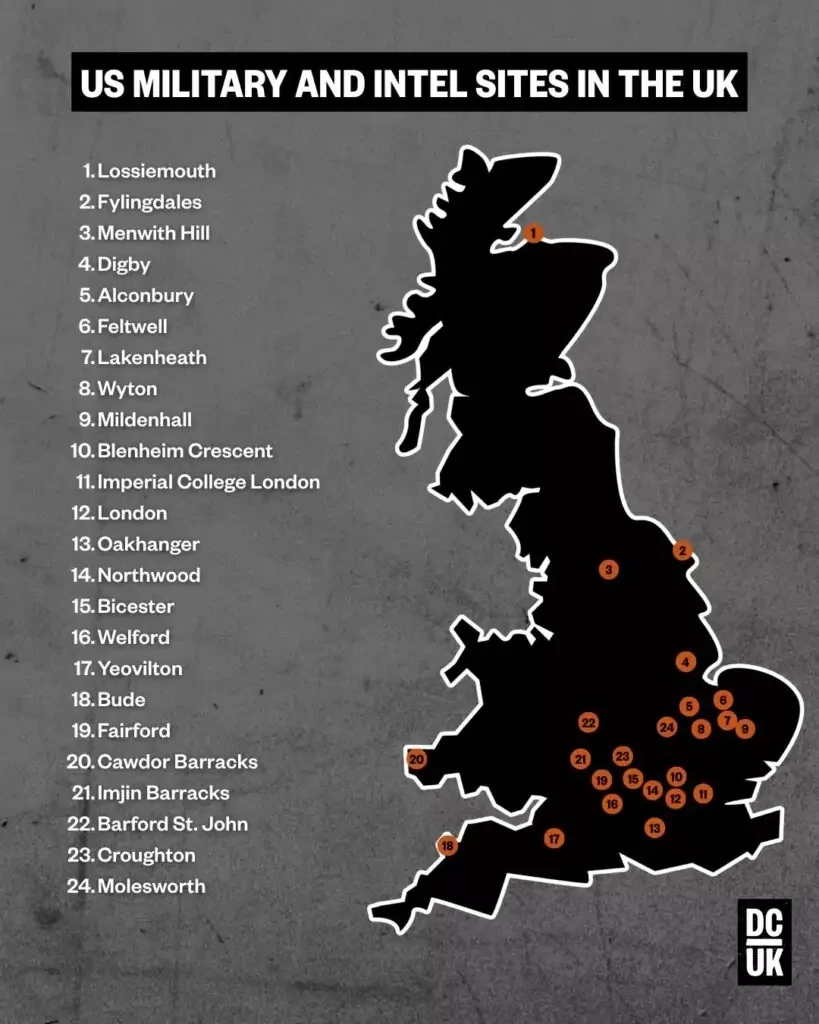
From where they are exactly to the laws governing them, here’s what we need to know to hold the UK government accountable for Trump’s use of British bases
MARK CURTIS , Declassified 4th March 2026
Keir Starmer has given his approval for Donald Trump’s US to attack Iran using British military bases.
But the UK government imposes a considerable veil of secrecy over the US use of these bases, keeping the British public in the dark about how its territory is used in foreign wars.
Former Labour Party leader and independent MP Jeremy Corbyn said: “From transferring equipment to refuelling planes to surveillance flights, we deserve to know the truth about exactly what these military bases are and have been used for, whether to benefit the US or Israel or both.
“There is a reason why the government is so reluctant to tell us: they know that this information could tip British complicity in genocide and war into active participation. We will continue to push for a full, public and independent inquiry into the use of these bases.”
Here are some of the things we need to know about the US military and intelligence presence in the UK and British territories.
Where exactly are they?
We don’t know where all US military personnel in Britain are. Whenever governments answer questions about the US presence in the UK, they mention major bases which the US Air Force operate – such as at Fairford, Mildenhall and Lakenheath – but have also referenced “undisclosed locations”.
The government also says that, in addition to the major air bases with a US presence, there are six other designated Nato facilities in the UK, where US military personnel can also be located.
But Declassified recently found a US War Department document highlighting 22 American military sites in Britain, some of which successive UK governments have failed to mention. It is not clear how many of these 22 sites are currently hosting US military personnel.
Declassified has identified other locations in Britain that are likely to host US military or intelligence personnel, bringing the total to 24.
Even this may not cover the full scale of the US military presence in the UK, since it is believed that US military personnel are frequently, if not permanently, stationed at still more sites, such as the key Royal Navy bases at Coulport, Devonport and Faslane.
Keir Starmer’s government is also refusing to tell parliament how many US forces are located at each of its major bases in Britain. The reason it gives for not saying is that “we are in a new era of threat that remains more serious and less predictable”.
The government also refuses to say where the US has any navy, army or marine detachments in the UK. Incredibly, it says “the overall US force composition across its UK footprint is a matter for the US”.
Who really owns the US military sites in Britain?
This is also unclear. The US War Department document we found states that, as of 2024, it owned, leased or otherwise controlled 22 military sites in Britain, and that these are worth £11bn. The UK government contends that the War Department owns no facilities in Britain, making the exact terms of the US presence even more unclear.
The US document, for example, said its War Department owns 12 buildings covering over 39,000 square feet at RAF Oakhanger in Hampshire, which is a satellite ground station.
Yet in answer to a recent parliamentary question, the MoD said it owns RAF Oakhanger.
The government also says it owns MOD Bicester, which is another site where the US War Department says it holds 261 buildings. What are the terms and conditions governing these holdings?
What military operations does the US conduct from Britain?
Governments have refused to give us the full picture. The standard response is: “The Ministry of Defence does not comment on the operational activity of other nations”, even when they’re operating in Britain.
When the US bombed Iran in June last year, the MoD refused to say if US aircraft based in Britain had been involved.
The MoD also refuses to say if the US has used its British bases to transport arms to Israel.
What US military operations need UK approval?
Britain has a vague agreement with the US on the use of British bases, going back to a 1952 communiqué between prime minister Winston Churchill and president Harry Truman. …………………………………………………………………………………………………………………………. https://www.declassifieduk.org/we-deserve-to-know-the-truth-11-questions-about-us-bases-in-britain/
Pro-nuclear group faces questions over ‘links’ to major London PR firm.

BRITAIN Remade is the apparently “grassroots” group leading the push
to overturn Scotland’s ban on nuclear power. But The Ferret has found
that two of its directors come from a firm which lobbies for the UK’s
biggest nuclear company.
Britain Remade organised the recent launch of the
“Scotland for nuclear energy” campaign and has repeatedly called for
Holyrood to reverse its long-standing opposition to new atomic energy. The
“pro-growth” group campaigns to make it easier to build things in the
UK – including housing, transport links and clean energy.
It says it is
“independent” and “grassroots”. But it has been alleged that
Britain Remade has close ties to the London-based public relations firm
Stonehaven. Stonehaven represents EDF – the French energy giant that owns
Scotland’s last operational nuclear power station at Torness in East
Lothian. EDF could be one of the biggest beneficiaries of any move to lift
the ban on new nuclear plants.
A Ferret investigation into the relationship
between Stonehaven and Britain Remade uncovered that BRM Futures Ltd –
the private company behind the campaign group – recently named two senior
Stonehaven figures as directors. We also found other overlaps including
that Britain Remade had been incorporated at an address that was previously
the registered office of Stonehaven, by an individual whose name resembles
that of Stonehaven’s finance director.
Critics argued the public has “a
right to know who is behind any campaign” otherwise there was a risk of
Scottish democracy being “undermined behind closed doors”. Britain
Remade told The Ferret it had “never taken a penny of corporate money”,
sets its own priorities and campaigns “on what we think matters for the
country”. It also said any claim that funders get a veto on anything it
writes or campaigns on is “categorically untrue”.
However, despite
direct questions, it did not confirm the nature of its relationship with
Stonehaven or whether it had been set up by anyone at the firm. Stonehaven
did not respond to a request for comment. Companies House filings –
updated on February 3, just two days before the Glasgow launch of the new
nuclear campaign – show that BRM Futures Ltd appointed Pandora Lefroy and
Rachel Wolf as directors in October 2024. Lefroy has worked at Stonehaven
for more than 10 years and is now the firm’s managing partner. Wolf is
the chief executive of Public First, another consultancy firm bought by
Stonehaven last year, and now sits on the board of the wider Stonehaven
Group Holdings Limited. Filings show that BRM Futures Ltd was incorporated
in February 2022 on the first floor of an office building called Thavies
Inn House, in the Holborn area of London. Until three months previously,
that same address had been Stonehaven’s registered office.
The sole
founding director listed on the incorporation document was Henry Frank
Lewis. He resigned in November 2022 when the campaign was officially
launched and current staff members Sam Richards, Sam Dumitriu and Jeremy
Driver were appointed. Stonehaven’s finance director is Harry Lewis.
Britain Remade did not respond to a question about whether he and Henry
Frank Lewis were the same individual. Like EDF, Britain Remade is named as
a client of Stonehaven on the professional lobbying register. It has also
reportedly used technology provided through Stonehaven to launch a petition
on onshore wind that secured more than 11,000 signatures. James Mitchell, a
professor of public policy at the University of Edinburgh, said the public
should be “very wary” of any organisation which was unwilling to
provide “such basic information”.
“The public has a right to know who
is behind any campaign pursuing a policy including, crucially, who funds
the campaign and with what level of funding,” he said.
The National 15th March 2026
Xi Hints At More Top Purges, Issues Warning To ‘Corrupt Elements’ In Chinese Army
by Tyler Durden, Mar 09, 2026, https://www.zerohedge.com/geopolitical/xi-hints-more-top-purges-issues-warning-corrupt-elements-chinese-army
One of the big themes to come out of China over the past several months (and even years) has been Chinese President Xi Jinping’s (apparently ongoing) sweeping purge of PLA military command ranks on the basis of “corruption” – or rather what is most probably perceived disloyalty.
Already there’s been several top dismissals including the firings of multiple members of the Central Military Commission (CMC) and dozens of generals – some even placed under house arrest, as well as a broad purge of the Chinese Communist Party.
Xi this weekend hinted there could be more to come, freshly warning Saturday during a speech to delegates from the People’s Liberation Army (PLA) and the People’s Armed Police that disloyalty to the party – or else selfish dealings and corruption – will not be tolerated.
“There must be no place in the military for those who are disloyal to the party, nor any place for corrupt elements,” Xi said.
He then called for strict oversight in “key areas such as fund flows, the exercise of power, and quality control” during the country’s next five-year plan which is set to be approved later this month.
Here’s more of what he said via Chinese state sources:
It is essential to fully strengthen the Party’s leadership and Party building in the military, and make Party organizations at all levels even stronger, Xi said, stressing the need to translate the Party’s leadership strength into development momentum.
It is important to consolidate the ideological foundation that ensures officers and soldiers follow the Party and its guidance, and ensure that modern weaponry and equipment are placed in the hands of politically committed personnel, Xi said.
A former CIA analyst who follows Chinese elite politics, Christopher K. Johnson, recently told the NY Times of the ongoing purge trend:
“This move is unprecedented in the history of the Chinese military and represents the total annihilation of the high command.”
The PLA has seen significant internal turmoil, especially since the Communist Party’s 20th Congress in late 2022. Several top military figures – including Defense Ministers Li Shangfu and Wei Fenghe, and CMC Political Work Department head Miao Hua – have disappeared or been removed, and many more followed.
A chilling reminder of the deceit & violence of Iraq war
March 09, 2026, by Bruce K. Gagnon
This film ‘Official Secrets’ is a true story. It’s now airing on Netflix and I urge folks to watch it.
‘Official Secrets,’ which opened in 2019, is the best movie ever made about how the Iraq War happened. It’s startlingly accurate, and because of that, it’s equally inspiring, demoralizing, hopeful, and enraging.
It’s been mostly forgotten now, but the Iraq War and its abominable consequences — the hundreds of thousands of deaths, the rise of ISIS terrorism, the nightmare oozing into Syria, arguably the presidency of Donald Trump — almost didn’t happen.
In 2003, as politicians in Britain and the US scheme to invade Iraq, GCHQ translator Katharine Gun leaks a classified e-mail that urges spying on members of the UN Security Council to force through the resolution to go to war.
Charged with breaking the Official Secrets Act, and facing imprisonment, Katharine and her lawyers set out to defend her actions. With her life, liberty and marriage threatened, she must stand up for what she believes in…
During this present Iran war – packed with lies, distortions and evil boasts of killing by the US and Israel – this 2019 film reveals the kind of ugly twists and turns that are regularly used to pull the wool over the public’s eyes.
Now and then a principled person stands against the dark wall of endless war.
Hungary detains Ukrainians transporting tens of millions in cash and gold
Hungarian authorities have launched an investigation into potential money laundering, but Ukraine insists those facilitating the transfer were state-owned bank employees carrying out their job

Thomas Brooke, ReMix News, 2026-03-06, https://rmx.news/article/hungary-detains-ukrainians-transporting-tens-of-millions-in-cash-and-gold/
Hungarian authorities have detained seven Ukrainian citizens and seized tens of millions of dollars, euros, and gold that were being transported through the country in armored vehicles, triggering the latest diplomatic dispute between Budapest and Kyiv.
Hungary’s National Tax and Customs Administration (NAV) confirmed on Friday that criminal proceedings had been launched on suspicion of money laundering following an operation carried out on March 5. Authorities intercepted two armored cash-transport vehicles traveling through Hungary from Austria toward Ukraine.
According to the Hungarian authorities, the vehicles were carrying approximately $40 million, €35 million in cash, and 9 kilograms of gold.
Hungarian Foreign Minister Péter Szijjártó said the case raised serious questions about the movement of large quantities of physical cash through the country.
“Since January, a total of $900 million and €420 million in cash has been transported through Hungary, and 146 kilograms of gold bars have also been transported through the country,” he said, as cited by Magyar Hírlap.
“We have a number of serious questions about this. First of all, this is a huge amount of cash, and we wonder why Ukrainians need to transport such a large amount of cash. If it is true that this is a transaction between banks, then the question rightly arises as to why the banks do not settle this between themselves by bank transfer, why it is necessary to transport such a large amount of cash, and why it has to be transported through Hungary,” Szijjártó added.
“These questions arise mainly because these cash shipments are accompanied by people who have clear ties to Ukrainian secret services.”
Hungarian Prime Minister Viktor Orbán’s political director, Balázs Orbán, also commented on the case, raising concerns about the purpose of the funds.
“Hundreds of millions in cash and gold moving through Hungary toward Ukraine — escorted by people linked to Ukrainian intelligence. Armored vehicles, suitcases full of money, staggering sums,” he wrote on X……………………………………………………………………………………….. https://rmx.news/article/hungary-detains-ukrainians-transporting-tens-of-millions-in-cash-and-gold/
Debunking the lies of the Iran War

The truth is, the United States has no idea what will happen if the Iranian government does fall. They are killing one leader after another, thinking they will eventually find someone who will work with the U.S. as Delcy Rodriguez has in Venezuela.
I’m aware of no one who actually studies Iran who thinks that is going to happen. It’s even less likely now that he’s killed most of the people he thought might fit that bill.
The U.S.-Israeli war on Iran has been built on lies. Here is the truth about Iran’s nuclear weapons program, the claim that Iran was an imminent threat, and the lie that Trump has a plan for what happens next.
By Mitchell Plitnick March 4, 2026, https://mondoweiss.net/2026/03/debunking-the-lies-of-the-iran-war/
When the United States invaded Iraq in 2003, many of us knew, and argued loudly, that the American public was being lied to. We knew that Iraq had no weapons of mass destruction and could back up our claims. The war went ahead anyway, but eventually, the lies were exposed.
Rather than build up support for his illegal and immoral war on Iran, as George W. Bush did nearly a quarter century ago, Donald Trump elected to simply ignore public opinion and start the war on his own. But, while Trump has his war and is not likely to be stopped by domestic forces until the war runs its course, he has found a need to justify his criminal actions.
As is their way, Trump and his minions simply lie. They’re not convincing many people, as polling shows that only about one in four Americans supports the Israeli-American attack on Iran.
This time, the lies are coming in true Trumpian fashion: they are inconsistent, contradictory, and confusing, meant more to overwhelm the audience than to convince it. But we shouldn’t be complacent about these lies. They have a way of both framing the debate and taking on a life of their own over time.
It’s important to examine some of these lies, and we should start with the biggest one.
The “Iran nuclear weapons program” lie
Over and over, we hear about the threat of an Iranian nuclear weapon. But rare indeed are the arguments for why this should be considered a casus belli when all reliable intelligence assessments have agreed that Iran has not pursued a nuclear weapon since 2003.
That assessment never wavered and never changed. It remains in place today. In the United States, it was reinforced by Donald Trump’s own intelligence services, collectively, just last year.
Moreover, while Trump’s endless boasting about having “obliterated” Iran’s nuclear program was always a lie, it is undeniable that significant damage was done to Iran’s key nuclear facilities last year. Yet we are somehow meant to believe that Iran’s nuclear potential is a threat, a mere eight months later.
The issue of a nuclear weapon has been a chimera from the start. Unfortunately, it was also manipulated by Iran at times. Having little real leverage against the United States, either militarily or diplomatically, Iran would sometimes turn to nuclear enrichment to try to get leverage in its efforts to either confront the West or press for sanctions relief.
That was a dubious strategy, even if it was understandable under the circumstances, as it gives the United States all it needs to falsely characterize Iran’s nuclear program as an effort to acquire a nuclear weapon. Iran would also, from time to time, diminish or even suspend cooperation with the International Atomic Energy Agency (IAEA). This, too, was an understandable strategy under the circumstances, but it had the same effect of creating evidence for arguments about the covert and dangerous nature of Iran’s nuclear program.
These tactics have been part of Iran’s game plan for 20 years. It’s not often discussed in those terms in the West, but it’s well understood in most governments and, coupled with the consistent intelligence assessments, makes it clear that Iran has not been in pursuit of a nuclear weapon. Whether Donald Trump can grasp this is, of course, an open question.
Yet when presented with a deal they perceive as in their interests, Iran has shown remarkable flexibility. The 2015 JCPOA, often called the Iran Nuclear Deal, provided for far more intrusive inspections than any country has ever been forced to undergo. Iran agreed and upheld its part of the bargain, despite the fact that the United States—which had agreed not only to lift certain nuclear-related sanctions but also to encourage investment in Iran to help its economy recover—had been actively discouraging economic support for Iran’s recovery. And despite the fact that its main regional adversary, Israel, had its own secret, undeclared, and unmonitored nuclear weapons stockpile of dozens, perhaps hundreds, of warheads.
This time, Iran agreed not only to IAEA inspections that were at least as intrusive, it also agreed not to stockpile enriched uranium. That means they would enrich only what they needed for their civilian use, and any excess would be handed over to whomever the IAEA agreed to send it to.
That’s what the Omani foreign minister announced to the world the day before Israel and the United States launched their attack on Iran. Given how closed-mouth Oman is in general and how close to the chest they have always kept information during all the negotiations they have mediated, this declaration was unprecedented. That he made that statement indicates he knew the attack was coming and hoped to thwart it. Sadly, he failed because neither Israel nor the Trump administration cares about being embarrassed by being caught in an outright lie.
The nuclear lie is the root of all of this, but many other lies are a part of the picture.
The “imminent threat” lie
The Trump administration has argued that there was an imminent threat to U.S. troops in the region. When Secretary of State and National Security Adviser Marco Rubio was asked to detail the threat, he said that, “It was abundantly clear that if Iran came under attack by anyone, … they were going to respond and respond against the United States. If we stood and waited for that attack to come first, before we hit them, we would suffer much higher casualties. We knew that there was going to be an Israeli action, we knew that that would precipitate an attack against American forces.”
So, Rubio is arguing that we had to attack Iran because otherwise Israel, beyond our control, was going to attack Iran and precipitate an attack on U.S. troops in the region. That, he argued, was the “imminent threat.”
The circular reasoning here is fallacious to the point that one would think it was spoken by a kindergartener.
There can’t be an imminent threat spurred by something you yourself have control of.
Moreover, just last June, we saw Trump literally force Israeli warplanes to reverse course mid-flight. He is more than capable of stopping an Israeli attack before one happens. Netanyahu would not dare spit in Trump’s face in that manner.
The U.S. was well aware that Iran had no plans to attack it. On Sunday, the Pentagon revealed, in a congressional briefing, that there was no intelligence in American possession whatsoever that indicated Iran was planning an attack. There simply was no imminent threat.
The “underground missiles” lie
“They’re totally fanatic about this, about the goal of destroying America. So they started building new sites, new places, underground bunkers that would make their ballistic missile programs and their atomic bomb programs immune within months if no action was taken.”
That was Netanyahu spelling out his cover story for this war of choice. This is a different kind of lie: it’s not exactly false, but it is decontextualized and deeply misleading.
Iran was reinforcing its underground facilities. This is only sensible. They had been attacked in June by two nuclear powers, both of which are militarily much stronger, especially in terms of air power, than Iran.
Iran was obviously aware that their nuclear facilities and ballistic missile stock and program were the main targets. Building underground facilities for the nuclear program and missiles is simply good sense, and absolutely Iran’s right. Further, all the United States had to do regarding the nuclear program was strike an agreement with Iran, and the IAEA would have had full access to the underground nuclear facilities.
Again, the idea that this justifies an unprovoked attack is absurd and well outside what is permissible under international law.
The Pahlavi lie
I’m using Reza Pahlavi, the son of the long-deposed Shah of Iran, as a marker for the general lack of any vision of what happens as a result of this criminal attack.
For Israel, this question is less pressing. While an Iran that looks like Syria or Libya would mean considerably less security for Israeli citizens, that is not a bad thing from Netanyahu’s point of view. His brand of demagoguery literally feeds off the fear of the citizens he rules, and threats only enhance his ability to eliminate the democracy that exists for Jews in Israel.
For the U.S., it’s a more pressing matter, yet one they apparently haven’t thought through.
They seem initially to have believed that Pahlavi could be brought in to lead Iran in place of the Islamic Republic, although Trump has expressed his lack of confidence in Pahlavi. He offered flowery words about being a stopgap leader who was simply going to usher in a new, pro-Western, pro-Israel, Iranian democracy.
But let’s recall who Pahlavi is. His father, Mohammad Reza Pahlavi was a brutal dictator, reinstalled by the United States in 1953 after the democratically elected prime minister, Mohammad Mosaddegh, was ousted in a CIA-backed coup.
Pahlavi himself lived in exile from the time his father was ousted, and after his father’s death, he named himself the new king of Iran. In 1982, Pahlavi was part of a plot, backed by the U.S. and Israel, to launch a coup in Iran, but it was abandoned when the Israeli leadership changed and the new prime minister, Yitzhak Shamir, thought the venture unwise. There are other instances like this in his history.
Pahlavi denies being connected to Israel or to American intelligence, but that is hardly credible. He is the son of a monarch, and his calls for democracy, given his history, ring hollow. More to the point, while there are some who have called his name during protests, Pahlavi, like other exiled Iranian figures and groups, has no coordinated support within Iran.
The Trump administration is currently encouraging Kurdish and other ethnic militias to help overthrow the Islamic Republic government, but the efforts have thus far been met with skepticism. That’s not surprising given the American history of abandoning such people after they rise up, reinforced only recently during the protests in Iran.
The truth is, the United States has no idea what will happen if the Iranian government does fall. They are killing one leader after another, thinking they will eventually find someone who will work with the U.S. as Delcy Rodriguez has in Venezuela. I’m aware of no one who actually studies Iran who thinks that is going to happen. It’s even less likely now that he’s killed most of the people he thought might fit that bill.
Deception is the main characteristic of American planning here, and one aspect of that is self-deception. Trump has allowed Netanyahu to convince him to engage in this foolish and reckless endeavor. It says much that none of Trump’s predecessors, going all the way back to the days of Ronald Reagan, were this stupid.
Make no mistake, this is an American war, even as it fulfills Netanyahu’s dearest and oldest dream. Trump was not forced or even tricked into this. He, and others on his staff (chiefly Marco Rubio) are flush with their apparent success in Venezuela, and Trump has visions of going down in history as the man who eliminated the hated Islamic Republic, a target of widespread, bipartisan American scorn since 1979.
There was never any possibility of a diplomatic resolution, as evidenced by what Iran offered just before Israel struck the first blow. For both Israel and the Trump administration, this war is rooted in the deep desire to eliminate the one country that has defied American and Israeli hegemony for years. The threat of a nuclear weapon is a lie, the concern about Iran’s quite abysmal human rights record is a complete sham.
It’s a war of choice, built on lies. We’ve been here before, two decades ago. Most Americans learned a lesson from that, which is why so few support this calamity. Unfortunately, the ones making the decisions are among the few who learned nothing.
When will US, Israel stop censoring massive damage to US facilities and Israel?

Walt Zlotow West Suburban Peace Coalition Glen Ellyn IL , 7 Mar 2
US Middle East bases are being pounded by Iranian drones and missiles. So is Israel.
Yet virtually none of this massive damage, signaling major failure of the US, Israeli war on Iran, is being shown to the American public which overwhelmingly opposes this senseless, self-destructive war. A CNN reporter in Tel Aviv admitted they could not show the destruction occurring around her due to government censorship.
All the Gulf States that house US bases are running out of defensive interceptors. So is Israel. Trump’s crazed War Secretary Pete Hegseth is so anxious to suppress the bad news, he’s accused mainstream media of trying to embarrass President Trump by focusing on the 6 dead Americans Trump got killed for nothing. Don’t publicize dead US service members Hegseth moans….publicize our war fighters’ victories.
Trump’s war to destroy Iran on behalf of Israeli Prime Minister Benjamin Netanyahu may crash the US economy, push America out of the Middle East, incur major US casualties, and find Iran still standing at the end. Remember, the US supported Iraq’s 1980 war against Iran which united its 90 million souls to support their Islamic government. After 8 years and hundreds of thousands of casualties, Iran survived.
The lesson of that war was to prepare for the next major attempt by the US to destroy Iran on behalf of Israel. Thirty-six years on, that preparation has upended Trump’s plan for a quick 3 day war to replace the Iranian Islamic government with a US puppet. Knowing he’s failing, Trump may, as early as tomorrow, unleash a massive bombing campaign using B-1’s. B-2’s and ancient B-52’s to pulverize the 90 million Iranians and their government refusing Trump’s surrender terms. All that will accomplish is add untold thousands of deaths to Trump’s war crime record.
After one week it’s time for mainstream media stop self-censoring Trump’s senseless war. It’s’ time to tell the unvarnished truth about its criminality incurring unprecedented US, Israeli destruction. The sooner they do, the sooner Congress might step in to defund and stop Operation Epic Failure.
1 This Month

of the week – Shut Down Drone Warfare!


Tell the Ukrainian Government to Drop Prosecution of Peace Activist Yurii Sheliazhenko

Petition to revoke the licensing of the Near Surface Nuclear Disposal Facility (NSDF) at Chalk River. https://www.ourcommons.ca/petitions/en/Petition/Details?Petition=e-7247
To see nuclear-related stories in greater depth and intensity – go to https://nuclearinformation.wordpress.com
-
Archives
- March 2026 (237)
- February 2026 (268)
- January 2026 (308)
- December 2025 (358)
- November 2025 (359)
- October 2025 (376)
- September 2025 (257)
- August 2025 (319)
- July 2025 (230)
- June 2025 (348)
- May 2025 (261)
- April 2025 (305)
-
Categories
- 1
- 1 NUCLEAR ISSUES
- business and costs
- climate change
- culture and arts
- ENERGY
- environment
- health
- history
- indigenous issues
- Legal
- marketing of nuclear
- media
- opposition to nuclear
- PERSONAL STORIES
- politics
- politics international
- Religion and ethics
- safety
- secrets,lies and civil liberties
- spinbuster
- technology
- Uranium
- wastes
- weapons and war
- Women
- 2 WORLD
- ACTION
- AFRICA
- Atrocities
- AUSTRALIA
- Christina's notes
- Christina's themes
- culture and arts
- Events
- Fuk 2022
- Fuk 2023
- Fukushima 2017
- Fukushima 2018
- fukushima 2019
- Fukushima 2020
- Fukushima 2021
- general
- global warming
- Humour (God we need it)
- Nuclear
- RARE EARTHS
- Reference
- resources – print
- Resources -audiovicual
- Weekly Newsletter
- World
- World Nuclear
- YouTube
-
RSS
Entries RSS
Comments RSS
 nuclear-news