In extreme heat wave, forest fire threatens Sakatchewan uranium mine – another example of global heating hitting nuclear activities.

Forest fire burns uncontained near Cigar Lake uranium mine in northern Sask., CBC, 2 July 21, All non-essential personnel have been evacuated due to the fire, Cameco said in a statement.
The Cameco Corporation has reported a forest fire in the vicinity of its Cigar Lake uranium mine in northern Saskatchewan.
In a statement Thursday morning, the company said it has evacuated about 230 workers from the mine and roughly 80 people remain on site to keep the facility in a safe state.
Cameco said, should the wildfire threat continue to grow, there is a plan to keep the workers there safe and a number of precautions have been implemented. It said it’s working closely with the Saskatchewan Public Safety Agency on site.
Cameco said the fire is complicated by extremely warm, dry weather resulting from the heat dome currently over Western Canada.
Production at the Cigar Lake mine has been temporarily suspended. …….
…… As of early Thursday afternoon, the provincial government’s website listed 19 active fires across Saskatchewan. Five are not contained, including the Briggs fire near the Cigar Lake mine. https://www.cbc.ca/news/canada/saskatchewan/forest-fire-cigar-lake-mine-1.6087459
Nuclear Reactor Security Risk: Middle East and Gulf Region
Nuclear Reactor Security Risk: Middle East and Gulf Region
By Dr. Paul Dorfman, Honorary Senior Research Associate at the UCL Energy Institute, University College London NCT Magazine 30 June 21, The Middle East and Gulf region faces unique challenges and perceived opportunities when it comes to nuclear power. The tense geopolitical environment makes nuclear power an even more controversial issue here than elsewhere as competing states share the unease that neighbors may use civilian nuclear programs for military ends. It is not that nuclear military interests are sole drivers of support for civil nuclear power, but the fact is dual-use technology comprises a significant complementary factor.
This dynamic plays out via a range of safety and security concerns. Unless enrichment of uranium and reprocessing technologies are effectively regulated against diversion of civil materials for military purposes, the reality is that new nuclear power plants can and will provide the cover to develop and make nuclear weapons. Whether that capability is turned into actual weapons largely depends on political inclination. For example, in response to developments in Iran, Saudi Arabia has made it clear on more than one occasion that there is another reason for their interest in nuclear energy – the relationship between civil and nuclear weapon programs.
Trans-Boundary Consequences
In order to function at any level, nuclear power needs stability and cooperation between neighboring states. However, as recent military strikes infer, the region is one of the world’s most volatile. Nuclear safety revolves around the broader issue of security, especially since some armed groups may view state-sponsored military operations as a reason to target nuclear installations or intercept enriched uranium fuel or waste transfers……………
Such a backdraft from foreign policy, and politics more generally, will increasingly dovetail with regional nuclear safety considerations. This is important because, given the associated high human activity-related hazards, there are broader concerns – since a major nuclear accident or incident would have significant transboundary consequences.
Attack Risk
An attack on a nuclear installation may be one of several types. There are two main targets in a nuclear power plant: the reactor itself and the ponds storing the highly radioactive spent fuel removed from the reactor. An attack on the reactor could cause the core to go critical or result in a loss of the coolant that removes heat from it. And the protection of nuclear plants with fighter aircraft or surface-to-air missiles is not an easy task, with time available to scramble fighter aircraft or fire surface-to-air missiles proving limited. So, there are now heightened concerns about the need to try to secure high-risk radioactive material from concerted attack, sabotage, or hijack to a transporter of nuclear material……..
Radiological Hazard
There are a number of distinct radiological hazards at a nuclear power station, including fission products and the activated inventory of the reactor fuel and core, the irradiated fuel store, and radioactive wastes. Operational hazards also include irradiated spent fuel transportation and new fuel delivery. ……………..
Risk Cycles
Shifting power relations, regional and international rivalries have led to instability, security threats, and patterns of violence in the Middle East and Gulf region. Interactions between soft and military power have played a crucial role in shaping political and security landscapes……….
Another Pathway
But another pathway is both feasible and possible. Given the entropic risks involved, why commit to further nuclear expansion in a region so often impaired by overt or covert conflict? The case for civil nuclear power in the region has never been strong, and because their state electricity systems are relatively small, significant nuclear electricity grid input risks overload anyway.
Worldwide and in the Middle East and Gulf region, the fate of new nuclear is inextricably linked to, and determined by, renewable energy technology roll-out. Currently, global market trends for new nuclear are declining. Whilst ramping improvement in renewable technology is one explanation for this dynamic, the main driver seems to be the plummeting costs of renewable energy and the ramping costs of new nuclear construction.
Accidents Happen ……….. . Whatever one’s view of the risks and benefits of nuclear energy in the Middle East and Gulf region and further afield, it seems clear that the possibility of military attack and catastrophic accident must be factored in – and all that implies for complex defense and energy policy decisions.
Old cracked infrastructure – the Florida building collapse – a warning for old cracked nuclear reactors.

embrittlement, pipe cracking, component degradation, technical obsolescence, an aging workforce, rampant incompetence, and worse define the reality of virtually every operating atomic reactor, here and around the planet.
Collapsed Florida Condo Sends a Giant Nuke Warning https://readersupportednews.org/opinion2/277-75/70146-rsn-collapsed-florida-condo-sends-a-giant-nuke-warning, By Harvey Wasserman, Reader Supported News, 28 June 21 he horrifying collapse of a south Florida condo should alarm us all about the next reactor catastrophe.
The owners of that 13-story condo were warned years ago that it could implode. They were apparently getting ready for repairs, but in the interim did nothing.
The owners of America’s 93 licensed reactors have been warned for decades that they could both implode and explode. They have also done nothing.
More than 150 people may have died in this avoidable Florida disaster. The death toll from the next avoidable reactor disaster could stretch into the millions, with property damage in the trillions, a blow from which our economy and ecosystems might never recover.
South Florida authorities have now ordered inspections of large buildings over forty years old. Nearly all US reactors – including four on the ocean in South Florida – are also now around forty years old.
They all must be immediately shut for rigorous inspection. To wait is to invite a radioactive version of what just happened to that condo.
The argument is not about nuclear power. It’s about basic sanity.
The industry is currently pushing “new” designs based on fusion, thorium, breeder technologies, molten salt, small modular, and more. None have been proven safe or effective in fighting climate chaos. Nor can they compete with renewables. None have a reasonable prospect of coming online before being completely left in the radioactive dust by accelerating advances in wind, solar, batteries, and LED efficiency.
All are certain to consume huge quantities of public money, pouring into private pockets (like those of Bill Gates) before failing utterly.
But they pale in importance alongside the 93 US reactors (there are some 430 worldwide) now plummeting toward certain catastrophe.
None of these reactors can get private liability insurance against an apocalyptic disaster. Most were designed in the pre-digital 1950s and ‘60s. Many were built with inferior materials and understanding.
Critical welds at California’s Diablo Canyon, for example, contain metal components long since banned. But Unit One continues to operate.
Critical concrete at New Hampshire’s Seabrook and Ohio’s Davis-Besse is crumbling. Fort Calhoun in Nebraska was flooded. Intake pipes at South Texas froze. Reactors in Ohio and Virginia have been damaged by earthquakes. Diablo is surrounded by earthquake faults set to deliver seismic shocks which a Nuclear Regulatory Commission resident inspector has said it can’t withstand. The owners of San Onofre want to bury their high-level wastes ONE HUNDRED FEET from the tide line. Meaningful evacuation planning is nonexistent at sites where nearby population centers have exploded since the original siting approval.
All these old reactors contribute to climate chaos with emissions of heat, radiation, and carbon. They suck up billions of gallons of precious water, then dump it or evaporate it with chemical, radioactive, and thermal pollution. In every case, our planet would benefit from their shutdown.
Virtually all US reactors are almost certainly embrittled, meaning emergency cooling water poured into the core to quell a meltdown would shatter critical components, resulting in apocalyptic hydrogen and possibly fission explosions, as at Chernobyl and Fukushima.
To put it most simply: no embrittled reactor has a workable set of brakes. Yet states like California, and the NRC itself, refuse to conduct relatively cheap and simple open inspections.
Thus embrittlement, pipe cracking, component degradation, technical obsolescence, an aging workforce, rampant incompetence, and worse define the reality of virtually every operating atomic reactor, here and around the planet.
So when we look in horror at that collapsed south Florida condo, with all those innocent souls buried in the rubble, we must remember that later today, parallel pictures could show a mega-hot runaway reactor spewing Chernobyl/Fukushima levels of radiation throughout the ecosphere.
Thankfully, the Solartopian realities of fast-accelerating wind, solar, battery, and efficiency technologies give us the leeway to shut them all NOW.
Let’s do it before it’s too late!!
Harvey Wasserman co-convenes the weekly Election Protection 2024 ZOOM. His People’s Spiral of US History is at www.solartopia.org.
EDF will try to minimise the radiological leak at the Taishan nuclear plant – but the damage is done.
A minor operating incident of a Chinese reactor at the French-designed Taishan NPP, pinned down by CNN. The small world of nuclear power has still not returned from the tortuous journey of this information. Monday, June 14, the American channel released a world scoop by reporting that the French group Framatome warned the American authorities of an “imminent radiological threat” to the Taishan power plant. In the hours that follow,
EDF, a 30% shareholder in the Taishan EPR plant, will specify that this is only a fuel rod leak (supplied by Framatome), confined in the very secure circuit. primary of a reactor. An operating incident under control, a priori without consequences. But the damage is done.
Le Figaro 24th June 2021
https://www.lefigaro.fr/international/nucleaire-chinois-la-bevue-incroyable-de-framatome-20210624
 | ReplyForward |
Magnox Silo Liquor “Crack Under Control.” note: it isn’t.
How does the Nuclear Industry get away with wanting to produce ever more and ever hotter nuclear wastes when they cannot contain the existing wastes. The Magnox Swarf silo is leaking – from an unknown point – part
of the silo is below ground. United Utilities are abstracting drinking water for West Cumbria from boreholes at South Egremont a short distance away.
This is just one of the tenders Sellafield has put out for help with “seepage.” Sellafield are asking contractors to help: The Key Questionis “Can We Stop This Leak Which Is In The Building” “Can We Identify The Location”.
Radiation Free Lakeland 25th June 2021
Magnox Silo Liquor “Crack Under Control.” note: it isn’t
Physicians raise doubts on environmental and safety risks of extending life of Wisconsin’s ageing nuclear plant. Federal Licensing Board to consider.
Federal Licensing Board Considers Challenge To Wisconsin’s Last Nuclear Plant
Wisconsin-Based Physicians Group Argues Point Beach Nuclear Plant Needs To Address Environmental Impact, Safety Concerns, Wisconsin Public Radio, By Hope Kirwan, Wednesday, June 23, 2021,
A Wisconsin advocacy group argued Tuesday that the state’s last operational nuclear power plant shouldn’t have their license extended given the environmental impact and safety concerns about the aging infrastructure.
Physicians for Social Responsibility Wisconsin (PSR), an anti-nuclear nonprofit group of health care professionals based in Madison, filed a petition in March challenging the application to renew Point Beach Nuclear Plant’s licenses for an additional 20 years.
The Two Rivers power plant is owned by NextEra Energy and its current licenses expire in 2030 and 2033.
The U.S. Nuclear Regulatory Commission’s Atomic Safety and Licensing Board held a remote hearing Tuesday to consider the nonprofit group’s challenge.
Terry Lodge, an attorney representing PSR, argued the nuclear power plant has caused “50 years of carnage” to fish, fish larvae and some migratory birds because the plant pulls water from Lake Michigan.
“There’s considerable local kill that occurs,” Lodge said during the hearing. “So long as this system is allowed to operate as it does, it is inevitable, with the uptake of approximately a billion gallons a day for purposes of cooling the two units at Point Beach.”
Lodge also claimed NextEra Energy didn’t adequately consider utility-scale solar energy systems as an alternative to continuing to operate the nuclear power plant. They argue solar technology will continue to progress before Point Beach’s current license expires and will be a more environmentally-friendly alternative to nuclear power.
“There is a fixation that is manifest in the Point Beach application that centralized, large baseload power units are somehow the most satisfactory and effective way of addressing the electric power needs in their jurisdiction. That is very false and in fact, Point Beach is an obstacle to the future,” Lodge said.
Lodge argued the 50-year-old plant hasn’t done sufficient testing or safety improvements to ensure there is a low probability of a reactor or turbine failure……..
After several hours of questioning both the utility and the doctors’ group during Tuesday’s hearing, the three-member licensing board is expected to issue a decision within 45 days. https://www.wpr.org/federal-licensing-board-considers-challenge-wisconsins-last-nuclear-plant
Alarm at Japan’s plan to restart Kansai’s ageing No.3 nuclear reactor
As Japan reboots ageing Mihama nuclear reactor, experts express concern, Reuters, Aaron Sheldrick 23 June 21
- Reactor restarted after sitting idle for 10 years
- First of four old reactors to get exceptions
- For an interactive graphic on the status of Japan’s nuclear reactors, click https://tmsnrt.rs/2OTpNfA
– The head of a major inquiry into Japan’s nuclear disaster and a former senior Cabinet adviser have sounded alarms over plans this week to restart a 44-year old reactor, saying the industry and government have not taken on board the lessons from Fukushima.
Kansai Electric Power (9503.T), which serves Osaka and its industrial environs – an area with roughly the same economic output as Mexico – said it restarted the No. 3 reactor at its Mihama station in western Japan earlier on Wednesday.
The reactor is the oldest to be restarted since the 2011 Fukushima disaster and needed special approval to have its lifetime extended beyond the standard 40-year limit. Most reactors in Japan remain shut after the accident highlighted failings in regulation and oversight.
Tatsujiro Suzuki, a former deputy chairman of the Cabinet Office’s Atomic Energy Commission, told Reuters he has misgivings over how approval for the restart was obtained.
- He said he was concerned about a lack of transparency and the use of subsidies to sweeten local opinion to get the necessary restart approval…….
- It looks like the industry and the government have not learned the lessons of Fukushima,” said Suzuki, who is on the advisory board of a parliamentary committee on nuclear safety.
Bureaucrats from the Ministry of Economy, Trade and Industry (METI), which supports nuclear energy to power Japan’s industrial economy, went to Fukui prefecture 110 times over a two-year period until early this year.
The visits to Fukui by officials including the head of the powerful natural resources agency were raised at a recent hearing of the parliamentary committee.
A subsidy of 2.5 billion yen ($23 million) was agreed for local communities before the Fukui governor signed off on the restart…….
- Five workers died at Mihama power station in 2004 after a pipe that had not been inspected for nearly a decade burst, releasing high pressure steam and hot water.
- In 2019, Kansai Electric executives admitted to receiving cash and gifts worth 360 million yen from an official from a town hosting one of its other nuclear plants.”They haven’t changed, that’s my impression, despite the scandal involving kickbacks,” Suzuki said……..
A silo mentality among executives and a collectivist mindset among bureaucrats, which puts organisational interests ahead of public duties on safety are still prevalent in Japan, Kurokawa said.
“It’s always important to ask what are the sanctions for bad corporate behaviour. If there are none, and in Japan there are none, then oversight is meaningless,” he said, adding he was concerned about the restart.
Mihama is one of 16 reactors that have received either preliminary or final approval to restart…………https://www.reuters.com/world/asia-pacific/japan-reboots-44-year-old-nuclear-reactor-experts-sound-alarm-2021-06-22/
Duke Energy planning for a fleet of 80 year-old nuclear reactors
Duke Wants to Run Its Nuclear Plants Until They’re 80 Years Old, 22 June 2021,
- Joins Exelon, Dominion, NextEra to run world’s oldest fleet
- Duke has 11 reactors at six sites in North and South Carolina
One of the biggest power companies in the U.S., is planning to run its fleet of 11 nuclear reactors until they’re 80 years old.
The company filed an application with the U.S. Nuclear Regulatory Commission to renew the license for its Oconee power plant for 20 years, Charlotte-based Duke said in statement Monday. The South Carolina facility began producing power in 1973 and the extensions would keep the three reactors in service until 2053 and 2054.
The company plans to submit similar extension requests for its five other nuclear plants in the Carolinas, which all went into service in the 1970s and 1980s. Duke is part of a growing number of U.S. nuclear owners that are planning to keep their reactors in service for eight decades. Exelon Corp., Dominion Energy Inc. and NextEra Inc. have already been granted similar extensions, creating what will eventually be the world’s oldest nuclear fleet……….
China’s Taishan nuclear reactor has 5 damaged fuel rods
There are likely five damaged fuel rods in the 1,750 MW Taishan-1 EPR in
China, which have led to an increase in radiation levels within the reactor
coolant, the Chinese Ministry of Ecology and Environment said in a
statement June 16, providing the first official explanation for the nuclear
reactor’s recent technical problems.
French power company EDF, a minority
owner of the Taishan plant, said in a statement June 14 that Taishan-1 had
seen an increase in the concentration of radioactive gases in its primary
circuit. The environment ministry added that “at present, the radiation
activity of [Taishan-1’s] reactor circuit coolant … is still within the
scope of allowing stable operation as stipulated in the technical
specifications for the operation of the nuclear power plant.”
The meeting
of technical specifications, which define the licensed operating parameters
or a reactor, and operational safety of the Taishan plant are guaranteed,
the ministry added. It also said the increase in radioactivity in
Taishan-1’s primary circuit is related to fuel-rod damage.
S&P 16th June 2021
The dangersof transporting nuclear weapons and other nuclear materials
Nuclear Transports**
The UK & Ireland Nuclear Free Local Authorities (NFLA) today publishes a
detailed analysis considering the wide range and large number of transports
of nuclear materials around the UK and Europe, and from the UK to other
countries.
The report highlights nuclear transports are continuing to
increase and remain a concern from the perspective of an accident or
malicious incident taking place with one of them. Nuclear transport is of
particular concern to the NFLA as radioactive materials are at their most
vulnerable when they are being transported off site, as they are away from
dedicated safe storage facilities and are in an ‘uncontrolled’
environment where they face a greater level of risk.
The report considersin detail the following transports: The safety of nuclear weapon road
convoys – it considers recent reports by the Nuclear Information Service,
ICAN UK and Nukewatch Scotland. The future transport by road of vehicles
containing redundant submarine reactors from Rosyth and Devonport to
Capenhurst by road. The report highlights the sheer number of road
transports involving nuclear materials as well.
The transport by rail of spent nuclear fuel from existing and decommissioned reactors, with
particular focus on the rail transports of radioactive materials from
Dounreay to Sellafield. It also highlights learning points from recent
conventional rail transport accidents. The transport of radioactive
materials by sea around the British Isles and globally to fulfil
international contracts. The transport of highly enriched uranium materials
stored at Dounreay by air to a site in South Carolina, United States.
Thereis also reference to a historical list of accidents involving planes with
nuclear weapons.
NFLA 22nd June 2021
The Taishan death blow

China’s EPR reactor accident should end French reactor projects
The Taishan death blow — Beyond Nuclear International Radioactive leak at Chinese reactor could finish French nuclear exports https://wordpress.com/read/feeds/72759838/posts/3403922693
By Stéphane Lhomme, Nuclear Observatory
If the opacity maintained by the Chinese regime prevents us, for the time being, from knowing the exact consequences of the radioactive leak involving the EPR no.1 reactor at Taishan, revealed on June 14 by CNN, it is, on the other hand, already possible to see how this unfolded and to recommend some next steps.
The fault in the fuel duct seals inside the Taishan EPR dates back to October 2020, that is to say, it had already been going on for more than eight months: the operators of the reactor — the Chinese and the French company Framatome — were perfectly well aware of the gravity of the situation and had jointly decided to hide the existence of the problem from not only the surrounding population but also from the International Atomic Energy Agency.
Luckily, the information ended up seeping out via the American subsidiary of Framatome (Areva NP Inc.). This latter, likely after discussions with the CIA and the White House, happily informed CNN.
Indeed, now that the situation at the EPR at Taishan is known around the world, it will be difficult for the Chinese to continue to operate the reactor under conditions that are most likely beyond its “scope of authorized operational safety” — contrary to what Framatome claims in order not to offend the Chinese.
It is widely known publicly that China and the USA, the two biggest global powers, are huge geopolitical and economic rivals. It is clear that if the Taishan 1 EPR, and perhaps its twin, Taishan 2, must be shut down for an extended period, this will be an inconvenience for China, which occasionally lacks electricity in this region. Hence the guilty pleasure felt by the Americans in revealing the problem.
But this will still remain only a limited problem for China where, contrary to what one sometimes reads or hears, nuclear power is a marginal energy source, consisting of less than 1% of the country’s energy consumption.
On the other hand, it is quite possible that the French nuclear industry will be the big loser in this affair, one that could represent a fatal blow for EDF’s EPR construction projects in France and overseas. Indeed, given that the EPR construction sites managed by the French — Areva in Finland, EDF in France and Great Britain — are veritable industrial and financial disasters, the promoters of the EPR reactor have been desperately clinging to the “good Chinese example”.
That is because the two EPRs at Taishan were built and brought on line (in December 2018 and September 2019 respectively) with “only” a few years delay and the cost overruns were officially limited to a few billion (according to China which, one must remember, is a dictatorship where “information” is totally controlled).
The situation currently unfolding in China demonstrates that, despite the alleged prowess of the Chinese nucleocrats, the Taishan EPRs are not going any better than those the French are trying desperately to build. This event will certainly sow enormous doubt among the few foreign leaders who are still considering ordering EPR reactors, despite all their setbacks. It is surely the straw that broke the camel’s back, or rather the radioactive leak that caused the (defective) EPR containment to overflow.
Likewise, this incident should motivate French political leaders (but also Finnish and British ones) to finally take responsibility and definitively halt EPR construction at Olkiluoto (Finland), Flamanville (France) and Hinkley Point (Great Britain), and to stop announcing future EPR projects in India and elsewhere.
Safety concerns on Taishan reactor, but China wants to be world’s nuclear leader by 2050
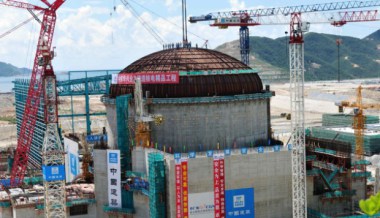
China’s nuclear safety queried over Taishan reactor, but it wants to lead world by 2050 SCMP, Stephen Chen in Beijing, 21 June 21
- Road map drawn up by the country’s nuclear experts sets series of goals to help it catch up with the West on safety
- Increase in radioactivity in Taishan did not spread outside reactor, data showed, but Chinese nuclear industry trails in software and hardware
China aims to become a dominant player in the world nuclear market in less than 30 years and have the highest safety standards and lowest costs, a government advisory body has said.
For decades, China tried to catch up with safety standards in Western countries, led by the United States and France. But now China plans to challenge them, the Chinese Academy of Engineering (CAE) said in a report published last Tuesday…….
by 2050, the road map describes China leading the setting of new industry standards for global nuclear power and taking “a bigger share in the international market”.
The increase in radioactivity in Taishan was caused by leaking fuel rods known as “leakers”
They are still used by many nuclear power plants globally, but the US had by 2013 eradicated them from more than 90 per cent of its reactors, …….
The Taishan radioactivity was viewed in some quarters as an environmental threat that the Chinese government had tried to cover up.
China’s National Nuclear Safety Administration had posted the event on its website on April 7, but the scientists who produced the road map admitted that the country’s nuclear safety was not yet up to the standards in the West, even if its nuclear reactors had no safety incidents in the past three decades.
Safety improvements require cutting-edge technology such as computer programs simulating the operation of a reactor, and materials to make critical components. The Chinese nuclear industry is behind in both software and hardware, according to the report.
Chinese nuclear power companies have produced numerous software products for nuclear plant design, operation and safety evaluation, but did so in isolation, and their reliability and modelling of serious accidents had room for improvement, said senior nuclear safety scientist Huang Hongwen in the report commissioned by the CAE.
China has also been dependent on Western suppliers of some hardware components critical to safe operation of nuclear plants, according to the report.
“Some of our high-precision nuclear safety equipment is still in the hands of others,” Huang wrote.
The US government imposed a sanction – which remains in place – on the Chinese nuclear power industry in 2019, banning the sale of any nuclear-related technology or goods to China except in the event of an immediate environmental threat such as radioactive leakage. The US government said it was investigating the Taishan event………….
Wang Junhao, president of Zhejiang University of Finance and Economics, wrote in the journal Economic Theory and Business Management in April that the penalties for safety lapses were too light to act as a deterrent.
“When a hidden safety hazard was discovered by regulatory inspections, the financial loss was too small,” Wang said. “There must be greater punishments.” https://www.scmp.com/news/china/science/article/3138214/chinas-nuclear-safety-queried-over-taishan-reactor-it-wants-lead
Nuclear Regulatory Commission launches special investigation at Southern Georgia Vogtle 3 nuclear unit
U.S. NRC launches investigation at Southern Georgia Vogtle 3 nuclear unit, June 21 (Reuters) – The U.S. Nuclear Regulatory Commission (NRC) said Monday it launched a special inspection at Southern Co’s (SO.N) Vogtle nuclear power plant in Georgia to identify what led to remediation work at the third unit, which is under construction.
The NRC said its team will focus on the electrical cable raceway system, which is designed to prevent a single event from disabling redundant safety-related equipment.
Southern has said the two units under construction at Vogtle, which are billions of dollars over budget and years behind schedule, were on track to enter service next year with Unit 3 in January and Unit 4 by its regulatory-approved in service date of November 2022. …………
When Georgia approved the Vogtle expansion in 2009, the two 1,117-megawatt Westinghouse AP1000 reactors were expected to cost about $14 billion and enter service in 2016 and 2017.
Some analysts estimate costs have ballooned to more than $27 billion due to delays related to a nuclear accident at Japan’s Fukushima plant in 2011 and the 2017 bankruptcy of Westinghouse, the project’s former contractor.
Southern estimated the capital cost for its 45.7% share of the new Vogtle reactors at about $8.7 billion.Reporting by Scott DiSavino Editing by Marguerita Choy https://www.reuters.com/business/energy/us-nrc-launches-investigation-southern-georgia-vogtle-3-nuclear-unit-2021-06-21/
Collaboration between Russia and Europe finally cleans up the most dangerous nuclear ship in the Arctic.
After 27 Years, Lepse No Longer Poses a Nuclear Threat to the Arctic, High North News, PETER B. DANILOV 17 June 21, Last week, the Russian service ship Serebryanka delivered the last spent-fuel bundles from the Lepse floating maintenance base to an Atomflot storage site in Murmansk, completing the final stage of securing the nuclear waste……. To ensure the dismantling of the Lepse floating maintenance base, it was necessary to specially develop new technologies and equipment and make innovative decisions,” said FSUE Atomflot Director General Mustafa Kashka.
In July 2020, the Lepse floating maintenance base’s main batch of spent nuclear fuel was unloaded at the Nerpa shipyard. A total of 620 spent-fuel bundles were extracted and unloaded.
Lepse was regarded as the most dangerous nuclear vessel in the north and the Norwegian environmental NGO Bellona began the work of securing the spent nuclear fuel onboard the vessel in 1994.
……….. The project to dismantle and dispose of the Lepse Floating Maintenance Base is multilaterally implemented.
In 1996, the project was included in the EU’s TACIS program (Technical Assistance to the Commonwealth of Independent States), which involved the allocation of funds for the inspection of the state of spent nuclear fuel.
Since 2008, the project has been carried out in the framework of a Grant Agreement between the European Bank for Reconstruction and Development (EBRD), Rosatom, and JSC NFC Logistics Centre (the project’s customer and coordinator).
The EBRD has provided 54 million euros from the Northern Dimension Environmental Partnership Fund (NDEP). https://www.highnorthnews.com/en/after-27-years-lepse-no-longer-poses-nuclear-threat-arctic
What actually happened at Taishan?
What actually happened at Taishan? https://www.rnanews.eu/what-actually-happened-at-taishan-nfla-call-on-nuclear-regulator-to-carefully-investigate-possible-r-140634.html?fbclid=IwAR2W5hoUwNH-6fgYOgVv6LIbM4wVWPGA1cLA4i8_XAC0PPIpz4odlGmSTcI NFLA call on nuclear regulator to carefully investigate possible radioactive leak and its implications for Hinkley C & Sizewell C | NFLA, 16 June 21,
The UK & Ireland Nuclear Free Local Authorities (NFLA) is concerned to read many contradictory reports over what has been called a ‘radioactive leak’ by some and ‘performance issues’ by others at the Taishan nuclear plant some 100kms from Hong Kong in the Guangdong region of China. NFLA has written to the UK nuclear regulatory, the Office for Nuclear Regulation (ONR), to ask it to investigate this matter with real urgency in terms of the implications for similar reactors being considered for the UK.
The Taishan plants developed in China use the same EPR (European Pressurised Reactors) technology being planned for the Hinkley Point C plant in Somerset and currently being considered in a public inquiry at Sizewell C in Suffolk.
Taishan is a prestige EPR project built after China signed a nuclear electricity generation agreement with ÉDF. Construction started in 2009, and the two units started generating electricity in 2018 and 2019, respectively. It is 70% owned by CGN, and 30% by Framatome, a subsidiary of EDF.
This incident came to light following an investigation by CNN, and it appears to have been going on for some considerable time.
According to the CNN investigation, in late May, one of the EPR reactors started venting radioactive gases – it is not known precisely why or when. The CNN article mentions possible fuel failures, and this is a possibility. It appears the Chinese nuclear regulator and the Chinese Government reacted by proposing to increase the safety limits for residents downwind in order to keep the reactor operating, and they told Framatome of this intention. Framatome objected to such an action and said China should instead shut down the reactor to find out what had gone wrong. The response from Chinese authorities was negative to this suggestion. As a result, Framatome (unusually) submitted an operational safety assistance request to the US Government on June 3rd, formally asking for a ‘legal waiver’ that would allow them to address an urgent nuclear safety matter. This was sent to the US Department of Energy (DOE), warning their officials that the nuclear reactor was leaking fission gas.
On June 8th, EDF asked the US DOE for an expedited review of their request, according to a memo obtained by CNN. “The situation is an imminent radiological threat to the site and to the public and Framatome urgently requests permission to transfer technical data and assistance as may be necessary to return the plant to normal operation” read the memo. Framatome reached out to the US government for assistance, the document indicates, because the Chinese government agency was continuing to increase its limits on the amount of radioactive gas that could safely be released from the facility without shutting it down, according to the documents reviewed by CNN.
Since this report came out, EDF and the Chinese authorities have tried to downplay that any serious incident took place, suggesting these matters were merely “performance issues” within safely levels. It should be noted though that an extraordinary board meeting has been requested by Framatome with its Chinese partners to discuss the matter. (2)
NFLA believe some kind of safety incident could well have taken place at the Taishan reactor, and sincerely hopes that it has not been anything approaching a major nuclear incident. The reaction of the Chinese nuclear regulator is of real concern to us, as is the large level of confusion that has clearly taken place over this incident.
NFLA has written to the UK Chief Nuclear Inspector asking for the Office of Nuclear Regulation to investigate this incident as part of the nuclear regulators’ Multinational Design Evaluation Programme, which includes a working group on the EPR that focuses on reviewing lessons learnt from commissioning, construction and early phase operations. Any concern that comes from this incident needs to be learnt quickly given the development of a similar reactor at Hinkley Point and a proposed reactor at Sizewell. For NFLA, this incident only goes to confirm its concern that the EPR reactor is highly complex and difficult to build, and safety issues could well remain within it.
NFLA Steering Committee Chair Councillor David Blackburn said:
“The murky details of what has actually happened to one of the Taishan Chinese EPR reactors in this incident is indicative of the lack of transparency that remains in the global nuclear industry. It also shows the real communication problems that can occur between in this case the French and Chinese nuclear companies and regulators. I hope this has not been a serious incident, but the detail initially provided to CNN suggests something has gone wrong and needs to be carefully considered in terms of its impact on this new nuclear reactor. It confirms to NFLA that there remain so many inherent issues in new nuclear that it would be far better to pursue instead safer, cheaper, more easily realisable and radioactive waste-free renewable energy alternatives.”
Ends – for more information please contact Sean Morris, NFLA Secretary, on 07771 930196.
1 This Month



26 September – International Day for the Total Elimination of Nuclear Weapons


PLEASE OPPOSE HR 8255 AND S.3639 – bills would accelerate satellite deployment, with no environmental review or safeguards – https://ncstd5li.quorum.us/campaign/169331/
To see nuclear-related stories in greater depth and intensity – go to https://nuclearinformation.wordpress.com
-
Archives
- September 2026 (233)
- August 2026 (330)
- July 2026 (355)
- June 2026 (287)
- May 2026 (306)
- April 2026 (356)
- March 2026 (251)
- February 2026 (267)
- January 2026 (308)
- December 2025 (358)
- November 2025 (359)
- October 2025 (375)
-
Categories
- 1
- 1 NUCLEAR ISSUES
- business and costs
- climate change
- culture and arts
- ENERGY
- environment
- health
- history
- indigenous issues
- Legal
- marketing of nuclear
- media
- opposition to nuclear
- PERSONAL STORIES
- politics
- politics international
- Religion and ethics
- safety
- secrets,lies and civil liberties
- spinbuster
- technology
- Uranium
- wastes
- weapons and war
- Women
- 2 WORLD
- ACTION
- AFRICA
- Atrocities
- AUSTRALIA
- Christina's notes
- Christina's themes
- culture and arts
- Events
- Fuk 2022
- Fuk 2023
- Fukushima 2017
- Fukushima 2018
- fukushima 2019
- Fukushima 2020
- Fukushima 2021
- general
- global warming
- Humour (God we need it)
- Nuclear
- RARE EARTHS
- Reference
- resources – print
- Resources -audiovicual
- Weekly Newsletter
- World
- World Nuclear
- YouTube
-
RSS
Entries RSS
Comments RSS
 nuclear-news