Seismic danger: Humboldt Bay Nuclear Power Plant – a geological saga
Lori Dengler | Humboldt Bay Nuclear Power Plant: a geologic saga, Times Standard LORI DENGLER |November 6, 2021 The Nuclear Regulatory Commission is about to accept PG&E’s application to terminate the license for Humboldt Bay Power Plant nuclear facility, Unit #3. It’s been a long time coming.
The nuclear facility ceased operations in 1976 for maintenance and refueling. It never produced power again and PG&E decided to permanently shut down the reactor in 1983. Dismantling began in 2009 and unused fuel rods, spent fuel, and contaminated parts of the facility were put into casks and buried on the site.
Here’s the Unit #3 bare-bones history: planning in the late 1950s, groundbreaking January 1961, commissioned August 1963, shut down July 1976, PG&E notice of permanent closure 1983, a license for storage of waste on site 1988, and active decommissioning and waste storage 2009- 2018. But between those points, there are many stories, and the geologic one traverses some of the biggest milestones in Earth Sciences.
Nuclear power was considered a solution to energy needs in the 1950s. PG&E was looking at three potential sites: Point Arena, Bodega Bay, and Humboldt. Proximity to the San Andreas fault and local activist outcry at the time took the first two off the list and they moved forward on the Humboldt Bay site.
How could they build a reactor in one of the most seismically active areas of the contiguous forty-eight states and only a few miles above the only U.S. fault outside of Alaska capable of producing a M9 earthquake? The simple answer is what they didn’t know; they had no clue that such a large earthquake could occur………………………………………..
Thus began the geologic scrutiny of the North Coast. For geologists, Unit #3 was an unexpected boon. The seismic network was only the first step. A few years later, PG&E brought on Woodward Clyde consultants (now URS) to study surface faulting potential and do the detailed analysis that an environmental impact study should routinely uncover today. Even after the decision was made to permanently close the reactor, studies continued on the storage site and the tsunami potential.
The saga of #3 reminds me of what Donald Rumsfeld (DOD Secretary) said in 2002 “… But there are also unknown unknowns — the ones we don’t know we don’t know.” Ah yes, those unknown unknowns. So much that we didn’t know when the plant was designed and constructed, and, in hindsight, were important to know. I’m only just beginning to scratch the surface on the geologic story of nuclear power on the North Coast. More next week. https://www.times-standard.com/2021/11/06/lori-dengler-humboldt-bay-nuclear-power-plant-a-geologic-saga/
A year after damaged by fire, French nuclear submarine has been repaired
The French Navy’s damaged nuclear sub is out at sea once more, By Vivienne Machi 3 Nov 21, STUTTGART, Germany — The French Navy’s nuclear submarine Perle has returned to sea following just about a year of work to repair its fire-damaged body and splice it together with a second boat.
In late October, the 26-year-old nuclear attack submarine departed Cherbourg Naval Base, where it has been undergoing repairs by manufacturer Naval Group since October 2020, and returned to the service’s main base in Toulon, French Ministry of Defense spokesman Hervé Grandjean told reporters.
The nuclear attack submarine caught fire while undergoing maintenance in June 2020 in Toulon, and burned for 14 hours. The fore of the submarine suffered the most damage, while the aft of the ship, which houses the nuclear power plant and propulsion, was left intact…………….. https://www.defensenews.com/digital-show-dailies/feindef/2021/11/03/the-french-navys-damaged-nuclear-sub-is-out-at-sea-once-more/
A close shave in 1999 with a flood at France’s Blayais nuclear power plant
“Sensitive affairs”. “Tcherno-Blaye”: the scenario of a French Chernobyl?
What happened at the end of December 1999, during the “storm of the
century”, at the Blayais nuclear power plant in Gironde? Incident under
control or disaster scenario narrowly avoided? That evening, in any case,
one of the jewels of the French nuclear fleet found itself … with its
feet in the water. A flood that could have led to the worst: the meltdown
of a reactor, with its dramatic consequences .
France Info TV 1st Nov 2021
Nuclear power plant operators want to run for eight decades, but a federal lab in Washington state found ‘critical gaps’ in knowledge about how reactors age.

One of the most challenging areas involves embrittlement of metal in reactor pressure vessels that are bombarded by neutrons during the fission process. Extreme embrittlement could result in reactors having to reduce power production or shut down all together.
The aging of reactor internals and concrete, and deterioration of cables, also are concerns, according to NRC documents Gunter obtained
Nuclear power plant operators want to run for eight decades, but a federal lab in Washington state found ‘critical gaps’ in knowledge about how reactors age, Nov. 1, 2021 By Hal Bernton , Seattle Times, Seattle Times staff reporter
That report was published online in 2017 by the federal laboratory. It detailed a series of “critical gaps” in knowledge, and proposed an ambitious research plan to help fill them in by studying parts pulled from shuttered nuclear power plants.
This report got a chill reception at the NRC.
Some commission staff thought some of the report’s wording was inaccurate or misleading and could lead readers to believe “we should not be issuing renewed licenses” to run for up to eight decades, according to emails and other documents obtained under the federal Freedom of Information Act.
“I think the entire report needs to be scrubbed for text that points to gaps and, if issued, we need a stronger basis for why we will grant renewed licensing … before harvesting [of parts from shutdown reactors] and testing is completed,” wrote one NRC staffer.
The report was substantially revised by the NRC, which in 2019 released a toned-down version of the report that deleted all seven references to critical gaps in knowledge.
The rocky path of this study through the federal regulatory commission offers an unusual window into the launch of a licensing renewal that is expected to determine the fate of most of the current generation of U.S. nuclear power plants.
This fleet of more than 90 reactors produces about one-fifth of the nation’s electricity — and does so without the direct release of carbon emissions while operating. [ED. Nobody counts the carbon emissions in the full nuclear fuel cycle]]
Most of these reactors, including the Columbia Generating Station, are licensed to operate for up to 60 years past their initial startup date.
Without license extension to operate for an additional 20 years, almost all of them would have to shut down during the first half of the 21st century, ………………..
2017 report posted online, then removed
Paul Gunter obtained the NRC documents detailing the internal criticisms of the PNNL report. He is an activist with Beyond Nuclear, a group working for a world “free of nuclear power and nuclear weapons.”
Gunter for years has watchdogged the relicensing of nuclear power plants, and more recently has been a vocal critic of the NRC’s proposal to consider up to 80 years of operation for U.S. nuclear power plants.
This is pushing to the extreme,” said Gunter.
Gunter during an online search went to the PNNL website, and found a copy of the 2017 report.
He was encouraged by the authors’ recommendations, and cited the study at a Sept. 26, 2018, meeting about relicensing convened by the NRC.
“I started asking questions and their jaws dropped, and they said, ‘We can’t be talking about this,’ ” Gunter recalls.
Soon after Gunter cited the report at the meeting, he said the report was pulled down from the PNNL as well as Department of Energy and International Atomic Energy Agency websites that had also posted the document.
Troubled by the effort to keep the 2017 report from public view, Gunter’s organization then filed a federal Freedom of Information Act request to gain access to NRC documents related to the study.
These documents show how NRC’s own research staff had questions about how important structures would hold up over 80 years of operations. A 2013 project description stated that “understanding and managing” how things degrade is “unquestionably a key need for continued safe and reliable” reactor operations, and “also an area with very significant uncertainties.”
One of the most challenging areas involves embrittlement of metal in reactor pressure vessels that are bombarded by neutrons during the fission process. Extreme embrittlement could result in reactors having to reduce power production or shut down all together.
The aging of reactor internals and concrete, and deterioration of cables, also are concerns, according to NRC documents Gunter obtained…………….
The NRC asked the PNNL researchers to come with a long-term plan to guide harvesting of high-priority parts from shutdown reactors that could then be analyzed and compared with the results from laboratory tests.
The study by PNNL’s Pradeep Ramuhalli and four other scientists concluded such harvesting would be “essential to provide reasonable assurance that the materials/components will continue to perform their safety function throughout the plant licensing period.”
That line was removed from the final report, which portrayed this research more as a useful option — rather than a necessity — and cautioned that it may not always be practical to salvage these parts…….
By the time the revised document was released, the NRC already had begun the relicensing process. https://www.seattletimes.com/seattle-news/nuclear-power-plant-operators-want-to-run-for-eight-decades-but-a-federal-lab-in-washington-state-found-critical-gaps-in-knowledge/
Fire at Akkuyu Nuclear Power Plant
Last minute… Fire panic at Mersin Akkuyu Nuclear Power Plant. It has
been reported that a fire broke out in the Akkuyu Nuclear Power Plant,
which is under construction in Mersin. Speaking about the fire, CHP’s Ali
Mahir Basarir said, “This nuclear power plant has been the scourge of
Mersin and Turkey.”
Cumhuriyet 31st Oct 2021
U.S. Navy reports on cause of incident with nuclear-powered submarine in South China Sea
The US Navy has figured out what a nuclear-powered attack submarine ran into in the South China Sea: report, Yahoo News, Ryan Pickrell, Tue, November 2, 2021,
- The US Navy has completed its investigation into a mysterious submarine incident in the South China Sea.
- USS Connecticut grounded on an uncharted seamount, USNI News first reported.
- The investigation has been sent to the fleet commander, who will consider accountability actions.
The US Navy investigators have determined what a nuclear-powered attack submarine hit in the South China Sea last month, USNI News reported Monday, citing defense officials familiar with the investigation and a legislative official.
The Seawolf-class nuclear-powered attack submarine USS Connecticut collided with an unidentified object on October 2, the Navy revealed five days after the incident. Investigators have reportedly determined the submarine ran aground on an undersea mountain, a seamount, the location of which was uncharted………… As of last Wednesday, the US Navy still was not quite sure what the submarine collided with, though defense officials told USNI News that early indications suggested that Connecticut collided with a seamount, an undersea feature that rises from the ocean’s depth…….
As the investigation into the incident has not yet been publicly released, information is still limited on how the submarine ran into an seamount and to what degree members of the crew and command are responsible……. https://news.yahoo.com/us-navy-figured-nuclear-powered-194721944.html
Sellafield workers told to return home due to flood warning – (climate change hitting nuclear again?)
NUCLEAR power plant workers are being told to return home due to heavy
rainfall flooding parts of Cumbria. A spokesman for the West Cumbrian power
plant Sellafield issued a statement online advising people to only travel
if strictly necessary.
The warning comes after the county was battered with
heavy rainfall and flooding. A spokesman for Sellafield said: “Cumbria
Police say the threat of flooding in Cumbria remains high and are advising
people to only travel if strictly necessary and to take pre-emptive action
to protect themselves.
Whitehaven News 28th Oct 2021
Pumice may affect nuclear power plants in Japan
 | |||
| to me |
| |||
| to me |
Pumice may affect nuclear power plants in Japan
Pumice may affect nuclear power plants in Japan, https://www3.nhk.or.jp/nhkworld/en/news/20211027_36/ Japan’s nuclear regulator says a massive number of pumice stones drifting in waters in the country’s southwest could affect domestic nuclear power plants.
Ishiwatari Akira, a member of the Nuclear Regulation Authority, told a regular meeting on Wednesday that the stones may affect the intake of water used for cooling nuclear reactors.
The pumice stones are being washed ashore on the coast of Okinawa Prefecture and the Amami region of Kagoshima Prefecture. They come from an undersea volcanic eruption near the Ogasawara island chain in the Pacific Ocean in August.
Japan’s nuclear regulator says a massive number of pumice stones drifting in waters in the country’s southwest could affect domestic nuclear power plants.
Ishiwatari Akira, a member of the Nuclear Regulation Authority, told a regular meeting on Wednesday that the stones may affect the intake of water used for cooling nuclear reactors.
The pumice stones are being washed ashore on the coast of Okinawa Prefecture and the Amami region of Kagoshima Prefecture. They come from an undersea volcanic eruption near the Ogasawara island chain in the Pacific Ocean in August.
Britain’s expensive problem of marine animals clogging up cooling systems on nuclear reactors – drones might monitor this
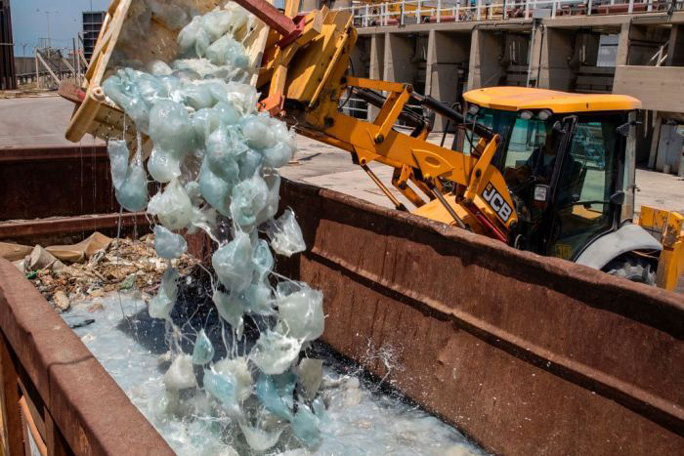
UK ponders drone monitoring of coastal nuclear plant cooling intake systems, Drone DJ, Bruce Crumley – Oct. 25th 2021 Authorities in the UK are examining a request to take a test UAV project live. It would involve extending experimental drone use monitoring coastal nuclear power plants for marine life that risks getting sucked into their cooling tubes to a real, increasingly troubling example of that in Scotland.
The problem centers on the Torness nuclear power facility to the east of Edinburgh. Its ocean-sucking intake vents have been getting clogged by recurring blossoms of marine life like jellyfish and kelp. In addition to that being fatal to the life forms involved, the incidents can cause the station’s temperature to increase to the point where temporary – but very expensive – closure is required. In response, drone industrial services company RUAS has requested authorities to allow it to fly regular drone missions around the nuclear plant to keep watch for amassing sea creatures so preventive measures can be taken to usher them away.
“The issue is, on a regular basis, they are affected by either jellyfish blooms or marine ingress including microalgae, that are blocking the intake of the nuclear power plant,” says the RUAS in a report by the Herald Scotland. “As a result, the reactor overheats due to the lack of water intake which cools the reactor, creating the need for the reactor to be shut down entirely as an emergency procedure. This has implications when they need to reactivate the reactor, which is costly and time consuming.”
It’s unclear thus far just how officials will respond to that obviously business-generating RUAS proposal. But it would certainly fall within the logic of an almost identical project the UK has been testing since July.
The nuclear plant-specific effort was launched as part of the UK’s broader Drone Pathfinder Programme promoting the use of UAV technologies. Under that, researchers have begun assessing “the feasibility of using unmanned aerial systems for the early detection of marine hazards near to coastal industries, such as nuclear power stations.”
That includes testing beyond visual line of sight (BVLOS) missions to permit near-constant monitoring – a mode RUAS is also hoping to employ at Torness. ……………… https://dronedj.com/2021/10/25/uk-ponders-drone-monitoring-of-coastal-nuclear-plant-cooling-intake-systems/
Swedish authorities delay permission for nuclear waste dump operation, due to concerns over corrosion of copper in containers

The Environmental Organizations’ Nuclear Waste Review (MKG), which has the
Friends of the Earth and the Swedish Society for Nature Conservation as
members, welcomes the fact that the Nuclear Waste Council has concluded
that there is a need for more copper corrosion research before a nuclear
fuel repository can be put into operation.
In a statement to the Government
on 21 October, the Council proposes that more research on copper corrosion
in a repository environment be conducted after the Government has given
permission to build the repository, and that a separate government decision
be made before the repository is taken into use. MKG believes that it is
already prepared for research within the LOT trial that can yield important
results before the government makes an admissibility decision on the
nuclear fuel repository. Waiting with research until after construction
starts means problems.
MKG 22nd Oct 2021
Recently restarted – Fukui nuclear unit halted for a year on safety issues.
Fukui nuclear unit halted after missing deadline on antiterror steps https://english.kyodonews.net/news/2021/10/e69ddb77abbd-fukui-nuclear-unit-halted-after-missing-deadline-on-antiterror-steps.html
KYODO NEWS – Oct 23, 2021 – A nuclear reactor in central Japan’s Fukui Prefecture was halted on Saturday, just four months after its restart as it could not meet a deadline set by regulators to implement antiterrorism measures.
The suspension of Kansai Electric Power Co.’s Mihama No. 3 unit came ahead of the deadline on Monday for such measures to be completed. After undergoing safety checks, the utility aims to make the necessary changes to its facilities around September next year and restart operations in mid-October.
In June, the No. 3 unit went online for the first time in about 10 years and became the first nuclear unit to operate beyond the government-mandated 40-year service period introduced under new rules set after the 2011 Fukushima disaster.
The reactor had stopped operations after the crisis at the Fukushima Daiichi plant triggered by a massive earthquake and tsunami. Regulators gave the green light to the aging No. 3 unit after screening the utility’s safety measures.
The Nos. 1 and 2 units of the Mihama plant were terminated in April 2015 in line with the 40-year limit.
Clyde nuclear base emergency staff to strike from tomorrow over safety fears
Clyde nuclear base emergency staff to strike from tomorrow over safety fears, Herald Scotland, By Martin Williams @Martin1Williams, Senior News Reporter 18 Oct 21, EMERGENCY workers at the home of Britain’s nuclear weapons on the Clyde are set to strike over “major safety concerns” after managers slashed firefighter numbers.
Action has been previously been given the go-ahead following a ballot of workers after managers proceeded with cuts to eight posts from the specialist fire safety crew at HM Naval Base Clyde, a reduction in strength of 15 per cent, with the a union describing it as an “an accident waiting to happen”.
Unite members working for outsourcing services firm Capita Business Services will now start strike action from Tuesday in a dispute over cuts to fire and rescue crew levels, and a lack of consultation………………
Workers believe the cuts impair the abilities of the onsite fire crews to do their jobs properly, particularly, in relation to incidents that would involve wearing breathing apparatus.
Capita has previously stated that they intend to mitigate safety risks due to the cuts through an investment in new technology to reduce fire risk”.
But workers have said they are not aware of any new technology which would address ongoing safety concerns…………………………… https://www.heraldscotland.com/news/homenews/19655524.clyde-nuclear-base-emergency-staff-strike-tomorrow-safety-fears/
US nuclear submarine accident sparks safety fears in South China Sea
US nuclear submarine accident sparks safety fears in South China Sea https://www.scmp.com/news/china/military/article/3152181/us-nuclear-submarine-accident-sparks-safety-fears-south-china?module=perpetual_scroll&pgtype=article&campaign=3152181Busy waterway’s complex underwater terrain and shipping litter make it a challenging environment for the giant vessels
Collision has also highlighted the difficulties in safely disposing of the reactors from decommissioned subs, with no agreed guidelines, experts say. Minnie Chan 16 Oct, 2021
The damage to a US nuclear attack submarine which collided with a mystery object in the South China Sea earlier this month has raised concerns about their operational safety, as well as what happens to damaged and decommissioned nuclear reactors.
Defence experts have warned that nuclear submarines – among the world’s deadliest weapons – are also vulnerable in the event of an underwater accident causing a nuclear leak, regardless of whether they are general-purpose attack subs (SSN) or platforms for the launch of ballistic missiles (SSBN).
Orano’s nuclear reprocessing problems at La Hague
Nuclear: the CGT denounces “a congestion” of rejects from Mox in Orano La
Hague. Due to recycling problems at the Marcoule plant, Orano La Hague has
to deal with scraps from Mox. A situation denounced by Greenpeace, but
under control according to Orano.
La Presse de la Manche 15th Oct 2021
1 This Month



26 September – International Day for the Total Elimination of Nuclear Weapons


PLEASE OPPOSE HR 8255 AND S.3639 – bills would accelerate satellite deployment, with no environmental review or safeguards – https://ncstd5li.quorum.us/campaign/169331/
To see nuclear-related stories in greater depth and intensity – go to https://nuclearinformation.wordpress.com
-
Archives
- September 2026 (233)
- August 2026 (330)
- July 2026 (355)
- June 2026 (287)
- May 2026 (306)
- April 2026 (356)
- March 2026 (251)
- February 2026 (267)
- January 2026 (308)
- December 2025 (358)
- November 2025 (359)
- October 2025 (375)
-
Categories
- 1
- 1 NUCLEAR ISSUES
- business and costs
- climate change
- culture and arts
- ENERGY
- environment
- health
- history
- indigenous issues
- Legal
- marketing of nuclear
- media
- opposition to nuclear
- PERSONAL STORIES
- politics
- politics international
- Religion and ethics
- safety
- secrets,lies and civil liberties
- spinbuster
- technology
- Uranium
- wastes
- weapons and war
- Women
- 2 WORLD
- ACTION
- AFRICA
- Atrocities
- AUSTRALIA
- Christina's notes
- Christina's themes
- culture and arts
- Events
- Fuk 2022
- Fuk 2023
- Fukushima 2017
- Fukushima 2018
- fukushima 2019
- Fukushima 2020
- Fukushima 2021
- general
- global warming
- Humour (God we need it)
- Nuclear
- RARE EARTHS
- Reference
- resources – print
- Resources -audiovicual
- Weekly Newsletter
- World
- World Nuclear
- YouTube
-
RSS
Entries RSS
Comments RSS
 nuclear-news