Playing with fire at Chornobyl — Beyond Nuclear International

Will we avoid a deadly sequel?
Playing with fire at Chornobyl — Beyond Nuclear International
After 36 years the nuclear site is again in danger https://beyondnuclearinternational.org/2022/04/24/playing-with-fire-at-chornobyl/
By Linda Pentz Gunter
For 36 years things had been quiet at Chornobyl. Not uneventful. Not safe. But no one was warning of “another Chornobyl” until Russian forces took over the site on February 24 of this year.
Russia’s invasion of Ukraine first took their troops through the Chornobyl Exclusion Zone, where they rolled armored vehicles across radioactive terrain, also trampled by foot soldiers who kicked up radioactive dust, raising the radiation levels in the area.
As the Russians arrived at the Chornobyl nuclear site, it quickly became apparent that their troops were unprotected against radiation exposure and indeed many were even unaware of where they were or what Chornobyl represented. We later learned that they had dug trenches in the highly radioactive Red Forest, and even camped there.
After just over a month, the Russians pulled out. Was this to re-direct troops to now more strategically desirable — or possibly more reasonably achievable — targets? Or was it because, as press reports suggested, their troops were falling ill in significant numbers, showing signs of radiation sickness? Those troops were whisked away to Belarus and the Russians aren’t talking. But rumors persist that at least one soldier has already succumbed to his exposure.
Plant workers at the nuclear site, despite working as virtual hostages during the Russian occupation and in a state of perpetual anxiety, where shocked that even the Russian radiation experts subsequently sent in, were, like the young soldiers, using no protective equipment. It was, said one, a kind of suicide mission.
What could have happened at Chornobyl — and still could, given the war is by no means over and the outcome still uncertain — could have seen history repeat itself, almost 36 years to the day of that first April 26, 1986 disaster.
Yet, Chornobyl has no operating reactors. So why is it still a risk? Doesn’t the so-called New Safe Confinement (NSC) structure protect the site?
The $2.3 billion NSC was built to cover over the original and crumbling old sarcophagus that had encased the lethal cargo left behind after the April 26, 1986 explosion of Unit 4.
Supposed to last just 100 years, that still inadequate timeframe was thrown into jeopardy as a reported firefight broke out prior to the Russian takeover. Fears arose that the shocks and vibrations of repeated shelling and artillery fire could cause the NSC to crack or crumble.
Housed inside the NSC is the destroyed Unit 4 as well as 200 metric tonnes of uranium, plutonium, irradiated dust, solid and liquid fuel, and a molten slurry of uranium fuel rods, zirconium cladding, graphite control rods, and melted sand.
The fuel lump from Unit 4, sitting inaccessible on a basement floor, remains unstable. In May 2021, there was a sudden and baffling escalation of activity there and a rise in neutrons, evoking fears of a chain reaction or even another explosion.
All of these volatile fuels and waste inventories still depend on cooling pumps to keep them cool. And those cooling pumps depend on power.
However, not everything at the site is within the NSC.
Units 1, 2 and 3 are not yet fully decommissioned and likely won’t be until at least 2064. Even though their fuel has been cooling for 20 years, it cannot go indefinitely without power. And managing it necessitates skilled, and unharried, personnel.
Loss of power threatens the ISF-1 spent nuclear fuel pool where much of the waste fuel is still stored. As nuclear engineer, Dave Lochbaum, described it in an email, “If forced cooling is lost, the decay heat will warm the water until it boils or until the heat dissipated by convective and conduction allows equilibrium to be established at a higher, but not boiling, point.
“If the pool boils, the spent fuel remains sufficiently cooled until the water level drops below the top of the fuel assemblies.”
At that point, however, adds Union of Concerned Scientists physicist, Ed Lyman, “a serious condition in the ISF-1 spent nuclear fuel pool” could occur. “However, because the spent fuel has cooled for a couple of decades there would be many days to intervene before the spent fuel was exposed.”
At the time of the invasion, workers at the site had been engaged in moving the full radioactive waste inventory from all 4 of the Chornobyl reactors, from the common fuel pool to the ISF-2 facility where it will be dismantled and put into long-term storage casks. It is unclear whether this operation was halted, but likely so.
Fire also remains a significant risk at the site. The massive 2020 wildfire that reached the perimeter of the Chornobyl plant site, occurred in April, well before the dry season. Military combat clearly invites the risk of igniting a lethal fire.
Indeed, the entire region, known as the Chornobyl Exclusion Zone, is a tinderbox. As Dr. Tim Mousseau and his research team discovered, dead wood and leaf litter on the forest floors is not decaying properly, likely because the microbes and other organisms that drive the process of decay are reduced or gone due to their own prolonged exposure to radiation.
As leaf litter and organic matter build up, the risk of ignition increases. There have been several hundred fires in the Zone already, sometimes, incomprehensibly, deliberately started. The explosions of war fighting could spark another. Indeed, stories did emerge about fires during the Russian occupation, their origin unclear.
But even without military attacks or destruction of the site, it was still at risk, especially when offsite power was lost, twice, raising fears of a potential catastrophe if emergency on-site power — consisting of diesel generators — did not work or ran out of fuel. Later reports revealed that plant workers had taken to stealing Russian fuel to keep those generators running.
Meanwhile, the State Nuclear Regulatory Inspectorate of Ukraine (SNRIU) had lost complete contact with its Chornobyl workforce. As days dragged into weeks, the SNRIU legitimately worried that an exhausted workforce, going without shift changes and operating under duress and potentially fear, could lead to mistakes that could prove deadly.
It was, after all, human error that had contributed to the first Chornobyl catastrophe.
On March 17, the SNRIU reported, “There is no information on the real situation at the Chornobyl NPP site, as there is no contact with the NPP personnel present directly at the site for the 22nd day in a row without rotation.”
Radiation monitors had remained off since the Russian occupation, leaving authorities and the public in the dark should there be any significant release of radioactivity as a result of damage at the site inflicted by military conflict or other causes.
Repeating a warning that had become a daily one on the SNRIU website, the agency concluded: “Given the psychological, moral, and physical fatigue of the personnel, as well as the absence of day-time and repair staff, maintenance and repair activities of equipment important to the safety of the facilities at the Chornobyl NPP site are not carried out, which may lead to the reduction of its reliability, which in turn can lead to equipment failures, emergencies, and accidents.”
Finally, a month into the occupation, a partial shift change was allowed. Workers could go home and rest. But almost immediately, the Russians attacked the nearby worker town of Slavutych, terrorizing the workforce and leaving at least three dead according to press reports.
Some personnel, including security guards, chose to stay on at the site. With good reason, they perhaps feared that the Russian occupying force would behave irresponsibly at a site that houses lethal cargos.
Sure enough, on March 24 stories emerged that Russian forces at Chornobyl may have “looted and destroyed a laboratory near the abandoned Chernobyl nuclear power plant that was used to monitor radioactive waste,” according to CNN and other news sources.
The laboratory, which conducts research into radioactive waste management, houses radioactive materials that may then have fallen into Russian hands.
The State Agency of Ukraine for Exclusion Zone Management, which announced the attack, went further in wishing “the enemy today…will harm himself, not the civilized world.”
And now here we are, just days away from the 36th commemoration of that terrible day in 1986. Still watching. Still waiting. Still holding our breath. The war is neither over, nor won by either side. The Chornobyl site, possibly now more radioactive than in the immediate past, sits like a ticking time bomb. Along with too many unanswered — and unanswerable — questions.
Who will protect it? Will it be spared further assault? And will the word Chornobyl come to mark a new nuclear catastrophe 36 years after the first?
Just how dangerous are the nuclear wastes at WIPP waste dump in New Mexico, and at Los Alamos National Laboratory?
Report: Some Los Alamos nuclear waste too hazardous to move via Santa Fe New Mexican, The Atomic Age, By Scott Wyland Oct 28 2017, https://lucian.uchicago.edu/blogs/atomicage/2021/08/04/report-some-los-alamos-nuclear-waste-too-hazardous-to-move-via-santa-fe-new-mexico/comment-page-2/
Los Alamos National Laboratory has identified 45 barrels of radioactive waste so potentially explosive — due to being mixed with incompatible chemicals — that crews have been told not to move them and instead block off the area around the containers, according to a government watchdog’s report.
Crews have worked to ferret out drums containing volatile compounds and move them to a more secure domed area of the lab after the Defense Nuclear Facilities Safety Board issued a scathing report last year saying there were possibly hundreds of barrels of unstable nuclear waste.
The safety board estimated an exploding waste canister could expose workers to 760 rem, far beyond the threshold of a lethal dose. A rem is a unit used to measure radiation exposure. In its latest weekly report, the safety board said crews at Newport News Nuclear BWXT Los Alamos, also known as N3B — the contractor in charge of cleaning up the lab’s legacy waste — have pegged 60 barrels with volatile mixtures and have relocated 15 drums to the domed area.
[…]
Officials at the U.S. Department of Energy’s environmental management office said they couldn’t comment on the report or on how the lab stores waste, citing lack of time to answer questions.
Volatile waste mixtures have received more attention since 2014 when a waste container from the Los Alamos lab packaged with a blend of organic cat litter and nitrate salts burst in an underground chamber of the Waste Isolation Pilot Plant near Carlsbad. The radioactive release contaminated the storage site so extensively it shut down for three years and cost $2 billion to clean up.
Hirsch noted some radioactive vapors escaped from WIPP’s underground site to the open air amid the leak. Federal reports have described a small amount of radioactivity slipping through exhaust vents that have since been sealed.
The fact that any radiation was emitted from below ground illustrates how destructive a waste barrel blowing up above ground could be, Hirsch said.
In the October report, the safety board said lab personnel had failed to analyze chemicals present in hundreds of containers of transuranic nuclear waste, making it possible for incompatible chemicals to cause a container to explode. Crews also never sufficiently estimated how much radiation would be released by such an event.
Waste with that kind of hair trigger should only be analyzed in a “hot cell,” with walls several feet thick, blast-proof glass and robotic arms that a technician operates to handle the materials, Hirsch said.
Read more at Report: Some Los Alamos nuclear waste too hazardous to move
Swiss population keen for nuclear bunkers, -but it’s doubtful that they’d be any use anyway.
‘A large-scale nuclear war would however be catastrophic, and no state would be able to guard against the effects.’
Companies are ‘overwhelmed with enquiries’ for NUCLEAR BUNKERS in Switzerland and reporting shortage of materials following Ukraine invasion
- Since 1960s, every Swiss municipality had to build nuclear bunkers for residents
- Residents are now contacting specialist companies to build or renovate shelters
- The bunkers are being viewed in a new light since Russia’s invasion of Ukraine
By RACHAEL BUNYAN FOR MAILONLINE and AFP 26 April 2022
Companies that build and repair bomb shelters are being ‘overwhelmed with enquiries’ for nuclear fallout bunkers in Switzerland, as Russian’s invasion of Ukraine has reawakened interest in the secure facilities.
Residents in Switzerland, where nuclear bunkers have been mandatory for every household since the 1960s, are now contacting the companies to build or renovate their shelters to make sure they can be protected in the event of bombings or nuclear war.
Demand is so high for the concrete nuclear bunkers that specialist companies are now facing shortages in raw materials required to build them………………………………………………………………….
Switzerland’s vast network of nuclear bunkers have a range of other day-to-day uses, including as military barracks or as temporary accommodation for asylum seekers. But Swiss authorities require that they can be emptied and reverted back to nuclear shelters within five days.
So far, Switzerland’s population has never been ordered down into the shelters, not even in the wake of the Chernobyl disaster.
Experts say the most likely scenario for needing to use them has always been a possible accident at one of Switzerland’s own nuclear power plants.
But now the conflict raging in Ukraine has added a new, urgent layer to the national nuclear anxiety.
With public concern growing, Swiss authorities have published overviews of the available shelter spots, and have urged households to always maintain a stock of food to last at least a week. ………………………………..
Experts caution though that the level of protection provided by the shelters in the case of actual nuclear weapons use would depend heavily on the intensity and proximity of the strikes.
‘The shelters could offer the population a certain level of temporary protection against radioactive events,’ Swiss defence ministry spokesman Andreas Bucher said.
‘A large-scale nuclear war would however be catastrophic, and no state would be able to guard against the effects.’ https://www.dailymail.co.uk/news/article-10751447/Companies-overwhelmed-enquiries-NUCLEAR-BUNKERS-Switzerland-following-Ukraine-invasion.html
Hungary receives nuclear fuel shipment by air from Russia

Gee, I hope they never have a crash.
https://www.power-technology.com/news/hungary-nuclear-fuel-shipment-air-russia/ April 8, 2022
The shipment arrived via the airspace of Belarus, Poland and Slovakia. Hungary has received its first shipment of nuclear fuel by air from Russia for its Paks nuclear power plant since the start of Russia’s invasion of Ukraine, which has made shipping of the fuel by rail unfeasible.
Hungarian Foreign Minister Peter Szijjarto announced the shipment in a Facebook video from Brussels, Belgium.
Szijjarto said: “Fuel (for the Paks plant) has always come from Russia by rail via Ukraine. Unfortunately, this is no longer possible, so we had to find an alternative way of shipping.”
Playing with fire at Chornobyl — Beyond Nuclear International
Will we avoid a deadly sequel?
Playing with fire at Chornobyl — Beyond Nuclear International
After 36 years the nuclear site is again in danger https://beyondnuclearinternational.org/2022/04/24/playing-with-fire-at-chornobyl/
By Linda Pentz Gunter
For 36 years things had been quiet at Chornobyl. Not uneventful. Not safe. But no one was warning of “another Chornobyl” until Russian forces took over the site on February 24 of this year.
Russia’s invasion of Ukraine first took their troops through the Chornobyl Exclusion Zone, where they rolled armored vehicles across radioactive terrain, also trampled by foot soldiers who kicked up radioactive dust, raising the radiation levels in the area.
As the Russians arrived at the Chornobyl nuclear site, it quickly became apparent that their troops were unprotected against radiation exposure and indeed many were even unaware of where they were or what Chornobyl represented. We later learned that they had dug trenches in the highly radioactive Red Forest, and even camped there.
After just over a month, the Russians pulled out. Was this to re-direct troops to now more strategically desirable — or possibly more reasonably achievable — targets? Or was it because, as press reports suggested, their troops were falling ill in significant numbers, showing signs of radiation sickness? Those troops were whisked away to Belarus and the Russians aren’t talking. But rumors persist that at least one soldier has already succumbed to his exposure.
Plant workers at the nuclear site, despite working as virtual hostages during the Russian occupation and in a state of perpetual anxiety, where shocked that even the Russian radiation experts subsequently sent in, were, like the young soldiers, using no protective equipment. It was, said one, a kind of suicide mission.
What could have happened at Chornobyl — and still could, given the war is by no means over and the outcome still uncertain — could have seen history repeat itself, almost 36 years to the day of that first April 26, 1986 disaster.
Yet, Chornobyl has no operating reactors. So why is it still a risk? Doesn’t the so-called New Safe Confinement (NSC) structure protect the site?
The $2.3 billion NSC was built to cover over the original and crumbling old sarcophagus that had encased the lethal cargo left behind after the April 26, 1986 explosion of Unit 4.
Supposed to last just 100 years, that still inadequate timeframe was thrown into jeopardy as a reported firefight broke out prior to the Russian takeover. Fears arose that the shocks and vibrations of repeated shelling and artillery fire could cause the NSC to crack or crumble.
Housed inside the NSC is the destroyed Unit 4 as well as 200 metric tonnes of uranium, plutonium, irradiated dust, solid and liquid fuel, and a molten slurry of uranium fuel rods, zirconium cladding, graphite control rods, and melted sand.
The fuel lump from Unit 4, sitting inaccessible on a basement floor, remains unstable. In May 2021, there was a sudden and baffling escalation of activity there and a rise in neutrons, evoking fears of a chain reaction or even another explosion.
All of these volatile fuels and waste inventories still depend on cooling pumps to keep them cool. And those cooling pumps depend on power.
However, not everything at the site is within the NSC.
Units 1, 2 and 3 are not yet fully decommissioned and likely won’t be until at least 2064. Even though their fuel has been cooling for 20 years, it cannot go indefinitely without power. And managing it necessitates skilled, and unharried, personnel.
Loss of power threatens the ISF-1 spent nuclear fuel pool where much of the waste fuel is still stored. As nuclear engineer, Dave Lochbaum, described it in an email, “If forced cooling is lost, the decay heat will warm the water until it boils or until the heat dissipated by convective and conduction allows equilibrium to be established at a higher, but not boiling, point.
“If the pool boils, the spent fuel remains sufficiently cooled until the water level drops below the top of the fuel assemblies.”
At that point, however, adds Union of Concerned Scientists physicist, Ed Lyman, “a serious condition in the ISF-1 spent nuclear fuel pool” could occur. “However, because the spent fuel has cooled for a couple of decades there would be many days to intervene before the spent fuel was exposed.”
At the time of the invasion, workers at the site had been engaged in moving the full radioactive waste inventory from all 4 of the Chornobyl reactors, from the common fuel pool to the ISF-2 facility where it will be dismantled and put into long-term storage casks. It is unclear whether this operation was halted, but likely so.
Fire also remains a significant risk at the site. The massive 2020 wildfire that reached the perimeter of the Chornobyl plant site, occurred in April, well before the dry season. Military combat clearly invites the risk of igniting a lethal fire.
Indeed, the entire region, known as the Chornobyl Exclusion Zone, is a tinderbox. As Dr. Tim Mousseau and his research team discovered, dead wood and leaf litter on the forest floors is not decaying properly, likely because the microbes and other organisms that drive the process of decay are reduced or gone due to their own prolonged exposure to radiation.
As leaf litter and organic matter build up, the risk of ignition increases. There have been several hundred fires in the Zone already, sometimes, incomprehensibly, deliberately started. The explosions of war fighting could spark another. Indeed, stories did emerge about fires during the Russian occupation, their origin unclear.
But even without military attacks or destruction of the site, it was still at risk, especially when offsite power was lost, twice, raising fears of a potential catastrophe if emergency on-site power — consisting of diesel generators — did not work or ran out of fuel. Later reports revealed that plant workers had taken to stealing Russian fuel to keep those generators running.
Meanwhile, the State Nuclear Regulatory Inspectorate of Ukraine (SNRIU) had lost complete contact with its Chornobyl workforce. As days dragged into weeks, the SNRIU legitimately worried that an exhausted workforce, going without shift changes and operating under duress and potentially fear, could lead to mistakes that could prove deadly.
It was, after all, human error that had contributed to the first Chornobyl catastrophe.
On March 17, the SNRIU reported, “There is no information on the real situation at the Chornobyl NPP site, as there is no contact with the NPP personnel present directly at the site for the 22nd day in a row without rotation.”
Radiation monitors had remained off since the Russian occupation, leaving authorities and the public in the dark should there be any significant release of radioactivity as a result of damage at the site inflicted by military conflict or other causes.
Repeating a warning that had become a daily one on the SNRIU website, the agency concluded: “Given the psychological, moral, and physical fatigue of the personnel, as well as the absence of day-time and repair staff, maintenance and repair activities of equipment important to the safety of the facilities at the Chornobyl NPP site are not carried out, which may lead to the reduction of its reliability, which in turn can lead to equipment failures, emergencies, and accidents.”
Finally, a month into the occupation, a partial shift change was allowed. Workers could go home and rest. But almost immediately, the Russians attacked the nearby worker town of Slavutych, terrorizing the workforce and leaving at least three dead according to press reports.
Some personnel, including security guards, chose to stay on at the site. With good reason, they perhaps feared that the Russian occupying force would behave irresponsibly at a site that houses lethal cargos.
Sure enough, on March 24 stories emerged that Russian forces at Chornobyl may have “looted and destroyed a laboratory near the abandoned Chernobyl nuclear power plant that was used to monitor radioactive waste,” according to CNN and other news sources.
The laboratory, which conducts research into radioactive waste management, houses radioactive materials that may then have fallen into Russian hands.
The State Agency of Ukraine for Exclusion Zone Management, which announced the attack, went further in wishing “the enemy today…will harm himself, not the civilized world.”
And now here we are, just days away from the 36th commemoration of that terrible day in 1986. Still watching. Still waiting. Still holding our breath. The war is neither over, nor won by either side. The Chornobyl site, possibly now more radioactive than in the immediate past, sits like a ticking time bomb. Along with too many unanswered — and unanswerable — questions.
Who will protect it? Will it be spared further assault? And will the word Chornobyl come to mark a new nuclear catastrophe 36 years after the first?
Investigations continue into possible stress corrosion in several of EDF’s nuclear reactors in France.
EDF has said it found indications of possible stress corrosion on the
auxiliary circuits of four French nuclear power reactors totalling 4.8 GW
in capacity, namely Chinon 3, Cattenom 3, Flamanville 2 and Golfech 1. The
signs of possible corrosion were detected during ultrasonic inspections of
parts of the piping at its Chinon 3 (905 MW), Cattenom 3 and Flamanville 2
(1.3 GW each) reactors, the French state-owned utility said in a statement
at the end of last week.
The units are among six reactors that EDF
considers as “priority” for these checks, with the other three being
Flamanville 1 (1.3 GW) and Bugey units 3 and 4 (880 MW each). Meanwhile,
inspections carried out on the safety injection system circuit at Golfech 1
(1.3 GW) during planned maintenance also detected indications of possible
corrosion, EDF added. A spokeswoman told Montel on Tuesday that the utility
was carrying out further investigations to find out whether it was
corrosion or not.
Montel 19th April 2022
https://www.montelnews.com/news/1313964/edf-finds-indications-of-possible-corrosion-on-4-reactors-
France’s nuclear energy output falling, as signs of corrosion halt several nuclear reactors

Electricite de France SA has found corrosion on key piping on four nuclear
reactors during recent checks, taking the number of affected units at its
French fleet of atomic generators to nine.
Corrosion issues have forced the French energy giant to halt some of its 56 reactors for lengthy checks and repairs, just as Europe faces its worst energy crisis in half a century.
The state-controlled utility previously said its nuclear output will fall
to the lowest in more than three decades this year and hardly rebound next
year due to the reactor works.
Signs of corrosion were found in pipings of
the Chinon-3, Cattenom-3 and Flamanville-2 reactors, three of the six units
that EDF had decided to check in February, EDF said in a statement posted
on its website last week. Indications of corrosion have also been found at
the Golfech-1 unit during a planned maintenance halt, and deeper checks
will be carried out, the utility said.
Bloomberg 19th April 2022
Magnitude 5.3 earthquake shakes Fukushima and Ibaraki
Magnitude 5.3 earthquake shakes Fukushima and Ibaraki https://www.japantimes.co.jp/news/2022/04/19/national/quake-fukushima/ 19 Apr 22,
An earthquake with a preliminary magnitude of 5.3 struck Ibaraki and Fukushima prefectures as well as other parts of Japan on Tuesday morning, the Meteorological Agency said.
The 8:16 a.m. quake registered a lower 5 on japan’s seismic intensity scale of 7 in northern Ibaraki, while parts of Ibaraki, Fukushima, Tochigi and Saitama prefectures registered a 4. No tsunami warning was issued.
The temblor originated in an inland part of Fukushima at a depth of about 90 kilometers.
More information:
- Detailed information about this earthquake from the Yahoo! Japan Weather & Disaster website
- Detailed information about this earthquake from the Japan Meteorological Agency website
- The Japan Meterological Agency website
- An explanation of shindo, Japan’s earthquake intensity scale.
- A guide to what to do before, during and after an earthquake.
- Our portal for disaster-related information
Fears sunken Russian warship Moskva was carrying nuclear weapons
There are fears that sunken Russian warship The Moskva was carrying nuclear weapons that could now cause a “broken arrow” incident. news.com.au
Megan Palin, April 16, 2022 There are fears that sunken Russian warship The Moskva that is now believed to be resting at the bottom of the Black Sea was carrying nuclear weapons.
Maksym Marchenko, the governor of the Odesa region, said Ukraine struck the ship with two Neptune missiles and caused “serious damage” on Thursday.
The Russian Defence Ministry denied there had been an attack by Ukraine on the ship, which would normally have about 500 sailors aboard, and said the heavily damaged Moskva sank in a storm under tow after being gutted by fire.
Speaking at the Pentagon on Friday, a senior US defense official said the Moskva warship was hit by two Ukrainian Neptune missiles, prompting its sinking.
In a chilling revelation, sources say it’s likely that several nuclear missiles are on the sunken vessel, and there is now real concern that could lead to a nuclear accident – otherwise known as a “broken arrow” incident in American military slang.
Mykhailo Samus, director of a Lviv-based military think-tank; Andriy Klymenko, editor of Black Sea News; and Ukrainian newspaper Defence Express all warned today that the Moskva was designed to carry warheads which could fit in the nose of its supersonic P-1000 “Vulkan” missiles – designed to take out American aircraft carriers.
“On board the Moskva could be nuclear warheads – two units,’ Samus said, while Klymenko called on other Black Sea nations – Turkey, Romania, Georgia, and Bulgaria – to insist on an explanation. Where are these warheads? Where were they when the ammunition exploded,” he asked.
This is HUGE. Russia’s defense ministry admits Moskva, their flagship in Black Sea fleet, slava class cruiser, has SUNK! It was key to intelligence & air defenses for the Russian ships. IMO this is on the level big as stopping Russians from taking Kyiv. https://t.co/3SifeskeHzpic.twitter.com/EmNR4L0Vgy— John Spencer (@SpencerGuard) April 14, 2022
BlackSeaNews editor-in-chief Andriy Klymenko called for an urgent international probe into whether the Moskva was carrying nuclear weapons.
“Friends and experts say that there are two nuclear warheads for cruise missiles on board the Moskva,” he said………….. https://www.news.com.au/world/europe/fears-sunken-russian-warship-moskva-was-carrying-nuclear-weapons/news-story/959170261e82bd43b5eb3c37fabf8dcd
 | |||
Carelessness of Russian soldiers around Chernobyl – shows danger of nuclear sites in wartime
As we learn more about the negligence of Russian generals who ignored
warnings that the radioactive forest surrounding Chornobyl was a hazardous
staging ground for their assault on Kyiv, environmental historian Kate
Brown flags an ill-recognized reality: humanity is ill prepared for what
happens when nuclear facilities are held hostage during war.
Known as the
“Red Forest”—its pine trees turned red from radiation exposure after
a reactor at Chornobyl melted down in April 1986—the area where Russian
soldiers bulldozed and dug trenches and bunkers is the most contaminated
region of the Chornobyl Exclusion Zone, which is itself “one of the most
toxic places on Earth,” writes the New York Times.
But Russian generals did not seem troubled by the fact that their troops were digging and
bunking down in earthworks that may have had radiation levels 1,000 times
above ambient.
Energy Mix 12th April 2022
Able Archer: The NATO exercise that almost went nuclear
Able Archer: The NATO exercise that almost went nuclear.
Able Archer was a 1983 NATO military exercise that nearly triggered war with the Soviet Union
Able Archer was an annual NATO military exercise that involved thousands of military personnel and equipment. The goal of the exercise was to simulate an escalation in a conflict between NATO countries and the USSR, culminating in a co-ordinated nuclear attack.
Live Science, By Callum McKelvie , 13 Apr 22,
In 1983, the annual exercise almost triggered the outbreak of war between NATO and the Soviet Union, when miscommunication led the Soviet government to believe the West was in fact mounting an invasion.
Able Archer, was an annual NATO exercise and the culmination the culmination of the Autumn Forger maneuvers that involved 100,000 personnel, some 16,000 of which were flown in from the United States according to The Atomic Heritage Foundation. The exercise was designed to end with a simulated nuclear strike following a theoretical Warsaw Pact invasion of Western Europe.
Although the Soviet Union was aware that the annual event was due to take place, in 1983 Able Archer differed in many ways from previous exercises.
First, there were large periods of radio silence, as well as encrypted messages among the NATO forces.
Second, the imaginary forces were moved to high alert and there were even reports of fake missiles being taxied out of hangers with dummy warheads.
Finally, senior officials were involved with even President Ronald Reagan himself scheduled to participate, although in reality he dropped out, according to the BBC. In the buildup to the 1983 Able Archer exercise the Warsaw Pact countries had become increasingly paranoid about the potential of a U.S. nuclear attack.
In 1981 Ronald Reagan became the 40th President of the United States and quickly proved himself aggressive in his approach towards the USSR. In March 1983, just a few short months before Able Archer, Reagan referred to the Soviet Union as an “evil empire”, according to Voices of Democracy and announced his intent to build the “Star Wars” space-based anti-missile program, according to the Atomic Heritage Foundation.
That same year, the U.S. deployed Pershing II Nuclear Missiles at their bases in West Germany, able to reach a Soviet target in less than 10 minutes, according to Missile Threat.
As a result of the this threat and the fear of a nuclear strike, the KGB created Project RYaN, which stood for “Raketno-Yadernoe Napadenie” — translated meaning “Nuclear Missile Attack” — according to the Wilson Center.
“The Soviet Intelligence community was still traumatized by its failure to anticipate the German attack in 1941 and was determined not to be taken by surprise again,” Colonel Robert E Hamilton wrote in his article “Able Archer At 35: Lessons from the 1983 War Scare“.
As well as using traditional intelligence methods, including human agents, RYaN also utilized computers in a bid to monitor indicators from both NATO and the United States that a nuclear attack was imminent.
On Sept. 26, the Soviet Early Warning Satellite System registered a warning that five American minuteman missiles were on their way to Russian soil, according to Stanford University. The warning was revealed to be a false alarm.
“1983 was a supremely dangerous year in which a series of events seriously raised the temperature between East and West,” historian Taylor Downing told All About History Magazine “Most obvious here was the shooting down of a Korean civilian airliner, flight KAL 007, by a Soviet fighter plane after it had strayed off course by about 350 miles and ended up crossing Soviet airspace above a sensitive military area.
“Reagan could not believe this was a case of mistaken identity, a tragic accident that caused the death of 269 innocent people, ” Downing continued. “He called the Soviet Union “a terrorist state” that showed no regard for human life. I argue that at this point the Cold War nearly went hot as some in Washington demanded a military retaliation against the Soviet Union.”
As tensions between the two sides began to rise, so did the danger of a possible nuclear conflict. According to the strategy of Mutually Assured Destruction, if this occurred then both sides would annihilate each other.
“When situations are this tense it is always possible that one side will misinterpret what the other side is doing,” Downing said. “In the end, the safety of all nuclear systems is reliant upon the human factor — it is a politician or military leader who finally has to respond to threats perceived or real and press the nuclear button. So, no matter how sophisticated the failsafe systems are, it is down to a person to make the final decision — and all humans are fallible.”
When the Able Archer exercise began on Nov. 7, 1983, the Soviet response was unprecedented………………………………………….
In 1990 the President’s Foreign Advisory Board crafted a top secret report entitled “The Soviet War Scare” which makes clear the threat posed by Able Archer, stating that the US “may have inadvertently placed our relations with the Soviet Union on a hair trigger.”……………. https://www.livescience.com/able-archer
Oregon regulators have doubts about Natrium nuclear schedule for Kemmerer

Oregon regulators question nuclear schedule for Kemmerer
Public utility officials in Oregon say they support PacifiCorp’s plan to add the Natrium plant to its power fleet, but declined to formally recognize it as a viable project this early.
by Dustin BleizefferApril 13, 2022 TerraPower’s Natrium nuclear power plant in Kemmerer might help Oregon accomplish its climate action plan by helping to replace coal power, but state regulators, concerned by the project’s unprecedented timeline, aren’t yet willing to bet on it. TerraPower’s Natrium nuclear power plant in Kemmerer might help Oregon accomplish its climate action plan by helping to replace coal power, but state regulators, concerned by the project’s unprecedented timeline, aren’t yet willing to bet on it.
The Oregon Public Utility Commission in March declined to formally acknowledge PacifiCorp’s plans for Natrium to be a part of its future electrical generation portfolio.
“This project is just so early that we don’t really feel like we can give it that kind of weight,” Oregon PUC Commissioner Mark Thompson said. “That’s not because PacifiCorp has done something wrong. I just think it’s just not knowable. It’s so early on.”
The commission approved the balance of PacifiCorp’s “integrated resource plan” for how it will meet future power needs for its Oregon customers. Commissioners said they remain open to including Natrium in future filings from PacifiCorp.
Why it matters
Natrium skeptics have noted that crucial federal funding for the project is tied to meeting aggressive deadlines. The commission’s decision appears to be the first instance of a regulatory body acting on similar concerns.
PacifiCorp, which operates as Rocky Mountain Power in Wyoming, is a regulated utility providing electrical power to customers in six western states, including Oregon. State public utility authorities must approve plans for new electrical generation facilities before a utility is allowed to tap ratepayers to cover the cost………….
“PacifiCorp and TerraPower understand that PacifiCorp will only move forward if the Natrium demonstration project brings value to our customers,” PacifiCorp spokeswoman Tiffany Erickson said. https://wyofile.com/oregon-regulators-question-nuclear-schedule-for-kemmerer/
San Onofre’s not the only nuclear worry – there are “nuclear materials events” — lost or stolen radioactive material, radiation overexposures, leaks, and more.
Worried about nuclear waste at San Onofre? Other danger lurks
GAO sounds alarms about dirty bombs fashioned from small amounts of medical, industrial material Experts in protective gear prepare to sweep the University of Washington Research and Training Building after the accidental release of radioactive cesium-137 in 2019. (U.S. Government Accountability Office)
By TERI SFORZA | tsforza@scng.com | Orange County Register: April 11, 2022
In one doomsday scenario, rocket attacks on the nuclear waste stored at San Onofre Nuclear Generating Station send plumes of dangerous radiation skyward.
Critics in Southern California spend a lot of time worrying about the safety of the 3.6 million pounds of spent fuel entombed on the bluff above the blue Pacific — but the U.S. Government Accountability Office fixes its gaze on more mundane, and perhaps more terrifying, scenarios involving much smaller amounts of nuclear material routinely used by businesses, hospitals, universities and the like.
“The risks of an attack using a dirty bomb — a weapon that combines a conventional explosive, like dynamite, with radioactive material — are increasing and the costs could be devastating,” said the GAO in a snapshot released Tuesday, April 5.
“For example, weaknesses in Nuclear Regulatory Commission licensing for radioactive materials make it too easy for bad actors to obtain them, and NRC’s security requirements don’t account for the potentially devastating effects of a dirty bomb, such as billions of dollars in cleanup costs and deaths from chaotic evacuations.”
More than 2,000 “nuclear materials events” — including lost or stolen radioactive material, radiation overexposures, leaks of radioactive material and more — were reported by the NRC between 2010 and 2019, the GAO found.
In April 2019, an Arizona technician was arrested after stealing three radioactive devices from his workplace. According to a court filing, the technician intended to release the radioactive materials at a shopping mall, but was stopped before he could do any harm.
An accident at the University of Washington in 2019, involving a small amount of material, required clean-up and other costs of $150 million for one building alone, the GAO said.
In 2016, the GAO created a fake company to get a license for radioactive materials. GAO altered the license “and used it to obtain commitments to acquire a dangerous quantity of material.”
“The number of incidents of thefts, lost shipments, and careless mishandling are outrageously large,” said Edwin Lyman, director of nuclear power safety for the Union of Concerned Scientists, a nonprofit NRC watchdog
Even though very few of these lead to significant radiological consequences to the public, the NRC’s lax requirements fall short of best practices.”
Common stuff
Radioactive material is used in many medical and industrial settings in Southern California and throughout the nation. Small amounts help create images of organs, so doctors can find, identify and track tumors. Radioactive materials are used to kill cancer cells, shrink tumors and alleviate pain.
But security is an increasingly acute issue, the GAO said.
In 2018, the GAO reported that officials at U.S. airports had not verified the legitimacy of all licenses for imported radioactive materials.
“GAO has repeatedly found potential security weaknesses at medical and industrial locations storing such materials in the U.S.,” it said in one of many reports on the issue over the past several years.
“For example, in 2014, GAO reported that an individual had been given unescorted access to high-risk radioactive materials, even though he had two convictions for terroristic threat. Furthermore, small quantities of radioactive materials located within the same facility are not subject to enhanced security requirements that the total amount would be required to meet.”……………………………
Lyman, of the Union of Concerned Scientists, acknowledged that the NRC has taken some action to address the most egregious problems the GAO has identified over the years, but has not gone as far as many want.
“I do support the effort for better tracking and security of radioactive sources,” Lyman said………………….https://www.ocregister.com/2022/04/11/worried-about-nuclear-waste-at-san-onofre-other-danger-lurks/
Negligence uncovered at Diablo Canyon Nuclear Station
Unsettling and Unacceptable’ Negligence Uncovered at Diablo Canyon.
Report Reveals Significant Failure by Nuclear Safety Inspectors at Avila
Beach Power Plant. The Office of the Inspector General issued a damning
report on a significant failure by nuclear safety inspectors charged with
ensuring the safe operation of the Diablo Canyon nuclear power plant in
Avila Beach in southern San Luis Obispo County that led to one of the
plant’s two reactors being shut down for eight days in July 2020.
Santa Barbara Independent 29th March 2022
 | ReplyForward |
Unsettling and Unacceptable’ Negligence Uncovered at Diablo Canyon.
Report Reveals Significant Failure by Nuclear Safety Inspectors at Avila
Beach Power Plant. The Office of the Inspector General issued a damning
report on a significant failure by nuclear safety inspectors charged with
ensuring the safe operation of the Diablo Canyon nuclear power plant in
Avila Beach in southern San Luis Obispo County that led to one of the
plant’s two reactors being shut down for eight days in July 2020.
Santa Barbara Independent 29th March 2022
The Windscale nuclear accident 1957, and still not cleaned up. – a warning from history
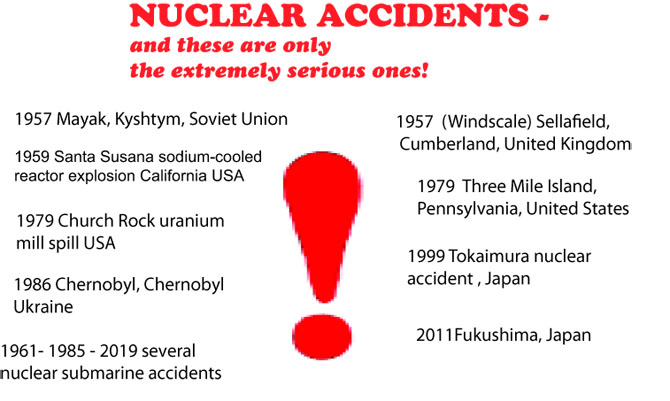
Nuclear power: the warnings from history. The PM wants to keep the lights
on with eight new atomic plants. He’s in denial if he thinks the
catastrophes of the past won’t happen again.
If Johnson is going to use nuclear history to justify his strategy, perhaps he needs to look a little
deeper, because Windscale was also the site of one of the world’s first
serious nuclear accidents. In October 1957, a fire raged for three days in
one of the reactors after changes to increase production.
Through the heroism of staff, and a significant degree of luck, the catastrophe was
contained. But significant radiation was released. Milk from cows within
200 square miles was contaminated. In 1982 officials estimated 260 people
developed cancer and 32 people died as a result. The two first reactors at
Windscale were closed, but the clean-up is still under way today.
Last November the top of the chimney in which the fire blazed was removed as
part of the demolition. The renowned nuclear historian Serhii Plokhy
describes the episode in a forthcoming book and points out: “The existing
nuclear industry is an open-ended liability.” No nuclear power station
has ever been fully decommissioned.
In Atoms and Ashes, Plokhy, 64, a
Ukrainian historian at Harvard, explores the causes and consequences of
Windscale and five other nuclear accidents: at Bikini Atoll in the Pacific
in 1954, Kyshtym in Russia in 1957, Three Mile Island in the US in 1979,
Chernobyl in Ukraine in 1986 and Fukushima in Japan in 2011.While most of
these accidents took place in the formative years of nuclear science,
Plokhy argues they could easily happen again. “Technology was improved as
a result, and every accident contributed to the shaping of subsequent
safety procedures and culture,” he writes.
“And yet nuclear accidents
occur again and again. Many of the political, economic, social, and
cultural factors that led to the accidents of the past are still with us
today, making the nuclear industry vulnerable to repeating old mistakes in
new and unexpected ways.”
Times 9th April 2022
https://www.thetimes.co.uk/article/nuclear-power-latest-warnings-history-chernobyl-ph9q7w80j
1 This Month



26 September – International Day for the Total Elimination of Nuclear Weapons


PLEASE OPPOSE HR 8255 AND S.3639 – bills would accelerate satellite deployment, with no environmental review or safeguards – https://ncstd5li.quorum.us/campaign/169331/
To see nuclear-related stories in greater depth and intensity – go to https://nuclearinformation.wordpress.com
-
Archives
- September 2026 (220)
- August 2026 (330)
- July 2026 (355)
- June 2026 (287)
- May 2026 (306)
- April 2026 (356)
- March 2026 (251)
- February 2026 (267)
- January 2026 (308)
- December 2025 (358)
- November 2025 (359)
- October 2025 (375)
-
Categories
- 1
- 1 NUCLEAR ISSUES
- business and costs
- climate change
- culture and arts
- ENERGY
- environment
- health
- history
- indigenous issues
- Legal
- marketing of nuclear
- media
- opposition to nuclear
- PERSONAL STORIES
- politics
- politics international
- Religion and ethics
- safety
- secrets,lies and civil liberties
- spinbuster
- technology
- Uranium
- wastes
- weapons and war
- Women
- 2 WORLD
- ACTION
- AFRICA
- Atrocities
- AUSTRALIA
- Christina's notes
- Christina's themes
- culture and arts
- Events
- Fuk 2022
- Fuk 2023
- Fukushima 2017
- Fukushima 2018
- fukushima 2019
- Fukushima 2020
- Fukushima 2021
- general
- global warming
- Humour (God we need it)
- Nuclear
- RARE EARTHS
- Reference
- resources – print
- Resources -audiovicual
- Weekly Newsletter
- World
- World Nuclear
- YouTube
-
RSS
Entries RSS
Comments RSS
 nuclear-news