Westinghouse could get a 40 year license renewal for its nuclear fuel fabrication plant , despite safety concerns
https://www.wltx.com/article/money/business/nuclear-regulatory-commission-renewal-westinghouse-license-40-years-hopkins/101-13b2c22b-241b-40c2-880b-8a6f3e46487bNuclear Regulatory Commission recommends renewal of Westinghouse license for another 40 years
Author: WLTX, July 29, 2022,
RICHLAND COUNTY, S.C. — A Richland County facility that manufactures nuclear fuel assemblies used in power plants could be getting a 40-year license renewal.
The possibility follows the recent release by the Nuclear Regulatory Commission (NRC) of its final environmental impact statement regarding Westinghouse Electric Co.’s Columbia Fuel Fabrication Facility (CFFF). The facility is located off Bluff Road in Hopkins…………………….
If the license is not renewed, CFFF would continue to operate under its current license until it expires on September 30, 2027. After that date, if the license is not renewed, CFFF would begin a decommissioning process that would include any site remediation required.
The proposed renewal has already met pushback from Savannah River Site Watch (SRS Watch).
“The 40-year license extension guarantees the risk of accidents and releases that will impact the environment and possibly human health over 40 years,” SRS Watch director Tom Clements said in a release. “The NRC should reconsider its 40-year license recommendation and in the formal decision on the license period that is soon to come a 20-year license, at most, should be issued.”
In July 2018, CFFF reported a leak where uranyl nitrate and hydrofluoric acid seeped into the soil under the nuclear fuel facility. Westinghouse officials said at the time no groundwater was contaminated at the site.
In August 2021, Westinghouse agreed to contribute $21.25 million to South Carolina’s Low-Income Home Energy Assistance Program after federal charges were filed against the company for its involvement in the failed expansion of the V.C. Summer Nuclear Plant in Jenkinsville, South Carolina. Westinghouse eventually paid $2.168 billion in settlements after abandoning construction at the site………
The 40-year renewal option is an ongoing process. The NRC must still provide the Environmental Protection Agency (EPA) with a final environmental impact statement. After the EPA publishes a notice it has received the statement in the Federal Register, the NRC must wait at least 30 days before issuing a license decision. The NRC will then publish its final safety evaluation report detailing its technical review of the Westinghouse license renewal application.
EDF forced to redesign UK nuclear reactors after horror leaks at Chinese sites
Energy crisis: EDF forced to redesign UK reactors after horror leaks at
Chinese sites. The company announced that it would change the way fuel rods
are held in place in their flagship new EPR generators, following reports
of fuel cell damage that forced a nuclear power plant with the same design
in China to shut down. Last year, state owned China General Nuclear (CGN)
announced that the EPR reactor at the Taishan plant, about 80 miles west of
Hong Kong, was shut down for “maintenance” after cracks in the fuel
rods were discovered.
Express 25th July 2022
Glascow City Council not informed when nuclear weapons convoys pass through city

Glasgow City Council ‘not informed’ when nuclear weapons convoy passes
through city. The convoys – which can contain as many as eight nuclear
warheads – pass through Glasgow on the M74 and M8 as they travel between
Atomic Weapons Establishment Burghfield near Reading and RNAD Coulport on
Loch Long.
Glasgow Live 27th July 2022
https://www.glasgowlive.co.uk/news/glasgow-news/glasgow-city-council-not-informed-24585579
EDF to change design of EPR nuclear reactors following troubles of the China one – (making it up as they go?)
EDF to redesign flagship UK nuclear reactors after China shutdown
Company to change way fuel rods are held in place in pioneering EPR generators,
By Rachel Millard, 23 July 2022 • The power company charged with driving Britain’s nuclear revolution is to overhaul the design of its flagship new reactor to avoid a repeat of damage to fuel rods that forced a unit in China to shut down. …https://www.telegraph.co.uk/business/2022/07/23/edf-redesign-flagship-uk-nuclear-reactors-china-shutdown/
‘Israeli cell planted explosives at nuclear facility,’ Iran media says
Report says cell arrested with ‘powerful explosives’, planned to blow up a ‘sensitive center’ in central Isfahan province — home to nuclear sites and missile bases
https://www.ynetnews.com/article/hkb1uwohq Ynet| 07.24.22
ranian news website Nour News, which is affiliated with Iran’s Supreme National Security Council, reported that the cell planned to blow up a “sensitive center” in Isfahan province in the center of the country. Isfahan is home to several major nuclear sites, as well as missile bases.
According to other reports, the cell crossed into Iran from Iraq’s Kurdistan region after “months of training” in Africa.
Iran’s Intelligence Ministry did not specify, however, how many cell members were arrested and did not publish details about their nationality.
New failure on the Flamanville EPR, the reactor control system’s malfunction
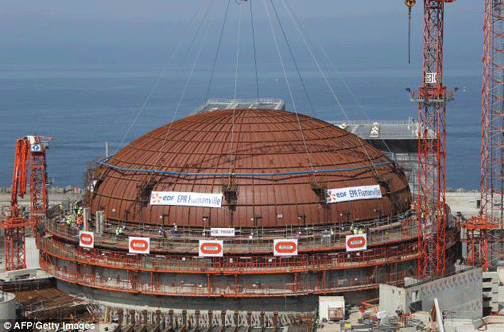
After problems with concrete, steel or welds, the reactor under
construction experienced a new malfunction.
Part of the installation’s control systems is out of order. The structural failure, known since 2019,
is now recognized by EDF. Flamanville and its EPR reactor, umpteenth
episode.
We thought we knew everything about the setbacks of the calamitous
EDF project which has been dragging on for fifteen years now on the nuclear
power plant in the Manche department and whose bill has gone in seventeen
years from 3.3 billion to 12.7 billion euros ( and even 19 billion with
interest and launch costs according to the Court of Auditors ).
Well no !
After the concrete problems during the construction of the reactor
building, the poorly forged steel of the bottom and the cover of the
nuclear vessel or the poorly made welds on the reactor piping, EDF has a
new problem on its hands.
And a big one: two essential systems which make
it possible to control the reactor are victims of a problem problem for the
start of the EPR. A tile known for several years by the operator and the
Nuclear Safety Authority (ASN), but which has not been the subject of any
publicity and has still not been resolved, according to information from
Liberation . We already knew that this powerful 1,650 MWe nuclear reactor
would not enter service before the end of 2023, more than ten years behind
the date initially planned.
Liberation 19th July 2022
Evacuation of site in France , as wildfires rage near nuclear power plant being decommissioned
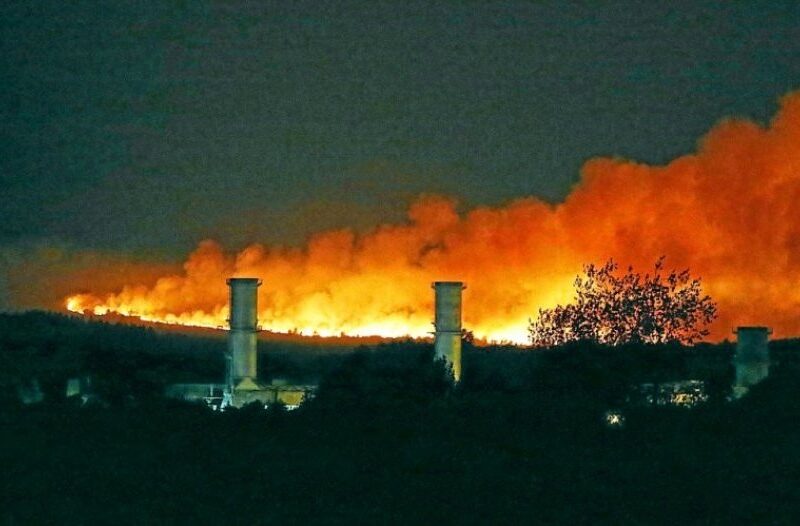
The EDF site in Brennilis, consisting of a nuclear power plant being deconstructed and a thermal power plant in operation, was evacuated around 1 p.m., due to the fumes stinking the air. It’s 10 a.m. on Tuesday morning.
The swirling fire, fanned by a wind blowing at 40 – 45 km/h, plays hide and seek with the firefighters. Claire Maynadier, sub-prefect of Châteaulin, has just hung up with the director of the Brennilis nuclear power plant . The evacuation of personnel is therefore not envisaged. “The fire front
is not near. Nevertheless, it remains uncontrolled. We remain vigilant,” she explains.
Le Telegramme 19th July 2022
Atomic Lies: New York’s bizarre Nuclear Preparedness PSA
http://www.envirosagainstwar.org/2022/07/16/atomic-lies-new-yorks-bizarre-nuclear-preparedness-psa/
July 16th, 2022 – by Gar Smith / Environmentalists Against War, ) — On July 11, New York City’s Emergency Management office released a Public Service Announcement that pretended to share important advice on steps New Yorkers could take to survive a nuclear attack. Here’s the PSA:
Re that “Don’t ask me how or why” PSA:
This updated version of the government’s misleading “duck-and-cover” nuclear war survival campaign from the 1950s begins by instructing New Yorkers to get away from the windows and huddle together “in the middle” of their building.
But, unlike a single-family suburban home, a typical New York high-rise apartment building can house thousands of individuals—so the “middle of the building” would get crowded pretty quickly.
While the PSA’s advice might help to survive a guided missile strike, it would be useless for a nuclear detonation. (All the more reason why there should be a nation-wide rebroadcast of ABC’s 1983 nuclear-strike enactment, “The Day After.”)
What Nuclear Scientists Say Would Happen
The New York PSA was so misleading that it prompted Steven Starr (a senior scientists with Physicians for Social Responsibility) to repost a 2015 research paper he co-authored with two other scientists. The article, which appeared in The Bulletin of the Atomic Scientists, addressed “the consequences of the detonation of a single [800 kiloton] warhead over midtown Manhattan.” Here are some sobering details:
“Within a few tenths of millionths of a second after detonation, the center of the warhead would reach a temperature of roughly 200 million degrees Fahrenheit (about 100 million degrees Celsius), or about four to five times the temperature at the center of the sun.”“
[T]he enormous heat and light from the fireball would almost instantly ignite fires over a total area of about 100 square miles.”
“The mass fire, or firestorm, would quickly increase in intensity, heating enormous volumes of air that would rise at speeds approaching 300 miles per hour.”
“The fireball would vaporize the structures directly below it and produce an immense blast wave and high-speed winds, crushing even heavily built concrete structures within a couple miles of ground zero. The blast would tear apart high-rise buildings and expose their contents to the solar temperatures; it would spread fires by exposing ignitable surfaces, releasing flammable materials, and dispersing burning materials.”
- “Two miles from ground zero, the Metropolitan Museum of Art, with all its magnificent historical treasures, would be obliterated. Two and half miles from ground zero, in Lower Manhattan, the East Village, and Stuyvesant Town, the fireball would appear 2,700 times brighter than a desert sun at noon.”
- ““Within tens of minutes, everything within approximately five to seven miles of Midtown Manhattan would be engulfed by a gigantic firestorm. The fire zone would cover a total area of 90 to 152 square miles. The firestorm would rage for three to six hours. Air temperatures in the fire zone would likely average 400 to 500 degrees Fahrenheit.”
Why Are They Telling Us To Prep For A Nuclear Attack??
Ellsberg on Nuclear Abolition or Annihilation
The following two short videos were released on July 11 by Defuse Nuclear War with the following introduction: Directed by Oscar-nominee Judith Ehrlich, this series explores the dangers of nuclear weapons and the politics that drive their existence. Hear firsthand accounts from Pentagon Papers whistleblower Daniel Ellsberg about his time as a nuclear war planner for the US military and learn hidden truth about realities of nuclear weapons.
ICBMs: Hair-Trigger Annihilation
Governor Newsom Wants to Keep Dangerous California Nuclear Power Plants Open

Buzz Flash, July 16, 2022, By Harvey Wasserman
As he begins to campaign for the White House, Gov. Gavin Newsom is toying with extending operations at two of the world’s most dangerous atomic reactors, sited at the aptly named Diablo Canyon, nine miles west of San Luis Obispo.
The coastal nukes are surrounded by a dozen earthquake faults, just 45 miles from the San Andreas, whose eruption could send an apocalyptic radioactive cloud into Los Angeles County, just 180 miles downwind. Potential human casualties could far exceed ten millon. The economic and ecological devastation would be incalculable.
Newsom’s emergence as a potential atomic triggerman has been tortured and tragic. Long marketed as an environmentalist, Newsom has fiercely criticized the state’s largest utility, for good reason.
Since 2000, Pacific Gas & Electric has twice fled to bankruptcy……………………………
Nuclear Regulatory Commission site inspector Dr. Michael Peck warned that Diablo could not withstand a credible seismic shock and should be shut. Peck worked five years inside the plant. But the NRC trashed his warnings and forced him out.
The NRC also warned in 2003 that Diablo Unit One is dangerously embrittled, a flaw that risks an apocalyptic explosion. Critical welds were done with metal amalgams long since abandoned. Serious cracking indicated in key components has been ignored in expectation the reactors will soon shut.
Diablo uses an obsolete “once-through” cooling system that destroys the marine environment; state law now requires cooling towers, which PG&E does not want to build.
In 2016 a broad coalition of unions, the governor, Public Utilities Commission, local communities, state regulators and environmental groups struck a landmark deal to shut both reactors as their operating licenses expire in 2024 and 2025.
The agreement has let PG&E avoid critical maintenance on the assumption that the nukes would soon close. The site lacks sufficient short-term waste storage space for fuel burned after 2025. Extremely dangerous manipulations of spent fuel pools would be required to handle more highly volatile rods and assemblies.
The shut-down agreement includes generous buy-outs for retiring workers. Retraining is set for younger ones in renewables and other fields. Much of the workforce has planned to stay on for decommissioning.
But six years into the shutdown phase, an irreplaceable core of inherited knowledge about the dangerously complex reactors has been lost, putting future operations in deep peril.
The reactors’s electricity costs California rate payers more than $3.5 million per day—-$1 billion/year—-over market prices. Timely shut-downs would avoid $8 billion in over-market charges, easily enough to replace the reactors with renewables.
The nukes’ dirty, costly output regularly forces far cheaper renewable generation off the grid. Since 2016 PG&E has added to the grid thousands of megawatts of renewables.
Unlike nuclear power, wind and solar emit no heat or carbon. Just 1500 workers work at Diablo, which has no job growth potential. More than 70,000 Californians work in the fast-expanding wind, solar, battery and efficiency industries.
Looming above all is the chance one or both Diablo’s reactors could explode, sending apocalyptic radioactive clouds into Los Angeles, the Bay Area or across into the central valley and then across the continental US., with incalculable human, ecological and economic devastation.
As the reactors age, with an aging, disappearing work force, worsening operational and structural defects, and cost and environmental impacts soaring, the harsh realities at Diablo Canyon point to catastrophe.
Why Gov. Newsom would court disaster to break the 2016 shut-down agreement and force these much-hated reactor to continue operations beyond their license agreements remains a mystery. But the costs of his folly could be apocalyptic.
Harvey Wasserman wrote the PEOPLE’S SPIRAL OF US HISTORY (solartopia.org) and most Mondays convenes the Green Grassroots Emergency Election Protection zoom call (www.grassrootsep.org) https://buzzflash.com/articles/harvey-waserman-newsom-wants-to-keep-dangerous-california-nuclear-power-plants-op
Nuclear: Doel 3 and Tihange 2 cannot be extended for safety reasons
15 July 2022 By The Brussels Times with Belga,
Operations at the Tihange 2 and Doel 3 reactors cannot be extended for technical and safety reasons, Engie Electrabel, which runs Belgium’s nuclear power plants, said on Thursday.
The Federal Agency for Nuclear Control (FANC) has not commented on the issue since neither the government nor Engie has requested a risk analysis.
The Doel 3 power plant will be shut down on the night of September 23 to 24 in accordance with the nuclear phase-out law. Tihange 2 will close in February…………………………..
Engie was asked earlier this month whether the Doel 3 and Tihange 2 reactors could be maintained until after winter, but the company said that solution could not be implemented for technical and safety reasons, an opinion confirmed by experts from Minister Van der Straeten’s office.
We need a safer interim storage solution for Ontario’s nuclear wastes.

– Angela Bischoff, Ontario Clean Air Allance. 15 Jul 22. The International Joint Commission’s Great Lakes Water Quality Board is calling for Ontario Power Generation’s (OPG) nuclear waste storage facilities to be “hardened” and located away from shorelines to prevent them from becoming compromised by flooding and erosion.
According to a report prepared for OPG, the total capital cost of building above-ground, attack-resistant, reinforced concrete vaults at the Pickering, Darlington and Bruce Nuclear Stations would be approximately $1 billion. This safer interim storage solution can be fully paid for by OPG’s nuclear waste storage fund, which has a market value of $11.3 billion.

We need a safer interim storage solution for Ontario’s nuclear wastes
The International Joint Commission’s Great Lakes Water Quality Board is calling for Ontario Power Generation’s (OPG) nuclear waste storage facilities to be “hardened” and located away from shorelines to prevent them from becoming compromised by flooding and erosion.
According to a report prepared for OPG, the total capital cost of building above-ground, attack-resistant, reinforced concrete vaults at the Pickering, Darlington and Bruce Nuclear Stations would be approximately $1 billion. This safer interim storage solution can be fully paid for by OPG’s nuclear waste storage fund, which has a market value of $11.3 billion.

As our new report, A Safer Interim Storage Solution for Ontario’s Nuclear Wastes, reveals this is urgent for multiple reasons:
– The total radioactivity of the nuclear wastes stored at the Pickering, Darlington and Bruce Nuclear Stations is 700 times greater than the total radiation released to the atmosphere by the Fukushima accident in 2011.
– OPG is currently storing these wastes in conventional commercial storage buildings.
– According to OPG, a new off-site facility for the storage of these wastes will not be in service until 2043 at the earliest.
Above-ground, attack-resistant, reinforced concrete vaults will provide much greater protection against deliberate attacks and greater radioactivity containment in the event of leaks, ruptures or other incidents than conventional commercial storage buildings.
– Building safer interim storage facilities will also create good jobs.
In Germany, six nuclear stations have hardened storage facilities. The concrete walls and roofs on these facilities are 1.2 to 1.3 metres thick. This is the kind of much safer design that Ontario should be copying as we wait for the Nuclear Waste Management Organization to find a “willing host” community to take these dangerous wastes.
What you can do
Please contact Premier Ford and Energy Minister Todd Smith and tell them that we need a safer interim storage option for OPG’s nuclear wastes. Ask them to order OPG to store its high-level radioactive wastes in above-ground, attack-resistant, reinforced concrete vaults at its nuclear stations.
Unconfirmed reports that Russian forces at Zaporizhzhia Nuclear Power Station might drain the cooling ponds

There have been unconfirmed reports that Russian forces at Zapphrizia
nuclear plant, Europe’s largest nuclear plant located in Ukraine, could be
attempting to drain the cooling ponds there – something which could spell
disaster for the continent and the UK.
The Russian forces reportedly want
to drain the cooling pond in order to conduct weapons searches. Dr Paul
Dorfman told Express.co.uk that this would be “utter madness” and
warned of disaster if the Russian forces went through with their plan.
Dr Dorfman is an Associate Fellow, Science Policy Research Unit (SPRU), Sussex
Business School, University of Sussex. He has worked with both the
Government as well as European Governments on various areas of nuclear
policy. He said: “Draining spent nuclear fuel ponds would be utter
madness, as cascading problems could lead to very significant radioactive
release – and depending on which way the wind is blowing, the radioactive
pollution could either go to Europe or Russia.”
Express 10th July 2022
Office for Nuclear Regulation (ONR) finds shortfalls in EDF’s cybersecurity plans
French energy giant EDF has been placed under ‘enhanced attention’ by the
UK’s Office for Nuclear Regulation (ONR) after identifying shortfalls in
its cybersecurity plans, according to reports this weekend.
The ONR is
taking action due to the findings of routine inspections over the past 12
months. The Telegraph newspaper quoted the body as saying it had
“identified shortfalls in governance, risk and compliance in certain
technical controls” during these inspections. EDF owns and runs the UK’s
network of nuclear power stations at five locations and is currently
building a new nuclear power station at Hinkley Point in Somerset, together
with minority Chinese partner CGN.
The action takes place against a
backdrop of increased awareness of the vulnerability of energy
infrastructure around Europe to cyber-attack. In particular, Russia has
been blamed for cyber-attacks on both windfarms and nuclear power plants in
Europe as part of its invasion of Ukraine.
Info Security 11th July 2022
https://www.infosecurity-magazine.com/news/edf-scrutiny-cybersecurity-record/
Les Echos 11th July 2022
Danger intensifies around Zaporizhzhia Nuclear Power Plant in southern Ukraine

The Russian army is transforming Europe’s largest nuclear power plant into a military base overlooking an active front, intensifying a monthslong safety crisis for the vast facility and its thousands of staff. At the
Zaporizhzhia Nuclear Power Plant in southern Ukraine, more than 500 Russian soldiers who seized the facility in March recently have deployed heavy artillery batteries, and laid anti-personnel mines along the shores of the reservoir whose water cools its six reactors, according to workers, residents, Ukrainian officials, and diplomats.
The Ukrainian army holds the towns dotted on the opposite shore, some 3 miles away, but sees no easy way to attack the plant, given the inherent danger of artillery battles around active nuclear reactors.
Wall St Journal 5th July 2022
New Energy Security Bill waters down regulation for fusion, warns Nuclear Free Local Authorities
As the Nuclear Free Local Authorities have feared, following a pre-Christmas BEIS consultation, the Johnson Government has recently revealed its plans to relax the regulatory regime applicable to future fusion reactors by choosing not to classify them as ‘nuclear installations’.
Fission nuclear reactors are subject to nuclear site licencing requirements overseen by the Office of Nuclear Regulation under the Nuclear Installations Act 1965 (NIA 1965), but government ministers have now decided that fusion plants should instead be regulated by the Health and Safety Executive and Environment Agency like other industrial facilities. The new Energy Security Bill just introduced to Parliament by the Business Secretary will exclude fusion reactors from the provisions of the NIA 1965.
Ministers claim that fusion does not present the same ‘higher hazards’ found in fission plants, but the NFLA fears that their decision is about making the UK attractive to investors in their haste to make the UK a ‘fusion industry superpower’ rather than prioritising public safety.
In its response to the Department of Business, Energy and Industrial Strategy (BEIS) consultation, the NFLA had called for ‘no watering down’ of the regime, challenging the notion that fusion was largely without risk.
For research commissioned by the NFLA revealed that fusion would result in the production of large quantities of radioactive waste, with the risk that radioactive tritium could enter the water supply. Fusion also requires immense temperatures, hotter than the sun, to spark and sustain a fusion reaction and this energy must be safely contained using challenging and unproven engineering solutions. Operation would also result in the whole structure being subjected to prolonged exposure to neutron radiation, a situation which if not carefully monitored could result in the very integrity of the reactor vessel being placed in jeopardy.
The Chair of the NFLA Steering Committee, Councillor David Blackburn, said: “The NFLA’s view is that the government’s decision is misguided. It seems blasé to treat a fusion plant for regulatory purposes in the same way as a factory making chemical products. Fusion presents some of the same hazards and challenges as fission, but some are new; surely then fusion is nuclear and so a plant utilizing this technology must be a ‘nuclear installation’.
“In the view of the NFLA, there is no logical reason on safety grounds not to apply the same regulatory regime to fusion reactors as fission reactors. By signalling through the Energy Security Act their determination to exclude fusion from the rigours of the licencing regime, it seems clear that the present government is more focused on reducing the regulatory and cost burden on investors and commercial operators entering the market, putting expediency and profits before public safety.”
On waste management and decommissioning, the government’s position is even more unclear with ministers calling it ‘premature’ to outline clear proposals at this time, something the NFLA is especially perturbed about.
Councillor Blackburn added: “It is a shame that ministers have missed a trick by refusing to state clearly that future operators will have to share a greater burden of the cost of decommissioning and waste management, rather than passing the bill to the Nuclear Liabilities Fund and ultimately the British taxpayer.”
1 This Month
Chernobyl: The Lost Tapes – A good documentary on Chernobyl on SBS available On Demand for the next 3 weeks– https://www.sbs.com.au/ondemand/tv-program/chernobyl-the-lost-tapes/2352741955560

of the week–London Campaign for Nuclear Disarmament

Tell the Ukrainian Government to Drop Prosecution of Peace Activist Yurii Sheliazhenko
To see nuclear-related stories in greater depth and intensity – go to https://nuclearinformation.wordpress.com
-
Archives
- April 2026 (152)
- March 2026 (251)
- February 2026 (268)
- January 2026 (308)
- December 2025 (358)
- November 2025 (359)
- October 2025 (376)
- September 2025 (257)
- August 2025 (319)
- July 2025 (230)
- June 2025 (348)
- May 2025 (261)
-
Categories
- 1
- 1 NUCLEAR ISSUES
- business and costs
- climate change
- culture and arts
- ENERGY
- environment
- health
- history
- indigenous issues
- Legal
- marketing of nuclear
- media
- opposition to nuclear
- PERSONAL STORIES
- politics
- politics international
- Religion and ethics
- safety
- secrets,lies and civil liberties
- spinbuster
- technology
- Uranium
- wastes
- weapons and war
- Women
- 2 WORLD
- ACTION
- AFRICA
- Atrocities
- AUSTRALIA
- Christina's notes
- Christina's themes
- culture and arts
- Events
- Fuk 2022
- Fuk 2023
- Fukushima 2017
- Fukushima 2018
- fukushima 2019
- Fukushima 2020
- Fukushima 2021
- general
- global warming
- Humour (God we need it)
- Nuclear
- RARE EARTHS
- Reference
- resources – print
- Resources -audiovicual
- Weekly Newsletter
- World
- World Nuclear
- YouTube
-
RSS
Entries RSS
Comments RSS
 nuclear-news