Situation at Ukrainian nuclear plants worrying as shelling and power cuts threaten containment
Ukraine’s four operational nuclear power plants all have access to the national grid again following a complete loss of off-site power last week. It was the first time that all the plants suffered a loss of external power at the same time since the conflict began nine months ago. They relied on diesel generators for back-up electricity
‘The complete and simultaneous loss of off-site power for Ukraine’s nuclear power plants shows that the situation for nuclear safety and security in the country [has] become increasingly precarious, challenging and potentially dangerous,’ said Rafael Mariano Grossi, director general of the International Atomic Energy Agency (IAEA). ‘It is extremely concerning. The situation further underlines the need for stepped-up action to protect the plants and prevent the danger of a serious nuclear accident.’
The recent shelling at the site of Ukraine’s Zaporizhzhia Nuclear Power Plant (ZNPP) has been one of the most intense episodes in recent months, according to the IAEA, which has a team on site. The ZNPP, Europe’s largest nuclear power plant, has lost power from the grid several times in recent months. Russia captured the plant early in the war.
The facility remains in shutdown mode but still needs electricity to maintain essential safety and security functions. Reactors need power for cooling even when they are in shutdown. Four of its six reactor units are in ‘cold shutdown’, while the two other units have been returned to ‘hot shutdown’ again – enabling them to provide steam to the plant and heat to the nearby city of Enerhodar.
The ZNPP has 20 diesel generators which start operating automatically when connection to the grid is lost. Typically, plants hold 10 days’ worth of fuel. In this latest episode, eight generators were needed over a day or so. The IAEA team reported that the plant’s six reactors were safe, and confirmed the integrity of the spent fuel, the fresh fuel and radioactive waste storage facilities. However, there was widespread minor damage across the site.
Matthew Bunn, professor of the practice of energy, national security, and foreign policy at the Harvard Kennedy School, agrees that nuclear reactors in a war zone pose potentially deadly dangers. ‘Operating a reactor on the backup diesel generators is something that should be done rarely and briefly,’ he says. ‘In Ukraine, they are being forced to do it again and again. Every time off-site power gets cut off, you’re operating with no backup to the diesel generators. If they fail, within hours the water will boil off, the reactor core will be exposed, and the fuel in the core will begin to melt and a catastrophic radiation release is likely. This is true even if a reactor is not operating: when the reactor shuts down, it stops releasing energy from splitting atoms, but the intensely radioactive material in the core continues to generate a lot of heat from radioactive decay. However, some of the reactors at Zaporizhzhia have been shut for months and have cooled somewhat. Now, if there were a total loss of power at those reactors, there would be significantly more time to try to restore power before melting would begin.’……………………………………..more https://www.chemistryworld.com/news/situation-at-ukrainian-nuclear-plants-worrying-as-shelling-and-power-cuts-threaten-containment/4016637.article
War and Nuclear Power: Stakes Are High for People, Environment, and Industry
Power, by Aaron Larson, 1 Dec 22, John Stevens Cabot Abbott, the 19th century American historian perhaps best known for writing History of Napoleon Bonaparte and History of the Civil War in America, is attributed with the quote, “War is the science of destruction.” In truth, however, I don’t think most combatants really think about science when going into battle; they have enough on their minds just trying to stay out of harm’s way. Nonetheless, there are many consequences, some that could require serious science to solve, that can result from the actions soldiers take during wartime.
The war in Ukraine has brought to light a few of the more significant risks associated with war in a modern world powered by nuclear energy. Ukraine is heavily dependent on nuclear power for its supply of electricity. The country is home to 15 reactors, which have provided more than half of Ukraine’s electricity in recent years. Among the nuclear power stations is the six-unit Zaporizhzhya facility, Europe’s largest nuclear power plant (NPP) with a total capacity of 6 GW (Figure 1). It is located in the “steppe zone” of Ukraine, a natural grassland plain in the southern part of the country.
Russian Troops Occupy Ukrainian Nuclear Site
Russian troops took control of the Zaporizhzhya NPP during the first week of March. International Atomic Energy Agency (IAEA) Director General Rafael Mario Grossi reported on March 4 that in the conflict leading up to the takeover, a projectile had hit a training/construction building within the plant site, causing a fire, which was extinguished by the local fire brigade at the power station. While none of the safety systems for the six reactors were affected and there was no release of radioactive material, the incident was significant in that it demonstrated the vulnerability both of the staff and the plant.
At the time, Grossi outlined “seven indispensable pillars for ensuring nuclear safety and security.” ……………….
It’s obviously easy for everyone to agree to maintain these pillars during peacetime, but during a war, the lines can be blurred. It’s understandable why the Russians, for example, might want to take the plant down, putting a crimp on the Ukrainian power grid. With some thought, and perhaps a little science, they could do so without jeopardizing the plant or the environment. But as I said in the beginning, soldiers don’t always think about things like that. Furthermore, many of the troops on the ground may not have a complete understanding of how a nuclear reactor works or what it needs to remain safe, which presents significant risk to everyone involved……………………………….
perhaps the most serious infringement on the IAEA pillars during the Russian occupation has been the multiple times off-site power has been lost at the plant. The site is equipped with 20 emergency diesel generators that can provide the required power for safe operation of the reactors and the ability to bring them to cold shutdown should off-site power be lost, but the loss of off-site power violates defense-in-depth principles and adds significant risk to plant operations.
Russia, of all countries, should have a firm understanding of the importance of safety in the nuclear power industry. It has 37 reactors in operation with a total net capacity of about 27.7 GW and three more units under construction. Russia also has significant interest in exporting its nuclear goods and services around the world.
Today, Rosatom claims to be in “first place in terms of the number of simultaneously implemented nuclear reactor construction projects” with its three units in Russia and 34 abroad at various stages of implementation. In 2021, Rosatom’s package of foreign orders exceeded $139.9 billion, according to the company. It doesn’t take a scientist to conclude that NPP projects would be seriously stalled by a nuclear incident in Ukraine. While I don’t really care if Russia ever sells another reactor abroad, it’s still in everyone’s best interest to maintain plant safety at Zaporizhzhya and prevent a nuclear catastrophe.
—Aaron Larson is POWER’s executive editor
UN votes to press countries to stop terrorists from getting nuclear weapons.
Business Standard. 1 Dec 22
The UNSC voted unanimously to keep pressing all countries to implement a resolution aimed at keeping nuclear, chemical, and biological weapons out of reach of terrorists and black marketeers
The U.N. Security Council voted unanimously Wednesday to keep pressing all countries to implement a resolution aimed at keeping nuclear, chemical and biological weapons out of the hands of terrorists, black marketeers and others.
The council resolution approved by a 15-0 vote extends the mandate of the committee monitoring implementation of the 2004 resolution on the threat of non-state actors obtaining or trafficking weapons of mass destruction for 10 years until Nov. 30, 2032. It also continues support for the committee’s group of experts.
The resolution calls on the committee and the 193 U.N. member nations to take into account the use by non-government groups and individuals of rapid advances in science and technology to spread the use of these banned weapons.
The council says in the resolution that it is gravely concerned at the threat of terrorism and the risk that non-state actors may acquire, develop, traffic in or use nuclear, chemical or biological weapons, including by relying on advances in science and technology…………………
The resolution requires all U.N. member states to adopt laws to prevent non-state actors from manufacturing, acquiring or trafficking in nuclear, biological or chemical weapons, the materials to make them, and the missiles and other systems to deliver them.
It also requires all countries to take measures to account for and secure all banned weapons, missiles and weapons material, and to develop border controls and step up efforts to detect, deter, prevent and combat … the illicit trafficking and brokering in such items………………………………………………… more https://www.business-standard.com/article/international/un-votes-to-press-countries-to-stop-terrorists-from-getting-nuclear-weapons-122120100102_1.html
Nuclear Guinea Pigs: NRC’s Licensing of Experimental Nuclear Plants


“Dr. Lyman warns us all once again how largely beholden to the nuclear industry the NRC is. NRC is willing to twist and contort even reasonable safety regulations in ways that cater to nuclear industry desires to a degree that would rival a toy balloon-dog at a children’s party. It is this kind of almost institutionalized acquiescence to industry wants that has led many to believe that NRC stands for Not Really Concerned.”
https://www.counterpunch.org/2022/11/22/nuclear-guinea-pigs-nrcs-licensing-of-experimental-nuclear-plants/ BY KARL GROSSMAN 22 Nov 22,
“Guinea Pig Nation: How the NRC’s new licensing rules could turn communities into test beds for risky, experimental nuclear plants,” is what physicist Dr. Edwin Lyman, Director of Nuclear Power Safety with the Union of Concerned Scientists (UCS), titled his presentation last week.
The talk was about how the U.S. Nuclear Regulatory Commission is involved in a major change of its “rules” and “guidance” to reduce government regulations for what the nuclear industry calls “advanced” nuclear power plants.
Already, Lyman said, at a “Night with the Experts” online session organized by the Nuclear Energy Information Service, the NRC has moved to allow nuclear power plants to be built in thickly populated areas. This “change in policy” was approved in a vote by NRC commissioners in July.
For a more than a half-century, the NRC and its predecessor agency, the U.S. Atomic Energy Commission, sought to have nuclear power plants sited in areas of “low population density”—because of the threat of a major nuclear plant accident.
But, said Lyman, who specializes in nuclear power safety, nuclear proliferation and nuclear terrorism, the NRC in a decision titled “Population-Related Siting Considerations for Advanced Reactors,” substantially altered this policy.
The lone NRC vote against the change came from Commissioner Jeffery Baran who in casting his ‘no’ vote wrote “Multiple, independent layers of protection against potential radiological exposure are necessary because we do not have perfect knowledge of new reactor technologies and their unique potential accident scenarios….Unlike light-water reactors, new advanced reactor designs do not have decades of operating experience; in many cases, the new designs have never been built or operated before.”
He noted a NRC “criteria” document which declared that the agency “has a longstanding policy of siting nuclear reactors away from densely populated centers and preferring areas of low population density.”
But, said Baran, under the new policy, a “reactor could be sited within a town of 25,000 people and right next to a large city. For reactor designs that have not been deployed before and do not have operating experience, that approach may be insufficiently protective of public health and safety…And it would not maintain the key defense-in-depth principle of having prudent siting limitations regardless of the features of a particular reactor design—a principle that has been a bedrock of nuclear safety.”
That is just one of the many reductions proposed in safety standards.
“The central issue,” commented Lyman in an interview following his November 17th presentation, “is that the NRC is accepting on faith that these new reactors are going to be safer and wants to adjust its regulations accordingly, to make them less stringent—on faith.”
The key motivation, he said, behind the nuclear industry’s push to significantly weaken safety standards is that the line of smaller nuclear power plants the nuclear industry is now pushing—including what it calls the “small modular nuclear reactor”—is that they are going to be “much more expensive” than the existing light-water nuclear power plants, the most common type of nuclear power plant which are large and are cooled by plain water. Thus, he said, these “advanced” nuclear plants would be more costly to operate than using energy alternatives, “certainly wind and solar.”
And the NRC is complying with the nuclear industry.
It’s a demonstration of one of the alternatives for the acronym for the NRC—Nuclear Rubberstamp Commission.
The list of proposed safety reductions in the PowerPoint portion of Lyman’s presentation under “Cutting corners on safety and security to cut costs,” and what the nuclear industry “wants” in what the NRC calls its “Part 53” assemblage of changes, included, in addition to the already completed alteration of siting criteria:
+ Allowing nuclear power plants to have a “small containment—or no physical containment at all.” Containments are the domes over nuclear plants to try to contain radioactive releases in an accident.
+ “No offsite emergency planning requirements.” The NRC has been requiring emergency planning including the designation of a 10-mile evacuation zone around a nuclear power plant.
+ “Fewer or even zero operators.” The nuclear industry would like advanced nuclear plants to operate “autonomously.”
+ Letting the plants have “fewer” NRC “inspections and weaker enforcement.”
+ “Reduced equipment reliability reporting.”
+ “Applications” for an advanced reactor “should contain minimal information.”
+ “The NRC’s review standards should be lenient.’
+ Letting the plants have “fewer inspections and weaker enforcement.”
+ “Fewer back-up safety systems.”
+ “Regulatory requirements should be few in number and vague.”
+ “Zero” armed security personnel to try to protect an advanced nuclear power plant from terrorists.
Lyman commented: “I could go on and on.”
The Nuclear Energy Information Service’s summary of his presentation stated: “Under
the direction of Congress, the NRC is developing new regulations to facilitate licensing of experimental reactors by relaxing safety security standards and by relying on safety demonstrations that utilize computer simulations rather than experimental data. The major focus of this effort, known as ‘Part 53,’ is being written with an unprecedented level of industry involvement. If ‘Part 53’ is enacted, first-of-a kind reactors would be located in densely populated urban areas without any promise for emergency evacuation, planning, without security forces to protect against terrorist attack, and without highly trained operators—and all without meaningful opportunities for public input”.
In his talk, Lyman referenced a 140-page report of the Union of Concerned Scientists which he authored, issued last year, titled “Advanced” Isn’t Always Better, Assessing the Safety, Security, and Environmental Impacts of Non-Light-Water Nuclear Reactors.
The report states: “Almost all nuclear power reactors operating and under construction today are LWRs, so called because they use ordinary water to cool their hot, highly radioactive cores. Some observers believe that the LWR, the industry workhorse, has inherent flaws that are inhibiting nuclear power’s growth….In response, the US Department of Energy’s national laboratories, universities, and numerous private vendors—from large established companies to small startups—are pursuing the development of reactors that differ fundamentally from LWRs. These non-light-water reactors are cooled not by water, but by other substances, such as liquid sodium, helium gas, or even molten salts.”
These “are sometimes referred to as ‘advanced reactors.’ However, that is a misnomer for most designs being pursued today…largely descend from those proposed many decades ago,” the report continued.
“In part,” it went on, “the nuclear industry’s push to commercialize NLWRs is driven by its desire to show the public and policymakers that there is a high-tech alternative to the static, LWR-dominated status quo: a new generation of ‘advanced’ reactors. But a fundamental question remains: Is different actually better? The short answer is no. Nearly all of the NLWRs currently on the drawing board fail to provide significant enough improvements over LWRs to justify their considerable risks.”
In the report, Lyman extensively examines issues involving each of the NLWR (Non Light Water Reactors) or “advanced” reactors.
David Kraft, director of the Chicago-based Nuclear Energy Information Service, after Lyman’s talk said in an interview: “Dr. Lyman warns us all once again how largely beholden to the nuclear industry the NRC is. NRC is willing to twist and contort even reasonable safety regulations in ways that cater to nuclear industry desires to a degree that would rival a toy balloon-dog at a children’s party. It is this kind of almost institutionalized acquiescence to industry wants that has led many to believe that NRC stands for Not Really Concerned.”
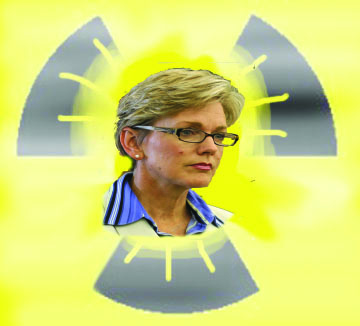
Kraft continued: “Make no mistake about it—while NRC is doing its part to serve nuclear industry needs, we should not lose sight of the fact that it is the aggressive pro-nuclear agenda of the Biden Administration that has unleashed a juggernaut of financial and PR support for new nuclear reactors. Everything from the tens of billions of dollars allocated for new nuclear in the Infrastructure Act and the IRA [Inflation Reduction Act, which establishes a nuclear power production tax credit], to the national dog-and-pony show [the recent U.S. tour promoting nuclear power] of Energy Secretary Jennifer Granholm, demonstrates the administration’s intentions to run roughshod over the objections of the public. We have a hard fight ahead of us.”
The Nuclear Energy Information Service is among the safe-energy, anti-nuclear organizations that are challenging the NRC’s effort to change its “rules” and “guidance” to boost “advanced” nuclear plants. Founded in 1981, its website is neis.org. It plans to soon post through its website a recording of Lyman’s Zoom presentation.
Lyman’s PowerPoint included a slide saying the “NRC is not currently” accepting comments on its plan for changes in its regulations for “advanced” reactors. But, it said, “the public is always free to weigh in” on NRC actions and recommended people attend any public meetings held on the issue.
Lyman joined the Union of Concerned Scientists in 2003 and is based in its Washington, D.C. office. Previously, he was president of the Nuclear Control Institute in Washington. Before that he was a postdoctoral research associate at Princeton University’s Center for Energy and Environmental Studies, now the Science and Global Security Program. He earned a doctorate in physics from Cornell University in 1992. He is a co-author of the book Fukushima: The Story of a Nuclear Disaster.
Karl Grossman, professor of journalism at State University of New York/College at Old Westbury, and is the author of the book, The Wrong Stuff: The Space’s Program’s Nuclear Threat to Our Planet, and the Beyond Nuclear handbook, The U.S. Space Force and the dangers of nuclear power and nuclear war in space. Grossman is an associate of the media watch group Fairness and Accuracy in Reporting (FAIR). He is a contributor to Hopeless: Barack Obama and the Politics of Illusion.
U.N. Supplied Qatar With Tech to ‘Prevent Nuclear Security Incident’ at 2022 World Cup
Washington Free Beacon, Adam Kredo • November 21, 2022,
The United Nations provided Qatar with equipment and training to prevent “a nuclear security incident” from occurring during the 2022 World Cup, according to the U.N.’s nuclear watchdog group.
The International Atomic Energy Agency (IAEA), which works on proliferation issues across the globe, says it has worked with Qatar’s National Committee for the Prohibition of Weapons for the past year “to thwart any attack involving nuclear or other radioactive material.” The announcement comes as jihadist groups like al Qaeda urge its militant followers “wage jihad” against the tournament as Westerners pour into the country……………
The IAEA says that in the lead up to the games, the organization helped Qatar integrate its nuclear security measures into larger plans that could help disrupt a nuclear or radiological attack. This included providing “comprehensive training to national counterparts on developing and implementing nuclear security measures and on responding to nuclear security events and related emergencies.”
The nuclear watchdog lent Qatar more than 120 radiation detecting devices, including personal radiation detectors, portable backpack detectors, and other instruments that can spot things like a dirty bomb, a crude explosive device that includes radioactive materials.
This is “the first time” the IAEA’s Malaysia-based security center provided such equipment to a country hosting a major public event, according to the IAEA………………………. https://freebeacon.com/national-security/un-supplied-qatar-with-tech-to-prevent-nuclear-security-incident-at-2022-world-cup/
Europe’s biggest nuclear power plant, Zaporizhzhia, is maybe the most dangerous place in the world right now.
The plant is in Russian-occupied Ukraine and has been shelled repeatedly since March.
The situation is carefully monitored by the International Atomic Energy Agency, the U.N.’s
nuclear watchdog agency tasked with making sure nuclear facilities are safe
and atomic material is only used for peaceful purposes.
Its director general, Rafael Mariano Grossi, recently inspected the site. “Well, it’s an
unprecedented thing, really, in so many ways,” Grossi told Lesley Stahl for
this week’s 60 Minutes. “This place is at the front line which makes the
whole thing so volatile and in need of an urgent action.” Before the war
the plant supplied 20% of Ukraine’s power.
It’s now largely idle, but the reactors still need to be constantly cooled down with circulating water. If
they over-heat it could lead to nuclear catastrophe within hours.
CBS 20th Nov 2022
Electricity production at Olkiluoto 3 reactor delayed until 2023.
Full-scale electricity production at Olkiluoto 3 reactor delayed until
2023. An investigation into damage to the reactor’s feedwater pumps will
take a number of weeks, with a knock on effect on the schedule for the
beginning of regular electricity production.
Finland’s newest nuclear reactor will remain offline longer than expected, announced its owner on
Monday, pushing back much-needed relief for electricity consumers. Nuclear
power utility Teollisuuden Voima (TVO) has announced that an investigation
into damage at the much-delayed Olkiluoto 3 nuclear reactor’s feedwater
pumps will continue for a number of weeks.
In a press statement, TVO said
that as a result of the ongoing investigation, the schedule for when
regular electricity production will begin at the reactor cannot currently
be estimated.
YLE News 22nd Nov 2022
Shelling of Zaporizhzhia is playing with fire, says UN nuclear chief, as blasts reported
Explosions cause damage at Ukrainian power plant, as Kyiv says it will investigate videos allegedly of surrendering Russians being shot
Guardian, Jennifer Rankin, Mon 21 Nov 2022
The UN nuclear energy watchdog has said the forces behind the shelling of Ukraine’s Zaporizhzhia power plant are “playing with fire”, after a series of explosions shook the facility.
The International Atomic Energy Agency (IAEA), which has experts based at Zaporizhzhia, reported on Sunday that powerful explosions had shaken the area on Saturday night and Sunday. It said its on-site experts saw some of the explosions from their windows.
It reported more than a dozen blasts from apparent shelling, with damage to some buildings, systems and equipment, but “none so far critical for nuclear safety”.
The head of the IAEA, Rafael Grossi, said the news was extremely disturbing and he called the explosions completely unacceptable. “Whoever is behind this, it must stop immediately. As I have said many times before, you’re playing with fire,” he said.
According to the IAEA Twitter account, Grossi renewed his appeal to Ukraine and Russia to agree and implement a nuclear safety and security zone around the plant as soon as possible.
Zaporizhzhia, in south-east Ukraine, is Europe’s largest nuclear power station and has been under Russian control since March, although its Ukrainian staff remain in place to run the facility. It has faced repeated shelling, raising fears of a nuclear disaster. Moscow and Kyiv have blamed each other for the attacks.
The plant’s six Soviet-designed water-cooled reactors are currently shut down, but there is a risk that nuclear fuel could overheat if the power that drives the cooling systems is shut. Shelling has frequently damaged the plant’s power supply.
Russian officials claimed that Ukrainian forces were behind the latest attacks. “They are shelling not only yesterday but also today, they are shelling even now,” an adviser to the head of Russia’s nuclear power operator Rosenergoatom, Renat Karchaa, told the Russian state news agency Tass. He said there had been 15 aerial strikes, including one that hit a storage facility.
Soon after the Russian accusations, Ukraine’s nuclear energy agency, Energoatom, said Russia was responsible for the shelling, which it said had resulted in 12 hits to Zaporizhzhia’s infrastructure. The company said on Telegram that the list of damaged equipment indicated that the attackers “targeted and disabled exactly the infrastructure that was necessary for the restart of 5th and 6th power units” and the restoration of power production for Ukrainian needs……………………………….. https://www.theguardian.com/world/2022/nov/20/shelling-of-zaporizhzhia-is-playing-with-fire-says-un-nuclear-chief-ukraine
Shutdown of UKraine’s Khmelnytskyy Nuclear Power Plant due to military attacks in the region
Ukraine’s Khmelnytskyy Nuclear Power Plant (KhNPP) lost all access to the
electricity grid yesterday due to military attacks in the country, forcing
it to temporarily rely on diesel generators for back-up power, Director
General Rafael Mariano Grossi of the International Atomic Energy Agency
(IAEA) said today, citing information he had received from Ukrainian
authorities.
The KhNPP’s grid connection was completely lost at 18:35
local time on 15 November, after the site’s four operating power lines
were progressively lost over a two-and-a-half-hour period because of
missile attacks on the country’s energy infrastructure, Ukraine told the
IAEA. During this period, the plant’s two reactors were shut down,
halting their delivery of electricity to households, factories and others.
IAEA 16th Nov 2022
Reactors at Ukrainian nuclear power plants shut down after Russian strikes
Reuters, Nov 16 (Reuters) – Several reactors at two Ukrainian power plants automatically shut down as a result of Russian missile strikes on Tuesday, President Volodymyr Zelenskiy said, adding that millions of people were left without electricity………..
As a result of the strikes, automation today disabled several nuclear units at two stations – these are calculated consequences, and the enemy knew exactly what he was doing,” Zelenskiy said in his nightly video address……….
Zelenskiy did not say which power plants were affected, but said that strikes hit the capital Kyiv, Lviv, Rivne and Volyn in the west, Kharkiv in the northeast, Kryvyi Rih and Poltava in the centre, Odesa and Mikolaiv in the south and Zhytomyr in the north…………….. https://www.reuters.com/world/europe/reactors-ukrainian-nuclear-power-plants-shut-down-after-russian-strikes-2022-11-16/
UK government to dump European Union nuclear safety laws – a deregulated race to the safety bottom?
Revealed: Fears over Brexit threat to nuclear safety laws, Herald 13th November,
UK GOVERNMENT plans threatening nuclear and radiation safety laws in a “Brexit bonfire” have provoked resistance from regulators and trade unionists, opposition from Scottish ministers, and alarm from campaigners.
The Cabinet Office has published a list of more than 2,400 European Union (EU) laws which are under review as part of the Government’s bid to scrap them. They include 10 key regulations designed to protect the public and workers from nuclear accidents and radiation leaks.
The UK Office for Nuclear Regulation (ORN), which oversees safety at civil and military nuclear sites, told The Ferret it was trying “to preserve the legislative framework” to meet the “highest international standards”.
The trade union Prospect, which represents scientists and engineers in the nuclear industry, accused UK ministers of “trying to weaken or dismantle a regulatory framework that has served the UK well over many decades”.
The Scottish Government attacked Westminster for “rolling back 47 years of protections in a rush to impose a deregulated race to the bottom”.
Campaigners are worried by the dangers of “watering down” nuclear safety law, and demand tougher legal protections.
A bill to remove “retained EU law” was introduced to the UK Parliament by the former business minister, Jacob Rees-Mogg, in September. It contains a “sunset” clause requiring all remaining EU law to be repealed or assimilated by the end of 2023, though this can be extended to 2026.
Among the laws under threat is the 2019 Radiation (Emergency Preparedness and Public Information) Regulations which compel councils and companies to draw up emergency plans to deal with nuclear accidents. According to UK Government guidance in 2015, the regulations are “key” to ensuring that the public is “properly protected”.
Three sets of regulations aimed at protecting workers and the public from the hazards of radiation are also up for review. One “lays down basic safety standards for protection against the dangers arising from exposure to ionising radiation”, the Government said.
Other laws on the UK Government list cover “maximum permitted levels” of radioactivity in food after a nuclear emergency; imports of radioactively contaminated food following the Fukushima nuclear accident in 2011 and the Chernobyl disaster in 1986; and the safety of decommissioning nuclear plants.
The ORN, which regulates the Faslane nuclear base and six other sites in Scotland, is understood to be taking the threat to nuclear safety laws “very seriously”. The six other sites are Chapelcross in Dumfries and Galloway; Dounreay in Caithness; Hunterston A and Hunterston B, both in North Ayrshire, Rosyth in Fife; and Torness in East Lothian
An ONR spokesperson told The Ferret: “We are in discussions with the Government to preserve the legislative framework that allows us to hold the nuclear sector to account consistent with the highest international standards.”
According to the veteran nuclear critic Pete Roche, this meant that the ONR was resisting the UK Government’s plans. “Reading between the lines, it looks as though the ONR is planning to fight any proposals to make drastic changes to nuclear regulation,” he said.
“In recent meetings I have been involved in, ONR representatives have stressed the need to uphold the highest international standards. I can only hope I am not being overly optimistic and that they stick to their guns.”
Prospect argued that the existing regulatory framework worked well at protecting workers and communities. This was vital as old nuclear plants were being decommissioned and new ones built, it said.
“Perhaps the Government should focus on ensuring that existing regulators are properly resourced to do this important work rather than trying to weaken or dismantle a regulatory framework that has served the UK well over many decades,” said Prospect’s senior deputy general secretary, Sue Ferns.
Ferns.
“Tearing up existing regulations for the sake of purportedly ‘taking back control’ does nothing but introduce uncertainty,” she added. “Nuclear is an international industry, there is no value in seeking to craft UK specific legislative variants just for the sake of it.”
The Scottish Government has urged the Scottish Parliament to withhold consent for the “Brexit bonfire” bill. “Ministers fundamentally oppose the Retained EU Law Bill,” said a spokesperson. “This bill puts at risk the high standards people have come to expect from EU membership, rolling back 47 years of protections in a rush to impose a deregulated race to the bottom.”
The 50-strong group of Nuclear Free Local Authorities was “gravely concerned” about the “threat to water down legislation which provides the public or our environment with protection from the operational or legacy risks posed by civil nuclear power”.
The group’s chairman David Blackburn, a Green councillor from Leeds, said: “If European regulations providing protection are to be removed, we will press Government ministers to instead enact equivalent, or preferably stronger, laws into UK domestic legislation.”
The environmental campaigner and former director of Friends of the Earth Scotland, Dr Richard Dixon, thought that the EU gave the public and workers “vital protections” against radiation risks.
“No backsliding at all can be allowed,” he said.
“This has never been more important with the prospect of damage to nuclear reactors or even the use of nuclear weapons in Ukraine.
“Protection of the same strength or better needs to be put in place.”
The UK Department for Business, Energy and Industrial Strategy did not respond to requests for comment. …………. https://www.heraldscotland.com/news/23121029.revealed-fears-brexit-threat-nuclear-safety-laws/
Sizewell C – proposed coastal area is not suitable for nuclear reactors
Letter: Your leader on Sizewell C ignores a couple of factors that are key
to our local objections. First, the coastline on which Sizewell A and B are
built and Sizewell C is proposed is disintegrating at an increasingly
alarming rate – just two weeks’ ago a building at nearby Thorpeness had
to be demolished due to collapse of the cliffs.
Second, there is insufficient water in Suffolk to build and operate Sizewell C, which was
one of the main reasons the government’s own planning inspectorate
advised against it recently. Water is planned to be found through the
construction of desalination plants – these require huge amounts of
energy, but more importantly the waste salt and other minerals from the
extraction process will be put back into the sea, poisoning the waters
around for miles.
There are other reasons why this is a disastrous
location: it is a site of special scientific interest and an area of
outstanding natural beauty and the prototype for this type of reactor has
yet to be proved at Flamanville – still not operational, years over
schedule and way over budget. Nuclear has moved on since the design of
these reactors. The government should think again.
Observer 13th Nov 2022
Stress corrosion continues to trouble the French nuclear fleet
This week EDF updated its expectations for its nuclear fleet for this
winter, downgrading its output forecasts to 275-285 TWh, compared to the
previous estimate of 280-300 TWh.
The main driver of the downgraded
forecasts is a refusal by the French nuclear regulator, Autorité de
Sȗreté Nucléaire (“ASN”) to allow EDF to re-start number of reactors
with stress corrosion problems, in line with the planned schedule: Cattenom
1 (1.3 GW) will be offline for a further three and a half months until 26
February 2023; Chooz 1 (1.5 GW) will remain closed for about three months
until 29 January 2023; Penly 2 (1.33 GW) will be delayed by more than two
months until 29 January 2023; Cattenom 3 (1.3 GW) will be closed for a
further two and a half months until 26 February 2023. A couple of other
reactors are likely to have minor delays to their re-start schedules.
Watt Logic 10th Nov 2022
Finland’s Olkiluoto 3 repairs could take several months – expert

CARL-EMIL WICKSTRÖM, Helsinki, 10 Nov 2022, (Montel) Fixing the cracked feedwater pumps at Finnish nuclear reactor Olkiluoto 3 (1.6 GW) could take several months if the parts need to be manufactured, nuclear expert Juhani Hyvarinen told Montel on Thursday………………
The manufacturing of new impellers would take at least a few months. But changing them does not take long, a few days or maximum a few weeks, including testing.”
The Olkiluoto 3 reactor has been in test production since March but was stopped last month after cracks were found in feedwater pump impellers.
Operator TVO is investigating the issue but has not yet provided estimates of how long the repairs will take or details on part replacements……………………………………….
Risk of further issues?
The reactor’s launch is 13 years beyond schedule already and so the turbine had been idle since being installed over a decade ago.
The risk of further complications remained until the project was complete, said Hyvarinen.
“So far, the common denominator with the issues has been that the turbine facility is a prototype, it is not exactly like the ones used in Germany for decades,” he said…………..
However, the issue may be how the reactor was run, he said, pointing to the frequent ramp ups and down during the commissioning phase.
“Ramping up and down”
“The pumps are not really designed for that and the manufacturer might not have considered there would be so much ramping up and down,” Hyvarinen said.
“The initial problems were on the reactor’s side before moving to the turbine, he noted. “There is a wave of issues from inside of the facility towards the outside”, indicating that if any new issues arose, they would likely be linked to electrical equipment such as generators, he added. https://www.montelnews.com/news/1365685/ol3-repairs-could-take-several-months–expert
Cracks found in feedwater pumps at Finland’s OL3 nuclear plant

by Kerry Hebden, 9 Nov 22
CRACKS of a few centimetres have been identified in all four of the feedwater pumps of the Olkiluoto 3 EPR nuclear power plant in Finland, less than a year after the facility attained first criticality.
Owned and operated by TVO, the Olkiluoto plant consists of two boiling water reactors, each producing 890 MW of electricity, and a third EPR (Evolutionary Power Reactor), dubbed Unit 3 or OL3. The EPR is a “Generation III+” nuclear reactor, “that benefits from significant technological advances in nuclear and occupational safety”, said Framatome (formerly known as Avera NP), the plant’s main contractor.
Unit 3 started construction in 2005, however it only began generating electricity in March 2022 after construction was repeatedly delayed. It was expected to begin commercial operation in September, but after the unit’s boron pumps started unexpectedly during a routine shutdown in April, and following the discovery of material in the turbine’s steam reheater that had detached from the steam guide plates in May, the firm pushed back the start date to December.
Now though, the further damage that has been observed in the inner parts of the feedwater pumps of the OL3 turbine plant, could delay progress further.
The large feedwater pumps are used to pump water from the feedwater tank into the steam generators. TVO said the cracks detected in the impellers of the pumps have no impact on nuclear safety, but so far the cause of the damage, which is currently being investigated in several different laboratories, has yet to be determined. …………………………….
One of Finland’s two nuclear power plants, the other being the VVER Loviisa plant, the Olkiluoto facility has been plagued by issues for years. Built by Areva NP for a fixed price of €3bn (US$3bn), the firm estimated in 2012 that the full cost of building the OL3 reactor would amount to around €8.5bn due to the frequent setbacks encountered during its construction.
The delays led to a bitter dispute between Areva and TVO, with each seeking compensation from the other through the International Court of Arbitration – a scenario which resulted in Areva paying hundreds of millions of euros in compensation to TVO.
Meanwhile the facility’s other reactors have also experienced problems. In July, OL1 was also temporarily shut down due to damaged fuel elements, and in December 2020, the OL2 reactor automatically shut down when a valve failure caused hot water to reach filters in the reactor’s cleaning system. “The plant’s safety systems functioned as planned, and the disturbance did not pose a danger to people or the environment,” TVO said in a statement at the time.
TVO did have plans to build a fourth unit at the Olkiluoto facility, and in 2008 submitted an environmental impact assessment in preparation of applying for a construction license. However delays to OL3 has led the company to put its plans on hold. https://www.thechemicalengineer.com/news/cracks-found-in-feedwater-pumps-at-finland-s-ol3-nuclear-plant/
1 This Month
Chernobyl: The Lost Tapes – A good documentary on Chernobyl on SBS available On Demand for the next 3 weeks– https://www.sbs.com.au/ondemand/tv-program/chernobyl-the-lost-tapes/2352741955560

of the week–London Campaign for Nuclear Disarmament

Tell the Ukrainian Government to Drop Prosecution of Peace Activist Yurii Sheliazhenko
To see nuclear-related stories in greater depth and intensity – go to https://nuclearinformation.wordpress.com
-
Archives
- April 2026 (139)
- March 2026 (251)
- February 2026 (268)
- January 2026 (308)
- December 2025 (358)
- November 2025 (359)
- October 2025 (376)
- September 2025 (257)
- August 2025 (319)
- July 2025 (230)
- June 2025 (348)
- May 2025 (261)
-
Categories
- 1
- 1 NUCLEAR ISSUES
- business and costs
- climate change
- culture and arts
- ENERGY
- environment
- health
- history
- indigenous issues
- Legal
- marketing of nuclear
- media
- opposition to nuclear
- PERSONAL STORIES
- politics
- politics international
- Religion and ethics
- safety
- secrets,lies and civil liberties
- spinbuster
- technology
- Uranium
- wastes
- weapons and war
- Women
- 2 WORLD
- ACTION
- AFRICA
- Atrocities
- AUSTRALIA
- Christina's notes
- Christina's themes
- culture and arts
- Events
- Fuk 2022
- Fuk 2023
- Fukushima 2017
- Fukushima 2018
- fukushima 2019
- Fukushima 2020
- Fukushima 2021
- general
- global warming
- Humour (God we need it)
- Nuclear
- RARE EARTHS
- Reference
- resources – print
- Resources -audiovicual
- Weekly Newsletter
- World
- World Nuclear
- YouTube
-
RSS
Entries RSS
Comments RSS
 nuclear-news