40 safety incidents with UK nuclear weapons convoys over past 3 years
The nuclear bomb convoy that regularly criss-crosses the UK by road has
logged 40 safety incidents in the last three years, according to
information released by the Ministry of Defence.
Convoy vehicles crashed
twice and got caught up in other road accidents five times. They also
suffered multiple brake faults, breakdowns and power losses. The convoy,
which carries nuclear warheads, caused the closure of roads or motorway
lanes 11 times. It was delayed by lorry fires, a spillage and two outbreaks
of Covid.
In one case the convoy had to deal with an “erratic driver
interfering with the convoy”. In another, it closed a road after a
motorist caught using a mobile phone tried to run away.
Campaigners
described the safety lapses as “concerning” and argued that small
incidents could easily escalate into something more serious. They said that
the risks being taken by the Ministry of Defence (MoD) were unjustified. An
SNP MP criticised the MoD for keeping the locations, dates and other
details of the incidents secret.
The Ferret 15th Jan 2023 https://theferret.scot/nuclear-bomb-convoys-40-safety-incidents/
Nuclear convoys: 40 safety reports in three years

Sunday Post By Rob Edwards, January 15, 2023,
The nuclear bomb convoy that regularly crisscrosses the UK by road has logged 40 safety incidents in the last three years, according to official figures.
Convoy vehicles have crashed twice and got caught up in other road accidents five times. They have suffered multiple brake faults, breakdowns and power losses.
The convoy has also caused the closure of roads or motorway lanes 11 times and been delayed by lorry fires, a spillage and two outbreaks of Covid. In one case it had to deal with an “erratic driver interfering with the convoy” and in another it closed a road after a driver caught using a mobile phone tried to run away.
Campaigners described the safety lapses as “concerning” and argued that small incidents could easily escalate into something more serious. They said the risks being taken by the Ministry of Defence (MoD) were unjustified……
A convoy of 20 or more vehicles transports nuclear warheads between the Burghfield nuclear weapons factory in Berkshire and the Royal Navy’s armaments depot at Coulport on Loch Long in Argyll and Bute at least six times a year. The warheads require regular maintenance.
In response to a request under freedom of information, the MoD released short summary logs of incidents involving the convoy during 2019, 2020 and 2021. The dates are blacked out and no locations are given.
Of the 40 incidents, 22 are categorised as “operational” and 18 as “engineering”. One of the two crashes involving a convoy vehicle caused “minor injuries” and a delay of two hours and 45 minutes. The other was attended by the police and caused a 32-minute delay.
The Ferret news website reported in 2018 the MoD recorded 157 safety incidents involving the convoy between 2008 and 2017. The number logged in 2017 (44) was a record high…………. more https://www.sundaypost.com/fp/nuclear-convoys-40-safety-reports-in-three-years/
—
IAEA plans “continuous presence” at all Ukraine nuclear power plants “to help prevent a nuclear accident” amid Russia’s war
BY PAMELA FALK, JANUARY 13, 2023
United Nations – The head of the United Nations atomic energy agency, the IAEA, is scheduled to visit Ukraine next week as a follow-up to his commitment last month to enlarge the watchdog agency’s oversight of Ukraine’s nuclear power plants, which have been shelled during Russia’s nearly 11-month war on the country.
The planned trip, confirmed by the IAEA on Friday, follows discussions by Director General Rafael Grossi, who with Ukraine’s Prime Minister Denys Shmyhal “agreed that the International Atomic Energy Agency (IAEA) will establish a continuous presence of nuclear safety and security experts at all of the country’s nuclear power plants as part of stepped-up efforts to help prevent a nuclear accident during the current armed conflict.”……………………………….
Last week, the IAEA said it “continues to prepare to deploy soon IAEA teams on a continual basis to the four other Ukrainian nuclear facilities, the Khmelnitsky, Rivne and South Ukraine NPPs [nuclear power plants], as well as the Chornobyl site, as agreed in Paris in December by Ukrainian Prime Minister Denys Shmyhal and IAEA Director General Grossi.”
…………………………….. Grossi was “continuing consultations with Ukraine and Russia aimed at agreeing and implementing a nuclear safety and security protection zone around the ZNPP as soon as possible.”
Embedding a team permanently at the Zaporizhzhia plant may be the most difficult part of the IAEA’s plan to implement. Russian forces have occupied the sprawling facility since March, and Russian President Vladimir Putin declared the plant within Russian territory in October…………………… more https://www.cbsnews.com/news/iaea-ukraine-power-plants-continuous-presence-help-prevent-nuclear-accident-russia-war/
Counter terror police investigate uranium package found at Heathrow airport.
A shipment of uranium discovered at Heathrow could have been part of a dry
run operation by Iranian terrorists to test the resilience of security
measures during recent Border Force strikes, a military intelligence expert
has warned.
Counter-terror police have launched an urgent investigation
after the radioactive substance was identified among a shipment of scrap
metal on board an Oman Air flight from Pakistan. The consignment – bound
for an Iranian-registered business in the UK – arrived at Heathrow on Dec
29, when Border Force staff were in the grip of an eight day walk-out.
The suspicious material, which could be used in the manufacture of a “dirty
bomb”, was detected by officials who were not on strike using
sophisticated radioactive scanning equipment.
Telegraph 11th Jan 2023
Nuclear Heathrow airport scare could be Litvinenko-style attack, claims
former general. Met Counter Terrorism Command officers raced to Heathrow
Airport Terminal 4 on December 29 after a package set off alarms over
“contaminated’ material- which turned out to be uranium
Mirror 11th Jan 2023
https://www.mirror.co.uk/news/uk-news/nuclear-heathrow-airport-scare-could-28927109
Terror police investigate after uranium found in package at Heathrow airport
Counter-terrorism police are investigating after a small amount of
uranium was detected in a package at Heathrow airport. Border Force
officers identified the parcel coming into the UK during a routine
screening on December 29.
There are strict rules around handling of the
nuclear fuel, which can be used in so-called “dirty bombs”, designed to
scatter radioactive material. The Met said its Counter Terrorism Command
was contacted in December after a “very small amount of contaminated
material” was identified.
Commander Richard Smith said there is no risk
to the public over the incident. “I want to reassure the public that the
amount of contaminated material was extremely small and has been assessed
by experts as posing no threat to the public,” he said. “Although our
investigation remains ongoing, from our inquiries so far, it does not
appear to be linked to any direct threat. As the public would expect,
however, we will continue to follow up on all available lines of inquiry to
ensure this is definitely the case.”
Telegraph 10th Jan 2023
Dirty bomb fears as ‘several kilos of URANIUM’ is found in cargo at
Heathrow: Package ‘shipped from Pakistan to UK-based Iranians’ is at centre
of Met Police anti-terror probe after being discovered when it triggered
airport alarms.
Daily Mail 10th Jan 2023
https://www.dailymail.co.uk/news/article-11620855/Dirty-bomb-fears-URANIUM-cargo-Heathrow.html
Deal on safe zone for Zaporizhzhia nuclear plant getting harder -IAEA
ROME, Jan 11 (Reuters) – Brokering a deal on a safe zone around Ukraine’s Russian-controlled Zaporizhzhia nuclear power plant is getting harder because of the involvement of the military in talks, the head of the U.N. nuclear watchdog said on Wednesday.
The Soviet-era plant, Europe’s largest, was captured by Russian forces in March, soon after their invasion of Ukraine. It has repeatedly come under fire in recent months, raising fears of a nuclear disaster.
“I don’t believe that (an agreement) is impossible, but it is not an easy negotiation,” International Atomic Energy Agency (IAEA) Director General Rafael Grossi said in an interview with Italian public television RAI.
Grossi, who previously said he hoped to broker a deal on protecting the plant before the end of 2022, said talks with Kyiv and Moscow had become more complicated because they involve not just diplomats, but also military officers………………………..
Moscow and Kyiv have accused each other of shelling the Zaporizhzhia facility. https://www.reuters.com/world/europe/deal-safe-zone-zaporizhzhia-nuclear-plant-getting-harder-iaea-2023-01-11/
Irish Republic monitoring nuclear risk as a consequence of fighting in Ukraine
International Atomic Energy Agency repeatedly expresses concern over shelling around Zaporizhzhia plant
Irish Times, Jennifer Bray, Mon Jan 9 2023
Europe’s exposure to a potential nuclear event in Ukraine is being monitored by a team of public health and Government officials as well as the State’s environmental watchdog.
The Zaporizhzhia plant, Europe’s largest, was captured by Russian forces in March, soon after their invasion of Ukraine. It repeatedly came under fire last year, prompting concerns about a possible nuclear disaster. The International Atomic Energy Agency (IAEA) has repeatedly expressed concerns over shelling around the site.
Health Service Executive chief risk officer Patrick Lynch told a meeting of the organisation’s audit and risk committee in October that public health officials were involved in an evaluation process around potential nuclear exposure which would require further reflection.
He advised the committee that a Government department and the Environmental Protection Agency (EPA) are “considering the potential risk of nuclear release in Ukraine and subsequent exposure across Europe”…….
A Department of the Environment spokesman confirmed that its officials and other agencies are “closely monitoring the evolving situation in Ukraine in relation to nuclear safety implications”.
He said the EPA is “in close contact” with the IAEA, the European Nuclear Safety Regulators Group and national authorities in other European countries in order “to keep a close watch on developments and to monitor any increases in exposure levels”.
The department said that the EPA has an around-the-clock radiation monitor in use………………………..
The EPA operates a radiation monitoring network for Ireland which is continuously monitoring for radioactivity in the environment and also maintains contact with radiation authorities in other countries throughout Europe.” https://www.irishtimes.com/politics/2023/01/09/republic-monitoring-nuclear-risk-as-a-consequence-of-fighting-in-ukraine/
Nuclear Ukraine? Amid ‘concerns’ over alleged Russian threat, the world overlooks the real danger

on February 19, 2022, before the start of Russia’s special military operation, Ukrainian President Vladimir Zelensky announced at the Munich Security Conference that Ukraine has the right to abandon the Budapest Memorandum, which proclaimed the country’s nuclear-free status.
Rt.com By Olga Sukharevskaya, ex-Ukrainian diplomat 6 Jan 23 Kiev is capable of building an atomic device, and its leaders often outline such thoughts.
Last year, Western media and high-ranking politicians actively discussed the possibility of Russian troops using atomic weapons in Ukraine. There has even been speculation on the likelihood of a nuclear war breaking out. However, it could be said that the risk is probably a lot higher on the other side of the barricades.
Ukraine’s Atomic History
Ukraine was a nuclear state after the collapse of the USSR, when 1,700 active atomic warheads remained in the country. Its politicians of that time had the prudence to abandon this status. The weapons were taken to Russia under international control, and their means of delivery were destroyed. Ukraine’s missile silos, with the exception of one which is now a museum near Kiev, were blown up, while its strategic bombers capable of carrying nuclear weapons were either transferred to Russia or destroyed.
Despite this, there were still many nuclear specialists in Ukraine, as research into nuclear fission has been conducted in Kharkov since the 1930s. In addition, five nuclear power plants were built in Ukraine during the Soviet years: Zaporozhye, Rovno, Khmelnitsky, and South-Ukrainian, as well as the infamous Chernobyl, where an accident involving a power unit led to an explosion that spewed radioactive fallout throughout Europe.
In addition, uranium is extracted at a deposit in Ukraine’s Kirovograd Region and enriched at a plant in the city of Zheltye Vody. In the 2010s, there were plans with Russia’s Rosatom to build a plant in Ukraine that would produce fuel for nuclear power stations. However, these were abandoned after the Maidan coup in 2014, when the country adopted an adversarial stance towards Russia.
At present, three of Ukraine’s five original nuclear power plants remain under its control. Chernobyl, which continued to generate electricity even after the 1986 accident, was finally decommissioned in 2020, while Zaporozhye, the largest nuclear power plant in Europe, has been guarded by Russian troops since last year. It is currently being run by Rosatom but does not produce electricity, largely for safety reasons. This is due to regular rocket and artillery attacks by Ukrainian troops, which have damaged numerous pieces of auxiliary equipment.
Push to Reobtain Nuclear Weapons
It should be noted that not everyone in Ukraine was happy that the country gave up its nuclear weapons. Ukrainian politicians have often failed to hide the fact that their dream of reobtaining nuclear weapons is not so much connected with their country’s security, as the desire to dictate their will to the rest of the world. Radical Ukrainian nationalists were particularly dissatisfied with the abandonment of the country’s nuclear status, and many of their manifestos contain a clause calling for it to be restored.
For example, “the return of nuclear weapons” is specifically cited as a goal in paragraph 2 of the Military Doctrine section in the program statement of the Patriot of Ukraine organization, while paragraph 7 of its Foreign Policy section reads: “The ultimate goal of Ukrainian foreign policy is world domination.” Patriot of Ukraine was created in 2014 by the notorious Andrey Biletsky, who formed it based on the ideology of the neo-Nazi Azov Battalion and had dreamed of Ukraine possessing nuclear weapons as far back as 2007.
In 2009, the Ternopil Regional Council, which was then dominated by Oleg Tianibok’s neo-Nazi Svoboda Party (called the Social-National Party until 2004), demanded that Ukraine’s president, prime minister, and head of the Verkhovna Rada “terminate the Budapest Memorandum of 1994 and retore Ukraine’s nuclear status.”
Ukraine’s longing for an atomic bomb especially increased after February 2014. In an interview with USA Today in March of that year, Ukrainian MP Pavel Rizanenko called Ukraine’s accession to the Treaty on the Non-Proliferation of Nuclear Weapons a “big mistake.” And that was not just the opinion of one MP. Just a few days later, representatives of the Batkivshchyna party, headed by ex-Prime Minister Yulia Timoshenko, and UDAR, headed by Kiev’s current mayor, Vitaly Klitschko, including the secretary of the parliamentary Committee on National Security and Defense, Sergey Kaplin, submitted a bill on withdrawing from the non-proliferation treaty. Kaplin claimed that Ukraine could create nuclear weapons in just two years because it already had almost everything necessary: The fissile materials, equipment (except centrifuges), technology, specialists, and even means of delivery. In September of the same year, Ukraine’s minister of defense, Valery Geletey, also expressed the desire to develop nuclear weapons.
In December 2018, the former representative of the Ukrainian mission to NATO, Major General Pyotr Garashchuk, announced the real possibility of Ukraine creating its own nuclear weapons. In 2019, Aleksandr Turchinov, who usurped power in Ukraine in February of 2014, called Ukraine’s renunciation of nuclear weapons a “historic mistake.” Following him, in April 2021, the Ukrainian ambassador to Germany, Andrey Melnik, stated that if the West did not help Ukraine in its confrontation with Russia, the country would launch a nuclear program and create an atomic bomb. And on February 19, 2022, before the start of Russia’s special military operation, Ukrainian President Vladimir Zelensky announced at the Munich Security Conference that Ukraine has the right to abandon the Budapest Memorandum, which proclaimed the country’s nuclear-free status.
Perhaps the most striking statement by a Ukrainian politician was made by David Arakhamia, the head of the Ukrainian parliament’s ruling parliamentary faction, Servant of the People. “We could blackmail the whole world, and we would be given money to service (nuclear weapons), as is happening in many other countries now,” he said in mid-2021.
Range of Possibilities
Is Ukraine technically capable of creating an atomic bomb? Absolutely. Yes, enriching uranium-235 to the purity necessary to set off a chain reaction would cost a lot, primarily to create centrifuges for separating isotopes. However, though this may be the most effective way to separate isotopes, it’s not the only one. The first American bombs dropped on Hiroshima and Nagasaki were created without the use of this technology.
In addition, it should not be forgotten that there are not only uranium, but also plutonium bombs. Breeder reactors are used to synthesize this chemical element, most often using heavy-water reactor technology, and research reactors are capable of producing weapons-grade plutonium. There is presently a nuclear research installation at the Kharkov Institute of Physics and Technology, and a VVR-M reactor suitable for plutonium production at the Institute for Nuclear Research of Ukraine’s National Academy of Sciences in Kiev. ………………………………………..
Nuclear Power on the Brink of Disaster
Just as dangerous is the nuclear power policy pursued by the Ukrainian government.
Ukraine inherited five nuclear power plants with 18 active reactors from the USSR. Three of them located at the Chernobyl NPP were decommissioned by 2000. Five of the six reactors at the Zaporozhye NPP, three of the four reactors at the Rovno NPP, one of the two reactors at the Khmelnitsky NPP, and all three reactors at the South Ukraine NPP have exceeded their original lifespans and received extensions of their operating lives for another 10 to 15 years.
The license extensions have sometimes been granted with violations of existing regulations since, after 2015, Ukraine’s State Nuclear Regulatory Inspectorate stopped cooperating with Russian vendors and has not overhauled reactor vessels, which become brittle after prolonged exposure to neutron radiation. Back in 2015, independent experts noted the critical condition of Reactor 1 of the South Ukraine NPP, which, nevertheless, has had its service life extended until 2025.
Ukraine’s Union of Veterans of Nuclear Energy and Industry sent a warning letter to the government in April 2020, arguing that the country’s nuclear energy sector was faced with a “threatening situation,” which, according to the authors of the letter, could well result in “a new Chernobyl.……………..
That fuel assemblies fabricated by Westinghouse tend to malfunction in Soviet-designed reactors was not a revelation. They have repeatedly caused emergencies at NPPs in Finland, Hungary, the Czech Republic, and Slovakia, but that did not deter the Ukrainian leadership. Not even losses of around $175 million caused by using non-standard assemblies persuaded Ukraine against conducting risky experiments with its nuclear assets………….
Emergencies at Ukrainian NPPs became a routine event, and yet Westinghouse assemblies accounted for 46% of all nuclear fuel used in Ukraine by the end of 2018………………………………………………………….
Provocation for Nuclear Escalation
After Russian forces assumed control of the Zaporozhye NPP, it became a target for incessant Ukrainian shelling, sometimes with the use of Western-made multiple launch rocket systems, heavy artillery, and attack drones. The plant sustained significant damage and was forced to stop generating electricity due to the destruction of auxiliary equipment and the threat to the reactors themselves. At the same time, an IAEA mission “was unable” to establish who was firing on the nuclear site, where Russian soldiers were present.
As the Western media was busy whipping up hysteria over the potential use of tactical nuclear weapons by Russia in Ukraine, it transpired that Ukraine was allegedly plotting a provocation of exactly that nature. According to Russian intelligence services, in October 2022, the Eastern Mining and Enrichment Combine in the town of Zheltye Vody and the Kiev Institute for Nuclear Research were in the final stages of developing a dirty bomb on the orders of the Ukrainian government. A missile plant in Dnepropetrovsk built a mock-up of the Russian Iskander missile, which was supposed to carry a radioactive charge and be “shot down” over the Chernobyl exclusion zone. The goal was to accuse Russia of using nuclear weapons and push NATO to retaliate in kind. In other words, to start a nuclear war in Europe.
All these facts mean that present-day Ukraine is arguably a real threat to nuclear security not just in Europe, but on a global scale. It has everything it would take, from irresponsible people in charge of safety and security at nuclear sites, to the technical capabilities. https://www.rt.com/russia/569292-one-step-from-nuclear-armageddon/
Canada: Pressure tubes at two nuclear reactors deteriorated far too quickly
Early in the summer of 2021, Canada’s nuclear safety regulator received
alarming news. Inspections had revealed that two pressure tubes from
different reactors at Canada’s largest nuclear power plant, the Bruce
Nuclear Generating Station, had deteriorated far more quickly than
expected.
This meant the station’s operator, Bruce Power, had violated the
terms of its operating licence. The revelation put the Canadian Nuclear
Safety Commission in a tight spot. How were its leaders to respond?
Globe & Mail 5th Jan 2023
https://www.theglobeandmail.com/canada/article-canada-nuclear-power-plants-candu-tubes/
Enforcement action revealed after Hinkley Point C worker death
THREE enforcement notices have been served on owners and contractors at the
Hinkley Point C nuclear power station development following a worker’s
death in November. The Office for Nuclear Regulation (ONR) said it could
now reveal the action it had taken because the statutory period for
appealing against the notices had passed. It said inspectors issued three
prohibition notices relating to specific activities on the site involving
vehicles and plant machinery.
West Somerset Free Press 4th Jan 2023
https://www.wsfp.co.uk/news/enforcement-action-revealed-after-hinkley-point-c-site-death-586395
Japan to use Self-Defense Forces to guard nuclear power plants
Government thinks critical infrastructure could be targeted, as seen in Ukraine.
Nikkei Asia 4 Jan 23, TOKYO –– The Japanese government will task the country’s Self-Defense Forces with protecting critical infrastructure, such as nuclear power plants, as it plans to respond immediately if civilian facilities become the target of an attack………….
Attacks on critical civilian infrastructure are banned under the Geneva Conventions, which sets the ground rules for the conduct of war. Russia’s strikes have highlighted the need to develop a response.
In Japan’s National Security Strategy, which was approved by the cabinet in December, the government states that measures to ensure the safety of critical facilities will be taken, not only in the event of an armed attack but in the run-up to a crisis that does not lead to such an attack………… https://asia.nikkei.com/Politics/Japan-to-use-Self-Defense-Forces-to-guard-nuclear-power-plants
Letter in the Morning Star Exposes Links Between Subsea Coal Mine and Subsea Nuclear Dumping
https://keepcumbriancoalinthehole.wordpress.com/2023/01/02/letter-in-the-morning-star-exposes-links-between-subsea-coal-mine-and-subsea-nuclear-dumping/?fbclid=IwAR0C2qCXmhrxSPHtjbGsYvRneNi62ihh9ipDvaV3q-9zT_7EImsE0LEQFy 0 BY MARIANNEWILDART
The UK Morning Star published this letter on 31st December
Dear Editor,
In response to your recent correspondents, I would say that the proposed coal mine in Cumbria shows that the government is not serious about tackling the climate crisis. Yes, it would provide jobs in the area but a much better answer is to provide jobs in the infrastructure for genuine sustainable energy such as wind turbines and solar panels – according to the Local Government Association that could create 6,000 ‘green’ jobs in Cumbria by 2030. Alok Sharma, who led the UN Conference on Climate Change in Glasgow said:
*85% of coal produced is for export
*Two major UK steel producers have said they won’t use this coal as they are moving to hydrogen
*The government’s own Climate Change Committee has said the mine would increase UK CO2 emissions by 0.4 million tonnes with clear implications for our legally-binding carbon emissions budgets.
The mine will be a backward step in UK climate action – and will damage the UK’s international climate reputation. Once again it would be the government saying to other nations, ‘Do as I say, not as I do’.
And course with this government there is always an ulterior motive. The CEO of the coal mine is Mark Kirkbride, who has now been appointed to the Government Committee on Radioactive Waste Management to advise on the UK Government’s nuclear dump plans. He was the advisor for the hugely damaging seismic blasting which took place in August in the Irish Sea to ‘investigate’ the complex geology for a nuclear dump. This blasting is also likely to have had a disastrous effect on the sea wild life. The area of the Irish sea where the seismic blasting took place overlaps the area of the proposed coal mine. As the Coal Mine Planning Inspector warned in his recommendation to the government stated: the risk of a seismic event cannot be ruled out’. So the CEO of a seismic inducing coal mine near Sellafield is employed as an advisor on radioactive waste burial in a Geological Disposal Facility. So not only will the coal mine produce huge carbon emissions, but it looks as if the deep voids which would come with the coal mining are being sought for a radioactive waste dump with potential earthquakes in the same area.
German residents told to prepare for nuclear emergencies
German Residents must make preparations for nuclear emergencies, the
President of the Federal Office for Radiation Protection, Inge Paulini,
warned on Wednesday. In an interview with Funke media group newspapers,
Paulini pointed out that “radiation does not stop at the borders,” and
claimed that the ongoing military conflict between Moscow and Kiev has
“made it clear to the German residents that we have to be and remain
prepared for a wide variety of nuclear emergencies.”
Russia has repeatedly insisted that it does not intend to use atomic weapons in
Ukraine and has referred to its nuclear doctrine which only allows the use
of such munitions in a retaliatory fashion or in the case the country is
faced with an existential threat from conventional warfare.
Global Village Space 29th Dec 2022
In a blow to France’s electricity supply, EDF extends maintenance at nuclear reactors
Electricite de France SA extended maintenance halts at two nuclear
reactors by more than four months, adding a strain on power supplies in
France and neighbouring countries.
The restart of EDF’s Penly-2 unit has
been delayed from Jan. 29 until June 11 while its Golfech-1 unit has been
pushed back to June 11 from Feb. 18, the utility said Monday in a message
on RTE’s transparency website.
The halt of the Chattenom-3 reactor is
prolonged by one month until March 26, and the restart of Civaux-2 is
postponed by more than a month until Feb. 19.
Longer-than-planned
maintenance halts and repairs of unexpected pipe cracks are curtailing
EDF’s nuclear output and turning France into a power importer when it’s
normally a key exporter.
The nation’s grid operator has warned of a
potential electricity shortfall in colder months as heating demand rises
while the utility grapples with the reactor repairs. EDF announced on
Friday the delayed the startup of a new nuclear reactor in western France
by several months into 2024 due to extended work. That project is already
more than a decade late.
Bloomberg 19th Dec 2022
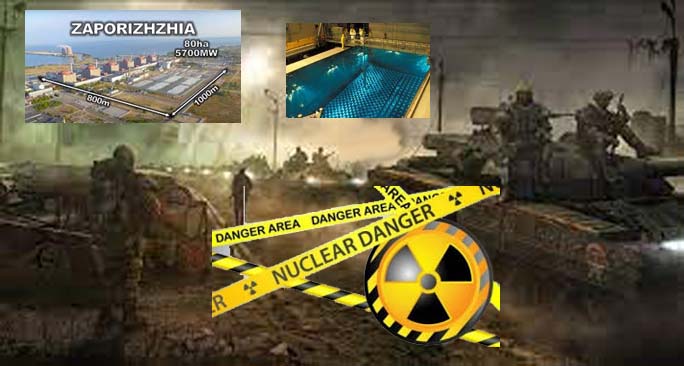
Russia building giant dome over Europe’s largest nuclear plant’s spent fuel stores, to shield them from Ukrainian attacks
The structure will shield stores of spent radioactive fuel from Ukrainian attacks.
https://www.rt.com/russia/568415-zaporozhye-nuclear-dome-ukrain 18 Dec 22
Russia is constructing a protective dome over spent radioactive fuel stores at the Zaporozhye nuclear power plant as Ukrainian forces continue to target the facility, senior regional official Vladimir Rogov has said.
He took to Telegram on Saturday to post a short video of the work that’s taking place. It showed technicians setting up shields over the tanks that hold spent nuclear fuel.
The dome is designed to protect the storage facilities from shrapnel and improvised explosive devices carried by drones, the official explained, adding that it would be reinforced further at a later period.
Russia’s nuclear energy corporation Rosatom had earlier warned that damage to the spent-fuel containers risks a release of radioactive material into the atmosphere, with unpredictable consequences.
The construction of the dome comes amid continued attacks on the Zaporozhye nuclear power plant and the nearby town of Energodar, which Moscow blames on Kiev. Russia has repeatedly said that such strikes could result in a nuclear disaster that would eclipse the 1986 Chernobyl incident and affect many countries in Europe.
Ukraine initially claimed that the Russian military had been hitting the plant itself as part of “false-flag” operations to make Kiev look bad. However, Ukrainian general staff eventually admitted to striking the area around the nuclear facility.
The Zaporozhye nuclear power plant, which is the largest on the continent, has been under Russian control since February 28. All of the reactors at the facility are currently shut down due to the security situation.
Zaporozhye Region, together with three other former Ukrainian territories – Kherson Region and the People’s Republic of Donetsk and Lugnask – joined Russia in autumn after holding referendums.
1 This Month
Chernobyl: The Lost Tapes – A good documentary on Chernobyl on SBS available On Demand for the next 3 weeks– https://www.sbs.com.au/ondemand/tv-program/chernobyl-the-lost-tapes/2352741955560

of the week–London Campaign for Nuclear Disarmament

Tell the Ukrainian Government to Drop Prosecution of Peace Activist Yurii Sheliazhenko
To see nuclear-related stories in greater depth and intensity – go to https://nuclearinformation.wordpress.com
-
Archives
- April 2026 (139)
- March 2026 (251)
- February 2026 (268)
- January 2026 (308)
- December 2025 (358)
- November 2025 (359)
- October 2025 (376)
- September 2025 (257)
- August 2025 (319)
- July 2025 (230)
- June 2025 (348)
- May 2025 (261)
-
Categories
- 1
- 1 NUCLEAR ISSUES
- business and costs
- climate change
- culture and arts
- ENERGY
- environment
- health
- history
- indigenous issues
- Legal
- marketing of nuclear
- media
- opposition to nuclear
- PERSONAL STORIES
- politics
- politics international
- Religion and ethics
- safety
- secrets,lies and civil liberties
- spinbuster
- technology
- Uranium
- wastes
- weapons and war
- Women
- 2 WORLD
- ACTION
- AFRICA
- Atrocities
- AUSTRALIA
- Christina's notes
- Christina's themes
- culture and arts
- Events
- Fuk 2022
- Fuk 2023
- Fukushima 2017
- Fukushima 2018
- fukushima 2019
- Fukushima 2020
- Fukushima 2021
- general
- global warming
- Humour (God we need it)
- Nuclear
- RARE EARTHS
- Reference
- resources – print
- Resources -audiovicual
- Weekly Newsletter
- World
- World Nuclear
- YouTube
-
RSS
Entries RSS
Comments RSS
 nuclear-news