PARIS, March 10 (Reuters) – France’s nuclear safety watchdog ASN has ordered energy utility EDF (EDF.PA) to inspect about 200 pipe weldings across its 56-nuclear reactor fleet after discovering three additional cracks this week, the regulator said on Friday.
An EDF spokesperson declined to comment on ASN’s criticism, but said the two newer cracks were due to “thermal fatigue”, which happens when very hot and cold water meet inside pipes, causing the steel to dilate, contract and become more fragile over time.
EDF regularly inspects pipes via ultrasound for this phenomenon during maintenance, the spokesperson added.
The latest defects and watchdog scrutiny come as France and the Britain announced a new energy partnership on Friday to strengthen cooperation on nuclear power, including construction of power stations, innovation and safety.
Neither French President Emmanuel Macron nor British Prime Minister Rishi Sunak mentioned the nuclear operator’s latest setbacks after a bilateral summit.
“You are helping us secure our supply of nuclear power thanks to EDF’s incredible work,” Sunak told Macron.
EDF is building a new nuclear plant in Britain, Sizewell C, which has suffered from cost overruns and construction delays. A second plant, Hinkley Point C, is also in the works.
The utility’s Penly 2 and Cattenom 3 in France are part of a group of 16 reactors flagged by EDF as being susceptible to corrosion-related cracks due to a design flaw, and prioritised for checks in its inspection and maintenance plan.
That plan is now being updated to accommodate the additional check of 200 weldings, and will be published “in coming days”, EDF has said.
European forward-curve power prices rose sharply on Friday following the announcement of new cracks, after French nuclear output in 2022 fell to a 34-year low while EDF scrambled to fix stress corrosion issues at several sites.
“Some market participants may be worried that the issues with corrosion are trickier than first anticipated, and that EDF will struggle both long- and short-term to fix it and bring generation back to pre-2022 levels,” Rystad analyst Fabian Ronningen said.
Electricite de France SA discovered new defects at two of its nuclear reactors that were halted for maintenance and repairs, raising fresh concerns that its electricity output will remain largely constrained this year after plunging in 2022.
Flaws tied to so-called thermal fatigue have been found on the pipes of the Penly-2 and Cattenom-3 reactors, the utility said in a statement. The pipes have been replaced as part of broader repairs related to “stress corrosion” cracks — a different type of faults — that are affecting emergency cooling pipes of some of the EDF’s atomic plants, according to the nuclear safety authority.
The nuclear giant has been forced to halt more than a dozen of its 56 reactors for months of repairs since it first found signs of such stress corrosion phenomenon in late 2021. The announcement comes just days after the country’s nuclear safety authority asked EDF to revise its program of reactor checks following the utility’s discovery of a “significant” stress corrosion crack earlier this year on its Penly-1 reactor. EDF said it will propose an update of its reactor check strategy to the watchdog in the coming days.
The fresh setbacks could force EDF to carry out more extensive checks on its atomic plants, reviving concern that France will have to import large amounts of power this year. Last year, worries about electricity shortages combined with dwindling deliveries of Russian gas pushed European energy prices to records.
Nuclear reactor: a deep crack discovered at Penly 1 risks destabilizing EDF. A new “stress corrosion” problem found by the the company on a shutdown reactor in Seine-Maritime could have significant repercussions, due to its size and location.
The discovery could have serious consequences for EDF. The company detected a major crack on a weld of an emergency circuit of a shutdown reactor, Penly 1, in Seine-Maritime, a new problem for the energy giant whose nuclear fleet is heavily disturbed since 2021 by these phenomena.
In a note, which went unnoticed until its media coverage on Tuesday by the Context site , EDF mentioned having detected a “significant stress corrosion defect” on an emergency pipe used to cool the reactor in an emergency. For Yves Marignac, ” the fact that larger cracks are possible raises the question of keeping the 6 reactors of the same type P’4″ in operation while awaiting their preventive repair” , announced in December by EDF for the current year 2023.
By Mark Hibbs | March 10, 2023 Bulletin of the Atomic Scientists,
One year after Russia’s assault and takeover of the Zaporizhzhia plant, Russians and Ukrainians face decisions about the operation status of the six reactors that will significantly impact nuclear safety and security. Decision makers might mothball the reactors, or instead elect one or more of a range of modes for operating them, on a scale from cold shutdown to resumed criticality and low-power operation…………………………………………………………………………………………..
the safest option for the Zaporizhzhia nuclear power plant would be to shut all reactors down, depressurize the circuits, and remove their fuel until the end of the war. As an IAEA peer reviewer in one European country with similar reactors said: “There would be no heat, no pressure, no radioactivity, and no severe accident.”
But the plant’s fuel inventory is another key consideration in decisions about how or if the Zaporizhzhia reactors are to be run. If removed from reactor cores, hot, highly radioactive fuel must be safely stored and contained.
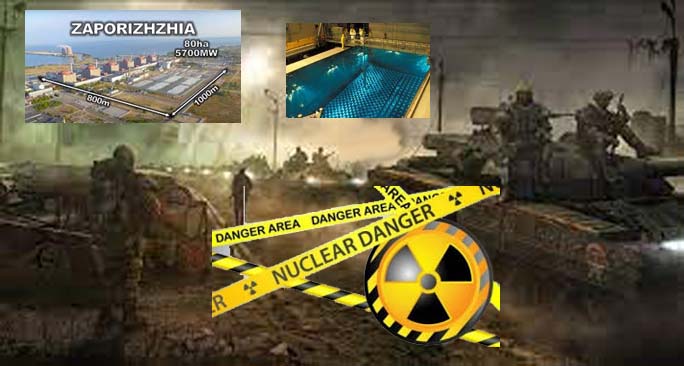
Ukraine regulations require that the spent fuel storage pool at each reactor accommodate a full core of fuel in an emergency. As part of EU post-Fukushima upgrades, Zaporizhzhia reactors were outfitted with portable equipment to supply water in an emergency to spent fuel pools and to reactor cores. But moving a core of fuel into a pool would significantly increase the heat load, and safe storage margins might be limited following previous re-racking to pack more fuel in the pools.
Unlike the microcracks detected on other reactors (such as those of Chooz, in the Ardennes, and Civaux, in Vienne, 1,450 MW, the most powerful and most recent), the defect observed at Penly is described as particularly important:
the ASN describes a crack extending over 155 millimeters (mm), “that is approximately a quarter of the circumference of the piping”. The nuclear policeman adds that its maximum depth is 23 mm, for a pipe thickness of 27 mm.
Although the Penly 1 reactor had already been identified as being among the most sensitive to the phenomenon of stress corrosion, this portion of the circuit in particular was considered “non-sensitive” by EDF, due to its geometry. The licensee, like ASN, considers that the presence of corrosion could be explained by the double repair to which the piping was subjected during the construction of the reactor.
Koeberg Thin Walled Holtec Nuclear Waste Canister In S. Africa Leaked After 17 Years, More Holtec Canister Problems That Threaten Massive Radiological Releases, Explosion & Criticality Risks From Holtec Canisters, Potential Canister Problem At Diabalo Canyon After 2 Years.
List of other thin walled nuclear canisters vendors who threaten life on Earth listed at https://sanonofresafety.org in addition to Holtec. Where is the media? The vaunted “free press”?
Six of 15 locations with nuclear power plants, excluding those in Fukushima Prefecture, have not compiled sufficient emergency plans, including wide-area evacuations, in the event of a serious accident.
Prime Minister Fumio Kishida has pushed a policy to “return to nuclear power,” but disaster prevention challenges remained unresolved, and local people have expressed concerns.
The emergency plans were deemed necessary after the March 2011 nuclear disaster at Tokyo Electric Power Co.’s Fukushima No.1 nuclear power plant.
Niigata Prefecture hosts TEPCO’s Kashiwazaki-Kariwa nuclear plant, one of the largest in the world.
On Feb. 7, disaster prevention officials of municipal governments in the prefecture held an annual meeting online in Niigata with staff of TEPCO and members of the Cabinet Office in charge of nuclear emergency preparations.
One theme at the meeting was whether people could safely flee if a severe accident were to occur at the plant on a day with heavy snow.
“For our residents, heavy snow is a threat much closer than terrorism, and it could cause tremendous anxiety and risk,” said a Nagaoka city government official, urging the prefectural government to examine evacuation plans in heavy snow.
Municipal governments within a radius of 30 kilometers of a nuclear power plant are required to draw up evacuation plans for severe nuclear accidents and discuss emergency procedures with the central government.
These plans are then supposed to receive approval at a nuclear emergency preparedness meeting chaired by the prime minister.
But there are no such plans in place in the Kashiwazaki-Kariwa area, where 437,000 people live.
Local officials said they are stumped over how to plan an evacuation in heavy snow.
On Dec. 18, snow started falling in the city of Kashiwazaki, where the nuclear power plant is located.
The Hokuriku Expressway that runs through the city was closed for up to 52 hours. National road No. 8, which runs parallel to the expressway, was shut down for 38 hours, and stranded vehicles formed a 22-km line in the snow.
The Kashiwazaki city government estimates that about 60,000 of the 79,000 or so residents would evacuate westward in the event of a nuclear power plant accident.
Any evacuation plan in the city would be severely hampered if the Hokuriku Expressway and national road No. 8 were unusable.
On Feb. 10, the Cabinet approved Kishida’s green transformation policy, marking a dramatic shift in the government’s post-3/11 stance on nuclear power.
The new policy allows the construction of new nuclear reactors and extending the maximum life of existing units beyond 60 years.
Operations of 10 reactors have already resumed.
Seven other reactors, including the No. 6 and No. 7 reactors at the Kashiwazaki-Kariwa plant, are scheduled to restart in or after this summer.
Kishida said the central government “will be out in front and take any and every step” to push the policy, an unprecedented remark for a prime minister concerning nuclear energy.
TEPCO is seeking to resume operations of the No. 7 reactor at Kashiwazaki-Kariwa plant in October.
The Nuclear Regulation Authority has issued a de facto ban on operations of the No. 7 reactor because of the utility’s blunders related to anti-terrorism measures, but the ban may be lifted in spring.
Once the ban is lifted, the remaining conditions for the reactor restart will be obtaining consent from local people and setting up a wide-area evacuation plan.
As of Feb. 11, TEPCO had held explanatory meetings on its reactor resumption plans to local residents at five locations in the prefecture.
A total of 71 people asked questions during the process.
A woman who made the last comment to TEPCO at the meetings said, “If you can’t protect people who can’t evacuate because of heavy snow, I don’t want you to resume the operation.”
Masaya Kitta, who heads TEPCO’s Niigata headquarters, replied: “An evacuation plan is not something we make. It may appear that we are leaving it to someone else, but we, as a plant operator, are doing our best to increase the evacuation plan’s effectiveness as much as possible.”
Of the seven reactors that the Kishida administration plans to restart in or after this summer, two are located in plants lacking local government evacuation plans: the Kashiwazaki-Kariwa plant and Japan Atomic Power Co.’s Tokai No. 2 nuclear power plant in Tokai, Ibaraki Prefecture.
In August 2022, Ibaraki Governor Kazuhiko Oigawa said the Tokai No. 2 plant “is located in an extremely densely populated area,” and the prefectural government “has been in an extremely difficult situation and faced enormous problems in making an effective and sensible evacuation plan.”
Around 940,000 residents live within 30 km of the Tokai No. 2 plant and would be subject to an evacuation in a nuclear disaster. That is the largest such figure in Japan.
Disaster prevention officials have had difficulties securing routes and transportation means for many people to evacuate all at once.
In a wide-area evacuation plan designed by the Ibaraki prefectural government, residents are supposed to leave in their own cars.
The prefecture will ask bus companies for cooperation to evacuate senior residents and disabled people.
The prefectural government estimates that more than 400 buses will be needed for the task, and it does not know how it can secure that many buses.
One guiding principle of the nuclear emergency preparedness was created in response to the 2011 Fukushima disaster.
Until then, the areas required to have an evacuation plan in place were located within 8 to 10 km of nuclear plants.
But the Fukushima accident showed how radioactive materials could spread to wider areas.
The central government expanded the radius to 30 km and required municipal governments within the areas to compile evacuation plans.
The central government also set up a group to discuss nuclear-related disaster-prevention measures in normal times.
But more than 10 years have passed since then. And many of the populated areas still do not have evacuation plans.
(This article was written by Yasuo Tomatsu and Shiki Iwasawa.)
By America Hernandez and Charlotte Campenhout, BRUSSELS, March 6 (Reuters) – Belgium’s nuclear regulator has advised the government against a life extension of the country’s three oldest reactors, despite the risk of a gap in electricity supply over the next two winters.
Instead, it proposed adjusting the life extension plans of two newer reactors so that safety upgrades are staggered, keeping the power on during the coming crunch period.
It’s not just Zaporizhzhia we have to worry about: There are 14 other nuclear power plants in the war zone. By Joshua Frank , TOMDISPATCH, February 28, 2023
In 1946, Albert Einstein shot off a telegram to several hundred American leaders and politicians warning that the “unleashed power of the atom has changed everything save our modes of thinking and we thus drift toward unparalleled catastrophe.” Einstein’s forecast remains prescient. Nuclear calamity still knoc
“………………………………………………………………………………………………………………………. here’s the true horror story lurking behind the war in Ukraine. While a nuclear tit-for-tat between Russia and NATO — an exchange that could easily destroy much of Eastern Europe in no time at all — is a genuine, if frightening, prospect, it isn’t the most imminent radioactive peril facing the region.
Averting a Meltdown
By now, we all ought to be familiar with the worrisome Zaporizhzhia nuclear complex (ZNPP), which sits right in the middle of the Russian incursion into Ukraine. Assembled between 1980 and 1986, Zaporizhzhia is Europe’s largest nuclear-power complex, with six 950-megawatt reactors.
……………………. In September 2022, due to ongoing shelling in the area, Zaporizhzhia was taken offline and, after losing external power on several occasions, has since been sporadically relying on old diesel backup generators. (Once disconnected from the electrical grid, backup power is crucial to ensure the plant’s reactors don’t overheat, which could lead to a full-blown radioactive meltdown.)
However, relying on risk-prone backup power is a fool’s game, according to electrical engineer Josh Karpoff. A member of Science for the People who previously worked for the New York State Office of General Services where he designed electrical systems for buildings, including large standby generators, Karpoff knows how these things work in a real-world setting. He assures me that, although Zaporizhzhia is no longer getting much attention in the general rush of Ukraine news, the possibility of a major disaster there is ever more real. A backup generator, he explains, is about as reliable as a ’75 Winnebago.
“It’s really not that hard to knock out these kinds of diesel generators,” Karpoff adds. “If your standby generator starts up but says there’s a leak in a high-pressure oil line fitting, it sprays heated, aerosolized oil all over the hot motor, starting a fire. This happens to diesel motors all the time. A similar diesel engine fire in a locomotive was partly responsible for causing the Lac Megantic Rail Disaster in Quebec back in 2013.”
Sadly enough, Karpoff is on target. Just remember how the backup generators failed at the three nuclear reactors in Fukushima, Japan, in 2011. Many people believe that the 9.0 magnitude underwater earthquake caused them to melt down, but that’s not exactly the case.
It was, in fact, a horrific chain of worsening events. While the earthquake itself didn’t damage Fukushima’s reactors, it cut the facility off from the power grid, automatically switching the plant to backup generators. So even though the fission reaction had stopped, heat was still being produced by the radioactive material inside the reactor cores. A continual water supply, relying on backup power, was needed to keep those cores from melting down. Then, 30 minutes after that huge quake, a tsunami struck, knocking out the plant’s seawater pumps, which subsequently caused the generators to go down.
“The myth of the tsunami is that the tsunami destroyed the [generators] and had that not happened, everything would have been fine,” former nuclear engineer Arnie Gunderson told Amy Goodman on Democracy Now! “What really happened is that the tsunami destroyed the [sea] pumps right along the ocean… Without that water, the [diesel generators] will overheat, and without that water, it’s impossible to cool a nuclear core.”
With the sea pumps out of commission, 12 of the plant’s 13 generators ended up failing. Unable to cool, the reactors began to melt, leading to three hydrogen explosions that released radioactive material, carried disastrously across the region and out to sea by prevailing winds, where much of it will continue to float around and accumulate for decades.
At Zaporizhzhia, there are several scenarios that could lead to a similar failure of the standby generators. They could be directly shelled and catch fire or clog up or just run out of fuel. It’s a dicey situation, as the ongoing war edges Ukraine and the surrounding countries toward the brink of a catastrophic nuclear crisis.
“I don’t know for how long we are going to be lucky in avoiding a nuclear accident,” said Rafael Grossi, director general of the IAEA in late January, calling it a “bizarre situation: a Ukrainian facility in Russian-controlled territory, managed by Russians, but operated by Ukrainians.”
Bad Things Will Follow
Unfortunately, it’s not just Zaporizhzhia we have to worry about. Though not much attention has been given to them, there are, in fact,14 other nuclear power plants in the war zone and Russia has also seized the ruined Chernobyl plant, where there is still significant hot radioactive waste that must be kept cool.
Kate Brown, author of Plutopia, told Science for the People last April:
“Russians are apparently using these two captured nuclear installations like kings on a chessboard. They hold Chernobyl and the Zaporizhzhia nuclear power reactor plants, and they are stockpiling weapons and soldiers there as safe havens. This is a new military tactic we haven’t seen before, where you use the vulnerability of these installations, as a defensive tactic. The Russians apparently figured that the Ukrainians wouldn’t shoot. The Russians noticed that when they came to the Chernobyl zone, the Ukrainian guard of the Chernobyl plant stood down because they didn’t want missiles fired at these vulnerable installations. There are twenty thousand spent nuclear fuel rods, more than half of them in basins at that plant. It’s a precarious situation. This is a new scenario for us.”
Of course, the hazards facing Zaporizhzhia and Chernobyl would be mitigated if Putin removed his forces tomorrow, but there’s little possibility of that happening. It’s worth noting as well that Ukraine is not the only place where, in the future, such a scenario could play out. Taiwan, at the center of a potential military conflict between the U.S. and China, has several nuclear power plants. Iran operates a nuclear facility. Pakistan has six reactors at two different sites. Saudi Arabia is building a new facility. The list only goes on and on.
Even more regrettably, Russia has raised the nuclear stakes in a new way, setting a distressing precedent with its illegal occupation of Zaporizhzhia and Chernobyl, turning them into tools of war. No other power-generating source operating in a war zone, even the worst of the fossil-fuel users, poses such a potentially serious and immediate threat to life as we know it on this planet.
And while hitting those Ukrainian reactors themselves is one recipe for utter disaster, there are other potentially horrific “peaceful” nuclear possibilities as well. What about a deliberate attack on nuclear-waste facilities or those unstable backup generators? You wouldn’t even have to strike the reactors directly to cause a disaster. Simply take out the power-grid supply lines, hit the generators, and terrible things will follow. With nuclear power, even the purportedly “peaceful” type, the potential for catastrophe is obvious.
The Greatest of Evils
In my new book Atomic Days: The Untold Story of the Most Toxic Place in America, I probe the horrors of the Hanford site in Washington state, one of the locations chosen to develop the first nuclear weapons for the covert Manhattan Project during World War II. For more than 40 years, that facility churned out most of the plutonium used in the vast American arsenal of atomic weapons.
Now, however, Hanford is a radioactive wasteland, as well as the largest and most expensive environmental clean-up project in history. To say that it’s a boondoggle would be an understatement. Hanford has 177 underground tanks loaded with 56 million gallons of steaming radioactive gunk. Two of those tanks are currently leaking, their waste making its way toward groundwater supplies that could eventually reach the Columbia River. High-level whistleblowers I interviewed who worked at Hanford told me they feared that a hydrogen build-up in one of those tanks, if ignited, could lead to a Chernobyl-like event here in the United States, resulting in a tragedy unlike anything this country has ever experienced.
All of this makes me fear that those old Hanford tanks could someday be possible targets for an attack. Sabotage or a missile strike on them could cause a major release of radioactive material from coast to coast. The economy would crash. Major cities would become unlivable. And there’s precedent for this: in 1957, a massive explosion occurred at Mayak, Hanford’s Cold War sister facility in the then-Soviet Union that manufactured plutonium for nukes. Largely unknown, it was the second biggest peacetime radioactive disaster ever, only “bested” by the Chernobyl accident. In Mayak’s case, a faulty cooling system gave out and the waste in one of the facility’s tanks overheated, causing a radioactive blast equivalent to the force of 70 tons of TNT, contaminating 20,000 square miles. Countless people died and whole villages were forever vacated.
All of this is to say that nuclear waste, whether on a battlefield or not, is an inherently nasty business. Nuclear facilities around the world, containing less waste than the underground silos at Hanford, have already shown us their vulnerabilities. Last August, in fact, the Russians reported that containers housing spent fuel waste at Zaporizhzhia were shelled by Ukrainian forces. “One of the guided shells hit the ground ten meters from them (containers with nuclear waste…). Others fell down slightly further — 50 and 200 meters,” alleged Vladimir Rogov, a Russian-appointed official there. “As the storage area is open, a shell or a rocket may unseal containers and kilograms, or even hundreds of kilograms of nuclear waste will be emitted into the environment and contaminate it. To put it simply, it will be a ‘dirty bomb.’”
Ukraine, in turn, blamed Russia for the strike, but regardless of which side was at fault, after Chernobyl (which some researchers believe affected upwards of 1.8 million people) both the Ukrainians and the Russians understand the grave risks of atomically-charged explosions. This is undoubtedly why the Russians are apparently constructing protective coverings over Zaporizhzhia’s waste storage tanks. An incident at the plant releasing radioactive particles would damage not just Ukraine but Russia, too.
Courting disaster — Beyond Nuclear International Embroiled in a year-long war, Ukraine’s reactors face new threats By Linda Pentz Gunter A year ago, we warned of the significant and unacceptable risks to Ukraine’s 15 nuclear reactors, should they become caught up in a war zone as a consequence of an invasion by Russia. A year later, as we outlined in a Beyond Nuclear press release, those risks have become a reality. And in recent days, the scares and close calls have ramped up again.
Just last week, cruise missiles flew dangerously low over the South Ukraine nuclear power plant in the country’s western region. Then alarms were raised as observers noticed an alarming drop in the water level of the Kakhovka Reservoir, on which the six-reactor Zaporizhzhia nuclear power plant depends for its essential cooling water supply.
A missile strike or loss of cooling water are just two of the many scenarios that could lead to a nuclear power plant disaster in Ukraine. Others include loss of electricity supply, human error or sabotage. The conditions of war just make any and all of these outcomes far more likely.
Indeed, these latest close calls and others prompted a recent statement by the head of Germany’s Federal Office for Radiation Protection, Inge Paulini, who warned that an incident at one of Ukraine’s nuclear power plants would have, “far-reaching consequences as long as the war continues.” And yet, she pointed out, “this danger already seems to be receding into the background of public awareness.”
Indeed, it has been a consistent pattern in the press not to take nuclear power risks seriously. Instead, the media publishes story after story, planted there by a well-orchestrated worldwide nuclear industry campaign, about the benefits of expanding nuclear power.
The Ukrainian energy ministry would seem to agree. Even in the midst of this devastating war, it has just made a deal with the American company, Westinghouse, to purchase two new AP1000 reactors. It is of course unrealistic to envisage these actually being built during a war and, if ever operational, they would simply become additional lethal targets.
In Ukraine, we have seen Russia routinely attack the electric grid, leading to periodic loss of offsite power at all four of Ukraine’s nuclear power plant sites. Zaporizhzhia, in the contested southeastern part of the country, has experienced multiple disconnections from the grid. So far, the diesel generators have functioned until offsite power was restored. But they are reliant on a steady replenishment of fuel, which could be impeded were the plant to come under siege.
A ready supply of cooling water is also essential so the drain down of the Kakhovka Reservoir is a serious concern. Why this is happening is unclear, but it is thought to be a possible Russian military tactic to flood strategic areas, making them impassable to advancing Ukrainian troops.
The unimaginable stress that continues to be experienced by the depleted workforce at Zaporizhzhia adds to the possibility of a fatal human error. Human error was at the root of both the 1979 Three Mile Island nuclear power plant accident in the United States and the 1986 Chornobyl Unit 4 explosion in Ukraine, without the contributing stress factor of war conditions.
The proximity of cruise missiles to nuclear plants is a nightmarish disaster waiting to happen, even if they are on their way to other targets, for now. But whether deliberate or accidental, a serious assault would release potentially enormous amounts of dangerous radioactive isotopes into the environment.
The reason damage from a nuclear power plant disaster is so serious is in part due to the longevity of the radioactive isotopes released and also because the fallout deposits these into the food chain by contaminating water, soil, crops and livestock.
Some of the enduring health outcomes include thyroid cancer, birth defects, still births, neonatal deaths, leukemias — especially among children — cancers and cardiovascular disorders. However, it should be noted that studies have also found elevated rates of leukemia in children living close to routinely operating nuclear power plants.
The international response so far has come mainly from the International Atomic Energy Agency (IAEA), which has called for safe zones around Ukraine’s nuclear power plants but so far has been unsuccessful in instituting these. And safe zones, while an essential first step, only prevent disaster resulting from a direct hit but are ineffective against loss of grid access or human error. Indeed, the IAEA has been struggling for more than two weeks simply to get a shift change of its observers at Zaporizhzhia accomplished. So far, conditions have remained too dangerous to allow this. “The Agency is doing everything it can to conduct the safe rotation of our staff there as soon as possible,” IAEA director, Rafael Grossi said.
Apart from being pre-deployed radiological weapons, nuclear power plants must, for safety reasons, be shut down when embroiled in a war. In Ukraine, where 50% of the country’s electricity is supplied by nuclear power, this means plunging an already terrified population into greater misery in the midst of winter. The lesson learned is that nuclear power, due to its inherent dangers, cannot serve as a reliable energy source. We must reject it as we do nuclear weapons and turn to other, more benign and renewable ways of supplying electricity.
Linda Pentz Gunter is the international specialist at Beyond Nuclear and writes for and curates Beyond Nuclear International.
Headline photo of Rocket in Kupiansk city (Kharkiv region of Ukraine) after Russian shelling. February 2023 by Олексій Мазепа / АрміяInform/Wikimedia Commons.
In a statement to the AP, the Cyprus Anti-Nuclear platform, a coalition of over 50 Greek Cypriot and Turkish Cypriot environmentalist groups, trade unions and political parties, said it “calls on all political parties, scientific and environmental organizations and the civil society to join efforts and put pressure on the Turkish government to terminate its plans for the Akkuyu nuclear power plant.”
Northwest Arkansas Democrat Gazette, by MENELAOS HADJICOSTIS and JENNIFER McDERMOTT The Associated Press
NICOSIA, Cyprus — A devastating earthquake that toppled buildings across parts of Turkey and neighboring Syria has revived a longstanding debate locally and in neighboring Cyprus about a large nuclear power station being built on Turkey’s southern Mediterranean coastline.
The plant’s site in Akkuyu, located about 210 miles west of the epicenter of the Feb. 6 quake, is being designed to endure powerful tremors and did not sustain any damage or experience powerful ground shaking from the 7.8 magnitude earthquake and aftershocks.
Cypriot European Parliament member Demetris Papadakis asked the European Commission what immediate actions it intends to take to halt the plant because of the dangers posed by building a nuclear power station in a seismic zone so close to Cyprus……..
But the size of the quake, the deadliest in Turkey’s modern history, sharpened existing concerns about the facility being built on the edge of a major fault line…………………………………………..
An official with Turkey’s Energy Ministry, when contacted by the AP, said there were no immediate plans to reassess the project. The official spoke on condition of anonymity in line with government protocol. Some activists, however, still say the project — the first nuclear power plant in Turkey — poses a threat.
Nuclear facilities are constructed of heavily reinforced concrete, sized for significant earthquake shaking and far more robust than commercial buildings, said Andrew Whittaker, a professor of civil engineering at the University at Buffalo who is an expert in earthquake engineering and nuclear structures.
The fact that it’s being built off the western end of the East Anatolian Fault, which was linked to the powerful tremor, suggests that the design would have been checked for significant shaking, Whittaker added.
Still, Whittaker said, it would be prudent to reassess seismic hazard calculations in the region for all infrastructure, including the plant.
“There’s no reason to be concerned, but there’s always a reason to be cautious,” he said.
That’s little comfort to activists in Turkey and on both sides of ethnically divided Cyprus. They’ve renewed their calls for the project to be scrapped, saying that the devastating earthquake is clear proof of the great risk posed by a nuclear power plant near seismic fault lines.
In a statement to the AP, the Cyprus Anti-Nuclear platform, a coalition of over 50 Greek Cypriot and Turkish Cypriot environmentalist groups, trade unions and political parties, said it “calls on all political parties, scientific and environmental organizations and the civil society to join efforts and put pressure on the Turkish government to terminate its plans for the Akkuyu nuclear power plant.”…………………….. https://nwaonline.com/news/2023/feb/19/quake-revives-debate-over-turkeys-nuclear-plant/?news-wor1
He challenged the MR bill to extend three reactors: “We are talking about nuclear reactors with single-walled tanks, honeycombed tanks, with hydrogen bubbles. We are talking about power stations that do not meet the conditions of resistance to seismic shocks, to the fall of an aeroplane… I remind you that Tihange is on the axis of the Bierset airport. The international safety standards are essential.”
Extending more than two nuclear reactors would be dangerous, warned Ecolo deputy prime minister Georges Gilkinet in an interview with Le Soir published Saturday. The minister opposes the MR’s proposal to extend the life of the three other units still in operation.
As the energy uncertainty brought on by the Ukraine crisis continues, De Croo’s Vivaldi government has reconsidered the question of Beligum’s nuclear power, which it had long been due to phase out.
for Georges Gilkinet, whose party has historically opposed any prolongation of Belgium’s reactors, “we will continue to push for the closure of the plants. The current plans to close five reactors have not been changed.” To prevent the real possibility of blackouts, the deputy prime minister speaks of “modulation” of three reactors rather than “extension”.
He challenged the MR bill to extend three reactors: “We are talking about nuclear reactors with single-walled tanks, honeycombed tanks, with hydrogen bubbles. We are talking about power stations that do not meet the conditions of resistance to seismic shocks, to the fall of an aeroplane… I remind you that Tihange is on the axis of the Bierset airport. The international safety standards are essential.” https://www.brusselstimes.com/belgium/374759/extending-more-than-two-nuclear-reactors-is-dangerous-says-gilkinet—
You know, everyone’s always talking about how the US military is only ever used to kill foreigners for resource control and generate profits for the military-industrial complex, but that’s not entirely true. Turns out the US military is also used for shooting down party balloons.
The Northern Illinois Bottlecap Balloon Brigade says one of its hobby craft went “missing in action” over Alaska on 11 February, the same day a US F-22 jet downed an unidentified airborne entity not far away above Canada’s Yukon territory.
In a blogpost, the group did not link the two events. But the trajectory of the pico balloon before its last recorded electronic check-in at 12.48am that day suggests a connection — as well as a fiery demise at the hands of a sidewinder missile on the 124th day of its journey, three days before it was set to complete its seventh circumnavigation.
If that is what happened, it would mean the US military expended a missile costing $439,000 (£365,000) to fell an innocuous hobby balloon worth about $12 (£10).
“The descriptions of all three unidentified objects shot down Feb. 10–12 match the shapes, altitudes and payloads of the small pico balloons, which can usually be purchased for $12–180 each, depending on the type,” writes Steve Trimble for Aviation Week, who first broke the Bottlecap Balloon Brigade story.
This information would put a bit of a wobble on Senate Majority Leader Chuck Schumer’s comments to ABC’s This Week on Sunday that all three of the balloons shot down through the weekend were Chinese surveillance devices, saying “the Chinese were humiliated” by the US catching them in their sinister espionage plot. If the US air force did in fact just spent millions of dollars shooting down American party balloons, it wouldn’t be the Chinese who are humiliated.
And it looks like that is indeed what happened. On Tuesday the National Security Council’s John Kirby said the “leading explanation” for the three unidentified flying objects that were shot down is that they were “balloons tied to some commercial or benign purpose.” On Thursday President Biden told the press that “The intelligence community’s current assessment is that these three objects were most likely balloons tied to private companies, recreation, or research institutions studying weather or conducting other scientific research.”
And this all comes out after US officials told The Washington Post that the “Chinese spy balloon” which started this historically unprecedented multi-day frenzy of aerial kinetic warfare over North America was probably never intended for surveillance of the United States at all. Experts assess that the balloon was blown over the continent entirely by accident, trying to reconcile that narrative with the contradictory US government claims of intentional Chinese espionage by suggesting that perhaps the Chinese had intended for the balloon to be used for spying on US military forces in the Pacific or something.
So to recap, the US air force shot down a Chinese balloon which US officials have subsequently admitted was only blown over the US by accident, then went on a spree of shooting things out of the sky which it turns out were probably civilian party balloons. The entire American political/media class has been spending the month of February furiously demanding more militarism and more cold war escalations over what is in all probability four harmless balloons.
And what’s really crazy is that they’re probably going to get those increases in militarism and cold war escalations they’ve been calling for, despite the entire ordeal originating primarily in the overactive imaginations of the drivers of the US empire. The shrieking hysterical panic about “Chinese spy balloons” has dwarfed the coverage of the revelations contradicting that narrative, and China hawks have been using the occasion to argue for increases in military spending. The Atlantic’s Richard Fontaine got all excited and wrote a whole article about how the threat of Chinese spy balloons can be used “to rally public concern and build international solidarity” against China.
These are the people who rule our world. They are not wise. They are not insightful. They are not even particularly intelligent. The US empire is a Yosemite Sam cartoon character who at any time can just flip out and start firing Sidewinder missiles at random pieces of junk in the sky, screaming “I’ll blast yer head off ya varmint!” If the US war machine was a civilian human, their family would be quietly talking amongst themselves about the possibility of conservatorship.
These are the last people in the world who should be running things, and they are the last people in the world who should be armed with nuclear weapons. But that’s exactly where we find ourselves in this bizarre slice of spacetime. God help us all.
Deadly Turkey earthquake stirs debate over nuclear plant construction. Activists have raised concerns over the construction of a nuclear power plant in the southern city of Akkuyu, Mersin Province due to its proximity to the 7.8 magnitude earthquake’s epicentre.
Sizewell B nuclear power station has been switched off for 66 days for refuelling and maintenance work. Last year, EDF unveiled plans to extend the operational life of the Sizewell B power station by at least 20 years. The energy company has made an £80 million investment in the power plant, part of which is the station’s 18th refuelling and maintenance outage. It is expected that engineers will complete more than 10,000 routine maintenance and inspection tasks and replace a third of the fuel during the 66-day outage.









 nuclear-news