Disaster Fears After Explosives Found Inside Zaporizhzhia Nuclear Plant
NewsWeek, BY BRENDAN COLE ON 5/4/23
Observers from the United Nations nuclear energy watchdog have found explosives inside Zaporizhzhia Nuclear Power Plant, Ukrainian media has reported.
A small team from the International Atomic Energy Agency (IAEA) is at the nuclear plant, which is Europe’s biggest and was seized by Moscow early in its invasion of Ukraine.
Operated by Ukrainian staff working under Russian forces and the Russian nuclear company Rosatom, the hostilities at the site, in which both sides accused the other of shelling, have sparked international alarm at what might happen if the reactors were impacted.
Observers from the United Nations nuclear energy watchdog have found explosives inside Zaporizhzhia Nuclear Power Plant, Ukrainian media has reported.
A small team from the International Atomic Energy Agency (IAEA) is at the nuclear plant, which is Europe’s biggest and was seized by Moscow early in its invasion of Ukraine.
Operated by Ukrainian staff working under Russian forces and the Russian nuclear company Rosatom, the hostilities at the site, in which both sides accused the other of shelling, have sparked international alarm at what might happen if the reactors were impacted.
……………………………… Mark Nelson, an adviser on nuclear energy, said that the sites’ reactors were close together but have independent safety features. “Even the Chernobyl blast at Reactor 4 in 1986 did not prevent Reactor 3 from continuing to run and indeed sharing a turbine building until 2000,” he said. https://www.newsweek.com/russia-ukraine-nuclear-zaporizhzhia-iaea-explosives-1798382
This week, Ukraine’s nuclear operator Energoatom said that Russian-installed managers at the plant were trying to leave the site in south-eastern Ukraine over concerns about Kyiv’s anticipated counteroffensive.
Newsweek has emailed Energoatom and the Russian defense ministry for comment.
West Hartford Preps For Hypothetical Nuclear Nightmare
The town is a host community for hypothetical evacuees living near a nuclear power plant in the state, with the largest drill ever planned.
Michael Lemanski, Patch Staff, May 7, 2023 https://patch.com/connecticut/westhartford/west-hartford-preps-nuclear-nightmare
—
Armageddon is not scheduled to break out in West Hartford on Saturday, May 13.
But it will only seem that way at Conard High School, where a faux nuclear disaster will play out that “fateful” day.
The West Hartford Fire Department and West Hartford Office of Emergency Management will conduct the largest, full-scale disaster drill in the town’s history.
As a result, residents are advised the parking lots at Conard High School, 110 Beechwood Road, will not be accessible during the drill hours of 7 a.m. to 3 p.m.
Town officials also warn that there will be a heavy presence of fire and police department personnel in the area.
“This is all part of the exercise,” wrote the town in an announcement last week.
The scenario for the drill is to activate West Hartford’s Emergency Shelter at Conard High School and be ready to receive and process residents of Montville and Waterford.
These “residents” were asked to evacuate due to an incident at the Millstone Nuclear Power Plant in Waterford.
West Hartford’s role is to scan evacuees and their vehicles and pets for hazardous particles and then provide assistance, counseling and placement services, if needed, according to the town.
The Federal Emergency Management Agency (FEMA) will be evaluating West Hartford’s readiness to serve as a “Host Community Reception Center” during this drill.
This exercise follows a practice drill held April 14 which allowed West Hartford to receive feedback in areas needing improvement.
The May 13 exercise involves about 150 staff, volunteers and role players from seven town departments and eight outside agencies.
Those agencies include the State Department of Emergency Management & Homeland Security, American Red Cross, Connecticut Department of Mental Health & Addiction Services, FEMA and Dominion Energy.
For more information on these exercises, email the West Hartford Office of Emergency Management at OEM@westhartfordct.gov.
For more information on the West Hartford Office of Emergency Management, click on this link.
Record high water levels threaten dam near Zaporizhzhia nuclear plant.
Dam water threat near Ukraine nuclear plant: Russia By David Ljunggren, May 5 2023 https://www.canberratimes.com.au/story/8184463/dam-water-threat-near-ukraine-nuclear-plant-russia/
Record high water levels could overwhelm a major dam in southern Ukraine and damage parts of the Russian-controlled Zaporizhzhia nuclear power station, a Russian official has told Tass agency.
Renat Karchaa, an adviser to the general director of nuclear energy firm Rosenergoatom, said if the Nova Kakhovka dam did rupture, the power cable line for the Zaporizhzhia plant’s pumping stations would be flooded.
“This (would create) functional problems for the operation of the plant and risks for nuclear safety,” he told Tass.
Last November, after Russian forces withdrew from the nearby southern Ukrainian city of Kherson, satellite imagery showed significant new damage to the dam.
Both sides have accused each other of planning to breach the dam using explosives, which would flood much of the area downstream and would likely cause major destruction around Kherson.
Karchaa’s comments represent a significant contrast from those made in late March by Ukrainian officials, who said they feared the Zaporizhzhia facility could face a shortage of water to cool reactors by late summer because Russian forces had let water out of a reservoir that supplied the plant.
Russian troops took over the plant as they invaded parts of Ukraine last year.
It is at the centre of a nuclear security crisis due to near-constant shelling in its vicinity which Kyiv and Moscow blame on each other.
France’s government postpones its nuclear safety reform indefinitely.
The merger of ASN and IRSN will not be examined by a joint committee during the
examination of the nuclear acceleration law on May 4th. The OPECST is
invited to discuss the future of this controversial merger. Game over for
the nuclear safety reform project. Announced by the government at the
beginning of February, the merger of the Nuclear Safety Authority, in
charge of civil nuclear safety, and the Institute for Radiation Protection
and Nuclear Safety (IRSN), in charge of nuclear safety expertise “is
withdrawn,” said the office of Energy Minister Agnès Pannier Runacher on
Friday.
Les Echos 28th April 2023
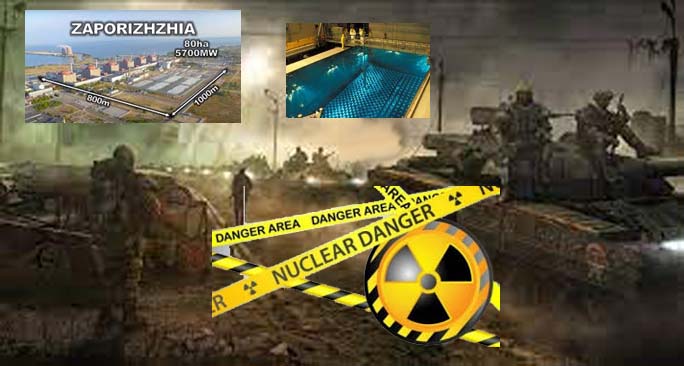
Zaporizhzhya Nuclear Power Plant: a Catastrophe Waiting to Happen
BY CAROL WOLMAN CounterPunch 1 May 23
A meltdown at Zaporizhzhya Nuclear Power Plant grows more likely with every passing day. With a meltdown, radioactive water from the plant would flow into the Dnieper River, which empties into the Black Sea, and thence to the Mediterranean. See below for map. The consequences would be catastrophic for Europe, North Africa, and the Middle East. Clearly this is an international problem. It calls out for an international solution.
Perhaps it is time to send in UN Peacekeeping Forces.
ZNPP has been at risk for a Fukushima-type meltdown since the Russians occupied the plant in March 2022. It sits on the front line of the war, the south side of the Dnieper River. The Russians quickly occupied the south side early in their invasion; the Ukrainians still occupy the north side.
The International Atomic Energy Agency was able to establish a presence at ZNPP after months of lobbying by its Director- General Mariano Grossi. He has personally visited twice and gets daily updates from the IAEA personnel on site. His latest report can be found here.
Grossi has been trying for almost a year to negotiate a safety zone around ZNPP. After his visit to the plant on 3/29/23, Grossi stressed that the increasing combat makes it urgent to find a way to prevent a potentially catastrophic nuclear accident.
He complains that he is not getting support from the UN, and even from his own agency. The EU issued a statement a few months ago but is not keeping the pressure on. Given the potential for catastrophe, it is astounding that more attention is not being given to the need to support Grossi’s efforts.
Instead, the media publishes reassuring articles about how many safety features ZNPP has.
Safety features are useless if the cooling water stops circulating around the nuclear material. The reactors have been shut down, so the pumps need an external power source.
The main power lines cross the Dnieper to the Ukraine energy grid on the north side of the river. The back up lines connect to conventionally fired plants in Ukrainian territory. They are right on the front line, and mortar fire from either side can cut them.
Since the invasion, all the external power lines to the plant- 4 major lines and 2-4 backup lines- have been cut simultaneously at least SIX times, forcing the pumps to rely on emergency diesel generators. As Grossi says ““Each time we are rolling a dice…And if we allow this to continue time after time, then one day our luck will run out.”
Without the constant circulation of cooling water, the nuclear fuel would overheat, resulting in a chain reaction and meltdown. This is what happened at Fukushima Daiichi 1:
; the earthquake and tsunami cut off the power and the pumps stopped working. A huge discharge of radioactive water into the vast Pacific Ocean continued for several years, until an ice wall was built around the damaged reactors.
Within three years after the Fukushima disaster, there were massive die-offs throughout the Pacific. Mollusks in particular suffered, and the result went up the food chain, so that sea mammals were starving and mutated. The sea bird population was decimated.
A meltdown at ZNPP would release large amounts of radioactive water into a much smaller body of water than the Pacific Ocean. The Dnieper River empties into the Black Sea and eventually into the Mediterranean. All the countries which border the Mediterranean would be affected. The consequences are unthinkable.
The circulation of cooling water could fail for another reason. It cycles through a holding pond nearby. Because of the constant influx of warm water from the reactors, still hot even in shutdown mode, the pond is prone to algae growth, which could clog the intake valves and stop the water flow. It is stocked with tropical fish, which eat the algae and keep the water clear.
The cooling pond is at risk. Global warming may cause the pond to overheat this summer, killing the scavenging fish…………………………………………………
Clearly this is an international problem. The danger of a meltdown at ZNPP is real; the consequences would be catastrophic for Europe, North Africa, and the Middle East…………………………………………………………….. https://www.counterpunch.org/2023/05/01/znpp-a-catastrophe-waiting-to-happen/
Libya lost, then found, 2.5 tonnes of uranium – a red flag for nuclear safety

The Conversation Olamide Samuel.Track II Diplomat and Expert in Nuclear Politics, University of Leicester 1 May 23
Earlier this year the International Atomic Energy Agency Director General Rafael Grossi reported that about 2.5 tonnes of uranium ore concentrate had gone missing from a site in Libya. This was arguably one of the largest quantity of uranium ore concentrate that had ever been misplaced.
Barely a day after the IAEA’s announcement, General Khaled Mahjoub of the self-styled Libyan National Army said the uranium ore had been found about 5km from the warehouse where it had been stored. A week later, the IAEA, which had been monitoring the stockpile occasionally, confirmed that most of the uranium ore concentrate had been found.
Uranium ore concentrate, popularly known as ‘yellowcake’, is a type of uranium concentrate powder obtained after uranium ore has been milled and chemically processed. Yellowcake has very low radioactivity, equivalent to the radioactivity of uranium ore found in nature, and it is produced by all countries where uranium ore is mined.
Yellow cake is further processed to become enriched uranium, which is used to manufacture the fuel for nuclear reactors. However, enriched uranium can also be used to manufacture nuclear weapons. If the technology were available, the 2.5 tons of missing yellowcake would have been half the amount required for a nuclear bomb.
Nuclear material experts had said the Libyan uranium ore concentrate in case posed “no significant security risk” as it required prohibitively sophisticated processing capabilities before it can be suitable for civil or weapons use.
Nevertheless, the news of missing Libyan uranium ore concentrate did highlight serious problems with the national and global governance structures for managing uranium.
Based on my experience in nuclear non-proliferation and politics, I believe that the missing Libyan uranium debacle illustrates two things.
Firstly, it illustrates the dangers of a IAEA that doesn’t have enough resources to monitor uranium ore stockpiles, especially in countries with unstable regimes. And faced with more pressing issues such as the safety and security of nuclear power plants in Ukraine, the IAEA won’t prioritise yellowcake storage.
Secondly, many African countries still struggle to implement nuclear safety and security governance provisions.
A regional destabiliser
Libya has been unstable since the fall of Muammar Gaddafi’s regime in 2011. This plunged the country into a civil war that has destabilised the North African and the Sahel regions, as Libya lost control of the largest and most diverse military arsenals in the region.
Much of this arsenal eventually fell into the hands of various non-state actors. Among them were Boko-Haram which mounted a reign of terror in northern Nigeria, and Ansar Al-Sharia in Tunisia.
Gaddafi had amassed stockpiles of nuclear material and technology as he sought to develop nuclear weapons. He had help from Abdul Qadeer Khan, who had been identified as a key facilitator for the global smuggling of nuclear material and technology.
Gaddafi eventually abandoned the weapons program in 2003, after months of secret disarmament negotiations with the US and British.
Following this deal, the US airlifted about 25 metric tonnes of Libya’s nuclear weapon programme components and documents. The last of Libya’s enriched uranium was removed in 2009. But there remained in Sabha, the southern Libyan city, about 6400 barrels of uranium ore concentrate. It’s this material that was under the control of an army battalion.
Olli Heinonen, a former Deputy Director of the IAEA, has since explained that it would have been very costly to airlift the remaining concentrate. He also said there were incentives for Libyans to holding onto the concentrate until the spot price of uranium was high enough for profitable export.
More questions than answers
Though the missing 2.5 tonnes of uranium have been recovered, questions remain: Why did 2.5 tonnes go missing in the first place? Who would have wanted to acquire it?
…………………………….. more https://theconversation.com/libya-lost-then-found-2-5-tonnes-of-uranium-a-red-flag-for-nuclear-safety-203775
Russia fixing power line from Zaporizhzhia nuclear plant to land it controls, IAEA says
VIENNA, April 28 (Reuters) https://www.reuters.com/world/europe/russia-fixing-power-line-zaporizhzhia-nuclear-plant-land-it-controls-iaea-says-2023-04-28/– Russia has informed the U.N. nuclear watchdog that equipment spotted at Ukraine’s Zaporizhzhia nuclear power plant, which Russia controls, will be used to fix a power transmission line that leads to Russian-held territory, the watchdog said on Friday.
The planned restoration of the downed power line could heighten Ukrainian fears that Russia is preparing to connect Zaporizhzhia, Europe’s largest nuclear power plant, to the power grid of territory that it controls.
A small number of International Atomic Energy Agency officials are present at the Zaporizhzhia nuclear power plant (ZNPP), which is operated by Ukrainian staff working under the orders of Russian forces and the Russian nuclear company Rosatom.
“The (IAEA) Team observed, and following questions were subsequently informed, that a large piece of equipment being transported into the turbine hall of Unit 3 was a transformer to replace the damaged ‘Kakhovka’ node in the ZNPP open switchyard,” the IAEA said in a statement.
“The Kakhovka line is one of the four 750 kV (kilovolt) lines that were operational before the military conflict. This line is linked to the currently Russian-controlled electrical grid, to the south of the ZNPP site,” it added.
Only one of those four power lines is currently working and is the only source of external power to the plant, which it needs to keep cooling the fuel in its six reactors even though they are shut down. Failing to cool that fuel could lead to a potentially catastrophic nuclear meltdown.
The IAEA said it also had not had access to the switchyard at a nearby thermal power plant (TPP) that can supply backup power to Zaporizhzhia. The IAEA last visited that switchyard in December, when damage from shelling was observed.
“Two weeks ago the team was informed that access would be granted in the coming days. It is important that ISAMZ (the IAEA Support and Assistance Mission to Zaporizhzhia) gets the necessary access to the ZTPP open switchyard given the implications on nuclear safety and security at ZNPP.”
Chernobyl anniversary offers a bleak look at what may await other Ukrainian nuclear plants
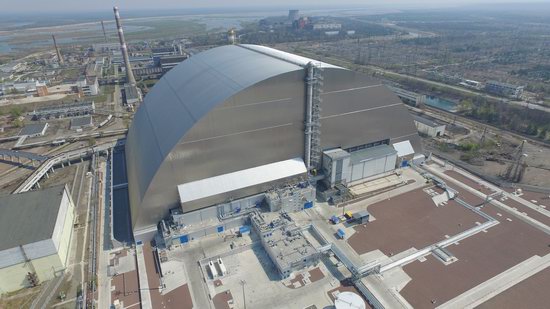
A huge steel and concrete sarcophagus covers the site of the meltdown. Under its dome, called the New Safe Confinement, lie 200 tons of lava-like nuclear fuel, 30 tons of highly contaminated dust and 16 tons of uranium and plutonium that continue to release high levels of radiation.
April 26, 2023 by Charles Digges https://bellona.org/news/nuclear-issues/2023-04-chernobyl-anniversar
A little over a year ago, Russian troops abandoned Chernobyl after briefly occupying it during the grim opening days of Moscow’s invasion of Ukraine. The takeover of the site where the world’s worst nuclear disaster happened thirty-seven years ago this week offered a preview of the reckless disregard for nuclear safety that has characterized so much of this war.
While the site has been left to Ukraine to painstakingly restore since the Russian withdrawal on March 31, 2022, the new anniversary of the Chernobyl plant’s original disaster on April 26, 1986, leaves lingering questions about what, exactly, the world can do when Ukraine’s nuclear infrastructure — or indeed any nuclear infrastructure — is attacked by a hostile neighbor.
The answer, at this point? Not much — aside from trying to pick up the pieces after the damage is already done.
As it stands, the Chernobyl exclusion zone is still dotted with mines planted by Russian troops when they rolled into the territory, churning up clouds of radioactive dust with hundreds of heavily armored vehicles. The mines have made treacherous any efforts to restore the territory.
Russian troops also dug trenches and set fires in an area known as the Red Forest — a gnarled expanse of irradiated trees — and scorched, according to NASA, some 14,000 hectares of land, filling the air with so much radioactive smoke that it was unsafe for firefighters to quell the blazes.
All the while, hundreds of Chernobyl employees — who oversee the site’s sprawling network of spent fuel storage facilities as well as the enormous efforts to dismantle the radioactive remnants of the exploded No. 4 reactor — were held hostage onsite, prevented from rotating out at the end of their shifts. Five workers were kidnapped and nine were killed, according to The Washington Post.
Those who remained said later that they had tried to keep the Russians from the most dangerous areas within the plant’s territory. But in what many called the worst situation they have seen in the decades since the initial disaster, Chernobyl’s power was cut by fighting, leaving them to rely on diesel generators for nearly a week to support the critical work of circulating water to cool spent nuclear fuel.
The damage the Russian soldiers did wasn’t purely technical. Doors to offices were ripped off hinges, windows smashed, walls spray-painted with graffiti.
“The poop was the icing on the cake,” Aleksander Barsukov, deputy director of the Chernobyl Ecocenter, which keeps samples of radioactive material collected from all over the world, told The Wall Street Journal after the Russian retreat.
By the time Russian troops pulled back from the plant on March 31, 2022 — amid reports of possible radiation poisoning among their ranks — Chernobyl’s technicians had been held at literal gunpoint at their workstations for more than a month.
During the retreat, according to Ukrainian accounts, Russian soldiers ransacked the site and took anything that looked valuable, looting more than 1,000 computers, and spiriting away dosimeters, software, lab tools, firefighting equipment — and in some cases even household appliances — piling them in stolen Ukrainian trucks.
“Whatever they didn’t steal, they broke,” Chernobyl Information Director Vitaly Medved told the BBC at the time.
Russian soldiers then brazenly mailed much of the booty home from across the Belarusian border. They also made off with radioactive instruments used to calibrate personal dosimeters for Chernobyl staff — substances that can cause radiation burns if handled improperly.
According to the European Bank of Reconstruction and Development, which has financed much of Chernobyl’s cleanup work since the original 1986 disaster, the Russian Army’s destructive adventure in the world’s most famous radioactive wasteland will cost some €100 million to repair.
The four RBMK reactors at the enormous nuclear station in Chernobyl no longer produce power, but before the invasion nearly 6,000 workers monitored the lasting effects of the disastrous meltdown that took place in 1986, as well oversaw as processing spent nuclear fuel from other plants in Ukraine. In the days before the invasion, all but a few hundred employees were evacuated.
Located just a few miles from the Belarusian border, Chernobyl was one of the first places occupied by Russian troops. Yevhen Kramarenko, the director of the exclusion zone — the 2,6000-square-kilometer area where radiation levels remain high and public access is limited — told The Washington Post that on the first day of the invasion, a Russian general presented himself as the new leader of the station, and introduced employees from Rosatom, Russia’s state nuclear corporation.
“I believe that at the time when they came,” Kramarenko told the paper, “they planned to be there permanently, they planned to take control for a long time.”
A sign of things to come?
Even before the occupation, the Chernobyl station had a post-apocalyptic air. It is situated in a dense forest, swarming with mosquitoes and gnats. Pripyat, the city where employees lived before the disaster, now stands empty and is being reconquered by nature.
A huge steel and concrete sarcophagus covers the site of the meltdown. Under its dome, called the New Safe Confinement, lie 200 tons of lava-like nuclear fuel, 30 tons of highly contaminated dust and 16 tons of uranium and plutonium that continue to release high levels of radiation.
Yet while Rosatom may have failed to keep hold of Chernobyl, the same cannot be said about Ukraine’s embattled Zaporizhzhia nuclear plant — Europe’s largest such facility — which once supplied a fifth of Ukraine’s electricity.
Since October of 2022, Moscow claims that it now controls the plant — a claim not honored by the UN’s International Atomic Energy Association, to say nothing of Kyiv.
From then on, Rosatom has begun flooding the Zaporizhzhia plant with Russian staff that it has transferred from its own Kalinin nuclear plant, 545 kilometers across the front to the northeast.
But while Russia asserts the six-reactor facility has been taken over as a protective measure, there is little to suggest that the joining of Russian and Ukrainian workforces is going smoothly. Only about 2,000 Ukrainian staff members still work at the plant, out of 11,000 before the war.
Indeed, much of Rosatom’s effort to assert itself at the plant has involved arresting and torturing Ukrainian workers opposed to the occupation as it toils to link Zaporizhzhia with the Russian electricity grid.
The plant, which lies on the south side of the Dnipro River next to the nuclear plant’s home city of Enerhodar, is on the front line of the war. Ukrainian troops are just a few of kilometers to the north, on the far bank of the Dnipro, while Russians are holed up in the power plant.Anxieties are high that the area could see renewed fighting in any Ukrainian counteroffensive.
Ukraine accuses the Russians of using the plant as a shield, hoping that the danger of causing a nuclear accident will keep Ukrainian soldiers from firing on them — the first time an atomic reactor has been put in such a position.
“They know Ukrainian troops would not dare to fire back. The nuclear power plant is a perfect hiding place from Ukrainian artillery,” Oleksiy Melnychuk, a former worker at the plant who fled from Enerhodar last July to Ukrainian-held territory, told Politico.eu. The Russians in turn accuse the Ukrainians of ignoring safety protocols and firing on areas near the plant.
The IAEA has inspectors on site and has been trying to walk a diplomatic tightrope to establish a non-military safety zone around the plant. While Moscow says it is keen to do so, Kyiv is leery of any step that could lend legitimacy to the Russian occupation.
Late last month, IAEA chief Rafael Mariano Grossi dropped the idea, and instead is now pushing for both sides to take steps to ensure that the plant isn’t attacked.
Over the last year, four of the station’s six VVER reactors have been put into a cold shutdown to minimize the risk of an accident, while two have been restarted to produce low levels of power to keep the plant operational. The facility needs access to electricity to ensure reactor cooling and other safety functions. However, its links to the Ukrainian grid have been cut six times since last March, forcing the ZNPP to rely on diesel-powered generators for emergency backup power — a situation that IAEA Director General Rafael Grossi has referred to as “rolling the dice.”
“And if we allow this to continue time after time then one day our luck will run out,” he added.
Still, even as events deteriorate, there is little the world can do but watch.
Even Grossi — who heads the world’s most respected nuclear power diplomacy body — has admitted as much. During a meeting of the IAEA’s 35-member board of governors last month, Grossi castigated his colleagues for “complacency” after the latest spate of airstrikes had again cut off Zaporizhzhia’s access to grid electricity.
“What are we doing to prevent this [from] happening?“ a flabbergasted Grossi asked the board. ”We are the IAEA, we are meant to care about nuclear safety.”
Even so, aspirations of pushing out the Russians among plant workers remain high.
“We still hope de-occupation is possible,” Melnychuk told Politico.eu. “You can’t even imagine how ready we all are to return and let our colleagues, working under tremendous pressure and fear, to finally have some rest.”
Unfortunately, the state of Chernobyl offers the clearest glimpse of what they may find if — or when — that time comes.
Remembering Chernobyl as nuclear danger grows with attacks in the Zaporizhzhia region
The explosion of a nuclear reactor put Chernobyl on the map in 1986 for the
worst reasons. It is still considered the most serious nuclear accident in
history.
The memories are vivid 37 years later and fears of a new nuclear
accident are more pressing since Russia attacked Ukraine. Ukraine has 15
nuclear power plants, but it is Zaporizhzhia that is focusing attention.
Despite appeals from the International Atomic Energy Agency (IAEA), there
are daily reports of attacks in the region. Interviewed by Euronews, a
former head of the IAEA believes that we are more exposed to danger today
than in 1986.
Euro News 26th April 2023
Ukraine’s nuclear power plants are still a source of nightmares years after the Chornobyl disaster
CNBC, APR 26 2023
- It’s been 37 years since the disastrous and deadly explosion at the Chornobyl nuclear power plant in Ukraine, then a part of the Soviet Union.
- The disaster in 1986 is still considered the world’s worst ever nuclear disaster.
- Ukraine’s nuclear power plants are still a source of concern as the war continues.
…………………………………………………………………………..The disaster is still seen as the most serious accident in the history of nuclear power operation although Ukraine has remained heavily dependent on nuclear energy.
Today, its nuclear power plants have once again become a source of nightmares as fears abound for their safety and security amid the relentless fighting between Ukrainian and Russian forces.
Ukraine has 15 operable nuclear reactors at four plants that generate about half of its electricity, according to the World Nuclear Association, although since the war started last February, the number of units in operation has changed over time, “with reactors put online and taken offline depending on the situation around the plants and the stability of external power supplies,” the association notes.
Most concerns around the safe functioning of the country’s power plants amid war have centered on the the nuclear power plant located in Zaporizhzhia in southern Ukraine, which also happens to be Europe’s largest nuclear power plant.
The Zaporizhzhia plant was occupied early on in the war by Russian forces (when it was attacked in the early hours of March 2 last year, it became the first operating civil nuclear power plant to come under armed attack) and it has repeatedly found itself at the epicenter of fighting since then, with both sides accusing each other of shelling near the facility and risking another potentially catastrophic nuclear accident.
There have been a number of occasions now when shelling near the plant has damaged external power lines to the facility, meaning that Ukrainian workers still running the plant have had to rely on emergency generators for the power needed for reactor cooling and other essential nuclear safety and security functions.
The IAEA’s Director-General Rafael Grossi described the unstable conditions that the plant is forced to operate in as “extremely concerning,” noting that “this is clearly not a sustainable way to operate a major nuclear facility.”
He has often repeated calls for the establishment of a demilitarized zone around the plant but, for now, that remains a distant prospect, although the IAEA was able to convince Russia to allow its inspectors to remain permanently on site to monitor safety at the plant. The IAEA has also sent inspectors to other nuclear facilities in Ukraine………………………………………….. https://www.cnbc.com/2023/04/26/37-years-after-chornobyl-ukraines-nuclear-plants-are-again-in-danger.html?fbclid=IwAR1LBPuusObwSd5ZQibJVClqi5jlDayFFhvoJjFjyWny6WWP6VXCG-Nlh2k—
No change to nuclear transport rules following accident down under, says regulator
in Western Australia.
The Office of Nuclear Regulation is responsible for oversight of operators transporting nuclear materials in the UK, and the Chief Nuclear Inspector’s report from October 2022 recorded 69 incidents related to nuclear transport in the reporting period. Two of these involved lost radioactive packages.
In response to the Western Australian accident, Richard Bramhall, of the Low-Level Radiation Campaign, told the NFLA: ‘The company is to be criticised for appalling practice since the gauge itself came apart and the packaging came apart and the vehicle was inadequate to contain the outcome of those failures.’
The NFLA and Dr Jill Sutcliffe, joint Chair of the NGA Forum of the Office of Nuclear Regulation, sent an FOI request to the ONR with their concerns. The ONR’s response is shown below as, whilst it contains no commitment to procedural changes, it has useful detailed guidance on the regulatory regime that applies to the transport of nuclear materials and links to reports.
The NFLA also wrote to senior executives at Rio Tinto PLC, the mining conglomerate that lost the caesium capsule, asking the company to issue a statement outlining how procedures would be tightened up to avoid another accident and whether Rio Tinto would fully reimburse the local authorities for the cost of recovering the capsule. Despite a reminder being sent urging the executives to respond, no reply has so far been received. 25 Apr 23
Maintenance impacted at Zaporizhzhia, says IAEA

24 April 2023 https://www.world-nuclear-news.org/Articles/Maintenance-impacted-at-Zaporizhzhia,-says-IAEA
The current situation at the Zaporizhzhia nuclear power plant is having a significant impact on the plant’s maintenance capability, the International Atomic Energy Agency (IAEA) said.
Plant management informed the IAEA experts present at plant that the scope of maintenance performed during outages on all units in 2022 was reduced compared with the planned scope, due to reduced maintenance staff, absence of external contractors who perform a significant part of the work, and a lack of spare parts needed for the maintenance, including critical components.
The Zaporizhzhia plant currently has only about one-quarter of its regular maintenance staff available, the IAEA said. It noted new staff are being hired but it will take some time until they are fully trained. The plant said a substantial list of required spare parts has recently been submitted to Russian state nuclear corporation Rosatom.
“As a result of the significant reduction of staff, the ZNPP currently does not have a systematic maintenance and in-service inspection schedule,” the IAEA said. “Before restarting any of the reactor units, the site is considering obtaining advice from an engineering organisation within Rosatom that will assess the status of the plant and provide recommendations for all structures, systems and components important to safety regarding their maintenance or any necessary replacement before operation. The site considers that this maintenance/replacement work may be undertaken using the services of a centralised Rosenergoatom company that is capable of performing these types of maintenance tasks.”
“This shows again the continuing detrimental impact that the current situation on the site is having on the seven indispensable pillars for ensuring nuclear safety and security, in this case pillars two and five on safety and security systems and equipment and logistical supply chain,” IAEA Director General Rafael Mariano Grossi said.
The IAEA noted that the Zaporizhzhia plant continues to rely on the only remaining functioning 750kV power line for the external electricity it needs for reactors cooling and other essential nuclear safety and security functions. Meanwhile, a back-up 330kV power line that was damaged on 1 March on the other side of the Dnipro River from the Russian-controlled plant remains unrepaired, with Ukraine having said military action is preventing its experts from safely accessing the location situated in territory it controls to repair the line.
Russia reported last month that Rosatom was working to remove damaged equipment from the open switchyard, with the aim of restoring three 330kV lines to the grid system in currently Russian-controlled territory. The IAEA team will access the site to assess the situation.
Four of the six reactors have been in cold shutdown, with two (units 5 and 6) in hot shutdown – which allows them to provide heat to the plant and the nearby town of Energodar where many of the workers live. However, the IAEA said that, with the weather warming, unit 6 has now been transferred to cold shutdown.
Campaigners’ concerns about safety of Sizewell as Russian ‘spy’ ship seen nearby
Campaigners have expressed concerns about the risks posed to Suffolk’s
Sizewell nuclear plants after a Russian ‘spy’ ship stopped at sites off the
coast. The Admiral Vladimirsky ship is believed to have stopped at wind
farms off the East Anglian coast to map undersea power cables as part of
plans to sabotage the UK’s key energy infrastructure.
Alison Downes, from campaign group Stop Sizewell C, said she wanted to know what measures UK regulators were proposing to protect UK power plants, including Sizewell B,
from attack.
East Anglian Daily Times 22nd April 2023
https://www.eadt.co.uk/news/23473262.concerns-sizewell-safety-russian-spy-ship-seen/
Nuclear life extension plans tested by obsolete components
Reuters, By Paul Day, April 5 – Nuclear operators must be able to swap out old parts for new to keep a reactor running, but when like-for-like is unavailable, original equipment manufacturers (OEMs) are faced with the challenge of finding an alternative while avoiding making any major changes.
There’s a rule of thumb that if a plant has to do a design change, it’ll cost anywhere from $300,000-$500,000 just in engineering, licensing changes, drawing changes, and that doesn’t include the cost of the required equipment … so we try, wherever possible, to keep our clients from doing a design change,” says Vice President of Westinghouse Parts Business in its Operating Plant Services unit Craig Irish………………………….
Life extensions
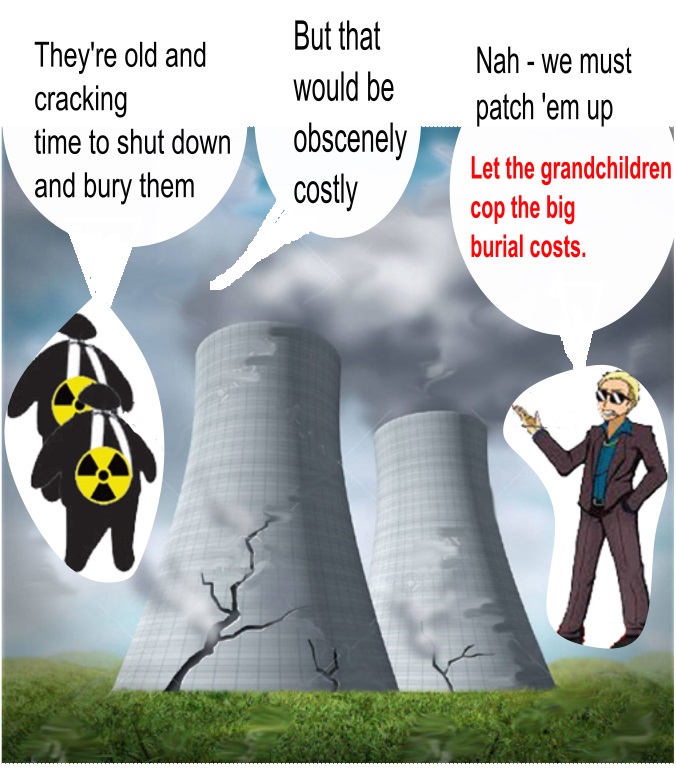
Many of the world’s nuclear power plants were built several decades ago and applications for long-term operations (LTOs) beyond initial lifespans are becoming increasingly common.
…………………………………………………………..In the United States………….the average age of the fleet is 41 years including three reactors that started operation 52 years ago, according to the Department of Energy (DOE)
Nine U.S. reactors have active applications with the Nuclear Regulatory Commission (NRC) to extend their lives and 10 reactors have publicly announced plans to extend their licenses to 80 years.
“Under current license basis 92% of operating reactors would shut down by 2050 and 74 percent would shut down by 2050 with anticipated license renewals. However, if 54 reactors extended operation to 80 years, only 20% of operating reactors would shut down by 2050,” the DOE said in its 2022 report on nuclear energy supply chains.
Obsolescence challenge
The challenge, say OEMs, is keeping a supply chain running and up to date for complex, always-on machines that were built with Reagan-era (or earlier) technology.
………………with construction times for some plants approaching ten years, many of the parts can be obsolete before the plant has even started generating power, according to Westinghouse’s Irish.
……………………………………………Internationally, part of the challenge is many of the parts produced for the nuclear industry face varying specifications depending on the regulator they are working under, restricting an already tight market to national boundaries.
Such differences will become even more pronounced with the introduction of a new generation of reactors expected to begin commercial operations within the next decade, with more than 70 SMR designs under development in 18 countries.
…………………………………………………………………………… “The biggest problem is a lot of these discrete components, resistors, diodes, transistors, capacitors, etc are either substantially changed from the 70s and 80s when we built these instruments or they’re not available or they got bought and sold by another company,” he says. https://www.reuters.com/business/energy/nuclear-life-extension-plans-tested-by-obsolete-components-2023-04-05/
Hungary to Prolong Nuclear Plant’s Lifetime as Expansion Stalls
By Marton Kasnyik, April 21, 2023 https://www.bloomberg.com/news/articles/2023-04-21/hungary-to-prolong-nuclear-plant-s-lifetime-as-expansion-stalls?leadSource=uverify%20wall
Hungary aims to extend the lifetime of its sole nuclear power plant by 20 years to bridge major delays to its Russian-managed expansion, according to a senior official.
Extending the operation of the Paks plant in southern Hungary will maintain the source of about 40% of the country’s electricity consumption. The government is currently assessing safety issues after previous 20-year extensions to the four existing reactors in the last decade.
“Our plan is to get a further 20 years of life-extension,” Energy Minister Csaba Lantos said at a conference on Friday.
Prime Minister Viktor Orban’s administration handed a €10 billion ($11 billion) contract to Russia’s Rosatom Corp. in 2014 to expand the Paks plant. The project has been marred by delays, including due to initial European Union opposition to the investment and the quality of Rosatom’s plans, which Hungary’s own regulator has said fell short of stringent requirements.
Last week, Hungary and Russia said they agreed to an amendment of their original contract following media reports of a potentially reduced role for Rosatom amid EU sanctions against Russia for its invasion of Ukraine.
The changes are “technical” in nature and don’t affect the project’s cost, Cabinet Minister Gergely Gulyas told reporters on Thursday, without elaborating.
1 This Month
10 March A LIVE WEBINAR THE REAL EFFECTS OF NUCLEAR POWER
What the Industry Isn’t Telling Us
1:00 PM Mountain, 2 pm Central, 3 pm Eastern. Live on the Keepers of the Water Facebook page

18 March Webinar @ 1 PM EST: An Assessment of SMR Projects: The Case of Canada
register for the zoom:
https://us02web.zoom.us/webinar/register/WN_o8BIIOUvQ2ONJR1nta65DQ#/registration


of the week – STOP SMALL MODULAR REACTORS IN CANADA
To see nuclear-related stories in greater depth and intensity – go to https://nuclearinformation.wordpress.com
-
Archives
- February 2026 (268)
- January 2026 (308)
- December 2025 (358)
- November 2025 (359)
- October 2025 (376)
- September 2025 (258)
- August 2025 (319)
- July 2025 (230)
- June 2025 (348)
- May 2025 (261)
- April 2025 (305)
- March 2025 (319)
-
Categories
- 1
- 1 NUCLEAR ISSUES
- business and costs
- climate change
- culture and arts
- ENERGY
- environment
- health
- history
- indigenous issues
- Legal
- marketing of nuclear
- media
- opposition to nuclear
- PERSONAL STORIES
- politics
- politics international
- Religion and ethics
- safety
- secrets,lies and civil liberties
- spinbuster
- technology
- Uranium
- wastes
- weapons and war
- Women
- 2 WORLD
- ACTION
- AFRICA
- Atrocities
- AUSTRALIA
- Christina's notes
- Christina's themes
- culture and arts
- Events
- Fuk 2022
- Fuk 2023
- Fukushima 2017
- Fukushima 2018
- fukushima 2019
- Fukushima 2020
- Fukushima 2021
- general
- global warming
- Humour (God we need it)
- Nuclear
- RARE EARTHS
- Reference
- resources – print
- Resources -audiovicual
- Weekly Newsletter
- World
- World Nuclear
- YouTube
-
RSS
Entries RSS
Comments RSS
 nuclear-news