Ukraine kills nuclear plant’s pro-Russian security chief with car bomb
Politico, October 4, 2024, By Seb Starcevic
The security chief at a Russia-controlled nuclear power plant in southern Ukraine was killed in a car bombing Friday, according to Russian and Ukrainian authorities.
Andriy Korotkyy, head of security at the Zaporizhzhia nuclear power plant, died after his car exploded on Friday morning in the Russian-occupied Ukrainian city of Enerhodar.
“A homemade explosive device was planted under the vehicle of the head of the security,” Russia’s Investigative Committee said in a statement on Telegram.
“When the man got into the car, it detonated. The victim died in the hospital from his injuries,” the committee said, adding that it was opening a murder investigation.
Ukraine’s Military Intelligence Directorate, also known as GUR, seemingly took responsibility for the blast that killed Korotkyy, calling him a “war criminal” and posting a video of a white SUV exploding on Telegram………………………………………………………………….
Moscow took control of the Zaporizhzhia nuclear power plant, the largest such facility in Europe, shortly after it invaded Ukraine in early 2022. It is located about 50 kilometers southwest of the city of Zaporizhzhia, home to more than 700,000 people.
There is widespread concern about the safety of the plant, with shelling and drone strikes nearby prompting the United Nations’ nuclear watchdog in August to issue a warning about a nuclear disaster.
Korotkyy is not the first Russian-allied official to die in a car bombing by Ukrainian intelligence. Mikhail Filiponenko, a pro-Russian lawmaker and ex-militiaman in occupied eastern Ukraine, was killed in a similar attack last November, with the GUR promising to punish other high-profile collaborators. https://www.politico.eu/article/ukraine-russia-andriy-korotkyy-car-bomb-nuclear-plant-zaporizhzhia/
Russia intercepts drone near Kursk, no damage to nuclear plant, governor says
By Reuters, October 4, 2024
MOSCOW, Oct 3 (Reuters) – Russian forces intercepted a Ukrainian drone on Thursday near the Russian town of Kurchatov but there was no damage to the nearby Kursk nuclear power plant, the regional governor said.
Governor Alexei Smirnov said debris from the drone caused explosions in a building unrelated to the plant.
Several Russian Telegram channels earlier reported the alleged Ukrainian attack, which they said had been thwarted by air defences but had resulted in a fire several miles from the nuclear plant…………………………
Rafael Grossi, head of the U.N. nuclear watchdog, visited the nuclear plant on Aug. 27 and said it was especially vulnerable to a serious accident because it lacks a protective dome that could shield it from missiles, drones or artillery. https://www.reuters.com/world/europe/russia-intercepts-drone-near-kursk-no-damage-nuclear-plant-governor-says-2024-10-03/
UN Nuclear Watchdog Warns on Ukraine Plant After Power Failure
By Patrick Donahue, October 04, 2024, https://www.bnnbloomberg.ca/investing/2024/10/04/un-nuclear-watchdog-warns-on-ukraine-plant-after-power-failure/
(Bloomberg) — The United Nations atomic watchdog reinforced warnings on safety risks in Russia’s war on Ukraine after Europe’s largest nuclear power plant lost a back-up power link for 36 hours earlier this week.
The International Atomic Energy Agency said the Russian-occupied Zaporizhzhia Nuclear Power Plant in southern Ukraine lost supply from its only remaining back-up power line before it was restored late Wednesday.
“The off-site power situation remains a deep source of concern,” IAEA Director General Rafael Mariano Grossi said in a statement. The disruption “shows that the situation is not improving in this regard, on the contrary.
The agency and Ukrainian authorities have repeatedly warned that fighting around the plant in Zaporizhzhia poses an urgent risk, particularly to substations that feed the nuclear plant with power needed to keep systems running.
The plant has lost external power eight times during the conflict, forcing engineers to maintain electricity supplies with diesel generators, the IAEA said.
An IAEA team found that shelling at a substation in nearby Enerhodar had destroyed a transformer and had damaged a nearby power line earlier in the week, the agency said. The IAEA last month took the unusual step of expanding its monitoring mission to include substations.
Lawmakers to Investigate Faulty Sub, Carrier Welding at Newport News Shipbuilding

USNI News, Sam LaGrone, September 27, 2024
THE PENTAGON – The House Armed Services Committee is investigating substandard welding on submarines and aircraft carriers at Newport News Shipbuilding, the committee announced on Friday.
Following a Thursday report in USNI News, lawmakers are now looking into how shipbuilders at the Virginia yard had violated proper welding procedures on work that made it into current in-service submarines. The flawed work was found by quality assurance teams at Newport News Shipbuilding, which has led to a wider investigation into welding quality that’s prompted a notification to the Department of Justice, USNI News reported.
“It is deeply concerning to learn that faulty welds may have been knowingly made to U.S. Navy submarines and aircraft carriers. The House Armed Services Committee is investigating how this occurred. The safety of our sailors is our top concern, and we need to immediately understand any risks associated with the faulty work,” reads the statement from HASC chair Rep Mike Rogers (R-Ala.), ranking member Rep Adam Smith (D-Wash.) and House Armed Services seapower and projection forces subcommittee leaders Rep. Trent Kelly (R-Miss.) and Rep. Joe Courtney (D-Conn.).
“The Department of Defense needs to immediately provide our committee with answers and a plan for how they will protect U.S. Navy vessels against tampering. Absolute transparency with Congress is essential.”
The Congressional query comes as the Navy and shipbuilder HII are gauging the scope of the ships that were affected overall. The number of in-service Virginia-class submarines that have been affected are in the “low single digits” and an ongoing analysis of under-construction Virginia, Columbia-class submarines and Ford-class aircraft carriers could stretch into October, a defense official told USNI News on Friday.
Earlier this year, quality assurance teams at Newport News discovered the sub-standard welds and reported the violations in procedure to both the Navy and the Department of Justice, according to a Friday statement on LinkedIn by Newport News president Jennifer Boykin.
“We recently discovered that the quality of certain welds on submarines and aircraft carriers under construction here at NNS do not meet our high-quality standards. Most concerning is that some of the welds in question were made by welders who knowingly violated weld procedures.” she wrote.
“We immediately put together a team made up of both internal and independent engineering and quality subject matter experts to determine the root causes, bound the issue and put in place immediate short-term corrective actions as we work through longer-term solutions.”
Boykin went on to say HII notified both the Navy and the Department of Justice on the sub-standard work………………………………………………………………………………………….
Neither HII nor the Navy have said when the initial faulty work was discovered.
While the assessment of the overall welds on the ships under construction could extend into next month, the Navy and HII now have the tedious task of reinspecting the welds and determining solutions.
Twice in the 2000s, the Navy mounted separate investigations into suspicious welds into then Northrop Grumman-managed Newport News Shipbuilding. In 2007, the Navy found welders used the wrong filler material in non-nuclear pipping on Virginia submarines. In 2009, the Navy had to reinspect the welds on nine submarines and four aircraft carriers after a shipyard inspector admitted to falsifying inspection reports, according to The Virginian Pilot.
The inspections can involve analyzing welds that are difficult to reach throughout a submarine or aircraft carrier. The subsequent weld checks after the 2009 investigation took years, USNI News understands. https://news.usni.org/2024/09/27/lawmakers-announce-investigation-into-faulty-submarine-carrier-welding-at-newport-news-shipbuilding-ships-affected-in-low-single-digits-officials-say
China’s Newest Nuclear Submarine Sank, Setting Back Its Military Modernization
Pierside accident came as Beijing attempts to expand its navy
WSJ, By Michael R. Gordon, Sept. 26, 2024
WASHINGTON—China’s newest nuclear-powered attack submarine sank in the spring, a major setback for one of the country’s priority weapons programs, U.S. officials said.
The episode, which Chinese authorities scrambled to cover up and hasn’t previously been disclosed, occurred at a shipyard near Wuhan in late May or early June.
It comes as China has been pushing to expand its navy, including its fleet of nuclear-powered submarines.
The Pentagon has cast China as its principal long-term “pacing challenge,” and U.S. officials say that Beijing has been using political and military pressure to try to coerce Taiwan, a separately governed island that Beijing claims as part of its territory.
China says its goal in building a world-class military is to deter aggression and safeguard its overseas interests. A spokesman for the Chinese embassy didn’t immediately respond to a request for comment…………………………………………………………….. more https://www.wsj.com/world/china/chinas-newest-nuclear-submarine-sank-setting-back-its-military-modernization-785b4d37?st=pMigx5&reflink=desktopwebshare_permalink
Nuclear power for AI: what it will take to reopen Three Mile Island safely
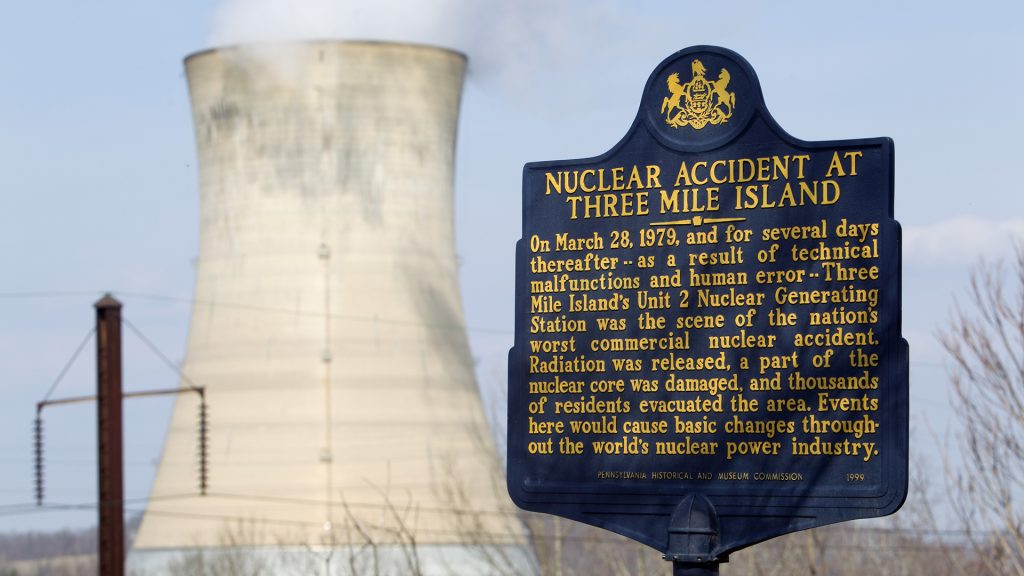
As Microsoft strikes a deal to restart a reactor at the notorious power station, Nature talks to nuclear specialists about the unprecedented process.
Michael Greshko, https://www.nature.com/articles/d41586-024-03162-2 30 Sept 24
Microsoft announced on 20 September that it had struck a 20-year deal to purchase energy from a dormant nuclear power plant that will be brought back online. And not just any plant: Three Mile Island, the facility in Londonderry Township, Pennsylvania, that was the site of the worst-ever nuclear accident on US soil when a partial meltdown of one of its reactors occurred in 1979.
The move, which symbolizes technology giants’ need to power their growing artificial-intelligence (AI) efforts, raises questions over how shuttered nuclear plants can be restarted safely — not least because Three Mile Island isn’t the only plant being brought out of retirement.
Palisades Nuclear Plant, an 805-megawatt facility in Covert, Michigan, was shut down in May 2022. But the energy company that owns it, Holtec International, based in Jupiter, Florida, plans to reopen it. This reversal in the facility’s fortunes has been bolstered by a US$1.5-billion conditional loan commitment from the US Department of Energy (DoE), which sees nuclear plants — a source of low-carbon electricity — as a way of helping the country to meet its ambitious climate goals. The Palisades plant is on track to reopen in late 2025.
“It’s the first time something like this has been attempted, that we’re aware of, worldwide,” says Jason Kozal, director of the reactor safety division at a regional office of the US Nuclear Regulatory Commission (NRC) in Naperville, Illinois, and the co-chair of a regulatory panel overseeing the restart of Palisades.
Here, Nature talks to nuclear specialists about what it will take to restart these plants and whether more are on the way as the world’s demand for AI grows.
A change in fortunes
Since 2012, more than a dozen nuclear plants have been shut down in the United States, in some cases as a result of unfavourable economics. Less cost-effective plants — such as those with only a single working reactor — struggled to remain profitable in states with deregulated electricity markets and widely varying prices. Three Mile Island, owned by the utility company Constellation Energy in Baltimore, Maryland, is a prime example. Today, 54 US plants remain in operation, running a total of 94 reactors.
Nuclear energy, which accounts for about 9% of the world’s electricity, has seen some resurgence internationally, but is also competing with other energy sources, including renewables. After the 2011 Fukushima Daiichi disaster, Japan suspended operations at all of its 48 remaining nuclear plants, but these are gradually being brought back online, in part to cut dependence on gas imports. By contrast, Germany announced a phase-out of its nuclear plants in 2011, and shut down its last three in 2023.
In the United States, nuclear energy’s fortunes might be turning as technology companies race to build enormous, energy-gobbling data centres to support their AI systems and other applications while somehow fulfilling their climate pledges. Microsoft, for instance, has committed to being carbon negative by 2030.
It’s further confirmation of the value of nuclear, and, if the deal is right — if the price is right — then it makes business sense, as well,” says Jacopo Buongiorno, the director of the Center for Advanced Nuclear Energy Systems at the Massachusetts Institute of Technology in Cambridge.
A new start
This isn’t the first time that the United States has brought a powered-down reactor back online. In 1985, for example, the Tennessee Valley Authority, a federally owned electric utility company, took the reactors at its Browns Ferry Nuclear Power Plant in Athens, Alabama, offline. After years of refurbishment, they were brought back online, with the final reactor restarted in 2007.
The cases of Palisades and Three Mile Island are different, however. When those plants closed, their then-owners made legal statements that the facilities would be shut down, even though their operating licenses were still active. Three Mile Island, which will be renamed the Crane Clean Energy Center under the proposed restart, shut down its single remaining functional reactor in 2019.
Because the plants were slated for shutdown and safety checks were therefore stopped, regulators and companies must now navigate a complex licensing, oversight and environmental-assessment process to reverse the plants’ decommissioning.
Safety checks will be needed to ensure, among other things, that the plants can operate securely once uranium fuel rods have been replaced in their reactors. When these plants were decommissioned, their radioactive fuel was removed and stored, so the facilities no longer needed to adhere to many exacting technical specifications, says Jamie Pelton, also a co-chair of the Palisades restart panel, and a deputy director at the NRC’s Office of Nuclear Reactor Regulation in Rockville, Maryland.
It will be no small feat to reinstate those safety regulations: to meet the standards, infrastructure will need to be inspected carefully. According to Buongiorno, any metallic components in the plants that have corroded since the shutdowns, including wires and cables used in instrumentation and controls, will need to be replaced.
The plants’ turbine generators, which make electricity from the steam produced as the plants’ fuel rods heat up water, will also get a close look. After sitting dormant for years, a turbine could develop defects within its shaft or corrosion along its blades that would require refurbishment. In the case of Palisades, the NRC announced on 18 September that the plant’s steam generators would need further testing and repair, following inspections conducted by Holtec.
Nuclear’s prospects
As the plants near their restart dates, their operators will also have to contend with a challenge faced by even fully operational plants: the need to source fresh nuclear fuel. US nuclear utility companies have long counted on the international market to buy much of the necessary raw yellowcake uranium and the services that separate and enrich uranium-235, the isotope used in nuclear reactors’ fuel rods. Russia has been a major international supplier of these services, even after the country’s 2022 invasion of Ukraine, because US and European sanctions have not targeted nuclear fuel. But to minimize its reliance on Russia, the United States is building up its own supply chain, with the DoE offering $3.4 billion to buy domestically enriched uranium.
There probably won’t be too many other restarts of mothballed nuclear plants in the United States, however, even as demand for low-carbon electricity grows. Not every US plant that has been shut down is necessarily in good enough condition to be easily refurbished — and the idea of reopening some of those would meet with too much resistance. As an example, Buongiorno points to New York’s Indian Point Energy Center, which was closed in 2021. The plant’s proximity to New York City had long provoked criticism from nuclear-safety advocates.
But that doesn’t mean that all of these sites will remain unused. One option is to build advanced reactors — including large reactors with upgraded safety features and small modular reactors with innovative designs — on sites where old nuclear plants once stood, to take advantage of existing transmission lines and infrastructure. “We might see interest in the US in building more of these large reactors, whether that’s fuelled by data centres or some other applications,” Buongiorno adds. “Utilities and customers are exploring this at the moment.”
Chinese nuclear-powered attack submarine sank earlier this year, says senior US defence official
ABC News, 27 Sept 24
In short:
China’s newest nuclear-powered attack submarine sank earlier this year, according to a senior US defence official.
A series of satellite images from Planet Labs from June appear to show cranes at the Wuchang shipyard, where the submarine would have been docked.
What’s next?
China’s submarine force is expected to grow to 65 by 2025 and 80 by 2035, the US Department of Defense has said.
A senior US defence official has said that China’s newest nuclear-powered attack submarine sank earlier this year, marking a potential embarrassment for Beijing as it seeks to expand its military capabilities.
China already has the largest navy in the world, with over 370 ships, and it has embarked on production of a new generation of nuclear-armed submarines.
The US defence official, speaking on condition of anonymity on Thursday, local time, said China’s new first-in-class nuclear-powered attack submarine sank alongside a pier sometime between May and June.
A Chinese embassy spokesperson in Washington said they had no information to provide.
“In addition to the obvious questions about training standards and equipment quality, the incident raises deeper questions about the PLA’s internal accountability and oversight of China’s defence industry — which has long been plagued by corruption,” the official said, using an acronym for the People’s Liberation Army.
“It’s not surprising that the PLA Navy would try to conceal the sinking,” the official added………………………………………………. more https://www.abc.net.au/news/2024-09-27/one-of-china-submarine-sank-says-us-defence-official/104406362
Outgoing French nuclear safety chief warns of 25% budget cut

(Montel) France’s ASN nuclear safety authority faces a 25% cut to its budget next year which would leave the body “unable to operate”, its outgoing head, Bernard Doroszczuk, has told parliamentarians.
by: Muriel Boselli, 25 Sep 2024
The same would apply when ASN plans to merge with its technical arm, the Institute for Radiation Protection and Nuclear Safety (IRSN), to create a new body ASNR from 2025, he told a French lower house committee on Tuesday.
“Whether it’s the ASNR or the separate ASN and IRSN, we don’t have the means to operate with these figures,” he said.
The planned cuts, due to be tabled in the government’s finance bill next month, would leave a EUR 37m hole in ASN’s EUR 150m budget, Doroszczuk said, adding this was “very alarming”.
Merger on 1 January?
President Emmanuel Macron proposed the head of the nation’s nuclear waste agency Pierre-Marie Abadie to succeed Doroszczuk when his term ends on 12 November.
One of Abadie’s first tasks will be to oversee the controversial merging of the ASN and the IRSN from 1 January 2025 as approved by parliament and officially stipulated as law on 22 May.
Despite legislative delays following France’s snap election, the launch of ASNR could go ahead on 1 January as planned even if “it won’t be perfect”, Doroszczuk said.
It would be a “transitional” entity at first, with only 30 reconfigured positions out of more than 2,000. The general management will be unified, but the entities responsible for nuclear safety and radiation protection within ASN and IRSN will remain unchanged.
Swarm of over 100 earthquakes hits Hanford nuclear site near Tri-Cities in Washington, U.S.
The Watchers, By Rishav Kothari, Thursday, September 26, 2024
A series of over 100 shallow earthquakes have struck 48 km (30 miles) on the edge of the Hanford nuclear site northwest of Washington’s Tri-Cities since Saturday, September 21, 2024, with scientists attributing the tremors to tectonic activity near the Yakima Fold and Thrust Belt.
Over 100 earthquakes have been recorded around 48 km (30 miles) northwest of the Tri-Cities area in Washington since Saturday. The quakes were recorded on the western edge of McGee Ranch, at the Hanford Reach National Monument.
Most of the quakes were below M2.0, with the largest being M2.9, which struck the north end of the swarm at 20:22 LT on Sunday, September 12. Most of them occurred at a depth of around 8 km (5 miles), classified as shallow crustal quakes.
…………………………………….. As there was no clear mainshock and only short intervals between the quakes, scientists are classifying them as a swarm. The quakes appear to have been caused by regular tectonic activity associated with the Yakima Fold and Thrust Belt on a fault line near Umatanum Ridge.
“This is a completely natural phenomenon. Although this swarm occurs just outside the Hanford Site, it has no connection to the radioactive waste stored there,” said Renate Hartog, manager of the Pacific Northwest Seismic Network. https://watchers.news/2024/09/26/swarm-of-over-100-earthquakes-hits-hanford-nuclear-site-near-tri-cities-in-washington-u-s/?fbclid=IwY2xjawFi1spleHRuA2FlbQIxMQABHbPlO3FW6M25Zs-Wzr71HhurIRjDtZISc92qOHDaDl7ZCS8V2dBgUTDrYQ_aem_Twt2AQaNNa6c4MMkNTE6zA
IAEA chief says situation tense around Russia’s Kursk plant, but no permanent mission planned.

By Reuters, September 24, 2024, https://www.reuters.com/world/europe/iaea-chief-says-situation-tense-around-russias-kursk-plant-no-permanent-mission-2024-09-23/
Sept 24 (Reuters) – U.N. nuclear agency chief Rafael Grossi, in an interview published early on Tuesday, said the situation remained serious around Russia’s Kursk nuclear power plant, but his agency planned no permanent mission at the site.
Ukrainian troops remain in Russia’s southern Kursk region after pouring over the border last month, but remain some 40 km (25 miles) from the facility.
“(The situation) is serious in that a military incursion has taken place and that incursion has reached the stage that it is not that distant from a nuclear power station,” Grossi, Director General of the International Atomic Energy Agency, told Russia’s RIA news agency.
Grossi visited the Kursk plant, made up of four reactors, last month and said it would be “extremely exposed” if it came under attack as the facility had no containment dome.
In his comments to RIA, made in New York ahead of debates at the U.N. General Assembly, he said he hoped favourable circumstances would mean he would not have to visit the plant again.
“I hope there will be no need to return to the Kursk station as that would mean that the situation has stabilised,” he said.
The IAEA, he said, had no plans to station observers permanently at the station – as it has at Ukraine’s four plants, including the Zaporizhzhia station, seized by Russian forces in the early days of Moscow’s February 2022 invasion of Ukraine.
Grossi said the situation remained tense at Zaporizhzhia, where each side regularly accuses the other of planning to attack the station.
“My experts continue to report on military action near the station,” he told RIA.
Grossi has visited the Zaporizhzhia station five times since the invasion and urged both sides to show restraint to guard against any nuclear accident.
Scottish nuclear base staff using pagers adds to Trident fears
National security concerns have been raised about the use of the antiquated technology in sites where nuclear weapons are stored and maintained.
Two sources have confirmed to this paper that the use of pagers, which appear to have been tampered with to cause explosions across Lebanon in attacks which have injured thousands, remains common at bases in Coulport and Faslane.
Pagers, also known as bleepers, are almost entirely redundant in most walks of life having been superseded by mobile phones decades ago – but they are still used on Ministry of Defence (MoD) sites in Scotland and by the Islamist militant group Hezbollah, which has blamed Israel for the attacks.
NHS workers in England were told to stop using pagers in hospitals in 2019 though it is thought some still use them.
Concerns about their use have been raised in light of Tuesday and Wednesday’s deadly attacks, which have killed at least 21 people including two children, in a move which threatens to escalate tensions between Israel and Lebanon into all-out war.
One source told The National that staff at a Scottish nuclear base who were on call or on duty used pagers.
Alba general secretary Chris McEleny, who previously worked at Royal Naval Armaments Depot Coulport where nuclear warheads are stored, told The National “people will be astounded that the safety of the UK’s nuclear deterrent is still supported by a network of 1980s and 1990s-style handheld pagers”.
He added: “The Hezbollah attack should result in the MoD now assessing the vulnerability of where the country’s stockpile of nuclear weapons are stored because pager holders are highly likely to be in close proximity the most critical possible systems and materials on site but then the pagers go offsite overnight.”
The revelation will add to fears about the state of Britain’s nuclear fleet, which is believed to be “rotting”.
Former Tory special adviser Dominic Cummings last year lifted the lid on what he said was the “nightmare” issue of Trident.
He wrote that nuclear weapons infrastructure was “a dangerous disaster and a budget nightmare of hard-to-believe and highly classified proportions”.
The UK Government was approached for comment.
New iodine tablets for communes near French nuclear power sites.
The tablets are distributed for use in the event of an emergency, but some say
the scheme does not go far enough. New iodine tablets are to be distributed
again to people living in French communes near nuclear power station sites,
after authorities renewed the campaign.
Since September 15, residents
living or people working within a 10 km radius of the Penly and Paluel
nuclear power plants (Seine-Maritime, Normandy) have been receiving new
free iodine tablets to use in the event of a nuclear plant accident.
Pharmacies are now able to distribute the tablets. The tablets can also be
collected and dispensed by public establishments to make it easier for
residents to get hold of them (if they are not able to get to a pharmacy).
Connexion 17th Sept 2024
Safety level at Scotland’s largest nuclear site raised to ‘enhanced’ after leaks found
By Katharine Hay, Rural affairs correspondent
Inspectors found “inadequate” storage of alkali metals at the site
earlier this year which fell below the legal requirements. A watchdog has
called for an increase in safety and regulation requirements at
Scotland’s largest nuclear clean-up and demolition project over the
current state of the building.
The Office for Nuclear Regulation (ONR)
found leaks from low-level radioactive waste pits in recent site
inspections at Dounreay, a nuclear power complex which is currently being
decommissioned on the north Caithness coast in the Highlands.
Scotsman 15th Sept 2024
As Biden deliberates, Ukraine’s nuclear plants are increasingly at risk
fear this coming winter may prove to be a breaking point for Ukraine in the energy war.
Stuck in the crosshairs are key substations feeding high voltage electricity to Ukraine’s still functioning nuclear power stations in Rivne, Khmelnytskyi and Yuzhnoukrainsk in southern Ukraine. Take these substations out and the reactors have to be shut down rapidly, or else it could provoke a “nuclear incident,” energy expert Mykhailo Gonchar told POLITICO. And “that’s what the Russians are aiming to do — hit the key substations.”
Paralyze the three nuclear power stations, though, and it’s game over for Ukraine in the energy war ,
The risk of Ukraine losing the war this winter has pushed Washington and London to reconsider how Kyiv uses Western-supplied long-range missiles, but the U.S. remains fearful of escalation.
Politico, September 15, 2024 , By Jamie Dettmer
KYIV — As the U.S. ponders loosening some of the restrictions on Ukraine’s use of Western-supplied long-range missiles to allow for the targeting of airfields and missile launch sites deeper inside Russia, Ukraine remains on tenterhooks.
As it stands, Washington doesn’t appear ready to take the gloves off entirely and allow Ukraine to target Russia’s airfields with long-range U.S. missiles quite yet — though it may withdraw restrictions on the U.K.’s Storm Shadows, which use U.S. technology.
“I would like to see a more forthright position coming from the Biden administration that says there’s no reason why Ukraine shouldn’t be fighting back,” former U.S. envoy to NATO Kurt Volker told POLITICO. “Russia’s the one attacking Ukraine from all these facilities across Russia. There’s no reason for there to be a sanctuary. But I don’t think we’re going to see Biden authorizing the use of U.S. missiles to strike at Russian airfields, although the British might be allowed to proceed without U.S. objection,” he added. “That won’t be enough.”
And if that’s really the outcome of these weeks-long intense negotiations, Ukraine’s energy officials will be among those most alarmed.
They fear this coming winter may prove to be a breaking point for Ukraine in the energy war. And that’s largely because Russian commanders are adapting their airstrike tactics, having learned from their previous failed bombing campaign to collapse the country’s energy system — and the recent shipments of Iran’s Fath-360 close-range ballistic missiles to Russia will help them do so.
Ukrainian officials expect Russia will use these missiles, which have a range limit of 120 kilometers, to complement their glide bombs in targeting logistics and communications hubs and ammunition depots in the rear of Ukraine’s front lines. That, in turn, will free Russia up to concentrate its own longer-range missiles on civilian infrastructure — particularly the energy system in a bid to break it.
Stuck in the crosshairs are key substations feeding high voltage electricity to Ukraine’s still functioning nuclear power stations in Rivne, Khmelnytskyi and Yuzhnoukrainsk in southern Ukraine. Take these substations out and the reactors have to be shut down rapidly, or else it could provoke a “nuclear incident,” energy expert Mykhailo Gonchar told POLITICO. And “that’s what the Russians are aiming to do — hit the key substations.”
Currently, 55 percent of Ukraine’s energy is generated by its three operating nuclear power stations — the one in Zaporizhzhia, which is the largest nuclear plant in Europe, was captured by Russia in 2022 and has largely been shut down. Russian missile and drone strikes have destroyed 9 gigawatts of the country’s electrical generating capacity — that’s half of the peak winter consumption — with 80 percent of thermal generation from coal- and gas-fired power plants and a third of hydroelectric production capacity wiped out by bombing.
Last year, Russia tried to isolate these nuclear power plants, focusing on degrading Ukraine’s energy transmission. It targeted distribution to consumers and businesses but was met with characteristic Ukrainian ingenuity and confounded by improvised repairs and rerouting.
Paralyze the three nuclear power stations, though, and it’s game over for Ukraine in the energy war , diminishing its war-fighting capacity, crashing the economy and weakening its position if peace negotiations do ever commence.
And according to officials in Kyiv, it’s the fear of this happening that’s been one of the factors driving the Biden administration to reconsider the restrictions, including on U.S. ATACMS and British Storm Shadows. Washington sat up when Russian airstrikes started targeting the main substations feeding operational electricity to the nuclear power plants in late August. “That concentrated minds,” said one Ukrainian official who asked not to be identified in order to speak freely………………………………………………………………………………………………
Burns also stressed no one should underestimate the risk of escalation and admitted his agency genuinely feared Russia might resort to tactical nuclear weapons in 2022. And while Biden and British Prime Minister Kier Starmer brushed off Putin’s threats on Friday, the U.S. administration still appears to be trapped between two worries — fear of how Moscow might respond if Western-supplied missiles start striking Russian airfields, and wreck projects for peace talks to get going, and alarm over the prospect of Ukraine losing power……………………………………………………………… https://www.politico.eu/article/russia-ukraine-nuclear-plants-energy-war-joe-biden-united-states-nato/
Japan, to make the biggest mistake in history: nuclear energy with water, and risk of explosion
by Jessica A., 09/15/2024, https://www.ecoticias.com/en/nuclear-energy-japan-hydrogen/6246/
Japan has a traumatic history with nuclear power, but that’s not stopping the country from taking new risks
The Fukushima nuclear disaster of 2011 devastated Japan and left the rest of the world terrified of nuclear power. While it wasn’t as horrific as the Chernobyl nuclear reactor explosion of 1986, it still traumatized both the Japanese people and the government. Yet now, Japan is facing an energy crisis, and nuclear energy may be the only realistic solution.
Japan is one of the countries at the forefront of the green energy revolution. The Japanese government understands that solar, wind, and hydroelectric energy can only produce a portion of the fuel and electricity the country and the world need. Hydrogen will have to make up some of the difference in the industrial sector, for uses in shipping, aviation, and manufacturing. Japan wants to use next-generation nuclear reactors to produce hydrogen with zero emissions.
Next-generation nuclear reactors have lower energy outputs and marginally better safety records
To make hydrogen a viable option for industrial fuel needs, Japan plans to use nuclear reactors
Many companies are already producing hydrogen for the industrial sector, but they often use natural gas or fossil fuels to do it. These methods result in at least some greenhouse emissions, and Japan wants to have a zero-emissions hydrogen production process in place by 2040 to help meet the world’s energy needs.
Nuclear reactors seem to offer a good solution to this problem because they generate a lot of heat, and that heat can be used to break down water for hydrogen harvesting. Hydrogen is the only clean fuel that scientists know of that can power industrial shipping vessels, planes, and large machinery.
To avoid making the climate crisis worse, governments need to commit to making the production of hydrogen a green process, meaning releasing zero emissions. Japan is looking at innovative ways of designing nuclear reactors to keep them safe so that they can power homes and produce hydrogen.
Many people are skeptical of nuclear energy, and Japan could be courting disaster with its plans to use high temperatures to break down water. One more nuclear explosion could mean the end of nuclear power forever. Only time will tell if the next-gen reactors pass all the safety tests required to go online.
1 This Month

To see nuclear-related stories in greater depth and intensity – go to https://nuclearinformation.wordpress.com
-
Archives
- September 2026 (194)
- August 2026 (330)
- July 2026 (355)
- June 2026 (287)
- May 2026 (306)
- April 2026 (356)
- March 2026 (251)
- February 2026 (267)
- January 2026 (308)
- December 2025 (358)
- November 2025 (359)
- October 2025 (375)
-
Categories
- 1
- 1 NUCLEAR ISSUES
- business and costs
- climate change
- culture and arts
- ENERGY
- environment
- health
- history
- indigenous issues
- Legal
- marketing of nuclear
- media
- opposition to nuclear
- PERSONAL STORIES
- politics
- politics international
- Religion and ethics
- safety
- secrets,lies and civil liberties
- spinbuster
- technology
- Uranium
- wastes
- weapons and war
- Women
- 2 WORLD
- ACTION
- AFRICA
- Atrocities
- AUSTRALIA
- Christina's notes
- Christina's themes
- culture and arts
- Events
- Fuk 2022
- Fuk 2023
- Fukushima 2017
- Fukushima 2018
- fukushima 2019
- Fukushima 2020
- Fukushima 2021
- general
- global warming
- Humour (God we need it)
- Nuclear
- RARE EARTHS
- Reference
- resources – print
- Resources -audiovicual
- Weekly Newsletter
- World
- World Nuclear
- YouTube
-
RSS
Entries RSS
Comments RSS
 nuclear-news