Unstable nuclear-waste dams threaten fertile Central Asia heartland
- Summary
- Dams unstable following a landslide in 2017
- 22-25 million euros needed to move the waste to safer areas
- 16 million could be displaced from region in event of disaster
MAILUU-SUU, Kyrgyzstan, April 23 (Reuters) – Dams holding vast amounts of uranium mine tailings above the fertile Fergana valley in Central Asia are unstable, threatening a possible Chernobyl-scale nuclear disaster if they collapse that would make the region uninhabitable, studies have revealed.
Dams holding some 700,000 cubic meters (185 million gallons) of uranium mine tailings in Kyrgyzstan have become unreliable following a 2017 landslide. A further landslide or earthquake could send their contents into a river system used to irrigate Kyrgyz, Uzbek and Tajik farmlands, the studies at the Soviet-era radioactive waste disposal facility showed. That event would possibly displace millions in those three countries.
The studies, part of a project by the European Commission and the European Bank for Reconstruction and Development to reinforce the facilities, show that the type of waste involved cannot be safely contained in their current locations and needs to be moved away from the banks of the Mailuu-Suu river.
The Fergana valley, where the contaminated water would go, is the most densely populated area in Central Asia with 16 million people, many of whom are involved in the cultivation of cotton, rice, grains, fruit and vegetables.
“If a landslide causes the river to burst, the waste from two mine dumps will enter the water,” says Gulshair Abdullayeva, a manager of the Mailuu-Suu radiology lab.
“The environmental disaster would almost be comparable with Chernobyl.”
Studies have shown that the waste in those dumps is liquid, making it more hazardous, and it could flow into the river in the event of a strong earthquake, says Sebastian Hess, an engineer with German firm G.E.O.S. contracted by the Kyrgyz government.
“That would be a horrible catastrophe,” he said. “This water is used to irrigate fields which means agricultural produce would be contaminated.”
The dams’ foundations were weakened by water during a 2017 landslide which raised the river’s water level, bring it closer to the tailings, engineers have said.
The Bishkek government and G.E.O.S. estimate that 22-25 million euros would be needed to move the waste from the two unsafe locations to one further away from the river.
The area near the town of the Mailuu-Suu, one of the world’s biggest uranium ore dumps, was developed by the Soviet Union between the 1940s and 1960s. A factory in the town also processed uranium ore from other nearby mines.
Paul Dorfman: “In Ukraine or the Middle East, the risk of a nuclear accident is real”

Nuclear safety . For nuclear safety expert Paul Dorfman, a military attack on a nuclear power plant would be disastrous, both humanly and environmentally.
Comments collected by Baptiste Gauthey, 04/21/2024
Two conflicts, and the same fear. On April 15, the Director General of the International Atomic Energy Agency (IAEA), Rafael Grossi, sounded the alarm about threats posed to infrastructure by the war in Ukraine and tensions in the Middle East nuclear power plants in these regions. “We are getting dangerously close to a nuclear accident [in Zaporizhia, a Ukrainian power plant ],” he even declared on the sidelines of the UN Security Council.
Paul Dorfman, chairman of the Nuclear Consulting Group and a member of the Irish government’s Environmental Protection Agency’s radiation protection advisory committee, says these concerns are entirely justified. According to him, a military attack on a nuclear power plant would lead to catastrophic consequences. To the point, even, of calling into question the development of civil nuclear power in the world? Interview.
In your opinion, is there a risk that the conflict in Ukraine could trigger a nuclear accident?
Paul Dorfman Of course, no nuclear power plant in the world is safe from military attack. These attacks could target either the reactor or the storage basins for highly radioactive spent fuel, which are significantly less protected.
There is no doubt that a military attack on the Ukrainian Zaporizhia power plant would trigger a catastrophe, with radioactive releases that would have a serious impact on the surrounding environment and human health. Additionally, if weather conditions are unfavorable, such as a wind blowing towards Central Europe or Russia, the consequences could extend well beyond Ukraine.
According to an article published in the Bulletin of the Atomic Scientists by Jungmin Kang and Eva Lisowski, the effects of such an attack could be comparable, if not greater, to those of Chernobyl ?
L’Express 21st April 2024
04/21/2024
Corrosion found in treated radioactive water tanks at Fukushima plant
Apr. 21 , https://japantoday.com/category/national/corrosion-found-in-treated-radioactive-water-tanks-at-fukushima-plantTOKYO
Corrosion has been found on the inside of tanks used to store treated radioactive water at the crippled Fukushima Daiichi nuclear power plant, its operator has revealed.
Tokyo Electric Power Company Holdings Inc said there are no problems with the strength of the tanks, but added that some of the more than 1,000 containers at the plant were installed over 10 years ago and have aged over time.
A TEPCO official said the operator will continue to inspect the tanks.
The firm began releasing the treated water containing tritium from the plant into the Pacific Ocean in August 2023 despite backlash from local fisheries and China.
In March, corrosion and peeling paint were spotted in three empty tanks that have been in use since 2016 at the plant, which suffered meltdowns following the devastating earthquake and ensuing tsunami in March 2011.
As it is impossible to check the inside of tanks currently containing treated water, other than with the use of underwater robots, TEPCO conducts annual exterior inspections to detect any abnormalities.
Tanks that have been used for more than 10 years also have the thickness of their steel plates measured using ultrasonic waves to assess their strength, TEPCO said.
The Japanese government and TEPCO have said that the treated water released from the Fukushima plant is diluted to reduce the levels of tritium to less than one-40th of the country’s national safety standards.
I’ve seen Iran’s nuclear HQ – these are the risks if Israel tries to destroy it.
The fortified Natanz uranium enrichment facility is thought to
be a top target if Israel attacks Iran. The uranium enrichment plant in the
Iranian desert has long been a centre of geopolitical controversy.
“Don’t take any photos. The guards will be watching. If they see you holding a camera, they’ll probably shoot us.”
That was my guide’s strict instruction as our mini-bus slowly approached
the Natanz uranium enrichment plant in the heart of the Iranian desert,
during my trip to the country in 2014. Despite growing optimism back then
about international negotiations over Iran’s nuclear programme, security
for Iran’s biggest and most controversial nuclear facility remained as
tight as ever.
You might think it odd that a public road would run within a
few hundred metres of such a sensitive area. We were driving on Freeway 7
from the city of Esfahan to the ancient village of Abyaneh, and the
quickest route happened to pass by Natanz.
One thing I remember from that
journey is the sight of anti-aircraft guns pointing towards the sky. If
Israel attacks Iran in vengeance for its drone and missile assault at the
weekend – following Israel’s own strike on the Iranian consulate in
Damascus – then Natanz is likely to be among the top desired targets for
its jets.
Rafael Grossi, director general of the International Atomic
Energy Agency, revealed on Monday that the extreme Islamic regime in Tehran
closed its nuclear sites over the weekend because of “security
considerations”. Asked if he believed that Israel might attack the
facilities, the head of the UN watchdog replied: “We are always concerned
about this possibility.” Mr Grossi called for “extreme restraint”.
Natanz has long been central to Iran’s nuclear programme. It is where
centrifuges spin uranium gas at extremely high speed to separate a lighter
form – uranium-235- from a heavier variant. It is the uranium-235 isotope
that can be split to produce energy. Even if Israel succeeded in blowing up
Natanz, the Washington-based Arms Control Association has warned: “Tehran
may have already diverted certain materials, such as advanced centrifuges
used to enrich uranium, to covert sites.
” If the Israeli prime minister
Benjamin Netanyahu decides to strike Natanz, or any other site in Iran,
then it’s hard to know where this crisis might end – with worries about a
wider regional conflict or even World War Three suddenly seeming realistic.
iNews 17th April 2024
https://inews.co.uk/news/world/iran-nuclear-hq-israel-risks-3010773
Continuing Safety Problems with New Waste Isolation Pilot Plant (WIPP) Shaft.
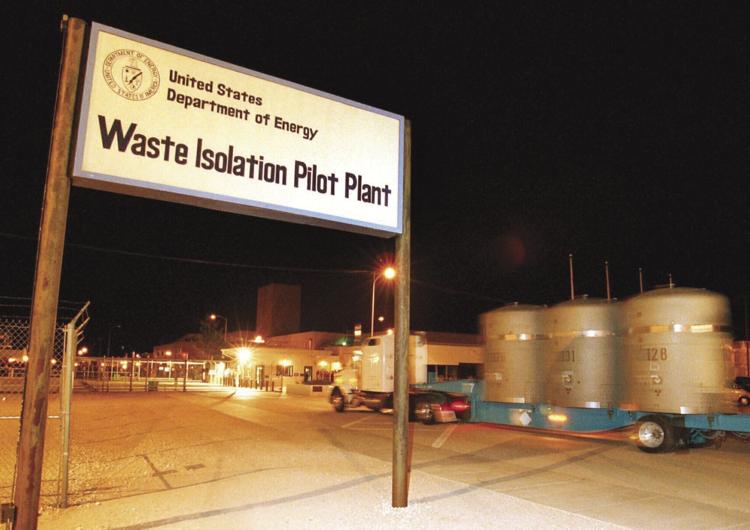
Recent monthly reports by the Defense Nuclear Facilities Safety Board relate disturbing stories about near-miss operational incidents in the fifth shaft, under construction, at the Waste Isolation Pilot Plant (WIPP). The underground federal radioactive waste disposal site is located 2,150 feet below ground surface in a salt formation almost 30 miles east of Carlsbad, New Mexico. The Board has reported broken cables, misaligned transport platforms for workers to reach the underground, and workers stuck in the new shaft. https://www.dnfsb.gov/
On November 20th, 2023, the third incident in that month occurred when a basket for transporting materials fell 2,150 feet down the new shaft. SIMCO, the management and operating contractor at WIPP, issued a formal stop work order to Harrison Western Shaft Sinkers JV, LLC, the subcontractor. Preliminary findings indicate the subcontractor did not implement formal controls for hoisting and rigging activities and allowed informal operator actions to take their place. https://www.dnfsb.gov/sites/default/files/document/29506/WIPP%20Monthly%20Ending%20November%202023.pdf and https://www.dnfsb.gov/sites/default/files/document/29776/WIPP%20Monthly%20Ending%20December%202023.pdf
The Shaft Sinkers hired a safety culture expert to make improvements to the operating practices and procedures. https://www.dnfsb.gov/sites/default/files/document/30376/WIPP%20Monthly%20Ending%20March%202024.pdf
More deficiencies in the @NuScale_Power standard design approval application
Ed Lyman (@NucSafetyUCS): More deficiencies in the @NuScale_Power standard
design approval application: @NRCgov staff are “unable to verify whether
the internal flood analysis has been performed to conclude equipment can
perform their safety function.”
USNRC 31st March 2024
Nuclear expert fears flooded radioactive dump sites in Siberia can threaten Arctic Ocean
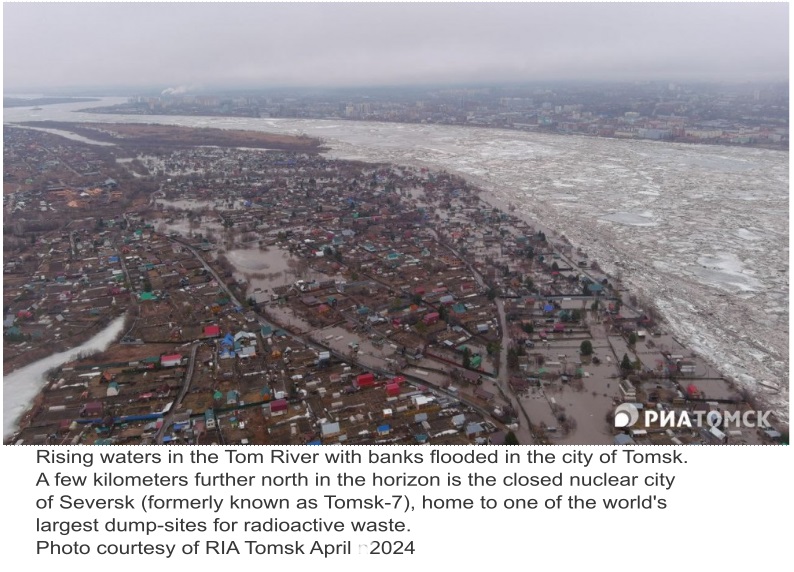
Floodwaters in Tomsk region threatens to submerge the river banks in Seversk where highly radioactive liquid waste from the Soviet Union’s nuclear weapons program for decades were injected into two unprotected underground reservoirs.
Water level on Monday continues to rise in the Tom River in Western Siberia.
The record floods are among the worst ever in the region and local emergency services help in evacuation of people living near tributaries of the Ob river system, including Tobol, Irtysh and Tom rivers.
Thousands of houses and tens of thousands of people live in the emergency zones, according to Kremlin information platform RIA Novosti. High snow falls in winter combined with swiftly rising spring temperatures and heavy rains are the reasons for the current extreme flood, Reuters reports.
Drone photos by RIA Tomsk shows how the swelling Tom River is inundating villages on the westside river banks. According to NEXTA news channel, water in Tom River has risen by nearly a meter over the day.
On the east side, a short 15 kilometers north of the city of Tomsk, is the closed city of Seversk. Until 1992, the secret city was code-named Tomsk-7 and was home to one of three production facilities for weapons-grade plutonium for the Soviet Union’s nuclear weapons program.
“There ain’t one single public message that Rosatom is monitoring the situation, that they have the situation under control,” says Aleksandr Nikitin, an exile nuclear safety expert working for the environmental foundation Bellona.
Nikitin was until the all-out war against Ukraine a member of Rosatom’s Public Council. The Council involved civic organizations and scientists in Russia and was aimed at raising public awareness of Rosatom’s core operations
“It’s surprising that there aren’t even simple statements like we have everything under control,” Nikitin adds.
According to the World Nuclear Association, the Siberian Chemical Combine in Seversk had five plutonium production reactors, an uranium enrichment plant and a processing plant for plutonium warheads. Although shut down, enormous amount of nuclear waste is still on site.
Most challenging are the liquid radioactive waste, both on the surface and pumped down in deep-well injections. The nuclear dump is likely Russia’s largest, by IAEA estimated to be 70 million cubic meters.
Widespread contamination in an area up to 28 kilometers came after a concrete cover blew off a reaction vessel at the plutonium extraction facility in 1993. The International Atomic Energy Agency (IAEA) listed it as a major radiological accident.
In 2000, a joint U.S.-Russian study found dangerous levels of radioactivity flowing into Russia’s Tom River from the Siberian Nuclear Combine.
Critics crumbled
Local environmentalists in Tomsk filed a lawsuit against the company in the late 1990s in an attempt to revoke a dumping permit for highly radioactive liquid waste down under. They feared for the city’s drinking water.
In Putin’s Russia, critical voices are gone. Environmental groups like Greenpeace, World Wide Fund for Nature, and Bellona are all listed as undesirable by law.
TV2 in Tomsk, known for its independent journalism and free debate since the early years after the breakup of the Soviet Union, got its broadcast shut down in 2014. After the start of the full-scale war in 2022, the reporters closed their YouTube producing newsroom and left Russia.
Aleksandr Nikitin is worried radioactivity could leak out to the river system under the current flood, but that information will not come before it is too late.
“Putin doesn’t give a fuck about these floods and other shitty lives of people in Russia.., he has a war and geopolitical goals of fighting the damned West,” Nikitin says.
For Rosatom, he adds, the logic is simple: “.. if you say that everything is under control, and then something happens, then you will have to answer for it.”
Nikitin says Rosatom is sure that in any case it will not bear any responsibility.
“Rosatom is today Putin’s “favorite child,” he explains.
It was Lavrenty Beria, director of Joseph Stalin’s secret police, who lead the establishment of the first plutonium production facilities east of the Ural mountains in the late 1940ties, early 1950ties. KGB and the Soviet nuclear establishment walked hand-in-hand for decades. What nowadays is Ulitsa Pervomayskaya (May 1st Street) in Seversk, was previously named Ulitsa Beria.
Arctic Ocean
A major concern for Aleksandr Nikitin and Bellona is that no one can exclude that leakages from a possible overflowed radioactive waste site could reach the Arctic Ocean.
Tom River is a tributary of the Ob which flows out in the Ob Bay and Kara Sea above the Arctic Circle.
During the years 1948-56, liquid radioactive waste from the Mayak reprocessing plant north of Chelyabinsk was discharged directly into the nearby river Techa which is connected to the river system Iset, Tobol, Irtysh and Ob. Especially Strontium-90, but also other isotopes, were carried by the water more than 2,000 kilometers downstream and measured in the Kara Sea, first time in 1951.
A joint Norwegian-Russian expedition to the Kara Sea in 1994 found traces of the same radionuclides, although in lower levels.
“Everything is now possible,” says Aleksandr Nikitin when seeing the photos of the flooded riverbanks of the Tom River.
“It all depends on the scale of leakages.”
“I’m sure the Siberian Chemical Combine sit quietly and wait. Hoping for it all to go over,” Nikitin says to the Barents Observer.
No Russian heavy weapons at Zaporozhye plant – IAEA boss
https://www.rt.com/russia/596018-no-heavy-russian-arms-zaporozhye/—16 Apr 24
Europe’s largest nuclear power plant was attacked by drones last week
Russia has not stationed heavy weapons at Zaporozhye Nuclear Power Plant, International Atomic Energy Agency (IAEA) Director General Rafael Grossi told reporters on Monday.
Moscow and Kiev have accused each other of shelling Europe’s largest nuclear plant, which sits close to the front line. Ukraine and its Western backers have also accused Moscow of using the facility as cover for its troops.
“There is no heavy weaponry there,” Grossi told reporters, after a UN Security Council meeting dedicated to the renewed strikes on the plant.
Although there are Russian “armored vehicles and some security presence at the plant,” IAEA monitors did not see any prohibited weapons, such as multiple rocket launchers, tanks, and artillery, Grossi explained.
He added that the IAEA does not have the mandate to determine which side has been attacking the facility, and argued that “indisputable evidence” is needed to establish who is responsible.
Addressing the Security Council, Grossi confirmed that Europe’s largest nuclear power plant was struck on April 7, which was the first direct attack on the site since November 2022. Inspectors have determined that the apex of the containment dome of the Unit 6 reactor building was hit, he added. “Whilst the damage to the structure is superficial, the attack sets a very dangerous precedent of the successful targeting of the reactor containment,” Grossi stressed, warning that “these reckless attacks must cease immediately.”
Russian UN Ambassador Vassily Nebenzia told the Security Council that Ukrainian forces have been “systematically” targeting the plant and surrounding areas. The Russian army has been “spotting and intercepting up to 100 drones per week,” Nebenzia added, insisting that Moscow has never placed heavy weapons at the facility or used the plant to stage attacks on Ukraine.
Officials in Kiev have denied striking the nuclear plant. “The position of Ukraine is clear and unequivocal: we are not conducting any military activities or provocations against nuclear sites,” Andrey Yusov, spokesman for Ukraine’s military intelligence, told national TV this month. Andrey Kovalenko, the head of the state-run Center for Countering Disinformation, has accused Moscow of spreading false information and “manipulating the IAEA.”
The agency said in its report this week that all of the facility’s six reactors are currently in cold shutdown. According to the plant’s management, only one reactor had been working since 2022 in order to keep the site operational. IAEA inspectors were deployed to monitor the facility in September 2022.
Theberton faces nightmare Sizewell C roadworks disruption
Fed-up villagers living along a B-road near Leiston have been left upset,
sleep-deprived and out of pocket after weeks of roadworks for Sizewell C. A
night-time operation to resurface the B1122 through Theberton and towards
Middleton between March 18 and April 10 left residents at the end of their
tether. Middleton Parish Councillor Charles Macdowell – who lives along the
road – said his house was shaking as they planed the surface of the road
and the noise kept him and his wife awake at night.
East Anglian Daily Times 15th April 2024
https://www.eadt.co.uk/news/24252702.theberton-faces-nightmare-sizewell-c-roadworks-disruption
Attacks on Ukraine’s nuclear plant put world at risk, IAEA warns
By Euronews with AP, 16/04/2024
https://www.euronews.com/2024/04/16/attacks-on-ukraines-nuclear-plant-put-world-at-risk-iaea-warns
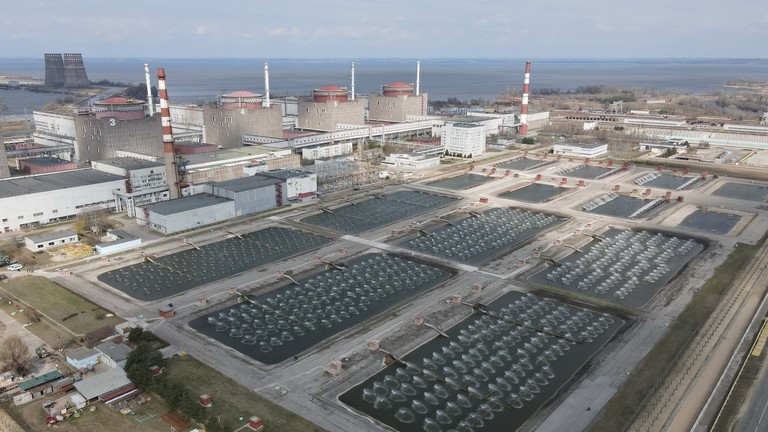
“We’re getting dangerously close to a nuclear accident,” IAEA Director General Rafael Mariano Grossi said following multiple attacks against the Zaporizhzhia Nuclear Power Plant in Ukraine.
The head of the International Atomic Energy Agency said attacks against Europe’s largest nuclear power plant have put the world “dangerously close to a nuclear accident”.
Without attributing blame, IAEA Director General Rafael Mariano Grossi said his agency has been able to confirm three attacks against the Zaporizhzhia Nuclear Power Plant since 7 April.
“These reckless attacks must cease immediately,” he told the Security Council on Monday. “Though, fortunately, they have not led to a radiological incident this time, they significantly increase the risk … where nuclear safety is already compromised.”
The remote-controlled nature of the drones that have attacked the plant means that it is not possible to determine who launched them, Grossi told reporters after the meeting.
“In order to say something like that, we must have proof,” he said. “These attacks have been performed with a multitude of drones”.
Zaporizhzhia sits in Russian-controlled territory in southeastern Ukraine and has six nuclear reactors.
Fears of a nuclear catastrophe have been at the forefront since Russian troops occupied the plant shortly after invading in February 2022. Continued fighting between Russian and Ukrainian forces – as well as the tense supply situation at the plant – have raised the risk of a disaster.
Ukraine and its allies on Monday blamed Russia for dangers at the site. Russia, for its part, said Ukraine was to blame for the attacks.
“The IAEA’s report does not pinpoint which side is behind the attacks,” Russia’s UN Ambassador Vassily Nebenzia said. “We know full well who it is.”
Safety probe at Cheshire-based nuclear cargo firm
By Sophie Zeldin-O’Neill, Senior Journalist, BBC News, 17 Apr 24
A company that transports uranium overseas has been told it must improve the safety of its operations.
Urenco UK Ltd (UUK), based in Capenhurst, Cheshire, had not made proper safety checks or made sure its shipments were correctly approved, industry watchdog the Office for Nuclear Regulation (ONR) said.
The problems were identified during inspections by the ONR.
UUK has until 31 May to comply with the improvement notice……………….
Nick Blackburn, principal inspector from ONR’s Transport Competent Authority, said all
companies involved in transporting radioactive materials needed to make
sure they were working within the law.
BBC 16th April 2024
An additional eight days for the annual outage of Olkiluoto 3 nuclear reactor due to new faults
An additional eight days for the annual outage of Olkiluoto 3. According
to the updated schedule, the annual outage of Olkiluoto 3 ends on April 28.
The reason for the additional eight days is the new faults found during the
outage and technical problems with inspection equipment. The annual outage
of OL3 started on March 2. Approximately 1,100 external professionals are
involved in the outage.
TVO 12th April 2024
https://www.tvo.fi/en/index/news/pressreleasesstockexchangereleases/2024/4795089.html
Zaporizhzhia Nuclear Power Plant: The ‘Sum Of All Fears’
Eurasia Review, , By IDN, By Leonam dos Santos Guimarães
Drone attacks on the Zaporizhzhia nuclear power plant, whether carried out by Ukraine or Russia, introduce a new and dangerous dimension to the conflict between the two largest former Soviet Socialist Republics, with possible far-reaching ramifications, not just for the region immediately surrounding the largest nuclear power plant in Europe, but also for all European Union countries and, more broadly, for the international community.
The biggest concern is the potential risk of a severe nuclear accident, which could have dire effects not only on Ukraine and Russia, but also on neighboring countries. The release of radioactive material knows no borders, and a contaminated cloud could spread across multiple nations depending on weather conditions, putting public health and the environment at risk on a significant scale.
The consequences of attacks on nuclear facilities are potentially severe and vast. A nuclear accident can result in the contamination of large areas, affecting land, water and wildlife, with lasting consequences for the environment and human health. It could also force mass evacuations of affected areas, creating humanitarian and refugee crises. In addition to the direct costs of cleanup and containment, a nuclear disaster can have a substantial economic impact on agriculture, land use, and public health.
Containing a leak at a nuclear power plant is a highly complex and challenging operation, depending on several factors. These include the type of damage to the reactor or other critical parts of the facility, as well as the amount and type of radioactive material released.
A plant’s ability to contain a leak depends on its design, existing safety systems, and how well those systems can handle the specific type of accident. The effectiveness of the immediate response, including confining the area, evacuating personnel, and implementing decontamination measures, is crucial to minimizing the impacts of a spill. The availability of technical, human, and financial resources to manage the situation is essential. This also includes international support, as seen after the Chernobyl accident and the Fukushima disaster.
Several factors
The scope of a nuclear accident in Europe will depend on several factors, including the direction and speed of the wind, which determine the dispersion of radioactive particles in the atmosphere, the amount of material released, which the greater the amount, the larger the area potentially affected, and the effectiveness of containment and decontamination measures, which can significantly limit the scope of contamination………………………………………………………….
The possibility that such attacks could trigger a third world war is a serious and plausible concern. An intricate web of military alliances, geopolitical interests and containment strategies influences the dynamics of the current conflict. Attacks against nuclear facilities are perceived as significant escalations of conflict. If considered acts of war, they may justify severe retaliation. The nature and extent of such retaliations would depend on many factors, including the international perception of the incident and the strategic decisions of major world powers.
The risk of a third world war
The involvement of NATO members providing support to Ukraine further complicates the situation. While NATO has been careful in its approach to avoid direct escalation with Russia, the line between support and direct involvement is fine and delicate. Preventing an escalation into a broader conflict will likely depend on intense diplomatic efforts and attempts at de-escalation by all parties involved……………………………………………….. https://www.eurasiareview.com/14042024-zaporizhzhia-nuclear-power-plant-the-sum-of-all-fears-oped/
Ukraine: Briefing on the Zaporizhzhia Nuclear Power Plant

On Monday afternoon (15 April), the Security Council will convene for an
open briefing under the “Threats to international peace and security”
agenda item. Slovenia and the US—the co-penholders on political issues in
Ukraine—supported by France, requested the meeting, which will focus on
the safety and security of the Zaporizhzhia Nuclear Power Plant (ZNPP) in
the city of Enerhodar.
It appears that Russia expressed approval for
holding the meeting, noting the alarming nature of the situation at the
nuclear power plant. International Atomic Energy Agency (IAEA) Director
General Rafael Mariano Grossi is the anticipated briefer. Ukraine is
expected to participate under rule 37 of the Council’s provisional rules of
procedure.
Security Council Report 12th April 2024
Towards an international regulatory framework for AI safety: lessons from the IAEA’s nuclear safety regulations
- Seokki Cha , Nature, Humanities and Social Sciences Communications volume 11, Article number: 506 (2024)
Abstract
This study explores the necessity and direction of safety regulations for Artificial Intelligence (AI), drawing parallels from the regulatory practices of the International Atomic Energy Agency (IAEA) for nuclear safety. The rapid advancement and global proliferation of AI technologies necessitate the establishment of standardized safety norms to minimize discrepancies between national regulations and enhance the consistency and effectiveness of these rules. The study emphasizes the importance of international collaboration and the engagement of various stakeholders to strengthen the appropriateness of regulations and ensure their continuous updating in response to the evolving risks associated with technological advancements.
The paper highlights the critical role of subgoal setting mechanisms in AI’s decision-making processes, underscoring their significance in ensuring the technology’s stability and social acceptability. Improperly tuned subgoal setting mechanisms may lead to outcomes that conflict with human intentions, posing risks to users and society at large. The study draws attention to the hidden risks often embedded within AI’s core decision-making mechanisms and advocates for regulatory approaches to guarantee safe and predictable AI operations. Furthermore, the study acknowledges the limitations of directly applying IAEA’s nuclear safety cases to AI due to the distinct characteristics and risks of the two fields.
The paper calls for future research to delve deeper into the need for an independent regulatory framework tailored to AI’s unique features. Additionally, the study emphasizes the importance of accelerating international consensus, developing flexible regulatory models that reflect the situation in each country, exploring harmonization with existing regulations, and researching timely regulatory responses to the fast-paced development of AI technology……………………………………………………………………………………………………. more https://www.nature.com/articles/s41599-024-03017-1
1 This Month

of the week – Shut Down Drone Warfare!


Tell the Ukrainian Government to Drop Prosecution of Peace Activist Yurii Sheliazhenko

Petition to revoke the licensing of the Near Surface Nuclear Disposal Facility (NSDF) at Chalk River. https://www.ourcommons.ca/petitions/en/Petition/Details?Petition=e-7247
To see nuclear-related stories in greater depth and intensity – go to https://nuclearinformation.wordpress.com
-
Archives
- April 2026 (103)
- March 2026 (251)
- February 2026 (268)
- January 2026 (308)
- December 2025 (358)
- November 2025 (359)
- October 2025 (376)
- September 2025 (257)
- August 2025 (319)
- July 2025 (230)
- June 2025 (348)
- May 2025 (261)
-
Categories
- 1
- 1 NUCLEAR ISSUES
- business and costs
- climate change
- culture and arts
- ENERGY
- environment
- health
- history
- indigenous issues
- Legal
- marketing of nuclear
- media
- opposition to nuclear
- PERSONAL STORIES
- politics
- politics international
- Religion and ethics
- safety
- secrets,lies and civil liberties
- spinbuster
- technology
- Uranium
- wastes
- weapons and war
- Women
- 2 WORLD
- ACTION
- AFRICA
- Atrocities
- AUSTRALIA
- Christina's notes
- Christina's themes
- culture and arts
- Events
- Fuk 2022
- Fuk 2023
- Fukushima 2017
- Fukushima 2018
- fukushima 2019
- Fukushima 2020
- Fukushima 2021
- general
- global warming
- Humour (God we need it)
- Nuclear
- RARE EARTHS
- Reference
- resources – print
- Resources -audiovicual
- Weekly Newsletter
- World
- World Nuclear
- YouTube
-
RSS
Entries RSS
Comments RSS
 nuclear-news