Criticism of NRC’s decision to reopen Davis Besse nuclear plant, despite the cracks
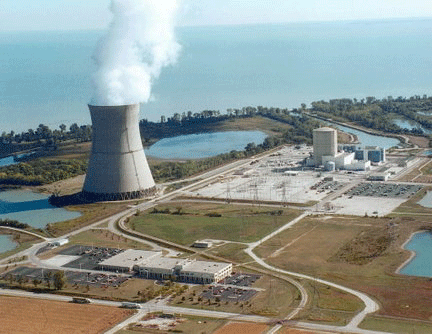 Ohio congressman criticizes decision allowing nuclear plant to reopen after concrete cracks, By Associated Press,Washington Post, December 5 TOLEDO, Ohio — A nuclear plant where cracks were found in protective concrete is being allowed to reopen despite unanswered questions about what happened, a congressman said Monday.
The U.S. Nuclear Regulatory Commission and operators of the Davis-Besse plant near Toledo don’t know what caused the cracks or whether it’s a bigger problem, said U.S. Rep. Dennis Kucinich, an Ohio Democrat who has been a longtime critic of the plant and its
owner…..
Since the discovery of the cracks, anti-nuclear activists have stepped up their opposition to renewing the plant’s license.
Davis-Besse’s license is set to expire in six years, and FirstEnergy has an application pending before the Nuclear Regulatory Commission to extend the operating license until 2037….
http://www.washingtonpost.com/business/industries/ohio-congressman-criticizes-decision-allowing-nuclear-plant-to-reopen-after-concrete-cracks/2011/12/05/gIQAdElRXO_story.html
New radioactive leak belies TEPCO’s claims of Fukushima cleanup success
 More Radioactive Water Leaks From Japanese Nuclear Plant, By HIROKO TABUCHI, NYT December 4, 2011 TOKYO — At least 45 tons of highly radioactive water has leaked from a purification facility at the Fukushima Daiichi buclear power station, and some of it may have reached the Pacific Ocean, the plant’s operator said on Sunday…..
the plant continues to pose a major environmental threat. Before the latest leak, the Fukushima accident had been responsible for the largest single release of radioactivity into the ocean, threatening wildlife and fisheries in the region, experts have said.
The new radioactive water leak called into question the progress that the plant’s operator, Tokyo Electric Power Company, appeared to have made in bringing its reactors under control…. Continue reading
Will Los Alamos plutonium nuclear lab be USA’s Fukushima?

 Questions swirl around $6 billion US nuclear lab Canadian Business, By AP | December 04, 2011 SANTA FE, New Mexico (AP) — At Los Alamos National Laboratory, scientists and engineers refer to their planned new $6 billion nuclear lab by its clunky acronym, CMRR, short for Chemistry Metallurgy Research Replacement Facility. But as a work in progress for three decades and with hundreds of millions of dollars already spent, nomenclature is among the minor issues.
Questions continue to swirl about exactly what kind of nuclear and plutonium research will be done there, whether the lab is really necessary, and — perhaps most important — will it be safe, or could it become New Mexico’s equivalent of Japan’s Fukushima? Continue reading
Move to legislate for safety regulation regarding Indian Point nuclear plant
“The Nuclear Regulatory Commission must have the ability and flexibility to quickly impose new regulations to safeguard the health and well-being of all Americans,” said Nadler. “Impeding the NRC’s ability to regulate will not save one job but might cost millions of lives….Indian Point Nuclear Power Plant lies less than 40 miles away from my New York City district, and there are 20 million people living within a 50-mile radius of the plant – the same radius used by the NRC as the basis for the evacuation zone recommended after the Fukushima disaster. Indian Point also sits near two fault lines and, according to the NRC, is the most likely nuclear power plant in the country to experience core damage due to an earthquake.”…. http://www.power-eng.com/news/2011/12/1554779024/rep-nadler-seeks-to-protect-new-yorkers-from-disaster-at-indian-point-nuclear-power-plant.html
All Japan’s nuclear reactors could be shut down by May 2012
Shutdown schedule for 9 active nuclear reactors, Reuters, 1 Dec 11“……..Kyushu Electric Power Co, one of the country’s most highly nuclear reliant regional power firms, on Thursday started regular maintenance on the No.1 unit at its sole Genkai nuclear plant, as planned, leaving only nine reactors online.
A total of 54 nuclear reactors had been available for commercial use before the March 11 earthquake and tsunami disabled cooling systems at Fukushima Daiichi, run by Tokyo Electric Power Co, triggering meltdowns and causing the world’s worst radioactive material leakage in 25 years.
No reactor shut for regular maintenance has restarted since the March 11 disaster amid public concerns over atomic energy and the government’s reassessment of safety regulations…… Without approval for restarts, all of Japan’s reactors could be shut by next May, …..
Following are the locations of nuclear power plants still in operation and the companies’ schedules for shutdowns. If the utility has not given a schedule, the dates by which each reactor has to be taken offline for maintenance are listed, according to Reuters calculations.:……. http://www.reuters.com/article/2011/12/02/us-nuclear-japan-active-idUSTRE7B104B20111202
Deliberate explosion damaged Iran’s uranium enrichment facility

 ‘Blast in Iran struck uranium enrichment facility’, By JPOST.COM STAFF AND YAAKOV KATZ, 11/30/2011 Satellite imagery confirms Isfahan facility rocked by blast was a
nuclear facility, ‘The Times’ reports, citing Israeli intel officials. Satellite imagery “clearly showing billowing smoke and destruction” has proven that an explosion Monday damaged a nuclear facility in the Iranian city of Ifsahan, according to aWednesday Times of London
report .
The report quoted Israeli intelligence officials as saying that there was “no doubt” that the blast damaged a uranium enrichment site, and asserted that it was “no accident.”
Officials from Isfahan have been denying that the city had been hit by an explosion. …http://www.jpost.com/Defense/Article.aspx?id=247560
Sabotage, assassinations, cyber attacks on Iran’s nuclear program
 Iran Nuclear Sabotage Suspected After Reports of Blasts at Atomic Centers, Bloomberg, By Ladane Nasseri – Nov 28, 2011 Reports of a blast in the province of Isfahan, home to one of Iran’s atomic facilities, adds to a series of unexplained incidents that have raised suspicions of sabotage against the country’s nuclear program. Continue reading
 India’s poor nuclear safety record
Koodankulam struggle: Western nations are learning from their mistakes, India is not The Weekend Leader, By Nityanand Jayaraman & Sundar Rajan, 30 Nov Chennai “………The claim that Indian nuclear plants are safe is contrary to the facts. Safety breaches in India’s nuclear establishments seldom come to light because of the shroud of secrecy surrounding the institutions. But what little we know gives serious cause for concern.
Just take the case of Kalpakkam. The following violations have come to light, including some that were acknowledged more than six months after the incident.
• 1987: A refuelling accident ruptured the reactor core
• 1991: Workers were exposed to radioactive heavy water
• 1999: 42 workers were exposed to radiation
• 2002: 100 kg of radioactive sodium was released into the environment
• 2003: 6 workers were exposed to high levels of radiation
Other very serious incidents have happened in other reactors. In November 2009, more than 55 workers at the Kaiga nuclear plant, Karnataka, were exposed to excessive levels of radiation when they drank water laced with radioactive tritium…. http://www.theweekendleader.com/Causes/833/Nuking-myths.html
Explosion near Isfahan, in Iran, possibly near nuclear centre
| Blast near Iran nuclear facility Gulf Daily News, , November 29, 2011 |
 TEHRAN: The sound of an apparent explosion was heard from Iran’s Isfahan city yesterday, Gholamreza Ansari, the head of the judiciary in the province said. An important Iranian nuclear facility involved in processing uranium is located near the city, although Iranian media reports did not say whether the explosion was near the nuclear centre. International Atomic Energy Agency spokeswoman Gill Tudor said the UN watchdog was aware of the reports but had no further information. TEHRAN: The sound of an apparent explosion was heard from Iran’s Isfahan city yesterday, Gholamreza Ansari, the head of the judiciary in the province said. An important Iranian nuclear facility involved in processing uranium is located near the city, although Iranian media reports did not say whether the explosion was near the nuclear centre. International Atomic Energy Agency spokeswoman Gill Tudor said the UN watchdog was aware of the reports but had no further information.
Iranian media provided contradictory information about the incident, which came less that three weeks after a massive explosion at a military base near Tehran that killed more than a dozen members of the Revolutionary Guard including the head of its missile forces…. http://www.gulf-daily-news.com/NewsDetails.aspx?storyid=318693 |
Nuclear power for India – neither safe nor necessary
 NUCLEAR EMERGENCY IN JAPAN: LESSONS FOR INDIA, Aid Netherlands, Shankar Sharma November 25, 2011 “…..While it is clear as to why Japan has put so much importance for the safety and reliability of its nuclear power plants (it is relying on its nuclear power industry for about 30% of its total electricity supply), can we assume similar checks and balances in India where the installed capacity of nuclear power is only about 2.8%?
In this background and with the potential for nuclear catastrophe our society has to seek answer to a credible question: whether the planned addition of more than 60,000 MW of nuclear power by 2031-32 (as per Integrated Energy Policy, IEP) is in the interest of our society?. It is also the high time that the proposed Jaitapur nuclear power park in Maharastra, and similar nuclear power parks in West Bengal, Andhra Pradesh and Gujarath are put to such a critical and objective analysis. A document by DAE (A Strategy for the Growth of Electricity in India: http://www.dae.gov.in/publ/doc10/index.htm) indicates the aspiration of the department to increase the nuclear power capacity to 274,560 MW by 2052. It is very unlikely that the huge risks involved in such a large number of nuclear reactors in the form of vast nuclear power parks can be acceptable to a densely populated and poor country like ours.
The other question that needs to be answered honestly is that in the backdrop of all the associated high risks, are nuclear power plants essential to our society? Can we not manage the legitimate demand for electricity from so many other benign options? …..http://www.nl-aid.org/continent/south-asia/nuclear-emergency-in-japan-lessons-for-india/
Japanese soldiers to enter Fukushima radiation zone
Once More Into the Breach, TIME by Kirk Spitzer , November 25, 2011 TOKYO – Japanese troops are being sent once again into the heart of the Fukushima radiation zone to battle contamination from the stricken nuclear power plant. Specially trained troops will enter the 20-kilometer (12.4 miles) exclusion zone around the plant next month to decontaminate abandoned government buildings and facilities…..
About 400 troops from the Ground Self Defense Force’s Central Nuclear Biological Chemical Weapon Defense Unit will be sent to Fukushima. They’ve been there before: Four members of the unit were injured in a hydrogen explosion at the plant on March 12. Several helicopter pilots and crew received large doses of radiation while dumping seawater on one of the damaged reactors.
The soldiers are expected to finish their work in about a month. No word on when, or if, all the contamination will be gone…… http://battleland.blogs.time.com/2011/11/25/once-more-into-the-breach/#ixzz1eqfdOOoZ
Earthquake risk to India’s planned huge Jaitapur nuclear plant
Jaitapur nuclear plant site not immune to earthquake: Experts Economic Times, 23 Nov 11 BANGALORE: Two leading geologists have warned that a magnitude 6-plus earthquake cannot be ruled out in Jaitapur – the proposed site of India’s largest 9,900 MW nuclear power plant on the west coast that has seen protests against it for safety reasons – and that it could occur within the lifetime of the power plant. Continue reading
Fukushima area – 5.9 magnitude earthquake
Magnitude-5.9 quake hits near Japan nuclear site, USA Today 24 Nov 11TOKYO (AP) – A strong earthquake struck Thursday morning near the Japan nuclear power plant hit by a powerful tsunami earlier this year. There were no immediate reports of damage or injuries.
The U.S. Geological Survey said the magnitude-5.9 quake struck shortly before 4:30 a.m. local time. It hit 62 miles (101 kilometers) east of the Fukushima Dai-ichi nuclear power plant. The quake struck at a depth of 23 miles (37 kilometers).
The quake struck 151 miles (244 kilometers) northeast of Tokyo. The Pacific Tsunami Warning Center did not immediately issue a tsunami alert. Similar quakes have struck in the region since a March 11 magnitude-9.0 earthquake…
The region lies on the “Ring of Fire” — an arc of earthquake and volcanic zones that stretches around thePacific Rim. About 90% of the world’s quakes occur in the region.http://www.usatoday.com/news/world/story/2011-11-23/japan-earthquake-1123/51372658/1
Japanese seismologist predicted nuclear earthquake disaster
Disregard for the science extended to a government panel started in 2001 to revise seismic engineering standards for Japan’s nuclear plants, said Ishibashi. He quit the panel after five years of debate that he called rigged and unscientific…..
an article on Hamaoka published in the October 1997 issue of Japan’s Science Journal that reads like a post-mortem of the Fukushima disaster: A major quake could knock out external power to the plant’s reactors and unleash a tsunami that could overrun its 6-meter
defenses, swamping backup diesel generators and leading to loss of cooling and meltdowns.

 Vindicated Seismologist Says Japan Still Underestimates Threat to Reactors, Bloomberg, By Jason Clenfield – Nov 21, 2011, Dismissed as a “nobody” by Japan’s nuclear industry, seismologist Katsuhiko Ishibashi spent two decades watching his predictions of disaster come true: First in the 1995 Kobe earthquake and then at Fukushima. He says the
government still doesn’t get it….
Haruki Madarame, now head of Japan’s Nuclear Safety Commission, from dismissing Ishibashi as an amateur when he warned of a “nuclear earthquake disaster,” a phrase the Kobe University professor coined in 1997. Ishibashi says Japan still underestimates the risk of operating reactors in a country that has about 10 percent of the world’s quakes. Continue reading
Danger of AREVA’s nuclear waste convoy from France to Germany
 If the radioactivity from the transport was dispersed in an accident or an attack, Areva would be discharged from almost all liability.
 Last Minute information – high-risk transport from France to Germany leaving one day early, 21 Nov 11 Transport of highly radioactive nuclear waste will again cross France from west to east, and part of Germany, exposing people and the SNCF agents to nuclear risks. Originally scheduled this Thursday, 24 November, the train from Valognes railway terminal has been advanced one day by AREVA and SNCF to try to avoid the huge mobilisation that is being prepared. The convoy should leave Valognes on Wednesday 23 at 14:36.The two routes planned by the authorities from Amiens remain unchanged, the convoy could head north towards Arras or south to Reims. Eleven containers carrying 301 barrels of high activity waste “re-treated” at the Areva plant in La Hague (Manche).
A rolling Chernobyl : Europe again under the threat of a nuclear convoy at high risk The official inventory of radioactivity in the transport amounted to 3756.5 peta becquerel (PBq) or 3.75 billion billion Becquerel of Becquerel. For comparison, the convoy will transport many times the radioactivity released during the Chernobyl disaster [i]. Scattered in the environment, the radio-toxicity potential [ii] this convoy would be enough to poison the whole human race [iii]. Continue reading
1 This Month





PLEASE OPPOSE HR 8255 AND S.3639 – bills would accelerate satellite deployment, with no environmental review or safeguards – https://ncstd5li.quorum.us/campaign/169331/
To see nuclear-related stories in greater depth and intensity – go to https://nuclearinformation.wordpress.com
-
Archives
- October 2026 (10)
- September 2026 (339)
- August 2026 (330)
- July 2026 (355)
- June 2026 (287)
- May 2026 (306)
- April 2026 (356)
- March 2026 (251)
- February 2026 (267)
- January 2026 (308)
- December 2025 (358)
- November 2025 (359)
-
Categories
- 1
- 1 NUCLEAR ISSUES
- business and costs
- climate change
- culture and arts
- ENERGY
- environment
- health
- history
- indigenous issues
- Legal
- marketing of nuclear
- media
- opposition to nuclear
- PERSONAL STORIES
- politics
- politics international
- Religion and ethics
- safety
- secrets,lies and civil liberties
- spinbuster
- technology
- Uranium
- wastes
- weapons and war
- Women
- 2 WORLD
- ACTION
- AFRICA
- Atrocities
- AUSTRALIA
- Christina's notes
- Christina's themes
- culture and arts
- Events
- Fuk 2022
- Fuk 2023
- Fukushima 2017
- Fukushima 2018
- fukushima 2019
- Fukushima 2020
- Fukushima 2021
- general
- global warming
- Humour (God we need it)
- Nuclear
- RARE EARTHS
- Reference
- resources – print
- Resources -audiovicual
- Weekly Newsletter
- World
- World Nuclear
- YouTube
-
RSS
Entries RSS
Comments RSS

