A crisis at Kursk?

IAEA chief, Rafael Grossi, duly went off to visit the Kursk site, to remind whoever is listening from either side that having a war around nuclear power plants is frightfully inconvenient when your agency is busy telling the world how safe the technology is and how badly we need more of it.
Linda Pentz Gunter, 2024 https://beyondnuclearinternational.org/2024/09/01/a-crisis-at-kursk/
The Russian war against Ukraine now threatens to envelop one of its own nuclear power plants, writes Linda Pentz Gunter
IAEA chief, Rafael Grossi, visited the threatened Kursk nuclear power plant in Russia last week, but continues to promote nuclear power expansion.
The trouble with nuclear technology, of any kind really, is that it depends on sensible and even intelligent decisions being made by supremely fallible human beings. The consequences of even a simple mistake are, as we have already seen with Chornobyl, catastrophic.
To add to the danger, nuclear technology also relies on other seemingly elusive human traits, beginning with sanity but also something that ought to be — but all too often isn’t —fundamentally human: empathy. That means not wanting to do anything to other people you wouldn’t want to endure yourself. But of course we see humans doing these things every day, whether at the macro individual level or on a geopolitical scale. We just have to look at events in Congo, Gaza, Haiti, Sudan; the list goes on.
And of course we cannot ignore what is playing out in Ukraine and now Russia. Because of the war there, dragging on since Russia’s February 24, 2022 invasion of Ukraine, we remain in a perpetual state of looming nuclear disaster.
Currently, the prospects of such a disaster are focused on Russia, where that country’s massive Kursk nuclear power plant is the latest such facility to find itself literally in the line of fire as Ukrainian troops make their incursion there in response to Russia’s ongoing war in their country.

But we cannot forget the six-reactor site at Zaporizhzhia in Ukraine either, embroiled in some of the worst fighting in that country, the plant occupied by Russian troops for more than two years and also perpetually one errant missile away from catastrophe.

Ukraine relies heavily on nuclear power for its electricity supply, with 15 reactors in all at four nuclear power plants, when all are fully operational. In 2023, even as the war raged around the nuclear sites, Ukraine was still providing a little over half of the country’s electricity from nuclear power.
Russia is far more dependent on natural gas, a product it also exports, and only draws just over 18 percent of its electricity needs from its estimated 37 reactors, situated at 11 nuclear sites.
There are also some fundamental technological differences between the Zaporizhzhia and Kursk nuclear power plants themselves. Kursk, like Zaporizhzhia, is also a six-reactor site, one of the three largest nuclear power plants in Russia. (Zaporizhzhia is not only the biggest nuclear power plant in Ukraine but also Europe’s largest.)
But while Zaporizhzhia is made up of six Russian VVER reactors, more akin to the pressurized water reactors used in the United States and much of Europe, the Kursk reactors are of the old Soviet RBMK design.
This is the same model as the Chornobyl unit that exploded in 1986, irradiating land across Ukraine, Russia, Belarus and much of Europe, contamination that persists in many areas today.
Alarmingly, because the Kursk RBMK reactors lack a secondary containment dome, they are even more vulnerable to war damage than Zaporizhzhia’s.
Furthermore, unlike Zaporizhzhia, where all six reactors are fully shut down — making a meltdown less likely but not impossible — two of Kursk’s reactors are still running. And the Russians have already told the International Atomic Energy Agency (IAEA) that they found the remains of a drone just over 300 feet away from the Kursk nuclear plant. Ukraine has of course denied responsibility for any attempted assault on the plant just as Russia has disavowed accusations it tried to attack the Zaporizhzhia nuclear site.
IAEA chief, Rafael Grossi, duly went off to visit the Kursk site, to remind whoever is listening from either side that having a war around nuclear power plants is frightfully inconvenient when your agency is busy telling the world how safe the technology is and how badly we need more of it.
However, like a helpless pre-school teacher with naughty toddlers, Grossi’s only recourse appears to be to tell both the Russians and Ukrainians repeatedly to stop. And since he can’t exactly take away their candy, and in fact has no “or else” to implement, they simply ignore him.
Most of us do still feel empathy for those whose lives we watch extinguished each night as ever more horrific news reports pour in from the countries where war and strife have become a seemingly endless and unstoppable ordeal.
Most of us don’t want another Chornobyl, either, for Ukrainians, for Russians or for anyone. And since we can’t rely on human beings to use nuclear power responsibly, this is one “toy” we have to take away.
Linda Pentz Gunter is the international specialist at Beyond Nuclear and writes for and edits Beyond Nuclear International. Her forthcoming book, Hot Stories. Reflections from a Radioactive World, will be published in autumn 2024.
Chernobyl Roulette by Serhii Plokhy review – gripping account of wartime chaos at Ukraine’s nuclear plant
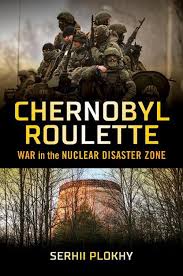
Luke Harding, Mon 2 Sep 2024, https://www.theguardian.com/books/article/2024/sep/01/chernobyl-roulette-by-serhii-plokhy-review-gripping-account-of-wartime-chaos-at-ukraines-nuclear-plant
The Ukrainian historian compellingly chronicles the singular courage and selflessness of atomic power station employees held hostage by Russian troops in 2022
Luke Harding, Mon 2 Sep 2024
On 24 February 2022, workers at the Chornobyl nuclear power station in Ukraine woke to the sound of explosions. A battle was going on, not far from the contaminated exclusion zone. By late afternoon, the Russians had arrived. A column of military vehicles pulled up at a checkpoint and an officer got out. Moscow, he said, was now in charge.
The plant’s 300 personnel – specialist operators and firefighters, plus troops from Ukraine’s national guard – became prisoners. Over the next few weeks, they kept the station’s systems going, working in cramped conditions and living side by side with their armed Russian masters. The enemy had invaded from Belarus. Its main force trundled onwards towards Kyiv.
Chernobyl Roulette by the Ukrainian historian Serhii Plokhy is a gripping account of the extraordinary events inside the plant (Plokhy spells the power station with an “e”). It is a tale of bravery and selflessness, reminiscent of the sacrifice demonstrated by the Chornobyl employees who went through the 1986 nuclear disaster, when reactor No 4 blew up. Some of those on duty in 2022 were involved in the original Soviet-era clean-up.
They included Valentyn Heiko, the 59-year-old shift foreman who was taken hostage with his colleagues. He proved to be a subtle and resilient leader. Heiko met the Russian commanders and told them they would have to follow Ukrainian safety rules and behave in a “civilised manner”. If they didn’t, he promised to unleash a radiation incident, killing them and everyone else. This was blackmail. And a bluff. It worked.
According to Heiko, some of the Russians were polite and rational. About a third of the soldiers, though, were brainwashed and often drunk. The occupiers moved into the fourth floor of the administration building. The station got crowded. There was a shortage of food, cigarettes and razors. The captive nuclear operators – unable to go home to the nearby town of Slavutych – grew beards and puffed on butts.
There were small acts of resistance. Liudmyla Kozak – one of 17 imprisoned women – refused a demand to wear a white armband. The Russians warned her she might be shot. Kozak found a white medical cap, embroidered it with a blue and yellow patch and wore that instead. An order was given to turn off the radio, which brought news of the Russian army’s setbacks around Kyiv. Staff switched it on anyway.
After three weeks, Heiko and his stressed and exhausted workmates could scarcely function. Astonishingly, 46 colleagues volunteered to replace them. The old shift exited the plant, travelled by bus through Belarus and crossed the Dnipro River in a fishing boat. Heiko carried the station’s Ukrainian flag with him. The new team went in the same way – uncertain if or when they would return.
The Kremlin’s occupation of the nuclear plant was an act of astounding recklessness. Soldiers dug trenches in the red forest, one of the world’s most toxic places. It is unclear if they suffered lasting health damage, their heads “full of sawdust”, as one gleeful Ukrainian official put it. Plokhy suggests this might be wishful thinking. Overall, though, radiation levels went up, as thousands of tracked Russian vehicles churned up deadly dust.
In the south of the country, meanwhile, another Russian unit captured the Zaporizhzhia nuclear power station, Europe’s biggest. The attackers fired rocket-propelled grenades at civilian infrastructure and damaged a reactor. Two and a half years on, the Russians are still there. Its turbine halls are stuffed with military kit and weapons. From the territory, they regularly bombard nearby Ukrainian towns with Grad missiles.
Last month, Russian soldiers started a fire in a cooling tower – an apparent warning, after Ukraine’s surprise counter-invasion of Russia’s Kursk region. Since the beginning of Moscow’s all-out attack, Vladimir Putin and his minions have issued a string of mass destruction threats directed at Kyiv and the west. State TV hosts talk about nuking London, Berlin and Paris.
The Chornobyl 2 story at least had a happy ending. On 30 March 2022, Russian servicemen fled north, as part of a pull-out from the Kyiv region. They departed with numerous items stolen from the plant: radiation dosimeters, computers and cars. In the town of Chornobyl, military looting parties carried off sacks of household goods. They even took ancient stuff: black-and-white TVs and video recorders.
The Ukrainian workers who put duty before personal survival narrowly averted another Chornobyl crisis. In Plokhy’s view, Moscow’s 2022 violent takeover of two atomic energy stations should serve as a “wake up call to the world”. It was, he argues, an act of nuclear terrorism carried out by a large nuclear power – a rogue one. The distinction between tactical nuclear weapons and civil nuclear facilities looks increasingly blurred, he says.
How the international community should respond to these alarming developments is less clear. Plokhy calls for a reform of the laws governing nuclear state behaviour and of the body that is supposed to administer them – the International Atomic Energy Agency (IAEA). When Russian tanks entered Chornobyl, the IAEA, led by Rafael Grossi, issued no condemnation of the Kremlin. Nor did it call on the occupiers to get out, appealing instead to “both sides”.
Plokhy is the author of several previous nonfiction books on Ukraine. These include Chernobyl: History of a Tragedy, which won the 2018 Baillie Gifford prize, and The Russo-Ukrainian War, an account of the conflict and its origins, published last year. Chernobyl Roulette is equally compelling. It salutes the singular men and women who stepped up – as their predecessors did before them – when protocols and governments failed.
Acid discharge and risk assessment shortfall at Cheshire nuclear-site
Companies on a nuclear site were served improvement notices following an
acid leak and a risk assessment shortfall. Watchdog, the Office for Nuclear
Regulation (ONR), told a tenant and contractor on the Urenco UK site they
must improve the safety of its operations.
It follows two separate and
unconnected issues on the site in Capenhurst, near Ellesmere Port, in May
and July which were investigated by ONR inspectors. The first improvement
notice was issued to Urenco ChemPlants, a tenant organisation on the site,
after acid was discharged from a pipework leak at the Tails Management
Facility in May.
Liverpool Echo 30th Aug 2024
https://www.liverpoolecho.co.uk/news/liverpool-news/toxic-acid-leak-nuclear-site-29831937
Fears of ‘serious consequences’ if ‘extremely exposed’ Russian nuclear plant is attacked.
Gergana Krasteva Aug 28, 2024, https://metro.co.uk/2024/08/27/extremely-exposed-russian-nuclear-plant-protected-just-normal-roof-21499930/
Fears of a nuclear accident are rising in western Russia weeks after Ukraine began its incursion there.
Russian president Vladimir Putin claimed a power plant came under fire, and the United Nations’ nuclear watchdog chief warned of heightened risk at the facility in the Kursk region.
International Atomic Energy Agency director general Rafael Grossi, who inspected the site outside the town of Kurchatov, said the reactor is ‘extremely exposed’ to attack and the consequences of a drone strike on the facility would be ‘extremely serious’.
He said the RBMK-type facility – the same model as Ukraine’s Chernobyl nuclear plant – is protected by ‘just a normal roof’.
Ukrainian troops currently control territory which is ‘the size of Los Angeles’ around the nuclear plant.
The site lacks the containment dome and protective structure typical of modern power plants.
‘The core of the reactor containing nuclear material is protected just by a normal roof,’ Grossi told a news conference earlier today.
‘This makes it extremely exposed and fragile, for example, to an artillery impact or a drone or a missile.
‘This is like the building across the street, all right? With all this nuclear material.’
Grossi continued: ‘There is no specific protection. And this is very, very important. If there is an impact on the core, the material is there and the consequences could be extremely serious.’
He added that during his visit of the plant he saw evidence of drone strikes in the area.
The Kremlin has accused Ukrainian forces of attacking the area around the plant, but the army has denied this.
‘I was informed about the impact of the drones. I was shown some remnants of them and signs of the impact they had,’ Grossi said, without actually saying who was responsible.
Despite the ongoing fighting, the nuclear facility is operating in ‘close to normal conditions’.
At the same time, the IAEA is monitoring the Ukraine’s Zaporizhzhia plant, which has been occupied by Russian forces since the start of the full-scale invasion.
Grossi will travel to Ukraine next week to meet with Volodymyr Zelensky about the situation at the facility.
The operation in Kursk, the largest incursion into Russia since World War II, has resulted in the occupation of about 500 square miles.
Putin has sent reinforcements into the region but it was not clear to what extent these movements might be weakening his position in eastern Ukraine, where his soldiers were making slow advances in efforts to gain ground in Kharkiv region.
Russia’s defence ministry said that Ukraine has suffered heavy casualties in Kursk – some 6,600 troops either killed or injured – and that more than 70 tanks have been destroyed along with scores of armoured vehicles.
Advocates for nuclear power should heed the lessons from Kursk
By Richard Broinowski, Aug 29, 2024, https://johnmenadue.com/advocates-for-nuclear-power-should-heed-the-lessons-from-kursk/
On 22 August, Rafael Grossi, director-general of the International Atomic Energy Agency, warned of the deadly effect a military attack on Russia’s nuclear power complex at Kursk would have on civilian communities in Russia, Ukraine and potentially across Europe. He had previously warned of the consequences of such attacks on Ukraine’s nuclear reactors at Zaporizhzhia.
The Kursk nuclear complex is approximately 30 kilometres from a fluid military situation between invading Ukrainian forces and Russian defenders. The complex has six Russian designed RBMK reactors, the same type as at Chernobyl. Two are shut down, two are in construction mode, and two are hot. None have protective domes. The easiest and most effective military action would be destruction of the complex’s power supply, which as with flooded generators at Fukushima, would halt cooling pumps, overheat the reactors, cause a melt-down of fuel rods, and the uncontrolled venting of radioactive materials into the atmosphere.
People have short memories, and tend to forget the dimensions of previous nuclear disasters and near disasters, particularly at Windscale, Three Mile Island, Chernobyl and Fukushima. Chernobyl was arguably the worst, followed closely by Fukushima. At Chernobyl, reactor number four exploded, not due to military action, but an experiment by Russian engineers to see how long turbines would spin and supply power to cooling pumps if the reactor’s main electric supply failed. In the reactor, the collision of incandescent nuclear fuel with cooling water created an explosion which blew apart the reactor vessel and spread radioactive dust including xenon gas, short-lived Iodine 131 (eight days) and Caesium 137 (30 years) across much of Ukraine and Belarus, as well as parts of Russia, and Scandinavia. The nearest town of Pripyat was evacuated and a no-go zone of 30 kilometre radius, later expanded to 4,300 square kilometres, was declared.
Subsequent reports by the UN Scientific Committee on the Effects of Atomic Radiation found that immediate deaths caused by radiation from Chernobyl could be calculated, most certainly deaths from thyroid cancer, but not of long-term stochastic deaths. The precise number is unknown and there are wildly different estimates, including among the medical profession. Because of fears about radiation damage to foetuses, over one million abortions were performed across Europe in the year following the disaster.
And now, two warring countries dice with death over Zaporizhzhya, Europe’s largest nuclear power complex and one of the 10 largest in the world. Most recent attacks occurred between 2022 and 2024. Fighting in 2022 led up to Russia wresting management of the complex. While it was going on, a large calibre bullet pierced the outer wall of reactor number four and an artillery shell hit a transformer in reactor number six.
In April 2024, the IAEA reported the plant was attacked by a swarm of drones, three of them torching surveillance and communication equipment. There were three direct hits on containment structures. On 11 August, fire broke out in one of two cooling towers. Zelensky blames Putin for the attacks, Putin blames Zelensky. Putin is probably right. Why would Russia attack the complex it now managed? Both tend to downplay the disastrous consequences an attack on the reactors or their electricity and cooling systems would have on civilian populations across Europe. They would be similar if not worse than the results of the Chernobyl fiasco.
Although badgered by journalists following his 22 August address, Grossi refused to attribute blame for the attacks at Zaporizhzhia and who might initiate them at Kursk. He said the IAEA was not a political organisation, and blame would be up to the UN Security Council. He would not get into speculation. When pressed, however, he said if his investigations led to clear evidence of the perpetrators, he would call them out. Meanwhile, he was about to go to Kursk and examine the situation in conjunction with the managers and engineers of the nuclear complex there. He then planned to separately see both Putin and Zelensky.
What the whole situation should bring home to Australian politicians and their backers in the nuclear industry, who so blithely recommend the construction of a dozen-odd nuclear reactor complexes here, is the widespread lethal damage a kinetic attack on any one of them would cause in this country. We already see that US military and surveillance installations would become natural targets for China if ever war breaks out over Taiwan. Nuclear reactors would pose a much wider damage to the civilian population.
Central Japan nuclear reactor fails to pass safety review
Tsuruga plant’s No. 2 reactor may lie above active fault in Fukui, watchdog says
https://asia.nikkei.com/Business/Energy/Central-Japan-nuclear-reactor-fails-to-pass-safety-review— 28 Aug 24
TOKYO (Kyodo) — Japan’s nuclear watchdog on Wednesday decided that a reactor in Fukui Prefecture failed to pass its restart safety review, marking the first such case since the regulatory body’s founding after the 2011 Fukushima nuclear crisis.
The No. 2 reactor at the Tsuruga plant, operated by Japan Atomic Power, fell short of the safety requirements due to a possible active fault underneath the offline unit. The Nuclear Regulation Authority plans to seek public comments on its assessment report before making its decision official, possibly in October.
In quake-prone Japan, building reactors or other important safety facilities directly above active faults is prohibited.
Japan Atomic Power first applied for the safety screening with the hope of restarting the reactor in November 2015.
But a safety review team of the NRA concluded in July it could not rule out that an active fault located around 300 meters north of the reactor building could potentially stretch right beneath the facility.
The assessment process for the reactor had been rocky, with proceedings suspended twice after it was revealed that Japan Atomic Power had submitted documents that included inaccuracies and data rewritten without approval. It reapplied in August last year.
The Tsuruga nuclear plant is a two-unit complex, with the No. 1 reactor set to be scrapped.
The No. 2 reactor, which started commercial operations in February 1987, went offline in May 2011.
Japan revamped its regulatory setup by launching the NRA in 2012 and has also introduced a set of new safety requirements to reflect the lessons learned from the disaster at Tokyo Electric Power Co. Holdings’ Fukushima Daiichi plant, triggered by a huge earthquake and tsunami in March 2011.
Russia says UN watchdog must be ‘more objective’ after trip to nuclear plant near fighting

By Reuters, August 28, 2024
MOSCOW, Aug 28 (Reuters) – Russia said on Wednesday it wanted the International Atomic Energy Agency to take a “more objective and clearer” stance on nuclear safety, a day after the agency head visited a Russian nuclear plant near where Ukraine has mounted an incursion into the country.
Separately, Russia said its forces had defused unexploded U.S.-supplied munitions fired by Ukraine that were shot down just 5 km (3 miles) from the Kursk nuclear plant.
IAEA chief Rafael Grossi toured the Kursk facility on Tuesday and warned of the danger of a serious nuclear accident there. He said he had inspected damage from a drone strike last week, which Russia had blamed on Ukraine, but did not say who was responsible.
Russian state news agency RIA quoted Foreign Ministry spokeswoman Maria Zakharova as saying in a radio interview that Moscow wanted the IAEA to speak out more clearly on issues of nuclear security, although she denied it was demanding that the agency take a pro-Russian line.
“We see both the assessments and the work of this structure (the IAEA), but each time we want a more objective and clearer expression of the position of this structure,” Zakharova said.
“Not in favour of our country, not in favour of confirming Moscow’s position, but in favour of facts with one specific goal: ensuring safety and preventing the development of a scenario along a catastrophic path, to which the Kyiv regime is pushing everyone.”
The IAEA could not immediately be reached for comment…………………………
Ukraine has not responded to Russian accusations that it attacked the plant near where its forces launched a surprise incursion on Aug. 6 that Russia is still trying to repel. There has been fighting about 40 km (25 miles) from the facility.
Russia’s National Guard said in a statement on Wednesday that its sappers had found a shell from a U.S.-supplied HIMARS multiple launch rocket system 5 km from the plant, and a rocket fragment which it said was stuffed with 180 unexploded munitions.
There was no immediate comment from Ukraine on the purported Russian find, and Reuters could not independently verify the location of the video.
Grossi said during his visit that the plant, built to a Soviet design, was especially vulnerable because – unlike most modern nuclear power stations – it lacked a containment dome that might offer protection in the event of a strike by drones, missiles or artillery………………………. https://www.reuters.com/world/europe/russia-criticises-un-nuclear-watchdog-after-trip-plant-close-fighting-2024-08-28/
UN fears nuclear incident possible at Russia’s ‘vulnerable’ Kursk plant after drone strikes
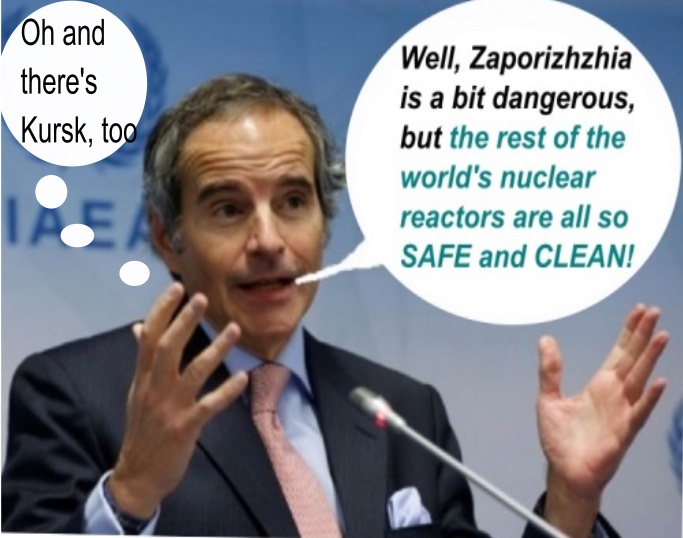
International Atomic Energy Agency raises the alarm about the Kursk plant’s vulnerable nuclear reactor as war rages nearby.
August 27, 2024 By Csongor Körömi https://www.politico.eu/article/un-international-atomic-energy-agency-rafael-grossi-nuclear-incident-russia-kursk-plant-drone-strikes-war-in-ukraine/?fbclid=IwY2xjawE7xONleHRuA2FlbQIxMQABHYsv1ZIaZ4vYeP7K4rKYHQMLy03ZNTz8FBhh11Vv7C3OjzmKz-vJZUlyQA_aem_UFL5Vx9yHAwB2AVR6omFyA
The United Nations’ nuclear watchdog chief warned on Tuesday of heightened risk at the nuclear power plant in Kursk, Russia, where Ukraine has been conducting a military counteroffensive.
International Atomic Energy Agency Director General Rafael Grossi led the mission to the nuclear site after Russian President Vladimir Putin claimed it came under fire following Ukraine’s incursion into the region. Kyiv has denied accusations that it targeted the plant.
“The danger or the possibility of a nuclear accident has emerged near here,” Grossi told reporters, according to Reuters. He added that during his visit of the plant he saw evidence of drone strikes in the area.
“I was informed about the impact of the drones. I was shown some of the remnants of them and signs of the impact they had,” Grossi said, without saying who was responsible.
He warned that the nuclear reactor at the Kursk plant doesn’t have a protective dome, unlike most nuclear facilities, making its core very vulnerable to artillery or drone strikes.
“The core of the reactor containing nuclear material is protected just by a normal roof, he said during his visit. “This makes it extremely exposed and fragile, for example, to an artillery impact or a drone or a missile.”
“A nuclear power plant of this type, so close to a point of contact or a military front, is an extremely serious fact that we take very seriously.”
Despite the ongoing conflict, the power station is operating “in very close to normal conditions,” according to Grossi.
“My message is the same for everyone: no nuclear accident can happen. It is our responsibility to make sure of that,” Grossi said at the news conference, adding that the agency won’t take sides in the Russian-Ukrainian war. “This conflict, this war, is not the responsibility of the IAEA.”
The war that reignited following Russia’s all-out military assault on Ukraine, now in its third year, has been fraught with nuclear risks, with numerous instances of nuclear weapon saber-rattling and recklessness near energy-generating nuclear facilities.
After the start of the conflict, Grossi worked to establish five principles to be respected by both Russia and Ukraine to ensure nuclear safety and avert an atomic catastrophe.
Russia captured Ukraine’s Zaporizhzhia nuclear plant at the start of its invasion and has repeatedly endangered the plant’s safety, drawing condemnation from Grossi.
Grossi will travel to Ukraine next week to meet with President Volodymyr Zelenskyy and discuss “a number of things,” including the situation at the Zaporizhzhia nuclear plant and the presence of IAEA experts at other sites in Ukraine.
The effects of world’s worst nuclear disaster in Chernobyl, Ukraine, in the 1980s are still felt to this day. Hundreds of thousands of square kilometers of land in Russia, Belarus and Ukraine were contaminated, and an area of around 30 kilometers around the plant remains essentially uninhabitable. Soviet authorities initially denied the scale of the disaster.
Sellafield Ltd told to improve after hazardous substance breaches
Sellafield Ltd has been handed two improvement notices after hazardous
substance control breaches. The Office for Nuclear Regulation has served
the notices after breaches of The Control of Substances Hazardous to Health
Regulations 2002.
Enforcement action was taken after Sellafield Ltd failed
to manage the risks of working with nickel nitrate and to prevent or
adequately control exposure of workers to this hazardous substance in one
of its effluent facilities. These shortfalls did not compromise either
nuclear or radiological safety. Used in the treatment of effluent, nickel
nitrate is not radioactive, but is a hazardous substance and could cause
harm to the health of a worker exposed to it.
To mitigate these risks,
operations involving the chemical should be conducted in a glovebox to
protect workers from any harmful health effects. In one facility on site,
contamination was found outside the glovebox area, which resulted in
workers potentially being exposed to the chemical. A poorly designed and
maintained glovebox appeared to have contributed to the contamination.
Cumbria Crack 27th Aug 2024
Nuclear power risks rising in Russia-Ukraine war
Dr Philip Webber, SGR, warns that another nuclear power plant is at major risk as the war enters new territory.
Responsible Science blog, 22 August 2024 more https://www.sgr.org.uk/resources/nuclear-power-risks-rising-russia-ukraine-war—
The Russia-Ukraine war has already led to extremely serious risks to nuclear power plants. In a previous article, [1] I described in some detail those related to the Zaporizhzhia nuclear power plant (ZNPP) in Ukraine. The situation there has once again deteriorated – as I discuss below – but I want to focus first on the threat to another power station.
Kursk
Due to the Ukraine military incursion into the Kursk region of the Russian Federation, which began on 15 August, [2] there is now a severe risk to the huge Kursk nuclear power plant (KNPP) – which has elements in common with the Chernobyl plant. The KNPP is located some 60 kilometres from the border with Ukraine and is, at the time of writing, close to an area of fierce fighting. As a result, the International Atomic Energy Agency (IAEA) has issued further warnings to remind the warring parties to not risk a nuclear disaster in Europe. [3][4]
The KNPP – like the ZNPP – includes six nuclear reactors, and is also one of the three biggest nuclear power stations in Russia. But there are two critical differences. First, two of the KNPP reactors are operating at full power. Second, these two reactors are of the same design – the RBMK – as the Chernobyl nuclear plant, which suffered the world’s worst nuclear accident in 1986. Crucially, these reactors have no protective dome structure [5] making them very vulnerable to a military strike or aircraft impact. With intense fighting only a few tens of kilometres away, both reactors are well within the range of artillery or rocket fire. A military strike on either reactor could initiate a very serious release of radioactive material creating a Europe-wide nuclear disaster.
It is anticipated that the IAEA will soon visit the Kursk NPP to assess the situation on the ground.
Zaporizhzhia
Returning to the situation at the Zaporizhzhia NPP, IAEA inspectors stationed there have again reported intense military activity – artillery, rocket and heavy machine-gun fire – very close to the plant, and several instances of explosive drone strikes on the plant itself, as well as on vital electrical substations and surrounding woodland. [6] One of the two ZNPP cooling towers was hit, fires were started beside an electrical sub-station resulting in a loss of power, and the perimeter road was cratered.
The six ZNPP reactors are all in ‘cold shutdown’ but rely on a supply of electricity to power pumps for water cooling of the reactor cores – and a large number of spent fuel storage tanks – to prevent overheating to dangerous levels and a resultant release of radioactive material. The reliable supply of water remains a serious problem and emergency supplies of fuel for emergency diesel generators are also dangerously low.
Drone attacks also continue to be reported near Ukraine’s other nuclear power sites. [7]
The IAEA Director General, Rafael Grossi, has issued a series of warnings reminding both Russia and Ukraine of UN agreements to avoid military activity at or near nuclear plants. [8] However, the only way to remove these risks completely is for a rapid, negotiated end to the war.
Dr Philip Webber is Co-chair of Scientists for Global Responsibility. He has written widely on the risks of nuclear weapons and nuclear power – including co-authoring the book, London After the Bomb. He spent part of his career working as an emergency planner in local government.
References………………………………………………..
Rafael Grossi to visit Kursk nuclear power plant in Russia , following reports that remains of a drone were found there
https://www.world-nuclear-news.org/Articles/Grossi-plans-visit-to-Kursk-plant, 23 Aug 24
Russian authorities informed the IAEA that the drone fragments were located roughly 100 metres from the plant’s used nuclear fuel storage facility. The IAEA said it was told that the drone was “suppressed” in the early morning of 22 August.
Grossi has confirmed his intention to personally assess the situation at the site during his visit next week. During his visit, he will “discuss modalities for further activities as may be needed to evaluate the nuclear safety and security conditions of the Kursk nuclear power plant.”
“Military activity in the vicinity of a nuclear power plant is a serious risk to nuclear safety and security,” Grossi said. “My visit to KNPP next week will provide us with timely access to independently assess the situation.”
On 9 August, the IAEA said it was monitoring the situation after Ukrainian forces advanced 30 kilometres into Russia’s Kursk region, bordering Ukraine. They had reportedly advanced within 50 kilometres of the Kursk nuclear power plant.
The report of a drone at the Kursk plant comes just days after a drone struck on a road near the perimeter of the Russian-held Zaporizhzhia nuclear power plant in Ukraine. On 17 August, an explosive carried by a drone detonated just outside the plant’s protected area, close to the cooling water sprinkler ponds and about 100 metres from the Dniprovska power line, which is the only remaining 750 kilovolt line providing external power supply to the plant.
Recent days have seen a fire in one of the cooling towers at the Zaporizhzhia plant and damage to a power and water substation in nearby Energodar, where many of the nuclear power plant workers and their families live.
The six-unit Zaporizhzhia nuclear power plant – or ZNPP – is Europe’s largest nuclear power plant, has been under Russian military control since early March 2022. It is close to the frontline between Russian and Ukrainian forces.
Ukraine and Russia each accuse the other side of putting nuclear safety at risk and breaching the IAEA’s central safety principles for nuclear facilities. Grossi explained at the United Nations in April that the IAEA would not attribute blame without “indisputable proof” and said the agency aims to “keep the information as accurate as we can and we do not trade into speculating”.
Fluid leak forces rail shipment to return to the San Onofre nuclear power plant

Federal regulator says the leak had “low safety significance” but Southern California Edison officials admit it should not have happened.
By Rob Nikolewski | rob.nikolewski@sduniontribune.com | The San Diego Union-Tribune, August 21, 2024
A pair of dismantled pressurizers that departed the San Onofre Nuclear Generating Station by rail had to be returned to the now-shuttered power plant after it was discovered that one of the giant pieces of equipment had leaked fluid during the trip.
Surveys conducted by the plant’s operator, Southern California Edison, said “no detectable radioactivity” above otherwise normal background levels was detected and there was “no threat to public health and safety, or the environment.” But an official with the utility admitted to the Union-Tribune, “that should not happen.”
An inspection from the U.S. Nuclear Regulatory Commission found two violations but the federal regulator’s report described the “safety significance” of the infractions as “low.”
The NRC’s inspection report made no mention of issuing any fines.
But Edwin Lyman, director of nuclear safety at the Union of Concerned Scientists, suspects the NRC’s report does not reflect “the severity of (Edison and its contractor’s) screw-up.”
“They had one job to do, which was to transport this pressurizer without any (free) liquid in a container that couldn’t leak,” Lyman said. “And they missed on both counts.”
……………………………What happened?
The San Onofore Nuclear Generating Station, known as SONGS for short, is in the midst of a massive $4.7 billion decommissioning and dismantlement project that is scheduled to wrap up by the end of 2028.
During the course of the demolition, about 1.1 billion pounds of material is expected to be removed, with most of it going by rail. More than 1,000 rail shipments originating from a spur built at SONGS have left the site since dismantlement efforts began some four years ago.
In late June, two large pressurizers were loaded onto special rail cars, on their way to a disposal site in Clive, Utah.
When a nuclear power plant is in operation, pressurizers control reactor coolant systems that use demineralized pure water to remove heat from the reactor core and allow steam to power turbine generators.
The SONGS Unit 2 and Unit 3 pressurizers are big — 37 feet tall and weighing about 100 tons each, with capacity to regulate 16,500 gallons of liquid.
After they were taken out, the pressurizers were labeled as Class A waste, which is the lowest level of radioactive waste as classified by the NRC.
At a stop at a railyard in San Bernardino, a worker noticed a water leakage on the top of the flatbed railcar hauling the Unit 2 pressurizer. SCE officials said the water did not drip onto the ground.
No leaks were found in the Unit 3 pressurizer but both were sent back to SONGS to find out what happened.
Although each pressurizer was supposed to be completely drained, it was soon discovered that 190 gallons of water was found at the bottom of the Unit 2 pressurizer.
“Workers incorrectly believed” all the water had been drained out of the pressurizer before it was loaded onto the rail car, Pontes said.
What now?
An ongoing investigation is trying to determine what went wrong. Until then, the pressurizers from both units will not be rescheduled for shipment back to Utah.
The NRC noted two violations — one for failing to ensure the pressurizer was “properly closed and sealed to prevent release of radioactive content” and the second for not properly packaging it for shipment.
Pontes said the NRC findings are being reviewed by SCE, the dismantlement’s general contractor (called SONGS Decommissioning Solutions) and workers at the facility. “We remain committed, in our oversight role, to ensuring safety and adherence to all regulatory material packaging requirements,” he said.
But Lyman questioned whether the NRC’s actions amounted to a “slap on the wrist.”
“When they process these violations through their system and it spits out ‘low-safety significance,’ I don’t feel it conveys the gravity of the two violations, when compounded, led to a release of this liquid,” Lyman said. “It could have been worse, presumably.”
Other incidents
First opened in 1968, SONGS has not produced electricity since 2012 after a leak in a steam generator tube led to its closing.
In August 2018, a 50-ton canister filled with radioactive spent fuel was being transferred to a dry storage facility on the north end of SONGS. While being lowered into a cavity, the canister was accidentally left suspended almost 20 feet from the floor.
Eventually, the canister was safely lowered but the NRC later fined Edison $116,000 and chided the company for failing “to establish a rigorous process to ensure adequate procedures, training and oversight guidance.”
In April 2022, demolition work was briefly halted after a worker fell about five feet while trying to install a ventilation hose into the floor vault opening, injuring his shoulder.
Once the dismantlement project wraps up, all that is expected to remain at SONGS will be two dry storage facilities; a security building with personnel to look over the waste; a seawall 28 feet high, as measured at average low tide at San Onofre Beach; a walkway connecting two beaches north and south of the plant, and a switchyard with power lines.
The switchyard’s substation without transformers stays put because it houses electricity infrastructure that provides a key interconnection for the power grid in the region. https://www.sandiegouniontribune.com/2024/08/21/fluid-leak-forces-rail-shipment-to-return-to-the-san-onofre-nuclear-power-plant/?fbclid=IwY2xjawE3ZUdleHRuA2FlbQIxMQABHapLLh1xKud7eOWCb9iO4yGGQxJgVZFSJhbgWcw92LLlNek-XIz_bl-r_g_aem_TD76JCKRAQE_2TARdViWEw
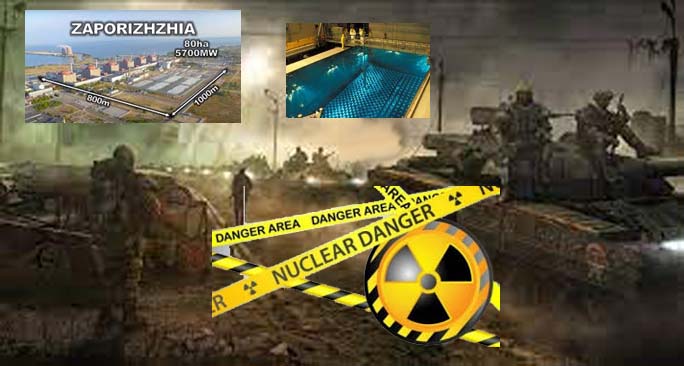
Fire at Zaporizhzhia elevates meltdown risk
13 Aug 24, https://cnduk.org/fire-at-zaporizhzhia-elevates-meltdown-risk/
CND scientific advisor, radiation expert Dr Ian Fairlie writes about the elevated risks posed by the recent fire at the Zaporizhzhia nuclear plant.
The recent fire at the Russian-occupied Zaporizhzhia nuclear plant in Ukraine is causing much concern throughout Europe.
Ukraine’s nuclear energy company, Energoatom, which operated the site until Russian forces seized control in the early days of the war, confirmed that flames broke out at the service water supply facility, later engulfing one of the cooling towers. Both Vladimir Putin and Volodymyr Zelensky have traded blame for the fire. The six nuclear reactors at Zaporizhzhia are in cold shutdown and no nuclear activity was recorded on Sunday August 11, but the overall risk of nuclear meltdown remains elevated.
In 1986, the huge nuclear accident at the Chornobyl nuclear station in Ukraine resulted in radioactive fallout throughout Europe including all of the UK.
Ideally, the UK government should make arrangements to pre-distribute prophylactic iodide tablets (to protect against thyroid cancer) to all individuals who wish them, as occurs in many countries, but it has resisted previous calls for this. Current UK official advice on iodide tablets merely states “you will be given official advice from government or emergency services on how to get them, when to take them and how much to take”.
In the absence of timely official UK advice, readers may wish to consult official US advice or the WHO’s advice.
‘Very serious’ nuclear situation could happen ‘at any moment’ in Ukraine, says IAEA chief
Cathy Newman, Presenter 4 News 20 Aug 24
We spoke to Rafael Grossi, Director General of the International Atomic Energy Agency.
Cathy Newman: Let’s start with Zaporizhzhia, because earlier you said that safety was deteriorating there after this drone strike. How critical would you say it is?
Rafael Grossi: Well, we could have a very serious situation any moment. Because when you see the amount of military activity surrounding the plant………………………….The physical integrity of the facility is being challenged. So, this is why we say that what we see is a deterioration. The condition of the plant, I should say, is that it’s not producing energy at the moment, is in jargon what we call shut down. But there’s a lot of material there, a lot of nuclear material there. There’s a lot of spent fuel there. Fresh fuel. So, things that if impact could trigger the release of radioactivity.
Cathy Newman: So the risk has been minimised, but it hasn’t been removed, clearly. I mean, in theory, another Chernobyl is possible?
Rafael Grossi: ………………………………………… I would say, as I was just mentioning, you have all of this material around and you could have a situation theoretically where because of the loss of external power, which has occurred, we had nine episodes of complete blackouts of the plant. So no cooling function. So if you lose all that, you could eventually have a meltdown.
Cathy Newman: So it’s perilous, clearly. I wonder whether you think the risk of the Kursk plant, ……………. Russia is now fortifying around that plant. I mean, is that potentially more risky because it’s a much more volatile situation.
Rafael Grossi: It is certainly serious and we should take it very, very seriously. We are taking it, the agency at the IAEA, very, very seriously. This nuclear power plant is, I would say, within artillery range already. You have just informed that the incursion of the Ukrainian troops, is a few miles, a couple dozen kilometres into Russian territory and just a few miles, in kilometres is about between 20 and 30 km from the plant itself. And there is a technical aspect here. You were just mentioning Chernobyl. The reactors here, you have six reactors in Kursk. You have two reactors that are being decommissioned. You have two reactors that are operating. No shutdown, operating when you have hot reactors. Anything that could happen there could be maximised in this sense.
And then two other units being built. The two reactors that are operating are of a type called RBMK, which is exactly the type of reactors, an old model type of reactor was the one, like the ones that were in Chernobyl. These reactors have a particularity. Normally when you look at a nuclear reactor is a dome. There is a concrete and metal protection. These two reactors don’t have that, don’t have any of that. The core of these reactors is open. Is like, as if you were here and you could see the fuel elements there. So, God forbid, was there an impact on the plant, we could have a very serious situation…………………………………………………………………………………. https://www.channel4.com/news/very-serious-nuclear-situation-could-happen-at-any-moment-in-ukraine-says-iaea-chief
Flight attendant turned author reveals terrible security vulnerability she fears could trigger nuclear apocalypse.
A former flight attendant who became a successful thriller author has
revealed a terrifying security weakness that she fears could cause a
nuclear apocalypse.
New York Times bestselling author T.J. Newman, 41, got
the idea for her most recent book ‘Worst Case Scenario’ after asking pilots
to share their scariest fears. One pilot told her that he often worried
that a plane could crash into a nuclear power plant, which ‘planted the
seed’ for her third novel, Newman said.
She soon started to research his
fear to see if there ‘was any validity to his fears,’ and soon figured out
that even though reactors – the heart of nuclear power plants – are
hardened, the material stored outside of them could cause a major disaster.
‘The research terrified me, and it became very quickly apparent that what
became the premise of the book is completely plausible,’ she said.
Daily Mail 21st Aug 2024
1 This Month

of the week – Shut Down Drone Warfare!


Tell the Ukrainian Government to Drop Prosecution of Peace Activist Yurii Sheliazhenko

Petition to revoke the licensing of the Near Surface Nuclear Disposal Facility (NSDF) at Chalk River. https://www.ourcommons.ca/petitions/en/Petition/Details?Petition=e-7247
To see nuclear-related stories in greater depth and intensity – go to https://nuclearinformation.wordpress.com
-
Archives
- April 2026 (79)
- March 2026 (251)
- February 2026 (268)
- January 2026 (308)
- December 2025 (358)
- November 2025 (359)
- October 2025 (376)
- September 2025 (257)
- August 2025 (319)
- July 2025 (230)
- June 2025 (348)
- May 2025 (261)
-
Categories
- 1
- 1 NUCLEAR ISSUES
- business and costs
- climate change
- culture and arts
- ENERGY
- environment
- health
- history
- indigenous issues
- Legal
- marketing of nuclear
- media
- opposition to nuclear
- PERSONAL STORIES
- politics
- politics international
- Religion and ethics
- safety
- secrets,lies and civil liberties
- spinbuster
- technology
- Uranium
- wastes
- weapons and war
- Women
- 2 WORLD
- ACTION
- AFRICA
- Atrocities
- AUSTRALIA
- Christina's notes
- Christina's themes
- culture and arts
- Events
- Fuk 2022
- Fuk 2023
- Fukushima 2017
- Fukushima 2018
- fukushima 2019
- Fukushima 2020
- Fukushima 2021
- general
- global warming
- Humour (God we need it)
- Nuclear
- RARE EARTHS
- Reference
- resources – print
- Resources -audiovicual
- Weekly Newsletter
- World
- World Nuclear
- YouTube
-
RSS
Entries RSS
Comments RSS
 nuclear-news