AS Russia spens $millions on new submarines, it again delays cleanup of radiologically dangerous ship us
 Vessel a radiological hazard The scientific community in Russia has been unified, repeatedly underscoring to Russian media that the unloaded spent nuclear fuel aboard the ship poses a major environmental danger to the Arkangelsk Region, where Zvezdochka is located
Long-time push to dismantle huge Soviet nuclear battle cruiser again put off The long struggle to dismantle the Soviet era nuclear missile cruiser Admiral Ushakov – which has been out of active duty for the past 17 years following a machinery accident – has been put off for another year over cost concerns, raising environmental and radiological concerns, the b-port news portal in Murmansk reported. Bellona, June 11, 2014 by Charles Digges
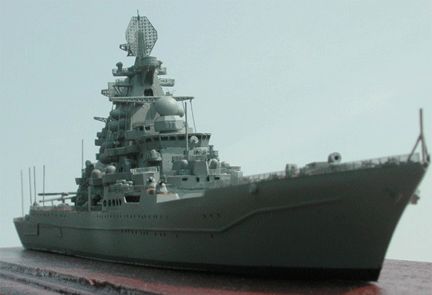
The long struggle to dismantle the Soviet era nuclear missile cruiserAdmiral Ushakov – which has been out of active duty for the past 17 years following a machinery accident – has been put off for another year over cost concerns, raising environmental and radiological concerns, the b-port news portal in Murmansk reported.
A spokesman for Zvezdochka ship repair yard where the vessel is moored, yesterday told b-port that dismantlement works on the enormous vessel would not begin until 2016 at the earliest.
Russia’s state nuclear corporation Rosatom has included in its 2015 budget costs for drawing up engineering schematics for its dismantlement, but by all accounts, the project is running late and short on cash.
The financial crunch to dismantle the Admiral Ushakov comes as a bad time. The majority of international aid flowing to nuclear submarine dismantlement and radiological waste security via the G-8 Global Partnership plan has already been committed, laying the burden for securing the vessel on the Russian government.
Unilateral funding from the United States’ Cooperative Threat Reduction (CTR) program has also reached its conclusion, and tensions between the West and Russia over the simmering crisis in Ukraine make it difficult for Moscow to find donors.
What’s more, the costs for dismantling nuclear battleships and cruisers run as much as 10 times more than dismantling the largest nuclear submarines, experts say, mostly because the expertise for nuclear battleship and cruiser deconstruction in Russia is in short supply, and international assistance almost a necessity, officials told b-port. This could become a problem with as many as three older nuclear battleships still on the Russian Navy’s registers.
For its part, the Russian Navy is instead pouring a mint into developing new submarine technologies at the expense of cleaning up legacy waste, said Nils Bøhmer, Bellona’s general manager and nuclear physicist
‘The Russian navy is currently spending millions on new submarines which is diverting funding from cleaning up radiological challenges left over from the past,” said Bøhmer. “To have this vessel lying around for 17 years with spent fuel is a dangerous and uncertain situation.”…….
Vessel a radiological hazard
The scientific community in Russia has been unified, repeatedly underscoring to Russian media that the unloaded spent nuclear fuel aboard the ship poses a major environmental danger to the Arkangelsk Region, where Zvezdochka is located…….http://bellona.org/news/nuclear-issues/radioactive-waste-and-spent-nuclear-fuel/2014-06-long-time-push-dismantle-huge-soviet-nuclear-battleship-put
European Energy Commission directs stricter rues on nuclear reactor safety

 Europe orders nuclear power operators to be more open on safety issues http://www.clickgreen.org.uk/news/international-news/124795-europe-orders-nuclear-power-operators-to-be-more-open-on-safety-issues.htmlby ClickGreen staff. Published Wed 11 Jun 2014 The European Union has agreed new laws to tighten up safety standards and improve supervision of nuclear facilities in response to the lessons learned from the Fukushima nuclear disaster in Japan.
For the first time a legally binding “safety objective” will cover all existing and new nuclear installations across Europe.
The new regulations include the requirement for greater transparency and to provide better public information on the safety record of nuclear sites.
The European Union, in response, carried out a series of stress tests to examine the resilience of nuclear power stations and used the results to draft a response plan based on the latest international standards.
The company also failed to tell the local population that a condition of its continued operation was that it must shut down its reactor immediately should a severe weather warning be issued.
There are 132 nuclear reactors currently in operation in Europe.
Today’s announcement of an agreement for this new Directive was reached under the Greek Presidency, after “delicate and strenuous negotiation”, since the safety of nuclear installations is for member states an important matter of national sovereignty.
European Energy Commissioner Günther Oettinger said: “Nuclear safety is paramount to all European citizens. We need to put all our efforts into making sure that the highest safety standards are followed in every single nuclear power plant across the EU.
“The new Nuclear Safety Directive, once formally adopted, will help ensure continuous improvement of the safety of our nuclear installations.”
The new nuclear safety architecture provides that member states implement a regulatory framework requiring accident prevention, and should an accident occur, mitigating the consequences of radioactive releases.
It also reinforces crucial components of the nuclear safety system, such as the independent role and function of the regulatory authorities, the safety peer reviews mechanism and the promotion of safety culture.
Specifically, the Directive:
• Introduces higher standards for nuclear safety in Europe, as it requires that member states take prevention measures for any type of accident, no matter how much unlikely may be considered
• Introduces topical peer reviews of the nuclear installations throughout Europe every six years, in coordination among member states. The first topical peer review is scheduled for 2017
• Requires operators to have infrastructure and suitable arrangements for accident management and emergency response
• Requires the strengthening of the role, function and effective independence of the regulatory authorities
• Introduces for member states the legal requirement to promote and enhance nuclear safety culture
• Introduces requirements on transparency, public information, public participation and cooperation between member states, nuclear and non-nuclear, in the vicinity of nuclear installations.
The Chairman of the Greek Atomic Energy Commission (EEAE), Christos Housiadas, commented: “All member states, nuclear and non-nuclear, had an equal opportunity to participate in this negotiation, as the consequences of nuclear accidents do not stop at borders.”
A risky situation – conflict in Ukraine and Ukraine’s nuclear reactors

 Ukraine crisis raises risk for nuclear reactors, DW 10 June 14, Ukraine’s volatility exacerbates the risk for the country’s 15 Soviet-style nuclear reactors, warn German experts. They demand more attention for the country where the world’s worst nuclear accident took place The recent news of a water shortage due to a broken pipeline affecting thousands in
strife ravaged Eastern Ukraine spells trouble for the safety of the country’s nuclear power plants.
That’s because the security and reliability of a country’s critical infrastructure like its electrical power and water grid is essential to safely run nuclear reactors.
“Once you have decided to operate a nuclear power plant or like in this case a nuclear reactor park, you must guarantee you don’t have unstable social situations and you definitely can’t have a war,” Michael Sailer, chairman of the German Nuclear Waste Management Commission and member of the German Reactor Safety Commission, told DW.
Potential for human error “We are talking about nuclear power plants that have a high risk even when they are constructed well and properly maintained,” Sailer who also heads Freiburg-based environmental think tank Öko-Institut added. “And in the Ukraine we are talking about the additional problem that there is an increased potential for human error due to less motivated nuclear operators than elsewhere and the fact that the security features of these reactors are a lot weaker than those of modern reactors.”
Ukraine currently has four nuclear power plants with 15 reactors online providing roughly half of the country’s energy needs which makes it practically impossible to shut them down during the crisis. All of the reactors stem from the Soviet era, went on the grid in the 1980s and are similar to the Chernobyl reactor that blew in 1986 causing the worst nuclear accident in history. Ukraine’s largest plant in Zaporizhia is located about 200 kilometers from Donetsk, the epicenter of the clash between pro-Russian militants and the Kyiv government.
Danger of sabotage But it’s not just the maintenance of the technical infrastructure and the motivation of the engineers operating the reactors that has the experts worried. The continued fighting between government and pro-Russian forces including the seizure of buildings raises the risk that the country’s nuclear plants could also be drawn into the mix…….
More attention The Chernobyl ruin serves as a reminder of the danger of nuclear energy
That the command structures particularly in the east of the country are already tenuous and embattled is evidenced by the ongoing fighting, the hostage taking of OSCE observers and the seizures of public buildings. And that this can easily affect critical infrastructure is highlighted by the recent news of a broken water pipeline in Eastern Ukraine.
That’s why – notwithstanding NATO’s assistance – not enough attention is being paid to the security of nuclear power plants in Ukraine, argue the experts.
“It’s really a problem, because only very few people think about this,” said Sailer. Nuclear experts usually don’t focus on such instable situations and the people who are concerned with instable situations like diplomats usually don’t realize how sensitive a nuclear power plant is.”http://www.dw.de/ukraine-crisis-raises-risk-for-nuclear-reactors/a-17694776
Borth Carolina had a close shave with a nuclear bomb
 Nuclear bomb nearly detonated after falling on North Carolina, declassified report says June 11, 2014 SMH, Dan Lamothe and Walter Russell Mead There are few things in this world that can change the course of history faster than a nuclear bomb exploding. The devastation is immediate and lasts for years.
That makes the latest details to emerge about a January 24, 1961, incident involving two nuclear bombs all the more jarring.
A B-52 bomber broke up in the sky over North Carolina, and one of the two bombs on board was in the “armed” setting by the time it hit the ground near Goldsboro, North Carolina, according to a newly declassified report published on Monday by the National Security Archive. f the switch had not been damaged by the impact of the crash, the weapon could have detonated, the report said……..
That incident, which led to an anti-nuclear movement in Britain, where the plane was bound, is one of many stories Eric Schlosser, the author of Fast Food Nation, tells in Command and Control.
During the cold war, nuclear bombs fell out of the sky, burned up in plane crashes and were lost at sea. In the incident Schlosser describes in greatest detail, “the Damascus accident” of September 18, 1980, the warhead from a Titan II missile was ejected after a series of mishaps that began when a repairman dropped a socket wrench and pierced a fuel tank.
Tactical nuclear weapons scattered across Europe had minimal security; misplaced tools and failed repairs triggered serious accidents; inadequate safety procedures and poor oversight led to dozens of close brushes with nuclear explosions.
People have died in these accidents, sometimes as a result of their own carelessness or bad luck, but often while doing their best to protect the rest of us from an accidental nuclear blast.: http://www.smh.com.au/world/nuclear-bomb-nearly-detonated-after-falling-on-north-carolina-declassified-report-says-20140611-zs3en.html#ixzz34OSCZMvQ
Fracking brings instability and anxiety to the area around USA’s Waste Isolation Pilot Project (WIPP)

 Will Fracking Cause Our Next Nuclear Disaster? 09 June 2014 By Dahr Jamail, Truthout | The idea of storing radioactive nuclear waste inside a hollowed-out salt cavern might look good on paper. The concept is to carve out the insides of the caverns, deep underground, then carefully move in the waste. Over time, the logic goes, the salt will move in and insulate the containers for thousands of generations. “The whole game is to engineer something that can contain those contaminants on the order of tens of thousands of years,” Tim Judson, the executive director of the Nuclear Information Resource Service(NIRS), told Truthout. NIRS is intended to be a national information and networking center for citizens and environmental activists concerned about nuclear power, radioactive waste, radiation and sustainable energy issues, according to Judson.
Salt-cavern storage was the plan for the Waste Isolation Pilot Project (WIPP), the world’s third-deepest geological repository, constructed and licensed to permanently dispose of radioactive waste for 10,000 years. The repository sits approximately 26 miles east of the town of Carlsbad in southeastern New Mexico.
Since shipments began in 1999, more than 80,000 cubic meters and 11,000 shipments of waste have been transferred to WIPP.
But at the moment, there are several ongoing critical problems at the site, which has been closed and unable to accept shipments of radioactive waste ever since a fire and radiation release in February. Dozens of barrels of radioactive waste from Los Alamos National Lab, like the one that caused the radiation leak, now pose an “imminent” or “substantial” threat to public health and the environment.
Yet, these problems could pale in comparison to what might happen at the site if an earthquake were to strike, or if the protective salt layer were compromised by nearby drilling for oil and gas, and in particular, hydraulic fracturing, commonly known as fracking.
Fracking is a technique used in obtaining gas and petroleum, in which water is mixed with sand and toxic chemicals, and the mixture is injected at extremely high pressure into a wellbore to create small fractures.
Thus, one would logically deduce that fracking should never be done anywhere near WIPP. However, it is being done there, and experts expect it to increase.
“In the last three years, a dozen fracking wells have become operational within five miles of the site [WIPP],” Don Hancock, the director of the Nuclear Waste Safety Program at Southwest Research and Information Center, told Truthout.
Given that it is already well known that fracking causes earthquakes, it is clear that the nuclear waste storage site is now in danger of having its structural integrity compromised.
“These are the major concerns,” Hancock warned. “There is clearly a possibility that the deep fracking can affect the stability, but even more likely is fracking liquids nearing or entering the waste beds – which would be a very bad thing.”
“They Are Drilling All Around It”
Truthout spoke with a state of New Mexico employee who is intimately familiar with the permitting and drilling processes related to WIPP. The employee spoke on condition of strict anonymity, due to a fear of reprisals from the pro-drilling administration of radical right-wing Tea Party Governor Susana Martinez.
“There is so much drilling coming online down there now,” the employee explained. “They are going back into existing fields and drilling horizontally, and the WIPP siteis located right in the middle of all these fields, so they are drilling all around it.”
The source said that the oil and gas companies who are drilling and fracking near WIPP “have permission to go under the [WIPP] boundary to target the reservoirs there, so it appears as though most of the wells are horizontal, and that is a concern.”
According to the employee, “The fracking fluids they are injecting are very unstable, and if it continues like this there could be big problems…. There was a 5.2 [earthquake] in West Texas from fracking, and that’s a big concern given the sensitivity of the WIPP site and what the possible consequences could be.”…….http://www.truth-out.org/news/item/24201-will-fracking-cause-our-next-nuclear-disaster
India wants Russia to make Koodankulam Nuclear Power Plant safer
India Seeks More Security Measures for Koodankulam Nuclear Power Plant New Indian Express, By Prashant Rangnekar 9 June 14 MOSCOW: India has sought “enhanced security measures” for the Koodankulam Nuclear Power Plant after the Fukushmia Daichi atomic disaster in Japan, Russia said.
“This can lead to immediate stopping of chain reaction in case of crisis. The system will ensure water supply for cooling of the reactor even if there is a black out for 24 hours,” Asmolov said.
He was speaking at the sidelines of Atom2014 Expo, a conference organised by Rosatom, a Russian state atomic energy body……
Anti-nuclear activists and People’s Movement Against Nuclear Energy (PMANE) have been spearheading more than a two-year-old protest against KNPP in Tirunelveli, demanding its closure, citing safety reasons.http://www.newindianexpress.com/nation/India-Seeks-More-Security-Measures-for-Koodankulam-Nuclear-Power-Plant/2014/06/09/article2271651.ece
The Nights of Fire and Explosions at WIPP
Breaking Bad: A Nuclear Waste Disaster By Joseph Trento, DC Bureau, June 5th, 2014 “…..There were warnings that not all was sanguine at WIPP. On Wednesday February 5, a truck used to haul salt taken out of the mine to make room for more and more radioactive casks caught fire because of a fuel spill. A fire in a mine is always serious. But a fire in a high-level nuclear storage facility is very serious. The first concern was a storage cask or canister had caused the fire but no radiation monitors went off, only a fire alarm. Eighty-six workers were slowly evacuated from the mine.
Fortunately, the workers made it to the surface and the fire was isolated to the ruined truck and involved no radioactive waste. That day there was no plutonium flash, no compromised canisters; just six workers were transported and treated at Carlsbad Medical Center. Another seven workers were treated at WIPP for smoke inhalation and the facility closed until everyone was certain the fire was out. A crew had to be sent in to do the inspection because, inexplicably, the WIPP facility is remarkably short of sophisticated remote sensing equipment. DOE immediately began an investigation.
The DOE Office of Environmental Management (EM) put together an Accident Investigation Board (AIB) to review what had gone right and wrong. The main contractor, Nuclear Waste Partnership, as well as the entire Carlsbad DOE field office was under scrutiny. DOE issued a press release saying, “The fire was a serious event that posed a threat to workers deep underground. In this case, the fire resulted in minor smoke inhalation to six workers, but it did not impact the public or the environment. There is no indication the fire was related to the February 14 radiological release.”
What investigators found was shocking. Carlsbad DOE officials did not conduct basic oversight of the private contractors running WIPP. The contractors failed to implement basic fire safety procedures, such as managing flammable truck fuel in an underground nuclear storage facility. In addition, WIPP officials repeatedly ignored the recommendations of the Defense Facilities Board – the gold standard for maintaining basic safety standards at all defense facilities. But the most damning part of the report said the safety culture required in such a dangerous environment no longer existed. Ironically, as the fire investigation was still underway, investigators had time to prevent the explosion that was to come. But their observations were ignored. The DOE EM report should have resulted in the immediate shutdown and full safety review of the facility. Instead, DOE Washington pressed to keep the waste flowing into WIPP. “The reality is DOE is overwhelmed with nuclear waste and has no safe place to put it,” Greg Mello says.
Nine days later, 2150 feet under the New Mexico desert, just before midnight on February 14, a canister of Los Alamos plutonium-tainted nuclear waste exploded. In a nuclear repository holding thousands and thousands of similar canisters and casks in what was supposed to be the most secure nuclear storage facility in the world, the very thing that was never supposed to happen did. No security cameras had been installed that could view the explosion. The radiation unleashed by the cracked canister quickly contaminated the sprawling underground salt mine. The seven football-field sized rooms in the Panels contain canisters that could have then caught fire and exploded. The continuous air monitor (CAM) finally detected the radiation and an alarm sounded alerting the night shift that high-level radiation had been detected. At that point, the contractors and DOE had no idea of the extent of the damage.
A DOE press release put the best face on a disaster: “Only 11 employees were at the WIPP site on the surface, no employees were in the underground. Two other WIPP employees reported to the site a couple hours later. The continuous air monitor measured airborne radioactivity close to the operating location where waste was being emplaced. Ventilation air is pulled from the underground repository by huge fans on the surface. This exhaust consists of unfiltered clean air… When the CAM alarmed, two dampers were automatically closed in the exhaust duct that redirected the exhaust through high efficiency particulate air (HEPA) filters that removes radioactive particles.
DOE said, “The next day an above ground exhaust air monitor on the WIPP site detected very low levels of airborne radioactive contamination. The 140 employees at the site were kept indoors as a precaution while air samples were taken. The 13 employees present during the radioactive release event on February 14 were tested for internal radioactive contamination after the event. The 140 employees have also been offered testing.
“It is believed that a small amount of radioactivity leaked by the exhaust-duct dampers, through the unfiltered exhaust ducts and escaped above ground. The exhaust duct dampers are large ‘butterfly’ valves that are designed to close and cut off the airflow through the exhausters. However, the valves do not fully seal the exhaust ducts and still allowed a small amount of unfiltered air to escape.”
In fact, DOE employees used spray foam to seal the dampers to keep more radiation contaminated air from escaping from a half mile underground.
That night America’s only official high-level nuclear waste site was rendered useless for at least the next three years. Everything that was supposed to happen did not. Air vents to the surface did not automatically close. DOE failed to keep computer records updated of what deadly waste was in what container and where it was located. That small explosion not only contaminated 21 workers and caused an unknown amount of radiation released into New Mexico’s air, but it also revealed a Department of Energy that is the midst of a nuclear security crisis not in some far off country like Pakistan or one of the former Soviet Republics but here at home.
This time the Environmental Management team asked to investigate by DOE did not have to face the pressure of telling headquarters that WIPP should be shuttered. Radiation contamination did that for them.
The loss of WIPP means the most deadly substances science has managed to create will have to be stored in place across our country in places totally unsuited for such storage. At WIPP, the deadly conditions created by the explosion will make monitoring the remaining radioactive materials very difficult. The official report of the WIPP accident was scathing. But scathing reports on DOE operations are common…. “.http://www.dcbureau.org/201406059835/natural-resources-news-service/breaking-bad-nuclear-waste-disaster.html
West Michigan citizens tell NRC chair of problems with nuclear power plants
Nuclear Regulatory Chair Hears Concerns About Plants in West Michigan, by Paul Chicchini Fox 17 BENTON HARBOR, Mich. (June 5, 2014) – A group of concerned citizens and environmental groups met today with the chairman of the Nuclear Regulatory Commission to discuss two plants in west Michigan.
The closed-door meeting was held at the Courtyard Marriott in Benton Harbor with Chairman Allison MacFarlane.
The conversation focused on the Donald C. Cook site in Bridgman and the Palisades Plant in Covert Township.
Palisades has been in the spotlight since its 2007 purchase by Entergy because of several problems.
Bette Pierman, a Democratic candidate for Michigan’s 21st District Senate seat, told FOX 17 she had concerns about the Palisades facility.
“There are failing infrastructure problems right now,” said Pierman. “There’s leaks that have been going on. Some of them since 2007 – recorded and reported.”
The most recent reported leak at the plant involved 70 gallons of oil, which officials said did not pose a threat to any bodies of water.
During a planned refueling outage between January and March, workers discovered a piece of metal – an impeller blade – lodged in a reactor vessel. It was determined the object wasn’t a hazard.
“That’s not the issue,” Pierman said. “The issue is that they’ve got failing equipment that continues to fail and they’re not taking care of the problem.”……… http://fox17online.com/2014/06/05/nuclear-regulatory-chair-hears-concerns-about-plants-in-west-michigan/#ixzz33ukJoMk5
China’s nuclear plants face safety challenges (Is near enough good enough?)
 China’s nuclear power plants “generally safe”: watchdog
Xinhua) 20:34, June 04, 2014 BEIJING, June 4
China’s operating nuclear power units enjoy a relatively good safety record, and the quality of the units under construction has been well controlled, said the head of China’s nuclear watchdog on Wednesday…
.. However, Li said maintaining safety in this area is a challenging task,
as it concerns state security. He admitted that loopholes and problems, both in supervision and the whole nuclear industry, still exist.
The vice minister vowed to strengthen supervision with a well-established institution, a perfected legal system, as well as more capable personnel.
http://english.peopledaily.com.cn/n/2014/0604/c90882-8736930.html
Wildfire danger to New Mexico nuclear waste facility
 U.S. nuclear waste facing wildfire risk THE HINDU, NARAYAN LAKSHMAN , 5 June 14, A New Mexico facility containing 3,706 cubic meters of toxic radiological materials may be on the precipice of a serious incendiary event after the U.S. Department of Energy confirmed that it would fail to meet a deadline to remove drums of nuclear waste from the wildfire-prone area owing to safety concerns.
Although the DoE initially planned to move the “transuranic waste,” from the federal Los Alamos National Laboratory to a Texas facility by June 30, shipments out of the facility were said to have been “put on hold due to concerns about the chemical stability of the mixture in the containers.”
The deteriorating conditions of nuclear waste storage at the facility in recent years were further exacerbated in 2011 by wildfires near the nuclear-weapons laboratory, and the state government of New Mexico ordered the site to complete transfer of the material to other locations “before this year’s wildfire season reaches its peak,” the Nuclear Threat Initiative group noted.
However, apparently one Los Alamos drum of transuranic waste, comprising “tools, rags and other debris contaminated with radioisotopes such as plutonium from U.S. nuclear labs,” may have been responsible for a radiological leak at a repository near Carlsbad, New Mexico, on February 14……. http://www.thehindu.com/news/international/world/us-nuclear-waste-facing-wildfire-risk/article6083055.ece
Two Pakistani Nuclear military offices murdered
 2 Linked to Pakistan nuclear program killed in attack Fox News June 04, 2014 A suicide attacker killed two military officers linked to Pakistan’s nuclear program, along with three civilians, near the Kamra air base, not far from this capital, police told Efe.
The incident occurred in the Fateh Jang area about 10 a.m. when a vehicle belonging to the Pakistan Atomic Energy Commission was boarded by the suicide bomber, who was on foot, after which he detonated the explosives attached to his body…….http://latino.foxnews.com/latino/news/2014/06/04/2-linked-to-pakistan-nuclear-program-killed-in-attack/
Another nuclear hazard in Japan – 110 active volcanoes
 ‘Ring of Fire’ volcano risk the last obstacle for Japan nuclear plants BY MARI SAITO AND KENTARO HAMADA TOKYO Tue Jun 3, 2014 (Reuters) – In the three years since the Fukushima disaster, Japan’s utilities have pledged $15 billion to harden their nuclear plants against earthquakes, tsunamis, tornadoes and terrorist attacks.
But as Japan’s nuclear safety regulator prepares to rule on whether the first of the country’s 48 idled reactors is ready to be come back online, the post-Fukushima debate about how safe is safe enough has turned to a final risk: volcanoes.
The Nuclear Regulation Authority (NRA) has already said the chance of volcanic activity during the lifespan of Kyushu Electric Power’s nuclear plant at Sendai was negligible, suggesting it will give it the green light. The plant, some 1,000 km (600 miles) south of Tokyo, lies in a region of active volcanic sites.
Critics, including some scientists who were consulted by the NRA, say that shows regulators are turning a blind eye to the kind of unlikely but potentially devastating chain of events that pushed the Fukushima Daiichi plant into a triple meltdown in 2011 when a tsunami crashed into the facility.
The debate has played out in several months of public hearings in Tokyo by the NRA and could weigh on the last hurdle for restarting nuclear plants – the opinion of local residents – at a time when the costs of keeping reactors shut are mounting……..
Critics say the NRA safety review overestimates the power of science to predict future volcanic eruptions.
Japan lies on the “Ring of Fire”, a horseshoe-shaped band of fault lines and volcanoes circling the edges of the Pacific Ocean. Japan itself is home to 110 active volcanoes.
Sendai, at the southern end of the island of Kyushu, is 50 km (31 miles) from Sakurajima, an active volcano. Five giant calderas, crater-like depressions formed by past eruptions, are also in the region, the closest one just 40 km (25 miles) from the Sendai plant.
“No-one believes that volcanic risks have been adequately discussed,” said Setsuya Nakada, a professor of volcanology at the University of Tokyo, who advised officials when they were forming regulatory guidelines for monitoring volcanoes……..
As soon as the NRA clears the Sendai nuclear plant for restart, local townships closest to the facility will hold public hearings. The government has said it will defer to the prefecture and the host city to make the final decision. http://www.reuters.com/article/2014/06/04/us-japan-nuclear-volcano-idUSKBN0EE2BF20140604
Britain taking risks in extending safety limits of old nuclear reactors
UK will have to gamble with nuclear safety to provide power, analyst warns http://www.theguardian.com/environment/2014/jun/04/uk-may-need-to-gamble-with-nuclear-safety-to-avoid-blackouts Safety limits of Britain’s ageing nuclear power plants may have to be extended to avoid major blackouts Terry Macalister The Guardian, Thursday 5 June 2014 Britain may have to stretch safety limits on nuclear power stations to keep the lights on, warned a leading energy analyst on Wednesday.Dorian Lucas, a nuclear specialist at energy consultancy, Inenco, made his comments after it was revealed that power group, EDF, had won permission to change the rules for its Dungeness B station.
 “Britain has no choice but to gamble with extending the safety limits of the country’s ageing fleet of nuclear power plants to avoid the looming spectre of 1970s-style blackouts,” said Lucas.The atomic power station in Kent has come to an agreement with the Office of Nuclear Regulation (ONR) that it can have the margin increased on the shrinkage of the graphite bricks inside the reactor from 6.2% to 8%.
The bricks are losing weight due to decades of radiation but a spokeswoman for EDF said the new limit was only a “teeny little step” that was well within the most conservative safety case.
In a statement, the nuclear regulator said: “ONR would not allow continued operation of any nuclear reactor unless it was safe to do so. We recognise the challenges presented by ageing of the Advanced Gas-cooled Reactor (AGR) fleet in the UK, and we continue to pay close attention to the problems associated with the graphite core of the reactors. We are satisfied that the reactors are safe to operate.”
But Steve Thomas, professor of energy policy at the University of Greenwich, told the BBC: “It doesn’t feel good when we come up against limits and the first thing they [the ONR] do is to move the goalposts.”
Nuclear submarine commander reveals horror of 2011 accident
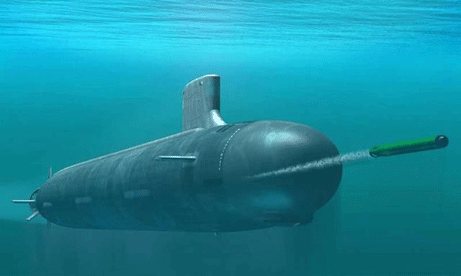 Horror on board Plymouth nuclear submarine as crew battles to survive By Plymouth Herald June 04, 2014 By TRISTAN NICHOLS Defence Reporter @tristan_nichols A “CATASTROPHIC” systems failure on board a Devonport-based nuclear submarine caused a mass-casualty incident, The Herald can today exclusively reveal.
Eight of those casualties were in a ‘life-threatening’ condition.
Temperatures inside the boat soared to 60 degrees Celsius with 100 per cent humidity as the crew battled to fix the problem miles from land.
With the three-year anniversary of the previously unreported incident having just passed, Ryan Ramsey, the submarine’s Commanding Officer at the time, today revealed: “I genuinely thought there was going to be a loss of life on board. People were going to die.”
The tragic incident happened at about 10.30am around three hours after the hunter-killer submarine had left Fujairah in the United Arab Emirates on May 26, 2011……….http://www.plymouthherald.co.uk/Horror-board-Plymouth-nuclear-submarine-crew/story-21181219-detail/story.html
EDF wants to weaken safety standard at Dungeness nuclear atation
Nuclear power plant dismisses safety concerns Folkestone Herald, By Antony Thrower June 04, 2014
DUNGENESS power station has dismissed claims in the media this morning which claimed a reactor at the site would have breached the agreed safety margin “within months” and could have to “shut down”.
The BBC reported graphite bricks at the core of the advanced gas-cooled reactors were cracking and starting to lose weight due to decades of radiation, which could affect safety.
It suggested the current graphite weight loss limit for Dungeness is set at 6.2% but the regulator says when it reached 5.7% its operator, French power giant EDF, applied to raise it to 8%…….http://www.folkestoneherald.co.uk/Nuclear-power-plant-dismisses-safety-concerns/story-21186452-detail/story.html
1 This Month




PLEASE OPPOSE HR 8255 AND S.3639 – bills would accelerate satellite deployment, with no environmental review or safeguards – https://ncstd5li.quorum.us/campaign/169331/
To see nuclear-related stories in greater depth and intensity – go to https://nuclearinformation.wordpress.com
-
Archives
- September 2026 (323)
- August 2026 (330)
- July 2026 (355)
- June 2026 (287)
- May 2026 (306)
- April 2026 (356)
- March 2026 (251)
- February 2026 (267)
- January 2026 (308)
- December 2025 (358)
- November 2025 (359)
- October 2025 (375)
-
Categories
- 1
- 1 NUCLEAR ISSUES
- business and costs
- climate change
- culture and arts
- ENERGY
- environment
- health
- history
- indigenous issues
- Legal
- marketing of nuclear
- media
- opposition to nuclear
- PERSONAL STORIES
- politics
- politics international
- Religion and ethics
- safety
- secrets,lies and civil liberties
- spinbuster
- technology
- Uranium
- wastes
- weapons and war
- Women
- 2 WORLD
- ACTION
- AFRICA
- Atrocities
- AUSTRALIA
- Christina's notes
- Christina's themes
- culture and arts
- Events
- Fuk 2022
- Fuk 2023
- Fukushima 2017
- Fukushima 2018
- fukushima 2019
- Fukushima 2020
- Fukushima 2021
- general
- global warming
- Humour (God we need it)
- Nuclear
- RARE EARTHS
- Reference
- resources – print
- Resources -audiovicual
- Weekly Newsletter
- World
- World Nuclear
- YouTube
-
RSS
Entries RSS
Comments RSS

