Los Alamos scientist had plan to build nuclear weapons, and to bomb New York

 US nuclear scientist secretly taped by FBI claiming he could bomb New York , Guardian, 29 Jan 15 Los Alamos scientist Pedro Leonardo Mascheroni jailed for five years after also offering to build nuclear weapons for Venezuela A disgruntled, former Los Alamos National Laboratory scientist promised to build 40 nuclear weapons for Venezuela and design a bomb targeted for New York City in exchange for “money and power,” according to secret FBI recordings released Wednesday.
In the recordings, Pedro Leonardo Mascheroni tells an agent posing as a Venezuelan official that the bombs would prevent the United States from invading the oil-rich nation and brags to his wife that the passing of secrets would make him wealthy.
“I’m going to be the boss with money and power,” the naturalized US citizen from Argentina is heard saying. “I’m not an American anymore. This is it.”
Mascheroni said his New York bomb wouldn’t kill anyone but would disable the city’s electrical system and help Venezuela become a nuclear superpower. It was not known how realistic his New York bombing idea was.
But he suggested that once Venezuela obtained a bomb, the country should explode it “to let the world know what we’ve got,” according to the recordings….The US government did not allege Venezuela sought US secrets…..http://www.theguardian.com/us-news/2015/jan/29/us-nuclear-scientist-secretly-taped-by-fbi-claiming-he-could-bomb-new-york
Fatal accidents cause TEPCO to suspend decommissioning at Fukushima No. 1 power plant
Tepco suspends Fukushima No. 1 cleanup to probe fatal accidents Japan Times STAFF WRITER JAN 23, 2015 Tokyo Electric Power Co. has said it will suspend decommissioning work at the wrecked Fukushima No. 1 power plant until it completes safety checks related to two fatal accidents at its facilities in the prefecture this week……http://www.japantimes.co.jp/news/2015/01/23/national/tepco-suspends-fukushima-no-1-cleanup-to-probe-fatal-accidents/#.VMWMHtKUcnm
Nuclear danger predictions for Japan in 2004: they are the same today
Japan’s deadly game of nuclear roulette, Japan Times, BY LEUREN MORET MAY 23 2004 Of all the places in all the world where no one in their right mind would build scores of nuclear power plants, Japan would be pretty near the top of the list.
The Japanese archipelago is located on the so-called Pacific Rim of Fire, a large active volcanic and tectonic zone ringing North and South America, Asia and island arcs in Southeast Asia. The major earthquakes and active volcanoes occurring there are caused by the westward movement of the Pacific tectonic plate and other plates leading to subduction under Asia.
Japan sits on top of four tectonic plates, at the edge of the subduction zone, and is in one of the most tectonically active regions of the world. It was extreme pressures and temperatures, resulting from the violent plate movements beneath the seafloor, that created the beautiful islands and volcanoes of Japan.
Nonetheless, like many countries around the world — where General Electric and Westinghouse designs are used in 85 percent of all commercial reactors — Japan has turned to nuclear power as a major energy source.
In fact the three top nuclear-energy countries are the United States, where the existence of 118 reactors was acknowledged by the Department of Energy in 2000, France with 72 and Japan, where 52 active reactors were cited in a December 2003 Cabinet White Paper.
The 52 reactors in Japan — which generate a little over 30 percent of its electricity — are located in an area the size of California, many within 150 km of each other and almost all built along the coast where seawater is available to cool them.
However, many of those reactors have been negligently sited on active faults, particularly in the subduction zone along the Pacific coast, where major earthquakes of magnitude 7-8 or more on the Richter scale occur frequently. The periodicity of major earthquakes in Japan is less than 10 years. There is almost no geologic setting in the world more dangerous for nuclear power than Japan — the third-ranked country in the world for nuclear reactors.
“I think the situation right now is very scary,” says Katsuhiko Ishibashi, a seismologist and professor at Kobe University. “It’s like a kamikaze terrorist wrapped in bombs just waiting to explode.”……..
Yoichi Kikuchi, a Japanese nuclear engineer who also became a whistle-blower, has told me personally of many safety problems at Japan’s nuclear power plants, such as cracks in pipes in the cooling system from vibrations in the reactor. He said the electric companies are “gambling in a dangerous game to increase profits and decrease government oversight.”
Sugaoka agreed, saying, “The scariest thing, on top of all the other problems, is that all nuclear power plants are aging, causing a deterioration of piping and joints which are always exposed to strong radiation and heat.”
Like most whistle-blowers, Sugaoka and Kikuchi are citizen heroes, but are now unemployed…….
It is not a question of whether or not a nuclear disaster will occur in Japan; it is a question of when it will occur. http://www.japantimes.co.jp/life/2004/05/23/to-be-sorted/japans-deadly-game-of-nuclear-roulette/#.VMMMH9KUcnk
Fissures in earth not far from 7 nuclear reactors
Official: Fissures in earth now suspected under dam upstream of nuke plants — “There’s plenty of rumors… We’re considering all possibilities… Leak is actually in embankment, that’s where all the focus is” — Speculation that problem to go on for years — New drone footage shows excavation in progress (VIDEO) http://enenews.com/officials-fissures-suspected-dam-multiple-nuclear-reactors-downstream-considering-all-possibilities-leak-actually-embankment-all-focus-plenty-rumors-speculation-repair-project-could-years-video?utm_source=feedburner&utm_medium=email&utm_campaign=Feed%3A+ENENews+%28Energy+News%29
Follow-up to: ‘Sinkhole develops under dam in US — 7 nuclear reactors downstream — NRC notified of ‘stability issues’, plants begin evaluating potential flood impacts‘ and ‘Muddy seepage coming up near foundation of Boone Dam — Officials working around clock, using submarines and ground-penetrating radar
Bristol Herald Courier, Jan 14, 2015 (emphasis added): Water is still seeping at Boone Dam and the cause has yet to be determined… Boone Dam has two portions, a concrete portion [and] an earthen embankment. “The leak is actually in the embankment, that’s where all the focus is,” Travis Brickey, a spokesman for TVA, said Monday… TVA is currently drilling around the area where the units discharge water… Though there is no clear timeline on how long the investigation will take, Brickey said that it’s safe to say that there will be a project at the dam. But he’s not sure… how long the project will last or how it will impact the reservoir.
WJHL, Jan 12, 2015: TVA… says it plans to make an announcement about… water seeping out of a nearby riverbank near Boone Dam [after] what’s now being described as a “prolonged analysis” to find the source of the water moving underground… [TVA spokesman Travis Brickey] confirmed TVA engineers now suspect water is moving through fissures in rock under the earth-filled section of Boone Dam… TVA has lowered Boone Lake [to reduce] pressure on the dam [and] stopped passing water through its power-generating turbines at Boone Dam as a safety precaution… That’s forced TVA to release water [which is] shooting into the air… a highly visible water release that seems to have fired speculation about what’s going on at Boone Dam… TVA is non-committal about its plans to refill the lake in the spring. “It’s too soon to tell,” Brickey said.
TVA spokesman Travis Brickey, Jan 12, 2015: “We are considering all possibilities and continue to analyze the data… We’ve installed additional monitoring equipment along with anextensive core drilling campaign… We’re aware that there are plenty of rumors… Our engineers are working to develop next steps.”
More from Brickey: “We’re doing a lot of engineering work and looking at repair options and what that might entail… I assure you there are a lot of people working on this.”
WCYB, Dec 29. 2014: People who visit Boone Lake won’t be seeing normal water levels any time soon… Brickey says that TVA is reviewing repair options on Boone Dam… But, the longer it takes for TVA to announce the plans, the more concerned many marina owners are becoming.
Kingsport Times-News, Dec 29, 2014:“It’s all speculation,” Brickey said of rumors that the lake’s drawdown could last two years or longer… TVA’s most recent press [said] “reservoir levels could be lowered further if conditions change… The duration of the drawdown will depend on the results of the ongoing analysis.”
22 Fukushima-style reactors still operating in USA
Japan closing 5 reactors but U.S. still running its Fukushimas, Beyond Nuclear 17 Jan 15 The Japanese nuclear industry has announced it will permanently close five more of its remaining 48 “operable” nuclear reactors by March 2015, leaving the country with 43 reactors “operable” but still not actually “operating.” Two of the plants to be decommissioned are the same GE Mark I boiling water reactors identical to Fukushima. Despite the political landscape in Japan still promoting nuclear power, the anti-nuclear movement there continues to campaign to keep all of Japan’s reactors closed indeifinitely.
When a B-52 crashed due to turbulence – carrying 2 nuclear bombs!
the weapons are found. Not entirely safe, but “…relatively intact…” according to the Air Force. It’s a scary sounding moderation to describe radioactive A-bombs lying around in the woods of the Eastern U.S. unattended.
[Read also: On this day in 1968 a B-52 crashed in Greenland with 4 hydrogen bombs]
The nuclear nightmare of Savage Mountain: when a B-52 crashed due to turbulence. With two nukes, The Aviationist, Jan 15 2015 By Tom Demerly
This is true. And it’s terrifying. It reads like an Ian Fleming or Tom Clancy thriller. But it’s real. Continue reading
France’s government on high alert due to UFO’s over nuclear facilities
UFOs spotted over nuclear plants in France and Belgium Open Minds Alejandro Rojas January 15, 2015
The French government is on high alert due to a large amount of UFO sightings over nuclear power plants since October, 2014. The latest sighting in France was just last week, and witnesses in Belgium spotted one in December. Most media outlets suspect that the objects are drones, but not all of the witnesses are convinced. If they are drones, the authorities say they do not know who they belong to. According to Austrian news site ORF.at, there were 18 separate occasions UFOs were seen flying over nuclear power plants in France between early October and early November. They say authorities suspect it is the coordinated effort of an unknown group.
ORF.at says the sightings have sparked a debate over nuclear power plant security. Greenpeace has accused the French government of downplaying the danger of these unknown over flights.
The latest incident was announced on January 3, 2015. The nuclear power plant in Nogent-sur-Seine, southeast of Paris, says two security guards saw “two flying objects.” In late December, an object flew over a nuclear power plant in Belgium. The power plant is in Doel, about 10 miles from Antwerp. The news site Spiegel Online, says that plant had been shut down four months ago reportedly due to sabotage. No further details have been released.
According to Speigel Online, Greenpeace again raised concerns that the plants “are not adequately protected from attacks by drones.”……….http://www.openminds.tv/ufos-spotted-nuclear-plants-france-belgium/31709
Sellafield Catch Up 2015
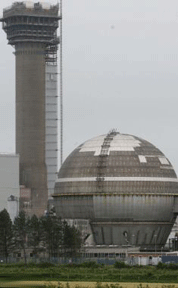
 nuClear News Jan 15 “…….2014 began with the publication of a new report (1) from the House of Commons Public
Unsafe, unreliable- Vladimir Slivyak’s verdict on Russian nuclear reactors

 Reactors from Russia are unsafe and unreliable, India shouldn’t buy them: Russian environmentalist Vladimir Slivyak DiaNuke.org, 9 Jan 15 “………….Over a dozen incidents and failures have already occurred at the newly built VVER at Kalinin NPP, including one involving a hydrogen explosion.
The Russian fast breeder reactor – the only commercial unit of this type in the world – has in its over 30 years of operation experienced almost as many various accidents, including fires involving radioactive substances and coolant leaks.
Further development of the breeder technology planned by Rosatom in Russia includes experiments with plutonium fuel. VVER-1200s are also designed to operate with plutonium fuel. Introducing this nuclear material into electricity generation on an industrial scale will likely lead to new accidents that will result in plutonium contamination.
Additionally, eleven old RBMK units – all variations on the Chernobyl design – still remain in operation in Russia.
Rosatom continues to reprocess spent nuclear fuel at the disastrous Mayak facility. Not only is the stockpile of extracted plutonium growing, but there is also a constant significant increase in volumes of radioactive waste resulting from reprocessing. The Mayak nuclear facility in Chelyabinsk Region was a place of a devastating nuclear accident of 1957, which caused widespread radioactive contamination and led to the resettlement of about 20,000 of local residents in the subsequent years.
Unfortuntely, several thousands of local residents still have to live in contaminated area because Rosatom doesn’t take responsibility for their resettlement and people themselves are too poor to move away. That’s best illustration of what is safety culture and social responsibility in understanding of the Russian nuclear industry.
Russia has no realistic and viable plan for the disposal of radioactive waste. The risk of radioactive leaks from the aging radioactive waste storage facilities is increasing. Rosatom’s attempts to build new disposal sites for radioactive waste in several regions of Russia have been met by harsh opposition from local populations and environmental groups. But even if such sites were ultimately built, their capacity would be enough to take care of only a small fraction of the waste accumulated over many decades.
How strong is the nuclear safety regulation in Russia? What have been post-Fukushima changes?
Unfortunately, it’s far from strong. In 1990s we had special safety regulator, Gosatomnadzor (or GAN). It was reporting directly to the president of country and was able to confront Rosatom on the most important safety issues. I mean there is certain difference in mandates of operator and regulator, and they must be in confrontation to improve the safety. When regulator becomes a friend to operator we are getting into Japanese situation which in the end bring us to another Fukushima sort of disaster. But that’s not the way it went in Russia. Rosatom successfully lobbied for dissolving of independent GAN. And finally it became just the department inside of another bigger structure, without any ability to control. After Fukushima, regulator proposed to close several old reactors down but that was easily ignored by Rosatom who said Russian reactors are best in the world and Fukushima would never happen in Russia. Something like that was said by Western industry after Chernobyl and all wanted to believe in it until Western-designed Fukushima exploded several times.
The Russian nuclear giant, Atomsroyeport, has been clearly unwilling to abide by the Indian liability law which has a clause on supliers liability in case of an accident. What does it say on their claims of safety?
It just confirms old fact that there is no 100% safe reactors. Which means, sooner or later, new Chernobyl or new Fukushima (or both) will happen again somewhere in the world. Russian industry knows very well that their reactors have vulnerabilities. And they don’t want to pay in case of another Chernobyl which they know is possible. Just like the owner of Fukushima is not paying to Japanese people……….http://www.dianuke.org/russian-reactors-are-unsafe-and-unreliable-india-shouldnt-buy-them-russian-environmentalist-vladimir-slivyak/
Danger of transporting nuclear weapons through Glasgow, especially in extreme weather

 Ministry of Defence blasted for transporting nuclear weapons through Glasgow city centre during extreme weather by Scottish CND and SNP Daily Record, Jan 13, 2015 By Joe McGuire
A CONVOY believed to be carrying city-destroying warheads drove through the middle of Glasgow on the M74 and M8 on Sunday night and crossed the Erskine Bridge during high winds. THE Ministry of Defence has come under fire from anti-nuclear campaigners and politicians after reports that a convoy carrying nuclear weapons travelled through the centre of Glasgow despite weather warnings.
The convoy drove through the middle of Glasgow on the M74 and M8 between 11.35pm and 11.55 pm on Sunday night and crossed the Erskine Bridge during high winds.
While the Scottish CND (Campaign for Nuclear Disarmament) maintain the convoys, which transport nuclear warheads between the Atomic Weapons Establishment in Berkshire to the UK’s fleet of nuclear-armed submarines at Faslane, are always unsafe, the campaigners condemned moving the weapons during extreme weather as reckless……….
SNP MSP for Glasgow Anniesland and co-president of Parliamentarians for Nuclear Non-proliferation and Disarmament Bill Kidd added: “This practice is deeply worrying and poses an unacceptable risk to the people of Glasgow. The idea that weapons of mass destruction are being transported through our city while we sleep is absolutely chilling – and shows the utter folly of basing nuclear weapons just 30 miles from our biggest population centre.
“The impact of any safety breach during one of these convoys does not bear thinking about. It’s time that these immoral and unsafe weapons were removed from Scotland for good.”
Glasgow Now has reached out to the Ministry of Defence for comment. http://www.dailyrecord.co.uk/news/local-news/ministry-defence-blasted-transporting-nuclear-4970433
India’s Koodankulam reactor no 1 not really functioning, repeated shutdowns
 Reactors from Russia are unsafe and unreliable, India shouldn’t buy them: Russian environmentalist Vladimir Slivyak DiaNuke.org, 9 Jan 15 “……..The Koodankulam reactor no 1, despite its commissioning with much fanfare last year, is not really functioning and has seen repeated shut-downs. The people’s movement in Koodankulam says its because of the sub-standard equipments from Russia and it is unsafe. What do you think?
Bad quality of equipment and reactor components coming from Russia is not a secret anymore. It was noticed in China as well. Under current management, Rosatom became deeply corrupted which resulted in regular public scandals and arrests. In last 3 years several deputy directors of Rosatom were arrested on corruption charges, and in total about 300 people were fired from Rosatom’ organizations for the same reason. Very huge scandal happened with Zio-Podolsk producing steam-generators for nuclear plants – people there used cheap metal for manufacturing, instead of expensive one required by technology. Difference in price of cheap and expensive metals was going into pockets of top-management. Another scandal was about stealing money for radioactive waste treatment, and another one about bribes and procurement, etc.
Bad quality of reactor components, you are likely dealing with in case of Kudankulam, is a direct consequence of corruption. You can read more on corruption issue in the special report on Russian nuclear industry published in December (can be downloaded here)…….http://www.dianuke.org/russian-reactors-are-unsafe-and-unreliable-india-shouldnt-buy-them-russian-environmentalist-vladimir-slivyak/
Safety concerns may close South Korea’s Wolsong No.1 reactor
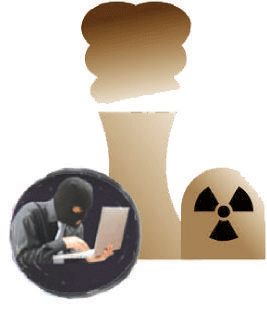
 Hacking of Korea’s nuclear operator raises risk of aging reactor closures Yahoo News By Meeyoung Cho SEOUL (Reuters) 12 Jan 15, – The hacking of South Korea’s nuclear operator means the country’s second-oldest reactor may be shut permanently due to safety concerns, said several nuclear watchdog commissioners, raising the risk that other aging reactors may also be closed.
“The operator failed to prevent it (the hack) and they don’t know how much data has been leaked. If the old reactor is still allowed to continue to run, it will just hike risks,” said Kim Hye-jung, one of the nine commissioners who will this month review an application to restart the Wolsong No.1 reactor.
The future of Wolsong No.1, shut in 2012 after reaching its 30-year lifespan, is seen as critical to the fate of other reactors, including the oldest Kori No.1 which had its lifespan extended by 10 years to 2017………
Even those commissioners who deem the reactor safe think that other issues such as public pressure will likely influence their decision, which is expected in February at the earliest.
Concerns over nuclear power have grown since the Fukushima disaster in Japan in 2011 and revelations in 2012 of fake certificates for reactor parts in South Korea.
(Additional reporting by Sohee Kim and Brian Kim; Editing by Henning Gloystein and Michael Perry) http://news.yahoo.com/hacking-koreas-nuclear-operator-raises-risk-aging-reactor-070014531–finance.html
Secrets revealed – Scotland’s nuclear disaster plans
 Scotland’s secret nuclear disaster plan revealed Scotsman , 12 Jan 15 A SECRET plan to deal with a Chernobyl-style nuclear emergency in central Scotland has finally been revealed in a dossier which has been kept under wraps for decades.
The classified documents which show how the government would have responded to a full-scale atomic crisis have been opened and placed in the National Archives.
The files outline the steps that would have been taken if lethal substances had leaked from the twin Hunterston A and B nuclear plants on the Ayrshire coast.
They reveal that staff at Scotland’s largest hospital were primed to treat victims suffering from burns and radiation sickness, a community centre would have been converted into a decontamination zone and residents would have been issued with anti-radiation tablets.
They also show that the strategy for a mass public evacuation revolved around police officers knocking on residents’ doors and politely advising them to leave……..
Hunterston A was opened by the Queen in September 1964, but stopped producing electricity in 1990 and is currently being decommissioned. The neighbouring Hunterston B plant was opened in 1976 and is due to operate until 2023 – well beyond its original planned closure date.
Last year Nicola Sturgeon, the then deputy first minister – a long-term opponent of nuclear power – expressed “deep concern” after it emerged that cracks had been found in one of the plant’s reactors………http://www.scotsman.com/news/environment/scotland-s-secret-nuclear-disaster-plan-revealed-1-3657911
The nuclear dangers in Ukraine energy wars: don’t miss the full article!
What’s profitable for the nuclear industry in the US and Japan is toxic for the EU, particularly its more environmental and anti-nuclear member-nations including Germany and Austria, which will have no choice but to accept this legal precedent for continent-wide fracking and a revival of nuclear power.
|
Ukraine Energy Wars Are Leading To A Fukushima-Chernobyl Debacle In Europe
|
|
By Yoichi Shimatsu. Rense1-5-15
|
| full article at http://www.rense.com/general96/ukraineenenerg.html |
| Clashes over energy in Ukraine between the West and Russia could prompt another Chernobyl-type accident or a catastrophe on the order of a Fukushima that will complete the nuclear devastation of the Northern Hemisphere. As news media fixate on conflicts over pipelines that supply Europe with Russian gas, another energy war is erupting over control of Ukraine’s nuclear-power industry, which generates half that nation’s electricity.Prime Minister Arseniy Yatsenuk’s campaign for “energy independence” from Russian-sourced natural gas and nuclear fuel is not a study in cost control, economic security or even national sovereignty. His corporate-giveaway policies are actually a concession to Western energy interests in return for their influence over the EU, which can provide loans to avert an imminent default on Kiev’s debt to the IMF and World Bank. With an annual budget shortfall of $15 billion and a currency collapse, Ukraine is staggering under external sovereign debt estimated at between $140 and $200 billion.
The IMF and World Bank have halted further transfers of loan tranches to Kiev, which is now unable to make payments on its gas imports from Russia. Kiev policymakers are therefore desperately looking to expand their nuclear industry. Unfortunately two recent accidents at its largest nuclear-power plant highlight the serious risks to a nation still grappling with the long-term effects of the 1986 Chernobyl meltdown. ………. |

More worrying flights by drones, near France’s nuclear plant
 Catch me if you can: More drones break into France’s nuclear air space Rt January 04, 2015 Two aircraft – presumably drones – were spotted flying over a French nuclear power plant on Saturday. The incident happened amid the country’s efforts aimed at detecting and intercepting such flying objects above nuclear facilities.
1 This Month
26 September – International Day for the Total Elimination of Nuclear Weapons





PLEASE OPPOSE HR 8255 AND S.3639 – bills would accelerate satellite deployment, with no environmental review or safeguards – https://ncstd5li.quorum.us/campaign/169331/
To see nuclear-related stories in greater depth and intensity – go to https://nuclearinformation.wordpress.com
-
Archives
- September 2026 (323)
- August 2026 (330)
- July 2026 (355)
- June 2026 (287)
- May 2026 (306)
- April 2026 (356)
- March 2026 (251)
- February 2026 (267)
- January 2026 (308)
- December 2025 (358)
- November 2025 (359)
- October 2025 (375)
-
Categories
- 1
- 1 NUCLEAR ISSUES
- business and costs
- climate change
- culture and arts
- ENERGY
- environment
- health
- history
- indigenous issues
- Legal
- marketing of nuclear
- media
- opposition to nuclear
- PERSONAL STORIES
- politics
- politics international
- Religion and ethics
- safety
- secrets,lies and civil liberties
- spinbuster
- technology
- Uranium
- wastes
- weapons and war
- Women
- 2 WORLD
- ACTION
- AFRICA
- Atrocities
- AUSTRALIA
- Christina's notes
- Christina's themes
- culture and arts
- Events
- Fuk 2022
- Fuk 2023
- Fukushima 2017
- Fukushima 2018
- fukushima 2019
- Fukushima 2020
- Fukushima 2021
- general
- global warming
- Humour (God we need it)
- Nuclear
- RARE EARTHS
- Reference
- resources – print
- Resources -audiovicual
- Weekly Newsletter
- World
- World Nuclear
- YouTube
-
RSS
Entries RSS
Comments RSS

