For The 2016 Nuclear Security Summit we need to develop a culture of security
A culture of security: Focus for the next Nuclear Security Summit? Igor Khripunov, Bulletin of the Atomic Scientists, 27 June 15 Igor Khripunov is a distinguished fellow at the Center for International Trade and Security at the University of Georgia (USA) and adjunct professor at its School of Public and International…
It would not take much highly enriched uranium to kill hundreds of thousands of people: as little as what could fit in a five-pound bag of sugar. That it has not happened so far does not mean it may never happen, especially when one considers that there are more than2,000 metric tons of dangerous nuclear materials in hundreds of sites scattered across the globe. And that there have been more than 2,300 cases of theft or loss of nuclear or radioactive material since the early 1990s.Consequently, one of the greatest dangers facing the global community is the risk of terrorists getting enough uranium or plutonium to build a working, crude nuclear bomb, or to spike a conventional bomb with enough radioactive material to create a so-called “dirty bomb”—one which disperses harmful radioactive material over a wide area. The latter in particular is quite a plausible scenario; just think how the public would react if such a device exploded in a major urban center.
To prevent either scenario from happening, a coalition of about 80 civil society organizations from across the globe has been working together for the past five years to improve the security of fissile materials. Known as the Fissile Materials Working Group (FMWG), it has been a forceful advocate for the prevention of nuclear terrorism, by spotlighting attention on the issue, sponsoring talks, and publishing detailed, formal written recommendations, among other activities. Its latest contribution is the report “The Results We Need in 2016: Policy Recommendations for the Nuclear Security Summit” developed by a group of international experts and circulated this month at public events in Vienna and Washington, DC. The release of the report was timed to coincide with the most crucial meetings of the “summit sherpas”—the official representatives of the participating states charged with preparing its agenda and drafting the final communiqué.
With the planning of the next summit in mind, the report prioritizes the items that the nongovernmental expert community wants the 2016 summit to focus on during its two-day proceedings. The list includes enhancing the security of military nuclear material, information sharing, best practices, and the elimination of highly enriched uranium (HEU) in civilian applications, among other agenda items. In so doing, the FMWG has elevated the role of the public from what was perceived not long ago as a bystander to that of a major and proactive stakeholder in nuclear security. And a unique feature of the group’s report is that it takes a much wider and longer-term perspective of nuclear security challenges compared to the rather short-term vision often espoused by most government experts.
But a funny thing happened on the way to the forum: It turns out that there is more to ensuring the security of nuclear material than physically protecting it, or trying to account for the whereabouts of every last bit of, say, highly enriched uranium. There is also something a bit harder to define, but perhaps even more important: a broader, all-embracing culture of nuclear security, that takes into account the human factor. Known as nuclear security culture, this approach encompasses programs on personnel reliability and training, illicit trafficking interception, customs and border security, export control, and IT security, to name just a few. Security culture has become a bit of a buzzword in many security-related domains, and the FMWG report seeks to raise it above this level, explicitly detailing the concept and its implications in a special section…………
nuclear security culture must become part of a comprehensive, joint architecture that elevates security to a basic societal value. Sharing the progress made in the nuclear field with other domains—particularly the chemical and the biological—will call for deeper communication and cooperation. To avoid fragmentation, security experts will need a shared concept to work together.
Finally, we must treat nuclear security culture as a continuously evolving educational and training discipline. Collaboration among government, industry, and academia is pivotal to a thriving, broad-based nuclear security culture; this means that nuclear security culture promotion needs a multi-stakeholder approach.
The 2016 Nuclear Security Summit can leave a valuable legacy by addressing such issues in a nuclear security culture roadmap endorsed by participating states. Nuclear security culture is an agenda item that deserves much more attention at the upcoming summit. http://thebulletin.org/culture-security-focus-next-nuclear-security-summit8428
Many incidents and near misses in USA’s nuclear reactors

 The Truth About Nuclear Power – Part 16 Subtitle: Near Misses on Meltdowns Occur Every 3 Weeks Roger E. Sowell, Marina del Rey, California 25 June 15
This is the second of approximately one dozen articles on nuclear safety, these will (or do) include (1) the relationship between plant operators and the regulatory commission, NRC, and show that safety regulations are routinely relaxed to allow the plants to continue operating without spending the funds to bring them into compliance. (2) Also, the many, many near-misses each year in nuclear power plants will be discussed. (3) The safety issues with short term, and long-term, storage of spent fuel will be a topic. (4) Safety aspects of spent fuel reprocessing will be discussed. (5) The health effects on people and other living things will be discussed. The three major nuclear disasters (to date) will be discussed, (6) Chernobyl, (7) Three Mile Island, and (8) Fukushima. (9) The near-disaster at San Onofre will be discussed, and (10) the looming disaster at St. Lucie. (11) The inherent unsafe characteristics of nuclear power plants required government shielding from liability, or subsidy, for the costs of a nuclear accident via the Price-Anderson Act. (12) Finally, the serious public impacts of evacuation and relocation after a major incident, or “extraordinary nuclear occurrence” in the language used by the Price-Anderson Act, will be the topic of an article. Previous articles showing that nuclear power is not economic are linked at the end of this article.
In the four year period 2010-2013, inclusive, the US nuclear reactors had 70 near-misses. These occurred in 48 of the 103 reactors. Some, therefore, had multiple near-misses in the same year. One plant, Columbia, had 3 near-misses in the same year. Wolf Creek, and Ft. Calhoun each had one near-miss in three of the four years. On average, that is 17 near-misses per year, or roughly 17 percent of the reactor fleet. Put another way, every 3 weeks, another near-miss occurs. The frequency of near-misses is expected to increase over time, as the aging reactors have more equipment degrade and fail, and new systems are installed that are unfamiliar to the operators.
What is common in these incidents are old and degraded equipment that fails due to improper inspection, replacement equipment that either does not work as expected, or operators are improperly trained, and in one notable case, improperly trained workers left critical bolts improperly tightened on the reactor head.
The most serious incident, in my view, occurred at the Byron Station, Unit 2, in January, 2012, in Illinois. A complete loss of cooling water at Unit 2 was temporarily replaced with water from Unit 1. Had this been a single-reactor plant, with no operating reactor close at hand, the loss of cooling could have resulted in a partial or full core meltdown, exactly what happened at Fukushima, Japan. This is completely unacceptable.
Some, the nuclear proponents, will argue that the safety systems are adequate since no meltdowns occurred. However, the sheer number of serious incidents shows that eventually, another catastrophe will occur. The US has been lucky, but that luck is likely running out as the plants grow older and more mishaps occur.
Information in these incidents are taken from Union of Concerned Scientists’ series of annual reports, 2010 – 2013, inclusive. The commentary is my own. Links to the four (now five) reports are:
2010 see link
2011 see link
2012 see link
2013 see link
2014 see link (link added 5/10/2015)
Incidents in 2013 (Fourteen incidents)…………http://sowellslawblog.blogspot.com.au/2014/05/the-truth-about-nuclear-power-part-16.html
Trident whistleblower’s new message on nuclear unsafety

 Trident whistleblower: the MoD are brainwashing public over nuclear safety, Herald Scotland, Rob Edwards Sunday 21 June 2015
McNeilly disclosed last week that he had been dishonourably discharged by the Royal Navy for making public a dossier alleging that Trident was “a disaster waiting to happen” and going absent without leave. He is promising to say more in July.
The Sunday Herald revealed his allegations on May 17, while he was on the run. The following day he handed himself in to police at Edinburgh airport, saying he had achieved what he wanted.
His dossier, which detailed 30 safety and security flaws on Trident submarines, was raised in the House of Commons by the former SNP leader, Alex Salmond. But it was dismissed by the MoD as “factually incorrect or the result of misunderstanding or partial understanding”…….
“You were lied to about nuclear weapons in Iraq, and now you’re being lied to about how safe and secure the weapons are on your homeland,” he said.
“The government overestimated Saddam and now they are underestimating the Islamic State. If things stay the way they are I put the odds of a terrorist attack at some point in the next eight years at around 99 per cent.”
He claimed that his concerns about lax security at Faslane had been backed by senior military figures. “The equipment that is brought on board by civilian contractors and military personnel isn’t checked,” he said.
“People are in positions without the proper security clearance. Mass amounts of people are being pushed through the system due to manpower shortages. IDs aren’t being checked properly.”
A pin code at a security gate wasn’t being used “because it’s either broke or people just get buzzed through because they’ve forgotten their pin,” he said. “It’s ridiculous.”
It was wrong to regard current security as “the best we can do” when it wasn’t, he argued. “It’s literally harder to get to the careers office in Northern Ireland than it is to get down a nuclear submarine.”
People have become far too relaxed in the war on terror, he claimed. “The fact is anyone with a couple of fake IDs can get unto a nuclear submarine,” he added. “Islamic State have already shown that they can acquire fake documentation and IDs.”
McNeilly called for security to be tightened, and for the removal of Trident missiles. “The military seem to be happy with the security at the site,” he told the Sunday Herald.
“Islamic State have the ability to easily penetrate through the security that the navy is currently providing. The site’s security must be heightened above its current highest state until the missiles are removed……..
USA Department of Energy investigates radiation leaks, and exposure to workers at nuclear sites
DOE probes worker radiation exposure at test site By STEVE TETREAULT REVIEW-JOURNAL WASHINGTON BUREAU WASHINGTON, 19 June 15 — The Department of Energy has launched investigations into two incidents over the past year where workers at the Nevada National Security Site were exposed to potential contamination while conducting nuclear weapons activities.
The episodes took place on June 16, 2014, and Oct. 21, 2014, at the National Criticality Experiments Research Center, the laboratory where the government maintains a substantial stockpile of nuclear material used for research and training.
The department is looking into the circumstances surrounding “losses of contamination control of highly enriched uranium” at the lab, according to Steven Simonson, director of the DOE Office of Enforcement…….
The incidents that prompted the investigation were the latest disclosed missteps by Los Alamos and other outposts in the weapons complex that have come under close scrutiny within DOE and on Capitol Hill.
In May, the Energy Department proposed to fine the operator of the Los Alamos National Laboratory $247,500 after it lost track of classified material that was supposed to have been shipped to the Nevada National Security Site in 2007, but never arrived. The mistake was not detected until five years later.
The New Mexico laboratory also has been faulted in the 2014 release of radiation from the Waste Isolation Pilot Plant that contaminated nearly two dozen workers with low levels of radiation and forced the nuclear waste site to close.
Investigations uncovered violations at the laboratory in how transuranic waste destined for WIPP was packaged and managed……..http://www.reviewjournal.com/news/nevada/doe-probes-worker-radiation-exposure-test-site
Peach Bottom Atomic Power Station radiation leak – source is found
Exelon locates source of radiation leak at Peach Bottom, YDR.com Officials say the tritium posed no health risk By Brett Sholtis bsholtis@ydr.com @BrettSholtis on Twitter 06/19/2015
Peach Bottom Atomic Power Station. On April 17, 2015, Exelon detected a level of tritium in excess of the EPA-recommended guidelines. Exelon has located the source of the leak and is taking steps to correct the problem. The Nuclear Regulatory Commission said the tritium poses no health or environmental risk. (FILE — YORK DAILY RECORD/SUNDAY NEWS)
Exelon Corporation has located the source of a water leak that led to elevated levels of tritium in a groundwater well at Peach Bottom Atomic Power Station. Peach Bottom spokeswoman Krista Connelly declined to specify the source of the leak, but confirmed that they have located it………
Paul Gunter, a director at public interest group Beyond Nuclear, said the tritium points to a larger problem of recurring leaks, which the industry doesn’t take seriously. “This is a one-off measurement in one well,” Gunter said. “It doesn’t say how much got out. This is what they detected at that one point.”….http://www.ydr.com/local/ci_28347377/exelon-locates-source-radiation-leak-at-peach-bottom
AREVA and EDF need to clean up their organisational mess ASAP – says France’s nuclear watchdog

 French nuclear watchdog urges quick resolution of Areva rescue plan, Reuters, PARIS | BY MICHEL ROSE AND BENJAMIN MALLET 12 June 15 Areva’s (AREVA.PA) financial situation is worrying, the head of France’s ASN nuclear watchdog said on Thursday, urging the loss-making nuclear company and utility EDF (EDF.PA) to wrap up a rescue plan for Areva as soon as possible.
The French government last week approved EDF’s plan to take a majority stake in Areva’s nuclear reactor business and gave the two state-owned companies a month to do a deal.
“Areva’s current financial situation, it could get better, (it) can be considered as preoccupying in terms of safety,” ASN Director Pierre-Franck Chevet told Reuters in an interview.
“That’s why we have formally asked to hear them … to ask what kind of organisation they are putting in place to fulfils the commitments they have made in terms of safety for the incoming period,” he added, noting a meeting was scheduled by the end of June.
An EDF spokeswoman declined to comment, while an Areva spokeswoman pointed to comments made by Areva Chairman Philippe Varin on Wednesday, that safety remained an absolute priority.
ASN, an independent regulatory authority, last year imposed on Areva a requirement to recondition radioactive waste stored at its La Hague facility in northern France, which could cost several billion euros and which must be provisioned for, Chevet said.
However the watchdog has no power on the merger per se and its only remit is safety. It can shut down a nuclear plant if it sees a safety issue or fine companies for any transgressions……..http://uk.reuters.com/article/2015/06/11/uk-france-nuclear-asn-idUKKBN0OR2EU20150611
Plan for China to take over nuclear build in UK raisers safety fears
Nuclear safety fears as China to build atomic reactor in UK using imported parts, http://www.mirror.co.uk/news/world-news/nuclear-safety-fears-china-build-5866142 11 JUNE 2015 BY MARK ELLIS
In return for investment in Somerset’s Hinkley Point the Chinese want to take over the decommissioned nuclear station in Bradwell, Essex Britain is risking a nuclear crisis by letting China build an atomic reactor here, the GMB union has claimed.
National Secretary Gary Smith said the Chinese want to use their own parts, which a top expert has criticised, to replace Essex’s Bradwell plant.
The government has also been accused of holding up the “white flag” and surrendering Britain’s role as a serious player in the nuclear industry.
The stark warning to Energy Secretary Amber Rudd come in a letter from Britain’s third biggest union, raising serious concerns about national security.
The Chinese National Nuclear Corporation (CNNC) is involved in a multi-billion deal to fund Hinkley Point C nuclear plant in Somerset and Bradwell in Essex. Continue reading
Transfer of radiation experts to Alabama makes Californiaans more vulnerable , in nuclear disaster
“Dangerous Decision” Could Leave Californians Vulnerable After Nuclear Disaster. 4 Southern California, 12 June 15 By Joel Grover and Matthew Glasser
An EPA plan to consolidate resources would move West Coast nuclear response team to Alabama. Housed in a nondescript office park in Las Vegas, the United States Environmental Protection Agency has an elite team of radiation experts trained to respond to a nuclear disaster. One of their most important tools is a Mobile Environmental Radiation Lab known as the “MERL.”
A set of three large vehicles, the MERL can be in Southern California in a matter of hours after a terrorist attack or nuclear accident. And it allows the radiation response team to quickly identify and track dangerous radiation spreading across the region.
“The laboratory would be used to make emergency response decisions as to where people are okay to go, and where they can’t go,” explains Richard Flotard, a retired EPA radiation chemist.
But the NBC4 I-Team has obtained an EPA internal memo explaining that the agency is moving the mobile lab from Las Vegas to Alabama, leaving the state far removed from what California’s Office of Emergency Services calls a “first response” tool in the case of nuclear attack or accident.
Homeland Security officials have long worried that the port of LA, or downtown LA, could be a prime target for terrorists to detonate a nuclear device.
The EPA says it plans to move the lab to Montgomery, Alabama, home of another EPA radiation facility, this summer because of “tight resources.” That means the lab would have to drive across 7 states, taking 4-6 days for it to get to California in case of a nuclear event.”Leaving the western U.S. without this critical resource will increase response time to our state, jeopardizing our combined ability to adequately protect the public” during a nuclear disaster, said Jennifer Chappelle of the Governor’s Office of Emergency Services in a letter to the EPA.
Dr. Vern Hodge, a radiation scientist at the University of Nevada Las Vegas who has been studying radiation for decades, told NBC4 that “it’s a criminal act if you remove this rapid response unit from the west coast.”……..http://www.nbclosangeles.com/news/local/Dangerous-Decision-Could-Leave-Californians-Vulnerable-After-Nuclear-Disaster-307086911.html
Risk of nuclear meltdown due to faulty valves in new-generation EPR reactor
 Faulty valves in new-generation EPR nuclear reactor pose meltdown risk, inspectors warn http://www.telegraph.co.uk/news/worldnews/europe/france/11662889/Faulty-valves-in-new-generation-EPR-nuclear-reactor-pose-meltdown-risk-inspectors-warn.html
Flamanville third-generation EPR nuclear reactor – the same model Britain plans to use for two new plants at Hinkley Point – has multiple faults in crucial safety valves, inspectors warn By Henry Samuel, Paris 09 Jun 2015 Nuclear safety inspectors have found crucial faults in the cooling system of France’s flagship new-generation nuclear power plant on the Channel coast, exposing it to the risk of meltdown.
The third-generation European Pressurised Reactor currently under construction in Flamanville is the same model that Britain plans to use for two new plants at Hinkley Point in Somerset.
State-controlled nuclear giant Areva is responsible for the design and construction.
France’s nuclear safety watchdog found “multiple” malfunctioning valves in the Flamanville EPR that could cause its meltdown, in a similar scenario to the 1979 Three Mile Island nuclear accident in the US.
The inspectors listed the faults in a damning presentation obtained by Mediapart, the investigative French website. This is the latest setback for what is supposed to be France’s atomic energy showcase abroad, following the revelation last month that its steel reactor vessel has “very serious anomalies” that raise the risk of it cracking. The vessel houses the plant’s nuclear fuel and confines its radioactivity. Continue reading
Nuclear safety breaches – legal action, at Devonport Naval Base
 Six nuclear incidents at Plymouth dockyard including employee contaminated with radiation By Plymouth Herald, June 09, 2015 Plymouth’s naval base is facing legal action after an employee suffered a dose of radiation.
The safety breach is one of six highlighted at Devonport Naval Base by the Office for Nuclear Regulation from the end of last year.
Radioactive water from the cooling system of a nuclear reactor was also mistakenly discharged into a submarine.
The ONR says reporting of safety incidents at the Plymouth base has been below standard…….http://www.plymouthherald.co.uk/nuclear-incidents-Plymouth-dockyard-including/story-26661676-detail/story.html
Big fines for USA’s nuclear weapons labs for new security violations
Nuclear weapons labs hit with sizable fines for new security violations A classified material was missing for years before anyone noticed, and a lab official’s public slides included bomb design data, Center for Public Integrity 6 June 15 By Patrick Malone
In notices published by the Energy Department on June 5, the National Nuclear Security Administration provided only general information about the materials and data that got loose but said the breaches were among the most serious such infractions, and could have an “adverse impact on national security.”
It said a private company that operates Sandia National Laboratories in Albuquerque, New Mexico, would be fined $577,500 for its poor handling of classified nuclear bomb design information.
A second private company that operates Los Alamos National Laboratories, also in New Mexico, faced a fine of $247,500 for failing to secure something that was identified only as classified “matter,” according to one of the notices, as well as a fine of $150,000 for an unrelated employee safety violation.
The notice did not explain what the missing “matter” is, but accused Los Alamos of conducting a poor investigation into what happened to it and of wrongly assuming, for years, that it had been safely destroyed.
The Energy Department said the two violations involving classified materials and data were labelled with its highest level of severity because they “involve the actual or high potential for adverse impact on the national security,” but it did not explain further. Even Los Alamos’s own internal inquiry “concluded that a compromise of classified information cannot be ruled out,” the Energy Department said.
The notices suggest that the laboratories – which endured unusual scrutiny a decade ago over allegations that they had failed to safeguard highly sensitive nuclear weapons information – are still having trouble complying with security regulations…….
In a separate probe, Energy Department investigators similarly found a longstanding security breach went undetected for years at Sandia National Laboratories. http://www.publicintegrity.org/2015/06/05/17462/nuclear-weapons-labs-hit-sizable-fines-new-security-violations?utm_campaign=syndication
Cyber attack an increasing threat to nuclear facilities – says IAEA
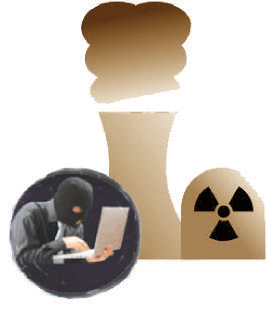 UN watchdog group warns of cyberattacks on nuclear facilities, SC Magazine http://www.scmagazine.com/international-conference-on-computer-security-hosted-for-first-time/article/418241/ Ashley Carman, Editorial Assistant 3 Jun 15 Nuclear facilities around the world are facing daily cyberattacks on their systems, a United Nations nuclear watchdog group said during a Monday conference.
“Reports of actual or attempted cyberattacks are now virtually a daily occurrence,” said Yukiya Amano, director general of the International Atomic Energy Agency (IAEA). “Last year alone, there were cases of random malware-based attacks at nuclear power plants and of such facilities being specifically targeted.”
The conference at which Amano spoke, the International Conference on Computer Security in a Nuclear World, is in its inaugural year and goes until June 5, the UN reported.
“Staff responsible for nuclear security should know how to repel cyber-attacks and to limit the damage if systems are actually penetrated,” Amano said. “The IAEA is doing what it can to help governments, organizations, and individuals adapt to evolving technology-driven threats from skilled cyber adversaries.”
Just 30 miles from New York City – a nuclear disaster-in-waiting
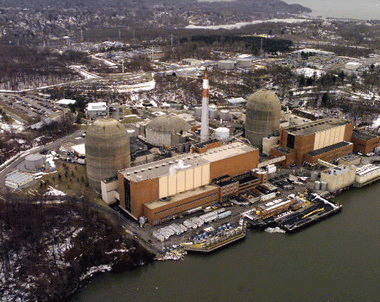 HOW A POTENTIAL FUKUSHIMA SITS 30 MILES FROM NYC , Pontiac Tribune, by Claire Bernish 11 May 15 “…………..there is something of grave concern scheduled to begin shortly, and its close proximity to the aging nuclear plant — which at one time found itself on the list of the nation’s worst — has largely escaped coverage by the corporate media. Oh, did I mention IPEC is located in a seismic zone?
When contemplating risk, there is an assumption that the factors under consideration will lead to an informed decision in answering the question: Is it worth it?
The Algonquin Incremental Market Project (AIM) is a glaring example of an entire industry hellbent on ignoring that essential question altogether. The Federal Energy Regulatory Commission (FERC), with approval by the Nuclear Regulatory Commission (NRC), gave the green light on plans for Spectra Corporation to construct a 42″, high – pressure natural gas pipeline which will run through the IPEC facility, less than a quarter mile — at one critical point just 105 feet — from the No 2 and No 3 reactors. But that’s only the beginning of the folly characterizing the AIM pipeline expansion, a project intended to pump fracked shale gas from Pennsylvania into New England.
Spectra, a giant in the natural gas infrastructure industry, has been seeking the addition to its 1,129 mile long Algonquin Pipeline since 2011. Though the project gained approval, how it managed to do, is a feat that defies logic entirely. Working with the NRC from its outset, engineer Paul Blanch is a nuclear energy proponent with decades of experience in nuclear safety and federal regulation, and holds security clearance for his job — by all accounts an industry ‘insider’. His take on the AIM project should carry weight:
“I’ve had over 45 years of nuclear experience and [experience in] safety issues,” Blanch told Truthout. “I have never seen [a situation] that essentially puts 20 million residents at risk, plus the entire economics of the United States by making a large area surrounding Indian Point uninhabitable for generations. I’m not an alarmist and haven’t been known as an alarmist, but the possibility of a gas line interacting with a plant could easily cause a Fukushima type of release.”
Gas is a volatile, explosive substance, and the pipelines tasked with transporting it are subject to corrosion and neglect, making maintenance and inspection the highest priority. However, a report [pdf] by the National Transportation Safety Board (NTSB) in January found operators had“inadequate evaluation of threats […] which may lead to underestimating the true magnitude of risks to a pipeline”, compounded by “inspectors [who] lack training to effectively verify the validity of an operator’s risk assessment”. With that in mind, an increase in the number of ‘incidents’ (read: accidents) in high – consequence areas (HCA), which are locations where injury and property damage are likely to occur, really comes as no surprise. And yet, Indian Point could qualify as the area of the highest consequences possible . . . New York City, with some 20 million people, sits just 37 miles to its south.
Why does this pipeline have approval? Continue reading
Volcano erupting not far from Sendai where nuclear restarts have just been approved
 Japan Plans To Restart Reactors Surrounded By Active Volcanoes, Simply Info May 29th, 2015 Japan’s NRA has given the go ahead to restart two reactors at the Sendai nuclear plant. A recent court decision rejected the concerns of the public related to the safety of the plant. The needed local approvals are expected to permit the plant to restart even though public opinion is about two to one against restarts. The first reactor could restart as early as July.
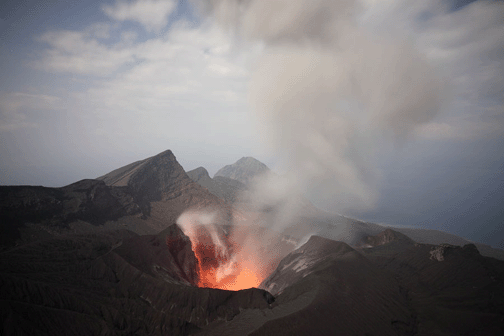
One volcano 64km from the nuclear plant erupted last October. Now one 160km south of the plant is actively erupting. Residents of that island are being evacuated. Even a distant volcano cancause serious problems for a nuclear plant. The ash released in an eruption can take out power lines and cause equipment such as diesel generators to fail. We also found other risks that are unaddressed with the Sendai plant related to any disaster response……..Sendai still lacked an evacuation plan ……..http://www.fukuleaks.org/web/?p=14778
Turbulent activity of the sun – a threat to nuclear power plants
“Very chilling warning” from Japan expert who foretold Fukushima meltdowns: “The Gods are warning us of something even more serious… incredibly disastrous” — Professor: Suddenly, our sun is doing very strange things… Crisis much worse than Carrington Event possible… Most unstable period since ice age, I’m very concerned about nuclear plants (VIDEO) http://enenews.com/very-chilling-warning-japan-expert-foretold-fukushima-meltdowns-gods-warning-serious-incredibly-disastrous-professor-all-sudden-sun-doing-very-strange-very-unusual-could-stronger-carrington-event-u?utm_source=feedburner&utm_medium=email&utm_campaign=Feed%3A+ENENews+%28Energy+News%29
Interview with Dr. Robert Schoch, Boston Univ. (PhD Geology & Geophysics, Yale Univ.), Dec 2013 (8:15 in, emphasis added) “At the end of the last ice age our sun was incredibly active… all the data points to the fact that this is actually what brought the last ice age to a close, with dramatic climate changes, dramatic changes on the surface the earth [and] incredible geological changes… The sun had this turbulent period about 10,000 BC [and] is going through this turbulence once again. This has been well documented by astrophysicists — that all of a sudden our sun is doing very strange, very unusual things… our sun is now more turbulent, more active, than it’s been since the end of the last ice age.”
Katsuhiko Ishibashi, Seismologist and Emeritus professor at Kobe Univ., Apr 28, 2015 (at 38:00 in): “This really is what I think… The Gods of this huge nature are actually warning the people of the Japanese archipelago in steps… In 2003, there was an earthquake that shook a nuclear plant where the design basis went over the standard seismic motion… Then 2007 at Kashiwazaki-Kariwa… a direct, serious hit — and yet the Japanese people did not listen. Then it gave us Fukushima… The Gods are warning us that something even more serious can happen in this Japanese archipelago. And of course nuclear power plant accidents can result not just by earthquake. It could have an incredible, serious effect. It has been dishing it out step-by-step, warning us toward something that actually could be incredibly disastrous” … Moderator: “Very chilling warning” (Japan Times, May 1, 2015: “In 1997, [Ishibashi] wrote a report… where he coined the term “nuclear earthquake disaster.” The paper was written about 14 years before the Fukushima disaster, yet reads like a post-mortem of what happened: A major quake knocks out external power to the plant’s reactors and unleashes a tsunami… leading to loss of cooling and meltdowns.”)
Dr. Schoch, Oct 2014 (55:30 in): “There’s very strong evidence [of] a major solar outburst at the end of the last ice age… Our sun is again going through a period of instability, similar to what we saw 12,000 years ago… We may be due… for some major surprises… The Carrington event of 1859 [largest geomagnetic storm on record] may have just been the start of things to come… I don’t want to be a fear monger… but I think we have to look at the data, I think we have to look at it realistically, and I do think we have to be prepared… We’re incredibly vulnerable with our modern electronics and our dependence on electricity and electrical grid systems… It’s well understood by those people who have studied it, if we had a Carrington event today it would be devastating… we could well have something much stronger than a Carrington event.”
Dr. Schoch, Nov 2013 (12:00 in): “The sun is more active now than it’s been for the last 8,000 or more years… There have been very reputable papers published for instance in the journal ‘Nature’, arguably the most prestigious science journal… that we are going into a period of major solar activity… There’s a saying ‘shot across the bow’… The first real evidence of this increased activity may be the 1859 Carrington event… a major solar outburst.”
Dr. Schoch, Nov 2013 (4:30 in): “I hate to bring it up, but I will because I think it’s serious — the nuclear power plants that we have around the world, we’ve seen what can happen. Fukushima was not that long ago. When you knock out power to a nuclear power plant, the cooling systems don’t necessarily function… If you lose power to a nuclear power plant, we’ve seen what the results can be — and it could be a lot worse than Fukushima.… I don’t want to be alarmist, but on the other hand, I think we have to call it the way we see it. I think we really need to be talking about the evidence — which I believe is very good evidence — of what’s happened in the past, and the ramifications for this in the present and future.”
Dr. Schoch, Dec 2013 (17:00 in): “Something that I’m very concerned about is… we saw a little foreshadowing [at] Fukushima… a nuclear power plant loses electricity… If that happens to hundreds of nuclear power plants… or even just a couple, you’ve got major concerns.”
Ishibashi’s press conference here — Interviews with Dr. Schoch here (1 | 2 | 3 | 4)
1 This Month
26 September – International Day for the Total Elimination of Nuclear Weapons





PLEASE OPPOSE HR 8255 AND S.3639 – bills would accelerate satellite deployment, with no environmental review or safeguards – https://ncstd5li.quorum.us/campaign/169331/
To see nuclear-related stories in greater depth and intensity – go to https://nuclearinformation.wordpress.com
-
Archives
- September 2026 (313)
- August 2026 (330)
- July 2026 (355)
- June 2026 (287)
- May 2026 (306)
- April 2026 (356)
- March 2026 (251)
- February 2026 (267)
- January 2026 (308)
- December 2025 (358)
- November 2025 (359)
- October 2025 (375)
-
Categories
- 1
- 1 NUCLEAR ISSUES
- business and costs
- climate change
- culture and arts
- ENERGY
- environment
- health
- history
- indigenous issues
- Legal
- marketing of nuclear
- media
- opposition to nuclear
- PERSONAL STORIES
- politics
- politics international
- Religion and ethics
- safety
- secrets,lies and civil liberties
- spinbuster
- technology
- Uranium
- wastes
- weapons and war
- Women
- 2 WORLD
- ACTION
- AFRICA
- Atrocities
- AUSTRALIA
- Christina's notes
- Christina's themes
- culture and arts
- Events
- Fuk 2022
- Fuk 2023
- Fukushima 2017
- Fukushima 2018
- fukushima 2019
- Fukushima 2020
- Fukushima 2021
- general
- global warming
- Humour (God we need it)
- Nuclear
- RARE EARTHS
- Reference
- resources – print
- Resources -audiovicual
- Weekly Newsletter
- World
- World Nuclear
- YouTube
-
RSS
Entries RSS
Comments RSS

