Unusual Event’ Declared At Oyster Creek Nuclear Plant, Low water levels in plant’s water intakes were apparently caused by weather conditions from the recent storm Lacey Patch, By Patricia A. Miller, Patch Staff| LACEY TOWNSHIP, NJ– Control room operators at the Oyster Creek Nuclear Plant declared an “unusual event” early Saturday morning when water levels in the plant’s water intakes dipped too low, a spokesman for the Nuclear Regulatory Commission said.
Control room operators reduced reactor power to about 70 percent in response to the lower-than-normal water intake levels and will continue to monitor and evaluate conditions throughout the day, spokesman Neil Sheehan said
An “unusual event” is the lowest of the NRC’s four levels of emergency classification, he said.
Water from the intake canal is used for cooling purposes, doesn’t flow through radioactive materials and is discharged at higher temperatures to the outfall portion of the canal, Sheehan said.
The dry-storage plan OK’ed by the Coastal Commission is the Holtec system: cheaper canisters with 1/2 to 5/8-inch thick stainless steel walls, wildly short of the 10 to 20-inch thick-walled ones used in other countries.
At the controversy’s core is the susceptibility of Holtec canisters to cracking, which could leak radiation into the environment.
Holtec canisters have no seismic rating, are not proven safe for transport, and there is no means to even inspect them for cracks or for existing cracks to be repaired in a safe manner. A crack can’t even be detected until after a radiation leak has occurred.
A highly disturbing report from Sandia National Laboratories states that a crack in a hot canister can penetrate the wall in under 5 years.
Mosko: Ticking Time Bomb at San Onofre Nuclear Plant,https://voiceofoc.org/2018/01/mosko-ticking-time-bomb-at-san-onofre-nuclear-plant/By SARAH “STEVE” MOSKOThe seaside nuclear reactors at the San Onofre Nuclear Generating Station in San Clemente were permanently shut down in 2013 following steam generator malfunction. What to do with the 3.6 million pounds of highly radioactive waste remains an epic problem, however, pitting concerned citizens against Southern California Edison, the California Coastal Commission and the Nuclear Regulatory Commission (NRC). Edison operates San Onofre, the Coastal Commission is charged with protecting the coastline, and the NRC is responsible for long-term storage of spent nuclear fuel and protecting the public.The Problem
A reactor’s spent nuclear fuel must be stored safely for 250,000 years to allow the radioactivity to dissipate. San Onofre’s nuclear waste has been stored in containers 20 feet under water in cooling pools for at least five years, the standard procedure for on-site temporary storage. Long-term storage necessitates transfer to fortified dry-storage canisters for eventual transportation to a permanent national storage site which, under the Nuclear Waste Policy Act of 1982, the federal government is under obligation to construct.
However, the plan to build an underground repository at Yucca Mountain in the Nevadan desert was ditched in 2011 out of concern that deep groundwater could destabilize the canisters, leaving the United States with literally no plan on the horizon for permanent storage of nuclear waste from San Onofre or any other of the country’s nuclear power plants. In fact, under the NRC’s newest plan – the so-called Generic Environmental Impact Statement – nuclear power plant waste might be stored on-site forever.
Given this, informed southern Californians are up in arms about the 2015 permit by the Coastal Commission allowing Edison to build a dry-storage bunker right at San Onofre – near major metropolitan areas and within a few hundred feet of both the I-5 Freeway and the shoreline in a known earthquake zone – using thin-wall canisters never proven safe for storage or transport (Coastal Development Permit No. 9-15-0228). Most other countries, including Germany, France, Japan, Russia and Australia, utilize thick-wall canisters with time proven safety technology.
The Current Plan
The dry-storage plan OK’ed by the Coastal Commission is the Holtec system: cheaper canisters with 1/2 to 5/8-inch thick stainless steel walls, wildly short of the 10 to 20-inch thick-walled ones used in other countries. Each of 72 remaining canisters slated to be converted from wet to dry storage will contain about 50,000 pounds of nuclear waste and as much radiation as was released from Chernobyl.
At the controversy’s core is the susceptibility of Holtec canisters to cracking, which could leak radiation into the environment, both land and sea. Seawater seepage into canisters can produce explosive substances.
Holtec canisters have no seismic rating, are not proven safe for transport, and there is no means to even inspect them for cracks or for existing cracks to be repaired in a safe manner. A crack can’t even be detected until after a radiation leak has occurred.
The Coastal Commission acknowledges these issues but is allowing Edison 20 years to hopefully come up with a solution.
In the meanwhile, loading into dry-canisters already began in December, 2017 and is scheduled to be completed by 2019. Furthermore, Edison plans to empty the cooling pools once the dry transfer is completed, eliminating the only approved method to replace a defective canister.
A highly disturbing report from Sandia National Laboratories states that a crack in a hot canister can penetrate the wall in under 5 years. Notwithstanding, Holtec’s 25-year warranty of their canisters is an absurdity given that nuclear waste radiation takes thousands of years to reach safe levels.
There is also no community evacuation plan in place in the event of radiation leakage at San Onofre. The fear is that failure of even one canister could leave Orange and San Diego counties an uninhabitable wasteland for eons, with exposed humans suffering permanent genetic damage. And, home and business insurance doesn’t cover losses due to radiation contamination.
The very real specter of radiation havoc from a terrorist bomb attack launched from an offshore boat or a truck on the I-5 Freeway looms as well.
In the minds of many, the reckless plan allowed by the NRC and endorsed by the Coastal Commission and Edison creates imminent risk of a “Fukushima” in South Orange County.
The Solution
A lawsuit filed by the San Diego watchdog organization Citizens Oversight in 2015 asserted that the Coastal Commission failed to adequately consider both the special risks of on-site storage in an earthquake zone next to the ocean and the shortcomings of the Holtec system. In a court settlementjust reached on Aug. 25, 2017, Edison agreed to hire a team of experts in hopes of locating an alternative temporary storage site. Edison also agreed to develop a plan for dealing with cracked canisters, though there is no assurance that such a plan is feasible for Holtec canisters.
Though the settlement plan appears a first step toward a saner solution to San Onofre’s nuclear waste problem, the obligations in the plan are far too vague to assuage the concerns of local residents. Their main points are threefold: There are other safer temporary storage sites inland that can be considered; maintaining the cooling pools is imperative until all nuclear waste has been moved off-site; and Holtec canisters should be abandoned in favor of thick-wall options that already have a 40-year track record of safety during both transport and storage in countries across the globe.
Case in point, the thick-wall canisters in place at Fukushima survived both the earthquake and the tsunami.
Take action to protect yourself and your family by signing on to a petition from PublicWatchdogs.orgto revoke the Coastal Commission’s permit to turn San Onofre into a nuclear waste dump.
Kenya’s nuclear quest: A case of extreme optimism? As the country moves towards the reality of nuclear energy by 2027, questions on expertise and safety concerns abound. Daily Nation, 2 Jan 17“………While the government brags that over 60 per cent of the country’s population has access to power, unreliable power supply and frequent power outages steal the thunder from this achievement, pushing the government into overdrive to boost power production.One of the strategies is to put up a nuclear energy plant by 2027, in a fervent push to lower the country’s energy deficit and electricity tariffs.
The project will cost a staggering Sh2 trillion begging the question of whether it will lower energy tariffs and still remain afloat.
Sceptics also argue that a sunshine-rich country such as Kenya should never think of going the risky route of nuclear energy……
While government officials strongly defend the nuclear project, questions abound about how a country whose major cities – Nairobi, Kisumu, and Mombasa – have failed to handle minor fire disasters and basic household waste will effectively deal with toxic wastes, which are the by-product of nuclear power generation.
In Nairobi for instance, where every individual generates about two kilogrammes of waste every day, garbage is littered all over, with roads becoming impassable when it rains. Moreover, some hospitals and clinics carelessly dispose their medical waste in landfills ran by cartels, yet the government insists it can handle nuclear waste.
One of the critics of nuclear power generation is North Horr Member of Parliament Chachu Gaya, who says that the government should explore safer sources of energy such as solar and wind energy, and only consider nuclear as an energy source of last resort……
Opponents are also worried about health hazards, safety and radioactive waste management, with questions about the country’s preparedness to deal with radioactive waste and accidental leaks which advanced economies like Japan have grappled with.
“Kenya only rides on optimism in its quest to generate nuclear power, but lacks human capital or infrastructure to roll out the technology,” says Oyath, adding that Kenya’s poor waste management strategies and pitiable response to disasters are considerable grounds to dismiss the project……..http://www.nation.co.ke/health/Ready-for-nuclear/3476990-4248378-l09oc2/index.html
While this number was much lower than the previous year, one incident was above the lowest level on the INES scale, for the first time since 2015.
The International Nuclear Events Scale (INES) has seven levels, Level 1 being the lowest.
In 2016 there were 15 nuclear incidents in Belgium, all on Level 1. While there were fewer incidents this year, one of these was on Level 2.
That incident took place in July, during the transport of poorly packaged radioactive material that had been sent on passenger flights from Cairo to Brussels via Zurich. Many passengers, including one Belgian, were potentially exposed to radiation above the prescribed limit, but without any significant consequences for their health.
One of the Level 1 incidents was at the Doel plant where a deterioration of the concrete was observed in October.
Suddeutsche Zeitung 29th Dec 2017, [Machine Translation]In the nuclear power plant Neckarwestheim a leak hasbeen discovered during a tour in Block II in the control area. This was
announced by the Ministry of the Environment on Friday in Stuttgart. As a
result of the leak on a pipeline behind a circulation pump discovered on 22
December, about 100 liters of radioactive concentrate had leaked into the
control area of the reactor auxiliary building. However, this has no or
only a very low safety significance, said the Ministry. The operator had
shut off the pump. The affected area had been decontaminated, people were
not harmed. The cause will be further investigated. The system will be out
of service until the repair is complete. http://www.sueddeutsche.de/news/wirtschaft/atomkraft—stuttgart-leck-in-rohrleitung-bei-atomkraftwerk-neckarwestheim-dpa.urn-newsml-dpa-com-20090101-171229-99-447002
Trump’s plan takes Barack Obama’s policy of “American exceptionalism” to a new level. In his speech accompanying the NSS’s release, Trump stated, “America has been among the greatest forces for peace and justice in the history of the world.”
Yet Trump has not only continued but also escalated the Bush-Obama wars in Afghanistan and Iraq, dropped Tomahawk missiles on Syria, threatened North Korea and Iran, intensified airstrikes against Muslim countries, and fanned the flames of conflict in the Middle East.
Trump’s NSS stresses military might but makes scant reference to diplomacy. His administration is building 10 new aircraft carriers worth $13 billion each as a counterweight to China, and expanding the US nuclear weapons program to the tune of $1 trillion over the next 30 years.
Nuclear weapons are “the foundation of our strategy to preserve peace and stability by deterring aggression against the United States, our allies, and our partners,” according to the NSS. But Trump has dangerously escalated tensions with North Korea, providing that country with increasing incentives to develop nuclear weapons that reach around the world.
And by refusing to recertify Iran’s compliance with the nuclear agreement, in spite of the UN International Atomic Energy Agency’s finding to the contrary, Trump is further imperiling peace.
The NSS’s brief mention of working with international organizations is belied by the Trump administration’s abiding contempt for the United Nations. The UN Charter was created in 1945 by the countries of the world to collectively restore and maintain international peace and security.
As with Trump’s domestic program, the NSS makes no pretense of concern for human rights in other countries. This is evidenced in practice by Trump’s unwavering support for Israel‘s brutal occupation of Palestinian lands, including, most recently, his declaration that Jerusalem is the capital of Israel . The NSS accurately states, “for generations the conflict between Israel and the Palestinians has been understood as the prime irritant preventing peace and prosperity in the region.”
But the NSS minimizes Israel’s central responsibility for the conflict, stating, “the threats from radical jihadist terrorist organizations and the threat from Iran are creating the realization that Israel is not the cause of the region’s problems.”
In defiance of nearly all other nations, Trump’s Jerusalem declaration endangers world peace. Indeed, last week, the UN Security Council voted 14-1, with a US veto, to condemn Trump’s characterization of Jerusalem as the capital of Israel. And in a rarely used procedure called Uniting for Peace (UFP), the UN General Assembly overwhelmingly followed suit. UFP allows the General Assembly to take measures to restore international peace and security when the Security Council is unable or unwilling to act. By utilizing UFP, which requires a two-thirds vote, this resolution has greater force than other General Assembly decisions. The International Court of Justice upheld the legality of UFP in its 1962 advisory opinion.
Richard Falk, former UN Special Rapporteur for Palestinian Human Rights, told Truthout that, “What is already evident on the basis of [Trump’s Jerusalem] decision itself is the severe damage done to the global and regional leadership reputation of the United States.”
While setting forth the goal of being an “energy-dominant nation,” the NSS gives short shrift to “the importance of environmental stewardship.” Obama’s 2015 NSS, on the other hand, correctly stated that climate change was an “urgent and growing threat to our national security.” Yet Trump’s NSS does not recognize the threat of climate change. And in spite of increasingly extreme and unseasonal weather events such as recent hurricanes and wildfires, Trump has alarmingly and irresponsibly pulled out of the Paris climate accord.
The four pillars of the NSS, according to Trump, are protecting the US homeland, promoting US prosperity, achieving peace through strength and advancing US influence in the world.
Pillar I: Protect the Homeland
The NSS singles out unauthorized immigration as a threat to the homeland, but also implicitly attacks authorized immigration as well. It states that residency and citizenship decisions “should be based on individuals’ merits and their ability to positively contribute to US society, rather than chance or extended family connections.” This policy leads to the separation of families and makes us no safer.
Pillar I stresses securing our borders “through the construction of a border wall,” embodying Trump’s campaign mantra. There is no evidence that an expensive border wall will secure US borders or make us safer.
“The United States rejects bigotry and oppression,” according to Pillar I. Yet Trump has instituted three iterations of a Muslim ban, which would exclude from the United States immigrants from six Muslim-majority countries, as well as North Korea and Venezuela.
The Trump administration has also drastically cut back on accepting refugees from Syria, whose people are suffering from a prolonged, tragic civil war.
Pillar I pledges the US government will “help communities recover and rebuild” after natural and other disasters. Yet Trump has failed to meaningfully respond to the devastation wrought by the recent hurricane in Puerto Rico, which is part of the United States.
Pillar II: Promote American Prosperity
One subsection of Pillar II, called “Reduce the Debt Through Fiscal Responsibility,” cites “modernizing our tax system” as a way to “make the existing debt more serviceable.” Ironically, at Trump’s urging, the GOP-controlled Congress passed a radical tax overhaul that will reportedly add $1.5 trillion (or more) to the debt in the next 10 years. This is the height of irresponsibility.
Moreover, the United Nations has just conducted an investigation of extreme poverty in the United States, with disturbing results. It concluded that the prevalence of poverty and inequality “are shockingly at odds with the [US’s] immense wealth and its founding commitment to human rights.” The report documented a rise in poverty that disproportionately affects women and people of color as well as many white Americans. Homelessness, police surveillance, criminalization of poverty and unsafe sanitary practices were also flagged as problems.
Yet documentation of poverty in the United States is conspicuously absent from Trump’s NSS. In fact, Pillar II cites “unnecessary regulations” as problematic. Deregulation serves the interest of the wealthy. Since he took office, Trump has eliminated hundreds of regulations that protect health, safety and workers.
Pillar III: Preserve Peace Through Strength
This pillar identifies China, Russia, Iran, North Korea and jihadist terrorist groups as “actively competing against the United States and our allies and partners.” It stresses diplomacy “short of military involvement” as “indispensable.” Yet Trump castigated Secretary of State Rex Tillerson for pursuing diplomacy with North Korea while escalating the war of words and pushing punishing sanctions against that emerging nuclear power. Although Pillar III pays lip service to the “law of armed conflict,” Trump’s actions have violated those rules.
Pillar IV: Advance American Influence
Pillar IV states, “Around the world, nations and individuals admire what America stands for. We treat people equally and value and uphold the rule of law.” But since taking office, Trump has celebrated white supremacists, pardoned racist Sheriff Joe Arpaio and ended the Deferred Action for Childhood Arrivals program. He has also consistently violated US and international law.
The United States sells weapons and provides military advisers to Saudi Arabia, which enables the Saudis’ illegal bombing and medical/food/fuel blockade of Yemen, the poorest Arab country. This has resulted in famine and an outbreak of cholera affecting millions of Yemenis, particularly children. California Democratic Representatives Ted Lieu and Ro Khanna both warned that such actions expose US officials to criminal liability for aiding and abetting Saudi war crimes in Yemen.
This pillar admits that the UN “can help contribute to solving many of the complex problems in the world.” It emphasizes that the “United States supports the peaceful resolution of disputes under international law.” Yet the administration reacted to the Security Council and General Assembly’s rejections of Trump’s Jerusalem-as-capital-of-Israel declaration by threatening countries that voted against it with loss of foreign aid. Moreover, Trump threatened to cut off funding to the UN itself, the most significant peacekeeping organization in the world.
Resist Trump’s Agenda
Increasing disillusionment with Trump’s policies and, most recently, his unpopular new tax bill, may lead to the loss of a Republican majority in one or both houses of Congress in the 2018 midterm elections. It is incumbent on us all to continue and escalate our resistance to the Trump regime. The future of the United States and indeed, the world, depends on it.
Trump’s NASA Plans Are a Nuclear Disaster Waiting to Happen http://www.truth-out.org/news/item/43021-the-nuclear-disaster-of-trumps-nasa-plansDecember 29, 2017By Linda Pentz Gunter, Earlier this month, President Trump announced that he wants the National Aeronautics and Space Administration (NASA) to “lead an innovative space exploration program to send American astronauts back to the moon, and eventually Mars.” But while couched in patriotic sound bites and pioneering rhetoric that “Florida and America will lead the way into the stars,” the risks such ventures would entail — and the hidden agenda they conceal — have scarcely been touched upon.
For those of us who watched Ron Howard’s nail-biter of a motion picture, Apollo 13,and for others who remember the real-life drama as it unfolded in April 1970, collective breaths were held that the three-man crew would return safely to Earth. They did.
What hardly anyone remembers now — and certainly few knew at the time — was that the greater catastrophe averted was not just the potential loss of three lives, tragic though that would have been. There was a lethal cargo on board that, if the craft had crashed or broken up, might have cost the lives of thousands and affected generations to come.
It is a piece of history so rarely told that NASA has continued to take the same risk over and over again, as well as before Apollo 13. And that risk is to send rockets into space carrying the deadliest substance ever created by humans: plutonium.
Now, with the race on to send people to Mars, NASA is at it again with its Kilopower project, which would use fission power for deep space. It would be the first fission reactor launched into space since the 1960s. Fission, commonly used in commercial nuclear reactors, is the process of splitting the atom to release energy. A by-product of fission is plutonium.
Small reactors would be used to generate electricity on Mars to power essential projects in the dark. But first, such a reactor has to get to Mars without incident or major accident. And the spacecraft carrying it would also be nuclear-powered, adding monumentally to the already enormous risk. As physicist Michio Kaku points out, “Let’s be real. One percent of the time, rockets fail, they blow up, and people die.” With plutonium on board, the only acceptable accident risk has to be 0 percent.
When Apollo 13 mission astronaut John Swigert told NASA Mission Control “Houston, we’ve had a problem,” it only touched on the most immediate crisis: the damaging of the craft after the explosion of an oxygen tank that forced the crew to abort the planned moon landing.
However, what few knew at the time — and what was entirely omitted from Howard’s 1995 film — was the even bigger crisis of what to do about the SNAP-27 Radioisotope Thermoelectric Generator (RTG) on board. The RTG was carrying plutonium-238. It was supposed to have been left on the moon to power experiments. Now that no moon landing was to occur, what would become of the RTG, especially if Apollo 13 ended up crashing back to Earth in a fireball? Such an outcome could disperse the plutonium as dust, which, if inhaled, would be deadly.
One (and possibly the only) journalist who has been consistently on the “nukes in space” beat for more than 30 years is Karl Grossman. When the Apollo 13 movie came out, he picked up the phone and called the film’s production company, Imagine Entertainment, to ask why they had not included the higher drama of the plutonium problem. “It was surprising to see Hollywood not utilizing an Armageddon theme,” he told Truthout.
Grossman said that Michael Rosenberg, then executive vice president and now co-chairman of Imagine Entertainment, told him that the omission was an “artistic decision.” However, since NASA personnel had served as advisors for the film, Grossman speculated that the agency might have been more than a disinterested party. Far better that the film confine itself to the life-threatening jeopardy of the three astronauts rather than the danger to life on Earth that would have been posed by falling plutonium.
Grossman was already well aware of the Armageddon potential of NASA missions by the time he called Howard’s production company. In 1985, he had learned that two space shuttle missions planned for 1986 would carry plutonium-powered probes to be lofted into space to orbit the Sun and Jupiter. As it turned out, the ill-fated Challenger was one of the shuttles scheduled for the May 1986 plutonium mission, in what would have been its second flight that year.
Grossman said he had been worried at the time about a rocket explosion on launch, a not unprecedented disaster. Or what if a shuttle carrying a plutonium-fueled space probe failed to attain orbit, exploded and crashed back to Earth?
The official NASA and Department of Energy (DOE) documents Grossman eventually obtained using the Freedom of Information Act, “insisted that a catastrophic shuttle accident was a 1-in-100,000 chance,” he said.
But on January 28, 1986, Challenger exploded. (Shortly thereafter, NASA changed the odds of a catastrophic shuttle accident to 1-in-76.) Grossman called The Nation and asked if they knew that Challenger’s next mission would have carried plutonium. The magazine invited Grossman to write an editorial — “The Lethal Shuttle” — which ran on the magazine’s front page.
After The Nation editorial, Grossman was invited over to the offices of “60 Minutes.” He duly appeared with armfuls of documents and alarming “what ifs” but, as he told Truthout, “there was no ignition,” and “60 Minutes” never picked up the story.
Over the years, articles about the use of nuclear power on space devices and military plans for space continued to be ignored. With the mainstream media apparently reluctant to challenge the space program — perhaps out of a misplaced sense of “patriotism” — Grossman continued his solo investigations. In 1997, he penned a book, The Wrong Stuff, which detailed NASA’s blunders with plutonium-fueled missions and its unrealistic calculations about the probability of a major accident.
There had been problems before Challenger. In 1964, an aborted mission carrying an RTG had resulted in a reentry burn-up over Madagascar. Plutonium was found in trace amounts in the area months later. Although the event was downplayed, it had serious consequences, as Grossman found in a report he cited in The Wrong Stuff. The plutonium had spread all over the world.
According to page 21 of the report, “A worldwide soil sampling program carried out in 1970 showed SNAP-9A debris to be present on all continents and at all latitudes.”
John Gofman, professor of molecular and cell biology at UC Berkeley, and involved in the isolation of plutonium in the early years of the Manhattan Project, connected the SNAP-9A accident to a worldwide spike in lung cancer, as reported on page 12 of Grossman’s The Wrong Stuff.
Similarly, in 1968, a weather satellite was aborted soon after takeoff from Vandenberg Air Force Base. The plutonium from its RTG plunged into 300 feet of water off the California coast. Fortunately, in this instance, it was retrieved. At the time, all satellites were powered by RTGs. But in the wake of these disasters, NASA had already begun to push to develop solar photovoltaic (PV) power for satellites. Today, all satellites are powered by solar PV, as is the International Space Station.
Apollo 13 jettisoned its 3.9 kg of plutonium over the South Pacific, already the setting for scores of atomic weapons tests by the US and France. Contained in a graphite fuel cask, it supposedly came to rest in the deep Tonga Trench. No one will ever bother to retrieve it, even though it is now technically feasible, because of the enormous cost. Whether it has leaked (likely) and how it has affected marine life will now never be known.
Grossman kept on writing about the dangers of nuclear materials in space as well as the possibility for space wars. He found that one of the reasons NASA and the DOE sought to use nuclear power in space was to work in tandem with the Pentagon, which was pushing Ronald Reagan’s Strategic Defense Initiative, known colloquially as “Star Wars.” Star Wars was predicated on orbiting battle platforms with nuclear reactors — or “super RTGs” — on board, providing the large amounts of energy for particle beams, hypervelocity guns and laser weapons.
Although seemingly alone on the issue as a journalist, Grossman is not without an important resource in the form of Bruce Gagnon’s Maine-based Global Network Against Weapons and Nuclear Power in Space, which has been campaigning on the issue since 1992. Gagnon has watchdogged space weaponry but also US government plans to plunder other planets and moons for minerals, as the Trump administration is hinting it expects to do. Gagnon told Grossman that such plans have never been far from the nuclear industry’s radar and that at nuclear power industry conferences, “Nuclear-powered mining colonies and nuclear-powered rockets to Mars were key themes.”
The topic was also covered by Helen Caldicott and Craig Eisendrath in their 2007 book, War in Heaven. That same year, the Cassini space probe was launched. It carried 72.3 pounds of plutonium fuel, used to generate electricity, not propulsion — 745 watts of it to run the probe’s instruments. As Grossman wrote in a recent article and drew attention to in his documentary — Nukes in Space: The Nuclearization and Weaponization of the Heavens — Cassini “was launched on a Titan IV rocket despite several Titan IV rockets having blown up on launch.”
In 1999, because “Cassini didn’t have the propulsion power to get directly from Earth to Saturn…. NASA had it hurtle back to Earth in a ‘slingshot maneuver’ or ‘flyby’ — to use Earth’s gravity to increase its velocity,” Grossman wrote. A catastrophic failure of that operation could have seen Cassini crash to Earth, dispersing its deadly plutonium load. According to NASA’s Final Environmental Impact Statement for the Cassini Mission, Section 4-5, the “approximately 7 to 8 billion world population at the time … could receive 99 percent or more of the radiation exposure.” And yet, the agency proceeded to take that chance.
The world had once again dodged a radioactive bullet. In September 2017, having completed its mission, Cassini was deliberately crashed into Saturn, contaminating that planet with plutonium. While less controversial than lethally dumping it on Earth, the event raises at least moral, if not scientific questions about humankind’s willingness to pollute other planets with abandon after already doing so to our current home.
The Trump administration’s planned new missions to the moon and Mars would seem to follow that pattern, with Trump stating ominously, “this time we will not only plant our flag and leave our footprint.” The US now intends to conduct “long-term exploration and use” on Mars and the moon.
A recent article in Roll Call suggested that while Trump has said little publicly about the militarization of space, behind-the-scenes space satellite warfare is very much on the agenda with serious money set aside to develop “weapons that can be deployed in space.”
A war in space might not involve nuclear weapons — for now. But warring satellites could knock out nuclear weapons early warning systems and set other potential disasters in motion. These cataclysmic risks play strongly into the arguments — enshrined in the recent UN nuclear weapons ban — that we should be disarming on Planet Earth, not arming in space.
Politicians and decision-makers in South Korea are torn about a plan to
continue construction of two nuclear power plants, following a major
earthquake. The magnitude 5.4 earthquake in early November reignited public
concern about whether the country can still be considered a seismic safe
zone. Now a 500-strong panel of experts is due to report. http://www.aljazeera.com/news/2017/12/south-korea-concerns-raised-safety-nuclear-plants-171226071506379.html
Ontario’s long-awaited new nuclear emergency plan falls short, Greenpeace says Ontario has updated its plan for dealing with nuclear emergencies for the first time since the 2011 Fukushima disaster, The Star.com, By ROB FERGUSON Queen’s Park Bureau, Dec. 28, 2017 Ontario has updated its plan for dealing with potentially deadly emergencies at nuclear power plants for the first time since the 2011 Fukushima disaster forced the evacuation of 70,000 people in Japan.
The 173-page effort follows criticisms from provincial auditor general Bonnie Lysyk earlier this month that the nuclear response blueprint has not been changed since 2009 to reflect lessons learned elsewhere.
“Ontario has three nuclear power facilities and 18 operating reactors, which makes it the largest nuclear jurisdiction in North America and one of the largest in the world,” she wrote in her annual report.
“Plans need to be regularly updated with current information and to reflect the best approach to respond to emergencies so they can be used as a step-by-step guide during a response,” Lysyk added.
The new plan takes into account radiation emergencies that could stem from reactor accidents, leaks during the transportation of radioactive material, explosions and even a satellite crashing on nuclear plants at Pickering and Darlington east of the heavily populated Greater Toronto Area or at the Bruce reactors near Kincardine on Lake Huron…….
The plan was released a week after the government put out a request for experts to conduct a technical study of it, making a mockery of the process, said the anti-nuclear group, Greenpeace.
“It’s ass backward and incompetent,” said Shawn-Patrick Stensil, senior energy analyst for Greenpeace, a vocal critic of the government’s nuclear energy program.
There is little in the updated nuclear response plan to prepare for a major disaster, he added, such as emergency zones that are too small given the potentially large scale of nuclear disasters.
“While other countries have strengthened public safety since Fukushima, it’s taken the Ontario government six years to maintain the status quo,” said Stensil.
“Other countries are preparing for bigger accidents.”……….
Toronto city council passed a motion in November calling on the province to prepare for more severe accidents and expand delivery of anti-radiation potassium iodide pills beyond the current 10-kilometre zone around nuclear power plants.
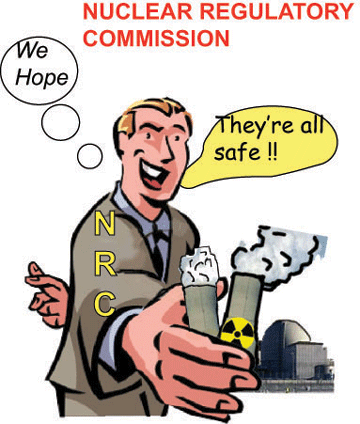
Nuclear Regulatory Commission downplays safety warnings, investigation finds, CBS News, 20 Dec 17,The federal agency responsible for safety at the nation’s 61 nuclear power plants routinely downplays warnings from plant workers and its own experts about problems, including some with potential for disaster, a Better Government Association investigation found.
Employees from U.S. nuclear power plants filed nearly 700 complaints with the United States Nuclear Regulatory Commission in recent years, claiming retaliation for raising safety concerns, records show. The agency found no wrongdoing.
NRC officials also overruled recommendations from their own technical experts on how to protect plants from potential catastrophe spurred by floods, equipment failures, power outages and other problems.
Interviews with more than 20 current and former NRC and nuclear plant employees reveal a pattern of top officials dismissing safety warnings rather than impose costly fixes on plant operators. Some said careers suffered as potential threats were never fully addressed.
“It’s the NRC’s longstanding practice to consistently declare the plants are safe and to avoid directly answering any questions that might suggest otherwise,” said Lawrence Criscione, an NRC risk analyst.
NRC officials would not consent to an interview. But NRC spokeswoman Viktoria Mitlyng responded in writing to BGA questions……..
The nuclear industry, through its trade group and individual companies, often downplays the seriousness of problems highlighted by NRC experts. Exelon and others in the industry bat down potential rules and regulations by pleading to NRC’s top managers……….
The problem, say people who conduct government reviews, is that the NRC’s final rulings often don’t reflect warnings from its experts.
“Management tells you where they want the answer to go. If you push, you’re not going to get promoted again – there are other people who are willing to say it’s not a serious issue,” said Richard Perkins, one of Criscione’s NRC colleagues involved in exposing flooding concerns.
One case in point is the emergency safety valve issue at Exelon’s Byron and Braidwood plants……..
Underscoring that frustration is the NRC’s record of handling whistleblower complaints lodged by plant employees. From 2010 through 2016, workers filed 687 complaints. The NRC investigated just 235 and upheld none.
The largest number of complaints, 84, were filed by employees at the two nuclear plants operated in Georgia by Southern Nuclear, records show. Next were the 70 complaints lodged by nuclear workers in South Carolina, 58 by workers in Tennessee and 50 in California. Illinois ranked 12th, with 21 whistleblower cases filed. https://www.cbsnews.com/news/nuclear-regulatory-commission-downplays-safety-warnings-investigation-finds/
Trump Drops Climate Threats from National Security Strategy, Scientific American, The president claimed yesterday that the true danger to U.S. security is not climate change, but regulations By Jean Chemnick, ClimateWire on December 19, 2017President Trump argued yesterday that the true threat to national security is not climate change but regulations that get in the way of U.S. economic and energy “dominance.”
Trump introduced his first National Security Strategy, in which he broke from the Obama administration in not listing climate change as a chief threat. His remarks at times sounded like an economic address, frequently veering into discussion of tax and trade, industrial deregulation, and a celebration of the stock market. Trump insisted that wealth and national security go hand in hand.
“Economic vitality, growth and prosperity at home is absolutely necessary for American power and influence abroad,” he said in an address that heavily focused on global competition over cooperation……
It was a sentiment that permeated the 56-page security strategy, and in particular the section titled “Embrace Energy Dominance,” which dealt with energy and climate issues…….
FAA names seven nuclear research labs as no-drone zones Drones are now prohibited from flying within 400 feet of the facilities.Engadget Mariella Moon, @mariella_moon 20 Dec 17The FAA has granted DOE’s request to make seven of its facilities no-drone zones — and they’re all nuclear research laboratories. Starting on December 29th, you can no longer fly your UAVs within 400 feet of Hanford Site in Franklin County Washington, Pantex Site in Panhandle Texas, Los Alamos National Laboratory in New Mexico, Idaho National Laboratory, Savannah River National Laboratory in Aiken South Carolina, Y-12 National Security Site in Oak Ridge Tennessee and Oak Ridge National Laboratory. Some of them are no longer operational — the Hanford site where plutonium was produced for the nuclear bomb detonated over Nagasaki, for instance, is now mostly decommissioned — but some are still active……https://www.engadget.com/2017/12/19/faa-nuclear-research-labs-no-drone-zone/
The other North Korea nuclear threat we should be worried about CNBC, 20 Dec17
North Korea’s questionable nuclear safety standards and its isolation from the global scientific community increase the risk of a nuclear accident, according to 38North
The country’s leader Kim Jong Un was caught on tape smoking a cigarette next to an intercontinental ballistic missile earlier this year
If a nuclear disaster does occur, it would likely cause regional panic
Nyshka Chandran | @nyshkacThe risk of a North Korean nuclear meltdown can’t be ignored, according to a recent note published on 38North, a project of the US-Korea Institute at Johns Hopkins School of Advanced International Studies.
Longstanding doubts over the hermit kingdom’s nuclear safety resurfaced in July, when a video emerged of leader Kim Jong Unsmoking a cigarette next to a Hwasong-14 intercontinental ballistic missile.
“Kim’s recklessness is certainly notable, and it hints at an under-emphasized and potentially devastating possibility: the threat of a nuclear accident in North Korea,” said the 38North note, released late last week.
Adding to the concern, Chinese researchers said in September that North Korea’s Punggye-ri nuclear test site was at risk of imploding. That was followed by TV Asahi’s October report of a tunnel collapse at the same nuclear site, an incident believed to have killed more than 200 people. Pyongyang, in response, called the report false and dismissed it as misinformation.
North Korean Nuclear Reactor Safety: The Threat No One is Talking About, 38 North, BY: MATT KORDA, DECEMBER 14, 2017 The ability of North Korea to safely operate its nuclear reactors, according to many experts, is increasingly being called into question given the North’s isolation and lack of safety culture. Pyongyang’s ability to respond to a nuclear accident in a timely fashion will make the difference between a small-scale event and a catastrophic disaster. And while the actual contamination would be localized, the lack of transparency from North Korea in dealing with the situation is likely to cause political panic in the region in excess of the actual radiological exposure and environmental impact. The opening of nuclear safety talks with the North to help prevent such an accident from occurring would provide a rare opportunity for regional dialogue and could pry open the door for realistic and productive discussions of North Korea’s nuclear program.
A Disaster Waiting to Happen?
A video of Kim Jong Un smoking next to an untested liquid-fueled missile tells you everything you need to know about North Korea’s nuclear safety culture. The remarkable 14-second clip shows the Supreme Leader taking a puff while a Hwasong-14 intercontinental ballistic missile is erected on the launch pad mere feet away—prompting a torrent of snarky Twitter commentary expressing regret that Kim’s lit cigarette had not “solved the problem for us.” Kim’s recklessness is certainly notable, and it hints at an underemphasized and potentially devastating possibility: the threat of a nuclear accident in North Korea.
At the March 2014 Nuclear Security Summit in The Hague, then-South Korean President Park Geun-hye claimed that Yongbyon, North Korea’s primary nuclear research center, “is home to such a dense concentration of nuclear facilities that a fire in a single building could lead to a disaster potentially worse than Chernobyl.” While her damage assessment is likely an exaggeration—researchers from 38 North assess Chernobyl’s power output to have been 3,000 percent greater than Yongbyon—the potential for a nuclear accident is not.
Niko Milonopoulos and Edward D. Blandford noted previously that a sudden fault in North Korea’s outdated power grid could prevent the Yongbyon reactors from being adequately cooled and could potentially trigger a meltdown. Such an event could also be prompted by a natural disaster or abnormal weather patterns. Complementary analysis by Nick Hansen indicates that North Korea’s 5 MWe plutonium production reactor had to be briefly shut down following a flood in July 2013 which destroyed parts of the cooling systems. He noted with concern that “if a major flood cuts off the cooling water supply to the reactors before they can be shut down, a major safety problem could occur.” This is exactly what prompted the series of nuclear meltdowns at Fukushima……….http://www.38north.org/2017/12/mkorda121417/
Times 14th Dec 2017,A French-designed nuclear reactor ordered by Britain is facing further
scrutiny after the disclosure that defects were detected in one of the same models under construction in China. The revelation adds to the string of setbacks that have hit the European Pressurised Reactor (EPR) designed by Areva, the French nuclear group.
Britain has ordered two of those reactors for Hinkley Point C. They are being built by EDF, the French state energy
giant, and China General Nuclear Power Corporation at a cost of £19.5 billion.
China General Nuclear Power Corporation, which is building two reactors in a joint venture with EDF near Macau in southern China, said it had found “local defects” in the Taishan 1 reactor. It said that welding in the deaerator, which is used to remove oxygen from water circuits, was defective. The parts had been replaced, it said.
Taishan 1 is due to come on stream this month to become the world’s first functioning example of the
European reactor. The second Chinese reactor, Taishan 2, is due to come online next year. The $8.7 billion project was initially due to be completed last year, but was delayed by safety concerns.
The problems in China pale by comparison with those affecting other projects. Work on a similar reactor at Olkiluoto in Finland began in 2005 and was supposed to finish in 2009. It is now expected to be in action from 2019. EDF is also
building a reactor at Flamanville in Normandy which was due to begin operating in 2012, but won’t be working until the end of next year. The reactors at Hinkley Point were originally due to be operational in 2025 but EDF said this summer that they were likely to be 15 months late. https://www.thetimes.co.uk/edition/business/new-defects-in-hinkley-type-reactor-tjj0cprhz