Director general of Orano (formerly Areva) tries to convince French Assembly that nuclear fuel pools are not dangerous
 National assembly 9th March 2018, [Machine Translation]
Philippe Knoche, a plane crash or rocket fire could not damage enough spentfuel storage tanks to dewater them. “I would like to take this example
because our opponents use it a lot …”
http://www.lcp.fr/la-politique-en-video/la-hague-le-patron-dorano-ex-areva-minimise-les-risques-en-cas-de-chute-davion
Still more to be done, to decrease danger risk in USA’s nuclear reactors
 US hardens nation’s power plants seven years after Fukushima nuclear disaster, Washington Examiner, by John Siciliano | Seven years later, all of the nation’s 99 reactors comply with NRC regulations established in the wake of the Fukushima disaster, according to the commission.
However, the reactors that are of the same or similar design to the Japanese Daiichi power plant still have some work to do.
The commission ordered all boiling-water reactors with Mark I and Mark II designs to achieve “full compliance” with new venting requirements beginning at the end of June 2018………..
Lawsuits filed against the Japanese utility company that ran the Daiichi plant will be heard in court later this year.
More than 100 U.S. sailors and servicemen who participated in the rescue effort after the tsunami hit Japan are suing the TEPCO electricity company for not warning them about the threat of radiation after they knew of the damage to the power plant.
“The NRC was not a party to that,” said Burnell, who said the agency has not been requested by the courts to participate.
In 2011, the commission issued warnings to U.S. citizens in Japan about the risk of radiation, directing all citizens who live within 50 miles of the Daiichi plant to evacuate. Japanese authorities downplayed the seriousness of the radiation and refuted the claims made by then-NRC Chairman Gregory Jaczko.
Senior management at the NRC have visited Fukushima and interacted with their Japanese counterparts since then, Burnell said. The NRC and the Energy Department meet regularly with Japanese officials to discuss what happened. http://www.washingtonexaminer.com/us-hardens-nations-power-plants-seven-years-after-fukushima-nuclear-disaster/article/2651239
The power of the people – Safecast gets the facts on Fukushima radiation
Safecast operates using measurements captured by volunteers. Data is verified and validated when two randomly selected people take the same measurement of the same place. Safecast’s reliable system means local people could count on its data and stay informed. Around 3,000 Safecast devices are deployed worldwide, and 100 to 150 volunteers regularly contribute their time and effort to the project.
As Safecast’s power and influence in society — both inside and outside of Japan — expanded, so did its technologies.
“We are a pro-data group, we are not an activist group,”

Radiation monitoring group formed during Fukushima nuclear disaster now a source of global  data https://www.japantimes.co.jp/news/2018/03/09/national/radiation-monitoring-group-formed-
 fukushima-nuclear-disaster-now-source-global-data/#.WqLraB1ubGg BY NAOMI SCHANEN STAFF WRITER
Back in 2011, soon after the 3/11 disaster, Safecast was born. Today, the global volunteer-centered citizen science organization is home to the world’s largest open data set of radiation measurements.
Safecast was a response to the lack of publicly available, accurate and trustworthy radiation information. The group initially set out to collect radiation measurements from many sources and put them on a single website. What the volunteers quickly realized was that there was simply not enough official data available.
Soon after the disaster, members attached a homemade Geiger counter to the side of their car and drove around Fukushima taking measurements. They quickly noticed that radiation levels were radically different even between streets, and that the government-issued city averages were far from sufficient as data that could be used by citizens to determine the safety of their areas.
Within weeks the group’s members decided to build their own Geiger counters and collect the data themselves. They picked the name Safecast the following month.
For months after the nuclear disaster began, the government released only very limited information about the spread of radiation. The first informative map of radiation levels in Fukushima, based on aerial surveys, was not available until May 2011. The first map with an adequate level of detail to show contamination in the Tokyo metropolitan area, including infamous “hot spots” in cities such as Kashiwa, Chiba Prefecture, was not released until October that year. As confusion spread and triggered panic among citizens, Safecast was determined to commit itself to one thing: openness. “What Safecast proves is that all the preparation in the world — all the money in the world — still fails if you don’t have a rapid, agile, resilient system,” explains Joi Ito, Safecast co-founder and director of MIT Media Lab, on Safecast’s website.
In 2012, Safecast began working with municipal governments in Fukushima to put Geiger counters on postal delivery cars and collect data. As international attention on the group’s activities grew, Safecast was invited to present its findings at an expert meeting at the International Atomic Energy Agency in February 2014.
Safecast operates using measurements captured by volunteers. Data is verified and validated when two randomly selected people take the same measurement of the same place. Safecast’s reliable system means local people could count on its data and stay informed. Around 3,000 Safecast devices are deployed worldwide, and 100 to 150 volunteers regularly contribute their time and effort to the project. “How do you make a trustworthy system where the people don’t have to trust each other?” Azby Brown, Safecast’s lead researcher, asked during a recent interview at its Shibuya office.
As Safecast’s power and influence in society — both inside and outside of Japan — expanded, so did its technologies. The group’s first mobile device, named “bGeigie” with b standing for bento (boxed lunch), was built and deployed in April 2011. The first of these needed to be tethered to a laptop for data collection. But the group soon developed all-in-one devices. They were gradually shrunk, and the “bGeigie Nano” sold as a kit is now the organization’s main machine. It’s compact and able to accumulate all of the data it captures onto a memory card.
In December, Safecast members were given a special tour of Tokyo Electric Power Co. Holdings’ gutted Fukushima No. 1 nuclear power plant. The operator allowed them, for the first time ever, to bring their sensors on site and openly measure radiation there during the hourlong tour, with the clear understanding that they would publish the data and radiation maps openly online. “We consider it an important step towards transparency on Tepco’s part,” Brown said in an email. Then in January, Safecast managed to install a “Solarcast Nano,” a solar-powered real-time radiation monitor, on the fence of an abandoned facility for the elderly about 2 km from Fukushima No. 1. It is the closest independent real-time data-collection point to the crippled plant. Over the years, the group has collected over 90 million data points worldwide. Each data point comes with a string of data containing the time, GPS coordinates and a radiation measurement.
It’s been seven years since the devastating earthquake and tsunami, and the subsequent meltdown of the nuclear power plant, so why is Safecast’s work still relevant today?
“We are a pro-data group, we are not an activist group,” said Pieter Franken, another Safecast founding member. Safecast is constantly supplying local people with up-to-date information on radiation conditions, allowing them to make crucial decisions such as where and when evacuees can move back. Many locals are also volunteers, motivated by their emotional attachment to the area and determined to do their part in rebuilding their hometown, the group said.
While most of Safecast’s volunteers in Japan are Japanese who wanted to help out as much and as quickly as they could with the skills that were available, the unique composition of the group’s core members — many of whom are non-Japanese and hailing from diverse academic and professional backgrounds — has given the group the advantage of an outside perspective, and an agility that locals lacked. Franken is a computer scientist who has worked in the financial industry for over 25 years, while another founding member, Sean Bonner, has worked in community activism and is currently an associate professor of media and governance at Keio University. And Brown, who is a senior adviser at the Kanazawa Institute of Technology and also teaches at other Japanese universities, is a design and architecture expert. “A true Japanese company would have spent two years making the perfect Geiger counter before they would have released anything,” said Franken. “You need a little bit of extra impulse,” he added. “I think that is where, if you look at the composition of this group, some of us were in a unique position because of our ability to work in Japan, but also work with people outside to provide that spark to go and do it.”
In fact, as Brown explained, they have the ability to work as foreigners in Japan — without facing the social consequences of speaking out, criticizing or breaking rules that have prevented many Japanese and local firms from being able to help out as much as they wanted to. At the same time, most key members of Safecast are long-term residents of Japan and their desire to help amid the disaster was deeply rooted. “Not one of us flew away or would even think of abandoning our home just because there is a disaster. We live in Japan; this is our home,” said Joe Moross, a Safecast engineer and expert on radiation and environmental sensors.
Unfortunately, the environmental effects of the nuclear disaster will persist for decades. Brown believes that because cesium is known to migrate slowly into the soil, there is a possibility that some plants and trees will show higher levels of radioactivity in five to 10 years as the cesium reaches their roots.”We have to keep the pressure up and the only way to do this is to consistently keep on going, even if there is no disaster,” explained Franken. Holding workshops for high school and college students both in Japan and around the world, Safecast is continuing to expand its dominance in the field of independent radiation monitoring. Franken explained that by hosting these events, Safecast hopes to increase its volunteers and people’s awareness about the nuclear issues at hand.
“It’s been an amazing experience to be able to create something positive out of something so negative,” Franken said.
There’s no slowing down for Safecast. “Globally, we still have a lot to fill in,” said Bonner, noting there are still many places that have no or little data, such as Russia and China. “(At the) beginning of last year we started to measure air quality as well, so that’s another effort that we’re starting to reach out to. Between those two things, that’s a significant amount of stuff.
“We haven’t finished what we started,” he said. “We can’t even begin to think of what’s the next thing. We still have a lot of work to do that we’re still deeply engaged in doing.”
Radiation monitors failed at Hanford nuclear station – spread of contamination was not detected
 Report says radioactive monitors failed at nuclear plant, abc news, By THE ASSOCIATED PRESS RICHLAND, Wash. — Mar 9, 2018, A new report says mistakes and mismanagement are to blame for the exposure of workers to radioactive particles at the Hanford Nuclear Reservation in Washington state.
Radioactive leaks from Bugey nuclear power plant, near Lyon, France
 Sortir du Nucleaire 7th March 2018, In December 2017, a radioactive leak was detected at the Bugey nuclear
power plant, 35 km from Lyon. Four associations complain and call for the
immediate shutdown of the plant, which combines risks of all kinds.
On December 20, 2017, EDF detected an abnormal concentration of tritium in a
piezometer (tube allowing access to the water table) on the site of the
Bugey nuclear power station. The concentration of this radioactive
substance, which can cause serious damage to the DNA, reached 670
Becquerels per liter.
Larger concentration peaks (up to 1600 Bq / l) were
detected on subsequent days and at other locations on the site. This
presence of tritium in the Rhône water table suggests the release into the
environment of other radioelements and probably chemical elements.
Contaminated water has also certainly reached the Rhône.
http://www.sortirdunucleaire.org/Fuite-radioactive-a-la-centrale-nucleaire-du
Thorium nuclear reactors: no safer than conventional uranium reactors
Dispelling Claim 4: Thorium reactors are safer than conventional uranium reactors Thorium ‒ a better fuel for nuclear technology? Nuclear Monitor, by Dr. Rainer Moormann 1 March 2018
The fission of U-233 results in roughly the same amounts
of the safety-relevant nuclides iodine-131, caesium-137
and strontium-90 as that of U-235. Also, the decay heat is
virtually the same. The differences in produced actinides (see
next claim) are of secondary importance for the risk during
operation or in an accident. In this perspective, thorium use
does not deliver any recognisable safety advantages.
Of greater safety relevance is the fact that uranium-233
fission produces 60% less so-called delayed neutrons than
U-235 fission. Delayed neutrons are not directly created
during the fission of uranium, but from some short-lived
decay products. Only due to the existence of delayed
neutrons, a nuclear reactor can be controlled, and the
bigger their share (for instance 0.6% with U-235), the
larger is the criticality range in which controllability is given
(this is called delayed criticality). Above this controllable
area (prompt criticality) a nuclear power excursion can
happen, like during the Chernobyl accident. The fact that
the delayed super-critical range is with U-233 considerably
smaller than with U-235, is from a safety point of view an
important technical disadvantage of thorium use.
During the design of thermal molten salt reactors (breeders),
the conclusion was that the use of thorium brings problems
with criticality safety that do not appear with classical
uranium use in this type of reactors. For that reason, it was
necessary to turn the attention to fast reactors for the use
of thorium in molten salt reactors. Although this conclusion
cannot be generalised, it shows that the use of thorium can
lead to increased safety problems.
As mentioned, a serious safety problem is the necessity to
restart breeder and reprocessing technology with thorium.
Thorium is often advertised in relation to the development
of so-called advanced reactors (Generation IV). The
safety advantages attributed to thorium in this context are
mostly, however, not germane to thorium (the fuel) but
rather due to the reactor concept. Whether or not these
advanced reactor concepts bring overall increased safety
falls outside the scope of this article, but that is certainly
not a question with a clear “yes” as the answer.
Unknown – whether there were nuclear missiles on Russian ship that was ravaged by fire
Bellona 27th Feb 2018, A Russian official has admitted there were missiles aboard the
Yekaterinburg nuclear submarine when it was ravaged by fire during repair
work at a shipyard near Murmansk in late 2011, reviving a six year old
mystery about what specific dangers faced the Russian public when the
accident occurred.
And while many Russian media rushed to report the
official’s remarks as conclusive proof that the submarine was armed with
nuclear missiles when it was swept by the blaze, it remains unclear whether
they, in fact, had been topped with their warheads at the time the fire
swept through the sub, injuring 19.
http://bellona.org/news/nuclear-issues/2018-02-russian-officials-offhand-remark-about-nuclear-submarine-fire-ignites-fresh-speculation-and-new-denials
A forgotten nuclear disaster? 1985 Russian submarine accident
In 1985, a Russian Submarine Created an Atomic Disaster. The Radiation Lingers to This Day. Kyle Mizokami, 27 Feb 18,
According to Nuclear Risks, the accident scene was heavily contaminated with radioactivity. Gamma ray radiation was not particularly bad; at an exposure rate of five millisieverts per hour, it was the equivalent of getting a chest CT scan every hour. However, the explosion also released 259 petabecquerels of radioactive particles, including twenty-nine gigabecquerels of iodine-131, a known cause of cancer. This bode very badly for the emergency cleanup crews, especially firefighters who needed to get close to the explosion site, and the nearby village of Shkotovo-22. Forty-nine members of the cleanup crew displayed symptoms of radiation sickness, ten of them displaying acute symptoms.
In 1985, a Soviet submarine undergoing a delicate refueling procedure experienced a freak accident that killed ten naval personnel. The fuel involved was not diesel, but nuclear, and the resulting environmental disaster contaminated the area with dangerous, lasting radiation. The incident, which remained secret until after the demise of the USSR itself, was one of many nuclear accidents the Soviet Navy experienced during the Cold War.
The Soviet Union’s nuclear war planners had a difficult time targeting the United States. While the United States virtually encircled the enormous socialist country with nuclear missiles in countries such as Turkey and Japan, the Western Hemisphere offered no refuge for Soviet deployments in-kind.
One solution was the early development of nuclear cruise missile submarines. These submarines, known as the Echo I and Echo II classes, were equipped with six and eight P-5 “Pyatyorka” nuclear land attack cruise missiles, respectively. Nicknamed “Shaddock” by NATO, the P-5 was a subsonic missile with a range of 310 miles and 200- or 350-kiloton nuclear warhead. The P-5 had a circular error probable of 1.86 miles, meaning half of the missiles aimed at a target would land within that distance, while the other half would land farther away.
The missiles were stored in large horizontal silos along the deck of the submarine. In order to launch a P-5 missile, the submarine would surface, deploy and activate a tracking radar, then feed guidance information to the missile while it flew at high altitude. The system was imperfect—the command link was vulnerable to jamming, and the submarine needed to remain on the surface, helpless against patrol aircraft and ships, until the missile reached the target. Eventually the P-5 missiles were withdrawn and the P-5 missile was replaced with the P-6, a similar weapon but one with its own radar seeker for attacking U.S. aircraft carriers.
The introduction of the P-6 gave the Echo II a new lease on life. ……
On August 10, the submarine was in the process of being refueled. Reportedly, the reactor lid—complete with new nuclear fuel rods—was lifted as part of the process. A beam was placed over the lid to prevent it from being lifted any higher, but incompetent handling apparently resulted in the rods being lifted too high into the air. (One account has a wave generated by a passing motor torpedo boat rocking the submarine in its berth, also raising the rods too high.) This resulted in the starboard reactor achieving critical mass, followed by a chain reaction and explosion.
The explosion blew out the reactor’s twelve-ton lid—and fuel rods—and ruptured the pressure hull. The reactor core was destroyed, and eight officers and two enlisted men standing nearby were killed instantly. A the blast threw debris was thrown into the air, and a plume of fallout 650 meters wide by 3.5 kilometers long traveled downwind on the Dunay Peninsula. More debris and the isotope Cobalt-60 was thrown overboard and onto the nearby docks.
According to Nuclear Risks, the accident scene was heavily contaminated with radioactivity. Gamma ray radiation was not particularly bad; at an exposure rate of five millisieverts per hour, it was the equivalent of getting a chest CT scan every hour. However, the explosion also released 259 petabecquerels of radioactive particles, including twenty-nine gigabecquerels of iodine-131, a known cause of cancer. This bode very badly for the emergency cleanup crews, especially firefighters who needed to get close to the explosion site, and the nearby village of Shkotovo-22. Forty-nine members of the cleanup crew displayed symptoms of radiation sickness, ten of them displaying acute symptoms. …….
Flamanville EPR: defects affect secondary circuit welds in nuclear reactor
Actus Environnement 23rd Feb 2018, [Machine Translation] The welds of the Flamanville EPR would not meet all the technical requirements. ASN will give its opinion in the second half of 2018. It also
mentions dysfunctions in the organization of the site.
On February 22nd, EDF announced that it had detected defects in the secondary circuit welds
of the EPR reactor under construction in Flamanville (Manche). In question:
the quality of realization of the welds of the circuit which evacuates
steam of the steam generators towards the turbine.
Thirty-eight of the 66 welds in the circuit are affected. Questioned on the subject in the
National Assembly, Pierre-Franck Chevet, president of the Nuclear Safety
Authority (ASN), described the subject as “serious” .
This Friday, the ASN publishes a note in which it indicates to have questioned February 7 EDF
and Framatome about the site of the EPR. The gendarme of the nuclear
indicates that it “informed EDF and Framatome that it will collect the
opinion of the permanent group of experts for GP ESPN nuclear pressure
equipment [about the anomalies of welding]” . But, assures EDF, “[the]
pipes are in compliance with the regulation of nuclear pressure equipment”
The company ”
https://www.actu-environnement.com/ae/news/defauts-soudures-circuit-secondaire-epr-flamanville-30722.php4#xtor=ES-6
France; EDF discovering many more “anomalies ” and “non-conformities” in nuclear reactors
 Nuclear Transparency 23rd Feb 2018 [Machine Translation] Review of forgings at Le Creusot: EDF discovered
1,063 anomalies and 233 nonconformities on 23 reactors. Following the discovery of numerous irregularities at Creusot Forge, now Framatome, EDF continues its review of the parts installed in its reactors.
A first report was published in September 2017 . A second assessment has just been posted. EdF makes a count of compliance discrepancies by distinguishing “non-conformities” that relate to an internal requirement to the
manufacturer of “anomalies” relating to the regulatory or customer’s external requirements.
Some anomalies are similar to falsifications, according to the ASN. There are now 1,063 anomalies and 233 nonconformities out of 23 reactors only. Others are expected. http://transparence-nucleaire.eu.org/revue-pieces-forgees-creusot-edf-a-decouvert-1-063-anomalies-233-non-conformites-23-reacteurs/
Thursday Blog 24th Feb 2018, EDF has just revised upwards the number of defects affecting its reactors. The latest count of the company reports 1,063 ” anomalies ” (553 more than September 2017) and 233 ” non-conformities ” (103 more) on the equipment of 23 of its operating nuclear reactors. Added to this are 95 anomalies and 16 non-compliances on Flamanville EPR equipment revealed in September 2017.
These results are the result of EDF’s checks on all equipment manufacturing records from the plant. du Creusot (26732) and installed on its reactors. EDF released this second wave of results on Thursday 22 February.
http://leblogdejeudi.fr/nucleaire-edf-a-decouvert-1-063-anomalies-et-233-non-conformites-sur-23-reacteurs/
Steam drainage pipes made by EDF and Fromatome (i.e. AREVA) not all safe
ASN 23rd Feb 2018 [Machine Translation] The ASN college questioned EDF and Framatome
(formerly Areva NP) about the deviations in the welding of the main steam
drainage pipes.
The first discrepancies were brought to the attention of
the ASN in early 2017. These pipes are affected by a so-called “rupture
exclusion” approach, which implies a strengthening of design, manufacturing
and service monitoring requirements. This reinforcement must be sufficient
to consider that the rupture of these pipes is extremely improbable.
It allows the operator not to fully study the consequences of a rupture of
these pipes in the safety demonstration of the installation. In order to
achieve the expected high quality of production, strengthened requirements
including mechanical properties were defined by the operator (EDF) and the
manufacturer (Framatome).
However, these reinforced requirements have not
been specified to the subcontractor in charge of producing the welds. The
controls carried out during manufacturing in the factory have shown that
they are not all compliant for certain welds. As a result of an ASN
inspection, this observation has been extended to other welds of these
pipelines made at the Flamanville site.
https://www.asn.fr/Informer/Actualites/Reacteur-EPR-de-Flamanville2
France’s nuclear regulator censures EDF over Flamanville project welding problems

French nuclear watchdog raps EDF over Flamanville failings, Regulator says EDF must improve pre-startup testing, Orders EDF to send it report on weldings problems (Adds ASN comment on welding problems), By Geert De Clercq, PARIS, Feb 23 (Reuters) – French nuclear regulator ASN said it has told EDF to improve the running of the construction of the Flamanville nuclear reactor, which is years behind schedule and billions over budget.
The ASN has repeatedly said a schedule to load nuclear fuel at the EPR reactor in Flamanville, which is the same type as EDF is building in Britain’s Hinkley Point, by year-end is tight.
ASN said EDF must improve the follow-up of pre-startup test as well as the treatment of any flaws, and to improve the information flow to the regulator.
“EDF has promised to put in place an action plan to remedy these dysfunctions,” ASN said in a statement on Friday.
The ASN also said it had questioned EDF and Framatome, the company formerly called Areva, about flaws in the welding of the Flamanville reactor’s steam pipes.
………Any further delay to Flamanville would be another blow to the image of the EPR reactor. Three others have been under construction for years in Finland and China and are all over budget and schedule.
It could also force EDF to increase its cost estimate for the reactor, which it last updated to 10.5 billion euros in September 2015, from an original estimate of 3 billion euros. https://www.reuters.com/article/edf-flamanville/update-1-french-nuclear-watchdog-raps-edf-over-flamanville-failings-idUSL8N1QD2G2
Chinese and USA officials scuffled over the “nuclear football”
Nuclear football’ scuffle broke out during Donald Trump’s visit to China , ABC News 20 Feb 18
A scuffle broke out between Chinese and US officials over the “nuclear football” — the briefcase containing the US nuclear launch codes — during a visit to Beijing by US President Donald Trump last year, according to media reports.
Key points:
- Report says Chinese official tackled to ground
- Secret Service confirms scuffle but not tackle
- Chinese not believed to have taken possession of briefcase
US news website Axios said multiple sources confirmed an incident in which Chinese officials tried to block a military aide with the briefcase from following Mr Trump into the Great Hall of the People, despite the aide being required to stay close to the President at all times.
The report said when Mr Trump’s chief of staff Mike Kelly attempted to intervene, a Chinese official tried to grab him before a US Secret Service agent tackled the Chinese official to the ground.
The Secret Service did not initially deny the incident took place, but in a tweet said reports that a host nation official was “tackled” to the ground were “false”.
The federal law enforcement agency later confirmed an incident had taken place……..
The “nuclear football” is a leather briefcase that contains the codes needed to launch a nuclear strike while away from fixed command centres.
It is carried by a rotating group of military officers near the President whenever he is travelling. http://www.abc.net.au/news/2018-02-20/scuffle-broke-out-over-nuclear-football-during-trumps-china-trip/9463976
Earthquake in New Hampshire raises new concerns about safety of Seabrook Station Nuclear Power Plant
Quak e rattles anti-nuclear activists in N.H.http://www.bostonherald.com/news/local_coverage/2018/02/quake_rattles_anti_nuclear_activists_in_nh, Friday, February 16, 2018
A gigantic nuclear garbage pool for France: that is EDF’s dangerous plan

EDF plans to build a giant nuclear garbage pool in Belleville-sur-Loire instead of stopping producing unmanageable waste!http://www.sortirdunucleaire.org/EDF-projette-de-construire-une-piscine-poubelle February 13, 2018
On February 13, 2018, the Reporterre site revealed the new EDF project. In view of the prolongation of the operation of nuclear reactors and to unclog the four basins of the La Hague plant where used fuel is stored, the electrical firm wants to build a giant new “pool of deactivation” near the Belleville plant -sur-Loire (Cher). We strongly condemn this imposed, dangerous and expensive project. Rather than create a new trash, EDF must turn off the tap and dry up the production of unmanageable radioactive waste!
In France, spent fuel is stored in “deactivation pools” for the time needed to cool them (between 3 and 5 years). If each nuclear power plant has its own pool adjoining the reactor building, the La Hague plant (Manche) hosts 4 pools in which are immersed more than 10,000 tons of spent fuel, representing a hundred reactor cores waiting for a improbable “reprocessing”. Supposedly temporary, storage in these pools has been going on for 40 years. Consequences: the pools are full and the space is running out. Instead of starting a decline in spent fuel stocks by stopping the production of electricity from nuclear power, EDF is stubborn and plans to build an additional pool in Belleville-sur-Loire. But the experience of La Hague shows that the use of these pools goes hand in hand with disproportionate risks.
Vulnerable pools and potentially dramatic accidents The 4 cooling pools at the La Hague plant concentrate the largest volume of radioactivity in Europe. Belleville-sur-Loire could soon compete with this facility. Oversized, the giant basin that EDF plans to build in Belleville-sur-Loire could accommodate up to 8,000 tons of spent fuel, the equivalent of 93 cores of reactors.
This project is all the more worrying because EDF is never very concerned about the protection of the reactor deactivation pools it operates. Will the centralized Belleville pool be protected as recommended by nuclear safety authorities around the world since Fukushima? Nobody can say it. And the risk increases even if EDF chooses not to bunkerize the building that contains the pool, as is the case at the Orano factory in La Hague, where the basins are protected by a vulgar tin roof
… But even with a concrete hull, in the event of an accident, the amount of radioactivity released into the atmosphere would be incommensurate with the releases resulting from an accident in the core of a reactor: to concentrate in the same place such a quantity of radioactive material has intrinsic risks. And what about the dangers of transporting such large quantities of radioactive waste across France?
The Belleville-sur-Loire swimming pool project poses even more safety problems because it is supposed to house the assemblies of MOX – a mixture of uranium and plutonium oxides – a particular fuel that, when it is used, releases much more radioactivity than “normal” uranium assemblages. And since MOX can not be reprocessed or reused, temporary storage in this pool could well become permanent storage.
Finally, in normal operation, these pools are allowed to reject radioactivity. If a new bin of this kind were built, dangerous radioelements like tritium or krypton 85 would inevitably end up in the environment.
An opaque and expensive project EDF led this project with complete opacity. At the time Greenpeace submitted a report that points to the fragility and dangerousness of the 62 cooling pools scattered over the hex, EDF plans to build a 63rd, size XXL. Discussed on the sly, well protected from democratic choices and far from energy issues, the project was kept secret by EDF.
Once again, citizens and residents of the region are faced with a fait accompli. Still, the idea is in the pipes for a long time. Urged by ASN – which invited it in 2013 to “revise its spent fuel management and storage strategy, by proposing new storage methods” – EDF, to comply with the National Plan management of radioactive materials and waste, once again chose the worst option.For EDF and the promoters of the atom, the construction of such an installation is only one way of guaranteeing new outlets for a declining nuclear industry and of claiming to ensure the management of spent fuel for a new period.
The “Sortir du nucléaire” Network strongly denounces this project and, alongside the associations of the region, will resolutely oppose its implementation. In no case this pool is a “solution” to the problem of the accumulation of radioactive waste. In order not to generate new risks and to put the costs of a disproportionate installation on the citizens, the only solution is to dry up the production of this unmanageable waste. Press contacts: Martial CHATEAU: 06 45 30 74 66 Catherine FUMÉ: 06 62 84 13 88
1 This Month
26 April – Chernobyl: Inside the Meltdown airs on National Geographic on Sunday 26th April from 4pm

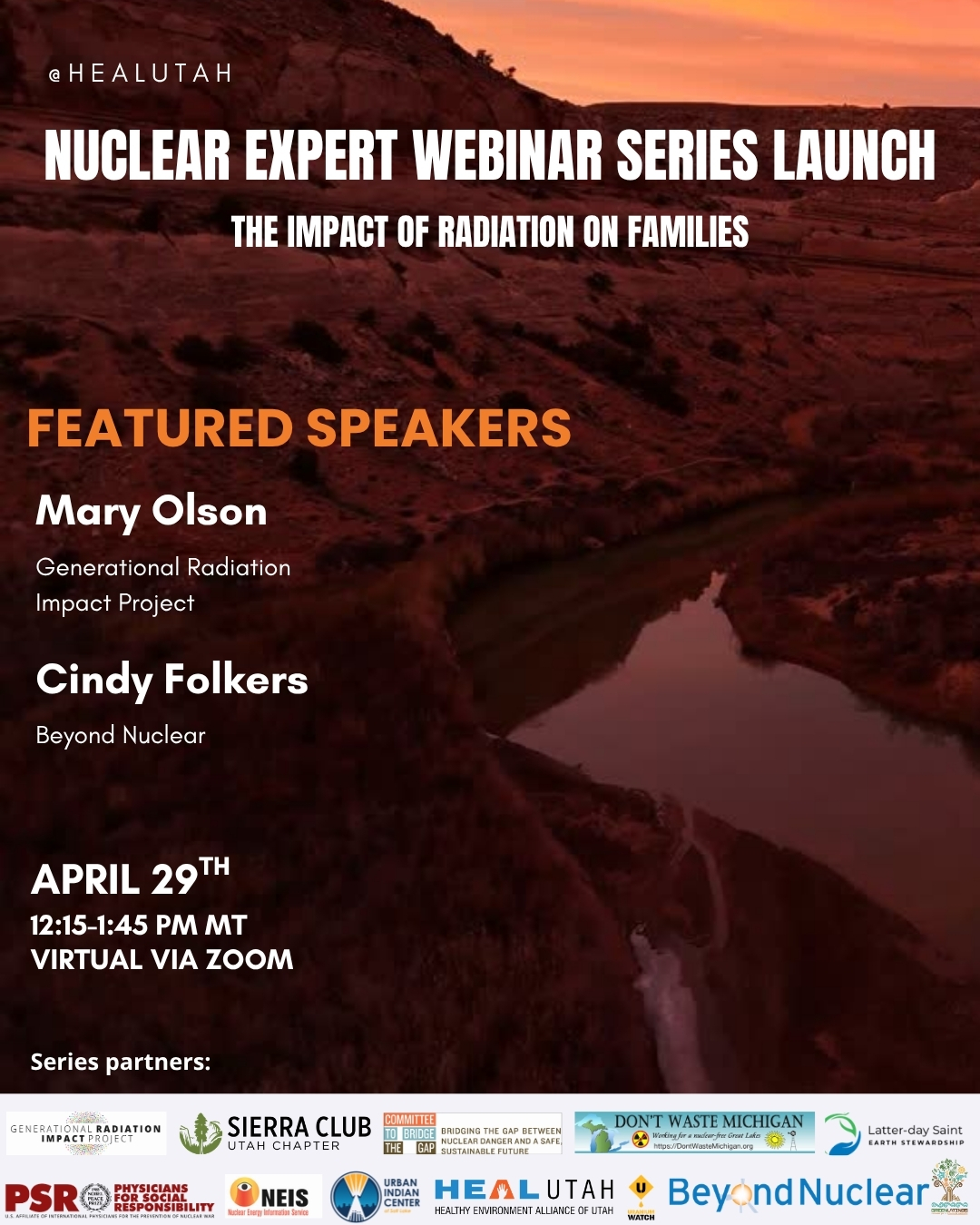
29 April – Nuclear Expert Webinar #1 – Radiation Impacts on Families with Mary Olson and Cindy Folkers
- 12:15 PM MT – 1:45 PM MT
- Location: Virtual – REGISTER TODAY

4 May -West Suburban Peace Coalition to discuss Iran war at May Educational Forum
Monday, May 4, 7:00 – 8:00 PM Central Standard Time
Title: : How Trump’s Narrative Tries to Shape the Reality of the War on Iran.
Contact Walt Zlotow, zlotow@hotmail.com 630 442 3045 for further information
14 May – online event From Bombs to Data Centres: the Face of Nuclear Colonialism

Pine Ridge Uranium is the real threat, not Tehran- Tell Burgum: Stop the Extraction.
Chernobyl: The Lost Tapes – A good documentary on Chernobyl on SBS available On Demand for the next 3 weeks– https://www.sbs.com.au/ondemand/tv-program/chernobyl-the-lost-tapes/2352741955560
To see nuclear-related stories in greater depth and intensity – go to https://nuclearinformation.wordpress.com
-
Archives
- April 2026 (346)
- March 2026 (251)
- February 2026 (268)
- January 2026 (308)
- December 2025 (358)
- November 2025 (359)
- October 2025 (376)
- September 2025 (257)
- August 2025 (319)
- July 2025 (230)
- June 2025 (348)
- May 2025 (261)
-
Categories
- 1
- 1 NUCLEAR ISSUES
- business and costs
- climate change
- culture and arts
- ENERGY
- environment
- health
- history
- indigenous issues
- Legal
- marketing of nuclear
- media
- opposition to nuclear
- PERSONAL STORIES
- politics
- politics international
- Religion and ethics
- safety
- secrets,lies and civil liberties
- spinbuster
- technology
- Uranium
- wastes
- weapons and war
- Women
- 2 WORLD
- ACTION
- AFRICA
- Atrocities
- AUSTRALIA
- Christina's notes
- Christina's themes
- culture and arts
- Events
- Fuk 2022
- Fuk 2023
- Fukushima 2017
- Fukushima 2018
- fukushima 2019
- Fukushima 2020
- Fukushima 2021
- general
- global warming
- Humour (God we need it)
- Nuclear
- RARE EARTHS
- Reference
- resources – print
- Resources -audiovicual
- Weekly Newsletter
- World
- World Nuclear
- YouTube
-
RSS
Entries RSS
Comments RSS
 nuclear-news