Crash of nuclear waste truck, fortunately the cask was empty
Brattleboro Reformer 22nd June 2020, An oversized flatbed truck carrying an empty nuclear waste cask headed to the Vermont Yankee nuclear power plant drove onto a soft shoulder on Route 11 in Andover and tipped over Friday morning, setting off a 36-hour effort to retrieve the cask and reopen the busy east-west highway. The cask is slated to be used at the Vernon nuclear power plant which is undergoing demolition and decommissioning. The cask, which weighs upwards of 50 tons, is used as an on-site cask to transfer waste on site, according to Curtis Roberts, a spokesman for Orano, one of the companies involved in the
decommissioning project with main owner NorthStar Vermont Yankee LLC.
He said the cask is owned and manufactured by Orano [Ed note: formerly AREVA, which went bankrupt] . Orano is disassembling the nuclear reactor core, which contains high levels of radioactivity.
https://www.reformer.com/stories/truck-carrying-empty-nuclear-waste-cask-crashes,607654
Heaviest load ever through Nevada, the 770-ton reactor pressure vessel from dead SanOnofre nuclear station
A heavy chunk of the San Onofre nuclear plant is slowly moving to Utah, San Diego Tribune,
The 770-ton reactor pressure vessel from Unit 1 is part of the plant’s decommissioning efforts, By ROB NIKOLEWSKI, JUNE 19, 2020
A reactor pressure vessel that helped Unit 1 at SONGS generate electricity left the plant’s premises May 24 via railand is now at an industrial park in North Las Vegas, Nevada, about to be taken some 450 miles north on roads, accompanied by a pair Nevada Highway Patrol trooper pilot cars, to the Utah border.
The shipment will then continue, reaching the Energy Solutions disposal site in the town of Clive, Utah, located about 75 miles west of Salt Lake City.
The old reactor vessel and its contents are designated as Class A low-level waste, considered by the U.S. Nuclear Regulatory Commission as the least hazardous of radioactive waste classifications. Encased in a carbon steel cylinder for the trip, the vessel contains pieces of radioactive metal and grout.
Officials with the Utah Department of Transportation are awaiting a permit from Emmert International, a company based in Oregon contracted to move the vessel to its final destination…..
According to the Las Vegas Review-Journal, officials expect the vessel to leave North Las Vegas June 29 and arrive in Clive seven days later.
The vessel will be loaded onto a trailer 122 feet long, with 45 axles. The trailer’s eight pieces are being put together with cranes at the Apex Industrial Park. Once assembled, the trailer will then take to the road, avoiding Interstate 15 by traveling on U.S. Highway 93, state Route 318, U.S. Highway 6, back to Highway 93 and eventually taking Interstate 80 into Utah.
Six heavy-duty Class 8 trucks with combined 4,000-horsepower will haul the vessel. The entire configuration will use 460 tires that are 18 inches wide to prevent damaging roads, bridges and public infrastructure. Emmert International will use hydraulic jacks to reinforce drainage culverts.
“It’s the heaviest load to ever traverse Nevada roadways,” Nevada Department of Transportation spokesman Tony Illia told the Review-Journal. ….. https://www.sandiegouniontribune.com/business/story/2020-06-19/a-heavy-chunk-of-the-san-onofre-nuclear-plant-slowly-moving-to-utah
Environmental problems, and legal holdup for Russia’s $20 billion nuclear power project in Turkey
Russia’s $20 billion nuclear power project located in Mersin on Turkey’s Mediterranean coast has long come under fire over safety and environmental concerns, including claims of large cracks in the concrete foundations due to loose and unstable ground in the area.
Officials broke ground on the Akkuyu power plant in 2018, which is set to be Turkey’s first nuclear power station and is due to come online in 2023 – the 100th anniversary of the Republic of Turkey.
But engineers and workers began ringing alarm bells over a potential nuclear disaster soon after its inception, and a group of NGOs filed a lawsuit with a Turkish court demanding for construction to be halted…….
A Turkish court in the southern province of Mersin ruled on Friday to accept a request by the NGOs for relevant ministries and the National Security Council (MGK) to be able to intervene in the project, Cumhuriyet newspaper reported.
The court said the case would be reported to the MGK, which has no obligation to intervene in construction, but may now choose to do so. Lawyers involved in the case hd also said that the Russian power power plant could pose a national security threat to Turkey.
The court also gave the green light to a request by the NGOs for the involvement of a number of Turkish ministries in the case, including the Health Ministry, the Treasury and Finance Ministry, as well as the Food, Agriculture and Livestock Ministry.
How this latest development will play out in the ambitious Russian-Turkish joint-venture remains to be seen. But it arrives at a time of ongoing tensions between Ankara and Moscow over Idlib province in northwest Syria, where the two countries back opposing sides……https://ahvalnews.com/nuclear-energy/turkeys-russian-nuclear-power-project-hits-legal-hurdle
Record-sized huge load – SanOnofre old nuclear reactor pressure vessel heading through Nevada roads to Utah
|
Decommissioned nuclear reactor coming to Nevada roads, Las Vegas Review-Journal, June 14, 2020 By Mick Akers You may have heard the term “wide load,” but one load hitting Silver State highways later this month will take that to another level.
The load is a 1.5 million-pound, 16.5-foot-diameter decommissioned reactor pressure vessel from Southern California Edison’s San Onofre Nuclear Generating Station that will set out on Nevada highways starting June 29, according to Tony Illia, Nevada Department of Transportation spokesman. The reactor will mark the largest item to ever travel on Nevada roads when it begins the final leg of its retirement journey, heading for Utah. “This record-sized move over state highways marks the culmination of over a year of planning and coordination,” Illia said. “It’s the heaviest load to ever traverse Nevada roadways.” The vessel arrived May 28 in North Las Vegas and is being staged at Apex Industrial Park. It will be loaded onto a custom-made, 122-foot-long, 45-axle over-the-road trailer, which arrived on site in eight pieces and is being assembled by cranes. “The load is being moved across the state using six heavy-duty Class 8 trucks with four tractors pushing and two pulling using a series of interconnecting tow bars to create a 23-foot-tall by 306.5-foot-long train that will be the same length as the Statue of Liberty laid on its side,” Illia said. There will be combined 4,000-horsepower used to transport the configuration, which will weigh in at a massive 2.4 million pounds. The load will be dispersed across 460 total tires, up to 18 inches in width to prevent damage to state roads, bridges or drainage facilities, according to Illia.
The truckload will be accompanied by a pair Nevada Highway Patrol trooper pilot cars, traveling at a speed of 5 to 10 mph. Emmert International, which specializes in moving large equipment, is contracted to deliver the massive object to its burial ground. The contractor will reinforce up to nine drainage culverts along the route using hydraulic jacks to prevent damage to public infrastructure, Illia said. With the speed restrictions, it’s anticipated it will take seven days to travel the approximately 450 miles to reach its destination at Energy Solutions’ Nuclear Waste Facility in Clive, Utah, about 75 miles from Salt Lake City……… https://www.reviewjournal.com/news/news-columns/road-warrior/decommissioned-nuclear-reactor-coming-to-nevada-roads-2053253/ |
|
The ‘chemical fingerprint’ of a 2017 nuclear explosion
 Scientists just found the ‘chemical fingerprint’ of an alleged nuclear explosion that went undeclared in Russia, Business Insider, Aria Bendix Jun 16, 2020
- A group of scientists known as the “Ring of Five” detected unusual levels of radiation in Europe in 2017.
- A new study offers “irrefutable proof” that the radiation came from nuclear waste reprocessing.
- The study lends further evidence to the claim that Russia failed to disclose an accident at the Mayak nuclear facility in September 2017.
- For the past three years, a group of scientists called the “Ring of Five” has been inching toward the conclusion that an undisclosed nuclear accident took place in Russia in 2017.
In July 2019, the group released evidence that an explosion may have occurred at the Mayak nuclear facility — once the center of the Soviet nuclear-weapons program. Mayak was also the site of the 1957 Kyshtym explosion, the world’s third-worst nuclear accident behind Fukushima and Chernobyl.
- In late 2019, the scientists suggested that, given the large amount of radiation admitted on the date, the accident took place on September 26, 2017. The radiation seemed to spread from Russia’s Southern Urals region (where the Mayak facility is located) toward central Europe, Scandinavia, and Italy.
A third study, released Monday, offers “irrefutable proof” that the explosion was linked to nuclear waste reprocessing — a method that separates plutonium and uranium from spent nuclear fuel. The Mayak facility is the largest nuclear reprocessing facility in the region. That makes it the most likely, if not the only possible, origin site — though Russia has never acknowledged a nuclear accident at the facility in 2017…….
- The Ring of Five has been monitoring Europe’s atmosphere for elevated levels of radiation since the mid-1980s. The group originally hailed from five countries: Sweden, Germany, Finland, Norway, and Denmark. But after the Chernobyl disaster in 1986, the team enlisted the help of other nations to expand their efforts. It now includes researchers from 22 countries.
- On October 2, 2017, Italian scientists sent an alert to the Ring of Five about elevated levels of ruthenium-106, a radioactive isotope, in Milan. The discovery marked the first time that ruthenium-106 had been found in the atmosphere since Chernobyl.
“We were stunned,” Steinhauser said. “We did not have any anticipation that there might be some radioactivity in the air. We were just measuring air filters as we do on a weekly basis, 52 times a year, and suddenly there was an unexpected result.”
- Steinhauser said the explosion was the “single greatest release from nuclear-fuel reprocessing that has ever happened.”
But Russia has not responded to any findings from the Ring of Five. In December 2017, Russian officials attributed the radiation to an artificial satellite that burned up in the atmosphere. The scientists’ latest study excludes that possibility.
- The study is the first direct evidence that the ruthenium-106 came from nuclear waste reprocessing. It identified a unique “chemical fingerprint” among samples of the isotope collected in 2017.
Within those samples, the scientists found signs of two chemicals commonly associated with nuclear waste reprocessing: (III) chloride and ruthenium(IV) oxide. This provided “direct evidence that fuel reprocessing was the origin of the 2017 environmental release,” the scientists wrote………. https://www.businessinsider.com/russia-nuclear-accident-mayak-facility-new-evidence-2020-6?r=AU&IR=T
Sizewell nuclear power station could become a dangerous nuclear island
 No2NuclearPower 16th June 2020, Letter to The Times (unpublished) Rachel Fulcher Suffolk Costal FOE:
The Sizewell C debate is salty indeed (Alistair Osborne, 10/06/20). Anyone taking a brisk walk along the Suffolk coast around Sizewell can see clearly how unstable and dynamic it is. Defensive anti-tank blocks from World War II spill down the collapsed cliffs, and here and there the remains of a
pill box, once aloft, can be seen lying on the shingle. ‘Dragons’ teeth’ have disappeared under the sea and then re-appeared before being finally removed – some by EDF ironically. Signs warn of cliff falls, yet, sadly, a man was killed not long ago walking his dog along the beach.
EDF Energy maintains that the two offshore sand banks will continue to protect the nuclear power stations at Sizewell from storm surges for the projected lifetime of Sizewell C, including the long-term storage of high-level nuclear waste. What madness is this? Local swimmers and sailors know only too well how these shift and change. Once you could swim out and stand on one – no longer possible as it has eroded and flattened.
Equally, as Nick Scarr correctly points out, and as our own in-depth researches demonstrate, the two banks have been moving apart, allowing the larger waves to reach the shore during storms.
The power of the sea should not be under-estimated. At nearby Thorpeness, thought to be stable due to the out-lying coralline crag, houses are now teetering on the edge, despite the revetment hastily put in place. Gabions are already rusting away and the huge sand bags have been tossed about by the waves. EDF Energy says in their consultation documents that their new defences would guard Sizewell C against projected climate change and sea level rise.
Even if that were the case, which cannot be proven, what would be the result of these? For a
start, they would cause ‘coastal squeeze’, preventing natural roll-back and resulting in flanking erosion and flooding. Not only would this put at increased risk villagers living either side of the station, but the RSPB’s flagship reserve of Minsmere immediately to the north and Sizewell
Marshes SSSI at the rear.
Indeed, this would leave a highly unsafe nuclear island. Water in the wrong place at a nuclear power station can have devastating consequences, as the catastrophe at Fukushima demonstrates only
too well. Let’s hope that the Planning Inspectorate puts the precautionary principle in place and turns down this hazardous development.
http://www.no2nuclearpower.org.uk/news/campaign-update/sizewell-debate-turns-salty/
Say NO to hauling dangerous nuclear waste across America
Say NO to hauling dangerous nuclear waste across America, NIRS,17 June 2020 The Nuclear Regulatory Commission (NRC) is accepting comments on two proposals to build Consolidated Interim Storage (CIS) facilities in New Mexico and Texas. Building these so-called ‘interim’ sites would require hauling dangerous, high-level nuclear waste all over the country twice: Once to the ‘interim’ sites, then once again to the permanent site—if that is ever built. If the permanent site is not built, the ‘interim’ sites could become de-facto permanent storage sites. Communities in New Mexico and Texas would become the latest sacrifice to the nuclear industry.
We can’t allow this dangerous, high-level nuclear waste to be hauled around the country to storage sites that won’t be permanent solutions to our nuclear waste problem. Tell the NRC and your member of Congress to say NO to the CIS facilities in New Mexico and Texas….. https://org2.salsalabs.com/o/5502/p/dia/action4/common/public/?action_KEY=27069
Risk of fire on a nuclear submarine. France’s lucky escape, due to reactor being removed for overhaul
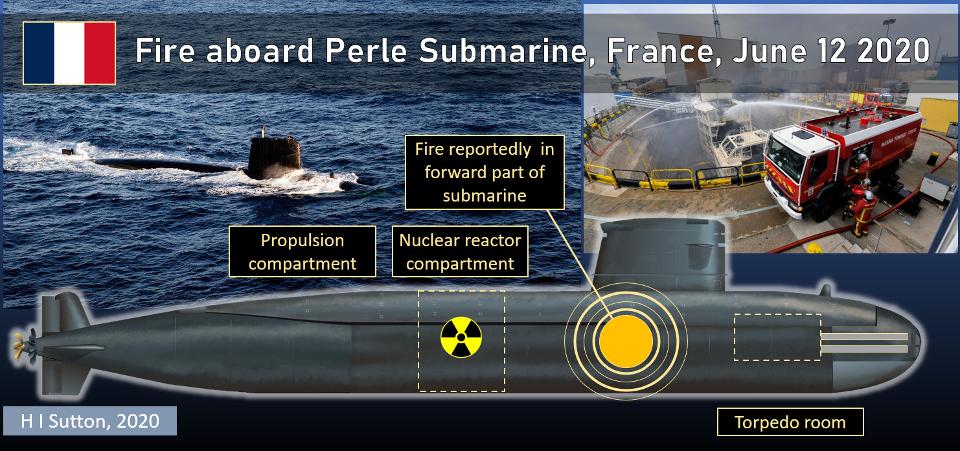
Why The Catastrophic Fire On A Nuclear Submarine Is Nothing To Gloat About https://www.forbes.com/sites/hisutton/2020/06/14/why-the-catastrophic-fire-on-a-nuclear-submarine-is-nothing-to-gloat-about/#ef9667d2ffd0
As details emerge of the fire aboard the French submarine Perle on Friday, it seems unlikely to me that the boat will be returned to service. Whichever way you look at it, the fire is a terrible blow for the French Navy (Marine Nationale). Their submarine fleet is already stretched. But France’s misfortune brings home a basic reality that it could happen to any navy.
The cause of the fire, which took most of Friday to extinguish, has yet to be determined. Florence Parly, Minister of the Armed Forces, was reported by Naval News as saying on June 13 that the “cause for such a strong (and rapid) fire is still unknown.” She also said that if the boat turns out to be fixable, everything will be done to repair it. Any hint of optimism in this statement may point to the terrible predicament that it will leave the French Navy in if it cannot be repaired.
No Reason To Gloat
You will not find many in the defense community laughing at France’s expense. When a Russian or Chinese warship suffers a similar accident, many casual observers are quick to make jokes. Less so the defense community.
For example on April 13 a Chinese Type-075 assault carrier caught fire in Shanghai. That ship, the first of its type, was being fitted out before delivery. The types of work done during refit are similar to the deep overhaul that Perle was being subject to. Or in December last year a Russian aircraft carrier caught fire.
But the Western defense community is very aware that these accidents could equally apply to their home navies. Overhauling ships and submarines is ‘hot work’ and fires can easily occur.
The fire took 14 hours to put out, from 10.35am until 00.50 am the next morning. This may sound like a long time, but the U.S. Navy had a similar experience dealing with a fire aboard the Los Angeles class submarine USS Miami in 2012. That fire, which was also during an overhaul, lasted 12 hours and caused so much damage that the boat had to be written off. In the American case it turned out that the fire had been started deliberately by a dockyard worker hoping that the alarm would get him off work early.
In general, fires aboard submarines can be harder to put out. This is because of the cramped spaces aboard, and also because there are very few openings into the submarine. And they can be more devastating than a similar fire aboard a surface vessel because the heat can deform the steel hull. On a surface vessel this can be repaired more easily, but with a submarine it can make the hull weaker so that it is no longer safe to dive. This is why I am not optimistic that she will be repairable.
The fire was not as bad as it could have been. Fortunately the nuclear reactor had apparently already been removed. So the fire has not been categorized as a nuclear accident. And the torpedoes and missiles had also been unloaded so there was no risk of them exploding.
Many core systems, such as the combat system and sonar, had also been removed. So if the hull can be saved, then returning her to service is at least feasible. But everything seems to depend on whether the hull itself has been weakened.
Fire on French submarine – luckily its nuclear reactor, nuclear fuel, had been removed for overhaul
 A French Submarine Caught Fire In Drydock. It Could Lead Paris To Rethink Its Nuclear Deterrence Strategy. Forbes, Sebastien Roblin 11 June 20 A fire broke out in the rear section of the French nuclear-powered attack submarine Perle on Friday morning as she lay in drydock in the port of Toulon. White clouds of smoke poured into the sky as firefighters from Toulon and Marseilles rushed to the scene. A French Submarine Caught Fire In Drydock. It Could Lead Paris To Rethink Its Nuclear Deterrence Strategy. Forbes, Sebastien Roblin 11 June 20 A fire broke out in the rear section of the French nuclear-powered attack submarine Perle on Friday morning as she lay in drydock in the port of Toulon. White clouds of smoke poured into the sky as firefighters from Toulon and Marseilles rushed to the scene.
Finally at 9:36 p.m local time the Mediterranean Maritime Prefecture reported that the fire had been brought under control by completely flooding the rear compartments of the boat with foam, further noting that the “reactor rooms remains untouched.”…….. Just as importantly, the ship’s 48 megawatt pressurized water nuclear reactor, nuclear fuel, and (conventional-only) weapons had been removed when the submarine entered the drydock in January 2020 for an overhaul by Naval Group due for completion by February 2021. For that reason, the local maritime prefecture claims there is no possibility of radioactive contamination from the incident.
The firefighting effort reportedly involved 30 specialist naval firefighters with support from a firefighting boat, as well as additional specialists scrambled from Marseilles, 11 specialized ground-based firefighting vehicles, and at least 10 ESNA submariners to advise the firefighters. However, there are growing fear that the Perle may have sustained too much damage to be saved. A veteran submariner told the local paper Var Matin “If the thick hull [made of 80HY high-tensile steel]…is deformed, the boat is screwed.” The cause of the blaze is speculated to possibly be faulty welding or a high-pressure cutting gone awry. France’s Nuclear Submarine Force French periodical LeMonde warned that should the Perle suffer “irremediable damage,” there was the possibility “the entire organization of French nuclear deterrence may have to be rethought. And the Navy may have to give up on certain strategic missions.” The Perle does not actually carry any nuclear weapons. However, one of the primary roles of French attack submarines is protecting the four larger Triomphant-class nuclear-powered ballistic missile submarines (SSBNs) from hostile submarines. Indeed, the SSBN Le Téméraire conducted a test launch of an unarmed M51 nuclear ballistic missile just the day prior. France perceives these submarines as performing a vital role in strategic nuclear deterrence, or “dissuasion” as it’s called in France………. Establishing the cause of the accident that may put out of action a valuable strategic asset will also be a priority for Defense Minister Florence Parley, particularly given how much more serious the incident might have been had weapons, the reactor and/or additional personnel had been onboard. For now the citizens of Toulon can only be thankful that loss of life was averted and that there is no apparent risk of contamination. The French Navy will have to take stock of the damage, adjust its plans for its SSN fleet accordingly—and consider how it can minimize the odds of another such accident occurring. https://www.forbes.com/sites/sebastienroblin/2020/06/12/a-french-submarine-caught-fire-in-drydock-it-could-lead-paris-to-rethink-its-nuclear-deterrence-strategy/#4addae213d05 |
|
|
Canada’s proposed radioactive waste disposal rules are weak and industry-friendly
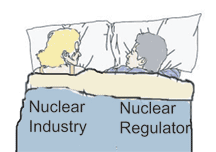 Proposed radioactive waste disposal rules are weak and industry-friendly
French nuclear watchdog demands EDF fix faults at 5 reactors
French nuclear watchdog demands EDF fix faults at 5 reactors, Montel News, MURIEL BOSELLI, Paris 10 June 20, France’s nuclear safety authority has served EDF with a formal notice to repair deviations and reinforce five reactors at its 5.4 GW Gravelines nuclear power plant by the end of October – work that would not require shutdowns.
The notice concerned deviations in five out of the plant’s six reactors. Operator EDF had already made changes to equipment around reactor 5, ASN said on Wednesday. https://www.montelnews.com/en/story/french-nuclear-watchdog-demands-edf-fix-faults-at-5-reactors/1121918
Nuclear submarine accidents contaminating Russia’s Far East
Here’s What You Need To Remember: The explosion blew out the reactor’s twelve-ton lid—and fuel rods—and ruptured the pressure hull. The reactor core was destroyed, and eight officers and two enlisted men standing nearby were killed instantly. A the blast threw debris was thrown into the air, and a plume of fallout 650 meters wide by 3.5 kilometers long traveled downwind on the Dunay Peninsula. More debris and the isotope Cobalt-60 was thrown overboard and onto the nearby docks.
In 1985, a Soviet submarine undergoing a delicate refueling procedure experienced a freak accident that killed ten naval personnel. The fuel involved was not diesel, but nuclear, and the resulting environmental disaster contaminated the area with dangerous, lasting radiation. The incident, which remained secret until after the demise of the USSR itself, was one of many nuclear accidents the Soviet Navy experienced during the Cold War……
The explosion blew out the reactor’s twelve-ton lid—and fuel rods—and ruptured the pressure hull. The reactor core was destroyed, and eight officers and two enlisted men standing nearby were killed instantly. A the blast threw debris was thrown into the air, and a plume of fallout 650 meters wide by 3.5 kilometers long traveled downwind on the Dunay Peninsula. More debris and the isotope Cobalt-60 was thrown overboard and onto the nearby docks.
According to Nuclear Risks, the accident scene was heavily contaminated with radioactivity. Gamma ray radiation was not particularly bad; at an exposure rate of five millisieverts per hour, it was the equivalent of getting a chest CT scan every hour. However, the explosion also released 259 petabecquerels of radioactive particles, including twenty-nine gigabecquerels of iodine-131, a known cause of cancer. This bode very badly for the emergency cleanup crews, especially firefighters who needed to get close to the explosion site, and the nearby village of Shkotovo-22. Forty-nine members of the cleanup crew displayed symptoms of radiation sickness, ten of them displaying acute symptoms…….
While the Chazhma Bay region appears contaminated to this day with radiation, it is unknown how much of it is the result of the K-431 incident and how much the result of the many nuclear-powered submarines that were junked and forgotten in the area.
The K-431 incident was one of several involving Soviet submarine reactors. Ten Soviet submarines experienced nuclear accidents, and one other, K-11, also suffered a refueling criticality………. https://news.yahoo.com/1985-nuclear-submarine-explosion-contaminated-213000521.html
French state-controlled utility EDF has to inspect valve leaks at Flamanville, Taishan, Finland nuclear sites
Flamanville and Taishan nuclear sites after valve leaks were reported at
Finland’s Olkiluoto 3 (OL3) nuclear reactor, a company’s spokesman said
on Wednesday. EDF was unaware of any major issues at Flamanville and
Taishan sites similar to the valve leaks in Finland, the spokesman also
said. Finland’s nuclear watchdog reported on May 25 valve problems in a
component involved in the cooling process at the long-delayed OL3 nuclear
reactor.
Emergency preparedness at San Onofre Nuclear Plant – agreement approved
|
Southern California Edison and five local government agencies announced that they will continue their longstanding collaborative emergency preparedness activities related to SONGS. The five jurisdictions are the counties of Orange and San Diego, and the cities of San Clemente, Dana Point, and San Juan Capistrano. The county boards of supervisors and city councils approved the new agreement at their respective meetings on June 2. Senator Bates, Orange County Sheriff Don Barnes, and Southern California Edison Vice President and Chief Nuclear Officer Doug Bauder issued the following statements regarding the agreement: Senator Bates: The agreement will provide the five local jurisdictions more than $12.6 million for the eight-year deconstruction period of SONGS through 2029, and more than $9.9 million for the 20-year period through 2049, by which time spent nuclear fuel could potentially be removed from SONGS. Senator Bates authored Senate Bill 465 in 2019 that would have made it clear that local governments will continue to receive funding for costs incurred as a result of carrying out activities that ensure the safety and welfare of the communities surrounding SONGS. The full Senate and the Assembly Governmental Organization Committee both unanimously passed SB 465. In discussions with stakeholders, Senator Bates agreed to hold her bill to see if a voluntary agreement could be reached and ratified, which occurred this week. She has long advocated for the federal government to move SONGS’ nuclear waste to a safe and secure location that is far from communities as possible. SONGS sits near an active fault line, adjacent to the heavily-trafficked Interstate 5 and the Pacific Ocean, and sandwiched between densely-populated Orange and San Diego counties. Senator Bates previously served on the San Onofre Community Engagement Panel (CEP) when she was an Orange County Supervisor. She worked with her fellow panelists to address the issues raised by the continued storage of SONGS’ waste on-site. She also authored Senate Joint Resolution 23 in 2016 that urged Congress to pass the Interim Consolidated Storage Act of 2016 (House Resolution 4745). The Act would have paired a region that is volunteering to host an interim waste storage facility with communities around the country that have nuclear waste demanding a better storage solution. http://www.oc-breeze.com/2020/06/05/182927_agreement-approved-to-protect-emergency-preparedness-at-san-onofre-nuclear-plant/ |
|

U.S. Nuclear Regulatory Commission will run environmental study BEFORE relicensing South Carolina nuclear fuel plant
After public outcry, feds will conduct extensive study of SC nuclear fuel plant The State BY SAMMY FRETWELL JUNE 05, 2020 , Following state concerns about previously unknown pollution at an atomic fuel plant near Columbia, the U.S. Nuclear Regulatory Commission announced Friday that it will conduct an extensive environmental study of the Westinghouse fuel factory.
Conducting a detailed study is expected to delay by a year any decision on a new license for the plant while the agency looks into problems that have surfaced in recent years.
The plant has polluted groundwater, some of which has only been discovered since 2018, and neighbors have raised concerns about safety and water contamination.
The NRC’s decision marks the first time the agency has ever conducted a full environmental impact statement before deciding if a nuclear fuel fabrication plant should be relicensed, NRC spokesman Roger Hannah said. The plant’s owner, Westinghouse, wants a new 40-year-operating license for the plant, built in 1969.
“In March 2020, the NRC received new data collected by Westinghouse during ongoing site investigations,’’ the agency said in a news release Friday afternoon. “Based on the NRC’s independent evaluation of the new data .
… the NRC decided it could no longer conclude that renewal of the license would result in a finding of no significant impact’’ to the environment.
The Westinghouse plant, which employs more than 1,000 people, is one of only three nuclear fuel factories of its kind in the United States. The plant makes fuel rods for the nation’s atomic energy plants. Plants in North Carolina and Washington state also make nuclear fuel.
Tom Clements, a nuclear safety watchdog in Columbia, said it appears that the NRC listened to concerns by the public and state regulators.
“That is very encouraging to hear,’’ said Clements, who said the full study is needed. “It took a clamor from the public before they would do the right thing. I’m glad they have finally done this.’’
The S.C. Department of Health and Environmental Control called for a full environmental impact statement after finding rising pollution levels in ponds on the site.. …… https://www.thestate.com/news/local/environment/article243310956.html
1 This Month



26 September – International Day for the Total Elimination of Nuclear Weapons


PLEASE OPPOSE HR 8255 AND S.3639 – bills would accelerate satellite deployment, with no environmental review or safeguards – https://ncstd5li.quorum.us/campaign/169331/
To see nuclear-related stories in greater depth and intensity – go to https://nuclearinformation.wordpress.com
-
Archives
- September 2026 (245)
- August 2026 (330)
- July 2026 (355)
- June 2026 (287)
- May 2026 (306)
- April 2026 (356)
- March 2026 (251)
- February 2026 (267)
- January 2026 (308)
- December 2025 (358)
- November 2025 (359)
- October 2025 (375)
-
Categories
- 1
- 1 NUCLEAR ISSUES
- business and costs
- climate change
- culture and arts
- ENERGY
- environment
- health
- history
- indigenous issues
- Legal
- marketing of nuclear
- media
- opposition to nuclear
- PERSONAL STORIES
- politics
- politics international
- Religion and ethics
- safety
- secrets,lies and civil liberties
- spinbuster
- technology
- Uranium
- wastes
- weapons and war
- Women
- 2 WORLD
- ACTION
- AFRICA
- Atrocities
- AUSTRALIA
- Christina's notes
- Christina's themes
- culture and arts
- Events
- Fuk 2022
- Fuk 2023
- Fukushima 2017
- Fukushima 2018
- fukushima 2019
- Fukushima 2020
- Fukushima 2021
- general
- global warming
- Humour (God we need it)
- Nuclear
- RARE EARTHS
- Reference
- resources – print
- Resources -audiovicual
- Weekly Newsletter
- World
- World Nuclear
- YouTube
-
RSS
Entries RSS
Comments RSS
 nuclear-news