One of the world’s worst nuclear disasters is likely something you’ve never heard of.
This is, of course, the Goiânia Accident of 1987. This
happened in the city of Goiânia in the Goiâs region of Brazil, which
surrounds the Federal District containing the purpose-built capital
Brasilia. In 1985, a hospital in the city moved locations, leaving behind a
radiotherapy unit which used the substance caesium-137 to treat cancer. Two
years later in 1987, two men broke into the abandoned building looking for
items with scrap value, and stole the machine – including its radioactive
component which they were not aware of.
Unilad 4th July 2023
https://www.unilad.com/news/nuclear-disaster-goiania-brazil-accident-918843-20230704
“Radioactive” is compelling viewing
New film spotlights women’s experiences with the Three Mile Island nuclear accident
By Karl Grossman
Radioactive: The Women of Three Mile Island is the title of a newly-released documentary feature film directed, written and produced by award-winning filmmaker Heidi Hutner, a professor of environmental humanities at Stony Brook University, a “flagship” school of the State University of New York.
With greatly compelling facts and interviews, she and her also highly talented production team have put together a masterpiece of a documentary film.
It connects the proverbial dots of the 1979 Three Mile Island nuclear plant disaster—doing so brilliantly.
The documentary has already received many film awards and has had a screening in recent months in New York City—winning the “Audience Award for Best Documentary” at the Dances With Films Festival—and Harrisburg, Pennsylvania; Sarasota, Florida; Dubuque, Iowa; Long Island, New York; First Frame International Film Festival in New York City; the Environmental Film Festival in Washington D.C., and is soon the featured film at Kat Kramer’s #SHEROESForChange Film Festival in Los Angeles and the Cinequest Film Festival in San Jose, California, as well as the Uranium Film Festival in Rio de Janeiro in Brazil. And there will be tours across the U.S.
Resident after resident of the area around Three Mile Island is interviewed and tells of widespread cancer that has ensued in the years that have followed the accident—a cancer rate far beyond what would be normal. Accounts shared in the documentary are heartbreaking.
A whistleblower who had worked at the nuclear plant tells Hutner of the deliberate and comprehensive attempt by General Public Utilities, which owned TMI, to cover up the gravity of the accident and its radioactive releases, especially of cancer-causing Iodine-131 and Xenon 133.
An attorney, Lynne Bernabei, involved in litigation in the wake of the accident, says the Three Mile Island “cover-up was one of the biggest cover-ups in history.” Meanwhile, the U.S. Nuclear Regulatory Commission which is “supposed to protect the public” has then and since been just “interested in is promoting the [nuclear] industry. This is corrupt,” says attorney Joanne Doroshow, now a professor at New York Law School and director of the Center for Justice & Democracy. Many examples of this are presented.
The documentary’s focus on women includes women being far more at risk to the effects of radioactivity than men. Mary Olson, a biologist, founder, and director of the Gender & Radiation Impact Project, says in the film that those setting radiation standards in the U.S. from the onset of nuclear technology in 1942, based impacts on a “25 to 30 years-old” male “defined as Caucasian.” She said, “It has come to be known as the ‘Reference Man.” However, Olson cites research findings that “radiation is 10 times more harmful to young females” and “50 percent more harmful to a “comparable female” than it is to “Reference Man” who is “more resistant” to radioactivity than a woman.
There’s the scientist Dr. Aaron Datesman, who is now pursuing a major chromosomal study regarding the impact of the disaster on the health of people in the area and how people have been harmed despite the denials of the nuclear industry. This study is based on his recent ground-breaking work, “Radiological Shot Noise,” in Nature.
And more and more…………………………………………………………………………. more https://beyondnuclearinternational.org/2023/06/18/radioactive-is-compelling-viewing/—
Cyberattack Hits US National Lab, Nuclear Waste Site
A contractor at a US national lab and a radioactive waste storage site
managed by the Department of Energy were among the victims of wide-ranging
cyberattack that saw several federal agencies hacked, according to a person
familiar with the matter.
A department spokesperson confirmed Thursday that
records from two of the agency’s “entities were compromised,” though
further details on the extent of the breach couldn’t immediately be
determined. Multiple US agencies were compromised by a hacking campaign in
which attackers exploited flaws in a popular software tool to gather
information from a range of victims.
Bloomberg 15th June 2023
Kakhovka dam breach raises risk for Zaporizhzhia nuclear plant – receding waters narrow options for cooling

The Conversation June 7, 2023, Najmedin Meshkati, Professor of Engineering and International Relations, University of Southern California
A blast on June 6, 2023, destroyed the Kakhovka dam on the Dnieper River in eastern Ukraine. The rupture lowered water levels in a reservoir upriver at the Zaporizhzhia Nuclear Power Plant in the city of Enerhodar. The reservoir supplies water necessary for cooling the plant’s shutdown reactors and spent fuel, which is uranium that has been largely but not completely depleted by the fission reaction that drives nuclear power plants.
The International Atomic Energy Agency, which has inspectors on-site to monitor effects of the war at the plant, issued a statement saying that there was no imminent danger. Nevertheless, the destruction of the dam increases the risk of a disaster at the plant, a risk already heightened by ongoing combat in the area.
The Conversation asked Najmedin Meshkati, a professor and nuclear safety expert at the University of Southern California, to explain what the dropping water level means for the safety of the nuclear power plant and the ongoing risks to the plant’s spent fuel.
Why are dropping water levels a threat to the power plant?
The immediate situation is becoming very precarious. The dam is downstream from the plant, meaning that the flooding will not jeopardize the plant. But the plant draws water from a major reservoir on the river for its cooling system. This reservoir is draining because the downstream dam has been damaged.
The plant doesn’t need the massive amount of water it otherwise would because its six reactors are in cold shutdown. But the plant still needs water for three purposes: to reduce the residual heat from the shutdown reactors, to cool the spent fuel, and to cool the emergency diesel generators if the plant loses off-site power.
The plant’s operators pumped water from the reservoir into a cooling pond, which is why the IAEA said the plant has enough water for several months. But that’s the last resort, which is why the agency also said that it’s vital that the cooling pond remains intact. If the plant loses the cooling pond, the only hope would be to try something like they did at the Fukushima nuclear power plant after the earthquake and tsunami in Japan in 2011. They brought in huge water pumps to pump saltwater from the Pacific Ocean into the reactors to cool them down. The plant operators may need to try to pump water from the Dnieper River.
The two lifelines of any nuclear plant, whether operational or closed down, are water and electricity. The newly launched Ukrainian counteroffensive puts these two lifelines in further jeopardy. Since the Russian occupation, the plant has suffered a lot and lost off-site power seven times. My immediate concern is that if the plant loses its last remaining power line, which powers the cooling pumps, then it needs to rely on emergency diesel generators. There are 20 generators with on-site storage of only 10 to 15 days of fuel supply. Getting fuel while the counteroffensive is going on is another major challenge.
What does it mean to have a nuclear reactor in cold shutdown?………………………………………………………………..
What are the risks from the spent fuel at the plant?
The plant still needs a reliable source of electricity to cool the six huge spent fuel pools that are inside the containment structures and to remove residual heat from the shutdown reactors. The cooling pumps for the spent fuel pools need much less electricity than the cooling pumps on the reactor’s primary and secondary loops, and the spent fuel cooling system could tolerate a brief electricity outage.
One more important factor is that the spent fuel storage racks in the spent fuel pools at the Zaporizhzhia Nuclear Power Plant were compacted to increase capacity, according to a 2017 Ukrainian government report to the IAEA. The greater number and more compacted the stored spent fuel rods, the more heat they generate and so more power is needed to cool them.

These massive concrete cylinders store spent nuclear fuel rods. The Zaporizhzhia Nuclear Power Plant stores much of its spent fuel outdoors in casks like these. U.S. Nuclear Regulatory Commission
There is also a dry spent fuel storage facility at the plant. Dry spent fuel storage involves packing spent fuel rods into massive cylinders, or casks, which require no water or other coolants. The casks are designed to keep the fuel rods contained for at least 50 years. However, the casks are not under the containment structures at the plant, and though they were designed to withstand being crashed into by an airliner, it’s not clear whether artillery shelling and aerial bombardment, particularly repeated attacks, could crack open the casks and release radiation into the grounds of the plant.
………………………..This situation is rapidly evolving. And if something happens and there is a radiation release, it’s going to spread around the world. https://theconversation.com/kakhovka-dam-breach-raises-risk-for-zaporizhzhia-nuclear-plant-receding-waters-narrow-options-for-cooling-207192
Bellona publishes new report on Ukraine’s besieged Zaporizhzhia nuclear plant
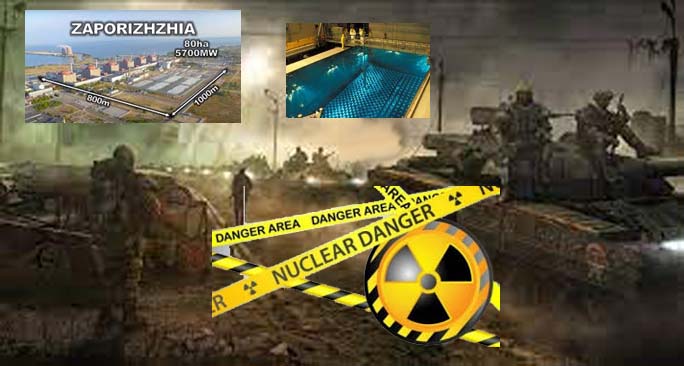
It’s something the world nuclear energy community never thought it would see — and thus never prepared for.
June 1, 2023 by Charles Digges https://bellona.org/news/nuclear-issues/2023-06-zaporizhzhia-nuclear-report
For a year and a half, the world has bourn witness to an unprecedented spectacle: the military occupation of a civilian atomic energy station.
The March 2022 seizure by Russian troops of the Zaporizhzhia Nuclear Power Plant in Southeastern Ukraine has forced six nuclear reactors and pools of spent nuclear fuel onto the front lines of the biggest land war in Europe since World War II.
It’s something the world nuclear energy community never thought it would see — and thus never prepared for. As a result, the world has watched helplessly as heavy ordinance strikes nail-bitingly close to the plant on a regular basis, repeatedly severing outside power to the facility’s cooling and safety systems.
According to Rafael Grossi, who heads the UN’s atomic energy agency —and who has repeatedly beseeched Moscow and Kyiv to create a non-military safe zone around the plant — the situation is a gamble with radioactive stakes.
“We are rolling a dice and if this continues then one day our luck will run out,” he has said more than once.
Unfortunately, the time has come to ponder just what it would look like were that to happen.
This is the subject of a new Bellona report entitled “The Radiation Risks of Seizing the Zaporizhzhia Nuclear Power Plant.”
In it, we analyze a variety of war-time scenarios that could befall the plant and what the consequences of those might be.
What would happen if any of the plant’s six Soviet-built VVER-1000 nuclear reactors were struck by artillery? Or a missile? What about the spent nuclear fuel storage pools? What if those were struck? Where would the radioactive fallout from any of these events go?
And perhaps, in light of recent events, the most salient danger — what would happen if the plant was unable to maintain outside power to run reactor cooling systems? Would that amount to Fukushima redux?
We also present a number of recommendations that should be followed in order to keep the plant safe while it continues to be hostage to the aggression.
Among them, we urge the Russian and Ukrainians struggling for control of the plant to keep the reactors in shut-down mode, which would greatly reduce the severity of a radiological accident. We also recommend that no nuclear fuel be unloaded, packed for storage or transported. These are complex technical tasks that cannot be undertaken by a hostage workforce while a war rages on around them.
Above all, we urge a Russian withdrawal from the plant and Ukraine as a whole, for it is not until then that anything like safe operation of Europe’s largest nuclear power plant can be restored.
Ukraine’s Depleted Uranium Blast: Europe on Brink of ‘Environmental Disaster’

Sputnik lnternational 19.05.2023
Russian Security Council Secretary Nikolai Patrushev warned on Friday that a radioactive cloud was heading towards Western Europe following the destruction of a Ukrainian warehouse storing British-supplied depleted uranium ammunition.

Sputnik News spoke with Dr. Chris Busby, physical chemist and scientific secretary of the European Committee on Radiation Risk, about how the West’s decision to provide depleted uranium (DU) ammunition to Ukraine has potentially caused a continent-wide ecological disaster. Below is his answer in full.
Recently, several web media outlets provided videos of an enormous explosion in the town of Khmelnitski, located to the West of Kiev, and about 200 km from the border with Poland. There were two major explosions which produced a massive roiling swirling fireball which, like an atomic bomb, developed upwards and formed a mushroom cloud, which was black.
I have represented nuclear atmospheric test veterans in the Royal Courts of Justice in London and have seen many films of nuclear explosions: this was not one. A nuclear explosion is characterised by an immediate intense white light which wipes out the camera film or detector.
So, what was it? It was suggested by several commentators that an arms depot that had been hit contained the Depleted Uranium (DU) weapons sent by the UK to the Ukraine for use in the British Challenger tanks as anti-tank penetrators. That the explosion was one involving the burning of the DU in the fireball. Since I am a scientific authority on Uranium and its health effects, but have also examined its dispersion and behaviour in the environment, I will comment on what I believe happened, and why it is important. I was a member of the UK government Ministry of Defence Depleted Uranium Oversight Board (DUOB) in 2000-2005, and also the UK government Committee Examining Radiation Risk from Internal Emitters (CERRIE) 2000-2004. I am Scientific Secretary of the European Committee on Radiation Risk (ECRR) which is an independent NGO that provides advice on risk from ionising radiation.
My main research interest in this area is Uranium and health, particularly the DU particles, which are so small they act as a gas and move over very large distances once they are created by the burning of DU. I found them in England in 2003 after they had come from Iraq. I found them in 2023 in England after they came from the Ukraine war. So that is the first thing: the material is able to travel very large distances.
Therefore, if the Khmelnitsky explosion was a DU one, the material would move with the wind direction and should be detectable at monitor sites downwind.
First, we need to say that DU has a gamma signature, it releases gamma rays. The UK and USA governments lie about this. They point to the fact that the U-238, that remains after the fissile U-235 is removed in the centrifuges (and is sent off for nuclear weapons and reactors), is a weak alpha emitter.
They say that alpha radiation cannot penetrate skin and so the DU itself is harmless. That it cannot be detected by a Geiger Counter and the alpha particles don’t make it through the window. There is, of course, a health problem if the post-impact particles are inhaled and pass into the body through the lung into the lymphatic system or directly into the digestive system, but essentially DU is harmless.
What you need to know is that Uranium 238, when it decays with its alpha emission, turns into Thorium-234 and Protoactinium-234m which then turns into Uranium 234. Thorium 234 is a beta and gamma emitter delivering 6% of its decay energy as a gamma ray. Thus, large clouds of DU particulate aerosol will be detectable by gamma detectors.
When I visited Iraq with Al Jazeera in 2000 I went to the south and examined the corpses of the tanks that had been hit by DU in the first Gulf War. Some of the A-10 DU penetrators were still lying around. They gave off an intense gamma ray signal, and the holes in the tanks were highly gamma ray active. So much for only an alpha emitter.
I am a yachtsman: examination of the UK metereological weather pressure maps tell us that at the time, and for days after the explosion, there was an anticyclone to the North of the explosion site and winds were weak but from the South East blowing North Westerly around the high-pressure area. So, the plume would move towards Poland. If the winds were about 5km/h they would reach any Poland detectors 250 km away on the 15th.
After Chernobyl, the European Union set up a Europe-wide gamma radiation detector system that used to give gamma readings in real time. I went to look. But astonishingly, all the data was blocked. The web- based system, administered from Germany, (EURDEP) would not provide the detector maps that are normally available. Luckily, there were some location maps on the web and some that had been already downloaded by colleagues of mine before the system stopped working. I obtained maps from Poland. One of these I show below. [on original]
You will see that a very highly significant increase in gamma radiation occurred at this detector, north west of the explosion site almost exactly when it would be expected on the basis of a distance of 250km and a mean wind speed of 5km/h. The increase, from 60nSv/h to 90nSv/h was highly statistically significant about 50%. Other detectors all across Poland showed an increase*, as the plume passed over them, the increase being weaker the further away (due to dispersion of the plume).
Later, the Poles measured the increase at the Marie Curie Institute in Lublin, but their map was a more sophisticated one and needed some expert interpretation. The Polish map gave gamma increases split into two natural isotopes, Bismuth and Thallium, also total gamma and cosmic ray gamma………………………………………………………………..
The European radiation detector system web map came back online on May 18. The map type had been changed and everything we saw in the downloads had disappeared or had been smudged out by data analysis averaging. Why? This, and the early blocking of access to the site suggest panic and cover-up.
So taken all together, what we see is a massive explosion which is thought to be DU, and reports of a spike in gamma radiation near the site. Uranium oxide is black, and the black plume moves north west slowly, the weather pattern is stable and the wind blows to Poland. The Polish EU detectors all show gamma radiation increases at the expected time of arrival of the plume. The EU detector system is shut down rapidly, but not before we have obtained data from several sites. The Poles provide a detector result that identified Bismuth as the cause of the increase, but do not go so far as to formally state that it is (in case of later blowback).
One final piece of evidence. We see videos on the internet of the Ukrainians clearing up the explosion site using Robot vehicles, not ordinary firemen. Why do they need Robot vehicles? The last times we saw Robot vehicles clearing up was in the ruins of Chernobyl and Fukushima.
If I am right, there has been an environmental disaster, and the DU particles will travel across Poland, Germany and Hungary, and will end up in the Baltics, probably later the whole of Europe including the UK (after all, the Chernobyl Uranium particles came to the UK).
They will deliver genetic damage and death like that seen in the Balkans and Iraq. Cancer, birth defects, miscarriage, infertility, lung damage, mental problems (Gulf War Syndrome) and so forth. The scientific and epidemiological evidence on this has been clear since the Gulf War. It is all there in the scientific literature—but the governments in the West and the military ignore it, deny it and cover it up. In the case of the UK coroners court finding for Stuart Dyson, the jury found that DU caused his fatal colon cancer.

But when the coroner wrote to the health minister (as he had to by UK law, Rule 43) the reply was: we disagree. This stuff can be measured, but no one will measure it, or if they do, they will be attacked and their arguments dismissed.
Even if I am wrong, and there is some other explanation for the gamma peaks, DU must be banned. It is a weapon of indiscriminate effect and kills civilians, the enemy and your own troops (well, Ukrainian troops). It is much worse than a war gas, like Sarin, or phosgene, mustard gas or all the other chemical agents banned by civilisation. This stuff destroys the genetic basis of life itself. And no one does anything. Those who use it base their action on obsolete science supported by dishonest epidemiology carried out by dishonest scientists and obsolete and fantastical risk models.
Those who provide the weapons, the UK government in this case, are morally bankrupt. Unless it is their intention to destroy the Ukrainian people. Who knows anymore? The world has gone mad.
*Poland’s National Atomic Energy Agency claims there is no increase in radiation levels https://sputnikglobe.com/20230519/ukraines-depleted-uranium-blast-europe-on-brink-of-environmental-disaster-1110462939.html
Fire on Trident nuclear submarine at Scots navy base prompts safety concern for nearby locals.
Fire on Trident nuclear submarine at Scots navy base prompts safety
concern for nearby locals. The fire on-board HMS Victorious last year
raised concerns from local councillors about what was being done to keep
residents safe in the event of a nuclear incident.
Daily Record 30th March 2023
https://www.dailyrecord.co.uk/news/scottish-news/fire-trident-nuclear-submarine-scots-29592800
Glasgow Live 30th March 2023
https://www.glasgowlive.co.uk/news/fire-trident-nuclear-submarine-prompts-26592968
Russian Factory That Makes Nuclear Missile Engines Catches Fire
News Week, BY ISABEL VAN BRUGEN ON 3/23/23
fire has broken out on the territory of a Russian factory that manufactures equipment for the Russian Army, according to state media reports.
Seven people have been rescued from a burning building and firefighters are still searching for the source of the blaze at the Yaroslavl Motor Plant, in Yaroslavl, Russia, which describes itself on its website as one of Russia’s largest enterprises producing multi-purpose diesel engines, clutches, gearboxes and spare parts.
The Russian Emergencies Ministry was quoted by state-run news agency TASS as saying that fire departments were alerted to the blaze at 1.30 p.m. local time. Photos circulating on social media show plumes of thick black smoke rising into the sky.
According to local media reports, there was an explosion prior to the fire…………………………
Russian blogger and analyst Anatoly Nesmiyan said on his Telegram channel that “something quite serious is on fire” at the factory, though did not elaborate on what that could be. Nesmiyan described the factory as one of the largest manufacturers of engines and gearboxes for equipment belonging to the Russian Army, including engines for Topol-M nuclear missile launchers.
According to the Washington-based Center for Strategic and International Studies, the Topol-M is a Russian solid-fueled intercontinental ballistic missile with a range of 11,000 kilometers (6,835 miles).
The incident is the latest in a string of mysterious fires in Russia since President Vladimir Putin invaded Ukraine on February 24, 2022.
On Monday, a Russian anti-Putin partisan movement called Black Bridge claimed responsibility for last week’s fire at a building used by Russia’s Federal Security Service (FSB) in the southern city of Rostov-on-Don near the Ukraine border. https://www.newsweek.com/russian-factory-fire-nuclear-missile-engines-fire-explosion-1789877
Huge 1.5 million litres of radioactive water with tritium leaks from nuclear power plant
Xcel Energy said they are cleaning up the leak of 400,000 gallons (1.5
million litres) of tritium-contaminated water from its Monticello nuclear
power plant in Minnesota.
Mirror 18th March 2023
https://www.mirror.co.uk/news/us-news/huge-15-million-litres-radioactive-29492496
400,000 gallons of radioactive water leaked from a nuclear plant in Minnesota
AP By STEVE KARNOWSKI 16 Mar 23
ST.. PAUL, Minn. (AP) — Minnesota regulators said Thursday they’re monitoring the cleanup of a leak of 400,000 gallons of radioactive water from Xcel Energy’s Monticello nuclear power plant, and the company said there’s no danger to the public.
………………… While Xcel reported the leak of water containing tritium to state and federal authorities in late November, the spill had not been made public before Thursday. State officials said they waited to get more information before going public with it.
…………………….. The Monticello plant is about 35 miles (55 kilometers) northwest of Minneapolis, upstream from the city on the Mississippi River.
………………. Xcel said it has recovered about 25% of the spilled tritium so far, that recovery efforts will continue and that it will install a permanent solution this spring.
…………… Xcel Energy is considering building above-ground storage tanks to store the contaminated water it recovers, and is considering options for the treatment, reuse, or final disposal of the collected tritium and water. State regulators will review the options the company selects, the MPCA said. https://apnews.com/article/minnesota-xcel-energy-nuclear-radioactive-tritium-leak-c7a12ecb1b203179c5f7fef42bd0a3aa?utm_source=homepage&utm_medium=TopNews&utm_campaign=position_02
Quake revives debate over Turkey’s nuclear plant
In a statement to the AP, the Cyprus Anti-Nuclear platform, a coalition of over 50 Greek Cypriot and Turkish Cypriot environmentalist groups, trade unions and political parties, said it “calls on all political parties, scientific and environmental organizations and the civil society to join efforts and put pressure on the Turkish government to terminate its plans for the Akkuyu nuclear power plant.”
Northwest Arkansas Democrat Gazette, by MENELAOS HADJICOSTIS and JENNIFER McDERMOTT The Associated Press
NICOSIA, Cyprus — A devastating earthquake that toppled buildings across parts of Turkey and neighboring Syria has revived a longstanding debate locally and in neighboring Cyprus about a large nuclear power station being built on Turkey’s southern Mediterranean coastline.
The plant’s site in Akkuyu, located about 210 miles west of the epicenter of the Feb. 6 quake, is being designed to endure powerful tremors and did not sustain any damage or experience powerful ground shaking from the 7.8 magnitude earthquake and aftershocks.
Cypriot European Parliament member Demetris Papadakis asked the European Commission what immediate actions it intends to take to halt the plant because of the dangers posed by building a nuclear power station in a seismic zone so close to Cyprus……..
 | |||
But the size of the quake, the deadliest in Turkey’s modern history, sharpened existing concerns about the facility being built on the edge of a major fault line…………………………………………..
An official with Turkey’s Energy Ministry, when contacted by the AP, said there were no immediate plans to reassess the project. The official spoke on condition of anonymity in line with government protocol. Some activists, however, still say the project — the first nuclear power plant in Turkey — poses a threat.
Nuclear facilities are constructed of heavily reinforced concrete, sized for significant earthquake shaking and far more robust than commercial buildings, said Andrew Whittaker, a professor of civil engineering at the University at Buffalo who is an expert in earthquake engineering and nuclear structures.
The fact that it’s being built off the western end of the East Anatolian Fault, which was linked to the powerful tremor, suggests that the design would have been checked for significant shaking, Whittaker added.
Still, Whittaker said, it would be prudent to reassess seismic hazard calculations in the region for all infrastructure, including the plant.
“There’s no reason to be concerned, but there’s always a reason to be cautious,” he said.
That’s little comfort to activists in Turkey and on both sides of ethnically divided Cyprus. They’ve renewed their calls for the project to be scrapped, saying that the devastating earthquake is clear proof of the great risk posed by a nuclear power plant near seismic fault lines.
In a statement to the AP, the Cyprus Anti-Nuclear platform, a coalition of over 50 Greek Cypriot and Turkish Cypriot environmentalist groups, trade unions and political parties, said it “calls on all political parties, scientific and environmental organizations and the civil society to join efforts and put pressure on the Turkish government to terminate its plans for the Akkuyu nuclear power plant.”…………………….. https://nwaonline.com/news/2023/feb/19/quake-revives-debate-over-turkeys-nuclear-plant/?news-wor1
What We Know About The US Air Force’s Balloon Party So Far

https://caityjohnstone.medium.com/what-we-know-about-the-us-air-forces-balloon-party-so-far-6c59b80e7a3d Caitlin Johnstone, 18 Feb 23
You know, everyone’s always talking about how the US military is only ever used to kill foreigners for resource control and generate profits for the military-industrial complex, but that’s not entirely true. Turns out the US military is also used for shooting down party balloons.
In an article titled “Object downed by US missile may have been amateur hobbyists’ $12 balloon,” The Guardian’s Richard Luscombe reports the following:
The Northern Illinois Bottlecap Balloon Brigade says one of its hobby craft went “missing in action” over Alaska on 11 February, the same day a US F-22 jet downed an unidentified airborne entity not far away above Canada’s Yukon territory.
In a blogpost, the group did not link the two events. But the trajectory of the pico balloon before its last recorded electronic check-in at 12.48am that day suggests a connection — as well as a fiery demise at the hands of a sidewinder missile on the 124th day of its journey, three days before it was set to complete its seventh circumnavigation.
If that is what happened, it would mean the US military expended a missile costing $439,000 (£365,000) to fell an innocuous hobby balloon worth about $12 (£10).
“The descriptions of all three unidentified objects shot down Feb. 10–12 match the shapes, altitudes and payloads of the small pico balloons, which can usually be purchased for $12–180 each, depending on the type,” writes Steve Trimble for Aviation Week, who first broke the Bottlecap Balloon Brigade story.
This information would put a bit of a wobble on Senate Majority Leader Chuck Schumer’s comments to ABC’s This Week on Sunday that all three of the balloons shot down through the weekend were Chinese surveillance devices, saying “the Chinese were humiliated” by the US catching them in their sinister espionage plot. If the US air force did in fact just spent millions of dollars shooting down American party balloons, it wouldn’t be the Chinese who are humiliated.
And it looks like that is indeed what happened. On Tuesday the National Security Council’s John Kirby said the “leading explanation” for the three unidentified flying objects that were shot down is that they were “balloons tied to some commercial or benign purpose.” On Thursday President Biden told the press that “The intelligence community’s current assessment is that these three objects were most likely balloons tied to private companies, recreation, or research institutions studying weather or conducting other scientific research.”
And this all comes out after US officials told The Washington Post that the “Chinese spy balloon” which started this historically unprecedented multi-day frenzy of aerial kinetic warfare over North America was probably never intended for surveillance of the United States at all. Experts assess that the balloon was blown over the continent entirely by accident, trying to reconcile that narrative with the contradictory US government claims of intentional Chinese espionage by suggesting that perhaps the Chinese had intended for the balloon to be used for spying on US military forces in the Pacific or something.
So to recap, the US air force shot down a Chinese balloon which US officials have subsequently admitted was only blown over the US by accident, then went on a spree of shooting things out of the sky which it turns out were probably civilian party balloons. The entire American political/media class has been spending the month of February furiously demanding more militarism and more cold war escalations over what is in all probability four harmless balloons.
And what’s really crazy is that they’re probably going to get those increases in militarism and cold war escalations they’ve been calling for, despite the entire ordeal originating primarily in the overactive imaginations of the drivers of the US empire. The shrieking hysterical panic about “Chinese spy balloons” has dwarfed the coverage of the revelations contradicting that narrative, and China hawks have been using the occasion to argue for increases in military spending. The Atlantic’s Richard Fontaine got all excited and wrote a whole article about how the threat of Chinese spy balloons can be used “to rally public concern and build international solidarity” against China.
These are the people who rule our world. They are not wise. They are not insightful. They are not even particularly intelligent. The US empire is a Yosemite Sam cartoon character who at any time can just flip out and start firing Sidewinder missiles at random pieces of junk in the sky, screaming “I’ll blast yer head off ya varmint!” If the US war machine was a civilian human, their family would be quietly talking amongst themselves about the possibility of conservatorship.
These are the last people in the world who should be running things, and they are the last people in the world who should be armed with nuclear weapons. But that’s exactly where we find ourselves in this bizarre slice of spacetime. God help us all.
____________________
The half billion nuclear kitty litter incident
by Brian Nitz “…………………………. imagine being the person who caused a nuclear accident by ordering the wrong kitty litter?
It happened in February 2014 at a nuclear weapons waste processing facility for the Los Alamos National Laboratory in New Mexico. Anyone involved may be trying hard to forget that it ever happened. The confusion began with a typo in a request for “kitty litter/zeolite clay.” (Zeolites can also be used in energy storage as I wrote here).
At some point this was replaced with kitty litter (clay). This was further transformed into an order for organic cat litter, specifically the sWheat Scoop brand which the manufacturer claims is 100% wheat. Now while the word organic has a folk meaning to environmentalists and hipsters at your local cafe, to chemists it means something more specific……………………………
Don’t try this at home
Green Prophet recently covered the possibilities of using Zeolite for energy storage and this amazing mineral has many more tricks up its sleeve. But while it might seem obvious that anything capable of detoxifying cat pee would be equally effective for nuclear waste disposal, this isn’t necessarily true.
The problem with using 100% organic wheat-based organic kitty litter for your nuclear waste disposal instead of zeolite (non-clay) kitty litter has to do with its reactivity and flammability when confined in a barrel with plutonium, americium, uranium and nitrate-based processing chemicals when compared to zeolite. It doesn’t help that all of this takes place deep underground in an abandoned salt mine where there is much more salt and nuclear waste than there are people to watch it.
So the problem wasn’t discovered until barrel #68660 burst, releasing radiation into a ventilation system. It is believed that several hundred nuclear waste barrels were contaminated with the wrong kind of kitty litter. The cost of the cleanup is said to have been more than half a billion. https://www.greenprophet.com/2023/02/kitty-litter-nuclear/
That time Northern California had a near nuclear accident
by: Matthew Nobert, Feb 11, 2023 https://fox40.com/news/local-news/sutter-county/that-time-northern-california-had-a-near-nuclear-accident/
KTXL) — The Sacramento region has a rich history of United States Air Force aviation, but on a Tuesday in 1961 that history turned dark as an aircraft armed with nuclear bombs crashed in Sutter County.
Following World War II the United States Air Force was looking to add a modern bomber to its fleet and in 1955 the B-52 Stratofortress began its military service.
Between 1960 and 1968, the USAF would run Operation Chrome Dome, which would have B-52’s armed with nuclear weapons remain continuously airborne on the border of the Soviet Union.
On March 14, 1961, a B-52F-70-BW armed with two nuclear weapons departed Mather Air Force Base, now Mather Airport, when the cabin pressure in the crew compartment began to fail, according to Department of Defense records.
The crew dropped the plane to 10,000 feet but the increased fuel consumption caused “fuel exhaustion” before an air tanker could refuel the B-52.
The crew bailed out at 10,000 feet, but the commander stayed until 4,000 feet in order for the massive bomber to be steered away from a populated area.
The bomber crashed into Sutter County farmland near the intersection of Moroni Road and Drexler Road, about 17.5 miles southwest of Yuba City.
When the bomber crashed, the two nuclear weapons it was carrying were stripped away from the body of the plane, but their explosives did not detonate. No nuclear contamination was detected either.
This recounting of events by the Department of Defense was challenged years later in a 2013 book written by Retired USAF Lt Col Earl McGill, a B-47 and B-52 pilot during the Cold War.
His book “Jet Age Man: SAC B-47 and B-52 Operations in the Early Cold War” recounts the Strategic Air Commands (SAC) Operation Chrome Dome and the events of March 14, 1961.
“Whatever the cause, SAC crews were briefed on every B-52 accident….we were summoned to the alert shack briefing room where we were told that a B-52 returning from a 24-hour CHROME DOME mission ran out of fuel and dumped four Mk-28’s on Northern California,” McGill writes.
McGill’s recounting of the crash also puts into question how safe the nuclear weapons actually were when the plane went down.
“The safety devices barely worked as designed,” McGill writes. “Apparently three weapons chutes did not fully deploy, which prevented detonation. The one that hung up (in a tree), we were briefed, had ‘rung in’, a term we used to indicate ‘armed’….”
McGill’s book was Nominated as Best Military History Book 2013 by Air Power History, published by the US Air Force Historical Foundation.
Northern California was not the only area of the United States or the world that saw crash landings by B-52’s armed with nuclear bombs.
Operation Chrome Dome would come to an end in 1968 after five B-52 crashes in the United States and abroad.
Fears of ‘catastrophic’ nuclear horror as Turkey’s reactor rocked by horror earthquake
Turkey’s Akkuyu Nuclear Power Plant is facing a major risk, an expert has
warned, as the death toll of the disastrous earthquake racks up. The
disaster in Turkey and Syria has so far left 11,224 confirmed dead, with
the World Health Organisation warning that the final death toll could be as
high as 20,000.
Rescue teams in Turkey and Syria worked through the night
to recover more bodies from the rubble of thousands of buildings destroyed.
Following the disaster, an expert told Express.co.uk that Turkey’s nuclear
power plant, which lies just 16 miles away from an earthquake fault and is
currently under construction, could be at risk.
Express 8th Feb 2023
1 This Month

of the week – Shut Down Drone Warfare!


Tell the Ukrainian Government to Drop Prosecution of Peace Activist Yurii Sheliazhenko

Petition to revoke the licensing of the Near Surface Nuclear Disposal Facility (NSDF) at Chalk River. https://www.ourcommons.ca/petitions/en/Petition/Details?Petition=e-7247
To see nuclear-related stories in greater depth and intensity – go to https://nuclearinformation.wordpress.com
-
Archives
- April 2026 (68)
- March 2026 (251)
- February 2026 (268)
- January 2026 (308)
- December 2025 (358)
- November 2025 (359)
- October 2025 (376)
- September 2025 (257)
- August 2025 (319)
- July 2025 (230)
- June 2025 (348)
- May 2025 (261)
-
Categories
- 1
- 1 NUCLEAR ISSUES
- business and costs
- climate change
- culture and arts
- ENERGY
- environment
- health
- history
- indigenous issues
- Legal
- marketing of nuclear
- media
- opposition to nuclear
- PERSONAL STORIES
- politics
- politics international
- Religion and ethics
- safety
- secrets,lies and civil liberties
- spinbuster
- technology
- Uranium
- wastes
- weapons and war
- Women
- 2 WORLD
- ACTION
- AFRICA
- Atrocities
- AUSTRALIA
- Christina's notes
- Christina's themes
- culture and arts
- Events
- Fuk 2022
- Fuk 2023
- Fukushima 2017
- Fukushima 2018
- fukushima 2019
- Fukushima 2020
- Fukushima 2021
- general
- global warming
- Humour (God we need it)
- Nuclear
- RARE EARTHS
- Reference
- resources – print
- Resources -audiovicual
- Weekly Newsletter
- World
- World Nuclear
- YouTube
-
RSS
Entries RSS
Comments RSS
 nuclear-news
