Fitzpatrick Nuclear Power Plant radioactively leaking into Lake Ontario
Nuclear Power Plant Found Leaking Into Lake Ontario, We Are Anonymous, July 7th, 2016 | by Alek Hidell “……The latest nuclear plant to have been discovered to have a leak is the Fitzpatrick Nuclear Power Plant in Oswego, New York. The plant is run by energy corporation Entergy. A visible sheen was observed spreading out for miles from the site of the plant, making it undeniable that the leak wasn’t coming from elsewhere. It was discovered by a Coast Guard Auxiliary air crew. A section of Lake Ontario had to be cordoned off, preventing the leak from spreading further.
Neil Sheehan, a spokesman for the Nuclear Regulatory Commission, made the following statement: “It appears about 20 to 30 gallons that leaked were then drained through the plant’s discharge drain system to the lake. The company has placed oil-absorbent pads on the turbine building roof and has also stopped all circulating water pumps to eliminate any further discharges.”
It is not much of a comfort to know that the government is contributing to the cleanup. With decades of research and knowledge about the dangers of nuclear power, the government continues to build them, with five new plants under construction as of 2015. I don’t believe any of us need to be reminded of the dangers of nuclear power after the recent Fukushima Daiichi Nuclear Power Plant meltdown.
After the earthquake and subsequent tsunami, the reactors and their cooling system shut down. This resulted in nuclear materials being dumped into the Pacific ocean. Traces of the radiation are being found along the California coastline. And as you’d expect, the official inquiry found that despite the earthquake and tsunami, the meltdown was preventable and a result of a failure to maintain vital systems.
New York is no stranger to leaky nuclear plants; the Indian Point nuclear plant has been shut down at least 14 times since 1973. The most recent closing of the facility took place in 2015, when two fuel rods lost power. When you look at the incidents of closure at Indian Point, as well as every other nuclear plant, it becomes obvious that the fundamental problem is a crumbling infrastructure. Much like our roads and bridges, nuclear power plants, especially ones built before the 1980s, are falling apart…….http://anonhq.com/nuclear-power-plant-found-leaking-lake-ontario/
More information needed on safety issues at Pilgrim Nuclear Power Station
 Nuclear safety expert seeks data about Pilgrim incident By Christine Legere The Cape Cod Times Jul. 1, 201 PLYMOUTH – A well-known nuclear safety expert is looking for more information from the Nuclear Regulatory Commission regarding a report that both emergency diesel generators at the Pilgrim Nuclear Power Station had been out of commission at the same time for a short period in April while the reactor was operating at full power.
David Lochbaum, director of the Nuclear Safety Program for the Union of Concerned Scientists, questions how long the plant had been running with no emergency generators, which provide a default power source to safely shut down the reactor, maintain safe shutdown conditions and operate all essential systems if primary and secondary power sources have failed……..
Meanwhile, Mary Lampert, a Duxbury resident and director of Pilgrim Watch, said she believed the situation occurred because of aging equipment and lack of vigilance.
“It’s the same old story: Entergy running the reactor on the cheap – generating not required backup power but trouble for us and themselves,” wrote Lampert in an email. ……http://www.enterprisenews.com/news/20160701/nuclear-safety-expert-seeks-data-about-pilgrim-incident
USA’s nuclear power plants have experienced 10 perilous near misses

 10 Near Misses at U.S. Nuclear Power Plants Considered Precursors to a Meltdown https://ecowatch.com/2016/05/24/near-misses-nuclear-plants/ Greenpeace | May 24, 2016 Following the 30th anniversary of the Chernobyl nuclear disaster, Greenpeace USA released a new report Tuesday on the 166 near misses at U.S. nuclear power plants over the past decade. Of the incidents identified in Nuclear Near Misses: A Decade of Accident Precursors at U.S. Nuclear Plants, 10 are considered by the Nuclear Regulatory Commission (NRC) to be important precursors to a meltdown.
“Contrary to NRC commissioners’ claims, there is nothing safe about the nuclear reactors in the United States,” Greenpeace Nuclear Policy Analyst Jim Riccio said. “Thirty years after Chernobyl and five years after Fukushima, it is clear that these kinds of disasters could absolutely happen here. It is time for the NRC to listen to the whistleblowers within its own ranks and address these longstanding issues and vulnerabilities.”
In addition to the 163 accident precursors or near misses documented by the NRC, Greenpeace identified three significant near misses that NRC risk analysts failed to review under the agency’s Accident Sequence Precursor Program (ASP): the triple meltdown threat to Duke Energy’s Oconee Nuclear Station west of Greenville, South Carolina. According to NRC’s risk analysts, if nearby Jocassee Dam had failed, all three of the nuclear reactors at Oconee were certain to meltdown.
The report identified the following incidents as the top 10 near misses at nuclear plants between 2004-2014:
1. Browns Ferry 1 in Athens, Alabama: Residual heat removal loop unavailable; valve failure.
2. Wolf Creek in Burlington, Kansas: Multiple switchyard faults, reactor trip and loss of offsite power.
3. Robinson in Hartsville, South Carolina: Fire causes partial loss of offsite power & reactor coolant pump seal cooling challenges.
4. Fort Calhoun in Fort Calhoun, Nebraska: Fire in safety-related 480 volt electrical breaker due to deficient design control. 8 other breakers susceptible.
5. River Bend in St. Francisville, Louisiana. Loss of normal service water, circulating water and feedwater caused by electrical fault.
6. Oconee 1 in Seneca, South Carolina: Failure of Jocassee Dam would result in a meltdown.
7. Oconee 2 in Seneca, South Carolina: Failure of Jocassee Dam would result in a meltdown.
8. Oconee 3 in Seneca, South Carolina: Failure of Jocassee Dam would result in a meltdown.
9. North Anna 1 in Mineral, Virginia: Dual loss of offsite power caused by earthquake AFW pump out of service & failure of Unit 2 EDG.
10. Byron 2 in Byron, Illinois: Transformer & breaker failures cause Loss of Off Site Power, reactor trip and de-energizing of safety buses.
“If the NRC can’t even accurately track near meltdowns why should the public have any confidence that they can prevent them? It’s time to retire these dangerous nuclear plants and end the nuclear era once and for all,” Riccio concluded.
Unfolding nuclear disasters in America
Is there any nuclear site in the United States that is not currently collapsing, leaking or otherwise posing a major health or environmental risk? Certainly there are, but that number is becoming smaller and smaller.
In addition to three other nuclear disasters unfolding across the country, a fourth has now arisen. This new disaster is located in Washington state in a facility known as the Hanford site.
One week after 19 workers were sent for medical evaluation as the nuclear waste tank was being transferred because of a leak, 3 more workers are now being reported as injured at the site. According to RT, the workers inhaled radioactive fumes – the same issue facing the 19 previously hospitalized workers. This brings the injured number of workers up to 22…….
Although the facility was decommissioned at the end of the Cold War, the facility has been used to store nuclear waste. In fact, according to RT, two-thirds of America’s radioactive materials are stored at this location which makes it one of the largest facilities of its kind in the world.
The storage tanks which were built as early as 1940 and as late as 1970 contain 56 million gallons of radioactive chemicals.
According Gerry Pollet, a Washington State Representative, those tanks were never expected to last longer than 20 years.
Pollet says,
Twenty years was a dream in the first place. And, as you know, some of them didn’t last 20 years – and we had a small explosion on the 1950s. That hot waste boiled; created a steam explosion under the tank, and we were lucky that we didn’t have half of eastern Washington having to be permanently evacuated.
The company operating the facility acknowledged “higher-than-normal readings for contamination” for a certain tank, but claimed that the readings “well below the alarm level.” RT correspondent Alexey Yaroshevsky traveled to the Hanford site with a Geiger counter.
Yaroshevsky measured the radiation levels of a rock laying well outside of the containment facility and, while the readings were not considered an emergency even the reporter’s handheld device registered a higher-than-normal level of radiation.
Yaroshevsky wondered aloud whether or not the radiation levels closer to the center to the containment facility would be much higher. The reports of the Hanford site leakage now add a West Coast dimension to the nuclear crisis that has escalated in the last few weeks.
In addition to Hanford, reports West Lake Landfill in St. Louis, Missouri which houses sizable amounts of nuclear waste is facing an approaching fire from an adjacent landfill that threatens to turn West Lake into a cauldron of radioactive air pollution. In addition, a nuclear power plant in Turkey Point, Florida is reportedlyleaking polluted water into Biscayne Bay. New York’s Indian Point power plant is also threatening to become a major radioactive incident. Constant leaks, mishaps and other signs of an outright collapse have existed at Indian Point for quite some time but have increased in frequency over the last year . http://www.naturalblaze.com/2016/05/is-this-the-4th-recent-nuclear-disaster-to-strike-the-u-s.html

Washington nuclear waste site’s huge spike in radiation levels
TV: EPA data reveals “sharp spike in radiation level” around US nuclear site — “It’s been reportedly leaking huge amounts of radioactive materials for more than 2 weeks” — Evacuations enacted… Almost 50 workers have sought medical attention… Symptoms include bleeding ulcers, burned lungs (VIDEOS) http://enenews.com/tv-epa-data-reveals-sharp-spike-radiation-level-around-nuclear-site-leaking-huge-amounts-radioactive-materials-2-weeks-evacuations-enacted-almost-50-workers-sought-medical-attention-symtoms-incl?utm_source=feedburner&utm_medium=email&utm_campaign=
KING 5 News, May 5, 2016 (emphasis added): Record number of Hanford workers sickened by toxic vapors — An unprecedented number of workers at Hanford have been exposed to dangerous chemical vapors since Thursday, April 28. In one week’s time a total of 47 people either sought medical attention… Symptoms reported by workers include a headache, burning nose and throat, nausea, a metallic taste in the mouth, elevated blood pressure, and dizziness… [T]hose familiar with the nuclear site cannot remember so many people falling victim in such a short period… On May 4, two more evacuations were enacted at the site after workers smelled odors and experienced symptoms… “Forty-two employees have been evaluated as a precautionary measure due to reported odors or symptoms at the on-site medical facility since Thursday. Thirty-one employees reported health symptoms while 11 went for cautionary reasons. All have been released to return to work” said Rob Roxburgh of the Dept. of Energy, in a statement sent to KING 5 on Wednesday. Chemical vapor releases at Hanford come from underground nuclear waste storage tanks that vent the gasses without warning.
RT, May 7, 2016: Spike in radiation levels after toxic waste leak at Washington nuclear site — Radiation levels at the Hanford, Washington nuclear waste site have spiked to “elevated risk” after thousands of gallons of toxic waste leaked in April… The recent readings from the Environmental Protection Agency (EPA) obtained by RT have revealed that a sharp spike in the radiation level had been registered in Richland on the morning of May 5. The readings show the random jump when the toxic fume rates briefly reached around 410 CPM (counts per minute), nearly the highest possible level… As of Friday afternoon, there have been no media reports suggesting that an evacuation or other measures and guidance have been ordered for Richland… The most recent radiation spike comes less than a month after a massive leak was first detected…
RT transcript, May 5, 2016: On Thursday last week at least 19 workers at the Hanford nuclear site were hospitalized after inhaling poisonous fumes, from tasting metal in their mouth tobleeding ulcers and burned lungs.
RT transcript, May 3, 2016: At the Hanford nuclear site in Washington state… more workers sought medical attention after inhaling radioactive fumes. This adds to 19 workers hospitalized last week for the same reason — reinforcing burning concerns about the facility as it’s been reportedly leaking huge amounts of radioactive materials for more than 2 weeks… [Tom Carpenter, Executive Director of Hanford Challenge:] “It’s an environmental disaster, at some point the [Columbia] River becomes so contaminated that you can’t use the river.”… Ecologists say the situation can always get worse. They hate to think what would happen in case of even a minor earthquake in a geologically unstable area that it is. But even in the current state of thingswith tanks leaking nuclear poison into the environment, Hanford is already way past the ticking time bomb stage.
RT transcript, May 2, 2016: [Tom Carpenter, Executive Director of Hanford Challenge:] “A second double-shelled nuclear waste tank is showing signs of having failed, you find that out because there’s high radiation levels in between the two shells of the tank. There should be no radiation in that space… but instruments they have deployed there show high radiation levels,plutonium, cesium, strontium-90, etc. – well where did that come from? It probably came from the tank, meaning there’s a hole.”… So we’re looking at potentially a catastrophe, a disastrous catastrophe? [Carpenter:] “Every day we’re looking at that at Hanford – I’m totally serious.”
RT transcript, Apr 21, 2016: ‘Washington state nuke plant leaks thousands of gallons of toxic waste‘… Experts say it’s time for every American to be worried.
No to Nuclear Energy in Nigeria
Nigeria: Say No to Nuclear Energy in Nigeria AllAfrica, 1 May 16“…..Nigeria’s history of disaster management or maintenance culture in the past and the present has much to be desired of, so how can it want to project into a future of nuclear energy with all the attendant risk.
It does not take an expert in Nuclear energy to be able to state basic obvious facts that are glaring. Any major mishap involving radiation leaks from nuclear energy can lead to a disaster of catastrophic proportion that could lead to thousands of death, long term health problems, spikes in cancer incidents and birth defects. The devastation of a nuclear disaster in a highly populated country like Nigeria would send shock waves around the world. A breach in the nuclear containers of a nuclear reactor or a nuclear meltdown would release nuclear materials into the atmosphere and ground and could literally obliterate parts of the country and turn them into waste lands and “ghost lands”.
No matter how prepared even the extremely prepared and efficient countries are, in a case of a nuclear disaster they can only try to mitigate the damage, so what chance would Nigeria have if a nuclear melt down were to occur in the country. Even if the argument is that the likelihood of a nuclear disaster is minuscule, should Nigeria of today, the way it is, subject its people to that risk? The risk out weighs the benefit.
Was it not in Koko, Delta State, that someone shipped in containers of nuclear waste?
Countries try to get rid of their radio-active waste, yet a Nigerian shipped it into his country and dumped it amongst his people. The community, struggling under their daily routine for survival did not sense the eminent danger and instead opened up the containers, used them to collect water and for other domestic use. By the time the government brought it to public knowledge, the people in the affected area of Koko had been exposed to radiation. When scientist came with Geiger counters to measure the amount of radiation in the area and also on the people, a lot of them did not understand what was going on and had little understanding of the dangers of nuclear radiation. Have the people of Koko been followed? Have longitudinal studies been done on their health status? Were children born in that area since the episode monitored? Is the soil in that area still being tested regularly or have the people of Koko been forgotten? These are but a few of the questions…….
Nigeria is blessed with sunshine; it can invest in solar energy. It has vast areas of empty flat land so it can invest in wind energy by using turbines……..http://allafrica.com/stories/201605010001.html
Computer viruses have infected German nuclear power station
 German nuclear plant infected with computer viruses, operator says http://www.dailymail.co.uk/wires/reuters/article-3560358/German-nuclear-plant-infected-computer-viruses-operator-says.html , 27 April 2016 FRANKFURT, – A nuclear power plant in Germany has been found to be infected with computer viruses, but they appear not to have posed a threat to the facility’s operations because it is isolated from the Internet, the station’s operator said on Tuesday.
The Gundremmingen plant, located about 120 km (75 miles) northwest of Munich, is run by the German utility RWE.
The viruses, which include “W32.Ramnit” and “Conficker”, were discovered at Gundremmingen’s B unit in a computer system retrofitted in 2008 with data visualisation software associated with equipment for moving nuclear fuel rods, RWE said.
Malware was also found on 18 removable data drives, mainly USB sticks, in office computers maintained separately from the plant’s operating systems. RWE said it had increased cyber-security measures as a result.
W32.Ramnit is designed to steal files from infected computers and targets Microsoft Windows software, according to the security firm Symantec.
First discovered in 2010, it is distributed through data sticks, among other methods, and is intended to give an attacker remote control over a system when it is connected to the Internet.
Conficker has infected millions of Windows computers worldwide since it first came to light in 2008. It is able to spread through networks and by copying itself onto removable data drives, Symantec said.
RWE has informed Germany’s Federal Office for Information Security (BSI), which is working with IT specialists at the group to look into the incident.
The BSI was not immediately available for comment.
After Japan’s Fukushima nuclear disaster five years ago, concern in Germany over the safety of nuclear power triggered a decision by the government to speed up the shutdown of nuclear plants. Tuesday was the 30th anniversary of the Chernobyl nuclear disaster. (Reporting by Christoph Steitz, Eric Auchard and Joseph Nasr; Editing by Kevin Liffey)
‘Catastrophic’ Nuclear leak at Washington’s infamous Hanford Site
 Nuclear leak at Washington’s infamous Hanford Site is CATASTROPHIC, former worker claims, as eight inches of radioactive waste escapes core of ‘the world’s safest’ tank, Daily Mail , 20 Apr 16 [EXCELLENT PHOTOS]
- Tank has two shells; a crack was spotted in the inner one in 2011
- Now that crack has widened, spilling waste into the gap between the shells
- It happened after attempts to pump the waste out of the tank
- The Department of Energy says this was ‘anticipated’
- But workers at the plant said they weren’t told it was a possibility
- The double-shell tank can contain up to a million gallons of deadly waste
- It was supposed to be the safest possible container for radioactive liquid
- The Hanford Site provided plutonium for the first atomic bomb
By JAMES WILKINSON FOR DAILYMAIL.COM, 20 April 2016
A nuclear leak first spotted five years ago at Washington state’s Hanford Site has got dramatically worse with eight inches of radioactive liquid escaping a protective carbon steel shell.
The tank, named AY-102, has two shells, with the inner steel layer containing up to one million gallons of the deadly waste, and the outer concrete one providing a two-foot-wide gap to collect the waste if the inner shell broke.
Now a small leak in the inner shell first seen in 2011 has worsened, allowing eight inches of the dangerous goo to leak out in an event that one ex-worker is calling ‘catastrophic.’
Former Hanford worker Mike Geffre was the first to spot the leak in AY-102’s inner shell in 2011, but it took the government a year to actually announce what had happened.
Back then, the small leak only allowed a slow flow of radioactive waste into the gap between the shells, or ‘annulus’. That liquid which would quickly dry up into a white powder. But after five years, they discovered on Sunday that the crack had got worse.
‘This is catastrophic,’ he told KGW.com. ‘This is probably the biggest event to ever happen in tank farm history. The double-shell tanks were supposed to be the saviors of all saviors.’
The Hanford Site was a major Second World War and Cold War nuclear site; it provided plutonium for the first atomic bomb.
It now houses millions of gallons of nuclear waste – two-thirds of all high-level radioactive waste in America in 2007 – and cleanup on the site has been ongoing since 1989.
As well as AY-102, six single-shell tanks were noted to be leaking in 2013.
Ironically, the original cracks in AY-102 appear to have been further widened by government efforts to pump waste out of the tank, sources told KGW.
Pumping began three weeks ago, after Washington state spent three years petitioning the federal government, which owns the tanks, to deal with the damaged structure.
But the change in pressure appears to have ‘blown out’ the weakened wall, causing the increased leak and bringing the waste closer to the nearby Columbia River.
‘The primary tanks weren’t designed to stage waste like this for so many years,’ a current worker told KGW. ‘There’s always the question, “Are the outer shells compromised?”‘…………
workers at the plant told KGW that despite claims the breach was ‘anticipated,’ they had not been made aware that something like this could occur.
And Geffre said that he was frustrated that his warnings in 2011 hadn’t been acted on for an entire year. ‘It’s an example of a culture at Hanford of “We don’t have problems here. We’re doing just fine.” Which is a total lie,’ he said.
Construction on the Hanford site began in 1943, and it went on to house the world’s first full-scale plutonium production reactor, and to provide plutonium for the first atomic bomb.
After the Cold War ended, the site housed 53 million gallons of high-level radioactive waste and 25 million cubic feet of solid radioactive waste.
There were 200 square miles of contaminated groundwater beneath the site. http://www.dailymail.co.uk/news/article-3547975/Five-year-long-nuclear-leak-Washington-state-s-infamous-Hanford-Site-CATASTROPHIC-former-worker-claims-eight-inches-radioactive-waste-escapes-world-s-safest-tank-one-night.html
Chernobyl’s nuclear nightmare – a timeline
Chernobyl: Timeline of a nuclear nightmare http://www.wtsp.com/news/nation-now/chernobyl-timeline-of-a-nuclear-nightmare/138536883 Kim Hjelmgaard and USA TODAY , April 17, 2016

Timeline of a disaster
February 1986:
Ukraine’s Minister of Power and Electrification Vitali Sklyarov tells Soviet Life magazine that the odds of a meltdown at Chernobyl’s nuclear power plant are “one in 10,000 years.”
April 25, 1986:
The plant’s operators prepare to conduct a special test to see how an emergency water cooling system would fare in the event of a complete loss of power.
April 26, 1986:
The test begins at 1:23.04 a.m.
Fifty-six seconds later, pressure builds in the reactor No. 4 in the form of steam. This causes an explosion that lifts a 1,000-ton lid that covers volatile fuel elements. Radiation is immediately released into the air.
As oxygen pours into the reactor, a graphite fire begins. A chemical reaction causes a second explosion, and burning debris lands on the roof of reactor No. 3.
Meanwhile, the engineer responsible for the night shift, Alexander Akinhov, does not yet think the reactor’s core is damaged. “The reactor is OK, we have no problems,” he says. Akinhov subsequently dies from radiation illness.
Thirty separate fires develop. An alarm goes off at a local fire station.
At 1.45 a.m. firefighters arrive. They know nothing about radiation and aren’t wearing any protective clothing. Driver Grigory Khmel later recalls: “We saw graphite lying everywhere. I kicked a bit of it. Another fireman picked up a piece and said ‘hot.’ Neither of us had any idea of radiation. My colleagues Kolya, Pravik and others all went up the ladder of the reactor. I never saw them again.”
At 3:12 a.m. an alarm goes off at an army base deep in the Soviet Union. The general in charge decides to send troops. They arrive in Ukraine’s capital of Kiev at 2 p.m.
At 5 a.m. reactor No. 3 is shut down. Reactors No. 1 and 2 are stopped about 24 hours later.
April 27, 1986:
As more emergency response teams arrive, evacuations begin in a radius of 6 miles around the plant. April 28, 1986:
The Soviet Union publicly admits for the first time that an accident happened but gives few details.
An alarm goes off at a Swedish nuclear plant after the soles of shoes worn by a nuclear safety engineer there test positive for radioactivity. The radiation is traced to Chernobyl.
May 1, 1986:
May Day parades to celebrate workers go ahead as planned in Kiev and Belarus’ capital Minsk despite huge amounts of radiation continuing to be released. Wind, and radioactive clouds, blow back toward Kiev after initially drifting northwest toward Europe. Authorities believe that by holding these celebrations they will prevent panic.
May 14, 1986:
Soviet leader Mikhail Gorbachev talks about the accident live on television. He subsequently mobilizes hundreds of thousands of people, including military reservists from all parts of the Soviet Union, to help in the cleanup.
They become known as “liquidators.” Many will become ill and die from radiation-related diseases.
Gorbachev, in a 2006 memoir, says Chernobyl “was perhaps the real cause of the collapse of the Soviet Union.”
Allison MacFarlane on nuclear safety
 How to protect nuclear plants from terrorists, PhysOrg April 14, 2016 by Allison Macfarlane, The Conversation In the wake of terrorist attacks in Brussels, Paris, Istanbul, Ankara and elsewhere, nations are rethinking many aspects of domestic security. Nuclear plants, as experts have long known, are potential targets for terrorists, either for sabotage or efforts to steal nuclear materials.
Currently there are 444 nuclear power plants operating in 30 countries around the world and 243 smaller research reactors, which are used to produce isotopes for medical uses and to train nuclear engineers. The nuclear industry also includes hundreds of plants that enrich uranium and fabricate fuel for reactors. Some of these facilities contain materials terrorists could use to build a nuclear or “dirty” bomb. Alternatively, power plants could be “hijacked” to create an accident of the sort experienced at Chernobyl and Fukushima, sending clouds of radioactivity over hundreds of miles.
At last month’s Nuclear Security Summit in Washington, D.C., representatives from 52 countries pledged to continue improving their nuclear security and adopted action plans to work together and through international agencies.
But significant countries like Russia and Pakistan are not participating. And many in Europe are just beginning to consider physical security measures. From my perspective as a former nuclear regulator and now as director of the Center for International Science and Technology Policy at George Washington University, it is clear that nuclear plants are vulnerable to terrorist attacks.
It is not news that security is weak at many civilian nuclear power and research facilities.
In October 2012, Greenpeace activists entered two nuclear power plants in Sweden by breaking open a gate and scaling fences without being stopped by guards. Four of them hid overnight on a roof at one reactor before surrendering the next morning.
Just this year, Sweden’s nuclear regulatory agency adopted a requirement for armed guards and additional security measures at the plants. However, these upgrades do not have to be in place until early 2017.
In 2014 French nuclear plants were plagued by unexplained drone overflights. And Greenpeace activists broke into the Fessenheim nuclear plant near the German border and hung a large banner from the reactor building.
In light of the recent Brussels attacks, reports from Belgium are more alarming. In 2012 two employees at the country’s Doel nuclear power station left Belgium to fight in Syria. In 2014 an unidentified saboteur tampered with lubricant in the turbine at the same reactor, causing the plant to shut down for five months. And earlier this year authorities investigating the Paris attacks discovered video surveillance footage of a Belgian nuclear official in the home of one of the Paris suspects.
One has to assume that potential attackers may understand how the sites and materials can be used.
Given the heightened state of alert in Europe, governments should, I believe, immediately increase security at civilian nuclear facilities. They could emulate the United States, where security at nuclear facilities has substantially increased since the September 11, 2001 terrorist attacks.
American role model
U.S. nuclear power plants now are some of the most well-guarded facilities in the world.
The U.S. Nuclear Regulatory Commission (NRC) regulates both safety and security at nuclear power plants. After 9/11, these sites were required to add multiple layers of protection, with the cores of reactors (where the fuel is located) the most highly defended areas………
The United States has also adopted regulations to ensure cybersecurity at reactors. As new, entirely digital reactors come online, such measures will be more necessary than ever.
The successful 2010 Stuxnet attack, for example, in which a computer worm infiltrated computers at Iranian nuclear facilities and caused machines to malfunction, showed how vulnerable unprotected computer networks can be.
Improving security worldwide
There are no global standards for physical protection at civilian nuclear facilities. Each country adopts its own laws and regulations dictating what nuclear site owners are required to do to protect plants from attack.
As a result, measures at plants can vary widely, with some countries depending on the local police force for protection and leaving guards unarmed. Often the level of security depends on cultural norms and attitudes, but the recent attacks in Europe suggest a rapid adjustment is needed.
Here are steps that, in my view, all countries can take to make nuclear plants more secure……..
To prevent an attack at a nuclear site, governments must take security at nuclear sites seriously now, not a year from now.
In light of the current terrorist threat and with four Nuclear Security Summits completed, countries with nuclear plants need to up their game with regards to physical security at nuclear power facilities before it’s too late. http://phys.org/news/2016-04-nuclear-fromterrorists.html#jCp
Spanner in the works of Japan’s planned nuclear power revival

 Japan’s Nuclear Energy Comeback Takes a Tumble IEEE Spectrum, By John Boyd, 29 Mar 16, Just when it seemed Japan was poised to get its nuclear plants up and running again after the 2011 accident at Fukushima Daiichi brought about the shutdown of all the country’s nuclear operations, a series of mishaps has raised doubts over the government’s ability to achieve its goal of supplying 20-22 percent of Japan’s energy needs with nuclear power by 2030.
Last month, TEPCO, the regional electric utility that operated the Fukushima plant, issued a press release admitting that according to the results of a recent investigation, staffers had not followed guidelines requiring them to quickly declare a meltdown following the Daiichi accident.
“In the course of our investigations, it was discovered that TEPCO’s internal manual at the time clearly stated that a core meltdown was to be determined if the percentage of core damage exceeded 5%,” states the release. It goes on to say that, “We have confirmed that there were events where it may have been possible to issue notifications and reports more promptly immediately after the tsunami hit on March 11, 2011.”
Two days before last month’s TEPCO announcement, Kansai Electric Power Co. (KEPCO, which serves the Osaka and Kyoto regions) revealed that it had found a leak on 20 February in the filtering system of the Unit 4 reactor at its Takahama Nuclear Plant in Fukui Prefecture, some 500 kilometers west of Tokyo. A contaminated pool of water was also discovered. The incident happened during preparations to restart the reactor after Japan’s Nuclear Regulatory Authority’s (NRA) had deemed it safe to go back on line.
“Subsequently, the puddle was wiped [up] and it was confirmed that there was no remaining contamination,” the KEPCO announcement explained.
Convinced that all was well, KEPCO started up the reactor on 26 February. It shut down automatically three days later due to a “main transformer/generator internal failure,” the company reported.
But the biggest blow came on 9 March, when the District Court in Otsu, Shiga Prefecture, located near the Takahama plant—though unprecedentedly not in the same prefecture—ordered the immediate shutdown of Units 3 and 4. The decision came after it agreed with a group of local plaintiffs that the plant did not satisfy all the NRA safety requirements. The Unit 3 reactor had gone back online in January………
, says the University of Tokyo’s Terai, “Should there be more legal actions of this kind inside and outside the prefectures where the plants are located, the power companies would face serious problems in starting up their nuclear power plants.”
Given that some 30 lawsuits and petitions for injunctions have been reported in the press, such an outcome seems likely. Currently, the NRA is reviewing 20 nuclear reactors in 16 power stations to see if they meet the new regulatory rules. Meanwhile, the Takahama closures leave just two reactors in operation—both at the Sendai plant run by Kyushu Electric Power Co., also in western Japan.
Clearly, the power companies’ missteps are not helping the NRA’s efforts to rebuild trust with citizens—a critical factor in winning the necessary approval of local governments……http://spectrum.ieee.org/energywise/energy/nuclear/japans-nuclear-energy-comeback-takes-a-tumble
Troubled history of New York’s Indian Point nuclear power station
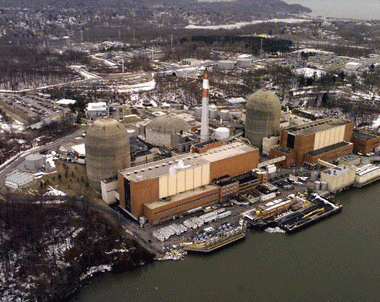 Indian Point nuclear plant reeks of troubled history As New York’s governor and other critics wage an ongoing campaign to shut the facility down citing leaks and old age, nearby residents explain complicated tale, Guardian, Sam Thielman, 29 Mar 16 Outside the Westchester Diner in Peekskill, New York, about 40 miles from New York’s Central Park, a reactor dome crests the trees behind an overpass like a giant’s bald head.
It’s one of two at Indian Point Energy Center, at the bank of the Hudson river in neighboring Buchanan, among the oldest nuclear power plants still in operation, and a monument to the energy industry’s resistance to years of work by concerned scientists, locals and state officials to close down a facility that only last month dumped a plume of radioactive waste into their groundwater.
Indian Point’s two working reactors opened in the early 1970s and have had a lot of people worried for a long time. Five years ago the New York Times wondered if it was “America’s Fukushima” – the Japanese site of the world’s worst radiation crisis since Chernobyl. In February the New York governor, Andrew Cuomo, called its operation “unacceptable” – he wants the plant closed.
It’s easy to see the source of his concern. The population density around Indian Point is of more than 2,100 people per square mile, by far the greatest for any of the US’s 61 nuclear power plants. Many of those people live and work in the plant’s shadow with growing unease.
In May 2015, an electrical transformer in the reactor called Unit 3 exploded, causing water to flood a room near the explosion where electrical distribution panels are housed and pouring 3,000 gallons of oil into the Hudson. The Union of Concerned Scientists classified the incident as a “near miss” in its annual review.Last year near misses occurred at eight nuclear facilities in the US. “Had the flooding not been discovered and stopped in time, the panels could have been submerged, plunging Unit 3 into a dangerous station blackout, in which all alternating current (AC) electricity is lost,” the report’s authors wrote. “A station blackout led to the meltdown of three nuclear reactor cores at Fukushima Dai-ichi in 2011.”
In February, radiation levels at three monitoring wells around the plant spiked, in one spot by 65,000%. Patricia Kakridas, a spokeswoman for Entergy, said the source was likely “water which exited a temporary filtration system that was set up and dismantled in late January 2016” in preparation for refueling; the company said radioactive material won’t leach into drinking water.
And in March, when the plant was being refueled, a breaker tripped and cut power in one of the reactors; when the diesel generators kicked in, they died while trying to restart the first electrical system. Fortunately a second backup worked.
Because the plant is cooled in large part by water from the Hudson – up to 2.5bn gallons a day – it kills about 1 billion fish and other aquatic organisms a year.
Incidents such as these are among the reasons Cuomo wants it closed, and Indian Point is now in a vulnerable position. The operating license for Indian Point 3 expired in December. The license for Indian Point 2 expired in 2013 (Indian Point 1 was decommissioned in 1974). Yet both remain active as the company pursues a license renewal and in the meantime Spectra, a pipeline company, is planning to add a gas pipeline that runs underneath the property to the two that have been there since the plant was built………
The fuel remains onsite at Indian Point, as it does at most nuclear power plants, and must be carefully maintained, for example it must be cooled for at least a decade before it can be sealed in concrete “dry casks”. Sheehan (and others) point out that moving it out of the state along Interstate 95 is impractical given the population density along the busy transport corridor. The plant has produced about 1,500 tons of waste and continues to produce more.
At this point, the license renewal process for Indian Point is scheduled through at least September of 2016 but the legacy of Indian Point, whether it closes or no, has a half-life of far, far longer.http://www.theguardian.com/us-news/2016/mar/28/indian-point-nuclear-plant-new-york-troubled-history
Unexpected shutdown of Washington nuclear power station
Nuclear Power Plant in Washington Unexpectedly Shut Down, abc news, By THE ASSOCIATED PRESS RICHLAND, Wash. — Mar 29, 2016 Washington state’s only nuclear power plant has been shut down after operators received an indication that a system used to cool equipment wasn’t working. Officials said there was no release of radiation and no danger to the public.
The Columbia Generating Station near Richland was shut down about 1:30 p.m. on Monday, Energy Northwest spokesman John Dobken said.
Officials hope to restart the plant sometime this week, Dobken told The Associated Press early Tuesday.
The Tri-City Herald reported that the plant was shut down after operators were alerted to problems with the system that uses water to cool heat exchangers and pumps, including those that control the power level of the reactor.
Energy Northwest says it seems that a water system valve may not have been in the right position, but adds that an investigation is ongoing…….http://abcnews.go.com/US/wireStory/nuclear-power-plant-richland-unexpectedly-shut-37995902
Shot dead – Belgian nuclear security guard, and his security badge stolen
 Guard at Belgian nuclear plant shot dead; his security badge was stolen. By Kellan Howell – The Washington Times – Saturday, March 26, 2016 Just two days after terrorists attacked the Brussels airport and subway system, a security guard for a Belgian nuclear facility was murdered and his security access badge was stolen, Belgian media reported Saturday.
The security guard’s badge was de-activated as soon as it was discovered it was stolen, according to French newspaper Derniere Heure.
He was shot dead in the Charleroi region of Belgium as he walked his dog, International Business Times reported. http://www.washingtontimes.com/news/2016/mar/26/belgian-nuclear-guard-shot-badge-stolen/
Belgium: staff refused access following news that terrorists had considered attack on nuclear plant
Nuclear Staff Lose Access After Brussels Attacks http://news.sky.com/story/1666949/nuclear-staff-lose-access-after-brussels-attacks 25 Mar 16
A number of workers at the Tihange plant have their passes withdrawn as reports say nuclear sites could have been targeted. The entry badges of some workers at Belgium’s nuclear sites have been withdrawn amid reports the suicide bombers who attacked Brussels may have originally planned to target a nuclear power plant.
Nuclear control agency spokeswoman Nele Scheerlinck confirmed that “in recent days, several people have been refused access to the nuclear sites”.
The El Bakraoui brothers, who blew themselves up at the airport and metro station on Tuesday, had secretly filmed the home of the head of Belgium’s nuclear research and development programme, it has been reported. :: Terror Suspect Linked To Paris Ringleader The footage recorded the nuclear chief’s routine and caused investigators to conclude the terrorists “could have put national security in danger like never before”, according to Belgian media.
However, the arrest of Paris attacker Salah Abdeslam forced them to switch to targets, said reports.
A police source is quoted as saying: “There is no doubt that they rushed their operations because they felt under pressure. “Even if one couldn’t prevent these (Brussels) attacks, one can say that their magnitude could have been much bigger if the terrorists had been able to implement their original plan and not opted for easier targets.”
In the immediate aftermath of Tuesday’s attacks at the airport and subway, security was boosted around Belgium’s nuclear sites and hundreds of staff were evacuated.
Belgian media reports said 11 staff had their badges withdrawn at the Tihange plant. Ms Scheerlinck said the move is “not necessarily linked with the terrorist attacks”. However, she added that the decision usually takes weeks and is based on information from the intelligence services and police, as well as a person’s criminal record.
The head of the UN’s nuclear watchdog warned of Friday that countries need to do more to prevent “nuclear terrorism”.Yukiya Amano, the head of the International Atomic Energy Agency, said that it was not impossible that militants could manufacture a “primitive” device. It is now an old technology and nowadays terrorists have the means, the knowledge and the information,” he said.
Mr Amano also warned about the dangers of a “dirty bomb”. “Dirty bombs will be enough to (drive) any big city in the world into panic,” he said. “And the psychological, economic and political implications would be enormous.”
1 This Month



26 September – International Day for the Total Elimination of Nuclear Weapons


PLEASE OPPOSE HR 8255 AND S.3639 – bills would accelerate satellite deployment, with no environmental review or safeguards – https://ncstd5li.quorum.us/campaign/169331/
To see nuclear-related stories in greater depth and intensity – go to https://nuclearinformation.wordpress.com
-
Archives
- September 2026 (219)
- August 2026 (330)
- July 2026 (355)
- June 2026 (287)
- May 2026 (306)
- April 2026 (356)
- March 2026 (251)
- February 2026 (267)
- January 2026 (308)
- December 2025 (358)
- November 2025 (359)
- October 2025 (375)
-
Categories
- 1
- 1 NUCLEAR ISSUES
- business and costs
- climate change
- culture and arts
- ENERGY
- environment
- health
- history
- indigenous issues
- Legal
- marketing of nuclear
- media
- opposition to nuclear
- PERSONAL STORIES
- politics
- politics international
- Religion and ethics
- safety
- secrets,lies and civil liberties
- spinbuster
- technology
- Uranium
- wastes
- weapons and war
- Women
- 2 WORLD
- ACTION
- AFRICA
- Atrocities
- AUSTRALIA
- Christina's notes
- Christina's themes
- culture and arts
- Events
- Fuk 2022
- Fuk 2023
- Fukushima 2017
- Fukushima 2018
- fukushima 2019
- Fukushima 2020
- Fukushima 2021
- general
- global warming
- Humour (God we need it)
- Nuclear
- RARE EARTHS
- Reference
- resources – print
- Resources -audiovicual
- Weekly Newsletter
- World
- World Nuclear
- YouTube
-
RSS
Entries RSS
Comments RSS
 nuclear-news