Skagit Valley Herald, Apr 13, 2017 RICHLAND, Wash. (AP) — A shipment of nuclear waste from a commercial power plant located on the Hanford Nuclear Reservation in Washington state was improperly labeled when it was trucked to a commercial disposal site, the Nuclear Regulatory Commission said.
As a result, Energy Northwest, the consortium that operates the Columbia Generating Station nuclear plant, has been temporarily barred by state regulators from sending waste to the US Ecology disposal site located on leased Hanford land, the Tri-City Herald (http://bit.ly/2pyWwWi ) reported Thursday.
The Energy Northwest plant makes electricity and is located on the sprawling Hanford site, which is half the size of Rhode Island. Energy Northwest is separate from Hanford’s past mission of creating plutonium for the nation’s nuclear weapons, which ended in the 1980s. Plutonium production left Hanford with the nation’s largest collection of radioactive waste.
April 14, 2017
Posted by Christina Macpherson |
incidents, USA |
Leave a comment
Careless workers cause flood at Pilgrim nuclear power plant in Plymouth http://www.masslive.com/news/index.ssf/2017/04/operator_error_leads_to_flood.html By Mary Serreze | Special to The Republican on April 04, 2017 Operators at the 45-year-old Pilgrim Nuclear Power Station failed to follow standard procedures last week, causing water to flood into a reservoir at the base of the reactor, reports the Cape Cod Times.
Workers incorrectly opened and shut certain valves, causing water to flood from a massive storage tank to an area of the reactor known as the torus. The torus plays a role in depressurizing and cooling down the reactor in case of a serious accident.
“This was a breakdown in the process that shows lack of adherence to procedure,” according to a spokesman for the Nuclear Regulatory Commission. He said there were no immediate safety concerns.
At noon on Friday, Pilgrim operators were flushing pipes in the reactor’s cooling system in preparation for an upcoming refueling. They opened a valve on the torus without first closing the valve on the water storage tank. Water being drained into the torus, setting off an alarm in the control room.
“This volume of water placed the torus level above the administrative limit for readiness should an unplanned event occur,” a spokesman for plant owner Entergy Corp. told the Cape Cod newspaper. “Station personnel appropriately responded to close the valves and processed and filtered the water from the torus back to the condensate storage tanks.”
Friday’s flood was the second recent serious incident involving operator error. On March 27, workers triggered the wrong switch, causing the temporary shutdown of a coolant injection system that is essential to cool the plant in a severe emergency.
Federal regulators in 2015 labeled Pilgrim as one of the three worst performers in the country and placed under increased oversight for safety violations and unplanned shutdowns.
Soon thereafter, Entergy announced it would close Pilgrim permanently in mid-2019 due to poor market conditions and increased operational costs. The closure will remove 680 megawatts of capacity from the New England power grid.
There have been a number of problems and violations at the aging nuclear power plant in recent years. Pilgrim has reportedly logged $40 million in annual losses.
April 7, 2017
Posted by Christina Macpherson |
incidents, USA |
1 Comment
South Korea’s Kori No. 4 nuclear reactor shut due to water level rise, http://www.reuters.com/article/us-southkorea-nuclear-idUSKBN16Y2N6 South Korea’s Kori No. 4 nuclear reactor was manually shut down after the water level in a collection tank rose due to a coolant leak, a spokesman at the reactor’s operator said on Tuesday.
“We estimate the water level of the reactor’s collection tank increased after coolant was leaked,” said Lim Dae-hyun, the spokesman at Korea Hydro & Nuclear Power Co Ltd (KHNP).
Lim added that there was no release of radioactivity and that the cause of the water level increase was being investigated.
The 950-megawatt Kori No. 4 reactor is near Busan, a city more than 300 km (190 miles) southeast of the capital, Seoul.
KHNP, fully owned by state-run utility Korea Electric Power Corp (KEPCO), runs the country’s 25 nuclear reactors, which supply about a third of South Korea’s electricity. (Reporting by Jane Chung; Editing by Jonathan Oatis)
March 29, 2017
Posted by Christina Macpherson |
incidents, South Korea |
Leave a comment
BARC scientists probing how 2 nuclear reactors contracted ‘small pox’http://www.thehindu.com/news/cities/mumbai/barc-scientists-probing-how-2-nuclear-reactors-contracted-small-pox/article17532987.ece PRESS TRUST OF INDIA MARCH 20, 2017 Mumbai: In a plot similar to a Bollywood thriller’s, scientists are burning the midnight oil to discover the reason behind the mysterious nuclear leak at the Kakrapar Nuclear Power Plant in Gujarat.
This 21st century atomic potboiler is actually unfolding through the hard work of scientists at the Bhabha Atomic Research Centre (BARC), whose laboratory actually shares a wall with the famous property where Raj Kapoor used to live. Here, they are working overtime to find out the real cause of the leaks at the twin reactors in southern Gujarat.
To avoid panic and further accidents, Indian nuclear watchdog Atomic Energy Regulatory Board (AERB) has shut down the affected plants till the cause has been found. Nuclear experts say the pipes, made from a rare alloy, have contracted what seems like small pox, and this contagion has spread all over the critical tubes in two Indian Pressurised Heavy Water Reactors (PHWR) at the Kakrapar facility. To make matters worse, more than a year into the investigation, the teams of scientists can’t figure out what has gone wrong.
It was on the morning of March 11, 2016, and as fate would have it, exactly five years after the Fukushima reactors in Japan began exploding, Unit Number 1 of the 220-MW PHWR at Kakrapar developed a heavy water leak in its primary coolant channel and a plant emergency was declared at the site.
The indigenously built nuclear plant had to be shut down, but no worker was exposed and there were no radiation leaks, the Department of Atomic Energy confirmed. Operator Nuclear Power Corporation of India Limited (NPCIL) said the reactor had shut down safely, and confirmed that safety systems had functioned normally.
The atomic thriller really begins when experts were trying to find out why a leak recognition system failed, when it should have raised an alarm. “There is a leak detection system in place in all PHWRs, but in this case it failed to detect the leak on March 11, 2016,” confirms AERB Chairman SA Bhardwaj. The watchdog body suspects the crack developed so rapidly that the electronic leak detection system just did not have the time to react.
Subsequent investigations revealed that the leak detection system was fully functioning and the operator had not shut it down to cut costs. Nothing in the core of a nuclear reactor can be done in a jiffy, and several weeks after the first leak, the initial probe using a specially designed tool revealed four big cracks in a coolant tube had led to the massive leak.
The mystery unfolds
The discovery of the crack was only the beginning of the mystery. Further efforts to find the cause established that the outside of the tube, the part not exposed to high-temperature heavy water, was corroded due to unknown causes.
This was a stunning discovery, since the outside of the failed tube was exposed only to high-temperature carbon dioxide and there had been no recorded case of a similar corrosion on the outside of any tube. It is also very hard to access this part since the space is tiny in the annulus.
The AERB then ordered that all tubes made of a special zirconium-niobium alloy be checked on the outside. To their surprise, they discovered that the contagion of the nodular corrosion, ‘small pox-like’ in layman’s parlance, was widespread in many of the 306 tubes. Similar tubes from the same batch used at other Indian reactors continued to operate without corrosion.
The needle of suspicion now pointed to carbon dioxide, a gas known to be very stable in high-radiation environments. A further post mortem revealed that Unit-2, which is twin of the affected reactor, had also been affected by a similar leak on July 1, 2015. Investigations into Unit-2’s failure were made but no conclusive result had been found. This back-to-back failure of two fully functional nuclear reactors befuddled engineers.
BARC begins probe
Undaunted, AERB ordered that the entire assembly and not just the affected tube be safely pulled out and brought to BARC, India’s foremost nuclear laboratory, for detailed failure analysis.
In addition, since India operates another 16 similar nuclear plants, a full-fledged investigation was carried out on coolant channels at all atomic power plants. The investigating team found the ‘small pox-like’ corrosion was confined only to the two units at Kakrapar.
While NPCIL heaved a sigh of relief, the finding made it all the more difficult to discern the true cause of the leaks at Kakrapar. Mr. Bhardwaj says investigators are wondering if the carbon dioxide used in Kakrapar may have been contaminated, which caused the nodular corrosion.
The source of the carbon dioxide was traced backwards, and it seems only the Kakrapar plant was sourcing its gas from a Naptha cracking unit, where it was possibly contaminated by hydrocarbons.
March 20, 2017
Posted by Christina Macpherson |
incidents, India |
Leave a comment
Nuclear core was unarmed, but 6,000 pounds of explosives detonated
WYFF News 4 Mar 13, 2017, Mars Bluff SC – This weekend was the 59th anniversary of an event many people don’t know happened in South Carolina. On March 11, 1958, a nuclear bomb was accidentally dropped on a small community near Florence.
A U.S. Air Force Boeing Stratojet that was flying out of Hunter Air Force Base took off at about 4:30 p.m. headed for the United Kingdom and then on to Africa. The aircraft was carrying nuclear weapons as a precaution in case war broke out with the Soviet Union.
The captain of the aircraft accidentally pulled an emergency release pin in response to a fault light in the cabin, and a Mark 4 nuclear bomb, weighing more than 7,000 pounds, dropped, forcing the bomb bay doors open. The bomb, which lacked an armed nuclear core, plunged 15,000 feet to the ground below…..http://www.wyff4.com/article/moose-on-the-loose-animal-races-to-catch-up-to-snowboarder/9131703
March 15, 2017
Posted by Christina Macpherson |
history, incidents, USA, weapons and war |
Leave a comment
Contractor brings firearm into nuke plant, http://www.enewscourier.com/news/local_news/contractor-brings-firearm-into-nuke-plant/article_443c1832-005b-11e7-af38-4fd2702fa81a.html Adam Smith, 4 Mar 17, A decision by a contractor to bring a firearm into the protected area at Browns Ferry Nuclear Plant Thursday led to the plant declaring an “Unusual Event,” an official said Friday.
Ray Hopson, spokesman with the Tennessee Valley Authority, said the contractor is working as part of the scheduled refueling outage on the plant’s Unit 2. The firearm, a small-caliber derringer, was not discovered on the worker’s person, he said.
The firearm was brought through the plant’s stringent security portal. Hopson said TVA Nuclear has taken compensatory measures to bolster security screening across its fleet.
There were no injuries or safety threats to employees or to the public.
The Unusual Event, which is the least severe of the four emergency classifications, was declared at 12:30 p.m., Hopson said. Officials with the Alabama Emergency Management Agency and U.S. Nuclear Regulatory Commission were notified. The plant exited the Unusual Event at 3 p.m.
He said the contractor was escorted off the site and his nuclear access clearance was revoked.
“TVA Police are conducting an investigation to determine the next steps in the legal process relating to potential violations of federal statutes,” Hopson said. “The company takes this incident seriously and is in communication with the Nuclear Regulatory Commission to evaluate performance and ensure that proper steps are taken to prevent a recurrence.”
March 4, 2017
Posted by Christina Macpherson |
incidents, USA |
Leave a comment
http://www.nj.com/salem/index.ssf/2017/03/cooling_system_steam_leak_shuts_down_nj_nuclear_pl.html By Bill Gallo Jr. | For NJ.com March 01, 2017 LOWER ALLOWAYS CREEK TWP. — An increase in steam leakage in the cooling system of the Salem 1 nuclear reactor has prompted its operators to take the plant out of service, officials said.
The reactor was shut down at 2:44 p.m. Tuesday, according to Joe Delmar, a spokesman for the plant’s operator, PSEG Nuclear.
Delmar said that the condensation collected from the steam was initially measured at a stable .17 gallons per minute. That increased, though, to .30 gallons per minute.
The reactor’s cooling system contains more than 90,000 gallons of radioactive water, Delmar said Wednesday. In order to find the source of the leak, operators cut the plant’s power down to 28 percent, but later determined the reactor needed to be totally shut down to correct the problem.
The steam leak was found on a valve used to draw samples of cooling system water for testing.
With the plant offline, it will make it safe for workers to enter the reactor containment building where the leak is located and fix the problem, Delmar said.
Delmar said there is not estimate when Salem 1 will return to service producing electricity.
He said on Wednesday that PSEG Nuclear’s other two plants at the Island, Salem 2 and Hope Creek, were operating at full power.
March 4, 2017
Posted by Christina Macpherson |
incidents, USA |
Leave a comment
BRINK OF APOCALYPSE Britain has faced 110 nuclear weapon alerts – four times more than the MoD admits, One incident reportedly saw nuclear weapons accidentally taken to Falklands War on ship carrying Prince Andrew, The Sun BY DANNY COLLINS 19th February 2017,
BRITAIN has risked nuclear disaster on more than 110 occasions over the last 65 years, a shocking new report has revealed.
Terrifying incidents included a lorry toppling over while carrying nuclear warheads. Britain has risked nuclear disaster on more than 100 occasions over the past 65 years including the collision of a Royal Navy and French submarine in the Atlantic While the Royal Navy ship on which Prince Andrew operated from during the Falklands War accidentally carried nukes to the South Atlantic.
Andrew’s ship HMS Invincible carried ten nukes while fellow aircraft carrier HMS Hermes had 16.
The revelation is all the more terrifying given that six Royal Navy vessels were sunk with French-supplied Exocet missiles during the conflict with Argentina.
The MoD has previously disclosed only 27 “major incidents” – although the true number is 110, a dossier seen by The Mail reveals.
Nukes are also believed to have rolled from a lorry into a roadside ditch after it toppled over on an icy Wiltshire road in 1987.
Among the other incidents was a collision between a Royal Navy and French submarine in the Atlantic eight years ago.
The report also said 116 UK citizens had died as a result of cancer or accidents arising from working with nuclear weapons.
Britain’s nuclear weapons were first tested in 1952 after the development programme began in 1940…….
The Royal Navy faced serious questions last month when a bungled test sent a dummy nuclear missile hurtling towards the US
February 20, 2017
Posted by Christina Macpherson |
incidents, UK |
Leave a comment

 Flamanville plant in northern France has been hit by a massive explosion Staff writers, news.com.au News Corp Australia Network 9 Feb 17 AN EXPLOSION at a nuclear power plant on France’s northwest coast on Thursday caused minor injuries, but the authorities said there was no risk of radiation.
The blast occurred in the engine room at the Flamanville plant, which lies 25 kilometres west of the port of Cherbourg and just across from the Channel Islands. “It is a technical incident. It is not a nuclear accident,” senior local official Jacques Witkowski said. He said a ventilator had exploded outside the nuclear zone at the plant, which has been in operation since the 1980s and is operated by state-controlled energy giant EDF.
“It’s all over. The emergency teams are leaving,” Mr Witkowski said.Five people suffered smoke inhalation but there were no serious injuries, Mr Witkowski said.
One of the two pressurised water reactors at the plant was shut down after the explosion and the incident was declared over at 1100 GMT (10pm AEDT), the authorities said.
The two 1300 megawatt reactors have been in service since 1985 and 1986, and the site currently employs 810 people, along with an additional 350 subcontractors.
A new third-generation reactor known as EPR is being built at Flamanville, which will be the world’s largest when it goes into operation in late 2018.
“Explosions in turbines, usually related to oil in bearings overheating, are not uncommon and occur from time to time in conventional coal, oil or gas plants,” said Barry Marsden, a professor of nuclear graphite technology at the University of Manchester.
But Neil Hyatt, a professor of radioactive waste management at Sheffiled University said the incident should not be taken lightly.
“Any incident of this kind at a nuclear power plant is very serious, and the national and international regulators will want to undertake a thorough investigation to understand the cause and lessons to be learned,” he said.
Construction of the new reactor at Flamanville began in 2007 and was initially due for completion in 2012 but has been delayed several times, and its initial budget has more than tripled, to 10.5 billion euros ($11.2 billion)…….http://www.news.com.au/world/europe/flamanville-plant-in-northern-france-has-been-hit-by-a-massive-explosion/news-story/28f0f083f4850f3289939ed489f56c95
February 10, 2017
Posted by Christina Macpherson |
France, incidents |
Leave a comment
Seawater leak forces reduced power at Pilgrim nuclear power plant, Wicked Local Pembroke By Michael P. Norton STATE HOUSE NEWS SERVICE, 7 Feb 17
A seawater leak at Pilgrim Nuclear Power Station has prompted plant operators to sharply reduce energy output there.
Control room operators reduced power to about 50 percent on Monday afternoon, Feb. 6, after there was an indication of a leakage into the Plymouth plant’s condenser.
A power plant spokesman told the News Service on Tuesday morning that the plant is now operating at 28 percent while repair work is undertaken.
Entergy Pilgrim Station spokesman Patrick O’Brien did not have an estimate of how much seawater leaked into the plant’s condenser……..http://pembroke.wickedlocal.com/news/20170207/seawater-leak-forces-reduced-power-at-pilgrim-nuclear-power-plant
February 8, 2017
Posted by Christina Macpherson |
incidents, USA |
Leave a comment

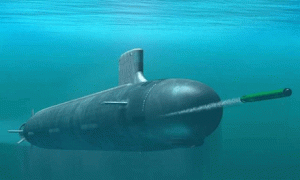 Scottish cold war nuclear submarine collision kept secret for 43 years
Documents published by CIA reveal crash between US and Soviet subs a few miles off coast of Scotland in 1974, Guardian, Matthew Weaver, 26 Jan 17, Two nuclear submarines from rival sides in the cold war collided a few miles off the coast of Scotland in an incident that was covered up for 43 years.
The potentially catastrophic crash occurred in November 1974 when the SSBN James Madison, armed with 16 Poseidon nuclear missiles, was heading out of the US naval base at Holy Loch, 30 miles north-west of Glasgow.
Soon after leaving the port it hit an unidentified Soviet submarine that had been sent to tail it, according to a cable to then US secretary of state Henry Kissinger, marked “secret eyes only” [pdf].
The cable, sent by national security adviser Brent Scowcroft, said: “Have just received word from the Pentagon that one of our Poseidon submarines has just collided with a Soviet submarine.
“The SSBN James Madison was departing Holy Loch to take up station when it collided with a Soviet submarine waiting outside the port to take up trail.
“Both submarines surfaced and the Soviet boat subsequently submerged again. There is no report yet of the extent of damage. Will keep you posted.”
The cable was published by the CIA on 17 January as part of a mass release of more than 12m pages of previously classified reports in 930,000 documents.
The cable corroborates an until-now unconfirmed report on the incident in the Washington Post on 1 January 1975 by the investigative journalist Jack Anderson. He reported that the collision left a 9ft scratch on the side of the James Madison and that the two submarines came within inches of sinking one another.
Another document marked “top secret” [pdf]released in the same batch expressed alarm that the news of the collision had leaked.
It said: “On 3 January, the NID [National Intelligence Daily] ran an item on the collision just off Holy Loch of US Polaris submarine and a Soviet attack submarine. Unfortunately, Jack Anderson had run the same news in the Washington Post a day or two earlier.
“This pre-emption on Anderson’s part forced the surfacing (no pun intended) of a piece of information in a current intelligence 2 months after the event occurred. …..
Kate Hudson, general secretary of the Campaign for Nuclear Disarmament, said the secret cable exposed the “enormous risks” of nuclear weapons.
“The history of nuclear weapons is a history of near misses, accidents, potential catastrophes and cover-ups. This latest example joins 25 other near misses that could have led to nuclear war.”
CND is calling for an inquiry into Trident, the successor to the Poseidon programme, after it emerged that a malfunctioning missile with the potential to carry a nuclear warhead was forced to self-destruct in mid-air off the US coast last June.
Hudson added: “These enormous risks have to be acknowledged particularly when we also now face the increasing likelihood of cyber-attack on nuclear weapons systems. With advancing technological developments added to the already dangerous mix there can be no confidence that nuclear weapons are a credible part of British security in the 21st century……… https://www.theguardian.com/us-news/2017/jan/25/nuclear-submarine-collision-cold-war-cia-scotland
January 27, 2017
Posted by Christina Macpherson |
history, incidents, secrets,lies and civil liberties, UK |
Leave a comment
At least one person has died in an explosion at a power plant in central Russia, media are reporting, citing Emergencies Ministry sources. The blast caused metal structures to collapse over a 600-square-meter area.
“According to preliminary reports, a gas mixture exploded at the power plant,” TASS news agency reported, citing a source at the Emergencies Ministry of the Penza region.

The total number of victims is yet unclear, the source said. However, TASS has reported that one person died, citing the Russian Center for Disaster Medicine.
The building of the TPP-1 power plant has been partially destroyed, and some 600 square meters of its roof are said to have collapsed, according to RIA Novosti, citing a source at Emergencies Services.
The incident has not affected the city’s heating supply, TASS reported, citing the head of the Emergencies Ministry’s press service, Anna Shupilova.
“The incident did not affect the heating system of the city; the whole heating system is operating in normal mode,” she said.
DETAILS TO FOLLOW
https://www.rt.com/news/375147-penza-power-plant-explosion/

Source for this diagram ; http://www.gazprom.com/f/posts/01/207595/annual-report-2012-eng.pdf
Background on Plant
The Novocherkasskaya GRES coal-fired power plant is owned by OGK-2 (Second Generating Company of the Wholesale Power Market), a subsidiary of the Russian gas giant Gazprom. The plant is located near the city of Novocherkassk, and consists of eight 264-MW coal-fired units. Construction was originally approved in 1952; the first unit went online in 1965, and the final, eighth unit in 1972. The plant has since been converted to run on gas as a supplementary fuel, but the primary fuel is still coal.[1][2]
The plant was formerly owned by OGK-6, which was also majority-owned by Gazprom; Gazprom merged OGK-6 into OGK-2 in November 2011. The boilers in Units 6 and 7 were replaced in 2005 and 2009, respectively.[3]
Description of Expansion
In 2011, OGK-2 signed a contract for the construction of a 330-MW ninth coal-fired unit at Novocherkasskaya. The construction contractor is SWECO Soyuz Engineering, a subsidiary of SOYUZ Holding. Unit 9 will run on circulating fluidized bed technology. Total construction cost will be about $700 million.[3] The boiler was built by U.S. company Foster Wheeler.[4] Completion was originally scheduled for November 2015.[5] In July 2015, the provincial government said the unit was on track to be completed in late 2015 or early 2016.[6]
The unit was successfully tested in December 2015.[7] The unit was completed and brought online in July 2016.[8
http://www.sourcewatch.org/index.php/Novocherkasskaya_GRES_power_station
January 26, 2017
Posted by arclight2011part2 |
incidents, Russia |
1 Comment

 British unarmed nuclear missile ‘veered towards US mainland’ in test firing http://www.news.com.au/world/british-unarmed-nuclear-missile-veered-towards-us-mainland-in-test-firing/news-story/1c54697418967b79ff406bc805104709 JANUARY 23, 2017 THE UK government has been accused of a cover up after failing to disclose that an unarmed nuclear missile may have been mistakenly fired at the US mainland.
January 23, 2017
Posted by Christina Macpherson |
incidents, UK |
Leave a comment
Amanda Oglesby , @OglesbyAPPApp.com Jan. 4, 2017 LACEY – The U.S. Nuclear Regulatory Commission performed special inspections of Oyster Creek Generating Station after personnel found a box of uranium-containing monitors outside the nuclear power plant’s designated nuclear-containing Material Access Area.
The box of eight local power range monitors was found Oct. 6 under a pallet and other material inside the warehouse, where it mostly likely sat for decades, according to a letter from Exelon Generation to the U.S. Nuclear Regulatory Commission. Nothing on the box marked the contents as containing radioactive material, according to the letter.
The monitors, which measure power inside of the nuclear reactor, contained less than a gram of uranium-235, said Neil Sheehan, a spokesman for the Nuclear Regulatory Commission.
Uranium-235 is radioactive. If ingested or inhaled, it can cause cancer or serious damage to major organs in the body, according to the Centers for Disease Control.
It is the same isotope of uranium that is used within the plant’s fuel rods, said Dave Lochbaum, director of the Nuclear Safety Program for the Union of Concerned Scientists. With enough of the material, someone could make a dirty bomb or nuclear weapon, he said.
“You want to control this material so it doesn’t get into places it shouldn’t be,” Lochbaum said.
Radiation is odorless and tasteless, so it can cause harm before someone realizes they are being exposed, he said……http://www.app.com/story/news/investigations/watchdog/investigations/2017/01/04/nuclear-material-misplaced-oyster-creek/96165918/
January 6, 2017
Posted by Christina Macpherson |
incidents, USA |
Leave a comment
 SMH, 24 Dec 16, Eamon Duff. A security consultant who held a “top secret” government clearance inside Australia’s only nuclear facility has been arrested and charged with the
illegal possession of “official secrets” and an unauthorised weapon.
Until February last year, Anthony Rami Haddad was manager of security and operations at the Lucas Heights nuclear reactor, safeguarding the site against theft, diversion and sabotage.
However, following a stint in the Middle easrt where he worked on another nuclear security project, he returned hom eto Sydney, and last month became entangled in an unrelated investigation being run by the Australian Federal Police’s fraud and anti-corruption team.
A fortnight ago, Haddad appeared before Sydney’s Downi8ng Centre Local court, where he pleaded guilty to unauthorised receipt of official secrets under the Commonwealth crimes Act.
He has yet to enter a plea for a second charge, ppossessing an unauthorised prohibited firearm. His barrister, Nikolaos Siafakas, will apply to have the outstanding matter dealt with under section 32 of teh Mental Health Act……..
According to ANSTO documents, Haddad’s many responsibilities at Lucas Heights included the “mamagement of security operations” at the onsite Little Forest radioactive waste dump and its “seamless integration” into the facility’s “wider” protective security systems.
Haddad will reappear in court on February 7 http://www.smh.com.au/national/lucas-heights-security-boss-anthony-haddad-charged-over-official-secrets-gun-20161223-gthdwv.html
December 26, 2016
Posted by Christina Macpherson |
AUSTRALIA, incidents, secrets,lies and civil liberties |
Leave a comment