Rotten resin gas ‘most likely’ cause of Ibaraki nuclear accident http://www.asahi.com/ajw/articles/AJ201707040020.html July 4, 2017 The Japan Atomic Energy Agency (JAEA) now considers the most likely cause of last month’s nuclear contamination accident at its Oarai research center to be gas produced by decomposing resin containing plutonium and other radioactive substances.
The June 6 incident at the facility in Ibaraki Prefecture, northeast of Tokyo, exposed five workers to plutonium when they handled 26-year-old radioactive waste stored there.
Resin was used to stick the radioactive waste on an aluminum sheet and stored in a tightly sealed polyethylene container, which was wrapped in plastic bags and placed in a stainless steel container.
The accident occurred when the workers opened the steel container and were exposed to radioactive particles that seeped out of the polyethylene container in gas that ruptured the plastic coverings and escaped into the room they were in.
“Decomposition of resin by a radioactive substance is considered as the most likely cause of the gas’s formation,” said Toshio Kodama, JAEA president, at a July 3 meeting with the science and technology ministry’s special investigation team that was set up to determine the cause of the accident.
JAEA found that the polyethylene container inside the plastic bags contained powdered plutonium set in pieces of epoxy resin.
The agency is looking at other possibilities, but now considers decomposition of the resin as the most likely cause.
On the same day, the National Institute of Radiological Sciences in Chiba announced that three of the five workers have been admitted to its facility for the third time to receive medication via an intravenous drip that speeds the excretion of radioactive substances from their bodies as urine.
The health of the five workers has not changed, according to NIRS.
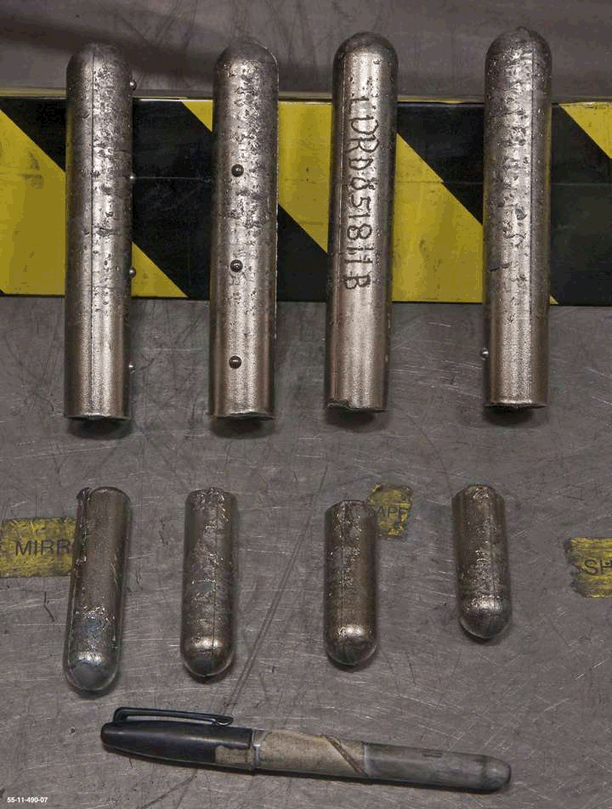
A near-disaster at a federal nuclear weapons laboratory takes a hidden toll on America’s arsenal , Science Repeated safety lapses hobble Los Alamos National Laboratory’s work on the cores of U.S. nuclear warheads By The Center for Public Integrity, Patrick Malone Jun. 29, 2017 Technicians at the government’s Los Alamos National Laboratory settled on what seemed like a surefire way to win praise from their bosses in August 2011: In a hi-tech testing and manufacturing building pivotal to sustaining America’s nuclear arsenal, they gathered eight rods painstakingly crafted out of plutonium, and positioned them side-by-side on a table to photograph how nice they looked.
At many jobs, this would be innocent bragging. But plutonium is the unstable, radioactive, man-made fuel of a nuclear explosion, and it isn’t amenable to showboating. When too much is put in one place, it becomes “critical” and begins to fission uncontrollably, spontaneously sparking a nuclear chain reaction, which releases energy and generates a deadly burst of radiation.
The resulting blue glow — known as Cherenkov radiation — has accidentally and abruptly flashed at least 60 times since the dawn of the nuclear age, signaling an instantaneous nuclear charge and causing a total of 21 agonizing deaths. So keeping bits of plutonium far apart is one of the bedrock rules that those working on the nuclear arsenal are supposed to follow to prevent workplace accidents. It’s Physics 101 for nuclear scientists, but has sometimes been ignored at Los Alamos.
As luck had it that August day, a supervisor returned from her lunch break, noticed the dangerous configuration, and ordered a technician to move the rods apart. But in so doing, she violated safety rules calling for a swift evacuation of all personnel in “criticality” events, because bodies — and even hands — can reflect and slow the neutrons emitted by plutonium, increasing the likelihood of a nuclear chain reaction. A more senior lab official instead improperly decided that others in the room should keep working, according to a witness and an Energy Department report describing the incident.
Catastrophe was avoided and no announcement was made at the time about the near-miss — but officials internally described what happened as the most dangerous nuclear-related incident at that facility in years. It then set in motion a calamity of a different sort: Virtually all of the Los Alamos engineers tasked with keeping workers safe from criticality incidents decided to quit, having become frustrated by the sloppy work demonstrated by the 2011 event and what they considered the lab management’s callousness about nuclear risks and its desire to put its own profits above safety.
When this exodus was in turn noticed in Washington, officials there concluded the privately-run lab was not adequately protecting its workers from a radiation disaster. In 2013, they worked with the lab director to shut down its plutonium handling operations so the workforce could be retrained to meet modern safety standards.
Those efforts never fully succeeded, however, and so what was anticipated as a brief work stoppage has turned into a nearly four-year shutdown of portions of the huge laboratory building where the plutonium work is located, known as PF-4.
Officials privately say that the closure in turn undermined the nation’s ability to fabricate the cores of new nuclear weapons and obstructed key scientific examinations of existing weapons to ensure they still work. The exact cost to taxpayers of idling the facility is unclear, but an internal Los Alamos report estimated in 2013 that shutting down the lab where such work is conducted costs the government as much as $1.36 million a day in lost productivity.
And most remarkably, Los Alamos’s managers still have not figured out a way to fully meet the most elemental nuclear safety standards. ……
these safety challenges aren’t confined to Los Alamos. The Center’s probe revealed a frightening series of glaring worker safety risks, previously unpublicized accidents, and dangerously lax management practices. The investigation further revealed that the penalties imposed by the government on the private firms that make America’s nuclear weapons were typically just pinpricks, and that instead the firms annually were awarded large profits in the same years that major safety lapses occurred. Some were awarded new contracts despite repeated, avoidable accidents, including some that exposed workers to radiation…….
George Anastas, a past president of the Health Physics Society who analyzed dozens of internal government reports about criticality problems at Los Alamos for the Center, said he wonders if “the work at Los Alamos [can] be done somewhere else? Because it appears the safety culture, the safety leadership, has gone to hell in a handbasket.”
“Due to the cyber attack, the website of the Chernobyl nuclear plant is not working,” said Ukraine’s exclusion zone agency which oversees the Soviet plant that exploded in 1986 and is now surrounded by an uninhabited contaminated zone.
“Due to the temporary shutdown of the Windows system, the radiation monitoring of the industrial area is being done manually,” the agency said on its website.
“That means that our measurers go out with hand-held meters on the Chernobyl plant like it was decades ago,” a spokeswoman for the agency, Olena Kovalchuk, told AFP.
The plant’s destroyed reactor was enclosed in a huge metal structure last year in a bid to stop radiation leaks at the site, where more than 200 tonnes of uranium remain.
Ukraine, along with Russia and companies across Europe, was hit on Tuesday in a wave of cyberattacks which IT experts identified as a modified version of the Petya ransomware that struck last year.
Ukraine’s exclusion zone agency said that Chernobyl’s “technological systems are working as usual” and that radiation control is “without delays”.
The passwords of two senior EDF nuclear plant managers were traded online
French-owned firm EDF Energy operates all 15 of Britain’s nuclear reactors
Comes as thousands of government officials – including MPs – were hacked
By Iain Burns For Mailonline, 25 June 2017 Two senior managers at nuclear plants operated by EDF Energy had their passwords listed on Russian hacking sites.
The passwords – ‘Nuclear1’ and ‘Radiat10n’ – are thought to have been used on the business site LinkedIn.
They were being traded by hackers who had easily guessed the letters and numbers.
EDF, which operates Britain’s 15 nuclear reactors, did not comment about the breach.
But the French-owned firm did say, according to The Times, that it is ‘continually reviewing its defences and preparedness in this area’.
The lists on which the passwords appeared were traded privately before being made public.
It comes as around 1,000 British MPs and parliamentary staff, 7,000 police employees and more than 1,000 Foreign Office officials were all understood to have had confidential information traded online without their knowledge.Even some of the prime minister’s closest government ministers, including education secretary, Justine Greening, and business secretary, Greg Clark, are thought to have been affected by the hack.
The huge database was being sold for just £2, with the low price justified by the fact it had already spent months being passed around. Its original price is likely to have been much higher.
Hackers can easily guess many passwords, especially those which are merely a word associated with a certain person but with ‘3’ instead of ‘E’ or ‘1’ instead of ‘I’.
There have been warnings that the hacked passwords could be used to blackmail workers in sensitive jobs, or even to break into government servers.
Le Parisien 19th June 2017 A drone flew over a nuclear power plant located in the commune of Avoine, a
few kilometers from Chinon, Sunday evening in the early evening. An
investigation is underway. The Chinon nuclear power plant was overflown
by a drone on Sunday night. At around 8:20 pm, a small flying object was
observed by a station employee. Thirty minutes later, the specialized
gendarmes go to the scene, view the video surveillance images and confirm
the employee’s testimony. A research device was launched by the soldier. No
results so far. A complaint must be filed by the plant manager. The inquiry
is conducted by the Chinon Research Brigade. http://www.leparisien.fr/faits-divers/indre-et-loire-un-drone-survole-la-centrale-nucleaire-de-chinon-19-06-2017-7066137.php
Reuters 19th June 2017, A fire that broke out on the roof of a nuclear reactor at the Bugey plant
in central-eastern France has been extinguished, operator EDF said on
Monday, citing fire brigade officials. The fire began at the plant’s
nuclear reactor number 5, some 35 kilometers from the city of Lyon, nuclear
regulator ASN said earlier in a statement. EDF said in a separate statement
there were no injuries or fatalities, while safety body IRSN said on
Twitter that sensors had not picked up any increase in radiation. http://www.reuters.com/article/us-france-power-nuclearpower-idUSKBN19A2AH
Palo Verde nuclear plant still ran after backup equipment exploded,Ryan Randazzo , The Republic | azcentral.com June 13, 2017 For 57 days last year and early this year, one of the nuclear reactors at the Palo Verde Nuclear Generating Station west of Phoenix kept running after an explosion knocked a backup generator out of service.
Experts at the Nuclear Regulatory Commission disagreed strongly over whether the plant should have been allowed to keep running during the repairs, according to documents leaked to the Union of Concerned Scientists, a watchdog group.
The NRC usually allows a nuclear plant 10 days to make such repairs. In this case, the agency granted the plant’s operator, Arizona Public Service Co., two extensions. NRC officials said the decision came after a careful review of the risks.
But not everyone at the agency agreed with the decision. NRC employees filed three dissents that were given to The Arizona Republic by the scientist watchdog group. The NRC subsequently released one of the documents, a petition asking for the time extensions to be revoked.
“The NRC’s action is inconsistent with the NRC mission, NRC vision, NRC safety objectives, NRC regulatory effectiveness strategies, NRC openness strategies and the principles of good regulation,” said Roy Mathew, a longtime agency employee, in his Jan. 23 petition to his employer……
Among Mathew’s concerns were that if the nuclear plant lost power from the grid and had a similar failure in its other diesel generator, it would not have been able to cool nuclear fuel in a timely manner. If the fuel can’t be cooled, it can lead to radiation releases……
Smoke detected at crippled Chernobyl power plant – Ukraine nuclear watchdog, Rt.com 13 Jun, 2017 Ukraine’s nuclear regulatory body reported smoke at one of the rooms at Unit 3 in Chernobyl, adding that it was briefly “liquidated” by the state emergency personnel and the radiological situation at the site has not changed following the incident.
“At 15:57 pm we’ve received information from Chernobyl nuclear power plant about smoke in room 509 of Power Unit Three. At 16:00 the smoke was liquidated by the State Emergency Service staff,” a statement issued by the State Nuclear Regulatory Inspectorate of Ukraine reads.
“The radiological situation in the third power unit and the station’s territory has not changed,” it added.
Dozens of new cracks discovered at Belgian nuclear reactors https://www.rt.com/news/391826-belgium-nuclear-reactor-cracks/11 Jun, 2017 The latest ultrasonic inspections have detected a substantial number of new micro cracks in nuclear reactors at the Tihange and Doel power plants in Belgium since the last study conducted three years ago, Belgian and German media report.
At least 70 additional cracks were uncovered at the Tihange 2 nuclear reactor during an ultrasonic inspection in April of this year, Belga news agency reports. Some 300 new flaws have also allegedly been discovered at the Doel 3 reactor tank during a check last November, according to tagesschau.de.
Belgian Interior Minister, Jan Jambon, confirmed the micro fissures at Tihange 2 following a parliamentary inquiry posed by Green Group leader Jean-Marc Nollet, DW reports. The reported new cracks at Doel 3 have not yet been confirmed.
The cracks do not pose any danger to operations at the nuclear plants, says operator Engie-Electrabel, which carried out the inspections under instructions from the Belgian Atomic Regulatory Authority (FANC).
The operator said the new flaws were discovered due to a “different positioning of the ultrasound device.” Engie-Electrabel maintains that as long as cracks do not expand, they do not pose a danger to the reactor’s operations.
Branding Engie-Electrabel “irresponsible,” environmentalist group, Nucléaire Stop, has criticized the operator for still running Tihange 2 reactor despite a 2.22 percent increase in faults.
In February 2015, FANC said 3,149 cracks had been found at Tihange, while 13,047 were discovered at Doel. The operator must now submit additional analyzes of the situation by September.
Tihange lies only 60 kilometers (about 37 miles) from the German border, while Doel is 150 kilometers away, near Antwerp. Germans living in the area close to this border have been exerting pressure on the government to force Belgium to shut down the aging reactors.
IAEA-database of nuclear and radiological incidentshttp://www.laka.org/docu/ines/ Here you find the full list of nuclear and radiation incidents which are reported since 1990 by national nuclear regulatory agencies to the International Atomic Energy Agency.
The list gives an impression of the spread, diversity and frequency of incidents and accidents with nuclear power plants, reprocessing plants, fuel enrichment plants, nuclear laboratories, irradiation facilities and with radioactive transports. It is not a complete list of all nuclear incidents; different national regulators have different regimes as to which incidents to report to the IAEA and which not.
The Vienna-based IAEA only releases reports from the previous twelve months to the public. After twelve months, reports are hidden from the IAEA-website. This makes it impossible for neighbors, non-governmental organizations and journalists to monitor the occurrence of nuclear incidents throughout the years. The risks of a certain nuclear power station can only be assessed by the frequency and the gravity of incidents occurring throughout the years. By releasing the full IAEA-list with all reported incidents from 1990, Laka, an Amsterdam based research group on nuclear energy, makes this safety-relevant accessible for the public.
To provide overview of incidents and accidents, Laka also put all reports also in an on-line map.
The alert was sent out during a regularly scheduled drill to test the readiness of emergency officials in case of an actual emergency at PSEG Nuclear’s Artificial Island generating complex in Lower Alloways Creek Township.
“At 8:45 p.m., a training message was created in order to test an electronic communications system,” New Jersey State Police said in a statement issued Wednesday afternoon.
Possible leak found at Washington nuclear site, NewsFix, MAY 21, 2017, BY CNN WIRE, WASHINGTON — Authorities at Washington state’s Hanford nuclear waste site are investigating a possible leak after discovering radioactive material on a worker’s clothing. The discovery follows an incident two weeks earlier in which a site tunnel collapsed, sparking fears of radiation exposure.
Washington River Protection Solutions, a contractor working at the site, on Thursday detected high readings of radiation on a robotic device known as a crawler that workers were pulling out of a nuclear waste tank. Contamination was also discovered on the clothing of one of the workers.
“Established decontamination procedures were followed, which involves removing the contaminated clothing. Further surveying the worker showed no contamination remained. No other workers were affected, and all members of the crew were cleared for normal duty,” said WRPS spokesman Peter Bengtson.
The Double-Shell Tank AZ-101 contains 800,000 gallons of nuclear waste, according to the Washington Department of Ecology, which oversees the Hanford site. The nuclear plant is located in the south-central part of Washington state, about 45 miles from Yakima.
Using leak-detection instruments, WRPS said it did not find liquid escaping the tank. However, workers are preparing a plan to conduct a visual inspection by video.
Cleanup at Idaho Nuclear Landfill on Hold After Pit Collapse https://www.usnews.com/news/best-states/idaho/articles/2017-05-18/cleanup-at-idaho-nuclear-landfill-on-hold-after-pit-collapse
Officials are trying to determine what caused the side of a pit at a nuclear waste landfill in Idaho to collapse. May 18, 2017, By REBECCA BOONE, Associated Press BOISE, Idaho (AP) — Some cleanup efforts at a nuclear waste landfill in Idaho were placed on hold while workers try to figure out what caused a collapse in a dig area that sent an excavator into a pit.
The excavator was digging up transuranic waste — which is waste contaminated with highly radioactive elements.
No radiation was released during the May 11 incident, and no one was injured, said Erik Simpson with Fluor Idaho, a contractor hired to clean up the site at the Idaho National Laboratory.
The excavator was digging at the 97-acre (392,545-sq. meter) Subsurface Disposal Area near Idaho Falls when the side of the pit collapsed.
Simpson said the excavator slid partway into the 21-foot (6 -meter) deep pit. The operator remained in his protective cab for about 90 minutes.
Collapsed tunnel sealed at U.S. nuclear site after accident, Chicago Tribune, Nicholas K. GeraniosAssociated Press, 11 May 17, Workers at a Washington state nuclear site where a tunnel filled with nuclear waste in railroad cars partially collapsed have safely sealed off a large sinkhole that emerged as a result of the collapse, U.S. Energy Secretary Rick Perry said Thursday.
Authorities also revealed that the 400-square foot (37-square meter) sinkhole they filled with soil could have been there since last weekend before it was discovered Tuesday. That’s because the area around the Hanford Nuclear Reservation’s waste-filled tunnels is not observed every day by workers who patrol the site’s sprawling grounds………
Washington state officials on Wednesday demanded that the federal Energy Department immediately assess the integrity of all the Hanford tunnels.
“The infrastructure built to temporarily store radioactive waste is now more than a half-century old,” said Maia Bellon, director of the state Department of Ecology, which oversees and regulates the federal government’s Hanford cleanup.
The 360-foot long (110-meter) rail tunnel that collapsed was built in 1956 from timber, concrete and steel and covered with 8 feet (2.4 meters) of dirt. Eight flatbed railroad cars loaded with radioactive material were parked there in 1965.
A much larger nearby tunnel built in 1964 has 28 railroad cars with radioactive waste.
The Energy Department was warned in a 2015 report it commissioned that both tunnels were vulnerable to a collapse from an earthquake or deterioration of tunnel building materials caused by intense radiation, the report said.
The nearby Yakama Nation said it has warned about the safety of the tunnels for several years.
“No preventative action was taken,” the tribe said in a statement.
The tribe also said the tunnels should be cleaned of radioactive waste and radiation long before a deadline of 2042 set by a cleanup agreement between the federal and state governments.
Tunnel collapses at Hanford; no radiation released, officials say http://www.king5.com/news/local/hanford/tunnel-collapses-at-hanford-no-radiation-released-officials-say/438227872Hundreds of workers were told to take cover at the Hanford Nuclear Reservation after a tunnel full of highly contaminated materials collapsed Tuesday morning. But officials say no radiation was released and no workers were hurt.Officials say a collapsed patch of ground above the tunnel was larger than first believed. The U.S. Department of Energy said the collapse covered about 400 square feet (37.1 square meters) instead of the 16 square feet (1.4 square meters) first reported.
Nuclear waste storage tunnel caves-in at Hanford
Hundreds of workers were told to go into a “take cover” position after the tunnel in a plutonium uranium extraction (PUREX) plant collapsed.
The agency says the rail tunnels are hundreds of feet long, with about eight feet (2.4 meters) of soil covering them. The U.S. Department of Energy says the incident caused the soil above the tunnel to sink between 2 and 4 feet (half to 1.2 meters).
“I would underscore this is confined to a small area of the Hanford site,” Destry Henderson, deputy news manager for the Hanford Joint Information Center, told NBC News. “The facility does have radiological contamination right now but there is no indication of a radiological release,” Henderson said.
A manager sent a message to all personnel telling them to “secure ventilation in your building” and “refrain from eating or drinking.”
A source said “take cover” status was expanded to the entire site at 10:35 a.m. The source also said that crews doing road work nearby may have created enough vibration to cause the collapse, and that Vit Plant employees were in cover mode as well.









 nuclear-news