Chernobyl nuclear power station hit by ‘Russian drone’
Despite hitting the nuclear plant, the small fire was quickly contained and officials said
there was no apparent radiation leak. The Chernobyl nuclear power station
was hit overnight in an apparent drone strike, International Atomic Energy
Agency (IAEA) has said. Ukrainian president, Volodymyr Zelensky, said a
Russian drone strike with a “high explosive warhead” hit the outer
shelter of the nuclear plant. The IAEA said that a UAV hit the shelter
protecting the site at approximately 1.50am local time.
Footage from lastnight, showing a Russian Drone striking the Containment Structure around
Reactor No. 4 at the Chernobyl Nuclear Power Plant (ChNPP) in Northern
Ukraine, as well as the extent of the Damage from inside the Containment
Structure.
iNews 14th Feb 2025,
https://inews.co.uk/news/world/chernobyl-nuclear-power-station-hit-by-russian-drone-3535413
Watchdog’s warning over nuclear waste rail crash
Federica Bedend, BBC News, North East and Cumbria, 1 Feb 25, more https://www.bbc.com/news/articles/c74m1rxynkxo
The nuclear watchdog has issued an improvement notice after two railway wagons carrying nuclear waste crashed.
It happened on the Sellafield site, in Cumbria, which manages more radioactive waste in one place than any other nuclear facility in the world.
The Office for Nuclear Regulation (ONR) said although no-one was injured and there were no radiation risks during the incident, which happened in November, it could have had “serious consequences”.
A Sellafield spokesman said: “An internal investigation was initiated to understand the root cause and to prevent this from happening again in future.”
The ONR said one of the wagons on the site’s railway had not been properly secured and it rolled about 200ft (60m), hitting a stationary wagon.
They added the wagons were left with minor damage and the nuclear containers were unaffected “due to their robust construction”, however health and safety improvements were needed to prevent future incidents.
Ian Bramwell, ONR’s head of regulation for Sellafield, said: “This will include improving how Sellafield plan, organise, monitor and review the measures in place to protect personnel directly and indirectly involved in rail activities on the site.”
The ONR will reinspect the site in the coming months and Sellafield has until 13 June to comply with the notice.
A Sellafield spokesman said it was working with the ONR to review its processes.
Ukraine nuclear fears increase amid warnings from IAEA
Emerging Risks 28th Jan 2025, https://www.emergingrisks.co.uk/ukraine-nuclear-fears-increase-amid-warnings-from-iaea/
The director general of the International Atomic Energy Agency (IAEA) has said he is growing increasingly concerned that the organisation’s efforts to prevent a major nuclear incident in war-torn Ukraine in under increasing threat.
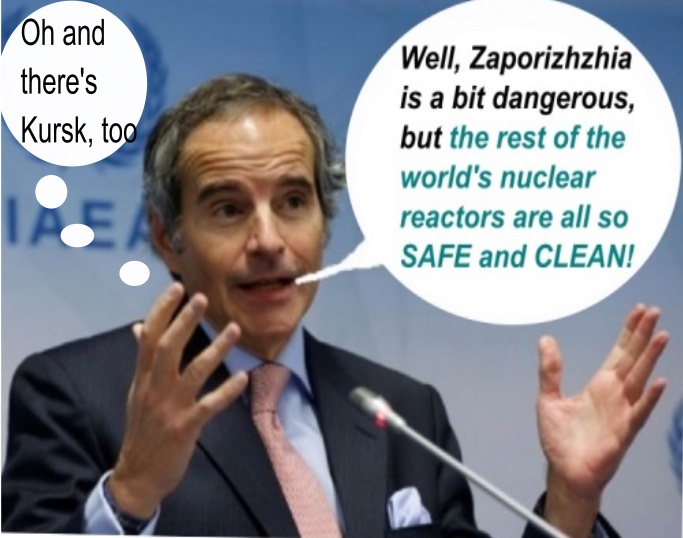
It comes as Rafael Mariano Grossi (above) revealed the agency’s team based at Ukraine’s Zaporizhzhya Nuclear Power Plant (ZNPP) has heard frequent explosions from outside the site over the past week.
He added The team reported hearing multiple instances of such military activity in recent days, at varying distances from the ZNPP. There was no damage reported to the plant itself. Although the sound of nearby military action has been a common occurrence ever since the IAEA established a continued presence at the ZNPP in September 2022, it has happened virtually daily in recent weeks.
“For almost three years now, we have been doing everything we can to help prevent a nuclear accident at the Zaporizhzhya Nuclear Power Plant and elsewhere in Ukraine,” Grossi explained. “An accident has not occurred, but the situation is not improving. It is still precarious. I remain seriously concerned about nuclear safety and security in Ukraine, including at the Zaporizhzhya site. Our work is far from over.”
He continued as part of the ongoing work to monitor developments relevant for nuclear safety and security, the IAEA team has continued to conduct walkdowns across the site – including but not limited to the main and emergency control rooms of four reactor units and one turbine hall – and observed and discussed various safety-related maintenance activities with the plant.
The IAEA team was also informed that the ZNPP is procuring three new mobile diesel generators, similar to those received late last year. They are in addition to the site’s 20 fixed emergency diesel generators that are designed to provide on-site power if there is a total loss of off-site power.
Separately, the ZNPP said that four diesel steam generators were put into operation for ten days to provide the steam needed to process liquid radioactive waste. These generators were commissioned a year ago.
Elsewhere in Ukraine, the IAEA said air raid alarms were heard on several occasions at Ukraine’s three operating nuclear power plants (NPPs) – Khmelnytskyy, Rivne and South Ukraine – as well as at the Chornobyl site. At the Khmelnytskyy NPP, the IAEA team members have taken shelter at their residence three times in recent days due to such alerts.
At the Khmelnytskyy and South Ukraine NPPs and the Chornobyl site, the IAEA teams were informed of instances of drones being detected at distances ranging from 2 to 30 km from the sites.
Despite such military activities, Ukraine’s nine operating nuclear power reactors have been operating at full capacity this week, safely generating much-needed electricity during the cold winter months.
Separately, the Agency continued with deliveries under its comprehensive programme of nuclear safety and security assistance to Ukraine. Last week, the Chornobyl site received equipment to enhance its nuclear security system. The delivery, the 104th organised by the IAEA since the start of the armed conflict, was supported with funds from the United Kingdom.
Russia claims nuclear plant targeted during massive Ukrainian drone attack

Russia and Ukraine continue to swap daily barrages, with the prospects of ceasefire talks appearing slim.
Aljazeera, 29 Jan 2025
A nuclear power plant was among targets during a massive Ukrainian drone attack, Russian officials have said.
Moscow said on Wednesday that the country’s energy infrastructure had come under attack by at least 100 drones overnight. Ukraine also reported strikes. The continuing barrages were accompanied by barbs from the two countries’ presidents, suggesting little prospect of peace talks.
The Russian Ministry of Defence said on Telegram that 104 drones were involved in raids across western Russia, many targeting power and oil facilities.
Local officials claimed that air defence systems had destroyed one drone that had attempted to strike the nuclear power plant in the western region of Smolensk.
“According to preliminary information, one of the drones was shot down during an attempt to attack a nuclear power facility,” Governor Vasily Anokhin said on the Telegram messaging app. “There were no casualties or damage.”
The Smolensk Nuclear Power Plant, the largest power generating plant in Russia’s northwest, was working normally on Wednesday morning, RIA state news agency reported, citing the plant’s press service.
Russia’s air defences reportedly destroyed drones over nine regions, including 11 over Smolensk, which sits on the border with Belarus. Nearly half were hit over Kursk, where Ukrainian troops have occupied several villages for months following an incursion.
Ukraine and Russia have been swapping drone and missile strikes on an almost daily basis, with energy infrastructure a particular target amid winter.
Warnings that the fighting could spark a nuclear disaster have been sounded since Russia launched its full-scale invasion of its neighbour in February 2022. However, most of the concern has focused on Ukraine’s Zaporizhzhia plant, which sits on the frontlines in the east of the country…………………………………………………………………….https://www.aljazeera.com/news/2025/1/29/russia-claims-nuclear-plant-targeted-during-massive-ukrainian-drone-attack
Nuclear icebreaker sustained hull damage after collision in the Kara Sea
A video published by the pro-Kremlin Telegram channel Mash shows how the 50 Let Pobedy sails straight into the cargo vessel Yamal Krechet.
Thomas Nilsen, 28 January 2025 , https://www.thebarentsobserver.com/news/nuclear-icebreaker-sustained-hull-damage-after-collision-in-the-kara-seanbsp/423819
The dramatic collision happened at 03.51 am on the night to January 26 but did not become known to the public before the press service of Rosatomflot confirmed the facts to several Russian media in the evening of January 28.
Murmansk-based Arctic Observer said in its Telegram channel that the collision happened as the powerful icebreaker was assisting a cargo ship sailing through the ice-covered waters.
According to Rosatomflot, the nuclear powered icebreaker continues to operate in normal mode along the Northern Sea Route, despite the damage to the hull.
Rosatomflot says in the press statement that “seaworthiness has not been lost” and “there were no casualties.”
The state owned operator of Russia’s icebreaker fleet underlines that the two onboard reactors were not harmed in the collision. The information has not been confirmed by independent sources.
Rosatomflot does not provide any information about what caused the navigation mistake leading to the huge icebreaker smashing into the smaller cargo ship.
The 50 Let Pobedy is the newest of the older Arktika-class nuclear-powered icebreakers. Construction of the vessel started in the late Soviet era (1989), but she was not commissioned before 2007.
The icebreaker has Murmansk as homeport, but can operate independently for months at a time during the icy navigation season along the Northern Sea Route.
The cargo vessel Yamal Krechet was according to MarineTraffic.com on her way from Arkhangelsk towards Sabetta, the port where Novatek’s Yamal LNG production facilitates are located.
There are no public reports about the possible damages to the cargo vessel. Several tens of containers can be seen on deck of the Yamal Krechet at the time of the collision, but it is not known immediately known what content the cargo includes.
When Russian Radar Mistook a Norwegian Scientific Rocket for a U.S. Missile, the World Narrowly Avoided Nuclear War

The Norwegian rocket incident, which took place on this day in 1995, marked the only known activation of a nuclear briefcase in response to a possible attack
Laura Kiniry. January 25, 2025, https://www.smithsonianmag.com/smart-news/when-russian-radar-mistook-a-norwegian-scientific-rocket-for-a-us-missile-the-world-narrowly-avoided-nuclear-war-180985836/
When the Cold War ended in 1991 with the collapse of the Soviet Union, it greatly reduced the threat of global nuclear war. But on January 25, 1995, that threat once again came front and center when Russian officers mistook a Norwegian rocket sent to study the aurora borealis for a weapon of mass destruction.
While not as well known as the 1962 Cuban Missile Crisis, the “Norwegian rocket incident” is considered one of the world’s closest brushes with nuclear war.
In the early morning hours of January 25, a team of Norwegian and American scientists launched a Black Brant XII four-stage sounding rocket from Norway’s Andoya Rocket Range, a launch site off the country’s northwestern coast. Its purpose: to study the northern lights over Svalbard, a Norwegian archipelago in the Arctic Ocean.
Although the scientists had notified dozens of countries, including Russia, in advance of their high-altitude scientific experiment, the information never made its way to Russia’s radar technicians.
Just four years after the Cold War’s end, tensions between the former USSR and the United States remained high. So when Russian officers at the Olenegorsk Radar Station detected a fast-moving object that was traveling on a high northbound trajectory above the Barents Sea, near Russia’s northern border, they feared it might be a nuclear attack from U.S. submarines. After all, it was similar in speed and flight pattern to a missile. It reached an altitude of 903 miles, separating into several sections as it flew, in the same way warheads would detach from a submarine-launched Trident missile.
Russia’s modus operandi was to identify an attack, assess it and decide whether to retaliate, all within ten minutes. Tracking the trajectory of the “missile” had already taken up the bulk of that time.
As a result, Russian submarine commanders were put on alert and ordered to prepare for a nuclear response. Russian President Boris Yeltsin was notified and given the Cheget, Russia’s nuclear briefcase—typically kept near the leader of a nuclear-weapons state at all times. This holds the launch codes for the country’s missile arsenal, which can be used to order a nuclear strike. To this day, it’s the only known activation of a nuclear briefcase in response to a possible attack.
After conferring with his top advisers, Yeltsin concluded that the rocket was heading away from Russian airspace and didn’t pose any threat to the country.
Twenty-four minutes after its launch, the rocket fell into the sea near Spitsbergen, the only permanently inhabited island on the Svalbard archipelago. The entire incident was over as quickly as it seemingly began.
It was a harrowing false alarm, and one that had the potential to cause widespread casualties. Though the incident has largely flown beneath history’s radar, it did lead to the re-evaluation and redesign of notification and disclosure protocols in both the U.S. and Russia
Jimmy Carter hailed as ‘action’ hero for stopping nuclear meltdown at 28

Jimmy Carter hailed as ‘action’ hero for stopping nuclear meltdown at 28 https://nypost.com/2021/12/16/jimmy-carter-is-action-hero-for-stopping-nuclear-disaster/
By Hannah Sparks, December 16, 2021 Who needs action movies when there are real-life superheroes like Jimmy Carter among us?
A viral Twitter thread is reminding the world that the 39th US President James Earl Carter Jr., now 97, actually rescued Ottawa, Ontario, from nuclear destruction as a 28-year-old way back on Dec. 12, 1952.
“Do you remember the world’s very first nuclear meltdown? That time the US President, an expert in nuclear physics, heroically lowered himself into the reactor and saved Ottawa, Canada’s capital?” asked Canadian physicist University of Ottawa professor Jeff Lundeen in his now-viral thread, originally posted Tuesday but officially trending two days later.
Sounds like schlocky action movie, but it actually happened!”
Lundeen’s revelatory tweet to his modest 1,078 followers now boasts nearly 50,000 likes, more than 20,000 retweets and hundreds of cheerfully shocked comments. He included data from the Ottawa Historical Society and a snippet of a 2011 report documenting Carter’s heroics, and he followed up with several other media sources that recount the historic tale.
As the story goes, the Plains, Ga., native planned his entire life to join the Navy — and did so when he received his appointment to the Naval Academy in 1942. After graduating with distinction, Carter spent two years completing his service ship duty before signing on to the Submarine Force. Following a series of relocations and promotions, the young lieutenant would request to join Captain Hyman G. Rickover’s nuclear sub program, where they were developing the world’s first atomic subs.
Rickover then sent Carter to work for the US Atomic Energy Commission, where he served on temporary duty with the Naval Reactors Branch. Meanwhile, a few months later, an accidental power surge at Chalk River Laboratories in Ottawa caused fuel rods within a nuclear research reactor to rupture and melt — risking a full nuclear meltdown.
It was the first such incident of its kind, and Carter’s team of 23 men was ordered to clean it up.
I
n a scene straight out of modern-day blockbusters, the operation would require the brave men to descend into the core by rope and pulley so they could deconstruct the reactor bolt by bolt. The lab had set up a duplicate reactor as a training field for Carter’s team, who would get only one shot at the real thing. Each man would have to descend into the core and complete their high-flying tasks in 90-second spurts, as exposure to toxic radiation within the reactor posed a high risk to their long-term health.
Their plan went off without a hitch. The core was shut down and then rebuilt. From there, Carter went on to become the engineering officer for the USS Seawolf, one of the first submarines to operate on atomic power. By 1961, he retired from the Navy and Reserves, and, in 1963, ran for his first political office.
For those who admire the single-term Democratic president, Lundeen’s tweet was just another reminder of Carter’s selfless service — and good jokes.
One top Twitter response included a quote from the president, who visited Pennsylvania’s Three Mile Island power plant in 1979, during their disastrous partial meltdown.
When asked by media if he thought it too dangerous to visit the radioactive site, he reportedly quipped, “No, if it was too dangerous they would have sent the vice president.”
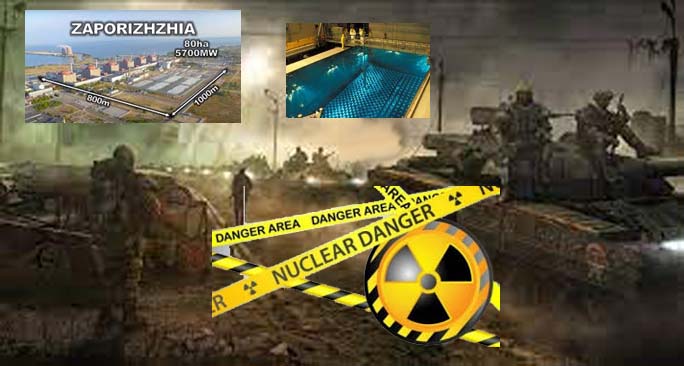
International Atomic Energy Agency (IAEA) staff reported hearing loud blasts near Ukraine’s Zaporizhzhya Nuclear Power Plant (NPP)
IAEA 5th Jan 2025,
https://www.iaea.org/newscenter/pressreleases/update-269-iaea-director-general-statement-on-situation-in-ukraine
International Atomic Energy Agency (IAEA) staff reported hearing loud blasts near Ukraine’s Zaporizhzhya Nuclear Power Plant (NPP) today, coinciding with reports of a drone attack on the plant’s training center, marking yet another threat to nuclear safety at Europe’s largest NPP, according to Director General Rafael Mariano Grossi.
The IAEA Support and Assistance Mission to Zaporizhzhya (ISAMZ) team stationed at ZNPP reported hearing two loud explosions coming from outside the perimeter of the site at approximately 12:45 and 15:45. For now, the IAEA has not yet been able to confirm any impact. The IAEA team also reported hearing machine gun fire coming from the site on multiple occasions.
The IAEA is aware of reports of an alleged attack by a drone at the ZNPP training center today, just outside of the site’s perimeter. Reports state that there were no casualties and no impact on any NPP equipment.
The ISAMZ team has reported that the intensity of military activities in the vicinity of Europe’s largest NPP – including multiple explosions at various distances from the site – has increased over the last 24 hours. “An attack on any nuclear power plant is completely unacceptable,” Director General Grossi stated. “In light of the increased military activity at ZNPP, I once again call for maximum restraint to avert the clear danger to its safety, and for the strict adherence to the five concrete principles established by the IAEA at the United Nations Security Council to protect the facility and the seven indispensable pillars of nuclear safety during an armed conflict also defined by the IAEA”.
The Time Navy Lt. Jimmy Carter Was Lowered Into A Partially Melted-Down Nuclear Reactor
The recently deceased 39th president had a hand in the dawn of the nuclear submarine age, including one especially dangerous mission.
The War Zone, Geoff Ziezulewicz, 30 Dec 24
resident Jimmy Carter’s time as a U.S. Navy officer might have been brief, but it served to inform the rest of his days before passing away Sunday at the age of 100. Prior to his political career and Nobel Prize-winning peacemaking efforts, Carter stood at the side of the father of the nuclear Navy during its infancy, and even got lowered into a melted-down nuclear reactor as a junior officer. Decades later, the former president was stunned to learn of the capabilities carried by the secretive spy submarine that bears his name to this day.
Ensign James Earl “Jimmy” Carter graduated from the U.S. Naval Academy in 1946, and applied to join the Navy’s nuclear submarine community a few years later, according to the Navy…………………………………………………………………………………………………………………………….
After Carter joined the Navy’s nuclear efforts, the 28-year-old and his crew were sent to repair the Chalk Water nuclear reactor near Ottawa, Canada, in late 1952. The reactor had suffered a partial meltdown, and a team was needed to shut it down, take it apart and replace it. Carter and the rest of the team took a train up north and soon got to work.
“They built an identical replica of the reactor on an adjacent tennis court to precisely run through the repair procedures, due to the maximum time humans could be exposed to the levels of radiation present in the damaged area,” a Navy history recounts. “Each member of the 22 member team could only be lowered into the reactor for 90-second periods to clean up and repair the site.”
Official accounts don’t clarify whether Carter was in command during the mission, or his precise role. Still, the future president did his part, Canadian journalist Arthur Milnes later recounted.
“He was lowered into the building … with his wrench, and he had to run over to the reactor casing and he had one screw to turn,” Milnes said after interviewing Carter about the incident. “That was all the time he had. And then, boom, back up.”
Carter and the others were regularly tested after the mission was finished to look for long-term health effects.
“They let us [crew members] get probably a thousand times more radiation than they would now.” Carter told CNN in 2008 while reflecting on the incident. “We were fairly well-instructed then on what nuclear power was, but for about six months after that, I had radioactivity in my urine.”
In his autobiography, “A Full Life, Reflections at Ninety,” Carter recounted the distinctive perils of being a submarine officer:
“Although some enlisted men could concentrate almost exclusively on their own fields of responsibility as engine men, electricians, torpedo experts, boatswains, quartermasters, gunners or operators of navigation and fire control equipment, every officer was expected to master all of these disciplines…we knew one mistake could endanger everyone aboard.”…………………………………………………………………………
Carter lived an extraordinary life, by all accounts. His time in the submarine community played a critical role in all that came after, and he remained a Navy man until the end.
You and I leave here today to do our common duty—protecting our Nation’s vital interests by peaceful means if possible, by resolute action if necessary,” Carter told the graduating class of Naval Academy midshipmen in 1978. “We go forth sobered by these responsibilities, but confident of our strength. We go forth knowing that our Nation’s goals—peace, security, liberty for ourselves and for others—will determine our future and that we together can prevail.”
RIP President Jimmy Carter, 1924-2024, https://www.twz.com/sea/the-time-navy-lt-jimmy-carter-was-lowered-into-a-partially-melted-down-nuclear-reactor
U.S. Nuclear Regulatory Commission Releases Report Confirming Radioactive Material Lost in Transit — Shipping Container Arrives Damaged and Empty in New Jersey
WCBM: Dec. 18, 2024,
The U.S. Nuclear Regulatory Commission (NRC) has confirmed that radioactive material was lost in transit earlier this month, heightening fears about public safety and sparking theories about mysterious drone activity in New Jersey.
Officer Lew, a prominent political commentator, highlighted the NRC’s event report during a review of regulatory alerts.
“While looking at the Nuclear Regulatory Commission Alerts. I can confirm that there is radioactive material that has gone missing on Dec 2nd, 2024 out of New Jersey. This might be the reason for the drones… just speculation at this point,” he wrote.
The missing material, identified as a Ge-68 pin source manufactured by Eckert & Ziegler, was reported lost by its licensee on December 3, 2024. Shipped for disposal, the container arrived at its destination severely damaged and empty.
According to the NRC’s report, the radioactive source, while classified as “Less than IAEA Category 3,” still poses potential risks if mishandled or exposed for prolonged periods.
According to the report:………………………………………….more https://wcbm.com/national-headline/u-s-nuclear-regulatory-commission-releases-report-confirming-radioactive-material-lost-in-transit-shipping-container-arrives-damaged-and-empty-in-new-jersey/?fbclid=IwY2xjawHUIsVleHRuA2FlbQIxMQABHaC7ofrCr2kLP94TcSi7EYfOtaubssy-0TKBwUEdQvNgm4uJEV2_JCc9yQ_aem_BLSGE-89x-qjcSu3l2UQqw
Nuclear submarine shipyard fire at Barrow-in-Furness leaves two in hospital
Josh Halliday Hannah Al-Othman and Jasper Jolly Guardian, 31 Oct 24
Two people have been taken to hospital after a “significant” fire broke out at BAE Systems’ nuclear submarine shipyard in Cumbria.
Residents said they saw huge flames and smoke billowing from the complex in Barrow-in-Furness, where the UK’s new multi-billion-pound Dreadnought submarines are being built.
Cumbria police said there was no nuclear risk but two people were taken to hospital for suspected smoke inhalation. Police said: “At this time there are no other casualties and everyone else has been evacuated from the Devonshire Dock Hall and are accounted for.”
BAE said the two people taken to hospital were workers at the site and they have since been discharged. About 200 people were working on a night shift at the time the fire broke out.
…………………………………………………………….. Four nuclear submarines from the Dreadnought class are being built there as part of a £31bn programme, which is due to replace the Vanguard submarines in the early 2030s. The last of the Royal Navy’s seven new nuclear-powered submarines, part of the Astute class, is also being built at the site.
It is understood that the boat in the hall is HMS Agincourt, whose completion had already been delayed to 2026. The previous Astute class, HMS Agamemnon, was launched last month. It remains unclear whether any submarines were damaged by the fire.
The MoD has been contacted for comment. Cumbria fire and rescue service said an investigation into the cause of the fire was under way.
Police on Wednesday advised residents to keep doors and windows closed, having earlier instructed people to stay indoors. Motorists in the area have also been told to close their windows, air vents and sunroofs and turn off fans and air-conditioning units.
It is understood that the warning was because of the risk of particles, such as those from metals, being released in the air from the heavy industry site, where sophisticated extraction techniques are normally in place.
BAE Systems reportedly told non-essential staff working at Devonshire Dock Hall to work from home on Wednesday, while the BBC reported that staff turning up for their shifts were confused as to which parts of the 25,000 sq metre site was accessible.
Shares in BAE Systems fell as much as 2% in morning trading after news of the fire, making it one of the biggest fallers on the FTSE 100 index of blue-chip companies.
A BAE Systems spokesperson said: “The area around the Devonshire Dock Hall has been evacuated and everyone has been accounted for. Two colleagues were taken to hospital having suffered suspected smoke inhalation and have both since been released.”
It is understood that the company will launch an investigation into the cause of the fire. The rest of the site remains open and operating normally.
Additional reporting by Dan Sabbagh
https://www.theguardian.com/business/2024/oct/30/nuclear-submarine-shipyard-fire-at-barrow-in-furness-leaves-two-in-hospital
Nuclear Missile Submarines Collided (Armed with Hundreds of Nuclear Weapons)
The two submarines were nuclear-powered. Thus, these boats could have become like Chernobyl under the waves.
the need for stealth is naval engagements should be well understood but it must also be stressed that, in the nuclear age, such secrecy could lead to truly devastating consequences unless some form of modus vivendi is crafted between Washington and Beijing to deescalate certain crises.
In February 2009, the British HMS Vanguard and French Le Triomphant, both nuclear-powered ballistic missile submarines, collided in the Atlantic Ocean during routine patrols. The incident raised serious concerns about naval safety protocols and the lack of communication between allied nations operating stealth vessels in close proximity.
The National Interest, by Brandon J. Weichert, October 20, 2024
What You Need to Know: In February 2009, the British HMS Vanguard and French Le Triomphant, both nuclear-powered ballistic missile submarines, collided in the Atlantic Ocean during routine patrols. The incident raised serious concerns about naval safety protocols and the lack of communication between allied nations operating stealth vessels in close proximity.
-Whistleblower William McNeilly later alleged that equipment failures and crew errors aboard the Vanguard contributed to the collision and that a cover-up ensued. This event underscored the potential catastrophic consequences of submarine collisions, especially between nuclear-armed vessels.
-The article also draws parallels to recent incidents involving U.S. and Chinese submarines, emphasizing the need for improved communication to prevent escalations that could lead to environmental disasters or even war.
The Collision
The collision happened in the early hours of 3 February 2009. The two subs were conducting routine patrols. At some point, in the mid-Atlantic, the two nuclear-powered submarines crossed paths and crashed into each other.
This catastrophe was the result of a combination of factors, but the most damning one of all comes from a Royal Navy submariner, William McNeilly, who decided to become a whistleblower. According to this whistleblower, the accident was likely the result of the British submarine which had been subject to “massive equipment failures, crew errors, and lax standards” onboard the HMS Vanguard.
Indeed, the official account provided to the public by the British government (and backed up by the French government), according to McNeilly, was far less caustic than the event actually had been. In fact, according to the whistleblower testimony, the British nuclear submarine was mere moments away from exploding (which would have ignited the ship’s nuclear reactor, causing all kinds of problems for the world).
The whistleblower account details how the FNS Le Triomphant had bashed out a “massive chunk” from the HMS Vanguard after which the French sub “grazed down the side of” the Vanguard. From there, “compressed air bottle groups had been dislodged by the collision and ‘were hanging off and banging against the pressure hull.’ The submarine had to return to base slowly because ‘if one of the [High Pressure Air] bottle groups exploded it would’ve created a chain reaction and sent the submarine plummeting to the bottom.’”
A “massive cover-up of the incident” soon followed.
According to McNeilly the Vanguard had become the poster child in the failing British Royal Navy (an issue about which this author has documented repeatedly in these pages) of mismanagement, lax discipline, and poor seamanship.
Before its collision with the Le Triomphant, there was another cover-up involving the Vanguard pertaining to a “deep depth incident” in which the HMS Vanguard “dived far beyond a normal safe depth. A combination of high-water pressure and the submarine’s low speed made it difficult for the submarine’s hydroplanes [to] generate enough lift to raise the submarine, and ballast water could not be pumped out fast enough to allow the submarine to rise.”
In essence, well before the 2009 collision, the Vanguard was almost lost due to poor seamanship. Yet, the Royal Navy, rather than address the problems, chose to cover it up and continue operating as though everything were normal.
Thankfully, the incident led to a review of submarine operations and safety protocols by both the British and French navies. It further highlighted the need for improved communication and coordination between allied nations operating in the same waters.
Although, the presence of a “massive cover-up” being enacted immediately upon the Vanguard’s return to port is unacceptable and begs the question as to whether the Royal Navy and French Navy really learned the right lessons or if they just figured out how to downplay things better.
The Subs Involved
Britain’s HMS Vanguard was the lead boat in the Vanguard-class ballistic missile submarine. ………………………………………………………………………….
On the other end of the collision was France’s Le Triomphant, the lead boat of the French navy’s Triomphant-class ballistic missile submarine. ………………………………………
The Triomphant carried 15 M45 ballistic missiles and had four torpedo tubes for F17 torpedoes.
This incident on the High Seas between two allied nations that simply were not aware that each other had submarines operating in the same Area of Responsibility (AOR) could have been far worse than it was. The two submarines, as you have read, were nuclear-powered. Thus, these boats could have become like Chernobyl under the waves.
Thankfully, that fate was avoided. But this incident was a clear wake-up call………………………
Implications for Sino-American Interactions Beneath the Sea
Just recently, in fact, the USS Connecticut is believed to have crashed into an undersea mountain (seamount) in the crowded South China Sea while it was possibly conducting a covert surveillance mission of China’s secretive naval base at Hainan Island.
It was a major source of embarrassment for the US Navy because, the incident not only revealed what the Connecticut was up to but it also put a dent in the Navy’s limited Seawolf-class fleet.
the need for stealth is naval engagements should be well understood but it must also be stressed that, in the nuclear age, such secrecy could lead to truly devastating consequences unless some form of modus vivendi is crafted between Washington and Beijing to deescalate certain crises.
This was done throughout the Cold War……………………………..
A Sino-American collision, which is likely to occur given the tension and interactions thus far between the two powers, could either lead to an environmental catastrophe. Or worse, it could lead to a world war. https://nationalinterest.org/blog/buzz/2-nuclear-missile-submarines-collided-armed-hundreds-nuclear-weapons-211587
Ukraine kills nuclear plant’s pro-Russian security chief with car bomb
Politico, October 4, 2024, By Seb Starcevic
The security chief at a Russia-controlled nuclear power plant in southern Ukraine was killed in a car bombing Friday, according to Russian and Ukrainian authorities.
Andriy Korotkyy, head of security at the Zaporizhzhia nuclear power plant, died after his car exploded on Friday morning in the Russian-occupied Ukrainian city of Enerhodar.
“A homemade explosive device was planted under the vehicle of the head of the security,” Russia’s Investigative Committee said in a statement on Telegram.
“When the man got into the car, it detonated. The victim died in the hospital from his injuries,” the committee said, adding that it was opening a murder investigation.
Ukraine’s Military Intelligence Directorate, also known as GUR, seemingly took responsibility for the blast that killed Korotkyy, calling him a “war criminal” and posting a video of a white SUV exploding on Telegram………………………………………………………………….
Moscow took control of the Zaporizhzhia nuclear power plant, the largest such facility in Europe, shortly after it invaded Ukraine in early 2022. It is located about 50 kilometers southwest of the city of Zaporizhzhia, home to more than 700,000 people.
There is widespread concern about the safety of the plant, with shelling and drone strikes nearby prompting the United Nations’ nuclear watchdog in August to issue a warning about a nuclear disaster.
Korotkyy is not the first Russian-allied official to die in a car bombing by Ukrainian intelligence. Mikhail Filiponenko, a pro-Russian lawmaker and ex-militiaman in occupied eastern Ukraine, was killed in a similar attack last November, with the GUR promising to punish other high-profile collaborators. https://www.politico.eu/article/ukraine-russia-andriy-korotkyy-car-bomb-nuclear-plant-zaporizhzhia/
China’s Newest Nuclear Submarine Sank, Setting Back Its Military Modernization
Pierside accident came as Beijing attempts to expand its navy
WSJ, By Michael R. Gordon, Sept. 26, 2024
WASHINGTON—China’s newest nuclear-powered attack submarine sank in the spring, a major setback for one of the country’s priority weapons programs, U.S. officials said.
The episode, which Chinese authorities scrambled to cover up and hasn’t previously been disclosed, occurred at a shipyard near Wuhan in late May or early June.
It comes as China has been pushing to expand its navy, including its fleet of nuclear-powered submarines.
The Pentagon has cast China as its principal long-term “pacing challenge,” and U.S. officials say that Beijing has been using political and military pressure to try to coerce Taiwan, a separately governed island that Beijing claims as part of its territory.
China says its goal in building a world-class military is to deter aggression and safeguard its overseas interests. A spokesman for the Chinese embassy didn’t immediately respond to a request for comment…………………………………………………………….. more https://www.wsj.com/world/china/chinas-newest-nuclear-submarine-sank-setting-back-its-military-modernization-785b4d37?st=pMigx5&reflink=desktopwebshare_permalink
Chinese nuclear-powered attack submarine sank earlier this year, says senior US defence official
ABC News, 27 Sept 24
In short:
China’s newest nuclear-powered attack submarine sank earlier this year, according to a senior US defence official.
A series of satellite images from Planet Labs from June appear to show cranes at the Wuchang shipyard, where the submarine would have been docked.
What’s next?
China’s submarine force is expected to grow to 65 by 2025 and 80 by 2035, the US Department of Defense has said.
A senior US defence official has said that China’s newest nuclear-powered attack submarine sank earlier this year, marking a potential embarrassment for Beijing as it seeks to expand its military capabilities.
China already has the largest navy in the world, with over 370 ships, and it has embarked on production of a new generation of nuclear-armed submarines.
The US defence official, speaking on condition of anonymity on Thursday, local time, said China’s new first-in-class nuclear-powered attack submarine sank alongside a pier sometime between May and June.
A Chinese embassy spokesperson in Washington said they had no information to provide.
“In addition to the obvious questions about training standards and equipment quality, the incident raises deeper questions about the PLA’s internal accountability and oversight of China’s defence industry — which has long been plagued by corruption,” the official said, using an acronym for the People’s Liberation Army.
“It’s not surprising that the PLA Navy would try to conceal the sinking,” the official added………………………………………………. more https://www.abc.net.au/news/2024-09-27/one-of-china-submarine-sank-says-us-defence-official/104406362
1 This Month

of the week – Shut Down Drone Warfare!


Tell the Ukrainian Government to Drop Prosecution of Peace Activist Yurii Sheliazhenko

Petition to revoke the licensing of the Near Surface Nuclear Disposal Facility (NSDF) at Chalk River. https://www.ourcommons.ca/petitions/en/Petition/Details?Petition=e-7247
To see nuclear-related stories in greater depth and intensity – go to https://nuclearinformation.wordpress.com
-
Archives
- April 2026 (57)
- March 2026 (251)
- February 2026 (268)
- January 2026 (308)
- December 2025 (358)
- November 2025 (359)
- October 2025 (376)
- September 2025 (257)
- August 2025 (319)
- July 2025 (230)
- June 2025 (348)
- May 2025 (261)
-
Categories
- 1
- 1 NUCLEAR ISSUES
- business and costs
- climate change
- culture and arts
- ENERGY
- environment
- health
- history
- indigenous issues
- Legal
- marketing of nuclear
- media
- opposition to nuclear
- PERSONAL STORIES
- politics
- politics international
- Religion and ethics
- safety
- secrets,lies and civil liberties
- spinbuster
- technology
- Uranium
- wastes
- weapons and war
- Women
- 2 WORLD
- ACTION
- AFRICA
- Atrocities
- AUSTRALIA
- Christina's notes
- Christina's themes
- culture and arts
- Events
- Fuk 2022
- Fuk 2023
- Fukushima 2017
- Fukushima 2018
- fukushima 2019
- Fukushima 2020
- Fukushima 2021
- general
- global warming
- Humour (God we need it)
- Nuclear
- RARE EARTHS
- Reference
- resources – print
- Resources -audiovicual
- Weekly Newsletter
- World
- World Nuclear
- YouTube
-
RSS
Entries RSS
Comments RSS
 nuclear-news