Church Rock America’s Forgotten Nuclear Sacrifice Zone

|
Church Rock, America’s Forgotten Nuclear Disaster, Is Still Poisoning Navajo Lands 40 Years Later. https://www.vice.com/en_us/article/ne8w4x/church-rock-americas-forgotten-nuclear-disaster-is-still-poisoning-navajo-lands-40-years-later Residents say they’ve been ignored even as they struggle with contaminated water and worry about having children. By Samuel Gilbert; photos by Ramsay de Give, Aug 12 2019,
Early in the summer of 1979, Larry King, an underground surveyor at the United Nuclear Corporation’s Church Rock Uranium mine in New Mexico, began noticing something unusual when looking at the south side of the tailings dam. That massive earthen wall was responsible for holding back thousands of tons of toxic water and waste produced by the mine and the nearby mill that extracted uranium from raw ore. And as King saw, there were “fist-sized cracks” developing in that wall. He measured them, reported them to his supervisors, and didn’t think anything more of it.
A few weeks later, at 5:30 a.m. on July 16, 1979, the dam failed, releasing 1,100 tons of uranium waste and 94 million gallons of radioactive water into the Rio Puerco and through Navajo lands, a toxic flood that had devastating consequences on the surrounding area. “The water, filled with acids from the milling process, twisted a metal culvert in the Puerco,” according to Judy Pasternak’s book Yellow Dirt: A Poisoned Land and the Betrayal of the Navajos. “Sheep keeled over and died, and crops curdled along the banks. The surge of radiation was detected as far away as Sanders, Arizona, fifty miles downstream.” According to a Nuclear Regulatory Commission report, radioactivity levels in the Puerco near the breached dam were 7,000 times that of what is allowed in drinking water. The heavily contaminated water flowed over the river banks, creating radioactive pools. “There were children up and down the river playing in those stagnant pools, and they were deadly poisonous,” Jorge Winterer, a doctor with Indian Health Service in Gallup, New Mexico, said after the spill. Earlier this year, standing in his yard next to an old Chevy, King pointed in the direction of the now dry Rio Puerco. “It came right through there,” said King. The unleashed river of waste had flowed through his family’s land just a half-mile from his house. “I remember the terrible odor and the yellowish color of the water.” He recalls seeing an elderly woman who had burned her feet crossing the Puerco while watering her sheep that day. King still lives on the family land, two miles downstream of the rebuilt dam in the Church Rock chapter of the Navajo Nation. His home is surrounded by a beautiful, unforgiving landscape of red rock cliffs, a scattering of Navajo residences and, if you look closely, fencelines with KEEP OUT signs marking the numerous abandoned uranium sites. Forty years later, the Church Rock spill remains the largest single largest accidental release of radioactivity in U.S. history, worse in terms of total radiation than that of the partial meltdown at Three Mile Island and second in world history only to the 1986 Chernobyl catastrophe, both of which have loomed much larger in the cultural imagination. The effects of the spill have lingered for an entire generation: In 2007, the Church Rock Uranium Mining Project found widespread contamination of drinking water sources in the Church Rock area. Navajo residents say they have not been given the attention given to other victims of nuclear accidents, even as they remain under the catastrophe’s long shadow, dealing with poisoned livestock and ongoing health problems amid other aftereffects. “We have never been a priority,” said King. “Forty years after the spill and nothing has been done.” “Our generation is afraid of having children,” said Faith Baldwin, who grew up on the Navajo nation surrounded by abandoned uranium mines. “Cancer runs in our family but it shouldn’t. Cancer, diabetes were nonexistent in Navajo rez.” During the Cold War, Navajo lands provided much of the raw material for the burgeoning nuclear industry. From 1944 to 1986 some 30 million tons of uranium ore were extracted from mines, but as demand for uranium decreased the mines closed, leaving over a thousand contaminated sites, few of which have been cleaned up. The Church Rock Chapter has some 20 such contaminated uranium sites, including the mine where King worked. Navajo workers at these places were often poorly paid, underprotected, and uninformed about the danger of radiation exposure. And even before the spill, King said, UNC would routinely pump uranium-contaminated water from the mine into the Puerco, turning the seasonal wash into a toxic “man-made stream.” According to a 1994 report by the U.S. Geological Survey on levels of radioactive elements in the Rio Puerco and Little Colorado River basins, “at least 300 times more uranium and 6 times more total gross alpha activity were released by day-to-day pumping from the underground mines than was released by the spill.” As a child King remembers playing in the dry Puerco wash, its banks often coated with a “yellowish slime.” And ranchers used the Puerco to water their livestock. Residents couldn’t have known that the Church Rock dam was at risk of rupturing, but there’s evidence that the United Nuclear Corporation did. King wasn’t the first to notice cracks in the dam: An Army Corps of Engineers report would later find that UNC was aware of the cracks as early as 1977, two years before the breach. That report concluded that UNC failed to properly reinforce the tailings dam, ignored advice from its own engineering consultant that might have prevented the coming disaster, and did not report the cracks to regulators. “The company was remiss in not heading the problem off,” said Chris Shuey, director of the Uranium Impact Assessment Program at the Southwest Research and Information Center, an organization providing information to the public about the impacts of energy development and resource extraction. Shuey said that UNC failed to repair cracks in the dam while simultaneously overfilling the uranium mill’s toxic tailing ponds that were being held back by that cracking wall. The cleanup process after the spill was also lacking. Only 1 percent of solid radioactive waste was removed, according to Paul Robinson, the research director at the Southwest Research and Information Center, and no compensation for the nearby residents was provided. In contrast, those affected by the Three Mile Island disaster were paid thanks to the company that operated that plant and its insurers. “Governments took meaningful measures to deal with the Three Mile Island accident,” said Eric Jantz, a lawyer from the New Mexico Environmental Law Center, “while neither the federal nor New Mexico governments have taken any steps to remediate the Church Rock spill even after 40 years.” As time went on, the impacts of uranium exposure became more evident to residents. King watched as his former mine coworkers died early deaths. Community members complained of health problems that prior to the entrance of the uranium industry were foreign: kidney disease, bone cancer, and lung cancer afflicting non-smokers. According to King, the only warnings about radioactivity were a few signs telling residents not to water their livestock in the wash. UNC’s cleanup efforts consisted of hiring some temporary workers to shovel waste from the wash into five-gallon buckets and haul it away, according to Colleen Keane, who made a documentary about the aftermath of the spill called The River That Harms. In the early 90s, King joined the Eastern Navajo Diné Against Uranium Mining (ENDAUM), a grassroots organization fighting against new uranium projects and trying to mitigate the negative impacts of mining operations. Through that work, King began hearing troubling stories from nearby Red Water Pond Road, a small community sandwiched between three uranium sites where residents “unwittingly used water from contaminated wells to drink, bathe, and hydrate their livestock,” according to a 2017 Reveal article. “Their sheep were born hairless… like baby rats,” said King. There were also the stories of butchered animals whose insides had turned a sickly yellow. A few years back, one of King’s neighbors killed a sheep. Instead of white, the stomach fat was yellow, “more yellow than those happy faces,” said King, pointing to a stuffed smiley face pinned above his couch. “They got concerned and decided to butcher another one. Pretty soon there was a pile of carcasses, all the same… They burned the whole thing.” he health impacts of the spill on residents remain poorly understood, with only a few authoritative heath studies having been conducted. One of the few government studies that came out after the spill did limited testing on both residents (six in total) and livestock. The resulting 1983 report from the New Mexico government, based on Centers for Disease Control (CDC) tests, concluded that Rio Puerco water “may be hazardous if used over several years as the primary source of drinking water, livestock water or irrigation water.” The report goes on to state that “the severity of these hazards is not well known at the time.” But since then, it’s become more obvious that the spill has had long-lasting and serious effects. In 2015, Tommy Rock, a doctoral student of earth science, uncovered uranium contamination in Rio Puerco water in Sanders, a town in eastern Arizona, by looking at tests stretching back to 2003. “The Church rock spill was the single most likely cause,” he said. “For decades people were unknowingly drinking poisoned tap water.” The water company did not report the contamination to residents, and after Rock’s findings a new company took over operations and is drawing on a different well. For many residents, the spill has come to embody the broader toxic legacy of the uranium industry on the indigenous lands of the West. According to the EPA, there are over 500 abandoned uranium mines, mill sites, and waste piles on Navajo Nation land that continue to contaminate water, soil, livestock and housing. “The Church Rock spill symbolizes the governmental and societal indifference to the impacts of uranium development on Indigenous lands,” said Jantz. “The Church Rock spill is the third largest nuclear accident after Fukushima and Chernobyl, and the largest in the US in terms of radiation released, but nobody knows about it.” “Three Mile Island had more coverage and people were compensated right away,” said King. “I always say we don’t get the same attention because we live in impoverished native community… We live in a sacrifice zone.” |
|
|
‘Dirty bomb’: Mystery Russian ‘superweapon’ kills five
An on-board reactor would give an engine almost unlimited range. In the case of a guided cruise missile, it could circle the world before receiving orders to attack from out of the blue.
But they’re not easy to control.
They operate at extremely high temperatures. They use explosive fuels, such as liquid hydrogen. And any accident could have devastating, long-lasting effects.
|
‘Dirty bomb’: Mystery Russian ‘superweapon’ kills five https://www.news.com.au/technology/innovation/military/dirty-bomb-mystery-russian-superweapon-kills-five/news-story/c3f85442bc12c6fea43cc4cf67df392e 13 Aug 19It was an explosion, played down by Russian officials — until they were forced to admit five people were dead and many more are at risk.
Jamie Seidel When an experimental missile exploded at a secret Russian base, things were immediately odd. Children from the nearby city of Severodvinsk were sent home from school. Its 185,000 residents were told to stay indoors. Doses of Iodine were distributed. All shipping was barred from the area for at least 30 days. What could cause such a reaction? How could a relatively small explosion cause such confusion? Russia’s nuclear energy agency Rosatom eventually stepped forward: It explained that a missile testing an “isotope power source for a liquid-fuelled rocket engine” had misfired. Rosatom conceded the accident on Thursday night had killed five, and three were being treated for burns. Russian officials said elite scientists Alexey Vyushin, Yevgeny Koratayev, Vyacheslave Lipshev, Sergey Pichugin and Vladislav Yanovsky — were killed during tests on a liquid propulsion system Little else is officially known. But military analysts have been speculating. Was it some sort of “dirty bomb”, with a radioactive warhead? Could it have been a failed launch from a nuclear-powered submarine? Suspicion has also fallen on one of President Vladimir Putin’s vaunted new “superweapons”. STORMY PETREL The idea of using a nuclear-reactor powered ramjet isn’t new It appears to have been thought up by Nazi rocket scientists during the dying days of World War II. With the fall of Berlin, these experts were divided up between the United States and the Soviet Union. Both nations embarked upon experimental nuclear-powered missile projects in the 1950s. It was quickly recognised the radiation-spewing technology was far too perilous to be practical. But a boisterous President Putin revealed what he called the 9M730 Burevestnik (Petrel) early last year as one of six new “superweapons”. NATO calls it the SSC-X-9 “Skyfall”. “Since its range is unlimited, it can manoeuvre as long as you want. No one in the world has anything like that,” Mr Putin boasted. “It may appear some day, but by that time we will develop something new.” The accompanying presentation showed the missile weaving its way between radar stations in the mid-Atlantic, passing around South America’s Cape Horn and worming its way up towards Hawaii. Mr Putin said the missile was successfully tested in late 2017 and was “invincible against all existing and prospective missile defence and counter-air defence systems”. “I want to tell all those who have fuelled the arms race over the last 15 years, sought to win unilateral advantages over Russia, introduced unlawful sanctions aimed to contain our country’s development: Aall that you wanted to impede with your policies have already happened,” Mr Putin declared. “You have failed to contain Russia.” But things don’t appear to be going to plan. EXPLOSIVE POTENTIAL Nuclear propulsion is promising — but also problematic. Continue reading |
Russia says small nuclear reactor blew up in deadly accident
|
August 13, 2019 The failed missile test that ended in an explosion killing five scientists last week on Russia’s White Sea involved a small nuclear reactor, according to a top official at the institute where they worked.
The institute is working on small-scale power sources that use “radioactive materials, including fissile and radioisotope materials” for the Defence Ministry and civilian uses, Vyacheslav Soloviev, scientific director of the institute, said in a video shown by local TV.
The men, who will be buried on Monday, were national heroes and the “elite of the Russian Federal Nuclear Centre,” institute Director Valentin Kostyukov said in the video, which was also posted on an official website in Sarov, a high-security city devoted to nuclear research less than 400 kilometers east of Moscow.
The blast occurred on August 8 during a test of a missile that used “isotope power sources” on an offshore platform in the Arkhangelsk region, close to the Arctic Circle, Russia’s state nuclear company Rosatom said over the weekend. The Defence Ministry initially reported two were killed in the accident, which it said involved testing of a liquid-fuelled missile engine. The ministry didn’t mention the nuclear element.
Rosatom declined to comment on the incident on Monday and a spokeswoman for the Sarov institute couldn’t immediately be reached.
Russian media have speculated that the weapon being tested was the SSC-X-9 Skyfall, known in Russia as the Burevestnik, a nuclear-powered cruise missile that President Vladimir Putin introduced to the world in a brief animated segment during his state-of-the-nation address last year.
The incident comes after a series of massive explosions earlier last week at a Siberian military depot killed one and injured 13, as well as forcing the evacuation of 16,500 people from their homes. Russia’s navy has suffered numerous high-profile accidents over the years. In July, 14 sailors died in a fire aboard a nuclear-powered submarine in the Barents Sea in an incident on which officials initially refused to comment. A top naval official later said the men gave their lives preventing a “planetary catastrophe.”
Russia’s worst post-Soviet naval disaster also occurred in the Barents Sea, when 118 crew died on the Kursk nuclear submarine that sank in after an explosion in August 2000. https://www.theage.com.au/world/asia/russia-says-small-nuclear-reactor-blew-up-in-deadly-accident-20190813-p52gfm.html
|
|


Putin’s silence on mysterious radiation accident
 Russia nuclear leak: Mysterious footage of hazmat officials escalates radiation panic https://www.express.co.uk/news/world/1164125/Russia-nuclear-leak-radiation-Putin-iodine-hazmat
CHILLING footage from Russia has intensified fears of a nuclear radiation accident after ambulances were spotted lined with protective chemical sheets and hospitals workers were seen wearing hazmat suits.
Rostam added that the explosion took place during the testing of an “isotope power source”.
The official said five of its employees had died as a result of the accident and three more were being treated for burns.
However, the extent of the incident and threat of radiation has not been disclosed, amid growing global concern.
The Archangelsk naval base has been placed under emergency lockdown for a month, with the nearby White Sea also closed to commercial shipping.
A sudden radiation spike detected in the region following the explosion prompted the initial speculation that the incident was related to a nuclear missile test.
The radiation level was recorded as 20 times higher than the normal level in the nearby city of Severodvinsk.
This has been reinforced by chilling footage filmed in the aftermath of the incident.
One video showed hospital workers wearing hazmat suits while they loaded the injured into an ambulance. Another terrifying video revealed a security escort of ambulances transporting the injured to Moscow.
In this footage, one of the ambulance is clearly coated in a chemical protection film.
A defence ministry source said that the worker’s clothes had been burned as soon as they were hospitalised with suspected radiation. Experts have linked the incident to the testing of the new nuclear-powered cruise missile Burevestnik mentioned during a speech by Vladimir Putin last year.
Local people have reportedly been urged to take precautions against radiation, with children from local kindergartens taken indoors after the blast.
There has also been a rush to buy iodine in Russia’s far north.
Russian expert Dr Mark Galeotti said the incident was “clearly a bigger issue than the Russians are letting on”.
He told the BBC: “Despite what the Kremlin have said, there must have been some sort of radiation leak – and they want people to not just stay out of harm’s way, but also don’t want people coming to the site with Geiger Counters.”
Five people were killed following Russian rocket explosion
Russia explosion: Five confirmed dead in rocket blast, BBC 10 Aug 19, Five people were killed and three injured following a rocket explosion on a naval test range in Russia on Thursday, state nuclear company Rosatom confirmed.
Rostacom said the accident occurred during tests on a liquid propellant rocket engine.
The three injured staff members suffered serious burns in the accident.
Authorities had previously said that two people died and six were injured in the blast at the site in Nyonoksa.
The company told Russian media that its engineering and technical team had been working on the “isotope power source” for the propulsion system.
The Nyonoksa site carries out tests for virtually every missile system used by the Russian navy, including sea-launched intercontinental ballistic missiles, cruise missiles and anti-aircraft missiles.
Authorities in Severodvink, 47km (29 miles) east of Nyonska said that radiation levels shortly after the blast were higher than normal for about 40 minutes but returned to normal……..
Ammunition dump blaze
It is the second accident involving Russia’s military this week.
On Monday, one person was killed and eight others were injured in a blaze at an ammunition dump in Siberia.
Flying munitions damaged a school and a kindergarten in the area. More than 9,500 people were evacuated.https://www.bbc.com/news/world-europe-49301438
Test rocket explosion causes radiation spike in northern Russian city
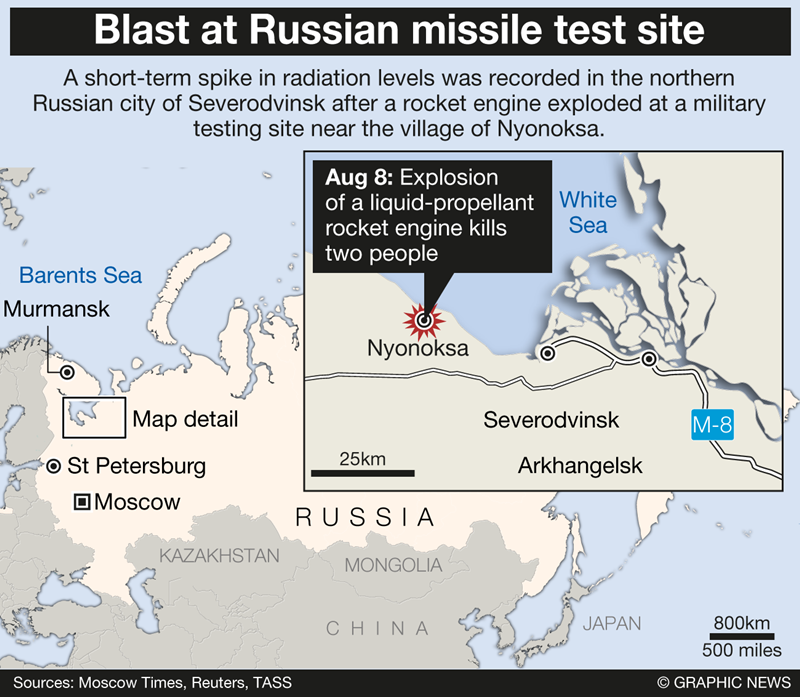
Test rocket explosion causes radiation spike in northern Russian city, killing two, https://thenewdaily.com.au/news/world/2019/08/09/rocket-radiation-explosion-russia/?fbclid=IwAR1udqv3rSjTDZE5hZpDHPDo-r7Q-zPhdnuvA-Ejqwu4iButecBmHPW2QdU Locals have been urged to take iodine tablets and stay indoors after a liquid-propellant rocket engine exploded at a nuclear test site, spiking radiation levels, killing two people and injuring another six.
Greenpeace cited data from the Emergencies Ministry that it said showed radiation levels had risen 20 times above the normal level in Severodvinsk, which is about 30 kilometres from Nyonoksa.
The environmental group said it had appealed to Russia’s consumer watchdog to establish how high radiation had risen, whether it posed a health risk to people and what had actually caused the spike.
According to Norway’s Barents Observer, the explosion happened about 9am on Thursday local time.
The paper reported the site is used for the testing of liquid-fuelled engines of ballistic missiles “for strategic nuclear-powered submarines”.
Authorities in Severodvinsk, which has a population of 185,000, reported the spike, forcing a bay in the White Sea to shut down to shipping.
“A short-term rise in background radiation was recorded at 12 o’clock in Severodvinsk,” Ksenia Yudina said on Thursday local time. However, Russia’s defence ministry was quoted earlier by state media as saying radiation was normal.
Explosion at Russian missile test, kills two, releases spike of radiation
Two killed and four injured after blast, defence ministry say, A short-term spike in radiation levels has been recorded after a rocket engine exploded during a test in Russia, regional authorities said.Moscow’s defence ministry said two were killed and four others wounded after the blast at a military shooting range in the northwestern region of Arkhangelsk.
The ministry said there was no release of radioactivity or any toxic substances.
However, Ksenia Yudina, a spokeswoman for the city of Severodvinsk, which has a population of around 185,000, said: “A short-term rise in background radiation was recorded at 12 o’clock in Severodvinsk.”
The defence ministry confirmed six servicemen and civilian engineers were injured, and two died of their injuries. It said the explosion took place during the test of a liquid-propellant rocket engine.
City officials said background radiation levels had fully “normalised”.
An Arkhangelsk port official said the Dvina Bay area of the White Sea would be closed off to shipping for a month following the explosion, the Interfax news agency reported.
The rocket engine explosion occurred at a weapons testing area near the village of Nyonoksa in the Arkhangelsk region, 800 miles north of Moscow, said the Interfax news agency.
Russian media said an area near Nyonoksa is used for tests on weapons including ballistic and cruise missiles used by the navy.
It came two days after 16,500 people were forced to flee their homes when massive blasts rocked an arms depot in Siberia.
Powerful explosions went on for about 16 hours, killing one person and injuring 13.
The nuclear disasters that we don’t hear about – The Kyshtym Disaster
5 Unknown Nuclear Disasters: Chernobyl Is Far from the Only One, Chernobyl is not the world’s only nuclear disaster, there are plenty of others to keep you up at night., Interesting Engineering, By Marcia Wendorf, 2 Aug 19
The Kyshtym Disaster
In September 1957, Ozyorsk, Russia was a closed city, built around the Mayak plant which produced plutonium for both nuclear weapons and fuel.
After scrambling to build the Mayak plant between 1945 and 1948, all six of its reactors initially dumped high-level radioactive waste directly into Lake Kyzyltash. When it became contaminated, they moved on to dumping into Lake Karachay, which also became contaminated.
In 1968, the Soviet government disguised the EURT area by creating East Ural Nature Reserve, with access allowed to only authorized personnel. Documents describing the disaster were only declassified in 1989.
On the International Nuclear Event Scale (INES), Kyshtym is rated a 6, making it the third-most serious nuclear accident behind only the Fukushima Daiichi nuclear disaster and the Chernobyl disaster, which are both Level 7
In 1953, workers built a storage facility for liquid nuclear waste, but that waste was being heated by residual decay heat from the nuclear reaction. The coolers around one of the tanks failed, and on September 29, 1957, that tank exploded with the force of between 70 to 100 tons of TNT.
While there were no immediate casualties, the explosion released an estimated 20 MCi (800 PBq) of radioactivity into the air. A plume containing 2 MCi (80 PBq) of radionuclides, primarily caesium-137 and strontium-90, moved toward the northeast and contaminated an area of more than 52,000 square kilometers (20,000 sq miles).
At least 270,000 people lived in that area, which is referred to as the East-Ural Radioactive Trace (EURT).
In an attempt to maintain secrecy, no evacuation was ordered, but a week later, on October 6, 1957, 10,000 people were removed from their homes.
Estimates of the death toll caused by the accident go from 200 to more than 8,000, depending on the study. A 2001 work stated that the accident caused 66 diagnosed cases of chronic radiation syndrome.
Amazingly, it wasn’t until 18 years later, in 1976, that the full scope of the disaster was disclosed by Zhores Medvedev in the publication the New Scientist.
In 1968, the Soviet government disguised the EURT area by creating East Ural Nature Reserve, with access allowed to only authorized personnel. Documents describing the disaster were only declassified in 1989.
On the International Nuclear Event Scale (INES), Kyshtym is rated a 6, making it the third-most serious nuclear accident behind only the Fukushima Daiichi nuclear disaster and the Chernobyl disaster, which are both Level 7…… https://interestingengineering.com/5-unknown-nuclear-disasters-chernobyl-is-far-from-the-only-one
K-19: The Widowmaker Trailer
The nuclear disasters we don’t hear about – The Windscale Fire
Windscale: Britain’s Biggest Nuclear Disaster – Part 01
5 Unknown Nuclear Disasters: Chernobyl Is Far from the Only One, Chernobyl is not the world’s only nuclear disaster, there are plenty of others to keep you up at night., Interesting Engineering, By Marcia Wendorf, 2 Aug 19
The Windscale Fire
Less than two weeks after Kyshtym, a fire broke out in Unit 1 of the two reactors at the Windscale facility located in what is now known as Sellafield, Cumbria UK.
The two reactors were created because of Britain’s need for an atomic weapon following World War II. Determining that a uranium enrichment plant would cost ten times as much to produce the same number of atomic bombs as a nuclear reactor, the decision was made to build a nuclear reactor that would produce plutonium.
The cores of the reactors were comprised of a large block of graphite, with horizontal channels drilled through it for the fuel cartridges. Each cartridge consisted of a 12-inch-long (30 centimeters) uranium rod encased in aluminum.
The reactor was cooled by convection through a 400-foot (120 m) tall chimney. When Winston Churchill committed the UK to create a hydrogen bomb, the fuel loads at Windscale were modified to produce tritium, but this also meant that the core became hotter.
On the morning of October 10, 1957, the core began to uncontrollably heat, eventually reaching 400 degrees C. Cooling fans were brought in to increase the airflow, but just worsened the problem. It was then that operators realized that the core was on fire.
Workers tried dousing the core first in carbon dioxide, then in water, but both proved ineffective. What finally worked was cutting off air to the reactor building, which starved the fire.
The fire caused the release of radioactive radionuclides across the UK and Europe, including an estimated 740 terabecquerels (20,000 curies) of iodine-131, 22 TBq (594 curies) of caesium-137 and 12,000 TBq (324,000 curies) of xenon-133.
By comparison, the 1986 Chernobyl explosion released far more, and the Three Mile Island accident in 1979 in the U.S. released 25 times more xenon-135 than Windscale, but less iodine, caesium, and strontium. The atmospheric release of xenon-133 by the Fukushima Daiichi nuclear disaster was similar to that released at Chernobyl, and thus, high above what the Windscale fire released.
There were no evacuations of the surrounding area, but it has been estimated that the incident caused 240 additional cancer cases. For a month after the accident, milk coming from 500 square kilometers (190 sq mi) of the nearby countryside was destroyed.
The reactor tank has remained sealed since the accident and still contains about 15 tons of uranium fuel. The reactor core is still slightly warm due to continuing nuclear reactions. It is not scheduled for final decommissioning until 2037. On the International Nuclear Event Scale, Windscale ranks at level 5………. https://interestingengineering.com/5-unknown-nuclear-disasters-chernobyl-is-far-from-the-only-one
 |
ReplyForward
|
The nuclear accidents we don’t hear about – Soviet Submarine K-19
5 Unknown Nuclear Disasters: Chernobyl Is Far from the Only One, Chernobyl is not the world’s only nuclear disaster, there are plenty of others to keep you up at night., Interesting Engineering, By Marcia Wendorf, 2 Aug 19
Soviet Submarine K-19
K-19 was one of what the Soviets called their Project 658-class submarines, while NATO called them Hotel-class. They were the first generation of nuclear submarines equipped with nuclear ballistic missiles.
Commissioned on April 30, 1961, K-19 was snake bit from the start. On its initial voyage, on July 4, 1961, it was conducting exercises off the coast of Greenland when suddenly, pressure in the reactor’s cooling system dropped to zero due to a leak.
The emergency SCRAM system immediately inserted the control rods, but due to decay heat, the reactor’s temperature rose to 800 degrees C (1,470 degrees F). The accident released steam containing fission products throughout the ship through the ventilation system.
The captain ordered the ship’s engineering crew to fabricate a new cooling system, but this required them to work within the radioactive area. The jury-rigged cooling water system prevented a complete meltdown of the reactor core.
American warships nearby had picked up K-19’s distress call and offered to help, but K-19’s captain, fearful of giving away Soviet military secrets, refused. Instead, K-19 sailed to meet up with a diesel-powered Soviet submarine. The accident had irradiated K-19’s entire crew, as well as the ship and some of her ballistic missiles.
Within a month, all eight members of the ship’s engineering crew died of radiation exposure. They are Boris Korchilov, Boris Ryzhikov, Yuriy Ordochkin, Evgeny Kashenkov, Semyon Penkov, Nicolai Savkin, Valery Charitonov, and Yuriy Povstyev.
Within the next two years, 15 other sailors died of radiation-related illnesses.
Towed into port, K-19 contaminated a 700 meter (2,300 feet) wide area, and the repair crews who worked on her. Eventually, the Soviet Navy dumped the damaged reactor into the Kara Sea.
The 2002 movie K-19: the Windowmaker, which starred Harrison Ford and Liam Neeson, is based on the K-19 disaster….. https://interestingengineering.com/5-unknown-nuclear-disasters-chernobyl-is-far-from-the-only-one
The nuclear accidents we don’t hear about – The Goiânia Accident
|
5 Unknown Nuclear Disasters: Chernobyl Is Far from the Only One, Chernobyl is not the world’s only nuclear disaster, there are plenty of others to keep you up at night., Interesting Engineering, By Marcia Wendorf, 2 Aug 19 The Goiânia AccidentIn the 1980s, the Instituto Goiano de Radioterapia (IGR) was a private radiotherapy hospital in Goiânia, Brazil. When it moved to a new facility in 1985, a caesium-137-based therapy unit was left behind. The caesium-137 was encased in a shielding canister made of lead and steel. Legal wrangling prevented the canister from being removed from the facility, and the court posted a security guard to protect the equipment. Unfortunately, that guard was nowhere to be found on September 13, 1987, when two men, Roberto dos Santos Alves and Wagner Mota Pereira, entered the facility and made off with the equipment, placing it in a wheelbarrow and taking it to Alves’s house. There, they began dismantling the equipment, and both immediately began to vomit. The next day, Pereira noticed a burn on his hand that required the amputation of several fingers. Alves soldiered on, piercing the canister with a screwdriver. He noticed the blue light of Cherenkov radiation. Alves’s arm ulcerated and had to be amputated, but before that, he sold the items to a scrapyard owned by Devair Alves Ferreira. Fascinated by the blue glow being emitted, Ferreira carried the items into his house, and over the next three days, he invited his friends and family in to observe the blue glow. Ferreira’s brother brought some of the caesium to his house where he sprinkled it onto a floor. There, his six-year-old daughter, Leide das Neves Ferreira, sat down and ate a sandwich. Eventually, Ferreira’s wife took the caesium to a hospital, and news of the radioactive leak was broadcast on local media. 250 people were found to be contaminated by radiation, with 129 people having internal contamination. Four people would die of radiation sickness including six-year-old Leide, Ferreira’s wife Gabriela, 37, and two employees of Ferreira, Israel Baptista dos Santos, 22, and Admilson Alves de Souza, 18. The Goiânia accident spread significant radioactive contamination throughout the Aeroporto, Central, and Ferroviários districts of Goiânia. Contaminated areas included Alves’s house, Devair Ferreira’s scrapyard which had extremely high levels of radiation, and his brother Ivo’s house. The “NATO Science for Peace and Security Series” bizarrely found radioactive contamination on: The Goiânia accident ranks as a number 5 on the International Nuclear and Radiological Event Scale. A 1990 film about the disaster won several awards at the 1990 Festival de Brasília film festival, and a 1994 episode of the TV series “Star Trek: The Next Generation,” “Thine Own Self,” was inspired by the Goiânia accident. …. https://interestingengineering.com/5-unknown-nuclear-disasters-chernobyl-is-far-from-the-only-one |
|
The nuclear accidents we don’t hear about – Chalk River Ontario
5 Unknown Nuclear Disasters: Chernobyl Is Far from the Only One, Chernobyl is not the world’s only nuclear disaster, there are plenty of others to keep you up at night., Interesting Engineering, By Marcia Wendorf, 2 Aug 19
Chalk River Ontario, Canada Incident
On December 12, 1952, there was a power excursion and partial loss of coolant in the NRX reactor at the Chalk River nuclear laboratories. Because of mechanical problems, the control rods couldn’t be lowered into the core, and the fuel rods overheated, resulting in a meltdown of the core.
Just like at Chernobyl, hydrogen gas caused an explosion that blew off the multi-ton reactor vessel seal. Also like at Chernobyl, 4,500 tons of radioactive water was found in the basement of the Chalk River reactor building. During the accident, 10,000 curies or 370 TBq of radioactive material was released into the atmosphere.
Future U.S. president Jimmy Carter, then a U.S. Navy officer, led a team of 13 U.S. Navy volunteers who helped in the cleanup of this disaster.
On the International Nuclear Event Scale, Chalk River is a 5, along with Goiânia, Three Mile Island, and Windscale. https://interestingengineering.com/5-unknown-nuclear-disasters-chernobyl-is-far-from-the-only-one
New research: 2017 radioactive cloud traced to an unacknowledged nuclear accident in southern Russia

Mysterious Radiation Cloud Over Europe Traced to Secret Russian Nuclear Accident https://www.livescience.com/66050-radiation-cloud-secret-russian-nuclear-accident.html By | July 29, 2019 A vast cloud of nuclear radiation that spreadover continental Europe in 2017 has been traced to an unacknowledged nuclear accident in southern Russia, according to an international team of scientists.
The experts say the cloud of radiation detected over Europe in late September 2017 could only have been caused by a nuclear fuel-reprocessing accident at the Mayak Production Association, a nuclear facility in the Chelyabinsk region of the Ural Mountains in Russia, sometime between noon on Sept. 26 and noon on Sept. 27.
Russia confirmed that a cloud of nuclear radiation was detected over the Urals at the time, but the country never acknowledged any responsibility for a radiation leak, nor has it ever admitted that a nuclear accident took place at Mayak in 2017. [Top 10 Greatest Explosions Ever]
The lead author of the new research, nuclear chemist Georg Steinhauser of Leibniz University in Hanover, Germany, said that more than 1,300 atmospheric measurements from around the world showed that between 250 and 400 terabecquerels of radioactive ruthenium-106 had been released during that time.
Ruthenium-106 is a radioactive isotope of ruthenium, meaning that it has a different number of neutrons in its nucleus than the naturally occurring element has. The isotope can be produced as a byproduct during nuclear fission of uranium-235 atoms.
Although the resulting cloud of nuclear radiation was diluted enough that it caused no harm to people beneath it, the total radioactivity was between 30 and 100 times the level of radiation released after the Fukushima accident in Japan in 2011, Steinhauser told Live Science.
The research was published today (July 29) in the journal Proceedings of the National Academy of Sciences.
Ruthenium release
The cloud of radiation in September 2017 was detected in central and eastern Europe, Asia, the Arabian Peninsula and even the Caribbean.
Only radioactive ruthenium-106 — a byproduct of nuclear fission, with a half-life of 374 days — was detected in the cloud — Steinhauser said.
During the reprocessing of nuclear fuel — when radioactive plutonium and uranium are separated from spent nuclear fuel from nuclear power reactors — ruthenium-106 is typically separated out and placed into long-term storage with other radioactive waste byproducts, he said.
That meant that any massive release of ruthenium could only come from an accident during nuclear fuel reprocessing; and the Mayak facility was one of only a few places in the world that carries out that sort of reprocessing, he said.
Advanced meteorological studies made as part of this new research showed that the radiation cloud could only have come from the Mayak facility in Russia. “They have done a very thorough analysis and they have pinned down Mayak — there is no doubt about it,” he said.
The accident came a little more than 60 years since a nuclear accident at Mayak in 1957 caused one of the largest releases of radiation in the region’s history, second only to the 1986 explosion and fire at the Chernobyl nuclear power plant, which is now in the Ukraine. [Chernobyl Nuclear Disaster 25 Years Later (Infographic)]
In the 1957 accident, known as the Kyshtym disaster after a nearby town, a tank of liquid nuclear waste at the Mayak facility exploded, spreading radioactive particles over the site and causing a radioactive plume of smoke that stretched for hundreds of miles.
Nuclear accident
The study showed that the 2017 accident at Mayak was unlikely to have been caused by a relatively simple release of radioactive gas, Steinhauser said. Rather, a fire, or even an explosion, might have exposed workers at the plant to harmful levels of radiation, he added.
Russia has not acknowledged that any accident occurred at the Mayak facility, maybe because plutonium is made there for thermonuclear weapons. However, Russia had established a commission to investigate the radioactive cloud, Steinhauser said.
The Russian commission ruled that there was not enough evidence to determine if a nuclear accident was responsible for the cloud. But Steinhauser and his team hope it may look again at this decision in the light of the new research.
“They came to the conclusion that they need more data,” he said. “And so we feel like, okay, now you can have all of our data — but we would like to see yours as well.”
Any information from Russia about an accident at the Mayak facility would help scientists refine their research, instead of having to rely only on measurements of radioactivity from around the world, Steinhauser said.
The international team of scientists involved are keenly interested in learning more about its causes. “When everybody else is concerned, we are almost cheering for joy, because we have something to measure,” he said. “But it is our responsibility to learn from this accident. This is not about blaming Russia, but it is about learning our lessons,” he said.
The often forgotten nuclear disaster in Russia’s Ural Mountains
River of radiation: Life in the area of the world’s 3rd-worst nuclear disaster Rt.com 28 Jul, 2019 Before Fukushima and Chernobyl, the worst-ever nuclear disaster was a massive leak from a plant in the eastern Urals. RT went to see how people live in areas affected by the fallout from the USSR’s risky rush to the nuclear bomb.
Chernobyl and Fukushima are the two names that are most likely to come to mind when one thinks about nuclear disaster, and rightfully so. People in the US will likely recall the Three Mile Island accident, while Britons may say the “Windscale fire.”
The name “Kyshtym” will probably mean nothing to the wider public, despite it belonging to the third-worst nuclear accident in history. An RT Russian correspondent traveled to the area to speak with locals, some of whom personally witnessed the 1957 disaster, to find out what living in such a place feels like.
Bomb at any cost
Kyshtym is the name of a small town in what is now Chelyabinsk Region in Russia, located in an area dotted by dozens of small lakes. A 15-minute car ride east will bring you to another town called Ozyorsk. Six decades ago, you wouldn’t find it on any publicly available map because it hosted a crucial element of the Soviet Union’s nascent nuclear weapons program, the Mayak plant.
The Soviet leadership considered building up a stockpile of weapons-grade plutonium to be a high priority, while environmental and safety concerns came as an afterthought. Some of the less-dangerous radioactive waste from Mayak was simply dumped into the Techa River, while the more-dangerous materials were stored in massive underground tanks.
The sealed steel containers, reinforced with meter-thick concrete outer walls, were considered strong enough to withstand pretty much anything. In September 1957 this assumption was proven wrong, when one of the tanks exploded with an estimated power of 70-100 tons of TNT. This happened due to an unrepaired cooling system, which allowed radioactive waste to build heat and partially dry up, forming a layer of explosives, an investigation later found. An accidental spark was then enough to blow off the 160-ton lid of the tank, damage nearby waste storages, and shatter every window pane within a 3km radius.
A plume of radioactive waste was ejected high into the air. Some 90 percent of the material fell right back, contaminating the area and adding to the pollution in the Techa River, but some was atomized and traveled northeast with the wind. A 300km long, 10km wide stretch of land running through three Russian regions is what’s left by the fallout. The worst-affected part of it was designated a natural reserve a few years after the disaster.
Cover up
The disaster was covered up in the Soviet media, which reported that the strange lights in the night sky – actually a glow caused by ionization from radioactive waste – was a rare event related to the aurora. The locals knew something was wrong, of course, due to the evacuation of two dozen nearby villages and the large-scale decontamination work that was to be carried out over the next several years.
Later, the military came to get radiation readings in it. Afterwards, soldiers demolished the banya and took away not only the house but even the layer of soil on which it was built.
Officially, the scale of the disaster remained a state secret until the late 1980s.
Poisoned river
The Techa River remains contaminated now, long after Mayak stopped dumping waste in it. The radiation is relatively low, however: standing next to it is no worse than traveling on an airplane. Thousands of people cross it every day via a bridge road that connects Chelyabinsk and Ekaterinburg – the two nearest provincial capitals.
The only inhabited village down the river is called Brodokalmak and is about 85km downstream from Ozyorsk, and 50km away from the bridge crossing …….
Ghost village
Halfway between the bridge and Brodokalmak is another village, Muslyumovo. It was inhabited until about a decade ago, when Rostatom, the Russian nuclear monopoly, offered to relocate its 2,500 residents. Now it’s a ghost village………
Triple exposure
Another place that had a close brush with Mayak’s waste is Metlino, a town about 25 minutes east from Ozyorsk. Some residents were unfortunate enough to have been exposed to radiation three times in their lives, according to Lyudmila Krestinina, who heads a lab at a local radiation research medical center.
First, they lived on the Techa River when it was used to dump waste. Then the disaster happened, and the cloud went past, close enough for some fallout but not close enough for it to become a major risk. The third time happened in 1967.
“There was drought and the Karachay bog, where waste was dumped from the Mayak, caught fire. The wind brought radioactive smoke over Metlino,” she said. “Now the contamination level has decreased several times, but it’s still higher than background radiation.”
The bog used to be a lake in the early days of Mayak, which started to dry up in the 1960s. The 1967 incident prompted major landscaping work to cover its shallow parts with earth and provide greater water supply. This solution was ultimately deemed unfeasible, so the rest of the lake was covered as well. The work ended just four years ago. ……. https://www.rt.com/russia/465243-kyshtym-nuclear-disaster-mayak/
Waste drum at Westinghouse nuclear fuel factory exploded, caught fire
Waste drum at Westinghouse nuclear fuel factory exploded, caught fire https://www.postandcourier.com/business/waste-drum-at-westinghouse-nuclear-fuel-factory-exploded-caught-fire/article_a0052bf8-a726-11e9-8bc5-b3f9366e8ad3.html, By Andrew Brown abrown@postandcourier.co, Jul 15, 2019
A waste drum at a nuclear fuel factory near Columbia caught fire and exploded last week, according to a federal safety report.
The workplace accident occurred at a Westinghouse facility in Hopkins, just off of Bluff Road. The plant makes pellets for nuclear power plants.
In a report filed with the Nuclear Regulatory Commission, Westinghouse said the drum exploded around 2 a.m. Friday after workers at the plant filled it with uranium-contaminated filters, rags, mops and some paper. The container held just over 70 grams of uranium, which is used in nuclear power plants to create a chain reaction that generates electricity.
Westinhouse said a chemical reaction caused the material to heat up, building pressure in the drum. The container blew off its lid, paper inside caught fire, and some of the contaminated material showered the surrounding area, according to the report.
A spokesman for the Nuclear Regulatory Commission said the fire essentially put itself out.
No workers at the plant were injured during the accident and testing confirmed that radiation levels didn’t exceed federal safety limits, according to the company. Westinghouse employees also checked the other drums at the facility to ensure they wouldn’t overheat and explode.
“Air samples taken within the area confirmed no impact to plant personnel, the public or the environment,” Westinghouse spokeswoman Courtney Boone.
Boone said Westinghouse was studying what caused the drum to explode. The company plans to set new rules to keep the wrong materials from mixing, and it will let containers of nuclear material vent to keep pressure from building inside. The Hopkins plant isn’t packaging waste in the meantime
NRC spokesman Joey Ledford said federal inspectors would address the explosion when they make a routine inspection later this month.
It’s not the first time the factory has caught the attention of regulators. The NRC reported last year that uranium at the factory leaked out a small hole and into the ground, according to a story in The State newspaper.
Thad Moore contributed to this report.
1 This Month



Shut down the radiation-damaged Heysham nuclear reactors now
To see nuclear-related stories in greater depth and intensity – go to https://nuclearinformation.wordpress.com

Say No to NASA’s Reckless Nuclear Reactor on the Moon
Say No to NASA’s Reckless Nuclear Reactor on the Moon
-
Archives
- October 2026 (256)
- September 2026 (339)
- August 2026 (330)
- July 2026 (355)
- June 2026 (287)
- May 2026 (306)
- April 2026 (356)
- March 2026 (251)
- February 2026 (267)
- January 2026 (308)
- December 2025 (358)
- November 2025 (359)
-
Categories
- 1
- 1 NUCLEAR ISSUES
- business and costs
- climate change
- culture and arts
- ENERGY
- environment
- health
- history
- indigenous issues
- Legal
- marketing of nuclear
- media
- opposition to nuclear
- PERSONAL STORIES
- politics
- politics international
- Religion and ethics
- safety
- secrets,lies and civil liberties
- spinbuster
- technology
- Uranium
- wastes
- weapons and war
- Women
- 2 WORLD
- ACTION
- AFRICA
- Atrocities
- AUSTRALIA
- Christina's notes
- Christina's themes
- culture and arts
- Events
- Fuk 2022
- Fuk 2023
- Fukushima 2017
- Fukushima 2018
- fukushima 2019
- Fukushima 2020
- Fukushima 2021
- general
- global warming
- Humour (God we need it)
- Nuclear
- RARE EARTHS
- Reference
- resources – print
- Resources -audiovicual
- Weekly Newsletter
- World
- World Nuclear
- YouTube
-
RSS
Entries RSS
Comments RSS

