The biggest radioactive spill in US history
The biggest radioactive spill in US history https://www.vox.com/21514587/navajo-nation-new-mexico-radioactive-uranium-spill How the US poisoned Navajo Nation. By Ranjani Chakraborty and Melissa Hirsch Oct 13, 2020, (Excellent photography) For decades, Navajo Nation was a primary source for the United States’ uranium stockpile during the nuclear arms race. It was home to more than 700 uranium mines, which provided jobs to Navajo residents. But the mining industry came with impending peril. Cases of lung cancer and other diseases began cropping up in a community that had previously had few of them. Land, air, and water was poisoned. And on July 16, 1979, the mining led to the biggest radioactive spill in US history.
Watch the video above to hear from residents in Church Rock, New Mexico, who’ve lived with the effects of the spill. More than 40 years later, the site still hasn’t been properly cleaned up, and residents continue to face illnesses, tainted water, and the loss of livestock. Today, with the Environmental Protection Agency’s new plan for cleanup, they’re worried it could wipe out their entire community.
If you want to learn more about mining in Navajo Nation, check out Doug Brugge, Esther Yazzie-Lewis, and Timothy Benally’s book on the subject. Or the feature documentary The Return of Navajo Boy by Groundswell Educational Films.
More reports of drones flying near Paolo Verde nuclear power plant, and others, and over spent nuclear fuel storage sites
 Dozens More Mystery Drone Incursions Over U.S. Nuclear Power Plants Revealed, Forbes, David Hambling– 7 Sept 20, Forbes recently described how a swarm of drones flew in a restricted area at Palo Verde Nuclear Power Plant on two successive nights last September. A new cache of documents obtained under the Freedom of Information Act (FoIA) reveals how 24 nuclear sites suffered at least 57 drone incursions from 2015 to 2019 – and Palo Verde itself was overflown again in December, despite new security measures.
A 2003 report noted how vulnerable such pools were to terrorist action, simply by making a hole in the pool to drain out the cooling water and causing the stored fuel to overheat: “We warned that U.S. spent fuel pools were vulnerable to acts of terror. The drainage of a pool might cause a catastrophic radiation fire, which could render an area uninhabitable much greater than that created by the Chernobyl accident.”
Iran has halted numerous cyber-attacks on its nuclear plants
Iran announced that it had stopped a large number of cyber-attacks targeting its nuclear facilities, spokesman of the Atomic Energy Organisation of Iran (AEOI), Behrouz Kamalvandi, announced yesterday.
In a press release reported by news agencies, Kamalvandi said that the explosion which hit Natanz nuclear facility a few months ago was a result of a terrorist attack.
Kamalvandi added: “The details of the terror attack on Natanz are still at the hands of the security services. We cannot reveal them now.”……. https://www.middleeastmonitor.com/20200907-iran-halts-numerous-cyber-attacks-on-nuclear-plants/
Arctic tragedy: the loss of Russian sailors in nuclear submarine accidents
Russia’s ‘slow-motion Chernobyl’ at sea, FUTURE PLANET | OCEANS By Alec Luhn, 2nd September 2020 By tradition, Russians
 always bring an odd number of flowers to a living person and an even number to a grave or memorial. But every other day, 83-year-old Raisa Lappa places three roses or gladiolas by the plaque to her son Sergei in their hometown Rubtsovsk, as if he hadn’t gone down with his submarine during an ill-fated towing operation in the Arctic Ocean in 2003.“I have episodes where I’m not normal, I go crazy, and it seems that he’s alive, so I bring an odd number,” she says. “They should raise the boat, so we mothers could put our sons’ remains in the ground, and I could maybe have a little more peace.”
After 17 years of unfulfilled promises, she may finally get her wish, though not out of any concern for the bones of Captain Sergei Lappa and six of his crew. With a draft decree published in March, President Vladimir Putin set in motion an initiative to lift two Soviet nuclear submarines and four reactor compartments from the silty bottom, reducing the amount of radioactive material in the Arctic Ocean by 90%. First on the list is Lappa’s K-159. ……………..
‘Cursed August’
Sergei Lappa was born in 1962 in Rubtsovsk, a small city in the Altai Mountains near the border with Kazakhstan. Though it was thousands of miles to the nearest ocean, he cultivated an interest in seafaring at a local model shipbuilding club, and after school he was accepted into the higher naval engineering academy in Sevastopol, Crimea. Tall, athletic and a good student, he was assigned to the navy’s most prestigious service: the Northern Submarine Fleet.
With the reactors off, Lappa and his skeleton crew of nine engineers operated the boat by flashlight. As the submarine was towed near Kildin Island at half past midnight, the cables to the bow pontoons broke in heavy seas, and a half-hour later water was discovered trickling into the eighth compartment. But as headquarters struggled with the decision to launch an expensive rescue helicopter, the crew kept trying to keep the submarine afloat. At 02:45am Mikhail Gurov sent one last radio transmission: “We’re flooding, do something!” By the time rescue boats from the tug arrived, the K-159 was on the bottom near Kildin Island. Of the three sailors who made it out, the only survivor was senior lieutenant Maxim Tsibulsky, whose leather jacket had filled with air and kept him afloat.
Yet another nuclear submarine had sunk during the “cursed” month of August, Russian newspapers wrote, but the incident caused little furore compared to the Kursk. The navy promised relatives it would raise the K-159 the next year, then repeatedly delayed the project.
Even after 17 years of scavenging and corrosion, at least the bones of the crew likely remain in the submarine, according to Lynne Bell, a forensic anthropologist at Simon Fraser University. But the families have long since lost hope of recovering them.
“For all the relatives it would bring some relief if their fathers and husbands were buried, not just lying on the bottom in a steel hulk,” Gurov’s son Dmitry says. “It’s just that no one believes this will happen.”
The situation has now changed, however, as Russia’s interest revives in the Arctic and its crumbling Soviet ports and military towns. Since 2013, seven Arctic military bases and two tanker terminals have been built as part of the Northern Sea Route, a shorter route to China that Putin has promised will see 80 million tonnes of traffic by 2025. The K-159 is lying underneath the eastern end of the route………….https://www.bbc.com/future/article/20200901-the-radioactive-risk-of-sunken-nuclear-soviet-submarines
UK: Nuclear site evacuated after chemical found
|
UK: Nuclear site evacuated after chemical found Bomb disposal squad deployed after chemical found in small amounts at site, AA Karim El-Bar |14.08.2020 LONDONA nuclear power site in Britain has been evacuated and a bomb squad deployed after a chemical was found needing removal, local media reported on Friday.
The chemical is organic peroxide and was found in small amounts on the site, which underwent a controlled evacuation as a precautionary measure. The incident took place at the Magnox Reprocessing Plant, which is part of the Sellafield site. The plant was non-operational and will remain so until the chemical is disposed of. The plant is also segregated from the nuclear section, and as such as the incident was declared a conventional safety risk rather than a nuclear safety risk……….. Sellafield is Europe’s largest nuclear site, with over 200 nuclear facilities and 1,000 buildings covering an area of two square miles. https://www.aa.com.tr/en/europe/uk-nuclear-site-evacuated-after-chemical-found/1942144 |
|
All too often the world has narrowly avoided World War 3, due to mistales
concentrating this power within a single individual is a big risk. “It’s happened a number of times that a president has been heavily drinking, or subject to medication he’s taking. He may be suffering from a psychological disease. All of these things have happened in the past,”
ways a country’s own technologies could be used against them. As we become more and more reliant on sophisticated computers, there is growing concern that hackers, viruses or AI bots could start a nuclear war. “We believe that the chance of false alarms has gone up with the increased danger of cyber-attacks,” says Collina. For example, a control system [like Pine Gap] could be spoofed into thinking that a missile is coming, which could mean a president is tricked into launching a counter-attack.
many experts agree that by far the biggest threat comes from the very launch systems that are supposed to be protecting us.
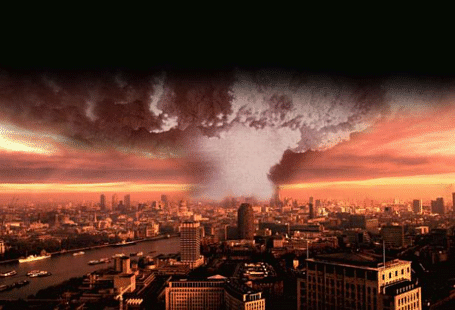 The nuclear mistakes that nearly caused World War Three , From invading animals to a faulty computer chip worth less than a dollar, the alarmingly long list of close calls shows just how easily nuclear war could happen by mistake. https://www.bbc.com/future/article/20200807-the-nuclear-mistakes-that-could-have-ended-civilisation By Zaria Gorvett, 10th August 2020 The nuclear mistakes that nearly caused World War Three , From invading animals to a faulty computer chip worth less than a dollar, the alarmingly long list of close calls shows just how easily nuclear war could happen by mistake. https://www.bbc.com/future/article/20200807-the-nuclear-mistakes-that-could-have-ended-civilisation By Zaria Gorvett, 10th August 2020It was the middle of the night on 25 October 1962 and a truck was racing down a runway in Wisconsin. It had just moments to stop a flight. Mere minutes earlier, a guard at Duluth Sector Direction Center had glimpsed a shadowy form attempting to climb the facility’s perimeter fence. He shot at it and raised the alert, fearing that this was part of a wider Soviet attack. Instantly, intruder alarms were ringing at every air base in the area. The situation escalated remarkably quickly. At nearby Volk Field, an air base, someone flicked the wrong switch – so rather than the standard security warning, pilots heard an emergency siren telling them to scramble. Soon there was a frenzy of activity, as they rushed to take to the skies, armed with nuclear weapons. Continue reading |
Beirut explosion was not an atomic bomb
The Beirut explosion created a huge mushroom cloud and visible blast wave, but nuclear-weapons experts say it wasn’t an atomic bomb. Here’s why. Business Insider , DAVE MOSHER, AUG 5, 2020,
- An explosion at a port rocked the Lebanese capital city of Beirut on Tuesday, killing at least dozens of people.
- As videos of the explosion spread across social-media sites, some observers likened the appearance of a mushroom cloud to that of an atomic bomb.
- The Lebanese prime minister has said the blast came from a stockpile of ammonium nitrate in a warehouse.
- Nuclear-weapons experts say the detonation was definitely not triggered by an atomic bomb.
- Atomic explosions are characterised by a blinding flash of light, a pulse of searing heat, and radioactive fallout, none of which were detected…………. https://www.businessinsider.com.au/beirut-explosion-not-nuclear-bomb-despite-mushroom-cloud-no-flash-2020-8?r=US&IR=T
Fire at the Belleville nuclear power plant reveals the disorganization of EDF
  Le Journal de l’Energie 30th July 2020 A fire at the Belleville nuclear power plant reveals the disorganization of Le Journal de l’Energie 30th July 2020 A fire at the Belleville nuclear power plant reveals the disorganization ofEDF. A fire broke out at the Belleville-sur-Loire (Cher) nuclear power plant in April 2020 during a routine maintenance operation carried out by subcontractors, which should not have been left unattended. An incident that was largely avoidable if EDF had followed basic safety rules. An
inspection by the Nuclear Safety Authority (ASN), after the incident, identified “many deviations”. Although the incident did not have an impact on the operation of the plant, it calls into question the safety culture of EDF, the world’s leading nuclear operator. https://journaldelenergie.com/nucleaire/incendie-centrale-nucleaire-belleville-desorganisation-edf/ |
|
Who flew drones over the nuclear reactors?
|
Mystery at Arizona’s Palo Verde nuclear plant: Who flew drones over the reactors? AZ Central,
Ryan RandazzoArizona Republic, Security guards at Palo Verde Nuclear Generating Station west of Phoenix noticed something odd on a September night last year.Five or six drones buzzed over the perimeter fence of the nuclear plant— the largest power generator in the United States — 50 miles west of Phoenix. They went across the open desert where security guards practice “force-on-force” simulated combat drills to sharpen their skills to ward off an assault, over heavy-duty gates and arrived at the protected area around the concrete-domed reactors. They stayed for nearly an hour, and came back the next night for a repeat performance. Nobody except the drones’ pilots knows whether this was a case of hobbyists touring the plant out of curiosity, or something much more nefarious, intended to disrupt a massive power source for customers from Texas to California. And nobody in any official capacity seems to know who piloted the drones that night or the next……… Security guards at Palo Verde Nuclear Generating Station west of Phoenix noticed something odd on a September night last year. Five or six drones buzzed over the perimeter fence of the nuclear plant— the largest power generator in the United States — 50 miles west of Phoenix. They went across the open desert where security guards practice “force-on-force” simulated combat drills to sharpen their skills to ward off an assault, over heavy-duty gates and arrived at the protected area around the concrete-domed reactors. They stayed for nearly an hour, and came back the next night for a repeat performance. Nobody except the drones’ pilots knows whether this was a case of hobbyists touring the plant out of curiosity, or something much more nefarious, intended to disrupt a massive power source for customers from Texas to California. And nobody in any official capacity seems to know who piloted the drones that night or the next……… Security guards at Palo Verde Nuclear Generating Station west of Phoenix noticed something odd on a September night last year. Five or six drones buzzed over the perimeter fence of the nuclear plant— the largest power generator in the United States — 50 miles west of Phoenix. They went across the open desert where security guards practice “force-on-force” simulated combat drills to sharpen their skills to ward off an assault, over heavy-duty gates and arrived at the protected area around the concrete-domed reactors. They stayed for nearly an hour, and came back the next night for a repeat performance. Nobody except the drones’ pilots knows whether this was a case of hobbyists touring the plant out of curiosity, or something much more nefarious, intended to disrupt a massive power source for customers from Texas to California. And nobody in any official capacity seems to know who piloted the drones that night or the next……. The Palo Verde incidents are apparently not the first time something like this has happened. One NRC email discusses “several high-speed” drone overflights of the Limerick Generating Station in Pennsylvania approximately eight months prior. Another indicates there had been 42 drone incidents in three years. APS officials said some of those were at Palo Verde. What if the pilots meant harm?At least one person in the NRC was concerned last year that an airspace restriction from the FAA wasn’t sufficient. “I would point out that restricted airspace will do nothing to stop an adversarial attack and even the detection systems identified earlier in this email chain have limited success rates, and there is even lower likelihood that law enforcement will arrive quickly enough to actually engage with the pilots,” wrote Joseph Rivers, a senior security adviser with the Nuclear Regulatory Commission who recently retired…… A columnist for Forbes went even further, speculating that the drones could have made three-dimensional maps of the power plant to assist a later attack. …… https://www.azcentral.com/story/money/business/energy/2020/07/31/drones-flew-over-palo-verde-nuclear-plant-arizona-pilots-unknown/5551928002/ |
|
|
Mystery over drone swarm above America’s largest nuclear power station
‘Drone Swarm’ Invaded Palo Verde Nuclear Power Plant Last September — Twice Forbes Jul 30, 2020, David Hambling
Documents gained under the Freedom of Information Act show how a number of small drones flew around a restricted area at Palo Verde Nuclear Power Plant on two successive nights last September. Security forces watched, but were apparently helpless to act as the drones carried out their incursions before disappearing into the night. Details of the event gives some clues as to just what they were doing, but who sent them remains a mystery.
Details of the events were obtained from the Nuclear Regulatory Commission by Douglas D. Johnson on behalf of the Scientific Coalition for UAP Studies (SCU) using the Freedom of Information Act (FOIA). The SCU’s main interest is in anomalous aerospace phenomena, what other people term UFOs. In this case though the flying objects were easily identifiable as drones, although their exact mission and origin are unknown. Johnson passed the information to The War Zone who give a detailed account.
Palo Verde Nuclear Power Plant is the largest in the U.S., producing over three gigawatts, 35% of Arizona’s total power capacity. It supplies electricity to Phoenix and Tucson, as well as San Diego and Los Angeles. It is a critical piece of strategic infrastructure; during the 2003 Iraq War, National Guard troops were deployed to Palo Verde to defend against a possible terrorist threat. In normal times, as with other nuclear installations, it is protected by armed security guards.
The armed guards, gates, fences and barriers were useless on the night of September 29th. According to the official report:
Officer noticed several drones (5 or 6) flying over the site. The drones are circling the 3 unit site inside and outside the Protected Area. The drones have flashing red and white rights [sic] and are estimated to be 200 to 300 hundred [sic] feet above the site. It was reported the drones had spotlights on while approaching the site that they turned off when they entered the Security Owner Controlled Area. Drones were first noticed at 20:50 MST and are still over the site as of 21:47 MST. Security Posture was normal, which was changed to elevated when the drones were noticed.”
The drones departed at 22:30, eighty minutes after they were first spotted. The security officers estimated that they were over two feet in diameter. This indicates that they were not simply consumer drones like the popular DJI Phantom, which have a flight endurance of about half an hour and is about a foot across, but something larger and more capable. The Lockheed Martin Indago, a military-grade quadcopter recently sold to the Swiss Army, has a flight endurance of about seventy minutes and is more than two feet across. At several thousand dollars apiece minimum, these are far less expendable than consumer drones costing a few hundred. All of which suggests this was not just a prank.
The next night events were repeated:…….
Despite this incident, two months later the NRC decided not to require drone defenses at nuclear plants, asserting that small drones could not damage a reactor or steal nuclear material. It is highly likely that such sites are still vulnerable to drone overflights.
Are such drones a genuine threat to nuclear facilities?…….
their ability to strike pinpoint targets to hit control systems and failsafes. While this would be unlikely to cause a Chernobyl, it might well shut the plant down, taking out 35% of Arizona’s electricity at a stroke. The successful attack on the Abqaiq facility last year, in which about twenty garage-built drones knocked out a heavily-defended oil facility in Saudi Arabia, should be a wakeup call that such unmanned precision strikes are not just the preserve of state actors any more………
the intruders, as well as establishing that Palo Verde lacks effective drone defenses, may now have highly detailed maps of the facility, showing the exact location of every valve, pipe, switch and control. Perhaps they simply aim to sell these on the dark web to anyone who will pay. Or perhaps they have something else in mind. Either way, it is an alarming demonstration of how easily drone intruders can now go anywhere anytime they wish. https://www.forbes.com/sites/davidhambling/2020/07/30/drone-swarm-invaded-palo-verde-nuclear-power-plant/#78cb15aa43de
Mysterious case of mass drone incursions over America’s most powerful nuclear power plant
The Night A Drone Swarm Descended On Palo Verde Nuclear Power Plant, The Drive, BY TYLER ROGOWAY AND JOSEPH TREVITHICK JULY 29, 2020
The mysterious case of mass drone incursions over America’s most powerful nuclear power plant that only resulted in more questions and no changes.
While the news has been filled with claims that strange unidentified craft with unexplainable capabilities are appearing over highly sensitive U.S. installations and assets as of late, a much less glamorous, more numerous, and arguably far more pressing threat has continued to metastasize in alarming ways—that posed by lower-end and even off-the-shelf drones. Less than a year ago and just days after the stunning drone attacks on Saudi Arabia’s most critical energy production infrastructure deep in the heart of that highly defended country, a bizarre and largely undisclosed incident involving a swarm of drones occurred on successive September evenings in 2019. The location? America’s most powerful nuclear plant, the Palo Verde Nuclear Generation Station situated roughly two dozen miles west to Phoenix, near Tonopah, Arizona.
In a trove of documents and internal correspondences related to the event, officials from the Nuclear Regulatory Commission (NRC) described the incident as a “drone-a-palooza” and said that it highlighted concerns about the potential for a future “adversarial attack” involving small unmanned aircraft and the need for defenses against them. Even so, the helplessness and even cavalier attitude toward the drone incident as it was unfolding by those that are tasked with securing one of America’s largest and most sensitive nuclear facilities serves as an alarming and glaring example of how neglected and misunderstood this issue is.
What you are about to read is an unprecedented look inside a type of event that is less isolated in nature than many would care to believe.
A Rapidly Accelerating Threat
India’s nuclear power industry – unsafe and shrouded in secrecy
 The alarming safety record of India’s nuclear power plants https://tribune.com.pk/article/97109/the-alarming-safety-record-of-indias-nuclear-power-plants In 2016, an emergency was declared when the nuclear plant at Kakrapar was shut down after a major water leak, Syed Zain Jaffery, July 28, 2020
The Indian nuclear power industry is still veiled in confidentiality and opacity while refusing to reveal its safety details. Prominent environmental watchdogs have already voiced apprehensions about safety standards adopted by the nuclear establishment, where technical negligence or poor maintenance is commonplace, and regulatory bodies in India habitually sweep major nuclear accidents under the carpet. The production of nuclear energy is regulated in secrecy by a government body known as the Nuclear Power Corporation of India (NPCIL).
It is no mystery as to why India is reluctant to establish a completely autonomous and politically neutral nuclear oversight authority to discretely operate from the industry it oversees. The nuclear disaster in Fukushima demonstrated the significance of independent nuclear oversight. India’s persistent refusal to create an independent regulatory body shows a lack of confidence in maintaining standards which are internationally recognised.
The former chairman and managing director of Nuclear Power Corporation, S.K. Jain, was of the view that,
This entire episode shows the lack of awareness in India regarding upholding proper safety procedures through a timely tackling of any evolving threats.
Alarmingly, Indian nuclear engineers failed to investigate the exact reason for the leakage. The central government unpublicised the incident and did not even allow ordinary citizens to use geiger-counters to measure radiation. Shockingly, New Delhi has prohibited the use of geiger-counters, which is a global norm, under the vague excuse of national security. An on-site emergency at Kakrapar nuclear power plant and the circumstance that led to the major leakage raises many questions regarding Indian nuclear expertise.
Syed Zain Jaffery The author holds a Masters degree from NUST, Islamabad and writes about current affairs and politics.
A series of accidents and near misses between surface vessels and submarines in the waters round Scotland.
The National 26th July 2020, IN a crowded field for shocking headlines this past month, readers may not
have noticed news of an alarming near-miss between a Royal Navy nuclear
submarine and a ferry on the Belfast-Cairnryan crossing.
The Maritime Accident Investigation Branch’s recently published analysis of this
incident makes for worrying reading and follows on from a series of
similarly dangerous accidents between surface vessels and submarines in the
waters round Scotland.
https://www.thenational.scot/news/18607663.scots-deserve-free-nuclear-sub-risks/
Cause of blast at Iran nuclear site – still shrouded in mystery
Iranian MP: Blast at nuclear site was ’caused by a security breach’ https://www.timesofisrael.com/iranian-mp-blast-at-nuclear-site-was-caused-by-a-security-breach/ Javad Karimi Qoddousi rules out a strike ‘by an external object’ as the cause of a fire that damaged an advanced centrifuge plant at Natanz
By TOI STAFF 22 July 20,
A building damaged by a fire, at the Natanz uranium enrichment facility some 200 miles (322 kilometers) south of the capital Tehran, Iran, in a photo released on July 2, 2020. (Atomic Energy Organization of Iran via AP)
An Iranian lawmaker said Wednesday that a recent blast and fire at the Natanz nuclear site was caused by a “security breach.”
MP Javad Karimi Qoddousi, a member of the Iranian parliament’s National Security Committee, ruled out “a strike on the complex by an external object” as the cause of the blast, appearing to deny the possibility of a missile attack or airstrike.
“If it was from the outside, we should have seen shrapnel, but there are absolutely no remnants left on the site,” he said, according to Radio Farda.
Qoddousi did not elaborate on what he meant by a “security breach.” Radio Farda noted the Persian term he used can also be translated as an infiltration of security, suggesting the blast came from inside the building.
The blast, which US media reports have attributed to Israel, damaged an advanced centrifuge development and assembly plant.
According to a New York Times report earlier this month, the blast was most likely the result of a bomb planted at the facility, potentially at a strategic gas line, but that it was not out of the question that a cyberattack was used to cause a malfunction that led to the explosion.
The July 2 Natanz explosion was one of a series of mysterious blasts at Iranian strategic sites in recent weeks, which have once again been largely attributed to either Washington, Jerusalem, or both.
The substantial damage done by an explosion and a fire at an advanced centrifuge assembly plant at Iran’s Natanz nuclear site. (satellite image from Planet Labs Inc. via AP)
Intelligence officials who assessed the damage to the Netanz centrifuge facility told The Times they believed it may have set back the Iranian nuclear program by as much as two years.
A spokesman for Iran’s foreign ministry has said that the cause of the Natanz explosion was not yet known, but warned that the country would retaliate severely if it emerges that a foreign entity was involved.
Iran has also called for action against Israel following the damage to the Natanz facility. “This method Israel is using is dangerous, and it could spread to anywhere in the world,” government spokesman Ali Rabiei said, during a press conference on July 7.
Iran says world ‘must respond’ to Israel after blast at nuclear site
|
Iran says world ‘must respond’ to Israel after blast at nuclear site, Times of Israel, Government spokesman calls for ‘limits to these dangerous actions by the Zionist regime’; Mideast official says explosion at Natanz was meant as a ‘wake-up call’ to Tehran By TOI STAFF7 July 2020, Iran on Tuesday called for action against Israel, following a recent blast at the Natanz nuclear facility that has been blamed on the Jewish state.
“This method Israel is using is dangerous, and it could spread to anywhere in the world,” government spokesman Ali Rabiei said during a press conference, according to a translation of his remarks by Israel’s Channel 12 news. He added: “The international community must respond and set limits to these dangerous actions by the Zionist regime.” His comments came as Iran appeared to publicly acknowledge on Tuesday that last week’s fire at Natanz, which badly damaged a building used for producing centrifuges, was not an accident. Israeli TV reports, without naming sources, have said the blast destroyed the laboratory in which Iran developed faster centrifuges and set back the Iranian nuclear program by one or two years. Nour News, seen as a mouthpiece of Iran’s Supreme Council of National Security, claimed that the blast at the Natanz facility, which came amid a series of mysterious disasters that struck sensitive Iranian sites in recent days, bore similarity to other strikes against the country’s security infrastructure. While asserting that “an airstrike on the Natanz plant is almost impossible” due to its strong air defenses, an article on the site said that “the combination of intelligence, logistics, action and the volume of destruction” prove that the incident was deliberate. The Washington Post and New York Times quoted Middle Eastern officials earlier this week as saying the blast at Natanz was caused by a large bomb planted by Israeli operatives…….. A member of the Revolutionary Guard confirmed to the Times on Sunday that an explosive was used, but didn’t specify who was responsible. ….. The building at Natanz was constructed in 2013 for the development of advanced centrifuges, though work was halted there in 2015 under the nuclear deal with world powers, Iran’s atomic agency spokesman Behrouz Kamalvandi said earlier this week. When the United States withdrew from the nuclear deal, work there was renewed, Kamalvandi said. He claimed the fire had damaged “precision and measuring instruments,” and that the center had not been operating at full capacity due to restrictions imposed by the nuclear deal. Iran began experimenting with advanced centrifuge models in the wake of the US unilaterally withdrawing from the deal two years ago…….. https://www.timesofisrael.com/iran-says-world-must-respond-to-israel-after-blast-at-nuclear-site/ |
|
1 This Month
6 June – WEBINAR- Get Inspired by Protests Against Military Bases!


Cuba Is Not a Failed State – It Is a Besieged State
PETITION: “Global Appeal to Endorse Palestinian Right of Return of Refugees”


of the week– Nuclear Reactor Information Task Force
To see nuclear-related stories in greater depth and intensity – go to https://nuclearinformation.wordpress.com
-
Archives
- June 2026 (27)
- May 2026 (306)
- April 2026 (356)
- March 2026 (251)
- February 2026 (268)
- January 2026 (308)
- December 2025 (358)
- November 2025 (359)
- October 2025 (376)
- September 2025 (257)
- August 2025 (319)
- July 2025 (230)
-
Categories
- 1
- 1 NUCLEAR ISSUES
- business and costs
- climate change
- culture and arts
- ENERGY
- environment
- health
- history
- indigenous issues
- Legal
- marketing of nuclear
- media
- opposition to nuclear
- PERSONAL STORIES
- politics
- politics international
- Religion and ethics
- safety
- secrets,lies and civil liberties
- spinbuster
- technology
- Uranium
- wastes
- weapons and war
- Women
- 2 WORLD
- ACTION
- AFRICA
- Atrocities
- AUSTRALIA
- Christina's notes
- Christina's themes
- culture and arts
- Events
- Fuk 2022
- Fuk 2023
- Fukushima 2017
- Fukushima 2018
- fukushima 2019
- Fukushima 2020
- Fukushima 2021
- general
- global warming
- Humour (God we need it)
- Nuclear
- RARE EARTHS
- Reference
- resources – print
- Resources -audiovicual
- Weekly Newsletter
- World
- World Nuclear
- YouTube
-
RSS
Entries RSS
Comments RSS
 nuclear-news