ECNS 30th April 2021, Tokyo Electric Power Company Holdings Inc. (TEPCO), the operator of the Fukushima Daiichi nuclear plant in Japan’s northeast said last week a container holding radioactive waste at the site of the plant may have leaked, Japan’s Asahi Shimbun reported Friday last week.
The TEPCO said some gel-like blocks with large amount of radiation were found last month at the site where the containers were kept, and the situation is under investigation, according to the newspaper. The containers have been stacked in three layers, and the top container has become rusted and corroded, causing liquid accumulation, said the company. The sides of the two lower containers have been contaminated with radioactive materials, and it is believed that the liquid leaking from the top container may have made its way to the ground through the containers below, according to the company.
The relevant containers have been moved to an indoor storage facility. The concentration of radioactive materials that emit beta rays in the gel-like blocks was 230,000 becquerels per gram, according to the report.
Feds: Nuclear waste tank at Hanford Nuclear Reservation may be leaking, Statesman Journal NICHOLAS K. GERANIOS, 30 Apr 21, Associated Press SPOKANE, Wash. (AP) — An underground nuclear waste storage tank in Washington state that dates to World War II appears to be leaking contaminated liquid into the ground, the U.S. Department of Energy said Thursday.
It’s the second tank believed to be leaking waste left from the production of plutonium for nuclear weapons at the Hanford Nuclear Reservation. The first was discovered in 2013. Many more of the 149 single-walled storage tanks at the site are suspected of leaking.
Tank B-109, the latest suspected of leaking, holds 123,000 gallons of radioactive waste. The giant tank was constructed during the Manhattan Project and received waste from Hanford operations between 1946 to 1976.
The Hanford site near Richland in the southeastern part of the state produced about two-thirds of the plutonium for the nation’s nuclear arsenal, including the bomb dropped on Nagasaki, Japan, and now is the most contaminated radioactive waste site in the nation.
A multi-billion dollar environmental cleanup has been underway for decades at the sprawling Hanford site.
The Washington state Department of Ecology and the U.S. Environmental Protection Agency were notified Thursday that the tank was likely leaking…….
A 20-second shut down of the Chernobyl nuclear power plant on 26 April 1986, created a surge that led to a chemical explosion, which released nearly 520 dangerous radionuclides into the atmosphere. As a result, large parts of the former Soviet Union were contaminated; territory which now lies within the borders of Belarus, Ukraine and Russia, according to the UN.
Marking the 35th anniversary of the accident, Secretary-General António Guterres said that together, “we can work to prevent and contain [disasters]… support all those in need, and build a strong recovery”
Never forget
As one of the most serious nuclear accidents in history, nearly 8.4 million people in the three countries were exposed to radiation, according to the UN.
Some 350,000 were forced to leave their homes in severely contaminated areas, which left a deeply traumatic and lasting impact on their lives: “Their suffering must not be forgotten”, said the top UN official.
He also pointed to the anniversary as an occasion to recognize the recovery efforts led by the three governments as well as the work of “scientists who sifted through the evidence” to provide important analysis that has informed emergency planning and reduced risks.
A legacy of assistance
While the Organization had helped the people in the areas surrounding Chernobyl at the onset, four years after the accident the Soviet Government acknowledged the need for international assistance.
That same year, 1990, the General Assembly adopted a resolution calling for “international cooperation to address and mitigate the consequences at the Chernobyl nuclear power plant”. This began the UN’s participation in the recovery effort.
And in 2019, a new safety casing over the old shelter was completed and given to the Government of Ukraine. It was achieved with €2.2 billion in donations from over 45 nations.
The UN said the milestone one of the largest ever seen projects in terms of international cooperation in the field of nuclear safety.
Working for ‘the common good’
UN country teams – working with civil society, international partners and donors – first supported emergency and humanitarian aid, then recovery and finally social and economic development, Mr. Guterres noted, adding that “our joint efforts have enjoyed some success”.
He cited that the number of small and medium-sized businesses operating in areas directly affected by the disaster has risen from 2,000 in 2002 to 37,000 today.
And thousands of residents, community leaders and doctors have been trained on health risks and promoting healthy lifestyles.
The Chernobyl disaster was contained by governments working with academics, civil society and others, “for the common good”, the UN chief said.
“It holds important lessons for today’s efforts to respond to the COVID-19 pandemic”, he concluded.
Sri Lanka expels ship carrying nuclear material for China, Channel News Asia, 22 Apr 21, COLOMBO: Sri Lankan authorities on Wednesday (Apr 21) expelled an Antigua-registered ship that entered the island’s territory without declaring a radioactive cargo bound for China.
The country’s Atomic Energy Regulatory Council said the MV BBC Naples was asked to leave after it was found to be in the Chinese-run port of Hambantota on Tuesday night carrying uranium hexafluoride.
“The ship failed to declare its dangerous cargo – uranium hexafluoride – and we decided to order it to leave our waters immediately,” council director general Anil Ranjith told AFP.
The ship had come from Rotterdam but authorities did not say where in China it was headed.
Ranjith said it was an offence to enter a port without declaring the material, which is used to enrich uranium, the fuel for nuclear power stations and weapons.
Sri Lanka’s opposition leader Sajith Premadasa demanded an investigation into the incident, describing it as a serious safety threat……
The entry of two Chinese submarines into Colombo in 2014 angered neighbouring India, the traditional regional power which is competing with Beijing for influence in the Indian Ocean.
Independent 17th April 2021, Iran has named a suspect it alleges is responsible for the attack on the country’s nuclear facility in Natanz. The incident at the country’s main uranium enrichment facility last week – which Tehran quickly blamed on Israel – cast a shadow over vital ongoing talks in Vienna aimed at salvaging the international deal intended to block Iran’s route to creating a nuclear arsenal.
Guardian 11th April 2021, A spokesman for Iran’s civilian nuclear programme said an “accident” struck the electrical distribution grid of the Natanz nuclear facility, a day after the government announced it was starting up new uranium enrichment centrifuges.
Behrouz Kamalvandi announced the accident on Sunday, saying there were no injuries and no pollution. A mysterious explosion in July 2020 damaged Natanz’s advanced centrifuge facility, with Iran later calling the incident sabotage. Iran had announced on Saturday that it had started up advanced uranium enrichment centrifuges at Natanz, in a breach of its undertakings under the 2015 nuclear deal, days after the start of talks on rescuing the accord.
Iran says it has begun mechanical tests on its newest advanced nuclear centrifuges, even as the five world powers that remain in a foundering 2015 nuclear deal with Iran attempt to bring the U.S. back into the agreement.
Concerns over nuclear safety ‘lapse’ at Hunterston, The Ferret , Rob Edwards-March 22, 2021
The discovery of a highly radioactive nuclear fuel element at Hunterston in North Ayrshire has sparked concerns about an “alarming safety lapse”.
The site’s local stakeholder group says this is “something that should not have happened” and is demanding answers from nuclear safety regulators. Campaigners claim it’s a “dangerous situation”……….
The UK Government company that runs the site promises the fuel element is “in a safe and controlled environment”. Its discovery was “completely expected” and more old fuel may be found, it says.
A fuel element is a long, thin metallic tube containing pellets of uranium. When burnt — or irradiated – in a reactor, it produces dozens of different radioactive materials, including plutonium, and becomes intensely radioactive.
Fuel elements burnt in the now defunct Hunterson A nuclear power station should have been sent to the Sellafield nuclear complex in Cumbria. There, they would have been processed and separated into low-level, medium-level and high-level radioactive waste, as well as plutonium.
But on 3 March 2021 workers emptying an old storage vault at Hunterston discovered an entire 64-centimetre fuel element amongst other radioactive waste. The find was reported to the UK Office for Nuclear Regulation, the Scottish Environment Protection Agency, and the local site stakeholder group.
Hunterston A was a first generation Magnox nuclear station with two reactors that operated from 1964 to 1990 and is currently being decommissioned. It is on the Firth of Clyde adjacent to the Hunterston B nuclear station, whose two reactors are due to close down by January 2022 after the discovery of hundreds of cracks in their graphite cores.
The Hunterston site stakeholders group, which represents local community interests, said it had been informed of the find on 8 March. The fuel element was discovered in the last of five old vaults being emptied of medium-level radioactive waste, it said.
“For a complete fuel rod to have found its way there, instead of into the cooling pond and on to Sellafield, is something, that should not have happened,” said a joint statement from the group’s chair, Rita Holmes, and vice-chair, Stuart McGhie.
“We have contacted the Office of Nuclear Regulation and asked several questions. They have assured us that they will be in touch by the 13 April. Till then, one can only speculate.”…………
The 50-strong group of UK nuclear-free authorities called for a full investigation. “This incident appears to be an alarming safety lapse that has not been resolved in the way it should have been,” said the group Scottish convenor, Glasgow SNP councillor, Feargal Dalton.
“Highly radioactive spent fuel, containing the likes of plutonium, should not be dumped in a vault at Hunterston A, but rather be sent to Sellafield where the appropriate waste management processes are in place.”
Dalton pointed out that The Ferret reported in 2020 that radioactive waste had been detected in a supposed empty fuel flask sent from Sellafield to the Hunterston B plant. “The Office for Nuclear Regulation needs to fully investigate this concerning safety breach,” he added.
The Edinburgh based nuclear consultant and critic, Pete Roche, said: “This dangerous situation illustrates that, when it comes to dealing with nuclear waste, human error is always going to be a potential problem.
“Thank goodness successive Scottish governments have decided to eschew building new reactors and make the most of our plentiful renewable resources instead. Dealing with our legacy nuclear waste is going to be difficult enough without creating yet more as the Westminster government is doing.”…………
Japanese nuclear regulators have assessed a security lapse at the Kashiwazaki-Kariwa nuclear plant in Niigata Prefecture as being at the most serious level in terms of anti-terror measures.
The Nuclear Regulation Authority was notified by the plant’s operator, Tokyo Electric Power Company, in January that a worker accidentally damaged sensor equipment for detecting intruders.
On Tuesday, the result of an investigation of the plant was reported at an NRA closed-door meeting.
The probe found that other sensor equipment may have remained broken since March of last year, making the plant vulnerable to intruders for months.
The NRA revealed that TEPCO employees in charge of security did nothing despite knowing that alternative measures taken were ineffective.
The NRA’s provisional assessment of the security lapse was that it was the most serious on a four-level scale of risks in safeguarding nuclear material.
The authority members plan to consider punishment for the utility as soon as the assessment is finalized.
Last September, another problem took place at the plant. An employee entered the plant’s central control room illegally, using another employee’s ID card.
Fears of Chernobyl-style disaster after 25 safety breaches at Sellafield nuclear plant There have been burst pipes, unstable chemicals, radiation leaks, a cooling tower failure and two plant evacuations in less two years at the site in Cumbria. MirrorBy John Siddle, 13 MAR 2021
Safety breaches at Sellafield have raised fears of a Chernobyl-style disaster.
Campaigners worry that incidents at Europe’s largest nuclear plant in Cumbria could lead to a blast bigger than the 1986 Ukraine horror.
An official report logs 25 breaches in less than two years, including burst pipes, unstable chemicals, radiation leaks, a cooling tower failure and two plant evacuations.
The bomb squad was called in last August after chemicals “changed state”.
Janine Allis-Smith, of a local anti-nuke group, says campaigners “fear an explosion that would make Chernobyl look like a tea party”.
La Presse de la Manche 19th Feb 2021, The EDF power plant in Flamanville (Manche) declared, on Friday February 19, 2021, a level 1 event concerning the diesel of production unit n ° 1, still at a standstill. The management of the Flamanville 1-2 nuclear power plant (Manche) declared, on Friday February 19, 2021, a significant safety event at level 1 of the INES scale, with the Nuclear Safety Authority .
Nuclear Rockets to Mars?, BY KARL GROSSMAN– CounterPunch, 16 Feb 21”…………There have been accidents in the history of the U.S.—and also the former Soviet Union and now Russia—using nuclear power in space.
And the NAS report, deep into it, does acknowledge how accidents can happen with its new scheme of using nuclear power on rockets for missions to Mars.
It says: “Safety assurance for nuclear systems is essential to protect operating personnel as well as the general public and Earth’s environment.” Thus under the report’s plan, the rockets with the nuclear reactors onboard would be launched “with fresh [uranium] fuel before they have operated at power to ensure that the amount of radioactivity on board remains as low as practicable.” The plans include “restricting reactor startup and operations in space until spacecraft are in nuclear safe orbits or trajectories that ensure safety of Earth’s population and environment” But, “Additional policies and practices need to be established to prevent unintended system reentry during return to Earth after reactors have been operated for extended periods of time.”
The worst U.S. accident involving the use of nuclear power in space came in 1964 when the U.S. satellite Transit 5BN-3, powered by a SNAP-9A plutonium-fueled radioisotope thermoelectric generator, failed to achieve orbit and fell from the sky, disintegrating as it burned up in the atmosphere, globally spreading plutonium—considering the deadliest of all radioactive substances. That accident was long linked to a spike in global lung cancer rates where the plutonium was spread, by Dr. John Gofman, an M.D. and Ph. D., a professor of medical physics at the University of California at Berkeley. He also had been involved in developing some of the first methods for isolating plutonium for the Manhattan Project.
NASA, after the SNAP-9A (SNAP for Systems Nuclear Auxiliary Power) accident became a pioneer in developing solar photovoltaic power. All U.S. satellites now are energized by solar power, as is the International Space Station.
The worst accident involving nuclear power in space in the Soviet/Russian space program occurred in 1978 when the Cosmos 954 satellite with a nuclear reactor aboard fell from orbit and spread radioactive debris over a 373-mile swath from Great Slave Lake to Baker Lake in Canada. There were 110 pounds of highly-enriched (nearly 90 percent) of uranium fuel on Cosmos 954.
Highly-enriched uranium—90 percent is atomic bomb-grade—would be used in one reactor design proposed in the NAS report. And thus there is a passage about it under “Proliferation and security.” It states that “HEU [highly enriched uranium] fuel, by virtue of the ease with which it could be diverted to the production of nuclear weapons, is a higher value target than HALEU [high assay low enriched uranium], especially during launch and reentry accidents away from the launch site. As a result, HEU is viewed by nonproliferation experts as requiring more security considerations. In addition, if the United States uses HEU for space reactors, it could become more difficult to convince other countries to reduce their use of HEU in civilian applications.”
An earthquake of 7.1 degrees on the Ritcher scale shook eastern Japan that Saturday (02/13/2021) and was strongly felt in Tokyo, without the Japanese authorities activating the tsunami warning for the moment.
Highest seismic activity before an earthquake occurs, are zero. The radioactivity contained in the pools of water that accumulate is a minor problem within this frame. We also remember that Japan’s nuclear program is a consequence of the unconditional surrender imposed by the U.S. after the Second War, to have control in the fissile material zone and lay its largest base on the island of Okinawa.
It was not an accident.
It’s not an earthquake fault.
It was the deliberate action of a conquest strategy, which made Japan a time bomb for all humanity.
Powerful magnitude 7.3 earthquake jolts Fukushima area, Japan Times 14 Feb 21, A powerful magnitude 7.3 earthquake struck late Saturday off the coast of Tohoku, leaving at least 50 people injured and knocking multiple power plants offline.
The quake, which measured a strong 6 on the Japanese seismic intensity scale — the second-highest level — jolted Miyagi and Fukushima prefectures in the Tohoku region. No tsunami warning was issued.
The injuries were reported in Miyagi and Fukushima prefectures, but it was not immediately clear if anyone was seriously hurt.
Nationwide, at least 950,000 homes were without power as of midnight, top government spokesman Katsunobu Kato said at a news conference. Kato later said that multiple power plants in the nation were offline.
A government source said the power outage situation was expected to improve through the early hours of Sunday but that more time would be needed in the Tohoku region.
The quake, which was also felt in Tokyo, where it registered a 4 on the Japanese scale, struck at around 11:07 p.m., according to the Meteorological Agency. The epicenter was off the coast of Fukushima, about 220 kilometers (135 miles) north of Tokyo. Its focus was estimated to be at a depth of about 55 kilometers.
At a news conference early Sunday morning, a Meteorological Agency official said aftershocks of up to a strong 6 on the Japanese scale could occur for at least a week. The official said Saturday’s quake was believed to be an aftershock of the Great East Japan Earthquake that struck the same region on March 11, 2011.
“Because (the 2011 quake) was an enormous one with a magnitude of 9.0, it’s not surprising to have an aftershock of this scale 10 years later,” said Kenji Satake, a professor at the University of Tokyo’s Earthquake Research Institute.
The quake registered a strong 6 in the southern part of Miyagi, and in the Nakadori central and Hamadori coastal regions of Fukushima, the agency said…….
No abnormalities have been found at the Fukushima Nos. 1 and 2 nuclear power plants, according to Tokyo Electric Power. The same was true for Japan Atomic Power Co.’s inactive Tokai No. 2 nuclear power plant in the village of Tokai in Ibaraki Prefecture and Tohoku Electric Power Co.’s Onagawa nuclear plant in Miyagi Prefecture, according to their operators……….
Prime Minister Yoshihide Suga immediately directed government agencies to assess damage, rescue any potential victims, work with municipalities and provide necessary information about any evacuation plans and damage as soon as possible. The government was setting up a task force to examine the quake.
Defense Minister Nobuo Kishi directed the Self-Defense Forces to gather information on the scope of the damage and be prepared to respond immediately.
The quake, which comes less than a month before the 10th anniversary of the Great East Japan Earthquake, registered a 4 on the Japanese scale as far north as Aomori Prefecture and as far west as Shizuoka Prefecture. It was the strongest quake in the region since April 7 that year, the meteorology agency said.
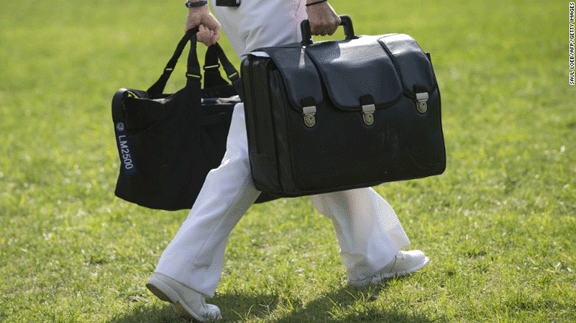
The dramatic footage of the 6 January insurrection shows the mob was within 30 metres of Mike Pence, when he made his escape. But there was a chilling detail that even the House prosecutors missed. With the then vice-president on that terrifying day, was an air force officer carrying the “football”, a large black briefcase carrying nuclear launch codes.
The codes in the vice-president’s football are not activated unless the president is dead or incapacitated. But the implications of it falling into the hands of rioters are still chilling.
“If the mob had seized Pence’s nuclear football, they may not have been able to order an actual launch but the public may not have known that,” Tom Collina, director of policy at the Ploughshares Fund disarmament advocacy group, said. “Parading the nuclear button around would have caused widespread panic and chaos as authorities scrambled to respond.”
The secret service bodyguards around Pence would most likely have defended the suitcase with deadly force, but if the pro-Trump mob had managed to seize it, they would have come away, not just with the codes used to identify the vice-president and authenticate his orders, but also the encrypted communications equipment used to make the call to the National Military Command Center in the Pentagon.
Most damaging of all, they would have all the nuclear attack options instantly available around the clock to the US commander-in-chief. That list of options used to be in a weighty handbook, but according to Fred Kaplan, author of The Bomb: Presidents, Generals, and the Secret History of Nuclear War, it has been condensed over the decades into a series of laminated cards, “like a menu at Wendy’s”, as one officer put it to Kaplan.
Not only would disclosure of that menu represent one of the worst security breaches imaginable, the encrypted communication equipment would tell an adversary a lot of how the US would respond to a major attack.
“They could glean all sorts of information about its structure and technology so it’s very significant,” said Hans Kristensen, director of the nuclear information project at the Federation of American Scientists.
Nuclear experts have questioned whether this cold war relic that provides such an obvious target for adversaries and terrorists, is still necessary. But the Trump era has also shone a bright light on the question of whether one individual should continue to have sole authority to launch the US nuclear arsenal.
Collina, co-author of The Button, a book on the presidency and nuclear weapons, said: “Of course the even bigger danger was that Trump had his own football that could have been used to end civilization as we know it.”
In other words, perhaps the only thing scarier than the football being surrounded by a mob is the thought of Trump being alone with it.
Koeberg Nuclear Power Station containment buildings suffer damage, ESI Africa, Feb 12, 2021 A recently released Eskom document has revealed that 40 years of exposure to sea air at Koeberg Nuclear Power Station has damaged the concrete of the containment buildings, according to Koeberg Alert Alliance.
At one stage the concrete containment dome was found to have cracked around the entire 110-meter circumference, states the Koeberg Alert Alliance.
“The containment buildings are the outer shells of the reactor buildings, built as pressure vessels to withstand the pressure if the reactors inside them ever malfunction and therefore prevent harmful radiation being leaked into the environment,” says DR, a member of Koeberg Alert Alliance and a retired analytical chemist.
“Where the chloride salts have entered, they have caused corrosion of the reinforcing steel bars, resulting in spalling and delamination of the concrete – it is even more alarming than I thought,” he says. Spalling results from water entering concrete which forces the surface to peel, pop out, or flake off. ……..
According to the Koeberg Alert Alliance, the provided 31-page report which refers to repairs done up until 2018, has eleven pages entirely blacked out and various other sections, photos and tables redacted with the reason given as “sensitive technical information”.
“The interesting parts are clearly those that have been redacted,” says University of Johannesburg Physics Professor, Hartmut Winkler. “The first big redact is titled History/Background and presumably describes past failures and recent damage that Koeberg Alert Alliance’s PAIA was interrogating. Why should the ‘History’ be sensitive due to technical information when the less redacted sections are full of technical details.
“The most puzzling redact to me are the references which are supposed to be publicly available documents, so why are they all being hidden? Do they expose some entities that Eskom does not want anyone to know have been involved with Koeberg and why? I would also query why the financial information would be redacted. Surely the public has a right to know how much money certain components cost, and what Eskom paid for them?” says Winkler.








 nuclear-news