The Windscale nuclear accident 1957, and still not cleaned up. – a warning from history
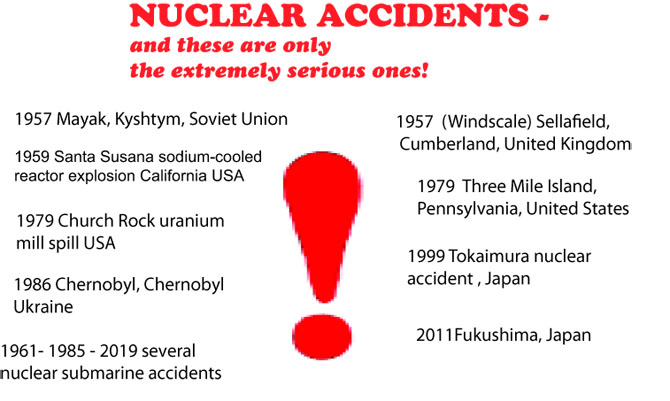
Nuclear power: the warnings from history. The PM wants to keep the lights
on with eight new atomic plants. He’s in denial if he thinks the
catastrophes of the past won’t happen again.
If Johnson is going to use nuclear history to justify his strategy, perhaps he needs to look a little
deeper, because Windscale was also the site of one of the world’s first
serious nuclear accidents. In October 1957, a fire raged for three days in
one of the reactors after changes to increase production.
Through the heroism of staff, and a significant degree of luck, the catastrophe was
contained. But significant radiation was released. Milk from cows within
200 square miles was contaminated. In 1982 officials estimated 260 people
developed cancer and 32 people died as a result. The two first reactors at
Windscale were closed, but the clean-up is still under way today.
Last November the top of the chimney in which the fire blazed was removed as
part of the demolition. The renowned nuclear historian Serhii Plokhy
describes the episode in a forthcoming book and points out: “The existing
nuclear industry is an open-ended liability.” No nuclear power station
has ever been fully decommissioned.
In Atoms and Ashes, Plokhy, 64, a
Ukrainian historian at Harvard, explores the causes and consequences of
Windscale and five other nuclear accidents: at Bikini Atoll in the Pacific
in 1954, Kyshtym in Russia in 1957, Three Mile Island in the US in 1979,
Chernobyl in Ukraine in 1986 and Fukushima in Japan in 2011.While most of
these accidents took place in the formative years of nuclear science,
Plokhy argues they could easily happen again. “Technology was improved as
a result, and every accident contributed to the shaping of subsequent
safety procedures and culture,” he writes.
“And yet nuclear accidents
occur again and again. Many of the political, economic, social, and
cultural factors that led to the accidents of the past are still with us
today, making the nuclear industry vulnerable to repeating old mistakes in
new and unexpected ways.”
Times 9th April 2022
https://www.thetimes.co.uk/article/nuclear-power-latest-warnings-history-chernobyl-ph9q7w80j
Workers evacuated from area of USA’s Waste Isolation Pilot Plant nuclear waste repository after ‘abnormal event’
Workers evacuated from area of Carlsbad nuclear waste repository after ‘abnormal event’
https://www.currentargus.com/story/news/2022/04/09/abnormal-event-reported-carlsbad-nuclear-waste-repository-waste-isolation-pilot-plant/9531100002/ Adrian Hedden
Carlsbad Current-Argus An incident at the Waste Isolation Pilot Plant nuclear waste repository near Carlsbad led to the evacuation of workers Saturday night from an area of the facility where waste is prepared for disposal.
The incident was reported at about 8:20 p.m. in the waste handling building.
As a drum of waste was being processed, liquid was found at the bottom of the container which tested positive for radioactive contamination, per a news release from WIPP officials.
All personnel in the area were evacuated and tested for contamination, and operations were temporarily paused. No radioactive contamination was found on any person or in the air as of 10 p.m., per the news release.
Workers were not in the underground at the time of the incident, the release read.
No radiation was released from the site, and there was no risk to the public, read the news release.
WIPP’s Emergency Operations Center and Joint Information Center were activated at the Skeen-Whitlock building in Carlsbad to respond to the incident that occurred at the facility east of Carlsbad near the border of Eddy and Lea counties.
Zaporizhzhia is a wake-up call demonstrating the vulnerability of nuclear plants to deliberate acts of war.
| Varrie Blowers, Secretary of BANNG discusses the implications of the war in Ukraine in the latest column for Regional Life, April, 2022. In the early hours of 4 March, fire was reported at Zaporizhzhia, the 6-reactor nuclear power station in Ukraine, Europe’s largest. The Russian army was carrying out a premeditated attack. A few days before, it had seized Chernobyl, the site in April, 1986 of the world’s worst nuclear accident……..to date. It was, mercifully, a training building that was on fire. Nonetheless, this attack on an active nuclear plant was unprecedented and in clear breach of the Geneva Conventions. But Russia was not deterred. Had there been a meltdown in a reactor or fire in the radioactive waste stores, the people of Ukraine would have been subject to a nuclear catastrophe. And the radioactive fallout of a nuclear incident of a magnitude worse than that of Chernobyl, would have had far-reaching and terrifying consequences. The incident shows for the first time the dangers of war in a nuclearised country. Nuclear plants do not seem to have been designed to cope with war. Nor can they just be switched off and abandoned. The workers at Zaporizhzhia, it has been reported, are being forced to work in conditions of exhaustion, hunger and stress – when mistakes could be made. While we hope never to experience such acts on our shores, there is the ever- present threat of terrorism and cyber-attack wreaking havoc on nuclear installations. Given what has happened, the Government should be disengaging from nuclear, not engaging in a gung-ho rush to build new plants, including Bradwell B. Chernobyl and Fukushima alerted the world to the dangers arising from nuclear accidents. Zaporizhzhia is a wake-up call demonstrating the vulnerability of nuclear plants to deliberate acts of war. BANNG 6th April 2022 https://www.banng.info/news/ukraine-nuclear-wake-up-call |
Nuclear safety incidents in UK, as inspection numbers fall

Four nuclear safety incidents reported to ministers in 2021 as inspection
numbers fall. Incidents included a reactor shutdown in Lancashire, a fire
at Sellafield, and a package of radioactive material found in a London
street. Four nuclear safety incidents were reported to UK Government
ministers due to their severity last year, i can reveal, with experts
raising fears over the declining number of inspections.
In the most serious
safety breach, on 22 July, the Heysham One nuclear power station in
Lancashire had a complete loss of 400kV power after a National Grid
transformer failed. Both reactors tripped automatically and were cooled and
safely shut down, according to an Office for Nuclear Regulation (ONR)
report.
On 11 September, a package of radioactive materials was found in
the street by a member of the public after being lost in transit between
two London hospitals. The ONR said there was no risk to the public or the
environment.
Two incidents at Sellafield in Cumbria also met ministerial
reporting criteria under nuclear safety laws. An analysis of reports from
the Office for Nuclear Regulation (ONR) revealed the four incidents in
2021, which met ministerial reporting criteria under nuclear safety laws.
The overall number of Incident Notification Forms documenting security
issues at UK nuclear facilities was 368 in the first 10 months of last
year. This is 72 per cent higher than the 214 submitted in 2018. However,
the number of nuclear security inspections carried out by the ONR appears
to have fallen. Data shows there were 136 inspections up to 17 December
2021, compared with 169 in 2019. The Heysham One incident, which was stood
down after 16 hours, was rated as level 2 – the third lowest on the
International Nuclear Event Scale, which ranges from zero to seven. The
report said there were “no radiological consequences”.
iNews 4th April 2022
Two sailors reportedly injured in accident on docked nuclear submarine
Two sailors reportedly injured in accident on docked nuclear submarine, New York Post, https://nypost.com/2022/04/03/two-sailors-injured-during-test-on-docked-nuclear-submarine/ By Sam Raskin, April 3, 2022
Two Navy sailors were injured Saturday during a “routine” test on a nuclear submarine docked in a naval shipyard in Washington State, according to reports.
The USS Louisiana ballistic missile submarine “experienced a problem in the forward crew access compartment while conducting a routine compartment air test,” a rep for the Puget Sound Naval Shipyard and Intermediate Maintenance Facility told CNN.
“The boat’s nuclear propulsion space was not affected,” said the spokesperson, Anna Taylor.
The malfunction caused a loud sound, a dislodged scaffolding enclosure and “other equipment,” Taylor told The Kitsap Sun.
Residents heard loud explosions about 12 p.m. Saturday in the area, the outlet reported.
The two sailors reportedly suffered non-life-threatening injuries and were taken to a medical facility. Their exact condition is not known.
Five other sailors were evaluated by Navy medical personnel but they did not need treatment, according to the spokesperson. The test at the 560-foot USS Louisiana — located in Bremerton on Washingtons’ Kitsap Peninsula since 1997 — was suspended after the incident.
Chernobyl: radiation sickness in soldiers, theft of radioactive materials, wildfires – a frightening case of the multiple dangers of nuclear power.
Russian soldiers in Chernobyl suffering from radiation poisoning, Several Russian soldiers in Chernobyl have fallen sick with radiation sickness after digging trenches in contaminated forests, news.com.au , Katie Davis and The Sun, 1 Apr 22,
Dozens of Russian troops stationed at the Chernobyl nuclear site in Ukraine have reportedly been struck down with radiation sickness after digging trenches in the contaminated forests.
Seven buses of soldiers suffering from acute radiation syndrome were taken from the exclusion zone to a hospital across the border in Belarus, The Sun reports.
Chernobyl was captured in the opening days of the current invasion of Ukraine by Russian President Vladimir Putin’s troops. However it was the site of a nuclear disaster in 1986 when a reactor exploded, contaminating the surrounding area.
As Russian soldiers took hold of the site, it sparked fears of a major radioactive disaster as a result of heavy fighting around the plant
Already, just three days after entering the area, the disturbing of soil by military vehicles saw radiation levels spike.
It also has been alleged Russian troops dug trenches in the highly toxic Red Forest zone, according to UNIAN News Agency.
And according to workers at the site, Russian soldiers drove their tanks and armoured vehicles without radiation protection through the area – kicking up clouds of radioactive dust.
A Chernobyl employee branded their actions as “suicidal” because the dust they inhaled was likely to cause internal radiation in their bodies.
The two Ukrainian sources said soldiers in the convoy did not use any anti-radiation gear while in the Red Forest – the most contaminated part of the zone around Chernobyl.
Dozens of Russian troops stationed at the Chernobyl nuclear site in Ukraine have reportedly been struck down with radiation sickness after digging trenches in the contaminated forests.
Seven buses of soldiers suffering from acute radiation syndrome were taken from the exclusion zone to a hospital across the border in Belarus, The Sun reports.
Chernobyl was captured in the opening days of the current invasion of Ukraine by Russian President Vladimir Putin’s troops. However it was the site of a nuclear disaster in 1986 when a reactor exploded, contaminating the surrounding area.
As Russian soldiers took hold of the site, it sparked fears of a major radioactive disaster as a result of heavy fighting around the plant.
Already, just three days after entering the area, the disturbing of soil by military vehicles saw radiation levels spike.
It also has been alleged Russian troops dug trenches in the highly toxic Red Forest zone, according to UNIAN News Agency.
And according to workers at the site, Russian soldiers drove their tanks and armoured vehicles without radiation protection through the area – kicking up clouds of radioactive dust.
A Chernobyl employee branded their actions as “suicidal” because the dust they inhaled was likely to cause internal radiation in their bodies. The two Ukrainian sources said soldiers in the convoy did not use any anti-radiation gear while in the Red Forest – the most contaminated part of the zone around Chernobyl.
Yaroslav Yemelianenko, an employee at the Public Council at the State Agency of Ukraine for Exclusion Zone Management, said Russian troops were taken to the Belarusian centre of radiation medicine in Gomel.
“Digging the trenches in the Rudu forest?” he wrote on Facebook. “Now live the rest of your short life with this.
“There are rules of handling this territory. They are mandatory to perform because radiation is physics – it works regardless of status or chases………………
Radioactive material stolen from Chernobyl
Earlier this week, it was reported that radioactive material was stolen from the site of the damaged nuclear power station…………………….
Ukraine’s State Agency blamed Russian troops for stealing “unstable” nuclear samples from Chernobyl after ransacking a lab.
They are believed to have then destroyed the November Central Analytical Laboratory which was full of nuclear waste and located in the radioactive exclusion zone.
The agency said the stolen radionuclides are “highly active”…………
Just last week, wildfires around Chernobyl sparked by Russian shelling scorched 10,000 hectares of forest.
Ukraine’s Deputy Prime Minister Iryna Vereshchuk accused Russia of “irresponsible” acts around the Chernobyl power station as she urged the United Nations to dispatch a mission to assess the risks.
She claimed Russian forces were preventing firefighters from bringing large numbers of fires in the zone under control……….
Ukraine’s human rights commissioner Lyudmila Denisova warned an increased level of radioactive air pollution could threaten neighbouring countries.
“Control and suppression of fires is impossible due to the capture of the exclusion zone by Russian troops,” she wrote on Facebook.
“As a result of combustion, radionuclides are released into the atmosphere, which are transported by wind over long distances. This threatens radiation to Ukraine, Belarus and European countries.”
The politician warned that failing to intervene could see “irreparable consequences” for “the whole world”.
“Catastrophic consequences can be prevented only by immediate de-occupation of the territory by Russian troops,” Ms Denisova said………… https://www.news.com.au/world/europe/russian-soldiers-in-chernobyl-suffering-from-radiation-poisoning/news-story/d98c53269a9602841331453438c482dd
7 wildfires in Chernobyl Exclusion zone exceed Ukraine’s emergency classification tenfold.

Seven wildfires have broken out in the exclusion zone surrounding the
Chernobyl Nuclear Power Plant, the site of the world’s worst nuclear
disaster, according to a statement by Ukraine’s Parliament. The fires,
which were observed via satellite, exceed Ukraine’s emergency
classification criteria tenfold.
Ukrainian officials stated that the fires
were caused by “the armed aggression of the Russian Federation, namely
the shelling or arson,” though this has not been independently verified.
Wildfires risk mobilizing and dispersing radioactive contaminants left over
from the 1986 nuclear accident at Chernobyl.
Bulletin of Atomic Scientists 23rd March 2022
Wildfires break out in Chernobyl amid a non-functioning radiation-monitoring system
Nuclear catastrophe threatened, as fires sweep through forests towards Chernobyl site

Chernobyl radiation fears as 25-acre forest fire burns towards nuclear plant. Fears are growing of a nuclear disaster after Russian troops began shelling the Ukrainian town where staff working at the Chernobyl plant live.
Russian shelling has lead to wildfires breaking out across Chernobyl’s Exclusion Zone, it has been claimed. It is believed that 25acres of the forest surrounding the Chernobyl nuclear site – which is under
Russian control – are now ablaze.
Officials are concerned the fire couldsweep through the forest and tear through the power plant, leading to anuclear disaster and “irreparable consequences” for Ukraine and the “whole world”.
Mirror 27th March 2022
https://www.mirror.co.uk/news/world-news/breaking-chernobyl-radiation-fears-forest-2656779
43rd anniversary of the Three Mile Island nuclear accident
Today marks the 43rd anniversary of Three Mile Island nuclear accident https://lancasteronline.com/news/local/today-marks-the-43rd-anniversary-of-three-mile-island-nuclear-accident/article_eeb55904-ae9d-11ec-8e5a-07c5df9c0e70.html LANCASTERONLINE | Staff 28 Mar 22
Today marked the 43rd anniversary of the accident at the Three Mile Island nuclear plant, the nation’s worst nuclear accident.
A combination of human error and malfunctioning controls resulted in a partial meltdown of the Unit 2 reactor and caused tens of thousands of Central Pennsylvania residents to be evacuated or to flee the area for several days in 1979.
Unit 2 never was reopened and has been placed in monitored storage until the Unit 1 reactor is closed and decommissioned.
In 2017, Exelon announced preliminary plans to close the facility unless a buyer was found; after no sale was reached, Unit 1 was officially shut down in December of 2019. Decommissioning is expected to last until 2079.
Forest fires erupt around Chernobyl nuclear plant 

Forest fires erupt around Chornobyl nuclear plant, https://www.ukrinform.net/rubric-ato/3441388-forest-fires-erupt-around-chornobyl-nuclear-plant.html Forest fires have broken out in the exclusion zone around the Chornobyl nuclear power plant because of combat actions. More than 10,000 hectares of forests are burning, which may cause increased levels of radioactive air pollution.
Ukrainian Parliament Commissioner for Human Rights Liudmyla Denisova wrote this on Facebook, Ukrinform reports.
Fire control and extinguishing is impossible due to the seizure of the exclusion zone by Russian troops, she wrote.
As a result of combustion, radionuclides are released into the atmosphere, which are transported by wind over long distances, which threatens radiation to Ukraine, Belarus and European countries. Due to windy and dry weather, the severity and area of fires will grow, which can lead to large-scale fires, which are difficult to deal with even in peacetime.
Denisova warned that the flames could engulf spent nuclear fuel storage facilities and nuclear waste storage facilities located in the Chornobyl zone.
She called on the International Atomic Energy Agency (IAEA) to “send experts and firefighting equipment to Ukraine as soon as possible to prevent irreparable consequences not only for Ukraine but for the whole world.”
“Catastrophic consequences can be prevented only by immediate de-occupation of the territory by Russian troops. Therefore, I call on international human rights organizations to take all possible measures to increase pressure on the Russian Federation to end military aggression against Ukraine and de-occupy high-risk areas,” she wrote.
Warning on effect of Russian force’s attack on nuclear research facility
| Russian forces have been firing at a nuclear research facility in Kharkiv, the Ukrainian parliament has said. The nation’s parliament said it is currently not possible to determine the scale of the damage of the attack. “It is currently impossible to estimate the extent of damage due to hostilities that do not stop in the area of the nuclear installation,” quoted the State Nuclear Regulatory Inspectorate as saying. Russian forces last fired on a nuclear reactor facility in the city over two weeks ago, hitting a building where there is equipment that officials warned could release radiation if damaged. The research facility is a part of the Kharkiv Institute of Physics and Technology, which reportedly produces radioactive materials for medical and industrial usage. The Security Service of Ukraine (SBU) previously warned that potential destruction of the facility would lead to a large-scale environmental disaster. Independent 27th March 2022https://www.independent.co.uk/news/world/europe/ukraine-russia-bomb-nuclear-reactor-kharkiv-b2044788.html |
Chernobyl nuclear plant lacking external power supply
Ukraine’s state nuclear power regulator said on Friday the electricity
supply to the Chernobyl nuclear power station had not yet been restored,
despite Russia’s energy ministry saying it was restored by Belarusian
specialists on Thursday. Ukraine has warned of an increased risk of a
radiation leak if the high-voltage power line, damaged in fighting, is not
repaired to the plant, which is occupied by Russian forces.
Reuters 11th March 2022
Video analysis reveals Russian attack on Ukrainian nuclear plant veered near disaster.
NPR, March 11, 2022: Last week’s assault by Russian forces on the Zaporizhzhia Nuclear Power Plant was far more dangerous than initial assessments suggested, according to an analysis by NPR of video and photographs of the attack and its aftermath.
A thorough review of a four-hour, 21-minute security camera video of the attack reveals that Russian forces repeatedly fired heavy weapons in the direction of the plant’s massive reactor buildings, which housed dangerous nuclear fuel. Photos show that an administrative building directly in front of the reactor complex was shredded by Russian fire. And a video from inside the plant shows damage and a possible Russian shell that landed less than 250 feet from the Unit 2 reactor building.
The security camera footage also shows Russian troops haphazardly firing rocket-propelled grenades into the main administrative building at the plant and turning away Ukrainian firefighters even as a fire raged out of control in a nearby training building.
The evidence stands in stark contrast to early comments by the International Atomic Energy Agency (IAEA), which while acknowledging the seriousness of the assault, emphasized that the action took place away from the reactors. In a news conference immediately after the attack, IAEA Director-General Rafael Mariano Grossi made reference to only a single projectile hitting a training building adjacent to the reactor complex.
“All the safety systems of the six reactors at the plant were not affected at all,” Grossi told reporters at the March 4 briefing.
In fact, the training building took multiple strikes, and it was hardly the only part of the site to take fire from Russian forces. The security footage supports claims by Ukraine’s nuclear regulator of damage at three other locations: the Unit 1 reactor building, the transformer at the Unit 6 reactor and the spent fuel pad, which is used to store nuclear waste. It also shows ordnance striking a high-voltage line outside the plant. The IAEA says two such lines were damaged in the attack.
“This video is very disturbing,” says Edwin Lyman, director of nuclear power safety at the Union of Concerned Scientists. While the types of reactors used at the plant are far safer than the one that exploded
n Chernobyl in 1986, the Russian attack could have triggered a meltdown similar to the kind that struck Japan’s Fukushima Daiichi Nuclear Power Plant in 2011, he warns.”It’s completely insane to subject a nuclear plant to this kind of an assault,” Lyman says.
In a news conference on Thursday, Grossi said that he had met with Ukrainian and Russian officials but failed to reach an agreement to avoid future attacks on Ukraine’s other nuclear plants. “I’m aiming at having something relatively soon,” he told reporters in Vienna.
The assault
On March 3, the nuclear plant was preparing for a fight. A news release posted to its website just hours before the assault described the facility as operating normally, with its assigned Ukrainian military unit ready for combat.
The Russian decision to move on the plant was clearly premeditated, according to Leone Hadavi, an open-source analyst with the Centre for Information Resilience, who helped NPR review the video.”It was planned,” Hadavi says, and it involved around 10 armored vehicles as well as two tanks. That is far more firepower than would have been carried by, say, a reconnaissance mission that might have stumbled across the plant by chance.
Just before 11:30 p.m. local time, someone began livestreaming the plant’s security footage on its YouTube channel. The livestream rolled on as Russian forces began a slow and methodical advance on the plant. The column of armored vehicles, led by the tanks, used spotlights to cautiously approach the plant from the southeast along the main service road to the facility.
Around an hour and 20 minutes later, one of the two tanks that led the column was struck by a missile from Ukrainian forces and was disabled.
That marked the beginning of a fierce firefight that lasted for roughly two hours at the plant. Immediately after the tank was disabled, Russian forces returning fire appeared to hit a transmission line connected to the plant’s main electrical substation. The IAEA says two of four high-voltage lines were damaged in the attack. Lyman says that these lines are essential to safe operations at the plant……..
Based on photos and damage assessments by Ukrainian officials and the IAEA, Lyman says that the damage appears to have been to some of the less hardened points within the nuclear plant. Unlike office buildings and elevated walkways, the reactors themselves and their spent fuel are sealed within a thick steel containment vessel that would withstand a great deal of damage.
But he also says that the host of systems required to keep the reactors safe are not hardened against attack. Cooling systems rely on exterior pipework; backup generators are kept in relatively ordinary buildings; vital electrical yards are out in the open; and the plant’s control rooms are not designed to operate in a war zone……………. https://www.npr.org/2022/03/11/1085427380/ukraine-nuclear-power-plant-zaporizhzhia
I was a nuclear missile operator. There have been more near-misses than the world knows
 | |||
I was a nuclear missile operator. There have been more near-misses than the world knows https://www.theguardian.com/commentisfree/2022/mar/10/i-was-a-nuclear-missile-operator-there-have-been-more-near-misses-than-the-world-knows, Cole Smith
As a 22-year-old I controlled a warhead that could vaporize a metropolis. Since Russia invaded Ukraine, the public is waking up again to the existential dangers of nuclear weapons
rom 2012 to 2017, I worked as a US air force nuclear missile operator. I was 22 when I started. Each time I descended into the missile silo, I had to be ready to launch, at a moment’s notice, a nuclear weapon that could wipe a city the size of New York off the face of the earth.
On the massive blast door of the launch control center, someone had painted a mural of a Domino’s pizza logo with the macabre caption, “World-wide delivery in 30 minutes or less or your next one is free.”
Since Russia invaded Ukraine, I’ve heard more discussions of nuclear war than I did in the entire nine years that I wore an air force uniform. I’m glad that people are finally discussing the existential dangers of nuclear weapons. There have been more near-misses than the world knows.
Greg Devlin was an airman assigned to an intercontinental ballistic missile (ICBM) team in Arkansas in 1980. One night he responded to a leak in the missile’s fuel tank. A young airman working in an ICBM launch tube had accidentally dropped a socket from his toolkit; the socket fell down the silo, ricocheted, and pierced a hole in the stage-one fuel tank. The missile’s liquid fuel exploded. Devlin was thrown 60ft down an asphalt road and watched as a massive fireball rose overhead.
The ICBM had a nine-megaton warhead – the most powerful single nuclear weapon in American history – on top. When the missile exploded, the warhead was thrown into the woods, disappearing into the night.
“I was stunned and in pain but I knew the nuke hadn’t gone off,” Devlin told me, “because I remembered those stories from Hiroshima where people had been turned into little charcoal briquettes. I was alive. That’s how I knew the nuke didn’t detonate.” Although the nuclear warhead didn’t explode, the accident still claimed the life of one airman and injured 21 others, including Devlin.
When I was training as a nuclear missile operator, my instructor told me the story of what happened in Arkansas that night in 1980. It’s a famous story within the missile community. Stories like these were a way of impressing upon young officers the integrity required to be a good steward of these weapons and a warning of how quickly things can go wrong. That warning was very much on my mind as I began my first “alert” down in the claustrophobic underground missile silo that housed the launch control center.
But somewhere along my way to nearly 300 nuclear “alerts” – 24-hour shifts in command of a launch crew – I began to brush the story off as a scare tactic for rookies. Similarly, I think that after the end of the cold war, the general public allowed the threat of nuclear warfare to recede into the background. The threat simply didn’t feel real to new generations like it did to those who grew up huddling under their desks during nuclear attack drills in elementary school.
And the young crews who steward this nuclear arsenal today aren’t immune from the post-cold war malaise. In 2013, during my first year on crew, 11 ICBM officers were implicated in a drug scandal. The following year, 34 ICBM launch officers were implicated in a cheating scandal on their monthly proficiency exams.
Deborah Lee James, the secretary of the air force at the time, said, “This was a failure of integrity on the part of some of our airmen. It was not a failure of our nuclear mission.”
In this attempt to save face, Secretary James revealed a state of dissonance that every nuclear missile operator lives with. We are told, day in and day out, that our integrity is crucial to the deterrent value of nuclear weapons and helps make the world a safer place. But what man or woman of integrity could possibly launch a nuclear weapon?
As the war in Ukraine is reminding us, life with nuclear weapons is not safer or more peaceful. If you study nuclear warfare, you’ll learn about “megatons” and nuclear yields, stockpiles and budget expenditures. These numbers quantify the enormous danger of nuclear weapons but also, in rendering that danger abstract, obfuscate it.
Greg Devlin has a different set of numbers from his experience with missiles. “Since that explosion I’ve had 13 spine surgeries and two spinal stimulators. I lived the last decade of my life on morphine,” said Devlin.
Nuclear weapons turn the most important parts of life into nothing more than numbers – which is exactly the thought process needed for a society that believes that launching a nuclear missile is a viable solution to conflict. Because in the wake of a nuclear attack there will be no individuals, only numbers.
Research reactor in Kharkiv has been completely destroyed
| A Ukrainian nuclear facility and research reactor in Kharkiv that was reportedly damaged by Russian shelling has, in fact, been completely destroyed, the International Atomic Energy Agency said in a briefing late Monday. IAEA head Rafael Grossi said that the relatively new the Kharkiv Institute of Physics and Technology, which had been built with the help of the United States, was considered “subcritical” and had “a very small inventory of material ,” and added that there had been no release of radiation. Bellona 8th March 2022 https://bellona.org/news/nuclear-issues/2022-03-ukrainian-research-reactor-reported-as-damaged-actually-destroyed-iaea-says |
1 This Month

of the week – Shut Down Drone Warfare!


Tell the Ukrainian Government to Drop Prosecution of Peace Activist Yurii Sheliazhenko

Petition to revoke the licensing of the Near Surface Nuclear Disposal Facility (NSDF) at Chalk River. https://www.ourcommons.ca/petitions/en/Petition/Details?Petition=e-7247
To see nuclear-related stories in greater depth and intensity – go to https://nuclearinformation.wordpress.com
-
Archives
- April 2026 (68)
- March 2026 (251)
- February 2026 (268)
- January 2026 (308)
- December 2025 (358)
- November 2025 (359)
- October 2025 (376)
- September 2025 (257)
- August 2025 (319)
- July 2025 (230)
- June 2025 (348)
- May 2025 (261)
-
Categories
- 1
- 1 NUCLEAR ISSUES
- business and costs
- climate change
- culture and arts
- ENERGY
- environment
- health
- history
- indigenous issues
- Legal
- marketing of nuclear
- media
- opposition to nuclear
- PERSONAL STORIES
- politics
- politics international
- Religion and ethics
- safety
- secrets,lies and civil liberties
- spinbuster
- technology
- Uranium
- wastes
- weapons and war
- Women
- 2 WORLD
- ACTION
- AFRICA
- Atrocities
- AUSTRALIA
- Christina's notes
- Christina's themes
- culture and arts
- Events
- Fuk 2022
- Fuk 2023
- Fukushima 2017
- Fukushima 2018
- fukushima 2019
- Fukushima 2020
- Fukushima 2021
- general
- global warming
- Humour (God we need it)
- Nuclear
- RARE EARTHS
- Reference
- resources – print
- Resources -audiovicual
- Weekly Newsletter
- World
- World Nuclear
- YouTube
-
RSS
Entries RSS
Comments RSS
 nuclear-news