Drone attacks Zaporizhia NPP training centre third time this year – IAEA
Zaporizhia Nuclear Power Plant (ZNPP) told the team of the International
Atomic Energy Agency (IAEA) based at the Plant that the drone hit the roof
of the training centre located just outside the ZNPP site perimeter on May
21, according to an update on the situation in Ukraine on the IAEA website
late on Wednesday.
The drone hit the roof, without causing any casualties
or major damage. It was not immediately known whether the drone had
directly struck the building or whether it crashed on the structure after
being shot down. The IAEA said that it was the third time this year that
the training centre was reportedly targeted by such an unmanned aerial
vehicle.
Interfax Ukraine 22nd May 2025, https://en.interfax.com.ua/news/general/1073812.html
‘We thought it was the end of the world’: How the US dropped four nuclear bombs on Spain in 1966
Myles Burke https://www.bbc.com/culture/article/20250404-how-the-us-dropped-nuclear-bombs-on-spain-in-1966 7 Apr 25
In 1966, the remote Spanish village of Palomares found that the “nuclear age had fallen on them from a clear blue sky”. Two years after the terrifying accident, BBC reporter Chris Brasher went to find what happened when the US lost a hydrogen bomb.
On 7 April 1966, almost 60 years ago this week, a missing nuclear weapon for which the US military had been desperately searching for 80 days was finally found. The warhead, with an explosive power 100 times that of the bomb dropped on Hiroshima, was carefully winched from a depth of 2,850ft (869m) out of the Mediterranean Sea and delicately lowered onto the USS Petrel. Once it was on board, officers painstakingly cut into the thermonuclear device’s casing to disarm it. It was only then that everyone could breathe a sigh of relief – the last of the four hydrogen bombs that the US had accidentally dropped on Spain had been recovered.
“This was not the first accident involving nuclear weapons,” said BBC reporter Chris Brasher when he reported from the scene in 1968. “The Pentagon lists at least nine previous accidents to aircraft carrying hydrogen bombs. But this was the first accident on foreign soil, the first to involve civilians and the first to excite the attention of the world.”
This terrifying situation had come about because of a US operation code-named Chrome Dome. At the beginning of the 1960s, the US had developed a project to deter its Cold War rival, the Soviet Union, from launching a pre-emptive strike. A patrol of nuclear-armed B-52 bombers would continuously criss-cross the skies, primed to attack Moscow at a moment’s notice. But to stay airborne on these long looping routes, the planes needed to refuel while in flight.
On 17 January 1966, one such bomber was flying at a height of 31,000ft (9.5km) over the Almería region of southern Spain, and attempted a routine air-to-air refuelling with a KC-135 tanker plane. “I believe what happened was the bomber was closing at a too-high rate of closure speed and he didn’t stabilise his position,” US Maj Gen Delmar Wilson, the man in charge of dealing with the catastrophic accident, told Brasher, “with the result that they got too close and collided.”
The B-52 bomber’s impact with the refuelling plane tore it open, igniting the jet fuel the KC-135 was carrying and killing all four of the crew onboard. The ensuing explosion also killed two men in the B-52’s tail section. A third managed to eject, but died when his parachute did not open. The other four members of the bomber’s crew successfully bailed out of their burning plane before it broke apart and fell to earth, raining down both flaming aircraft fragments and its lethal thermonuclear cargo onto the remote Spanish village of Palomares.
Everyone kept talking about a ‘broken arrow’. I learnt then that ‘broken arrow’ was the code word for a nuclear accident – Capt Joe Ramirez
The huge fireball was seen a mile away. Thankfully, it did not trigger a nuclear explosion. The bomber’s warheads were not armed and had built-in safeguards to prevent an unintended atomic chain reaction. But the thermonuclear devices did have explosives surrounding their plutonium cores as part of the triggering mechanism. In the event of an accident, the bombs had parachutes attached to them designed to cushion the impact on landing and prevent radioactive contamination. And indeed, one undetonated bomb did land safely in a riverbed and was recovered intact the following day. Unfortunately, two of the plummeting nuclear bombs’ parachutes failed to open.
That morning, Spanish farmer Pedro Alarcón was walking to his house with his grandchildren when one of the nuclear bombs landed in his tomato field and blew apart on impact. “We were blown flat. The children started to cry. I was paralysed with fear. A stone hit me in the stomach, I thought I’d been killed. I lay there feeling like death with the children crying,” he told the BBC in 1968.
Devastation and chaos
The other hydrogen bomb also exploded when it hit the ground near a cemetery. These dual blasts created vast craters and scattered highly toxic, radioactive plutonium dust across several hundred acres. Burning aircraft debris also showered the Spanish village. “I was crying and running about,” a villager called Señora Flores told the BBC in 1968. “My little girl was crying, ‘Mama, Mama, look at our house, it is burning.’ Because of all the smoke I thought what she said must be true. There were a lot of stones and debris falling around us. I thought it would hit us. It was this terrific explosion. We thought it was the end of the world.”
Once the news that the bomber had come down with nuclear weapons aboard reached US military command, a huge operation was launched. At the time of the disaster, Capt Joe Ramirez was an US Air Force lawyer stationed in Madrid. “There were a lot of people talking, there was a lot of excitement in the conference room. Everyone kept talking about a ‘broken arrow’. I learnt then that ‘broken arrow’ was the code word for a nuclear accident,” he told BBC’s Witness History in 2011.
US military personnel were scrambled to the area by helicopter. When Capt Ramirez arrived in Palomares, he immediately saw the devastation and chaos wrought by the accident. Huge pieces of smoking wreckage were strewn all over the area – a large part of the burning B-52 bomber had landed in the school’s yard. “It’s a small village but there were people scrambling in different directions. I could see smouldering debris, I could see some fires.”
Despite the carnage, miraculously no one in the village was killed. “Nearly 100 tonnes of flaming debris had fallen on the village but not even a chicken had died,” said Brasher. A local school teacher and doctor climbed up to the fire-scarred hillside to retrieve the remains of the US airmen who had been killed. “Later still, they sorted the pieces and the limbs into five coffins, an act that was to cause a certain amount of bureaucratic difficulty when the Americans came to claim only four bodies from that hillside,” said Brasher.
Three of the B-52 crew who managed to eject landed in the Mediterranean several miles off the coast and were rescued by local fishing boats within an hour of the accident. The fourth, the B-52 radar-navigator, ejected through the plane’s explosion, which left him badly burned, and was unable to separate himself from his ejection seat. Despite this, he managed to open his parachute and was found alive near the village and taken to hospital.
However, this still left the problem of locating the plane’s deadly nuclear payload. “My main concern was to recover those bombs, that was number-one priority,” Gen Wilson told the BBC in 1968.
One of our nuclear bombs is missing
“The first night, the Guardia Civil [the Spanish national police force] had come to the little bar in Palomares, and that was about the only place that had electricity. And they had reported what they considered to be a bomb, so we immediately despatched some of our people to this riverbed which is not far from the centre of town, and, in fact, it was a bomb, so we placed a guard on that. And then the next morning, at first daylight, we started conducting our search, and I believe it was something in the order of 10am or 11am the following morning, we located two other bombs.”
This accounted for three of the nuclear bombs, but there was still one missing. By the next day, trucks filled with US troops had been sent from nearby bases, with the beach in Palomares becoming a base for some 700 US airmen and scientists urgently trying to contain any radioactive contamination and locate the fourth warhead.
“The first thing that you could see as the search really got underway in earnest was Air Force personnel linking up hand-by-hand and 40 or 50 people in a line. They would have designated search areas. There were some people with Geiger counters who started arriving, and so they started marking off the areas which were contaminated,” said Capt Ramirez in 2011. When US personnel registered an area contaminated with radiation, they would scrape up the first three inches of topsoil and seal it in barrels to be shipped back to the US. Some 1,400 tonnes of irradiated soil ended up being sent to a storage facility in South Carolina.
Both the US and Spain, which at the time was under the brutal rule of Francisco Franco’s military dictatorship, were keen to downplay the devastating accident. Franco was especially worried that radiation fears would hurt Spain’s tourism industry, a major source of revenue for his regime. In an effort to reassure the local population and the wider world that there was no danger, the US Ambassador to Spain, Angier Biddle Duke, would end up taking a swim in the sea off Palomares coast in front of the international press just weeks after the accident.
But despite hundreds of US personnel conducting an intensive and meticulous search of the surrounding area for a week, they still couldn’t find the fourth bomb. Then Capt Ramirez spoke to a local fisherman who had helped rescue some of the surviving airmen who had splashed down in the sea. The fisherman kept apologising to Capt Ramirez for not being able to save one of the US flyers, whom he thought he had witnessed drifting down into the depths.
Capt Ramirez realised that the fisherman could have actually seen the missing nuclear bomb. “All the bodies had been accounted for, I knew that,” he said. The search then quickly shifted to the Mediterranean Sea, with the US Navy mobilising a flotilla of more than 30 ships, including mine-sweepers and submersibles, to scour the seabed. The exploration of miles of ocean floor was both technically complicated and a very slow process, but after weeks of exhaustive searching, a newly developed deep-diving vessel, Alvin, finally located the missing bomb in an underwater trench.
Nearly four months after it was first lost, the warhead was finally made safe and back in US hands. The next day, despite the secrecy with which the US military had surrounding its nuclear arsenal, it took the unusual step of showing the bomb to the world’s press. Ambassador Duke reasoned that unless people saw the bomb for themselves, they would never feel certain that it had actually been recovered.
Human error leads to water spill at Finnish EPR
About 100 cubic metres of slightly radioactive water flowed into rooms
within the containment of Olkiluoto unit 3 after a hatch in the reactor
pool was not properly closed before the filling of the pool began.
World Nuclear News 10th March 2025, https://www.world-nuclear-news.org/articles/human-error-leads-to-water-spill-at-finnish-epr
Efforts continue to eliminate fires in Chernobyl shelter’s roof
In an update on Thursday at 17:00 local time, the Chernobyl nuclear power plant operator said thermal imaging monitoring of the New Safe Confinement was continuing and parts of the exterior cut into “for the final elimination of smouldering areas”.
Workers from the State Emergency Service of Ukraine have been working at the site since the drone strike on Friday 14 February damaged the roof of the giant structure built to cover Chernobyl’s unit 4.
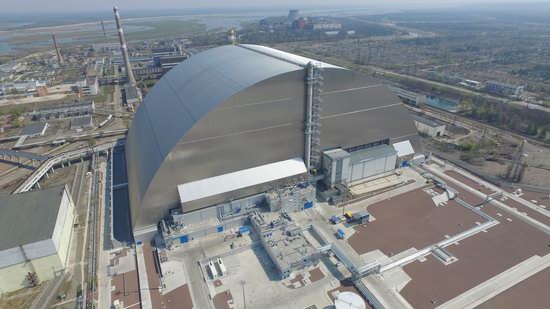
The Chernobyl plant company (ChNPP) said that the external cladding of the arch-shaped New Safe Confinement (NSC) had a 15 square metre area of damage from the drone, with further damage in areas up to 200 square metres. It said there was also damage to the internal cladding filler and to some bolted connections in the structure.
It says that radiation levels remain within their normal levels at the site – the NSC was built to cover a wide area, including the original rapidly built shelter over the remnants of unit 4 following the accident in 1986.
In its update on Thursday, the International Atomic Energy Agency, which has experts based at Chernobyl, said: “Firefighters are continuing to put out small fires that keep smouldering and spreading on the roof of the New Safe Confinement.” It added that agency staff’s “measurements continue to show normal gamma radiation dose rate values near the NSC compared to those recorded by the IAEA since it established a continuous presence at the site just over two years ago”………………………………………….
https://www.world-nuclear-news.org/articles/chernobyl-shelter-roof-small-fires-efforts-to-eliminate
World Nuclear News 20th Feb 2025
Damage to Chernobyl shelter being assessed after drone strike

World Nuclear News 17 February 2025, https://www.world-nuclear-news.org/articles/damage-to-chernobyl-shelter-being-assessed-after-drone-strike
Firefighters worked across the weekend to tackle smouldering roof insulation in the giant protective shelter which covers Chernobyl’s unit 4 following the drone strike on Friday. Radiation levels in the area remain normal – the original protective shelter inside the giant structure did not suffer any damage.
The State Emergency Service of Ukraine said on Monday morning there were three groups of climbers tackling three smouldering areas of the roof insulation on the New Safe Confinement. According to SSE ChNPP – which runs the Chernobyl site and decommissioning activities – radiation levels have remained normal throughout, with 84 people working at the scene as of Saturday afternoon, as they sought to wet the smouldering insulation and stop the spread.
It reported that a 15 square metres area of the external cladding of the arch-shaped New Safe Confinement was damaged at a height of about 87 metres, as well as wider “sheathing defects” for an area of about 200 square metres. Damage to both the outer and inner shell of the structure was identified.
The International Atomic Energy Agency, which has experts stationed at Chernobyl, said that the efforts to “put out and prevent the spread of any remaining fires – apparently fuelled by inflammable material in the roof cladding” had delayed work to start repairing the damage to the New Safe Confinement.
IAEA Director General Rafael Mariano Grossi said: “This was clearly a very serious incident, with a drone hitting and damaging a large protective structure at a major nuclear site. As I have stated repeatedly during this devastating war, attacking a nuclear facility is an absolute no-go, it should never happen. It is especially concerning as it comes as we are also seeing an increase in military activity in the area around the Zaporizhzhia nuclear power plant. The IAEA remains committed to doing everything we can to help prevent a nuclear accident.”
The IAEA said their team “confirmed that both the outer and inner cladding of the NSC arch had been breached, causing a hole measuring approximately six metres in diameter and also damaging some equipment as well as electrical cables. However, the structural support beams did not appear to have suffered major damage”.
The European Bank for Reconstruction and Development, which oversaw the shelter project and which together with 45 donors helped fund the EUR2 billion (USD2.1 billion) construction costs of the New Safe Confinement, said it “stands ready to support the government of Ukraine and partners” to ensure Chernobyl remains an environmentally safe and secure site.
What is the New Safe Confinement?
Chernobyl Nuclear Power Plant’s unit 4 was destroyed in the April 1986 accident (you can read more about it in the World Nuclear Association’s Chernobyl Accident information paper) with a shelter constructed in a matter of months to encase the damaged unit, which allowed the other units at the plant to continue operating. It still contains the molten core of the reactor and an estimated 200 tonnes of highly radioactive material.
However it was not designed for the very long-term, and so the New Safe Confinement – the largest moveable land-based structure ever built – was constructed to cover a much larger area including the original shelter. The New Safe Confinement has a span of 257 metres, a length of 162 metres, a height of 108 metres and a total weight of 36,000 tonnes and was designed for a lifetime of about 100 years. It was built nearby in two halves which were moved on specially constructed rail tracks to the current position, where it was completed in 2019.
It has two layers of internal and external cladding around the main steel structure – about 12 metres apart – with the IAEA confirming that both had been breached in the incident. The NSC was designed to allow for the eventual dismantling of the ageing makeshift shelter from 1986 and the management of radioactive waste. It is also designed to withstand temperatures ranging from -43°C to +45°C, a class-three tornado, and an earthquake with a magnitude of 6 on the Richter scale.
According to World Nuclear Association, the hermetically-sealed New Safe Confinement allows “engineers to remotely dismantle the 1986 structure that has shielded the remains of the reactor from the weather since the weeks after the accident. It will enable the eventual removal of the fuel-containing materials in the bottom of the reactor building and accommodate their characterisation, compaction, and packing for disposal. This task represents the most important step in eliminating nuclear hazard at the site – and the real start of dismantling”.
The wider context
Chernobyl nuclear power plant lies about 130 kilometres north of Ukraine’s capital Kyiv, and about 20 kilometres south of Belarus. A 30-kilometre exclusion zone remains around the plant, although some areas have been progressively resettled. Three other reactors at the site, which was built during Soviet times, continued to operate after the accident, with unit 3 the last one operating, until December 2000.
When Russia launched its invasion of Ukraine in February 2022 it rapidly took control of the Chernobyl plant. Its forces remained there until withdrawing on 31 March 2022 and control returned to Ukrainian personnel. The IAEA has had experts stationed at the site as the war has continued, seeking to help ensure the safety and security of the site.
IAEA teams are also in place at Ukraine’s three operating nuclear power plants and the Zaporizhzhia nuclear power plant, which has been under the control of Russian forces since early March 2022.
Ukraine has blamed Russia for the drone strike, while Russia denied it was responsible and blamed Ukraine. The IAEA has not attributed blame to either side during the war, with Director General Grossi explaining in a press conference at the United Nations in April last year that this was particularly the case with drones, saying “we are not commentators. We are not political speculators or analysts, we are an international agency of inspectors. And in order to say something like that, we must have proof, indisputable evidence, that an attack, or remnants of ammunition or any other weapon, is coming from a certain place. And in this case it is simply impossible”.
Nuclear expert issues Chernobyl update after it emerges fires are still burning.
Luke Alsford and Gergana Krasteva, Metro UK, February 16, 2025
Flames are still raging inside the Chernobyl nuclear station after multiple fires yesterday.
Three smoldering fires were detected earlier this morning, forcing teams to jump into action to prevent a disaster at the power plant.
Ukraine’s state agency on exclusion zone management confirmed that no release of radioactive material has been reported yet.
The plant was hit on Friday by a drone carrying a high-explosive warhead, according to Ukraine, 38 years after the nuclear explosion at the site…..
Firefighters continue to battle the blaze round the clock in challenging weather conditions, admitted the International Atomic Energy Agency.
The plant’s fourth reactor now has a 314 square foot gash after the drone strike.
Although no rise in radiation has been reported yet, an expert issued a frightening warning about how Russia’s attack will soon affect nearby radioactivity
Dr Olga Kosharna, founder of the Anti-Crisis Expert Nuclear Centre of Ukraine, said: ‘The hermetic seal has been broken.
‘It is clear that the ventilation systems will [work] differently and the radiation level will increase.
‘But I think that it will not go beyond the industrial site and the exclusion zone.
Chernobyl’s reactors are covered by an outer dome to prevent radioactive leakage after the 1986 disaster – the world’s worst civilian nuclear accident – which sent pollution spewing across Europe.
Video footage shows how the explosion blew a hole in the dome at 1.50am on Friday, before a fire then broke out.
An open fire on the roof structure – officially called the New Safe Confinement (NSC) – was swiftly put out by first responders.
However smouldering fires remain inside the 20ft diameter hole.
The International Atomic Energy Agency [IAEA] said: ‘The ongoing efforts to put out and prevent the spread of any remaining fires – apparently fuelled by inflammable material in the roof cladding – have delayed work to start repairing the damage.’
The organisation’s director Rafael Mariano Grossi added: ‘This was clearly a very serious incident, with a drone hitting and damaging a large protective structure at a major nuclear site.
‘As I have stated repeatedly during this devastating war, attacking a nuclear facility is an absolute no-go, it should never happen.’
Grossi also warned of an ‘increase in military activity in the area around the Zaporizhzhia Nuclear Power Plant.
‘The IAEA remains committed to doing everything we can to help prevent a nuclear accident. Judging by recent events, nuclear safety remains very much under threat.’…………………………….
Zelensky spoke at the Munich Security Conference yesterday, accusing Russia of flaming the conflict with the alleged drone attack……………………………… https://metro.co.uk/2025/02/16/nuclear-expert-issues-chernobyl-update-emerges-fires-still-burning-22567966/
High-Explosive Drone Pierces Shell Of Chernobyl Nuclear Plant At Very Moment Trump Pushes Ukraine Toward Peace
by Tyler Durden, Saturday, Feb 15, 2025, https://www.zerohedge.com/geopolitical/high-explosive-drone-pierces-shell-chernobyl-nuclear-plant-very-moment-trump-pushes
On Friday just prior to high-level meetings among Western security officials and Ukrainian leadership commencing in Munich, including US Vice President J.D. Vance and Zelensky, there was a dangerous incident at the Chernobyl Nuclear Power Plant in Ukraine’s Kyiv oblast.
Ukraine’s President Zelensky accused Russia of launching a drone equipped with a high-explosive warhead at the historic, defunct power plant, site of the April 1986 nuclear disaster and meltdown. The drone reportedly hit the protective containment shell of the Chernobyl plant.
Zelensky’s office released footage showing an impact to the giant concrete and steel shield protecting the remains of the nuclear reactor. BBC writes that “The shield is designed to prevent further radioactive material leaking out over the next century. It measures 275m (900ft) wide and 108m (354ft) tall and cost $1.6bn (£1.3bn) to construct.”
And WaPo details further of the looming potential dangers:
In 2019, construction was completed on the New Safe Confinement — a $1.7 billion arch-shaped steel structure, which would contain the destroyed reactor. The site still contained some “200 tons of highly radioactive material,” according to the European Bank of Reconstruction and Development, which helped finance the project.
Thus the situation is deeply alarming given the potential for a new radiation leak at the site which could impact the region, or even Europe. An IAEA team on the ground said it heard an explosion at around 01:50 local time coming from the New Safe Confinement (NSC) shelter. Photos showed flames at the top of the huge structure.
The UN agency is on high alert, but issued a statement saying the drone strike did not breach the plant’s inner containment shell. The IAEA also did not attribute blame, not identifying who sent the drone.
The Kremlin strongly rejected that it was behind the incident:
“There is no talk about strikes on nuclear infrastructure, nuclear energy facilities, any such claim isn’t true, our military doesn’t do that,” Peskov told reporters in a call.
Russian state media has meanwhile been warning of efforts by bad actors to sabotage Trump’s peace plan for Ukraine, after he held a 90-minute phone call with President Vladimir Putin this week.
Serious damage to the protective shield remains, which could present an ongoing serious safety issue at the site:
Simon Evans from the European Bank for Reconstruction and Development (EBRD) was head of the Chernobyl Shelter Fund, which oversaw the construction of the protective dome in the 2010s.
He described the apparent strike as “an incredibly reckless attack on a vulnerable nuclear facility”.
The shield “was never built to withstand external drone attack”, he told the BBC.
Given this, why would Russia at this very moment while Trump and Putin are trying to line up peace talks launch a high-explosive drone at the Chernobyl Nuclear Power Plant?
Cui bono?…
Zelensky has asserted that Putin is not actually ready for or seeking legitimate negotiations, contradicting recent statements coming from the Trump White House.
On Friday, he claimed: “The only country in the world that attacks such sites, occupies nuclear power plants, and wages war without any regard for the consequences is today’s Russia.”
Meanwhile, Ukraine’s State Nuclear Regulatory Inspectorate has in a fresh statement said that while the drone damaged “the external integrity” of the New Safe Confinement “and equipment in the crane maintenance garage” – it remains that there are no observable radiation spikes. “Firefighting efforts and damage assessment are ongoing,” it added.
Was this a desperate CHERNOBYL 2.0 ATTEMPT? Whodunnit?
Given that Chernobyl is a name that has captured popular imagination for decades since the apocalyptic historic disaster left the vicinity basically a radiation death zone, it could present the perfect false flag opportunity for anyone wishing to prolong and escalate the war.
A dramatic development in the Ukraine situation.
18 February 2025 https://theaimn.net/a-dramatic-development-in-the-ukraine-situation/
The shut-down Chernobyl nuclear reactor was hit by a drone on 14th February, and its outer covering was breached. The International Atomic Energy Agency (IAEA) was quick to gloss over the impact from the latest incident involving the wrecked Chernobyl nuclear reactor – ” Radiation levels inside and outside the so-called New Safe Confinement building “remain normal and stable,”….. and there are no reports of any casualties or radiation leak.”
To be fair, the IAEA did not attribute blame to Russia. Le Monde stated that the cause was a Russian Shahed drone, armed with a high-explosive warhead. So, it actually does look as if the offending drone came from Russia. But that is not certain. However, as far as the Western media goes – the issue is being covered as a deliberate attack by Russia. Youtube after Youtube video, article after article, blames Russia, and repeats Zelensky’s claims –“This is a terrorist attack for the entire world.” Zelensky spoke at the Munich Security Conference accusing Russia of a deliberate attack. Even if it was a Russian drone, there remains the possibility that this was a mistake, rater than intentional. What would Russia have to gain by this? Cui bono?
This event is significant in two ways – First – it could throw a spanner in the works of the current discussions on ending the war in Ukraine . These peace discussion are a whole nother story. Donald Trump is no doubt looking for a way for USA business interests to grab Ukraine resources as one large part of a peace deal in which Russia keeps its invaded territory. Zelensky’s presidency sort of ended on 20 May 2024 – he stays in power because it is war-time – which may well be part of his desire to keep the ear going, no matter what the cost. Zelensky seems to have cast some sort of mesmerising spell over Europe – depicting the Russian bear salivating to gobble up Europe. Good loyal Westerners seem pretty much obligated to oppose Donald Trump on all matters. However a plan to allow some concessions to Russia is a militarily reasonable way to end this war.
Secondly, it could really demonstrate the hypocrisy of the IAEA and its Director Rafael Grossi about nuclear safety
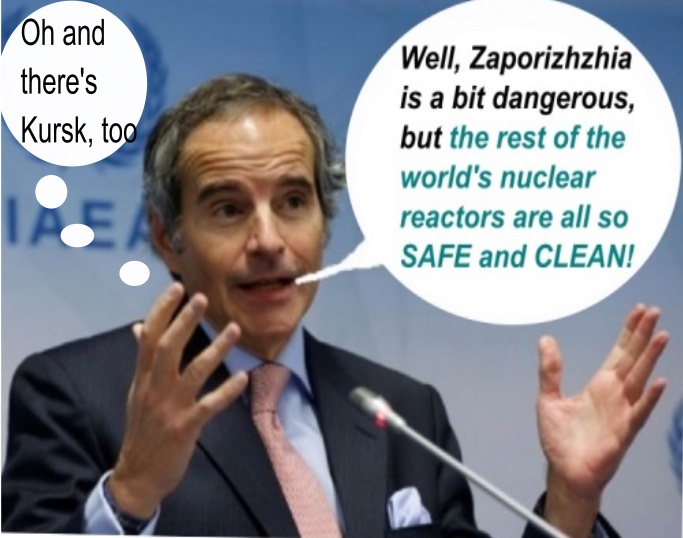
Does anyone really think that this Chernobyl incident is over? All sorted?
“Flames are still raging inside the Chernobyl nuclear station after multiple fires yesterday.” – Luke Alsford and Gergana Krasteva, Metro UK, February 16, 2025
Alsford and Krasteva set out in chilling (perhaps that’s not the right word) detail, the efforts going on, in extreme weather conditions, to prevent a disaster at the power plant, firefighters battling the blaze around the clock. The reactor’s containment shell. now has a 314 square foot gash. With the hermetic seal broken, the ventilation system is affected, and the radiation level will increase.
Those courageous workers at the wrecked Chernobyl nuclear power plant will probably get those fires out before it all gets much, much worse. And mend the hole in the containment shell. And the IAEA and everyone else will breathe sighs of relief. Until the next nuclear near-miss.
Flames are still raging inside the Chernobyl nuclear station after multiple fires yesterday.
Three smoldering fires were detected earlier this morning, forcing teams to jump into action to prevent a disaster at the power plant.
Ukraine’s state agency on exclusion zone management confirmed that no release of radioactive material has been reported yet.
The plant was hit on Friday by a drone carrying a high-explosive warhead, according to Ukraine, 38 years after the nuclear explosion at the site…..
Firefighters continue to battle the blaze round the clock in challenging weather conditions, admitted the International Atomic Energy Agency.
The plant’s fourth reactor now has a 314 square foot gash after the drone strike.
Although no rise in radiation has been reported yet, an expert issued a frightening warning about how Russia’s attack will soon affect nearby radioactivity
Dr Olga Kosharna, founder of the Anti-Crisis Expert Nuclear Centre of Ukraine, said: ‘The hermetic seal has been broken.
‘It is clear that the ventilation systems will [work] differently and the radiation level will increase.
‘But I think that it will not go beyond the industrial site and the exclusion zone.
Chernobyl’s reactors are covered by an outer dome to prevent radioactive leakage after the 1986 disaster – the world’s worst civilian nuclear accident – which sent pollution spewing across Europe.
Video footage shows how the explosion blew a hole in the dome at 1.50am on Friday, before a fire then broke out.
An open fire on the roof structure – officially called the New Safe Confinement (NSC) – was swiftly put out by first responders.
However smouldering fires remain inside the 20ft diameter hole.
The International Atomic Energy Agency [IAEA] said: ‘The ongoing efforts to put out and prevent the spread of any remaining fires – apparently fuelled by inflammable material in the roof cladding – have delayed work to start repairing the damage.’
The organisation’s director Rafael Mariano Grossi added: ‘This was clearly a very serious incident, with a drone hitting and damaging a large protective structure at a major nuclear site.
‘As I have stated repeatedly during this devastating war, attacking a nuclear facility is an absolute no-go, it should never happen.’
Grossi also warned of an ‘increase in military activity in the area around the Zaporizhzhia Nuclear Power Plant.
‘The IAEA remains committed to doing everything we can to help prevent a nuclear accident. Judging by recent events, nuclear safety remains very much under threat.’…………………………….
Zelensky spoke at the Munich Security Conference yesterday, accusing Russia of flaming the conflict with the alleged drone attack……………………………… https://metro.co.uk/2025/02/16/nuclear-expert-issues-chernobyl-update-emerges-fires-still-burning-22567966/
Restless radioactive remains are still stirring in Chernobyl’s nuclear tomb.


‘It’s like the embers in a barbecue pit.’ Nuclear reactions are smoldering again at Chernobyl https://www.sciencemag.org/news/2021/05/nuclear-reactions-reawaken-chernobyl-reactor
By Richard Stone, May. 5, 2021 , Thirty-five years after the Chernobyl Nuclear Power Plant in Ukraine exploded in the world’s worst nuclear accident, fission reactions are smoldering again in uranium fuel masses buried deep inside a mangled reactor hall. “It’s like the embers in a barbecue pit,” says Neil Hyatt, a nuclear materials chemist at the University of Sheffield. Now, Ukrainian scientists are scrambling to determine whether the reactions will wink out on their own—or require extraordinary interventions to avert another accident.
Sensors are tracking a rising number of neutrons, a signal of fission, streaming from one inaccessible room, Anatolii Doroshenko of the Institute for Safety Problems of Nuclear Power Plants (ISPNPP) in Kyiv, Ukraine, reported last week during discussions about dismantling the reactor. “There are many uncertainties,” says ISPNPP’s Maxim Saveliev. “But we can’t rule out the possibility of [an] accident.”
The neutron counts are rising slowly, Saveliev says, suggesting managers still have a few years to figure out how to stifle the threat. Any remedy he and his colleagues come up with will be of keen interest to Japan, which is coping with the aftermath of its own nuclear disaster 10 years ago at Fukushima, Hyatt notes. “It’s a similar magnitude of hazard.”
The specter of self-sustaining fission, or criticality, in the nuclear ruins has long haunted Chernobyl. When part of the Unit Four reactor’s core melted down on 26 April 1986, uranium fuel rods, their zirconium cladding, graphite control rods, and sand dumped on the core to try to extinguish the fire melted together into a lava. It flowed into the reactor hall’s basement rooms and hardened into formations called fuel-containing materials (FCMs), which are laden with about 170 tons of irradiated uranium—95% of the original fuel.
The concrete-and-steel sarcophagus called the Shelter, erected 1 year after the accident to house Unit Four’s remains, allowed rainwater to seep in. Because water slows, or moderates, neutrons and thus enhances their odds of striking and splitting uranium nuclei, heavy rains would sometimes send neutron counts soaring. After a downpour in June 1990, a “stalker”—a scientist at Chernobyl who risks radiation exposure to venture into the damaged reactor hall—dashed in and sprayed gadolinium nitrate solution, which absorbs neutrons, on an FCM that he and his colleagues feared might go critical. Several years later, the plant installed gadolinium nitrate sprinklers in the Shelter’s roof. But the spray can’t effectively penetrate some basement rooms.
Chernobyl officials presumed any criticality risk would fade when the massive New Safe Confinement (NSC) was slid over the Shelter in November 2016. The €1.5 billion structure was meant to seal off the Shelter so it could be stabilized and eventually dismantled. The NSC also keeps out the rain, and ever since its emplacement, neutron counts in most areas in the Shelter have been stable or are declining.
But they began to edge up in a few spots, nearly doubling over 4 years in room 305/2, which contains tons of FCMs buried under debris. ISPNPP modeling suggests the drying of the fuel is somehow making neutrons ricocheting through it more, rather than less, effective at splitting uranium nuclei. “It’s believable and plausible data,” Hyatt says. “It’s just not clear what the mechanism might be.”
The threat can’t be ignored. As water continues to recede, the fear is that “the fission reaction accelerates exponentially,” Hyatt says, leading to “an uncontrolled release of nuclear energy.” There’s no chance of a repeat of 1986, when the explosion and fire sent a radioactive cloud over Europe. A runaway fission reaction in an FCM could sputter out after heat from fission boils off the remaining water. Still, Saveliev notes, although any explosive reaction would be contained, it could threaten to bring down unstable parts of the rickety Shelter, filling the NSC with radioactive dust.
Addressing the newly unmasked threat is a daunting challenge. Radiation levels in 305/2 preclude getting close enough to install sensors. And spraying gadolinium nitrate on the nuclear debris there is not an option, as it’s entombed under concrete. One idea is to develop a robot that can withstand the intense radiation for long enough to drill holes in the FCMs and insert boron cylinders, which would function like control rods and sop up neutrons. In the meantime, ISPNPP intends to step up monitoring of two other areas where FCMs have the potential to go critical.
The resurgent fission reactions are not the only challenge facing Chernobyl’s keepers. Besieged by intense radiation and high humidity, the FCMs are disintegrating—spawning even more radioactive dust that complicates plans to dismantle the Shelter. Early on, an FCM formation called the Elephant’s Foot was so hard scientists had to use a Kalashnikov rifle to shear off a chunk for analysis. “Now it more or less has the consistency of sand,” Saveliev says.
Ukraine has long intended to remove the FCMs and store them in a geological repository. By September, with help from European Bank for Reconstruction and Development, it aims to have a comprehensive plan for doing so. But with life still flickering within the Shelter, it may be harder than ever to bury the reactor’s restless remains.
A drone pierced the outer shell of Ukraine’s Chernobyl nuclear plant. Radiation levels are normal
AP News 14th Feb 2025
CHERNOBYL NUCLEAR POWER STATION, Ukraine (AP) — A drone armed with a warhead hit the protective outer shell of Ukraine’s Chernobyl nuclear plant early Friday, punching a hole in the structure and briefly starting a fire, in an attack Kyiv blamed on Russia. The Kremlin denied it was responsible.
Radiation levels at the shuttered plant in the Kyiv region — site of the world’s worst nuclear accident — have not increased, according to the U.N. International Atomic Energy Agency, which said the strike did not breach the plant’s inner containment shell.
The IAEA did not attribute blame, saying only that its team stationed at the site heard an explosion and was informed that a drone had struck the shell.
Fighting around nuclear power plants has repeatedly raised fears of a nuclear catastrophe during three years of war, particularly in a country where many vividly remember the 1986 Chernobyl disaster, which killed at least 30 people and spewed radioactive fallout over much of the Northern Hemisphere.
The Zaporizhzhia nuclear power plant, which is Europe’s biggest, has occasionally been hit by drones during the war without causing significant damage……………………………………………………………………
Kremlin spokesman Dmitry Peskov denied Russia was responsible. “There is no talk about strikes on nuclear infrastructure, nuclear energy facilities. Any such claim isn’t true. Our military doesn’t do that,” Peskov said in a conference call with reporters.
It was not possible to independently confirm who was behind the strike. Both sides frequently trade blame when nuclear sites come under attack. https://apnews.com/article/russia-ukraine-war-chernobyl-zelenskyy-71d781dbd66754d0a548edd388f3447a
Chernobyl nuclear power station hit by ‘Russian drone’
Despite hitting the nuclear plant, the small fire was quickly contained and officials said
there was no apparent radiation leak. The Chernobyl nuclear power station
was hit overnight in an apparent drone strike, International Atomic Energy
Agency (IAEA) has said. Ukrainian president, Volodymyr Zelensky, said a
Russian drone strike with a “high explosive warhead” hit the outer
shelter of the nuclear plant. The IAEA said that a UAV hit the shelter
protecting the site at approximately 1.50am local time.
Footage from lastnight, showing a Russian Drone striking the Containment Structure around
Reactor No. 4 at the Chernobyl Nuclear Power Plant (ChNPP) in Northern
Ukraine, as well as the extent of the Damage from inside the Containment
Structure.
iNews 14th Feb 2025,
https://inews.co.uk/news/world/chernobyl-nuclear-power-station-hit-by-russian-drone-3535413
Watchdog’s warning over nuclear waste rail crash
Federica Bedend, BBC News, North East and Cumbria, 1 Feb 25, more https://www.bbc.com/news/articles/c74m1rxynkxo
The nuclear watchdog has issued an improvement notice after two railway wagons carrying nuclear waste crashed.
It happened on the Sellafield site, in Cumbria, which manages more radioactive waste in one place than any other nuclear facility in the world.
The Office for Nuclear Regulation (ONR) said although no-one was injured and there were no radiation risks during the incident, which happened in November, it could have had “serious consequences”.
A Sellafield spokesman said: “An internal investigation was initiated to understand the root cause and to prevent this from happening again in future.”
The ONR said one of the wagons on the site’s railway had not been properly secured and it rolled about 200ft (60m), hitting a stationary wagon.
They added the wagons were left with minor damage and the nuclear containers were unaffected “due to their robust construction”, however health and safety improvements were needed to prevent future incidents.
Ian Bramwell, ONR’s head of regulation for Sellafield, said: “This will include improving how Sellafield plan, organise, monitor and review the measures in place to protect personnel directly and indirectly involved in rail activities on the site.”
The ONR will reinspect the site in the coming months and Sellafield has until 13 June to comply with the notice.
A Sellafield spokesman said it was working with the ONR to review its processes.
Ukraine nuclear fears increase amid warnings from IAEA
Emerging Risks 28th Jan 2025, https://www.emergingrisks.co.uk/ukraine-nuclear-fears-increase-amid-warnings-from-iaea/
The director general of the International Atomic Energy Agency (IAEA) has said he is growing increasingly concerned that the organisation’s efforts to prevent a major nuclear incident in war-torn Ukraine in under increasing threat.
It comes as Rafael Mariano Grossi (above) revealed the agency’s team based at Ukraine’s Zaporizhzhya Nuclear Power Plant (ZNPP) has heard frequent explosions from outside the site over the past week.
He added The team reported hearing multiple instances of such military activity in recent days, at varying distances from the ZNPP. There was no damage reported to the plant itself. Although the sound of nearby military action has been a common occurrence ever since the IAEA established a continued presence at the ZNPP in September 2022, it has happened virtually daily in recent weeks.
“For almost three years now, we have been doing everything we can to help prevent a nuclear accident at the Zaporizhzhya Nuclear Power Plant and elsewhere in Ukraine,” Grossi explained. “An accident has not occurred, but the situation is not improving. It is still precarious. I remain seriously concerned about nuclear safety and security in Ukraine, including at the Zaporizhzhya site. Our work is far from over.”
He continued as part of the ongoing work to monitor developments relevant for nuclear safety and security, the IAEA team has continued to conduct walkdowns across the site – including but not limited to the main and emergency control rooms of four reactor units and one turbine hall – and observed and discussed various safety-related maintenance activities with the plant.
The IAEA team was also informed that the ZNPP is procuring three new mobile diesel generators, similar to those received late last year. They are in addition to the site’s 20 fixed emergency diesel generators that are designed to provide on-site power if there is a total loss of off-site power.
Separately, the ZNPP said that four diesel steam generators were put into operation for ten days to provide the steam needed to process liquid radioactive waste. These generators were commissioned a year ago.
Elsewhere in Ukraine, the IAEA said air raid alarms were heard on several occasions at Ukraine’s three operating nuclear power plants (NPPs) – Khmelnytskyy, Rivne and South Ukraine – as well as at the Chornobyl site. At the Khmelnytskyy NPP, the IAEA team members have taken shelter at their residence three times in recent days due to such alerts.
At the Khmelnytskyy and South Ukraine NPPs and the Chornobyl site, the IAEA teams were informed of instances of drones being detected at distances ranging from 2 to 30 km from the sites.
Despite such military activities, Ukraine’s nine operating nuclear power reactors have been operating at full capacity this week, safely generating much-needed electricity during the cold winter months.
Separately, the Agency continued with deliveries under its comprehensive programme of nuclear safety and security assistance to Ukraine. Last week, the Chornobyl site received equipment to enhance its nuclear security system. The delivery, the 104th organised by the IAEA since the start of the armed conflict, was supported with funds from the United Kingdom.
Russia claims nuclear plant targeted during massive Ukrainian drone attack

Russia and Ukraine continue to swap daily barrages, with the prospects of ceasefire talks appearing slim.
Aljazeera, 29 Jan 2025
A nuclear power plant was among targets during a massive Ukrainian drone attack, Russian officials have said.
Moscow said on Wednesday that the country’s energy infrastructure had come under attack by at least 100 drones overnight. Ukraine also reported strikes. The continuing barrages were accompanied by barbs from the two countries’ presidents, suggesting little prospect of peace talks.
The Russian Ministry of Defence said on Telegram that 104 drones were involved in raids across western Russia, many targeting power and oil facilities.
Local officials claimed that air defence systems had destroyed one drone that had attempted to strike the nuclear power plant in the western region of Smolensk.
“According to preliminary information, one of the drones was shot down during an attempt to attack a nuclear power facility,” Governor Vasily Anokhin said on the Telegram messaging app. “There were no casualties or damage.”
The Smolensk Nuclear Power Plant, the largest power generating plant in Russia’s northwest, was working normally on Wednesday morning, RIA state news agency reported, citing the plant’s press service.
Russia’s air defences reportedly destroyed drones over nine regions, including 11 over Smolensk, which sits on the border with Belarus. Nearly half were hit over Kursk, where Ukrainian troops have occupied several villages for months following an incursion.
Ukraine and Russia have been swapping drone and missile strikes on an almost daily basis, with energy infrastructure a particular target amid winter.
Warnings that the fighting could spark a nuclear disaster have been sounded since Russia launched its full-scale invasion of its neighbour in February 2022. However, most of the concern has focused on Ukraine’s Zaporizhzhia plant, which sits on the frontlines in the east of the country…………………………………………………………………….https://www.aljazeera.com/news/2025/1/29/russia-claims-nuclear-plant-targeted-during-massive-ukrainian-drone-attack
Nuclear icebreaker sustained hull damage after collision in the Kara Sea
A video published by the pro-Kremlin Telegram channel Mash shows how the 50 Let Pobedy sails straight into the cargo vessel Yamal Krechet.
Thomas Nilsen, 28 January 2025 , https://www.thebarentsobserver.com/news/nuclear-icebreaker-sustained-hull-damage-after-collision-in-the-kara-seanbsp/423819
The dramatic collision happened at 03.51 am on the night to January 26 but did not become known to the public before the press service of Rosatomflot confirmed the facts to several Russian media in the evening of January 28.
Murmansk-based Arctic Observer said in its Telegram channel that the collision happened as the powerful icebreaker was assisting a cargo ship sailing through the ice-covered waters.
According to Rosatomflot, the nuclear powered icebreaker continues to operate in normal mode along the Northern Sea Route, despite the damage to the hull.
Rosatomflot says in the press statement that “seaworthiness has not been lost” and “there were no casualties.”
The state owned operator of Russia’s icebreaker fleet underlines that the two onboard reactors were not harmed in the collision. The information has not been confirmed by independent sources.
Rosatomflot does not provide any information about what caused the navigation mistake leading to the huge icebreaker smashing into the smaller cargo ship.
The 50 Let Pobedy is the newest of the older Arktika-class nuclear-powered icebreakers. Construction of the vessel started in the late Soviet era (1989), but she was not commissioned before 2007.
The icebreaker has Murmansk as homeport, but can operate independently for months at a time during the icy navigation season along the Northern Sea Route.
The cargo vessel Yamal Krechet was according to MarineTraffic.com on her way from Arkhangelsk towards Sabetta, the port where Novatek’s Yamal LNG production facilitates are located.
There are no public reports about the possible damages to the cargo vessel. Several tens of containers can be seen on deck of the Yamal Krechet at the time of the collision, but it is not known immediately known what content the cargo includes.
1 This Month





PLEASE OPPOSE HR 8255 AND S.3639 – bills would accelerate satellite deployment, with no environmental review or safeguards – https://ncstd5li.quorum.us/campaign/169331/
To see nuclear-related stories in greater depth and intensity – go to https://nuclearinformation.wordpress.com
-
Archives
- October 2026 (40)
- September 2026 (339)
- August 2026 (330)
- July 2026 (355)
- June 2026 (287)
- May 2026 (306)
- April 2026 (356)
- March 2026 (251)
- February 2026 (267)
- January 2026 (308)
- December 2025 (358)
- November 2025 (359)
-
Categories
- 1
- 1 NUCLEAR ISSUES
- business and costs
- climate change
- culture and arts
- ENERGY
- environment
- health
- history
- indigenous issues
- Legal
- marketing of nuclear
- media
- opposition to nuclear
- PERSONAL STORIES
- politics
- politics international
- Religion and ethics
- safety
- secrets,lies and civil liberties
- spinbuster
- technology
- Uranium
- wastes
- weapons and war
- Women
- 2 WORLD
- ACTION
- AFRICA
- Atrocities
- AUSTRALIA
- Christina's notes
- Christina's themes
- culture and arts
- Events
- Fuk 2022
- Fuk 2023
- Fukushima 2017
- Fukushima 2018
- fukushima 2019
- Fukushima 2020
- Fukushima 2021
- general
- global warming
- Humour (God we need it)
- Nuclear
- RARE EARTHS
- Reference
- resources – print
- Resources -audiovicual
- Weekly Newsletter
- World
- World Nuclear
- YouTube
-
RSS
Entries RSS
Comments RSS


