Kobe Steel sent products with tampered data to nuclear companies, Cars, trains, planes … and nuclear facilities. REUTERS, Oct 27th 2017 TOKYO— Kobe Steel supplied parts with false specifications for nuclear equipment owned by Japan Nuclear Fuel Ltd, JNFL said on Friday, adding that the products were not used.
The parts were destined for use in centrifuges to enrich uranium, a JNFL spokesman said by phone. Citing security reasons, he declined to provide further details.
Kobe Steel has not told JNFL whether there are any safety issues with the parts, the spokesman said.
A Kobe Steel spokesman confirmed the firm fabricated data about specialized coatings used on the parts and had not identified any safety issues.
JNFL is the second company in the nuclear power industry to receive components affected by the steelmaker’s data tampering.
Tokyo Electric Power Co said this month it had taken delivery of pipes from Kobe Steel that were not checked properly.
Japan’s atomic regulator has asked nuclear operators to check whether they are using Kobe Steel products at nuclear plants, it said on Wednesday, adding it had received no reports that Kobe Steel’s data tampering scandal had affected safety.
No deadline has been given for nuclear operators to report back to the Nuclear Regulation Authority, a spokesman said by phone on Friday.
The unfolding data tampering scandal has spread from Kobe Steel’s copper and aluminum business to most areas of the company and sent companies at the end of complex supply chains across the world scrambling to check whether the safety or performance of their products has been compromised.
While no safety issues have been identified, Japan’s third-largest steelmaker is likely to face claims for replacement parts and other costs.
Kawasaki Heavy Industries Ltd would ask Kobe Steel to cover any costs for replacement of parts or other expenses related to the data tampering, President Yoshinori Kanehana told reporters on Friday at an earnings briefing…….
Kobe Steel said on Thursday 88 out of 525 affected customers had yet to confirm its products were safe in the light of widespread tampering of specifications, but that it had not received any requests for recalls.
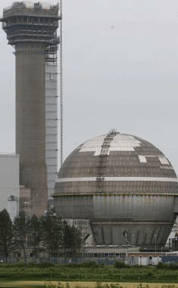
Times 22nd Oct 2017,The emergency removal of unstable chemicals from Sellafield yesterday hasraised fresh concerns over safety at the nuclear site.
Army bomb disposal specialists were called to the nuclear fuel reprocessing plant in Cumbria
after a routine audit found canisters of potentially explosive solventsdating back to the early 1990s.
Officials sought to reassure the public that it was “not a radiological event” and that the solvents had been
safely destroyed in two controlled explosions. However, one expert who
spoke on condition of anonymity claimed that although the solvents were not
radioactive they had been kept in the main laboratory near far more
dangerous materials. “This substance was in a dangerous oxidised state and
if it had exploded in that location it had the potential to distribute
radioactive material over the site and beyond,” the engineer said.
“Sellafield appears to be downplaying the severity of it to the public.”
The chemicals are understood to include tetrahydrofuran, an organic solvent
that can become unstable when exposed to air. Sellafield Ltd, part of the
government’s Nuclear Decommissioning Authority, said that after the
disposal the site was “working as it would be on any other Saturday“. https://www.thetimes.co.uk/edition/news/sellafield-chemicals-scare-defused-by-army-98pkzxcln
Evacuations after emergency at UK nuclear plant, explosives experts rush to scene, BOMB disposal specialist have been called to the Sellafield nuclear plant to deal with a chemical incident. Sunday Express, By SIMON OSBORNE, Oct 21, 2017 “…….Initial reports suggest the incident involved five bottles containing a number of non-nuclear chemicals. …..”An operational decision will be taken in due course on how best to dispose of the material.”
Sellafield reprocesses and stores nearly all of Britain’s nuclear waste.
There have been safety concerns at the plant after a tip-off from a whistleblower, including allegations of inadequate staffing levels and poor maintenance.
The programme discovered that liquid containing plutonium and uranium has been kept in thousands of plastic bottles for years. The bottles were only intended for temporary storage and some of them are degrading.
Researchers were was also told that parts of the facility are dangerously rundown.
Sellafield insisted the site in Cumbria is safe and has been improved with significant investment in recent years. http://www.express.co. uk/news/uk/869238/sellafield- nuclear-reprocessing-plant- chemical-alert-bomb-disposal- experts
Chihiro Kamisawa, Masako Sawai, CNIC BY CNIC_ENGLISH · AUGUST 4, 2017At around 11:15 on June 6, 2017, a plutonium release and exposure accident occurred in an analytical lab (Room 108, a controlled area) at Japan Atomic Energy Agency’s (JAEA) Research and Development Center Fuel Research Building. During work to inspect a storage canister (unopened in 26 years since 1991) containing plutonium and other nuclear fuel materials in laboratory fume hood H-1, the canister lid rose up after four of the six bolts were removed and the instant the remaining two bolts were removed the plastic bags inside the canister burst. The polyethylene container in which the nuclear fuel material was placed was double wrapped in two plastic bags. When these bags burst, the materials in the polyethylene container were abruptly released. The main person carrying out the task stated that he “felt wind pressure on his stomach.” The five persons, who were wearing half-face masks to carry out the task, inspected themselves with an α radiation surface contamination detector, confirming that they had all been contaminated.
While there are many unknowns regarding the accident and its cause, the exposure of the task personnel and other matters, we report here on what has become clear thus far and the problems that the accident poses. The Nuclear Regulation Authority (NRA) is scheduled to release the agency’s “report” about a month after the accident.
Occurrence of the plutonium dust release
Table 1 [on original] shows a timeline of the events based on releases by the JAEA, NRA and news media.
Several black lumps fell onto the floor in Room 108, from which a maximum of 55 Bq/cm2 were detected. The facility management supervisor instructed that a greenhouse (a temporary enclosure to implement detection and decontamination when retreating from the contaminated area) be set up at 11:54, and it is reported that this was completed at 14:29. More than three hours passed between the time of the accident and the time when the five task personnel exited the greenhouse. Concerning the delay in setting up the greenhouse, JAEA explained to NRA that “(The delay occurred because) the main work personnel in the Fuel Research Building were carrying out this work and other staff were engaged in stabilizing procedures for nuclear fuel materials (and could not leave their positions).”
As a result of a nasal smear (to detect contamination in the nostrils) taken inside the greenhouse, contamination of a maximum of 24 Bq (α radiation) was detected in the nostrils of three of the five personnel.
The five task personnel finally exited the controlled area at 18:55. Since α radiation had been detected in their nostrils and there was a strong possibility that the five people had inhaled plutonium, they were transported to the Nuclear Fuel Cycle Engineering Labs in Tokai Village, where measurement of plutonium inside their lungs was carried out using a lung monitor. Lung monitors detect the weak X-rays emitted by plutonium-239 and the gamma radiation emitted from americium-241 inside the lungs from outside the body. However, not only is this detection extremely difficult, it has poor sensitivity. The JAEA measurement results are shown in Table 2. [on original]………
This inappropriate long-term storage problem clearly shows, if one looks back at the historical series of organizations – the Nuclear Safety Commission, the Nuclear and Industrial Safety Agency and the NRA, that for 30 years or more none of these organizations made any public announcements on the issue, or knew what was happening and simply turned a blind eye. The regulatory organizations’ neglect thus far and the defensive awareness that they do not want this to be aired in public has undoubtedly been one of the remote causes of the accident at Oarai. This extremely facile method of dealing with plutonium and nuclear fuel materials is apparent from the notion that, since no serious accident has taken place up to now, it is fine to have the facility operators quickly sweep the problem under the carpet……. http://www.cnic.jp/english/?p=3910
North Korea earthquake hits near nuclear test site THE AUSTRALIAN, 13 Oct 17 A series of tremors and landslides near North Korea’s nuclear test base probably mean the country’s sixth and largest blast has destabilised the region, and the Punggye-ri nuclear site may not be used for much longer to test nuclear weapons, experts say.
A small quake was detected early today near the North’s nuclear test site, South Korea’s weather agency said, but unlike quakes associated with nuclear tests, it did not appear to be man-made.
The tremor was the latest in a string of at least three shocks to be observed since Pyongyang’s September 3 nuclear test, which caused a 6.3 magnitude earthquake.
Today’s quake was a magnitude 2.7 with a depth of 3km in North Hamgyong Province in North Korea, the Korea Meteorological Administration said. The United States Geological Survey measured the quake at 2.9 magnitude at a depth of 5km.
“This event occurred in the area of the previous North Korean nuclear tests. The event has earthquake-like characteristics, however, we cannot conclusively confirm at this time the nature (natural or human-made) of the event,” the US agency said.
But the Korea Meteorological Administration in the South said on its website that “analysis shows it was a natural quake”. “It is believed to have caused no damage,” it added.
The series of quakes has prompted experts and observers to suspect the last test – which the North claimed to be of a hydrogen bomb – may have damaged the mountainous location in the northwest tip of the country, where all of North Korea’s six nuclear tests were conducted.
“The explosion from the September 3 test had such power that the existing tunnels within the underground testing site might have caved in,” said Kim So- gu, head researcher at the Korea Seismological Institute.
“I think the Punggye-ri region is now pretty saturated. If it goes ahead with another test in this area, it could risk radioactive pollution.”
According to 38 North, a Washington-based project that monitors North Korea, numerous landslides throughout the nuclear test site have been detected via satellite images after the sixth test. These disturbances are more numerous and widespread than seen after any of the North’s previous tests, 38 North said.
The explosion from the sixth test was large enough for residents of the Chinese border city of Yanji, 200km north of North Korea’s nuclear test site, to feel the ground shake beneath their feet.
“The reason why Punggye-ri has become North Korea’s nuclear testing field is because this area was considered stable and rarely saw tremors in the past,” said Hong Tae-kyung, a professor of earth system science at Yonsei University in Seoul.
Fears of new nuclear test in North Korea after earthquake is detected near test site, Mirror UK, 12 Oct 17 All of North Korea’s previous six nuclear tests registered as earthquakes and the country’s latest tremor has struck on Friday the 13th A small earthquake has been detected in North Korea where previous nuclear tests have been carried out.
The United States Geological Survey said a 2.9 magnitude quake with a depth of 5km was recorded 23km north-east of Sungjibaegam.
The area is has been used previously by the country to carry out nuclear drills which have resulted in subsequent tremors.
A statement on the US Geological Survey website reads: “This event occurred in the area of the previous North Korean Nuclear tests.
“The event has earthquake like characteristics, however, we cannot conclusively confirm at this time the nature (natural or human-made) of the event.”
All of North Korea’s previous six nuclear tests registered as earthquakes of magnitude 4.3 or above.
The last test the country carried out on September 3 registered as a 6.3 magnitude quake.
Protesters Broke Into a Nuclear Power Plant to Prove How Badly Defended It Is Stunt was to show poorly defended France’s nuclear plants are, Fortune, By Reuters 12 Oct 17
Greenpeace activists broke through two security barriers and launched fireworks inside the grounds of a French nuclear plant on Thursday to highlight the vulnerability of the plants to attacks.
The environmentalist group issued video footage showing several of its members inside the fence of EDF’s Cattenom nuclear plant in northeast France, and launching several rounds of fireworks over the plant.
Local police said eight people had been detained. EDF said there had been no impact on Cattenom’s security and condemned Greenpeace’s intrusion as “irresponsible.”
“Do we need to wait for a malicious attack on a nuclear plant before EDF gets out of denial?” asked Greenpeace anti-nuclear campaign head Yannick Rousselet.
Olivier Lamarre, deputy head of EDF’s French nuclear fleet, said on a call with reporters that Greenpeace activists had broken through two barriers and reached the reactor’s nuclear zone to within a few tens of meters of the nuclear installations.
He said that as the activists had raised their hands in the air and unfurled a Greenpeace banner, police officials present on the site arrested them without violence within eight minutes……..
TORPEDOH! Bungling Navy officer accidentally fired a torpedo into a nuclear dockyard while doing maintenance Seaman was given a ‘get well soon’ package to restore his confidence after he attempted spur-of-the-moment missile test without an instruction manual while moored in Plymouth , The Sun, UK By Jacob Dirnhuber 6th October 2017
A BUNGLING Navy operator accidentally fired a torpedo at a nuclear dockyard that flew across a jetty and smashed into a fence.
Amazingly no-one was hurt when the 9ft missile, which was not armed, was blasted out of HMS Argyll while the ship was moored in Plymouth’s Devonport Naval base.
A newly-released file shows the misfire occurred after the operator attempted the test without a mandatory list of safety precautions to hand in March 2014.
The unarmed Sting Ray torpedo flew over a jetty and into a heavy duty metal fence at the high-security dockyard, which services nuclear submarines. Nobody was hurt.
The investigation found that following the information card instructions would have averted the misfire during what was meant to be simulated testing.
It concluded: “The fact that the maintainer was not in possession of the JIC led to a lapse in correct procedure which in turn culminated in the jettison of the TVT [test variant torpedo].”
The heavily-redacted Royal Navy report, released under the Freedom of Information Act, also found that the experienced engineer had wanted to carry out an overdue test.
It reads: “It is assessed that he seized an opportunity to conduct an overdue serial whilst the system was live and available to him.
“This may be viewed as a deviation from the intended plan.”
More dirt caves in during work to stabilize Hanford nuclear waste tunnelBY ANNETTE CARY, acary@tricityherald.com, OCTOBER 04, 2017 Work to fill a Hanford nuclear waste tunnel that partially collapsed started, and then stopped, overnight Tuesday after some of the dirt used to initially stabilize the tunnel began to cave into it.
The minor cave-in early Wednesday morning was around a box where workers were injecting grout, a concrete-like material, into the tunnel.
No radiological readings above those anticipated were detected, and none of the workers were at risk, according to the Department of Energy.
A PUREX plant tunnel holding eight rail cars loaded with highly radioactively contaminated equipment was discovered partially collapsed on May 9. A sand and soil mixture was poured into the 20-by-20-foot hole the next day……..
Quoting unnamed sources news portal The Print reported that the damage could be the result of either a collision at sea or accidental scraping while entering the harbour. Officials in the the Navy refused to comment on the incident.
“Repair work on the submarine is likely to be complicated given that the sonar dome is made of titanium, a difficult metal that requires both specialised machinery and manpower to work on. However, the indigenous Arihant nuclear armed submarines are also being made in Visakhapatnam and that could help,” said the report.
INS Chakra, inducted in April 2012, is on ten year lease. The vessel is belongs to Akula-II class of Russian submarine.
The submarine, having displacement of 12,000 tonnes, is powered by a 190 MW reactor with top speed of over 30 knots.
Bridgwater Mercury 16th Sept 2017, A FOURTH unexploded bomb thought to date back to the Second World War hasbeen found in the Bristol Channel not far from Hinkley C. Watchet
Coastguard say the 250lb device is partially detonated and is advising
vessels in the area to proceed with caution and stay at least 500m away
from the site. It is likely the device will be dealt with via a controlled
detonation later today (Saturday, September 16).
Seismologists stumped by mystery shock after North Korean nuclear test, Nature
A second jolt felt minutes after this month’s detonation continues to confound researchers.David Cyranoski, Eight-and-a-half minutes after North Korea set off a nuclear bomb on 3 September, a second burst of energy shook the mountain where the test had just occurred. More than a week later, researchers are still puzzling over what caused that extra release of seismic energy — and what it says about North Korea’s nuclear-testing site, or the risks of a larger radiation leak. Monitoring stations in South Korea have already picked up minute levels of radiation from the test.
A number of theories have emerged to explain the second event, ranging from a tunnel collapse or a landslide to a splintering of the rock inside Mount Mantap, the testing site. But seismologists can’t agree and say that they may not get enough evidence to pin down the cause.
“This is an interesting mystery at this point,” says Göran Ekström, a seismologist at Columbia University in New York City. The nature of the first seismic signal is clearer because it matches the profile of a bomb blast. The US Geological Survey (USGS) determined the magnitude of the seismic event associated with the nuclear explosion at 6.3, whereas the Comprehensive Nuclear-Test-Ban Treaty Organization (CTBTO) in Vienna calculated it at 6.1 on the basis of a separate analysis. The explosion was many times the size of past North Korean tests and was the largest seismic signal from a nuclear test ever detected by the international network of seismic monitoring stations used by the CTBTO.
The second event came 8.5 minutes later and registered as magnitude-4.1, reported the USGS. The agency suggested that it was associated with the test and may have been a “structural collapse”. The possibility that the smaller shock was caused by a tunnel collapse inside the testing site has dominated discussion in the media. But Paul Earle, a seismologist at the USGS, told Nature that was just one possibility that was raised in the immediate aftermath of the explosion. The USGS, he said, was “basing that on previous nuclear tests of comparable size that had a collapse”.
Possible signs of a collapse are visible on satellite images taken of the testing site, according to an analysis released on 12 September by 38 North, a partnership of the US-Korea Institute and the Johns Hopkins School of Advanced International Studies in Washington, DC.
But the seismic signal doesn’t match what would be expected from a collapse, says Lianxing Wen, a geophysicist at the State University of New York at Stony Brook. A collapse would produce mostly vertical movement of rock, but his own unpublished work suggests that the seismic clues point to a large horizontal movement as well, something he says would be more consistent with a landslide.
“It’s being fought by security site fire crews, with help from a helicopter able to detect any aerial release of radiation.” Like monitoring is going to help or they’re going to share their data. Not a peep about the radiation numbers during the fires in and around Los Alamos even though they were “monitoring” – comment by Helen Helen Mary Caldicott and Henry Peters
Wildfire burning in former Nevada nuclear site, Daily Mail UK By Associated Press 1 September 2017 RENO, Nev. (AP) – The Latest on wildfires burning across the western United States
An official says firefighters are battling a lightning-sparked wildfire in a remote part of the vast former national nuclear proving ground north of Las Vegas. Nevada National Security Site spokeswoman Tracy Bower said Thursday that the fire covers almost 4 square miles (10 square kilometers) in the western part of what used to be the Nevada Test Site.
More than 1,000 nuclear detonations occurred at the 1,360-square-mile (3522-square-kilometer) secure federal reservation from 1951 to 1992. It now hosts non-nuclear experiments and safety training.
Bower didn’t have immediate information about the exact location of the fire or what tests may have taken place in the burn area in the past.
She says the fire started Monday and isn’t considered a threat to people or buildings.
Third WWII bomb found in Bristol Channel near Hinkley Point, Guardian 30th Aug 2017 Matthew WeaverHalf-mile exclusion zone set up near nuclear plants after third unexploded device discovered in as many weeks
A half-mile (1km) exclusion zone has been set up in the Bristol Channel near the Hinkley Point nuclear power stations after a third unexploded second world war bomb was discovered in as many weeks.
Bomb disposal experts will carry out a controlled explosion on the 250lb (113kg) ordnance on Wednesday, two miles north-west of the power plants. HM Coastguard has set up an exclusion zone around the unexploded device and warned ships to avoid the area.
The bomb was reported in the early hours of Wednesday by a diving team from the Hinkley Point plant. They were clearing the seabed for intake and outtake pipes for cooling water for the reactors on the Hinkley Point C plant.
It is the third suspected second world war bomb to be found in the Bristol Channel in the past three weeks. An EDF source conceded that divers could find more unexploded ordnance before the exercise to clear the area was completed, as the channel was used as a former army training range. The project to clear the seabed is expected to take several more weeks. https://www.theguardian.com/world/2017/aug/30/third-wwii-bomb-bristol-channel-near-hinkley-point-nuclear







 nuclear-news