In Middle of Nuclear Standoff, U.S. Seizes North Korean Cargo Ship Illicitly Exporting Coal, Slate, By ELLIOT HANNON, 9 May 19
The U.S. has seized a North Korean cargo ship that it alleges has been used to illicitly export coal from the country in violation of international sanctions, the Department of Justice announced Thursday. The move, though many months in the making, is sure to stir resentment in Pyongyang as the two countries try to negotiate denuclearization.
This is the first time the U.S. has seized a North Korean ship for sanctions violations and U.S. officials say it is part of a broader push to increase pressure on Pyongyang to dismantle its nuclear program. The coal sector is key to the North Korean economy and its nuclear weapons program. The ship, named Wise Honest, was also importing heavy machinery…….
Chernobyl Isn’t a Story About an Accident—It’s a Story About Endless Impact
Four decades later, the Russian nuclear disaster—now the subject of an HBO miniseries—is still reverberating, The Ringer, By Michael Baumann May 6, 2019 “……….. an immense tradition of fiction about nuclear war or radiological mayhem. But somewhat paradoxically, a nuclear disaster, in and of itself, doesn’t make for particularly interesting television or film. You can’t fight radiation the way you can fire, or hide from it like you can a tornado. In the trailer for HBO’s Chernobyl miniseries, which premieres Monday night, Jared Harris’s Valery Legasov compares a radioactive atom to a bullet. Indeed, radiation kills instantly, though the process of dying from radiation poisoning can take anywhere from days to decades. By the time a nuclear accident happens, there’s nothing to do but limit the damage it causes.
A nuclear meltdown is not only more alien and irresistible than a natural disaster, it’s entirely anthropogenic. Fires, storms, and earthquakes occurred before industrialized society and will continue to occur after it ends. They can be written off on some level as acts of God, even when they’re caused, intensified, or exacerbated by human carelessness or malfeasance. Not so with a nuclear meltdown; nothing like it exists in nature. It doesn’t matter that nuclear power plants have a better safety record than fossil fuel power plants for the same reason it doesn’t matter that air travel is safer than driving: The deaths in those accidents are caused by something we all know humans weren’t designed to do. ………
even as the international cleanup effort enters its fourth decade, and even after the Ukrainian government opened the 30-kilometer quarantine zone to tourists, the legacy of the initial cover-up continues. Legasov, the chemist who led the Chernobyl investigation, took his own life on the second anniversary of the accident, leaving behind more questions than answers. In 1999, Belarusian physician Yury Bandazhevsky was sentenced to eight years in prison, supposedly for taking bribes from parents of prospective students—he says the Belarusian government was trying to stop and discredit his research into the health effects of the Chernobyl disaster. …….. https://www.theringer.com/tv/2019/5/6/18530653/chernobyl-hbo-miniseries-nuclear-accident
Kids who lived near the Chernobyl site have increased instances of thyroid cancer, and adults who helped with the reactor cleanup are more at risk of developing leukemia.
by Task and Purpose, 24 Apr 19, But the fact that these LSD rings popped up in the first place isn’t surprising at all. As I previously wrote, the middle of nowhere is the same kind of boring and awful whether it’s patrolling the Pacific or guarding nuclear silos in America’s heartland.
A sailor assigned to the nuclear reactor department aboard the USS Ronald Reagan admitted to bringing LSD aboard the aircraft carrier, Navy Times reports.
In a copy of a plea deal obtained by Navy Times, Machinist’s Mate (Nuclear Power) 3rd Class Philip S. Colegrove said he “wrongfully” brought the powerful hallucinogen aboard the Reagan while docked at various ports across Japan, as though there’s a right way to bring acid into the heart of a nuclear-powered warship.
The recent guilty pleas from Colegove and Electrician’s Mate (Nuclear Power) 2nd Class Sean M. Gevero bring the total number of Reagan nuclear reactor sailors disciplined in connection to “LSD abuse” aboard the Reagan to four, per Navy Times. A fifth is currently awaiting an Article 32 hearing
Ten other sailors, all from the same department, already faced administrative discipline last year for possessing and distributing LSD in connection to a drug ring aboard the nuclear aircraft carrier
The prevalence of LSD in a critical nuclear-related facility is surprisingly not confined to the Navy: In May 2018, 14 airmen from the Air Force security units at F.E. Warren Air Force Base in Wyoming tasked with safeguarding nuclear missile silos were disciplined for dropping acid between shifts.
But the fact that these LSD rings popped up in the first place isn’t surprising at all. As I previously wrote, the middle of nowhere is the same kind of boring and awful whether it’s patrolling the Pacific or guarding nuclear silos in America’s heartland.
Anyway, if anyone has any insights into the right way to bring LSD into your (potentially radioactive) place of work, give me a shout — for, uh, science.
This article originally appeared at Task & Purpose. Follow Task & Purpose on Twitter.
Since the early 1950s, the United States and Russia have had numerous accidents with their nuclear bombs, and a number have even gone missing. By Marcia Wendorf, April, 06th 2019 “Broken Arrow” is the name given to nuclear weapon accidents, whether they be by accidental launching, firing, detonating, theft or loss of the weapon. The U.S. admits to having 32 broken arrows worldwide, with six nuclear weapons having been lost and never recovered.
In the simplest terms, the way a nuclear weapon works is that a chemical high explosive compresses nuclear material until a critical mass is reached and fission is achieved. During fission, the nuclei of certain heavy atoms split into smaller, lighter nuclei, and release excess energy in the process. In some elements, such as certain isotopes of uranium and plutonium, the fission process releases excess neutrons which trigger a chain reaction if they’re absorbed by nearby atoms.
Thermonuclear weapons (hydrogen bombs) utilize a different process, that of fusion. When exposed to extremely high temperatures and pressures, some lightweight nuclei can fuse together to form heavier nuclei, releasing energy in the process. Those high temperatures and pressures are achieved by fission, so the trigger for a thermonuclear weapon is a nuclear weapon.
The 1950s
The first broken arrow occurred on February 14, 1950, when a U.S. Convair B-36 en route from Eielson Air Force Base near Fairbanks, Alaska to Carswell AFB in Fort Worth, Texas, crashed in northern British Columbia after jettisoning a Mark 4 nuclear bomb into the Pacific Ocean. The bomb was never found, and it contained a substantial amount of natural uranium plus 5,000 pounds (2,300 kg) of high explosives. According to the U.S. Air Force, the bomb didn’t contain the plutonium core necessary for a nuclear detonation. This was the first loss of a nuclear weapon in history.
On April 11, 1950, a B-29 bomber carrying a nuclear weapon, four spare detonators, and a crew of 13 crashed into a mountain near Albuquerque, New Mexico. The bomb’s high explosives detonated and the nuclear capsule was damaged but it was recovered. All thirteen crew members onboard the aircraft died.
On August 5, 1950 at Fairfield-Suisun AFB, California, a B-29 bomber carrying a Mark 4 nuclear bomb experienced problems with two of its propellers and crashed while attempting an emergency landing. In the ensuing fire, the bomb’s high explosives detonated and killed 19 crew members and rescue personnel.
On November 10, 1950, near Riviere-du-Loup, Quebec, Canada, which is about 300 miles northeast of Montreal, a U.S. B-50 aircraft jettisoned a Mark 4 nuclear bombover the St. Lawrence River. The weapon’s high explosive detonated on impact, but the core was lacking a necessary component and did not detonate. The explosion did scatter almost 100 pounds (45 kg) of uranium. The airplane went on to land safely.
On March 10, 1956, a a B-47 aircraft, carrying three crewmen and two nuclear cores from MacDill Air Force Base near Tampa, Florida, was en-route to Ben Guerir Air Base, Morocco, and had completed its first aerial refueling without incident. It failed to make contact with the tanker for a second refueling somewhere over the Mediterranean Sea, and it was reported missing. The kind of weapons the plane was carrying remains undisclosed, but the type of nuclear bombs commonly carried by B-47s was the Mark 15, which would have had a combined yield of 3.4 megatons. No trace of the plane or the two nuclear cores has ever been found.
On July 27, 1956, a U.S. B-47 bomber was on a training exercise when it crashed into a nuclear weapons storage facility at the Lakenheath Air Base in Suffolk, England. The entire crew of the aircraft was killed. Known as an “igloo”, the storage facility contained three Mark 6 nuclear bombs, one of whose detonators had been sheared off in the accident. Investigators concluded that it was a miracle that the bomb hadn’t exploded.
On May 22, 1957, a plane was transporting a nuclear bomb to Kirtland Air Force Base when suddenly, the bomb fell through the bomb bay doors and crashed into a field near Albuquerque, New Mexico. The bomb’s high explosives detonated, creating a crater 12 feet deep and 25 feet wide, however, the nuclear capsule was found intact. The only casualty was a cow who had been grazing close to the crash site.
On July 28, 1957, a U.S. Air Force C-124 aircraft from Dover Air Force Base, Delaware was carrying three nuclear bombs over the Atlantic Ocean. The plane experienced a loss of power, and the crew jettisoned two nuclear bombs into the ocean, and they have never been recovered.
On October 11, 1957, a plane carrying a nuclear bomb crashed on takeoff at Homestead Air Force Base, Florida. The plane burned for four hours, and the high explosives detonated, however, the nuclear capsule and its carrying case were found intact and only slightly damaged.
On February 5, 1958, near Savannah, Georgia, during a practice exercise, an F-86 fighter plane collided with a B-47 bomber that was carrying a 7,600-pound (3,400 kg) Mark 15 nuclear bomb. The F-86 crashed after the pilot ejected from the plane. The crew of the B-47 requested permission to jettison the bomb in order to reduce weight and prevent the bomb from exploding during an emergency landing. The bomb was jettisoned at 7,200 feet (2,200 m) over the Wassaw Sound off the shores of Tybee Island. Subsequent searches failed to locate the weapon.
It is not known if the bomb had its plutonium trigger, but if it did, the blast effects of a detonation would have been a fireball having a radius of 1.2 miles (2 km) and thermal radiation causing third-degree burns for 12 miles.
On March 11, 1958, a U.S. Air Force Boeing B-47E-LM Stratojet took off from Savannah, Georgia, and was scheduled to fly to the U.K. The aircraft was carrying nuclear weapons in case a war with the Soviet Union broke out. Captain Earl Koehler noticed a fault light in the cockpit, indicating that the bomb harness locking pin had not engaged. He sent Captain Bruce Kulka to the bomb bay area to fix the problem.
As Kulka reached around the bomb to pull himself up, he mistakenly grabbed the emergency release pin, and the Mark 6 bomb dropped onto the bomb bay doors. The bomb’s weight forced the doors open, and the bomb dropped 15,000 ft (4,600 m) to the ground. Two sisters, six-year-old Helen and nine-year-old Frances Gregg, along with their nine-year-old cousin Ella Davies, were playing 200 yards (180 m) from a playhouse their father had built for them.
The bomb struck the playhouse, its high explosives detonated and it created a crater 70 feet (21 m) wide and 35 feet (11 m) deep. Fortunately, the fissile nuclear core had been stored elsewhere on the plane. All three children were hurt, as were their father, mother and brother. The family sued the Air Force and received US $54,000. Today, the crater is still visible although overgrown by vegetation.
Sometime in 1958, a B-47 aircraft carrying a nuclear weapon inadvertently released the bomb over Mars Bluff, South Carolina. Luckily, the bomb lacked the fissile nuclear core, but the conventional explosives detonated, injuring six people and damaging buildings.
At a U.S. air base at Greenham Common, England on February 28, 1958, a B-47 carrying a nuclear weapon caught fire and completely burned. While the weapon didn’t explode, in 1960, a group of scientists found high levels of radioactive contamination at the base. The U.S. government has disclosed no further information about the incident.
On November 4, 1958, at Dyess Air Force Base in Texas, a plane carrying a nuclear weapon burst into flames during takeoff. The weapon’s high explosives detonated, killing a crewman, but the nuclear core remained intact. Only half a mile from the crash site was Butterfield Elementary School.
On November 26, 1958, at Chennault Air Force Base, Louisiana, a B-47 carrying one nuclear weapon caught fire while on the ground. This fire damaged the nuclear capsule and its protective case, and there was nuclear contamination of the area.
In Hardinsberg, Kentucky, on October 15, 1959, a B-52 carrying two nuclear weapons and a KC-135 refueling plane collided midair. Both planes and both bombs fell to the ground. The crash killed four crew members, and the two nuclear weapons were only slightly damaged. No radiation leakage was detected.
The 1960s
On January 24, 1961, a B-52 carrying two three- or four-megaton nuclear bombs was over Goldsboro, North Carolina when it suffered the structural failure of its right wing. The aircraft broke apart and the two nuclear weapons were released. On one bomb, three of its four arming mechanisms had activated.
In 2013, a Freedom of Information Act request confirmed that only a single switch out of four had prevented the bomb’s detonation. One of the recovery team recalled, “Until my death, I will never forget hearing my sergeant say, ‘Lieutenant, we found the arm/safe switch.’ And I said, ‘Great.’ He said, ‘Not great. It’s on arm.'”
The second bomb plunged into a muddy field, and its tail was discovered 20 feet below ground. A decision was made to leave the uranium and plutonium in place, and The United States Army Corps of Engineers purchased a 400-foot (120 m) circular easement over the buried components. Had either of the bombs gone off, everyone within an 8.5 mile (13.7km) radius would have been killed.
On March 14, 1961 a B-52F-70-BW Stratofortress bomber carrying four nuclear weapons experienced a problem with its cabin temperature. After temperatures climbed to between 125 degrees F and 160 degrees, the crew descended to 12,000 feet and depressurized the plane. After all four engines flamed out, the pilot put the plane into a dive and all crew members bailed out.
The plane crashed into a barley field near Yuba City, California, and the nuclear weapons were released. The weapons’ multiple safety measures protected against a nuclear explosion or release of radioactive material. A fireman was killed and several others were injured while rushing to the accident scene.
On July 4, 1961, a K-19 “Hotel”-class Soviet nuclear-powered ballistic missile submarine was off the coast of Norway. The cooling system of one of its two nuclear reactors failed, and the temperature of the nuclear core climbed to 800 degrees Celsius, threatening to melt down its fuel rods. The crew and the submarine itself were contaminated by radiation and several fatalities were reported.
On October 25, 1962, at the Duluth Sector Direction Center near Duluth, Minnesota, an intruder was shot while scaling a fence around the facility. This triggered a “sabotage alarm”, which triggered a warning at Volk Field in Wisconsin. This alarm triggered nuclear armed F-106A interceptor aircraft to be sent to the source of the original alarm – Duluth.
Because of the Cuban Missile Crisis, the U.S. was at DEFCON 3, and there were no practice drills, everything was the real deal. When Duluth communicated that nothing was seriously wrong, the planes were only stopped by a car that raced down the runway after them. The intruder turned out to have been a black bear.
On January 13, 1964, a U.S. B-52 carrying two nuclear bombs suffered severe turbulence, and its vertical stabilizer broke off. The crew bailed out and the plane crashed near Savage Mountain outside Barton, Maryland. The bombs were found “relatively intact in the middle of the wreckage”. Three crewmen were killed as a result of the accident.
On December 8, 1964, at Bunker Hill Air Force Base, Indiana, several Strategic Air Command (SAC) aircraft were taxiing down a runway. The jet blast from one aircraft caused the plane behind it to slide off the runway and catch fire. The five nuclear weapons onboard the plane burned, but radioactive contamination was limited to the immediate area of the crash and was subsequently removed.
On December 5, 1965, an A-4E Skyhawk attack aircraft carrying a 1-megaton thermonuclear weapon, rolled off the deck of the U.S.S. Ticonderoga and fell into the Pacific Ocean. The plane, its pilot, Douglas Webster, and the weapon sank in 16,000 feet of water and were never found. It wasn’t until 15 years later that the U.S. Navy finally admitted that the accident had taken place only 80 miles from Japan’s Ryuku island chain, and this caused an uproar in Japan, which prohibits nuclear weapons from being brought into its territory.
Sometime during the mid-1960s, in the Kara Sea, the Soviet nuclear-powered icebreaker Lenin encountered problems with its nuclear reactors, possibly experiencing a meltdown. It was forced to dump the reactors into the sea and they have never been found.
The most well-known broken arrow occurred on January 17, 1966 near Palomares, Spain. A U.S. B-52 aircraft, carrying four nuclear weapons, collided with its refueling tanker, a KC-135, at 31,000 feet (9,450 m) and crashed over the Mediterranean Sea. Of the four Mk28-type hydrogen bombs, three were found on land near the fishing village of Palomares. The high explosives in two of the bombs had detonated and released plutonium contamination across a 0.77-square-mile (2 km2) area. The fourth bomb, was recovered intact after a 2 ½ month-long search. During the U.S. cleanup effort, over 1,400 tons of soil were sent to a nuclear storage site.
On January 21, 1968, a fire erupted onboard a B-52 bomber operating out of Thule Air Base in the Danish territory of Greenland. The plane was carrying four B28FI thermonuclear bombs, and it crashed onto the sea ice in North Star Bay. The conventional explosives detonated and the nuclear capsules ruptured and dispersed their contents, resulting in radioactive contamination.
The U.S. and Denmark launched a clean-up operation, but the secondary stage of one of the nuclear weapons was never found. Workers involved in the clean-up operation have been experiencing radiation-related illnesses, and they have sought compensation.
On April 11, 1968, a Soviet diesel-powered “Golf”-class ballistic missile submarine sank 750 miles northwest of the Hawaiian island of Oahu. U.S. intelligence determined that the submarine had been carrying three nuclear-armed ballistic missiles and several nuclear-tipped torpedoes. The U.S. Central Intelligence Agency (CIA), partnered with industrialist Howard Hughes to build a specially-designed deep-water salvage ship, the “Glomar Explorer” to recover the lost sub. They were only partly successful when the Glomar raised approximately half of the submarine.
Also during the Spring of 1968, the U.S.S. Scorpion, a nuclear attack submarine, mysteriously sank about 400 miles southwest of the Azores islands. Besides the tragic loss of all 99 crew members, the Scorpion was carrying two nuclear-tipped weapons with yields of up to 250 kilotons.
The 1970s
On April 12, 1970, in the Atlantic Ocean about 300 miles northwest of Spain, a Soviet “November”-class nuclear-powered attack submarine experienced a problem with its nuclear propulsion system. A merchant ship attached a tow line and attempted to pull the submarine to safety, but the submarine sank, killing all 52 crew members on board.
Off the coast of Sicily, Italy on November 22, 1975, twelve years to the day of his assassination, the U.S. aircraft carrier John F. Kennedy collided with the cruiser USS Belknap during an exercise. The collision occurred at night and during high seas. One, or possibly both ships, contained nuclear weapons, but no nuclear contamination was detected by rescue personnel.
The 1980s
On September 19, 1980, near Damascus, Arkansas, crewman were performing maintenance on a Titan II Inter-continental Ballistic Missile (ICBM). A crewman accidentally dropped a wrench into the silo, and it punctured the missile’s fuel tank. The missile leaked fuel for over eight hours before finally exploding, killing one and injuring 21 others. The blast destroyed the entire compound, but the nuclear warhead was recovered intact.
On October 3, 1986, 480 miles east of Bermuda, a Soviet “Yankee I”-class nuclear-powered ballistic missile submarine suffered an explosion and fire in one of its missile tubes. An attempt was made to tow the submarine, but it sank on October 6, 1986 in 18,000 feet of water, taking its two nuclear reactors and approximately 34 nuclear weapons down to the bottom of the sea.
About 300 miles north of the Norwegian coast on April 7, 1989, a Soviet nuclear-powered attack submarine, the “Komsomolets”, caught fire and sank. The vessel’s two nuclear reactors and two nuclear-armed torpedoes were lost, along with 42 of the 69 crew members.
On August 10, 1985, at the Chazhma Bay repair facility, about 35 miles from the city of Vladivostok, Russia, an “Echo”-class Soviet nuclear-powered submarine suffered a reactor explosion that released a cloud of radioactivity. Fortunately, the cloud never reached Vladivostok, but ten Soviet officers were killed by the explosion.
The 1990s
Also in the White Sea, on September 27, 1991, a “Typhoon”-class nuclear-powered ballistic missile submarine suffered a missile launch malfunction during a test. No other information is available about this incident.
In the Barents Sea on February 11, 1992a collision occurred between a CIS (Commonwealth of Independent States) “Sierra”-class nuclear-powered attack submarine and the U.S. nuclear-powered attack submarine “Baton Rouge”. The Commonwealth of Independent States is comprised of Armenia, Azerbaijan, Belarus, Georgia, Kazakhstan, Kyrgyzstan, Moldova, Russia, Tajikistan, Turkmenistan, Ukraine, and Uzbekistan. The vessels reportedly suffered only minor damage, but a dispute arose over whether the incident had happened inside or outside of Russian territorial waters.
On August 12, 2000, also in the Barents Sea, a CIS “Oscar II” class submarine, the “Kursk”, suffered a torpedo failure and explosion. The ship sank with all 118 men onboard. No evidence of radiation contamination was detected.
On August 29, 2007, at Minot Air Force Base in North Dakota, six AGM-129 ACM cruise missiles, each loaded with a W80-1 variable yield nuclear warhead, were mistakenly loaded onto a B-52H bomber, and transported to Barksdale Air Force Base in Louisiana. The nuclear warheads were supposed to have been removed before transport, but they weren’t..
Once at Barksdale, the missiles with the nuclear warheads remained mounted to the aircraft for 36 hours and were not protected by the various mandatory security precautions for nuclear weapons. The missiles were never reported as missing, by Minot.
SAFCEI concerned at Koekerg nuclear power station ‘incidents’ Koeberg released radioactive waste into the environment in three separate incidents years ago. The Citizen, 7 Apr 19,
The recent revelations by Public Enterprises Minister Pravin Gordhan that three separate safety “incidents” had occurred at the Koeberg nuclear power station north of Cape Town in 2014 and 2015 should raise red flags for South African citizens, the Southern African Faith Communities’ Environment Institute (SAFCEI) said on Saturday.
“Not only is the executive decision to keep the public in the dark about these incidents problematic, but possible safety issues contradict the South African government’s assertion that nuclear energy is safe, clean, and a solution to climate change,” SAFSEI said in a statement……..
In the SAFCEI statement, Peter Becker of the Koeberg Alert Alliance said, “When something happens at Koeberg, the [NNR] decides whether it should be classed as an ‘incident’ or not. If it is an incident, they need to report on this and the public would be better informed. But, if they deem it to be less than an incident, then they do not need to report on it, and since the public is none the wiser, there would be no public outcry. The question is, how does the NNR decide what to report on and what to omit? And, shouldn’t citizens have some say in what the NNR is obliged to share with them?
“While the NNR’s 2014 annual report does mention ‘minor occurrences’, the 2015 report stated that there were no nuclear incidents reported during that period,” Becker said.
Government and the nuclear industry were “downplaying the dangers associated with nuclear energy production and have concealed incidents from the public”, SAFCEI’s executive director Francesca de Gasparis said in the statement.
“Not alerting the public to nuclear incidents is problematic because it gives a false picture of the realities of nuclear energy production. The issue of access to information, what information is available in the public realm, and who gets to decide what is shared is particularly risky when dealing with this kind of energy production. It makes us ask, once again, whether South Africa needs or wants nuclear energy as a part of its energy future?” De Gasparis said.
John O Groat Journal 3rd April 2019 A CAITHNESS community councillor is trying to find out about an explosion
which occurred at the Vulcan nuclear submarine site at Dounreay. Alexander
Glasgow believes the incident could have caused serious injuries and is
critical of the lack of information provided by the Ministry of Defence
(MoD) which operates the facility. He raised the issue at the latest
meeting of the Thurso community council and said he is “still chasing it
up” but colleagues wondered why he was asking questions when Vulcan is not
within the community council boundary. Mr Glasgow said: ” I find it
extraordinary that this isn’t considered within our bailiwick. As well as
the local economy, a great many employees live in Thurso. We could have had
multiple serious injuries here.”
Researchers under gag order couldn’t investigate true health impacts after Three Mile Island nuclear disaster
Residents around Three Mile Island were exposed to much more radiation from the nuclear disaster than was claimed by officials, a fact that was kept from researchers and the public for years.
After the Three Mile Island reactor core melted and radioactivity was released to the surrounding population, researchers were not allowed to investigate health impacts of higher doses because the TMI Public Health Fund, established to pay for public health research related to the disaster, was under a research gag order issued by a court. If a researcher wanted to conduct a study using money from this Fund, they had to obey two main parameters set forth by Federal Judge Sylvia Rambo, who was in charge of the Fund.*
Those studying the health impact of Three Mile Island radiation emissions were prohibited from assessing “worst case estimates” of radiation releases unless such estimates would lead to a conclusion of insignificant amount of harm — that being “less than 0.01 health effects”.
If a researcher wanted to claim more harm or investigate a worst-case scenario, an expert selected by nuclear industry insurers would have to “concur on the nature and scope of the [dosimetry] projects.”
We don’t know how much radiation was released because monitors were non-functional
Data from radiation monitors from the time were unreliable. The Kemeny Commission concluded “An exceptional percentage (well over half) of health physics and monitoring instruments were not functional at the time of the accident . . .” (from Beyea) Without properly functioning monitoring equipment, dose reconstruction — the method used to figure out how much radiation people were exposed to — is at best unreliable, at worst, deceptive.
Luckily, biology doesn’t lie
Biological data show some residents’ exposures were much higher — 60–90 rads — than officials or industry admitted at the time. To arrive at these doses, researchers (see the Wing study, below) used meteorological data to establish where the radiation plumes traveled that were released from TMI. Researchers then drew blood from people in these plume pathways who complained of symptoms associated with higher radiation exposure: vomiting, diarrhea, skin reddening (erythema). Using a chromosome test initially established in the 1960s and honed during examination of Chernobyl liquidators, researchers determined that the public in these plumes received 600-900 milligrays of radiation exposure — thousands of times higher than annual natural background doses; and very much higher than research paid for by the Fund could ever have assessed. Where mechanical dosimeters failed, residents’ blood did not.
Increases of disease with no cause
Studies conducted by three universities (Columbia, Pittsburgh, North Carolina Chapel Hill) on the impacts of the Three Mile Island disaster show breast, lung, leukemia and general cancer increases, some associated with proximity to the reactors, some in the pathways of the radioactive plumes. However, because of the proscriptive court order governing the TMI Public Health Fund, the two studies that were funded by it (Hatch, et al. from Columbia and Talbott, et al. from Pittsburgh) were unable to associate the disease increases in their studies to radiation exposure. These two investigators were forced to conclude “Radiation emissions, as modeled mathematically, did not account for the observed increase.” (emphasis added) Their compromised study conclusions help to prop up the continuing mirage that TMI did not damage health.
Independent research pointed to radiation as culprit
Only the research paper by Wing, et al., University of North Carolina Chapel Hill, was able to associate the cancer increases of lung and leukemia to radiation from Three Mile Island. These researchers had obtained independent funding, allowing them to not only investigate health outcomes, but to correlate them with radiation exposure, rather than rely on court-ordered restraints and industry-collected data. Lending further credibility to their research, Wing et al., examined bioindicators in the blood of residents. (See above).
Health studies need to focus on health outcomes, not dose
As demonstrated by the TMI Health Fund debacle, the starting point for any health study should NOT have been an assumption of dose, but an examination of disease increases in the surrounding community after TMI’s radiation releases. Assumptions, codified in the Fund, that doses were too low to cause health impacts were proved wrong by blood examinations. Yet, Judge Rambo decided, against this blood evidence, that higher doses from TMI were not worthy of study because they didn’t happen. This placed the researchers taking Fund money in a position of compromising their scientific integrity, and allowed the TMI Public Health Fund to serve as an instrument of obfuscation, rather than information.
Recent research points to continued concern
Current research has found that thyroid cancers in members of the TMI community carry a biological mark specific to radiation exposure, are more aggressive and appear earlier, than thyroid cancers outside of the TMI community. Although research is ongoing, these studies reveal that radiation from TMI may be implicated in thyroid disease – a correlation never admitted to by officials or industry.
Compromised science still with us
Despite the evidence in human blood, lived experience of the exposed, recognition of faulty monitors, and increases of cancers, the constant false narrative that TMI caused no harm remains. The faulty science that plagues the residents around TMI also pervades other radiation studies assessing health impact, including those following explosions at Chernobyl and Fukushima. We are still all impacted by this scientific and legal failing surrounding TMI, which makes it much harder to assess radiation’s impact on human health.
*“Radiation doses were calculated under an order from the court governing the TMI Public Health Fund. This order prohibited ‘upper limit or worst case estimates of releases of radioactivity or population doses . . . [unless] such estimates would lead to a mathematical projection of less than 0.01 health effects’. The order also specified that ‘a technical analyst . . . designated by counsel for the Pools [nuclear industry insurers] concur on the nature and scope of the [dosimetry] projects’” from Wing, 1997.
Cindy Folkers is the radiation and health specialist at Beyond Nuclear.
Public will never know truth behind Three Mile Island, anti-nuclear energy advocates say https://www.witf.org/news/2019/03/public-will-never-know-truth-behind-three-mile-island-anti-nuclear-energy-advocates-say.phpby Ivey DeJesus/PennLive | Mar 26, 2019 The public will never know the truth behind some of the most basic facts about the nation’s worst nuclear disaster nor the actual amount of radiation that was released.Those were some of the messages underscored on Monday by the head of Three Mile Island Alert, an anti-nuclear advocacy group, and other advocates at a press conference in the Main Rotunda of the state Capitol.
Just days shy of the 40th anniversary of the partial meltdown at the Three Mile Island nuclear plant in Londonderry Township, TMI Alert’s Eric Epstein excoriated the nuclear industry for misrepresenting the facts of the accident, and in the process misleading and misinforming the public.
“Three Mile Island is an accident without an ending,” Epstein said. “There’s no bookends to it. If you look at the holy trinity of nuclear accidents, Three Mile Island, Chernobyl and Fukushima, we can probably pretty much tell you when they started. The reality is there is no ending. This is a funeral where the pallbearers need to stand in place for 500 years. That’s tough for a society that has the memory of a fruitfly.”
Epstein was joined by Tim Judson, executive director of Nuclear Information and Resource Service, and Arnie Gundersen, a nuclear engineer, who over the years converted from a proponent to an ardent critic.
Judson and Gundersen outlined the chain of events that took place on March 28, 1979, the start of the partial meltdown, as well as the levels of radiation released and subsequent impact on the health of the region.
Judson said the Three Mile Island story amounted to a “mistelling of history” of what could have been a preventable accident. He said that as a result of inconsistencies provided by the nuclear industry, the public was not given – nor will never have – a clear picture of the facts and the risks surrounding the meltdown.
Gundersen explained that because inadequate radiation monitors were in place at the time, officials were never able to get an accurate reading of radiation levels.
All analysis of radiation releases were based on mathematical corrections to estimates derived from off-site dose readings, he said.
“How much radiation was released? Nobody knows,” said Gundersen, who began a change of heart on nuclear energy in the 1990s when he served as an expert witness for plaintiffs in a lawsuit against Three Mile Island.
He is today chief engineer of Fairewinds Associates, an advocacy group for clean, renewable energy.
The Nuclear Regulatory Commission has long stood by its 40-year-old estimate that 10 million Curies of radiation were released. The NRC has also long held that the radiation released during the accident was well within levels deemed safe. The industry has reiterated that no one died or was harmed as a result of the accident.
Gundersen said that according to his own analysis of raw data, he calculated that 10 times that amount was released.
Epstein further excoriated legislative efforts to “bail out” Pennsylvania’s nuclear power plants, including Exelon Corp., current owner of TMI-1.
He said proposals to bail out the nuclear industry in Pennsylvania – to the tune of nearly $3 billion – were “fundamentally and manifestly unfair,” adding that Three Mile Island Alert categorically opposed any bailout.Proposed legislation would lead to the reclassification of Pennsylvania’s nuclear plants as “zero emission energy” and create new requirements on how electric companies purchase power.
Among the members of the audience, were several visitors from Fukushima, Japan, site of the 2011 post-tsunami nuclear disaster that led to the evacuation of a quarter of million people.
“The same (tactics) used to minimize the damage and risk of health is the same between Fukushima and TMI,” said Hiroko Aihara, a journalist from Fukushima.
She said citizen engagement has been pivotal in the case of Three Mile Island and continues to be so in the Fukushima aftermath.
“It’s very important to work together. To know we are not alone,” she said.
Aihara said the Japanese people – like residents of central Pennsylvania 40 years ago – were not provided with the truth.
“Many people are still suffering… about evacuation, radiation, contamination and economic situation,” she said. “We are still suffering or fighting the situation.”
The “near-miss” was reported by a whistleblower last summer at the shuttered nuclear power plant owned by Southern California Edison. On Aug. 3, a nuclear waste-filled canister was left unsupported on a storage cavity during transfer.
The incident temporarily shut down the effort to transfer nuclear material from so-called wet storage to dry storage casks on the San Onofre site. It also put a renewed focus on safety concerns surrounding the decommissioning of the nuclear plant and the storage of nuclear waste at the facility.
Brazilian drug gang opens fire on convoy of trucks carrying nuclear fuel, Guardian Dom Phillips in Rio de Janeiro 20 Mar 2019 Latest incident raises concerns about Brazil’s nuclear security in a state struggling with violent crime A convoy of trucks carrying nuclear fuel came under armed attack on a highway in Rio de Janeiro state on Tuesday as it drove past a community controlled by a drug gang. Gang members armed with rifles opened fire on the convoy, Rio’s O Globo newspaper said.
Armed police escorting the convoy exchanged fire with armed gang members as the trucks carrying uranium continued to a nearby nuclear plant. The attack is the latest of several violent incidents in the area where Brazil has two nuclear reactors and has raised concerns about its nuclear security in a state struggling with high levels of violent crime.
The attack happened as the convoy passed the Frade community around noon near the tourist town of Angra dos Reis in the Green Coast (Costa Verde), around 200km from Rio de Janeiro. It reached the Angra 2 nuclear plant less than half an hour later, Brazil’s nuclear agency said……
Comment by Raymond John CockramI‘m figuring the probability that it was refined into fuel rods is closer to the truth given it was on its way to the reactor site, what you need to remember is that the Brazilian President is a self confessed fascist so media manipulation MUST be expected.
Daily Record 3rd March 2019 More than 500 “significant” health and safety incidents were recorded at the Faslane nuclear submarine base last year, the Sunday Mail can reveal. Documents released to the SNP under Freedom of Information for the Royal Navy facility near Helensburgh, in Dunbartonshire, show the figure has almost quadrupled since 2014.
Last year, there were 481 health and safety incidents at the high security base compared to 123 in 2015, 377 in 2016 and 501 in 2017. A statement confirmed that under Naval command, only those deemed as “significant” were now recorded on central systems. https://www.dailyrecord.co.uk/news/politics/faslane-nuclear-fears-after-500-14079043
TEPCO sat by idly on reports of fires, glitches at nuclear plants, By YUSUKE OGAWA/ Staff Writer, Asahi Shimbun 14th Feb 2019 , Tokyo Electric Power Co. ignored reports on fires and other problems from its nuclear power plants and didn’t even bother to share the information in-house or consider precautionary measures, the nuclear watchdog revealed.
The Nuclear Regulation Authority decided Feb. 13 it will investigate the failure by TEPCO’s headquarters to tackle the problems reported by its three facilities: the Kashiwazaki-Kariwa nuclear plant in Niigata Prefecture and the Fukushima No. 1 and No. 2 nuclear plants, both in Fukushima Prefecture.
A TEPCO official said that the company put off tackling the problems because the deadline for dealing with such matters “was not clearly stated.” TEPCO’s safety regulations stipulate that blazes, glitches in air-conditioning and other problems at nuclear plants must be dealt with by the main office of the operator. ttp://www.asahi.com/ajw/articles/AJ201902140054.html
Investigators declined immediate comment on whether the object was a weapon.
The incident began when the unidentified man failed to stop Monday evening at the security gate at the Nevada National Security Site, located 70 miles (112 kilometers) north of Las Vegas, according to Darwin Morgan, spokesman for the National Nuclear Security Administration.
Morgan said the trespasser drove 8 miles (13 kilometers) with officers in pursuit before he parked and approached them with the object in his hand. Deputies and site officers fired at him when he ignored their verbal commands, Morgan said.
The man died at the property formerly known as the Nevada Test Site.
The FBI has been notified and no additional information has been released, Nye County sheriff’s Lt. David Boruchowitz said.
Nevada is currently involved in a legal battle with the U.S. Energy Department to block the shipment of a metric ton of weapons-grade plutonium to the site from South Carolina.
Government scientists conduct tests simulating nuclear explosions at the 1,360-square mile (3,522-square kilometer) site in Nevada that is larger than the state of Rhode Island.
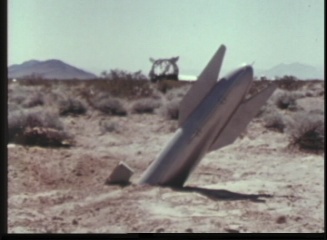
That day, a group of American and Norwegian researchers launched a Black Brant XII sounding rocket from the Arctic Circle island of Andøya in an effort to study aurora borealis (the northern lights).
The scientists had warned Russia, the US, and 28 other countries that they were planning a launch, as they knew there was a chance that the rocket would be mistaken for a nuclear first strike.
Within minutes, President Boris Yeltsin was brought his black nuclear-command suitcase. For several tense minutes, while Yeltsin spoke with his defense minister by telephone, confusion reigned,” the Washington Post’s David Hoffman reported a few years after the incident. “Little is known about what Yeltsin said, but these may have been some of the most dangerous moments of the nuclear age.”
It was, Hoffman reported, the first time a Russian or Soviet leader had used a nuclear briefcase in response to an actual alert. Yeltsin concluded that it was not actually a first strike and did not retaliate.
For that, I thank him; I don’t know if a Russian second strike would have sent enough warheads to kill 4-year-old Dylan all the way up in New Hampshire, but I’m also glad we didn’t have to find out.
But, of course, the 1995 incident was hardly the only time in the nuclear area we came close to an accidental nuclear exchange.
On October 27, 1962, Vasili Arkhipov, a Soviet navy officer, was in a nuclear submarine near Cuba when US naval forces started dropping depth charges (a mild explosive meant to signal for the submarine to identify itself). Two senior officers on the submarine thought that a nuclear war had already begun and wanted to launch a nuclear torpedo at a US vessel. But all three senior officers had to agree for the missile to fire, and Arkhipov dissented, preventing a nuclear exchange.
On September 26, 1983, Soviet Lt. Col. Stanislav Petrov was watching the Soviet Union’s missile attack early warning system when it displayed, in large red letters, the word “LAUNCH”; Petrov’s computer terminal gradually indicated that one, then two, then three, and eventually a total of five American missiles were incoming. Petrov declined to report the strike, knowing that if he did, the likely response would be a full nuclear retaliation. And it was good he did, because the Minuteman missiles the detection system thought it saw were actually just the sun’s reflection off clouds.
Also, in 1980, an intercontinental ballistic missile exploded in Damascus, Arkansas, while it had a 9-megaton nuclear warhead — with three times more explosive power than all the bombs of World War II combined — on top of it. The warhead didn’t detonate; if it did, Arkansas wouldn’t exist and you never would have heard of Bill or Hillary Clinton.
We can live safely in the knowledge that much or all of humankind won’t suddenly vanish due to a miscalculation by a radar officer in Russia or the US, and that people near missile sites won’t find themselves incinerated accidentally due to technician error. Or we can continue to have nuclear weapons. But we have to choose.
Fifty years ago today, a nuclear meltdown occurred in Switzerland’s first experimental nuclear power station. Built in an underground chamber in Lucens in the western part of the country, it was the site of the worst nuclear accident in Swiss history.
The plant was opened in 1962, with the aim of not only producing energy, but also allowing Switzerland to develop a reactor bearing the “Made in Switzerland” label and enabling experiments with nuclear energy.
But these plans were pushed aside when disaster struck in the plant’s reactor cavity on January 21, 1969. A pressure tube burst which created a power surge leading to the reactor malfunctioning and an explosion. Luckily, a member of staff who was scheduled to be working on the reactor at the time was found safe and sound elsewhere. The plant’s underground design also prevented people and the environment from being harmed.
The accident’s severity registered at 5 out of a possible 7. The concentration of leaked cooling gas that was behind the door of the reactor cavity was lethal. It wasn’t even possible to measure the radioactivity because it was above the maximum level on the measuring instruments.
But the reactor cavern was not completely sealed: the radioactivity spread to the control room 100 metres away. In the machine cavern closest to the reactor, a team involved in shutting down the turbine had been exposed to radiation. A witness report said that since the decontamination showers had been out of order, the workers had to shower in a temporary facility without hot water.
The government ordered an inquiry into the incident and a report was eventually published ten years later. The Swiss Association for Atomic Energy found there had been no major negligence on the part of the plant’s managers. The cause of the incident was corrosion in a pressure tube, brought about by humidity.






 nuclear-news