Almost forgotten? the Church Rock nuclear tragedy

On July 16, 1979, the worst accidental release of radioactive waste in U.S.
history happened at the Church Rock uranium mine and mill site. While the
Three Mile Island accident (that same year) is well known, the enormous
radioactive spill in New Mexico has been kept quiet. It is the U.S. nuclear
accident that almost no one knows about. Just 14 weeks after the Three Mile
Island reactor accident, and 34 years to the day after the Trinity atomic
test, the small community of Church Rock, New Mexico became the scene of
another nuclear tragedy.
Beyond Nuclear 16th July 2023, https://beyondnuclearinternational.org/2023/07/16/a-90-million-gallon-nuclear-tragedy/
Drone Strikes Nuclear Power Plant in UAE — This Could Get Bad
Zachary Shahan, 22 May 26, https://cleantechnica.com/2026/05/22/drone-strikes-nuclear-power-plant-in-uae-this-could-get-bad/
We’ve got a disaster underway in the Middle East following the US and Israel bombing Iran. The Straight of Hormuz remains blocked, and the global oil industry is approaching true crisis. However, things could get much worse — much, much worse.
Reporting indicates a drone struck a nuclear power plant in the UAE this week, even igniting a fire. Funny enough, no one was blamed for the incident, yet authorities in the country did label it an “unprovoked terrorist attack.”
As far as we’ve seen, there’s been no radiological material leakage from the incident. But imagine if another, bigger strike does lead to that….
“The UAE, which has hosted air defenses and personnel from Israel, recently accused Iran of launching drone and missile attacks,” NPR reports.
South Korea helped the UAE build the nuclear power plant in 2020.
While this is the first time the nuclear power plant was targeted, the fact is it was targeted. And we don’t really know how bad things could get. What if someone does bomb it and break through any safety barriers?
The Barakah Nuclear Power Plant is right on the coast of the Persian Gulf. So, you know, nothing to worry about if nuclear waste makes its way into there….
IAEA warning after drone hits used fuel facility near Chernobyl

WNN, 8 June 2026
Significant structural damage was caused to a building at the new central used fuel storage facility in the Chernobyl exclusion zone, International Atomic Energy Agency Director General Rafael Mariano Grossi has said.
In a briefing to the IAEA’s Board of Governors, and in a subsequent press conference, Grossi said that in a separate incident on Friday a drone had injured Russian military personnel undertaking de-mining activities as part of an IAEA-mediated ceasefire to allow the main 750 kV Dniprovska external power line to Zaporizhzhia Nuclear Power Plant to be fixed.
He said that over the weekend there had been further negotiations with both sides before it was agreed that the IAEA would send observers to monitor the mine-clearing work, which is necessary before the repair work can take place on the external power supply lines on pylons on either side of the military front line.
“Without the Dniprovska line, Zaporizhzhia Nuclear Power Plant’s off-site power situation is very fragile. Over the past days, the plant suffered its 18th offsite power outage since the war began. With a duration of 15-hours, it was also one of its longest, necessitating the use of emergency diesel generators to cool the six shut down reactors until offsite power was restored on Saturday morning,” he said.
The incident with a drone striking the three-year-old Central Spent Nuclear Fuel Storage Facility in the Chernobyl exclusion zone took place on Sunday, with Grossi reporting it caused “significant structural damage to part of the fuel reception building, including the IAEA safeguards office. Spent fuel was stored in casks just a few hundred metres from the damaged building. Thankfully, radiation levels at the facility remained normal, indicating the incident did not cause radioactive contamination. It remains unclear when the facility will be able to start receiving spent fuel from Ukraine’s operating nuclear power plants again”.
He added: “Attacking a facility with large amounts of nuclear material is extremely dangerous. It must not happen.”
The Centralised Spent Nuclear Fuel Storage Facility is a dry storage site for used nuclear fuel assemblies from the country’s VVER-1000 and VVER-440 reactors. It is designed to have a total storage capacity of 16,530 used fuel assemblies, including 12,010 VVER-1000 assemblies and 4,520 VVER-440 assemblies. Contracts were signed for its construction with USA-based Holtec International in 2005, although construction only began in 2017.
It started receiving used nuclear fuel from the country’s nuclear power plants at the end of 2023 and it has been operating under a commissioning licence. It was issued with its operating licence last month after an inspection carried out from 20 April to 1 May.
Operator Energoatom said the fire caused by the drone strike covered an area of 40 square metres and “was quickly localised and completely eliminated”. It said there were no injuries among the personnel and the radiation situation remained within normal limits.
During his speech to the board of governors and during his media briefing, Grossi maintained the IAEA’s stance of not attributing blame to either side for incidents during the war…………………….. https://www.world-nuclear-news.org/articles/iaea-warning-after-drone-hits-used-fuel-facility-near-chernobyl
‘Serious incident’ at Europe’s largest nuclear plant – work to stop ‘accident’ ongoing

An incident at the Zaporizhzhia Nuclear Power Plant in
Ukraine has left some Russian military personnel injured as efforts to
prevent a ‘nuclear accident’ continue. Russian military personnel have been
injured following a “serious incident” at Europe’s largest nuclear power
plant.
The International Atomic Energy Agency (IAEA) today said it had been
informed of an incident which occurred during de-mining efforts following a
localised ceasefire between Russia and Ukraine. The ceasefire is in place
so that power line repairs can be carried out, repairs the IAEA says are
crucial for preventing a “nuclear accident” at the site.
The power plant
has lost power on several occasions due to fighting in the region. Rafael
Mariano Grossi, IAEA director general, today called for “maximum military
restraint and full adherence to the ceasefire” so “efforts to prevent a
nuclear accident” can continue. The exact nature of the incident which led
to the recent injuries remains unclear.
Mirror 5th June 2026, https://www.mirror.co.uk/news/world-news/zaporizhzhia-nuclear-power-plant-accident-37255798
Another deadly explosion casts shadow over Hanwha Aerospace’s cutting-edge image.
2026-06-02, HANKYOREH, By Choi Ye-rin, staff reporter; Jang Hyeon-eun, staff reporter; Kim Joong-gon, staff reporter; and Kwon Hyo-jung, staff reporter
Five were killed and two injured at an explosion at the defense contractor’s Daejeon plant.
Another explosion at defense contractor Hanwha Aerospace’s plant in Daejeon, the country’s No. 5 city, killed five people Monday, bringing the total death toll from explosions at the site to 13, including five fatalities in 2018 and three in 2019.
Hanwha Aerospace has recently emerged as a leader in the country’s cutting-edge defense industry. Yet behind the scenes, its plant has seen a series of workplace disasters that are at odds with the standards expected of a world-class manufacturer.
The site of Monday’s explosion was the plant’s tool cleaning area of Building 56. Hanwha Aerospace said this facility, which washes explosive materials from tools used to make rocket propellant, is separated from other buildings.
The company added that a management supervisor and six production staff were cleaning tools using water mixed with detergent when a sudden explosion caused a fire. Five workers died and one suffered second-degree burns over his entire body, with one manager who was outside the facility sustaining minor injuries.
The workers apparently had no time to escape as the explosion caused flames to instantly engulf them. Police plan to request DNA analysis from the National Forensic Service to identify the victims……………………………………..
Ga Jae-woong, a Hanwha Aerospace senior vice president and manager of the plant, declined to disclose details such as what sort of explosive material was involved, only saying that all processes at the workplace are “confidential.”
Hanwha Aerospace’s failure to pinpoint the cause of the blast has sparked fierce criticism considering the growing death toll at the plant. All three explosions are known to have been related to solid propellant used to transport weapons.
In 2018, an explosion occurred during the process of loading fuel into a rocket propellant container. The next year, another happened during the removal of a propellant core.
Workers at the plant bear inherent risk because of the highly explosive properties of the propellant used in rocket boosters. But Monday’s catastrophe demonstrates the company’s failure to take effective measures to prevent such explosions even after similar incidents in 2018 and 2019.
Immediately after the 2018 blast that killed nine, a Ministry of Employment and Labor inspection uncovered as many as 486 violations of workplace safety regulations.
An annual report by Hanwha Aerospace also said it had been fined 2 million won (US$1,300) by fire authorities in Daejeon in January 2025 for failure to comply with regulations for hazardous material prevention, as well as 1.6 million won that June for inadequate maintenance and management of fire safety facilities.
“Defense contractors often classify their production processes as confidential, so there are cases where they never take proper follow-up measures even after explosions resulting in casualties occur,” said Yeom Gun-woong, a professor of police and fire administration at U1 University. “Three similar accidents have occurred at the same workplace, so a fact-finding investigation and comprehensive inspection are necessary.”
The company’s union demanded a thorough investigation into the incident and identification of those responsible, slamming Hanwha Aerospace’s “slogans of eradicating industrial accidents and creating a safe workplace” as “nothing but empty words.”
The Korean Confederation of Trade Unions, one of the country’s major umbrella unions, also criticized the company in a statement.
“Hanwha Aerospace has made it abundantly clear that it not only neglects the safety and lives of its workers, but has also made no safety improvements since the last two accidents,” it wrote. ………………………………….https://english.hani.co.kr/arti/english_edition/e_national/1261569.html
First attack on Arab nuclear site sends warning to Gulf, US
The first attack targeting an Arab nuclear site has sent a symbolic warning
to the United Arab Emirates and its allies, even as Iran and the US remain
in negotiations to end the Middle East war, analysts say. An unclaimed
drone struck an electrical generator on Sunday near the Arab world’s first
nuclear power plant in Barakah in the emirate of Abu Dhabi, triggering a
fire but causing no injuries nor radiation leak.
Daily Mail 18th May 2026 https://www.dailymail.com/wires/afp/article-15828501/First-attack-Arab-nuclear-site-sends-warning-Gulf-US.html
Russian ship that sank near Spain in 2024 may have carried nuclear reactor parts
By ASSOCIATED PRESS, , 13 May 2026, https://www.dailymail.com/wires/ap/article-15814163/Russian-ship-sank-near-Spain-carried-nuclear-reactor-parts.html
BARCELONA, Spain (AP) – A Russian ship that sank in the Mediterranean over a year ago after its engine room exploded may have been carrying pieces for nuclear reactors used in submarines, a Spanish government document shows.
The Ursa Major sank on Dec. 23, 2024, between Spain and Algeria while allegedly on a journey from St. Petersburg to Russia’s eastern port of Vladivostok. Two crew members were lost while 14 other people were saved by Spanish rescue craft.
In a written response to opposition lawmakers, the Spanish government wrote that the ship´s captain “confessed” that the ship was carrying “components for two nuclear reactors similar to those used in submarines.”
The response was included in a document registered by the Spanish parliament on Feb. 23 and was first reported by CNN on Tuesday. The document has been seen by The Associated Press.
At the time of the sinking, the Russian state-owned ship owner, Oboronlogistika, said that the Ursa Major was sabotaged. It said three powerful explosions damaged the boat just above the water line in what the company described as a “terrorist attack.”
Oboronlogistika was established under Russia´s defense ministry and placed under U.S. and European Union sanctions for its ties to Russia´s military.
According to the document, the boat’s manifest said the boat was carrying 129 containers, two large cranes and “two well covers.”
Officials said that when questioned upon rescue by the Harbor Master in Cartagena, Spain, the boat captain revealed that the well covers were nuclear components. He added that the boat was not carrying nuclear fuel.
Spanish authorities said they were not able to search the ship to confirm the information during the rescue operation which focused on saving the crew and searching for the two missing members. The wreck rests at 2,500 meters (8,200 feet) deep.
Kremlin spokesman Dmitry Peskov told a conference call with reporters on Wednesday that he hasn´t seen the reports regarding the ship´s cargo while adding: “there is nothing for us to comment on here.”
Fires break out in exclusion zone around Chernobyl nuclear plant
Arpan Rai & Maira ButtFriday 08 May 2026, https://www.independent.co.uk/bulletin/news/chernobyl-fires-radiation-russia-ukraine-b2973234.html
A forest fire burns in the exclusion zone around the Chernobyl nuclear power plant (AP)
- Russia has said it is carrying out enhanced radiation monitoring after fires broke out in the exclusion zone around the Chernobyl nuclear power plant on Friday.
- The country’s national public health agency said that enhanced radiation monitoring was being conducted and the situation was now “stable”.
- The 1986 Chernobyl disaster is considered to be the world’s worst civil nuclear accident.
- It spread Iodine-131, Caesium-134 and Caesium-137 across parts of Ukraine, Belarus, Russia, northern and central Europe.
- Meanwhile, Ukraine has continued its long-range attacks on Russia with a drone strike one of the country’s largest oil refineries, located in Yaroslav
Chernobyl, 40 Years Since Disaster: Five Things to Know
Ukraine on Sunday marks the 40th anniversary of the explosion at the
Chernobyl nuclear power plant – the worst civilian nuclear disaster in
history. It comes four years into the Russian invasion that has put the
plant once again under threat and raised risks of another radioactive
catastrophe.
Here are five things to know about the disaster and the plant
today: Thousands are estimated to have died as a result of exposure to the
radiation, though assessments of the precise human toll vary. A 2005 UN
report put the number of confirmed and projected deaths at 4,000 in the
three worst-affected countries. Greenpeace in 2006 estimated that the
disaster had caused close to 100,000 deaths. According to the United
Nations, some 600,000 people involved in the clean-up operation — known as
“liquidators” — were exposed to high levels of radiation. The disaster
raised public fears of nuclear energy, fuelling a surge in anti-nuclear
movements across Europe.
Kyiv Post 24th April 2026, https://www.kyivpost.com/post/74633
60 Years Nuclear Accident of Palomares – Lost hydrogen bombs and their consequences
Exactly 60 years ago, on January 17, 1966, one of the worst nuclear accidents of the Cold War occurred in southern Spain. A US tanker plane collided with a B-52 bomber carrying four hydrogen bombs. The planes exploded and fell with their dangerous cargo over the coastal village of Palomares in Andalusia. Two of the four bombs failed to deploy their parachutes. They shattered on impact, contaminating the air and soil around Palomares with plutonium and uranium. The fourth bomb fell into the Mediterranean Sea and was discovered just 80 days later.
Uranium Film Festival, 6 April 26
A conversation with the Spanish author and documentary filmmaker José Herrera Plaza from Almería. Interview by Norbert Suchanek
Where were you in January 1966, when the hydrogen bombs fell from the sky?
I had just started school in Almería, about 90 kilometers from Palomares. Like most people in Andalusia, I had no idea about the hydrogen bombs flying over our heads.
When and why did you begin your research on the Palomares accident and make it your main focus?
On January 13, 1986, I attended a meeting with the residents of Palomares. It was three days before the 20th anniversary of the accident, and their claims for compensation for health damages were about to expire. I wanted to make a documentary about this little-known, almost unbelievable story, but at that time, all sources for documentary films were classified. I waited 21 years, gathering all available documents, until I was finally able to complete the documentary “Operation Broken Arrow: The Palomares Nuclear Accident.”
What does “Operation Broken Arrow” mean?
“Broken Arrow” is an U.S. military code word. It refers to an accidental event that involves nuclear weapons like an accidental or unexplained nuclear explosion or the loss or theft of nuclear bombs.
How did the local authorities react? Were they aware of the plutonium threat?
The local authorities responded to the protocol of an aviation accident without knowing about the involvement of nuclear weapons or the contamination of a large area until several days later.
How and when did the government in Madrid react?
Spanish authorities learned of the crash almost immediately, thanks to alerts sent via emergency channels by a Spanish Navy helicopter. The fact that the plane was carrying four hydrogen bombs was revealed later that same day, thanks to the US ambassador. But both governments involved kept quiet about it until, three days later, the media exposed it to the public
How was it possible that the media reported on this so quickly during the Franco dictatorship?
The Spanish-American journalist André del Amo(link is external), from United Press International, was in Palomares two days after the accident and exposed the involvement of nuclear weapons as well as the use of Geiger counters in ground measurements. The following day, his report appeared in major media outlets worldwide. The dictatorship reacted in its usual manner: it confiscated newspapers from newsstands and at the airports in Madrid and Barcelona as soon as international flights landed.
Nevertheless, the residents of Palomares and the rest of Spain learned of the news because, to circumvent the strict media censorship, it was common practice to listen to Spanish-language shortwave broadcasts from Radio Paris, the BBC, and especially Radio España Independiente “La Pirenaica,” the station of the Communist Party of Spain, broadcasting from Bucharest, Romania.
What were the direct consequences of the shattered hydrogen bombs? Was there a risk of a nuclear explosion?
The two Mk-28 FI bombs had 68 times the explosive power of the atomic bomb that destroyed Hiroshima. Upon impact at Palomares, the Hydrogen bombs exploded because the conventional explosive charge of the trigger detonated. An area of 635 hectares was subsequently contaminated with fissile fuel: approximately 10 kilograms of plutonium-239 and -241, and slightly more than 10 kilograms of uranium-235 and uranium-238, also known as depleted uranium. While the risk of an accidental nuclear detonation was very low, it did exist. Nevertheless, these hydrogen bombs were among the most technologically advanced in the US arsenal at the time. Their safety systems were quite good, with the exception of the conventional explosive, which was sensitive to shock and vibration. Due to this accident and a similar one two years later in Thule, Greenland, the US military replaced this explosive with a shock- and fire-resistant one.
Was the local population warned about plutonium contamination and the consumption of potentially contaminated food such as tomatoes?
The inhabitants of Palomares were continually and perversely misinformed and thus continued for fifty years, in the Franco dictatorship as well as in democracy. All awareness of their precarious situation was thanks to the banned shortwave stations such as Radio España Independiente “La Pirenaica”, and BBC or Radio Paris in their evening programs in Spanish. Also the empathic help of one of the highest members of the Spanish nobility: the Duchess of Medina Sidonia, helped to inform the locals of her situation and rights, for which the fascist dictatorship of Franco put her in prison.
Are there any data or estimates on how many people became ill or died as a result of the contamination with Plutonium or Uranium?
No, because they have never allowed a rigorous epidemiological study to be conducted. When some independent people have tried, it has all been problems. At the same time, the official history created and maintained by the two Governments has stated that there has never been a tumor disease caused by plutonium. Palomares is an environmental sacrifice zone with significant health risks for its inhabitants. But it is not an exception to the rest of the world: invisible minority, invisible consequences……………………………………………………………………………………………………………………………………………………………………………………………………………https://uraniumfilmfestival.org/en/60-years-ago-in-palomares
New Addition to List of Nuclear Near Catastrophes
By David Swanson, World BEYOND War, February 23, 2026, https://worldbeyondwar.org/new-addition-to-list-of-nuclear-near-catastrophes/
There are many lists of nuclear close calls. We have a new one to add.
On Monday I visited a site in Caracas, Venezuela, where, very early in the morning on January 3, two powerful missiles slammed into the top of a hill, several feet apart, both beneath a tall telecommunications tower. The tower is largely gone. Debris flew for great distances — many times the distance of 270 meters to a nuclear reactor (white in the background in the photo above on original) and nuclear storage facility. The Earth shook. Buildings a great distance away were damaged and glass windows broken. A building adjacent to the nuclear reactor had rooms most significantly damaged. Electricity was cut off to a wide area, including to the nuclear reactor.
Any use of force whatsoever on any target at all is excessive when attacking someone’s country with violence, but it’s likely that much less force than two massive missiles could have sufficed for the crime of depriving people of electricity and communications. It’s also possible that something could have gone slightly wrong, resulting in a need to evacuate millions of men, women, children, and infants.
Does this bode well for the crime, threatened yet again, of attacking Iran? Will care be taken to avoid nuclear disasters, or in fact will such care be strictly avoided?
Or if Trump loses interest in Iran, could worse be in store for Venezuela?
The site of this nearly nuclear attack was the Venezuelan Institute of Scientific Research, a non-military facility. The nuclear reactor is for medical purposes, and nuclear materials are returned to this site from hospitals for storage.
The missiles were reportedly fired from perhaps a kilometer away by an F-35 — a wonderful airplane with its own long list of horrors and disasters.
The attack put a halt to research at the institute, and — according to people who had worked there for 30 years — was the first crime of any kind committed on the campus.
Workers were able to use generators and then to restore some power to the reactor in 4 days and full power in 10 days. There is talk of rebuilding the tower. There has also been a proposal to build a memorial on the site.
Visiting this location was part of the fourth day of a peace delegation to Venezuela. See reports on the first three days here:
Today in History – January 24: Pure luck stops two nuclear bombs destroying US city

By Nick Pearson, Jan 24, 2026, https://www.9news.com.au/world/today-in-history-january-24-what-happened-on-this-day/67dc0e76-b5a5-4799-8fd0-ef2c401b7812
Two concurrent nuclear explosions over a US town were narrowly averted on January 24, 1961.
A B-52 bomber flying over Goldsboro, North Carolina, started to break up in mid-air after a fuel leak.
The centrifugal forces set off a trigger in the cockpit which would be used to drop the payload in the back of the plane.
That payload was two hydrogen bombs, which dropped out of the plane as it broke up in the sky.
Five of the eight crew were able to bail out safely, but three were killed.
Meanwhile, the two hydrogen bombs fell to the ground.
By pure luck, neither of the weapons exploded.
The first weapon had landed in a field on a farm, landing reasonably softly because of its deployed parachute.
With one of the 24-megaton warheads, there were six interlocking safety mechanisms which needed to be triggered for the bomb to explode.
“When Air Force experts rushed to the North Carolina farm to examine the weapon after the accident, they found that five of the six interlocks had been set off by the fall,” nuclear safety supervisor Parker F. Jones wrote in a 1969 report.
“Only a single switch prevented the 24-megaton bomb from detonating and spreading fire and destruction over a wide area.”
The second bomb landed in a muddy field, leaving a 1.5m hole in the ground.
When it was recovered after a three-day operation, they found the safety switch had been turned to “Armed”.
It created a mystery as to why this bomb did not detonate.
The conclusion from investigators was that the impact from hitting the earth shifted the switch to “Armed”, but that same impact had broken the circuits that would have set the bomb off.
After breaking up on impact and sinking into deep mud, some major components of the bomb have still not been recovered.
If either bomb had detonated, it would have likely wiped out a city of about 30,000 people.
The farmer was paid $100 by the US government for a 61m-radius section of the farm.
They are still allowed to use the land for agricultural purposes but forbidden from digging more than five feet down.
Radioactive substance leaks from Fukui nuclear power plant in Japan
Jen Mills, Metro 24 Dec 2025
Radioactive water leaked from a disused power plant in Japan today during work to decommission it.
Parts of the Fugen nuclear plant in Fukui Prefecture are being dismantled, and while this took place, around around 20ml of water containing a ‘high’ amount of the radioactive isotope tritium leaked from a pipe.
Japanese broadcaster NHK One reported earlier that detailed investigations were underway to see if any workers were splashed with the water, though internal exposure via inhalation had been ruled out.
Citing the Nuclear Regulation Authority, they said no radioactive material had leaked outside the controlled area of the plant.
Fire at Windscale piles
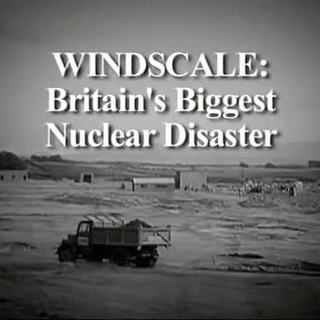
Does Britain Really Ned Nuclear Power? by Ian Fairlea, beyondnuclearinternational
“…………………………………………………………….In 1957, a major fire occurred at Windscale nuclear site (what is now known as Sellafield). The effects of the Windscale fire were hushed up at the time but it is now recognised as one of the world’s worst nuclear accidents. An official statement in 1957 said: ‘There was not a large amount of radiation released. The amount was not hazardous and in fact it was carried out to sea by the wind.’ The truth, kept hidden for over thirty years, was that a large quantity of hazardous radioactivity was blown east and south east, across most of England.
After years of accidents and leaks, several of them serious, and regular cover-up attempts by both the management and government, it was decided to change the plant’s name in 1981 to Sellafield, presumably in the hope that the public would forget about Windscale and the accident.
When, in 1983, Greenpeace divers discovered highly radioactive waste being discharged into the sea through a pipeline at Sellafield and tried to block it, British Nuclear Fuels Ltd (BNFL), who then operated the site, repeatedly took Greenpeace to the High Court to try to stop them and to sequestrate its assets. The first generation of British Magnox nuclear power stations were all secretly designed with the dual purpose of plutonium and electricity production in mind.
Some people think that because plutonium is no longer needed by the UK to make weapons as it already has huge stocks of weapons grade plutonium, there no longer is any connection between nuclear weapons and nuclear energy. This is incorrect: they remain inextricably linked. For example:
- All the processes at the front of the nuclear fuel cycle, i.e. uranium ore mining, uranium ore milling, uranium ore refining, and U-235 enrichment are still used for both power and military purposes.
- The UK factory at Capenhurst that makes nuclear fuel for reactors also makes nuclear fuel for nuclear (Trident and hunter-killer) submarines.
- Nuclear reactors are used to create tritium (the radioactive isotope of hydrogen) necessary for nuclear weapons.
………………………………………………………………………………………………… https://beyondnuclearinternational.org/2025/12/14/does-britain-really-need-nuclear-power/
French navy shoots at 5 drones buzzing nuclear submarine base, AFP reports

The incident follows a string of recent drone incursions in NATO airspace
December 5, 2025 , By Marion Solletty, https://www.politico.eu/article/drones-france-nuclear-submarine-base-reports/
PARIS — The French navy opened fire at drones that were detected over a highly-sensitive military site harboring French nuclear submarines, according to newswire Agence France-Presse.
Five drones were detected Thursday night over the submarine base of Île Longue, in Brittany, western France, a strategic military site home to ballistic missile submarines, the AFP reported, citing the the French gendarmerie, which is part of the military. The submarines harbored at the base carry nuclear weapons and are a key part of France’s nuclear deterrent.
French navy troops in charge of protecting the base opened fire, the report said. It was unclear whether the drones were shot down.
Local authorities told the AFP a legal investigation had been launched and that the base wasn’t affected in its operations.
Drones had already been spotted in the area last month, albeit not directly above the base, per reports in French media. The site had been buzzed by drones long before the invasion of Ukraine.
The incident follows a string of recent drone incursions in NATO airspace, with unmanned aircrafts seen buzzing around sensitive military sites and civil infrastructures in recent months across Europe, including in Belgium, Germany, Denmark and Norway.
In Poland, fighter jets were scrambled in September to shoot down drones of Russian origin, an incident widely seen as an escalation of Russian President Vladimir Putin’s hybrid war on Europe.
French authorities haven’t yet commented on the suspected origin of the drone incident Thursday at the well-known military site.
1 This Month





PLEASE OPPOSE HR 8255 AND S.3639 – bills would accelerate satellite deployment, with no environmental review or safeguards – https://ncstd5li.quorum.us/campaign/169331/
To see nuclear-related stories in greater depth and intensity – go to https://nuclearinformation.wordpress.com
-
Archives
- October 2026 (40)
- September 2026 (339)
- August 2026 (330)
- July 2026 (355)
- June 2026 (287)
- May 2026 (306)
- April 2026 (356)
- March 2026 (251)
- February 2026 (267)
- January 2026 (308)
- December 2025 (358)
- November 2025 (359)
-
Categories
- 1
- 1 NUCLEAR ISSUES
- business and costs
- climate change
- culture and arts
- ENERGY
- environment
- health
- history
- indigenous issues
- Legal
- marketing of nuclear
- media
- opposition to nuclear
- PERSONAL STORIES
- politics
- politics international
- Religion and ethics
- safety
- secrets,lies and civil liberties
- spinbuster
- technology
- Uranium
- wastes
- weapons and war
- Women
- 2 WORLD
- ACTION
- AFRICA
- Atrocities
- AUSTRALIA
- Christina's notes
- Christina's themes
- culture and arts
- Events
- Fuk 2022
- Fuk 2023
- Fukushima 2017
- Fukushima 2018
- fukushima 2019
- Fukushima 2020
- Fukushima 2021
- general
- global warming
- Humour (God we need it)
- Nuclear
- RARE EARTHS
- Reference
- resources – print
- Resources -audiovicual
- Weekly Newsletter
- World
- World Nuclear
- YouTube
-
RSS
Entries RSS
Comments RSS

