 Scientists just found the ‘chemical fingerprint’ of an alleged nuclear explosion that went undeclared in Russia, Business Insider, Aria Bendix Jun 16, 2020
- A group of scientists known as the “Ring of Five” detected unusual levels of radiation in Europe in 2017.
- A new study offers “irrefutable proof” that the radiation came from nuclear waste reprocessing.
- The study lends further evidence to the claim that Russia failed to disclose an accident at the Mayak nuclear facility in September 2017.
- For the past three years, a group of scientists called the “Ring of Five” has been inching toward the conclusion that an undisclosed nuclear accident took place in Russia in 2017.
In July 2019, the group released evidence that an explosion may have occurred at the Mayak nuclear facility — once the center of the Soviet nuclear-weapons program. Mayak was also the site of the 1957 Kyshtym explosion, the world’s third-worst nuclear accident behind Fukushima and Chernobyl.
- In late 2019, the scientists suggested that, given the large amount of radiation admitted on the date, the accident took place on September 26, 2017. The radiation seemed to spread from Russia’s Southern Urals region (where the Mayak facility is located) toward central Europe, Scandinavia, and Italy.
A third study, released Monday, offers “irrefutable proof” that the explosion was linked to nuclear waste reprocessing — a method that separates plutonium and uranium from spent nuclear fuel. The Mayak facility is the largest nuclear reprocessing facility in the region. That makes it the most likely, if not the only possible, origin site — though Russia has never acknowledged a nuclear accident at the facility in 2017…….
- The Ring of Five has been monitoring Europe’s atmosphere for elevated levels of radiation since the mid-1980s. The group originally hailed from five countries: Sweden, Germany, Finland, Norway, and Denmark. But after the Chernobyl disaster in 1986, the team enlisted the help of other nations to expand their efforts. It now includes researchers from 22 countries.
- On October 2, 2017, Italian scientists sent an alert to the Ring of Five about elevated levels of ruthenium-106, a radioactive isotope, in Milan. The discovery marked the first time that ruthenium-106 had been found in the atmosphere since Chernobyl.
“We were stunned,” Steinhauser said. “We did not have any anticipation that there might be some radioactivity in the air. We were just measuring air filters as we do on a weekly basis, 52 times a year, and suddenly there was an unexpected result.”
- Steinhauser said the explosion was the “single greatest release from nuclear-fuel reprocessing that has ever happened.”
But Russia has not responded to any findings from the Ring of Five. In December 2017, Russian officials attributed the radiation to an artificial satellite that burned up in the atmosphere. The scientists’ latest study excludes that possibility.
- The study is the first direct evidence that the ruthenium-106 came from nuclear waste reprocessing. It identified a unique “chemical fingerprint” among samples of the isotope collected in 2017.
Within those samples, the scientists found signs of two chemicals commonly associated with nuclear waste reprocessing: (III) chloride and ruthenium(IV) oxide. This provided “direct evidence that fuel reprocessing was the origin of the 2017 environmental release,” the scientists wrote………. https://www.businessinsider.com/russia-nuclear-accident-mayak-facility-new-evidence-2020-6?r=AU&IR=T
June 18, 2020
Posted by Christina Macpherson |
incidents, Russia |
Leave a comment
 A French Submarine Caught Fire In Drydock. It Could Lead Paris To Rethink Its Nuclear Deterrence Strategy. Forbes, Sebastien Roblin 11 June 20 A French Submarine Caught Fire In Drydock. It Could Lead Paris To Rethink Its Nuclear Deterrence Strategy. Forbes, Sebastien Roblin 11 June 20 A fire broke out in the rear section of the French nuclear-powered attack submarine Perle on Friday morning as she lay in drydock in the port of Toulon. White clouds of smoke poured into the sky as firefighters from Toulon and Marseilles rushed to the scene.
Finally at 9:36 p.m local time the Mediterranean Maritime Prefecture reported that the fire had been brought under control by completely flooding the rear compartments of the boat with foam, further noting that the “reactor rooms remains untouched.”……..
Just as importantly, the ship’s 48 megawatt pressurized water nuclear reactor, nuclear fuel, and (conventional-only) weapons had been removed when the submarine entered the drydock in January 2020 for an overhaul by Naval Group due for completion by February 2021. For that reason, the local maritime prefecture claims there is no possibility of radioactive contamination from the incident.
The firefighting effort reportedly involved 30 specialist naval firefighters with support from a firefighting boat, as well as additional specialists scrambled from Marseilles, 11 specialized ground-based firefighting vehicles, and at least 10 ESNA submariners to advise the firefighters.
However, there are growing fear that the Perle may have sustained too much damage to be saved.
A veteran submariner told the local paper Var Matin “If the thick hull [made of 80HY high-tensile steel]…is deformed, the boat is screwed.”
The cause of the blaze is speculated to possibly be faulty welding or a high-pressure cutting gone awry.
France’s Nuclear Submarine Force
French periodical LeMonde warned that should the Perle suffer “irremediable damage,” there was the possibility “the entire organization of French nuclear deterrence may have to be rethought. And the Navy may have to give up on certain strategic missions.”
The Perle does not actually carry any nuclear weapons. However, one of the primary roles of French attack submarines is protecting the four larger Triomphant-class nuclear-powered ballistic missile submarines (SSBNs) from hostile submarines.
Indeed, the SSBN Le Téméraire conducted a test launch of an unarmed M51 nuclear ballistic missile just the day prior. France perceives these submarines as performing a vital role in strategic nuclear deterrence, or “dissuasion” as it’s called in France……….
Establishing the cause of the accident that may put out of action a valuable strategic asset will also be a priority for Defense Minister Florence Parley, particularly given how much more serious the incident might have been had weapons, the reactor and/or additional personnel had been onboard.
For now the citizens of Toulon can only be thankful that loss of life was averted and that there is no apparent risk of contamination. The French Navy will have to take stock of the damage, adjust its plans for its SSN fleet accordingly—and consider how it can minimize the odds of another such accident occurring. https://www.forbes.com/sites/sebastienroblin/2020/06/12/a-french-submarine-caught-fire-in-drydock-it-could-lead-paris-to-rethink-its-nuclear-deterrence-strategy/#4addae213d05
|
|
|
June 13, 2020
Posted by Christina Macpherson |
France, incidents |
Leave a comment
In 1985, A Nuclear Submarine Explosion Contaminated Russia’s Far East,
Kyle Mizokami, The National Interest•June 5, 2020
Here’s What You Need To Remember: The explosion blew out the reactor’s twelve-ton lid—and fuel rods—and ruptured the pressure hull. The reactor core was destroyed, and eight officers and two enlisted men standing nearby were killed instantly. A the blast threw debris was thrown into the air, and a plume of fallout 650 meters wide by 3.5 kilometers long traveled downwind on the Dunay Peninsula. More debris and the isotope
Cobalt-60 was thrown overboard and onto the nearby docks.
In 1985, a Soviet submarine undergoing a delicate refueling procedure experienced a freak accident that killed ten naval personnel. The fuel involved was not diesel, but nuclear, and the resulting environmental disaster contaminated the area with dangerous, lasting radiation. The incident, which remained secret until after the demise of the USSR itself, was one of many nuclear accidents the Soviet Navy experienced during the Cold War……
The explosion blew out the reactor’s twelve-ton lid—and fuel rods—and ruptured the pressure hull. The reactor core was destroyed, and eight officers and two enlisted men standing nearby were killed instantly. A the blast threw debris was thrown into the air, and a plume of fallout 650 meters wide by 3.5 kilometers long traveled downwind on the Dunay Peninsula. More debris and the isotope Cobalt-60 was thrown overboard and onto the nearby docks.
According to Nuclear Risks, the accident scene was heavily contaminated with radioactivity. Gamma ray radiation was not particularly bad; at an exposure rate of five millisieverts per hour, it was the equivalent of getting a chest CT scan every hour. However, the explosion also released 259 petabecquerels of radioactive particles, including twenty-nine gigabecquerels of iodine-131, a known cause of cancer. This bode very badly for the emergency cleanup crews, especially firefighters who needed to get close to the explosion site, and the nearby village of Shkotovo-22. Forty-nine members of the cleanup crew displayed symptoms of radiation sickness, ten of them displaying acute symptoms…….
While the Chazhma Bay region appears contaminated to this day with radiation, it is unknown how much of it is the result of the K-431 incident and how much the result of the many nuclear-powered submarines that were junked and forgotten in the area.
The K-431 incident was one of several involving Soviet submarine reactors. Ten Soviet submarines experienced nuclear accidents, and one other, K-11, also suffered a refueling criticality………. https://news.yahoo.com/1985-nuclear-submarine-explosion-contaminated-213000521.html
June 6, 2020
Posted by Christina Macpherson |
incidents, Russia |
Leave a comment
|
 2019 Seattle radiation leak a ‘near miss’ to disaster, federal report finds 2019 Seattle radiation leak a ‘near miss’ to disaster, federal report finds
In May 2019, radiation leaked from a device at Harborview Research and Training. At first called a “minor” breach, investigators warn it could have been much worse. K5
Chris Ingalls May 23, 2020, SEATTLE — A March report from the U.S. Department of Energy (DOE) says a radiation leak at the Harborview Research and Training Building one year ago was “preventable” and “a near miss to a significant event” that could have devastated the Seattle area.
“It is a wake-up call for all of us,” said Dr. Jacob Kamen, a radiation expert at Mount Sinai Health System in New York City, who reviewed the 175-page report at KING 5’s request.
When radiation leaked from a medical device that a contractor was decommissioning on May 2, 2019 it was called a “minor” breach at the time.
But the DOE investigation revealed a stunning lack of oversight by federal regulators and a federally licensed contractor who pushed “…mission completion over safe conduct.”
Greg Wolf, a spokesman for the National Nuclear Security Administration (NNSA), which led the investigation, said the report was meant to be blunt so the same safety breakdowns would not happen again.
“In this joint investigation NNSA took an unflinching look at the incident and concluded that it was preventable. It was largely a result of weak and partially implemented oversight processes,” Wolf said…….
Video released by the DOE at KING 5’s request shows a serious mistake as the contractor uses an electric hand saw to cut into an aluminum tube that holds the cesium capsule. …….
the Seattle incident shows how much damage even a small amount of radioactive material can cause.
“So just imagine if a tiny fraction can do such contamination in a building for a year – what would it do if it’s used by someone with malicious purposes in downtown Seattle? Just imagine how bad it would be,” Kamen said.
Kamen says cesium could be used as a “weapon of mass disruption.” It would not necessarily result in a large body count, but it could contaminate city blocks and shut down the economic engine – much like coronavirus is doing now.
Kamen is one of the leading voices calling for the disposal of medical devices – like irradiators – from low security facilities across America……
The Harborview Research and Training Building remains closed during a cleanup that is nearing $9 million. Research projects that could be salvaged and medical training have been transferred to other locations…… https://www.king5.com/article/news/investigations/harborview-training-research-radiation-leak/281-d91e61fe-4e3e-4d4d-b6a1-9993be5e93c5
|
|
May 26, 2020
Posted by Christina Macpherson |
incidents, USA |
1 Comment
|
Finland’s new nuclear reactor hit by valve leak, SwissInfo Ch MAY 25, 2020 HELSINKI (Reuters) – Finland’s long-delayed Olkiluoto 3 (OL3) nuclear reactor was hit by another setback after the nation’s safety watchdog reported valve problems in a component involved in the cooling process.
The reactor in western Finland was built by a consortium of France’s Areva and Germany’s Siemens and had been due to start producing electricity in November this year.
“A leak was observed in the mechanical control valve of one of the pressuriser safety valves,” nuclear watchdog STUK said in a statement on Monday, adding that a full investigation is required before it can issue a nuclear fuel loading permit.
“This is very serious,” STUK’s head of inspection, Iiro Paajanen, told Reuters, adding that the leak was in part of the reactor’s primary circuit and involved in its cooling.
However, Areva said the issue is unlikely to cause further delay for the reactor, which was originally due to be completed in 2009. …..
Although Finland’s government issued an operating permit for the 1.6 gigawatt reactor in March 2019, OL3 needs final approval from STUK to load fuel and start production.
“At present, the plant unit still has several outstanding issues before a loading permit can be issued,” STUK wrote in its January-April safety report.
Reporting by Anne Kauranen and Tarmo Virki; Editing by Alexander Smith and David Goodman) https://www.swissinfo.ch/eng/finland-s-new-nuclear-reactor-hit-by-valve-leak/45783642
|
|
May 26, 2020
Posted by Christina Macpherson |
Finland, incidents |
Leave a comment

Georgia Nuclear: Vogtle Unit 3 Is Sinking! [BREDL Petition] https://www.fairewinds.org/demystify/georgia-nuclear-vogtle-unit-3-is-sinking-bredl-petition 18 May 2020, You can find the Fairewinds Associates expert report and BREDL’s legal filing here and under the reports section of this Fairewinds site. You also may read BREDL’s legal filing and the other documents filed on BREDL’s home site, where you will also see the breadth and depth of the environmental work conducted by the Blue Ridge Environmental Defense League and its associated chapters in many states. What Does the Leaning Tower of Pisa Have In Common with the Vogtle Nuclear Reactor?
By The Fairewinds Crew
The famous tower in Pisa, Italy was designed to stand straight up, and like Vogtle, it began to lean during construction. During the ensuing years after construction, the Pisa tower continued to sink into the ground due to the inability of the failing foundation to sustain the tower’s heavy weight. It became known as the Leaning Tower of Pisa. Similarly, the Vogtle Unit 3 nuclear power plant was designed to be straight on its firm ‘basemat foundation’, which is designed with extra rebar and mathematical calculations to assure that the foundation can support an atomic reactor as heavy as the unique design of the AP1000 with 8-million-pounds of emergency cooling water sitting on top of the containment.
Last month, Vogtle’s owner, Sothern Nuclear Operating Company (SNC), tried to amend its operating license with information that had been kept secret from the public. When that now leaning wall was first built five years ago, SNC established a program to monitor the lack of stability in the foundation.
Honestly, truth is stranger than fiction – you can’t make this stuff up! Now we learn that the Vogtle Unit 3 atomic power reactor is sinking into the red Georgia clay causing an inner wall to tilt! Yes, this is the same Vogtle Unit 3 that is already billions of dollars over budget and at least 5-years behind schedule.
On Tuesday, May 12, 2020, the Blue Ridge Environmental Defense League [BREDL] announced that part of the Vogtle Unit 3 nuclear power plant currently under construction in Waynesboro, Georgia, is sinking. According to BREDL’s press release, “In a legal action filed Monday with the Nuclear Regulatory Commission (NRC), the group called on regulators to revoke the plant’s license for false statements made by its owners, Southern Nuclear Operating Company. On May 11, BREDL filed a nineteen-page legal petition requesting a hearing before the Atomic Safety and Licensing Board on a License Amendment for Plant Vogtle’s Unit 3. The petition is supported by detailed, specific expert opinion. Under rules of procedure, Southern Company has 25 days to respond.”
Fairewinds Associates, Inc Chief Engineer Arnie Gundersen wrote an expert witness report submitted by BREDL to the NRC in which he said that Southern Nuclear Operating Company (SNC) chose not to disclose that the Vogtle Unit 3 foundation was sinking faster in the middle than at the edges, in the shape of a dish, causing internal walls to lean. From our point of view, leaning walls may have created a tourist destination for the Tower in Pisa, however, a leaning tower and failing foundation at a nuke plant is a meltdown waiting to happen.
BREDL has informed the NRC that there must be an entire reevaluation of the seismic/structural integrity of the entire nuclear plant. This means that a completely new licensing review and full analysis of all new stress conditions placed on other components that are no longer level needs to be conducted and receive an independent engineering review as well, since SCE has not publicized this fact to the people of Georgia.
Vogtle Units 3 & 4 are notoriously over budget, and their construction has been delayed for years. Now with the Covid-19 Pandemic, and these newly uncovered flaws, the construction will slow further as a complete safety review must be conducted to ascertain whether the ‘basemat foundation’ meets the foundation integrity demanded for a nuclear island (NI). The Vogtle Unit 3 nuclear island underlies the strange heavy design of the AP1000 with its donut-shaped 8-million-pound water tank at the apex of the entire containment system that is meant to protect us from a meltdown.
Let’s look more closely at the history of Vogtle and the so-called nuclear renaissance that never happened. Complicit in this financial boondoggle is the Georgia Public Service Commission (GPSC) whose members have greenlighted all these cost overruns in return for campaign contributions from the nuclear industry. That’s why we wrote The Night The Lights Went Out in Georgia. At Vogtle, all the extensive cost overruns have been shifted to Georgia taxpayers and ratepayers, and originally these plants were built with federal loan guarantees – that is our money folks, and a story for another time in the Vogtle saga.
During the past decade Fairewinds joined with other nuclear risk and environmental advocacy groups to raise awareness about the numerous safety flaws and operational issues associated with the AP1000 reactor design. You can read more about those problems and issues here.
In its legal brief, based on this Fairewinds Associates report, BREDL asked for a formal investigation of the Southern Nuclear Operating Company for making “materially false statements” to the NRC by claiming that the leaning walls were caused by construction tolerance measurements when the real reason the walls have moved is that the ‘basemat foundation’ of the Vogtle nuclear island (NI) is sinking.
May 18, 2020
Posted by Christina Macpherson |
business and costs, incidents, USA |
Leave a comment
 Germany: Radiation leak detected at research reactor, DW, 17 May 20,
A research reactor near Munich has emitted excess C-14 radiation, says the Bavarian city’s technical university. The “slight” leak late March had shown up Thursday when monthly readings were collated.
Munich’s technical university (TUM) said Saturday a neutron reactor located at Garchingjust north of the metropole was found to have leaked nuclides into the atmosphere “slightly” above the level permitted annually in its license.
Neither human beings nor the surrounding environment had been endangered, said the TUM and Bavaria’s environmental ministry — responsible for oversight.
Monthly figures collated on Thursday had shown an excess in C-14 particles 15% above the permitted yearly level, with the potential to cause “theoretically” a load for the public of 3 Mikrosieverts at the maximum…….
The facility was put on hold on March 17 because of the current pandemic, leaving many scientists unable to glean results for industry and medicine, said Görg.
The FRMII reactor, inaugurated in 2005, remains controversial among organizations like Germany’s branch of Friends of the Earth (BUND) and opposition Greens in Bavaria’s state assembly……. https://www.dw.com/en/germany-radiation-leak-detected-at-research-reactor/a-53467330
May 17, 2020
Posted by Christina Macpherson |
Germany, incidents |
Leave a comment
Radioactive muck found in pond; liner may be leaking at SC nuclear fuel plant, The State BY SAMMY FRETWELL, MAY 13, 2020 Nearly 40 years ago, the operators of a nuclear fuel plant near Columbia installed a liner in a treatment lagoon, hoping to trap radioactive and chemical waste before it could trickle into groundwater beneath the pond.
Now, the lagoon liner is wearing out. And that’s a concern.
Recent research suggests radioactive pollution has seeped through the synthetic barrier that was supposed to protect soil and groundwater in the Congaree River flood plain. Soil below the liner is suspected of being polluted with waste from the east lagoon, according to a new report for the plant’s operator, Westinghouse Nuclear.
’“It is expected that some contamination will exist in the soil underlying the east lagoon liner, given the long operating history of the lagoon and the potential for a liner system leak,’’ the May 8 report for Westinghouse says.
If the soil below the lagoon is polluted, as Westinghouse suspects, it could indicate that groundwater flowing away from the property and toward the Congaree River has been contaminated.
No one knows the extent of the contamination yet, but Westinghouse has a plan to dig radioactive sludge from the lagoon and haul it across the country for disposal in the Idaho desert.
Once the company has removed the mucky sludge and the lagoon’s 1980s era liner, it plans to test the soil below the waste pond to see how much contamination may be in the earth.
The new Westinghouse consulting report, released by the U.S. Nuclear Regulatory Commission, says sludge in the east lagoon at Westinghouse is contaminated with low enriched uranium and technetium-99, nuclear materials generated as part of production of fuel rods at the 51-year-old factory.
Exposure to sufficient amounts of uranium can cause kidney damage in adults and children. Technetium 99, which concentrates in the thyroid and gastrointestinal tract, can increase a person’s chances of cancer if exposed to certain amounts………
For now, Westinghouse is moving forward with cleanup efforts. Although the company doesn’t plan to clean up some pollution until it closes the plant in future decades, Westinghouse has agreed to get rid of other contamination sooner. …….
The tainted material that would be shipped to Idaho, likely next year, includes 45,000 cubic feet of sludge, soil and debris from the east lagoon, a 160-foot long pond behind the plant on Bluff Road.
Radioactive pond sludge would be hauled away on railroad cars to a U.S. Ecology site in the Owyhee Desert near Grand View, Idaho, according to plans filed with the U.S. Nuclear Regulatory Commission. Contaminated cylinders and a polluted sludge pile also will be carted away from the site for disposal……. https://www.thestate.com/news/local/environment/article242667201.html
May 14, 2020
Posted by Christina Macpherson |
environment, incidents, USA |
Leave a comment
|
Who Do You Call When Nuclear Weapons Go Missing? Mathematicians. Here’s What You Need To Remember: With no witnesses, no debris and a search area in the least understood part of the world’s ocean, there’s little even mathematical wizards can do. But even then, few thought 50 years ago that the lost bomb of Palomares would ever turn up. National Interest, 10 May 20
When a routine Cold War operation went terribly wrong, two planes and seven men died, a village got contaminated and a hydrogen bomb disappeared.
The search and cleanup required 1,400 American and Spanish personnel, a dozen aircraft, 27 U.S. Navy ships and five submarines. It cost more than $120 million and a lot of diplomatic capital.
And it made an obscure 18th-century mathematical theorem a practical solution to finding veritable needles in haystacks.
Around 10 a.m. on Jan. 17, 1966, two B-52Gs of the 31st Bomb Squadron based out of North Carolina approached two KC-135 tankers over the Spanish coast southwest of Cartagena.
The bombers each carried four 1.5-megaton B-28 hydrogen bombs as part of Operation Chrome Dome, a U.S. deterrence mission that placed nuclear-armed bombers on the Soviet Union’s doorsteps.
The resulting breakup destroyed the tanker in a fireball of blazing jet fuel. All four crew on board the tanker died. One hundred tons of flaming wreckage fell upon the arid hamlet of Palomares, near the Mediterranean Sea. Three of the four H-bombs aboard the bomber fell there, too.
Within 24 hours, a U.S. Air Force disaster team arrived from Torrejon Air Base near Madrid. Specialists from the Los Alamos and Sandia weapons labs — and Air Force logistics units — descended on the tiny rural town.
The search teams found the three H-bombs within a day. One landed on a soft slope, its casing relatively intact. The high explosives within the other two bombs detonated on impact, blowing 100-foot-wide craters in the dry soil and scattering plutonium, uranium and tritium across the landscape.
The region’s long history of human habitation complicated the land search. Almeria, the province where Palomares sits, hosted a mining industry for more than 5,000 years. Countless mine shafts, diggings and depressions pepper its dry landscape made famous by the spaghetti westerns filmed there. ,,,,,,, https://nationalinterest.org/blog/buzz/who-do-you-call-when-nuclear-weapons-go-missing-152441
|
|
May 11, 2020
Posted by Christina Macpherson |
incidents, Spain |
Leave a comment
 Ukraine Continues Fighting Fires Near Defunct Chernobyl Nuclear Plant, Radio Free Europe, 27 Apr 20 KYIV — Firefighters in Ukraine continue to battle a series of fires near the defunct Chernobyl nuclear power plant nearly a month after they broke out.
The State Service for Emergency Situations said on April 27 that brigades were still working to extinguish fires in the Lubyanskiy, Paryshivskiy, Dytyatkivskiy, and Denysovytskiy forest districts in the Chernobyl exclusion zone.
“The main efforts are focused on the localization of two fire sites, smoldering stumps, wood segments, and peat-boggy soil,” the service said, adding that radiation in the area does not exceed permissible levels.
The fires began on April 3 in the western part of the uninhabited exclusion zone before spreading to nearby forests.
Ukrainian officials have said they have extinguished the fires several times, but new fires continue appearing in the area…… https://www.rferl.org/a/ukraine-continues-fighting-fires-near-defunct-chernobyl-nuclear-plant/30579563.html
April 28, 2020
Posted by Christina Macpherson |
climate change, incidents, Ukraine |
Leave a comment
|
 Hanford Employee Being Tested for COVID-19; Cases Confirmed at Nuclear Fuel Services BY EXCHANGEMONITOR, 15 Apr, 20, Hanford Employee Being Tested for COVID-19; Cases Confirmed at Nuclear Fuel Services BY EXCHANGEMONITOR, 15 Apr, 20, An employee at the Hanford Site in Washington state is being tested for COVID-19, the Department of Energy said in an overnight post. …….
Hanford, like most other DOE nuclear cleanup sites, has drawn down to minimal operations during the federal public health emergency. Probably no more than 20% of its usual workforce remains on-site.
To date, Hanford has not reported any positive COVID-19 results among its workforce of about 11,000 federal and contractor employees.
Meanwhile, BWX Technologies subsidiary Nuclear Fuel Services on Tuesday reported multiple cases of COVID-19 among its workforce.
The Erwin, Tenn., defense-uranium contractor did not say how many employees were infected, or how many potentially exposed employees were in quarantine following contact with the sick workers……
It was not clear whether the COVID-19 emergency response might delay any Nuclear Fuel Services contract milestones. Among other things, the company is producing low-enriched uranium to produce tritium in civilian nuclear reactors for National Nuclear Security Administration (NNSA) nuclear weapons programs.
Nuclear Fuel Services also could wind up purifying defense uranium for the weapons program around 2023. The NNSA is negotiating with the company to act as a backstop for the Y-12 National Security Complex in Oak Ridge, Tenn., in a few years.
|
|
April 16, 2020
Posted by Christina Macpherson |
health, incidents, USA |
Leave a comment
 Wildfires near Chernobyl under control, Ukrainian authorities say, By Jack Guy and Mary Ilyushina, CNN, April 14, 2020 The fires reportedly came within two kilometers of the Chernobyl nuclear power plant.
April 14, 2020
Posted by Christina Macpherson |
incidents, Ukraine |
Leave a comment

Blaze rages near Chernobyl, endangering abandoned nuclear plant https://www.mercurynews.com/2020/04/13/blaze-rages-near-chernobyl-endangering-abandoned-nuclear-plant/
“A fire approaching a nuclear or hazardous radiation facility is always a risk” By Margaryta Chornokondratenko and Alexander Marrow | Reuters
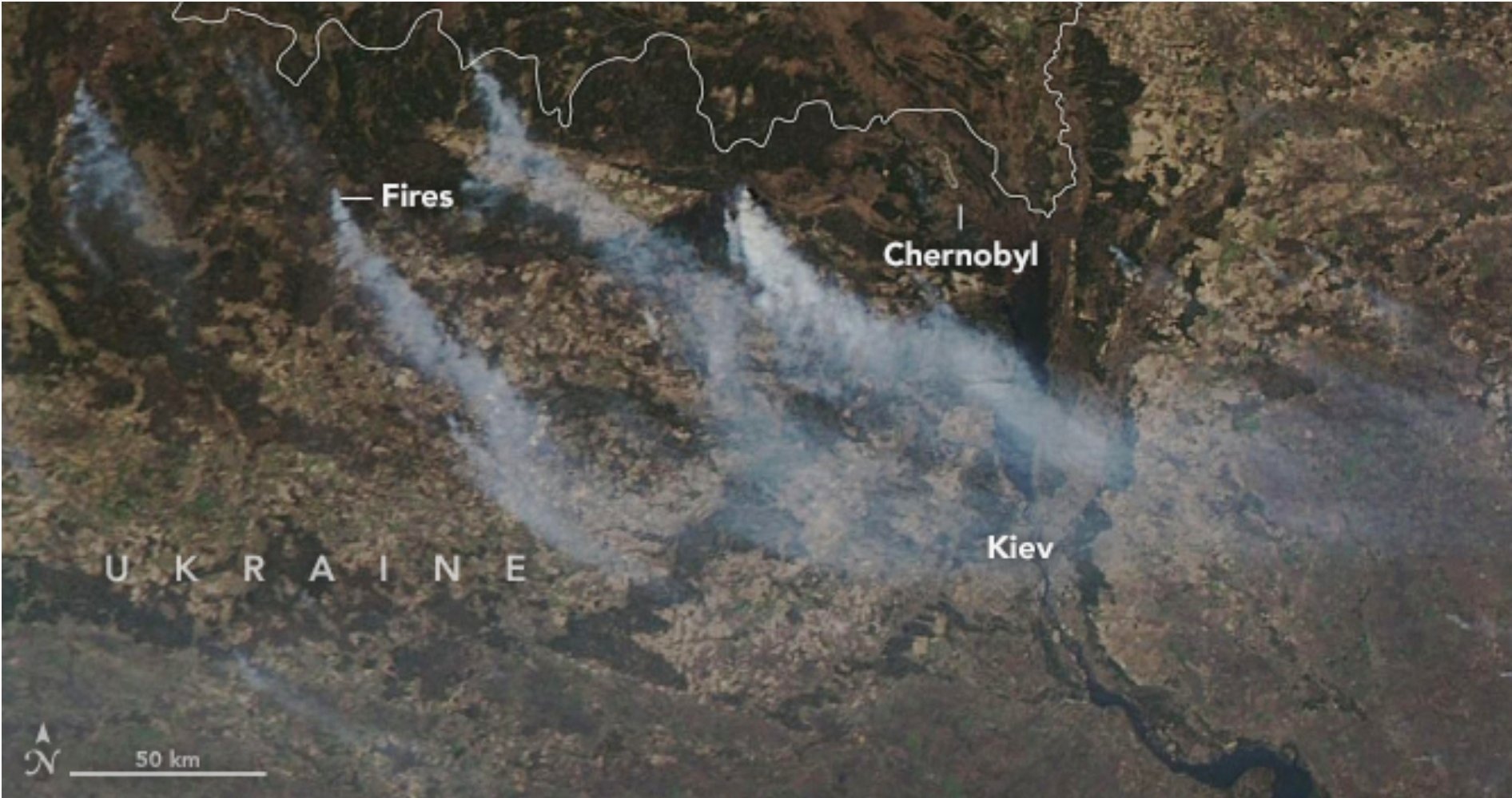
KIEV – A huge forest fire in Ukraine that has been raging for more than a week is now just one kilometer from the defunct Chernobyl nuclear power plant and poses a radiation risk, Greenpeace Russia warned on Monday, citing satellite images.
Ukraine’s Emergency Situations Service said it was still fighting the fires, but that the situation was under control.
Video footage shot by Reuters on Sunday showed plumes of black smoke billowing into the sky and trees still
ablaze, with firefighters in helicopters trying to put out the fires.
Aerial images of the 19 mile exclusion zone around the plant, site of the world’s worst nuclear accident in 1986, showed scorched, blackened earth and the charred stumps of still smoldering trees.
The Emergency Situations Service said radiation levels in the exclusion zone had not changed and those in nearby Kiev, the Ukrainian capital, “did not exceed natural background levels.”
Greenpeace Russia said the situation is much worse than Ukrainian authorities believe, and that the fires cover an area one thousand times bigger than they claim.
On April 4 Ukrainian authorities said the blaze covered an area of 20 hectares, but Greenpeace cited satellite images showing it was around 12,000 hectares in size at that time.
“According to satellite images taken on Monday, the area of the largest fire has reached 34,400 hectares,” it said, adding that a second fire, stretching across 12,600 hectares, was just one kilometer away from the defunct plant.
Ukrainian officials did not immediately respond to a request for comment on those claims.
Rashid Alimov, head of energy projects at Greenpeace Russia, said the fires, fanned by the wind, could disperse radionuclides, atoms that emit radiation.
“A fire approaching a nuclear or hazardous radiation facility is always a risk,” Alimov said. “In this case we’re hoping for rain tomorrow.”
Chernobyl tour operator Yaroslav Yemelianenko, writing on Facebook, described the situation as critical.
He said the fire was rapidly expanding and had reached the abandoned city of Pripyat, two kilometers from where “the most highly active radiation waste of the whole Chernobyl zone is located.” He called on officials to warn people of the danger.
Satellite images taken by NASA Worldview and seen by Reuters showed the two fires had extended far into the exclusion zone.
The fires, which follow unusually dry weather, began on April 3 in the western part of the exclusion zone and spread to nearby forests. Police say they have identified a 27-year old local resident who they accuse of deliberately starting the blaze.
It remains unclear if the person, who has reportedly confessed to starting a number of fires “for fun,” is partly or fully responsible.
April 14, 2020
Posted by Christina Macpherson |
incidents |
Leave a comment

Raging forest infernos in Chernobyl Exclusion Zone burning for eight days are now ‘close’ to exploded nuclear reactor amid new fears of radiation contamination
- Wildfires burning through Chernobyl forests are nearing the nuclear reactor
- There are fears that flames could reach radioactive trucks and vehicles abandoned after the notorious 1986 power station explosion
- Kiev has deployed more than 300 people and 85 pieces of equipment By JACK WRIGHT FOR MAILONLINE, 13 April 2020
|
- Wildfires burning through radioactive forests in the Chernobyl Exclusion Zone are getting ever closer to the exploded nuclear reactor.Firefighters are rushing to build firebreaks around the sarcophagus covering the ruined plant in Ukraine amid swirling winds.
There are fears that flames could reach abandoned trucks and other vehicles contaminated from the disastrous 1986 explosion.
An extraordinary video from firefighter Andrei Kukib shows an emergency vehicle driving through the raging fire and smoke laying waste to the polluted ‘dead zone’.
Fires have been blazing for nine days in the almost uninhabited 1,000-square-mile exclusion zone surrounding the disused plant. On Tuesday, the fire covered some 87 acres, having tripled in size due to strong winds, the emergencies service said in a statement.
- There are fears of radiation in the ground unleashed by the infernos can reach nearest city Kyiv, the Ukrainian capital, and other populated areas.This could be worse if the flames reach the Chernobyl reactors.
Kateryna Pavlova, a senior official involved in the firefighting, said: ‘We have been working all night digging firebreaks around the plant to protect it from fire.’
She told The New York Times: ‘At the moment, we cannot say the fire is contained.’
More than 300 people and 85 pieces of equipment have been deployed daily in the fight to extinguish the flames which comes as Ukraine – one of Europe’s poorest countries – is also battling against coronavirus.
- The State Agency for Management of the Exclusion Zone – which Pavlova heads – has ordered in three Antonov planes (AN-32P) and two MI-8 helicopters which have air dropped more than 250 tonnes of water in the wildfires.Police said the blaze broke out after a man set fire to dry grass near the exclusion zone. The man was detained by Ukrainian police. Ukrainian authorities rejected the warnings of the acting head of the country’s state ecological inspection service, Yehor Firsov, who withdrew remarks made this week that ‘radioactivity is higher than normal at the heart of the blaze’.
Initially covered up by the USSR, the 1986 explosion sent radioactive fallout across Europe exposing millions to dangerous levels of radiation. People are not allowed to live within 18 miles of the power station, which is some 62 miles north of Ukraine’s capital city Kiev.
The three other reactors at Chernobyl continued to generate electricity until the power station finally closed in 2000.
A giant protective dome was put in place over the fourth reactor in 2016.
Fires occur regularly in the forests near the Chernobyl power plant.
|
|
April 13, 2020
Posted by Christina Macpherson |
climate change, incidents, Ukraine |
Leave a comment





 nuclear-news