US Officials Keep Boasting About How Much The Ukraine War Serves US Interests
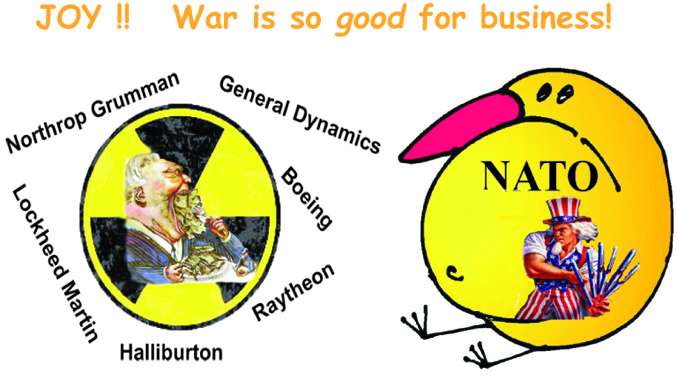
Last November the imperial war machine-funded think tank Center for European Policy Analysis published an article titled “It’s Costing Peanuts for the US to Defeat Russia,” subtitled “The cost-benefit analysis of US support for Ukraine is incontrovertible. It’s producing wins at almost every level.”
CAITLIN JOHNSTONE, SEP 3, 2023
One of the most glaring plot holes in the official mainstream narrative on Ukraine is the way US officials keep openly boasting that this supposedly unprovoked war which the US is only backing out of the goodness of its heart just so happens to serve US interests tremendously.
In a recent article for the Connecticut Post, Senator Richard Blumenthal assured Americans that “we’re getting our money’s worth on our Ukraine investment.”
“For less than 3 percent of our nation’s military budget, we’ve enabled Ukraine to degrade Russia’s military strength by half,” writes Blumenthal. “We’ve united NATO and caused the Chinese to rethink their invasion plans for Taiwan. We’ve helped restore faith and confidence in American leadership — moral and military. All without a single American service woman or man injured or lost, and without any diversion or misappropriation of American aid.”
As Antiwar’s Dave DeCamp recently observed, this type of “investment” talk about Ukraine has been getting more common. Last weekend Senator Mitt Romney called the war “the best national defense spending I think we’ve ever done.”
“We’re losing no lives in Ukraine, and the Ukrainians are fighting heroically against Russia,” Romney said. “We’re diminishing and devastating the Russian military for a very small amount of money … a weakened Russia is a good thing.”
Last month Senate Minority Leader Mitch McConnell argued that Americans should support the US government’s proxy warfare in Ukraine because “we haven’t lost a single American in this war,” adding that the spending is helping to employ Americans in the military-industrial complex.
“Most of the money that we spend related to Ukraine is actually spent in the US, replenishing weapons, more modern weapons,” McConnell said. “So it’s actually employing people here and improving our own military for what may lie ahead.”
McConnell has been talking about how much this war benefits the US since last year. During a speech back in December the ailing swamp monster argued that “the most basic reasons for continuing to help Ukraine degrade and defeat the Russian invaders are cold, hard, practical American interests.”
……………. As we’ve discussed previously, US empire managers have been talking about how much this war serves US interests ever since it began.
In May of last year Congressman Dan Crenshaw said on Twitter that “investing in the destruction of our adversary’s military, without losing a single American troop, strikes me as a good idea.”…………
Last November the imperial war machine-funded think tank Center for European Policy Analysis published an article titled “It’s Costing Peanuts for the US to Defeat Russia,” subtitled “The cost-benefit analysis of US support for Ukraine is incontrovertible. It’s producing wins at almost every level.”
“US spending of 5.6% of its defense budget to destroy nearly half of Russia’s conventional military capability seems like an absolutely incredible investment,” gushed the article’s author Timothy Ash. “If we divide out the US defense budget to the threats it faces, Russia would perhaps be of the order of $100bn-150bn in spend-to-threat. So spending just $40bn a year, erodes a threat value of $100–150bn, a two-to-three time return. Actually the return is likely to be multiples of this given that defense spending, and threat are annual recurring events.”
And of course the mass media have been all aboard the same messaging. A few weeks ago The Washington Post’s David Ignatius wrote an article explaining why westerners shouldn’t “feel gloomy” about how things are going in Ukraine, writing the following about how much this war is doing to benefit US interests overseas:
“Meanwhile, for the United States and its NATO allies, these 18 months of war have been a strategic windfall, at relatively low cost (other than for the Ukrainians)…………………………..
So on one hand the western political/media class have been hammering us in the face with the message that the invasion of Ukraine was “unprovoked” and that the US and its allies played no antagonistic role in paving the road to this conflict whatsoever, and on the other hand you’ve got all these empire managers enthusing about how much this war benefits US interests.
Those two narratives seem a wee bit contradictory, do they not?
A critical thinker can reconcile this contradiction in one of two ways. First, they can believe that the world’s most powerful and destructive government is just a passive, innocent witness to the violence in Ukraine, and is only benefitting immensely from the war as a complete coincidence. Second, they can believe the US intentionally provoked this war with the understanding that it would benefit from it.
From where I’m sitting, it’s not difficult to determine which of these is more likely. https://www.caitlinjohnst.one/p/us-officials-keep-boasting-about?utm_source=post-email-title&publication_id=82124&post_id=136680185&isFreemail=true&utm_medium=email
Archbishop Caccia recalls harm done by nuclear energy
The Holy See’s Permanent Observer to the United Nations reiterates Pope Francis’ and Holy See’s stance on nuclear disarmament and testing, at the UN General Assembly.
By Francesca Merlo, https://www.vaticannews.va/en/vatican-city/news/2023-08/archbishop-caccia-permanent-observer-holy-see-united-nations.html 30 Aug 23
Archbishop Gabriele Caccia, the Holy See’s Permanent Observer to the United Nations, echoed Pope Francis’ message regarding nuclear disarmament during the UN’s General Assembly High-level Plenary Meeting commemorating the International Day Against Nuclear Tests (IDANT).
In his address, Archbishop Caccia urged the international community to listen to the “prophetic voices” of nuclear test victims and take decisive steps towards disarmament.
Archbishop Caccia underscored the grave historical reality, saying the Trinity site’s first nuclear-explosive test 78 years ago ignited a dangerous arms race, causing immeasurable harm.
These tests have left a trail of suffering, he said, including “displacement, multigenerational health problems, poisoned food and water” and spiritual disconnection from the Earth.
Indigenous peoples, women, and children have borne the brunt, with minimal assistance provided.
Moral and legal duties
In response, Archbishop Caccia stated that nations relying on nuclear deterrence must fulfill their moral and legal duties to remedy the damages caused by these tests.
He cautioned against the resurgence of nuclear testing, which would heighten global tensions and undermine security.
The Holy See steadfastly supports the Comprehensive Nuclear-Test-Ban Treaty, the culmination of decades of international collaboration
Additionally, the Holy See advocates for reinforcing the nuclear-test ban stipulated in the Treaty on the Prohibition of Nuclear Weapons (TPNW).
Pope Francis’ assertion that nuclear weapons cannot underpin an “ethics of fraternity” resonates with this stance.
Rocket-Launching Billionaires Promise a New Pie in the Sky

Musk and Bezos are peddling new age-y religious drama of disaster and salvation, says author Mary-Jane Rubenstein.
By Kelly Hayes , TRUTHOUT August 17, 2023
hat we’re getting from both Musk and Bezos is this classically new age-y religious drama of disaster and salvation. They preach, they tell us that the end is near, the disaster is coming, that the world is going to end, but there is another world that everybody can build together, a new world and a place that they’ve never seen and a place that seems totally impossible,” says professor Mary-Jane Rubenstein, author of Astrotopia: The Dangerous Religion of the Corporate Space Race. In this episode of “Movement Memos,” host Kelly Hayes and Rubenstein discuss the religiosity of “NewSpace,” and how activists can challenge the new “pie in the sky” ideology that billionaires like Musk and Bezos are crafting.
Transcript
…………………………………………………………………………………………………………………………………………………………………………………………………………………………………….. MJR: So Musk and Bezos are probably the two best known actors in the contemporary corporate space race. As you probably know, Elon Musk wants us to move to Mars. He wants to colonize Mars. Jeff Bezos has a different plan. He thinks Mars is too far away. He wants to build space colonies that are closer to home that are positioned between the moon and the Earth. It would be sort of like living in a mall, a space mall, like a rotating indoor shopping center where the climate is controlled and there’s no real outside. But presumably you’d be able to grow some plants and things like that, and you’d be able to get your food and it would be totally perfect weather all year round and things like that.
So anyway, they have different views about what our lives are going to look like in outer space. Again, Musk has this sort of homesteader ideal that we’re going to terraform Mars and make it habitable for human beings. Bezos wants to keep us a little closer to Earth in these rotating shopping malls. Both of them are convinced that in order for human beings to, well, survive for Elon Musk, or to thrive for Jeff Bezos, we have to leave the Earth. And each of them is using his massive economic status and power to channel ungodly amounts of money and resources into conquering the cosmos so that human beings can have a decent future.
“KH…………………………………………….Bezos’s company Blue Origin and Musk’s SpaceX spent $2 million and $2.4 million, respectively, lobbying for government contracts in 2021. But Musk’s talk of using his vast wealth to “extend the light of consciousness” also helps spin popular mythos around extreme inequality in our times — like a new variation of the Divine Right of Kings. Instead of being chosen by God, men like Musk and Bezos are chosen by the market, and rather than representing an injustice, their absurd wealth supposedly represents our best hope for the future…………………………..
……………………………………… MJR: The environmental damage that the contemporary space race is doing is one of the most under-discussed crises of our contemporary moment.
…………………………………………………………………………………………………….. What I’m trying to say is I don’t think Elon Musk, a private entrepreneur, would have gotten NASA to offload to him so many of its contracts — I don’t think that he would’ve had the wherewithal to set up this massive Starlink Constellation without a big vision that presents itself as humanitarian, as future-oriented, as ideologically pristine, which is to say it’s a vision of the salvation of humanity that’s going to take place on Mars.
And again, once you sort of shake off the ideological patina here, you realize that Mars is terrible. It’s a terrible planet. If you get an invitation to go homestead Mars, probably don’t do it. It’s bad there. It’s really bad there. But I think he needs that vision in order to sell any of it.
KH: So, in Elon Musk, we have a man whose preposterous ideas are propped up by extreme wealth, a cult of personality, and one of the most absurd privatization gambits in U.S. history. But his current endeavors, like those of Jeff Bezos and other men who would like to rule space, are also propped up by some of the same ideas that have allowed the wealthy to loot and pillage the world we currently inhabit.
………………………………………………………………………………………………………………………………………………………………………………………………………………….. MJR I think symbolically and politically and rhetorically, the creation of the Space Force says that we do not agree that space is supposed to be a theater of peace. Rather, it’s supposed to be a theater of war. ………………………
‘……………………………………………………………………………………………………………………………………………………………. Capitalism relies on infinite growth. We can’t have infinite growth. We’re on a finite planet. So what we’re seeing right now [are] convulsions of late stage capitalism; it’s realizing it’s reaching limits and is therefore seeking out other planets and using this humanitarian claim as a justification for primarily economic ends. So we need to know that. This is just as much of an ideological ploy as the idea that Spain needed to conquer the Americas in order to save Indian souls or something like that. So I’m recommending some suspicion when it comes to these big grand narratives about the salvation of all of humanity…………………………………………………………… https://truthout.org/audio/rocket-launching-billionaires-promise-a-new-pie-in-the-sky/
 | |||
| |||
Nuclear deterrence is a dangerous fraud
The theory of nuclear deterrence is a feeble excuse for nations to hold onto their weapons of mass destruction and a fraud that must be exposed, writes Dr Sue Wareham. 23 Aug 23 https://independentaustralia.net/politics/politics-display/nuclear-deterrence-is-a-dangerous-fraud,17833
Dr Sue Wareham OAM is President of the Medical Association for Prevention of War (Australia) and a past board member of ICAN (the International Campaign to Abolish Nuclear Weapons) Australia.
HOW IS IT that “homo sapiens” has persisted with an invention that threatens our very survival, strikes fear in the heart of every rational one among us, diverts an unconscionable quantity of our collective time, labour and finances from things that are actually useful, and at the same time could be eliminated?
All we need to do is dismantle the invention and prioritise efforts to ensure that it remains a historic relic. That could all be done. Our failure to do so thus far is such an extraordinary gamble on our future that we must examine the reasons.
The invention is, of course, nuclear weapons. The answer to the opening question is not so straightforward, but given our current all-time high risk of these weapons being used, the question has never been more important. And given Australia’s rapidly growing enmeshment with the only nation that has used these weapons thus far in warfare, we in Australia have a particular interest in it.
The first response to the question that often comes to mind is that of “power”. That’s true, a tiny minority of the world’s leaders – in nine out of the nearly two hundred countries that make up the global community – see the capacity to inflict unimaginable suffering on others as a marker of global prestige and influence in world affairs.
But, as we shall see, translating a capacity for cruelty to military or political advantage is a completely different matter. And, in any event, even such leaders need to explain to their people how having horrific and widely-condemned weapons is actually a good thing. For this, they need a theory that sounds plausible; it doesn’t need to be valid, but it just needs to sound reassuring and humane.
That theory is nuclear deterrence — the theory that having nuclear weapons keeps a nation safe from attack, especially nuclear attack, because others will be too terrified of a possible nuclear response. The more inhumane our weapons appear, the safer we are and the more certain we are to prevail militarily if any armed conflict does occur — or so the theory goes. The Latin origin “terrere”, to terrify or deter by terror, sums up how deterrence is meant to work.
For Australia, the theory is extended nuclear deterrence, a belief that our ally – the U.S. – would launch its own nuclear weapons if needed to “protect” Australia (whatever that means in practice), even risking a nuclear retaliatory strike on its own shores in the process. Like nuclear deterrence itself, extended nuclear deterrence is no more than an unproven theory.
Nuclear deterrence has been so consistently presented as justification for the world’s worst weapons of mass destruction that it is worth unravelling. If it is found to be faulty, then the primary crutch that bolsters nuclear weapons policies is exposed as a dangerous fraud.
The first major problem with nuclear deterrence theory is that it hasn’t worked. Nuclear weapons have proven to be generally useless in preventing military aggression or bringing military victories. As nuclear weapons abolition advocate Ward Wilson argues: ‘It is possible for a weapon to be too big to be useful.’
History recounts multiple occasions in which a nuclear arsenal on one side of a conflict has been irrelevant to the outcome. Examples include the attacks on or by Vietnam, Afghanistan, the UK-held Falklands, Iraq (1991 and 2003), Lebanon, former Soviet republics, multiple confrontations between India and Pakistan (both nuclear-armed), and others. In addition, crises over the deployment of the weapons have triggered periods of extreme danger, such as the 1962 Cuban Missile Crisis.
The war in Ukraine is the latest example of a war involving a nuclear-armed adversary. Whether or not President Putin follows through with his gravely irresponsible threats to use nuclear weapons in this war remains to be seen, but “winning” a nuclear wasteland would be no more than a pyrrhic victory.
Claims that attacks on non-nuclear armed nations, such as Ukraine, would have been prevented if those nations did have “the bomb” are not supported by evidence. In any event, such claims would lead us to the conclusion that the weapons are essential for every nation — including, say, Iran and North Korea. Deterrence cannot work only for “us” and not for “them”.
Have nuclear weapons played a role in preventing a war between two nuclear-armed superpowers? We don’t know, but there is no evidence for such a role. Even if they did, could we rely on this deterrent effect to always work? The answer is a categorical no; such a proposition is not credible.
This leads to the second major problem with nuclear deterrence theory which is that to be reliable, it must work in every conceivable situation for all time. Common features of human behaviour, such as miscommunication, misunderstanding, clouded judgement or plain incompetence in a period of heightened tensions could spell catastrophe.
Irrational or malevolent leaders who care little about human suffering elevate the risks, as do ongoing cyber and computer vulnerabilities. Nuclear deterrence might be fit for a fantasy world where everything goes according to plan, but it is not fit for the real world. The nuclear weapons era has produced over a dozen “near misses” when detonation of a warhead was very narrowly avoided.
Tellingly, even governments for whom the mantra of deterrence is sacrosanct know all this. Repeatedly, official documents in the U.S. and, presumably, in other nuclear-armed nations, refer to measures needed “if deterrence fails”. Events that could be terminal for much of human civilisation are passed off with those few glib words, “if deterrence fails”, to set out what military strategy kicks in next.
Part of the “what next” for the U.S. is its missile defence program, another vast money-guzzling venture that won’t necessarily work but is designed to intercept incoming enemy nuclear missiles, the ones that haven’t been deterred; it just might save “our” side at least. The response of the “other” side, not to be deterred, is obvious — more missiles, thus the race continues.
There is one thing that “if deterrence fails” scenarios steer well clear of, however — what happens to people and the planet when the bombs do hit their target cities? For deterrence advocates, that’s someone else’s problem.
The third major impediment to nuclear deterrence is that pesky constraint on so many nefarious activities — the law. Since the entry into force in January 2021 of the Treaty on the Prohibition of Nuclear Weapons (TPNW), even the possession of these devices, let alone use or threats to use them, have been explicitly prohibited under international law.
While the prohibition is legally binding only for nations that have joined the Treaty (those with the weapons and their supporters, such as Australia, not yet being among them) its purpose goes much deeper. It replaces whatever international prestige might be attached to the weapons with international opprobrium. The treaties prohibiting both landmines and cluster munitions strongly influenced the behaviour of even nations that hadn’t signed them.
Fourthly, and herein lies the crux of all the above problems, nuclear deterrence is a threat to commit morally abhorrent actions. The incinerating of cities condemns millions of people, guilty and innocent alike, young and old, to the same collective unthinkable punishment. To play any role in deterring, a threat must be credible and therefore acceptable to those making it, something they would be prepared to carry through with in some circumstances.
Being the perpetrator of such suffering, or even just aiding and abetting it as extended nuclear deterrence requires, challenges us to consider whether our common humanity means anything at all. If it does, then committing or even threatening acts of savagery on a grand scale against innocent people has no place. It not only destroys the victims but also degrades the perpetrator.
Beyond the fundamental flaws of nuclear deterrence theory – its failure to prevent wars, its unsuitability for an imperfect world, its illegality and its immorality – it brings further risks and harm.
Economically, the cost of nuclear weapons programs is staggering, diverting scarce funds from essential human and environmental needs. In 2022, the nine nuclear-armed nations between them spent $82.9 billion on their nuclear weapons programs, over half of that being spent by the U.S. — all this for devices with the extraordinary purpose of existing so that they are never used.
With such national treasure invested in being able to commit atrocities, an enemy is needed, or a succession of enemies to suit changing circumstances. The enemy must be portrayed as morally inferior to us, less worthy as humans, so that no fate is deemed too terrible for them.
U.S. President Reagan’s “evil empire” speech of 1983 about the Soviet Union exemplified the process of dehumanising the “other”. President George W Bush’s reference in his January 2002 State of the Union address to the “axis of evil” – comprising Iran, Iraq, North Korea and others – did similarly. While more measured in rhetoric, President Biden’s “democracy versus autocracy” speech in February 2021 carried the same message of U.S. moral authority, for which read supremacy, with which it must confront its enemies.
As our “security” is built on a capacity to destroy, or euphemistically, “deter”, the critical task of building a common future with all people is marginalised. Foreign policies become stunted and skewed far too heavily towards inflicting collective punishment on whole populations rather than the slow and painstaking work of diplomacy to manage international relationships. Cooperation on global challenges such as climate dwindles as enmity is reinforced. Deterrence policy, with nuclear weapons at the pinnacle, erodes our capacity to survive together on this small and troubled planet.
Nuclear weapons themselves must be abolished. Given that they have proven to be almost useless in deterring anything or winning anything, this goal is achievable. Exposing the fraud of nuclear deterrence and extended nuclear deterrence theories – in promising security and yet delivering existential risk – is a key part of that process.
Lauding Lise Meitner, Who Said ‘No’ to the Atomic Bomb.

when Meitner was invited to work on the Manhattan Project, she responded, “I will have nothing to do with a bomb.”
The movie ‘Oppenheimer’ makes no mention of the co-discoverer of nuclear fission. But she would have wanted it that way.
BY OLIVIA CAMPBELL , 08.24.2023 https://undark.org/2023/08/24/lauding-lise-meitner-who-said-no-to-the-atomic-bomb/?utm_source=Undark%3A+News+%26+Updates&utm_campaign=ae4e66ce7b-RSS_EMAIL_CAMPAIGN&utm_medium=email&utm_term=0_5cee408d66-185e4e09de-%5BLIST_EMAIL_ID%5D
THE FILM “OPPENHEIMER,” which tells the story of the Manhattan Project’s development of the atomic bomb, has made quite a splash this summer, with audiences and critics alike hailing it as a riveting slice of scientific history. But it also has some viewers asking: Where are the women? In the film, Lilli Hornig is the only woman scientist named and portrayed working on the project, though she was not the only one involved. Charlotte Serber, shown as project leader J. Robert Oppenheimer’s secretary, actually did far more. Some scholars argue that physicist Lise Meitner, co-discoverer of nuclear fission, should have been included. As a biographer of historical women scientists, I should be the first in line to decry the erasure or minimization of women’s contributions. But should women be written into stories merely for the sake of representation, without first considering the context and the person? Is this what they would have wanted?
In Meitner’s case, the answer is “no.” Her discovery may have been crucial to creating the atomic bomb, but she wanted nothing to do with it nor wanted to be depicted in films about it. And I believe Meitner’s refusal to participate in the weaponization of her work on moral grounds makes her more worthy of commemoration than Oppenheimer. She chose humanity over notoriety.
According to Ruth Lewin Sime’s detailed biography, “Lise Meitner: A Life in Physics,” Meitner was likely the first female professor in Germany and the head of physics at the Kaiser Wilhelm Institute for Chemistry in Berlin. In 1934, she became so intrigued by Italian physicist Enrico Fermi bombarding elements with newly discovered particles called neutrons that she decided to do some tests of her own. After performing a few experiments, Meitner could tell that something exciting lay on the other side of her digging. She also knew she’d need an interdisciplinary team to properly conduct the research and interpret the results, so she recruited her chemist colleague Otto Hahn and later his assistant Fritz Strassmann. Little did she comprehend that they were on the cusp of upending the principles of nuclear physics.
Over the next four years, Meitner and her team spent their days irradiating various elements with neutrons and identifying the decay products. Meitner would use physics to explain the nuclear processes, and Hahn would conduct chemical analyses. In late 1938, Hahn and Strassmann discovered that neutron-bombarded uranium-235 samples seemed to contain barium — a much lighter element than expected, which the pair could not explain.
Meitner was headed toward the zenith of her career. But she had Jewish ancestry, so while making scientific history, she was also desperately searching for a way to make it out of Nazi Germany alive. With the help of a vast network of colleagues, she fled to Sweden in the summer of 1938. Meitner continued collaborating with colleagues via telephone, letters, and secret meetings for several months after her covert escape, but she would never move back to Germany.
In December 1938, Hahn wrote to Meitner about the puzzling barium results. This led Meitner and her nephew, nuclear physicist Otto Robert Frisch, into a discussion in which they calculated that bombarding uranium with neutrons could split the uranium atom’s nucleus in half, releasing 200 million electron volts of energy. Meitner and Frisch published their results in the scientific journal Nature on Feb. 11, 1939, proposing the process should be called “fission,” named after the biological term used to describe cell division. But Hahn and Strassmann published their own analysis in the journal Naturwissenschaften on Jan. 6. (And Hahn alone was awarded the 1944 Nobel Prize in Chemistry for the discovery of nuclear fission.)
Within a few short months of the papers, dozens of physicists had confirmed the process: uranium-235 atoms absorbed loose neutrons, causing them to become unstable and split. The process, some thought, might prompt a chain reaction. If so, the fission of just one pound of uranium-235 would release the same amount of explosive energy as roughly 8,000 tons of TNT.
The potential practical applications were many, but Meitner refused to be a part of the weaponization of her work. She’d experienced the horrors of war up close during her stint as a nurse at a military hospital near the Russian front in World War I and didn’t want to be involved in the creation of something that would bring pain, suffering, and death. Few scientists refused to help their side create weapons during the war, yet when Meitner was invited to work on the Manhattan Project, she responded, “I will have nothing to do with a bomb.”
When Meitner heard the news of the bombing of Hiroshima, she went for a five-hour walk. What had her science wrought? Rumors flew about her role in the project, despite her clear lack of participation. The Stockholm Expressen newspaper surmised that the bomb had been invented because a Jewish scientist escaped Germany and passed her secrets along to the Allies. Time magazine proclaimed Meitner a “pioneer contributor to the atomic bomb.” But she knew nothing of its creation and deplored this sensationalized, largely false publicity.
In January 1946, Meitner traveled to the U.S. to present lectures and teach classes at several universities across the country, as well as visit old friends and family who had immigrated there when fleeing the Nazis. At the airport in New York, she was met with a horde of photographers and reporters. At a Women’s National Press Club banquet where she was awarded “Woman of the Year,” Meitner sat next to President Harry Truman. When discussing the bomb, both agreed they wished for it never to be used again.
And yes, there were movie offers. Metro-Goldwyn-Mayer asked Meitner to approve of her depiction in the script for “The Beginning or the End,” a film about the development and use of the atomic bomb. Meitner wrote to Frisch that the script was “nonsense from the first word to the last” and that she “answered that it was against my innermost convictions to be shown in a film, and pointed out the errors in their story.” Oppenheimer, on the other hand, approved of the use of his likeness in the movie, apparently welcoming of the media attention.
MGM hoped a bigger payday might persuade Meitner to reconsider. In response, she gave three friends power of attorney and advised them to sue MGM on her behalf if any woman scientist appeared in the film. Meitner continued to refuse permission to use her name in films and plays.
Despite her work being corrupted to create death, Meitner never lost sight of the good that could come of the pursuit of scientific knowledge. “Science makes people reach selflessly for truth and objectivity,” she asserted in 1953. “It teaches people to accept reality, with wonder and admiration, not to mention the deep joy and awe that the natural order of things brings to the true scientist.”
History loves to laud the Oppenheimers: the ones who push the envelope, who puzzle through conundrums in the face of challenges, and who say “yes.” Saying “no” — choosing not to participate — is much less cinematic. But in this case, I think a moral objection is much more worth celebrating. #nuclear #antinuclear #nuclearfree #NoNukes
The Oppenheimer Imperative: Normalising Atomic Terror

Resilience becomes part of the semantics of contemplated, and acceptable mass homicide. Emphasis is placed on the bounce-back factor, the ability to recover, even in the face of such weapons.
To be tactical is to be somehow bijou, cute, and contained, accepting mass murder under the guise of moderation and variation. One can be bad, but bad within limits.
Australian Independent Media, by Dr Binoy Kampmark, 20 Aug 23 https://theaimn.com/the-oppenheimer-imperative-normalising-atomic-terror/#comment-1092670
The atomic bomb created the conditions of contingent catastrophe, forever placing the world on the precipice of existential doom. But in doing so, it created a philosophy of acceptable cruelty, worthy extinction, legitimate extermination. The scenarios for such programs of existential realisation proved endless. Entire departments, schools of thought, and think tanks were dedicated to the absurdly criminal notion that atomic warfare could be tenable for the mere reason that someone (or some people) might survive. Despite the relentless march of civil society against nuclear weapons, such insidious thinking persists with a certain obstinate lunacy.
It only takes a brief sojourn into the previous literature of the nuke nutters to realise how appealing such thinking has proven to be. But it had its challenges. John Hersey proved threatening with his 1946 New Yorker spectacular “Hiroshima”, vivifying the horrors arising from the atomic bombing of the Japanese city through the eyes of a number of survivors.
In February 1947, former Secretary of War Henry Stimson shot a countering proposition in Harper’s, thereby attempting to normalise a spectacularly vicious weapon in terms of necessity and function; the use of the bombs against Japan saved lives, as any invasion would have cost “over a million casualties, to American forces alone.” The Allies, he surmised, “would be faced with the enormous task of destroying an armed force of five million men and five thousand suicide aircraft, belonging to a race which had already amply demonstrated its ability to fight literally to the death.”
Inadvertent as it was, the Stimson rationale for justifying theatrical never-to-be-repeated mass murder to prevent mass murder fell into the bloodstream of popular strategic thinking. Albert Wohlstetter’s The Delicate Balance of Terror chews over the grim details of acceptable extermination, wondering about the meaning of extinction and whether the word means what it’s meant to, notably in the context of nuclear war.
“Would not a general thermonuclear war mean ‘extinction; for the aggressor as well as the defender? ‘Extinction’ is a state that badly needs analysis.” Wohlstetter goes on to make a false comparison, citing 20 million Soviet deaths in non-atomic conflict during the Second World War as an example of astonishing resilience: the country, in short, recovered “extremely well from the catastrophe.”
Resilience becomes part of the semantics of contemplated, and acceptable mass homicide. Emphasis is placed on the bounce-back factor, the ability to recover, even in the face of such weapons.
These were themes that continued to feature. The 1958 report of the National Security Council’s Net Evaluation Subcommittee pondered what might arise from a Soviet attack in 1961 involving 553 nuclear weapons with a total yield exceeding 2,000 megatons. The conclusion: 50 million Americans would perish in the conflagration, with nine million left sick or injured. The Sino-Soviet bloc would duly receive retaliatory attacks that would kill 71 million people. A month later, a further 196 million would die. In such macabre calculations, the authors of the report could still breezily conclude that “[t]he balance of strength would be on the side of the United States.”
Modern nuclear strategy, in terms of such normalised, clinical lunacy, continues to find form in the tolerance of tactical weapons and modernised arsenals. To be tactical is to be somehow bijou, cute, and contained, accepting mass murder under the guise of moderation and variation. One can be bad, but bad within limits. Such lethal wonders are described, according to a number of views assembled in The New York Times, as “much less destructive” in nature, with “variable explosive yields that could be dialed up or down depending on the military situation.”
The journal Nature prefers a grimmer assessment, suggesting the ultimate calamity of firestorms, excessive soot in the atmosphere, disruption of food production systems, the contamination of soil and water supplies, nuclear winter, and broader climatic catastrophe.
Some of these views are teasingly touched on in Christopher Nolan’s Oppenheimer, a three-hour cross narrative jumble boisterously expansive and noisy (the music refuses to leave you alone, bruising the senses). While the idea of harnessing an exceptional, exterminating power haunts the scientific community, the Manhattan Project is ultimately functional: developing the atom for military purposes before Hitler does. Once developed, the German side of the equation becomes irrelevant. The urgent quest for creating the atomic weapon becomes the basis for using it. Once left to politics and military strategy, such weapons are normalised, even relativised as simply other instruments in inflicting destruction. Oppenheimer leaves much room to that lunatic creed, though somehow grants the chief scientist moral absolution.
This is a tough proposition, given Oppenheimer’s membership of the Scientific Panel of the Interim Committee that would, eventually, convince President Harry Truman to use the bombs. In their June 16, 1945 recommendations, Oppenheimer, along with Enrico Fermi, Arthur H. Compton and Ernest O. Lawrence, acknowledged dissenting scientific opinions preferring “a purely technical demonstration to that of a purely military application best designed to induce surrender.” The scientific panel proved unequivocal: it could “propose no technical demonstration likely to bring an end to the war; we see no acceptable alternative to direct military use.”
In the film, those showing preference for a purely technical demonstration are given the briefest of airings. Leo Szilard’s petition arguing against a military use “at least not until the terms which will be imposed after the war on Japan were made public in detail and Japan were given an opportunity to surrender” makes a short and sharp appearance, only to vanish. As Seiji Yamada writes, that petition led a short, charmed life, first circulated in the Metallurgical Laboratory in Chicago, only to make its way to Edward Teller at Los Alamos, who then turned it over to Oppenheimer. The petition was, in turn, surrendered to the Manhattan Project’s chief overseer, General Leslie Groves, who “stamped it ‘classified’ and put it in a safe. It therefore never reached Truman.”
Nolan depicts the relativisation argument in some detail – one that justifies mass death in the name of technical prowess – during an interrogation by US circuit judge Roger Robb, appointed as special counsel during the 1954 security hearing against Oppenheimer. In the relevant scene, Robb wishes to trap the hapless scientist for his opposition to creating a weapon of even greater murderous power than the fission devices used against Japan. Why oppose the thermonuclear option, prods the special counsel, given your support for the atomic one? And why did he not oppose the remorseless firebombing raids of Tokyo, conducted by conventional weapons?
Nolan also has the vengeful Lewis Strauss, the two-term chairman of the US Atomic Energy Commission, moan that Oppenheimer is the less than saintly figure who managed to get away, ethically, with his atomic exploits while moralising about the relentless march about ever more destructive creations. In that sentiment, the Machiavellian ambition monger has a point: the genie, once out, was never going to be put back in.
Big Brave Western Proxy Warriors Keep Whining That Ukrainian Troops Are Cowards

CAITLIN JOHNSTONE, AUG 19, 2023
Amid continuous news that the Ukrainian counteroffensive which began in June is not going as hoped, The New York Times has published an article titled “Troop Deaths and Injuries in Ukraine War Near 500,000, U.S. Officials Say.”
Reporting that Ukrainian efforts to retake Russia-occupied territory have been “bogged down in dense Russian minefields under constant fire from artillery and helicopter gunships,” The New York Times reports that Ukrainian forces have switched tactics to using “artillery and long-range missiles instead of plunging into minefields under fire.”
Then the article gets really freaky:
“American officials are worried that Ukraine’s adjustments will race through precious ammunition supplies, which could benefit President Vladimir V. Putin of Russia and disadvantage Ukraine in a war of attrition. But Ukrainian commanders decided the pivot reduced casualties and preserved their frontline fighting force.
“American officials say they fear that Ukraine has become casualty averse, one reason it has been cautious about pressing ahead with the counteroffensive. Almost any big push against dug-in Russian defenders protected by minefields would result in huge numbers of losses.”
I’m sorry, US officials “fear” that Ukraine is becoming “casualty averse”? Because safer battlefield tactics that burn through a lot of ammunition don’t chew through lives like charging through a minefield under heavy artillery fire?
What are the Ukrainians supposed to be? Casualty amenable? If Ukraine was more casualty amenable, would it be more willing to throw young bodies into the gears of this proxy war that the US empire actively provoked and killed peace deals to maintain?
Something tells me that the US officials speaking to The New York Times about their “fear” of Ukrainian casualty aversiveness do not know what real fear is. Something tells me that if you marched these US officials through Russian minefields under constant fire from artillery and helicopter gunships, then they would understand fear.
Western officials have been spending the last few weeks whining to the media that Ukraine’s inability to gain ground is due to an irrational aversion to being killed. They’ve been decrying Ukrainian cowardice to the press under cover of anonymity, from behind the safety of their office desks.
In an article published Thursday titled “U.S. intelligence says Ukraine will fail to meet offensive’s key goal,” The Washington Post cited anonymous “U.S. and Western officials” to report that the massive losses Ukraine has been suffering in this counteroffensive had been “anticipated” in war games ahead of time, but that they had “envisioned Kyiv accepting the casualties as the cost of piercing through Russia’s main defensive line.”
The same article quotes Ukrainian Foreign Minister Dmytro Kuleba telling critics of the counteroffensive to “go and join the foreign legion” if they don’t like the results so far, adding, “It’s easy to say that you want everything to be faster when you are not there.”
In an article published last month titled “U.S. Cluster Munitions Arrive in Ukraine, but Impact on Battlefield Remains Unclear,” The New York Times reported unnamed senior US officials had “privately expressed frustration” that Ukrainian commanders “fearing increased casualties among their ranks” were switching to artillery barrages, “rather than sticking with the Western tactics and pressing harder to breach the Russian defenses.”
“Why don’t they come and do it themselves?” a former Ukrainian defense minister told The New York Times in response to the American criticism.
In an article last month titled “Ukraine’s Lack of Weaponry and Training Risks Stalemate in Fight With Russia,” The Wall Street Journal reported that unnamed western military officials “knew Kyiv didn’t have all the training or weapons” needed to dislodge Russia, but that they had “hoped Ukrainian courage and resourcefulness would carry the day” anyway.
“It didn’t,” Wall Street Journal added.
In the same article, The Wall Street Journal cited a US Army War College professor named John Nagle admitting that the US itself would never attempt the kind of counteroffensive it’s been pushing Ukrainians into attempting.
“America would never attempt to defeat a prepared defense without air superiority, but they [Ukrainians] don’t have air superiority,” Nagl said, adding, “It’s impossible to overstate how important air superiority is for fighting a ground fight at a reasonable cost in casualties.”
And now we’re seeing reports in the mass media that US officials — still under cover of anonymity of course — are beginning to wonder if perhaps it might have been better to try to negotiate peace instead of launching this counteroffensive that they knew was doomed from the beginning.
In an article titled “Milley had a point,” Politico cites multiple anonymous US officials saying that as “the realities of the counteroffensive are sinking in around Washington,” empire managers are beginning to wonder if they should have heeded outgoing Joint Chiefs chair Mark Milley’s suggestion back in November that it was a good time to consider peace talks.
“We may have missed a window to push for earlier talks,” one anonymous official says, adding, “Milley had a point.”
Oops. Oops they made a little oopsie poopsie. Oh well, it’s only Ukrainian lives.
Imagine reading through all this as a Ukrainian, especially a Ukrainian who’s lost a home or a loved one to this war. I imagine white hot tears pouring down my face. I imagine rage, and I imagine overwhelming frustration.
This whole war could have been avoided with a little diplomacy and a few mild concessions to Moscow. It could have been stopped in the early weeks of the conflict back when a tentative peace agreement had been struck. It could have been stopped back in November before this catastrophic counteroffensive.
But it wasn’t. The US had an agenda to lock Moscow into a costly military quagmire with the goal of weakening Russia, and to this day US officials openly boast about all this war is doing to advance US interests. So they’ve kept it going, using Ukrainian bodies as a giant sponge to soak up as many expensive military explosives as possible to drain Russian coffers while advancing US energy interests in Europe and keeping Moscow preoccupied while the empire orchestrates its next move against China.
Last month The Washington Post’s David Ignatius wrote an article explaining why westerners shouldn’t “feel gloomy” about how things are going in Ukraine, writing the following about how much this war is doing to benefit US interests overseas:
“Meanwhile, for the United States and its NATO allies, these 18 months of war have been a strategic windfall, at relatively low cost (other than for the Ukrainians). The West’s most reckless antagonist has been rocked. NATO has grown much stronger with the additions of Sweden and Finland. Germany has weaned itself from dependence on Russian energy and, in many ways, rediscovered its sense of values. NATO squabbles make headlines, but overall, this has been a triumphal summer for the alliance.”
Other than for the Ukrainians” he says, as a parenthetical aside.
Everyone who supported this horrifying proxy war should have that paragraph tattooed on their fucking forehead.
Poisoning the planet
Radioactive water dump is just latest example our reckless destruction of habitat
By Linda Pentz Gunter, 20 Aug 23, https://beyondnuclearinternational.org/2023/08/20/poisoning-the-planet/
Much has been made — and rightly so — about the potential impact on human health and the Japanese fishing industry if Japan moves forward with its proposal to dump 1.2 million cubic meters — that’s 1.3 million tons —of radioactively contaminated water into the Pacific Ocean from the destroyed Fukushima Daiichi nuclear power plant site.
Unfortunately, this looks likely to happen sometime this month or next despite the worldwide outcry. But when I say “happen”, that rather suggests a one-off dump. Instead, the discharge of these liquid nuclear wastes could go on for at least 17 years according to the Atomic Energy Society of Japan, but likely longer as decommissioning work at the site is expected to take at least 30-40 years.
It is perfectly right and reasonable that the Japanese fishing community sees its livelihood under threat from this proposal. Indeed, it has already taken a hit, as imports of Japanese fish stock to South Korea were down by 30% in May, before the dumping even began. This was clearly driven by jitters around the on-going safety of Japanese fish supplies once those radioactive discharges get underway.
And Pacific Island nations, along with an international team of scientific experts, have equally decried the plan as premature, unnecessary and in need of far greater confidence and further study before such discharges are executed, if ever.
But there is a greater moral issue here, one that speaks to humankind’s reckless and selfish behavior on planet Earth ever since mechanization and the various so-called industrial revolutions began.
For almost three centuries in the developed world, we have continuously and wantonly destroyed vast areas of precious habitat for numerous species. We have clear cut forests, sliced the tops off mountains, broken open the earth to mine minerals, exploded atomic weapons, spewed mercury and carbon into our air, drilled for oil, sprayed pesticides at will and filled the oceans with plastics, to name just a few environmental atrocities.
The toxic mess these activities leave behind has been dumped into rivers, streams, lakes and oceans, or on the lands where the less influential and powerful amongst us live — in the United States almost always in communities of color or on Native American reservations.
One of the worst offenders on this list is nuclear waste. In keeping with our heedless irresponsibility we have kept making lethal radioactive waste without the slightest idea how to safely manage or store it for the longterm. For years, barrels of the stuff were dumped into the sea, until a 1994 amendment to the London Dumping Convention, put an end to it.
But of course the nuclear industry found a way around this. Routine liquid discharges through a pipe circumvented this law. Institutions such as the LaHague reprocessing site on the northern French coast, have discharged radioactive liquids (and gases) for decades. Didier Anger, the now retired expert activist on the environmental crimes at La Hague, uses this history to warn us urgently and eloquently of the folly of discharging nuclear waste into our oceans.
At times, the liquid wastes from La Hague, measured at the discharge point by vigilant groups such as Greenpeace, could have been classified as high-level radioactive waste that would normally require a deep geological repository.
As we approach the moment when radioactive liquids are once more poured into the sea, this time in Japan, imposing a toxic burden on the creatures who are already struggling to survive there, we must ask whether human beings have some sort of divine right of kings to trash the habitat of other living things?
The answer should surely be ‘no’. That humans can generate a radioactive mess and “dispose” of it into some other creatures’ habitat, poisoning their environment is, frankly, both arrogant and abhorrent.
We have already done this everywhere and it has come with a terrible price to other creatures as well as to ourselves. The destruction and contamination of habitat has led to mass extinctions. The US has lost three billion birds since 1970. That’s one in four birds. We may have thought the birds were back in abundance during the start of the covid pandemic, but that was just us hearing what’s left of them more clearly, in the quiet of lockdown.
Bees, who perform around 80% of all pollination, are dying out and hives collapsing, all due to human activities. These include pesticides, drought, habitat destruction, nutrition deficit, air pollution, and, of course, the climate crisis.
Absent these and other essential members of the web of life, our own extinction is not far behind.
We need to stop this behavior and we need to stop it now. We should do it not only for ourselves but for the countless innocent creatures who should not be expected to offer up their homes as our dustbins.
Loading up the Pacific Ocean with liquid radioactive waste — whether it dilutes and disperses or not — is a crime of immorality representative of so many that have come before. If we are truly to change our plundering, polluting and profligate ways, banning the radioactive water dump at Fukushima would be an excellent place to start.
Linda Pentz Gunter is the international specialist at Beyond Nuclear and writes for and curates Beyond Nuclear International.
Atomic Bombing of Japan Was Not Necessary to End WWII. US Gov’t Documents Admit It
US government documents admit the atomic bombing of Hiroshima and Nagasaki was not necessary to end WWII. Japan was on the verge of surrendering. The nuclear attack was the first strike in Washington’s Cold War on the Soviet Union.
By Ben Norton / Geopolitical Economy Report August 10, 2023 https://scheerpost.com/2023/08/10/atomic-bombing-of-japan-was-not-necessary-to-end-wwii-us-govt-documents-admit-it/
It is very common for Western governments and media outlets to tell the rest of the world to be afraid of North Korea and its nuclear weapons, or to fear the possibility that Iran could one day have nukes.
But the reality is that there is only one country in human history that has used nuclear weapons against a civilian population – and not once, but twice: the United States.
On the 6th and 9th of August, 1945, the US military dropped atomic bombs on the Japanese cities of Hiroshima and Nagasaki. Around 200,000 civilians were killed.
Today, nearly 80 years later, many US government officials, journalists, and educators still claim that Washington had no choice but to nuke Japan, to force it to surrender and thus end World War Two. Some argue that this horrifying atrocity was in fact a noble act, that it saved even more lives that would have been lost in subsequent fighting.
This narrative, although widespread, is utterly false.
US government documents have admitted that Japan was already on the verge of surrendering in 1945, before the nuclear strikes. It was simply not necessary to use the atomic bomb.
The US Department of War (which was renamed the Department of Defense later in the 1940s) conducted an investigation, known as the Strategic Bombing Survey, analyzing its air strikes in World War II.
Published in 1946, the Strategic Bombing Survey stated very clearly, “Japan would have surrendered even if the atomic bombs had not been dropped”:
… it seems clear that, even without the atomic bombing attacks, air supremacy over Japan could have exerted sufficient pressure to bring about unconditional surrender and obviate the need for invasion.
Based on a detailed investigation of all the facts, and supported by the testimony of the surviving Japanese leaders involved, it is the Survey’s opinion that certainly prior to 31 December 1945, and in all probability prior to 1 November 1945, Japan would have surrendered even if the atomic bombs had not been dropped, even if Russia had not entered the war, and even if no invasion had been planned or contemplated
The nuclear strikes on Japan represented a political decision taken by the United States, aimed squarely at the Soviet Union; it was the first strike in the Cold War.
In August 1945, the USSR was preparing to invade Japan to overthrow its ruling fascist regime, which had been allied with Nazi Germany – which the Soviet Red Army had also just defeated in the European theater of the war.
Washington was concerned that, if the Soviets defeated Japanese fascism and liberated Tokyo like they had in Berlin, then Japan’s post-fascist government could become an ally of the Soviet Union and could adopt a socialist government.
The atomic bombs dropped on Hiroshima and Nagasaki, therefore, were not so much aimed at the Japanese fascists as they were aimed at the Soviet communists.
This expressly political decision to use nuclear weapons against Japan was in fact opposed by several top US military officials.
As one of the most famous generals in US military history, Dwight Eisenhower led operations in the European theater of the war and oversaw the subsequent occupation of what was formerly Nazi Germany.
Eisenhower later became president of the United States, following Harry Truman, the US leader who had nuked Japan.
Eisenhower is renowned worldwide for his leadership in the fight against fascism in Europe. But what is little known is that he opposed the US nuclear attacks on Japan.
After leaving the White House, Eisenhower published a memoir titled Mandate for Change. In this 1963 book, the former top general recalled an argument he had in July 1945 with then US Secretary of War Henry Stimson.
Stimson had notified him that Washington was planning to nuke Japan, and Eisenhower criticized the decision, stating that he had “grave misgivings” and was convinced “that Japan was already defeated and that dropping the bomb was completely unnecessary”.
The incident took place in [July] 1945 when Secretary of War Stimson, visiting my headquarters in Germany, informed me that our government was preparing to drop an atomic bomb on Japan. I was one of those who felt that there were a number of cogent reasons to question the wisdom of such an act. … But the Secretary, upon giving me the news of the successful bomb test in New Mexico, and of the plan for using it, asked for my reaction, apparently expecting a vigorous assent.
During his recitation of the relevant facts, I had been conscious of a feeling of depression and so I voiced to him my grave misgivings, first on the basis of my belief that Japan was already defeated and that dropping the bomb was completely unnecessary, and secondly because I thought that our country should avoid shocking world opinion by the use of a weapon whose employment was, I thought, no longer mandatory as a measure to save American lives. It was my belief that Japan was, at that very moment, seeking some way to surrender with a minimum loss of “face”. The Secretary was deeply perturbed by my attitude, almost angrily refuting the reason I gave for my quick conclusions.
These “completely unnecessary” nuclear attacks on Hiroshima and Nagasaki killed some 200,000 civilians. But they had a political goal, aimed at the Soviet Union.
The political reasons behind the atomic bombing of Japan have been publicly acknowledged by the US Department of Energy’s Office of History, which runs a website with educational information about the Manhattan Project, the scientific initiative that developed the bomb.
The US government website conceded that the Truman administration’s decision to nuke Japan was politically motivated, writing:
After President Harry S. Truman received word of the success of the Trinity test, his need for the help of the Soviet Union in the war against Japan was greatly diminished. The Soviet leader, Joseph Stalin, had promised to join the war against Japan by August 15th. Truman and his advisors now were not sure they wanted this help. If use of the atomic bomb made victory possible without an invasion, then accepting Soviet help would only invite them into the discussions regarding the postwar fate of Japan.
Other historians argue that Japan would have surrendered even without the use of the atomic bomb and that in fact Truman and his advisors used the bomb only in an effort to intimidate the Soviet Union.
…
Truman hoped to avoid having to “share” the administration of Japan with the Soviet Union.
Mainstream historians have acknowledged this fact as well.
Ward Wilson, a researcher at the establishment London-based think tank the British American Security Information Council, published an article in Washington’s elite Foreign Policy magazine in 2013 titled “The Bomb Didn’t Beat Japan. Stalin Did”.
“Although the bombs did force an immediate end to the war, Japan’s leaders had wanted to surrender anyway and likely would have done so before the American invasion planned for Nov. 1. Their use was, therefore, unnecessary”, he wrote.
Wilson explained:
If the Japanese were not concerned with city bombing in general or the atomic bombing of Hiroshima in particular, what were they concerned with? The answer is simple: the Soviet Union.
…
Even the most hard-line leaders in Japan’s government knew that the war could not go on. The question was not whether to continue, but how to bring the war to a close under the best terms possible.
One way to gauge whether it was the bombing of Hiroshima or the invasion and declaration of war by the Soviet Union that caused Japan’s surrender is to compare the way in which these two events affected the strategic situation. After Hiroshima was bombed on Aug. 6, both options were still alive. … Bombing Hiroshima did not foreclose either of Japan’s strategic options.
The impact of the Soviet declaration of war and invasion of Manchuria and Sakhalin Island was quite different, however. Once the Soviet Union had declared war, Stalin could no longer act as a mediator — he was now a belligerent. So the diplomatic option was wiped out by the Soviet move. The effect on the military situation was equally dramatic.
When the Russians invaded Manchuria, they sliced through what had once been an elite army and many Russian units only stopped when they ran out of gas.
…
The Soviet invasion invalidated the military’s decisive battle strategy, just as it invalidated the diplomatic strategy. At a single stroke, all of Japan’s options evaporated. The Soviet invasion was strategically decisive — it foreclosed both of Japan’s options — while the bombing of Hiroshima (which foreclosed neither) was not.
Attributing the end of the war to the atomic bomb served Japan’s interests in multiple ways. But it also served U.S. interests. If the Bomb won the war, then the perception of U.S. military power would be enhanced, U.S. diplomatic influence in Asia and around the world would increase.
…
If, on the other hand, the Soviet entry into the war was what caused Japan to surrender, then the Soviets could claim that they were able to do in four days what the United States was unable to do in four years, and the perception of Soviet military power and Soviet diplomatic influence would be enhanced. And once the Cold War was underway, asserting that the Soviet entry had been the decisive factor would have been tantamount to giving aid and comfort to the enemy.
Thus, before World War II was even over, the United States launched a Cold War against its ostensible “ally”, the Soviet Union – and against the potential spread of socialism anywhere around the world.
US spy agencies began recruiting former fascists and Nazi collaborators. US officials freed Class A Japanese war criminals from prison, some of whom went on to lead the government in Tokyo.
Many of these figures were involved in founding the right-wing Liberal Democratic Party (LDP), which has essentially run Japan as a one-party state since 1955 (excluding a mere five years of opposition rule).
A textbook example of this was Nobusuke Kishi, a notorious war criminal who ran the Japanese empire’s Manchukuo puppet regime and oversaw genocidal atrocities in collaboration with the Nazis. He was briefly imprisoned, but later pardoned by US authorities and, with Washington’s support, rose to become prime minister of Japan in the 1950s.
Kishi’s fascist-linked family still commands significant control over Japanese politics. His grandson, Shinzo Abe, was the longest-serving prime minister in the East Asian nation’s history.
Today, it remains important to correct widespread myths about this history, because they have a profound impact on popular culture.
In July 2023, Hollywood released a blockbuster film, “Oppenheimer”, by award-winning director Christopher Nolan. The movie was a huge commercial success, but was also criticized for its politics.
The film humanized the eponymous physicist who directed the Manhattan Project’s Los Alamos laboratory, J. Robert Oppenheimer, commonly known as the “father of the atomic bomb”.
Later in life, Oppenheimer came to regret the role he played in developing the weapon, and he campaigned against nuclear proliferation.
Ironically, Oppenheimer also became a victim of the US government’s McCarthyism, and was persecuted for his links to left-wing groups.
But while the movie was celebrated for depicting Oppenheimer’s complex internal struggles, it was accused of whitewashing the brutality of the US atomic bombings of Hiroshima and Nagasaki.
The Japanese civilians who lost their lives in these totally unnecessary attacks were eerily absent from the film.
By incessantly repeating the falsehood that nuking 200,000 people was the only way to get Japan to surrender, US officials have normalized this erasure of the civilian victims of its unnecessary, politically motivated war crimes.
…
U.S. group marks 1945 atomic bombings, at interfaith service in Hiroshima, urges abolishing nuclear weapons and building better world
Catholic Review, August 9, 2023, HIROSHIMA, Japan (OSV News) — On the 78th anniversary of the 1945 atomic bombing of Hiroshima, Archbishop Paul D. Etienne of Seattle and Archbishop John C. Wester of Santa Fe, N.M., and the Pilgrimage of Peace delegation from their archdioceses participated in an interfaith prayer ceremony and a peace memorial ceremony.
“It was hard to fathom that with just one bomb, this entire city along with some 140,000 people died as a result, far more than the tens of thousands gathered this morning to remember them,” Archbishop Etienne wrote on his blog about the interfaith ceremony at the Atomic Bomb Memorial Mound that was led by the Hiroshima Prefecture Federation of Religions.
Since the bombing on Aug. 6, 1945, many more people have died from radiation poisoning and other illness because of the bomb, and survivors (hibakusha) still carry physical and psychological wounds, the archbishop said.
“All of this was on my heart as we prayed together in this site of so much devastation, suffering and death,” he said.
During the service, several Shinto priests approached the altar with branches and reeds and bowed, followed by dozens of other dignitaries and religious leaders. Archbishops Etienne and Wester read the Prayer of St. Francis of Assisi as a reminder for all to be instruments of peace.
The Pilgrimage of Peace seeks to establish relationships with the bishops of Japan to work toward abolition of nuclear weapons, while “expressing our heartfelt sorrow for the devastating experiences endured by their nation,” according to the official pilgrimage site.
After the interfaith service, the Seattle/Santa Fe delegation walked to Hiroshima Peace Park for the annual Peace Memorial Ceremony, attended by more than 5,000 people from more than 110 nations. Speakers included the mayor and governor of Hiroshima and Japan’s prime minister. A representative shared words from the secretary general of the United Nations, and two young children read the Children’s Commitment to Peace.
The children, Archbishop Etienne said, “reminded us of simple and necessary things all of us can do to build a better world.”
The Peace Bell rang at 8:15 a.m. to mark the moment the bomb dropped on the city, followed by a moment of silence.
At nearby Gion Catholic Church, parishioners welcomed the delegation for a homemade lunch and played a short documentary about the Jesuit priests serving in Hiroshima on the day of the bombing. Their diaries detailed the experience of the blast, the indescribable heat, the black rain and the countless people trapped in buildings that went up in flames.
Led by Jesuit Father Pedro Arrupe, the Jesuit novitiate at Nagatsuka — located about three miles from the blast site — was immediately turned into a clinic housing more than 70 people that day. The home was soon overwhelmed with injured people, many with horrendous burns and bleeding, who made their way up the hill to the novitiate, Archbishop Etienne recounted.
…………………………………………………………………………………………………………… The prelate opened his Aug. 5 address by expressing “profound regret and sorrow for the atomic bombings that destroyed your beautiful cities of Hiroshima and Nagasaki.”
“Sadly, those atomic bombs were developed and built within my archdiocese. I stand before you today, humbly assuring you that while we can never know the full extent of your pain, we do wish to join our hearts with yours in a compassionate embrace of mutual regret,” Archbishop Wester said. “But even more so, I plead that we join together to make certain that these weapons will never be used again.”
He urged the “hibakusha” — the surviving victims of the atomic bombs that fell on Hiroshima and Nagasaki bombings — to “continue to provide the world with their painful testament for the needed abolition of nuclear weapons.” He called on the Japanese public to “press their national political leadership to sign and ratify the Treaty on the Prohibition of Nuclear Weapons, as the Vatican has done.”
To that end, he called for ongoing dialogue on nuclear disarmament, emphasizing this dialogue must be “respectful, rooted in prayer, based on nonviolence, and centered in the hope and belief that nuclear disarmament is achievable.”
It is not enough that we become instruments of peace, as important as that is,” Archbishop Wester said. “No, we must take up the cause of worldwide nuclear disarmament with an urgency that befits the seriousness of this cause and the dangerous threat that looms over all of humanity and the planet. I call upon all of us to take up the challenge of nuclear disarmament by engaging in the vital discussion and work that will lead to concrete action steps toward this noble goal.”
This story was written by Northwest Catholic, the magazine and website of the Archdiocese of Seattle.
Archbishop Paul D. Etienne of Seattle and Archbishop John C. Wester of Santa Fe, New Mexico, are both blogging about the Pilgrimage of Peace delegation in Japan. Their blogs can be found, respectively, at https://www.archbishopetienne.com and https://express.adobe.com/page/OQYvRXbV4lLr4. The Seattle Archdiocese’s website has daily updates on the pilgrimage: https://archseattle.org/about-the-archdiocese-of-seattle/archbishop-etienne/pilgrimage-of-peace.
Oppenheimer’ depicts a man becoming powerful—and irrelevant

By Laura Grego | August 4, 2023, https://thebulletin.org/2023/08/oppenheimer-depicts-a-man-becoming-powerful-and-irrelevant/?utm_source=Newsletter&utm_medium=Email&utm_campaign=MondayNewsletter08072023&utm_content=NuclearRisk_PowerfulAndIrrelevant_08042023
It was a packed house on Barbenheimer’s opening night—a box-office phenomenon of double feature viewing of Greta Gerwig’s Barbie and Christopher Nolan’s biopic Oppenheimer. It was a stormy night, too. So much so that we mistook the thunder outside for sound effects. (The sound design of Nolan’s film was spectacular and powerful, especially the silences.) I was glad to see Oppenheimer with longtime colleagues who work in this field. Like Nolan, so many of my cultural touchstones were about the Cold War. Generation X grew up acutely aware of the possibility of nuclear Armageddon, but it’s been a long time since teenagers were lining up for a film about nuclear weapons.
When I read Kai Bird and Martin J. Sherwin’s book American Prometheus, which the film is based on, a few weeks ago before seeing the movie, I was struck by a few things I hadn’t really known or understood about Oppenheimer. One surprise to me was how much J. Robert Oppenheimer was passionate about his two early loves: physics and New Mexico. By all accounts he loved the land and the people living there. And that love seemed to have been the reason the Manhattan Project’s secret laboratory was built in Los Alamos—though its remoteness seemed to suit the security needs of the project.
By the same logic, when came the moment of testing the bomb, the Trinity team selected a “suitably isolated” spot in the southern New Mexico desert for the first nuclear explosion. Little is said in American Prometheus about those who lived near the Jornada del Muerto site, only that the Trinity team had to “evict a few ranchers by eminent domain.” The scientists and engineers believed that the flat terrain and generally low winds would limit the spread of radiation. While the Tularosa basin was remote, about half-a-million people lived within 150 miles of the Trinity site. They were not warned or told to evacuate, neither before nor after the test. And data on civilian exposure from the Trinity test was not collected, so as not to alarm the public.
In fact, this negligence would become a regular feature of the post-war US nuclear test program, which included more than 200 aboveground nuclear explosions. Data collected by the National Cancer Institute shows the fallout from these tests has led to tens to hundreds of thousands of excess cancers. Some people have received compensation from the government for their illnesses, but not Trinity downwinders. (Though the Senate’s recent vote for a major expansion of the Radiation Exposure Compensation Act may remedy this.)
When I entered the theatre on that stormy night, I wondered whether Nolan’s Oppenheimer would pause to acknowledge that these first casualties of the nuclear age were in a place so close to the heart of Oppenheimer the man. In the end, the film’s perspective is Oppenheimer’s first-person, subjective point of view, with Nolan not inclined to widen the lens further. As someone who has worked on these issues for decades, I felt it to be a great weakness of the film, almost unforgiveable, to make so little room in a three-hour movie for those who suffered from the decisions made by “great men” in cloistered rooms. The film also fails by showing the Hiroshima and Nagasaki devastation only obliquely and reflected to us through Oppenheimer’s emotional remove.
Another thing that struck me in the book is that Oppenheimer’s strategy of persuading other scientists to join the project included his argument that the nuclear weapon would end not just the war in Japan, it would “end all wars,” once people understood the enormity of the weapons. Today it seems an incredibly naïve idea: 80 years later, the United States is still spending a billion dollars every five days to maintain its nuclear weapons. But how was Oppenheimer—so widely educated in history and philosophy and steeped in ethics—unable to see its consequences? Was he blinded by the greatness of his own creation or by ambition? Others would see this more clearly.
In the film, Oppenheimer’s friend and confidante Isidor Rabi provides a much-needed counterbalance to Oppenheimer’s intellectualizing, recognizing that the bomb “will fall on the just and unjust alike,” adding that he did not wish the culmination of three centuries of physics to be a weapon of mass destruction.
To retake control on what had been set in motion, it would have taken not only wisdom but more political savvy than Oppenheimer demonstrated. In the film, the scene in which the decision is taken to drop bombs on Hiroshima and Nagasaki skillfully shows an Oppenheimer who is being outmaneuvered. If he had really intended to argue the position of the Franck report and Szilard petition—two documents pressed on him by Manhattan project scientists—before the US political and military leadership, it seems it would have taken a different temperament and set of skills than he had. Oppenheimer was not the man for that moment.
Oppenheimer’s post-war attempt to advise the US government on nuclear weapons as a political insider ended in 1954 with the cruel public humiliation of the Atomic Energy Commission’s security hearing. After this, either because this experience broke him or he was not suited to the life of a nongovernmental critic, he essentially withdrew from the public debate about nuclear weapons almost entirely. He confined his comments mainly to abstracted and intellectual debates for the rest of his life. Oppenheimer did not sign the Einstein-Russell Manifesto against nuclear war, nor did he join the Pugwash Conferences thereafter.
As American Prometheus puts it, “Oppenheimer was still capable of being a critic; he just wanted to stand alone and with far more ambiguity than his fellow scientists. He was consumed with deep ethical and philosophical dilemmas posed by nuclear weapons, but at times it seemed that, as Thorpe put it, ‘Oppenheimer offered to weep for the world, but not to help change it.’”
Toward the end of the film, Oppenheimer is given an Enrico Fermi Award and being fêted—maybe because, as Einstein’s voiceover suggests, he was no longer so relevant.
A reader vents anger about America’s “terminal liberalism” – and much of this rings true

| Honestly, America is such an awful place. Just an awful, awful country. Not only is it the evil empire of today’s world, the ideology of America and Americans, is corrosive to the human spirit. Community and society don’t really exist in America because, America is basically terminal neoliberalism. Everyone is a rugged individual so, everything that happens to you is your fault. Even if it happened, due to the conditions created by the 2008 Financial Crash |
THERE is the near total defunding of mental health services. 100 million people in so much medical debt they are barely housed. 95,000 a year die from lack of affordable health care. You are judged for life as a loser, even if The economic circumstances you were born into were not your fault.
.Even judged in this crummy racist shithole, based on the color of your skin.
The idea of competing for jobs is insane, it’s directly equivalent to slaves or serfs trying to compete, for which master or lord they serve. It’s a vicious competition. Workers stab each other-in-the-back. They climb over the pile of corpses, lie, throw fellow workers, under the bus. All this , for some employer, that sees them as a tool and nothing else.
People all hate themselves, for failing in a rigged game, where they have to destroy each other to survive, or get ahead.
American society can go to hell. It’s already tearing apart . Children are slaughtering their classmates. Mass homelessness. Police state. Fascism. Nobody cares. Do you know what it takes, for a child to actually buy a gun and show up to school, with the intention, of killing everyone there? Not that much. Not only is it horrific, not only are other children dying, but when you think about it, the shooter is throwing their life away. Shooter kills, because they’ll live in prison until they die or they intend to shoot themselves, afterwards. Children know they have nothing to live for. Americans truly don’t care.
This culture is evil, Americans don’t give a darn about each other, remotely, not even a little, the only time they pretend to care, is when they try, justifying bombing other countries or, caging refugees. That is because, that is what Americans are, Cowardly, sadistic nucleoape killers
The life expectancy of Americans is falling every year, in large part due to opioid abuse, worst health care in the world, cancer from all the radioactive shit, Infant and mother mortality at its highest level ever! The usa has the highest level of Infant and mother in the world, for in a supposed developed country.
ther in the world, for in a supposed developed country. The wealthy in the usa have more money than ever before. The life expectancy of every citizen is falling. Nowhere else has this phenomenon occurred.
Even the Russians, didn’t see a spike in opioid deaths, until after the USSR had collapsed.
American society is disintegrating, it is a cancer. The chaos is just here.
Nuclear weapons since Oppenheimer: Who’s in control?
Bulletin, By Lisbeth Gronlund | August 4, 2023
The theme of control—and the lack of it—appears throughout Christopher Nolan’s latest film Oppenheimer.
………………………………………………………… While others were not so sanguine, Oppenheimer expected that he and other scientists who built the bomb would have a hand in future US policy. This belief also proved to be short-lived.
The scene in which the two bombs that would be detonated over Hiroshima and Nagasaki are boxed up and handed over to the military hammers home the point that the scientists were no longer in control of these weapons—literally and figuratively……………………..
…………………………….. Who really has been in control all these years? No one.
Policy makers—not just in the United States but in all nations with nuclear weapons—have abdicated their responsibilities to curb and eliminate the threat posed by their nuclear weapons. They have let the interests of their military and arms producers control the agenda—and the budget for these weapons. They have been swayed by the abstract goal of “deterrence,” which is a creature with a voracious appetite.
During the 2020 presidential election campaign, President Joe Biden pledged to adopt a “no first use” policy. It is shocking that the United States still considers using nuclear weapons first to be a viable option, even though it would likely spur a wider nuclear war. Sadly, it was not shocking that President Biden’s 2022 Nuclear Posture Review did not include this promised policy change. Instead, the president gave in to the military, which does not like to foreclose options. But, of course, that’s exactly what he and his overseas counterparts need to do—foreclose options. Take control. https://thebulletin.org/2023/08/nuclear-weapons-since-oppenheimer-whos-in-control/?utm_source=Newsletter&utm_medium=Email&utm_campaign=MondayNewsletter08072023&utm_content=NuclearRisk_WhosInControl_08042023
Scared to Death!

BY JOHN MIKSAD, https://www.counterpunch.org/2023/07/31/scared-to-death/– 31 July 23
I met U.S. Rep. Joe Courtney (D-CT) for the first time recently. I had a short, but revealing conversation with him.
I don’t know what he thought coming away from the exchange, but I know what I felt. I felt afraid. I saw someone who was enthusiastic about the current proxy war with Russia and the potential war with China, two nuclear armed nations. I saw someone who believes that the US only fights for freedom and democracy although I wonder if he could tell me that last war that was fought for freedom or that resulted in democracy.
I will admit that the weapons manufacturers–who Joe staunchly assists at every turn–have experienced more financial freedom (read “profits”) as a result of Joe’s efforts.
I saw someone who had no use for diplomacy because he believes that you can’t negotiate with adversaries, a belief that has led to countless wars through the millennia and continuous war in this century.
This is deeply concerning to me. Violent conflict over land, resources, ideology, power, and ego may have been the only model we’ve been exposed to, but we can no longer afford to continue working within this old paradigm of might makes right, zero-sum games, and endless arms races. All this has led us to where we find ourselves today, on the brink of self-annihilation.
The fear I felt coming away from this conversation stems from the realization that many of our elected officials adamantly maintain that violence is the only way.
We must find a way to talk, negotiate, build trust, and ultimately cooperate with all nations. I come to this conclusion based on the premise that all people of all nations now face the same existential threats from pandemics, climate collapse, and war escalating to nuclear annihilation.
For the first time in history, the entire human species has obvious common interests. The only rational way forward is to put aside our petty grievances and come together to deal with these existential threats. No one nation can solve these threats alone. There is no other way but together as an international community.
People like Joe are unwilling to give peace a chance and in doing so they are condemning all of us to hardship, suffering, and potentially death. They know only “us versus them” thinking.
They cannot get past the obsolete and barbaric paradigm of resolving conflict by violence or the threat of violence. They don’t realize that we will only have safety and security when all nations have safety and security. Their belief system is incompatible with the realities that we face.
They think that fighting over there protects us here. They don’t realize that there is always blowback and tragic predictable consequences from war that come back to bite us in many ways. We now have epidemic levels of violence within a society that has been shown by its government that violence is the best way to settle disputes.
The blood and treasure that war has stolen from us has left us with crumbling infrastructure, poor results in education and health, and a failing democracy. The planet’s climate is fast approaching tipping points (points of no return) as people around the world experience escalating climate catastrophes including deadly heat waves, floods, wildfires, droughts, and storms.
We continue to spend $1 trillion/year on war and militarism when we know from experience that the military cannot protect us from the real threats that we are now facing. In fact, war exacerbates these threats. War is the worst investment ever.
We must start with a reassessment of U.S. foreign policy and draw down our overreaching military with its expensive and ineffective 750 bases on the sovereign soil of some 80 foreign countries.

If we are to survive and help head the world in the right direction, we must join treaties for nuclear weapons. We must create strong democratized international institutions.
The clock is ticking.
Someone needs to take the lead and break the cycle of mistrust we helped create. It takes courage to do this. We must realize that only peace serves our interest and the interests of all our fellow inhabitants of earth.
I believe people can change. People do change. But not everyone will change. There were people who believed that owning slaves was morally acceptable even after slavery was outlawed.
That’s the way it will be with war and militarism as well. Even when it becomes quite obvious to most of us that the only way to deal with the global threats we face is through international cooperation, I suspect that Joe will believe that wars are still the preferable way to resolve our differences. I suspect he will always believe that all US wars are good and noble even though they kill civilians, create refugees, result in war crimes, and creates poverty, trauma, and desperation just like all war does.
Fortunately, we don’t have to convince everyone that war is barbaric and destructive. We only have to convince enough of our fellow citizens. When we reach a tipping point, the old paradigm will come tumbling down like the Berlin Wall.
Joe prefers to cling to his childhood games where he played the “good” cowboy that killed the “evil savages.” I’ve got some bad news for him about that story as well.
Joe is scared to death of Russia, China, Iran and North Korea.
I am scared to death of Joe.
Joe thinks that we should continue fighting over slivers of land on the other side of the planet.
I think we should be fighting to save the planet and all living things.
Joe thinks that nuclear war is on the table.
I think we must do everything in our power to reduce and ultimately eliminate the threat of nuclear annihilation.
Joe’s fear of other nations brings us ever closer to nuclear annihilation while distracting us from dealing with impending climate collapse and future pandemics.
I believe we need international cooperation for the safety, security, and well-being of all people.
Joe’s actions jeopardize the health and well-being of all people.
I believe we need to send an unequivocal message to Joe and the many other warmongers in Congress that they need to give peace a chance, not someday, but now.
John Miksad is Chapter Coördinator with World Beyond War.
1 This Month
6 June – WEBINAR- Get Inspired by Protests Against Military Bases!


Cuba Is Not a Failed State – It Is a Besieged State
PETITION: “Global Appeal to Endorse Palestinian Right of Return of Refugees”


of the week– Nuclear Reactor Information Task Force
To see nuclear-related stories in greater depth and intensity – go to https://nuclearinformation.wordpress.com
-
Archives
- June 2026 (27)
- May 2026 (306)
- April 2026 (356)
- March 2026 (251)
- February 2026 (268)
- January 2026 (308)
- December 2025 (358)
- November 2025 (359)
- October 2025 (376)
- September 2025 (257)
- August 2025 (319)
- July 2025 (230)
-
Categories
- 1
- 1 NUCLEAR ISSUES
- business and costs
- climate change
- culture and arts
- ENERGY
- environment
- health
- history
- indigenous issues
- Legal
- marketing of nuclear
- media
- opposition to nuclear
- PERSONAL STORIES
- politics
- politics international
- Religion and ethics
- safety
- secrets,lies and civil liberties
- spinbuster
- technology
- Uranium
- wastes
- weapons and war
- Women
- 2 WORLD
- ACTION
- AFRICA
- Atrocities
- AUSTRALIA
- Christina's notes
- Christina's themes
- culture and arts
- Events
- Fuk 2022
- Fuk 2023
- Fukushima 2017
- Fukushima 2018
- fukushima 2019
- Fukushima 2020
- Fukushima 2021
- general
- global warming
- Humour (God we need it)
- Nuclear
- RARE EARTHS
- Reference
- resources – print
- Resources -audiovicual
- Weekly Newsletter
- World
- World Nuclear
- YouTube
-
RSS
Entries RSS
Comments RSS
 nuclear-news