The Pentagon Is Recruiting Elon Musk To Help Them Win a Nuclear War

By Alan MacLeod / MintPress News 10 Feb 25
Donald Trump has announced his intention to build a gigantic anti-ballistic missile system to counter Chinese and Russian nuclear weapons, and he is recruiting Elon Musk to help him. The Pentagon has long dreamed of constructing an American “Iron Dome.” The technology is couched in the defense language – i.e., to make America safe again. But like its Israeli counterpart, it would function as an offensive weapon, giving the United States the ability to launch nuclear attacks anywhere in the world without having to worry about the consequences of a similar response. This power could upend the fragile peace maintained by decades of mutually assured destruction, a doctrine that has underpinned global stability since the 1940s.
A New Global Arms Race
Washington’s war planners have long salivated at the thought of winning a nuclear confrontation and have sought the ability to do so for decades. Some believe that they have found a solution and a savior in the South African-born billionaire and his technology.
Neoconservative think tank the Heritage Foundation published a video last year stating that Musk might have “solved the nuclear threat coming from China.” It claimed that Starlink satellites from his SpaceX company could be easily modified to carry weapons that could shoot down incoming rockets. As they explain:
Elon Musk has proven that you can put microsatellites into orbit, for $1 million apiece. Using that same technology, we can put 1,000 microsatellites in continuous orbit around the Earth, that can track, engage and shoot down, using tungsten slugs, missiles that are launched from North Korea, Iran, Russia, and China.”
Although the Heritage Foundation advises using tungsten slugs (i.e., bullets) as interceptors, hypersonic missiles have been opted for instead. To this end, a new organization, the Castelion Company, was established in 2023.
Castelion is a SpaceX cutout; six of the seven members of its leadership team and two of its four senior advisors are ex-senior SpaceX employees. The other two advisors are former high officials from the Central Intelligence Agency, including Mike Griffin, Musk’s longtime friend, mentor, and partner.
Castelion’s mission, in its own words, is to be at the cutting edge of a new global arms race. As the company explains:
Despite the U.S. annual defense budget exceeding those of the next ten biggest spenders combined, there’s irrefutable evidence that authoritarian regimes are taking the lead in key military technologies like hypersonic weapons. Simply put – this cannot be allowed to happen.”
The company has already secured gigantic contracts with the U.S. military, and reports suggest that it has made significant strides toward its hypersonic missile goals.
War and Peace
Castelion’s slogan is “Peace Through Deterrence.” But in reality, the U.S. achieving a breakthrough in hypersonic missile technology would rupture the fragile nuclear peace that has existed for over 70 years and usher in a new era where Washington would have the ability to use whatever weapons it wished, anywhere in the world at any time, safe in the knowledge that it would be impervious to a nuclear response from any other nation.
In short, the fear of a nuclear retaliation from Russia or China has been one of the few forces moderating U.S. aggression throughout the world. If this is lost, the United States would have free rein to turn entire countries – or even regions of the planet – into vapor. This would, in turn, hand it the power to terrorize the world and impose whatever economic and political system anywhere it wishes.
If this sounds fanciful, this “Nuclear Blackmail” was a more-or-less official policy of successive American administrations in the 1940s and 1950s. The United States remains the only country ever to drop an atomic bomb in anger, doing so twice in 1945 against a Japanese foe that was already defeated and was attempting to surrender.
President Truman ordered the destruction of Hiroshima and Nagasaki as a show of force, primarily to the Soviet Union. Many in the U.S. government wished to use the atomic bomb on the U.S.S.R. President Truman immediately, however, reasoned that if America nuked Moscow, the Red Army would invade Europe as a response.
As such, he decided to wait until the U.S. had enough warheads to completely destroy the Soviet Union and its military. War planners calculated this figure at around 400, and to that end—totaling a nation representing one-sixth of the world’s landmass—the president ordered the immediate ramping up of production.
This decision was met with stiff opposition among the American scientific community, and it is widely believed that Manhattan Project scientists, including Robert J. Oppenheimer himself, passed nuclear secrets to Moscow in an effort to speed up their nuclear project and develop a deterrent to halt this doomsday scenario.
In the end, the Soviet Union was able to successfully develop a nuclear weapon before the U.S. was able to produce hundreds. Thus, the idea of wiping the U.S.S.R. from the face of the Earth was shelved. Incidentally, it is now understood that the effects of dropping hundreds of nuclear weapons simultaneously would likely have sparked vast firestorms across Russia, resulting in the emission of enough smoke to choke the Earth’s atmosphere, block out the sun’s rays for a decade, and end organized human life on the planet.
With the Russian nuclear window closing by 1949, the U.S. turned its nuclear arsenal on the nascent People’s Republic of China.
The U.S. invaded China in 1945, occupying parts of it for four years until Communist forces under Mao Zedong forced both them and their Nationalist KMT allies from the country. During the Korean War, some of the most powerful voices in Washington advocated dropping nuclear weapons on the 12 largest Chinese cities in response to China entering the fray. Indeed, both Truman and his successor, Dwight D. Eisenhower, publicly used the threat of the atomic bomb as a negotiating tactic.
Routed on the mainland, the U.S.-backed KMT fled to Taiwan, establishing a one-party state. In 1958, the U.S. also came close to dropping the bomb on China to protect its ally’s new regime over control of the disputed island – an episode of history that resonates with the present-day conflict over Taiwan.
However, by 1964, China had developed its own nuclear warhead, effectively ending U.S. pretensions and helping to usher in the détente era of good relations between the two powers—an epoch that lasted well into the 21st century.
In short, then, it is only the existence of a credible deterrent that tempers Washington’s actions around the world. Since the end of the Second World War, the United States has only attacked relatively defenseless countries. The reason the North Korean government remains in place, but those of Libya, Iraq, Syria, and others do not, is the existence of the former’s large-scale conventional and nuclear forces. Developing an American Iron Dome could upset this delicate balance and usher in a new age of U.S. military dominance.
Nuking Japan? OK. Nuking Mars? Even Better!
Musk, however, has downplayed both the probability and the consequences of nuclear war.
According to the International Campaign to Abolish Nuclear Weapons, there are over 12,000 warheads in the world, the vast majority of them owned by Russia and the United States. While many consider them a blight on humanity and favor their complete eradication, Musk advocates building thousands more, sending them into space, and firing them at Mars.
Musk’s quixotic plan is to terraform the Red Planet by firing at least 10,000 nuclear missiles at it. The heat generated by the bombs would melt its polar ice caps, releasing carbon dioxide into the atmosphere. The rapid greenhouse effect triggered, the theory goes, would raise Mars’ temperatures (and air pressure) to the point of supporting human life.
Few scientists have endorsed this idea…………………………………………………..
Elon and the Military-Industrial-Complex
Until he entered the Trump White House, many still perceived Musk as a radical tech industry outsider. Yet this was never the case. From virtually the beginning of his career, Musk’s path has been shaped by his exceptionally close relationship with the U.S. national security state, particularly with Mike Griffin of the CIA……………………………………….
Griffin became the chief administrator of NASA. In 2018, President Trump appointed him the Under Secretary of Defense for Research and Engineering. While at NASA, Griffin brought Musk in for meetings and secured SpaceX’s big break. In 2006, NASA awarded the company a $396 million rocket development contract – a remarkable “gamble,” in Griffin’s words, especially as it had never launched a rocket. National Geographic wrote that SpaceX “never would have gotten to where it is today without NASA.”…………………………………………………….
Today, the pair remain extremely close, with Griffin serving as an official advisor to Castelion. A sign of just how strong this relationship is that, in 2004, Musk named his son “Griffin” after his CIA handler.
Today, SpaceX is a powerhouse, with yearly revenues in the tens of billions and a valuation of $350 billion. But that wealth comes largely from orders from Washington. Indeed, there are few customers for rockets other than the military or the various three-letter spying agencies.
In 2018, SpaceX won a contract to blast a $500 million Lockheed Martin GPS into orbit. While military spokespersons played up the civilian benefits of the launch, the primary reason for the project was to improve America’s surveillance and targeting capabilities. SpaceX has also won contracts with the Air Force to deliver its command satellite into orbit, with the Space Development Agency to send tracking devices into space, and with the National Reconnaissance Office to launch its spy satellites. All the “big five” surveillance agencies, including the CIA and the NSA, use these satellites.
Therefore, in today’s world, where so much intelligence gathering and target acquisition is done via satellite technology, SpaceX has become every bit as important to the American empire as Boeing, Raytheon, and General Dynamics. Simply put, without Musk and SpaceX, the U.S. would not be able to carry out such an invasive program of spying or drone warfare around the world.
Global Power
An example of how crucial Musk and his tech empire are to the continuation of U.S. global ambitions can be found in Ukraine. Today, around 47,000 Starlinks operate inside the country. These portable satellite dishes, manufactured by SpaceX, have kept both Ukraine’s civilian and military online. Many of these were directly purchased by the U.S. government via USAID or the Pentagon and shipped to Kiev.
In its hi-tech war against Russia, Starlink has become the keystone of the Ukrainian military. It allows for satellite-based target acquisition and drone attacks on Russian forces. Indeed, on today’s battlefield, many weapons require an internet connection. One Ukrainian official told The Times of London that he “must” use Starlink to target enemy forces via thermal imaging.
The controversial mogul has also involved himself in South American politics……………………………………………….
At Trump’s inauguration, Musk garnered international headlines after he gave two Sieg Heil salutes – gestures that his daughter felt were unambiguously Nazi. Musk – who comes from a historically Nazi-supporting family – took time out from criticizing the reaction to his salute to appear at a rally for the Alternative für Deutschland Party. There, he said that Germans place “too much focus on past guilt” (i.e., the Holocaust) and that “we need to move beyond that.” “Children should not feel guilty for the sins of their parents – their great-grandparents even,” he added to raucous applause.
The tech tycoon’s recent actions have provoked outrage among many Americans, claiming that fascists and Nazis do not belong anywhere near the U.S. space and defense programs. In reality, however, these projects, from the very beginning, were overseen by top German scientists brought over after the fall of Nazi Germany. Operation Paperclip transported more than 1,600 German scientists to America, including the father of the American lunar project, Wernher von Braun. Von Braun was a member of both the Nazi Party and the infamous elite SS paramilitary, whose members oversaw Hitler’s extermination camps.
Thus, Nazism and the American empire have, for a long time, gone hand in hand. Far more disturbing than a man with fascist sympathies being in a position of power in the U.S. military or space industry, however, is the ability the United States is seeking for itself to be impervious to intercontinental missile attacks from its competitors.
On the surface, Washington’s Iron Dome plan may sound defensive in nature. But in reality, it would give it a free hand to attack any country or entity around the world in any way it wishes – including with nuclear weapons. This would upend the fragile nuclear peace that has reigned since the early days of the Cold War. Elon Musk’s help in this endeavor is much more worrying and dangerous than any salutes or comments he could ever make. more https://www.mintpressnews.com/pentagon-recruiting-elon-musk-nuclear-war/289055/
The resurgence of nuclear power: a conversation with M. V. Ramana

energy central, 12 Feb 25
Ahmad Faruqui 45,027,conomist-at-Large. Ahmad Faruqui is an energy economist who has worked on electricity pricing issues throughout the globe and testified numerous times before regulatory commissions and governmental bodies.
Professor Ramana is the Simons Chair in Disarmament, Global and Human Security at the University of British Columbia. His latest book is Nuclear is Not the Solution. I put some questions to him on what is causing a resurgence of nuclear power and whether it is a good or a bad idea.
Faruqui. What is causing the resurgence? The sudden arrival of data centers, driven by the quest for AI? Or climate change?
Ramana. I would first dispute the idea that there is an actual resurgence in nuclear power. What we are seeing is a resurgence in talk about nuclear power. We have seen similar waves of talk about nuclear power, most recently during the first decade of this millennium when there was much talk about a so-called nuclear renaissance. It was during that period that the US government introduced the Energy Policy Act of 2005 which provided significant incentives to utilities to build nuclear plants.
Utilities proposed building more than thirty reactors, but of these only four nuclear reactors proceeded to the construction stage, and two of these reactors in the state of South Carolina were abandoned mid-project following huge cost and time overruns, after over 9 billion dollars were spent. Only two reactors were actually built, at the Vogtle power plant in Georgia, and these ended up costing over $36 billion, much more than the $14 billion estimated when construction of those reactors started, and even more than the roughly $5 to $6 billion figures that were suggested when the Energy Policy Act was passed.
It is in light of this history that we should consider the talk about new nuclear plants today. Coming back to your question, what is causing this talk about resurgence: I would argue that this is mostly motivated by the nuclear industry’s struggle to stay alive and viable. Many nuclear plants today are operating only because of government subsidies of one kind or the other. So, if the industry has to build anything new, it has to resort to hype and artificially induced panic about running out of power.
…………………………………………………………………………… Faruqui. Japan, which had shut down its nuclear power plants after the 2011 incident at Fukushima, is now planning to expand it rapidly to meet its climate goals. Does that surprise you?
Ramana. Once again, I would separate the rhetoric from reality………………………. Despite the strong support from the Japanese government to restart nuclear reactors for over a decade, Japan got just 5.6 percent of its electricity from nuclear power plants in 2023. That does not suggest that nuclear power will expand “rapidly”.
Faruqui. What is the status of nuclear power in Germany?
Ramana. Germany has shut down all of its reactors over a long phaseout process starting with a law passed in 2000. At that time, Germany’s nuclear reactors produced a little over 150 TWh of electrical energy. That has declined to zero in 2024. This decline in electrical energy has more than been compensated by renewables. In 2024, wind power contributed 136.4 TWh, biomass contributed 36 TWh, and solar photovoltaics contributed 72.2 TWh. Altogether renewables provided 62.7 percent of Germany’s electricity, and emissions from the power sector have declined by 58 percent between 1990 and 2024.
…………………………………………….Ramana. ………………..Most countries around the world do not operate nuclear plants. The existing nuclear plants are heavily concentrated in a few countries.
Faruqui. What are the main barriers to nuclear power: costs, delays in construction and activation, or inability to safely handle nuclear waste?
Ramana. I would say that the main barrier is cost; delays in construction and commissioning also translate into financial losses for the utilities building nuclear plants.
Faruqui. Are small modular reactors (SMRs), which are being put forward by tech billionaires such as Bill Gates, going to solve the problems associated with large, conventional reactors?
Ramana. I do not think so. As I mentioned earlier, one of the main challenges confronting those promoting nuclear power is poor economics. This problem is worse for small modular reactors. If they are ever built, SMRs will generate lower amounts of power, which means less revenue for the owner. But the cost of constructing these reactors will not be proportionately smaller. Therefore, electricity from SMRs will be more expensive than power from large nuclear plants……………………..
Faruqui. Can nuclear fusion get around the problems faced by nuclear fission energy?
Ramana. In my opinion, generating electrical power from nuclear fusion is unlikely to ever be economically viable. Three basic challenges confront using nuclear fusion to generate electricity. First, there is the “physics challenge”: to produce more energy than is used by the facility as a whole. Current nuclear fusion experiments are far from meeting this challenge. Second, there is the “engineering challenge” of converting what works in an experimental set up and produces energy for a microscopic fraction of second into a continuous source of electricity that operates 24 hours/day, 365 days/year. The third is the economic challenge of having this incredibly complicated process compete with other simpler and far cheaper ways of generating electricity.
Faruqui. Many nuclear plants have been shut down over the years in the US. What were the reasons? Are those concerns still valid for functioning power plants, such as Diablo Canyon in California?
Ramana. Most nuclear plants that were shut down in recent years were closed because of economic reasons……………………………………………………………………………
Faruqui. Some nuclear plants that were shut down are being reopened. In particular, Three Mile Island in Pennsylvania which was shut down in 1979 after a major disaster. What risks are associated with its reopening?
Ramana. Again, I would like to see the plant actually start operating before saying that the plant is “being reopened”………………………………… , the dangers of continuing operations are high and increasing.
Faruqui. Nuclear proponents argue that incidents such as Chernobyl in 1986 in what is now Ukraine and Fukushima in 2011 in Japan were caused by bad design and bad operations and are unlikely to occur in the US. Do you agree?
Ramana. While it is true that we are unlikely to have another severe accident exactly like the ones at Chernobyl and Fukushima, there are many different combinations of initiating factors and failures that can lead to another accident that results in radioactive materials being dispersed into the biosphere. …………………………………. For Perrow, “the dangerous accidents lie in the system, not in the components” and are inevitable……
more https://energycentral.com/c/gn/resurgence-nuclear-power-conversation-m-v-ramana
A Nuclear Future is Not Inevitable
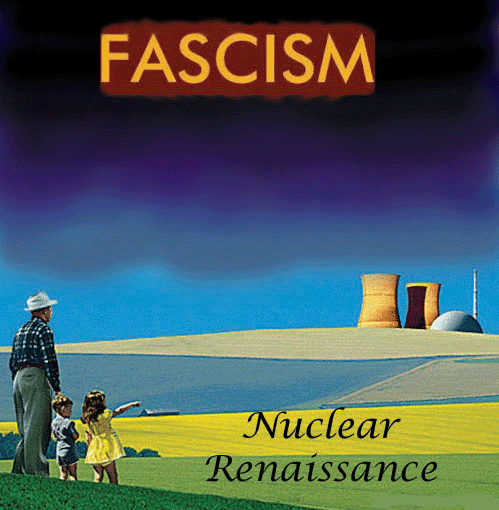
nuclear plants entail an ideology that is undemocratic and sometimes even fascistic.
“If you accept nuclear power plants,” argued philosopher Jerry Mander in 1977, “you also accept a techno-scientific-industrial-military elite.”
The marriage between Big Tech and nuclear power endangers us all.
John P. Slattery, Commonweal Magazine 9th Feb 2025 https://www.commonwealmagazine.org/nuclear-power-amazon-microsoft-trump-biden-slattery-ai
We are less afraid of nuclear power than we used to be. And we are less afraid than we should be, as Big Tech seeks to promote and control nuclear power for its own ends.
Consider Microsoft’s proposal to revive Three Mile Island, the site of the worst nuclear disaster in U.S. history. Under the deal, Microsoft would be the sole beneficiary of the power generated by the facility that shuttered in 2019. Microsoft’s stated goal in reopening this plant, scheduled for 2028, is to be fully committed to “decarbonizing” the power grid.
Consider also Google’s announcement to purchase nuclear energy from small modular reactors (SMRs) owned by Kairos Power. Kairos is currently building several of these reactors in Tennessee, in the belief that multiple smaller reactors will be easier to construct and maintain than a single large one. The first energy outputs are expected in 2030.
Finally, consider Amazon, which is following in Google’s footsteps by partnering with the company X-Energy to construct its own dedicated SMRs. Its plans, which would significantly outpace Google’s by the project’s completion in 2039, include nuclear reactors in Virginia, Washington, and Tennessee.
These long-speculated plans were announced in a flurry in the fall and confirm that the future of the tech industry—and of American energy production—is nuclear. The seemingly insatiable demand for energy by large language models—the core of what we have come to know as “artificial intelligence”—will be met by nuclear power.
There has been little to no pushback on these plans. The conservative Institute for Energy Research hailed the announcements as the latest reminder that “renewable energy is unreliable” for America’s growing energy demands, because, they argue, the promise of pure renewable energy is a fairy tale and not a practical solution. A few decades ago, a progressive think tank might have issued a rebuttal, aligning with a progressive Democratic Party to condemn private companies’ strong-arming of the power grid, the government, and the public into accepting nuclear power as the only viable option. But these are not today’s politics.
At the UN’s COP29 climate summit in October, nuclear power was celebrated as the only real way to meet the energy demands of the future while also slowing down climate change. The Biden administration—and the 2024 Democratic platform with him—was bullish about nuclear power, bolstering the tech companies’ plans by releasing a nuclear roadmap this November to triple U.S. nuclear capacity by 2050.
The popularity of nuclear power has grown so much at a federal level that Republican and Democratic positions today are indistinguishable on the topic. During Biden’s 2020 presidential bid, the Democratic Party fully endorsed nuclear power for the first time since 1972. In 1980, by contrast, the Democratic party opposed all new constructions of nuclear power and pushed for investments in renewable energy, while the Republican platform endorsed coal and nuclear power.
During the 2024 presidential campaign, only Donald Trump expressed reservations about nuclear power. Talking to Joe Rogan, Trump was wary of Biden’s promises about nuclear power, citing several projects that failed during his time as president and declaring nuclear power “too big, too complex, and too expensive” to be dependable. Given Trump’s newly close ties with a tech industry begging to be unregulated, it is hard to imagine that he will want to slow down their plans. Kamala Harris did not say much about nuclear power during her short bid for presidency, but neither did she back away from the Biden administration’s clear pro-nuclear stance.
When politicians and companies talk about nuclear power, they use language of inevitability and necessity. There is no other way to become carbon neutral, they argue. Nuclear power guarantees reliability and longevity in a way that no other power source can offer. The technology, argues its defenders, has come so far that the new reactors will be safe and environmentally friendly. The math behind nuclear energy is compelling: a single kilogram of enriched uranium can produce as much energy as 88 tons of coal, 47 tons of natural gas, and 66 tons of oil. For the same amount of energy, nuclear plants produce around two percent of the emissions of fossil fuels. On paper, it is an easy sell, but we should not be so easily convinced.
The science is clear: renewable energy sources like wind turbines, solar panels, geothermal vents, and hydroelectric plants remain the only true hope for a long-term future of stabilizing the climate and producing plentiful energy while keeping our air and water clean. Renewable energy projects, compared to nuclear power, are relatively simple to construct and to scale, from rooftop solar panels to hilltop wind turbines. A recent study showed that there are enough renewable-energy projects proposed today that would meet the entire national demand for energy by 2035 if the impediments were removed. These impediments include an aging power grid, bloated algorithmic models, corporate interests protecting the fossil-fuel industry, and the lack of federal willpower to overcome regulatory bottlenecks.
Nuclear power also has vast downsides that are, unsurprisingly, not discussed in the recent announcements and strategic national plans. Nuclear plants produce large quantities of radioactive waste for which there is no safe disposal method. Nuclear plants have consistently gone vastly over budget in construction, been expensive to maintain, and take far longer to complete than originally promised—if, indeed, they are ever completed. The Three Mile Island plant that shut down in 2019 did so because of unprofitability, not concern for safety.
Furthermore, nuclear power is a massive security and health risk. As Russia continues its invasion into Ukraine, the stability of the four Ukrainian power plants continues to be in question, as they have at multiple times lost power and been damaged by Russian attacks. The many safeguards in place are not bulletproof, and the destruction of a single power plant or a critical water line could cause serious injury or death to millions of people.
Beyond the environmental, health, economic, and planning risks, nuclear plants entail an ideology that is undemocratic and sometimes even fascistic.
“If you accept nuclear power plants,” argued philosopher Jerry Mander in 1977, “you also accept a techno-scientific-industrial-military elite.” Nuclear power requires all of these institutions to create and maintain itself. It cannot be left to decay, like an old coal plant or a broken wind turbine. It must be guarded around the clock with barbed wire and military security, not because we are in danger of losing electricity, but because nuclear power inherently endangers the entire global population. Every nuclear reactor produces waste that, with its lifespan of millions of years, places demands upon our children and grandchildren to maintain the technological and military capability to deal with its eternal radioactivity.
The emergence of bipartisan support for nuclear power aligns with the affinity of both parties toward the strong military, technological, scientific, and industrial complex that Mander warned about in the seventies. The Big Tech firms of today have become as dangerous as Big Oil in their capacity to influence global markets, political fortunes, and the lives of billions. Their desire for a power source that requires centuries of military and corporate control will further blur the lines between state and corporate power, transforming the military into a de facto protector of corporate wealth. “We may be able to manage some of the ‘risks’ to public health and safety that nuclear power brings,” wrote philosopher Langdon Winner in 1986, “but as society adapts to the more dangerous and apparently indelible features of nuclear power, what will be the long-range toll in human freedom?”
And there is yet another risk: the correlation of support for nuclear energy with support for nuclear weapons. While nuclear energy and nuclear weaponry should be able to be considered separately, support for one tends to bleed into support for the other. The recent bipartisan support for nuclear energy in the United States has come alongside alarming bipartisan support for expanding our arsenal of nuclear weapons. If nuclear energy demands an unhealthy merger of technological, corporate, and military powers, expanded nuclear weaponry welcomes a new global nuclear arms race that, when combined with the rise of AI weapon systems, will almost certainly drive us to the brink of global disaster.
A nuclear future is neither inevitable nor necessary. A renewable energy future is possible. A world without nuclear weapons is possible. A world where artificially intelligent algorithms serve democratic, peaceful societies is possible. Let us not be so taken with the glamour of an algorithm or the hype of some AI singularity that we sit by and watch Big Tech, along with our own government, take a step back from a long-term commitment to renewable energy. In the end, the only answer to nuclear power is the same answer to nuclear weapons: not even one is acceptable.
As China and the U.S. Race Toward A.I. Armageddon, Does It Matter Who Wins?

it doesn’t matter if the U.S. has no real enemies. The military industrial complex must continue to unceasingly grow, according to the logic of the Megamachine. It will invent enemies in order to justify that growth. That’s why we now have thousands of nuclear bombs and a sprawling, AI-driven, globally networked satellite and base infrastructure that encases the Earth like an iron maiden.
Koohan Paik-Mander CounterPunch , 7 Feb 25
A longstanding Sinophobia in the U.S. goes back to the 19th century, with the Chinese Exclusion Act, the tax on Chinese miners during the Gold Rush, and the exclusion from being able to testify in court.
Evidence of this entrenched history lingers today, in the trade sanctions against China, belligerent rhetoric from both Republicans and Democrats that led to a rash of violence against elderly Asian-Americans on American streets, as well as billions of dollars spent to fortify overseas bases in preparation for a U.S.-China war.
And the refusal to cooperate meaningfully with China on anything. As a result, the U.S. is thick in the midst of an AI arms race with China that is predicated on both nations’ dangerous faith in techno-salvation.
Thanks to the legacy of Sinophobia, it takes a whole lot to elicit an overwhelming embrace of China from average Americans, even if temporarily. But that’s what’s happened twice in the last month. The first time was the TikTok fiasco, when millions of distraught TikTok users had had their favorite platform snatched from them like a pacifier from a baby’s mouth. They found solace not in Meta nor X (as had been the plan), but rather, in the Chinese social media platform, Xiaohongshu, also known as “RedNote.”
The second instance was the debut of DeepSeek AI, which came on the heels of one of the most pompous pageants of delusional grandeur ever seen. It was Trump’s inauguration ceremony for his second term. Shortly thereafter, a press conference was held. Three tech oligarchs and the president bloviated about their Stargate AI project. It would cost $500 billion. That’s what they say is needed to stay ahead of the Chinese. (For some reason, the excuse of “staying ahead of the Chinese” seems to justify any astronomical expense.)
In the mean time, thousands of people have been left homeless due to wild fires in L.A., flooding in North Carolina, and even to this day, people from Lahaina, Maui are still without a place to call home. But none of these Americans got a press conference.
Instead, it was the oligarchs who took the stage. Oracle’s Larry Ellison, Masayoshi Son of Starbank, and Open AI founder Sam Altman described Stargate’s plans to build clusters of gigantic data centers across the country from sea to shining sea, each one bigger than any Walmart Superstore. It’s Manifest Destiny for data.
No one at the press conference mentioned that many of the data centers would be built on federal lands, would collectively use as much power as small European nations, require massive volumes of water, or would require a network of nuclear reactors. They did make the dubious promise their AI would cure cancer and heart disease. I think the guys who got wampum for Manhattan got a better deal.
A few days afterward, as if on cue, a Chinese company called DeepSeek that no one had ever heard of dropped their bombshell. The Chinese firm had released its own AI that was open-source, used fifty times less energy, performed on par with all the American AIs, and cost a gazillion times less to produce. Suddenly, the mirage of Silicon Valley’s invincibility faded away to reveal an overvalued industry that had gotten too fat, lazy and full of itself to innovate anything except marketing promises to investors. The very next day, a veritable trillion dollars peeled like a banana off the U.S. stock exchange tech sector. The story everywhere was that Chinese AI had officially “caught up” with the U.S.
When people cheered the scrappy Chinese underdog, it was as much a middle finger to the overblown hubris of the tech oligarchs as it was an embrace of Chinese innovation. It was motivated largely by the same class anger that rose up to lionize Luigi Mangione for killing a health insurance CEO with three inscribed bullets. People had been galled by the consolidated display of the broligarchy on the dais at the Trump inauguration, similar to the royals waving at the minions from the balcony at Buckingham Palace. Their message was unequivocal: We own you.
DeepSeek has been described as a Robin Hood of tech, taking from the rich to give AI to the poor. Sentiments of class anger buoyed admiration for the unknown company from China. They disregarded, for once, the stubborn stains of Sinophobia.
What was also overlooked in the midst of DeepSeek’s dazzling display of stock market disruption was responsible restraint around technology. As both China and the U.S. go hurtling ever faster toward Armageddon in the race to dominate in AI, they have both bought into techno-utopian ideologies, lock, stock and barrel………………………………………………………………….
China and the U.S. are entangled in a geopolitical rivalry, with existential stakes. Sure, it’s satisfying to enjoy the smarting blow that newcomer DeepSeek landed to the capitalist Goliath — China one, U.S. zero. But it’s not a boxing match. Such narrow framing loses sight of the fact that the race for accessible AI is a race for Mutually Assured Destruction (MAD).
………………………………………………………………………………………………………………The weapons industry wouldn’t tolerate the thought of degrowth, just like Microsoft, Google, Meta, Amazon et al. can’t bear it today. The war industry dealt with it by instead aggressively manufacturing enemies and reasons for war faster than it could manufacture more weapons. Now, forty years after the end of the Cold War with Russia, the war budget has increased every year and is now up to one trillion dollars, Los Alamos has begun manufacturing nukes for the first time in decades last year, we’ve got 800 bases around the world, rocket launchpads in wilderness areas, and thousands of satellites in the heavens.
It’s hard to get one’s bearings, especially in the midst of the engineered political maelstrom of the current moment. Fortunately, the books haven’t been burned (yet), so we can turn to the thinkers of the recent past for guidance.
The technology critics of the 20th century, such as Jacques Ellul, Lewis Mumford and Chellis Glendinning, urged us to conceptualize technology not just as a single artifact, such as a laptop, or just AI, or just a satellite, or just a nuclear weapon, but rather, as a whole way of thinking, a way of organizing society, our institutions, a way of being. Technology is not a one-off. It is systemic. Lewis Mumford called all of our technological society the Megamachine.
Every project, technology, organization, and endeavor is an expression of the Megamachine where the economic-growth imperative reigns supreme. It is all of a piece. It doesn’t matter if DeepSeek uses less energy. The growth imperative must be met……
Likewise, it doesn’t matter if the U.S. has no real enemies. The military industrial complex must continue to unceasingly grow, according to the logic of the Megamachine. It will invent enemies in order to justify that growth. That’s why we now have thousands of nuclear bombs and a sprawling, AI-driven, globally networked satellite and base infrastructure that encases the Earth like an iron maiden.
The poster child for the Megamachine in the digital age is Amazon. Former chair of the Federal Trade Commission Lina Khan’s seminal essay “Amazon’s Anti-trust Paradox,” tracks the logic of the behemoth’s growth over its history. She brilliantly unravels how Amazon decisively prioritized sheer growth over profit for its first eight years. The goal was to entrench a broad-spanning networked infrastructure that would guarantee a monopoly and continue to consolidate market dominion. They forwent profits for almost a decade expressly in order to monopolize the market. Again, the imperative for growth and global domination trumps decent common sense.
Former chair of the Federal Trade Commission Lina Khan’s seminal essay “Amazon’s Anti-trust Paradox,” tracks the logic of the behemoth’s growth over its history. She brilliantly unravels how Amazon decisively prioritized sheer growth over profit for its first eight years. The goal was to entrench a broad-spanning networked infrastructure that would guarantee a monopoly and continue to consolidate market dominion. They forwent profits for almost a decade expressly in order to monopolize the market. Again, the imperative for growth and global domination trumps decent common sense.
……………………………………………………………The sooner that the U.S. and China treat one another as fellow members of humankind, rather than adversaries, the real work of cooperation can begin. Both nations are home to millions of indigenous peoples who carry the know-how for surviving and thriving for generations into the future. Their wisdom is more precious than any AI. There’s no shortage of problems that our combined brilliance can improve if not solve: climate, nuclear weapons, species extinction, toxic waste clean-up, housing, microplastics, and last but not least, dangerous unregulated technologies. None of these colossal crises can be addressed as long as we are pointing fingers while locked in the downward spiral of a competition for global hegemony that the U.S. can never win.
Some of us remember the shining moment in history when the U.S. and Soviet Union built trust and signed a raft of nuclear arms control agreements. They modeled what ratcheting down tensions and the path to peace looks like. It would behoove the U.S. and China to follow their lead today, not only with nukes but also with AI and other emerging technologies. https://www.counterpunch.org/2025/02/07/as-china-and-the-u-s-race-toward-a-i-armageddon-does-it-matter-who-wins/
How Australia’s CANDU Conservatives Fell in Love with Canadian Nuclear

This time around, with the current push to embrace nuclear energy, the federal Australian Coalition’s ideas appear to be shaped by the internet, where a pro-nuclear media ecosystem of influencers and podcasters has flourished just as nuclear has become attractive to conservative parties worldwide.
Ontario, Canada is the only place in the world to tear out wind turbines and embrace nuclear power. Australia’s conservatives have been taking notes.
DRILLED, Royce Kurmelovs 5 Feb 25
If there is a Holy Land for nuclear energy, Australian Shadow Climate Change and Energy Minister, Ted O’Brien, seems to think it’s Ontario, Canada.
Other countries have well-established nuclear power industries, of course. There’s the United Kingdom where the Hinkley Point C nuclear reactor – dubbed “the world’s most expensive power plant” – where work began in 2007 with an expected start date of 2027 but is now at least ten years behind schedule and billions over budget. Meanwhile, it’s sister project, Sizewell C, is estimated to cost the equivalent of AUD $80bn (GBP £40bn, USD $49bn). There’s France where, in mid-August 2022, half the country’s nuclear reactors were forced offline, many as a direct result of climate impacts such as heat and drought.
Over in the United States, storied home of the Manhattan Project, where newly minted energy secretary (and fracking CEO) Chris Wright has announced a commitment to “unleash” commercial nuclear energy, one of the last two new nuclear power builds attempted this century forced Westinghouse into bankruptcy protection, and a separate effort by NuScale to build a cutting edge small modular reactor (SMR) was cancelled in November 2023 due to rising costs. There’s also Finland, a country of 5.6 million people, that finally turned on Europe’s newest nuclear reactor 18 years after construction began, finishing up with a price tag three times its budget. Though it had a noticeably positive effect on prices after start up, the cost of building Olkiluoto-3 was so high, its developer had to be bailed out by the French government. Since then, technical faults continue to send the reactor temporarily offline – a remarkably common occurrence among nuclear reactors.
Ontario, however, is so far the only place in the world that has ripped out wind turbines and built reactors – though the AfD in Germany has pledged to do the same if elected, and US President Donald Trump has already moved to stop new windfarm construction. Thanks to much self-promotion by pro-nuclear activists and Canada’s resources sector, that move caught the imagination of O’Brien and Australia’s conservative party. Now, as Australians head to polls in 2025, the country’s conservatives are looking to claw back government from the incumbent Labor Party with a pro-nuclear power play that critics charge is nothing more than a climate-delay tactic meant to protect the status quo and keep fossil fuels burning. “This is your diversion tactic,” says Dave Sweeney, anti-nuclear campaigner with the Australian Conservation Foundation. “There’s a small group that have long held an ambition for an atomic Australia, from first shovel to last waste barrel to nuclear missile. Some of the people who support this are true believers, for others it’s just the perfect smoke screen for the continuation of coal and embedding gas as a future energy strategy.”
Apples and Maple Syrup
On the face of it, Ontario is an odd part of the world on which to model Australia’s energy future. Privatization in both places has evolved messy, complicated energy grids, but that’s about all they have in common. One is a province on the sprawling North American landmass, and the other is a nation that spans a continent. Ontario has half the population of Australia and spends five months a year under ice. Its energy system has traditionally relied on hydro power and nuclear, where Australia is famously the driest inhabited continent on the planet that used to depend on coal but now boasts nearly 40% renewable electricity as of 2024.
One Australian state, South Australia, already draws more than 70% of its power from renewables and frequently records weeks where all its electricity needs are met with solar and wind. Unlike Ontario, and the rest of Canada, Australia has no nuclear industry aside from a single research reactor in the Sydney suburbs. The cost of transmitting power over vast distances in Australia makes up approximately two-fifths of retail power prices. Electricity prices in Ontario, meanwhile, have been artificially lowered by an $7.3bn a year bundle of subsidies for households and businesses. Comparing the two jurisdictions is stranger than comparing apples and oranges; it’s more like comparing apples and maple syrup.
None of this has stopped the province from becoming O’Brien’s touchstone for the marvels of nuclear energy, and “Ontario” from becoming his one-word reply to critics who question the wisdom of creating a new nuclear industry from scratch in Australia. If the country wanted to transition away from coal, the Coalition’s suggestion was it should be embracing nuclear energy — not more renewables — just look at Ontario. “We have to keep learning the lessons from overseas,” O’Brien told Sky News in August 2024. “There’s a reason why countries like Canada, in particular the province of Ontario, has such cheap electricity. They’ve done this many years ago. They were very coal-reliant and eventually, as they retired those plants, they went into nuclear.”
Weirder still, O’Brien is not the only Australian political leader to be chugging the maple syrup. Ever since the conservative Liberal-National Coalition began to float the idea of an atomic Australia as part of their 2025 election pitch, its leader, Peter Dutton, has similarly pointed to the Canadian province as an example for Australia to follow. In interview after interview, Dutton referred to Ontario’s power prices to suggest that nuclear is the future for Australia – raising the question: how did Ontario capture the hearts and minds of Australia’s conservatives?
Atomic Australia
The idea of an atomic Australia has long lived in the heart of Australian conservatism. Former conservative Prime Minister Robert Menzies once begged the United Kingdom to supply Australia with nuclear weapons after World War II, going so far as to allow the British to nuke the desert and the local Indigenous people at a site known as Maralinga. The first suggestion for a civilian nuclear power industry evolved out of this defense program and has never been forgotten. Iron ore magnate Lang Hancock and his daughter, Gina Rinehart, today Australia’s richest woman, both remained fascinated by nuclear energy. In 1977, Hancock, a passionate supporter of conservative and libertarian causes, brought nuclear physicist Edward Teller to Australia on a speaking tour to promote nuclear power, including an address to the National Press Club where he promised thorium reactors would change the world.
Though Australian plans to build a domestic nuclear industry have failed due to eye-watering costs and public concerns about safety, the country today is the fourth largest exporter of uranium according to the World Nuclear Association, sending 4820 tonnes offshore in 2022 and providing 8% of the world’s supply. The country is also planning to acquire a nuclear-powered submarine fleet through AUKUS, an alliance with the US and UK. This increasingly tenuous defense deal is thought unlikely to happen thanks to issues with US and UK shipyards, but the existence of the program has been used to justify the creation of a civilian nuclear power sector. There have been at least eight inquiries or investigations into the viability of a nuclear industry in Australia since 2005, and five proposals to build government-owned nuclear waste dumps since 1990. Each inquiry has concluded that nuclear power would largely be a waste of time and money and, with the exception of two facilities in Western Australia that store low-level radioactive waste, efforts to build additional dumps capable of storing higher grades of waste have mostly foundered for lack of community support. This time around, with the current push to embrace nuclear energy, the federal Australian Coalition’s ideas appear to be shaped by the internet, where a pro-nuclear media ecosystem of influencers and podcasters has flourished just as nuclear has become attractive to conservative parties worldwide.
When Australia LNP opposition leader Peter Dutton formally unveiled the gist of his “coal-to-nuclear” transition plan in June 2024, for example, he was asked what the plan would be to handle the waste and responded with a curious sleight of hand: “If you look at a 470MW [nuclear] reactor, it produces waste equivalent to the size of a can of Coke each year.” A fact check published in the Nine papers pointed out that nuclear reactors typically operate on much larger scales than 470 megawatts. Citing World Nuclear Association figures, it found a typical large-scale nuclear reactor with 1-gigawatt capacity will generate 30 tonnes of spent fuel each year – roughly 10 cubic metres, or 10,000 litres a year. It is unclear where Dutton or his speechwriters stumbled onto this talking point, but it appeared to be a corruption of the idea that one person’s lifetime waste from nuclear energy could fit inside a soda can – a common Facebook meme promoted by the Canadian Nuclear Association. A similar claim was repeated last year in a social media video by Brazilian model and Instagram influencer Isabelle Boemeke.
Boemeke, who goes by the online persona Isodope and claims to be the “world’s first nuclear energy influencer,” begins her video by outlining her daily diet, starting with black coffee and ending with a post-gym snack of energy-dense gummy bears. In a dramatic transition, she then compares the size of a gummy bear to the size of a uranium pellet, before launching into a didactic explanation of the role these pellets play in generating nuclear power.

“It also means the waste it creates is tiny. If I were to get all of my life’s energy from nuclear, my waste would fit inside of a soda can,” she says, before ending by advising her viewers not to drink soda because “it’s bad for you.”
Neither the Canadian Nuclear Association nor Boemeke elaborated on how the world might dispose of the cumulative waste if a significant proportion of the Earth’s population drew their energy from nuclear power – but then that is not the point.
Boemeke is hardly alone. Online there is a small but determined band of highly networked, pro-nuclear advocates, podcasters and social media influencers working to present an alternate vision for an atomic world. Many of those involved in this information ecosystem are motivated by genuine belief or concern over environmental issues, even if their activities often align with right-wing causes and ideas. Nuclear is often positioned as an essential climate solution, as well, although it’s typically a cynical promise: nuclear reactors take decades and billions of dollars to build, buying fossil power more time. In the U.S. especially, pro-fossil conservative politicians often use nuclear as a rhetorical wedge: they will ask any expert or advocate in favor of climate policy whether they support nuclear and imply that if they don’t, they must not be serious about actually addressing the climate crisis by any means necessary.
One of those helping export the strategy from North America to Australia is Canadian pro-nuclear advocate, Chris Keefer, host of the Decouple podcast and the founder of Canadians for Nuclear Energy. A self-described “climate hawk”, Keefer is a practicing emergency physician in Toronto who built an online presence as an advocate for keeping existing nuclear power plants open. Through his public advocacy, he has been instrumental in cultivating the image of Canadian – and particularly Ontarian – nuclear excellence, a legend he has recently promoted in Australia through a series of meetings, speeches and his podcast.
Nuclear on Tour
…………………………………………………………………in September 2023, when Keefer traveled to Australia to give a keynote address at Minerals Week, hosted by the Minerals Council of Australia (MCA) at Parliament House in Canberra. Ahead of his visit, a write up published in the The Australian Financial Review framed Keefer as a “leftie” and “long time campaigner on human rights and reversing climate change” who had previously “unthinkingly accepted long-standing left-wing arguments against nuclear” but had embraced nuclear due to his unionism. During his time in Australia, Keefer says he met with federal Opposition leader Peter Dutton to discuss “Ontario’s coal phaseout and just transition for coal workers”,………………………………………..
As political folklore this was a tale that would have appealed deeply to Keefer’s audience, whose constituencies were threatened by renewable energy projects. The MCA itself has historically been hostile to Indigenous land rights and campaigned heavily to stop or delay any government response to climate change during the 90s, largely in defence of coal producers…………………………………………. The promise of an Ontario-style “blue-blue alliance” – a political alignment between certain blue-collar unions and conservatives – would be alluring, especially given how well a pro-nuclear campaign paired with anti-wind scaremongering. Even a nuclear-curious Labor member may have spotted a way to stem the flow of votes to Greens.
Changing Winds
What Keefer presented to the Australian resources sector as a glorious triumph, Don Ross, 70, recalls as a difficult time in his small community that became a flashpoint in a fight over Ontario’s future. ……………………………………………
As a longtime member of the County Sustainability Group, Ross says an awareness that the climate is changing pushed him and others to fight for the White Pines Wind development back in 2018. In his telling, the community had the best wind resource in the area and had been pitched as a site for development since the year 2000. There were six or seven serious efforts over the years, all small projects in the range of 20 megawatts that would have allowed the community to be largely self-reliant in terms of power. Only White Pines came closest to completion. It was a ten year development process that Ross says was fought at every step by an anti-wind campaign, with some of the campaigners active since 2001.
“They just took all the information from Australia or America or around the world to fight the same fight – they used the same information, same tactics, played on the same fears and uncertainties,” Ross says. “They were very effective. They had the media backing them, and the conservatives saw an opportunity to drive a wedge.”……………………………………………………………………………………………..
By election day, four of the nine towers at the White Pines windfarm development were already built, the cranes were on site, and the other towers were laying in position ready to go. The development was just four weeks from completion when the election was called for Ford.
On his first day in office, Ford cancelled 758 renewable energy contracts. ……………………………… Ontario’s future Energy Minister, Todd Smith – a former radio presenter who has since left politics and now serves as Vice President of Marketing and Business Development at the Canadian nuclear technology firm, Candu Energy, a subsidiary of AtkinsRealis – had opposed White Pines from its inception. ………………………………………………………………….
Next the Ford government slammed the brakes on renewables investment. It shredded a cap-and-trade program that was driving investment in the province, a successful energy efficiency strategy that was working to reduce demand and a deal to buy low-cost hydropower from neighbouring Quebec. During the campaign, Ford promised Ontario’s voters that taxpayers wouldn’t be on the hook for the cost of literally ripping the turbines out of the ground and ending the other 750 or so projects. He had pledged that doing so would actually save CAD $790 million. When the final tally came in, that decision alone ended up costing taxpayers at least CAD $231 million to compensate those who had contracts with the province. The amount finally paid to the German-company behind the White Pines development is unknown. The former developers remain bound by a non-disclosure clause.
Canada’s Nuclear Heartland
…………………………………..Under Ford, Ontario – and later, Canada itself – fell into a nuclear embrace. Much of this, Professor Winfield says, played on a historical amnesia and nostalgia for what was considered a hero industry that traced its origins to the dawn of the atomic era. The province supplied the refined uranium used in the Manhattan Project and its civilian nuclear industry grew out of the wartime program. At first, the long-term strategy was to use domestic nuclear power as a base for a new export industry, selling reactor technology and technical expertise to the world. Development on a Canadian-designed and built reactor, the heavy-water CANDU – short for “Canadian Deuterium Uranium” – began in 1954. Two sites, Pickering and, later, Darlington were set aside for the construction of nuclear plants. The first commercial CANDU reactor would start up at Pickering in 1971 but the hope of a nuclear-export industry died on the back of questions about risk, waste, cost and scandals involving Atomic Energy of Canada that included attempts to sell CANDU reactors to Nicholai Ceausescu’s Romania.
………………………………………………“So Ontario went from an electricity system that was basically almost 100% hydroelectric to a system that was about 60% nuclear by the early 90s. By 1997, eight of the original 20 reactors in Ontario were out of service.”
……………………………………….Until 2018, the idea of a nuclear revival in Ontario seemed a fantasy. Then Doug Ford began ripping out wind turbines and blocking the province from considering renewables as part of its energy mix. It was an act designed to play to his base, especially the workforce within the nuclear industry………………… Whatever the precise figure is today, the weight of numbers from those directly involved, or further out in the supply chain, offered a constituency that could be appealed to. It also helped that Ford’s government was able to run its energy systems largely by executive fiat. …………………….
More of the Same
So far, Ford’s government – re-elected in 2022 – has taken advantage of this opaque arrangement to pursue its plan to refurbish 10 existing nuclear reactors, build four new 1200 megawatt units at the Bruce Nuclear Facility, and four new small-modular reactors (SMR) at Darlington – the centerpiece of Ontario’s promised nuclear revival. ………………………….
…………………….Each [smr] unit is built to be smaller, more standardized, with fewer components or systems. On paper, this is supposed to make it possible to manufacture the units in large batches, bringing down costs, which are historically the barrier to a broader embrace of nuclear power. As the Globe and Mail reported in early December 2024, Christer Dahlgren, a GE-Hitachi executive, acknowledged as much during a talk in Helsinki in March 2019. The company, which is responsible for designing the BWRX-300 reactors – an acronym for “Boiling Water Reactor 10th generation” – to be installed at Darlington, needed to line up governments to ensure a customer base. Keeping the total capital cost for one plant under $1 billion was necessary, he said, “in order for our customer base to go up”.
The initial price for Ontario’s new reactors, however, was offered before the design had been finished. As the cost is not fixed, any change to the design at any part of the process will up the cost as the plans are reworked. ………………………….the publicly-owned utility companies most likely to invest in nuclear power take on considerable financial risk with any given project – a risk that only goes up as the price tag climbs through the billions………..
………………..So far Ontario is the only jurisdiction to fully commit to a new SMR build. In January 2023, Ontario Power Generation, the successor entity to Ontario Hydro, signed the contract to deploy a BWRX-300, and preliminary site preparation at Darlington is currently underway. As Darlington was already an approved site for nuclear operations, the regulatory process is expected to be shorter, meaning the project will move towards construction much more quickly than others might – such as any new greenfield development in Australia. If everything goes to plan – a questionable assumption given the project will bind Ontario and Canada to United States at a time when US President Donald Trump is threatening to impose tariffs – the first reactor is expected to come online by 2028, with additional reactors to follow by 2034 and 2036.
………………….. Some estimates, such as Professor Winfields’, put the total cost of the Ford government’s nuclear refurbishment and SMR build plan in the range of $100bn, but firm numbers on the expected cost of the SMR build and the refurbishment of existing reactors have remained elusive. Industry insiders expect the numbers to be released by the end of 2025 potentially after an early provincial election.
……………….“The idea that anybody would be looking at us as a model in terms of how to approach energy and electricity and climate planning is just bizarre,” says Professor Mark Winfield from York University,. “You can’t make this stuff up. We’re a mess.”
……………………………………………………………..Ontario’s Soft Power
Winfield’s is a very different read of the landscape than the one presented by Chris Keefer, who rejects these criticisms, saying claims about overblown costs and delays are themselves overblown – a deflection that has been repeated by Australian political figures.
……………………………………………………….Nuclear, in Keefer’s view, remains not just a climate solution, but the climate solution. A self-described “climate realist”, he has developed this theme across more than 300 episodes of his podcast, Decouple – much of this output devoted to specifically promoting the Canadian nuclear industry and the CANDU reactor. It is a story told again and again, whether in conversation with figures like climate contrarian and long-time nuclear advocate Michael Shellenberger……………………….
Keefer knows his reach. He says he has given no formal advice to the Australian federal Coalition on nuclear but adds that his podcast “is listened to by policy makers throughout the anglosphere,” meaning that “it is possible that the thinking of Australian policy makers has been influenced by this content.” Among his lesser-known guests have been a small contingent of Australian pro-nuclear activists such as Aidan Morrison and former advisor to Ted O’Brien, James Fleay, both of whom have been publicly involved in making the case for an atomic Australia.
As far as pro-nuclear advocates go, Morrison has self-styled himself the “bad boy of the energy debate”. A physicist who abandoned his PhD with the University of Melbourne, he worked briefly as data scientist with large banks and founded a Hunter S. Thompson-themed bar “Bat Country”. His first foray into public life and nuclear discourse was as a YouTuber, where he used the platform to attack the Australian Energy Market Operator (AEMO) and its Integrated System Plan (ISP), a document produced from a larger, iterative and ongoing planning process that guides the direction of the National Electricity Market. ………In December 2023, Morrison was hired into the Centre for Independent Studies (CIS), another free market think tank and Atlas Network partner, as head of research on energy systems.
………………………………..As Keefer hosted Morrison on his podcast, Morrison returned the favor in October 2024 when he brought Keefer back to Australia for a CIS event titled “Canada’s Nuclear Progress: Why Australia Should Pay Attention.” Leading up to the event, they toured the Loy Yang coal-fired power plant together, and visited farmers in St Arnaud, Victoria who have been campaigning against the construction of new transmission lines. Where Keefer previously presented himself as a lefty with a hard realist take on climate change, his address to the free market think tank took a different tack.
Over the course of the presentation, Keefer once more retold the story of the pivotal 2018 provincial election in Ontario, but this time elaborated on how an alliance between popular conservative movements and blue-collar unions mobilised against what he called a “devastating” renewables build out. Because “it was astonishingly difficult to convert environmentalists into being pro-nuclear”, Keefer explained how he had sought to exploit a vacuum around class politics by targeting workers unions and those employed in the industry by playing to an underlying anxiety…………………………..
In the mix were union groups such as the Laborers International Union of North America (LiUNA), the Society of United Professionals, the boilermakers union and, critically, the Power Workers’ Union. These were all unions whose membership depended on big infrastructure builds, but it was helpful that Keefer’s advocacy aligned with the interests of capital and government.
Twenty thousand signatures on a petition wasn’t enough to save the White Pines wind farm from demolition in 2018, but according to Keefer, 5874 names on an online petition to the House of Commons he organized as part of a campaign to save the Pickering nuclear plant in 2020 was enough to earn him access.
“That really opened the doors in Ottawa politically for me,” he said of the petition to save Pickering. His go-to tactic to achieve this influence, he said, was the “wedging tool” to pull left and centrist parties “kicking and screaming at least away from anti-nuclearism.”
………………………………………………………………………. “So the environmental NGOs were very, very powerful. We needed to form a countervailing force within civil society, and so with that intent I co-founded Canadians For Nuclear Energy in 2020 very quickly, to have some kind of influence.”…………………………………………………………………………………………………………
A Confluence of Energies
Within this convergence of pro-nuclear activism, internationalist conservative political ambition and new media ecosystems, companies within Canada’s nuclear industry have also been positioning themselves to take advantage should the prevailing wind change in Australia. In October 2024, Quebecois engineering services and nuclear company, AtkinsRéalis – the parent company of Candu Energy that now employs Ontario’s former energy minister, Todd Smith – announced it was opening a new Sydney office to “deliver critical infrastructure for Australians”.
Though little known in Australia, the company has a storied history in Canada. Formerly known as SNC-Lavalin, the Quebecois company changed name in 2023 in the long wake of a lingering corruption scandal involving allegations of political interference by Canadian Prime Minister Justin Trudeau in the justice system. Today the company holds an exclusive license to commercialize CANDU reactor technology through Candu Energy and in 2023 signed an agreement with Ontario Power Generation to help develop Canada’s first SMR reactor. A year later, the company signed a memorandum of understanding with GE Hitachi Nuclear Energy to support the deployment of its BWRX-300 reactors in the UK.
………………………………………………Under a future Coalition government, AtkinsRealis’s work with traditional reactors and SMRs would make it one among a field of contenders for lucrative contracts to design, build and operate any nuclear facility……………………………………………………………………………….
Just getting started, however, would require lifting a ban on nuclear power introduced in 1998 by former conservative prime minister John Howard, and any state-level equivalent. Communities, many of which are already concerned about unanswered questions such as how material will be transported and stored, or how much water will be required in the driest inhabited continent, would need to be consulted. …………………………………..
If all goes according to plan – a heroic “if” – the earliest any nuclear generator would come online in Australia is 2037 – or 2035 if the country embraces SMR technology – with the rest to follow after 2040. In the short-to-medium term, the Coalition leader Peter Dutton has freely admitted his government would continue with more of the same in a manner reminiscent of Ontario: propping up Australia’s aging fleet of coal-fired power plants, and burning more gas as a “stopgap” solution in the interim.
………………………………“This is not going to deliver anything in the times that are relevant to what the Australian system needs, or certainly what the climate needs. It’s not a serious policy or proposal.” – Dylan McConnell, an energy systems expert with University of New South Wales
……………… …………………………..To sell this vision to the Australian public, the Coalition released a set of cost estimates in late December 2024, claiming its plan would be (AUD) $263bn cheaper than a renewables-only approach. These figures, however, were declared dead on arrival. Not only did the modelling underpinning them assume a smaller economy, with a vastly lower take up in electric vehicles over time, but it excluded the entire state of Western Australia – a state twice as big as Ontario and nearly four times as big as Texas with a tenth of the population – and did not consider ancillary costs such as water, transport and waste management. Even more nuanced reviews, published weeks later, found the assumptions underpinning the model outlined a program of work that would choke off renewables and backslide on Australia’s commitments under the Paris Agreement………………………………………………………………………………………………………………………
Power Politics
The lack of detail and apparent effort to crib from Ontario’s conservatives on strategy underscores how the politics of nuclear power is what made it attractive to the federal Coalition, a party that continues to fiercely protect the interests of oil, gas and coal producers. As the reality of climate change increasingly compels action, the party has been facing a challenge from independent, climate-conscious candidates known collectively as the “Teals”, running in seats previously thought safe. Nuclear power offers the perception that the party is taking climate change seriously even as it still serves its traditional constituency ………………………………………………… https://drilled.media/news/aus-nuclear
Trump, Who Tore Up Iran Nuclear Deal, Calls for Iran Nuclear Deal
The president has some grand, delusional ambitions for the Middle East
Rolling Stone, By Ryan Bort, February 5, 2025
“I want Iran to be a great and successful Country, but one that cannot have a Nuclear Weapon,” he wrote in a Truth Social post. “Reports that the United States, working in conjunction with Israel, is going to blow Iran into smithereens,’ ARE GREATLY EXAGGERATED. I would much prefer a Verified Nuclear Peace Agreement, which will let Iran peacefully grow and prosper. We should start working on it immediately, and have a big Middle East Celebration when it is signed and completed. God Bless the Middle East!”
The prospects for such a deal are slim given Trump’s zero-sum approach to foreign policy, not to mention how difficult it was to reach the initial agreement the president trashed in 2018. Trump signing a memorandum on Tuesday tightening sanctions against Iran didn’t seem to help. “The maximum pressure [policy] is a failed experience, and trying it again will lead to another failure,” Iran Foreign Minister Abbas Araghchi said in response according to the state-run Islamic Republic News Agency.
Trump’s recent Middle East wishcasting includes not only Iran capitulating to his demands, but the U.S. somehow taking ownership of the Gaza Strip, ridding it of Palestinians, and developing it into, as he put it Tuesday evening, the “Riviera of the Middle East.”
“The U.S. will take over the Gaza Strip,” Trump said during a press conference alongside Israeli Prime Minister Benjamin Netanyahu. “We’ll do a job with it, too. We’ll own it.”……… Subscribers only – more https://www.rollingstone.com/politics/politics-news/trump-iran-nuclear-deal-sanctions-1235257693/y
Trump says he wants new nuclear deal letting Iran ‘prosper’
AFR, Arsalan Shahla, Feb 6, 2025
Washington | US President Donald Trump said he was willing to immediately start working on a new nuclear deal with Iran that allows the country to “peacefully grow and prosper”, seemingly softening his stance on the Islamic Republic.
“Reports that the United States, working in conjunction with Israel, is going to blow Iran into smithereens, ARE GREATLY EXAGGERATED,” Mr Trump said in a post on his social networking site Truth Social on Wednesday (Thursday AEDT).
He didn’t give details on what such an agreement would entail, and Iranian officials haven’t yet responded to the post.
The US has long accused Tehran of using a decades-old civilian nuclear program to disguise ambitions to develop weapons, a claim repeatedly denied by Iran. The latest comments contrast with Mr Trump’s attitude in his first term, when he ordered a fatal strike on Iran’s most senior military general and prompted fears that the US would be drawn into war.
Mr Trump posted the Truth Social statement hours after signing a directive that calls for tough enforcement of existing sanctions. The move effectively revives his first-term “maximum pressure” strategy, including unilaterally quitting a landmark 2015 agreement that limited Iran’s nuclear program in exchange for sanctions relief.
Those measures weakened Iran’s economy but failed to thwart the country’s regional ambitions and instead triggered a security crisis in the oil-rich Persian Gulf that embroiled neighbouring Saudi Arabia and sent jitters through global energy markets.
Earlier, Iranian Foreign Minister Abbas Araghchi said Mr Trump’s maximum pressure strategy would continue to fail. “If the main issue is ensuring that Iran doesn’t pursue nuclear weapons, that’s already a firm commitment, Iran’s position is clear,” Mr Araghchi said in comments aired on state TV.
Oil prices fell as traders weighed concerns that a trade war between the US and China will hurt global growth against the possibility of further economic pressure on OPEC member Iran.
Withstanding the pressure
Mr Araghchi said Iran was already party to the treaty on the non-proliferation of nuclear weapons – a post-war international agreement seeking to prevent the spread of atomic bombs – and the country’s supreme leader, Ayatollah Ali Khamenei, had years earlier issued an Islamic ruling forbidding them.
However, the world’s top nuclear regulator said last month Iran’s stockpile of near-bomb-grade enriched uranium continued to grow. France, Germany and the UK asked inspectors with the International Atomic Energy Agency to prepare a special report in the first half of 2025 about Iran’s nuclear activities.
During Mr Trump’s initial term, the “maximum pressure” regime translated into strong sanctions and tough enforcement, including chasing Iranian oil cargoes on the high seas and killing the country’s most powerful military figure in a targeted drone strike……. https://www.afr.com/world/north-america/trump-says-he-wants-new-nuclear-deal-letting-iran-prosper-20250206-p5l9y6
Trump and the global nuclear order

The potential impact of Trump’s second term on the global nuclear order is profoundly negative. His previous acts, as well as the declared goals of those in his orbit, indicate that unilateral policies that emphasise short-term gain over long-term global stability will likely be maintained and intensified. The consequences – an unregulated nuclear weapons race, the loss of global norms, and heightened regional instability – call for immediate action from the international community.
Anubhav S Goswami, https://www.lowyinstitute.org/the-interpreter/trump-global-nuclear-order 2 Feb 25
The impact of the President’s second term on the
global nuclear order could be profoundly negative.
Donald Trump’s comeback to the White House poses a substantial challenge to the global nuclear order. His previous administration had contempt for arms control agreements. The United States’ exit from the Intermediate-Range Nuclear Forces (INF) Treaty removed a vital guardrail to nuclear escalation in Europe. This move, while deemed legitimate by the US in reaction to Russian transgressions of the Treaty, considerably weakened the international framework for arms control. Moreover, the hesitance of his first administration to prolong New START, the last existing nuclear weapons limitation treaty between the US and Russia, nearly led to its rupture prior to the Biden administration obtaining a five-year extension. This reluctance originated from Trump’s insistence on including China in future arms control talks.
The transactional approach to arms control in Trump’s first-term is casting a long shadow on the future of the global nuclear order in his second term. His America First platform is expected to reinforce his pursuit of unilateral nuclear programs.
The impending expiry of New START in February 2026 could be a pivotal moment in the stability of the global nuclear order. Trump was previously either uninterested in renewing the treaty or sought renegotiation under conditions disadvantageous to Russia. The good news is that both Trump and Russian President Vladimir Putin have signalled a willingness to restart nuclear arms talks as soon as possible. However, the expansion of China’s nuclear arsenal is a complication because Trump insists on China being a party to the talks.
Even if there’s a breakthrough on this front, there won’t be any stopping the massive US nuclear modernisation program already underway and costing $1.7 trillion over 30 years or nearly $75 billion per year from 2023 to 2032. The plans include “a new class of ballistic missile submarines, a new set of silo-based intercontinental ballistic missiles, a modified gravity bomb, a new stealthy long-range strike bomber, and associated warheads … for each delivery system”. Trump’s expected backing for this program, combined with plans for new systems like the nuclear-armed sea-launched cruise missile (SLCM) and the potential deployment of tactical nuclear weapons to the Indo-Pacific and European theatres, contribute to a resurgence of nuclear arms development on a global scale.
Furthermore, Trump is backing the upgrading of US missile defence shield by adding an interceptor layer in space. He laid out his vision for missile defence in his first term, saying in 2019: “[W]e will recognise that space is a new warfighting domain, with the Space Force leading the way. My upcoming budget will invest in a space-based missile defence layer. It’s new technology. It’s ultimately going to be a very, very big part of our defence and, obviously, of our offense”. If Trump pursues a nationwide missile defence shield, it could lead Russia and China to build more numerous and sophisticated offensive missile systems to overwhelm and evade American defences.
To make matters worse, the United States may resume nuclear testing for the first time since 1992. Breaking the long-standing tradition of refraining from nuclear testing may see other nuclear-armed states follow suit. According to several analysts, the US does not need to start testing again to preserve the credibility or efficacy of its nuclear weapons, with current modelling and simulation methods enough to guarantee the safety and dependability of nuclear weapons. Therefore, critics argue, recommencing testing would be solely a political decision to demonstrate strength. Supporters argue that although simulation is improving, it cannot fully replace real world testing, especially for new weapon designs.
The potential impact of Trump’s second term on the global nuclear order is profoundly negative. His previous acts, as well as the declared goals of those in his orbit, indicate that unilateral policies that emphasise short-term gain over long-term global stability will likely be maintained and intensified. The consequences – an unregulated nuclear weapons race, the loss of global norms, and heightened regional instability – call for immediate action from the international community.
The absence of a balanced strategy risks ushering in a period of increased nuclear peril. Experts and advocates working to reduce nuclear threats should remind US authorities that just having more nuclear weapons during the Cold War did little to make the country safer. Rather, the accidents and miscalculations generated by the pursuit of nuclear superiority nearly led to Armageddon on several occasions.
The Guardian view on Star Wars II: US plans for missile shield risk nuclear instability

Editorial, https://www.theguardian.com/commentisfree/2025/feb/02/the-guardian-view-on-star-wars-ii-us-plans-for-missile-shield-risk-nuclear-instability
Donald Trump’s initiative echoes past mistakes and could provoke adversaries and undermine efforts toward nuclear diplomacy.
With a stroke of his pen, Donald Trump last week ordered an “iron dome for America” – an act that risks sparking a destabilising global arms race. Mr Trump’s proposal takes its name from Israel’s air defence system, but it is cast in more ambitious terms for the US: a space-based interception system designed to counter nuclear, hypersonic and cruise missile threats.
It is also the latest turn of the wheel in a cycle of escalation. Moves by Washington to “increase security” have repeatedly ended up making the world more volatile and unsafe. The historic chance to eliminate nuclear weapons in 1986 slipped away over Ronald Reagan’s insistence on America’s unproven “Star Wars” missile defence system. In 2002, George W Bush – citing the threat from North Korea – ditched the anti-ballistic missile treaty, which was built on the idea that mutual vulnerability cools the nuclear arms race while unchecked defences fuel it. In The New Nuclear Age, Ankit Panda points out that Russia and China responded with countermeasures to ensure “their nuclear forces would have the ability to penetrate a sophisticated US system”.
The upshot of such policies has been that Russia and China can deliver devastating nuclear attacks against which the US has no real hope of defence, while North Korea has intercontinental ballistic missiles that can hit the US mainland. Proverbially, insanity is repeating the same action and expecting a different outcome. Yet Mr Trump is launching Star Wars II. Given the technological hurdles and prohibitive costs involved, the odds are that its vision will never be realised. The rhetorical effect, however, is likely to be to scare other countries into building more nukes.
Mr Trump’s executive order also represents a shift in US policy. Rather than missile defence centring on “rogue states” such as North Korea and Iran, it is being refocused on Russia and China. Its logic is that a new system would be such a strong deterrent that it would reduce the temptation for enemies to attack in the first place. Whether it does misses the point that it risks triggering an uncontrolled arms race.
In January 2022, a month before Russia’s invasion of Ukraine, the five recognised nuclear powers reaffirmed the “taboo” that using nuclear weapons is morally unacceptable. But their continued strategic value shows that nukes have not been truly stigmatised – because if they were, no one would be discussing them as useful military tools. Indeed, the dangerous rhetoric from Mr Trump, Russia’s Vladimir Putin and even India’s Narendra Modi suggests a worrying normalisation of a nuclear exchange.
This is particularly concerning when detente, eventually pursued by the US and the Soviet Union in the cold war, “appears elusive in this new three‑player great power nuclear contest” between Washington, Moscow and Beijing, as Mr Panda writes. The use of just a fraction of the trio’s nuclear arsenals would lead to mass destruction on an unprecedented scale. Unless there is a major shift, the last remaining US-Russia arms control treaty, New Start, which limits strategic nuclear warheads and restricts missile launcher numbers, will expire in 2026. US, Chinese and Russian officials must sit down together and rebuild nuclear stability. The world’s survival rests on them reviving an adversarial cooperation. True security comes from arms control and reductions and creative nuclear diplomacy, not trying to build an impenetrable shield.
No UK-Hungarian strategic cooperation deal on nuclear energy signed, says Britain
Hungary’s foreign minister Péter Szijjártó, and his British counterpart, David Lammy, discussed cooperation on energy in the context of reducing Hungarian dependence on Russia in talks earlier this week. https://tvpworld.com/84784041/no-uk-hungarian-strategic-cooperation-deal-on-nuclear-energy-signed-says-britain
However, Britain’s Foreign, Commonwealth and Development Office said no UK-Hungarian strategic cooperation agreement on nuclear energy was signed by the two ministers, as a story published by TVP World on January 30, 2025, had suggested.
Generation IV Advanced Nuclear Reactor Forum Signs Agreement To Ensure Continued Collaboration
No precise definition of a Generation IV reactor exists, but the term is used to refer to nuclear reactor technologies under development.

By Kamen Kraev, Nucnet 30th Jan 2025
Group is ‘bedrock of international research and development,’ says OECD head
An international forum dedicated to the development of a new generation of nuclear power plants has signed a framework agreement that will ensure collaboration continues beyond the expiration of the current agreement on 28 February 2025.
The Generation IV International Forum (GIF) said the new agreement, signed at Organisation for Economic Co-operation and Development (OECD) premises in Paris, France, marks the start of “a new chapter” for advanced reactor development.
GIF is an international organisation established in 2001 that coordinates the development of Generation IV reactors.
Canada, France, Japan and Switzerland signed the new agreement at this week’s ceremony. The UK and the US signed the agreement in the margins of Cop29 climate conference in Baku, Azerbaijan, in November 2024.
The OECD said other major nuclear energy countries are expected to sign the agreement, which will enter into force on 1 March 2025, increasing what is a collaborative effort on deployment of Generation IV nuclear energy systems “at a time when all options to deliver low-carbon energy are critically needed”.
No precise definition of a Generation IV reactor exists, but the term is used to refer to nuclear reactor technologies under development.
GIF’s Six Generation IV Reactor Concepts
GIF provides a platform for collaborative research and development on six Generation IV reactor concepts: gas-cooled fast reactors; lead-cooled fast reactors; molten salt reactors; sodium-cooled fast reactors; supercritical-water-cooled reactors and very high-temperature reactors………………………………………

OECD secretary general Mathias Cormann told ambassadors and delegates at the signing ceremony that this is GIF’s 24th year as the bedrock of international research and development on advanced reactor concepts with improved safety, performance, and proliferation-resistant features.OECD secretary general Mathias Cormann told ambassadors and delegates at the signing ceremony that this is GIF’s 24th year as the bedrock of international research and development on advanced reactor concepts with improved safety, performance, and proliferation-resistant features. https://www.nucnet.org/news/generation-iv-advanced-nuclear-reactor-forum-signs-agreement-to-ensure-continued-collaboration-1-4-2025
Trump calls North Korea a ‘nuclear power,’ drawing a rebuke from Seoul
Yahoo! News, Stella Kim, Wed, January 22, 2025
SEOUL, South Korea — Denuclearization of North Korea is a prerequisite for global stability, South Korea said Tuesday after President Donald Trump described the reclusive regime as a “nuclear power,” raising concern that the U.S. could be moving toward recognizing the North as a nuclear-armed state.
Since Trump was last in office, North Korean leader Kim Jong Un has vowed to “exponentially” boost his nuclear arsenal and ramped up weapons testing, including of missiles that could potentially strike the continental United States and overwhelm U.S. treaty ally South Korea.
The newly inaugurated Trump, who met with Kim three times during his first term to discuss North Korea’s U.N.-sanctioned weapons programs, spoke enthusiastically Monday about his past relationship with Kim, saying they liked each other.
“Now, he is a nuclear power,” Trump said while signing a series of executive orders in the Oval Office. “I think he’ll be happy to see I’m coming back.”
Trump’s defense secretary nominee, Pete Hegseth, also called North Korea a “nuclear power” during his Senate confirmation hearing last week.
While it is unclear what Trump and Hegseth meant by “nuclear power,” U.S. officials have long refrained from using the phrase as it could signal recognition of North Korea as a nuclear-armed state.
The Trump administration did not immediately respond to a request for comment Tuesday.
Though there is growing debate as to whether the international community should accept North Korea’s nuclear status, experts say doing so would significantly disrupt the geopolitical balance in the region and potentially set off an arms race, including the possible development of nuclear weapons by South Korea and Japan…………………………. https://www.yahoo.com/news/trump-calls-north-korea-nuclear-115137317.html
Hiroshima, Nagasaki request Trump visit to teach ‘reality’
THE ASAHI SHIMBUN, January 21, 2025, https://www.asahi.com/ajw/articles/15593546?fbclid=IwY2xjawH-kw1leHRuA2FlbQIxMQABHWQj2ot0ghPWLSQohYVpcrIV882O59BHkl0uht0iBsjnLw2qXSEFsC2wtA_aem_GPd2Oltqb_ec9tqxNwFwAw
HIROSHIMA–Hiroshima Governor Hidehiko Yuzaki has invited new U.S. President Donald Trump to visit the prefectural capital in an effort toward nuclear disarmament and world peace.
In a letter dated Jan. 20, Yuzaki urged Trump to visit the Hiroshima Peace Memorial Museum and engage in dialogue with the survivors of the U.S. atomic bombing of the city in 1945.
Yuzaki highlighted the significant influence the United States, a major nuclear superpower, holds over global security.
He emphasized that Trump’s visit to the city would help him understand the reality of the atomic bombing, sending a powerful message of peace that encourages political leaders to make decisions and take actions toward a world free of nuclear weapons.
A similar request was also sent to Vice President JD Vance.
The prefecture’s call comes amid increasing international tensions over nuclear issues and as 2025 marks the 80th anniversary of the Hiroshima bombing.
A similar request was made during the inauguration of President Joe Biden four years ago. President Barack Obama was the first sitting U.S. president to visit Hiroshima in 2016.
In a separate development, Nagasaki Mayor Shiro Suzuki has also announced plans to invite Trump to the city, the second and final location to be targeted by a nuclear attack.
“Leaders of nuclear powers have significant influence on nuclear disarmament efforts,” Suzuki said on Jan. 20, adding that he would closely watch Trump’s nuclear policies.
Hiroshima Mayor Kazumi Matsui will co-sign a letter to Trump, which calls for a presidential visit to both cities.
(This article was compiled from reports by Yuhei Kyono and Takashi Ogawa.)
Chris Hedges: The Ceasefire Charade

By Chris Hedges ScheerPost, January 16, 2025 m https://scheerpost.com/2025/01/16/chris-hedges-the-ceasefire-charade/
Israel, going back decades, has played a duplicitous game. It signs a deal with the Palestinians that is to be implemented in phases. The first phase gives Israel what it wants — in this case the release of the Israeli hostages in Gaza — but Israel habitually fails to implement subsequent phases that would lead to a just and equitable peace. It eventually provokes the Palestinians with indiscriminate armed assaults to retaliate, defines a Palestinian response as a provocation and abrogates the ceasefire deal to reignite the slaughter.
If this latest three-phase ceasefire deal is ratified — and there is no certainty that it will be by Israel — it will, I expect, be little more than a presidential inauguration bombing pause. Israel has no intention of halting its merry-go-round of death.
The Israeli cabinet has delayed a vote on the ceasefire proposal while it continues to pound Gaza. At least 81 Palestinians have been killed in the last 24 hours.
The morning after a ceasefire agreement was announced, Israeli Prime Minister Benjamin Netanyahu accused Hamas of reneging on part of the deal “in an effort to extort last minute concessions.” He warned that his cabinet will not meet “until the mediators notify Israel that Hamas has accepted all elements of the agreement.”
Hamas dismissed Netanyahu’s claims and repeated their commitment to the ceasefire as agreed with the mediators.
The deal includes three phases. The first phase, lasting 42 days, will see a cessation of hostilities. Hamas will release some Israeli hostages – 33 Israelis who were captured on Oct. 7, 2023, including all of the remaining five women, those aged above 50, and those with illnesses – in exchange for up to 1,000 Palestinians imprisoned by Israel.
The Israeli army will pull back from the populated areas of the Gaza Strip on the first day of the ceasefire. On the 7th day, displaced Palestinians will be permitted to return to northern Gaza. Israel will allow 600 aid trucks with food and medical supplies to enter Gaza daily.
The second phase, which begins on the 16th day of the ceasefire, will see the release of the remaining Israeli hostages. Israel will complete its withdrawal from Gaza during the second phase, maintaining a presence in some parts of the Philadelphi corridor, which stretches along the eight-mile border between Gaza and Egypt. It will surrender its control of the Rafah border crossing into Egypt.
The third phase will see negotiations for a permanent end of the war.
But it is Netanyahu’s office that appears to have already reneged on the agreement. It released a statement rejecting Israeli troop withdrawal from the Philadelphi Corridor during the first 42-day phase of the ceasefire. “In practical terms, Israel will remain in the Philadelphi Corridor until further notice,” while claiming the Palestinians are attempting to violate the agreement. Palestinians throughout the numerous ceasefire negotiations have demanded Israeli troops withdraw from Gaza. Egypt has condemned the seizure of its border crossings by Israel.
The deep fissures between Israel and Hamas, even if the Israelis finally accept the agreement, threaten to implode it. Hamas is seeking a permanent ceasefire. But Israeli policy is unequivocal about its “right” to re-engage militarily. There is no consensus about who will govern Gaza. Israel has made it clear the continuance of Hamas in power is unacceptable. There is no mention of the status of the United Nations Relief and Works Agency for Palestine Refugees in the Near East (UNRWA), the U.N. agency that Israel has outlawed and that provides the bulk of the humanitarian aid given to the Palestinians, 95 percent of whom have been displaced. There is no agreement on the reconstruction of Gaza, which lies in rubble. And, of course, there is no route in the agreement to an independent and sovereign Palestinian state.
Israeli mendacity and manipulation is pitifully predictable.
The Camp David Accords, signed in 1979 by Egyptian president Anwar Sadat and Israeli prime minister Menachem Begin, without the participation of the Palestine Liberation Organization (PLO), normalized diplomatic relations between Israel and Egypt. But the subsequent phases, which included a promise by Israel to resolve the Palestinian question along with Jordan and Egypt, permit Palestinian self-governance in the West Bank and Gaza within five years, and end the building of Israeli colonies in the West Bank, including East Jerusalem, were never honored.
Or take the 1993 Oslo Accords. The agreement, signed in 1993, which saw the PLO recognize Israel’s right to exist and Israel recognize the PLO as the legitimate representatives of the Palestinian people, and Oslo II, signed in 1995, which detailed the process towards peace and a Palestinian state, was stillborn. It stipulated that any discussion of illegal Jewish “settlements” was to be delayed until “final’ status talks, by which time Israeli military withdrawals from the occupied West Bank were to have been completed. Governing authority was to be transferred from Israel to the supposedly temporary Palestinian Authority. The West Bank was carved up into Areas A, B and C. The Palestinian Authority has limited authority in Areas A and B. Israel controls all of Area C, over 60 percent of the West Bank.
The right of Palestinian refugees to return to the historic lands seized from them in 1948 when Israel was created — a right enshrined in international law — was given up by the PLO leader Yasser Arafat, instantly alienating many Palestinians, especially those in Gaza where 75 percent are refugees or the descendants of refugees. Edward Said called the Oslo agreement “an instrument of Palestinian surrender, a Palestinian Versailles” and lambasted Arafat as “the Pétain of the Palestinians.”
The scheduled Israeli military withdrawals under Oslo never took place. There was no provision in the interim agreement to end Jewish colonization, only a prohibition of “unilateral steps.” There were around 250,000 Jewish colonists in the West Bank at the time of the Oslo agreement. They have increased to at least 700,000. No final treaty was ever concluded.
The journalist Robert Fisk called Oslo “a sham, a lie, a trick to entangle Arafat and the PLO into abandonment of all that they had sought and struggled for over a quarter of a century, a method of creating false hope in order to emasculate the aspiration of statehood.”
Israeli prime minister Yitzhak Rabin, who signed the Oslo agreement, was assassinated on Nov. 4, 1995 following a rally in support of the agreement, by Yigal Amir, a far-right Jewish law student. Itamar Ben-Gvir, now Israel’s National Security Minister, was one of many rightwing politicians who issued threats against Rabin. Rabin’s widow, Leah, blamed Netanyahu and his supporters — who distributed leaflets at political rallies depicting Rabin in a Nazi uniform — for her husband’s murder.
Israel has carried out a series of murderous assaults on Gaza ever since, cynically calling the bombardment “mowing the lawn.” These attacks, which leave scores of dead and wounded and further degrade Gaza’s fragile infrastructure, have names such as Operation Rainbow (2004), Operation Days of Penitence (2004), Operation Summer Rains (2006), Operation Autumn Clouds (2006) and Operation Hot Winter (2008).
Israel violated the June 2008 ceasefire agreement with Hamas, brokered by Egypt, by launching a border raid that killed six Hamas members. The raid provoked, as Israel intended, a retaliatory strike by Hamas, which fired crude rockets and mortar shells into Israel. The Hamas barrage provided the pretext for a massive Israeli attack. Israel, as it always does, justified its military strike on the right to defend itself.
Operation Cast Lead (2008-2009), which saw Israel carry out a ground and aerial assault over 22 days, with the Israeli air force dropping over 1,000 tons of explosives on Gaza, killed 1,385 — according to the Israeli human rights group B’Tselem — of whom at least 762 were civilians, including 300 children. Four Israelis were killed over the same period by Hamas rockets and nine Israeli soldiers died in Gaza, four of whom were victims of “friendly fire.” The Israeli newspaper Haaretz would later report that “Operation Cast Lead” had been prepared over the previous six months.
Israeli historian Avi Shlaim, who served in the Israeli military, wrote that:
the brutality of Israel’s soldiers is fully matched by the mendacity of its spokesman…their propaganda is a pack of lies…It was not Hamas but the IDF that broke the ceasefire. It did so by a raid into Gaza on 4 November that killed six Hamas men. Israel’s objective is not just the defense of its population, but the eventual overthrow of the Hamas government in Gaza by turning the people against their rulers.
These series of attacks on Gaza were followed by Israeli assaults in November 2012, known as Operation Pillar of Defense and in July and August 2014 in Operation Protective Edge, a seven week campaign that left 2,251 Palestinians dead, along with 73 Israelis, including 67 soldiers.
These assaults by the Israeli military were followed in 2018 by largely peaceful protests by Palestinians, known as The Great March of Return, along Gaza’s fenced-in barrier. Over 266 Palestinians were gunned down by Israeli soldiers and 30,000 more were injured. In May 2021, Israel killed over 256 Palestinians in Gaza following attacks by Israeli police on Palestinian worshippers at the Al-Aqsa Mosque compound in Jerusalem. Further attacks on worshippers at Al-Aqsa mosque took place in April 2023.
And then the breaching of the security barriers on Oct. 7, 2023 that enclose Gaza, where Palestinians had languished under a blockade for over 16 years in an open air prison. The attacks by Palestinian gunmen left some 1,200 Israeli dead — including some killed by Israel itself — and gave Israel the excuse it had long sought to lay waste to Gaza, in its Swords of Iron War.
This horrific saga is not over. Israel’s goals remain unchanged – the erasure of Palestinians from their land. This proposed ceasefire is one more cynical chapter. There are many ways it can and, I suspect, will fall apart.
But let us pray, at least for the moment, that the mass slaughter will stop.
Patrick Lawrence: The Nihilism of Antony Blinken

It is not, or not only, the extent of Blinken’s incompetence, which even this carefully staged presentation cannot obscure. We knew he was not up to the job Biden gave him from his first months on the seventh floor at State. It is his, Blinken’s, moral vacancy that must disturb us most. He is one of those hollow men Eliot described in his famous poem of this name. This is a man who professes “values”—“our values,” as he puts it—but has none, who stands for nothing other than the rank opportunity uniquely available with access to power. I have never heretofore thought of Antony Blinken as at heart a nihilist. But on his way out the door, this seems the most truthful way to understand him.
Blinken’s approval of Israel’s mass murder in Gaza, couched in the cotton-wool language to which Blinken always resorts when he wants to turn night into day, failure into success.
January 13, 2025 By Patrick Lawrence , ScheerPost
Readers write from time to time thanking me for keeping up with The New York Times so they don’t have to do so themselves. I understand the thought, and they are most welcome in all cases. But we have now the case of The Times’s lengthy interview with Antony Blinken, published in the Sunday Magazine dated Jan. 5. Yes, I have read it. And this time I propose others do the same. This is one of those occasions when it is important to know what Americans are supposed to think — or, better put, the extent to which Americans are not supposed to think.
It is sendoff time for the outgoing regime. You can imagine without my help what kind of piffle this is engendering, if you have not already noticed.
USA Today’s Washington bureau chief, Susan Page, threw President Biden a seven-inning game’s worth of softballs this week, producing a Q & A all about “legacy” and “inflection points,” the glories of American hegemony (“Who leads the world if we don’t?”) and how Joe could have defeated Donald Trump last November but was, after all, “talking about passing the baton” even when everything we read indicated he had no intention of doing so.
……………………. Journalism with American characteristics, no other way to name it. Not a single question about the Gaza crisis, genocide, Ukraine, China. Not even a mention of Russia. And what in hell, now that I think of it, will fill the shelves in a Joseph R. Biden, Jr., Presidential Library? This is really my question.
O.K., USA Today is a comic book—“McPaper,” we used to call it—and it is folly to expect anything more than fatuous pitter-patter out of Joe Biden (or anyone interviewing him) at this late stage in the proceedings. But The Times is not a comic book, its day-to-day unseriousness notwithstanding, and Blinken purports to gravitas and authority. Herein lies the problem. In his lengthy exchange with Lulu García–Navarro, Biden’s secretary of state renders a sober-sounding account of the world as the retiring regime now leaves it that is so shockingly far from reality as to be frightening.
“Today as I sit with you, I think we hand over an America in a much, much stronger position, having changed much for the better our position around the world,” Blinken asserts at the outset of this interview. “Most Americans,” he adds a short time later, “want to make sure that we stay out of wars, that we avoid conflict, which is exactly what we’ve done.” Go ahead, let your jaw drop. Blinken’s 50 minutes with The Times are an assault on reason, on truth. And as such they are an incitement to ignorance, precisely the condition that lands this nation in the incalculable trouble Blinken proposes we pretend is not there.
It is not, or not only, the extent of Blinken’s incompetence, which even this carefully staged presentation cannot obscure. We knew he was not up to the job Biden gave him from his first months on the seventh floor at State. It is his, Blinken’s, moral vacancy that must disturb us most. He is one of those hollow men Eliot described in his famous poem of this name. This is a man who professes “values”—“our values,” as he puts it—but has none, who stands for nothing other than the rank opportunity uniquely available with access to power. I have never heretofore thought of Antony Blinken as at heart a nihilist. But on his way out the door, this seems the most truthful way to understand him.
This is the man who swiftly made an utter mess of U.S.–China relations when, two months after taking office, his first encounters with senior Chinese officials blew up in his face during talks in an Anchorage hotel conference room. Sino–American ties have been one or another degree of hostile ever since. This is the man who, a year later, led the way as Biden provoked Russia’s self-protecting intervention in Ukraine. He, Blinken, has ever since refused negotiations. This is the man who, a year after that, began his continuing defense of Israel’s genocide in Gaza. It has been Blinken and Nod in action in each case.
This is the man who—a couple of notable moments here—celebrated World Press Freedom Day in London in May 2021, while Julian Assange was in a maximum-security prison a few miles away. “Freedom of expression and access to factual and accurate information provided by independent media are foundational to prosperous and secure democratic societies,” Blinken had the nerve to declare, citing the Universal Declaration of Human Rights as he did so. This is the man who perjured himself last May, when, under oath, he told Congress the State Department had found no evidence that Israel was blocking humanitarian aid to Gaza. (I take this occasion to praise Brett Murphy once again for breaking this story in ProPublica.)
Now we can settle in and listen to Blinken converse with his interlocutor from The Times.
Blinken on relations with China:
“We were really on the decline when it came to dealing with China diplomatically and economically. We’ve reversed that…. And I know it’s succeeding because every time I meet with my Chinese counterpart, Wang Yi, the foreign minister, he inevitably spends 30 or 40 minutes, 60 minutes complaining about everything we’ve done to align other countries to build this convergence in dealing with things that we don’t like that China is pursuing. So to me, that is the proof point that we’re much better off through diplomacy.“
This account of the regress of the U.S.–China relationship on Blinken’s watch is beyond bent. First, there is no record of Wang Yi, China’s distinguished foreign minister, ever complaining to Blinken or any other U.S. official about Washington’s alliances in East Asia. China’s complaints have primarily (but not only) to do with the Biden regime’s incessant assertion of American hegemony in the Pacific, its provocative conduct on the Taiwan and South China Sea questions, and its efforts to subvert an economy with which the U.S. can no longer compete.
Second, not even Japan, South Korea, and the Philippines, with which Washington has indeed strengthened military ties, are now “aligned” against China. They, along with all other East Asians, can read maps, believe it or not. And the whole of the Pacific region will favor balanced ties with the U.S. and China as long as you and I are alive. Drawing East Asians together in some kind of Sinophobic “convergence” is a long dream from which the Washington policy cliques simply cannot awaken.
Finally and most obviously, if antagonizing another major power is a measure of diplomatic success, the nation such a diplomat purports to represent is in the kind of trouble to which I alluded earlier.
Footnote: It has been a sad spectacle these past three years as a parade of Biden regime officials, Blinken chief among them, has marched to Beijing and failed one by one to repair the damage done in Anchorage. In their dealings with Blinken, Wang and Xi Jinping, China’s president, have treated Biden’s top diplomat as if he were a junior high school student who flunked geography.
Blinken on Russia and Ukraine:
“So first, if you look at the trajectory of the conflict, because we saw it coming, we were able to make sure that not only were we prepared and allies and partners were prepared, but that Ukraine was prepared. We made sure that well before the Russian aggression happened, starting in September and then again December, we quietly got a lot of weapons to Ukraine to make sure that they had in hand what they needed to defend themselves, things like Stingers, Javelins that were instrumental in preventing Russia from taking Kyiv, from rolling over the country, erasing it from the map, and indeed pushing the Russians back….
In terms of diplomacy: We’ve exerted extraordinary diplomacy in bringing and keeping together more than 50 countries, not only in Europe, but well beyond, in support of Ukraine and in defense of these principles that Russia also attacked back in February of that year. I worked very hard in the lead up to the war, including meetings with my Russian counterpart, Sergey Lavrov, in Geneva a couple of months before the war, trying to find a way to see if we could prevent it, trying to test the proposition whether this was really about Russia’s concerns for its security, concerns somehow about Ukraine and the threat that it posed, or NATO and the threat that it posed, or whether this was about what it in fact it is about, which is Putin’s imperial ambitions and the desire to recreate a greater Russia, to subsume Ukraine back into Russia. But we had to test that proposition. And we were intensely engaged diplomatically with Russia. Since then, had there been any opportunity to engage diplomatically in a way that could end the war on just and durable terms, we would have been the first to seize them. “
Where to begin? Give me a sec to catch my breath.
Blinken and his colleagues anticipated Russia’s invasion before it started in February 2022 because the Biden regime provoked it to the point Moscow had no other choice. Washington spent the autumn of 2021 arming Kiev, just as Blinken recounts, but Blinken makes no mention of the two draft treaties the Kremlin sent Westward that December—one to Washington, one to NATO in Brussels—as the proposed basis for negotiating a durable new security settlement between Russia and the Atlantic alliance. This was dismissed out of hand as a “non-starter,” the British-ism the Biden regime favored at the time. Blinken skips over this opportunity to develop productive diplomatic channels like a mosquito across a pond.
His idea of diplomacy, indeed, was limited to gathering one of those coalitions of the willing (or coerced) the American imperium has long favored, in this case to back the proxy war to come. There was not then and has not been since any serious effort to negotiate a settlement in Ukraine. Blinken seems actually to believe (or he pretends to believe) that there was never any question of Moscow’s legitimate security concerns: It was all about the Kremlin’s plan to “erase” Ukraine in the cause of the Russia’s neo-imperial ambitions. Somehow this proposition was tested and proved out, and I would love to know how.
I am reminded once again of that moment, a few months into the war, when Blinken pulled aside Sergei Lavrov for a private exchange after formal talks at the Kremlin. As I wrote subsequently, when he asked Moscow’s long-serving foreign minister if it was true Russia wanted to reconstruct the Czarist empire, Lavrov stared, turned, and left the room—no reply, no handshake, no farewell, just an abrupt exit. How could a diplomat of Lavrov’s caliber possibly entertain such a question? We are left with two alternatives, readers. Either Tony Blinken is extremely dim-witted to misinterpret Russia’s position this badly, or Tony Blinken is a very formidable liar.
My conclusion: He is both.
Footnote: Blinken has not spoken to Lavrov since that pitiful occasion in mid–2022 — or to any other senior Russian official so far as we know. And the Biden regime has on two occasions, most famously in Istanbul a month after the Russian invasion began, actively scuttled talks between Kiev and Moscow that could have ended the war.
We come to Blinken on Israel, Gaza, and the Palestinians.
Blinken spent a great deal of his time with García–Navarro explaining his views of the Gaza crisis. And for the most part he stayed with the tedious boilerplate with which we are already familiar. The Biden regime supports Israel’s right to defend itself. He has dedicated himself to making sure the Palestinians of Gaza “had what they needed to get by.” The impediments to a ceasefire and a return of hostages are all on Hamas, not the Netanyahu regime.
Has Israel committed war crimes? Do we witness a genocide? Have the Israelis blocked food aid? You can’t expect straight answers out of Blinken on these kinds of questions, and García–Navarro got none. What she got was Blinken’s approval of Israel’s mass murder in Gaza, couched in the cotton-wool language to which Blinken always resorts when he wants to turn night into day, failure into success. Yes, he allowed, the Netanyahu regime could have made some minor adjustments at the margin and the slaughter would have looked better. But there is no erasing Blinken’s ratification of Israeli terrorism, his judgment that it has been a success — or García–Navarro’s failure to call him on this, a topic to which I will shortly return.
There is one remark Blinken made in this sendoff Q & A that has stayed with me ever since I watched the video of it and then read the transcript. It concerns the Gaza crisis, but it expands in the mind like one of those sponges that grow large when wetted. “When it comes to making sure that Oct. 7 can’t happen again,” Blinken said, “I think we’re in a good place.”
I can hardly fathom the implications of this extravagantly thoughtless assertion. There is no understanding of the human spirit in it. It takes no account of the enduring aspirations of the Palestinians people, I mean to say, and so displays the shallowest understanding of the events of Oct. 7, 2023. It presumes, above all, that the totalized violence of uncontrolled power is some kind of net-positive and can prevail in some lasting way, and that there is no need to trouble about what is just, or what it ethical, or what is irreducibly decent, or a commonly shared morality, or, at the horizon, the human cause as against (in this case) the Zionist cause.
This sentence takes us straight to Antony Blinken’s nihilism. As he leaves office he mounts not only an assault on reason, as I argued above, or our faculties of discernment, but altogether an assault on meaning. The working assumption is that he or she who controls the microphones and megaphones is free to say whatever it is of use to say. It does not require any relationship to reality, only to expedience. This is what I mean by nihilism.
“I don’t do politics,” Blinken flippantly tells García–Navarro early in their time together. “I do policy.” García–Navarro lets this go, as she does so much else. It is prima facie ridiculous, a hiding place in which García–Navarro allows Blinken to take shelter. Policy is politics: They are inseparable, no exceptions. In this case, Blinken cannot possibly expect the world beyond America’s shores to take seriously his assessment of the world as the Biden White House leaves it. This interview is all politics all the time: It is strictly for domestic consumption, intended not only to salvage a reputation — one beyond salvaging in my view — but to continue the grinding business of manufacturing consent. ……………………………………………………………………………………………………………………………..
Watch the video of Lourdes “Lulu” Garcia-Navarro’s time with Blinken. As is easily detected, she reads from a script and remains resolutely faithful to it regardless of what Blinken says. She purports to be otherwise, but she is a supplicant. She pretends to challenge Blinken on this or that question, but it is all faux, pose. None of Blinken’s lies, misrepresentations, and plain disinformation come in for serious scrutiny. It is merely on-to-the-next-question.
This is not journalism. It is spectacle, a theatrical reenactment of journalism — another case of journalism with American characteristics. It is not the creation of meaning, either: It is the destruction of meaning. I have already noted my term for this. ………………………………………………………………………………………………………………………………….
The saving grace of García–Navarro’s encounter with Tony Blinken, and a little to my surprise, lies in the comment thread appended to the published piece. There are 943 comments at this writing. And there are some voices of approval, certainly.
But my goodness are the critics many. Here are a few straight off the top of the thread:
Jorden, California.
Blinken has tarnished the office of Secretary of State. Silly is not the word, not even irresponsible but diabolical. Just bad on so many levels…. The Biden administration will mark the sudden decline of American hegemony …. U.S. foreign policy needs a much needed injection of realist logic now.
From “Rockin’ in the Free World,” Wisconsin:
For readers who want to further marvel at the creature that is Tony Blinken, watch his performance of “Rockin’ in the Free World” from last winter in Ukraine. It is truly cinematic in its irony as he facilitates U.S.–backed genocide. Could not write it better. That’s when I realized how much I viscerally hate this guy, how pathological his lack of self-awareness is[.]
And from David in Florida:
Yes, it’s called being delusional or incompetent or utterly negligent! Good job Blinkin! You and Biden undermined the final support of the Democratic Party. Sure you and your overlords will be fine with I’ll[sic] gotten gains. The rest of us won’t.
……………………………………….more https://scheerpost.com/2025/01/13/patrick-lawrence-the-nihilism-of-antony-blinken/
1 This Month



26 September – International Day for the Total Elimination of Nuclear Weapons


PLEASE OPPOSE HR 8255 AND S.3639 – bills would accelerate satellite deployment, with no environmental review or safeguards – https://ncstd5li.quorum.us/campaign/169331/
To see nuclear-related stories in greater depth and intensity – go to https://nuclearinformation.wordpress.com
-
Archives
- September 2026 (206)
- August 2026 (330)
- July 2026 (355)
- June 2026 (287)
- May 2026 (306)
- April 2026 (356)
- March 2026 (251)
- February 2026 (267)
- January 2026 (308)
- December 2025 (358)
- November 2025 (359)
- October 2025 (375)
-
Categories
- 1
- 1 NUCLEAR ISSUES
- business and costs
- climate change
- culture and arts
- ENERGY
- environment
- health
- history
- indigenous issues
- Legal
- marketing of nuclear
- media
- opposition to nuclear
- PERSONAL STORIES
- politics
- politics international
- Religion and ethics
- safety
- secrets,lies and civil liberties
- spinbuster
- technology
- Uranium
- wastes
- weapons and war
- Women
- 2 WORLD
- ACTION
- AFRICA
- Atrocities
- AUSTRALIA
- Christina's notes
- Christina's themes
- culture and arts
- Events
- Fuk 2022
- Fuk 2023
- Fukushima 2017
- Fukushima 2018
- fukushima 2019
- Fukushima 2020
- Fukushima 2021
- general
- global warming
- Humour (God we need it)
- Nuclear
- RARE EARTHS
- Reference
- resources – print
- Resources -audiovicual
- Weekly Newsletter
- World
- World Nuclear
- YouTube
-
RSS
Entries RSS
Comments RSS
 nuclear-news