Trump has threatened Iran over an ultimatum that likely cannot be met

Trump’s ultimatum to Iran appears to be moving the U.S. down a path to where war is the only outcome, as occurred in 1914 – an outcome which ultimately triggered WW1.
Strategic Culture Foundation, Alastair Crooke, April 7, 2025
What is understood now is that ‘we’re no longer playing chess’. There are no rules anymore.
Trump’s ultimatum to Iran? Colonel Doug Macgregor compares the Trump ultimatum to Iran to that which Austria-Hungary delivered to Serbia in 1914: An offer, in short, that ‘could not be refused’. Serbia accepted nine out of the ten demands. But it refused one – and Austria-Hungary immediately declared war.
On 4 February, shortly after his Inauguration, President Trump signed a National Security Presidential Memorandum (NSPM); that is to say, a legally binding directive requiring government agencies to carry out the specified actions precisely.
The demands are that Iran should be denied a nuclear weapon; denied inter-continental missiles, and denied too other asymmetric and conventional weapons capabilities. All these demands go beyond the NPT and the existing JCPOA. To this end, the NSPM directs maximum economic pressure be imposed; that the U.S. Treasury act to drive Iran’s oil exports to zero; that the U.S. work to trigger JCPOA Snapback of sanctions; and that Iran’s “malign influence abroad” – its “proxies” – be neutralised.
The UN sanctions snapback expires in October, so time is short to fulfil the procedural requirements to Snapback. All this suggests why Trump and Israeli officials give Spring as the deadline to a negotiated agreement.
Trump’s ultimatum to Iran appears to be moving the U.S. down a path to where war is the only outcome, as occurred in 1914 – an outcome which ultimately triggered WW1.
Might this just be Trump bluster? Possibly, but it does sound as if Trump is issuing legally binding demands such that he must expect cannot be met. Acceptance of Trump’s demands would leave Iran neutered and stripped of its sovereignty, at the very least. There is an implicit ‘tone’ to these demands too, that is one of threatening and expecting regime change in Iran as its outcome.
It may be Trump bluster, but the President has ‘form’ (past convictions) on this issue. He has unabashedly hewed to the Netanyahu line on Iran that the JCPOA (or any deal with Iran) was ‘bad’. In May 2014, Trump withdrew the U.S. from the JCPOA at Netanyahu’s behest and instead issued a new set of 12 demands to Iran – including permanently and verifiably abandoning its nuclear programme in perpetuity and ceasing all uranium enrichment.
What is the difference between those earlier Trump demands and those of this February? Essentially they are the same, except today he says: If Iran “doesn’t make a deal, there will be bombing. It will be bombing the likes of which they have never seen before”.
Thus, there is both history, and the fact that Trump is surrounded – on this issue at least – by a hostile cabal of Israeli Firsters and Super Hawks. Witkoff is there, but is poorly grounded on the issues. Trump too, has shown himself virtually totalitarian in terms of any and all criticism of Israel in American Academia. And in Gaza, Lebanon and Syria, he is fully supportive of Netanyahu’s far-right provocative and expansionist agenda.
These present demands regarding Iran also run counter to the 25 March 2025 latest annual U.S. Intelligence Threat Assessment that Iran is NOT building a nuclear weapon. This Intelligence Assessment is effectively disregarded. A few days before its release, Trump’s National Security Adviser, Mike Waltz clearly stated that the Trump Administration is seeking the “full dismantlement” of Iran's nuclear energy program: “Iran has to give up its program in a way that the entire world can see”, Waltz said. “It is time for Iran to walk away completely from its desire to have a nuclear weapon”.
On the one hand, it seems that behind these ultimata stands a President made “pissed off and angry” at his inability to end the Ukraine war almost immediately – as he first mooted – together with pressures from a bitterly fractured Israel and a volatile Netanyahu to compress the timeline for the speedy ‘finishing off’ of the Iranian ‘regime’ (which, it is claimed, has never been weaker). All so that Israel can normalise with Lebanon –and even Syria. And with Iran supposedly ‘disabled’, pursue implementation of the Greater Israel project to be normalised across the Middle East.
Which, on the other hand, will enable Trump to pursue the ‘long-overdue’ grand pivot to China. (And China is energy-vulnerable – regime change in Tehran would be a calamity, from the Chinese perspective).
To be plain, Trump’s China strategy needs to be in place too, in order to advance Trump’s financial system re-balancing plans. …………………………………………………………………………………….. https://strategic-culture.su/news/2025/04/07/break-leg-that-old-mafia-warning-trump-has-threatened-iran-over-ultimatum-that-likely-cannot-be-met/
A Iran and US to enter high-stakes nuclear negotiations – hampered by a lack of trust
April 10, 2025. The Conversation, Ali Bilgic, Professor of International Relations and Middle East Politics, Loughborough University
The announcement of planned talks between the US and Iran in Oman signifies a crucial development – especially given the history of distrust and animosity that has characterised their interactions.
There remains a degree of confusion as to whether the negotiations over Iran’s development of a nuclear capacity will be direct or indirect. The US has said that its Middle East envoy, Steve Witkoff, will meet Iran’s foreign minister, Abbas Araghchi. Donald Trump has publicly stated that Iran will be in “great danger” if the negotiations fail.
Iran meanwhile has said that talks will be conducted through an intermediary. Araghchi commented that: “It is as much an opportunity as it is a test. The ball is in America’s court.”
This seeming clash in messaging before the talks have even begun is not the greatest omen for their success, even with the threat of US or Israeli military action hovering over Iran. Representatives from Iran, China and Russia are reported to have met in Moscow on April 8.
China’s foreign ministry released a statement reminding the world that it was the US “which unilaterally withdrew from the JCPOA [the 2015 nuclear deal or joint comprehensive plan of action] and caused the current situation”. It stressed the need for Washington to “show political sincerity, act in the spirit of mutual respect, engage in dialogue and consultation, and stop the threat of force and maximum pressure”.
This followed messaging from Washington which very much focused on the possibility of force and maximum pressure. Speaking to the press after meeting the Israeli prime minister Benjamin Netanyahu, Trump struck a very aggressive note, saying: “Iran cannot have a nuclear weapon and if the talks aren’t successful, I actually think it will be a very bad day for Iran if that’s the case…………………………………………………
Rocky road ahead
A major issue affecting the talks is the low level of trust between the two parties. The US’s involvement in the Gaza conflict – including Trump’s controversial proposal to clear Gaza of Palestinians to make way for possible redevelopment – has further strained relations. So has the recent US campaign against the Tehran-backed Houthi rebels in Yemen.
Further threats of this kind are likely to be seen by Iran as aggressive and coercive – and Trump’s latest rhetoric won’t have helped. This will inevitably undermine the prospects for trust between the parties.
Iran’s scepticism is rooted in past experiences where promises of economic relief were not fulfilled. Trump’s withdrawal of the US from the 2015 nuclear deal in 2018 is a case in point. This perceived breach of trust has made Iran cautious about entering into new agreements without concrete assurances.
The regional context adds another layer of complexity to the talks. American support for Israel’s actions in Gaza is likely to complicate matters. The populations of most Gulf states are fully supportive of Palestinian self-determination and are scandalised at the way the US president has seemingly given the green light to Israel’s breach of the ceasefire and resumption of hostilities.
Iran’s internal politics are also likely to play an important role in shaping its approach to the negotiations. The country is experiencing significant political polarisation between the “hardliners”, spearheaded by the supreme leader Ali Khamenei, and the “reformists”, who are relatively more conciliatory towards the US and Europe. ………………………..https://theconversation.com/iran-and-us-to-enter-high-stakes-nuclear-negotiations-hampered-by-a-lack-of-trust-254106
Russia pledges to help resolve Iran-US nuclear tensions
April 7 2025 –https://www.canberratimes.com.au/story/8936749/russia-pledges-to-help-resolve-iran-us-nuclear-tensions/
Russia is ready to do all it could to help resolve tensions between the United States and Iran around Tehran’s nuclear program, the Kremlin says.
Moscow has repeatedly offered to mediate between the two sides after warnings of military action against Iran by US President Donald Trump have rattled nerves across the region.
“We are in constant consultations with our Iranian partners, including on the topic of the nuclear deal,” Kremlin spokesman Dmitry Peskov told reporters on Monday.
“This process will continue, including in the near future. And, of course, Russia is ready to make every effort, to do everything possible to contribute to this problem’s resolution by political and diplomatic means.”
During his first term, Trump withdrew the US from a 2015 deal between Iran and world powers that placed strict limits on Tehran’s disputed nuclear activities in exchange for sanctions relief. Iran says it needs nuclear energy for peaceful purposes and denies it is seeking to acquire nuclear weapons.
Tehran has pushed back against Trump’s demands for direct talks, with a senior Iranian official issuing a warning over the weekend to neighbours that host US bases that they could be in the firing line.
Russian Deputy Foreign Minister Sergei Ryabkov said last week that Trump’s comments about bombing Iran only served to “complicate the situation” and cautioned that strikes could be “catastrophic” for the wider region.
Russia has for the most part refrained from such sharp criticism of Trump.
President Vladimir Putin has moved quickly since Trump took office to repair relations with the US in a rapprochement viewed with concern by Ukraine and its European allies.
Moscow has also deepened ties with Tehran since the start of the full-scale conflict in Ukraine with the two signing a strategic partnership treaty in January.
Trump claims US held direct nuclear talks with Iran
Aljazeera, 7 April 25
The US president makes the claim in a media conference with Israeli Prime Minister Netanyahu, while also threatening Tehran.
President Donald Trump has announced that the United States has begun direct negotiations with Iran over its nuclear programme, after Tehran had earlier dismissed Washington’s calls for the talks.
“We’re having direct talks with Iran, and they’ve started. It’ll go on Saturday. We have a very big meeting, and we’ll see what can happen,” Trump told reporters at the White House on Monday, alongside Israeli Prime Minister Benjamin Netanyahu.
“And I think everybody agrees that doing a deal would be preferable,” he added, without providing further details.
Trump also warned that Iran would be in “great danger” if diplomatic efforts to curb its nuclear ambitions failed, adding that Tehran “can’t have nuclear weapons”.
Earlier this month, Trump told NBC News: “If they [Iran] don’t make a deal, there will be bombing”. He added that the bombing would be “the likes of which they have never seen before.”
Trump’s announcement of direct talks with Tehran would not be to Netanyahu’s “liking”, as the Israeli leader has long wanted to simply bomb Iran, said Marwan Bishara, Al Jazeera’s senior political analyst.
“Trump has wanted a deal for a long time,” Bishara said. However, “Netanyahu certainly thinks Iran’s defences have been weakened by last year’s Israeli air strikes on Iran. And he sees this as a great opportunity, with US support, for Israel to finish off Iran.”
“In reality, Trump doesn’t want to enter a war with Iran while he is in the midst of trade wars with the rest of the world,” Bishara added.
‘Meaningless talks’
Over the weekend Iranian Minister of Foreign Affairs Abbas Araghchi described the prospect of direct negotiations with the US on Tehran’s nuclear programme as “meaningless”.
Araghchi’s remarks came after Trump said last month in a letter to Iran’s Supreme Leader Ayatollah Ali Khamenei that he hoped there would be a negotiation between the countries.
Tehran, which maintains that it is not seeking a nuclear weapon, has so far rejected Washington’s overtures, but has said it is open to indirect diplomacy – a stance repeated by Araghchi in Sunday’s statement.
In 2018, during his first presidency, Trump withdrew the US from the 2015 nuclear agreement between Iran and world powers, which had placed strict curbs on Tehran’s nuclear activities in exchange for sanctions relief.
Iran says its nuclear activities are solely for civilian purposes. Israel, the US’s top ally in the region, is widely believed to have an undeclared nuclear arsenal.
Netanyahu calls for Palestinians to leave Gaza
Speaking next to Netanyahu, who has been issued an arrest warrant by the International Criminal Court (ICC) for alleged war crimes in Gaza, Trump suggested that the war in Gaza could soon come to an end……………………………………………………………………………………………………….. https://www.aljazeera.com/news/2025/4/7/trump-claims-direct-us-talks-with-iran-on-nuclear-deal-have-begun
Iran rejects ‘meaningless’ direct talks with US
As war of words over nuclear weapons deal escalates, FM Araghchi says he wants talks on ‘equal footing’.
6 Apr 2025, https://www.aljazeera.com/news/2025/4/6/iran-foreign-minister-rejects-direct-talks-with-us
Iranian Foreign Minister Abbas Araghchi has described the prospect of direct negotiations on its nuclear programme with the United States as “meaningless” amid mounting tensions between the two countries.
Araghchi’s remarks came in a statement on Sunday, after Trump said last month in a letter sent to Iran’s Supreme Leader Ayatollah Ali Khamenei that he hoped there would be a negotiation between their countries aimed at preventing Tehran from acquiring nuclear weapons.
Trump upped the ante last week, saying: “If they don’t make a deal, there will be bombing.”
Araghchi questioned Washington’s sincerity in calling for negotiations, saying on Sunday, “If you want negotiations, then what is the point of threatening?”
Tehran, which maintains that it is not seeking a nuclear weapon, has so far rejected Washington’s overtures, but has said it is open to indirect diplomacy – a stance repeated by Araghchi in Sunday’s statement.
Araghchi said Iran wanted to negotiate on an “equal footing” with the US, describing it as “a party that constantly threatens to resort to force in violation of the UN Charter and that expresses contradictory positions from its various officials”.
In 2018, during his first term as president, Trump nixed the Joint Comprehensive Plan of Action, a deal between Iran and the permanent members of the United Nations Security Council that gave Iran sanctions relief in exchange for curbs on its nuclear programme.
Iran has since rolled back on its commitments under the agreement, amassing enough fissile material for multiple bombs, according to the International Atomic Energy Agency, which carries out inspections of Iranian nuclear sites.
Responding to Trump’s threat of war, Hossein Salami, the head of the Islamic Revolutionary Guard Corps, said on Saturday that the country was “ready” for war.
“We are not worried about war at all. We will not be the initiators of war, but we are ready for any war,” the official IRNA news agency quoted Salami as saying.
But Tehran’s position in the region appears to have weakened amid the ongoing war in Gaza and beyond, with Israel’s decimation of Hezbollah’s leadership in Lebanon, and the toppling of another key partner, Syrian President Bashar al-Assad, last year.
Iran says its nuclear activities are solely for civilian purposes. Israel, the top US ally in the region, is widely believed to have an undeclared nuclear arsenal.
With US bombers at the ready, can Trump cut a deal with Iran and avoid a war?
The United States and Iran are once again on a collision course over the
Iranian nuclear program. In a letter dated early March, US President Donald
Trump urged Iranian Supreme Leader Ayatollah Ali Khamenei to negotiate a
new deal.
The new deal would replace the defunct nuclear agreement
negotiated in 2015 between the United States, Iran and five other global
powers. Trump withdrew from that agreement, called the Joint Comprehensive
Plan of Action (JCPOA), during his first term.
Trump gave the Iranians a
two-month deadline to reach a new nuclear deal. If they don’t, the US will
bomb the country. In recent days, American B-2 bombers and warships have
been deployed to the region in a show of force. In response, Tehran has
agreed only to indirect negotiations. It has ruled out any direct talks
while under a US policy of “maximum pressure”.
Khamenei and his
generals have promised a “harsh response” to any military venture. Iran
has vowed to target all American bases in the region. France, one of key
negotiators in the 2015 deal, said this week a failure to secure a new deal
would make a military confrontation “almost inevitable”. In a positive
sign, however, Washington is reportedly “seriously considering” Iran’s
offer for indirect negotiations. And Trump is now suggesting Iran may
actually be open to direct talks.
The Conversation 5th April 2025 https://theconversation.com/with-us-bombers-at-the-ready-can-trump-cut-a-deal-with-iran-and-avoid-a-war-253828
The West has big plans for nuclear power: Will geopolitics play ball?
According to data from the US government, Russia holds roughly 44% of the
world’s uranium enrichment capacity. In terms of US demand for enriched
uranium, Russia accounted for 27% of this total (SWU) in 2023. To turn to
data from Euratom, Russia provided 37.9% of the total enrichment work to
supply EU utilities in the same year.
Faced with this dependency on Moscow,
former US president Joe Biden brought in a law banning uranium imports from
Russia in mid-2024. The legislation allowed some shipments to continue
until the end of 2027, although Russia then hit back with its own measures
— placing a temporary ban on these exports to the US.
“The US and Europe can quite quickly bring on new conversion facilities, but enrichment
will be more difficult,” Benjamin Godwin, head of analysis at PRISM, told
Euronews. “Inconsistency in policymaking in both the US and EU does make
it difficult for companies to commit to such capital-intensive projects,
but, as the Trump administration beds in, there is hope that industry will
be given a clearer signal on this,” he added.
One issue, experts claim,
is that both power plant operators and fuel suppliers are hesitant to be
the first to commit to future projects. Those producing nuclear power don’t
want to sign up to long-term supply deals unless they know uranium
processing facilities are being built. On the other hand, processors are
reluctant to expand unless they have agreements from buyers.
Euro News 5th April 2025, https://www.euronews.com/business/2025/04/05/the-west-has-big-plans-for-nuclear-power-will-geopolitics-play-ball
Military confrontation ‘almost inevitable’ if Iran nuclear talks fail: French FM
Daily Mail 3rd April 2025 AFP
‘Our priority is to reach an agreement that verifiably and durably constrains the Iranian nuclear program,’ Jean-Noel Barrot told lawmakers
France’s foreign minister warned on Wednesday that a military confrontation with Iran would be “almost inevitable” if talks over Tehran’s nuclear programme failed.
“In the event of failure, a military confrontation would appear to be almost inevitable,” Jean-Noel Barrot said in parliament, adding that it would severely destabilise the region.
Earlier Wednesday, President Emmanuel Macron chaired a meeting on Iran.
US President Donald Trump has threatened that Iran will be bombed if it persists in developing nuclear weapons. Iran’s supreme leader, Ayatollah Ali Khamenei, has promised to hit back………………………………………………………. https://www.dailymail.co.uk/wires/afp/article-14564181/Military-confrontation-inevitable-Iran-nuclear-talks-fail-French-FM.html
Once seen as a symbolic protest, the nuclear ban treaty is growing teeth.

Olamide Samuel , Olamide Samuel leads network and engagement initiatives at Open Nuclear Network (ONN), a programme of PAX sapiens. April 3, 2025,
Amid Russia’s war in Ukraine, nuclear saber-rattling, and the United States’ sudden turn away from its longtime transatlantic alliances, fears of nuclear conflict are leading European governments to pursue new ways of protecting themselves. Last month, European Union leaders approved a massive new militarization independent of US support; France is considering extending its own nuclear deterrent over the whole continent; and some countries have resurrected Cold War-style civil defense plans. Germany, for example, has piloted a smartphone app to direct citizens to the nearest bomb shelter, while Norway is reintroducing a policy that requires bomb shelters in all new buildings. And the EU has called on its citizens to stockpile 72 hours-worth of supplies in the face of “emerging threats.”
But what of the rest of the world? Even so-called “limited” use of nuclear weapons is unlikely to stay limited to one region; a nuclear war of any kind will almost certainly not. Radioactive fallout, climate disruption, and economic shockwaves can cross borders and continents, meaning no country truly stands apart from the danger. Nations far from the blast zone—whether or not they participate in a nuclear conflict—could still face crop failures, mass migrations, and other cascading disasters. In short, if nuclear weapons are used anywhere, everyone’s safety is at risk.
Survival requires attention to larger, systemic issues—international cooperation, governance of risk, and global diplomacy—that offer more meaningful protection than any nuclear weapon or bunker can. The popularization of civil defense discussions, while potentially comforting in their simplicity, in fact exposes a collective failure to tackle the underlying causes of these fears. Humanity’s long-term survival depends on global efforts to reduce the risks that threaten us.
The Treaty on the Prohibition of Nuclear Weapons (TPNW) is one such global effort. Critics initially dismissed the treaty as a purely symbolic gesture—a “protest treaty” unlikely to affect real-world security. But recent developments suggest the ban treaty is growing some teeth. In November 2024, TPNW states prevailed on the United Nations General Assembly to launch a comprehensive scientific study on the effects of nuclear war. And at the treaty members’ most recent major meeting in March—which I attended—a detailed report articulating the security concerns of non-nuclear countries took center stage at the UN’s New York headquarters.
These steps represent a pivotal milestone for the treaty, which is now emerging as a key venue for serious diplomatic deliberations about nuclear security at a critical moment—a moment when many traditional arms-control agreements and forums have either collapsed or stalled. Thanks largely to the TPNW, a new space has opened up, in which frank and thorough examination of the catastrophic human and environmental consequences of nuclear weapons use can help expose the risks of nuclear deterrence itself.
Fixing the nuclear diplomacy gap. For decades, global arms control agreements have struggled to ease the fears of countries without nuclear weapons. The Nuclear Non-Proliferation Treaty (NPT)—essentially a bargain between nuclear haves and have-nots—promised eventual disarmament, but progress has been glacial. Major powers have been backsliding: The Intermediate-Range Nuclear Forces Treaty is history, and the last US-Russia arms pact, New START, is on life support and set to expire in less than a year. Traditional forums like the UN Conference on Disarmament have been deadlocked for years.
All the while, the security concerns of non-nuclear weapon states have been largely ignored. In meetings of treaties like the NPT, discussions tend to focus on keeping nuclear weapons out of the wrong hands—but what about the danger posed to everyone by the weapons the great powers already have? For a country with no nukes, the prospect of radiation drifting across its borders or a “nuclear winter” causing famine remains an existential threat. Yet, in the old forums, nuclear-armed states and their allies have often brushed aside these worries, insisting that their deterrence doctrines keep the peace.
Against this backdrop, the countries party to the TPNW have shifted focus to address these issues head-on. At the treaty’s third meeting of states parties in early 2025, they unveiled a report on the security concerns of states living under the shadow of nuclear weapons. This move signaled the ban-treaty states aren’t just pursuing disarmament ideals but are also eager to articulate their own concrete security priorities in a world with ongoing nuclear threats.
The report synthesizes the collected input of TPNW states, experts, and non-governmental organizations after the treaty’s second meeting at the end of 2023. The report’s findings challenge the notion that states consider deterrence a source of stability and security. The report notes that TPNW states consider that “nuclear deterrence is a dangerous, misguided and unacceptable approach to security.” It then recasts humanitarian impacts of nuclear weapons as core national security concerns for non-nuclear nations and explains why: a single nuclear detonation wouldn’t just devastate the immediate target; it could knock out electrical grids with electromagnetic pulses and blanket entire regions in radioactive fallout. And the damage wouldn’t stop there. The authors describe the “transboundary” impacts: mass migrations of refugees fleeing irradiated zones, the breakdown of emergency services, global supply chains for food and medicine ruptured, and the potential collapse of public order far from ground zero.
In other words, nuclear war anywhere endangers people everywhere—and since the existential security of the world’s non-nuclear states continues to be entirely determined by the security priorities of a few nuclear powers, the report reframes those humanitarian consequences as fundamental security concerns for every state: “From the perspective of States parties to the Treaty on the Prohibition of Nuclear Weapons, policy decisions regarding nuclear weapons should be based primarily on the available scientific facts about the consequences and risks of nuclear weapons rather than on the uncertain security benefits of nuclear deterrence.”
What we know and what we don’t know. The last UN-mandated study on nuclear war impacts, conducted by the United Nations Scientific Committee on the Effects of Atomic Radiation (UNSCEAR) in 1988, was a landmark assessment that brought scientific consensus to the global threat of nuclear winter. However, the study is now outdated. In the 37 years since, we have made significant advancements in climate modeling and environmental science in ways that allow for higher-resolution simulations of atmospheric effects, such as those caused by soot and dust following nuclear detonations to better simulate the cascading impacts of nuclear conflict.
Subsequent studies have examined the global impacts of nuclear war, including influential work by Alan Robock and Brian Toon in the 2000s and 2010s on cooling and agricultural effects, and a 2019 study projecting severe global food and health consequences from an India-Pakistan nuclear conflict. Although these supplementary independent studies are important, there is still a lack of broader appreciation of the full-scale impact of nuclear detonations.
Our ignorance is, to some extent, by design. The effects of nuclear war are often viewed (especially by nuclear weapon states and their allies) through a military lens, focused primarily on the immediate consequences of a nuclear strike, without fully accounting for the long-term environmental, societal, and human impacts.
To address this gap, members of the TPNW’s Scientific Advisory Group recommended in 2023 that the UN mandate an assessment of the effects of nuclear war. In November of last year, a resolution establishing an independent Scientific Panel on the Effects of Nuclear War was brought to the General Assembly, cosponsored by 20 TPNW states. Apart from the nuclear weapons states, the resolution received overwhelming support: 144 countries voted in favor, 30 abstained.
Of the nuclear weapon states, France, the United Kingdom and Russia voted against the resolution; the United States did not record a vote; and with the exception of China, which voted for the study, other nuclear states (Israel, India, Pakistan, and North Korea) all formally abstained.
In explaining their votes, both France and the UK curiously stated that a scientific panel would not provide any “new” insights into our understanding of the effects of nuclear war. The UK, in particular, raised concerns about the budgetary implications, despite the panel’s total operating cost being only $300,100—equivalent to the cost of operating the UK’s nuclear deterrent for two hours. Imagine then, if this panel (in conjunction with the World Trade Organization) were to reveal the economic impact of a limited nuclear war on global socioeconomic systems? Such findings are very feasible, given the broad mandate of the scientific panel: Article 7 of the resolution calls upon a range of global agencies to support the panel’s work beyond obvious ones like the International Atomic Energy Agency—including those that look at financial, health and agricultural effects, like the World Health Organization, the World Food Programme, the Food and Agricultural Organization, and the World Trade Organization.
Deterrence as science denial. Studies on self-deterrence have shown that political leaders’ decisions about nuclear weapons aren’t just shaped by military strategy—they’re deeply influenced by the moral and psychological weight of such decisions. Many leaders may hold back from using nuclear weapons not because they fear defeat, but because they want to maintaininternational legitimacy, avoid alienating allies, and protect the global non-proliferation system; and because they understand some of the devastating, irreversible consequences, especially for the environment and future generations. The idea of being the person who triggers the end of civilization or leaves the planet in ruins is something most leaders are reluctant to face.
Even Donald Trump has acknowledged the dangers of nuclear weapons, as when he said in October 2024, “getting rid of nuclear weapons would be so good … because it’s too powerful, it’s too much,” and his more recent statements suggesting that “the destructive capability is something that we don’t even want to talk about” and that the United States, China and Russia could denuclearize.
This, perhaps, explains why updated studies on the societal impact of nuclear war are so politically charged, and why some states opposed the new study (which after all, is just a study). To acknowledge the global societal impact of nuclear weapons is to confront the unmanageable consequences of their use and challenge the foundations of deterrence itself. As Robock notes in an interview with the Bulletin, if the US nuclear establishment “acknowledged the horrific impacts of nuclear war, their theory of deterrence would fail.”
Survival beyond bunkers. Ultimately, humanity’s safety depends not on geographical location, but on global efforts to reduce risks. Since its entry into force, the TPNW has begun to emerge as an unexpected yet indispensable forum for questioning whether the logic of deterrence itself makes sense in a world that cannot afford the consequences of failure.
Illuminating the true impacts of nuclear war has a way of cutting through abstract theories — as it did in the 1980s when public horror at nuclear winter nudged even hardline leaders toward arms control. In the same way, the convergence of the UN’s new impacts study and the TPNW’s security initiative could shatter any lingering illusion that nuclear war can be “managed.”
In just four years, the TPNW has evolved beyond the caricature of a “protest treaty.” It offers something the traditional forums often cannot: a willingness to confront the uncomfortable truths about nuclear weapons, from their humanitarian consequences to the fragility of deterrence itself. The TPNW is not about dismantling the system overnight; it’s about ensuring we have the courage and the foresight to imagine a future where nuclear arsenals—and the assumption that we need them—no longer exist.
TRUMP’S PURSUIT OF A UKRAINIAN PEACE: Early Results and Future Prospects
Russian and Eurasian Politics, by Gordonhahn, April 4, 2025
U.S. President Donald Trump and his new and internationally inexperienced administration have been in hot pursuit of a ceasefire and peaceful resolution of the NATO-Russia Ukrainian War. The pursuit has laid bare the false promise of an end to the war on the administration’s first or even one-hundredth day as previously advertised. This is no business deal. This the hardball world of international politics, national power and interests, ancient and not-so-ancient local and international resentments, grievances, betrayals, and hatreds. Despite what may seem as a disappointing complications and the inevitably longer timeline for the arrival of any prospective ceasefire or conclusive peace, significant early progress was made, and the stumbling blocs that have appeared were to be expected and can be overcome with time and the further deterioration of Ukraine’s position on the battle fronts, which is inevitable.
There has been some confusion among observers and the public regarding the process, with issues such as NATO expansion tied to a ceasefire in some minds. This is a subject for a final treaty, not a ceasefire, which is needed to allow peace talks to proceed more smoothly, niot to mention ending the bloodshed and destruction. The ceasefire agreement must not be conflated from peace treaty negotiations. A ceasefire will, therefore, take at least several, if not many months. This is not least of all because of the need to resolve what Russian President Vladimir Putin called “nuances” – organizational measures needed to implement a full-fledged ceasefire.
While agreement, violated albeit, has been achieved on a month-long ceasefire regarding energy infrastructure, the two sides are very far apart regarding any treaty. Putin’s 4 goals for Russia’s ‘special military operation (SMO) contradict directly Zelenskiy’s demands for security guarantees and the return of all territory annexed or occupied by Russia. Again, these are problems to be addressed under any peace treaty. The ceasefire must be fully implemented before any treaty can be addressed in any robust fashion.
Trust-building is desperately needed, especially between Russia and Ukraine and can develop as partial agreements are made, complied with, and yield new agreements. Recent history and a long cultural tradition of security vigilance in Russia and in part inherited by Ukraine, the apposition of Russian nationalism and more rabid Ukrainian ultras-nationalism and neofascism, and, most importantly, the exacerbating factor of outside interference in Ukraine and Russian-Ukrainian relations by the U.S., Europe, and NATO create a matrix of distrust between all the parties, including the ostensible mediating side, the U.S., which is the lead combatant on the NATO side of the NATO-Russia Ukrainian War. The last point undermines the peace process from the start, and depending on how that process develops could end in many in Moscow, already being suspicious, coming to see the entire process as a ruse to hold off a Russian victory, viewing Trump’s America as ‘playing the good cop’, while Zelenskiy and Europe continue the war.
The ceasefire is evolving into four distinct elements — energy infrastructure, sea, air, and land ceasefires – to comprise the overall ceasefire prospectively. The full ceasefire could be achieved by mid-summer but more a more realistic target is before the end of the year……………………………………………………………………………………………………………………………………..
Trump has levers to push the parties towards peace. For the Ukrainians, he can withhold intelligence and weapons supplies. For the Russians he can delay or threaten to forego rapprochement or various aspects of it: sanctions relief, trade agreements, and renewed cooperation regarding the world’s various conflicts. Pres. Trump’s “Liberation Day” 20 percent tariff on EU goods might be adjusted depending on Brussels’ compliance with American wishes for sanctions relief for Russia. Otherwise, the EU is positioned to scuttle BSI 2.0. Indeed, Russia’s 10 percent tariffs and 0 percent on Russia can be adjusted depending on where pressure needs to be applied.
In sum, there are a host of problems that will take months of concerted effective diplomacy led by the U.S. as things stand now. But the Trump administration is short of seasoned diplomats and experienced foreign and security policy experts. We have a long, hard way to go before peace reigns in Ukraine. https://gordonhahn.com/2025/04/04/trumps-pursuit-of-a-ukrainian-peace-early-results-and-future-prospects/
China or America. Who is the warmonger?
by Richard Cullen | Mar 28, 2025, https://michaelwest.com.au/china-or-america-who-is-the-warmonger/
The US wants us to believe we should be scared of China, buy nuclear subs to help fight her, and increase our military spending to 3% of GDP. But who is the real warmonger, asks historian ,
One way to get a brisk fix on who is most scary is to look back over the last decade or so. And then consider what has unfolded over the last few months.
America, with its Gothic military budget greater than the next nine nations combined and with close to 800 worldwide military bases, has been involved in non-stop global warfare over the last decade in the Middle East and beyond. In Afghanistan, the US spent over $2 trillion to replace the Taliban with the Taliban.
Any doubt about this war-mongering obsession (notwithstanding recent White House attempts to wind back the Ukraine war) has been comprehensively erased by the continuing mass homicidal horror stories emerging, month after month, from the hellscape created by Israel in Gaza, backed with obscene fervour by the US.
Over the same period, the drum-beat mantra for China has been, “let’s go to work” rather than “let’s go to war.”
If the Europeans are serious about peace, they should invite Zelensky to fewer meetings.

the inability of Europe’s leaders to hold a meeting without inviting President Zelensky of Ukraine. He appears, in his cargo pants and black sweatshirt, to be treated like royalty.
because Zelensky attends every major European meeting now on the war effort, his narratives dominate the agenda of the day, whether or not the host agrees.
the inability of Europe’s leaders to hold a meeting without inviting President Zelensky of Ukraine. He appears, in his cargo pants and black sweatshirt, to be treated like royalty.
because Zelensky attends every major European meeting now on the war effort, his narratives dominate the agenda of the day, whether or not the host agrees.
Ian Proud, March 30, 2025,https://strategic-culture.su/news/2025/03/30/if-europeans-serious-about-peace-they-should-invite-zelensky-fewer-meetings/
Putin sees that the U.S. is trying to intermediate in talks, rather than simply taking sides with Ukraine.
President Zelensky now attends every major European meeting of Heads. While perhaps understandable, that means the agenda gets hijacked by Ukrainian demands and limits Europe’s ability to play an impartial role in peace talks.
European leaders met again in Paris on 27 March to discuss ideas for a coalition of the willing, specifically, a group of European nations that would be willing to provide security guarantees to Ukraine as part of a future peace process.
That meeting produced no new breakthroughs and the co-hosts, President Macron of France and Prime Minister Starmer of Britain, held separate press conferences at the end. Yet again, it wasn’t possible to reach a consensus on the controversial topic of using frozen Russian assets for reconstruction in Ukraine, given the significant legal and financial risks around this.
No new determination was reached on the controversial notion of deploying western ‘reassurance’ troops to Ukraine in the future. Some European countries including Greece and Italy have made it clear that they see this as an unworkable and dangerous step. Unworkable, because the deployment of, essentially, NATO troops to Ukraine, will almost certainly face resistance from Russia. Dangerous because, even the most optimistic western commentators are talking about a deployed European force of 30,000 troops, which is tiny when set against the 600,000 Russian troops thought to be in Ukraine right now
But there is a deeper problem as well. Proposals to deploy troops to Ukraine, however unworkable and dangerous, are addressing the wrong question. The United States and, indirectly, the NATO Secretary General, have admitted that Ukraine’s desire to join the military alliance is now off of the table. The Paris summit would have better focussed on the detail of what security guarantees for Ukraine might look like as part of any peace deal. This might be along the lines of an Article 5 type of commitment by willing European states, as recommended by the Italian Prime Minister, Giorgia Meloni.
Leaders like Macron and Starmer also can’t claim the threat of a military force is merely a tactic to put pressure on Russia to strike for peace, given the proposed force’s limited size and the reality that it would take months, at the current rate of progress, for troops to arrive in Ukraine, if they ever did.
Yet again, this talks to Europe’s inability to fight wars by committee. Big meetings in Paris give European leaders their moment to say the right things, express solidarity and offer every type of support short of assistance. But, and fundamentally, events like the Paris Summit offer no new ideas and inject no new energy or momentum into efforts to bring peace to Ukraine.
In fact, in terms of the substance, these events have become a distraction from and a delaying tactic to, real peace.
A contributing factor, it seems to me, is the inability of Europe’s leaders to hold a meeting without inviting President Zelensky of Ukraine. He appears, in his cargo pants and black sweatshirt, to be treated like royalty. And, of course, it may be understandable that people feel a sense of solidarity with Ukraine at a time of war and feel a personal affinity to Zelensky.
But the question remains, what role does Zelensky play at these talks?
Clearly, he arrives with his own ‘asks’ and a package of narratives to deploy during his many press engagements in Europe. These include the need to impose more sanctions on Russia, that Europe should force Putin to make peace, that only strengthening Ukraine with more weapons will help. You’ve probably heard these lines countless times before because they are aggressively deployed by every Ukrainian official and media outlet.
As Ukraine is fighting Russia on the battlefield, I understand their need to pursue an aggressive public communications posture as part of their wider war effort, including to prop up morale at home. In Zelensky’s shoes, I might pursue a similar tactic. And yet, the lines he advances, on sanctions and applying pressure on Russia all appear, most likely, to extend the war, not end it.
And because Zelensky attends every major European meeting now on the war effort, his narratives dominate the agenda of the day, whether or not the host agrees.
So, during his press conference in Paris, and following Zelensky’s script, Starmer said that the west should impose more sanctions on Russia as part of efforts to force President Putin to make peace. This despite the fact that eleven years after the first sanctions were introduced, Russia’s economy still outperforms those in Europe. (Indeed, this week the UK Office of Budget Responsibility halved its estimate of UK economic growth in 2025 from 2% to 1%.) Or that, with Russia still retaining the upper hand on the battlefield in Ukraine, imposing further sanctions now will merely, and self-evidently, discourage President Putin from agreeing any peace deal.
An extremely small potential package of sanctions relief on the Russian Agricultural Bank hangs in the balance, despite the US agreeing with the Ukrainian and Russian delegations in Saudi this week to unlock the Black Sea deal. President Macron has said that there can be no sanctions relief until there is complete peace. The European Commission Press Spokesperson has said that sanctions can’t be removed until the compete withdrawal of Russia troops in Ukraine, a position that clearly hasn’t been discussed or agreed with other EU Member States.
These British, French and wider European pronouncements might be well-meaning, but they are usually unhelpful. On top of the already challenging bureaucratic straitjacket on Europe making a constructive input into peace talks, the presence of Zelensky at all of their meetings inevitably drags them towards agreeing and promoting his agenda.
And, of course, it also means that Russia does not see Europe as an independent actor in any peace talks, as it has become an extension of Ukraine and unable to adopt an impartial position. Not least as European leaders seldom, if ever, engage directly with President Putin.
That’s why Putin has been open to engaging in peace talks with Trump, because he sees that the US is trying to intermediate in talks, rather than simply taking sides with Ukraine. Zelensky has now ‘insisted’ that Britian and France should be represented at any future peace talks for Ukraine. In truth, if Starmer and Macron want to play a more prominent role in the process, they should invite Zelensky to fewer meetings.
Nuclear war threat: why Africa’s pushing for a complete ban
Olamide Samuel, Track II Diplomat and Expert in Nuclear Politics, University of Leicester, April 1, 2025 , https://theconversation.com/nuclear-war-threat-why-africas-pushing-for-a-complete-ban-253171
At a time of heightened geopolitical tensions between Russia and Ukraine, intensified by strategic dynamics involving the US, Nato and Russia over Europe’s security, nuclear weapons are back on the agenda.
In recent times, Russia has openly threatened to use nuclear weapons. The UK and France are considering ways to rapidly increase their nuclear weapons stockpiles.
Germany, Poland, Sweden, Finland, South Korea and Japan are now seeking nuclear weapons capabilities.
Even a limited nuclear war in Europe would lead to catastrophic global climatic effects. Huge amounts of debris thrown high into the atmosphere would block sunlight, causing global temperatures to drop sharply. It would be much harder to grow food around the world.
This would severely threaten Africa’s food security, exacerbating mass migration, disrupting supply chains and potentially collapsing public order systems.
How should African countries respond to this growing threat?
Based on my experience in nuclear non-proliferation and politics, I argue that African leaders need to proactively confront the risks, while there is still time.
All African states, except for South Sudan, abide by the Nuclear Non-Proliferation Treaty. This is an international agreement which limits the spread of nuclear weapons. And 43 African states have gone further to join the African Nuclear Weapons Free Zone Treaty (Treaty of Pelindaba). This was negotiated in the belief that it would “protect African states against possible nuclear attacks on their territories”.
As conflict and uncertainty pushes many western leaders to support the madness of nuclear weapons proliferation, African leaders are in a unique position to push back against this.
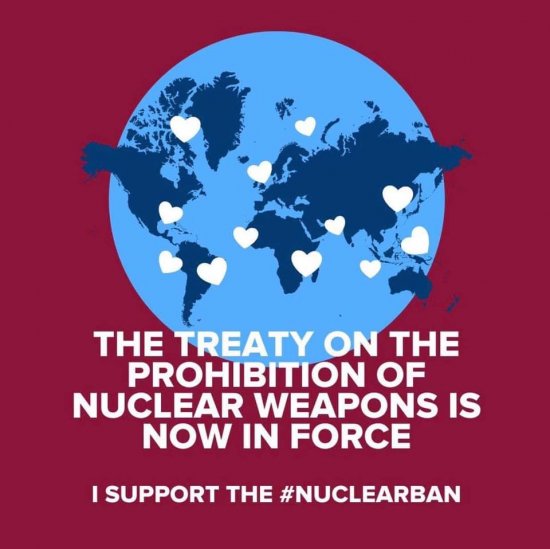
Africa’s strength in numbers in the Treaty on the Prohibition of Nuclear Weapons, also known as the Nuclear Ban Treaty, is a vehicle the continent can use to address nuclear weapons risks, head-on.
Global divide
On one side, nuclear-armed states cling to deterrence for their national security. They insist that possessing nuclear arsenals keeps them safe.
At present, there are nine nuclear-armed states: the US, Russia, the UK, China, France, India, Pakistan, Israel and North Korea. These countries possess around 12,331 nuclear warheads (as of 2025).
The use of only 10% of these weapons could disrupt the global climate and threaten the lives of up to 2 billion people.
On the other side, African countries and other non-nuclear-weapon states such as Ireland, Austria, New Zealand and Mexico highlight how deterrence creates unacceptable risks for the entire international community.
This global majority – the 93 countries that have signed the Nuclear Ban Treaty and 73 that are party to it – argue that real safety comes from eliminating nuclear threats.
The Nuclear Ban Treaty became international law on 22 January 2021. It is the first instance of international law challenging the legality and morality of nuclear deterrence.
Since 2022, states parties to the Nuclear Ban Treaty have held formal meetings to address current nuclear risks. In March 2025, at their third meeting, 17 African states officially recognised nuclear deterrence as a critical security concern. They called on nuclear armed states to end deterrence.
The deterioration of the international security environment is so palpable that there has been a noticeable shift in nuclear ban states’ perception of nuclear threats. Nuclear disarmament is no longer just a humanitarian or moral concern to these states, it is now a national security concern.
South Africa warned that
any use of nuclear weapons would result in catastrophic humanitarian consequences that would have a global impact.
Ghana likewise stressed that Africa is not immune to nuclear war’s fallout:
Africa, despite its geographic distance from the immediate hotspots of nuclear conflict, is not immune to the repercussions of nuclear weapons.
Africa bears a unique historical connection to nuclear issues. Nuclear testing in the Sahara Desert in the 1960s, when France detonated nuclear bombs in Algeria, had devastating consequences. Widespread radioactive contamination harmed local communities, caused long-lasting health problems, displaced populations, and left large areas environmentally damaged and unsafe for generations.
For its part, Nigeria recalled that Africa had “long acknowledged the existential threat nuclear weapons posed to human existence.”
The meeting determined that it is unacceptable that states parties are exposed to nuclear risks, “created without their control and without accountability”. It stressed that eliminating nuclear risks “is a prime and legitimate concern and national responsibility” of states.
Next steps
Delegates effectively asked whether their own national security concerns had less value than those of nuclear-armed states. I think this is a valid question.
Africa’s leaders and their allies in the Nuclear Ban Treaty are reframing what “national security” means in the nuclear age.
Rather than accepting a world perpetually held hostage by the madness of nuclear deterrence, they are asserting that the security of nations – and of peoples – is best served by dismantling this threat to humanity.
They are prioritising human life, development and international law over the threat of overwhelming force.
The outcome of this contest will have profound implications, not just for Africa but for the entire globe.
Walt Zlotow – Why do so many leaders remain stupid about Ukraine war?
Walt Zlotow, West Suburban Peace Coalition, Glen Ellyn IL , 31 Mar 2.
The 3 year long destruction of Ukraine should never have occurred.
Had leaders in the US, NATO and Ukraine simply used common sense, Ukraine would not be a shell of its former self before the February 24, 2022 Russian invasion that has largely destroyed it. Ukraine economy shattered. Hundreds of thousands of dead and wounded. Over 10 million fled. Over 45,000 square miles lost to Russia forever.
This occurred from massive stupidity by all the leaders in the countries involved.
The stupidity starts with US presidents going back to Bill Clinton. In 1999 he broke the deal with USSR/Russia that he would not expand NATO eastward to their borders. From 1999 thru 2023 US relentlessly doubled NATO from 16 to 32 members.
Reasons likely many but all stupid. Smart diplomats, historians and political scientists were aghast, declaring this would inevitably lead to a US Russian confrontation. It took 23 years but stupid presidents Clinton, Bush, Obama, Biden all stupidly succeeded into provoking Russia to attack.
Odd, but only Trump was not stupid enough to add to NATO during his first term. He was however incredibly stupid to begin arming the Kyiv neofascists to wipe out the Russian leaning Ukrainian separatists in Donbas. That, along with NATO expansion, ensured Russia would intervene.
Western European NATO giants England, France and Germany also took their stupidity cue from Uncle Sam. They were getting cheap energy from Russia but stupidly bowed to US demands to weaken, isolate Russia thru NATO expansion and Kyiv warfare on Donbas Ukrainians. They were cool with replacing cheap Russian gas with exorbitant US LNG. Now they’re economies are crumbing, allowing inroads from MAGA like political opponents. Incredibly, instead of recognizing their stupidly, they’re stupidly planning to squander hundreds of billions of their vanishing treasure to keep the war going till they wreck their economies
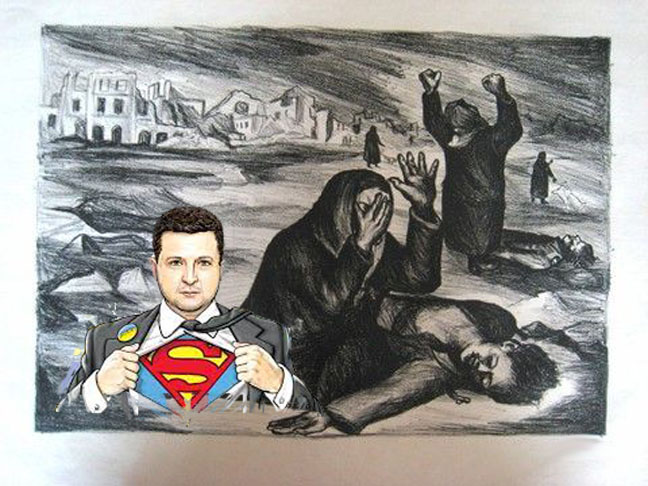
If we were awarding a Stupid Prize, it must go to Ukraine President Volodymyr Zelensky. The comedian turned politician campaigned for the Ukraine presidency on a platform of peace with the Donbas Ukrainians being brutalized by the Kyiv government. It got him elected with big majority of Donbas voters. Alas, Zelensky was too stupid to realize the Kyiv neofascists would never allow him to make peace with Donbas separatists they sought to destroy. To save his presidency, possibly even his life, Zelensky abandoned his voting base.
Zelensky even stupidly amassed 60,000 elite troops on the Donbas border in early 2022 to finish off his constituents there. All that achieved, along with stupidly begging NATO for membership, was to provoke the Russian invasion.
Once started, Zelensky became stupider and stupider. He wisely prepared to sign a peace deal with Russia in the first 2 months which would have ended the war without Ukraine losing a single square mile of territory. But Zelensky stupidly caved to stupid US and UK leaders who told him he could win with US/NATO weapons…but no troops. That stupidity sent Ukraine into failed state status.
Ukraine is now on the cusp of peace being negotiated 2 leaders, Trump and Putin, employing common sense instead of stupidity. But the US Democratic Party, Ukraine, UK, French, German and other NATO leadership remain mired in stupidity that this senseless war must continue till the last Ukrainian soldier is dead.
They all forget the first rule of sane, peaceful governance: Don’t do stupid.
Trump’s bombing threat over Iran nuclear programme prompts backlash
Guardian, Patrick Wintour Diplomatic editor, 31 Mar 25
Iranian officials accuse US president of breaching UN charter and say ‘violence brings violence’
Iran has reacted with outrage after Donald Trump said the country will be bombed if it does not accept US demands to constrain its nuclear programme.
The US president said on Sunday that if Iran “[doesn’t] make a deal, there will be bombing. It will be bombing the likes of which they have never seen before.”.
Trump’s latest threat – more explicit and violent than any made before – came after he sent a letter to Iran, as yet undisclosed, offering to hold talks on its nuclear programme. Iran had sent a reply to the US stating it was willing to hold indirect talks, officials confirmed.
Esmail Baghaei, the Iranian foreign ministry spokesperson, said of Trump’s threat: “The explicit threat of bombing Iran by the head of a country is clear contradiction to the essence of international peace and security.
Such a threat is a gross violation of the United Nations charter and a violation of the International Atomic Energy Agency safeguards regime. Violence brings violence and peace creates peace, America can choose.”
The supreme leader, Ayatollah Ali Khamenei, a sceptic about talks with the US, said Iran was “not overly concerned” by Trump’s words. “We consider it unlikely that such harm would come from outside. However, if any malicious act does occur, it will certainly be met with a firm
and decisive response,” he said.
Brig Gen Amir Ali Hajizadeh, the commander of the Revolutionary Guard’s aerospace force, said: “Someone in glass houses does not throw stones at anyone,” adding: “The Americans have at least 10 bases with 50,000 troops in the region, meaning they are sitting in a glass house.”
But the Iranian foreign minister, Abbas Araghchi, clearly had authority to keep the prospect of talks alive, saying Iran had already replied to the Trump letter through intermediaries in Oman and adding he knew the Iranian letter had now reached the US. Araghchi said direct talks were not possible while the US continued to threaten and bully Iran………………………………………………………………………………………………………………. https://www.theguardian.com/world/2025/mar/31/trumps-bombing-threat-over-iran-nuclear-programme-prompts-backlash
1 This Month
Chernobyl: The Lost Tapes – A good documentary on Chernobyl on SBS available On Demand for the next 3 weeks– https://www.sbs.com.au/ondemand/tv-program/chernobyl-the-lost-tapes/2352741955560

of the week–London Campaign for Nuclear Disarmament

Tell the Ukrainian Government to Drop Prosecution of Peace Activist Yurii Sheliazhenko
To see nuclear-related stories in greater depth and intensity – go to https://nuclearinformation.wordpress.com
-
Archives
- April 2026 (126)
- March 2026 (251)
- February 2026 (268)
- January 2026 (308)
- December 2025 (358)
- November 2025 (359)
- October 2025 (376)
- September 2025 (257)
- August 2025 (319)
- July 2025 (230)
- June 2025 (348)
- May 2025 (261)
-
Categories
- 1
- 1 NUCLEAR ISSUES
- business and costs
- climate change
- culture and arts
- ENERGY
- environment
- health
- history
- indigenous issues
- Legal
- marketing of nuclear
- media
- opposition to nuclear
- PERSONAL STORIES
- politics
- politics international
- Religion and ethics
- safety
- secrets,lies and civil liberties
- spinbuster
- technology
- Uranium
- wastes
- weapons and war
- Women
- 2 WORLD
- ACTION
- AFRICA
- Atrocities
- AUSTRALIA
- Christina's notes
- Christina's themes
- culture and arts
- Events
- Fuk 2022
- Fuk 2023
- Fukushima 2017
- Fukushima 2018
- fukushima 2019
- Fukushima 2020
- Fukushima 2021
- general
- global warming
- Humour (God we need it)
- Nuclear
- RARE EARTHS
- Reference
- resources – print
- Resources -audiovicual
- Weekly Newsletter
- World
- World Nuclear
- YouTube
-
RSS
Entries RSS
Comments RSS
 nuclear-news