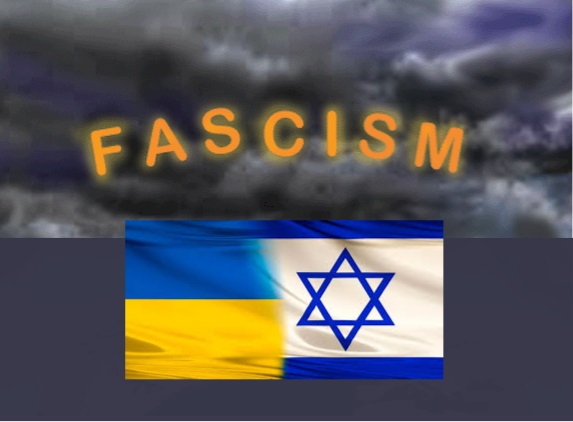
From Bandera to Ben-Gurion, a new axis of ethno-supremacy is rising, fueled by U.S. backing. Same guns. Same flags. Same ideology. Gaza and Donbass are not separate wars. They are one machine.
The Ukraine–Israel Nexus: Pragmatic Alliances Amid Paradoxes and Shared Challenges From Bandera to Ben-Gurion, echoes of ethno-nationalist revival resonate in the modern trajectories of Ukraine and Israel, two states forged through war, hardened by siege mentalities, and fueled by historical narratives of existential struggle. But these similarities are no accident of parallel development. They reflect a deepening alignment shaped by shared adversaries like Russia and Iran, backed and brokered by the same Western patrons.
In 2022, an officer of Ukraine’s Azov Regiment, toured Israel after surviving the siege of Mariupol. By 2025, Israeli drones were flying missions over Rafah, while American-made PSRL-1 rocket launchers, initially supplied to Ukraine, were spotted in conflict zones across the Middle East. Some experts suggest these may have reached Gaza through black-market channels, though a direct transfer remains unproven. What is undeniable, however, is the convergence of military technologies, intelligence doctrines, and battlefield logistics spanning both theaters.
In April 2022, Ukrainian President Volodymyr Zelenskyy, himself a stalwart ally to the Zionist cause, declared that he envisioned Ukraine becoming “a big Israel.” In doing so, he abandoned the pretense of liberal reform and embraced a future defined by permanentmilitarization, domesticsurveillance, and an ideologicallymobilizedcitizenry. Ukraine, he suggested, would survive not by joining Europe’s post-national dream, only by imitating the ethos of a heavily securitized Middle Eastern state.
Zelenskyy’s statement didn’t emerge in a vacuum. It followed decades of quietly intensifying Ukrainian–Israeli ties, in historical memory, military cooperation, tech integration, and shared narratives of victimhood. But it also exposed a deeper and more disturbing fusion. When the president of a country still reckoning with the legacy of the Holocaust and its own fascist collaborators calls for the building of a “Big Israel,” he is not just invoking a model of defense, he is invoking a model of justified violence, permanent siege, and a long tradition of selective memory, one that both Ukraine and Israel have wielded to reconcile uncomfortable historical alliances of culpability.
Just as the OUN’s collaboration with Nazi Germany is selectively reframed within the Ukrainian national mythos, Israel’s founding story often omits its own moments of strategic accommodation with fascism.
In the 1930s and ’40s, elements of the Zionist movement, most notably the Haavara Agreement between Nazi Germany and the Jewish Agency, facilitated Jewish emigration to Palestine while bypassing international boycotts of the Nazi regime. Revisionist factions like Lehi (the Stern Gang) and Irgun Zvai Leumi even sought military cooperation with the Axis powers against the British. These uncomfortable truths, long buried beneath the moral absolutism of Holocaust remembrance, underscore a shared willingness, Ukrainian and Zionist alike, to collaborate with and even become genocidal regimes when national aspirations were at stake.
What binds Gaza and Donbass is not a monolithic “machine of violence” but a transnational matrix of ideological alignment, technical cooperation, and strategic utility. Ukraine’s campaign of “decommunization” often mirrors Israel’s internal securitization and demographic engineering, both clad in the moral armor of historical trauma. In practice, both states justify aggressive internal and external policies through the language of survival.
This article maps the ideological, military, economic, and cultural architecture of the Ukraine–Israel relationship. From Soviet-era tensions to the post-2014 reconfiguration of alliances, we explore how pragmatic imperatives have forged a new axis of ethno-nationalist power, increasingly central to NATO’s long-term vision of regional dominance.
I. Historical Ties To understand the modern partnership between Ukraine and Israel, one must begin with their shared, and often contradictory past. Ukraine was both a cradle of early Zionism and a site of violent antisemitic pogroms. Movements likeHibbat Zion, emerged in the 1880s in cities like Odessa and Kiev, decades before Theodor Herzl’s more famous Vienna-based political Zionism. Their mission: to restore the Jewish people to their ancestral homeland in Palestine. Ukraine, in this sense, was an incubator for the ideological DNA of the Israeli state……………………………………………………………………………………………………………………………………………………………………………………………….
…………………….The historical relationship between Israel and Ukraine is not one of ideological clarity. It is a pragmatic evolution, shaped by war, memory, trauma, and strategy. The next sections will examine how these contradictions manifest on the battlefield through weapons, doctrine, personnel, and propaganda, across Gaza and Donbass alike.
Selective Memory: How Competing Genocides Forged Strategic Amnesia In the narrative war between historical truth and political utility, few examples are as revealing, or as cynical, as the ways Ukraine and Israel have reframed and often embellished their respective traumas to enable strategic cooperation.
By the 1980s, Ukrainian nationalist émigrés began aggressively promoting the 1932–33 Soviet famine, or Holodomor, as the “Ukrainian Holocaust.” This was a calculated response to the rising global awareness of Jewish suffering, spurred by the 1978 NBC miniseries Holocaust, which explicitly portrayed Ukrainians as Nazi collaborators. For diaspora groups still loyal to Stepan Bandera’s legacy, the documentary posed a threat to their rehabilitated image, which they had worked fervently to whitewash. In turn, they constructed a counter-narrative of equal, if not greater, Ukrainian victimhood, one that would cast the Soviet state as genocidal and reframe Ukrainian history through the lens of national martyrdom.
This rhetorical project relied on inflating death tolls,………………………………………………………………..
The result is a pact built on strategic amnesia: a cold alliance between two states whose foundational traumas have been rewritten to serve military alignment, ideological affinity, and common enemies………………………….
…………II. Blood Ties and Battle Lines: Commanders, Crusaders, and Collaborators The machinery of transnational warfare is not only built with weapons, laws, and doctrines, but with men. Individuals who embody the ideological convergence between Zionist ethno-nationalism and Ukrainian fascism do not operate in the shadows; they are often celebrated, recruited, and strategically deployed across theaters like Gaza and Donbass. These figures serve as ideological evangelists, field commanders, propaganda tools, and networking nodes between far-right militias, Western intelligence networks, and private security structures.
Some are Azov veterans turned actors and influencers. Others are American-Israeli contractors building bridges between Tel Aviv and Kiev. ……………………..
Iran’s parliament on Tuesday urged the Foreign Ministry and Atomic Energy Organization to fully implement existing legislation limiting cooperation with the International Atomic Energy Agency, amid growing pressure from Western powers and renewed nuclear talks in Geneva. In a strongly worded statement, the National Security and Foreign Policy Committee of Iran’s parliament described IAEA chief Rafael Grossi as “a servant of the US and the Zionist regime,” accusing him of siding with hostile powers and remaining silent over attacks on Iranian nuclear sites, according to remarks published by state media.
The UN nuclear watchdog’s inspectors have returned to Iran after their expulsion during a brief war with Israel and the US, IAEA chief Rafael Grossi said Tuesday, amid reports he has been placed under 24/7 protection following Iran’s threat to his life. “Now the first team of IAEA inspectors is back in Iran, and we are about to restart,” International Atomic Energy Agency (IAEA) director general Grossi said. Grossi, who was in Washington DC for the annual meeting of the Institute of Nuclear Materials Management, stopped short of saying there was an agreement or timeline for them to resume their work. “When it comes to Iran, as you know, there are many facilities. Some were attacked, some were not. So we are discussing what kind of modalities, practical modalities, can be implemented in order to facilitate the restart of our work there.”
“AUKUS is only going to lead to more submarines collectively in 10, 15, 20 years, which is way beyond the window of maximum danger, which is really this decade.”
The moment the security pact known as AUKUS came into being, it was clear what its true intention was. Announced in September 2021, ruinous to Franco-Australian relations, and Anglospheric in inclination, the agreement between Washington, London and Canberra would project US power in the Indo-Pacific with one purpose in mind: deterring China. The fool in this whole endeavour was Australia, with a security establishment so Freudian in its anxiety it seeks an Imperial Daddy at every turn.
To avoid the pains of mature sovereignty, the successive Australian governments of Scott Morrison and Anthony Albanese have fallen for the bribe of the nuclear-powered Virginia Class SSN-774 and the promise of a bespoke AUKUS-designed nuclear–powered counterpart. These submarines may never make their way to the Royal Australian Navy. Australia is infamously bad when it comes to constructing submarines, and the US is under no obligation to furnish Canberra with the boats.
The latter point is made clear in the 2023 National Defense Authorization Act, which directs the US President to certify to the relevant congressional committees and leadership no later than 270 days prior to the transfer of vessels that this “will not degrade the United States underseas capabilities”; is consistent with the country’s foreign policy and national security interests and furthers the AUKUS partnership. Furthering the partnership would involve“sufficient submarine production and maintenance investments” to meet undersea capabilities; the provision by Australia of “appropriate funds and support for the additional capacity required to meet the requirements”; and Canberra’s “capability to host and fully operate the vessels authorized to be transferred.”
In his March confirmation hearing as Undersecretary of Defense Policy, Eldridge Colby, President Donald Trump’s chief appointee for reviewing the AUKUS pact, candidly opined that a poor production rate of submarines would place “our servicemen and women […] in a weaker position.” He had also warned that, “AUKUS is only going to lead to more submarines collectively in 10, 15, 20 years, which is way beyond the window of maximum danger, which is really this decade.”
The SSN program, as such unrealised and a pure chimera, is working wonders in distorting Australia’s defence budget. The decade to 2033-4 features a total projected budget of A$330 billion. The SSN budget of A$53-63 billion puts nuclear powered submarines at 16.1% to 19.1% more than relevant land and air domains. A report by the Strategic Analysis Australia think tank did not shy away from these implications: “It’s hard to grasp how unusual this situation is. Moreover, it’s one that will endure for decades, since the key elements of the maritime domain (SSNs and the two frigate programs) will still be in acquisition well into the 2040s. It’s quite possible that Defence itself doesn’t grasp the situation that it’s gotten into.”
Despite this fantastic asymmetry of objectives, Australia is still being asked to do more. An ongoing suspicion on the part of defence wonks in the White House, Pentagon and Congress is what Australia would do with the precious naval hardware once its navy gets them. Could Australia be relied upon to deploy them in a US-led war against China? Should the boats be placed under US naval command, reducing Australia to suitable vassal status?
Now, yet another think tanking outfit, the Washington-based Center for Strategic and International Studies (CSIS), is urging Australia to make its position clear on how it would deploy the Virginia boats. A report, authored by a former senior AUKUS advisor during the Biden administration Abraham Denmark and Charles Edel, senior advisor and CSIS Australia chair, airily proposes that Australia offers “a more concrete commitment” to the US while also being sensitive to its own sovereignty. This rather hopeless aim can be achieved through “a robust contingency planning process that incorporates Australian SSNs.” This would involve US and Australian military strategists planning to “undergo a comprehensive process of strategizing and organizing military operations to achieve specific objectives.” Such a process would provide “concrete reassurances that submarines sold to Australia would not disappear if and when needed.” It might also preserve Australian sovereignty in both developing the plan and determining its implementation during a crisis.
In addition to that gobbet of hopeless contradiction, the authors offer some further advice: that the second pillar of the AUKUS agreement, involving the development of advanced capabilities, the sharing of technology and increasing the interoperability between the armed forces of the three countries, be more sharply defined. “AUKUS nations should consider focusing on three capability areas: autonomy, long-range strike, and integrated air defense.” This great militarist splash would supposedly “increase deterrence in both Europe and the Indo-Pacific.”
In terms of examples, President Trump’s wonky Golden Dome anti-missile shield is touted as an “opportunity for Pillar II in integrated air defense.” (It would be better described as sheer science fiction, underwritten by space capitalism.) Australia was already at work with their US counterparts in developing missile defence systems that could complement the initiative. Developing improved and integrated anti-missile defences was even more urgent given the “greatly expanding rotational presence of US military forces in Australia.”
This waffling nonsense has all the finery of delusion. When it comes to sovereignty, there is nothing to speak of and Australia’s security cadres, along with most parliamentarians in the major parties, see no troubles with deferring responsibility to the US imperium. In most respects, this has already taken place. The use of such coddling terms as “joint planning” and “joint venture” only serves to conceal the dominant, rough role played by Washington, always playing the imperial paterfamilias even as it secures its own interests against other adversaries.
Given that the whole basis for Russia launching the war was to put a hard red line in the sand that NATO would not be expanded to include Ukraine, there is no reason to believe that Russia would attack Ukraine in future, if its core underlying concern was resolved.
But security guarantees will need to be realistic and sanctions removal must form part of the plan.
The need for Ukraine’s postwar security has become a major talking point since President Trump’s historic meeting with President Putin in Alaska on 15 August.
U.S. Special Envoy Steve Witkoff spoke of a ‘game-changing’ commitment by President Putin to accept Security guarantees by NATO states. This meant that ‘the United States and other European nations could effectively offer Article 5 like language’.
It is clear that security guarantees are vital for all sides, including for Russia.
Security guarantees are important to European nations, precisely to reduce the risk of Europe being engulfed in a senseless and, frankly, avoidable war with Russia. There has never been any evidence that Russia wants to invade Europe, despite that being a comfortable go-to line for European propagandists.
So, for Europe in particular, the offer of security guarantees must represent a meaningful act of deterrence. A commitment by western nations to fight, so as to prevent the possibility of future war. What this deterrence does not mean is to station NATO troops permanently or even temporarily inside of Ukraine, whether they be called a Reassurance Force, Peacekeeping Force or anything else.
If this war was provoked by a desire by Russia to stop NATO advancing to its western border through Ukraine, why then would Russia agree to have NATO troops inside Ukraine? NATO has large armies on Ukraine’s border already and mounts air patrols as it is.
So, security guarantees don’t need to mean boots on the ground, but rather a willingness to defend Ukraine against a future war which was absent during the current war.
And that is why security guarantees are important for Ukraine.
That country will be forgiven for scepticism about whether NATO states such as France, the UK or Germany would come to their military rescue in the event of a future war having gone to extreme lengths not to come to their military rescue in this war.
If NATO countries are going to make commitments to Ukraine’s future security, then they will have to mean it if they ever want to be taken seriously again.
This is important to Ukraine specifically because upon the cessation of hostilities, and whether it wants to or not, it will need to reduce the size of its army. Ursula von der Leyen has spoken about turning Ukraine into a ‘steel porcupine’ that Russia can’t swallow.
But who is going to pay for this, as Ukraine cannot?
In peacetime, European citizens will rightly press for their governments to refocus spending on domestic priorities, and to cease channeling funds into the woefully corrupt gravy train of Ukraine.
Ukrainian defence spending – $54.5bn for this year – already makes up over 67% of Ukraine’s budget and 31% of GDP. Ukraine needs yearly cash injections from western nations of at least $40bn just to stay afloat. Much of that, now, is in the form of concessionary loans which Ukraine, one day in the distant future, will need to pay back.
Ukraine is otherwise cut off from international capital markets. You don’t need to be a maths genius to see that if western funds dry up, Ukraine will have less than $15bn available each year for defence.
Ukraine’s army was around two hundred thousand before the war broke out and now counts at almost one million. Salary costs will come down after the war ends, because soldiers likely will lose the lucrative frontline bonuses they receive which can effectively quadruple their normal pay, if they survive long enough to spend it.
That in itself will present another major social problem for Ukraine to demobilise soldiers who will find themselves in a shattered country that is in a dire economic state. But specifically, Ukraine will need to trim the size of its army, because it won’t be able to afford to pay for it. It is completely unrealistic to expect western nations to continue to pump tens of billions each year into Ukraine to maintain an army of one million in peacetime.
So, this undoubtedly presents huge challenges, but it must surely be in Ukraine’s interest to sue for peace and to start a complicated and, I fear, long and rocky road to EU membership, reconstruction and growth. As a country, it gains nothing but death and destruction by keeping the war going and losing ground and lives each day.
Security guarantees are vitally important to Russia too. President Trump’s unequivocal stance that Ukraine won’t join NATO must be backed up by a Treaty to ensure that Russia will have confidence that this commitment to Ukrainian military neutrality is real and permanent,
Given that the whole basis for Russia launching the war was to put a hard red line in the sand that NATO would not be expanded to include Ukraine, there is no reason to believe that Russia would attack Ukraine in future, if its core underlying concern was resolved.
Conquering all of Ukraine has never been a core aim in this war, in my opinion. Even though it has the military upper hand, I believe that Russia wants peace too. Peace will mean a long and fraught process of normalisation of relations with Ukraine, Europe and with the U.S. Indeed, the reengagement in peaceable economic, social and cultural relations would surely prevent the need for a future war.
But there’s texture here, of course, both Russia and Ukraine would need to resist provocations that precipitated a future conflict. Let’s not forget that from the onset of the Ukraine crisis in 2014, and after the Minsk II agreement was reached in February 2015. It became a goal of Ukraine and western powers to impose economic sanctions on Russia.
As we seem to enter the final furlong towards peace in Ukraine after a devastating war, pressure continues from both Europe and Ukraine to continue to sanction Russia to maintain the pressure. In recent days, President Zelensky has urged more sanctions if President Putin does not meet him in person. The European Union is preparing its 19th round of sanctions since 2022, despite the prospect of peace seemingly on the horizon.
This is one of the reasons that any peace deal needs a plan for sanctions removal, not addition. As I have said many times before, setting out a clear plan to reduce Russian sanctions that do not provide Ukraine with a veto will be vital to incentivising President Putin to cut a deal.
It is deluded to believe, more than eleven years after the first sanctions were imposed on Russia, that threatening Russia with more sanctions will incentivise a peace deal. It must surely be obvious that further threats of sanctions will simply encourage President Putin to order his troops on in their campaign.
So, if a peace deal is to be agreed, despite the pain of agreeing it, it must facilitate peace or, at the very least, the absence of war. It must ensure that Europe is serious about honouring its commitment to Ukraine in the future, it must give Ukraine the confidence that it can move its army to a peacetime footing, and it must manifestly promote a normalisation of relations with Russia that is so long overdue.
South Korea’s state-run nuclear power firm has been banned from bidding for new power plant projects in North America and Europe over an intellectual property (IP) dispute, the Seoul-based Yonhap News reported on Tuesday.
Korea Hydro & Nuclear Power (KHNP) faces the IP dispute under its agreement with the US energy firm Westinghouse, signed in January, according to industry sources.
The sources mentioned that the KHNP cannot sign for new nuclear power plant deals in North America and the UK, Japan, Ukraine, and EU nations, excluding the Czech Republic.
The agreement was signed after Westinghouse accused the KHNP of infringing on its IP, claiming that the plant designs of the South Korean company utilize its licensed technology.
The deal had cleared a major obstacle for the KHNP-led Korean consortium to finalize a 26 trillion won ($18.7 billion) contract in June to build two nuclear power units in the Czech Republic.
The report came as the KHNP President Whang Joo-ho confirmed on Tuesday that the company had closed operations in Poland.
“After the new Polish administration took office … the country decided to drop the state-owned enterprise projects (in the nuclear power sector),” Whang said.
Poland became the fourth European country where the KHNP confirmed its business closure, following Sweden, Slovenia, and the Netherlands.
“It was determined by all that the best way to end the horrific war between Russia and Ukraine is to go directly to a Peace Agreement, which would end the war, and not a mere Ceasefire Agreement, which often times do not hold up.”
The Dwarfs had to slink away. Will they, at long last, tell Zelensky they cannot back up their rhetoric with the needed arms and financial support?
I shall not make the de-rigueur disclaimer lest anyone infer that I think President Donald Trump is Snow White. Nor do I feel a need to assure readers that I am not “in Putin’s pocket.” In the tradition of a “current intelligence” analyst, I shall simply “call ‘em like I see ‘em.” And there are lots of dots to put together.
It has been clear since the Alaska summit that Trump and Russian President Vladimir Putin have come to an overall agreement on Ukraine and that it is now being fleshed out in plain sight. And both are acutely aware of the many forces wishing to sabotage moves toward a negotiated settlement.
They have agreed to call it “Biden’s war” and then to conduct themselves as though they have bigger fish to fry – first and foremost improving U.S.-Russia relations.
Why have so many observers been unable to grasp the significance of this key sentence in the first paragraph of the readout from the Aug. 6 Putin-Witkoff meeting – the meeting that set these hopeful events in train?
“Once again, it was noted that Russia-US relations could be placed on a totally different, mutually beneficial footing, which would be in stark contrast with the way these relations have evolved in recent years.” (Emphasis added.)
(Pardon the pedantry, but it is not widely known that the Kremlin’s Russian-to-English translator erred in using the subjunctive could. The word in the Russian readout is stronger; it means can – the indicative, not the subjunctive mood.) This is, well, indicative.
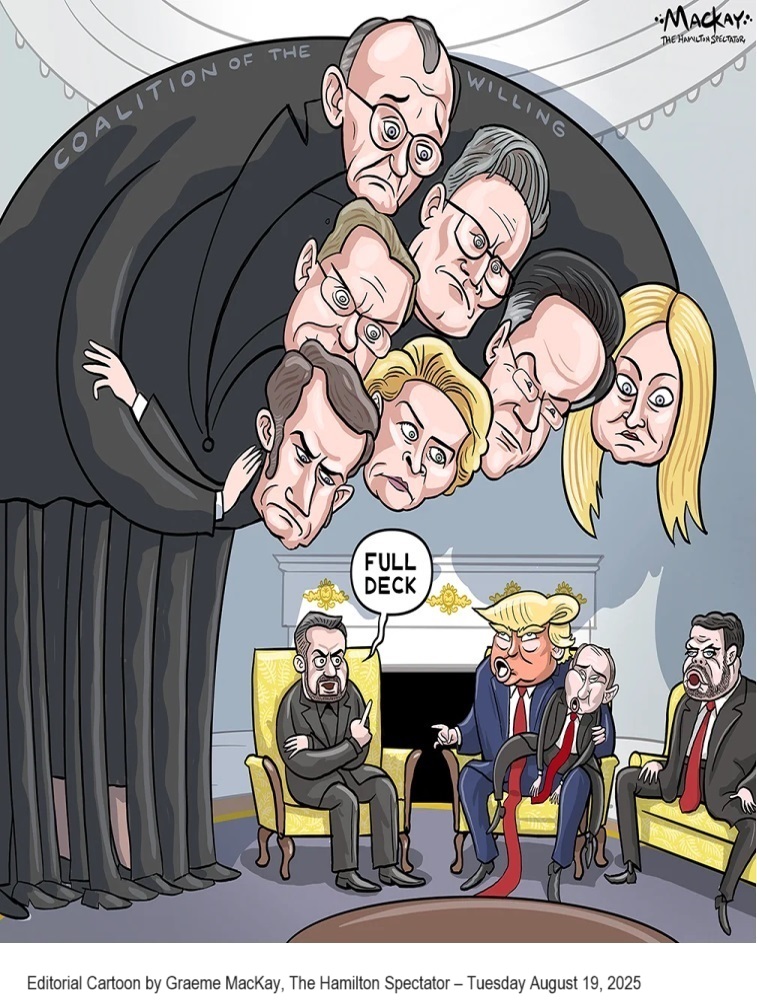
The shared, overriding objective to improve bilateral ties came through clearly both at the summit on Friday and at the “March of the Gnomes” on Monday when seven European leaders arrived at the White House to back Volodymyr Zelensky (no offense to garden gnomes – or dwarfs).
Enroute Alaska
On Air Force One, Trump told Fox’s Bret Baier, “I won’t be happy if I walk away without some form of a ceasefire.” Nyet, was Putin’s answer.
Perhaps the president thought he could work his persuasive powers on Putin one-on-one and change his mind. More likely, Trump knew his gambit had zero prospect of success, and merely wanted to be able to tell the foot-draggers later that he had thrown one last Hail Mary pass, but in vain.
Just a few hours later Trump wrote on truthsocial:
“It was determined by all that the best way to end the horrific war between Russia and Ukraine is to go directly to a Peace Agreement, which would end the war, and not a mere Ceasefire Agreement, which often times do not hold up.”
The New York Times and other media were quick to point out that Trump was “siding with Putin.”
Maps … and Charts
While Putin used the Alaska summit to make clear Russia’s core interests on Ukraine and to argue that he had no option other than to invade, it is a safe bet that he also showed Trump a map depicting the “order of battle;” that is, the disposition of forces along the contact line and in reserve.
This morning Trump hinted that Russia should be allowed to hold onto the territory it has occupied in Ukraine, a concept so far anathema to Zelensky and most of the European leaders.
THE Map
“The Ukrainian soldiers were brave as hell because it’s fighting a force that’s much, much bigger and clearly much more powerful,” Trump said of the Russian military … “And you know, it’s not like they’ve stopped. If you, I assume you’ve all seen the map, you know, a big chunk of territory is taken, and that territory has been taken.
“Now they’re talking about Donbas. But Donbas, right now, as you know, is 79 percent owned and controlled by Russia,” Trump added. “So they understand that.”
Zelensky and the Seven Dwarfs
The Dwarfs had to slink away. Will they, at long last, tell Zelensky they cannot back up their rhetoric with the needed arms and financial support? It will take a while, but in the end they will have to do so.
The end is near.
Ray McGovern works with Tell the Word, a publishing arm of the ecumenical Church of the Saviour in inner-city Washington. His 27 years as a C.I.A. analyst included leading the Soviet Foreign Policy Branch and conducting the morning briefings of the President’s Daily Brief. In retirement he co-founded Veteran Intelligence Professionals for Sanity (VIPS).
The troupe arrived to “daddy’s” DC office for their official dressing down. If nothing else, we must marvel at the fact that the meeting produced some of the most remarkable political optics, perhaps, in history:
Has there ever been anything like this? The entire pantheon of the European ruling class reduced to sniveling children in their school principal’s office. No one can deny that Trump has succeeded in veritably ‘breaking Europe over his knee’. There is no coming back from this turning point moment, the optics simply cannot be redeemed.
But even snide ridicule aside, objectively speaking, we must point to how absolutely defeated and low-energy the delegation looked……………
Hands in pockets, looks of mild confusion or disinterest, vacant eyes, and that bizarre ‘dead-space’ atmosphere like a “TV tuned to a dead station” (hat tip Mr. Gibson). It’s clear that no one wants to be there, and everyone knows the artificial charade looks and feels forced. The real punchline comes at the 1:00 mark where it becomes eminently obvious the entire hollow exercise is nothing more than an ego-stroke for the cunning Ringmaster himself, as he bids his abject pupils to veer their gaze at the carefully-situated artwork presiding over the gilded humiliation ritual.
Volumes could be written on the implications of such a low point in European influence. But we’ll suffice with concluding that it’s clear the matter of the Ukrainian conflict’s resolution is of such existential importance to the behind-the-scenes cabal which writes the Euro-puppets’ orders, that this cabal is willing to risk everything, including politically sacrificing its “compradors” posing as elected leaders.
It’s pointless to even granularize it, but there were many small moments of humiliation in the meeting: from Trump’s seeming non-recognition of Finland’s president—unable to find him despite his sitting directly across from him—to Trump humbling Ursula, who came armed with a prescripted spiel about Russians kidnapping Ukrainian children; Trump slapped her silent by pointing out they had convened to talk about something else entirely, i.e. your propaganda is irrelevant and unwanted here.
It should also be noted that Trump did not greet a single one of the European messengers personally as they arrived, having a chaperone escort them like children from the White House playground instead. It was in sharp contrast to the pomp and ceremony of the Putin visit. This, of course, is by design, with Trump effectively showing the craven European compradors their subordinate place as part of his slow restructuring of the world order; Trump respects only power—mealy and servile leaders repulse him and earn his boot-print on their foreheads.
So what did the meeting actually accomplish, other than raising Trump’s prestige and smothering inconvenient media narratives from the news cycle?
What we saw was another rehash of the same routine as in Alaska: talks are held, major “progress” announced, yet no concrete details or evidence is provided. In this case, the big achievement is said to be the agreement on a meeting between Putin and Zelensky, followed by a “trilat” as Trump calls it. The problem is, there is zero evidence the Russian side has agreed to any such thing.
Firstly, press outlets blared that Trump “phoned Putin” in the midst of his meeting with the Europeans—Trump himself promptly shot this down:
I post this example to again illustrate just how much disinfo noise is clogging the airwaves around this issue. And this contextualizes the remainder of the analysis, surrounding what Russia may or may not have agreed to. You see, just as easily as mainstream outlets lied about Trump’s call, they may be doing so about the now-circulating claims that Putin has “agreed to” meet with Zelensky.
The Russians have been playing things extremely close to their chests, even more than usual. It appears they have adopted a strategy of deliberate strategic ambiguity in order to give Trump the license he needs to play his game against the Europeans—and Ukraine—while the Russians sit back and watch.
In this case, in confirming Trump’s attempt to get Putin and Zelensky to sit down together, Putin aide Ushakov very subtly modified the language to state that Putin and Trump discussed raising the level of “negotiators” and mentioned the possibility of Russia studying this proposal—as I wrote on X:
An interestingly evasive word-salad as non-answer in customary “Politburo-speak”. He doesn’t really confirm anything other than Trump and Putin discussed “raising the level of negotiators” between Russia and Ukraine (specifically omitting what level that would be). And in fact, he didn’t even say raising the level itself was discussed but rather the possibility of “studying” this proposal. It seems Russia for now continues to play strategic ambiguity to give Trump the arm space he needs to “work” on the Europeans and Zelensky.
In this case, in confirming Trump’s attempt to get Putin and Zelensky to sit down together, Putin aide Ushakov very subtly modified the language to state that Putin and Trump discussed raising the level of “negotiators” and mentioned the possibility of Russia studying this proposal—as I wrote on X:
An interestingly evasive word-salad as non-answer in customary “Politburo-speak”. He doesn’t really confirm anything other than Trump and Putin discussed “raising the level of negotiators” between Russia and Ukraine (specifically omitting what level that would be). And in fact, he didn’t even say raising the level itself was discussed but rather the possibility of “studying” this proposal. It seems Russia for now continues to play strategic ambiguity to give Trump the arm space he needs to “work” on the Europeans and Zelensky.
President Trump said on Monday that he was working on arranging a meeting between Russian President Vladimir Putin and Ukrainian President Volodymyr Zelensky, comments that came after a day of hosting the Ukrainian leader and several European officials at the White House.
“At the conclusion of the meetings, I called President Putin, and began the arrangements for a meeting, at a location to be determined, between President Putin and President Zelensky,” the president wrote on Truth Social.
Trump said that once Putin and Zelensky meet, he would join them for a three-way talk. “After that meeting takes place, we will have a Trilat, which would be the two Presidents, plus myself,” he wrote.
Yury Ushakov, an aide to Putin, said that during the call with Trump, the Russian leader “expressed support for direct negotiations between the delegations of Russia and Ukraine.”
Trump said that one topic of discussion with Zelensky and European leaders on Monday was the potential security guarantees Ukraine would receive from Western nations as part of a peace deal, which will likely be a major sticking point in negotiations with Russia.
“During the meeting we discussed Security Guarantees for Ukraine, which Guarantees would be provided by the various European Countries, with a coordination with the United States of America,” he said.
European leaders, led by British Prime Minister Keir Starmer and French President Emmanuel Macron, are calling for a troop deployment to Ukraine to uphold any potential peace deal. When asked if the US would send troops to Ukraine, Trump didn’t rule out the idea.
But Russia has made clear that it’s strongly opposed to the idea of the deployment of troops from NATO countries to Ukraine, a position it reiterated on Monday. “We reiterate our repeatedly expressed position that we deny any scenarios that envisage the deployment of a military contingent to Ukraine with the participation of Nato states, which could lead to an uncontrollable escalation of the conflict with unpredictable consequences,” said Russian Foreign Ministry spokeswoman Maria Zakharova.
The other major sticking point is the issue of territory. Russia has reportedly offered to end the war if Ukraine withdraws from the Donbas region and the lines are frozen in the southern Kherson and Zaporizhzhia oblasts, but Zelensky continues to publicly reject the idea of ceding territory.
Zelensky has received strong backing from the European leaders who joined him in Washington and held talks with them to coordinate their position ahead of the meetings with Trump. According to a press release from Zelensky’s office, he and the Europeans “stressed their firm support for Ukraine’s sovereignty and territorial integrity and the unacceptability of changing internationally recognized state borders by force.”
The statement said they also “welcomed the readiness of the United States to participate in guaranteeing security for Ukraine” and that “one of the key issues in the negotiations with President Trump will be the joint participation of the United States and Europe in creating the future security architecture for Ukraine and, consequently, for the entire European continent.”
Zelensky was joined in Washington by Starmer, Macron, German Chancellor Friedrich Merz, Italian Prime Minister Giorgia Meloni, Finnish President Alexander Stubb, European Commission President Ursula von der Leyen, and NATO Secretary-General Mark Rutte.
history….will remember whether statesmen had the courage to talk instead of continuing to fight, to compromise instead of escalating, to think beyond the next election cycle or arms shipment.
The war hawks may laugh, but in a world teetering on the edge, diplomacy is no joke
The Alaska summit between Donald Trump and Vladimir Putin was never going to please the usual suspects. The war hawks in Washington, London, and their loyal stenographers in the mainstream press had sharpened their knives long before the meeting even began. For them, diplomacy is weakness, dialogue is treason, and peace is always suspicious. Yet for all their noise, the very fact that the U.S. and Russia sat down to talk is of historic importance—and a step that no amount of scaremongering can erase.
From the beginning, the Atlantic establishment mocked the very idea of dialogue with Moscow. They repeated their tired mantra: Russia is “isolated,” Russia must be “contained,” Russia should be “punished.” But as
Tarik Cyril Amar rightly pointed out during our Cold 2.0 conversation, Russia has never been isolated—except in the fever dreams of Western editorial boards. It is integrated into the world, it has options, and it has a professional diplomatic corps that runs circles around its Western counterparts.
The real absurdity is that some critics, even among multipolarists, argued that Russia should have boycotted the summit—that engaging with Washington is a trap, that agreements will only be broken, that the American “blob” never changes course. Of course, the caution is justified: America is unreliable, aggressive, and deeply arrogant. But the conclusion is wrong. Diplomacy is not about naivety. It is about leveraging one’s strength. And Russia today, unlike in the 1990s, is not a supplicant. It can negotiate from a position of power.
This is what the hawks cannot stand: that Russia walked into the room with Trump as an equal, and walked out with its position strengthened. That reality alone triggered the predictable chorus of whining from the likes of John Bolton—who begrudgingly admitted that “Putin clearly won.” Well, if even the mustached high priest of regime change says it, perhaps we should take note.
Meanwhile, Britain’s Telegraph solemnly declared that Ukraine has lost the war but that Britain must “prepare for Russia’s next onslaught.” These are the same people whose government cannot even keep its nuclear submarines from rusting in Scottish ports. Perhaps Whitehall should focus less on imaginary Russian invasions and more on fixing the crumbling infrastructure at home. But then again, blaming Russia is so much easier than admitting neoliberal Britain has sabotaged daily life all by itself.
The mainstream press, too, embarrassed itself. Journalists shouted at Putin about “killing civilians”—but I have yet to see the same bravery directed at Benjamin Netanyahu as he presides over the ruins of Gaza. The double standards are glaring, the hypocrisy suffocating. As I said during the show, neoliberal rot has sabotaged daily life in Britain and America far more effectively than any Russian plot ever could. But instead of confronting their own failures, the West’s talking heads project blame outward and cling to the fantasy of a “rules-based international order” that exists only on paper.
Let us be clear: breaking the ice between Washington and Moscow is not a concession to empire. It is a recognition that wars end not with hashtags or think tank white papers, but at the negotiating table. Trump’s shift toward demanding a peace deal—not just a ceasefire—mirrors Russia’s own position and marks a fundamental break from the stale Western script. If he sticks to it, this could be a turning point.
Of course, the hawks will howl. They always do. But history will not remember their op-eds. It will remember whether statesmen had the courage to talk instead of continuing to fight, to compromise instead of escalating, to think beyond the next election cycle or arms shipment.
The Alaska summit was not about personal chemistry between leaders. It was about something much bigger: the possibility of reversing a dangerous spiral. The war hawks may laugh, but in a world teetering on the edge, diplomacy is no joke.
—Kevork Almassian is a Syrian geopolitical analyst and the founder of Syriana Analysis.
It’s clear that both Trump and Putin are playing a long game. Trump wants to get rid of the pesky two-bit actor in Kiev – but without applying old school US coup/regime-change tactics. In his mind, the only thing that really registers is future, possible, mega trade deals on Russian mineral wealth and the development of the Arctic.
the US seeks a meek Europe subjugated to the strategy of tension, otherwise there’s no EU military surge, buying billions worth of over-priced American weapons with money it doesn’t have.
Alaska was not only about Ukraine. Alaska was mostly about the world’s top two nuclear powers attempting to rebuild trust and apply the brakes on an out-of-control train in a mad high-speed rail dash towards nuclear confrontation.
There were no assurances, given the volatile character of US President Donald Trump, who conceived the high-visibility meeting with his Russian counterpart Vladimir Putin. But a new paradigm may be in the works nonetheless. Russia has essentially been de facto recognized by the US as a peer power. That implies, at the very least, the return of high-level diplomacy where it is most needed.
Meanwhile, Europe is dispatching a line-up of impotent leaders to Washington to kowtow in front of the Emperor. The EU’s destiny is sealed: into the dustbin of geopolitical irrelevance.
What has been jointly decided by Trump, personally, and Putin, even before Moscow proposed charged-with-meaning Alaska as the summit venue, remains secret. There will be no leaks about the full content.
Yet it’s quite significant that Trump himself rated Alaska as a 10 out of 10.
The key takeaways, relayed by sources in Moscow with direct access to the Russian delegation, all the way to the 3-3 format (it was initially designed to be a 5-5, but other key members, such as Finance Minister Anton Siluanov, did provide their input), emphasize that:
“It was firmly put [by Putin] to stop all direct US weapon deliveries to Ukraine as a vital step towards the solution. Americans accepted the fact that it is necessary to dramatically decrease lethal shipments.”
After that happens, the ball swings to Europe’s court. The sources specify, in detail:
“Out of the $80 billion Ukrainian budget, Ukraine itself provides less than around $20 billion. The National Bank of Ukraine says that they collect $62 billion in taxes alone, which is a hoax; with a population around 20 million, much more than one million of irreversible battlefield losses, a decimated industry and less than 70 percent of pre-Maidan territory under control that is simply impossible.”
So Europe – as in the NATO/EU combo – has a serious dilemma: ‘Either support Ukraine financially, or militarily. But not both at the same time. Otherwise, the EU itself will collapse even faster.’
Now compare all of the above with arguably the key passage in one of Trump’s Truth Social posts: “It was determined by allthat the best way to end the horrific war between Russia and Ukraine is to go directly to a Peace Agreement, which would end the war, and not a mere Ceasefire Agreement, which often times do not hold up.”
Add to it the essential sauce provided by former Russian president Dmitri Medvedev:
“The President of Russia personally and in detail presented to the US President our conditions for ending the conflict in Ukraine (…) Most importantly: both sides directly placed responsibility for achieving future results in negotiations on ending hostilities on Kiev and Europe.”
Talk about superpower convergence. The devil, of course, will be in the details.
BRICS on the table in Alaska
In Alaska, Vladimir Putin was representing not only the Russian Federation, but BRICS as a whole. Even before the meeting with his US counterpart was announced to the world, Putin spoke on the phone with Chinese President Xi Jinping. After all, it’s the Russia–China partnership that is writing the geostrategic script of this chapter of the New Great Game.
Moreover, top BRICS leaders have been on a flurry of interconnected phone calls, leading to forge, in Brazil’s President Luiz Inacio “Lula” da Silva’s assessment, a concerted BRICS front to counteract the Trump Tariff Wars. The Empire of Chaos, the Trump 2.0 version, is in a Hybrid War against BRICS, especially the Top Five: Russia, China, India, Brazil, and Iran.
So Putin did achieve a minor victory in Alaska. Trump: “Tariffs on Russian oil buyers not needed for now (…) I may have to think about it in two to three weeks.”
Even considering the predictable volatility, the pursuit of high-level dialogue with the US opens to the Russians a window to directly advance the interests of BRICS peers – including, for instance, Egypt and the UAE, blocked from further economic integration across Eurasia by the sanctions/tariff onslaught and the accompanying rampant Russophobia.
None of the above, unfortunately, applies to Iran: The Zionist axis has an iron grip on every nook and cranny of Washington’s policies vis-à-vis the Islamic Republic.
It’s clear that both Trump and Putin are playing a long game. Trump wants to get rid of the pesky two-bit actor in Kiev – but without applying old school US coup/regime-change tactics. In his mind, the only thing that really registers is future, possible, mega trade deals on Russian mineral wealth and the development of the Arctic.
Putin also needs to manage domestic critics who won’t forgive any concessions. The desperate western media spin that he would offer freezing the front in Zaporozhye and Kherson in exchange for getting all of the Donetsk Republic is nonsense. That would go against the constitution of the Russian Federation.
In addition, Putin needs to manage how US business would be allowed to enter two areas that are at the heart of federal priorities, and a matter of national security: the development of the Arctic and the Russian Far East. All that will be discussed in detail two weeks from now, at the Eastern Economic Forum in Vladivostok.
Once again, follow the money: Both oligarchies – in the US and Russia – want to go back to profitable business, pronto.
Lipstick on a defeated pig
Putin, bolstered by Foreign Minister Sergey Lavrov – the undisputed Man of the Match, with his CCCP fashion statement – finally had ample time, 150 minutes, to spell out, in detail, the underlying causes of Russia’s Special Military Operation (SMO) and lay out the rationale for long-term peace: Ukraine neutrality; neo-nazi militias and parties banned and dismantled; no more NATO expansion.
Geopolitically, whatever may evolve from Alaska does not invalidate the fact that Moscow and Washington at least did manage to buy some strategic breathing space. That might yield even a new shot toward respect for both powers’ spheres of influence.
So it’s no wonder the Atlanticist front, from Europe’s old money to the bling bling novices, is freaking out because Ukraine is a giant money laundering mechanism for Eurotrash politicos. The Kafkaesque EU machine has already bankrupted EU member-states and EU taxpayers – but anyway, that’s not Trump’s problem.
Across Global Majority latitudes, Alaska displayed the fraying of Atlanticism in no uncertain terms – revealing that the US seeks a meek Europe subjugated to the strategy of tension, otherwise there’s no EU military surge, buying billions worth of over-priced American weapons with money it doesn’t have.
The Putin–Trump meeting dropped some important veils. It revealed that Washington views Russia as a peer power, and that Europe is little more than a useful American tool.
At the same time, despite covetous US oligarchic private designs on Russian business, what Washington’s puppet masters truly want is to break up Eurasia integration, and by implication every multilateral organization – BRICS, SCO – driven to design a new, multinodal world order.
Of course, a NATO surrender – even as it is being strategically defeated, all across the spectrum – remains anathema. Trump, at best, is applying lipstick on a pig, trying to craft, with trademark fanfare, what could be sold as a Deep State exit strategy, toward the next Forever War.
Putin, the Russian Security Council, BRICS, and the Global Majority, for that matter, harbor no illusions.
One can easily imagine that most neocons in Washington, London and the EU are pulling their hair out. Zelensky as well. His cash cow is wandering off the farm.
No immediate ceasefire was agreed upon. That was the chief demand of Zelensky, Starmer, Macon and Merz. They wanted to use that time to re-stock Ukraine with more weapons (especially drones) that could keep attacking civilians in the Donbass and inside of Russia.
Give Trump a nod (what ever his real motivations might be) he has now angered the ‘allies’ and they know that if they want the proxy war on Russia to continue (and they surely do) they are going to have to pay for it.
In one interview on Fox, Trump said the US funded Ukraine at the tune of $350 billion while the EU gave $100 billion.
Actually the US can’t afford to keep pissing money down the rat hole – especially when they want to spend that money getting ready for war with China. (And maybe still with Russia and Iran too.)
The Ukraine gamble is lost.
The oligarchic owned media in the US ensured that the Obama-Biden-Hillary Clinton orchestrated coup in Kiev in 2014 was swallowed by the people across the ‘democratic’ west. The public was firmly brainwashed to believe that Ukraine was the white hat team and Russia was the black hat bad guys.
Few know that the US-NATO started the war in 2014 and killed/wounded tens of thousands of Russian-ethnics in the Donbass region of eastern Ukraine – the place where the war is centered today.
In early 2022 Russian went into the Donbass after years of fruitless negotiations with the west to end their attacks on the Donbass. The US-NATO always wanted the war. They dreamed of breaking Russia up into pieces.
But don’t think the US has given up on its ill-fated quest to break up Russia. Alaska was just a ‘strategic retreat’. Just look at how Washington is fiddling with Armenia and Azerbaijan to destabilize another border land of both Russia and Iran.
The US is also working with Canada, Sweden, Denmark, Norway and Finland to militarize the Arctic in order to challenge Russia’s large border with that vast resource rich region.
The US-NATO only know war. Their economies are driven by military spending. Their so-called leaders are virtually all corporate apparatchiks.
And don’t forget that many of these EU-NATO leaders are related to former high level Nazi operatives during WW2.
Europe appears stuck in the quicksand of their disappearing ‘unipolar’ control. They just can’t accept that they must get along with the Global South that is rising after 500 years of colonial domination.
The US and EU got rich off the treasure they stole from the Global South. Museums across the west are loaded with treasures taken from these nations.
Trump is still about America First. That has not changed. The public in the US must campaign against the Pentagon’s trillion dollar a year offensive war machine.
Following a three-hour meeting between Russian President Vladimir Putin and President Donald Trump, the leaders delivered brief statements at a press conference, stating that the talks were productive and constructive.
Putin spoke first, telling the press that the talks were in a “constructive atmosphere of mutual respect. We had very thorough negotiations.” He added that he hoped European governments and Ukraine would receive the agreements made with Trump “constructively” and that they would not interfere with the progress.
The Russian leader also blamed former US President Joe Biden for starting the war in Ukraine and argued that the invasion would not have happened if Trump had been the president. Trump has often claimed the conflict in Ukraine was Biden’s war, and he could have prevented the war from breaking out.
Putin noted that before the start of the war in 2022, Moscow sent Washington a proposal that would have stopped the Russian invasion of Ukraine. A core issue for the Kremlin was the growing ties between NATO and Ukraine. However, the Biden administration refused to negotiate on this point, and Putin ordered the invasion.
The Russian President said that during the Biden administration, US and Russian relations hit a post-Cold War low point. Putin expressed hope that the summit would be the start of the process to repair the ties and resolve the Ukrainian crisis.
“I believe we had a very productive meeting. There were many, many points we agreed on, I would say most of them,” Trump said. “A couple of big ones we haven’t quite gotten there, but we made some headway.”
Trump explained that no final agreement was made. “So there’s no deal until there’s a deal,” he added. He went on to say he would call European leaders and Ukrainian President Zelensky. He added that it was ultimately up to the Ukrainians to accept any agreement.
The President did not specify what issues were left unresolved, but later in his statement, he mentioned that the “most significant” issue remains unsettled.
At the end of the press conference, Putin extended an invitation to Trump to attend a summit in Moscow. “That is an interesting one. I will get a little heat on that one. But I can see it possibly happening,” Trump replied.
Friday’s meeting in Alaska also included Secretary of State Marco Rubio, envoy Steve Witkoff, Foreign Minister Sergei Lavrov, and aide Yury Ushakov.
The buildup was epic. For weeks, the Trump administration talked up the meeting with Vladimir Putin as if the world was about to witness a defining moment in history. Media speculation was feverish – would there be a grand bargain on Ukraine, arms control, or even global security itself? Some even hinted it might mark the beginning of a “new era” in U.S.–Russia relations.
And then it happened.
The meeting was less “historic breakthrough” and more “awkward photo-op.” No landmark agreements were reached, no peace deals signed, no strategies unveiled. Just vague talk about “respect,” “better relations,” and “future discussions.” In other words: business as usual, wrapped in hype.
Trump will, of course, try to frame it as a personal victory – that’s his style. He even claimed afterward that Putin praised him for what he’d done for America. Maybe he did, maybe he didn’t – but given Trump’s track record of exaggerating praise, it’s hard to take the claim at face value. What we do know is that there was little of substance for anyone to point to. America’s allies were left wondering why so much diplomatic capital was spent for so little return, while adversaries quietly enjoyed the spectacle.
Putin, for his part, looked calm and unruffled. He gave away nothing, promised little, and let Trump carry the theatrics. In the end, he walked away looking like the steady hand, while Trump appeared desperate for validation.
This wasn’t the dawn of a new era. It was a reminder that in international politics, theatrics without substance are just that – theatrics. And the more often the world sees this pattern repeat, the less seriously America’s leadership is taken on the global stage.








 nuclear-news