France’s Electricite de France (EDF) boasts new cheaper nuclear reactor – makes Hinkley C nuclear project look unwise.
 Times 17th Feb 2018, EDF has claimed that a new nuclear reactor it is developing will be a
better and cheaper version of the two it is building in Britain. The
state-owned French energy group said that its “optimised” version of the
European Pressurised Reactor being installed at Hinkley Point in Somerset
would be unveiled in 2020 and was destined initially for the French market.
A spokeswoman said that the optimised reactor would be between 25 per cent
and 30 per cent cheaper than the existing version. It is scheduled to be
available for use from 2030. The newspaper Le Monde reported that the new
reactor could cost as little as 6 billion euros or £5.3 billion.
The cost of the two reactors due to come on stream at Hinkley Point in 2025 is
£19.6 billion. Any improvements in EDF’s reactors would raise more
questions about the sustainability of the Hinkley Point C project and
another power station at Sizewell, Suffolk.
However, British experts derided the announcement of an optimised and cheaper reactor as a sign of
the French company’s desperation. Paul Dorfman, founder of the Nuclear
Consulting Group, said EDF’s claim that costs could come down “goes against
all technological logic”. He dismissed the claim as a public relations
exercise to avert a plunge in EDF’s credit rating and as an attempt to woo
President Macron, who is strongly in favour of nuclear power.
https://www.thetimes.co.uk/edition/business/edf-promises-nuclear-reactors-cheaper-than-hinkley-points-9nvq0crlq
Netanyahu says Israel could act against Iran’s ’empire’
Robin Emmott, Thomas Escritt 18 Feb 18 MUNICH (Reuters) – Prime Minister Benjamin Netanyahu said on Sunday that Israel could act against Iran itself, not just its allies in the Middle East, after border incidents in Syria brought the Middle East foes closer to direct confrontation……… https://www.reuters.com/article/us-germany-security-israel-iran/netanyahu-says-israel-could-act-against-irans-empire-idUSKCN1G20C8?feedType=RSS&feedName=newsOne
North Korea wants to mend relations with South Korea – but also to continue nuclear military development
 North Korea seeks easing tensions, but vows to advance nuclear power Nikkei Asian Review, 16 Feb 18, BEIJING (Kyodo) — North Korea called on South Korea on Friday to abandon its joint military drills with the United States to improve inter-Korean ties further, while reiterating its eagerness to advance its nuclear capacity to make the country a military power.
“To mend relations between the north and the south and to make a breakthrough toward the unification, military tensions should be reduced as a matter of first priority,” it said in its editorial published on the 76th anniversary of former leader Kim Jong Il’s birth.
Pyongyang has been steadfastly opposed to the annual joint military drills, describing them as preparations for invasion.
The official newspaper of North Korea’s ruling Workers’ Party, meanwhile, said in an editorial Friday that Pyongyang has become a nuclear power thanks to earnest efforts by Kim Jong Il, father of the current leader Kim Jong Un.
“We have to boost our prestige as the world’s strongest nuclear nation,” the Rodong Sinmun, North Korea’s most influential newspaper, said, indicating Pyongyang is still intending to develop nuclear weapons despite a thaw with the South.
Relations between the two Koreas are apparently improving after North Korea decided to join the Pyeongchang Winter Olympics, which began late last week. Through high-level delegates including his sister, Kim Jong Un has invited South Korean President Moon Jae In to visit Pyongyang for a summit.
Washington and Seoul have agreed to suspend their joint military drills until the March 18 end of the Paralympics, to which North Korea has pledged to send its athletes.
Pyongyang, however, has so far shown no sign of giving up its missile and nuclear development programs despite facing U.N. sanctions that ban it from developing or testing nuclear and ballistic missile technology…….https://asia.nikkei.com/Politics-Economy/International-Relations/North-Korea-seeks-easing-tensions-but-vows-to-advance-nuclear-power
It is not wise to be cynical about North Korea’s thawing mood
 The West risks missing a chance at peace if it continues to treat North Korea’s change of heart with cynicism Could it be that Trump’s bombast over the airwaves cut through in Pyongyang in a way that conventional diplomacy had failed to do? The Independent UK, Mary Dejevsky @IndyVoices 16 Feb 18
“”…………The mixed messages about the North Korean skaters, however, highlighted – or so it seemed to me – something else: a reluctance on the part of the foreign policy establishment, including the media, to look good news in the face, especially when it has not been expected.
How long ago was it –in fact, a bare six weeks – that Kim Jong-un and the US President were trading very public, very macho, insults, culminating in Donald Trump’s memorable boast that his nuclear button was “much bigger and more powerful” than Kim’s and, what is more, “my button works”.
Even the most hardened pessimist would have to admit that between then and now there has been something of a mood swing. Less than three weeks after the “big button” exchange, North Korea suddenly acted on overtures in Kim’s New Year address to broach talks with the South, and even participated in the Olympics. The IOC delayed its deadline for entries, permitted North Korea’s participation, and the next thing we knew was that North and South were concocting a joint ice hockey team, the North’s nonagenarian de facto head of state was on his way to Seoul, and Kim announced that his sister – his sister – would be going to the opening ceremony, too.
Far from hailing these developments as the possible start of a North-South thaw, however, the Western response seemed – to me, at least, – both fearful and curmudgeonly. Kim Jong-un was suspected of the basest of motives. Might he not be deviously stringing the South along, it was asked, just waiting to demand all sorts of impossible concessions at the last moment that would cast the Seoul government as the villain if it refused?
And was Kim not also staging a vast military parade in Pyongyang on the eve of the official Olympic opening? Well, of course, he was. No self-respecting national leader, least of all an autocrat in the mould of Kim, can be seen to be weak in front of his own people. Shows of strength have a habit of going hand in hand with diplomatic U-turns.
As the North Korean nuclear threat vanished from the headlines, however, it was only to be replaced with another menace from the North. Kim’s very presentable little sister, Kim Yo-jong, was accused of stealing the limelight, diluting the world’s attention that should have been Seoul’s, and presenting an image of the North that was scandalously at odds with the cruel and earth-scorched reality. Don’t allow yourself to be fooled, was the message.
That she was received in Seoul at the highest level and filmed handing over an invitation to President Moon Jae-in to visit Pyongyang was also somehow seen as out of order, another trick to gain diplomatic advantage. Surely it would all turn sour even before the Olympic glow over the South had faded. The North Korean threat was still there.
Far from hailing these developments as the possible start of a North-South thaw, however, the Western response seemed – to me, at least, – both fearful and curmudgeonly. Kim Jong-un was suspected of the basest of motives. Might he not be deviously stringing the South along, it was asked, just waiting to demand all sorts of impossible concessions at the last moment that would cast the Seoul government as the villain if it refused?
And was Kim not also staging a vast military parade in Pyongyang on the eve of the official Olympic opening? Well, of course, he was. No self-respecting national leader, least of all an autocrat in the mould of Kim, can be seen to be weak in front of his own people. Shows of strength have a habit of going hand in hand with diplomatic U-turns.
As the North Korean nuclear threat vanished from the headlines, however, it was only to be replaced with another menace from the North. Kim’s very presentable little sister, Kim Yo-jong, was accused of stealing the limelight, diluting the world’s attention that should have been Seoul’s, and presenting an image of the North that was scandalously at odds with the cruel and earth-scorched reality. Don’t allow yourself to be fooled, was the message.
That she was received in Seoul at the highest level and filmed handing over an invitation to President Moon Jae-in to visit Pyongyang was also somehow seen as out of order, another trick to gain diplomatic advantage. Surely it would all turn sour even before the Olympic glow over the South had faded. The North Korean threat was still there.
Nor should the use by potentates – and not just potentates – of close relatives as personal representatives and trusted go-betweens – be discounted as a ploy. Rather than being designed to detract from the South’s Olympic show, Kim Jong-yo’s trip to Seoul might rather be seen as evidence of her brother’s serious intent and esteem.
And what might have changed the equation? How about the US Secretary of State’s low-key offer of direct talks without preconditions that he made in December? Repeated in Seoul by Vice-President Mike Pence this week (once he had done cold-shouldering the North Koreans for the benefit of the US audience back home), this is what first broke the deadlock. There have been concessions on all sides.
So while the doomwatchers see the Olympic thaw as, at best, a deceptive interlude before the nuclear stand-off inevitably resumes, I would argue, for more optimism. A basis has been laid for detente; there is a real chance now to step back from the brink. The risk now is less that the North is insincere, than that suspicion and cynicism everywhere cause this chance to be missed. http://www.independent.co.uk/voices/north-korea-war-nuclear-us-uk-europe-world-peace-conflict-a8212656.html
Has the softening of North Korea’s image made it harder for the USA hawks to strike?
Has North Korea’s week at the Winter Olympics diminished the nuclear threat? Guardian, Tania Branigan, 15 Feb 18, “……Pyongyang has no intention of giving up its nuclear programme, as Washington demands. Although it has in the past committed itself to peaceful reunification, no one believes it is willing to change in the way that it would be needed. The real issue is that the doomsday clock is ticking closer to midnight since the election of Donald Trump – and any attempt to halt the hands is welcome.
The North is increasingly close to developing a nuclear-tipped ICBM that can hit the continental US. Washington knows it cannot destroy all the country’s capabilities – so hawks are now arguing for a “bloody nose” strategy to warn Kim Jong-un off threatening the US (though he must know any attack would be suicidal). Seoul, just 35 miles from the border, would bear the brunt of any retaliation. A conflict could kill tens of thousands and potentially draw in other regional powers, including China.
The task of Kim Yo-jong and the bevy of cheerleaders has been to normalise the image of a country that looks utterly abnormal to outsiders. ………
Kim has cemented his position, in part through tighter control. He purged and executed his uncle Jang Song-thaek; and he is believed to have ordered the killing of his self-exiled brother, Kim Jong-nam, a year ago. There have been repeated crackdowns on smuggled – especially South Korean – media.
On the other hand he has promised his people a return to prosperity, and though this has mostly been signalled by totemic projects such as a ski resort, there have been some broader economic shifts, such as an increase in marketisation, apparently producing modest improvements in the economy. And, in dispatching the Olympic delegation, and then inviting the South Korean president Moon Jae-in to visit him, he has shown he can reduce tensions as well as increase them.
Sending his sister was doubly inspired. A family member is a more intimate representative than a high-ranking official. And for a patriarchal culture, Kim Yo-jong and the cheerleaders are – by virtue of gender – not only charming and unthreatening but somehow morally elevated, detached from worldly, manly concerns of power (never mind that, in reality, Kim is at the heart of her brother’s regime). ……..
Quiet diplomacy brought South and North Korean athletes together for the Winter Olympics
 The Quiet Diplomacy to Save the Olympics in a Nuclear Standoff, NYT.
Russian Deputy Foreign Minister says that USA’s new Nuclear Posture, if adopted, will destroy global strategic stability
Adoption of revamped nuclear doctrine by US destroys global strategic stability — diplomat http://tass.com/politics/989106, It’s important to pinpoint the fact openly, the Russian deputy foreign minister said , NOVOSIBIRSK, February 8. /TASS/. Adoption of a revamped nuclear doctrine by the US destroys global strategic stability, Russian Deputy Foreign Minister Sergei Ryabkov said on Thursday.
“By passing the revamped nuclear doctrine, the US Administration undermines strategic stability if not simply destroys it in the most immediate way,” he said. “It’s important to pinpoint the fact openly and that’s what we’ll be doing.”
“I hope we’ll have an opportunity to discuss it with my counterpart [US Undersecretary of State for Political Affairs Thomas] Shannon shortly,” Ryabkov said.
US disarmament ambassador Robert Wood’s tirade at UN attacking North Korea, Russia AND China
 US attacks North Korea, Russia AND China over nuclear ambitions in STUNNING tirade THE UNITED States has taken aim at North Korea, Russia and China and accused the countries of growing their nuclear stockpiles while “pursuing the development of new nuclear capabilities to threaten other peaceful nations”. By WILL KIRBY, Express UK Feb 6, 2018
He said: “Russia, China and North Korea are growing their stockpiles, increasing the prominence of nuclear weapons in their security strategies, and – in some cases – pursuing the development of new nuclear capabilities to threaten other peaceful nations.”
He then warned Pyongyang “may now be only months away from the capability to strike the US with nuclear-armed ballistic missiles”.
The only way to address the “urgent and unpredictable threat to the United States, its allies and partners” posed by North Korea is, according to Mr Wood, to ensure the hermit state’s nuclear programme is “completely, verifiably and irreversibly eliminated”.
In response, North Korea accused the US of seeking to aggravate the delicate situation on the Korean peninsula by “deploying large nuclear assets” nearby.
Pyongyang diplomat Ju Yong Chol said the scale of the US military enforcements shows “they are designed to make a preemptive strike against the DPRK [Democratic People’s Republic of Korea].”
Ju said: “US officials including the defence secretary and the CIA director repeatedly talked about DPRK nuclear and missile threat to justify their argument for a military option and a new concept of a so-called ‘bloody nose’, a limited pre-emptive strike on the DPRK is under consideration within the US administration.”
North Korea launched a series of ballistic missiles in 2017 as well as carrying out its biggest-ever nuclear test, prompting fears across the globe about the Kim regime’s ability to attack the international community.
Estimates on the size of North Korea’s arsenal vary but it is likely to be dwarfed by the weapons caches of its rivals.
The US has 450 silo-based Minuteman III missiles, while Russia has 369 missiles based in silos or mobile launchers.
China, meanwhile, has between 55 and 65 missiles deployed in an underground tunnel network……. https://www.express.co.uk/news/world/915088/north-korea-nuclear-usa-russia-china-missile-attack-trump-weapon-stockpile-world-war-3
World back in Cold War peril, with Trump’s new Nuclear Posture Review
Ironically, an Obama-era nuclear agreement with Russia went into full effect Monday. It was aimed, like previous agreements forged by the Reagan and George W. Bush administrations, to defuse the possibility of just such a cataclysmic “Great Power” conflict. Under the terms of the New START treaty, as it’s known, both Russia and the United States are committed to deploying no more than 1,550 nuclear warheads. There’s a strict verification regime on both sides, and proponents of the pact say those inspections have built confidence in the otherwise severely strained U.S.-Russia relationship.
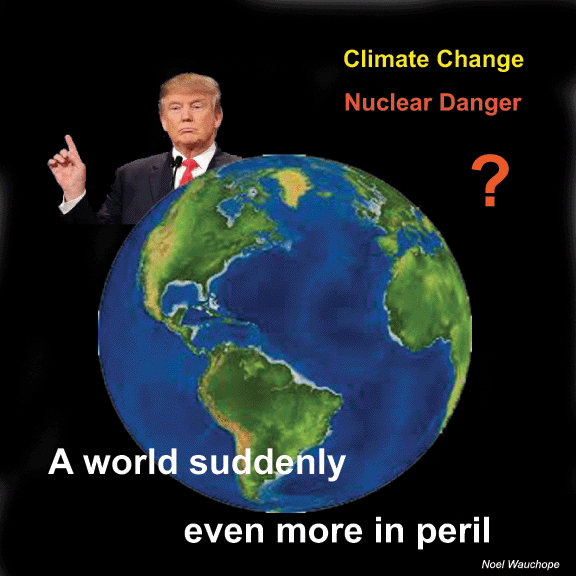 Trump’s nuclear policy is taking us back to the Cold War, WP The Trump administration has touted its new nuclear policy, released at the end of last week by the Pentagon, as a tough, realistic assessment of foreign threats and U.S. capabilities. The Nuclear Posture Review, the first to be conducted since 2010, purportedly describes “the world as it is, not as we wish it to be” — and calls for an expansion of America’s nuclear arsenal to confront the evolving capabilities of other nuclear powers.
If that is the administration’s view of the world, it is far from a consensus. A legion of critics blasted a potential nuclear buildup as dangerous, fiscally ruinous and redolent of outdated Cold War thinking. Some pointed out that a coterie of nuclear hawks helped draft the NPR, including one academic who argued in 1980 that the United States could defeat the Soviet Union in a nuclear war, while stomaching “approximately 20 million” casualties, “a level compatible with national survival and recovery.”
Rep. Mac Thornberry (R-Tex.), chairman of the House Armed Services Committee, echoed the administration’s recommendations to increase the stockpile of “low-yield” nuclear weapons — armaments that could still wipe out whole cities — and deploy a number of these warheads on submarine-launched intercontinental ballistic missiles as a sign of American intent. “The U.S. must recognize the reality of a return to great power competition and posture itself accordingly,” he wrote in an op-ed for Defense News.
President Trump also plugged the new approach during last week’s State of the Union address.
Though boosters of the administration’s nuclear agenda frame it as a continuation of long-standing American policy, it is a marked reversal from the strategy of Trump’s predecessor. “The previous administration’s policy hinged on what President Barack Obama called a moral obligation for the United States to lead by example in ridding the world of nuclear weapons,” wrote my colleague Paul Sonne. “Officials in the Trump administration and the U.S. military argue that Obama’s approach proved overly idealistic, particularly as relations with Moscow soured. Russia, China and North Korea, they say, all advanced their nuclear weapons capabilities instead of following suit.”
Skeptics of the Trump administration’s embrace of nuclear weapons argue that they won’t be able to credibly deter the sort of low-level aggression carried out by countries like Russia in Eastern Europe and North Korea in northeast Asia. The strategy seems to embrace the weapons more for their own sake than any utility they might provide.
“The document reads less like a strategy of how best to deter threats to the United States and its allies and more like a piece of advocacy for nuclear weapons — a self-conscious defense of their utility, affordability, and an effort to expand their mission. It is less a Pentagon policy document than a memo from a powerful lobby,” wrote Adam Mount, a senior fellow at the Federation of American Scientists. “Rather than working to reduce nuclear dangers, the nation’s nuclear policy now reflects the reasoning of U.S. adversaries and readily follows them into a more dangerous world.”
Joe Cirincione, president of the Ploughshares Fund, which pushes for global disarmament, warned that the new nuclear posture also gives Trump wider scope to order nuclear strikes. That’s something a majority of Americans don’t trust him with, according to a recent Washington Post poll.
“The authors spend pages arguing that the world has grown exponentially more dangerous due to the weakness of Trump’s predecessors,” Cirincione said in a recent op-ed. “They completely ignore the agreements that decreased Russian arsenals, rolled back and froze Iran’s nuclear program, and eliminated and secured tons of nuclear material from terrorists. The Nuclear Posture Review paints a world of terrifying ‘Great Power’ conflict.”
Ironically, an Obama-era nuclear agreement with Russia went into full effect Monday. It was aimed, like previous agreements forged by the Reagan and George W. Bush administrations, to defuse the possibility of just such a cataclysmic “Great Power” conflict. Under the terms of the New START treaty, as it’s known, both Russia and the United States are committed to deploying no more than 1,550 nuclear warheads. There’s a strict verification regime on both sides, and proponents of the pact say those inspections have built confidence in the otherwise severely strained U.S.-Russia relationship.
But there’s little indication that the Trump administration has much interest in extending the agreement beyond 2021, when it is set to expire. Critics say that’s a scary prospect. “Even in this environment, as long as Russia complies, extension is critical,” wrote John F. Kerry, the former secretary of state, who as a senator marshaled support for the treaty’s passage through Congress. “To let one of the last elements of constructive engagement expire with no follow-on process would ignore the hard-fought lessons of the Cold War. It would court nuclear competition that brings neither stability nor security.”
ndeed, experts warn that the climate of nuclear competition ushered in by Trump could risk a new global buildup of nuclear weapons that offers little strategic gain.
“Risking a new nuclear arms race, as is now likely and would be even more so should New START be allowed to expire without a replacement in hand, would divert American resources away from our conventional advantage, and bring us no additional security,” wrote Jon Wolfsthal, a nonresident fellow at Harvard University’s Belfer Center for Science and International Affairs and a former Obama administration official. “It would also repeat the great mistakes of the Cold War when we learned that arms races and nuclear wars cannot be won, and are better left unfought.” https://www.washingtonpost.com/news/worldviews/wp/2018/02/06/trumps-nuclear-policy-is-taking-us-back-to-the-cold-war/?utm_term=.4f13c0dbcc63
USA- Russia New START Treaty takes effect – with central limits on strategic arsenals for 7 years
The United States of America and the Russian Federation have implemented the Treaty on Measures for the Further Reduction and Limitation of Strategic Offensive Arms (New START Treaty) for seven years. February 5, 2018 marks the date that the Treaty’s central limits on each country’s strategic nuclear arsenal take effect.
The United States completed its reductions and achieved these limits in August 2017. The Russian Federation has repeatedly stated its commitment to the New START Treaty, including meeting the central limits, and we expect our upcoming data exchange under the Treaty to reaffirm that commitment.
Implementation of the New START Treaty enhances the safety and security of the United States and our allies and makes strategic relations between the United States and the Russian Federation more stable, transparent, and predictable; critically important at a time when trust in the relationship has deteriorated, and the threat of miscalculation and misperception has risen. The Treaty exemplifies an enduring commitment by both parties to cooperate on issues affecting the strategic relationship and international security. The United States looks forward to continuing implementation of the Treaty with the Russian Federation.
The United States and the Russian Federation will exchange data on their respective strategic nuclear arsenals within the next month, as we have done twice per year over the last seven years in accordance with the Treaty. Through the Treaty’s verification regime, which includes short-notice, on-site inspections at military bases and facilities, the United States is able to verify the data provided by the Russian Federation regarding its strategic nuclear arsenal. The verification regime provides both countries insight into each other’s strategic nuclear delivery systems, warheads, and facilities, as well as data exchanges to track the status and makeup of nuclear weapons systems.
The recently released U.S. Nuclear Posture Review notes that arms control can contribute to U.S. security by helping to manage strategic competition among states. The United States remains committed to arms control efforts that advance U.S., allied, and partner security. The United States will continue to fully implement the New START Treaty and remains committed to working with others, including the Russian Federation, to create the conditions to support the ultimate goal of the global elimination of nuclear weapons. The New START Treaty remains a critical component for supporting global non-proliferation efforts and strategic stability between the United States and the Russian Federation. Through implementing the New START Treaty, the United States continues to demonstrate its commitment to fulfilling its arms control obligations, including under the Treaty on the Non-Proliferation of Nuclear Weapons.
American companies’plans to market nuclear technology to India have come to nothing
 The Hindu 3rd Feb 2018, Watching the Republic Day parade, where 10 ASEAN leaders were chief guests,
it was easy to miss the fact that the dates of their visit also marked the
anniversary of another big visit three years ago: the visit by then U.S.
President Barack Obama, when he announced a “breakthrough” in the
India-U.S. civil nuclear deal, to finally pave the way for a commercial
contract.
“The deal is done,” Sujatha Singh, who was Foreign Secretary
at the time, said as the government issued papers and held briefings
describing the nature of the agreement between India and the U.S. on
supplier liability and tracking requirements, which would enable American
companies to build nuclear power reactors in India.
Today, nearly a decade since the memoranda of understanding were inked, and three years after the
last wrinkles were ironed out, there is no sign yet of any concrete
contract between an American company and the Indian authorities to build a
reactor.
In 2009, both GE-Hitachi and Toshiba-Westinghouse had begun talks
on techno-commercial agreements for six reactors each in India. These
commercial contracts were to be the start of the ‘payoff’ for the U.S.
that had considerably shifted its stand on non-proliferation to give India
the waivers needed, and they were to herald India’s arrival on the global
nuclear power stage in return.
Instead, GE-Hitachi’s plans were shelved after it rejected the Obama-Modi agreement in January 2015, saying GE would
not accept the compromise formula on supplier liability. (While others have
indicated they would accept the liability offer, none of them has put that
on paper.) Toshiba-Westinghouse then carried the baton to actualise the
India-U.S. civil nuclear deal, but ran into a different storm as both
Toshiba and Westinghouse had major financial troubles last year. After a
near-bankruptcy, Toshiba jettisoned Westinghouse for just $4.6 billion to a
Canadian consortium, a deal that is now expected to be cleared by the end
of 2018.
http://www.thehindu.com/opinion/lead/forging-a-new-nuclear-deal/article22637628.ece
China wants USA to drop its “Cold War mentality
The US military believes its nuclear weapons are seen as too big to be used and wants to develop low-yield bombs.
Russia has already condemned the plan.
Iran’s foreign minister claimed it brought the world “closer to annihilation”……….
China said on Sunday it “firmly” opposed the Pentagon’s review of US nuclear policy.
The defence ministry in Beijing said Washington had played up the threat of China’s nuclear threat, adding that its own policy was defensive in nature.
“We hope that the United States will abandon its Cold War mentality, earnestly assume its special disarmament responsibilities, correctly understand China’s strategic intentions and objectively view China’s national defence and military build-up,” its statement said. …..http://www.bbc.com/news/world-asia-42935758
Donald Trump’s hostility to the 2015 nuclear deal is dampening foreign investment in Iran
Iran says Trump’s hostility to nuclear deal scares investors, http://abcnews.go.com/International/wireStory/iran-trumps-hostility-nuclear-deal-scares-investors-52826053
Iran says President Donald Trump’s hostility to the 2015 nuclear deal is dampening foreign investment in the energy sector despite the lifting of sanctions.
Oil Minister Bijan Zanganeh told reporters on Sunday that the uncertainty over the future of the agreement, which Trump has repeatedly threatened to scrap, is scaring off potential investors.
Trump re-certified the deal in January but said he would not do the same in May unless it is fixed.
Iran hopes to attract more than $150 billion to rebuild its energy industry after years of sanctions. Last year it signed a $5 billion gas deal with France’s Total SA and a Chinese oil company to develop a massive offshore gas field.
Top U.S. nuke envoy says Washington wants talks with N.K. for denuclearization
http://english.yonhapnews.co.kr/northkorea/2018/02/02/0401000000AEN20180202008700315.html SEOUL, Feb. 2 (Yonhap) — The top U.S. nuclear envoy said Friday that Washington wants to open dialogue with North Korea for its denuclearization.
After meeting with South Korean Vice Unification Minister Chun Hae-sung in Seoul, Joseph Yun also told reporters that he sees the resumed inter-Korean talks and easing tensions after the North’s decision to join the upcoming Winter Olympics as a “good opportunity” for denuclearization efforts.
“We want to open dialogue with North Korea, we want to have a credible dialogue, a dialogue that could lead steps towards denuclearization,” he said. “That is our goal and of course President Moon has also emphasized that goal too.”
Britain’s new nuclear build – a profitable “golden era” for China’s State-owned nuclear companies
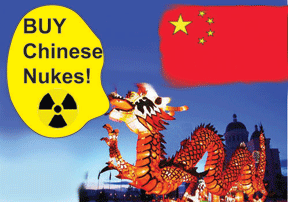 Xinhuanet 1st Feb 2018, China General Nuclear Power Corporation (CGN), a major Chinese nuclear
power operator, said Wednesday that nuclear projects in Britain were
proceeding well. He Yu, chairman of the board of CGN, said since the deals
were inked in 2016 with French energy company EDF and the British
government, CGN has invested 1.7 billion British pounds in order to advance
the projects. CGN signed agreements in 2016 for Hinkley Point C (HPC), a
nuclear project in Somerset, and a suite of agreements relating to the
Sizewell C (SZC) in eastern England and Bradwell B projects (BRB) in Essex.
“A total of 15 Chinese suppliers and contractors have passed a preliminary
qualification assessment for the HPC project,” He said. “HPC, which is
Britain’s first new nuclear power station in a generation, is the largest
construction in Europe.”
http://www.xinhuanet.com/english/2018-02/01/c_136940068.htm
Reuters 31st Jan 2018, Notable Chinese investments in Britain include the Hinkley C nuclear power
station which is being built by China General Nuclear Power Corp and the
British arm of France’s EDF (EDF.PA), while British firms, such as Rolls
Royce (RR.L), have won large deals from Chinese firms to supply items like
plane engines. Both May and senior Chinese officials have restated their
commitment to the “golden era” in ties but a row over May’s decision
to delay approval for the Chinese-funded Hinkley nuclear plant in late 2016
chilled relations. However, Britain was the first Western country to sign
up to the China-backed Asian Infrastructure Investment Bank and it sent
Finance Minister Philip Hammond to a Beijing summit last year about
President Xi Jinping’s flagship ‘Belt and Road Initiative’ – a
trillion-dollar infrastructure-led push to build a modern Silk Road.
https://www.reuters.com/article/us-china-britain/chinas-li-says-ties-with-britain-to-stay-unchanged-through-brexit-idUSKBN1FK023
-
Archives
- May 2026 (62)
- April 2026 (356)
- March 2026 (251)
- February 2026 (268)
- January 2026 (308)
- December 2025 (358)
- November 2025 (359)
- October 2025 (376)
- September 2025 (257)
- August 2025 (319)
- July 2025 (230)
- June 2025 (348)
-
Categories
- 1
- 1 NUCLEAR ISSUES
- business and costs
- climate change
- culture and arts
- ENERGY
- environment
- health
- history
- indigenous issues
- Legal
- marketing of nuclear
- media
- opposition to nuclear
- PERSONAL STORIES
- politics
- politics international
- Religion and ethics
- safety
- secrets,lies and civil liberties
- spinbuster
- technology
- Uranium
- wastes
- weapons and war
- Women
- 2 WORLD
- ACTION
- AFRICA
- Atrocities
- AUSTRALIA
- Christina's notes
- Christina's themes
- culture and arts
- Events
- Fuk 2022
- Fuk 2023
- Fukushima 2017
- Fukushima 2018
- fukushima 2019
- Fukushima 2020
- Fukushima 2021
- general
- global warming
- Humour (God we need it)
- Nuclear
- RARE EARTHS
- Reference
- resources – print
- Resources -audiovicual
- Weekly Newsletter
- World
- World Nuclear
- YouTube
-
RSS
Entries RSS
Comments RSS
 nuclear-news