Disarmament over destruction: A renewed push for a world without nuclear weapons
United Nations, By Sachin Gaur, 25 September 2025
In the final days of the Second World War, as the idea of the United Nations was beginning to take shape, the atomic bombings of two Japanese cities sent a chilling warning to the world, of the terrifying destructive power of nuclear weapons. Eight decades later, amidst rising geopolitical tensions and ongoing conflicts, the threat from nuclear arms is escalating.
Highest threat level for decades
In his message for the ‘International Day for the Total Elimination of Nuclear Weapons’, observed annually on September 26, UN Secretary-General Antonio Guterres reminds the world that “nuclear weapons deliver no security – only the promise of annihilation.”
Nuclear disarmament has remained a top priority for the UN since its inception. In fact, the very first resolution adopted by the UN General Assembly in 1946 focused on nuclear disarmament.
In the decades that followed, the UN continued to lead diplomatic efforts in this direction. In 1959, the General Assembly formally supported the goal of general and complete disarmament. In 1978, the first Special Session of the General Assembly on Disarmament declared nuclear disarmament to be the highest priority.
Every UN Secretary-General has actively pursued this goal. The current incumbent, António Guterres, has repeatedly warned in recent years that “geopolitical tensions and mistrust have escalated the risk of nuclear warfare to its highest levels in decades.”
“These weapons are growing in power, range, and stealth. An accidental launch is one mistake, one miscalculation, one rash act away,” he told the Security Council last year
What’s at stake
Although nuclear weapons have only been deployed twice, their shadow still hangs over humanity. Over 12,000 nuclear warheads still exist today. Their destructive potential threatens entire cities, millions of lives, the environment, and future generations.
More than 50 per cent of the world’s population lives in countries that either possess nuclear weapons or are part of nuclear alliances. Deep concerns surrounding the possible use of these weapons have intensified due to conflicts, including the war in Ukraine.
Many nuclear-armed countries are also planning to modernise their arsenals. The integration of emerging technologies, such as artificial intelligence, raises the possibility of misjudgements and misunderstandings, making the risks even more complex and unpredictable.
A renewed nuclear arms race?
A range of multilateral treaties and initiatives have been established to curb, regulate, or eliminate nuclear weapons over the decades, helping – to some extent – to put the brakes on proliferation and advanced disarmament.
However, rising global instability and violent conflicts are placing increasing pressure on these mechanisms. The weakening of such frameworks risks sparking a renewed nuclear arms race.
In 2019, the United States announced its withdrawal from the Intermediate-Range Nuclear Forces Treaty, which targeted the elimination of a specific class of nuclear missiles and, in 2022, a major review conference failed to reach consensus on the Nuclear Proliferation Treaty.
The following year, Russia withdrew its ratification of the Comprehensive Nuclear Test-Ban Treaty (CTBT) and suspended its participation in the ‘New START’ Treaty on measures for the reduction and limitation of Strategic Offensive Arms
These developments have led to growing frustration over the slow pace of disarmament and increasing concern about the catastrophic potential of even a single nuclear detonation: since the end of the Cold War, while the number of deployed nuclear weapons has decreased, not a single nuclear warhead has been eliminated as a result of any treaty. Nor are there any active negotiations currently aimed at nuclear disarmament………………………….. https://news.un.org/en/story/2025/09/1165949
Two leaders, two realities: Trump vs Albanese at the UN.


26 September 2025 Roswell , https://theaimn.net/two-leaders-two-realities-trump-vs-albanese-at-the-un/
President Trump has spoken at the United Nations, and now Prime Minister Anthony Albanese has too.
The contrast could not have been starker. Trump rambled like a man who’d just been handed the microphone at a small-town karaoke night – except the song was foreign policy and he didn’t know the words. He wandered through half-baked grievances, boasted about imaginary achievements, and at one point seemed to forget which country he was president of.
Albanese, meanwhile, spoke like an actual world leader – calm, confident, and passionate. He talked about climate action, regional security, and cooperation with the kind of clarity that makes you think, “Ah yes, this person knows what he’s talking about.”
And yet, if you relied on Australia’s right-wing media, you’d think you’d just watched two completely different events. To them, Trump was basically Moses parting the Red Sea with one hand while balancing the U.S. economy on the other. Albanese, apparently “reckless,” was a bumbling tourist who accidentally stumbled into the General Assembly and asked for directions to Times Square.
One commentator even claimed Trump was “extraordinary” – which is technically true if you count all the diplomats burying their heads in their hands. Meanwhile, Albanese’s calm and measured speech was branded “utterly humiliating” and dismissed as nothing but “symbolic gestures,” because apparently international diplomacy should be performed like a WWE entrance.
This is the theatre we live with now: policy and substance don’t make headlines, but a man ranting about wind turbines does. If Trump had started selling selfies from the UN podium, they’d have called it “bold economic diplomacy.”
The world saw two very different leaders this week – one looking like he could chair a serious discussion about global challenges, the other looking like he should be gently escorted back to his seat before he accidentally sanctioned Canada.
World leaders urged to prevent nuclear war, end the nuclear arms race and achieve global nuclear abolition
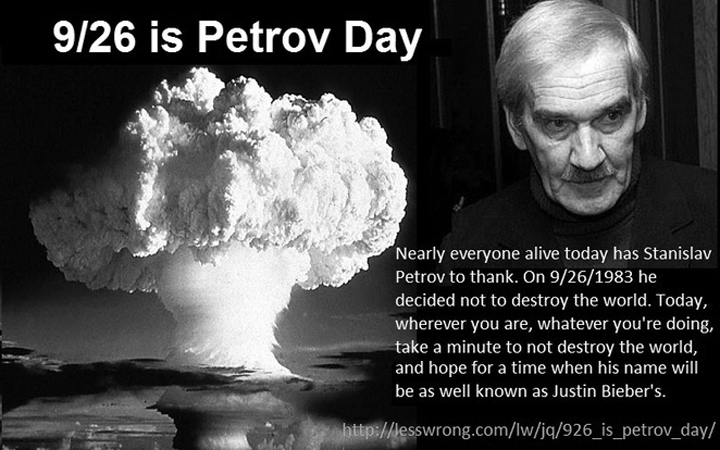
September 26 is a significant date. On this day in 1983 a nuclear war was narrowly averted when Colonel Stanislav Petrov, Duty Officer at a Russian nuclear early warning facility, broke protocol by not affirming to senior command an apparent incoming ballistic missile attack from the United States (later confirmed as a false alarm).
UNFOLD ZERO, New York, September 26, 2025
World leaders, meeting at a UN High Level Meeting to commemorate the International Day for the Total Elimination of Nuclear Weapons today, are being called to stand down nuclear forces, end the costly nuclear arms race and commit to achieving the global elimination of nuclear weapons no later than 2045, the 100th anniversary of the United Nations.
The call comes in in a Joint Appeal for Nuclear Abolition Day September 26 from over 500 civil society organizations representing peace, disarmament, human rights, environment, business, religious, youth, development and academic communities from around the world. It is endorsed by an additional 1000+ individuals, including parliamentarians, local body representatives, religious leaders, Nobel Laureates, former diplomats, academics/scientists, medical professionals, youth leaders and regular members of civil society (see below for a small sample list of endorsers).
The Appeal, which is organized by NuclearAbolitionDay.org, highlights that the risk of nuclear war by accident, miscalculation, crisis escalation, or malicious intent, is higher now than ever – with the Doomsday Clock ticking closer to midnight. The use of nuclear weapons by any of the nine nuclear-armed States or their nuclear allies would have catastrophic human, economic, and environmental consequences.
“Nuclear weapons are a hazard for all of humanity and therefore should be dismantled and abolished altogether from the face of our earth our planet our home,” says Ela Gandhi (South Africa), Chairperson of Gandhi Development Trust, Honorary Co-President of Religions for Peace and Granddaughter of Mahatma Gandhi.
“On September 26, we face the fact that proliferation of nuclear arms fits the definition of insanity,” says Senator Marilou McPhedran (Canada), Member of Parliamentarians for Nuclear Non-proliferation and Disarmament.
The Appeal attests that the threat and use of nuclear weapons is generally illegal, and that States currently relying on nuclear weapons for their security have an obligation to replace these policies with approaches based on international law and common security, as outlined in the UN Charter.
“The 1996 International Court of Justice Advisory Opinion held that there exists an obligation to pursue in good faith and bring to a conclusion, negotiations leading to nuclear disarmament in all its aspects under strict and effective international control,” says Dr. Deepshikha Kumari Vijh (USA),Executive Director of the Lawyers Committee on Nuclear Policy, who will present the appeal to the High-Level Meeting this afternoon. “Nuclear Weapon States are urged to meet this obligation.”
“The lack of engagement and good faith actions by UN Member States on nuclear disarmament is not just disappointing – it’s a dangerous failure,” says Chris Guillot, co-founder of AwareNearth. “We must shift our mindset on nuclear risk now, for the sake of future generations.”
“Let us all build friendship and peace among nations, abolish genocidal nuclear weapons and give hope to Humanity” says Mairead Corrigan Maguirre (Ireland), Nobel Peace Laureate 1976.
September 26 is a significant date. On this day in 1983 a nuclear war was narrowly averted when Colonel Stanislav Petrov, Duty Officer at a Russian nuclear early warning facility, broke protocol by not affirming to senior command an apparent incoming ballistic missile attack from the United States (later confirmed as a false alarm). “If a similar situation of incorrect information about a potential nuclear attack were to arise today, either in the Russian nuclear command and control system or in the US one, it’s doubtful, in the current geopolitical context of explicit nuclear threats, that a latter-day equivalent to Colonel Petrov would be there,” says John Hallam (Australia), Steering Committee Member for NoFirstUse Global. “The consequences for everyone and everything would then be catastrophic.”…………………………………………………………………………………………………………. https://www.unfoldzero.org/world-leaders-urged-to-prevent-nuclear-war-end-the-nuclear-arms-race-and-achieve-global-nuclear-abolition/
US-UK deal nuclear signed to speed up reactor approval, as companies announce cross-border partnerships
SIR KEIR STARMER and Donald Trump have signed a bilateral agreement to
advance nuclear technology, alongside a series of commercial partnerships
between US and UK companies. The Atlantic Partnership for Advanced Nuclear
Energy, signed between the two leaders during the US president’s second
state visit to the UK, aims to speed up regulatory approval in both
countries for nuclear power projects by allowing assessment results to be
shared.
The deal is focused on next generation nuclear technology as well
as small modular reactors (SMRs). The deal has been welcomed by industry
and is viewed as a step toward deeper transatlantic collaboration on
nuclear development between the US and UK.
The bilateral agreement allows
regulatory tests approved in one country to support reactor assessments in
the other. The UK government expects the agreement to cut the time required
to secure a nuclear project licence from three to four years down to two.
Chemical Engineer 25rg Sept 2025, https://www.thechemicalengineer.com/news/us-uk-deal-nuclear-signed-to-speed-up-reactor-approval-as-companies-announce-cross-border-partnerships/
50 States One Israel – Wikipedia
26 Sept 25 https://en.wikipedia.org/wiki/50_States_One_Israel
50 States One Israel was a conference held in Israel from September 14, 2025 to September 18, 2025[1] for state legislators from the United States and members of the Israeli government.[2][3] Hosted by the Israeli Foreign Ministry, the conference was described as the largest delegation of elected officials to visit Israel.[2] According to Lior Haiat, Deputy Director for North America at the Foreign Ministry, lawmakers including state legislators from all 50 states were in attendance.[2]
Background
………………………….. The conference, including travel, is paid entirely by the Israeli government.[4]
According to a July 8, 2025 letter to Oregon Representative David Gomberg sent by Israel’s consulate-general to the Northwest, The Ministry of Foreign Affairs will provide “roundtrip economy airfare from New York to Tel Aviv (including domestic U.S. flights to NYC),” and “all in-country transportation, accommodations, meals, and guided programming.”[1] Five lawmakers from every state were expected to attend.[5
……………… On September 15, 2025, attendees visited the Western Wall and the Church of the Holy Sepulchre.[6] Later, Foreign Minister Gideon Sa’ar urged American lawmakers to pass anti-BDS laws in their states.[7] In the evening, Prime Minister of Israel Benjamin Netanyahu gave a welcome address to the delegation.[8][9] ……………………..
On September 17, 2025, President of Israel Isaac Herzog addressed the delegation, saying that Israel’s “ironclad bond with the United States of America [exists] because we drink from the same fountain: the values of the Bible”.[11]………………….
Attendees…………incomplete list of 105 lawmakers named here
Impact
In the period following the conference, several participants faced criticism from constituents, the general public, and family. The daughter of New Mexico State Senator Jay Block took to social media platforms to register her disgust with her father’s participation in the conference, stating “It seems like he sold his soul to the devil and is now just peddling lies and propaganda… I just genuinely hope that this will be the end of my dad’s political career…”[61] Leading up to a potential government shutdown, Republican House Speaker Matt Hall of Michigan had instructed the Republican caucus not to leave the state while the budget was not completed and removed all bills from Representative Jaime Greene’s committee for her absence in attending the event.[62]
References.…………………………………………………
Russia, Iran sign nuclear power plants deal as sanctions loom
Agreement between Rosatom and Iran targets energy expansion with eight new nuclear plants planned by 2040.
By Usaid Siddiqui and Reuters, 24 Sep 2025, https://www.aljazeera.com/news/2025/9/24/russia-iran-sign-nuclear-power-plants-deal-as-sanctions-loom
Russia and Iran have signed a memorandum of understanding on the construction of small nuclear power plants in Iran, according the Russian state nuclear corporation Rosatom, as Tehran has been engaged in a diplomatic push to avert new sanctions over its nuclear programme.
The agreement was signed by Rosatom chief Alexei Likhachev and Iran’s top nuclear official, Mohammad Eslami, on Wednesday at a meeting in Moscow. Rosatom described it as a “strategic project”.
Eslami, who is also Iran’s vice president, told Iranian state media earlier this week that the plan was to construct eight nuclear power plants as Tehran seeks to reach 20GW of nuclear energy capacity by 2040.
Iran, which suffers from electricity shortages during high-demand months, has only one operating nuclear power plant, in the southern city of Bushehr. It was built by Russia and has a capacity of approximately 1GW.
The development comes amid looming sanctions on Iran, after the United Nations Security Council voted on Friday not to permanently lift economic sanctions on Iran over its nuclear programme, meaning sanctions will return by September 28 if no significant deal is reached beforehand.
Russia was among four nations that voted to stop the sanctions from being reintroduced.
Iran pushed back against the UNSC vote, saying the resumption of sanctions would “effectively suspend” the country’s cooperation with the International Atomic Energy Agency (IAEA), the UN watchdog.
The vote followed a 30-day process launched in late August by the United Kingdom, France and Germany – known as the E3 – to reinstate sanctions unless Tehran meets their demands.
The E3 have accused Tehran of breaching its nuclear commitments, including by building up a uranium stockpile of more than 40 times the level permitted under a 2015 nuclear deal, from which Trump unilaterally withdrew in 2018, during his first term. The deal allowed Iran to enrich uranium up to 3.67 percent purity.
In its defence, Iran says it boosted its nuclear enrichment only after Trump withdrew from the deal and reimposed sanctions on the country. Tehran deems the US action a violation of the 2015 deal.
Iranian officials have accused the European trio of abusing the dispute mechanism contained in the 2015 Treaty on the Non-Proliferation of Nuclear Weapons (NPT), which allows for the application of sanctions under a “snapback mechanism”.
New sanctions would result in freezing of Iranian assets abroad, a halt in arms deals with Tehran, and penalise the development of ballistic missile programme, among other measures.
Iran has repeatedly denied pursuing nuclear weapons but affirmed its right to peacefully pursue nuclear energy. Addressing the United Nations General Assembly on Wednesday, Iran’s President Masoud Pezeshkian said Tehran would never seek a nuclear bomb.
On Tuesday, Iran’s Supreme Leader Ayatollah Ali Khamenei said Tehran will not directly negotiate with the United States over Iran’s nuclear programme, calling talks with the US “a sheer dead end”.
Tensions escalated this June, when Israel launched a 12-day war on Iran, with Israeli and US forces striking several nuclear facilities.
Britain recognises Palestine. Now what?
| Declassified, UK 25 Sept 25 This week, UK prime minister Keir Starmer announced that Britain has officially recognised the state of Palestine. The Labour government had previously said it would only use the threat of recognition to pressure Israel to agree to a ceasefire and allow aid into Gaza .This clearly didn’t work and, amid mounting public pressue, the UK joined the Canadian, Australian, and Portuguese governments in recognising Palestine based on 1967 borders. Foreign Office maps have now been updated to include Gaza and the West Bank as “Palestine” rather than the “Occupied Palestinian Territories”. Benjamin Netanyahu responded to the move with fury, vowing that a Palestinian state “will not happen” and claiming the move “endangers our existence and constitutes an absurd reward for terrorism”. The Israeli prime minister found sympathy in British circles, with Nigel Farage sending his condolences and Tory party leader Kemi Badenoch calling the move “absolutely disastrous”. But what does recognition actually mean? For starters, it will not mean that Palestinians have the right to defend themselves from Israel – a right that is apparently exclusively available to the Israelis. “Our position is clear”, wrote Starmer in Israeli media outlet Ynet. “The Palestinian state must be demilitarised. It will have no army or air force”. Israel will thus continue to control the land, sea, and air borders around Palestine, signifiying no meaningful change in the current status quo. The Palestinians will also be deprived of their right to self-determination, with Starmer stressing that “Hamas can have no future” in Palestine, including “no role in government” or security. So what is Britain actually recognising? As Ilan Pappé recently wrote in Declassified, “geographically recognising [Palestine in its current state] is tantamount to recognising a disempowered political entity stretching over less than 20 percent of the West Bank”. There are currently more than 800,000 Jewish settlers in the West Bank, with more settlements being approved by the Israeli government and extremist ministers pushing for annexation of the area. Gaza, meanwhile, has been razed to the ground. In these circumstances, Britain’s recognition of Palestine looks more like empty gesture politics than a statement of intent to change the material reality on the ground. Indeed, it is difficult to take Starmer seriously when the UK continues to arm Israel and send spy flights over Gaza, while refusing to impose a trade ban on products from illegal settlements. Rather than helping to bring a new Palestinian reality into being, then, Starmer appears to be recognising a cadaver that the UK government had a hand in killing. |
Iran, U.S. signal possible easing in nuclear tensions

By Parisa Hafezi and John Irish, September 25, 2025 https://www.reuters.com/world/middle-east/irans-president-tells-un-tehran-will-never-seek-build-nuclear-bomb-2025-09-24/
- Summary
- Iran president speaking at U.N. General Assembly
- Gaps remain between Iran and E3 as deadline looms
- European powers offering delay if Iran makes concessions
UNITED NATIONS, Sept 24 (Reuters) – Tehran and Washington signalled a possible softening in nuclear tensions on Wednesday, with Iran insisting it has no ambitions to build nuclear weapons and the U.S. expressing readiness to resume talks aimed at resolving the long-standing standoff.
A few hours after Iranian President Masoud Pezeshkian told the U.N. General Assembly that Iran will never seek to build a nuclear bomb, U.S. President Donald Trump’s Middle East Envoy Steve Witkoff said “we have no desire to hurt them”.
“We’re talking to them. And why wouldn’t we? We talk to everybody. As well we should. That’s the job. Our job is to solve things,” he told the Concordia summit in New York.
Prior to a 12-day war between Iran and Israel in June, Tehran and Washington held five rounds of nuclear talks but faced major stumbling blocks such as uranium enrichment on Iranian soil, which Western powers want to bring down to zero to minimise any risk of weaponisation.
Tehran accuses Washington of “betraying diplomacy” and the nuclear talks have stopped since the war.
One Iranian insider told Reuters that “several messages have been conveyed to Washington for resumption of talks via mediators in the past weeks, but Americans have not responded”.
On Tuesday, Iran’s Supreme Leader Ayatollah Ali Khamenei, who has the last say on key state matters such as foreign policy and Iran’s nuclear programme, ruled out negotiations with the United States under threat.
The United States, its European allies and Israel accuse Tehran of using its nuclear programme as a veil for efforts to try to develop the capability to produce weapons. Iran says its nuclear programme is for peaceful purposes only.
‘A FEW HOURS LEFT’
Britain, France and Germany on August 28 launched a 30-day process to reimpose U.N. sanctions – known as snapback – that ends on September 27, accusing Tehran of failing to abide by a 2015 deal with world powers aimed at preventing it from developing a nuclear weapon.
The European powers have offered to delay reinstating sanctions for up to six months to allow space for talks on a long-term deal if Iran restores access for U.N. nuclear inspectors, addresses concerns about its stock of enriched uranium, and engages in talks with the United States.
“I think we have a desire, however, to either realize a permanent solution and negotiate around snapbacks, and if we can’t, then snapbacks will be what they are. They’re the right medicine for what’s happening,” Witkoff said.
But amid the looming threat of sanctions and last-ditch talks between Tehran and European powers to reach a deal to avert snapback of sanctions, diplomats have warned the chances of success remain slim.
After meeting his Iranian counterpart on the sidelines of the UN General Assembly, French President Emmanuel Macron said Iran still had a chance to prevent reimposition of international sanctions, adding that Tehran had not offered anything tangible.
“An agreement is still possible. There are only a few hours left. It is up to Iran to meet the legitimate conditions we have set,” Macron posted on X.
Two European diplomats told Reuters that Iran, the E3 and the EU held a fresh round of talks on Wednesday.
DEADLINE ON SATURDAY
If Tehran and the E3 fail to reach a deal on an extension by the end of September 27, then all U.N. sanctions will be reimposed on Iran, where the economy already struggles with crippling sanctions reimposed since 2018 after Trump ditched the pact during his first term.
The so-called snapback process would reimpose an arms embargo, a ban on uranium enrichment and reprocessing, a ban on activities with ballistic missiles capable of delivering nuclear weapons, a global asset freeze and travel bans on Iranian individuals and entities.
Writing by Parisa Hafezi, Editing by Michelle Nichols, Hugh Lawson, Alison Wiliams and Daniel Wallis
Russia willing to extend New Start nuclear treaty – Putin
22 Sept 25, https://www.rt.com/russia/625057-putin-start-treaty-initiative/
The president stressed that allowing the deal to expire would be a big mistake.
Russia is prepared to continue abiding by the New START treaty on nuclear arms for one year even after it expires next February, Russian President Vladimir Putin has said.
Speaking at a meeting with the permanent members of Russia’s Security Council on Monday, Putin said that due to the hostile and destructive steps taken by the West in recent years, the foundations of constructive relations and cooperation between nuclear-armed states have been significantly undermined.
“Step by step, the system of Soviet-American and Russian-American agreements on nuclear missile and strategic defensive arms control was almost completely dismantled,” Putin said. He stressed that the systems of agreements between Russia and the US, who possess the two largest nuclear arsenals in the world, long served as a stabilizing factor and contributed to global stability and international security.
Putin noted that the New START treaty, signed in 2010 by Russia and the US, is the last remaining bilateral agreement limiting nuclear weapons. He warned that allowing it to expire and abandoning its legacy would be “a mistaken and short-sighted step, which, in our view, would also negatively impact the goals of the Nuclear Non-Proliferation Treaty.”
The president announced that in order to avoid provoking a strategic arms race and ensuring an “acceptable level of predictability and restraint,” Russia is prepared to continue adhering to the central limitations of the New START Treaty for one year after February 5, 2026.
“Based on our analysis of the situation, we will subsequently make a decision on maintaining these voluntary self-restraints,” he added.
At the same time, Putin stressed that Moscow would implement this measure only if the US “follows suit and does not take steps that undermine or disrupt the existing balance of deterrence potential.”
The president ordered Russia’s relevant agencies to continue closely monitoring US activities in regard to strategic offensive arms arsenals and any plans to expand the strategic components of the US missile defense system. If it is deemed that Washington is taking actions that undermine Moscow’s efforts to maintain the status quo on strategic offensive arms, Russia will “respond accordingly,” Putin said.
The recognition of Palestine: what it does, what it doesn’t do, and why now
rather than respond to the pleas of the public with material sanctions against Israel, European and Western states have largely opted to adopt this symbolic recognition and pro forma support for a two-state solution. Meanwhile, on the ground, Israel continues to engage in annexation measures that are meant to render these recognitions meaningless.
The recognition of Palestine as a state is more of a symbolic gesture than a meaningful act, like imposing sanctions on Israel would be. Still, it shows that even Israel’s allies have been forced to take action as Israel’s genocide in Gaza deepens.
By Qassam Muaddi September 22, 2025, https://mondoweiss.net/2025/09/the-recognition-of-palestine-what-it-does-what-it-doesnt-do-and-why-now/
The United Kingdom, Canada, Portugal, and Australia officially recognized the State of Palestine in a series of separate but coordinated statements on Sunday, September 21. Other European and Western nations, including France, Belgium, New Zealand, and several other key allies of Israel, are expected to join the chorus of recognitions at today’s UN General Assembly meeting in New York. The summit is based on a joint Saudi-French initiative to revive a two-state solution called “the New York Declaration,” which was first issued at a conference on September 12. The conference was boycotted by the U.S, which opposed the summit.
In Sunday’s initial announcements of recognition, UK Prime Minister Keir Starmer said that “we are acting to keep alive the possibility of peace and a two-state solution,” adding that the ongoing Israeli bombardment campaign in Gaza, as well as its starvation of the Palestinian population, were “utterly intolerable.” Starmer also decried Israel’s acceleration of settlement building in the West Bank, which he said has caused the “fading” of hope in the two-state solution.In light of the wave of announcements, Israeli Prime Minister Benjamin Netanyahu said that Israel’s response would come after he meets with U.S. President Trump on September 27, adding that he has “worked for years to prevent the establishment of this state of terror in the face of enormous internal and external pressure.”
The Israeli PM said that he has “doubled Jewish settlement in the West Bank,” vowing to continue, while condemning all nations recognizing a Palestinian state after October 7 as “rewarding terrorism.”
Meanwhile, the United States derided the countries that declared their recognition of Palestine as engaging in “performative gestures.”
“Our priorities are clear,” a state department official told AFP on Sunday. “The release of the hostages, the security of Israel, and peace and prosperity for the entire region that is only possible free from Hamas.”
The recognition comes as Israel ramps up its annihilation campaign in Gaza City, which has resulted in the leveling of broad swathes of the ancient city’s eastern neighborhoods as the army sends in decommissioned armored personnel carriers rigged with explosives to destroy entire residential blocks.
Israel is also openly discussing plans for the annexation of the West Bank. One such plan, presented earlier in September by far-right Finance Minister Bezalel Smotrich, would see the annexation of 82% of the West Bank, including Bethlehem. This annexation plan would leave Palestinians with nothing but six isolated enclaves that make up less than 18% of the West Bank.
Israel has also accelerated the approval of the building of ambitious settlement projects, which aim to split the West Bank in two and “bury” the prospects of a Palestinian state, as articulated by Smotrich in mid-August.
What the recognition does
What the recognition does
The recognition is a political act, and it has political implications.
Primarily, it opens the way for higher levels of diplomatic relations between Palestine and other countries that now recognize the occupied Palestinian territories as a part of Palestine’s national soil. This politically highlights the already-established illegality of Israel’s settlements in these territories.
Finally, the recognition of a Palestinian state preemptively regards Israel’s planned annexation of the West Bank as illegitimate.
What it doesn’t do
However, this recognition does not imply any additional legal obligations on the part of the recognizing states to take action to ensure the establishment of the Palestinian state or to end the occupation of its territories. Those obligations were already enshrined in the Geneva Conventions, which define the obligations of states that are signatories to them in cases of occupation.
One of those legal obligations is for states to refrain from engaging in any action that aids the annexation of occupied territory. Yet these same countries have been dealing commercially with the Israeli state’s settlement economy for years, despite their existing obligations.
Moreover, the aforementioned countries are members of the International Criminal Court (ICC), which has issued arrest warrants against Netanyahu and his former Defense Minister, Yoav Gallant. These states are under the obligation to aid in their arrest, whether they recognize Palestine as a state or not.
Why now?
The worldwide Palestine solidarity movement has continued to expand in the same countries that have recently recognized Palestine, reflecting a marked shift in public opinion, driven largely by Israel’s increasingly graphic and devastating genocidal assault on Gaza. Politically, it has become untenable for many Western governments to remain passive, and the pressure to signal a position that diverges from their long-standing unconditional support for Israel has become impossible to ignore.
But rather than respond to the pleas of the public with material sanctions against Israel, European and Western states have largely opted to adopt this symbolic recognition and pro forma support for a two-state solution. Meanwhile, on the ground, Israel continues to engage in annexation measures that are meant to render these recognitions meaningless.
How will Israel respond?
The immediate changes on the ground are expected to come through Israel’s response to the wave of recognitions. Palestinians now brace for intensified crackdowns, including more arrests, raids, checkpoints, and further restrictions on movement.
Yet the most anticipated Israeli step is the formal annexation of parts of the West Bank, most likely the Jordan Valley and the larger settlements, such as Maale Adumim east of Jerusalem. Such a move would bring about new layers of restrictions on Palestinians’ daily lives.
The official annexation of any part of the West Bank would likely impose new draconian restrictions on Palestinians seeking to move in and out of the annexed areas. Instead of simply being cut off from other Palestinian localities through a network of checkpoints and iron gates that are opened and closed by the Israeli army at will, they might soon be required to apply for special entry permits to move throughout the West Bank, as is currently the case for Palestinians wishing to visit Jerusalem.
Palestinians might also become subject to more intense restrictions on their freedom to build homes, access services, and work, intensifying the engineered hardship meant to push them to leave their homes altogether.
More rural communities, and possibly entire towns, could be forcibly expelled by settlers or demolished by the Israeli army.
These are scenarios Palestinians have already lived for years in areas effectively annexed — whether officially, as in East Jerusalem, or de facto, as across much of Area C. But Israel could depart from this pattern, as it has in Gaza, and push annexation to new levels, seizing as much land as possible with as few Palestinians as possible. “Maximum land, minimum Arabs,” as the old Zionist adage has it, most recently repeated by Smotrich.
Still, if any of these scenarios materialize, they will not be the direct outcome of Palestine’s recognition as a state, but rather of Western governments reducing that recognition to symbolism, while avoiding any real action that could force change on the ground.
South Korea would accept a Trump-Kim deal to freeze nuclear programme, president tells BBC
BBC, Jean Mackenzie, Seoul correspondent, 22 Sept 25
South Korea’s president has said he would agree to a deal between Donald Trump and Kim Jong Un in which North Korea agreed to freeze production of its nuclear weapons, rather than get rid of them.
Lee Jae Myung told the BBC North Korea was producing an additional 15-20 nuclear weapons a year and that a freeze – as “an interim emergency measure” – would be “a feasible, realistic alternative” to denuclearisation for now.
North Korea declared itself a nuclear power in 2022 and vowed to never relinquish its weapons.
“So long as we do not give up on the long-term goal of denuclearisation, I believe there are clear benefits to having North Korea stop its nuclear and missile development,” Lee Jae Myung said.
“The question is whether we persist with fruitless attempts towards the ultimate goal [of denuclearisation] or we set more realistic goals and achieve some of them,” Lee added.
President Lee, who entered office in June, wants to establish peaceful relations with North Korea and reduce tensions, which flared under his predecessor Yoon Suk Yeol, who was impeached for trying to impose martial law last year.
The South Korean leader has been vocal about wanting President Trump to resume nuclear talks with Kim, which broke down in 2019 during Trump’s first term, after the US asked the North to dismantle its nuclear facilities.
In a speech to parliament on Sunday, the North Korean leader suggested he would be willing to negotiate with Trump – but only if the US dropped its demand for the North to denuclearise.
Lee told the BBC that he thought it possible that Trump and Kim could come back together, given they “seem to have a degree of mutual trust”. This could benefit South Korea and contribute to global peace and security, he added.
In a speech to parliament on Sunday, the North Korean leader suggested he would be willing to negotiate with Trump – but only if the US dropped its demand for the North to denuclearise.
Lee told the BBC that he thought it possible that Trump and Kim could come back together, given they “seem to have a degree of mutual trust”. This could benefit South Korea and contribute to global peace and security, he added.
The BBC sat down with the South Korean president at his office in Seoul, ahead of his trip to the United Nations General Assembly in New York on Monday.
South Korea currently holds the presidency of the UN Security Council, but Lee would not be drawn on whether the body was failing South Korea, because for years both China and Russia have blocked attempts to impose further sanction the North over its nuclear programme.
“While it’s clear the UN is falling short when it comes to creating a truly peaceful world, I still believe it is performing many important functions,” Lee said, adding that reforming the Security Council was “not very realistic”.
Asked whether China was now enabling North Korea’s nuclear weapons programme, Lee said it was “impossible to know”, but based on his current knowledge this was not his understanding………………………………………………………………………………………………………………………. https://www.bbc.com/news/articles/cwy91w0e1z2o
The genie of ‘Israeli First’ dominance is out of the bottle
Alastair Crooke, September 22, 2025, https://strategic-culture.su/news/2025/09/22/genie-israel-first-dominance-is-out-bottle/
Netanyahu will soon find that Israel has lost America – and the rest of the world, too.
‘Gaza is on fire; the Jewish state will not relent’, Israeli Defence Minister Katz excitedly proclaims: “The IDF is striking with an Iron fist at terrorist infrastructure”. In fact, over recent weeks Israel has struck at ‘infrastructure’ in West Bank, Iran, Syria, Lebanon, Yemen, and Tunisia – besides Gaza.
The so-called ‘Rules-Based Order’ blueprint (if it ever truly existed beyond narrative) has been ripped up in favour of violent Zionism: Genocide, sneak attacks under the guise of on-going peace negotiations, assassinations, and the de-capitation of political leaderships. It is war without limits; without rules; without law; and in complete disdain for the UN Charter. Ethical boundaries, more particularly, are dismissed as mere ‘moral relativism’.
Something profound is re-shaping Israeli foreign policy. The transformation needs be understood as a U-turn within the very core of Zionist thinking (a journey from Ben Gurion to Kahane), as Yossi Klein has written.
Israel’s strategy from past decades continues to rest on the hope of achieving some literal Chimeric transformative ‘de-radicalisation’ of both Palestinians and of the Region, writ large – a de-radicalisation that will make ‘Israel safe’. This has been the ‘holy grail’ objective for Zionists since Israel was first founded.
Israeli Strategic Affairs Minister Ron Dermer claims that such radical mutation in consciousness will only come from the bombing of opponents into utter submission. (The lesson which he draws from WWII). One aspect – Israel’s foreign policy – then is clear: It is the ‘War of the Jungle’.
But there is another aspect; one perhaps more troubling: These norms and ethical principles that Israel openly seeks to tear apart are, in the last resort, American proclaimed norms and values. Strikingly, the U.S. has abandoned its traditional ethos when it comes to Israel. And rather than criticise or seek to limit Israel’s use of such norm-busting military actions, the Trump Administration emulates them – sneak attacks under the guise of talking peace, de-capitation attempts, and striking with missiles at unknown vessels off Venezuela, vaporising the crew.
The U.S. is doing this openly – thumbing its nose, like Israel, at international law and conventions.
It does appear that key components of the U.S. Establishment increasingly favour the military strategies of Israel and even are shifting from the moral ethos of a ‘Just War’, shall we say, to one closer to the Hebraic ethos of ‘Amalek’. It amounts to updating western moral ‘software’ with the alternative ‘justice’ of absolute war.
Does the Israel state have a future? Israel is now carrying out a second Nakba in Gaza and the West Bank, with Jewish society remaining trapped in repression and denial – just as it was back in 1948. Israeli Historian, Ilan Pappe wrote in 2006 in his seminal work on the 1948 Nakba the fundamental importance of “retrieving [the events of 1948] from oblivion”:
Once the decision was taken [on 10 March 1948], it took six months to complete the mission. When it was over, more than half of Palestine’s native population, close to 800,000 people, had been uprooted, 531 villages … destroyed, and eleven urban neighbourhoods emptied of their inhabitants. The plan … and above all its systematic implementation in the following months, was a clear-cut case of an ethnic cleansing operation, regarded under international law today as a crime against humanity …
The story of 1948 is not complicated … It is the simple but horrific story of the ethnic cleansing of Palestine, a crime against humanity that Israel has wanted to deny and cause the world to forget. Retrieving it from oblivion is incumbent upon us, not just as a greatly overdue act of historiographical reconstruction or professional duty; it is … a moral decision, the very first step we must take if we ever want reconciliation to have a chance.
I wrote recently how Israeli film-maker Neta Shoshani’s controversial documentary about the 1948 Nakba showed Israeli ethical and legal boundaries to have been erased in a bout of bloodletting and rape. The absolute loss of ethos (there was no accounting or justice), Shoshani says, imperilled the then-legitimacy of the State founding project. Repeated a second time – the current war – she warns, “could be the one That Ends Israel”.
Shoshani’s comments hint at the trauma felt by secular liberal Jews at witnessing the norms and lifestyle of their largely secular-liberal society upended by the swivel towards the militaristic and eschatological objectives of the Israeli Right. Finance Minister Smotrich declared recently that the Jewish people are experiencing “the process of redemption and the return of the divine presence to Zion – as they engage in the ‘conquest of the land’”.
Many European Jews did arrive in the new Israeli state to find safety and protection, however, they also came to participate in the Zionist project in Palestine.
For now, Netanyahu states he has Trump’s “100%” support and “unlimited credit” for the maelstrom unleashed across the region. As Ben Caspit writes, quoting a senior Israeli diplomat:
“The fact that Rubio landed here just days after the [Doha] attack, and voiced almost no criticism — in fact, the opposite — gives a tailwind to Israel’s operation in Gaza … Israel has not received such a generous and long line of credit from any American administration”.
And Trump seems to be moving away from the ‘global peacemaker’ moniker to concentrate more narrowly on demonstrating American ‘exceptional greatness’ – through tariffs, sanctions or military operations – thus demonstrating a dominating, if not Great, America.
Yet the problems are all too apparent: In previous years, Israel had been largely relegated to the sidelines at the U.S. National Conservatism Conference. This time around, the Jewish state and its wars couldn’t be avoided. The latest Conservatism conference slid into ‘civil war’ between the neo-con ‘realists’ supporting Israel, and those asking: “Why are these our wars? Why are Israel’s endless problems America’s liabilities? Why should we accept [Israel as being part of] ‘America First’?”, as the editor of The American Conservative exploded: “We f***ing shouldn’t!”
The tension within the Republican Party is obvious: MAGA supporters wish to support Trump, but the big Jewish donors and commentators, such as pro-Israel hawk Max Abrahms, mocked Tucker Carlson-loving “MAGA isolationists” at the conference, who had gone “insane” in their push to disengage from the Middle East.
Trump warned Netanyahu that the genocide in Gaza is causing Israel to bleed support among Republicans, including especially among younger people. Nonetheless, Trump has not modified his unwavering support for Israel (for whatever reason), but he has taken notice of the ‘mood vibe’ amongst his base.
If Trump has indeed noticed the change, Netanyahu doesn’t care. As Amir Tibon in Haaretz reports:
“If Trump thinks his comments on Israel’s loss of ‘control over Congress’ will be a wake-up call for Netanyahu, he’s mistaken. Israelis didn’t need Trump to know that their country is losing the battle over global public opinion”.
“Netanyahu and Ron Dermer … are at peace with Israel’s loss of international support, heightened isolation, the threats of sanctions against it, and arrest warrants for its leaders (including Netanyahu himself). The two don’t seem to care, and the reason, ironically, is the very man sounding the alarm: Donald Trump”.
“From Netanyahu’s point of view, as long as he’s got Trump’s backing – none of it matters”.
Well, Israel’s wars have lost a generation of young American conservatives – and they’re not coming back. Whatever the circumstances to the killing of Charlie Kirk, his death has let loose the genie of ‘Israeli First’ dominance in Republican politics to escape from the bottle.
When Netanyahu does peer out, he will find that Israel has lost America (and the rest of the world, too).
“Recognizing” The Rubble Of Palestine
Caitlin Johnstone, Sep 22, 2025, https://www.caitlinjohnst.one/p/recognizing-the-rubble-of-palestine?utm_source=post-email-title&publication_id=82124&post_id=174214040&utm_campaign=email-post-title&isFreemail=true&r=1ise1&triedRedirect=true&utm_medium=email
UK, Canada and Australia: Never fear, Palestinians! We’re here to save the day!
Palestinians: You’re going to stop the genocide?
UK, Canada and Australia: HAHAHAHAHA! No! Oh god no. Haha! No, we are going to give a great big Thumbs Up to the idea of your eventual statehood!
Palestinians: Will you at least stop sending them weapons?
UK, Canada and Australia: LOL no.
In response to the UK, Canada and Australia announcing their recognition of a Palestinian state, Benjamin Netanyahu has proclaimed that Israel will never allow such a state to exist.
“It’s not going to happen. There will be no Palestinian state to the west of the Jordan River,” Netanyahu said, adding that Israel will continue expanding settlements in the West bank.
It’s funny how Israel supporters will claim it’s a genocidal hate crime to say “from the river to the sea Palestine will be free”, but apparently it’s fine to say from the river to the sea Palestine will not be free. Even if you say it while actually committing genocide.
Israeli officials coming out saying there will never be a Palestinian state are completely discrediting all the two-state solution western liberals who’ve spent two years condemning Hamas because they didn’t pursue their liberation by going through the proper channels.
Reminds me of that Jon Stone quote you see going around sometimes, “One reason people insist that you use the proper channels to change things is because they have control of the proper channels and they’re confident it won’t work.”
Westerner: I support a two-state solution.
Israel: There will never be a Palestinian state.
Westerner: Okay then I support a one-state solution where everyone has equal rights.
Israel: You’re calling for an end to the Jewish state you monster.
Westerner: Alright then I support the Palestinian resistance.
Israel: That’s supporting terrorism. You are Hamas and we can legally murder you.
Westerner: Well can I at least support a permanent ceasefire to end the genocide?
Israel: [cocks pistol] What did I just tell you about supporting Hamas?
Westerner: Okay then, I support Palestinians living as a permanent underclass until they can be slowly salami sliced out of existence as a people.
Israel: Getting warmer.
Westerner: I support removing all Palestinians from their historic homeland via ethnic cleansing or extermination before the end of Donald Trump’s presidential term.
Israel: [puts away gun] That’s more like it.
I saw a video where two Australian doctors described how they had to deliver a baby via emergency c-section because the baby’s mother had been decapitated by an Israeli airstrike. Information like this always reminds me of that period last year when all the western politicians and media outlets were telling us that the worst people in the entire world were the university students who were protesting against this genocide.
The Global Sumud Flotilla is saying they’re seeing drones around their ships again just days out from their planned arrival to bring aid into Gaza. Earlier this month drones repeatedly dropped incendiary firebombs on the boats.
This comes as Israel’s Foreign Ministry declares that the flotilla is a Hamas ally, and as Google runs Israel-sponsored ads spinning the flotilla as a terrorist operation.
I don’t know if the Israelis are going to kill these courageous activists, but you can tell they really, really want to.
Remember that time we spent two years watching a horrific live-streamed genocide and then everyone tried to tell us we’re supposed to cry and express our deepest condolences when one of the propagandists for that genocide got shot? That was weird, right?
When Biden finally fucking dies I’m going to be much more insensitive and hostile than I ever was about Charlie Kirk, because he was objectively more murderous and destructive. And when I do, right wingers won’t be shrieking at me about how evil it is to speak ill of the dead. These people have no principles; they’re just herd-minded NPCs trying to canonize a horrible man because he has the same ideology as them.
You’re never going to believe this, but it turns out that news story everyone’s been yelling hysterically about is being used to advance many pre-existing agendas of the US empire.
Officials at the US War Department have announced that they’re considering using Charlie Kirk as a tool for military recruitment. You can add that to the list of all the other agendas they’re using Kirk’s death to advance like increased censorship and surveillance and attacks on leftist dissident groups.
This was predictable from the very beginning. Never play along with their games.
How Iran Just Proved the West Doesn’t Want a Nuclear Deal: Another War for Israel Near
Palestine Chronicle, September 20, 2025, By Robert Inlakesh
The UN Security Council’s rejection of sanctions relief for Iran marks the final collapse of the JCPOA, pushing Tehran toward confrontation and closing the door on future diplomacy.
This Friday, the United Nations Security Council (UNSC) voted to reject the continuation of sanctions relief for Iran, meaning that the end result of the Obama-era nuclear deal has been an even greater economic blow to Tehran. Not only does this send the message of war, but it also eliminates any hope for future agreements and cooperation.
The UNSC vote represented a death blow to the Joint Comprehensive Plan of Action (JCPOA), otherwise known as the Iran Nuclear Deal. As a result of this vote, a major shift is about to occur that will have enormous violent reverberations.
When the JCPOA was originally negotiated back in 2015, part of the agreement was an in-built mechanism that would permit “snap-back” sanctions to be applied against Iran, should it fail to apply to its side of the agreement.
In late August, the E3 countries – Britain, France, and Germany – had initiated a 30-day process, which would lead to the imposition of these “snap-back” sanctions, unless Iran decided to meet unrealistic demands that they knew wouldn’t be met. Now, as per the UNSC vote to block sanctions relief on Iran, the Islamic Republic has been given until September 28 to reach a significant deal to block the imposition of sanctions.
In response to this, Russia, China, Algeria, and Pakistan, who had voted for the continuation of sanctions relief, condemned the move of the Security Council and even indicated they would not comply with such sanctions.
So, why is this a bombshell decision?
Some media commentators and analysts are treating this UNSC decision as a simple road to more sanctions and pressure on Tehran. As is usually the case, however, the devil is in the details, and to understand this, we must look to the knock-on effects.
To begin with, there are the implications of domestic Iranian politics. The current President of Iran, Masoud Pezeshkian, is from what is known as the Reformist Camp in Iranian politics. This political movement appealed to more liberal leaning Iranians and advocates opening up ties with the West, making the JCPOA one of their primary projects.
Under the former leadership of Hassan Rouhani, the Iranian negotiating team that was headed by Javad Zarif, managed to pull off the Nuclear Deal with the administration of then US President Barack Obama. At the time, it was hailed as a major deal and had even convinced many Iranians that the path of pursuing cordial relations with the West was not only possible, but favorable.
It wasn’t long, however, until the agreement began to come under greater scrutiny, due to an American-European refusal to implement their sides of the bargain. Then came the Presidency of Donald Trump, who in 2018 decided to unilaterally withdraw from the deal and impose a “maximum pressure” sanctions campaign on Iran instead.
At this stage, not only did it appear that the deal had completely fallen apart, but now the sanctions that were being imposed were even more severe than they were prior to the JCPOA in 2015. Yet, there were still efforts being made between the Iranian government and its European counterparts, despite the lack of the EU nations’ willingness to disobey the United States.
Meanwhile, the sanctions against Iran were blocking vital medical supplies from entering the country and further impacting their already suffering economy. Amidst this, the US attempted to stir civil unrest inside of Iran and in 2020 launched an assassination strike against Iran’s top General, Qassem Soleimani, of the Islamic Revolutionary Guard Corps (IRGC)’s Quds Forces.
When it came time for a political change inside the United States, during Joe Biden’s campaign, he had promised to revive the Iran deal. Yet, he failed to follow up on this pledge upon taking office in 2021. Instead, he continued to implement the sanctions of his predecessor…………………………………………………
Ultimately, the Biden administration stalled and failed to achieve any breakthrough, refusing to revive the deal, instead requesting all kinds of additional elements that were considered non-starters by Iran.
On May 19, 2024, tragedy struck inside Iran as its President and other prominent officials were killed in a helicopter crash. This led to a new election cycle, where the Reformists yet again gained power.
Iran’s President, Massoud Pezeshkian, has repeatedly made it clear that he seeks to open up relations with the West and, through his foreign minister, Abbas Araghchi, has sought to make this happen.
When the Trump administration took power, it was clear that the Israelis and the US sought to attack Iran, not to pursue genuine dialogue. Yet, the reformist government pursued diplomacy regardless, as Oman stepped in to mediate talks between delegations headed by Abbas Araghchi and his American counterpart Steve Witkoff.
During the course of these negotiations, on June 13, the Israelis decided to launch an attack that assassinated Iranian generals and nuclear scientists, while striking Iran’s nuclear project. This led to the 12-day war, as it is now being called. The Iranian public, whom the Israelis and US had expected to rebel against their government, did the very opposite and decided instead to rally behind the flag.
The US decided to participate in the Israeli attack, even further weakening the credibility of the United States. What’s more is that Iranian military officials had accused the head of the International Atomic Energy Agency (IAEA), Rafael Grossi, of providing the Israelis with sensitive information about Iran’s nuclear program.
As a result of this, the Iranian parliament passed a bill that barred the IAEA from the country, as various lawmakers called for pressing legislation that would lead to Tehran’s withdrawal from the Nuclear Non-Proliferation Treaty (NPT).
Instead, the reformist government decided to still desperately pursue talks with the Europeans, signed another agreement that re-invited the IAEA into their country to monitor the nuclear program, and reached out to try to pursue talks to revive the JCPOA.
This brings us to the broader implications of the UNSC vote and where this leads……………………………………………………………………………..
Either way this goes, the result is going to be conflict, and the more that the reformists attempt to desperately negotiate and are humiliated, the more aggressive the US and Israelis are likely going to be. What this UNSC vote signals is a major shift that has just occurred, from which there can be no going back………………………………………………………………
Iran has desperately tried to pursue the path of negotiations, but has been betrayed, insulted, sanctioned, and physically attacked for its efforts. It is no longer a matter of if the next Iran war will occur, but when. https://www.palestinechronicle.com/how-iran-just-proved-the-west-doesnt-want-a-nuclear-deal-another-war-for-israel-near/
Iran hits out ahead of UN vote on nuclear sanctions
Tehran says it has offered fair proposals and accuses the E3 of ‘political bias’ in seeking to revive sanctions.
By Elis Gjevori and News Agencies, 19 Sept 25, https://www.aljazeera.com/news/2025/9/19/iran-hits-out-ahead-of-un-vote-on-nuclear-sanctions
Iran has hit out at European states that have threatened to revive international sanctions over the monitoring of its nuclear programme.
Tehran officials on Friday accused the European states, which have said they will reimpose international sanctions if Tehran does not meet conditions, of “political bias” and insisted that they have presented fair proposals to resolve the issue.
The complaints come ahead of a scheduled United Nations Security Council (UNSC) vote later on Friday on a resolution that would permanently lift UN sanctions.
The resolution is unlikely to get the nine votes needed to pass, diplomats told news agencies, and if it did, it would be vetoed by the United States, Britain or France.
Britain, France and Germany – known as the E3 – launched a 30-day process in late August to reimpose sanctions unless Tehran meets their demands.
Iranian officials have accused the trio of abusing the dispute mechanism contained in the 2015 Treaty on the Non-Proliferation of Nuclear Weapons (NPT), which allows for the application of sanctions under a “snapback mechanism”.
“What Europeans are doing is politically biased and politically motivated … They are wrong on different levels by trying to misuse the mechanism embedded in the Joint Comprehensive Plan of Action (JCPOA),” Deputy Foreign Minister Saeed Khatibzadeh said.
The Europeans offered to delay the snapback for up to six months if Iran restored access for UN nuclear inspectors and engaged in talks with the US.
However, French President Emmanuel Macron said on Thursday that sanctions are likely to be reinstated, with European officials claiming that Iran has not engaged seriously in negotiations.
Following Macron’s statement, Iran’s Foreign Minister Abbas Araghchi had said that Tehran had presented a “reasonable and actionable plan” and insisted Iran remains committed to the NPT.
Khatibzadeh cautioned that “all options are on the table if diplomacy fails,” although he did not offer details.
“If Europeans go on this path, they are making the level of unpredictability to the highest level possible, and they are responsible for… any possible future risks,” he declared.
Dirty work
The E3 accuse Tehran of breaching the Joint Comprehensive Plan of Action (JCPOA), which was signed by Iran, the US, China, Russia, and the EU.
Under the deal, Iran agreed to curb its nuclear programme in return for sanctions relief. The agreement unravelled in 2018 after then-US President Donald Trump pulled out and reimposed unilateral sanctions.
Tensions escalated further earlier this summer, when Israel launched a 12-day war on Iran, with Israeli and US forces striking several nuclear facilities.
German Chancellor Friedrich Merz caused anger in Tehran at the time when he declared: “This is dirty work that Israel is doing for all of us.”
Iranian officials have also criticised the UN nuclear watchdog, the International Atomic Energy Agency (IAEA), for accusing Tehran of noncompliance with its nuclear obligations ahead of the attacks.
Iran has repeatedly denied seeking a nuclear weapon, while Israel is widely believed to possess an undeclared nuclear arsenal of dozens of atomic bombs.
1 This Month
Chernobyl: The Lost Tapes – A good documentary on Chernobyl on SBS available On Demand for the next 3 weeks– https://www.sbs.com.au/ondemand/tv-program/chernobyl-the-lost-tapes/2352741955560

of the week–London Campaign for Nuclear Disarmament

Tell the Ukrainian Government to Drop Prosecution of Peace Activist Yurii Sheliazhenko
To see nuclear-related stories in greater depth and intensity – go to https://nuclearinformation.wordpress.com
-
Archives
- April 2026 (114)
- March 2026 (251)
- February 2026 (268)
- January 2026 (308)
- December 2025 (358)
- November 2025 (359)
- October 2025 (376)
- September 2025 (257)
- August 2025 (319)
- July 2025 (230)
- June 2025 (348)
- May 2025 (261)
-
Categories
- 1
- 1 NUCLEAR ISSUES
- business and costs
- climate change
- culture and arts
- ENERGY
- environment
- health
- history
- indigenous issues
- Legal
- marketing of nuclear
- media
- opposition to nuclear
- PERSONAL STORIES
- politics
- politics international
- Religion and ethics
- safety
- secrets,lies and civil liberties
- spinbuster
- technology
- Uranium
- wastes
- weapons and war
- Women
- 2 WORLD
- ACTION
- AFRICA
- Atrocities
- AUSTRALIA
- Christina's notes
- Christina's themes
- culture and arts
- Events
- Fuk 2022
- Fuk 2023
- Fukushima 2017
- Fukushima 2018
- fukushima 2019
- Fukushima 2020
- Fukushima 2021
- general
- global warming
- Humour (God we need it)
- Nuclear
- RARE EARTHS
- Reference
- resources – print
- Resources -audiovicual
- Weekly Newsletter
- World
- World Nuclear
- YouTube
-
RSS
Entries RSS
Comments RSS
 nuclear-news